What Are the Three Types of Wires in a Cable? Hot, Neutral, and Ground Explained
Open up almost any residential electrical cable in North America and you will find three conductors inside the jacket. Each one has a job, and the system only works because the three jobs are kept distinct. The hot wire delivers electricity to the device, the neutral returns it to the source, and the ground gives stray current a safe path to earth instead of through a person. Take any one of them out and you either lose function or lose safety.
The Hot Wire: The Source of the Power
The hot conductor is the wire under voltage. In a standard 120-volt branch circuit in North America, the hot wire sits at about 120 volts above ground potential for the entire time the breaker is on. It is the wire you absolutely do not want to touch with a bare hand. The hot supplies the current that flows through whatever you have plugged in or switched on.
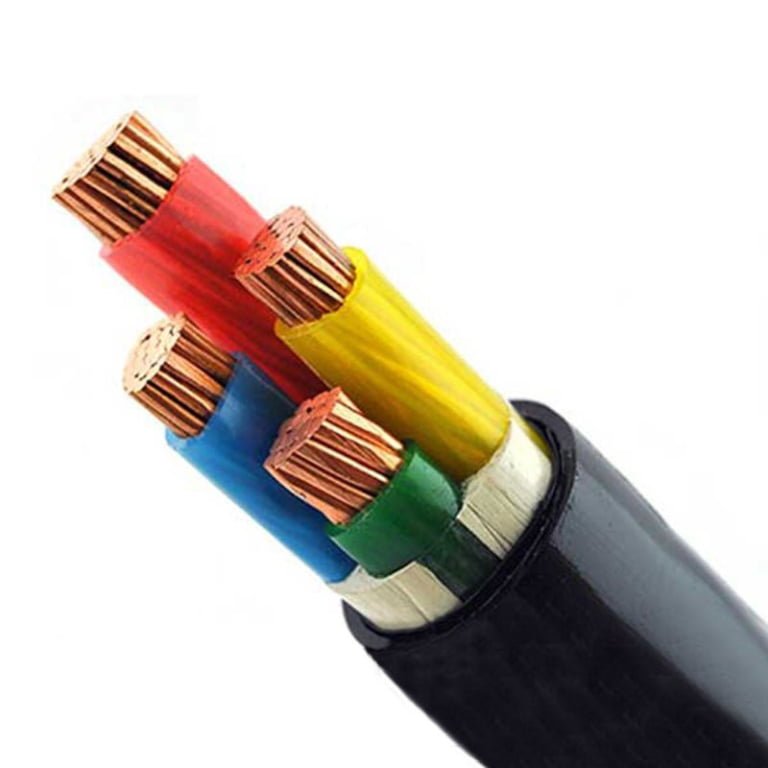
By convention, hot wires are colored black for the most common circuits, with red used as a second hot in 240-volt circuits, three-way switching, or shared neutral situations. Blue and yellow appear in some commercial three-phase wiring. The colored insulation is a courtesy to the next person who opens the box; the wire itself is identical to the others underneath.
In the rest of the world, color conventions differ. Most of Europe uses brown for the live conductor, with black and grey for the additional lives in three-phase systems. If you are working on any wiring, never trust color alone. A non-contact voltage tester or a multimeter confirms what you are about to touch.
The Neutral Wire: The Return Path
For current to flow, it has to make a complete loop. Electricity leaves the panel through the hot conductor, passes through the appliance doing the work, and returns to the panel through the neutral conductor. Without that return path, the circuit is broken and nothing operates.
The neutral wire sits at near-zero potential relative to ground because it is bonded to ground at exactly one point: the main service panel. This single bonding point is critical. It keeps the neutral at a safe voltage during normal operation but allows it to carry the full load current back to the transformer at the street. If neutrals were bonded to ground at multiple points throughout a building, current would flow through the grounding system, which is precisely what the grounding system is designed not to do.
Neutral wires are color-coded white or grey in North America and blue in most of the rest of the world. A neutral is not a safe wire to grab; under load it is carrying the same current as the hot. The voltage to ground is low, but if the neutral is disconnected upstream, the entire downstream length can rise to line voltage.
The Ground Wire: The Safety Path
The ground wire, formally called the equipment grounding conductor, exists only for safety. It carries no current during normal operation. Its job is to be there when something goes wrong: when a hot wire chafes through and touches a metal appliance case, when a worn cord shorts inside an outlet box, when lightning induces a surge that needs somewhere to go.
When a fault sends current onto the metal chassis of an appliance, the ground wire gives that current an easy path back to the panel and ultimately to the earth. Because the ground path has much lower resistance than the path through a human body, the current preferentially flows through the wire. The high current also trips the breaker quickly, cutting power before anyone notices the fault.
Ground conductors are bare copper in NM-B cables, green or green-with-yellow-stripe in conduit installations, and green-yellow internationally. They are bonded to the metal cases of appliances, to outlet boxes, to switch boxes, and ultimately back to the grounding electrode system at the main service: usually a ground rod, a buried water pipe, or both.
The Three Together
A standard 120-volt circuit in North America uses one hot, one neutral, and one ground, for three conductors total. That is why a typical NM-B cable for a kitchen receptacle is labeled “14/2 with ground” or “12/2 with ground”: the “2” refers to the two insulated conductors (hot and neutral), and “with ground” notes the additional bare copper grounding wire.
A 240-volt circuit, such as one feeding an electric dryer or water heater, uses two hots (one black, one red), one neutral, and one ground. The cable is labeled “10/3 with ground” because it has three insulated conductors plus the bare ground. The neutral on a 240-volt circuit only carries the imbalance between the two hots, which is why some pure 240-volt loads (like baseboard heat) do not need a neutral at all.
What Happens If You Confuse Them
Reverse a hot and neutral, and many devices will still appear to work. Lights turn on, motors spin. But the safety switches and protective features built into the device may now be on the wrong side of the load, leaving live components exposed when the device is “off.” Lose the neutral entirely on a multi-wire branch circuit, and the voltage between hot and ground can swing wildly depending on the load. Lose the ground, and the system functions normally until the first fault, which is exactly when you need it most.
This is why electrical inspectors care so deeply about color-coding, proper terminal placement, and grounding continuity. The three wires are not interchangeable, even when they look similar inside an outlet box.
A Note on Two-Wire Cables
Old houses built before the mid-1960s often have only two-wire cables: a hot and a neutral, with no equipment ground. These installations are not inherently dangerous if undisturbed, but they offer no fault path and no place to land a three-prong outlet’s ground pin. Replacing the outlets with GFCI receptacles, which detect fault current by comparing hot and neutral instead of relying on a ground wire, is the common code-compliant fix when full rewiring is not feasible.
The Bottom Line
Three wires, three jobs. Hot brings the power in, neutral takes it back out, and ground stands by to catch anything that goes wrong. The whole modern electrical system depends on keeping those three roles distinct from the panel to the outlet to the appliance.