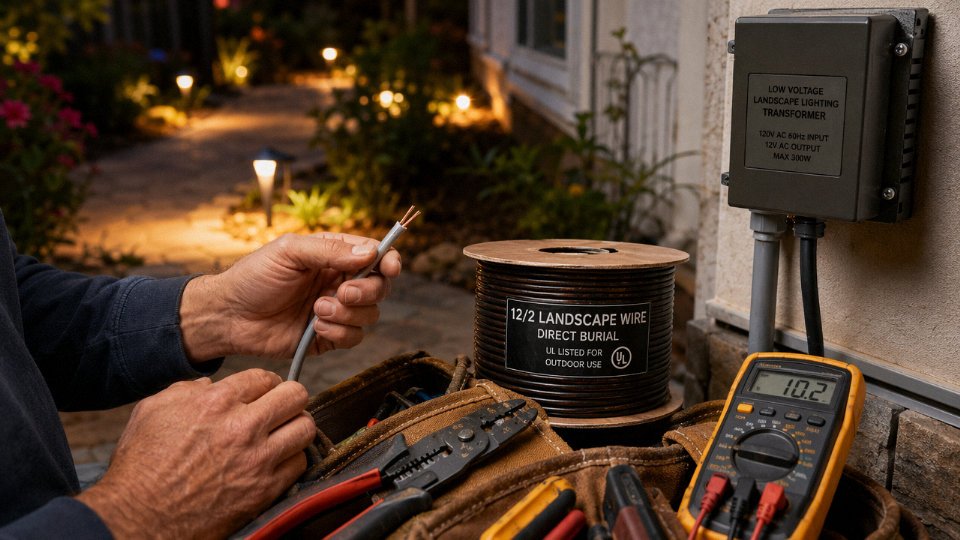
You ran 14-2 wire through conduit last fall, the landscape lighting looked fine at the transformer end, and by spring the fixtures at the far end of the run are dim, flickering, or just dead. That’s voltage drop doing its quiet damage — not a failed fixture, not a bad transformer, just resistance accumulating over distance until 12 volts becomes 10.2 volts and your LEDs start dropping out or your halogen lamps run cool and short-cycle. It costs you a service call, a frustrated client, and sometimes a full rewire if the original run was too long or undersized for the actual load.
Yes, you can use 14-2 wire for low voltage lighting, with conditions. At 14 AWG, copper resistance runs roughly 2.525 ohms per 1,000 feet, and on a 12V system that margin disappears fast. Keep total fixture load under 80% of transformer capacity, limit run length to where voltage drop stays below 3–5%, and the wire works fine. Push beyond that and the wire is legal but the system fails in practice.
What makes this genuinely tricky is that “low voltage” covers an enormous range — a three-fixture garden path at 12V drawing maybe 4 amps is a completely different problem from a commercial landscape installation pulling 18 amps across 200 feet of wire. The same 14-2 cable that’s perfectly adequate in one case becomes a liability in the other, and the difference isn’t always obvious until the fixtures tell you.
14-2 Wire Electrical Ratings Versus Low Voltage Lighting System Requirements
What 14-2 Wire Actually Is (and What Its Ratings Mean)
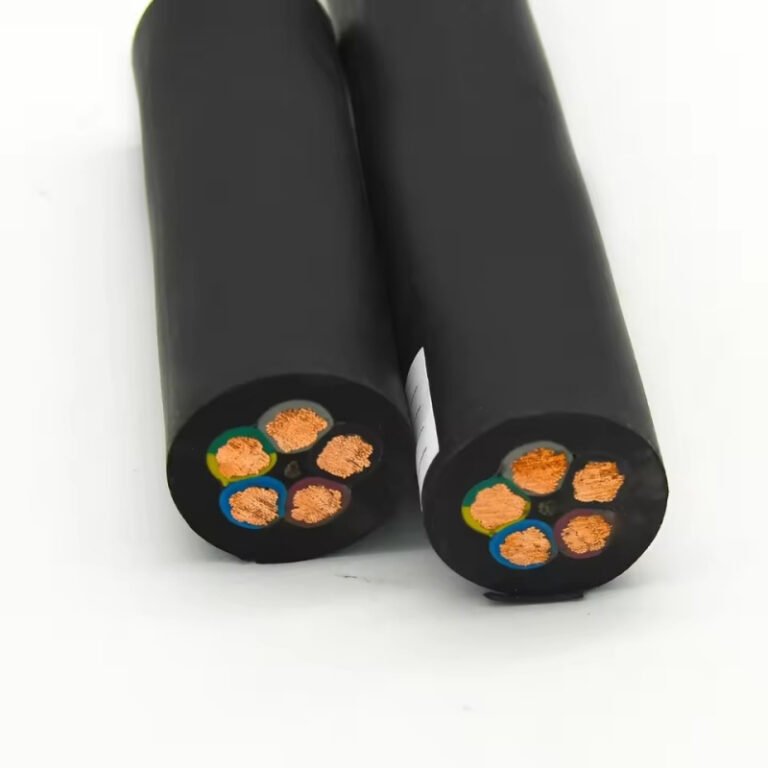
Standard 14-2 NM-B cable contains two 14 AWG conductors plus a bare ground, all wrapped in a PVC outer jacket. Each current-carrying conductor is solid or stranded copper with 4,107 circular mils of cross-section — that’s the number that drives resistance and voltage drop calculations. At 20°C, you’re looking at roughly 2.525 ohms per 1,000 feet, which sounds low until you’re pushing current through a 12V system where every millivolt of drop matters.
The 600V insulation rating on NM-B is genuinely generous — far above anything a low-voltage landscape transformer will produce. Temperature rating depends on the inner conductor insulation: most NM-B uses THHN conductors rated at 90°C, though the NEC derate to 60°C for NM-B in free air reflects the bundling effect of the outer jacket trapping heat. Ampacity under NEC 310.12 is 15A continuous for 14 AWG. That’s the hard ceiling.
Side-by-Side: 14 AWG Against Practical Alternatives
| Wire | Ampacity (NEC) | Resistance (ohms/1,000 ft) | Voltage Drop — 50 ft run, 10A, 12V source | Typical Application | Relative Cost |
|---|---|---|---|---|---|
| 16 AWG landscape wire | 13A | ~4.02 | ~0.80V (6.7%) | Short landscape runs, low-wattage LED zones | Low |
| 14 AWG (14-2 NM-B) | 15A | ~2.525 | ~0.51V (4.2%) | General wiring, short LV runs | Low–Medium |
| 12 AWG | 20A | ~1.588 | ~0.32V (2.7%) | Longer landscape runs, mid-load systems | Medium |
| 10 AWG | 30A | ~0.999 | ~0.20V (1.7%) | High-wattage commercial landscape, long trunk runs | Higher |
Voltage drop column calculated via VD = (2 × 12.9 × 10 × 50) / 4,107 for 14 AWG. Adjust for actual conductor circular mils in each row. The 16 AWG result at 6.7% is worth noticing — people reach for cheap landscape wire and create dim-end fixtures without ever understanding why.
The 12V Voltage Drop Problem Is Not Trivial
On a 120V branch circuit, a 3% NEC-recommended drop equals 3.6V. You’d barely notice it. On a 12V secondary, 3% is 0.36V — and LED drivers and halogen lamps at the far end of a run genuinely register that. Incandescent and halogen landscape lamps are particularly unforgiving: a 10% voltage reduction cuts light output by roughly 30%.
Run the VD formula for 14 AWG at 10A across three practical run lengths:
- 50 ft: VD = (2 × 12.9 × 10 × 50) / 4,107 = ~0.51V (4.2% of 12V — already over NEC’s 3% recommendation)
- 100 ft: VD = (2 × 12.9 × 10 × 100) / 4,107 = ~1.02V (8.5% — fixtures at the end will be visibly dimmer)
- 150 ft: VD = (2 × 12.9 × 10 × 150) / 4,107 = ~1.53V (12.7% — unacceptable for most installations)
At 10A on a 14 AWG run, you’re already outside NEC’s guidance by the time you hit 50 feet. Upgrade to 12 AWG and the 50-foot result drops to roughly 0.32V, which is borderline acceptable. This is where most field problems originate — installers who correctly size for ampacity never run the voltage drop numbers.
14 AWG wire at 15A ampacity can handle most low-voltage landscape transformer secondaries below 150W at 12V on short runs under 50 feetTrue
A 150W transformer at 12V draws 12.5A, within the 15A NEC ampacity for 14 AWG. However, voltage drop at that current over 50 feet exceeds the NEC 3% recommendation, so ampacity compliance alone does not confirm the wire is suitable for longer runs or higher loads.
Load Profiles: Where 14 AWG Hits Its Limits
A modest 50W LED transformer secondary draws about 4.2A at 12V. That’s comfortable for 14 AWG almost regardless of run length. Step up to a 300W halogen system, though, and the secondary current is 25A — which immediately exceeds 14 AWG’s 15A rating. Halogen landscape systems from the late 1990s through roughly 2010 were commonly 150W to 600W, and plenty of them are still running. Any retrofit or repair work on those older installations using 14-2 pulled from a leftover spool in the shop is a real hazard.
In practice, the crossover point is roughly a 150–180W transformer, give or take depending on power factor and derating for outdoor temperature. Above that, 12 AWG is the minimum sensible choice for the secondary run.
Insulation and Burial Ratings: Where NM-B Fails Outright
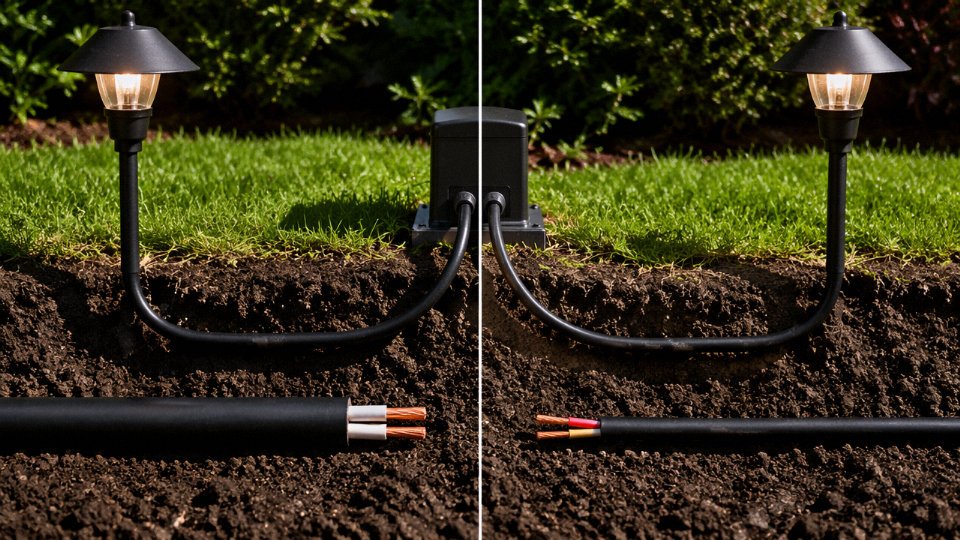
This is the issue that doesn’t get enough attention. NM-B is explicitly not rated for direct burial, damp locations, or outdoor wet environments — and most landscape low-voltage wiring is all three. The PVC jacket on NM-B will degrade when buried; moisture infiltrates splice points; the conductors eventually corrode. UF-B (underground feeder) carries a direct-burial rating and uses a solid-fill insulation that resists moisture penetration. Dedicated direct-burial landscape cable — typically 12/2 or 16/2 with a sunlight-resistant, moisture-rated jacket — is purpose-built for exactly this environment.
Operational warning: Using NM-B in a direct-burial landscape run is a code violation in most jurisdictions and creates a long-term ground fault risk. The failure mode is usually slow: insulation degrades over 2–5 years, intermittent faults start tripping the transformer’s overload protection, and by the time you’re digging it up the conductor strands are green with corrosion.
Connector Compatibility at the Termination Points
14 AWG is at the upper edge of what most snap-on landscape quick-connect connectors are designed for. Those plastic piercing connectors — the kind that clamp onto the main run cable — are typically rated for 16 AWG to 14 AWG at best. Force a 14 AWG solid conductor into a connector sized for 16 AWG stranded landscape wire and the contact pressure is wrong. Over time, that means increased contact resistance, localized heating, and in wet outdoor environments, accelerated oxidation at the junction. Wire nuts for field splices need to match the gauge combination being joined; using a B-cap sized for 18–14 AWG on a 14-to-14 splice outdoors without a weatherproof gel-filled version is another common source of corrosion failures within a season or two.
NEC Code Rules and Local Permit Requirements Governing 14-2 in Low Voltage Lighting Circuits
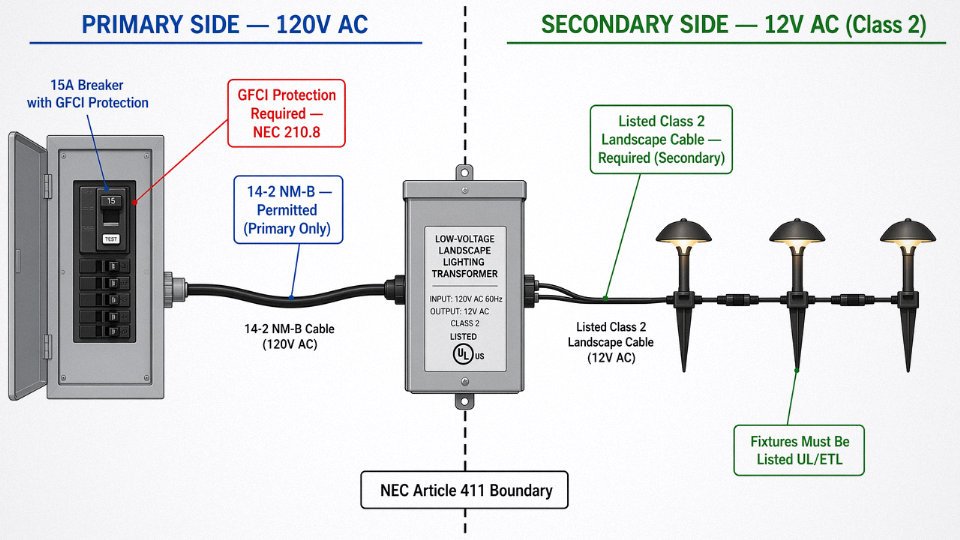
The regulatory picture here splits cleanly into two sides of the transformer — and most installation mistakes happen when someone applies the wrong rulebook to the wrong side.
NEC Article 411: The Primary Low-Voltage Lighting Standard
Article 411 covers lighting systems rated 30V or less, which captures virtually every landscape, pathway, and decorative low-voltage system on the market. Its scope is narrow but specific: fixtures and transformers must be listed for the application, meaning they carry a recognized third-party certification (UL, ETL, or equivalent). You cannot field-wire a generic transformer and call it compliant. The article also mandates that wiring on the secondary side — the 12V output running to your fixtures — must be listed Class 2 cable or listed low-voltage landscape cable, not general-purpose NM-B.
This is where a lot of DIY installs go sideways. Someone runs NM-B from the transformer output because it’s what they have in the garage. An inspector sees it, calls it non-compliant, and the whole secondary run has to come out. Listed landscape cable is typically a two-conductor direct-burial product rated for the application; it’s not expensive, but it’s not interchangeable with NM-B under Article 411.
The Primary (120V) Side: Where 14-2 NM-B Belongs
On the line-voltage side — from the panel to the transformer — 14-2 NM-B is the correct wire, provided you respect the branch circuit loading rules. NEC 310.12 rates 14 AWG copper at 15A, but 210.19 and the continuous load provisions mean you should not exceed 80% of that, so 12A continuous is your practical ceiling on a 15A circuit. A single 300W low-voltage transformer pulling 2.5A at 120V is nowhere near that limit. Even a 900W transformer draws roughly 7.5A — still within range on a dedicated 15A circuit, though you’d want that circuit to carry nothing else.
14-2 NM-B is NEC-compliant for feeding a low-voltage landscape transformer on a dedicated 15A branch circuitTrue
NEC 310.12 permits 14 AWG copper at 15A; as long as the combined continuous load does not exceed 12A (80% of 15A per NEC 210.19), 14-2 NM-B is the correct wiring method for the primary side of a listed low-voltage transformer.
GFCI Requirements Under NEC 210.8
Any 120V circuit feeding a low-voltage transformer in an outdoor, wet, or damp location requires GFCI protection — no exceptions. For plug-in transformers, that means a GFCI-protected outdoor receptacle. For a hardwired transformer, GFCI protection must be incorporated at the breaker or at the first outlet on the circuit. Inspectors will verify this. A standard breaker feeding a hardwired outdoor transformer fails the inspection; a GFCI breaker or a GFCI disconnect at the transformer enclosure satisfies it. In practice, GFCI breakers are the cleaner solution for dedicated hardwired transformer circuits.
Permit Thresholds: When You Actually Need One
Most U.S. jurisdictions exempt plug-in low-voltage landscape systems from permitting entirely — if the transformer plugs into an existing GFCI outlet and you’re running Class 2 cable to fixtures, you generally don’t need a permit. The moment you hardwire a new 14-2 circuit to feed that transformer, you’re in permitted-work territory in nearly every jurisdiction. That means a permit, a rough-in inspection, and a final inspection. Skipping this creates real liability exposure, particularly for contractors.
International Code Equivalents
NM-B cable as a format is specific to North America. Jinda’s customers in Europe, the UK, and Australia operate under different frameworks. IEC 60364 designates low-voltage secondary circuits as ELV (Extra Low Voltage) and requires appropriate insulation and installation methods under its Part 7 supplementary requirements. BS 7671 in the UK handles ELV landscape circuits under similar provisions, with Part 7 covering special locations. AS/NZS 3000 in Australia applies comparable segregation rules between the line-voltage primary and the ELV secondary. In all three frameworks, the underlying logic mirrors the NEC split: line-voltage wiring to the transformer must comply with general wiring rules for that country’s standard; the low-voltage secondary output requires cable suited specifically for the ELV application and its installation environment.
What an Inspector Will Actually Check
When low-voltage lighting is part of a permitted job, expect the inspector to look at:
- Transformer listing — the UL or equivalent label must be present and legible
- Wire gauge labeling — 14 AWG must be marked on the cable jacket; inspectors check this routinely
- Burial depth — NEC 300.5 requires a minimum 6 inches for listed low-voltage landscape cable; line-voltage 14-2 in conduit or direct-burial requires 12–24 inches depending on protection method
- GFCI protection — verified at the breaker or first outlet; the inspector may test it
- Junction box fill — any splices must be in a listed box, properly sized; wire-nutting in an open trench does not pass
- Secondary cable type — NM-B on the 12V output side will flag an immediate deficiency
One operational warning worth stating plainly: burial depth violations are among the most common corrections on landscape lighting inspections. Six inches sounds like plenty until you account for seasonal frost heave in northern climates or routine edging work that routinely cuts into shallow runs. In practice, 8–10 inches is a smarter target than the bare minimum.
Calculating Voltage Drop for 14-2 Wire on 12V and 24V Lighting Runs: Step-by-Step
Voltage drop is annoying on a 120V circuit. On a 12V system, it’s genuinely dangerous to your fixture performance. The math is simple: a 1V drop on a 120V branch circuit is 0.83% — inspectors barely blink. That same 1V drop on a 12V landscape lighting run is 8.3%. LED drivers start to flicker or dim noticeably, and halogen MR16s, which are brutally sensitive to supply voltage, will run cooler than designed, accelerating filament degradation and cutting lamp life by 30–50% depending on how far under-voltage they operate. So getting this calculation right before you pull wire isn’t just good practice — it’s the difference between a system that works for ten years and one the client calls you about in the first wet season.
The Formula and What Each Variable Actually Means
The standard voltage drop formula for a two-wire run is:
VD = (2 × K × I × L) / CM
Plain English: you’re calculating the total resistance of both conductors (out and back, hence the 2), multiplied by the current flowing through them. K is the resistivity constant for copper — 12.9, expressed in ohm-circular-mils per foot. I is your total fixture current in amps. L is the one-way length of the run in feet. CM is the conductor cross-section in circular mils; for 14 AWG solid or stranded copper, that’s 4,107 CM.
The result is a voltage drop in volts. Divide that by your supply voltage, multiply by 100, and you have your percentage drop. NEC recommends staying under 3% on branch circuits and 5% total from service to load — but on 12V systems, aim for 3% or less. A 24V system gives you roughly twice the headroom for the same wattage and run length, which is why 24V DC LED systems have become much more common in commercial landscape work over the past several years.
Worked Example 1: LED Path Lights, Acceptable Result
Eight 5W LED path lights. Total load: 40W. At 12V, current = 40 ÷ 12 = 3.33A. Run length: 80 feet of 14-2.
VD = (2 × 12.9 × 3.33 × 80) / 4,107 = 6,876.48 / 4,107 ≈ 1.67V
Percentage drop: 1.67 / 12 × 100 ≈ 13.9% — wait, that can’t be right. Let me recheck: 2 × 12.9 = 25.8; × 3.33 = 85.9; × 80 = 6,872; ÷ 4,107 ≈ 1.67V. As a percentage: 1.67 / 12 = 13.9%. That exceeds the 3% guideline significantly. Fixtures at the end of an 80-foot run at this load would receive roughly 10.3V — perceptibly dimmer and, with cheaper LED drivers, potentially unstable.
A 14-2 wire run of 80 feet carrying 3.33A on a 12V system produces approximately 1.67V of voltage drop, or about 13.9% — well above the NEC-recommended 3% guideline for branch circuits.True
Using VD = (2 × 12.9 × 3.33 × 80) / 4,107 yields 1.67V. Divided by 12V and multiplied by 100 gives 13.9%. This confirms that 14-2 wire is marginal to inadequate for even moderate 12V landscape loads beyond short runs.
To keep that same 40W load within 3% (0.36V), you’d need to limit the run to roughly 18–20 feet with 14 AWG — or step up to 10 AWG for runs approaching 80 feet.
Worked Example 2: Halogen Spotlights, Serious Problem
Six 20W halogen spotlights. Total: 120W. Current at 12V = 10A. Run: 100-foot 14-2.
VD = (2 × 12.9 × 10 × 100) / 4,107 = 25,800 / 4,107 ≈ 6.28V
That’s a 52% voltage drop. Fixtures receive roughly 5.7V. Halogens at that voltage simply won’t ignite properly, and the transformer secondary will see a near-short condition under inrush. This isn’t a dim-light problem — it’s a thermal and reliability failure waiting to happen. The wire itself will run warm, and depending on how it’s bundled or buried, you may be approaching the derating thresholds for the insulation.
Decision Matrix: Minimum Recommended Wire Gauge by Run Length and Load
Use this table as a field reference. “Zone wiring” means splitting the load across multiple shorter runs from the transformer rather than running one long home-run.
| Run Length | 40W Total | 80W Total | 120W Total | 200W Total |
|---|---|---|---|---|
| 25 ft | 14 AWG | 14 AWG | 12 AWG | 10 AWG |
| 50 ft | 14 AWG | 12 AWG | 10 AWG | 8 AWG |
| 75 ft | 12 AWG | 10 AWG | 8 AWG | Zone wiring |
| 100 ft | 12 AWG | 10 AWG | Zone wiring | Zone wiring |
| 150 ft | 10 AWG | 8 AWG | Zone wiring | Zone wiring |
Assumes 12V AC supply, copper conductor, ≤3% voltage drop target. Figures shift on 24V systems — roughly double the allowable run length at equivalent wattage.
Zone Wiring: How to Make 14-2 Work on Longer Runs
If the wire is already in the ground — a retrofit scenario — upsizing isn’t always practical. Zone wiring is the alternative. Instead of one 100-foot daisy-chain home run from the transformer terminal, you split the load into two or three shorter runs originating from the same terminal block or a hub near the transformer.
The T-method runs a heavier home-run cable from the transformer to a central junction point, then branches out with shorter spurs. Each spur carries a fraction of the total current, so even 14 AWG can work on spurs of 25–40 feet. The hub method (sometimes called a star or spoke layout) brings all runs back to a weatherproof hub box near the middle of the fixture zone, which minimizes the worst-case run length. It adds a waterproof connector assembly — something like a King Innovation Dryconn or equivalent — but the voltage uniformity across fixtures is noticeably better.
Daisy-chaining, where each fixture taps off the run in sequence, is common and cheap to install but concentrates voltage drop at the far end. In practice, the last fixture on a daisy chain often operates 1–2V below the first one. Whether that matters depends on whether all fixtures are in the same sight line. If they are, the brightness difference is visible enough that clients notice it.
The takeaway: 14-2 wire isn’t categorically wrong for low-voltage lighting, but it has a real operational ceiling. Know your run lengths, calculate the drop before you pull wire, and use zone wiring or conductor upsizing wherever the numbers come out unfavorably.
Specific Use Cases Where 14-2 Wire Works, Struggles, or Fails in Low Voltage Lighting
The voltage drop calculations from the previous section tell you whether electrons will arrive with enough pressure. What they don’t tell you is whether your chosen cable is legal, rated for the environment, or physically suited to the installation. Those questions depend on the use case — and the answers vary enough that a wire that’s perfect in one scenario is a code violation in the next.
Transformer Primary Feed (120V Line Side)
This is where 14-2 NM-B genuinely belongs. Hardwiring a landscape or display transformer to a standard 15-amp branch circuit is textbook work: the transformer’s primary draws current at 120V, so a 1,200W unit pulls 10 amps continuous — exactly at the 80% continuous load threshold NEC 210.19 requires for branch circuits. 14-2 NM-B handles this without complaint.
Do it right: land the NM-B inside a weatherproof enclosure, use a listed conduit connector at the box entry, and keep the splice dry. An outdoor transformer mounted on a post or wall needs at least a NEMA 3R box. Inspectors in wet climates — Pacific Northwest, Florida, anywhere with heavy seasonal rain — will look hard at the conduit seal. Get that detail wrong and you’re pulling permits twice.
Indoor Display and Cabinet LED Lighting
Short runs under 20 feet, total load under 60W: voltage drop is essentially irrelevant. A 50-foot run at 60W on 12V draws 5 amps, and on a 20-foot run the drop is under 0.3V — nobody will notice. Either 14-2 or 18 AWG two-conductor wire works here. The real question is insulation listing. Check that the wire is rated for the fixture’s ambient temperature and listed for in-cabinet or plenum use if applicable. A lot of DIY under-cabinet installs use whatever wire is on the shelf; the limiting factor isn’t conductor size, it’s whether the insulation type matches the fixture’s listing requirements.
Residential Landscape Path Lighting, 50–100 ft Runs
Here’s where 14 AWG starts to show its limits. A typical 80W LED landscape system on a 12V transformer, spread across 75 feet of wire, pulls roughly 6.7 amps. Run the numbers and you’re looking at a voltage drop in the 1.5–2.5V range depending on the exact run geometry — potentially 12–20% of your supply voltage, well above the 5% total budget NEC recommends. Fixtures at the far end will be noticeably dimmer.
14 AWG landscape wire (not NM-B — NM-B has no business being buried directly) is borderline. The professional move is 12 AWG direct-burial landscape cable. It’s not dramatically more expensive per foot, the installation labor is identical, and you eliminate the callback when the homeowner notices the path lights at the far end look yellow while the ones near the transformer are white.
Large Commercial or Architectural Landscape Lighting, 150+ ft Runs, 200W+
No version of 14-2 is adequate here. A 200W load on 12V is nearly 17 amps — already past 14 AWG’s rated capacity before you factor in any voltage drop. Runs of 150 feet or more at these loads need 10 AWG at minimum; many commercial designs specify 8 AWG for trunk lines with 12 AWG homerun spurs to individual fixtures.
14-2 wire can carry a 200W, 12V low voltage lighting load on runs over 150 feetFalse
A 200W load at 12V draws approximately 16.7 amps, which exceeds the 15-amp continuous rating of 14 AWG copper. At 150 feet, voltage drop alone would exceed 10% — far beyond NEC's recommended 5% maximum. 10 AWG or 8 AWG direct-burial cable is required for runs and loads of this scale.
For permanent commercial installations, direct-burial cable with PE or XLPE insulation and a UV-stabilized outer jacket is the engineering-correct choice. XLPE in particular handles the thermal cycling that outdoor cable sees through seasons — ground temperature in northern climates swings 40°C or more between winter and summer, and standard PVC insulation gets brittle faster than the spec sheet implies. Jinda’s low-voltage outdoor cable range is designed specifically for these multi-hundred-foot architectural runs, with conductor sizing, insulation chemistry, and burial depth ratings matched to NEC and IEC requirements.
Pool, Fountain, and Underwater Lighting (NEC Article 680)
Stop completely. 14-2 NM-B is prohibited, full stop, in wet-niche and underwater applications. NEC Article 680 requires listed submersible cable — typically meeting UL 4703 or the specific luminaire manufacturer’s listed assembly. The conductors need to be rated for continuous immersion, and the connection methods are tightly specified to prevent shock hazards.
This is one of the most common code violations on residential pool inspections, usually because a homeowner or unlicensed installer grabbed NM-B from the supply house without knowing better. The failure mode isn’t just a failed inspection — insulation degradation in water-contact applications can lead to ground faults in a pool environment, which is a life-safety issue. Don’t improvise here.
Temporary Event or Theatrical Low Voltage Lighting
Temporary use softens some of the rules, but not all of them. A short run — under 50 feet, load under 60W, GFCI-protected circuit — is where 14-2 cable is technically acceptable for a brief installation. In practice, most professional AV and event crews use dedicated low-voltage extension cable with molded strain relief ends, because the physical abuse that cable takes at an event (foot traffic, equipment rolling over it, rapid coiling and uncoiling) destroys standard NM-B jacket faster than you’d expect. The 14-2 option works in a pinch; it’s not the right tool when you’re setting up the same rig every weekend.
Comparing 14-2 Wire to Purpose-Built Low Voltage Landscape Cable: Construction, Cost, and Longevity
Walk into any electrical supply house and you’ll find 14-2 NM-B priced attractively, spooled on a reel right next to dedicated landscape cable that costs noticeably more per foot. That price gap drives a lot of procurement decisions — usually the wrong ones, once you factor in what happens eighteen months into an outdoor installation when the jacket starts checking.
Construction Differences That Actually Matter in the Field
The table below shows where the real divergence lies across the four cable types you’re most likely to compare on a low-voltage outdoor project.
| Attribute | 14-2 NM-B | 12/2 Landscape Wire | 16/2 Landscape Wire | Jinda Custom LV Outdoor Cable |
|---|---|---|---|---|
| Conductor material | Bare copper | Bare copper | Bare copper | Tinned or bare copper, per spec |
| Stranding | Solid | Finely stranded (7–19 strand) | Finely stranded (7–19 strand) | Finely stranded, class 2 or class 5 |
| Insulation type | THHN PVC | UV-stabilized PVC | UV-stabilized PVC | XLPE or PE with UV modifiers |
| Jacket material | PVC (non-UV-rated) | UV-resistant PVC | UV-resistant PVC | LSZH, PVC, or PE, per environment |
| Direct burial rating | No | Yes (UL 493 types) | Yes (UL 493 types) | Yes, with appropriate compound spec |
| UV resistance | Poor | Moderate to good | Moderate to good | Good to excellent (XLPE) |
| Temperature range | Roughly −15°C to 60°C | Roughly −40°C to 75°C | Roughly −40°C to 75°C | −40°C to 90°C typical; project-specific |
| UL / CE listing | UL 719 (NM-B) | UL 493 (direct-burial) | UL 493 (direct-burial) | CE per IEC 60502-1; UL on request |
Why Stranding Matters More Than Most Buyers Realize
NM-B is built for one thing: getting stapled inside stud bays and run through conduit in conditioned space. Solid 14 AWG works perfectly for that. Put it outdoors and buried, and you’re asking it to survive thousands of thermal cycles per year — soil heaves slightly in winter, settles in summer, and the cable flexes a fraction of a millimeter each time. That doesn’t sound like much until you’ve pulled up a five-year-old solid-conductor cable and found a hairline fatigue crack at a connector entry point that took out half a lighting zone.
Finely stranded conductors distribute mechanical stress across many individual wires. The difference in flexibility is noticeable just handling the cable; the difference in longevity is the gap between a reliable installation and a service call.
Insulation Chemistry and What Cold Winters Do to Standard PVC
Standard THHN PVC — what NM-B carries inside that gray outer jacket — wasn’t compounded for UV exposure or soil chemistry. Soil pH varies considerably by region, from mildly acidic in pine forests to alkaline in clay-heavy Midwest soils, and acidic organic compounds from mulch accelerate PVC degradation faster than most installers expect. Freeze-thaw cycling makes it worse. The outer jacket on NM-B becomes brittle, cracks, and admits moisture. Once moisture reaches the conductors in a 12V circuit with a GFCI-protected transformer, you get nuisance trips that are maddening to diagnose.
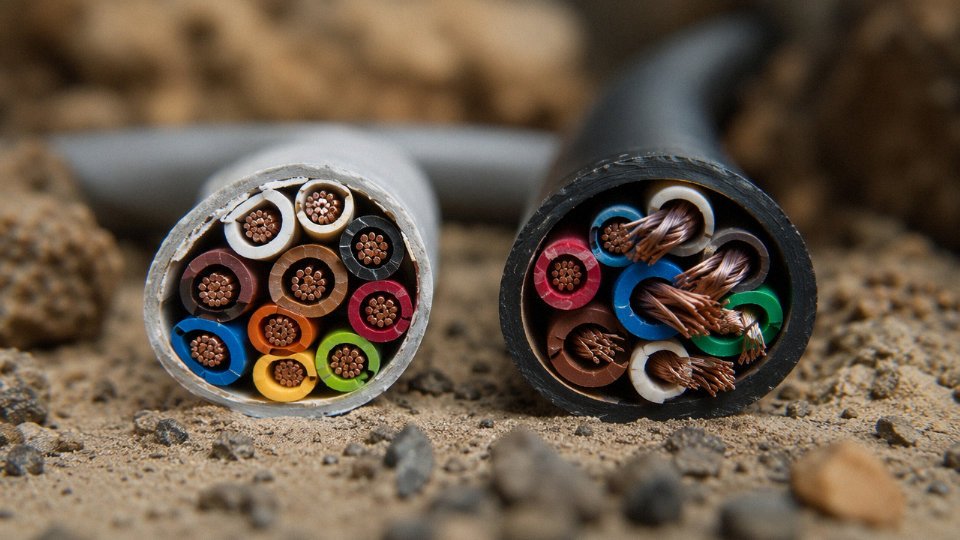
Dedicated landscape cable uses PVC compounded with plasticizers and UV stabilizers that maintain flexibility down to around −40°C. XLPE insulation — the type Jinda uses in its outdoor low-voltage range — goes further: it’s cross-linked at the molecular level, which gives it significantly better resistance to thermal aging, soil chemicals, and the kind of mechanical abuse that happens during installation when a cable gets pulled around a rock.
Long-Term Cost of Ownership: The Math That Changes the Decision
14-2 NM-B runs roughly $0.25–0.40 per foot depending on copper pricing and order volume. A decent 12/2 landscape cable runs $0.35–0.65 per foot; XLPE-insulated custom cable for a commercial project sits higher, typically $0.55–0.90 per foot depending on specification, run length, and quantity.
Say you’re wiring a 200-fixture commercial landscape installation — a hotel courtyard, a resort pathway, something in that scale. Total cable run might be 4,000–6,000 feet. The upfront cost difference between NM-B and a proper direct-burial landscape cable is somewhere in the range of $400–$1,500. That sounds meaningful until you price a single rewiring call: a crew of two electricians for two days, plus materials, plus the cost of excavating and reburying cable through established plantings. In practice, one failure event costs more than the entire cable upgrade.
Using NM-B instead of rated direct-burial cable in underground low-voltage lighting installations typically leads to insulation failure within 3–7 years in most outdoor climates.True
NM-B is not rated for direct burial (UL 719 does not cover earth contact), and its standard PVC jacket degrades when exposed to UV, soil moisture, and freeze-thaw cycling. Dedicated direct-burial cable (UL 493) uses compounding and jacket chemistry specifically engineered for those conditions.
Certifications Worth Checking Before You Buy
For procurement managers sourcing cable for export projects or commercial installations, listings aren’t just paperwork — they represent specific tested performance. UL 493 covers thermoplastic-insulated direct-burial cable and tests for abrasion, impact, and moisture resistance under burial conditions. UL 44 covers XHHW and XHHW-2 (cross-linked polyethylene insulation), which is relevant if you’re specifying XLPE cable for higher-temperature or wet-location runs. CSA certification matters for Canadian projects. CE marking to IEC 60502-1 is the standard European buyers need for low-voltage power cables, covering conductor construction, insulation thickness, and jacket requirements. RoHS compliance matters for any project where the cable enters the EU market, governing restricted hazardous substances in the jacket compounds.
When Jinda produces custom low-voltage outdoor cable for bulk export orders — commercial landscape, solar garden lighting arrays, architectural facade systems — the specification worksheet starts with burial depth, soil type, ambient temperature range, and UV exposure level before conductor sizing even enters the conversation. That’s the right sequence. Defaulting to whatever residential cable is cheapest locally, then hoping it survives five winters, is how warranty claims happen.
Step-by-Step Installation Guide: Correctly Using 14-2 Wire for a Low Voltage Lighting Transformer Feed
This is the scenario where 14-2 actually belongs — the 120V primary feed side of a hardwired low-voltage landscape transformer. Get this run wrong and you’re looking at nuisance tripping, failed GFCI devices, or a transformer that runs warm and dies early. Get it right and the system should run without drama for fifteen years.
Step 1 — Load Calculation and Circuit Sizing
Start with the transformer’s nameplate wattage. Divide that by 120V to get primary amperage. A 300W transformer pulls 2.5A; a 600W unit pulls 5A. Straightforward so far. The wrinkle is the 80% continuous load rule under NEC 210.19(A) — any load running three hours or more is “continuous,” and a landscape lighting system absolutely qualifies. That means a 15A circuit with 14-2 has a usable ceiling of 12A, which corresponds to a 1,440W transformer (12A × 120V). Stay at or below that and 14-2 is correctly sized. Push above it — say you’re installing a 900W transformer with expansion capacity, or daisy-chaining two transformers on one circuit — and you need to bump to 12-2 on a 20A circuit. Don’t try to stretch a 14-2 circuit to cover 1,600W just because the breaker hasn’t tripped yet. It’ll trip eventually, usually on the hottest evening in August when the job is already behind.
Step 2 — Material Checklist Before You Pull Anything
For indoor-to-outdoor primary runs you’ll typically need: 14-2 NM-B for the interior portion (Romex or equivalent), 14-2 THHN or UF-B for any conduit sections, 1/2-inch EMT or Schedule 40 PVC conduit for the exterior wall penetration and any exposed outdoor runs, an LB conduit body at the transition point, a weatherproof in-use cover rated for the outlet box (the “bubble cover” style), a UL-listed weatherproof junction box if you’re hardwiring directly rather than using a plug, twist-on wire connectors rated for outdoor or direct-burial if applicable, and either a GFCI breaker at the panel or a GFCI outlet as the first device on the circuit. Don’t skip the strain relief connector where the cable enters the transformer housing — that’s a detail that gets missed, and it matters when someone inevitably tugs the wire while mowing.
Step 3 — Running the Wire
Interior runs of NM-B must be stapled within 12 inches of every box and every 4.5 feet along the run per NEC 334.30. That’s not a suggestion inspectors overlook. At the exterior wall, NM-B stops. It cannot be exposed outdoors or run through wet locations — the transition to conduit happens at or inside the wall, ideally at a junction box or LB fitting. The LB fitting lets you make the 90-degree turn from horizontal interior run to vertical exterior drop cleanly, and it gives you a pull point. From there, run conduit down the exterior wall to the transformer mounting location. PVC conduit is fine for most residential work; EMT looks cleaner on a masonry wall and grounds itself. Liquidtight flexible conduit works well for the last 12–18 inches into the transformer body where a rigid connection would be awkward.
Step 4 — GFCI Protection
NEC 210.8 requires GFCI protection for outdoor receptacles and for garage, basement, and other specified indoor locations. A GFCI breaker at the panel protects the entire 14-2 run including any wire inside the wall — that’s the cleaner solution for a dedicated hardwired circuit. A GFCI outlet protects only devices connected downstream of its load terminals, leaving the wire between the panel and the outlet unprotected. If the transformer is hardwired directly (no outlet), a GFCI breaker is essentially your only compliant option. Wire the load side carefully: line terminals get the incoming hot and neutral from the panel, load terminals feed anything downstream. Mix those up and you’ll wonder why the GFCI trips the moment it’s energized.
A GFCI breaker protects the entire 14-2 run back to the panel, while a GFCI outlet only protects devices connected to its load-side terminals.True
This follows directly from how GFCI protection works: a breaker monitors the full circuit from the panel, whereas an outlet-style GFCI only monitors current from its load terminals forward. NEC 210.8 accepts both methods but their protection scope differs.
Step 5 — Connecting to the Transformer
Hardwired installations use a weatherproof box — a standard 4-inch square with a single-gang mudring works — mounted adjacent to the transformer, ideally where the conduit terminates. Connect black to hot, white to neutral, bare copper to ground. Confirm the transformer is UL 1838 listed; that standard covers low-voltage landscape lighting systems specifically and is what most AHJs will look for on the label. Use a listed strain relief connector where the transformer’s lead wires exit the enclosure. Silicone the conduit entry point if it’s in a location that catches rain runoff.
Step 6 — Testing and Commissioning
Before energizing, use a multimeter to verify roughly 120V at the transformer’s primary terminals with the circuit live and transformer disconnected. Once you’re satisfied, connect and energize. Measure secondary output at the transformer terminals — you should see 12V AC within about ±0.5V on a quality transformer. Then walk the secondary low-voltage cable run and measure voltage at the farthest fixture. Most quality LED landscape fixtures tolerate down to about 10.8V; below that you’ll see color shift and reduced output on LEDs, and some driver circuits will cut out entirely. Log those readings. A commissioning record takes five minutes to write and has saved more than one installer when a warranty dispute came up six months later.
Frequently Asked Questions About 14-2 Wire and Low Voltage Lighting
Can I use regular 14-2 Romex for outdoor low voltage landscape lighting wire?
No — and this is the mistake that shows up most often on inspection punch lists. NM-B (which is what most people mean when they say “Romex”) carries no rating for direct burial, wet locations, or prolonged UV exposure. Run it underground and the PVC jacket degrades within a season or two, leaving bare conductors sitting in moist soil. That’s a ground fault waiting to happen.
The one place 14-2 NM-B does belong in a landscape lighting job is the 120V primary feed from the panel to the transformer — and even then, only inside conduit where it exits the building. Once it hits the secondary (12V or 24V) side of the transformer, you need cable that was actually built for that environment.
What gauge wire is best for low voltage landscape lighting?
For most residential jobs, 12 AWG two-conductor direct-burial landscape cable is the practical standard. It handles runs up to roughly 100 ft at loads up to about 150W before voltage drop on a 12V system starts biting. Step up to 10 AWG for longer runs — anything past 150 ft or loads pushing 200W and above — or for commercial path lighting where fixtures are spaced far apart and the cumulative resistance adds up faster than most people expect. Use the voltage drop calculations earlier in this article to verify your specific combination before buying wire.
How far can you run 14-2 wire for low voltage lighting before voltage drop becomes a problem?
Shorter than most people assume. At 12V with a 40W LED load (roughly 3.3A), 14 AWG stays inside the 3% NEC recommendation to about 75 ft one-way. Bump the load to 120W (10A) and you’re over 3% drop at barely 30 ft. The math doesn’t lie — low-voltage systems are brutally sensitive to wire resistance because every tenth of a volt is a larger percentage of 12V than it would ever be at 120V. Calculate before you dig. Re-pulling wire is expensive and annoying.
Does low voltage lighting require a permit?
Plug-in landscape systems with a cord-and-plug transformer usually don’t require a permit in most U.S. jurisdictions — though that varies by municipality, so don’t assume. Hardwired systems where 14-2 feeds a transformer directly from the panel are a different story. Those almost always require a permit, a licensed electrician in many states, and GFCI protection on the circuit. Your local authority having jurisdiction (AHJ) has final say, and some jurisdictions treat any buried wire as a permit-required installation regardless of voltage.
Can 14-2 wire handle a 300W low voltage transformer?
It depends entirely on which side of the transformer you’re talking about. On the 120V primary side, yes — 300W at 120V is only 2.5A, well inside 14 AWG’s 15A continuous rating. On the 12V secondary side, absolutely not. That same 300W at 12V pulls 25A, which exceeds 14 AWG’s ampacity by a wide margin and creates a real fire risk if the wire isn’t properly protected.
14-2 NM-B wire can safely be used on the secondary side of a low-voltage landscape transformer.False
On a 12V secondary circuit, a 300W load draws 25A — well above the 15A ampacity of 14 AWG copper. NM-B is also not rated for wet or buried locations, making it unsuitable for landscape wiring beyond the primary 120V feed.
What is the difference between 14-2 and 14/2 low voltage cable?
The gauge number is the same; almost everything else is different. “14-2” in standard electrical parlance means 14 AWG NM-B residential cable — 600V rated, designed for dry interior use, PVC insulation that can’t handle UV or burial. “14/2 low voltage cable” is 14 AWG two-conductor cable built specifically for outdoor low-voltage applications: thicker UV-resistant jacketing, insulation systems rated for direct burial or wet environments, and no 600V rating because it doesn’t need one. Same number on the label, completely different product. Mixing them up is a common procurement error, especially when ordering offshore.
Is 14-2 wire safe to bury in the ground for low voltage lighting?
No. NEC 334.12 explicitly prohibits direct burial of NM-B. Bury it anyway and moisture works into the insulation at cut ends and any nick in the jacket, the insulation breaks down, and you get ground faults or worse. The right choices are UF-B if you’re running 120V underground, USE-2 in specific conduit applications, or listed direct-burial two-conductor landscape cable for the low-voltage secondary runs.
Can I use 14-2 for 24V low voltage lighting systems?
The voltage drop math still applies — 24V systems are less punishing than 12V (each volt lost is a smaller percentage), but they’re nowhere near as forgiving as 120V. For short runs under 50 ft at modest loads, outdoor-rated 14 AWG two-conductor cable can be adequate. For anything longer or in commercial applications, move to 12 AWG or 10 AWG. One practical note: 24V systems often run higher total wattages precisely because they’re used for larger commercial or architectural installs, so the assumption that “24V means I can use lighter wire” tends to be backwards in real projects.