Specify “armored cable” on a purchase order and you will likely get exactly what you need. Write “steel wire armored” on one region’s datasheet and send that same spec to a supplier in a different country, and there is a reasonable chance you get back a quote for something that looks similar but isn’t — different armor geometry, different conductor count, different crush rating. That mismatch costs time at best and a failed installation at worst, especially on underground runs or industrial tray work where pulling the wrong cable means rework that runs into days, not hours.
Armored cable goes by several names depending on region, construction, and application standard. The most common alternatives include SWA (Steel Wire Armored), STA (Steel Tape Armored), MC cable (Metal-Clad), AC cable (Armored Cable, per NEC Article 320), BX cable (an older North American trade name), and ARMOURED cable (British/Commonwealth spelling). The specific name used determines the armor geometry, applicable standard, and mechanical protection rating — so the names are not always interchangeable.
What makes this genuinely complicated is that two cables sold under different names can look nearly identical on a reel but perform very differently under mechanical load, in wet burial, or across a wide temperature swing — and the naming conventions embedded in IEC, NEC, BS, and AS/NZS standards each carry their own structural assumptions. Worth understanding before the next procurement cycle.
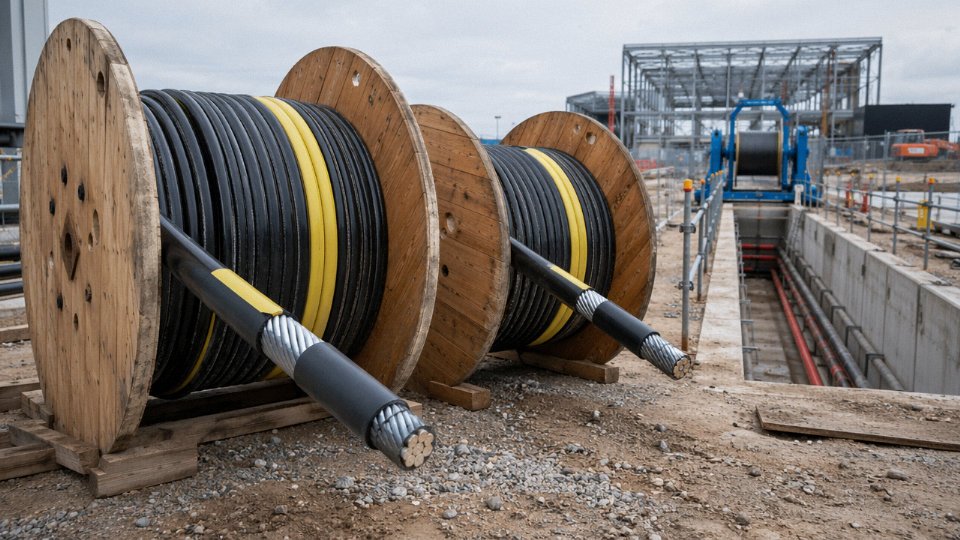
The Complete Glossary: Every Major Alternative Name for Armored Cable Decoded
Every name below describes a cable with some form of mechanical armor — but they are not interchangeable, and specifying the wrong one in a purchase order or installation drawing has real consequences: rejected shipments, failed factory acceptance tests, or cables that simply don’t fit the conduit schedule.
SWA — Steel Wire Armored Cable
This is the big one. “SWA cable” is almost certainly the most searched alternative name for armored cable globally, and for good reason — BS 5467 and BS 6346 (now largely superseded by BS 7846 and BS 5467 revisions) established the construction so thoroughly across the British Commonwealth that an entire generation of electrical engineers learned cable specification through SWA. The armor consists of galvanized steel wires laid helically over the inner sheath, providing crush resistance typically in the range of 450 to 6,000 N/cm depending on wire diameter, number of cores, and which construction standard applies. SWA is dominant in the UK, Middle East, most of Africa, and large portions of South and Southeast Asia. If you’re quoting a substation project in Nigeria, a water treatment plant in Pakistan, or a power distribution upgrade in Malaysia, the engineer on-site almost certainly wants SWA — even if the actual governing standard is IEC 60502.
AWA — Aluminum Wire Armored Cable
Same helical-wire construction as SWA, but the armor wires are aluminum alloy rather than galvanized steel. The reason this exists isn’t just weight saving, though AWA is noticeably lighter for large cables. On single-core cables carrying AC current, a closed loop of magnetic steel armor induces circulating currents that can cause significant heating and energy loss. Aluminum, being non-magnetic, breaks that loop. For single-core cables above roughly 70–95 mm² (the exact threshold depends on current level and installation method), AWA is the technically correct choice, not an optional upgrade. Common in UK and Commonwealth markets, and increasingly specified for offshore and renewable energy projects where weight matters.
STA — Steel Tape Armored Cable
Instead of wires, STA uses two overlapping steel tapes wound around the inner sheath. The radial profile is thinner, the weight is lower, and the cable is easier to bend in tight installations — but the crush resistance is meaningfully lower than SWA. STA is widely used in China under GB/T 12706 and exported extensively under IEC 60502. For indoor runs, cable trays, and light buried applications with adequate mechanical protection elsewhere, STA is perfectly adequate. Put it in rocky trench fill without a concrete cover tile and you’ll be pulling it out within a few years.
STA (Steel Tape Armored) cable provides equivalent crush resistance to SWA (Steel Wire Armored) cable of the same conductor size.False
Steel tape armor offers a thinner, lighter construction but substantially lower crush resistance than helical steel wire armor. SWA is the correct choice where high point-load mechanical protection is required, such as direct buried runs in rocky or trafficked ground.
DSTA (Double Steel Tape Armored) and DSWA (Double Steel Wire Armored) are simply the doubled-layer variants for heavy mechanical duty — commonly specified for direct burial in industrial sites or wherever single-armor construction doesn’t satisfy the project’s mechanical protection category.
MC Cable — Metal-Clad Cable
North American engineers, stop here. MC cable, defined by UL 1569 and NEC Article 330, is not wire armored in the SWA sense. The “armor” is a continuous smooth or corrugated aluminum or steel sheath formed by roll-forming and seaming directly over the conductors and their insulation. There are no individual wires. This matters for termination hardware, for fault current path calculations, and for what fittings the inspector will accept. Specifying SWA on a US project drawing, or quoting MC cable to a UK engineer, will create problems at the procurement stage at minimum and at the panel termination at worst.
AC Cable and BX Cable
Type AC cable (NEC Article 320) is the flexible spiral-steel-interlocked version — the stuff used for final connections to equipment in commercial buildings across North America. “BX” is technically a brand name that originated with General Electric in the early 20th century and became genericized over decades, in the same way “Thermos” became a common noun. On a US job site, an electrician asking for “BX” usually means flexible armored cable for a short whip connection, not a heavy feeder. Don’t mix this up with rigid armored power cable when writing specs.
Armored Power Cable — Spelled-Out Descriptors
“Armoured power cable” (British spelling) and “armored power cable” (American spelling) are simply the full written-out descriptors used in project specifications, datasheets, and technical submittals. They mean the product category, not a specific construction. The spelling difference is a genuine procurement database problem — a search for “armoured” in some systems won’t surface results filed under “armored,” which matters when you’re cross-referencing approved vendor lists or customs documentation. Worth knowing if you manage international procurement.
LSAS — Lead Sheathed Armored Cable
Still appearing in railway signaling, traction power, and older utility specifications, LSAS has a lead sheath applied over the insulation before the armor goes on. The lead provides additional moisture exclusion and some chemical resistance. It’s a legacy construction — you won’t find it in new IEC general-purpose standards — but it shows up in refurbishment specs for infrastructure built before the 1970s and in some niche transit authority standards that haven’t been rewritten since then.
Mining Cable and Trailing Cable with Armor
In extractive industries — underground coal, hard rock mining, quarrying — “mining cable” and “trailing cable” describe armored cables built for repeated flexing, dragging, and exposure to water and abrasion. The armor here is often braided or served rather than rigid tape or wire, because the cable has to move with the machine. This is a fundamentally different product from a rigid armored power cable, even though both carry the “armored” descriptor. Substituting one for the other is an equipment damage scenario, not just a specification note.
How Armor Construction Differences Explain the Naming Divergence
The naming sprawl around armored cable is not random. In most cases, a different name signals a genuinely different physical structure — different layers, different materials, different mechanical behavior. Understanding that linkage is the fastest way to cut through specification confusion and avoid ordering the wrong product.
Wire Armor Versus Tape Armor
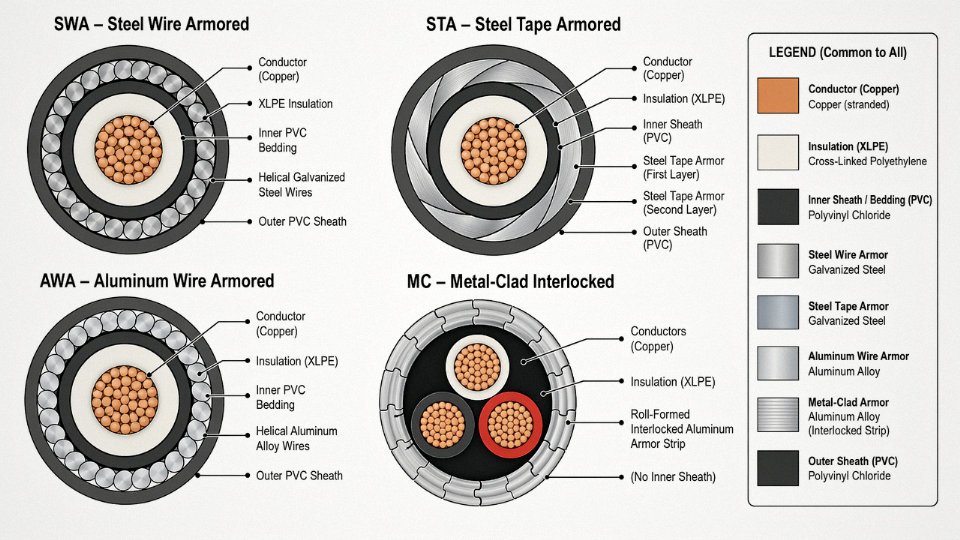
This is the most consequential split in the whole armored cable family. Steel Wire Armored (SWA) and Aluminum Wire Armored (AWA) cables are built with a helical layer of individual wires wound around the cable core. That construction gives you both crush resistance and tensile strength simultaneously — the wires can carry longitudinal load, which is why SWA is the standard choice for direct burial, vertical risers, and submarine runs where the cable has to support its own weight over distance. Crush resistance in these constructions typically runs from roughly 450 N/cm up to around 6,000 N/cm depending on wire gauge, number of wires, and the governing standard; a lightly armored 4 mm² SWA sits at the low end while a large multicore power cable built to BS 5467 sits near the top.
Steel Tape Armored (STA) cable uses one or two overlapping steel tapes wound helically instead. It handles radial crush reasonably well in a duct or conduit, but it has very limited tensile capacity. Pulling a steel tape armored cable through a long conduit run with significant tension is a real mistake — the tape can deform or separate, and the result is mechanical damage that may not be visible until a fault develops. The naming difference (SWA vs. STA) directly reflects this difference in structural capability, which is why treating the two names as interchangeable in a purchase order is a problem.
Interlocked Armor and Continuous Corrugated Sheath
MC cable — Metal Clad cable, governed by UL 1569 and NEC Article 330 in North American markets — introduces a completely different construction logic. The armor is roll-formed aluminum (or steel) strip, either interlocked like a series of S-shaped hooks or formed into a smooth corrugated tube around the cable core. Interlocked armor gives the cable real flexibility, which is why electricians use it in commercial buildings where the cable has to snake through tight spaces and terminations. A continuous corrugated sheath, by contrast, creates an essentially sealed metal tube — it acts as a moisture barrier in a way that interlocked armor does not. This distinction matters in humid industrial environments or food processing plants where condensation is a persistent problem. Neither construction behaves like SWA or STA under tensile load; they are genuinely different products that happen to share the broad category of “armored cable.”
Braid and Spiral Armor
In instrumentation and control applications, you will see catalogs listing “braided armored cable” or “spiral steel wire armored cable.” These are almost always flexible, small-diameter cables where the armor is woven braid or a close-pitched spiral of steel wire — optimized for repeated flexing, not for the kind of crush resistance or tensile strength demanded in power distribution. Confusing a spiral-armored instrument cable with an SWA power cable is unlikely in practice, but the naming overlap causes real search and specification errors when engineers are screening catalogs quickly.
The Inner Sheath Layer: Small Detail, Large Naming Consequence
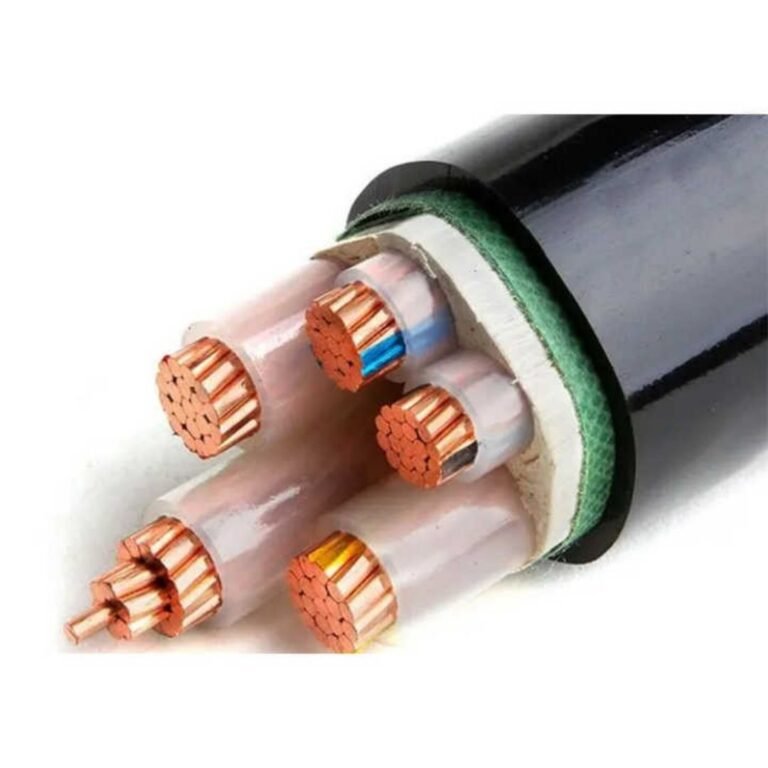
Whether a bedding layer — typically PVC or XLPE — sits between the cable cores and the armor has a direct effect on the official product designation under IEC, BS, and NEC families. IEC 60502 and BS 5467 SWA cables include an inner PVC sheath as standard; that layer protects insulation from the armor wires during installation and affects the current rating calculation. Some simpler armored constructions omit it, and those products carry different type designations. When a customer sends a name Jinda’s engineering team hasn’t encountered before, the first diagnostic step is always to map it to a construction type — identify whether the armor is wire, tape, interlocked strip, corrugated sheath, braid, or spiral, and whether an inner bedding layer is present — before pulling anything from the catalog. Skipping that step and matching on name alone is where wrong-product shipments originate.
Wire armor (SWA/AWA) provides both tensile and crush resistance, while tape armor (STA) provides mainly crush resistance with limited tensile strength.True
This is consistent with construction physics and confirmed in BS 5467 and IEC 60502 product standards. The helical wire layer distributes longitudinal load across multiple wires; tape layers are not designed to carry tensile load and can deform or separate under sustained pull tension.
Regional Standards That Govern Armored Cable Names: IEC, BS, NEC, GB, and Beyond
If you’ve ever received a project specification from a Middle East EPC contractor that references “SWA to IEC 60502-2” and then tried to source an equivalent product from a North American catalog, you already know the problem. The cable exists. The standard exists. But the product name, the armor designation code, and the test requirements don’t map neatly onto each other — and getting that substitution wrong means the wrong cable goes into the ground.
IEC 60502-1 and IEC 60502-2: The International Reference Point
IEC 60502 covers power cables with extruded insulation and their accessories for rated voltages from 1 kV (Part 1) up to 30 kV (Part 2). It’s the closest thing the industry has to a universal backbone. Rather than using trade acronyms, IEC uses construction suffixes embedded in the cable type designation — so armor is indicated structurally within the code rather than branded as “SWA” or “MC.” A steel wire armored XLPE cable under IEC reads something like NA2XSY or 2XFY depending on the national adaption, which confuses buyers accustomed to acronym-based naming.
Most countries adopt IEC 60502 either directly or as the basis for a national derivative. Germany, the Netherlands, much of Southeast Asia, and the Gulf states work from IEC with varying national amendments. China uses IEC as the export reference while running GB/T 12706 domestically. The UK historically ran on BS but is now formally harmonized through CENELEC — though the SWA product name has outlasted the original standard by decades.
BS 6346 and BS 5467: Where “SWA” and “AWA” Got Their Names
British Standards codified the naming conventions that now appear in specifications from Lagos to Kuala Lumpur. BS 6346 covered PVC-insulated SWA cables; BS 5467 covered XLPE-insulated variants. Both have been largely superseded by the harmonized HD series under CENELEC, but here’s the practical reality: procurement specs written in the 1990s and early 2000s still circulate on major infrastructure projects, and site engineers in former British-influenced markets still write “SWA to BS 5467” out of habit even when they mean the IEC-harmonized equivalent. Knowing that the BS lineage is the source of the SWA and AWA terminology — steel wire armored versus aluminum wire armored — prevents unnecessary RFI cycles.
NEC Article 320 and Article 330: The US Framework Is Fundamentally Different
In the US, 'armored cable' in everyday use refers to Type AC (NEC Article 320) or Type MC (NEC Article 330), not SWA.True
The NEC defines installation methods and permitted uses; UL 4 covers Type AC and UL 1569 covers Type MC. SWA as defined under IEC or BS has no direct NEC listing and cannot be installed in the US without separate approval.
This is a genuine substitution trap on international projects. A US-trained engineer reading “armored cable” defaults to Type AC or MC — interlocked aluminum armor, no bedding layer, very different mechanical protection characteristics compared to SWA. Crush resistance on Type MC typically runs well below the 450–6,000 N/cm range you’d see on SWA construction, depending on conduit fill assumptions built into the NEC installation method. If a petrochemical project has both US and UK/IEC specification sections, someone needs to explicitly reconcile these at the procurement stage.
GB/T 12706: China’s National Standard and Its Armor Coding Logic
China’s GB/T 12706 series governs power cables including steel tape armored (STA) and steel wire armored variants. The armor designation is embedded directly in the cable type code: in a designation like ZR-YJV22, the “22” suffix signals steel tape armor with PVC outer sheath. “32” would indicate steel wire armor. This positional coding system is efficient but completely opaque to engineers trained on IEC suffix logic or BS naming conventions.
Jinda manufactures extensively under GB/T 12706 for domestic power infrastructure and grid projects, then adapts construction and test requirements to IEC 60502 for export supply. In practice, the core conductor cross-sections, insulation thicknesses, and armor wire diameters are very close — but the documentation, test reports, and type designations look entirely different, which matters at customs and third-party inspection.
AS/NZS 5000 and Middle East Project Specifications
Australia and New Zealand inherited SWA terminology from British practice; AS/NZS 5000 uses it with local amendments covering conductor temperature ratings and short-circuit performance. Gulf region project specifications from operators like ADCO, Saudi Aramco, or KNPC typically specify SWA to IEC 60502-2 as the baseline but layer on company-specific deviations — particular bedding materials, specific armor wire diameters, or enhanced flame performance requirements that go beyond the base standard. Always read the project data sheets, not just the standard number.
| Standard Body | Document | Armored Cable Designation | Armor Material Options | Typical Voltage Range | Primary Markets |
|---|---|---|---|---|---|
| IEC | 60502-1 / -2 | Construction suffix codes (e.g., -A, type codes) | Steel wire, steel tape, aluminum wire | 1 kV – 30 kV | Global, Middle East, SE Asia |
| BSI / CENELEC | BS 5467, HD series | SWA, AWA | Steel wire, aluminum wire | Up to 33 kV | UK, Africa, SE Asia, Australia |
| NFPA (NEC) / UL | Article 320/330, UL 4, UL 1569 | Type AC, Type MC | Interlocked aluminum, steel | 600 V typical | USA, Canada (CSA adapted) |
| SAC (China) | GB/T 12706 | Numeric suffix (22 = STA, 32 = SWA) | Steel tape, steel wire | 1 kV – 35 kV | China, some export markets |
| Standards Australia | AS/NZS 5000 | SWA | Steel wire, aluminum wire | Up to 33 kV | Australia, New Zealand |
The takeaway for procurement managers: the standard number alone is not sufficient. You need the standard, the armor designation within that standard’s coding system, and the project-specific deviations. A cable that passes IEC 60502-2 is not automatically acceptable on a Saudi Aramco project without checking the SAES specification supplements, and a cable coded correctly under GB/T 12706 needs re-documentation before it ships to a UK-regulated site.
Armored Cable Applications by Industry: Matching the Right Name to the Right Job
The name an engineer uses for armored cable rarely comes from a textbook. It comes from the industry they work in — the standard their site inspector enforces, the failure mode they’ve learned to fear, and the specification their procurement system was built around twenty years ago. Understanding this is genuinely useful, because a purchasing manager who asks for “SWA cable” on a solar farm bid might get exactly the wrong product, and one who specifies “MC cable” for a European tunnel project will confuse every supplier in the room.
Power Distribution and Utilities: Underground and Direct Burial
SWA (Steel Wire Armored) and STA (Steel Tape Armored) are the workhorses here. For direct burial, wire armor is strongly preferred over tape — the helical wire construction handles the tensile load during cable pulling through conduit or open trench far better than tape, which can unzip under sustained pull tension. Rodent resistance matters too, particularly in agricultural or semi-urban installations where cable runs several kilometers between substations.
Burial depth requirements vary by voltage class and local standard, but most international project specifications land in a consistent range: 600–900 mm cover for LV circuits, 900–1,200 mm for MV. Shallower than that and you’re relying on warning tape and luck. In practice, rocky ground and road crossings often require concrete protection slabs regardless of depth, which adds cost engineers sometimes forget when they’re comparing cable-only quotes.
Oil, Gas, and Petrochemical: Where Armor Becomes a Safety Component
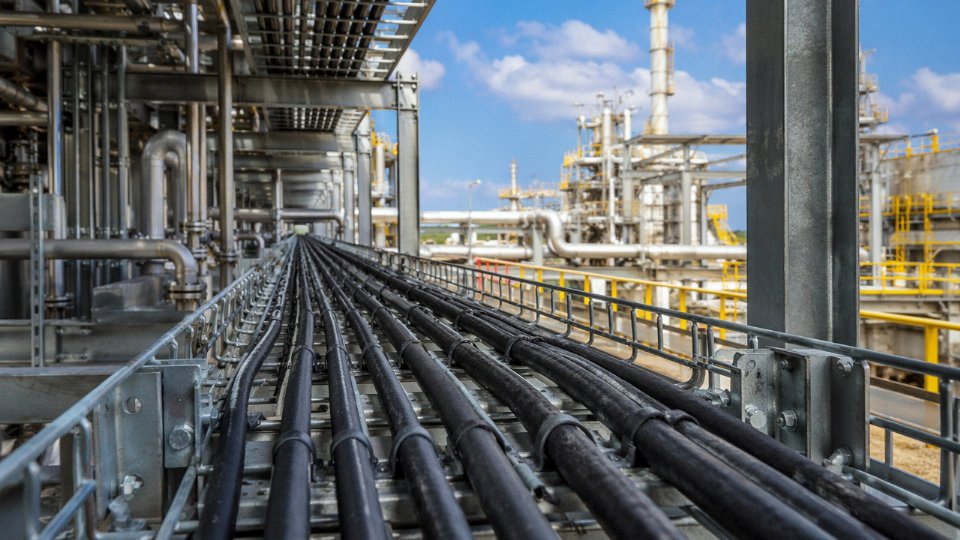
Instrumentation armored cable, control armored cable, OS (overall screened) armored cable — these terms are standard vocabulary on any refinery project. The armor here does double duty: mechanical protection in congested cable trays, and a continuous earthing path that matters acutely in zones classified under IEC 60079. In Zone 1 or Zone 2 areas, a compromised earth path is not a minor defect. It’s a potential ignition source. The armor’s bond resistance and continuity get tested and documented in ways that don’t happen on a standard building site.
In IEC 60079 hazardous areas, the steel wire armor of an armored cable can serve as the protective earth conductor, provided it meets the cross-sectional area and continuity requirements of the applicable installation standard.True
IEC 60079-14 permits the armor to function as the earth path under defined conditions, but this must be verified against armor CSA and the fault current prospective at the installation point — it is not automatic.
Marine and Offshore
The designation shifts to armored marine cable or SWA marine cable to IEC 60092. Vibration, flexing, and salt air create a different failure environment than buried land cable. One frequently overlooked point: aluminum wire armor is effectively ruled out in saltwater-adjacent installations. Galvanic corrosion between aluminum armor and steel glands or copper conductors accelerates in marine environments to a degree that causes armor failure within a few years. Steel wire, properly gland-sealed, is the standard choice.
Mining and Tunneling
Trailing cable, mining flexible armored cable, reeling cable with armor — flexibility is the governing design criterion, not crush resistance alone. A cable that gets coiled and uncoiled on a drum several times per shift will fatigue its armor wires if the construction is too rigid. AS/NZS 2802 and IEC 60702 cover some variants. The armor wire diameter and lay length are tuned for flex life, not just mechanical impact.
Building and Infrastructure
North American projects call these MC cable (Metal-Clad, per NEC Article 330) or, in healthcare facilities, health-care facility cable to NEC 517. European and Asian specifications lean toward fire-resistant armored cable (FRC) or LSOH/LSZH armored cable — armor combined with a low-smoke zero-halogen outer sheath, a combination that matters seriously in data centers, hospitals, and metro stations where evacuation time and smoke toxicity are life-safety issues.
Renewable Energy
Solar DC armored cable and wind turbine torsion-resistant armored cable. The solar variant needs UV-stable outer sheathing and, on utility-scale farms, often a direct-burial rating. Wind turbine cables require torsional flexibility because the cable runs through the tower twist with yaw movement — IEC 62930 and IEC 61400 set the relevant performance benchmarks. Standard SWA construction without torsional design typically fails prematurely in this application. It’s a substitution error that shows up as warranty claims 18–24 months into operation.
Specifying Armored Cable Correctly: A Practical Checklist to Avoid Costly Substitution Errors
Getting the name right is only half the battle. A specification that says “armored cable” and nothing else is essentially an open invitation for a supplier to ship whatever armored product they happen to stock. On international projects especially, that ambiguity gets exploited — not always maliciously, but the result is the same: wrong product on site, delay, and a rework cost that almost always exceeds whatever was saved on the original purchase.
Here is a checklist that closes those gaps before they become site problems.
Step 1 — State the Governing Standard on the First Line
Don’t write “armored cable.” Write “3-core 16 mm² copper conductor steel wire armored cable to IEC 60502-2” or “Type MC cable to UL 1569, installed per NEC Article 330.” The standard does more than define the product — it locks in the test regime, the dimensional tolerances, the minimum armor wire diameter, and the acceptable sheath materials all at once. Two cables that look identical on a cut sheet can differ significantly in crush resistance and fault current capability depending on which standard they’re built to. That one line of specificity eliminates roughly 80% of the substitution risk before any other detail is written.
Step 2 — Define Armor Material, Construction, and Dimensions
Steel wire, aluminum wire, steel tape, and interlocked aluminum armor are not interchangeable. Specify which one, and then go further: state the wire diameter or tape thickness. IEC 60502-2 Table 5 gives minimum armor wire diameters keyed to the cable’s overall diameter before armoring — if you’re buying to that standard, reference the table directly in your spec. A steel wire armored cable on a direct-burial pull with 200 m of route through stony ground will see tensile loading that steel tape simply cannot handle. STA is a radial crush product, not a tensile one. That distinction rarely makes it into a rushed spec, and it’s the source of more field failures than most procurement teams realize.
Step 3 — Voltage Rating, Insulation System, and Temperature Limits
State all three explicitly. PVC insulation at 0.6/1 kV carries a maximum continuous conductor temperature of 70°C and a short-circuit limit of 160°C. XLPE at the same voltage rating runs to 90°C continuous and 250°C under fault. At 3.6/6 kV or above, insulation screen construction and partial discharge test requirements come into play — those need to be called out separately. Specifying XLPE versus PVC isn’t just a thermal preference; it affects current-carrying capacity, cable diameter, bending radius, and long-term performance in wet conditions. A project in a region with ambient soil temperatures above 30°C in summer will see noticeably different ampacity from the same cross-section depending on which insulation system was specified.
Step 4 — Outer Sheath Material and Color
PVC sheath compound matters more than most specs acknowledge. ST2 compound is standard; ST7 offers better oil and UV resistance for industrial environments. LSOH/LSZH is non-negotiable in tunnels, confined plant spaces, or anywhere smoke toxicity is a life-safety concern. Color is also a regulatory issue in several markets — black outer sheath is required or conventional for direct-burial in many countries, while orange sheathing is the accepted norm for photovoltaic and renewable energy feeders in Germany and France. Getting the sheath color wrong on a regulated installation can trigger a failed inspection, which is a far more expensive problem than the cable itself.
Step 5 — Third-Party Certification Requirements
Specify which certification body’s listing or approval is required: BASEC for UK projects built to BS standards, KEMA or CESI for European markets, UL listing for North American installations, SASO for Saudi Arabia, or project-specific third-party witness testing. This is not a formality. A cable that carries the right markings on its outer sheath but lacks traceable test documentation becomes a liability the moment an insurance assessor or building control officer asks for it.
Jinda holds multiple international certifications and can provide third-party test reports along with factory inspection access for projects requiring independent verification.True
Shandong Jinda Special Cable Group holds certifications across several international markets and supports factory audits for large or regulated procurement programs.
Common Substitution Errors Worth Flagging Explicitly
A few errors come up repeatedly enough that they deserve a direct call-out in any spec review:
| Substitution Made | Why It Gets Specified | Actual Risk |
|---|---|---|
| STA in place of SWA on direct-burial pull | Looks similar, often cheaper | Tape armor fails under tensile load; cable damage on installation |
| Aluminum wire armor substituted for steel, three-core cable | Weight saving, cost reduction | If steel armor is the specified earth continuity conductor, aluminum provides lower fault current capacity and creates galvanic risk at terminations |
| Type MC substituted for SWA on a BS/IEC-specified project | Both described loosely as “armored” | Different construction standard, different armor attachment method, different fault protection assumptions — not a like-for-like swap |
The aluminum wire armor substitution is the one that catches engineers most off-guard. In a three-core SWA cable where the armor serves as the circuit protective conductor, the armor’s fault current rating is part of the protection coordination. Switch to aluminum wire armor without rechecking the earth fault loop impedance calculation and you may have a system that trips slower than designed — or doesn’t trip at all within the required time.
Write specifications that are specific enough to leave no room for interpretation. In practice, a well-written cable specification takes fifteen minutes longer to draft and can save days of site delay.
How Jinda Manufactures SWA, STA, and Armored Power Cable Across Five Production Bases
Running five production bases across China isn’t unusual for a large cable group — what matters is how those bases are organized. Jinda’s 470,000 m² of manufacturing floor space is divided by product family rather than simply by geography, which makes a real difference to lead times and quality consistency. High-voltage armored cable (typically 6–35 kV MV product and above) runs on dedicated lines where conductor cross-sections, insulation wall thickness, and armor geometry all require tighter process control and more frequent in-process checks. Low-voltage SWA and STA lines — the 1–4 core, 1.5–240 mm² workhorses that make up the bulk of international orders — run on separate equipment optimized for throughput and fast changeover between core counts. Special-purpose armored cables for mining, marine, and renewable energy installations occupy their own cells; armored trailing cables for underground mining, for instance, require flexible stranded conductors, tougher outer sheaths, and flame-retardant compounds that simply don’t belong on a standard LV line. Export-dedicated lines feed directly into a bonded warehouse zone, which is the practical reason Jinda can offer documented traceability rather than the vague “available on request” response that commodity suppliers tend to give.
Raw Material Control: Where Specification-Grade Cable Diverges from Commodity Product
Copper and aluminum rod is sourced against documented chemical composition certificates — oxygen-free copper rod for conductors above roughly 95 mm² where resistance uniformity matters more, standard ETP rod for smaller sizes. Steel wire for SWA goes through a triple acid bath galvanizing process, and zinc coating weight is verified to IEC 60502 Table 4 requirements before the wire is released to the armoring floor. That sounds routine, but in practice a surprising number of commodity manufacturers skip the incoming coating weight check and rely on the supplier’s certificate alone. A reel of under-galvanized armor wire looks identical on the outside and will fail corrosion resistance testing only months after installation — by which point the cable is already buried.
XLPE compound qualification is another gate that separates serious manufacturers from traders with a nameplate factory. Each compound batch undergoes elongation at break, tensile strength, and hot set testing before it moves to the extrusion line. Acceptable ranges are tied to the specific insulation class; the numbers shift depending on whether the cable is rated 0.6/1 kV or 6/10 kV, so a single blanket acceptance criterion is itself a red flag.
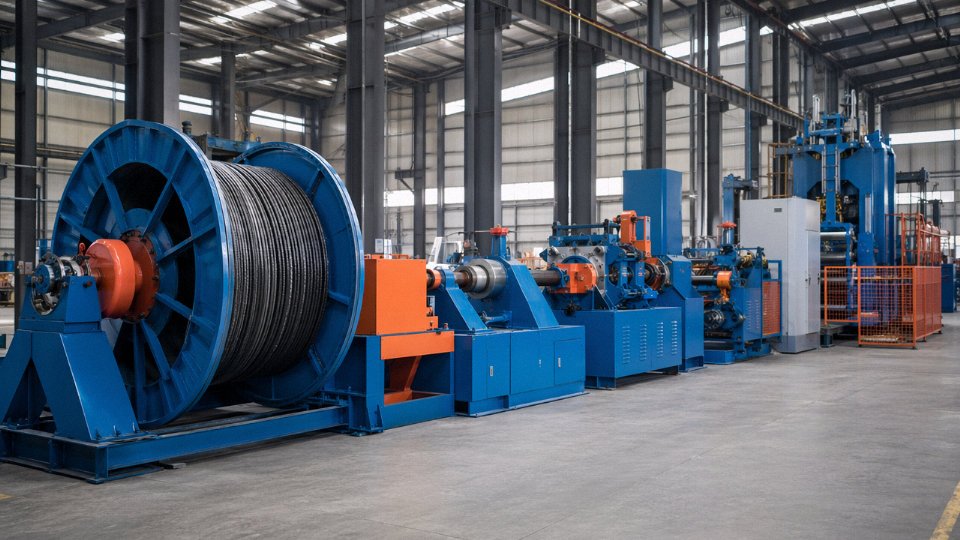
Armor Application: Planetary Wiring and Steel Tape Lines
SWA and AWA armor is applied on planetary wire armoring machines, where laying angle and inter-wire tension are controlled continuously rather than checked at the start of a shift and forgotten. Optical measurement of the completed armor OD happens in-line; if the diameter drifts outside tolerance — usually a sign of inconsistent wire tension — the system flags it before the outer sheath extrusion buries the problem permanently. For STA (steel tape armored) product, tape overlap is held to a defined percentage, typically 15–25% depending on tape width and cable OD, and the annealing status of each tape coil is verified on intake. Under-annealed tape is stiffer and more prone to cracking at bends, which matters significantly for cables that will be pulled through conduit or over cable trays with tight bend radii.
Testing Laboratory
The in-house lab runs conductor resistance per IEC 60228, insulation resistance and high-voltage tests per IEC 60502, armor tensile strength and crush resistance per EN 50395 — SWA crush resistance for standard LV product typically falls in the 450–3,000 N/cm range, depending on wire diameter and core count — and fire performance per IEC 60332-1 and 60332-3. LSOH emission testing follows IEC 60754. Throughput runs to roughly 200-plus type tests annually, which is enough volume that the lab team is genuinely practiced rather than occasionally dusting off equipment for an audit.
Jinda offers third-party witness testing through accredited bodies including BASEC and KEMATrue
Third-party witness testing by BASEC (UK) and KEMA (Netherlands) is a recognized compliance route for international cable supply; manufacturers offering this service must maintain production and testing standards consistent with those agencies' audit requirements, which is a meaningful differentiator from self-certified commodity supply.
Export documentation includes CE marking, REACH and RoHS declarations, and an ERP-linked traceability system that ties every shipped reel to its production batch, raw material certificates, and test records. Customers can request reel-level records up to ten years after shipment — useful when a contractor phases a large infrastructure project across several years and needs to verify that a replacement reel matches the original specification.
Realistic Lead Times
Standard LV SWA cables in common configurations are often available from stock or within 15–25 working days for custom conductor/sheath combinations. MV armored cables at 6–35 kV typically run 30–45 working days from order confirmation, assuming no unusual insulation thickness or shielding requirements. Custom mining or marine armored cables — where the design review process itself takes time — generally land in the 45–60 working day window. Those ranges assume normal raw material availability; like any manufacturer, Jinda’s copper-intensive lines are sensitive to rod supply lead times, and buyers on tight project schedules should discuss stock positions early rather than treating lead time as a fixed promise.
Frequently Asked Questions About Armored Cable Names, Types, and Selection
What is the most common alternative name for armored cable?
SWA — Steel Wire Armored cable — is the term you’ll encounter most often in global procurement, and for good reason: IEC and BS-standard markets stretch across Europe, the Middle East, Africa, and most of Asia-Pacific, which together represent the bulk of international cable volume. In those markets, when an engineer writes “armored cable” on a drawing, they almost certainly mean SWA to BS 5467 or IEC 60502-1. Cross the Atlantic and the dominant term shifts to MC cable (Metal-Clad Cable) under NEC Article 330. The underlying function is the same — mechanical protection for conductors — but the construction details and the test standards diverge enough that you cannot simply swap one for the other on a specification without consequences.
Is BX cable the same as armored cable?
Roughly, but not precisely. BX started as a brand name in early 20th-century North America and stuck so hard it became generic, much like “Hoover” for vacuum cleaners. What BX actually describes is flexible steel interlocked-strip armor — what the NEC now formally calls Type AC under Article 320. The interlocked spiral construction gives it flexibility for threading through tight conduit runs and junction boxes, but it does not provide the same level of crush resistance or longitudinal tensile strength as SWA, which uses continuous helical steel wires laid around the cable core. In practice, using BX/Type AC language on an international project specification will confuse European or Asian suppliers, and vice versa. Be explicit about the armor construction, not the colloquial name.
Can SWA cable be used instead of STA cable?
Not always, and the distinction matters more than most procurement checklists acknowledge. SWA’s individual steel wires handle tensile load well — it is the right choice for direct burial pulls beyond roughly 50 m, vertical risers taller than about 5 m, and any catenary or suspended installation. STA (Steel Tape Armored) is lighter, sits lower in conduit fill calculations, and costs a bit less per meter, but the overlapping steel tape armor is not designed for significant axial tension. Pull STA cable hard on a long horizontal duct run and you risk tape deformation or separation at joints. For most indoor tray or buried conduit installations with short runs, STA performs fine. The decision comes down to installation method and mechanical loading, not simply preference.
What does the ’22’ mean in a Chinese cable code like YJV22?
The GB/T designation system encodes construction in the numeric suffix. The first ‘2’ identifies steel tape armor; the second ‘2’ identifies a PVC outer sheath. So YJV22 is an XLPE-insulated, PVC-sheathed, steel-tape-armored power cable — the Chinese near-equivalent of STA cable to IEC 60502. Understanding this code matters when sourcing from Chinese manufacturers, because a supplier quoting “YJV22” and a European spec calling for “STA to IEC 60502-1” are usually describing the same product family, but confirming the armor tape thickness, overlap percentage, and sheath compound to the actual project standard is still necessary.
YJV22 is the Chinese GB/T equivalent of STA (Steel Tape Armored) cable per IEC 60502-1.True
Both use overlapping steel tape armor over the cable core with a PVC outer sheath; the GB/T designation numerically encodes the armor and sheath type, matching the STA construction described in IEC 60502-1.
Is armored cable the same as shielded cable?
No, and conflating the two is surprisingly common, even among experienced engineers. Armor is an outer mechanical layer — steel wire, steel tape, aluminum wire — that protects the cable from crush loads, rodents, excavation damage, and similar physical threats. Shielding is an inner electromagnetic layer, typically a thin aluminum-polyester foil or a copper braid sitting between the insulation and the outer jacket, designed to suppress EMI ingress or egress. Many industrial cables carry both: the shield handles signal integrity, the armor handles the installation environment. Specifying only one when you need both is a wiring design error that usually only shows up after commissioning, in the form of noisy instrumentation or tripped protective relays.
How do I know if my project needs SWA or MC cable?
Follow the governing standard, not the product catalog. BS or IEC specification, or project location outside North America: specify SWA or AWA (Aluminum Wire Armored). NEC or CEC reference, project in the United States or Canada: specify Type MC or Type AC. On international EPC contracts — particularly oil-and-gas or infrastructure projects that mix European design houses with North American owner standards — this is one of the most reliably recurring substitution errors, and it creates real delays at customs, at third-party inspection, and at final client acceptance. A quick decision table:
| Project Standard | Location | Specify |
|---|---|---|
| BS 5467 / IEC 60502 | Outside North America | SWA or AWA |
| GB/T 12706 | China domestic | YJV22 (STA) or YJV32 (SWA) |
| NEC Article 330 | USA / Canada | Type MC |
| NEC Article 320 | USA / Canada (flexible) | Type AC (BX) |
Does Jinda supply armored cables certified to both IEC and North American standards?
Jinda’s primary export range is built to IEC 60502-1 and IEC 60502-2, with BASEC and KEMA certifications covering SWA and STA constructions across low- and medium-voltage ratings. Those certifications satisfy the majority of international project requirements in Europe, the Middle East, Africa, and Asia-Pacific. For UL-listed Type MC cable intended for NEC-governed projects in the United States, customers should contact Jinda’s technical team directly to confirm current certification scope and whether cross-reference testing documentation is available for the specific cable construction required. Certification status on non-primary export ranges can change, and getting that confirmation in writing before a project’s material approval stage is always worth the email.
Choosing a Reliable Armored Cable Supplier: Evaluation Criteria for Long-Term Global Projects
Procurement for armored cable on infrastructure or EPC projects isn’t a commodity exercise. Get the supplier selection wrong and you’re looking at re-procurement delays, failed FAT, or — worst case — a cable that passes incoming inspection and fails in the field three years later. These criteria come from real project work, not a vendor scorecard template.
Standards Coverage Breadth
A supplier who can produce to IEC 60502, BS 5467, GB/T 12706, and AS/NZS 1cables simultaneously from the same production line eliminates a significant amount of approved vendor list overhead on multi-region projects. In practice, most traders can paper over this gap by sourcing from different factories, but that breaks traceability. Ask for a certified product range matrix — a single document listing every cable construction, voltage class, and cross-section against the specific standard it’s certified to. Cross-reference it against your specification matrix before you shortlist. If the supplier hesitates or sends a marketing brochure instead, that tells you something.
Third-Party Certification Currency
BASEC, KEMA, CESI, SASO — these certificates expire, and they’re construction-specific. A supplier might hold a valid BASEC certificate for 4 mm² SWA at 0.6/1 kV and nothing else. If your project calls for 240 mm² at 6.35/11 kV, that certificate is irrelevant. Always request the certificate itself, read the scope of approval, and check the expiry date. Certificates issued more than three years ago without renewal activity deserve a follow-up question. This is a tedious step that procurement teams often skip under schedule pressure, and it’s exactly where substitution errors creep in.
Jinda holds current third-party certifications covering multiple voltage classes and cross-sections under IEC and regional standards, with documentation available for project-specific review.True
Verifiable through certificate request to the manufacturer; procurement managers should always independently confirm scope and expiry against their specific cable type.
Vertical Integration and Raw Material Traceability
Suppliers who draw their own conductor rod, compound their insulation in-house, and galvanize their own armor wire have a fundamentally shorter non-conformance loop. When a sheath adhesion issue or a tensile failure on armor wire surfaces, they can pull mill certificates, batch records, and process parameters within hours rather than days. Ask for the material traceability flowchart — a real one, not a diagram drawn for the audit. If a supplier sources conductor from one subcontractor, insulation compound from another, and armor wire from a third party without documented incoming inspection criteria, their quality system is only as strong as their weakest supplier relationship.
Factory Inspection Access and Expediting
For orders above roughly 50–100 km of cable (the threshold varies by project risk profile), witnessed factory acceptance testing is not optional. Confirm upfront that the supplier has a formal FAT procedure, calibrated test equipment with current calibration records, and an international project management team capable of coordinating witness testing in English. Technical documentation in the project language matters more than most buyers acknowledge until they’re trying to resolve a query on-site at 11 p.m.
Production Capacity and Financial Stability
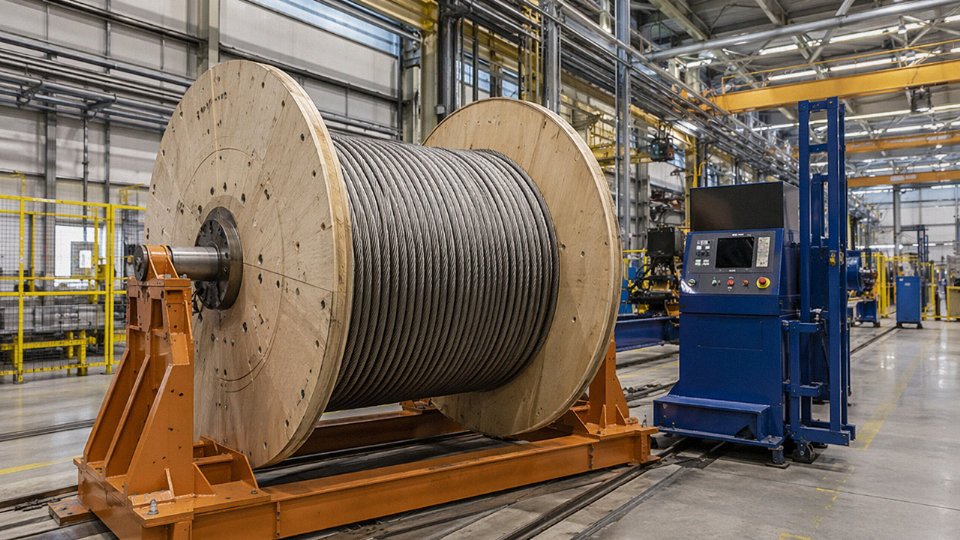
A manufacturing footprint of 470,000 m² across five production bases, with over 1,000 employees, represents the kind of organizational scale that can run parallel large orders without robbing Peter to pay Paul on delivery. Smaller operations — even technically competent ones — can get into trouble when two major EPC clients have coinciding delivery windows. Request audited production capacity data and, specifically, evidence of comparable-volume reference projects. Rough throughput figures are fine; what you’re really probing is whether the supplier has ever actually delivered 2,000+ km of armored cable in a single contract year.
After-Sales and Technical Support
Armored cable failures are slow. Armor corrosion in coastal installations, insulation degradation from sustained overtemperature, mechanical damage from poorly designed cable supports — these show up two, five, sometimes eight years post-installation. A supplier who retains test records, can produce original drum test certificates on request, and will engage seriously in root-cause analysis when a fault occurs is worth a meaningful price premium over a commodity trader who closes the file on shipment. Ask directly: do you have a dedicated after-sales engineering team, and can you provide a recent example of a post-installation technical support case? The answer — and the speed of it — is itself a data point.