You’ve got a cable run to plan, a tight budget, and two viable paths in front of you — armoured cable or conduit with standard singles — and the wrong choice doesn’t just cost money at installation, it costs money every time something fails. A trench dug twice, a conduit system that fills with groundwater over winter, or an armoured cable spec’d into a location where you actually needed pull-and-replace flexibility: any of these scenarios turns a straightforward procurement decision into a maintenance headache that follows a plant for years.
The short answer is yes, conduit can substitute for armoured cable in most fixed installations, but the decision hinges on three practical factors: whether you need future rewiring access, what mechanical abuse the route will face, and total installed cost rather than cable price alone. Armoured cable (SWA or AWA) is generally the right call for direct burial, high-crush environments, and runs where pulling new wire later is impractical. Conduit wins when flexibility, phased upgrades, or regulatory pull-through requirements drive the spec.
What most comparisons skip is the middle ground — the runs where either system technically works, but one of them quietly wins on lifecycle cost, installation time, or code compliance in ways that only become obvious once you start pricing out conduit fittings, calculating fill ratios against IEC 60364, or realising your armour selection is wrong for the soil chemistry on site. That’s where the real decision lives.
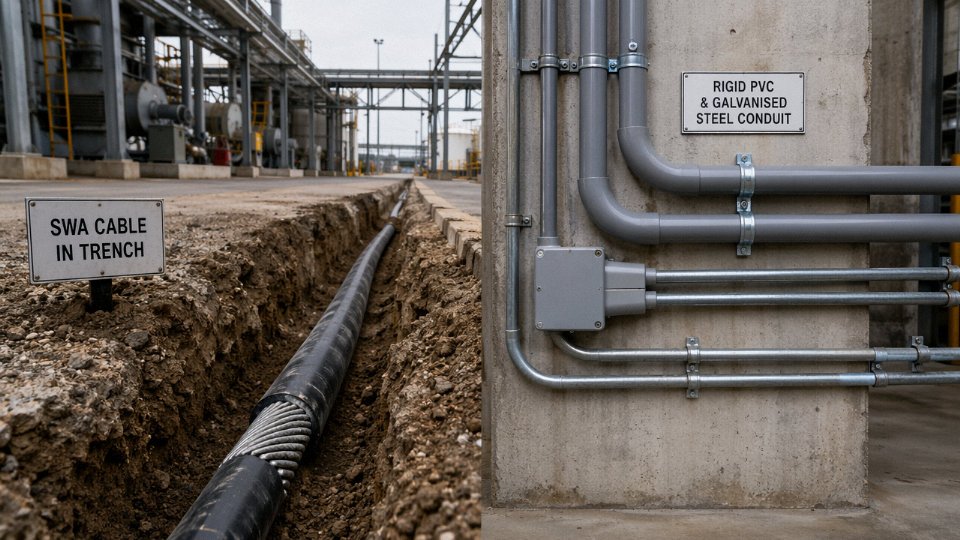
How Each System Actually Protects Conductors: Mechanical, Moisture, and Chemical Resistance Compared
Protection isn’t a single number — it’s a profile. A system that excels against crush loads may fail completely against sustained moisture, and vice versa. Getting this wrong doesn’t just mean a failed inspection; it means a cable fault six months after commissioning, a trench re-excavation, or worse, an arc fault in a wet junction box. Here’s how the two approaches actually compare, hazard by hazard.
Crush and Impact Resistance
Steel wire armour (SWA) tested to IEC 60502-1 achieves crush resistance in the range of 450 N/100 mm for single steel tape armour up to roughly 3,500–4,000 N/100 mm for double steel wire armour on larger cables. The exact value depends on wire diameter, number of wire layers, and overall cable diameter — so always check the manufacturer’s test certificate, not just the catalogue description.
Schedule 40 PVC conduit, by contrast, deforms under point loads of roughly 90–200 N depending on conduit diameter and temperature. That gap is not academic. A loaded forklift axle generates ground contact pressures that can exceed Schedule 40 PVC limits by an order of magnitude, even with modest soil cover. A direct-buried SWA cable under the same forklift passes without damage. This is why most site-specific installation standards for vehicle crossing areas either mandate armoured cable direct burial or require concrete-encased rigid steel conduit — plain PVC conduit with a warning tape is not adequate, regardless of what the cheapest quoted design says.
Rigid steel conduit (RSC / IMC) does close this gap substantially, but wall thickness and joint integrity matter. A poorly supported long run with corroded couplings is not the same beast as a freshly installed system. In practice, rigid steel conduit crush performance depends on how it was installed and how old it is.
Moisture Ingress
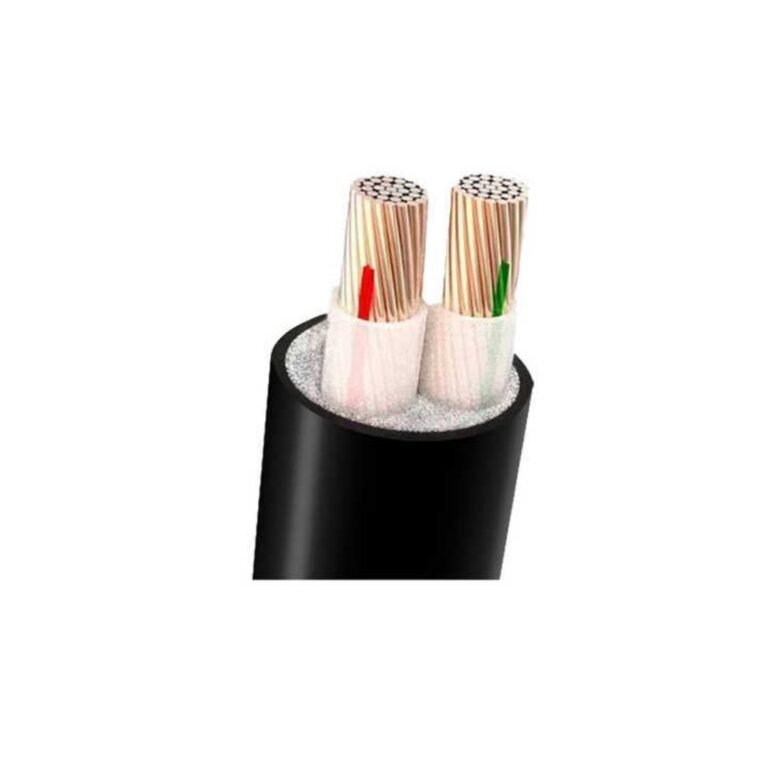
A properly manufactured and terminated SWA cable with an outer PVC or LSZH oversheath achieves IP67 or IP68 as a single, continuous component. That IP rating belongs to the cable itself, not to a system of assembled parts.
Conduit is different in a fundamental way: the moisture protection of the entire run is only as good as its weakest seal. Every conduit entry, every junction box gland, every swept bend with a pull-through access point is a potential ingress site. In humid tropical climates — Southeast Asia, West Africa, coastal industrial sites — “sealed” conduit entries that look fine at commissioning will wick moisture within one or two wet seasons due to thermal cycling and condensation. Sustained submersion protection in a conduit system requires sealed fittings rated for that duty at every single connection point, and that is genuinely difficult to guarantee across a long installation.
Armoured cable with an outer sheath achieves IP67/IP68 as a single component without relying on field-assembled seals at intermediate points.True
IEC 60502-1 and manufacturer type-test certificates confirm that a correctly manufactured and terminated SWA or AWA cable with oversheath achieves IP67/IP68 rating intrinsically. This contrasts with conduit systems where IP rating depends on the quality of every individual seal in the assembled run.
Chemical and UV Resistance
PVC-sheathed SWA handles most common industrial chemicals adequately — the sheath is the primary chemical barrier, and the armour layer sits beneath it rather than exposed. For aggressive environments (hydrocarbon splashing, strong acids, prolonged UV exposure), HDPE-sheathed or LSZH variants are available, and specifying the right outer sheath addresses the chemical hazard in one decision.
Conduit introduces a separate specification problem. You must choose the conduit material — PVC, galvanised steel, stainless — based on the chemical environment, and then separately specify the conductor insulation. PVC conduit degrades under prolonged UV exposure and becomes brittle, which is a real failure mode in above-ground outdoor runs in hot climates. Galvanised steel corrodes in acidic or coastal environments. Stainless solves both problems but at significant cost. The point is that you are now making two separate chemical compatibility decisions rather than one, which doubles the specification burden and doubles the failure modes.
Rodent, Termite, and Mechanical Abuse
This one is underweighted in most European and North American guidance, but it matters enormously for installations across Africa, Southeast Asia, South Asia, and parts of South America. Steel wire armour physically deters rodent and termite attack — not because rodents cannot try, but because the mechanical resistance of the steel wires exceeds what gnawing achieves. PVC conduit does not provide this deterrent. Rodent gnaw-through inside buried PVC conduit is a documented, recurring failure mode in agricultural and mining installations across these regions. The conduit actually concentrates the problem by creating a sheltered tunnel that rodents find attractive.
Protection Profile Comparison
| Hazard | SWA Armoured Cable | PVC Conduit + Unarmoured Cable | Rigid Steel Conduit + Unarmoured Cable |
|---|---|---|---|
| Crush (vehicle/equipment) | High — 450–4,000 N/100 mm per IEC 60502-1 | Low — deforms at 90–200 N; not suitable for vehicle crossing without concrete encasement | Moderate-High — depends on wall thickness, support spacing, and joint integrity |
| Impact (dropped tools, debris) | High — armour distributes impact | Low — wall too thin to redistribute point loads | Moderate — better than PVC, degrades with corrosion |
| Moisture / submersion | IP67/IP68 intrinsic to cable per IEC 60529 | Poor in sustained submersion — relies on every field seal being perfect | Moderate — better sealing options available, but still joint-dependent |
| UV exposure | Stable with UV-stabilised PVC or HDPE sheath | Poor — standard PVC becomes brittle in 3–7 years of direct sun | Good (galvanised or painted); verify coating condition |
| Rodent / termite attack | Good — steel wire armour deters gnawing | Poor — PVC conduit offers no meaningful deterrent | Moderate — steel deters, but thin-wall versions can be breached |
| Chemical resistance | Good — sheath selection covers most environments; single spec decision | Requires separate conduit material and conductor insulation specs | Requires separate evaluation; galvanised steel vulnerable to acids and coastal chlorides |
| Fire spread | Low smoke / low flame spread with LSZH variants per IEC 60332 | Conduit limits spread but unarmoured insulation inside is still the fuel source | Conduit limits spread; conductor insulation rating still governs |
The table makes the core point plainly: no single system wins across all hazards. SWA cable has a strong profile for buried, rodent-prone, or submerged environments. Rigid steel conduit is appropriate for reconfigurable above-ground industrial installations where you genuinely need the ability to pull new conductors. PVC conduit has legitimate uses in dry, protected, indoor environments — using it outdoors in tropical climates or under vehicle traffic areas is the misapplication that generates most of the field failures.
Installation Labour, Bending Radius, and Termination Complexity in Practice
The material cost comparison between conduit and armoured cable is the easy part. What actually determines project budget overruns is the labour — and most estimators undercount it badly on conduit-heavy designs.
Conduit Pulling: The Hidden Crew-Hours
Running conduit is a multi-step process: fix the raceway, pull the conductors, and deal with every bend and junction along the way. Pull tension accumulates fast once you factor in conductor weight, conduit friction coefficient (which varies — wire-pull lubricant helps, but it degrades in heat), and the number of direction changes. On a straight 50 m run, pulling three 6 mm² singles through 32 mm rigid steel conduit is straightforward. Add two 90-degree sweeps and a vertical rise and you’re looking at tensions that can stress conductor insulation at the pull point, particularly on XLPE.
The 40% fill rule under IEC 60364-5-52 (and NEC Article 344/358 for North American projects) isn’t arbitrary. That 32 mm conduit has a usable cross-section of roughly 314 mm², so the 40% limit leaves you about 125 mm² of real working space — enough for three 6 mm² single-cores but not much else once you account for cable lay. Estimators who spec conduit sizes on paper from conductor areas alone, without running the actual fill calculation, regularly end up on site with undersized conduit that has to be partially re-run.
Pull boxes are required every 30–60 m on anything but the most direct routes, and each one is a material item, a labour item, and a schedule dependency. On a 200 m run with two direction changes and a transition from a cable tray to panel entry, you might need three pull boxes. Each takes 45–90 minutes to install and terminate properly. Multiply that across a large industrial building and the conduit system’s apparent labour simplicity disappears.
Armoured Cable: Simpler Route, Harder Handling
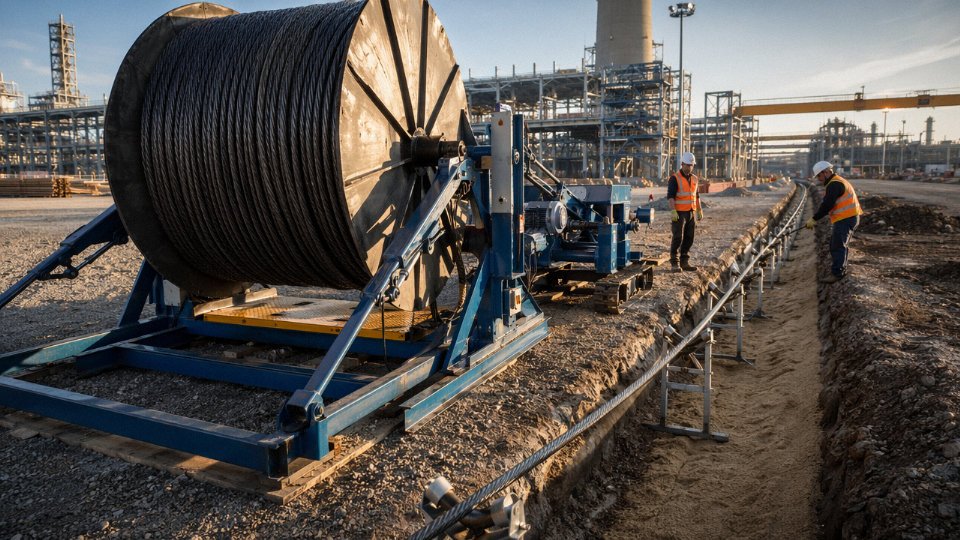
Single-operation laying is the real advantage of SWA/AWA cable — no separate raceway installation, no pulling crew, no fill calculations. The cable goes in on one pass. That said, the cable’s weight changes the logistics in ways that catch out project teams who’ve only worked with lighter building cables.
A 4-core 240 mm² SWA cable runs approximately 8–12 kg per metre depending on conductor material and armour type. A 500 m drum at that weight is between 4 and 6 tonnes. You need drum stands rated for the load, a cable-laying machine or roller sets for longer runs, and on some sites, a crane to position the drum. None of that shows up in a per-metre cable price. Budget it separately or the site foreman will be improvising with forklift forks, which is how armour gets kinked.
Termination: Where Errors Become Expensive
SWA cable terminations require the right gland — A2, B2, or CW type per BS EN 50262, depending on whether the entry is indoor/outdoor, whether you need IP66 or IP68, and the specific cable outer diameter. The compression range of the gland body must match the cable’s actual armour OD within a few millimetres. Use a gland with too wide a compression range and the armour isn’t gripped properly; the earth continuity path is compromised and the IP rating is void. This happens on site regularly, especially when a last-minute cable substitution changes the OD slightly and nobody updates the gland schedule.
Using the wrong gland compression range on SWA cable voids both the mechanical protection rating and the electrical earth continuity provided by the armour.True
BS EN 50262 gland selection is based on the actual armour OD tolerance band. A gland that cannot compress onto the armour wire layer cannot grip it mechanically or establish low-impedance earth contact, defeating both functions the armour is supposed to provide.
Conduit terminations have their own complications — bushings at equipment knockouts, separate bonding jumpers to maintain earth continuity across metallic conduit joints, and locknut torque requirements that are routinely skipped on site. Neither system is zero-effort at the endpoint.
Bending Radius and Routing Constraints
Multicore SWA cable minimum bending radius typically falls between 8 and 12 times the overall cable diameter (check the manufacturer’s datasheet — this varies). For a 50 mm OD cable, that’s 400–600 mm minimum bend. In congested equipment rooms or when transitioning from a horizontal cable tray to a vertical riser, that radius can be genuinely difficult to achieve without planning cable entry positions early in the design.
Rigid steel conduit solves nothing here. Standard elbows come in fixed radii, and field-bending below code minimums without a proper hydraulic conduit bender creates stress concentrations in the raceway and often kinks the pulled conductors later. Both systems constrain routing — just differently, and the constraint shows up at different stages of the project.
Future Modifications: The Decision That Comes Back
One area where conduit has a genuine, practical advantage: future additions. If fill ratio permits, pulling an additional circuit through an existing conduit run is a few hours of work. With armoured cable, adding capacity means running an entirely new cable and re-terminating at both ends. For facilities that expect to add equipment over a 10–15 year operating life — a phased manufacturing expansion, for instance — the conduit system’s flexibility is worth real money, and that should appear explicitly in the project’s whole-life cost model, not just the initial installation budget.
Regulatory Compliance: IEC, NEC, BS 7671, and Regional Standards That Determine Your Choice
Standards don’t just validate your design — they constrain it. On international projects especially, the wrong cable system choice gets flagged at the inspection stage, forcing costly rework that could have been avoided at the specification desk.
IEC 60364: When Mechanical Protection Becomes Mandatory
IEC 60364-5-52 defines wiring system selection based on external influences — the “BD” codes for mechanical stress are the ones that force the conversation. In areas classified BD2 (moderate mechanical risk) or higher, the standard requires either a mechanically protected wiring system or a cable with inherent mechanical protection. Both rigid conduit and SWA satisfy that requirement, but the standard doesn’t stop there. For buried installations, IEC 60364-5-52 Table 52B still calls for a minimum depth — typically 0.5 m in pedestrian areas, 0.6 m or more where vehicles can cross — and a physical warning layer regardless of whether you’ve run SWA or conduit. The armour doesn’t replace burial depth. Neither does the conduit.
IEC 60364-4-43 governs overcurrent protection and is relevant here because conduit fill ratio directly affects the current-carrying capacity correction factors you apply. At 40% fill (the three-or-more-conductors limit under IEC 60364-5-52), cables in conduit run hotter than the same cable in free air, and your protection device settings have to reflect that. Ignore the derating and you’ll get nuisance tripping or, worse, insulation degradation you won’t see until a fault.
BS 7671 and the Commonwealth Footprint
The UK’s 18th Edition wiring regulations are still the working reference across a surprisingly large part of the world — not just the UK, but Gulf Cooperation Council countries, much of sub-Saharan Africa, South and Southeast Asian markets with British infrastructure heritage. Regulation 522.6 requires mechanical protection where cables are at risk of mechanical damage, and it explicitly recognises SWA as satisfying that requirement as a wiring system in its own right (Appendix 4, wiring system reference method B2 and beyond). That recognition matters because it means SWA doesn’t need to be enclosed in conduit to be compliant in most above-ground industrial locations — the armour is the protection.
Conduit installations under BS 7671 carry their own obligations: correct support spacing, appropriate box fill, and — for steel conduit — earthing continuity verified at every joint. In practice, on older UK-influenced sites, you’ll find conduit systems where the earthing continuity has degraded over years of vibration and joint loosening. That’s a real inspection finding, and it’s one SWA largely avoids.
NEC and the MC Cable Confusion
NEC Metal-Clad (MC) cable is equivalent to IEC SWA and can substitute for it on North American projectsFalse
NEC Article 330 MC cable uses interlocked aluminium or steel strip armour, not the helical steel wire construction of IEC SWA. Crush resistance, flexibility, and termination hardware are different. An Asian manufacturer supplying IEC 60502 SWA to a project spec written around NEC MC requirements creates a certification mismatch that can fail inspection.
This distinction trips up procurement teams regularly on LNG and petrochemical projects where the EPC contractor writes a North American spec but sources cable internationally. The fix is straightforward — agree the governing standard at the RFQ stage, not after the cable arrives on site.
GB/T 12706 and Third-Party Test Equivalency
Jinda’s production runs to GB/T 12706, which is substantially harmonised with IEC 60502. The conductor, insulation, and sheath test methods align closely, but “substantially harmonised” is not the same as “identical,” and project specifications for European or Middle Eastern utilities will typically demand IEC 60502 type-test reports from a recognised body. KEMA, SGS, Bureau Veritas, and CESI are the names that satisfy most international project audits. Third-party test reports covering dielectric, crush, and flame-propagation tests — issued against IEC 60502-1 or IEC 60502-2 — are the practical bridge between GB/T production and non-Chinese project specifications.
Hazardous Area Installations: Different Certification Chains
Both conduit and armoured cable are permissible in Zone 1/Zone 2 (IEC 60079-14) and Division 1/Division 2 (NEC Article 501) classified areas, but the compliance path diverges sharply. Conduit systems in hazardous areas require sealing fittings at every boundary where the conduit passes between zones, filled with an approved compound — a step that’s frequently under-specified and sometimes omitted in the field, which is a serious safety failure, not just a paperwork issue. Armoured cable with certified Ex-rated glands avoids the sealing compound requirement at zone boundaries, which is one reason SWA dominates in offshore and chemical plant design. The cable gland, however, must carry its own Ex certification (typically Ex e or Ex d), and the gland-cable combination needs to be tested as a system, not assumed compatible based on individual component ratings.
For procurement managers working across multiple jurisdictions simultaneously — which describes most of Jinda’s international project customers — the practical approach is to build a compliance matrix early: governing electrical standard by country, accepted cable standard, required third-party test body, and hazardous area classification method. A one-page matrix at the start of a project saves significant rework at the far end.
Total Installed Cost Analysis: Material Price Is Only One Line Item
Most procurement decisions get made on cable price per metre. That’s understandable — it’s the easiest number to compare — but it’s also how projects end up over budget or stuck with a system that costs twice as much to maintain over its design life. Getting this right means breaking the total installed cost into five categories and working through each one honestly.
Material Cost: Cable or Conduit
For a 95 mm² 3-core copper SWA cable at 0.6/1 kV, expect indicative supply prices in the range of $28–55 per metre depending on copper spot price, armour type (steel wire vs. aluminium wire), and order volume. An equivalent unarmoured cable — same conductor cross-section, same insulation class — typically runs $18–38 per metre. That gap, roughly 15–40%, looks significant until you account for everything else.
HDPE conduit (typically 110 mm OD for a 95 mm² 3-phase run, with room for a 40% fill ratio as IEC 60364 demands) adds $4–9 per metre for the duct itself. Rigid galvanised steel conduit for the same run can reach $12–22 per metre in material alone, and that’s before fittings.
Fittings and Accessories
This is where conduit systems bleed cost quietly. Every directional change needs a swept elbow or pull box. Seals at building entries, saddle clamps every 600–900 mm, draw-wire, pull lubricant, conduit couplings — it adds up faster than estimators expect. A realistic accessories budget for a 200 m buried conduit run with two direction changes and four building penetrations sits at $600–1,400 depending on the conduit type and sealing specification.
SWA cable fittings are simpler: armoured cable glands (brass or stainless, IP68-rated for buried transitions), an earth tail, a shroud. Budget $25–80 per termination point. For a 200 m feeder with two terminations, that’s negligible compared to the conduit accessories bill.
Labour: Pulling, Terminating, Testing
Armoured cable is a single-trade, single-pass installation. One crew lays and terminates. On a 200 m outdoor buried feeder, that’s roughly 6–12 person-hours for an experienced team, depending on site access and trench conditions.
Conduit systems split into two trades and two mobilisations: conduit laying first, cable pulling second. On constrained industrial sites or phased shutdowns, that can mean two separate access permits, two scaffold or plant setups, sometimes weeks apart. In practice, that scheduling gap is where projects slip. Labour unit rates vary enormously by region, but doubling the access requirement is never free.
Civil Works: Trenching Depth
Unarmoured cable in a suitable conduit can often be buried at 450–500 mm under IEC 60364 and BS 7671 in standard ground conditions. Direct-buried SWA typically requires 600–700 mm or more depending on cable voltage rating and local authority requirements — sometimes 900 mm under trafficked surfaces. Shallower conduit trenching reduces spoil removal and reinstatement cost, which on urban or paved sites can run $30–80 per linear metre. That’s a real advantage for conduit in certain civil environments.
Worked Example: 200 m Outdoor Buried Feeder, 95 mm² Cu, 0.6/1 kV, 3-Phase
Assumptions stated explicitly — copper at roughly $9,200/tonne, mid-range labour at $45/person-hour, two bends, standard soil, two termination points each end:
| Cost Category | SWA Direct Burial | HDPE Conduit + Unarmoured | Rigid Steel Conduit + Unarmoured |
|---|---|---|---|
| Cable / conduit material | $8,200–11,000 | $5,800–9,000 | $8,600–12,800 | |
| Fittings and accessories | $200–400 | $700–1,400 | $1,100–2,200 | |
| Labour (all trades) | $400–700 | $700–1,200 | $900–1,500 | |
| Civil works (trench, backfill) | $7,000–12,000 | $5,500–9,500 | $5,500–9,500 | |
| Indicative total | $15,800–24,100** | **$12,700–21,100 | $16,100–26,000 |
The HDPE conduit option can undercut SWA on total installed cost when civil savings are large — urban paved sites particularly. Rigid steel conduit rarely wins on pure cost; its justification is usually specific mechanical or regulatory requirements above ground.
Maintenance and Failure Cost Over 25 Years
This is the number that rarely appears in tender documents and almost always matters most.
A single water ingress event in a long conduit run is brutal to diagnose and fix. The fault could be anywhere along 200 m of buried duct. TDR (time-domain reflectometry) won’t locate a resistive wet joint in low-voltage conduit with the same precision it gives on a sheathed armoured cable. In practice, you excavate along the run until you find it — budget $3,000–12,000 for fault location and access on a 200 m run, plus lost production.
SWA cable fault location with TDR is faster and more precise than fault location in a buried conduit system carrying unarmoured cableTrue
TDR measures the impedance discontinuity along a continuous sheathed conductor. Unarmoured cable inside conduit lacks the continuous metallic sheath that makes TDR accurate; fault location relies on other methods and often requires physical excavation of the conduit run.
SWA fault location on a continuous armoured run gives TDR distance accuracy within roughly 1–3% of the cable length. A localised repair joint — properly made with a heat-shrink or resin-filled joint kit — typically costs $400–900 in materials and a day’s skilled labour. The excavation footprint is small and targeted.
Over a 25-year design life with realistic fault probability estimates — assume one significant fault event per 15–20 years for buried systems in aggressive soil or areas with ground movement — the conduit system’s maintenance cost exposure is meaningfully higher than SWA, even accounting for its lower initial civil cost in some scenarios.
Where Conduit Genuinely Wins
Intellectual honesty requires saying this clearly: commercial buildings, data centres, and facilities with high technology refresh rates are legitimate conduit territory. If a building’s electrical loads will change every 5–8 years, the ability to pull new cables without civil works has real value. The flexibility premium is earned back on the first rewire. For a fixed industrial feeder that will carry the same load for 25 years, that flexibility is worth nothing — and the SWA option’s total cost case is strong.
Environment-Specific Decision Rules: Underground, Overhead, Industrial Floors, Marine, and Hazardous Areas
The right choice between conduit and armoured cable shifts dramatically depending on where the cable actually lives. A system that’s ideal for direct burial performs poorly in a marine bulkhead penetration. What works on an industrial cable tray may be wrong under a road. Run through your specific environment below before finalising the specification.
Direct Burial — General Industrial and Infrastructure Sites
SWA or STA armoured cable is the default for direct burial in the vast majority of international projects, and for good reason: it arrives on the reel ready to bury without additional protective infrastructure. IEC 60364 generally requires a minimum burial depth of 0.5 m for low-voltage cables in protected areas, increasing to 0.7–1.0 m under agricultural land or areas subject to mechanical disturbance. BS 7671 (the UK wiring regulations) specifies similar depths and requires additional tile or marker tape protection. NEC Article 300.5 sets 600 mm (24 in) for most 0–600 V installations in rigid metal conduit but drops to 450 mm for residential branch circuits — the depth requirement actually changes based on the protection method.
Conduit for direct burial isn’t wrong, but it introduces a failure mode that’s easy to underestimate: water ingress. Any conduit run with an imperfect seal at a joint, especially after years of ground movement, becomes a water channel that pools at low points and wicks along conductors. If future cable replaceability without excavation is a hard project requirement — common on long infrastructure runs, airport taxiway lighting, or campus sites — then HDPE duct with a draw wire is absolutely worth the extra cost. For everything else, armoured cable is simpler and more reliable.
Underground in Concrete Encasement or Under Roads with Heavy Traffic
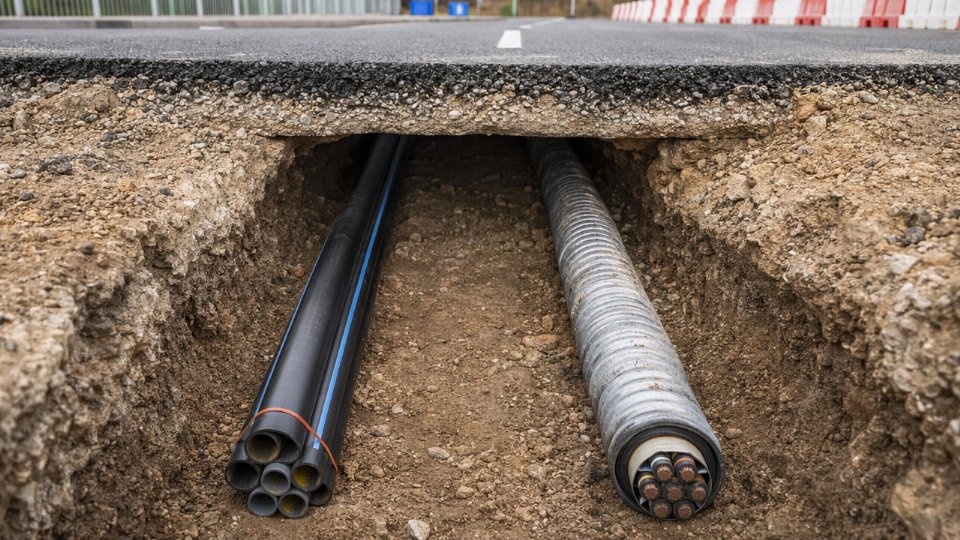
Flip the default here. Under roads, driveways, or any surface subject to regular excavation by third parties (utility crews, paving contractors), rigid conduit or HDPE duct is the correct choice. Armoured cable under a road is a permanent commitment — if an excavator clips it, you’re cutting out and jointing in a live carriageway. A duct system lets you pull a replacement cable without breaking ground. Spare duct capacity is cheap at installation time and expensive to retrofit later.
Armoured cable under roads is always code-compliant without conduitFalse
Several jurisdictions, including some NEC-governed US states and certain EU local authority specifications, require conduit or duct for any cable crossing beneath a paved road surface, regardless of armour type. Always check the local authority or highway authority specification before specifying SWA alone.
Industrial Plant Floors and Cable Trays
Both systems are genuinely viable here, and in practice the decision is often driven by the facility’s existing cable management standard rather than a pure engineering calculation. A plant that has standardised on steel wire armoured cable on ladder trays for the past 20 years is not going to switch to conduit for a single new production line — and they shouldn’t.
That said, conduit in floor trenches or under raised access floors earns its place when you need to consolidate many small circuits into one routed run and expect additions over the facility’s life. Adding a circuit to an existing conduit (within fill ratio limits — remember, 40% maximum usable cross-section for three or more conductors under IEC 60364, which means a 32 mm conduit realistically handles only three 6 mm² single-cores) costs a fraction of pulling a new armoured cable. Armoured cable on open trays wins on neatness, avoids conduit joint maintenance, and is faster to install on long straight runs.
Marine and Offshore
IEC 60092 governs electrical installations on ships, and it is unambiguous: cable penetrations through watertight or fire-rated bulkheads require armoured cable with appropriate sealing arrangements. Unarmoured cable in conduit is used within accommodation modules where installation conditions closely resemble building wiring, but it is the exception, not the rule, on a working vessel.
Subsea cable — whether connecting a platform to shore or linking offshore structures — is invariably armoured, typically with double steel wire armour (DSWA) and a lead or aluminium moisture barrier. Conduit plays no role there. For offshore platforms above the waterline, the humid, salt-laden atmosphere demands cables with at minimum a PVC or polyurethane outer sheath over the armour; standard SWA without an oversheath corrodes faster than most engineers expect in a marine environment.
High Ambient Temperature — Steel Mills, Glass Plants, Furnace Areas
This environment punishes an underspecified conduit system quietly and slowly. PVC-insulated conductors in conduit derate significantly above 30–40°C ambient, and running standard conduit alongside a reheat furnace where ambient air is 60–70°C is a thermal design problem, not just a derating footnote. You need to work through the full IEC 60364-5-52 derating calculation, and in some cases the conduit itself needs to be positioned away from radiant heat sources or actively cooled.
Armoured cable with XLPE insulation rated to 90°C, or silicone-insulated types rated to 150–180°C, handles these environments as a single self-contained product. The specification is cleaner, the derating calculation is more straightforward, and there are fewer points of failure. In my experience, high-temperature industrial zones are where the conduit-versus-armoured-cable comparison most clearly tips toward armoured cable — the thermal engineering alone justifies it.
Earthing, Bonding, and Fault-Current Performance: The Electrical Safety Dimension Often Overlooked
Mechanical protection gets most of the attention in conduit-versus-armoured debates. Earthing rarely does — until an inspection fails or, worse, a fault occurs and the protective conductor path turns out to be compromised. This is worth spending real time on.
SWA Armour as a Combined Protective Conductor
In IEC and BS 7671 installations, the steel wire armour of a correctly terminated SWA cable can legally serve as the circuit protective conductor, eliminating the need for a separate earth core. That’s not a workaround; it’s an explicitly recognised arrangement under BS 7671 Regulation 543.1, provided the armour cross-sectional area satisfies the adiabatic equation: S ≥ √(I²t) / k, where k is the material constant for steel (roughly 46 for steel armour versus 115 for copper). In practice, the armour of a typical 4-core 16 mm² SWA cable is borderline adequate as CPC for circuits up to around 63 A, depending on disconnection time and prospective fault current. Check it per installation — don’t assume.
The commercial benefit is real: a 3-core-plus-earth SWA cable costs noticeably more than the 4-core equivalent used armour-as-CPC. Over a large project with hundreds of cable runs, that difference adds up.
Earth Fault Loop Impedance Over Long Runs
Here’s where armour-as-CPC silently fails on longer installations. Steel wire armour has a resistance roughly 8–12 times higher per unit length than an equivalent cross-section copper conductor, depending on wire diameter and lay. For a 16 mm² 4-core SWA with armour resistance around 3.0–3.5 mΩ/m (both outward and return path combined with the phase conductor), the maximum run length before Zs exceeds the limit for a 63 A Type B MCB at 230 V — where Zs must not exceed roughly 0.73 Ω — lands somewhere in the range of 80–120 m, depending on cable temperature and source impedance. For a 32 A Type B MCB the limit is more generous, around 1.44 Ω, extending usable armour-as-CPC length to perhaps 180–220 m. These are estimates; calculate for your actual supply Ze.
Beyond those lengths, you either install a supplementary copper earth conductor run alongside or inside the SWA, upsize the cable to reduce conductor resistance, or switch to a 5-core SWA with a dedicated copper CPC. Specifying engineers on large industrial sites often discover this only at the Zs testing stage. That’s an expensive time to find it.
Steel wire armour in an SWA cable can serve as the circuit protective conductor under BS 7671 without a separate earth wireTrue
BS 7671 Regulation 543.1 and the adiabatic equation permit this, provided the armour cross-sectional area is adequate for the prospective fault current and disconnection time of the protective device.
Metallic Conduit as CPC — The Maintenance Liability
Rigid steel conduit can serve as a CPC under both IEC 60364 and NEC Article 250. The theory is sound. The practice is messier. Every coupling, locknut, and junction box connection in the run must maintain electrical continuity. One corroded coupling — fairly common in damp plant environments after five or ten years — breaks the earth path silently. There’s no obvious visible sign, and the circuit keeps functioning normally until a fault occurs.
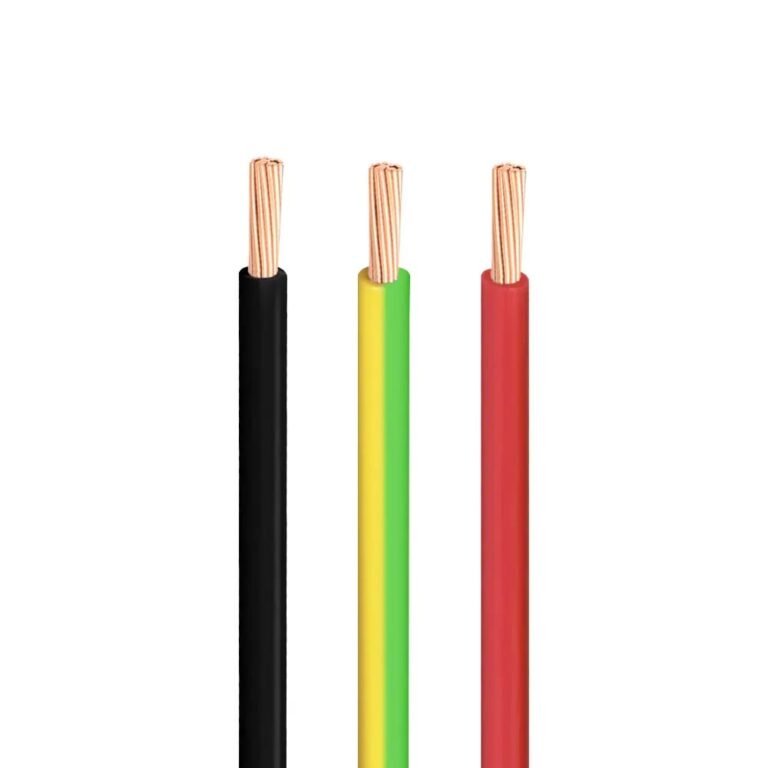
Most modern installations running metallic conduit now pull a dedicated green-yellow earth conductor inside regardless, precisely to avoid depending on mechanical joint integrity. In my experience, any site that has gone through a serious fault investigation once tends to adopt that approach afterwards. The conduit bonding is kept as supplementary; the copper wire does the real work.
Single-Core Cables, Steel Conduit, and Induced Voltage
This one catches people out more than it should. If you run single-core AC cables with one phase per separate steel conduit run — common when pulling large cross-sections — the conduit becomes a shorted single-turn transformer secondary. The result is eddy-current heating in the steel, measurable energy loss, and induced voltages on the conduit surface. IEC 60364-5-52 and NEC 300.20 both prohibit this arrangement for AC circuits. All conductors of a circuit must be in the same conduit, or in a non-magnetic conduit such as HDPE, or enclosed together in a multicore cable.
Multicore SWA avoids the problem entirely — all phase conductors sit within the same armour, so the net magnetic flux through the armour is close to zero under balanced load.
EMC and Screening: A Common Misconception
SWA is not an EMC screen. The armour wires have gaps in coverage, and the armour is typically not bonded at both ends in a controlled manner for screening purposes. For instrumentation loops, thermocouple circuits, or any signal cable where you need genuine electromagnetic shielding, you need either a foil-and-braid screened instrumentation cable — run in conduit if mechanical protection is also needed — or a purpose-built screened armoured cable that combines both functions. Jinda’s instrumentation armoured cable range, for example, incorporates an inner foil screen plus SWA, addressing both requirements in one construction.
Substituting plain SWA for screened cable on a 4–20 mA loop in a VFD-heavy plant and then troubleshooting the interference issues is a painful lesson. The cable cost difference is minor compared to the commissioning time lost.
Selecting the Right Armoured Cable Construction for Your Specific Application
Once you’ve confirmed that armoured cable is the right system for your site, the next question — and frankly the one where most spec errors happen — is which armoured cable. The generic term “SWA cable” covers a family of constructions with meaningfully different mechanical, electrical, and fire-performance characteristics. Getting this wrong rarely causes an immediate failure; it causes a problem two years later, or at the FAT, or when an insurer’s loss adjuster shows up after a fire.
Armour Type: Match the Mechanical Environment, Not Just the Price List
Steel wire armour (SWA) is the workhorse. Direct burial, multicore LV power distribution, general industrial runs — SWA handles the full range of crush loads you encounter in most plant and infrastructure projects, and its galvanised steel wires provide a robust earth path. For most projects below 33 kV running three-core or four-core cables, SWA is the default unless something about the site says otherwise.
That “something otherwise” is usually weight or induction. Aluminium wire armour (AWA) runs roughly 30–45% lighter than equivalent SWA, which matters on long vertical risers in tall buildings or on overhead self-supporting runs where cumulative cable weight stresses cleats and trays. There’s a second reason to choose AWA that’s easy to miss: on single-core cables carrying significant AC current, a closed magnetic loop of steel armour wires generates eddy-current heating losses that can reduce effective current-carrying capacity by 10–20% depending on conductor size and load. AWA breaks that loop. If your project involves single-core 95 mm² or larger LV feeders — common on main distribution boards in commercial or industrial buildings — AWA or a suitable non-magnetic alternative is not optional, it’s a thermal necessity.
Steel tape armour (STA) suits lighter-duty indoor tray or duct installations where the cable won’t see direct burial crush loads or sustained mechanical abuse. It’s less flexible than wire armour, so long runs with multiple bends become a real installation headache. Use it where it fits; don’t force it into an underground trench.
For submarine or very high crush-load environments — river crossings, mine shafts, heavily trafficked industrial floors — double steel wire armour (DSWA) provides layered crush resistance that single-layer constructions simply can’t match. The cost premium is real, typically 25–50% over standard SWA depending on conductor size, but so is the consequence of armour failure under 10+ metres of water or under repeated forklift loading.
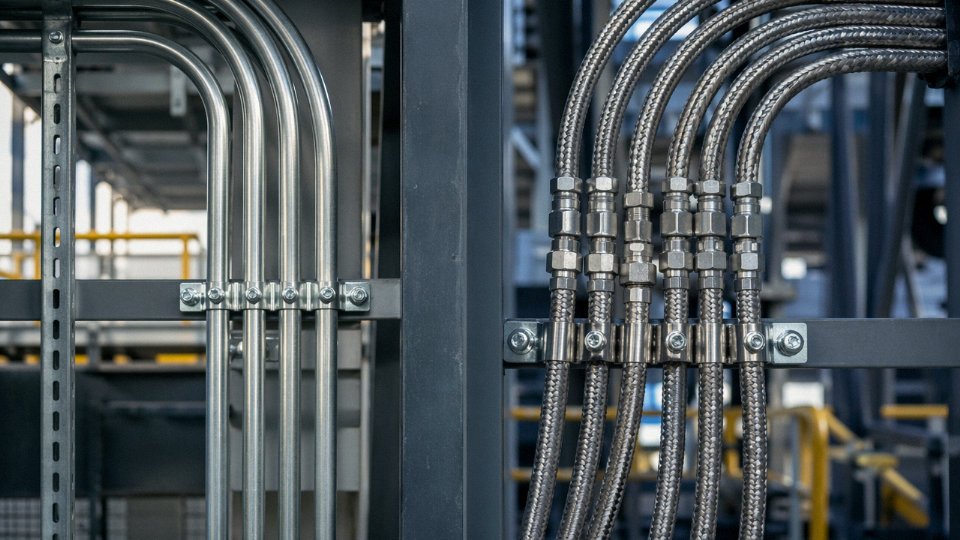
Conductor Material: The Aluminium Termination Problem Nobody Talks About Enough
Copper conductors terminate easily, tolerate a wider range of compression lugs, and are forgiving of less-than-perfect jointing practice. Aluminium conductors are 60–70% lighter and cost significantly less per ampere-metre at large cross-sections — at 185 mm² and above, the economics of aluminium become difficult to argue against for power distribution runs.
The catch is that aluminium oxidises rapidly on a freshly cut surface, and aluminium oxide is a high-resistance semiconductor. Site teams that don’t apply anti-oxidant compound during termination and that use ferrules rated for copper will get a joint that passes initial continuity testing and fails under load heating six months later. This isn’t a material problem; it’s a training and procedure problem. Specify anti-oxidant compound and aluminium-rated compression ferrules in your installation spec, not as an afterthought.
Aluminium armoured cable requires anti-oxidant jointing compound and aluminium-rated ferrules to prevent high-resistance terminations under thermal cycling.True
Aluminium oxide forms rapidly on cut surfaces and has significantly higher resistivity than aluminium metal; without anti-oxidant compound and correct ferrules, termination resistance increases under repeated thermal cycling, leading to hotspots and potential joint failure.
Insulation and Sheath Selection: XLPE vs. PVC vs. EPR
PVC insulation remains cost-effective and perfectly adequate for standard LV applications in benign indoor environments. Its limitation is the 70°C conductor temperature rating, which directly limits current-carrying capacity — on a circuit where you’re right at the boundary between cable sizes, upgrading to XLPE buys you a 90°C rating and meaningfully better short-circuit withstand without changing the cable’s physical diameter.
XLPE is now the default for most MV cables and for modern LV installations where short-circuit current capacity matters. EPR (ethylene propylene rubber) offers exceptional flexibility at low temperatures and outstanding performance in wet or offshore environments — it’s the standard choice for mining trailing cables, offshore platform feeders, and anything that needs to remain pliable at -40°C. It costs more than XLPE; use it where the environment justifies it.
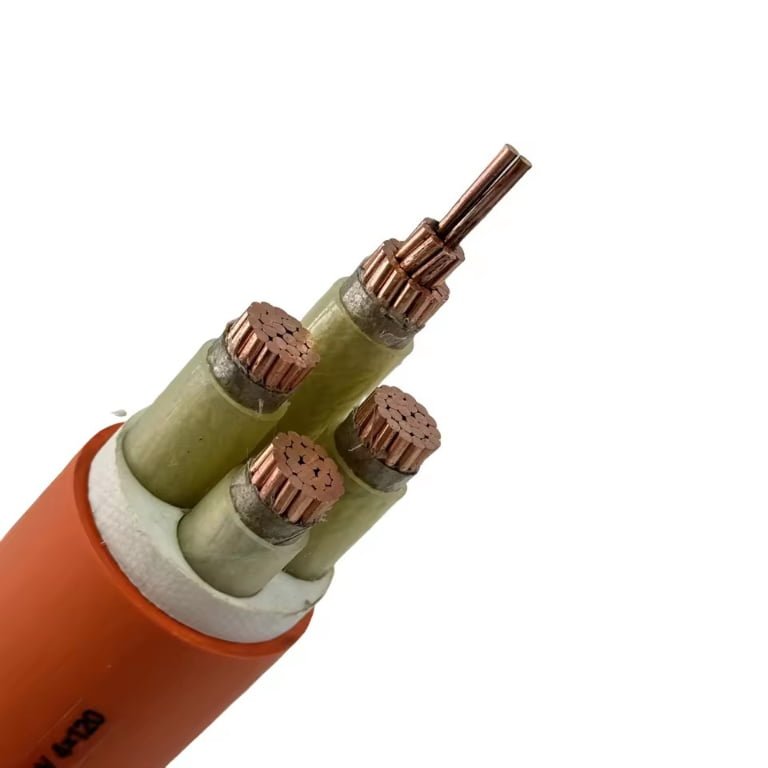
Inner sheath material deserves attention in buildings and tunnels. Standard PVC inner sheath emits dense black smoke and hydrogen chloride when it burns. For cable routes passing through occupied buildings, data centres, tunnels, or any space where smoke toxicity matters, specify LSF or LSZH (low-smoke, halogen-free) compound for both inner and outer sheaths. Jinda’s WDZA-YJY series addresses exactly this — armoured, XLPE-insulated, LSZH-sheathed cables for projects where smoke performance is a contract or regulatory requirement.
Outer sheath colour follows local convention and affects nothing electrical, but getting it wrong on an international project wastes time at customs. Black is common in IEC markets; grey appears frequently in European installations; orange signals underground or high-voltage designation in several markets. Confirm the local convention in the project spec before manufacturing.
Voltage Class: Don’t Over-Specify Short LV Circuits
Voltage class governs insulation wall thickness, which drives cable diameter and cost. A 0.6/1 kV cable is correct for virtually all LV distribution below 1,000 V. Stepping up to 3.6/6 kV for a 415 V feeder because it “gives more margin” adds cost — typically 15–30% on insulation alone at equivalent cross-section — without any real safety benefit on a properly designed LV system. Reserve MV voltage classes (3.6/6 kV through 8.7/15 kV and beyond) for actual MV circuits. Obvious in principle; less obvious when a procurement manager is standardising on a single cable type across a mixed-voltage site.
Fire Performance: The Compliance Detail That Becomes a Liability
Standard SWA cable will propagate flame along a cable tray. That is not a defect — it’s simply what an unmodified PVC or XLPE sheathed cable does, and for outdoor, underground, or isolated industrial runs it’s irrelevant. The moment a cable route passes through a fire compartment wall, a stairwell, or a protected escape route, the specification must change.
IEC 60332-3 flame-retardant cables resist propagation when tested in bundled vertical installation. IEC 60331 fire-resistant cables maintain circuit integrity at 750°C or 950°C for a defined duration — relevant on fire alarm feeders, emergency lighting circuits, and smoke control systems. IEC 61034 covers low-smoke emission during combustion. These are not interchangeable; a flame-retardant cable is not fire-resistant, and a fire-resistant cable is not necessarily low-smoke. Projects in high-rise buildings, public infrastructure, and process plant with a fire safety case will typically require combinations: IEC 60332-3 plus IEC 61034 at a minimum for general cable routes, with IEC 60331 on life-safety circuits.
Jinda’s NHXH series (fire-resistant, halogen-free, armoured) and WDZA-YJY series (flame-retardant, LSZH, armoured) are available for international projects where these compliance tiers are specified. The right conversation with a project’s cable supplier — before the purchase order is raised — is to confirm which IEC fire clauses the project specification actually requires and which cable construction meets each one. Getting that conversation wrong, or skipping it, is how a project ends up with the right armour type but the wrong fire rating, and a costly cable replacement programme when the building inspector arrives.
Frequently Asked Questions: Conduit vs. Armoured Cable
Can I run armoured cable without conduit at all?
Yes — and this is really the whole point of armoured cable. SWA (steel wire armoured) and STA (steel tape armoured) cables are engineered specifically for direct burial, surface mounting on cable tray, cleated runs in cable tunnels, and free-air installation without any additional conduit. The armour is the mechanical protection layer. You still need to respect minimum burial depths (typically 0.5 m for general installations, 0.6–1.0 m under trafficked surfaces, depending on BS 7671 Table 52.1 or your regional equivalent) and the manufacturer’s minimum bending radius — usually 6–8× overall diameter for SWA, which matters more than people expect on tight cable-tray bends. What you do not need is a conduit system on top of it. That is the labour and material cost saving that makes armoured cable genuinely competitive over long industrial runs.
Is armoured cable waterproof?
Careful with the terminology here. The outer sheath — PVC or LSZH — is the moisture barrier, not the armour itself. An intact, undamaged armoured cable assembly can achieve IP67 or IP68 as a complete system, including the terminating glands, which matters for submersible pump feeds and underground crossings. The steel wire armour sitting underneath the sheath is not watertight on its own; moisture will wick along the armour interstices if the sheath is breached. In practice, any sheath damage found during installation must be repaired with compatible heat-shrink or compound-filled jointing before burial. I have seen cables laid with site-damaged sheaths that caused insulation degradation within 18 months — not a failure mode that announces itself until the fault actually trips.
An armoured cable with a damaged outer sheath retains full waterproofingFalse
The outer PVC or LSZH sheath is the primary moisture barrier in an armoured cable assembly. Armour wire or tape alone does not prevent water ingress. A sheath breach allows moisture to track along the armour bed and contact conductor insulation over time.
Can I use PVC conduit instead of steel conduit to save cost?
For concealed wiring in walls, ceiling voids, or under concrete slabs with protective cover tiles, Schedule 40 or Schedule 80 PVC conduit is entirely reasonable and widely used. It will not corrode, it is easy to work with, and it is meaningfully cheaper than rigid steel. The limits are real, though. PVC conduit’s point-load crush resistance is roughly 90–200 N depending on wall thickness — compare that to SWA cable achieving 450–4,000 N/100 mm depending on armour construction. Exposed runs in loading bays, compressor rooms, or anywhere a forklift might nudge the surface are not appropriate for Schedule 40 PVC. The other hard constraint: PVC conduit cannot serve as a circuit protective conductor. If your installation relies on the conduit for earth fault current return — which is common in some older wiring practices — you need a separate CPC inside the conduit, or switch to steel.
What is the maximum length for a conduit run before I need a pull box?
IEC 60364 and NEC Article 344/358 both approach this through cumulative bend angle rather than pure distance. The practical limit is 360° of total bends in a single pull section. In straight-run terms, cable weight and fill ratio push practical limits to roughly 30–60 m between pull points, depending on cable weight, conduit diameter, and lubricant. Exceed this and pulling tension damages conductor insulation — sometimes visibly, often not. A 90° bend is roughly equivalent to 15–20 m of straight run in terms of pull tension, which surprises people who have never actually done the calculation before roping in the cable.
Does armoured cable cost more than conduit plus wire?
On the shelf, yes — armoured cable typically runs 15–40% more per metre than equivalent-rated unarmoured cable, with the spread depending on conductor size, armour type, and whether you are buying in project volumes. But that comparison is not the right one. Once you add rigid steel conduit material, fittings, straps, pull boxes, the labour to cut, thread, bend, and mount it, and the separate earth conductor you often still need, the installed cost of conduit systems frequently lands at $8–25 per linear metre above the cable material cost alone. For outdoor runs over roughly 50 m, underground installations, or any route requiring real mechanical protection, armoured cable total installed cost is usually competitive or lower. The break-even point shifts depending on local labour rates and whether conduit can be pre-fabricated off-site.
Can I use armoured cable in a hazardous area?
Yes, subject to correct gland selection. The cable itself does not need ATEX or IECEx certification — the cable is not the source of ignition risk. What does need to be certified is the cable gland, which must maintain the armour compression, the IP rating of the enclosure entry, and the earth continuity path required by IEC 60079-14. Use an uncertified brass compression gland in an Ex e or Ex d enclosure and you have invalidated the enclosure certification, regardless of how good the cable is. In my experience this is where hazardous-area cable installations fail inspection most often — not the cable specification, but the gland.
Does Jinda supply armoured cable to international standards other than GB?
Yes. Jinda produces armoured cables to IEC 60502-1 and IEC 60502-2, BS 6724 (LSZH SWA), and customer-specified constructions for particular export markets. Third-party test certification is available through SGS, Bureau Veritas, and KEMA, which matters for projects requiring independent verification — particularly infrastructure, energy, and public-sector contracts in Europe, the Middle East, and Southeast Asia. Export documentation, country-specific approval requirements, and drum-length scheduling for bulk orders can be discussed directly with Jinda’s technical sales team, who are accustomed to working across time zones and international tender specifications.
Decision Framework and Final Recommendation: A Structured Checklist for Specifiers
Work through the branches below in order. Each question eliminates options until you reach a terminal recommendation. Print it, mark it up on site — that’s what it’s for.
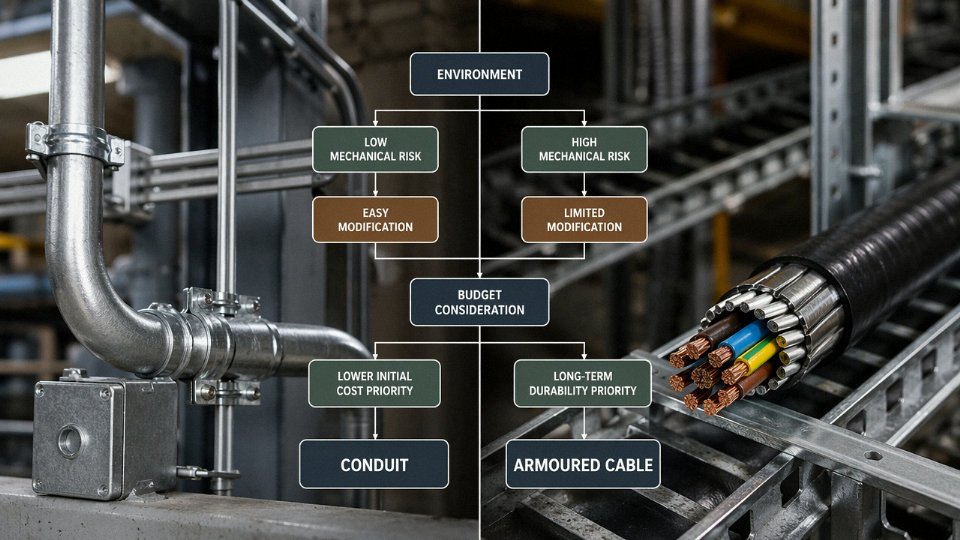
The Decision Tree
Start: What is the primary installation environment?
If the cable runs underground without a pre-installed duct, go directly to armoured cable. Full stop. The burial depth, soil chemistry, and traffic loading questions still matter for which armour type, but conduit is off the table unless a continuous, watertight duct system is already in place and maintained.
If the cable runs on an industrial surface, tray, or exposed overhead, ask: Is significant mechanical abuse expected — fork-lift traffic, falling objects, regular wash-down, or chemical splash? Yes → armoured cable, likely SWA for steel environments or AWA where weight or corrosion is a concern. No → conduit is viable; choose rigid steel (RMC/IMC) where impact is still moderate, PVC where the environment is dry and loads are light.
If the cable runs inside a building — clean commercial, data centre, office, light industrial — ask: Is rewiring or circuit modification likely within roughly 15 years? Yes → conduit, almost certainly. Pulling new conductors through an existing conduit run costs a fraction of ripping out and replacing armoured cable. No → either system is defensible; cost and earthing strategy will decide it.
Regulatory jurisdiction closes the remaining branches. Under BS 7671 in the UK, using SWA armour as the circuit protective conductor is well-established and simplifies the earthing design on short runs. Under NEC in North America, the armour-as-EGC path is more restricted; conduit systems there carry an inherent earthing continuity advantage that’s hard to replicate cheaply with armoured cable. IEC 60364 installations vary by national annex — know your local amendment before you finalise the earthing arrangement.
The Five Conditions Where Armoured Cable Is the Clear Winner
- Direct burial without a pre-installed duct — SWA or DSWA depending on soil corrosivity and load
- No realistic expectation of rewiring within the cable’s service life, typically 25–40 years for a well-specified installation
- High mechanical abuse: mining, heavy industry, portside infrastructure, anywhere a conduit would be crushed or fractured within months
- Marine, offshore, or continuously exposed outdoor environments where conduit joints become the weakest corrosion point over time
- Short-circuit fault paths where using the steel wire armour as the CPC simplifies the earthing design and reduces termination hardware — provided the armour cross-section is confirmed adequate for the prospective fault current
The Five Conditions Where Conduit Is the Clear Winner
- Building interiors — offices, hospitals, schools — where future occupants will almost certainly need to add or modify circuits
- Under roads or paved areas where utility access is a planning condition and the authority requires a draw-able duct
- Mixed-circuit runs sharing a common route but serving different distribution boards, voltages, or tenants
- Data centres and commercial buildings on rapid technology refresh cycles, where cable routes outlive the circuits they carry by a wide margin
- Retrofit projects where the conduit is already installed and structurally sound — pulling new conductors through existing infrastructure beats any armoured cable solution on cost, almost without exception
SWA armour cross-section must be verified against prospective fault current before using it as the sole CPCTrue
IEC 60364-5-54 and BS 7671 Appendix 4 both require the armour cross-section to satisfy the adiabatic equation for the disconnection time; on longer runs or higher fault-current supplies, the armour alone may be insufficient and a supplementary earth conductor is needed
Procurement Note: Vague Specifications Cost Money
A single-line description — “100 m of 4-core armoured cable, 16 mm²” — leaves the manufacturer guessing on at least six parameters: conductor material (copper or aluminium), insulation system (XLPE or PVC), armour type (SWA, AWA, STA), inner and outer sheath material, voltage class (0.6/1 kV or higher), and the governing standard (IEC 60502-1, BS 6724, or other). Each variable shifts the price. A vague inquiry gets a vague price with a wide contingency buffer built in — which is nobody’s preferred outcome.
A proper cable schedule defines every one of those parameters per circuit. For specifiers who are starting from a single-line project description, Jinda’s technical team can work through the schedule systematically, match each circuit to the right construction, and return datasheets with sample third-party test reports. That process costs nothing and removes the ambiguity before it becomes a procurement or inspection problem.
Jinda has been manufacturing special cables since 1987, operates five production bases with roughly 470,000 m² of manufacturing space, and supplies customers across more than 50 countries. The export logistics, documentation, and quality records are established — not a promise but a track record. If you have a cable schedule to review or a bulk-supply inquiry to price, contact the technical team directly for a structured review and competitive quotation.