Grab the wrong power cable off the shelf — or worse, accept a substitute from a supplier who swears it’s “compatible” — and you’re looking at anything from a tripped breaker on a slow day to a melted connector or a field return that costs more to investigate than the TV itself was worth. The cable looks identical. The plug fits the socket. The TV powers on. And then, three months later, something fails and nobody can immediately explain why. That’s the scenario that keeps procurement managers up at night, and it’s more common than it should be because the answer to “are these cables interchangeable?” is genuinely more complicated than most sourcing checklists acknowledge.
TV power cables are not universally interchangeable. While many share the IEC 60320 C13/C14 connector format rated at 10A/250V, compatibility depends on four variables: the local mains voltage (100–127V or 220–240V), frequency (50 or 60 Hz), the cable’s conductor cross-section (typically 0.75–1.5 mm²), and the country-specific plug standard on the wall end. A cable that is electrically and mechanically correct in one market can be non-compliant — or genuinely unsafe — in another.
What makes this topic slippery is that the connector end often does fit physically, and a TV will frequently run without immediately obvious complaint even on a marginally undersized cable. The failure mode is slow — heat buildup, insulation degradation, a connector that starts to discolor — and by the time it’s visible, the root cause has already been argued into a warranty grey zone. Understanding exactly where universality ends and where it doesn’t is the practical core of this.
IEC 60320 Connector Standards: What Actually Plugs Into the Back of a TV
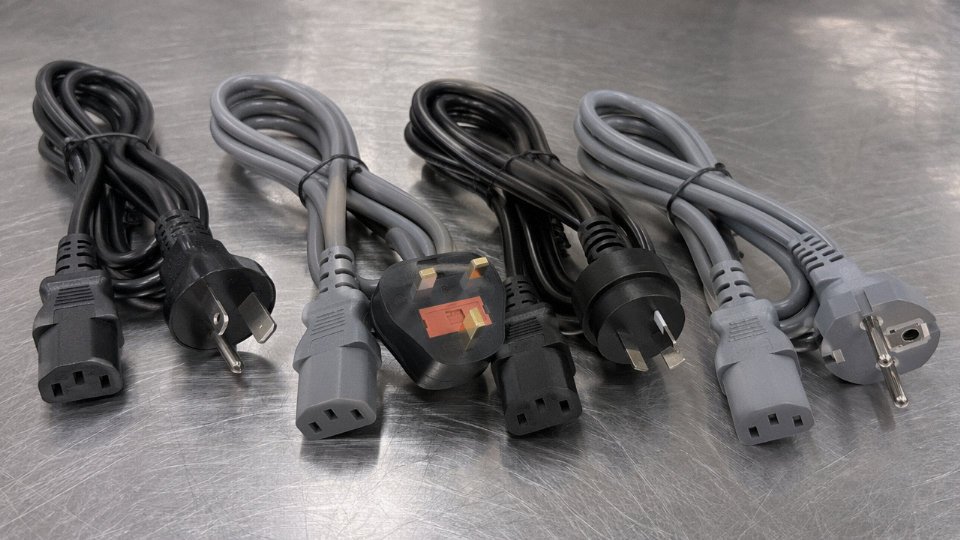
The IEC 60320 standard — formally titled “Appliance couplers for household and similar general purposes” — is the international framework that defines how detachable power cords connect to electrical appliances. It was developed precisely to prevent the chaos you’d otherwise get from every manufacturer inventing its own inlet geometry. For televisions specifically, it sets the physical dimensions, contact arrangement, current ratings, and retention force requirements that determine whether a cable will seat properly, maintain a safe connection, and survive years of occasional unplugging.
The C13/C14 Pairing: Why It Dominates TV Applications
The C13 connector (on the cable end) mating with the C14 inlet (on the appliance) is the combination you’ll find on the overwhelming majority of flat-screen TVs produced since roughly the mid-2000s. The geometry is three-pin: two flat angled blades for live and neutral, plus a round grounding pin offset below them. That ground pin is non-negotiable for mains-connected appliances above certain wattage thresholds in most regulatory regimes. The C13 is rated 10A at 250V — more than adequate for a typical LCD or OLED panel drawing anywhere from 30W to 300W depending on screen size and backlight technology.
Dimensional tolerances on the C14 inlet are tight by design. The connector locks with a spring-retention mechanism, and IEC 60320 specifies a minimum retention force (usually around 10–30 N depending on connector family) so the cord doesn’t pull free under normal handling. In a commercial display installation — a hotel room, a retail fixture — that retention matters more than people realize.
Connectors That Look Similar but Aren’t
This is where procurement mistakes happen. The C7, C15, and C19 all belong to the same IEC 60320 family but serve different applications and are physically incompatible with a C14 inlet by design.
| Connector Pair | Pins | Ground | Rating | Typical Use |
|---|---|---|---|---|
| C7 / C8 | 2 | No | 2.5A, 250V | Laptop bricks, small AV gear |
| C13 / C14 | 3 | Yes | 10A, 250V | Televisions, monitors, desktop PCs |
| C15 / C16 | 3 | Yes | 10A, 250V | High-temp (e.g., kettles) — notch on bottom edge |
| C19 / C20 | 3 | Yes | 16A, 250V | High-draw commercial displays, servers |
The C15 is the one that trips people up most often. It looks nearly identical to a C13, but carries a small notch on the lower edge to prevent it from mating with a standard C14 inlet — that notch exists because C15 is rated for higher operating temperatures (up to 120°C versus 70°C for C13) and a regular C14 socket on a TV chassis isn’t built for that thermal environment. Plugging a C15 into a C14 inlet isn’t possible by design. The keying is mechanical, deliberate, and the correct response to that resistance is to stop, not force it.
The C19/C20 pairing is worth knowing if you’re sourcing cables for large-format commercial signage or video walls. Those panels can draw 400W or more continuously, and the 16A rating of C19/C20 provides appropriate headroom. A standard C13 cable technically cannot physically mate with a C20 inlet anyway — the blade geometry differs — but specifying the wrong cable in a bulk procurement order wastes time and freight costs.
A C13 cable can be forced into a C20 inlet if enough pressure is appliedFalse
The C13 and C20 connectors have different blade geometry and housing dimensions defined by IEC 60320. They are physically incompatible by design; no amount of force creates a valid or safe connection.
Budget TVs and the Proprietary Inlet Problem
Samsung, LG, Sony, Hisense, TCL, and most volume manufacturers standardized on C14 inlets across their flat-screen lines years ago. That standardization is why you can walk into any hotel in Europe, pull the TV power cord, and replace it without calling a specialist. Some budget or regionally distributed models — particularly certain OEM units assembled for specific markets in Southeast Asia or Sub-Saharan Africa — still ship with 2-pin proprietary inlets or barrel-type DC connectors fed from an external adapter brick. These are not IEC 60320 devices. A C13 cable is useless with them, full stop.
What Quality Manufacturing Actually Requires
Producing a C13 cable to genuine IEC 60320 compliance isn’t just a matter of molding the right shape. Cable manufacturers like Jinda run contact resistance measurements (typically below 0.5 mΩ on new product), dielectric withstand tests at voltages well above rated mains, and insertion/withdrawal cycle testing that can run to 10,000 cycles for commercial-grade product. The conductor cross-section for a TV power cable typically runs 0.75 mm² to 1.0 mm² for lighter domestic panels, stepping up to 1.5 mm² for larger commercial displays — the right choice depends on the panel’s rated current draw and the cable routing length, not just what fits the connector housing.
Wall Plug Ends Are Never Universal: A Country-by-Country Wiring Standard Breakdown
The TV-end connector — usually a C13 — may be the same whether you’re shipping to Rotterdam or Los Angeles. The wall-plug end is a completely different story. Every major market has its own physical standard, its own voltage regime, and in some cases its own mandated fuse or certification body. Getting this wrong in bulk procurement means containers of cable that legally cannot be sold, or worse, assembled and shipped to end users who plug them in without knowing the difference.
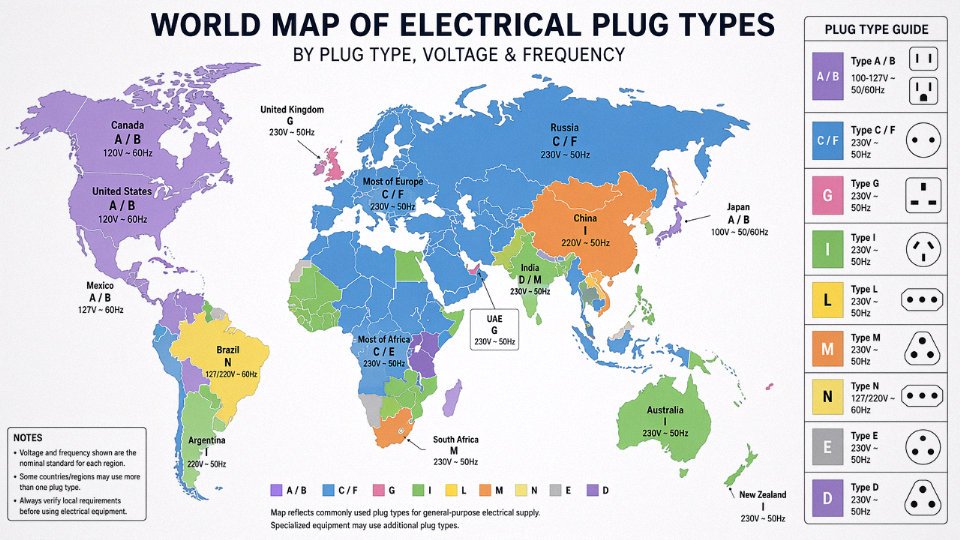
The Major Plug Standards, Region by Region
Here is a working reference table. Voltage ranges reflect actual grid conditions rather than nominal values — plant experience shows real-world supply often runs 5–8% off nominal, which matters for both cable insulation rating and fuse sizing.
| Plug Type | Primary Markets | Pin Configuration | Nominal Voltage | Frequency |
|---|---|---|---|---|
| Type A | USA, Canada, Mexico, Japan | 2 flat parallel blades | 100–127 V | 60 Hz (50 Hz Japan) |
| Type B | USA, Canada, Mexico | 2 flat blades + round earth | 100–127 V | 60 Hz |
| Type C | Continental Europe, much of Asia/Africa | 2 round pins (Europlug) | 220–240 V | 50 Hz |
| Type G | UK, Ireland, Hong Kong, Singapore, Malaysia | 3 rectangular blades, fused | 220–240 V | 50 Hz |
| Type I | Australia, New Zealand, China, Argentina | 2 or 3 flat angled blades | 220–240 V | 50 Hz |
| Type L | Italy | 3 round pins in-line | 220–240 V | 50 Hz |
| Type N | Brazil | 2 round + 1 round earth (IEC 60083 derivative) | 220–240 V (some regions 127 V) | 60 Hz |
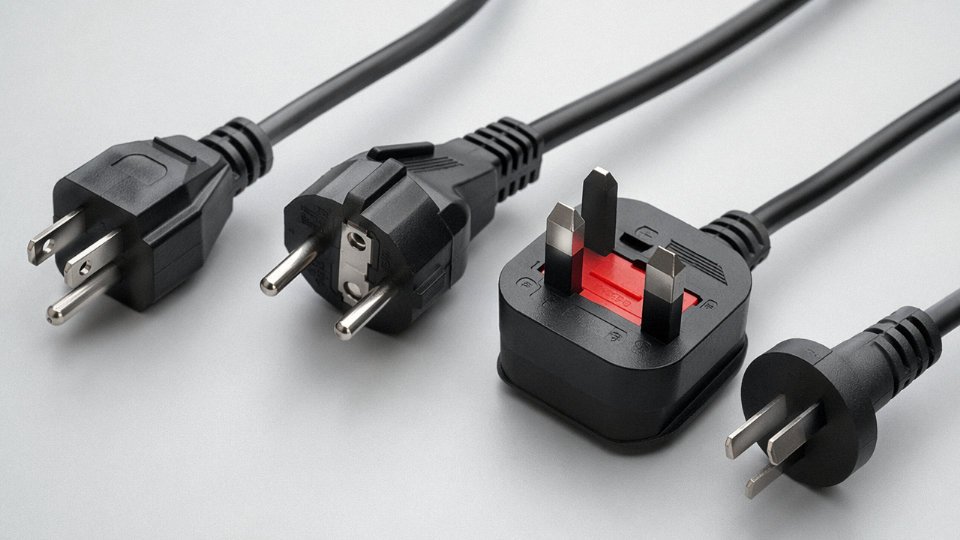
A C13-to-Type-G cable for the UK market and a C13-to-Type-A cable for the US market share nothing except the coupler end. The conductor cross-section requirements, overmold geometry, certification marks, and fuse provisions are all different. Procurement specs that simply say “C13 power cable” without specifying the plug-end type routinely generate the wrong product.
The UK Type G Fused Plug: A Compliance Trap
BS 1363 is unusual globally in that it mandates a fuse inside the plug itself. For television sets, the correct rating is typically 3 A or 5 A — not the 13 A fuse that is sometimes fitted by assembly workers who grab whichever cartridge is on the bench. A 13 A fuse in a TV power cable offers essentially no overcurrent protection at load levels that would actually damage the set or the cord. Customs officers and electrical safety inspectors in the UK and Hong Kong do check this. In bulk orders, the fuse rating must be called out explicitly in the purchase order, and the supplier’s quality control process must verify it at the assembly stage rather than treating it as a detail.
BS 1363 (UK) requires a fused plug on all detachable appliance cords, and the fuse rating must be matched to the appliance load.True
BS 1363 mandates a cartridge fuse within the plug body. For TVs drawing under 700 W, a 3 A fuse is standard; up to around 1,000–1,200 W, 5 A is used. Fitting a 13 A fuse, which is common in improperly assembled cables, defeats this protection entirely.
Brazil Type N: The Standard That Surprises Importers
NBR 14136 — Brazil’s national plug standard — became mandatory for new equipment sold in Brazil in stages starting in the early 2010s, but a surprising number of cable suppliers outside South America still quote Type C (Europlug) as an acceptable substitute. It is not. Brazilian regulatory body INMETRO actively enforces this, and product that ships with non-compliant plugs faces rejection at customs or mandatory recall. The Type N plug has a specific pin diameter, pin spacing, and earth-pin geometry that differs from Schuko and Europlug — they are not interchangeable despite a superficial visual resemblance. If your TV shipment is destined for São Paulo, the cable assembly must be explicitly specified and certified for Type N.
Brazil’s voltage situation adds another wrinkle: parts of the country, particularly older urban infrastructure in São Paulo and Rio de Janeiro, historically ran at 127 V, while newer installations and other states use 220–240 V. A cable for the Brazilian market must therefore be paired with a TV’s internal power supply that can handle both, and the cable assembly itself should be rated accordingly.
How Production Is Organized for Multi-Market Sourcing
Jinda’s manufacturing approach addresses this directly. The C13 appliance coupler end is produced to a common specification across production runs, but the cable assembly is configured per destination market — pairing that common coupler with the correct wall-plug end and applying the certification marks that the destination country requires. UL/CSA covers the North American market, CE marking applies to European supply, SAA for Australia and New Zealand, SABS for South Africa, PSE for Japan, and KC for South Korea. These are not interchangeable; each involves testing to different standards, and a CE-marked cable is not automatically acceptable in an Australian market even though both run at 220–240 V.
For procurement teams placing international orders, the practical implication is straightforward: the purchase order must specify the destination country (or region), the plug type, the certification required, and — for UK-bound cable — the fuse rating. Leaving any of those fields open invites substitution errors that only surface once product is already in-market.
Voltage and Frequency Compatibility: When the Cable Fits but the Electricity Does Not
Physical fit is only half the story. A C13 connector that seats perfectly into the IEC inlet on the back of a TV tells you nothing about whether that cable is safe to run on the local mains supply — and this is the part that gets glossed over in most cable guides.
The TV’s Internal Power Supply Does the Heavy Lifting
Almost every flat-screen TV sold in the last fifteen years uses a switched-mode power supply (SMPS) on the input stage. These are rated, in virtually all cases, for 100–240V AC at 50 or 60 Hz. That wide input range is why you can take a television from Tokyo to Frankfurt and it will run without a transformer. The SMPS handles the conversion internally.
This is genuinely useful, but it creates a subtle misconception: people assume that because the TV is globally compatible, the cable connecting it to the wall is also globally compatible. It is not. The cable’s job is to carry mains voltage directly — unmodified — from the outlet to the TV inlet. Whatever voltage is on the wall is the voltage on that cable’s conductors and insulation. The TV’s SMPS sits downstream of the cable, not upstream of it.
Insulation Ratings: Where 300V Gets Uncomfortable
Cable insulation is rated for a maximum continuous working voltage, and the two common ratings you’ll see on TV power cables are 300V and 500V. On a 230V nominal circuit, the actual peak voltage hits roughly 325V — that’s just how sinusoidal AC works (230 × √2). A cable marked 300V is therefore technically marginal on any European, Australian, or Chinese outlet, operating with almost no headroom against transient spikes, wiring irregularities, or the voltage tolerances permitted under EN 50160 (which allows nominal 230V supplies to run as high as 253V in practice, pushing the peak to around 358V).
A TV power cable rated 300V insulation is safe on a standard 230V European outletFalse
On a 230V nominal circuit, peak voltage reaches approximately 325V and supply tolerances can push it higher. A 300V-rated cable operates with minimal margin. The correct specification for 220–240V markets is 300/500V rated cable, where the 500V figure refers to the conductor-to-conductor and conductor-to-earth rating under IEC standards.
For any market running 220–240V mains, specify cables rated 300/500V minimum. This is not over-engineering — it’s the baseline.
Conductor Sizing and Real Loads
For most televisions in the 40–65 inch range drawing 50–200W, a 0.75 mm² conductor (roughly 18 AWG) handles the load comfortably with room to spare. Problems start when people use the same cable for larger commercial displays, 75-inch-plus panels with integrated soundbars, or screens running in high-brightness commercial mode continuously.
A rough working reference:
| Rated Load | Current at 120V | Current at 230V | Minimum Conductor |
|---|---|---|---|
| Up to 150W | ~1.25A | ~0.65A | 0.75 mm² |
| 150–300W | ~1.3–2.5A | ~0.65–1.3A | 0.75 mm² |
| 300–500W | ~2.5–4.2A | ~1.3–2.2A | 1.0 mm² |
| 500–800W | ~4.2–6.7A | ~2.2–3.5A | 1.5 mm² |
Actual draw depends on brightness settings, audio output, and connected USB peripherals. Commercial installations running displays 12–18 hours a day in high-brightness mode should be sized toward the upper end of any range, not the lower.
Frequency: Mostly a Non-Issue, With One Exception
For any SMPS-based TV — which covers essentially all LCD, LED, and OLED flat panels — 50 Hz versus 60 Hz makes no practical difference. The SMPS rectifies the AC to DC almost immediately and operates efficiently across both frequencies.
Where frequency does matter is older equipment: CRT televisions, early plasma sets, and any external surge protector or UPS in the circuit that uses a transformer-based design rather than a switched-mode one. Those devices can run hotter, less efficiently, or outside spec when the frequency doesn’t match their design rating. For modern TVs this is rarely a concern, but it’s worth flagging when procurement teams are sourcing cables for regions with legacy installed bases.
Cables Don’t Convert Anything
This is worth stating plainly because it comes up more than it should. A power cable is a conductor, not a converter. Plugging a cable into a 230V outlet and running it to a device does not reduce the voltage to 110V. The cable carries whatever the wall delivers. Using a cable with inadequate insulation rating on a higher-voltage circuit doesn’t fail visibly or immediately — it degrades insulation over time, and the failure mode when it does occur is typically a short circuit or, in a worst case, a fire. The connector fitting physically is irrelevant to that risk entirely.
Cable Construction Specifications That Determine Safety and Longevity
The connector type gets all the attention, but in practice the difference between a cable that lasts a decade and one that causes a nuisance trip — or worse, a smoldering jacket — lives inside the cable itself. Engineers and procurement managers who only specify “C13 to Type G, 1.8 m” are leaving a lot of room for trouble.
Conductor Material and Stranding
TV power cables are flexible appliance cords. They get coiled, hung behind furniture, occasionally stepped on. For that kind of service life, you need stranded conductors — specifically Class 5 flexible stranding per IEC 60228, built from annealed copper. Annealed copper is soft enough to tolerate repeated bending without work-hardening and cracking, and its conductivity is predictable: you can hit your rated resistance figures reliably.
Copper-clad aluminum (CCA) is the red flag. You’ll find it in budget cables from spot suppliers, and it looks identical to pure copper on the outside. The problems are real: CCA carries roughly 1.5× the resistance of equivalent copper at the same cross-section, which means higher I²R heating at load. Worse, aluminum cold-flows under terminal crimp pressure over time, loosening the connection — a classic cause of intermittent faults and localized overheating at the connector. Any serious procurement specification should include a conductor material clause and back it up with a EDXRF or density check on incoming samples.
Copper-clad aluminum conductors have the same ampacity as solid copper conductors of the same AWG size.False
CCA has approximately 61% of the electrical conductivity of pure copper, meaning a CCA conductor of the same physical cross-section will run hotter under the same current load and does not meet the same ampacity rating as an annealed copper conductor.
Insulation Materials
PVC insulation dominates the TV cable market for good reason — it’s cost-effective, flexible across a reasonable temperature range (rated typically 70°C to 90°C depending on compound), and compatible with standard tooling. For most residential and commercial TV installations, PVC is perfectly adequate.
LSZH (low smoke zero halogen) becomes mandatory — not optional — in public buildings, transport facilities, data centers, and increasingly in EU markets under the Construction Products Regulation (CPR). The reason is simple consequence logic: burning PVC releases hydrogen chloride gas, which is corrosive to electronics and toxic in confined spaces. An LSZH jacket chars rather than drips, and smoke output is dramatically lower. Specifying LSZH for a hotel AV rollout or a hospital display installation is not premium over-engineering; it’s baseline compliance. Expect a modest cost premium over standard PVC, usually in the range of 15–35% depending on compound grade and order volume.
Rubber-jacketed cords show up in industrial display applications — factory floor monitors, outdoor kiosks, rugged signage — where flexibility across a wider temperature range (down to −25°C or lower) and resistance to mechanical stress matter more than aesthetics.
Jacket and Outer Sheath
Jacket thickness tolerances are governed under IEC 60227 and IEC 60245. A thin jacket might pass a casual visual check but will fail a dielectric withstand test or show premature cracking when routed around a sharp cable clip. Color conventions are more market-driven than you might expect: black dominates globally, but North American retail TV cable SKUs frequently use white or light gray to match consumer electronics aesthetics — worth confirming with your buyer before a large production run.
For outdoor digital signage or industrial enclosures, ask explicitly about UV stabilization and oil resistance. Standard PVC has minimal UV resistance; a cable rated for outdoor use needs a specifically compounded jacket, or you’ll see embrittlement within 18–24 months in direct sunlight.
Cable Length and Voltage Drop
Replacement TV cables ship most commonly in 1.5 m, 1.8 m, and 3.0 m lengths. For commercial AV installations where a 5 m or 10 m run is needed — say, a ceiling-mounted display fed from a floor box — voltage drop is worth a quick calculation: V = I × R, where R comes from the conductor resistance per IEC 60228 for your cross-section. A 55 W TV at 230 V draws roughly 0.24 A. Even with a 10 m run in 0.75 mm² copper (conductor resistance around 26 mΩ/m, so about 0.52 Ω for the loop), the voltage drop is under 0.13 V. Negligible. The more important variable for longer commercial runs is actually mechanical protection and jacket integrity, not electrical drop.
Quality Verification
Specifying cable without demanding documented test evidence is a procurement gap. The baseline tests worth requiring are: dielectric withstand (typically 2,000 V AC for 1 minute across conductor-to-conductor and conductor-to-ground), insulation resistance (≥100 MΩ·km is the usual threshold), and conductor resistance per IEC 60228 to confirm you’re actually getting copper and the right cross-section. Third-party certification marks — UL for North American supply chains, HAR or ENEC for European, CCC for China domestic distribution — are the paper trail, but a legitimate manufacturer should also be able to supply recent in-house test reports from a calibrated lab, not just the certification plaque on the cable.
Jinda operates in-house testing covering dielectric withstand, insulation resistance, conductor resistance, and flame performance, which means production batches can be validated against specification without relying solely on third-party schedules. For procurement managers running large international orders, that in-house capability matters — it shortens response time when a deviation is caught and gives you a direct technical counterpart to talk to, rather than waiting on a test lab turnaround.
Certification and Compliance Landscape: What Marks Must Appear on a TV Power Cable
Getting the connector type right and specifying the correct conductor cross-section still leaves you exposed if the cable doesn’t carry the right certification marks for its destination market. Customs holds, product recalls, and voided liability insurance are the real consequences — not hypothetical ones. For OEM television manufacturers, commercial AV integrators, and procurement teams sourcing replacement cords in volume, certification is the unglamorous part of the job that causes the most expensive surprises when it’s handled carelessly.
North America: UL Listing vs. UL Recognition — a Distinction That Actually Matters
In the US and Canada, flexible power cords for televisions fall under UL 62 and CSA C22.2 No. 49 respectively. Most people in procurement have seen both the UL Listed mark and the UL Recognized Component mark, and many assume they’re interchangeable. They aren’t. A cable sold as a standalone replacement cord — the kind a service technician buys to swap out a damaged lead on a commercial display — must carry the full UL Listing mark. The Recognized Component mark (the backwards-UR symbol) is valid only when the cable ships as part of a finished, separately-listed product. If you’re importing replacement cords and your supplier gives you UR-marked cable, you have a non-compliant product the moment it’s sold independently. That distinction trips up importers repeatedly, especially when sourcing from manufacturers who primarily supply OEM bundles rather than aftermarket channels.
European Union: HAR, CE, and the Growing CPR Demand
European markets require the HAR mark on harmonized flexible cords — this is a CENELEC agreement that allows a cord approved in one member country to be sold across all participating countries without re-testing. CE marking under the Low Voltage Directive (2014/35/EU) applies to the cable assembly. These two are baseline requirements.
The Construction Products Regulation (EU 305/2011) and its CPR cable classes (Eca, Dca, and above) are technically aimed at cables permanently installed in buildings, not detachable appliance cords. In practice, commercial AV contractors installing displays in hotels, airports, and corporate environments are increasingly asked by facilities managers and fire compliance officers to specify CPR-rated cables anyway. It’s not always a legal mandate for a detachable cord, but refusing to provide CPR documentation on a large commercial fit-out can stall a project or lose a tender. Worth knowing before you finalize a spec.
United Kingdom: Post-Brexit UKCA and the Fused Plug Requirement
Since January 2025, CE marking no longer satisfies the GB market for new product placements — UKCA is required. The underlying technical standard for flexible cords is BS 6500. Separately, the UK’s mandatory BS 1363 plug must include a correctly rated fuse, typically 3 A for most TV power cords. This is non-negotiable and occasionally overlooked by suppliers used to supplying continental European or Asian markets, where fused plugs aren’t the norm.
Asia-Pacific: Four Separate Regimes, Each With Its Own Process
Australia and New Zealand use the RCM mark (which consolidated the old SAA and C-Tick marks), referencing AS/NZS 3112 for the plug and AS/NZS 3191 for flexible cords. Japan requires the PSE mark under the Electrical Appliance and Material Safety Act — the diamond PSE for specified appliances, the circle PSE for non-specified. South Korea requires the KC mark. China requires CCC (China Compulsory Certification) for products sold domestically, even if the manufacturer is based in China.
These aren’t just sticker differences. Each scheme involves its own testing protocols, factory audits at varying frequencies, and renewal cycles.
Emerging Markets: In-Country Testing and Local Agent Requirements
Brazil (INMETRO), India (BIS), and South Africa (SABS) all require in-country testing through accredited laboratories, and Brazil and India additionally require a registered local agent or importer of record who takes on compliance liability. Lead times for initial certification in these markets commonly run 4–9 months, depending on laboratory queue times and whether technical documentation is complete on first submission. These markets are high-growth for television sales, so treating certification as an afterthought when entering them is a costly mistake.
A UL Recognized Component mark is sufficient for a TV power cable sold as a standalone replacement cord in the US market.False
UL Recognition applies to components used within a separately listed end product. A cable sold independently as a replacement cord requires a full UL Listing under UL 62 to be compliant for standalone sale in the US market.
Working with a cable manufacturer who already holds active certifications across these schemes — and can supply the original test reports, not just copies of marks — compresses your compliance timeline significantly and shifts documentation liability where it belongs: to the manufacturer. At customs, a shipment without traceable certification documentation doesn’t get a warning. It gets held, and sometimes seized outright, while your customer’s production schedule or installation deadline moves on without you.
Bulk Procurement Strategy: Specifying TV Power Cables for Multi-Region TV Manufacturing or Distribution
Getting the physical connector right is only the beginning. For OEM TV manufacturers shipping into six different markets, or a hospitality chain stocking 800 rooms across three countries, the real procurement work happens before a purchase order is ever issued — in the specification sheet.
Lock the Specification Before You Issue a PO
A properly locked spec sheet for a TV power cable should define, at minimum: the TV-end connector type and governing standard (IEC 60320 C13 for the overwhelming majority of flat-panel TVs drawing under 10 A), the wall-plug variant and the specific national certification required for that plug (BS 1363 for the UK, CEE 7/4 Schuko for Germany and much of continental Europe, NEMA 5-15P for North America, GB 2099 for China mainland, AS/NZS 3112 for Australia), conductor cross-section in both mm² and AWG — typically 0.75 mm² to 1.0 mm² (18 AWG) for TVs under roughly 150 W, stepping to 1.0–1.5 mm² for larger screens or hospitality installs where cables sit coiled behind furniture for years — insulation and jacket material with the applicable standard (IEC 60227 for PVC-based flexible cords, IEC 60245 for rubber, with LSZH specified explicitly if the cable will run in hotels, hospitals, or any enclosed public space), finished cable length (tolerance ± 30–50 mm is realistic; tighter than that and you pay for it), color (black or white, and that choice matters — hospitality clients replace individual cables in the field and mismatched colors in a rack or behind a display wall cause real complaints), and packaging format: coiled with a printed label wrap for retail or hospitality, bulk reel for OEM line-feed, or retail blister for aftermarket. Every one of these variables drives a separate tooling, certification, or production-line decision at the manufacturer’s end. Leave any of them ambiguous and you will receive a “standard” interpretation that may not match your market.
MOQ Realities and SKU Consolidation
For certified cables with country-specific plugs, expect MOQs from credible manufacturers to sit somewhere between 500 and 5,000 pieces per variant, depending on how exotic the certification and whether dedicated mold tooling is involved. A straight C13-to-NEMA 5-15P cable in black, 1.8 m, with UL certification is a commodity line — MOQ might be 500 pieces. A C13-to-BS 1363 with ASTA certification and LSZH jacket in 2.0 m white is less common; some suppliers won’t touch under 2,000 pieces without a tooling surcharge.
One practical way to reduce SKU complexity across low-volume markets is to standardize on a C13 tail cable — a short, uncertified IEC-to-IEC lead — paired with separately sourced, certified country-specific plug adapters for markets where volumes don’t justify a dedicated certified cable. It’s not a perfect solution (adapter chains add length and connection resistance), but for a market where you’re placing 200 units a year it often makes more operational sense than maintaining a dedicated certified SKU.
Sample and Approval Process
Plan for 4–8 weeks from specification sign-off to a certified production sample on a new cable variant. That window covers tooling confirmation, initial production run, and third-party lab submission. First article inspection (FAI) should be conducted against the locked spec sheet, not the factory’s generic datasheet. Retain a golden sample — physically tagged and stored, not just photographed — because color matching and dimensional tolerance drift are genuine problems on long production runs, and you need a physical reference when raising a nonconformance. For major market certifications (UL, CE/HAR, SAA, PSE), use an accredited third-party lab: SGS, Intertek, and TÜV Rheinland are the names you’ll see on most compliance paperwork. In-house test reports from the factory are a starting point, not a conclusion.
Supplier Qualification
Beyond price, the qualification criteria that actually matter at scale are: ISO 9001:2015 quality management with audit records available (not just a certificate scanned and emailed), dedicated appliance cord production lines that don’t share tooling or processes with power or data cable lines, in-house conductor drawing and stranding capability (factories that buy pre-stranded wire from a third party have less control over conductor quality and traceability), and — critically — certifications already held on file for your target markets. Asking a supplier to obtain fresh UL or SAA certification for a new variant from scratch adds 8–16 weeks and cost that usually falls on you one way or another.
Jinda’s five production bases across China, totaling 470,000 m² of manufacturing space, are set up specifically to run parallel certified production of multiple variants without cross-contamination of specifications — a real operational risk at smaller factories where a single line might switch between HAR, UL, and PSE jobs with informal changeover procedures.
Total Cost of Ownership: The Certification Math
The per-unit price comparison between a compliant cable at roughly $1.80 and a non-compliant one at $0.90 looks straightforward until you model the tail risk. A 2% field failure rate on 50,000 units means 1,000 cables failing in the field. If each failure generates a warranty claim averaging $35–60 in handling, replacement, and logistics — and that’s before any liability exposure or regulatory recall action — the “cheap” cable has already cost you $35,000–60,000 on the failure population alone, against a per-unit saving of $45,000. The margin disappears, and that math doesn’t include the cost of a product recall, a retailer chargeback, or a market access suspension if a non-compliant cable triggers a customs hold or a safety authority investigation.
A non-compliant TV power cable that passes visual inspection will always perform safely in normal use.False
Visual inspection cannot detect undersized conductors, inadequate insulation thickness, or missing flame-retardant additives — all of which can cause overheating or fire under sustained load conditions that are normal for a TV running 6–8 hours daily.
Procurement managers sometimes treat power cables as a commodity afterthought at the end of a BOM. In practice, they are the one component most likely to trigger a regulatory action, because they’re the one component most visible to customs inspectors and safety authorities — and the one most commonly substituted by lower-tier suppliers trying to hit a price target.
Common Substitution Mistakes and How to Identify an Incorrect or Counterfeit TV Power Cable
Field substitutions happen constantly — a cable goes missing during a hotel install, someone grabs whatever fits from the spares bin, or a procurement shortcut lands a batch of “equivalent” cords on the warehouse shelf. The connector fits, the TV powers on, and nobody flags it until an insurance auditor or a fire investigator asks to see the compliance documentation.
Mistake 1: Using a PC Monitor Cable on a TV Inlet
A standard computer monitor power cord — C13 female to a country-specific wall plug — will physically mate with a C14 inlet on most televisions. The ratings are nominally the same: 10 A / 250 V. In many cases it will run the TV indefinitely without visible incident.
The problem is certification, not physics. A cable assembled and certified for the German market under a VDE mark, then used in a UK installation, lacks a valid ASTA or BSI certification for that jurisdiction. The plug body itself may not conform to BS 1363 tolerance requirements even if it seats in the socket. If that TV is in a commercial property — a hotel room, a hospital waiting area, a retail display — and there’s ever a fire or an insurance claim, the non-compliant cable creates a liability gap that no one wants to discover retroactively. This isn’t theoretical; it’s exactly the kind of detail that AV installation companies have learned the hard way during post-incident audits.
Mistake 2: Substituting a C7 Figure-8 Cable for a C13
This one is genuinely dangerous. The C7 connector has two pins, no earth. It’s designed for double-insulated, Class II appliances — small radios, laptop chargers, lightweight audio gear. Using it on a TV that has an earthed C14 inlet simply doesn’t work mechanically (the inlet geometry is different), but the more alarming scenario is the reverse: someone replaces a damaged C13 cable with a C7 on a TV that was never intended to be unearthed, usually because the C7 cable was nearby and, with some force or an adapter, a connection was improvised.
Metal-chassis televisions and large-screen models above roughly 32 inches typically require a protective earth path because leakage current at operational temperatures can exceed safe touch-voltage thresholds without it.True
IEC 60065 and its successor IEC 62368-1 specify maximum permissible touch current for Class I appliances; without the earth return path, leakage current has nowhere to go except through a person contacting the chassis.
Don’t use a C7 on any TV with a three-pin inlet. Full stop.
Mistake 3: Running an Extension Cord as a Permanent Supply Cable
This happens in temporary installations that become permanent by accident. Extension cords and power strip leads are built to IEC 60884 or regional equivalents — standards written for intermittent, flexible, user-managed use. TV power cables are specified under IEC 60227 or IEC 60245 for continuous appliance duty. The insulation temperature ratings differ (often 60°C for basic extension cord PVC versus 75–105°C for appliance cord jacket compounds), and gauge selection in cheap extension cords frequently runs light — 1.0 mm² or even 0.75 mm² on a cord that might be coiled, trapped behind furniture, or carrying a 55-inch TV’s inrush current daily for years.
The consequence isn’t always immediate. Insulation degrades at elevated temperature over months, conductor resistance creeps up as connections loosen, and eventually you get intermittent faults or worse. The gauge question matters: a 0.75 mm² cord is acceptable for a 32-inch TV drawing under 80 W, but for anything in the 65-inch class pulling 150–200 W continuously, you want 1.0 mm² at minimum, and 1.5 mm² is the safer spec for warm ambient environments.
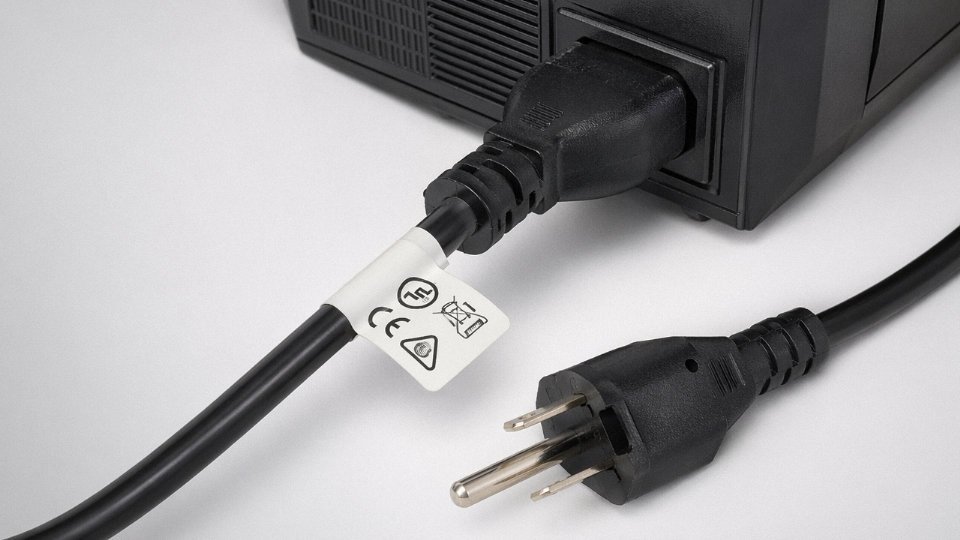
How to Spot a Counterfeit or Substandard Cable
Start with the print legend on the cable jacket. A compliant cable will carry a continuous, legible printed line showing at minimum: the voltage and current rating, conductor cross-section, applicable standard number (e.g., H05VV-F 3G0.75), and the manufacturer or production batch identifier. If that legend is absent, blurry, or clearly stamped on as a secondary process rather than extruded-printed, treat the cable as suspect. Genuine certification marks — CE, UL Listed, VDE, KEMA, PSE — should be crisp and correctly proportioned. A blurry or slightly off-geometry mark is a common tell on counterfeits; the tooling cost to reproduce them accurately is where counterfeit producers cut corners.
Check conductor color codes. In IEC-region cables: brown is live, blue is neutral, green/yellow stripe is earth. In North American cables, the NEC color convention differs. A cable sold for the European market with black-white-green conductors inside is either misspecified or mislabeled — neither is acceptable.
Any installer with a basic multimeter can perform a conductor resistance check and compare against IEC 60228 Class 5 limits (roughly 26 mΩ/m for 0.75 mm² at 20°C, give or take depending on copper purity). High resistance on a “new” cable means undersized or poor-quality conductors. A digital caliper on the plug pins will tell you quickly whether a BS 1363 plug’s pin dimensions fall within the standard’s tolerances — counterfeit UK plugs routinely fail on pin length and the insulated-sleeve requirement on live and neutral.
The counterfeit appliance cord problem is not trivial. Industry estimates from compliance testing organizations suggest somewhere between 15% and 25% of aftermarket appliance cords circulating in some developing markets are non-compliant in at least one measurable parameter — conductor cross-section, insulation rating, or certification mark legitimacy. The range is wide because it depends heavily on the specific market and supply channel. Sourcing from a manufacturer with traceable production records, third-party audit certifications, and documented test reports for each cable family is the only reliable way to eliminate that risk. A price difference of a few cents per unit on a cable is not worth the liability exposure — and experienced procurement managers generally know that already.
Frequently Asked Questions About TV Power Cable Compatibility
Can I use any C13 cable with my TV?
Physically, yes — the C13 socket and C14 TV inlet are dimensionally fixed by IEC 60320, so any compliant C13 plug will mate with any C14 inlet regardless of TV brand or country of manufacture. That’s the easy part. The wall-plug end is a completely separate question. A cable bought in Germany carries a Schuko plug and CEE 7/4 certification; that same cable is mechanically useless and legally non-compliant in the UK, Japan, or Australia without being re-terminated. The certification marks also matter: a C13 cable carrying only a CE mark is not automatically acceptable for sale in the US market, and vice versa. So “any C13 cable” is shorthand for “any C13 cable that matches your country’s socket standard and carries the required national safety approval.” Those two conditions eliminate most of the cheap grab-and-go options you’ll find at airport kiosks.
Is a TV power cable the same as a computer monitor cable?
In most cases, yes — electrically and physically identical. Both devices typically use a C14 inlet on the equipment side and a C13 cable end, running on the same conductor sizes (usually 0.75 mm² to 1.0 mm²) and the same insulation ratings. In practice, I’ve seen data center teams routinely swap monitor and TV cables without issue when they’re in the same country and voltage region, and there’s nothing wrong with that provided the certification marks on the cable jacket are appropriate for the country of use. The one edge case worth checking: some high-brightness commercial displays or large-screen TVs (75 inches and up) can draw enough current that a 0.75 mm² conductor runs warm under sustained load. A 1.0 mm² or 1.5 mm² cable costs almost nothing extra and removes that marginal concern entirely.
What happens if I plug a 120V-rated cable into a 230V outlet?
A cable insulation rated only for 150V or 300V is safe on a 230V RMS mains circuit long-term.False
A 230V RMS circuit has a peak voltage of roughly 325V. Cable insulation rated at 150V is plainly undersized. Even 300V-rated insulation is technically marginal and not approved for 230V distribution circuits in most markets — IEC and regional codes require 300/500V-rated cable for 230V mains use. Repeated thermal and voltage cycling degrades the insulation over months, creating a real short-circuit and fire risk.
This is the failure mode that doesn’t announce itself immediately. The cable works. The TV turns on. Nothing trips. Then, somewhere between six months and two years later, the insulation has degraded enough to arc. Always specify 300/500V-rated cable for any 230V market, full stop.
Can I cut and extend a TV power cable to reach a distant outlet?
Don’t. Splicing mains-voltage cable without a rated, certified junction enclosure violates the electrical codes of virtually every jurisdiction — NEC in the US, BS 7671 in the UK, AS/NZS 3000 in Australia. It also voids the TV’s warranty and, depending on your insurer, voids fire coverage. The right answer is a properly rated extension cord with the appropriate national approval, or a new outlet installed by a licensed electrician. It costs more than a roll of electrical tape. It’s also the only option that doesn’t eventually cause a problem.
How do I know what certification my TV cable needs?
The required certification follows the country of use, not the country of manufacture. A Jinda-manufactured cable built in Shandong still needs UL or CSA approval for the North American market, BASEC or ASTA approval for the UK, PSE for Japan, SAA for Australia. Request a certificate of conformity from your supplier for each specific certification — a competent manufacturer holds these as physical documents, not just checkbox declarations on a datasheet.
Do smart TVs or OLED TVs require a different power cable?
No. The C14 inlet is standard across LED, OLED, QLED, and every other current consumer display technology. Power consumption does vary — a 65-inch OLED typically draws somewhere in the 150–200W range under real-world content, versus roughly 80–120W for a comparable edge-lit LED panel, depending on brightness settings and content type. A standard 0.75 mm² C13 cable handles all of that comfortably; its safe capacity at 230V is well above 2,000W, which no consumer TV on the market approaches. Display technology doesn’t change what cable you need.
What is the minimum order quantity for custom-certified TV power cables from a manufacturer like Jinda?
MOQs depend heavily on which certification variant you need and which plug end. Single-region orders (say, Schuko C13 with VDE approval only) generally run from around 500 pieces on the low end for standard configurations. Multi-certification variants — where the same factory run needs to satisfy UL, VDE, and SAA simultaneously — tend to start higher, often 2,000 to 5,000 pieces per variant, because the testing and approval costs need to amortize across the run. Hospitality procurement teams ordering for multi-country hotel rollouts often find it more cost-effective to specify a consolidated package rather than ordering each regional variant separately. Contact Jinda’s sales team directly for project-specific pricing; the variables are specific enough that a published price list doesn’t reflect what a real multi-region program actually costs.
Sourcing Certified TV Power Cables at Scale: How Jinda Supports Global OEM and Distribution Partners
For a procurement manager running a multi-region TV distribution program, finding a cable supplier that can actually execute — across certifications, lead times, and documentation — is harder than it sounds. Most manufacturers either hold a narrow certification portfolio and expect you to manage the gaps, or they quote fast and deliver inconsistently. The operational reality of sourcing appliance cords at scale is messier than a product catalog suggests.
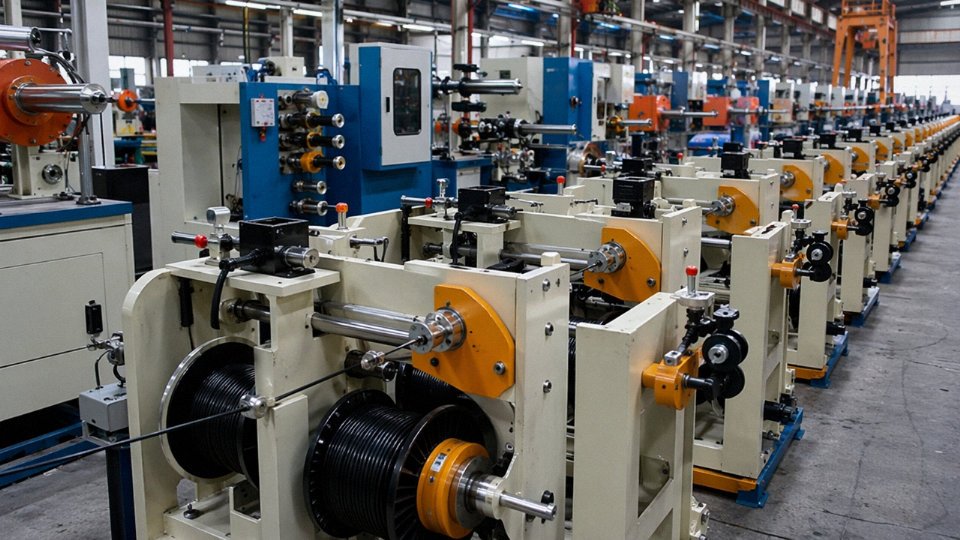
Production Infrastructure Built for Parallel Certification Lines
Jinda operates five manufacturing bases across China, with a combined floor area of roughly 470,000 m². That scale matters for a specific reason: maintaining separate, dedicated production lines for cables built to different certification schemes — UL, HAR, SAA/RCM, CCC, and others — rather than running them on shared tooling and hoping traceability holds. Cross-contamination between specification runs is a real failure mode. A UL-rated cable accidentally assembled with a HAR-rated plug housing, or a CCC conductor gauge substituted during a line changeover, can invalidate an entire shipment and trigger a regulatory non-conformance. Jinda’s ISO 9001:2015-managed system maintains production traceability per certification family, which means test reports tie back to specific production batches — something customs authorities and product registration bodies increasingly want to see.
R&D and Customization: From Specification Sheet to Certified Sample
When a customer brings a new cable requirement — say, a 1.0 mm² LSZH-jacketed C7 cord for a hospitality TV program destined for the UK and Australia — Jinda’s engineering team works through conductor alloy selection, insulation compound formulation, and plug tooling as an integrated process rather than farming each element out. Documented development lead times for a new certified variant typically run 8 to 14 weeks from order confirmation, depending on whether third-party certification testing (TÜV, SGS, Intertek) is required for the new configuration. That figure assumes the base certification is already held; if you’re introducing a market where Jinda doesn’t yet hold the relevant approval, build in more time and budget for lab coordination.
Certifications Already on File
This is where the practical advantage is most tangible. Jinda’s appliance cord product lines currently hold UL (North America), CE/HAR (Europe), SAA/RCM (Australia and New Zealand), PSE (Japan), KC (South Korea), CCC (China), and SABS (South Africa). Holding these on file — with current, auditable test reports — compresses a buyer’s time-to-market considerably compared to sourcing from a facility that must apply from scratch. A fresh UL listing application alone can run four to six months. For OEM TV manufacturers on a product launch schedule, that gap is disqualifying.
Jinda holds active certifications including UL, CE/HAR, SAA/RCM, PSE, KC, CCC, and SABS across its appliance cord product lines.True
These are listed certifications for Jinda's cable product range as documented in their official company profile and product certification records, covering the major regulatory markets for TV power cord distribution.
Supply Reliability for Blanket Orders
With over 1,000 employees and in-house procurement of copper rod, PVC and LSZH compounds, and plug components, Jinda can support blanket purchase orders without the supplier-tier volatility that hits smaller manufacturers during raw material price swings. Stock items on standard certified variants typically ship in 2 to 4 weeks. Custom certified configurations run 8 to 14 weeks. Annual production capacity across cable families is substantial enough to handle large distributor or OEM volumes without single-order bottlenecks — though in practice, committing to rolling forecasts with Jinda’s account team smooths scheduling on both sides.
Documentation and After-Sales Support
Procurement doesn’t end at delivery. Jinda’s technical team prepares documentation packages covering test reports, certificates of conformity, material safety data sheets, and RoHS/REACH compliance declarations — the paperwork that customs brokers, product registration bodies, and internal quality auditors consistently request. For distributors managing product registrations across multiple countries simultaneously, having that documentation structured and ready-to-submit is genuinely useful. Account management is structured by region, covering partners across more than 50 countries, which in practice means a named contact who understands the regulatory context of your specific market rather than a generic support queue.