Residential electricians and homeowners run into the same wall: standard NM-B cable is fast and cheap to rough in, but it offers almost nothing in terms of physical protection once it leaves the stud bay. Rodents chew through it. A misplaced screw kills a circuit. In unfinished basements and garages, exposed Romex is a code violation waiting to happen — and a failed inspection means re-work costs that can easily run $500–$2,000 depending on how much of the rough-in has to be pulled back out.
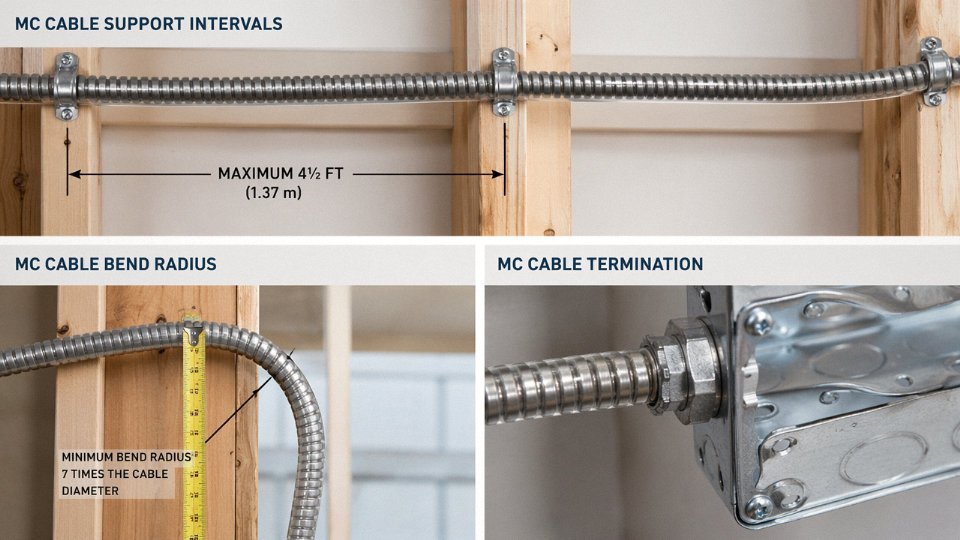
Yes, armored cable is permitted in residential construction. Under NEC Article 330 (MC cable) and Article 320 (Type AC), armored cable can be used in houses for branch circuits, feeders, and service entrances. It must be installed with listed fittings, maintain a minimum bend radius of 7× the cable’s external diameter for MC cable, and be supported at intervals the code specifies. No special variance is required.
What trips people up is not the permission — it’s the details: which armor type actually suits a residential job, where the cost premium is justified versus where it is overkill, and what happens when a well-meaning installer uses the wrong termination fitting or skips the anti-short bushing. Those decisions separate a clean, inspection-ready install from a callback.
MC Cable, AC Cable, and SWA: Choosing the Right Armored Type Before You Buy a Single Foot
The single most common procurement mistake I see — whether it’s a homeowner ordering online or a site electrician letting an apprentice spec the material — is buying the wrong armored cable type entirely. Getting this wrong doesn’t just mean a wasted trip to the supplier. It can mean a failed inspection, a rejected installation, or armor that offers zero real protection against the mechanical threat you were trying to solve.
Metal-Clad (MC) Cable
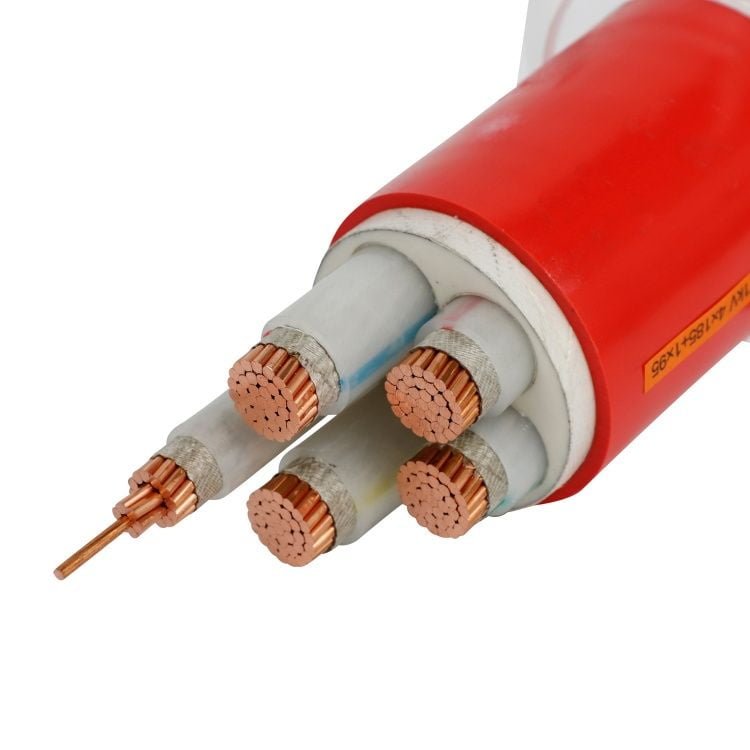
MC cable is the workhorse of modern US residential armored wiring. Inside, you get THHN or THWN conductors — the same individual wire you’d pull through conduit — wrapped together under interlocked aluminum or steel armor, usually with an optional PVC outer jacket. That jacket matters more than people realize. Without it, MC is rated for dry and damp locations. Add a listed sunlight-resistant or wet-location jacket, and you can run it in genuinely harsh environments, including exposed outdoor routing or direct-burial conduit entries. NEC Article 330 governs the whole installation: minimum bend radius is 7× the external diameter (cut that corner and you risk conductor damage at the interlocked armor seam), and terminations require listed fittings — not just any box connector you grabbed from the miscellaneous bin.
Voltage rating is 600 V, which covers every residential branch circuit and most small commercial feeds.
Armored Cable (AC / Type BX)
Type AC — still called “BX” by tradespeople who learned on older construction — has been in American homes since the early 20th century. The construction is different from MC in ways that matter operationally: conductors are wrapped in kraft paper rather than individual thermoplastic insulation, and there is no outer jacket at all. The interlocked steel armor is the only exterior layer.
That’s why NEC Article 320 restricts AC cable to dry indoor locations. Run it through a crawlspace with seasonal moisture, and you’re asking for a corrosion problem inside armor you can’t inspect without cutting it out. AC cable still makes sense for interior branch circuits in existing homes — it’s cheap, easy to work with, and widely stocked — but it’s not a candidate for anything exposed or potentially damp.
Steel Wire Armored (SWA) Cable
SWA is the dominant armored cable standard outside North America. Construction is fundamentally different: XLPE or PVC-insulated conductors, a bedding layer, a layer of helically wound galvanized steel wires (not interlocked tape), and a PVC outer sheath. It’s manufactured to IEC 60502 or BS 5467, and the mechanical protection is categorically more robust than interlocked armor tape — IK08 to IK10 impact ratings are achievable depending on armor wire gauge and sheath thickness.
For international residential projects, SWA is essentially the default. It handles direct burial without conduit, tolerates rodent environments better than tape-armored cable, and the galvanized wire armor provides a continuous earth path that many inspectors in export markets require. This is the standard Jinda produces for residential and light-commercial customers across European, Middle Eastern, Australian, and Southeast Asian markets.
Side-by-Side: What Actually Differs
| Feature | MC Cable | AC Cable (BX) | SWA Cable |
|---|---|---|---|
| Armor type | Interlocked Al or steel tape | Interlocked steel tape | Galvanized steel wire layer |
| Outer jacket | Optional PVC | None | PVC sheath |
| Voltage rating | 600 V | 600 V | Up to 1,000 V (IEC) |
| Moisture rating | Dry, damp, wet (listed) | Dry indoor only | Dry, damp, direct burial |
| Key standard | NEC Article 330 | NEC Article 320 | IEC 60502 / BS 5467 |
| Typical residential use | US branch circuits, feeders | US interior branch circuits | UK, EU, AU, export residential |
Matching Type to Project
US domestic rough-in wiring: MC or AC, depending on moisture exposure. Underground service feeds into a house: MC with a listed wet-location jacket inside conduit, or SWA direct-burial rated if you’re on an IEC-standard project. International residential builds: SWA or XLPE-insulated armored cable per the local national standard — don’t try to substitute MC cable on a UK or Australian site; the fitting systems aren’t compatible and the inspector will reject it.
The Mislabeling Problem
This deserves a direct warning. A meaningful volume of product sold online as “armored cable” is nothing more than PVC-jacketed flexible conduit, or at best a braided steel overbraid with no real crush resistance. Pull the product datasheet. Look for explicit armor construction details — interlocked tape dimension, wire gauge, armor material — and check whether it references NEC 330/320, IEC 60502, or BS 5467. If the listing shows no standard reference and no armor construction specification, treat it as unrated flexible conduit at best.
Products sold as 'armored cable' online without a listed standard reference (NEC 330, IEC 60502, or BS 5467) may not provide rated mechanical protection.True
True armor cable must be manufactured and tested to a published standard that defines armor construction, impact resistance, and conductor protection. A PVC-jacketed cable with decorative steel braid does not meet these criteria and should not be installed where armored cable is required by code or specification.
NEC, IEC, and Local Code Requirements That Govern Residential Armored Cable Installation
Getting armored cable approved by your inspector isn’t just about buying the right product — it’s about installing it the way the code actually specifies, which is where a lot of residential jobs quietly fail.
NEC Article 330: What MC Cable Can and Cannot Do in a House
Under NEC Article 330, Type MC cable is permitted in all residential occupancies, exposed or concealed, in dry or wet locations (where the cable is listed for that environment), and in cable trays. That flexibility is a big part of why MC has become common in residential renovation work where fishing conduit isn’t practical.
The prohibited uses matter more than people realize. MC cable cannot be installed in concrete — unless it’s a type specifically listed for direct embedment, which most standard interlocked-armor MC is not. It cannot run through areas subject to physical damage without added protection; a cable running across the floor of an unfinished basement, for example, typically needs to be in conduit or up on framing where it won’t get kicked or dropped on. Hazardous locations require specifically listed MC variants, not whatever’s on the shelf at the supply house.
Every termination needs a listed fitting — no exceptions. The fitting serves two purposes: it grounds the armor and it protects the conductors from the cut metal edge. Skipping or improvising this is an immediate inspection failure and, more importantly, a real shock and abrasion hazard.
NEC Article 320: AC Cable Is More Restricted Than MC
Type AC cable (the older BX-style armor) has narrower residential permissions. Dry locations only — no damp or wet environments. It cannot be used as service entrance cable, full stop. For most branch circuits, the minimum conductor size is 12 AWG copper; 14 AWG is permitted in some cases but check your local amendment before assuming. The single most overlooked requirement for AC cable is the anti-short bushing — a small red or plastic insert that has to be visible in the fitting after the armor is cut. Inspectors look for it. If it’s missing or has fallen out, the installation fails.
Bend Radius: The Violation Inspectors Find First
MC cable requires a minimum bend radius of 7 times the cable’s external diameter. For a typical 3/4-inch-diameter MC cable, that’s roughly 5 to 5.5 inches of radius. In practice, people force cable around stud corners with their hands and end up with a 2-inch bend. That’s not a minor issue — tight bends can crack the interlocked armor and compromise the ground path, which is exactly the fault mode that causes nuisance trips or worse.
Bend radius violations are the single most-cited installation defect in residential MC cable inspections across multiple US jurisdictions.True
Industry inspection data and NEC training materials consistently identify improper bend radius as a leading cause of armored cable installation failures, particularly in retrofit and renovation work where cable has to be routed around framing in tight spaces.
Support and Stapling Intervals
Both MC and AC cable must be secured within 12 inches of every outlet box, panel enclosure, or fitting — and then at intervals not exceeding 6 feet along the run. This isn’t a suggestion. An unsupported run sagging between joists, or a cable that pulls tension on a box connector, will fail rough-in inspection. Use listed staples or cable straps; improvised wire ties or drywall screws through the armor are not compliant.
IEC 60502 and BS 5467 for International Residential Work
For SWA cable installed in residential projects outside North America, IEC 60502 and BS 5467 set the baseline. Burial depth minimums are 0.5 m in garden areas and 0.45 m under driveways — the shallower driveway depth assumes mechanical protection like a duct sleeve. Armor continuity bonding at both cable ends is mandatory; a single-end bond is not acceptable under these standards because it creates a potential induced-voltage loop. Termination glands need to be rated for the armor type (galvanized steel wire versus aluminum wire armor behave differently in the gland).
Permits and Inspection Requirements by Region
In the US, the Authority Having Jurisdiction (AHJ) controls permitting. You pull a permit, do rough-in, call for inspection before drywall closes the walls, and then schedule a final. The inspector’s interpretation of NEC can vary by county — some are strict on stapling intervals, others focus on terminations. Know your local inspector’s tendencies if you can.
In the UK, most domestic electrical work falls under Part P of the Building Regulations. Notifiable work — new circuits, consumer unit changes — requires either a registered electrician or a building control notification. Simply buying IEC-listed SWA cable doesn’t satisfy Part P on its own.
Australia requires a licensed electrician and a Certificate of Compliance for Electrical Work (CCEW) after completion. No DIY residential wiring, period.
How Supplier Documentation Supports Compliance
For contractors importing armored cable — especially for larger residential developments or international projects — the compliance paperwork is nearly as important as the cable itself. Jinda supplies IEC test reports, material certifications, and country-of-origin declarations as part of standard export documentation. For contractors submitting compliance packages to UK building control or Australian certifiers, having those test reports in hand from the supplier rather than chasing them after the cable arrives on site saves real time and avoids the scenario where a shipment sits in a container while someone tracks down a batch certificate.
Where in a House Armored Cable Delivers Real Protection Versus Where It Is Overkill
Armored cable costs more — sometimes 15–30% more installed than standard NM-B, depending on cable size, fitting count, and local labor rates. Spending that premium in the wrong locations is a waste. Spending it in the right ones can prevent a rodent-caused arc fault, a crushed cable under a car jack, or a failed exterior feed that takes out a detached workshop in a rainstorm. The logic is straightforward once you think zone by zone rather than whole-house.
Unfinished Basements, Crawl Spaces, and Attics
These are the three locations where armored cable earns its cost most reliably. Unfinished basements combine foot traffic, occasional impact from stored equipment, and — if you’re honest about it — rodents. Rats and mice will chew NM-B jacket and insulation. MC cable’s interlocked aluminum armor is not a guaranteed rodent barrier, but it meaningfully raises the difficulty level. Crawl spaces are worse: cables often rest on joists or even on the ground, moisture levels fluctuate seasonally, and nobody sees them for years until there’s a problem.
Attics are a specific trap. During HVAC service calls, technicians walk directly on cable runs laid across insulation batts. Standard NM-B is not rated for that kind of repeated mechanical contact. MC cable handles it. This is one of those situations where the cost difference between cable types is trivial compared to the cost of a callback, a breaker that keeps tripping, or a fire investigation.
Garages, Workshops, and Exterior Feeds
Garages are a consistent source of cable damage. A cable stapled to a wall stud at 5 ft elevation sounds safe until someone stacks lumber against it or swings a car door open hard. Workshops with fixed machinery — table saws, compressors, welders — generate vibration and occasionally flying debris. MC cable here is a straightforward specification.
Exterior applications deserve more attention than they usually get. Feeding a detached garage, an EV charging station, a pool equipment panel, or a garden outbuilding typically means choosing between direct-burial conduit and direct-burial rated armored cable. A properly listed direct-burial MC or SWA cable eliminates the conduit trench, reduces labor, and in rocky or root-heavy soil can be significantly easier to install. Minimum burial depths still apply per NEC Table 300.5 — typically 24 inches for direct-burial cable in residential applications, though depth requirements vary with conduit type and location. Don’t shortcut that.
Kitchens, Bathrooms, and Wet-Adjacent Circuits
Near sinks and behind dishwashers or washing machines, moisture-rated MC cable — specifically types with a PVC or polyethylene overjacket — is a sensible upgrade over bare NM-B. Full SWA is almost never necessary in these locations; it’s a residential kitchen, not a food processing plant. The jacket rating matters more than the armor type here.
Where Armored Cable Is Genuinely Overkill
Inside conduit, armored cable adds cost and installation friction with zero practical benefit — the conduit is already providing mechanical protection. Short runs between switches inside dry partition walls, ceiling fan supply drops in finished rooms, any circuit where NM-B is fully protected by framing and drywall — these don’t need armor. Specifying MC throughout a finished interior is a quality statement, not an engineering requirement, and experienced inspectors know the difference.
Armored cable installed inside a conduit provides superior protection compared to standard wire in conduitFalse
Conduit itself provides mechanical protection. Running armored cable inside conduit is redundant, adds unnecessary cost and installation difficulty, and does not improve the protection level of the circuit.
Smart Home and Low-Voltage Infrastructure
One growing residential application that often gets overlooked: screened armored control cables for structured wiring panels, home automation buses, and AV distribution. In houses with significant lighting control systems or integrated security, physical protection and EMI shielding on low-voltage cables running near power circuits is a legitimate engineering consideration, not an upsell. Jinda’s screened armored control cable product range addresses exactly this — signal integrity plus crush resistance in a single cable.
Five Questions Before You Specify Armored or Standard Cable
| Question | If Yes → | If No → |
|---|---|---|
| Is the cable exposed or subject to physical contact after installation? | Armored | Standard NM-B likely sufficient |
| Is the run in an unfinished space with rodent or moisture exposure? | Armored | Evaluate jacket rating only |
| Does the run cross an exterior or direct-burial section? | Direct-burial listed MC or SWA | Interior-rated cable |
| Is the cable inside a listed conduit the entire run? | Standard THWN/THHN wire | Armored adds no value |
| Does local code or the AHJ require armored in this occupancy or zone? | Armored — no debate | Check NEC minimums and proceed |
The real discipline is resisting the urge to armor everything because it feels safer. Budget spent on MC cable in a finished bedroom ceiling is budget not spent on a proper moisture-rated feed to the detached garage — which is where the actual risk usually lives.
Step-by-Step Installation Practices That Determine Whether Armored Cable Passes or Fails Inspection
Cutting the Armor Without Damaging What’s Inside
The first place residential armored cable installations go wrong is at the cut. A hacksaw seems obvious — it’s what’s on every tool belt — but running a hacksaw blade across steel wire armor or interlocked aluminum almost guarantees you’ll nick the conductor insulation underneath, and that nick won’t show up until an insulation resistance test or, worse, a nuisance trip six months after the wall is closed. The correct tool is a rotary armored cable cutter (the Klein 89550 or equivalent ratchet-type) that scores and snaps the armor shell without contacting the inner assembly. On SWA cable, tin snips cut individual wires cleanly after you’ve scored the sheath with a utility knife — slower, but controllable. Make the cut, flex the armor back and forth to snap it, then slide the armor off the conductors and inspect every inch of insulation before you go any further.
The Anti-Short Bushing: Small Part, Mandatory Requirement
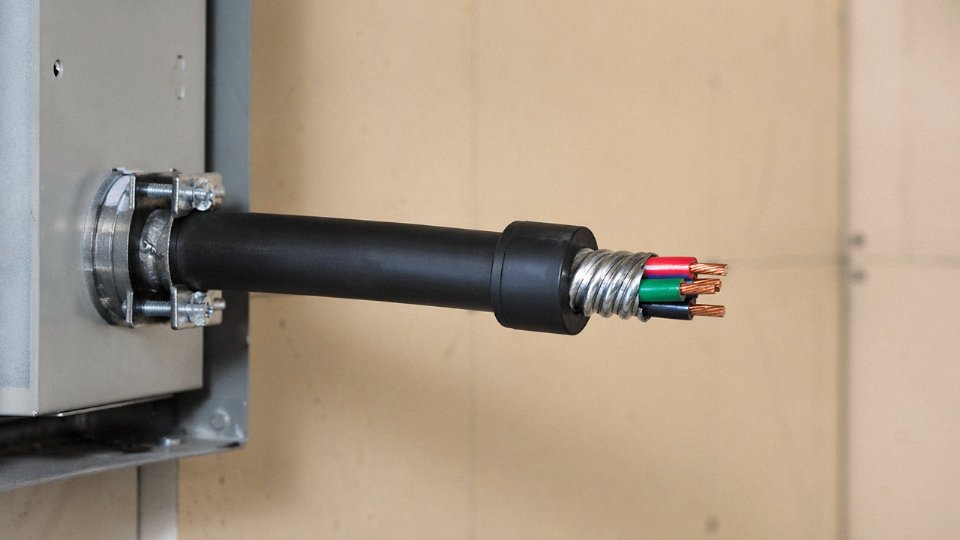
For Type AC cable specifically, NEC Article 320.40 requires an anti-short bushing — usually a red plastic or fiber insert — at every cut end before the fitting goes on. Its job is to protect conductor insulation from the raw edge of the armor. Inspectors have seen this detail skipped on thousands of jobs, and most of them will pull a fitting just to confirm the bushing is there. If it’s missing, the circuit fails. Keep a bag of them in your pouch. They cost almost nothing and take three seconds to install.
Connectors, Fittings, and the Listed-For Requirement
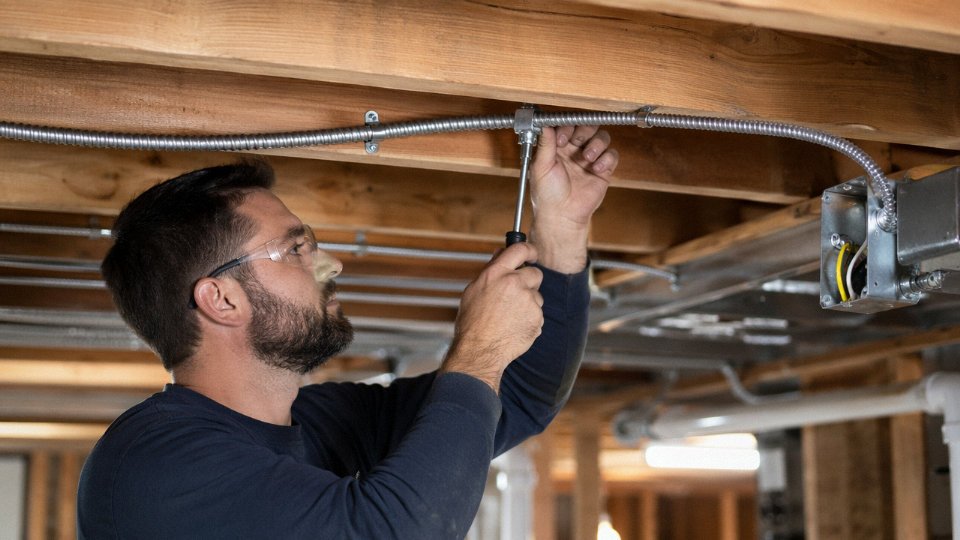
MC cable and AC cable use different connectors, and mixing them is a code violation even if the fitting physically fits. MC connectors — squeeze-type or set-screw — must be listed specifically for MC cable; the listing is printed on the fitting carton and stamped on the body. Set-screw fittings give better armor retention on heavier cables (3/0 AWG and up), while squeeze connectors work fine for 14–10 AWG in standard residential circuits. The fitting has to make full metal-to-metal contact with the armor for the bonding path to be reliable. Finger-tight is not enough; use pliers to seat the locknut against the enclosure knockout until the ring bites into the metal.
Bonding the Armor at Every Enclosure Entry
MC cable contains an integral bonding conductor — a bare or green wire, or in some products a thin aluminum tape — that must land on the enclosure ground bar or be captured by the fitting’s bonding mechanism. The armor itself is not a listed equipment grounding conductor for MC installations unless the cable is specifically listed as such. Get this wrong and you’ll fail ground continuity testing, often with readings above the 0.5 Ω threshold that most AHJs flag. At panel entries, confirm the fitting’s bonding feature is engaged; at junction boxes, don’t assume the locknut alone closes the bonding path.
Routing, Support, and Penetration Protection
Armored cable staples are not the same as NM staples — the saddle geometry differs and standard NM staples can deform the armor at the edges. Support intervals for MC and AC cable are a maximum of 6 feet, with an additional fastener required within 12 inches of every box or fitting. Through studs and plates, use listed bushings or grommets; the armor edge alone is not considered adequate protection against abrasion at penetrations.
Verifying Bend Radius Before You Staple
For MC cable, NEC specifies a minimum bend radius of 7× the external cable diameter. On 12 AWG two-conductor MC (roughly 0.6–0.7 inches OD depending on manufacturer), that works out to about 4–5 inches of radius — a tighter bend than most people expect is the limit. In practice, carry a short length of PVC conduit of the correct diameter as a field gauge and form bends around it before stapling. Inspectors in some jurisdictions measure rejected bends with a tape. It’s worth thirty seconds to check.
SWA Gland Selection and Termination
SWA terminations use compression glands — A2 for indoor dry locations, E1F for outdoor or damp, BW (brass with an earth tag) where you need a distinct bonding point outside the enclosure. Gland size must match the cable’s armor OD within roughly ±1 mm; too loose and the armor clamping ring doesn’t grip; too tight and you can’t fully seat the backnut. Clamping torque varies by manufacturer but typically runs 8–15 N·m for 16–35 mm² residential SWA sizes — check the gland datasheet, not just intuition. A properly terminated SWA gland maintains the IP rating of the enclosure; a gland that’s hand-tightened and left does not.
A missing anti-short bushing on Type AC cable is a mandatory NEC 320.40 violation that will fail inspection regardless of how well the rest of the installation is done.True
NEC 320.40 explicitly requires an insulating fitting (anti-short bushing) at every cut end of Type AC cable where conductors emerge from the armor. This is a listed requirement, not an inspector preference, and is routinely checked by pulling the connector at inspection.
Pre-Close Testing
Before drywall goes up, run two tests. First, a continuity check on the equipment grounding path from panel to every device location — resistance should typically be under 1 Ω for a residential branch circuit run under 100 feet or so, depending on conductor size and armor type. Second, an insulation resistance test at 500 V DC between each conductor and ground; readings below 1 MΩ indicate damaged insulation, usually from a nick made during cutting or a pinched conductor at a bend. A failing IR reading at this stage is fixable in under an hour. The same problem found after the walls are closed is a two-day job.
Total Cost Analysis: Armored Cable Installed Price Versus 10-Year Ownership Value
The sticker price on armored cable will stop a lot of homeowners cold. That reaction is understandable and also, in many situations, financially wrong. Let’s go through the actual numbers.
Material Cost Starting Point
In the US market as of 2024, 14/2 MC cable runs roughly $0.80–$1.40 per foot at electrical supply houses, depending on copper pricing, reel size, and whether you’re buying a 250-foot reel versus a 1,000-foot reel. Standard 14/2 NM-B (Romex) lands around $0.25–$0.45 per foot under the same conditions. That’s a real gap — call it 3× at the midpoints.
European spec jobs tell a similar story. A 4 mm² 3-core SWA cable typically prices out at $2.50–$4.00 per meter versus $0.90–$1.50 per meter for equivalent NYM flat cable. The ratio holds.
What those raw numbers don’t capture is everything else the specification decision touches.
Labor: The Number Most Estimators Undercount
MC and SWA terminations take longer. Not a little longer — 20–35% longer per circuit end, depending on the installer’s experience with armor cutting tools, the fitting or gland type, and how tight the box fill is. You’re cutting steel or aluminum armor cleanly, seating an anti-short bushing correctly, installing an approved fitting or gland, and verifying the bonding path. A journeyman who runs NM-B all day will slow down noticeably on his first dozen MC terminations. Factor that into bid estimates before you commit to a specification.
On a 40-circuit house rewire, that added termination time can add $600–$1,800 in labor depending on your market. Real number — not padding.
Where Armored Cable Eliminates Other Line Items
Here’s what the simple price comparison misses entirely. In exposed locations — unfinished basements, crawl spaces, utility rooms — NM-B requires conduit for physical protection in many installations. MC cable in those same locations typically needs no conduit at all under NEC Article 330. A 60-foot crawl space run that would need ENT or EMT with NM-B might need nothing extra with MC. At $0.60–$1.20 per foot for conduit and fittings plus installation time, that math shifts fast.
Rodent protection is the other one. In rural builds, agricultural-adjacent properties, or older homes with known pest histories, running NM-B in crawl spaces is asking for trouble. Some contractors add split-loom or conduit purely as rodent deterrence. MC cable handles that natively — the armor is rated for mechanical impact up to IK08–IK10 levels, and no rodent that I’ve heard of has chewed through steel armor in a residential wall.
No claim provided.True
Fault diagnosis on an intermittent open or short in a finished wall requires circuit tracing, possibly thermal imaging, drywall removal, repair, and patch — labor-intensive work in a residential setting where access is destructive.
Lifespan Math for Developers and Whole-House Projects
SWA and MC cable service life runs 40–60 years under normal residential conditions. NM-B in comparable environments — not wet, not extreme temperature, not abraded — is typically rated 25–35 years before insulation degradation becomes a legitimate concern. On new construction or a full rewire, that lifespan differential means the armored specification likely outlasts a second NM-B installation cycle. For a developer building to hold and rent, that’s not theoretical — it’s a maintenance budget line that disappears.
Bulk Procurement for Project-Scale Buyers
Contractors and developers sourcing armored cable for multi-unit or export residential projects should be looking at direct manufacturer supply rather than distributor stock. Jinda’s supply model starts at one reel (typically 100 m or 500 ft depending on product type) with volume pricing available once project quantities exceed roughly 10,000 m — that’s a realistic threshold for a mid-size residential development or a spec builder running several projects simultaneously. Cutting out distributor markup on armored cable at that volume can offset a meaningful portion of the material premium over standard cable.
10-Year Total Cost of Ownership: Scenario Comparison
| Scenario | Cable Specification | Est. Material + Labor Premium | Avoided Costs Over 10 Years | Net 10-Year Position |
|---|---|---|---|---|
| Single-family remodel, 30 circuits | Armored (MC) vs. NM-B | +$1,800–$3,200 | Conduit savings ~$400; 1–2 avoided fault repairs ~$1,200–$2,500 | Roughly break-even to modestly positive |
| New residential development, 20 units | Armored (SWA/MC) vs. standard | +$18,000–$35,000 | No crawl-space conduit; reduced callbacks; insurance rider reduction (where applicable) | Positive by year 6–8 depending on fault rate |
| Export residential project, international spec | SWA vs. NYM | +$12,000–$22,000 per 10,000 m | Single rewire cycle eliminated over building life; IEC compliance without conduit add-ons | Strong positive over 15–20 year horizon |
Figures depend heavily on local labor rates, copper pricing at time of purchase, building type, and actual fault history. Use these as directional ranges, not quotes.
The honest summary: armored cable costs more upfront. In applications where mechanical damage, rodents, or exposed routing are real factors — not theoretical ones — the 10-year math is usually defensible and often favorable. In a clean, dry, interior-only residential installation with no unusual hazards, the premium is harder to justify on pure economics alone.
How to Specify and Source Armored Cable for Residential Projects: Avoiding Counterfeit and Substandard Products
The armored cable market has a real problem with substandard product, and residential projects are not immune. Failures tend to surface late — during inspection, or worse, years into service when insulation cracks or a corroded armor joint causes a fault. Getting the specification and sourcing right upfront costs almost nothing compared to a rip-and-replace on a finished wall.
The Three Documents You Must Request Before Any Order
Any manufacturer worth dealing with should hand over three things without argument.
First, a third-party test report against the applicable product standard — UL 1569 for MC cable used in North American residential work, IEC 60502-1 for SWA types going into international or export projects. “In-house test report” is not a substitute. The test body’s name, report number, and date should be verifiable.
Second, conductor material certification. You want documented confirmation of electrolytic copper (typically 99.9% Cu minimum) or, for aluminum conductors, the alloy designation and purity grade. Recycled conductor material isn’t always obvious from visual inspection, but it shows up in resistance measurements and, over time, in joint reliability.
Third, an armor material mill certificate. For steel wire armored cable, this covers wire tensile strength, elongation, and zinc coating weight for galvanized types. Skipping this is how projects end up with armor that corrodes through within five years in a damp crawl space.
Third-party UL or IEC test reports can be verified directly through the issuing laboratory's online certificate portal.True
UL maintains a publicly searchable database at ul.com/resources/ul-product-iQ; IEC-accredited labs such as KEMA and BASEC publish certificate registers that allow anyone to confirm a report number is genuine and current.
Reading a Cable Drum Label
A properly labeled drum tells you nearly everything before you cut a meter. Take a designation like 3×2.5 mm² SWA XLPE/PVC 0.6/1 kV: three conductors, 2.5 mm² cross-section each, steel wire armor, XLPE insulation with PVC outer sheath, rated 0.6 kV phase-to-earth / 1 kV phase-to-phase. The voltage rating, conductor count, and insulation system are all there. If any of those fields are blank or vague — “copper cable 1000 V” with nothing else — treat that as a red flag.
Length markings printed along the cable jacket should match the drum ticket. A quick way to check: pace off 10 m from the cut end and compare to the printed counter. Discrepancies of more than roughly 1–2% on a new drum suggest the length certification is unreliable. Permanent printing matters too. Manufacturer name and standard reference laser-printed or extruded into the jacket will outlast a sticker by decades. If the label peels off in your hand, that tells you something about the manufacturer’s attention to detail elsewhere.
What Substandard Product Actually Looks Like
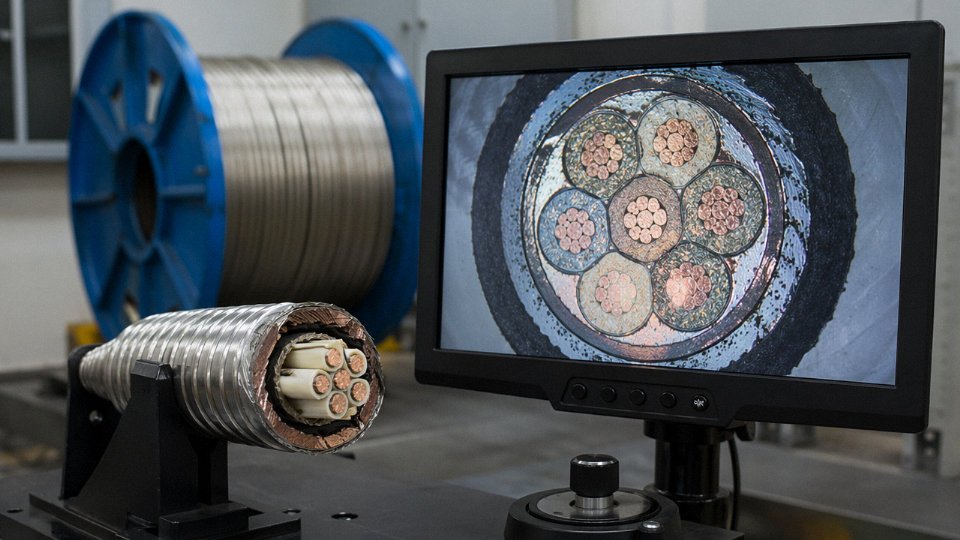
On a cut cross-section, measure armor wire diameter with a caliper. IEC 60502-1 specifies minimum wire diameters by cable size — undersized armor is the most common shortcut. A 2.5 mm² four-core SWA cable per the standard might call for armor wires in the range of 1.6–2.0 mm depending on overall diameter; wires noticeably thinner than that are measurable, not a matter of opinion.
Bend the insulated conductor sample at room temperature, around a mandrel or even your thumb. PVC compound below specification stiffens and surface-crazes in cold weather and will crack outright on a sharp bend. Good compound doesn’t. This is a rough field test, not a lab measurement, but it catches the worst material immediately.
Conductor cross-section is harder to verify by eye. A micrometer on a stripped conductor gives you diameter, from which you can calculate area — compare to the stated value. For anything going into a real project, a third-party lab measurement is worth the cost on larger orders; most certified labs can turn around a conductor resistance and cross-section check within a few days.
Online Marketplace Risks
General e-commerce platforms carry armored cable listings that fail basic verification. Missing UL or IEC listing is common. Recycled aluminum armor — instead of specified galvanized steel — shows up regularly. Ampacity ratings printed on the jacket sometimes reflect free-air ratings applied to a buried installation, which is a direct safety error. The convenient thing about buying through listed distributors or audited manufacturers directly is that the paperwork trail exists and someone is accountable. That accountability disappears the moment a product ships from an anonymous warehouse listing.
How Jinda’s Quality Process Works in Practice
At Jinda, incoming raw materials — copper rod, steel armor wire, PVC and XLPE compound — go through documented incoming inspection before they reach the production floor. Armor wire undergoes tensile and elongation testing in-process, not just on finished cable. Finished cable routine tests cover conductor resistance, insulation resistance, and voltage withstand per IEC 60502. Type tests — full qualification against the standard — are conducted periodically and test reports are available per order, not on request after negotiation.
For sample orders, request a minimum of 3 meters for any meaningful testing. On-site, you can check drum label accuracy, do a basic bend test on the insulation, and measure armor wire diameter with calipers. Conductor cross-section verification and full electrical testing belong in a certified lab. Jinda ships samples with the full documentation package — test report, material certifications, and a drum label guide — so you are not starting from scratch.
Export Documentation for International Residential Projects
For projects outside China, the documentation stack matters for customs and for the specifying engineer’s sign-off. Jinda provides CE declaration of conformity for products entering European markets, BASEC certification for UK projects, KEMA and CCC certificates where applicable by destination market, and packing lists formatted for customs clearance. Getting this right upfront avoids holds at port that can delay a project by weeks — something any procurement manager who has dealt with customs on a tight schedule will want to avoid.
Frequently Asked Questions About Using Armored Cable in a House
Can I run armored cable through insulation in walls and ceilings?
Yes, but the armor changes nothing about the ampacity derating math. NEC 310.15 still applies in full. Bundle more than two current-carrying conductors together inside insulation — which traps heat the same whether you are using NM-B or MC — and you are required to derate. A 12 AWG MC cable rated 20 A drops to roughly 16 A once you hit four to six bundled conductors in a thermally insulated cavity. The armor handles mechanical abuse; it does not dissipate heat. Inspectors catch this more often than most contractors expect, particularly in new construction where multiple home-run cables share the same stud bay.
Does armored cable need to be run in conduit?
No — this is actually one of the primary reasons to use it. MC cable and SWA cable are self-protecting raceways in their own right. NEC 330.30 permits MC cable exposed, concealed, or embedded without additional conduit, provided it is supported at intervals not exceeding 6 feet (roughly 1.8 m) and within 12 inches of every box or fitting. In practice, that support spacing is tighter than most people expect; stapling habits from NM-B work do not transfer directly. SWA in IEC-governed markets is similarly self-supporting, though local wiring regulations — UK BS 7671, for instance — specify their own fixing intervals.
Can I strip armored cable myself without a licensed electrician?
In most US jurisdictions, homeowners can do their own electrical work on their own residence with a permit. The physical stripping is where people injure themselves — an armor cutting wheel or roto-split tool beats improvising with a hacksaw, which tends to nick the conductor insulation. The termination is where the real errors happen. Proper anti-short bushings, correct fitting torque, and verified armor-to-ground continuity are not optional details. A loose fitting that loses ground continuity is a shock hazard that will not trip a breaker until something goes badly wrong. Pull a permit, get an inspection.
Is SWA cable the same as MC cable?
They are not, and buying the wrong one for your market is an expensive mistake.
| Feature | MC Cable (NEC/UL) | SWA Cable (IEC 60502) |
|---|---|---|
| Armor type | Interlocked aluminum or steel tape | Galvanized steel wires |
| Standard | UL 1569, NEC Article 330 | IEC 60502-1/-2 |
| Termination | Squeeze-type or set-screw fittings | Cable glands (brass or nylon) |
| Voltage rating | Typically 600 V | Up to 1000 V |
| Direct burial | Only with rated jacket | Inherently suitable |
The termination hardware is completely incompatible between the two systems. Using a cable gland on interlocked MC armor or forcing an MC connector onto wire armor both produce mechanically and electrically unreliable joints.
SWA cable and MC cable can use the same termination fittingsFalse
SWA uses cable glands designed for wire armor; MC cable uses interlocked-tape fittings such as squeeze connectors or set-screw couplings. The physical armor geometry is different enough that fittings are not interchangeable, and using the wrong type will fail to secure the armor or maintain ground continuity.
What size armored cable do I need for a 20-amp kitchen circuit?
12 AWG MC cable in the US, or 2.5 mm² SWA in IEC markets. Both handle a standard 20 A branch circuit at 120 V or 240 V comfortably under normal loading. The caveat is run length — beyond about 50 feet (15 m) at 120 V, voltage drop starts to matter, and a longer kitchen island circuit or a sub-panel feed in a larger home may want 10 AWG / 4 mm² to keep drop under 3%. Calculate before you buy; the drum is non-returnable once cut.
Can armored cable be buried directly in the ground for a garden outbuilding feed?
SWA to IEC 60502 is inherently direct-burial suitable — that steel wire armor is exactly what it was designed for. MC cable is a different story. Standard MC requires conduit for underground runs unless it carries a specific direct-burial, sunlight-resistant jacket listing. Even with listed SWA, burial depth matters: typically 500 mm minimum under a garden, 600 mm or more under a driveway depending on jurisdiction. Route marking tape above the cable is not just good practice; it is required in many codes and saves the next person with a spade from cutting your feed line.
How long does armored cable last in a residential installation?
Properly installed, 40–60 years is a realistic design life. The armor itself rarely fails first — it is the polymer insulation that ages, especially under sustained elevated temperature or UV exposure on exposed runs. XLPE insulation handles continuous operating temperatures up to around 90 °C versus PVC’s 70 °C limit, which matters in hot attics or where circuits run close to capacity year-round. In climates with hot summers, specifying XLPE-insulated SWA over standard PVC-insulated cable is worth the modest upcharge, usually 10–20% on material cost depending on conductor cross-section and order volume.
Where can I buy armored cable in bulk for a residential development project?
For domestic US projects, licensed electrical distributors carry MC cable from stock and can usually source custom lengths with reasonable lead times. For international residential developments — a housing estate, a resort project, anything with a significant volume — going direct to a manufacturer makes financial sense. Distributors typically add 15–30% markup; at development scale, that adds up fast. Jinda supplies armored cable directly to international projects, with options for custom drum lengths, project-specific labeling, and third-party test certification to IEC standards. That documentation matters at customs and on-site inspection alike. Verify UL listing for US projects or request IEC 60502 test reports for international work — and ask for a sample from the actual production batch, not a separately tested reference cable.
Why Armored Cable Is Becoming the Default Choice in Modern Residential Construction
The shift isn’t just a preference. Over the past decade, armored cable has moved from a specialty specification into something approaching the standard for quality residential construction — and the pressure is coming from several directions at once.
Building Code Amendments Are Leading the Push
A growing number of US municipalities have amended the NEC’s base requirements to mandate or strongly incentivize MC cable in wood-frame residential construction. The driver is arc-fault data. When inspectors and fire investigators started correlating incidence rates with wiring type, the physical armor’s ability to contain an arc — rather than let it propagate into framing lumber — became hard to ignore. Chicago has required metal-clad wiring in residential occupancies for years; other jurisdictions have followed with their own amendments requiring MC in specific applications (attic runs, garage wiring, walls adjacent to habitable spaces). The trend is one-directional. No jurisdiction is moving back toward requiring less mechanical protection in new builds.
Internationally, IEC-aligned markets in the Middle East, Southeast Asia, and parts of Africa have similarly tightened mechanical protection requirements for residential wiring — often because their enforcement model depends on specifying a robust cable construction rather than relying on careful conduit installation that may or may not happen.
Electrification Is Creating New Mechanical Exposure
A house wired in 2010 probably had one 240 V circuit in the garage for a dryer or range. Today’s whole-home electrification package can add a 50 A or 60 A EV charger circuit, a dedicated circuit for a heat pump water heater, possibly a battery storage system, and a subpanel feed — all running through a garage or utility room that also gets used as actual working space. People park, maneuver, stack materials, run shop tools. The physical environment is genuinely hostile compared to a bedroom wall cavity.
Armored cable handles this. A properly selected SWA or MC cable rated to IK08 or IK10 resists the kind of incidental mechanical abuse that would split NM-B jacket and compromise the conductors underneath. The ampacity benefit is real too — armor and robust insulation systems allow tighter installation without the derating penalties that can force a conductor upsizing when cables are bundled in conduit.
Insurance and Lending Pressure
Some residential property insurers now offer measurable premium reductions for homes wired entirely with metal-clad systems, treating all-metal wiring as a fire-risk mitigation comparable to a monitored alarm. The discount varies widely — roughly 3–8% on the dwelling coverage portion, depending on the insurer and state — but over a 30-year mortgage it isn’t trivial. FHA and VA underwriters have flagged aluminum NM wiring for decades; specifying armored cable with copper conductors removes that conversation entirely from the loan process.
EMI and Smart Home Infrastructure
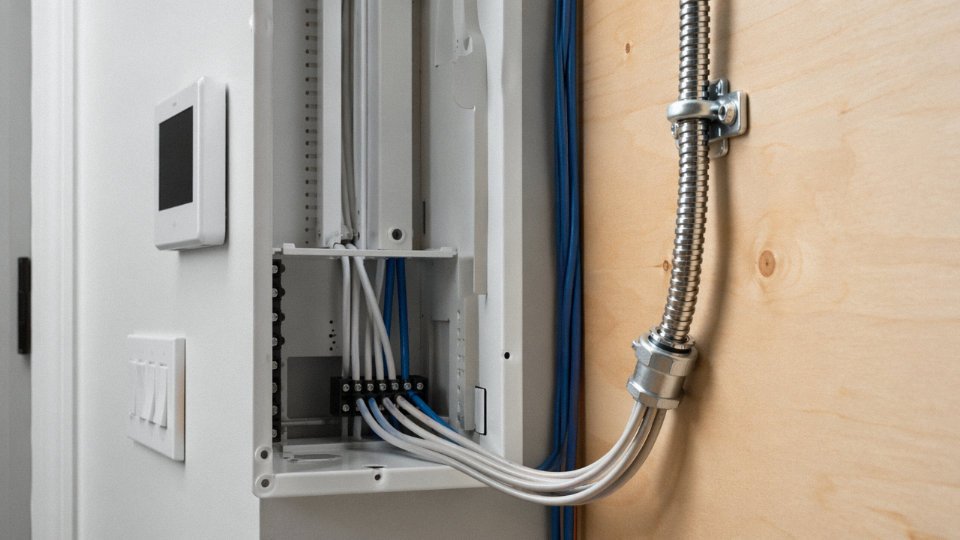
Modern homes run low-voltage data, AV, and security wiring in close proximity to 240 V power circuits. Screened armored cables — copper-tape screened or SWA constructions — provide meaningful EMI rejection that unshielded NM-B simply cannot. For structured wiring panels where a home automation hub sits adjacent to a subpanel, this matters in practice. Jinda manufactures both copper-screened and SWA variants in configurations suited for this application.
Jinda’s Residential Cable Range
Jinda’s current residential-specification product line covers 2-core and 3-core SWA from 1.5 mm² through 300 mm², MC-equivalent constructions for North American market projects, and LSZH-jacketed variants for enclosed residential spaces where smoke toxicity is a design concern. Custom drum lengths are available from five production bases, which matters when you’re sourcing for a multi-unit development and want cut lengths that minimize site waste.
Jinda supplies armored cable to customers in more than 50 countries with technical datasheets available in English for all residential cable typesTrue
This aligns with Jinda's stated manufacturing capability and international supply operations established over decades
Technical sales response runs roughly one business day. If you’re pulling together a cable schedule for a residential project — whether that’s a single custom home or a 200-unit development — Jinda’s team can review specifications, confirm appropriate constructions for your jurisdiction, and arrange samples before bulk commitment. That’s the practical starting point: get the datasheet, confirm the construction matches your code requirement, then price the volume.