Outdoor cable failures rarely announce themselves. A compromised sheath lets moisture track toward the armor, the armor corrodes, and by the time a ground fault trips the breaker — or doesn’t, if protection coordination is loose — you’re looking at unplanned downtime, a trench reopened through finished landscaping or a live production yard, and a repair bill that dwarfs whatever was saved by skipping proper cable selection in the first place. Picking the wrong cable for an outdoor run is one of those decisions that feels invisible for two or three years, then costs you on the worst possible day.
Yes, armored cable can be run outside. Steel wire armored (SWA) and steel tape armored cables with UV-stabilized XLPE or PVC outer sheaths are specifically engineered for outdoor exposure, direct burial, and mechanical stress. Installed to IEC 60502, BS 5467, or NEC burial-depth requirements — typically 600 mm minimum in open ground — they deliver service lives of 30 to 40 years under normal conditions.
What makes outdoor armored cable installation succeed or fail, though, is rarely the cable itself. It’s the combination of armor type, sheath chemistry, burial depth, soil conditions, and termination quality — and the gaps between what a spec sheet promises and what actually gets installed on a job site. Each of those variables deserves a close look.
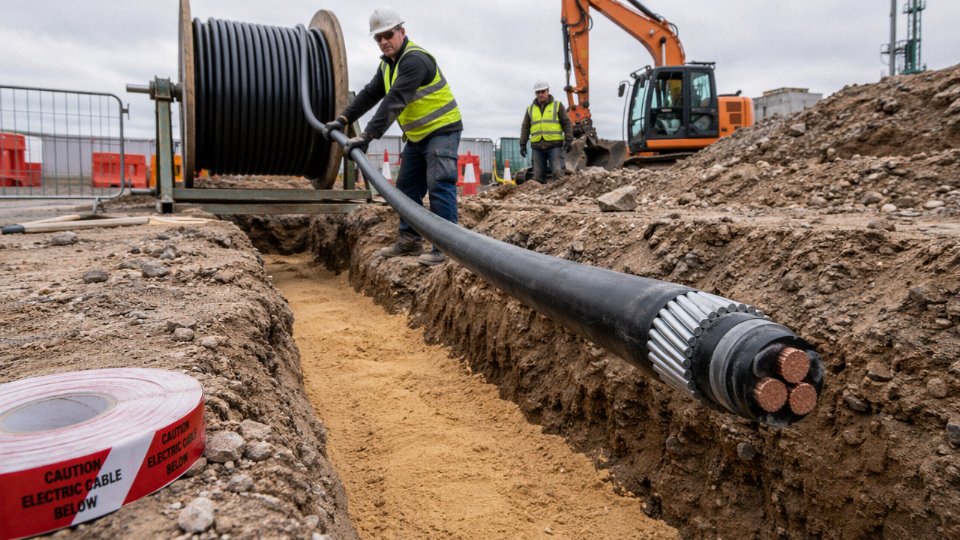
Armored Cable Construction: Which Layers Actually Make It Outdoor-Capable
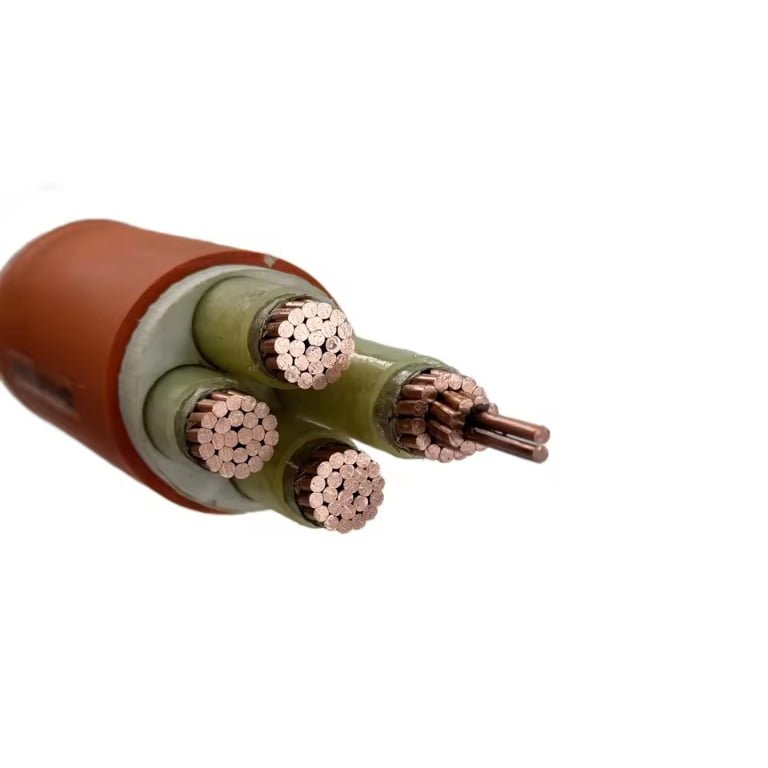
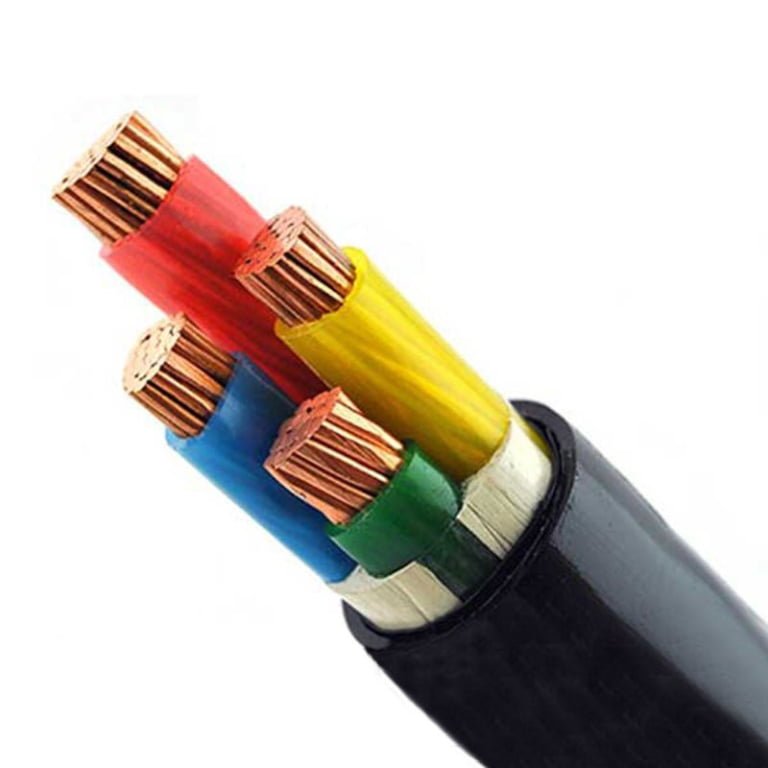
Understanding whether a specific cable will survive outdoor service comes down to reading the cross-section correctly. Marketing language on a datasheet is not the same as construction. Here’s what each layer actually does — and which ones matter most once the cable leaves a conduit and faces weather, soil, or UV exposure.
Conductor Material and Stranding
Most outdoor armored cables use plain annealed copper conductors, either solid (for smaller sizes, typically up to 16 mm²) or stranded for flexibility and fault-current distribution in larger sizes. Tinned copper is specified less often but shows up in marine or high-humidity industrial environments where copper oxide formation at terminations becomes a maintenance headache over time. Aluminum conductors appear in utility-scale distribution runs where weight and cost per meter are the dominant drivers — though aluminum demands more careful termination practice, particularly around galvanic compatibility with steel armor.
Stranding class matters more than most procurement specs acknowledge. Flexible Class 5 stranding can pull more easily through conduit but costs more; Class 2 is typical for fixed outdoor installations and handles direct burial fine.
Insulation Compound
XLPE (cross-linked polyethylene) is the outdoor workhorse. It handles continuous conductor temperatures up to 90 °C under normal load and short-circuit temperatures up to 250 °C, and it resists moisture absorption far better than standard PVC. PVC insulation is cheaper and adequate for many applications, but it softens noticeably above 70 °C and can become brittle in sustained cold — below roughly -15 °C, standard PVC insulation starts losing flexibility in ways that matter during installation in winter. EPR (ethylene-propylene rubber) is the choice for flexible outdoor cables in mining, offshore, or any situation with frequent movement; it tolerates a wider thermal swing but costs significantly more than XLPE and isn’t necessary for most fixed-route outdoor runs.
Inner Bedding and Fillers
Bedding sits between the insulated cores and the armor layer. Its job is to prevent the armor wires or tapes from cutting into the insulation under mechanical load, and to distribute radial pressure evenly. Extruded PVC or polypropylene tape bedding is standard. This layer is rarely discussed in procurement conversations, but poor bedding selection on cables subjected to frequent thermal cycling or ground movement leads to insulation damage that’s invisible until a fault occurs.
Armor Layer: Where Mechanical Outdoor Performance Lives
SWA (steel wire armored) is the most common choice for direct burial and outdoor tray installations. The galvanized steel wires provide tensile strength and crush resistance, and the zinc coating delays corrosion — though in coastal or chemically aggressive soils, that protection has limits. AWA (aluminum wire armored) gives you roughly 30–40% less weight per meter and far better performance in salt-air environments; offshore substations and coastal industrial plants frequently specify AWA for this reason. STA (steel tape armored) uses overlapping steel tapes rather than helical wires, which improves radial crush resistance but reduces flexibility and longitudinal tensile strength — it suits short, fixed runs more than long pulled installations. Double-steel-tape armor is specified where mechanical abuse risk is highest: busy cable crossings, rocky direct burial routes, or anywhere cable protection from rodent damage or ground movement is a genuine concern.
| Armor Type | Direct Burial | UV Resistance (with sheath) | Weight | Corrosion Behavior | Typical Voltage Range |
|---|---|---|---|---|---|
| SWA | Excellent | Good–Excellent | Medium–Heavy | Moderate (galvanized) | 0.6/1 kV – 33 kV |
| STA | Good | Good | Medium | Moderate | 0.6/1 kV – 11 kV |
| AWA | Good | Good–Excellent | Light | Good (salt-air resistant) | 0.6/1 kV – 33 kV |
| Double Steel Tape | Excellent | Good | Heavy | Moderate | 0.6/1 kV – 11 kV |
The Outer Sheath: The Real Outdoor Differentiator
Most engineers fixate on the armor, but the outer sheath is what actually determines long-term outdoor performance. Standard PVC sheaths will chalk, crack, and lose plasticizer over years of UV exposure. UV-stabilized PVC to IEC 60502 Type ST2 incorporates carbon black or UV absorbers; in practice this extends sheath service life from roughly 10–15 years (standard PVC outdoors) to the 30–40-year design life the cable was engineered for — provided installation follows manufacturer guidelines on burial depth and bend radius.
HDPE (high-density polyethylene) outer sheaths are preferred for direct burial applications where soil chemistry is aggressive — acidic peat soils, ground contaminated with oils or solvents, or areas with significant moisture cycling. HDPE resists hydrocarbons better than PVC and maintains flexibility at lower temperatures. LSZH (low-smoke zero-halogen) sheaths are specified where fume toxicity in a fire event matters: cable tunnels, underground transit systems, congested cable trays in occupied buildings. LSZH carries a cost premium and isn’t necessary for an open outdoor trench, but if the cable transitions indoors through any confined space, it’s worth specifying end-to-end rather than splicing mid-run.
Jinda manufactures SWA, STA, AWA, and double-steel-tape armored cables with IEC 60502-compliant UV-stabilized and HDPE sheath options and can supply third-party test reports covering UV aging resistance and mechanical crush performance.True
Jinda's production capabilities across five manufacturing bases in China, combined with their IEC 60502 compliance documentation and third-party testing program, support this claim for customers requiring verifiable material qualification.
When evaluating any armored cable for outdoor service, pull the sheath compound specification before anything else. The armor type tells you about mechanical protection. The sheath tells you whether the cable will still be intact in fifteen years.
Outdoor Installation Methods: Aerial, Surface-Mounted, Conduit, and Direct Burial Compared
How you run armored cable outside matters just as much as which cable you specify. Get the method wrong and you’ll be dealing with premature sheath cracking, water ingress at terminations, corrosion under cleats, or a cable that fails a mechanical damage inspection before the project is even commissioned. Each installation method has a genuine use case — none is universally “best.”
Aerial Runs: Messenger Wire, Trays, and Sag
SWA cable can be run overhead, but it needs support. On cable trays or ladder rack suspended between structures, cleat spacing of roughly every 900 mm on horizontal runs is standard IEC practice; on vertical risers, supports can typically be spaced up to 1,200–1,500 mm depending on cable OD and weight per meter (check the manufacturer’s pulling tension table — a 50 mm² 4-core SWA weighs in the range of 3.5–5 kg/m and that adds up fast over a 30-meter span). For free-span aerial runs, a catenary or messenger wire carries the mechanical load and the cable is lashed or clipped to it — never rely on the cable’s own armor to handle tensile stress from sag over unsupported distances. Sag calculations should keep tension well below the cable’s rated axial load, typically 15–25% of break load as a working figure, but confirm with the specific product datasheet.
UV exposure is the other aerial concern. Bare PVC outer sheaths degrade in direct sunlight in as little as 5–8 years in high-UV environments (tropical or desert climates, rooftop runs). Specify a UV-stabilized XLPE or carbon-black-modified PVC sheath if the run will see continuous direct sunlight. The armor beneath doesn’t protect the sheath — it protects the insulation after the sheath fails, by which point moisture has likely already entered.
Surface-Mounted on Walls and Structures
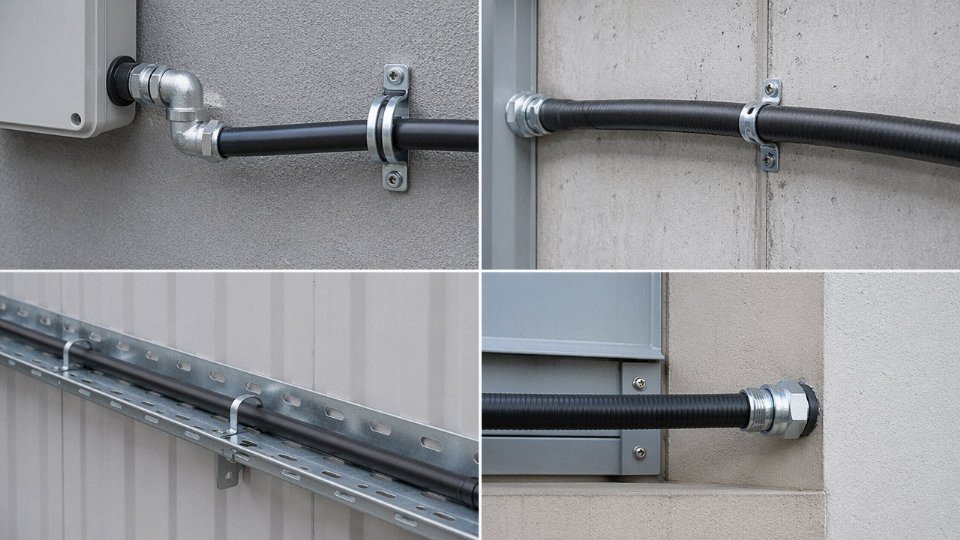
Fixing armored cable to masonry, steel, or concrete uses cleats, cable clips, or cable ladder systems. Hardware must be stainless steel or hot-dip galvanized — mild steel clips will rust through in 2–4 years outdoors in any humid or coastal environment, and then you have a corroding cleat bearing on the cable OD. Standoff distance from combustible surfaces is a real concern in industrial settings; local fire codes typically require 50 mm minimum clearance, though this varies by jurisdiction.
The armor is not a substitute for mechanical protection in high-traffic zones. In areas where forklifts, vehicles, or personnel regularly pass, a steel conduit sleeve or protective duct from ground level up to at least 2 meters is worth the extra cost. I’ve seen SWA cable on a factory wall completely flattened by a single forklift incident — the armor took the hit but the insulation was compromised.
Inside Conduit Outdoors
Running armored cable inside conduit outdoors is permitted and sometimes the right call — particularly in areas with severe chemical exposure (battery rooms, fertilizer plants, coastal facilities) or where the surface looks clean today but the maintenance culture suggests it won’t stay that way. The armor becomes a redundant mechanical layer, which is genuinely useful.
Conduit fill rules still apply. Seal conduit entry points at buildings with a listed conduit seal fitting to prevent moisture migration by capillary action — warm indoor air draws cold outdoor moisture in through an unsealed conduit faster than most people expect, especially seasonally.
Direct Burial
Minimum burial depth for low-voltage armored cable in open ground runs 600 mm under IEC/BS practice and 610 mm (24 inches) under NEC for direct burial. Rocky or disturbed ground, road crossings, and agricultural land typically demand more — 750 mm to 1,000 mm is common for road crossings, and some utilities require 1,200 mm under paved surfaces.
Bedding matters. A 75–100 mm sand surround below and above the cable protects against point loading from stones. Lay warning tape 150–200 mm above the cable, not at cable depth where it’s useless. Document the route with GPS coordinates and as-built drawings — undocumented buried cable gets hit by excavators; it’s almost a certainty over a 20-year asset life.
Soil chemistry is frequently ignored until it isn’t. Galvanized steel wire armor corrodes measurably faster in acidic soils below pH 6.0, and in soils with high chloride content near coastal areas. If the soil report shows pH in the 4.5–5.5 range — not unusual in peat-heavy or industrially contaminated ground — either specify stainless steel wire armor, use HDPE-sheathed cable with additional protection, or route differently.
Method Comparison at a Glance
| Criterion | Aerial | Surface-Mounted | In Conduit | Direct Burial |
|---|---|---|---|---|
| Installation cost | Medium | Low–Medium | Medium–High | Medium |
| Mechanical protection | Medium | Medium (low in traffic zones) | High | High |
| Maintenance access | Easy | Easy | Moderate | Poor |
| UV exposure handling | Critical — specify UV sheath | Moderate concern | Shielded — low concern | Not applicable |
| Typical project type | Cross-building, overhead yard runs | Plant walls, cable bridges | Chemical plants, road crossings | Site distribution, substation feeds |
Direct burial of standard SWA cable without sand bedding or marker tape meets minimum installation standards.False
IEC and BS 7671 practice requires a sand surround and protective marker tape above the cable. Omitting bedding increases point-load damage risk, and omitting marker tape dramatically increases the probability of third-party excavation damage over the cable's service life.
Code and Standards Compliance for Outdoor Armored Cable: NEC, IEC, BS, and Beyond
Buying the wrong cable — or buying the right cable and installing it under the wrong listing — can fail an inspection, void insurance, and leave you with a full re-pull. Standards compliance isn’t paperwork for its own sake. It’s the mechanism that tells you, precisely, what a given cable is permitted to do.
NEC (NFPA 70): MC Cable Is Not a Blanket Approval
A lot of installers assume that because Metal-Clad (Type MC) cable is armored, it’s inherently outdoor-rated. Article 330 of the NEC corrects that assumption quickly. Standard MC cable is listed for dry, damp, and wet locations — but wet location approval does not automatically extend to direct burial or continuous outdoor exposure without the appropriate listing designation.
The NEC distinguishes specific subtypes. MC-HL (metal-clad, health care limited) has its own restrictions. More relevant for outdoor industrial work: there is a “listed for direct burial” MC category that uses a moisture-resistant, corrosion-resistant outer jacket — usually a polyethylene oversheath — plus a bare or coated aluminum interlocked armor or steel wire armor underneath. Unless the cable’s label or manufacturer data sheet explicitly states “listed for direct burial,” it cannot go in the ground without conduit. That’s not interpretation; that’s Article 330.116.
Burial depth under NEC Table 300.5 depends on circuit voltage and the presence of overcurrent protection. For circuits up to 600 V in direct burial (no conduit), the minimum is 24 inches — that aligns closely with IEC/BS practice of 600 mm, though the NEC also allows reductions under concrete encasement or GFCI protection in certain residential scenarios. Medium-voltage circuits have their own rows in that table, and they generally require deeper burial or conduit regardless of armor type.
IEC 60502-1 and IEC 60502-2: The International Baseline
IEC 60502-1 covers cables up to 1 kV; IEC 60502-2 picks up from 6 kV through 30 kV. Together they’re the most widely adopted framework globally — accepted across the EU, most of Southeast Asia, the Middle East, Africa, and large parts of South America. If you’re procuring for a project outside North America, IEC compliance is usually the baseline expectation, not a premium option.
For outdoor and direct-burial applications, IEC 60502 specifies the armor type (SWA, STA, AWA), oversheath material requirements, and test protocols for mechanical protection, water penetration, and UV resistance. A cable manufactured and tested to IEC 60502-2 for medium-voltage outdoor use carries real engineering weight — it means the construction has been validated against those specific environmental conditions, not just listed generically.
IEC 60502-compliant SWA cables are recognized as suitable for direct burial and outdoor installation across more than 50 countries.True
IEC 60502-1 and IEC 60502-2 are adopted or referenced by national standards bodies across the EU, Middle East, Africa, Southeast Asia, and South America, making IEC compliance the de facto international baseline for armored cable procurement and installation approvals.
BS 5467 and BS 6724: Still Very Much Alive
British Standards tend to get treated as legacy specs, but if you’re supplying to a utility project in Nigeria, a substation in the UAE, or infrastructure work in Malaysia, there’s a good chance the specification sheet still calls out BS 5467 (XLPE-insulated armored cables) or BS 6724 (armored cables with low-smoke zero-halogen sheaths). Commonwealth markets held onto these standards tightly, and many engineering consultancies in those regions still write them into tender documents as primary references rather than IEC alternatives.
BS 6724 in particular matters for outdoor installations near public access — tunnels, cable bridges, transit infrastructure — because the LSZH sheath requirement isn’t just about fire performance indoors; it’s about specifying a cable that behaves predictably in confined outdoor spaces where smoke generation during a fault could create secondary hazards.
CE, UL, ATEX, and CCC: The Regional Certification Layer
Beyond the core construction standards, regional certifications determine whether a cable can legally be installed on a given site:
| Certification | Region / Scope | Key Outdoor Consideration |
|---|---|---|
| CE Marking | European Economic Area | Confirms conformity with EU directives; required for sale but not a detailed performance standard on its own |
| UL Listed | North America | UL 1569 (MC cable) — listing must specifically include “wet location” and “direct burial” if those uses are intended |
| ATEX / IECEx | Hazardous area zones (global) | Outdoor industrial sites with flammable atmospheres require zone-rated cable glands and — depending on the circuit — specific cable construction |
| CCC | China domestic market | Mandatory for cables installed in China; separate from IEC compliance even when IEC is the design basis |
ATEX is worth flagging explicitly. Outdoor doesn’t mean automatically safe from a zone classification standpoint — a petrochemical yard, a tank farm perimeter, or a paint facility loading dock can be Zone 1 or Zone 2 outdoors. The cable listing needs to align with the zone, and that requirement sits on top of whatever outdoor or burial rating the cable carries.
Practical Takeaway for Procurement and Specification
Always verify that a cable’s type approval or listing specifically covers the intended installation method. “Outdoor rated” and “direct burial rated” are not synonymous. A cable approved for outdoor surface mounting still needs conduit if it’s going underground. Pull the data sheet, look for the specific listing language, and if you’re working across multiple jurisdictions on the same project, understand which standard governs each segment.
Jinda manufactures armored cables to IEC 60502-1 and IEC 60502-2, BS 5467, and BS 6724, with the flexibility to produce to project-specific standards where tender documents require it. Third-party test certificates and full technical data sheets — the actual documents procurement managers and site engineers need for compliance packages — are available on request for any product line.
Environmental Hazards That Determine Armored Cable Longevity Outdoors
Getting armored cable into the ground or onto a cable tray outside is the easy part. Making it last 30 years is where the specification work actually matters. The outdoor environment attacks cable from at least five distinct directions simultaneously, and each one has a different failure mode and a different mitigation.
UV Radiation
Standard black PVC sheath with no added UV stabilizer will retain acceptable mechanical properties for roughly 10–15 years in direct sunlight — less in equatorial climates, more in northern latitudes with weak seasonal sun. That sounds adequate until you’re specifying a 25-year substation build. UV-stabilized PVC or XLPE compounds push usable life to 25–30+ years by incorporating carbon black or hindered amine light stabilizers at concentrations that genuinely absorb UV rather than just pigmenting the sheath.
HDPE outer sheath is the strongest performer for UV resistance among common sheath materials, which is why it appears on cables specified for exposed aerial runs or coastal installations. If your cable will spend its entire service life in direct sunlight — rooftop runs, open coastal racks — HDPE sheath is worth the small cost premium. For conduit or buried runs, basic UV-stabilized PVC is usually sufficient because the sheath isn’t the primary protection once the cable is covered.
Moisture and Water Ingress
“Water-resistant” and “waterproof” are not the same thing, and the gap between them costs projects dearly. A water-resistant sheath slows ingress; it won’t stop longitudinal water tracking once a nick or cut admits moisture at a termination point. Water that enters a cable in a flooded trench can wick along the interstices between armor wires and conductor strands for tens of meters, degrading insulation and causing partial discharge faults that are genuinely difficult to locate.
Longitudinal water blocking — swellable tape under the armor, flooding compound in the interstices, or both — is the right answer for any cable that might sit in standing water, even intermittently. This is standard on IEC 60502-2 medium-voltage cables for buried service. During storage and installation, end-sealing is not optional. An unsealed drum end left outdoors for a wet weekend can introduce enough moisture to compromise a termination joint later. This gets skipped more often than it should on busy sites.
Temperature Extremes
Low-temperature flexibility ratings matter in ways that aren’t obvious from a datasheet. A cable rated to –40 °C for service temperature may still become brittle during installation at that temperature if the sheath compound has poor elongation at break at low temperature — IEC 60811 specifies the test method. In high-altitude or Arctic installations, always confirm the installation temperature rating separately from the service rating.
At the hot end, desert environments impose daily thermal cycling of 40–50 °C across the sheath. Insufficient elongation at break in the outer compound causes cracking over a few hundred cycles. Derate conductor ampacity for sustained ambient temperatures above 40 °C; the derating curves in IEC 60287 or NEC tables are straightforward but frequently ignored on outdoor runs where shade assumptions don’t hold.
Soil and Chemical Corrosion
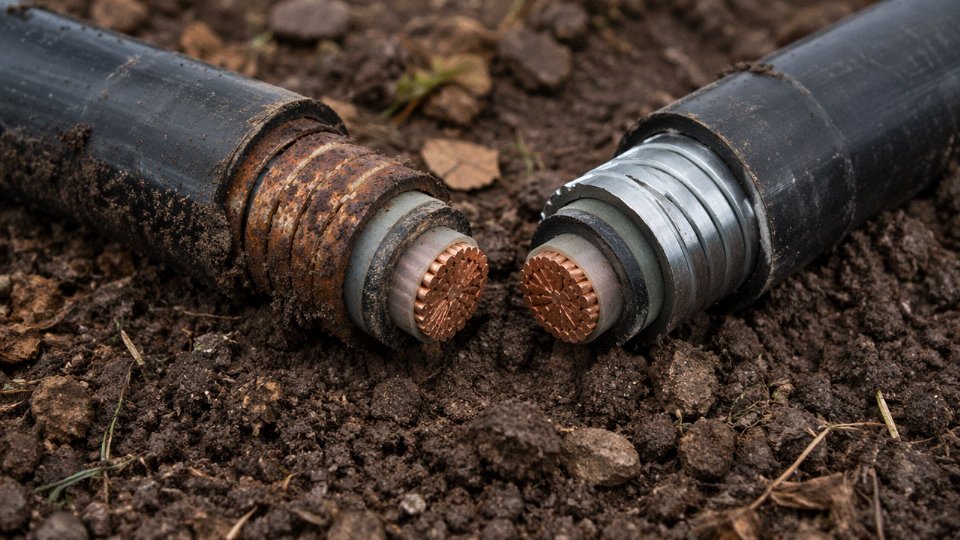
Standard galvanized steel wire armor handles normal soil chemistry adequately. Where soil pH drops below roughly 5 or rises above 9, or where industrial backfill contains sulfates or chlorides, galvanic corrosion of the armor accelerates meaningfully. Epoxy-coated or stainless-steel armor is appropriate for those zones; the cost difference is real but far smaller than replacing a failed cable buried under a process area.
Stray electrical currents in urban environments — from DC traction systems, grounding networks, cathodic protection systems — cause galvanic corrosion that looks almost identical to chemical attack. If the route runs within a few hundred meters of light rail or an electrochemical plant, stray current survey data should inform the armor specification. This is an easy hazard to overlook during desktop design.
Mechanical Hazards
Rodents are a legitimate engineering problem, not an edge case, in agricultural or forested sites. HDPE outer sheath provides better bite resistance than PVC, but in known rodent zones the reliable answer is an armored duct or a secondary mechanical barrier. Ground movement and frost heave stress the cable axially; flexible stranding and burial below the frost line are the appropriate responses, not armor alone. For runs under trafficked surfaces, mechanical protection tiles above the cable or steel conduit for the top 300 mm of burial depth are standard practice — the armor handles incidental contact, not repeated dynamic load from vehicles.
Coastal and Offshore Environments
Salt spray and tidal splash are genuinely corrosive to standard galvanized steel armor within a few years. Aluminum wire armor (AWA) with an HDPE outer sheath is the typical specification for coastal and marine above-ground runs; tinned-copper conductors add protection where condensation cycling is severe. For anything submersible or offshore, IEC 60092 provides the framework — it covers marine cable design in a level of detail that onshore standards don’t address, including armor material selection for seawater exposure.
UV-stabilized HDPE outer sheath provides superior long-term UV resistance compared to standard PVC sheath for directly exposed outdoor armored cable runs.True
HDPE's molecular structure and high carbon black loading give it better resistance to UV-induced chain scission than standard PVC, which relies on plasticizers that can leach over time, reducing flexibility and UV performance. This is reflected in material specifications from cable manufacturers and confirmed by IEC 60811 weathering tests.
The practical takeaway is that no single specification covers all five hazard categories equally well. A cable optimized for arctic flexibility may have marginal UV resistance; one specified for corrosive soil may not be rated for submersion. Cross-checking your site’s actual hazard profile against the cable’s construction spec — sheath compound, armor material, water-blocking provision — is the work that determines whether a cable reaches its design life or fails in year eight.
Step-by-Step Outdoor Armored Cable Installation Best Practices
Good cable fails in the field because of bad installation far more often than it fails from manufacturing defects. That’s worth keeping in mind before you unroll a single meter.
Pre-Installation Checks
Before the cable drum leaves the compound, confirm the outer sheath is intact. Transport damage — a crushed section from an overtightened strap, a gouge from a forklift tine — is surprisingly common and easy to miss until an insulation resistance test fails three days later. Walk the drum perimeter, check both flanges for cracks, and record the drum number, cable type, voltage rating, and length against your material delivery note. Cross-check the cable type designation against the installation method in the spec: SWA (steel wire armored) for direct burial, STA (steel tape armored) where crush loads are lower, XLPE vs. PVC sheath for the service temperature on your site. Mismatches here cost money and time. Weigh the drum if your logistics setup allows — a drum significantly lighter than the manufacturer’s declared weight can indicate a short length.
Handling and Unreeling
Never roll a cable drum on its flat face. Stand it on its flange, use a proper drum jack or cable stand that keeps the axle off the ground, and unreel in the direction of the arrow marked on the flange. Pulling cable against the natural lay direction builds torsional stress that can buckle the armor wires or, worse, cause the cable to birdcage.
Minimum bending radius for multicore SWA cable under IEC 60502 guidance is typically 8× the overall cable diameter during installation — that’s the dynamic figure. Exceeding it, even briefly at a trench corner, can damage XLPE insulation without leaving any visible external sign. Use cable rollers at every directional change, especially at trench entry points and surface conduit transitions. Skipping the rollers to save setup time is a common site shortcut that accelerates sheath wear at the very points where mechanical stress concentrates.
Direct Burial Procedure
Excavate to your required depth plus a minimum 75 mm for sand bedding below the cable — in practice, add another 50 mm contingency because trench bottoms are rarely perfectly flat. Lay the cable in a gentle S-curve rather than pulling it taut along the trench floor. That slight sinusoidal lay accommodates thermal expansion and contraction; a cable pulled dead straight under summer heat has nowhere to move and develops tensile stress at termination points over years of cycling.
Place 75 mm of clean, sharp-free sand over the cable, then install a concrete or clay protective tile directly on top. Marker tape goes in at roughly 300 mm below final grade — high enough that a shovel strike hits the tape before it hits the cable. Backfill in compacted layers, and install surface route markers (posts, marker plates) at intervals your site standards require, typically every 10–15 m and at every change of direction.
Outdoor Termination
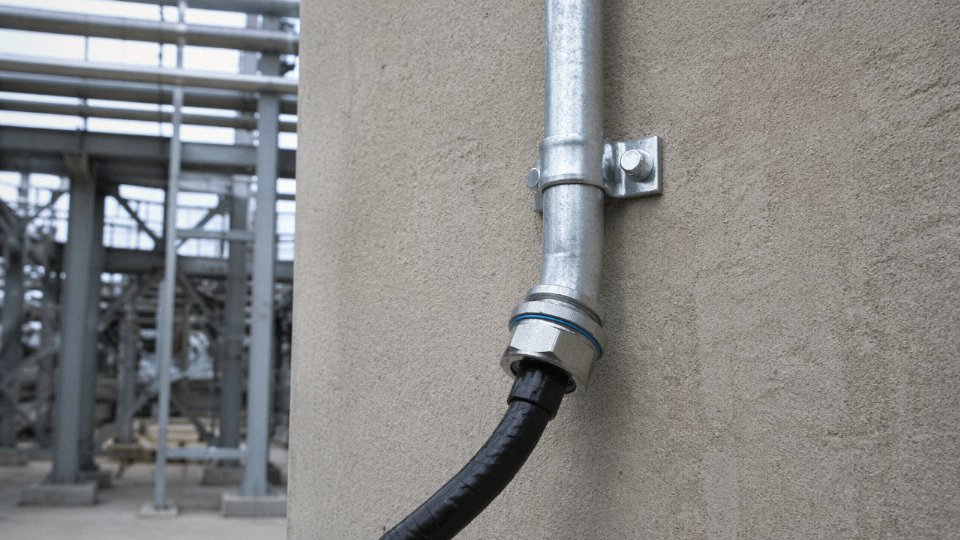
Use cable glands rated IP66 minimum for exposed outdoor terminations; IP68 where there’s any realistic risk of submersion or pressure washing nearby. The gland must mechanically grip the armor layer — loose armor grip means the cable’s weight is carried by the conductor connections over time, and it means the armor earth path is unreliable. Apply UV-resistant self-amalgamating tape over exposed sheath ends and use outdoor-rated heat-shrink or cold-shrink termination kits designed for the sheath material. Don’t mix PVC-grade and XLPE-grade kits; the adhesion chemistry differs.
Armor Bonding and Earthing
For runs shorter than roughly 100 m, bond the armor at both ends to a common earth. This provides a low-impedance fault path and keeps touch voltages safe. On longer runs — high-voltage circuits especially — bonding both ends creates a closed loop where induced voltages drive circulating currents through the armor, generating heat and wasting energy. Single-point bonding with a parallel earth continuity conductor is the preferred approach in those cases, and IEC 60364-5-54 and BS 7671 Chapter 54 both address the selection criteria. Which approach your project needs depends on cable length, load current, and fault level requirements; if you’re unsure, the armor circulating current calculation is straightforward and worth running before committing to the bonding arrangement.
Testing After Installation
Run an insulation resistance test at 1 kV DC (500 V for cables below 1 kV rating is acceptable for a site acceptance test, but 1 kV gives you a more discriminating result) before any terminations are made permanent. Record IR values phase-to-phase and phase-to-earth; values below roughly 100 MΩ on a new LV cable warrant investigation before energizing. Test armor continuity end-to-end — a break in armor coverage that passed visual inspection will show up here. Where the project specification calls for a high-voltage withstand test, follow the manufacturer’s test voltage limits precisely; over-voltage testing of XLPE cables causes cumulative insulation damage that shortens service life in ways that don’t show up until years later.
Armor circulating currents on long single-core SWA cable runs can cause measurable cable heating and energy loss if both armor ends are bonded.True
Induced voltages in the armor of long cable runs drive circulating currents through the closed loop formed by double-end bonding. IEC 60287 provides the calculation method; the effect is real and documented in power systems engineering practice.
Document everything — test instrument serial numbers, ambient temperature at test time, values recorded, and inspector sign-off. Those as-built records are what your maintenance team needs when something fails five years from now.
Selecting the Right Outdoor Armored Cable for Your Project: Specification Checklist
Getting the installation method right matters, but specifying the wrong cable in the first place will cost you far more — in warranty disputes, premature failures, or a re-pull that nobody budgeted for. This checklist is written for the person filling out the purchase order or the Bill of Materials, not for a general reader.
Voltage Class
Start here, and be precise. The IEC 60502 voltage designation system expresses rated voltage as U₀/U (kV), where U₀ is conductor-to-earth and U is conductor-to-conductor. Common outdoor power cable classes are 0.6/1 kV, 3.6/6 kV, 6/10 kV, 8.7/15 kV, and 12/20 kV. Specifying “10 kV cable” without the U₀/U designation is genuinely ambiguous — a 6/10 kV cable and an 8.7/15 kV cable both get called “10 kV” loosely, but they have different insulation wall thicknesses and different fault-withstand margins. Confirm your system nominal voltage, your earthing arrangement (solidly earthed, impedance earthed, isolated neutral), and then select the voltage class that gives adequate U₀ headroom for your earthing regime.
Conductor Sizing
Cross-section drives cost and thermal performance simultaneously. For IEC projects, start with IEC 60364-5-52 ampacity tables, then apply correction factors for soil thermal resistivity (anything above roughly 1.5 K·m/W starts to noticeably derate buried cables — in clay-heavy or dry sandy soils this bites harder than most people expect), cable grouping, and ambient temperature. In NEC jurisdictions use Table 310.15(B)(16) or 310.15(B)(18) for direct-burial, again with applicable adjustment factors. State the cross-section explicitly in mm² for IEC orders and AWG or kcmil for NEC-governed projects. Mixing conventions on the same purchase order is a common source of costly errors.
Insulation and Sheath
For outdoor armored cable, XLPE insulation is the usual choice over PVC — better thermal rating, lower dielectric losses at medium voltage, and it handles thermal cycling more gracefully over a 30–40 year service life. EPR is worth considering for offshore or very cold-climate applications where flexibility at low temperatures matters. The outer sheath compound needs a stated UV stability requirement if any portion of the cable is surface-mounted or aerial; not all black PVC compounds offer equivalent UV resistance, and you want this confirmed in the test data, not assumed. If the installation is inside a tunnel, a public building basement, or any space with limited ventilation, specify LSZH (Low Smoke Zero Halogen) sheathing explicitly. Don’t leave it as an implication.
Armor Type and Material
SWA (Steel Wire Armored) covers the majority of outdoor burial and surface-mounted applications. For coastal environments, marine installations, or areas with high soil chloride content, specify AWA (Aluminum Wire Armored) to avoid galvanic corrosion risk. High mechanical-risk routes — road crossings, areas prone to ground movement — benefit from double-steel-tape armor. When writing the specification, state the nominal armor wire diameter and lay pitch. These details prevent a supplier from substituting thinner wire armor that technically meets a generic “SWA” description but reduces crush resistance meaningfully.
Certification and Documentation
At minimum, request: a factory routine test report for each drum, a type-test certificate per IEC 60502-1 or -2, and a material compliance declaration covering RoHS and REACH. For projects requiring UL listing or BS compliance, confirm this before the order is placed — retrofitting certification after manufacture is not straightforward.
Packaging and Logistics
Specify drum inner diameter, maximum outer diameter, and flange dimensions if your site has cable-laying equipment with reel-stand constraints. State whether wooden or steel reusable drums are needed. Length marking every 1 m or 5 m on the cable surface should be written into the order — it makes field cutting and as-built documentation significantly cleaner.
Jinda's technical team responds to project specification inquiries within 24 hours with a preliminary offer.True
Jinda operates dedicated technical sales teams across time zones to support international project timelines, making same-business-day preliminary response a standard service commitment for bulk and project orders.
To engage Jinda for a quotation, submit a structured Bill of Materials or Specification Sheet covering the points above. Sample lengths can be dispatched for approval testing before a bulk order is confirmed — a step worth building into the project schedule rather than skipping under schedule pressure.
Frequently Asked Questions About Running Armored Cable Outside
Can standard indoor MC cable be used outdoors?
No — not unless the specific product carries an outdoor or direct-burial listing. Standard Type MC cable is listed for dry, indoor locations. The distinction matters because an unlisted cable in a wet outdoor environment will pass moisture into the termination, corrode the armor, and degrade the insulation over a timescale that’s hard to predict but is often surprisingly fast — sometimes under three years in humid coastal climates. Before spec’ing any MC product for an outdoor run, pull up the UL listing (or the relevant IEC product standard) and confirm it explicitly says “wet location” or “direct burial.” If the listing doesn’t say it, don’t assume it. This is one of those things that gets caught in inspection, or worse, after a ground-fault event.
Does the armor on SWA cable eliminate the need for conduit outdoors?
For direct burial and surface mounting in most industrial and utility applications, yes — the steel wire armor provides mechanical protection sufficient to meet code without a separate conduit. That said, “most applications” is doing real work in that sentence. NEC and virtually every local authority having jurisdiction (AHJ) will require conduit where the cable crosses under roadways, enters a building at grade, or passes through areas with chemical splash or vehicle traffic. In practice, the crossing under a site access road is the one that catches people off guard — you’ll trench the whole run in direct burial, then hit the road crossing and need to sleeve it through PVC or steel duct anyway. Worth planning at the drawing stage rather than improvising with a hired excavator standing by.
How deep does armored cable need to be buried?
Under IEC and BS practice, low-voltage armored cable needs at least 600 mm of cover in open ground, 450 mm under footpaths, and 900 mm under roads. NEC Table 300.5 specifies 24 inches (610 mm) for direct-burial cables rated 0–600 V under general conditions. These are minimums — in agricultural land where deep plowing occurs, experienced site engineers often specify 900 mm even where 600 mm would technically comply.
IEC/BS practice requires a minimum burial depth of 600 mm for LV armored cable in open ground, and NEC Table 300.5 requires 24 inches (610 mm) for 0–600 V direct-burial cable in general conditions.True
Both IEC 60502-series installation guidance and NEC Article 300 Table 300.5 specify these respective minimum cover depths for low-voltage direct-burial cable in standard soil conditions.
How long does armored cable last outdoors?
A properly specified and correctly installed outdoor armored cable carries a design service life of 30–40 years. Achieving the upper end depends heavily on a UV-stabilized outer sheath — usually HDPE or UV-grade PVC — galvanized or aluminum armor rather than bare steel, and installation that avoids damage at the point of laying. Cables that arrive on-site with sheath nicks, get dragged over sharp trench edges, or are terminated into fittings that allow water ingress will fail well short of that design figure. The installation day has a disproportionate effect on the total service life.
Can armored cable be left exposed above ground outside?
Yes, when properly fixed to cable trays, cable ladders, or cleats at manufacturer-specified intervals, and when the outer sheath carries a UV-resistance rating. The interval spacing matters more than people realize — unsupported spans allow the cable to sag, stress the armor wires at the support points, and eventually work-harden and crack the wires. Non-UV-rated sheath left in direct sunlight will chalk, crack, and fail within a few years in high-UV environments like the Middle East or sub-Saharan Africa. Specify the right sheath compound first; cleat spacing second.
Is armored cable waterproof?
Water-resistant, not waterproof — that’s the honest answer. Standard armored cable can operate continuously in wet locations and handle rain or soil moisture without issue. Actual submersion or long-term water contact under pressure is a different requirement. Applications involving water crossings, cable ducts that flood seasonally, or submarine-adjacent runs need a water-blocked construction: swellable tape wrapping or a flooding compound that provides a longitudinal watertight barrier, per IEC 60502-2 Annex requirements. Ordering standard armored cable for a submerged run is a specification error that no amount of good installation practice can fix.
What is the minimum bending radius for outdoor SWA cable during installation?
For multicore SWA cable, minimum bending radius during installation is 8× the overall cable diameter. Single-core SWA requires 12×. These aren’t conservative suggestions — going tighter can crack the XLPE insulation, deform the armor lay, and create stress points that show up as partial discharge or premature failure years later, sometimes at a bend that looks completely fine on the surface. Drum trailers that feed cable too fast around a tight pulley sheave are a common cause of radius violations on long trench runs. The manufacturer’s warranty is typically void if bending radius violations are documented.
Can Jinda supply armored cable certified for both IEC and BS standards?
Yes. Jinda manufactures cables to IEC 60502-1/2, BS 5467 (PVC-sheathed SWA), and BS 6724 (LSZH-sheathed SWA), with third-party type-test certificates available for project submission. For projects requiring compliance with national variants — DEF STAN, AS/NZS, or specific Gulf country standards — custom constructions can be quoted against the project specification. Lead times and minimum order quantities vary by construction and voltage class, so early engagement on the technical schedule is worth it if your project has a tight procurement window.
Why Jinda Armored Cables Are Built for Global Outdoor Infrastructure Projects
If you’ve read this far, you already understand what separates a properly specified outdoor armored cable from a product that fails in the second wet season. The question shifts from what to specify to who can actually manufacture it to those specs, at volume, with documentation your project engineer and customs broker will both accept.
Manufacturing Scale That Matches Real Project Volumes
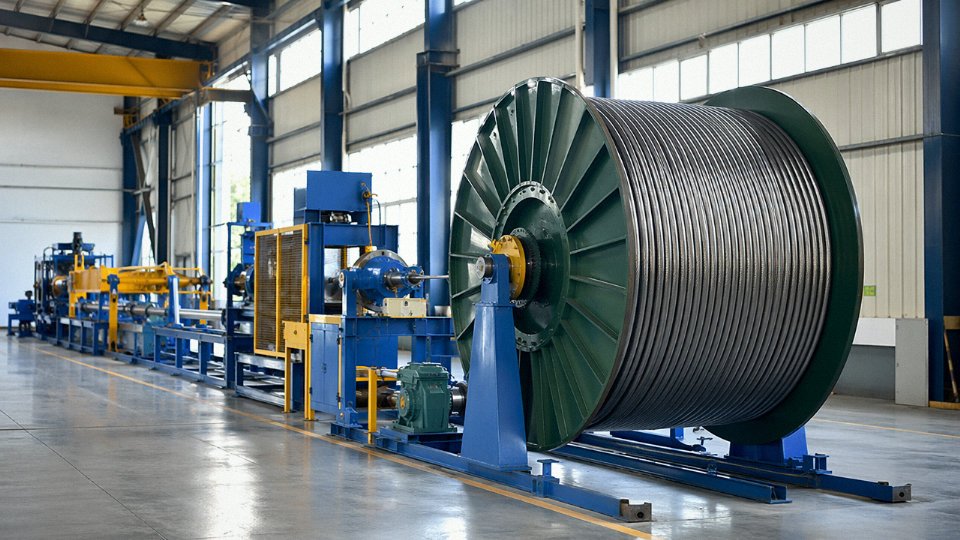
Five production bases, roughly 470,000 m² of combined floor space — that’s not a headline, it’s a logistics reality. Large infrastructure contracts in power distribution, renewable energy, or industrial plant construction often require cable quantities that a mid-size manufacturer simply can’t deliver without splitting drums across production runs, which introduces inconsistency in armor pitch and sheath thickness. Jinda’s dedicated armored cable lines run SWA, AWA, STA, and XLPE-insulated medium-voltage constructions in continuous lengths up to 3,000 m per drum. For a substation feeder route or a wind farm string that needs unjointed runs, that continuous length capability is worth more than a lower unit price from a supplier who maxes out at 500 m.
Quality Systems With Teeth
ISO 9001 certification is table stakes at this point. What matters operationally is what happens at the test bench. Every meter of insulation passes a spark test before armoring — that means a pinhole or thin spot in the XLPE or PVC doesn’t get buried under steel wire and shipped to site. Every finished drum goes through an armor continuity check, which catches broken wire armor before it leaves the factory rather than after a ground fault trace reveals the problem three years into service.
The in-house high-voltage test laboratory is rated to 132 kV AC withstand. For medium-voltage SWA cables at 11 kV or 33 kV going into a grid-connected solar project or an industrial substation, being able to provide factory test certificates from the same facility that made the cable — rather than outsourced to a third-party lab with a six-week queue — shortens the project documentation cycle noticeably.
Jinda performs a spark test on every meter of insulation and an armor continuity check on every finished drum before shipment.True
These are standard in-process quality controls for IEC 60502-compliant armored cable manufacturing and are verifiable through factory audit or third-party inspection witness testing.
Export Experience Isn’t Just a Country List
Cables have shipped to infrastructure projects across Southeast Asia, the Middle East, Africa, Europe, and South America. The practical value of that track record isn’t the geography — it’s the paperwork fluency. Projects in these regions routinely require letter-of-credit payment terms, origin certificates, SASO or SONCAP conformity documentation, and third-party inspection by SGS, Bureau Veritas, or TÜV before loading. Jinda’s export team handles these workflows regularly enough that they don’t slow down your shipping schedule.
Pre-Order Technical Support
Before you place an order, the application engineering team can run cable sizing, route derating calculations for direct-burial or conduit configurations, and installation method reviews. In practice, this catches undersizing errors on long feeder runs where ambient soil temperature or grouped burial significantly reduces ampacity — the kind of mistake that’s cheap to fix at the specification stage and expensive after commissioning.
Free samples are available for approved projects above minimum quantity thresholds, which lets your QA team or a third-party lab verify construction before committing to a full order.
Customization and Lead Times
Conductor cross-sections run from 1.5 mm² up to 1,000 mm². Voltage classes cover 0.6/1 kV through 35 kV. Sheath color, meter-marking interval, LSZH or halogen-free compound — all configurable per project specification. Standard constructions typically ship within 15–25 working days depending on conductor size and drum quantity; urgent project timelines can be accommodated with a production scheduling confirmation in writing.
Submit your cable schedule through the Jinda international sales team or via the company website. A technical-commercial proposal comes back within 24 hours of receiving a complete specification — conductor size, voltage class, armor type, length per drum, quantity, and destination standard.