Outdoor cable failures rarely announce themselves. A sheath cracks after two winters of UV exposure, moisture tracks along the conductor, insulation resistance drops quietly over months — and then you’re pulling a shift crew to dig up a run that was supposed to last twenty years. Replacement isn’t just the cable cost; it’s excavation, lost production, and if it’s a feeder to critical equipment, potentially a regulatory inspection before you can re-energize. Specifying the wrong cable for an outdoor installation is one of those decisions that looks fine on paper until it absolutely isn’t.
Yes, armored cable can be used outside — and in most industrial and utility applications, it’s the preferred choice. Steel wire armored (SWA) or steel tape armored (STA) cables handle direct burial, open tray, conduit, and exposed overhead runs. The armor resists mechanical damage; the outer sheath, rated typically from -40°C to +90°C depending on whether the insulation is XLPE or PVC, handles weather and UV when specified correctly. The real question isn’t whether armored cable works outdoors — it’s which construction, burial depth, and sheath compound suit your specific environment.
What trips up even experienced procurement managers is that “armored cable” covers a wide family of constructions, and the differences between them matter enormously once you’re three years into a coastal petrochemical installation or a run through clay soil that floods every spring. The armor grade, sheath material, and bedding layers all interact — and choosing based on price per meter alone tends to produce the kind of failure nobody wants to explain to a plant owner.
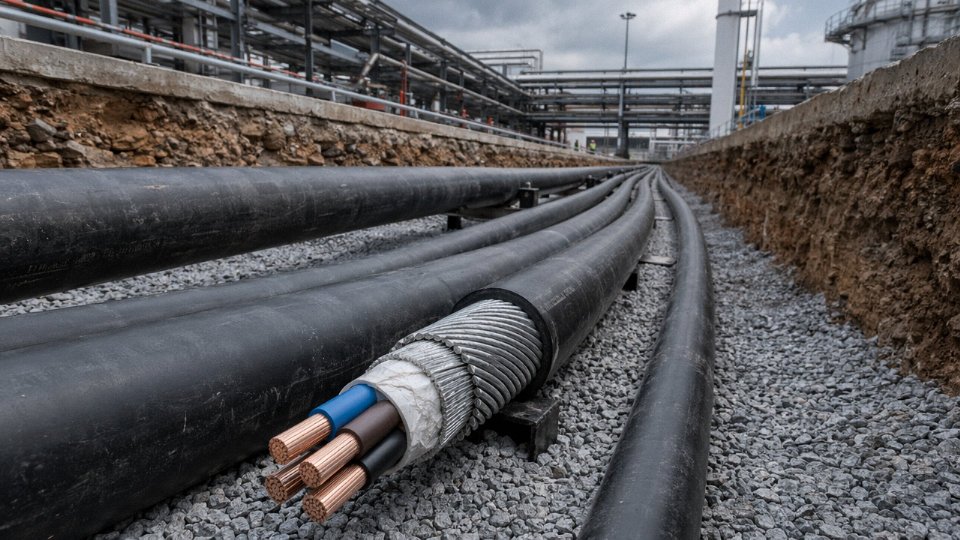
Armor Types Explained: Which Construction Is Actually Built for Outdoor Conditions
Not all armored cable is the same, and that distinction matters enormously once you move past indoor tray installations into genuine outdoor exposure — burial, aerial runs, coastal plant yards, or industrial areas with vehicle traffic. The armor layer is doing real mechanical and sometimes electrochemical work. Matching the wrong construction to the environment gets expensive: premature insulation failure, galvanic corrosion at splice points, or a cable that physically pulls apart during installation on a sloped trench.
Steel Wire Armor (SWA)
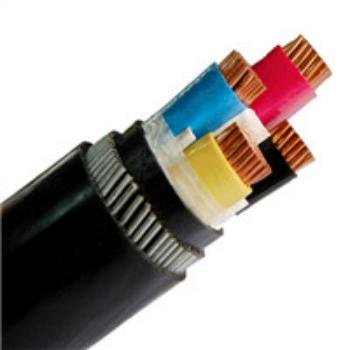
SWA is the workhorse. Galvanized steel wires wound helically over the inner sheath give you both tensile strength and crush resistance in one layer — which is exactly what direct burial demands. Tensile load capacity ranges from roughly 450 N/cm on small 2.5 mm² conductors up toward 900 N/cm on 240 mm² cables, with actual figures depending on wire diameter and lay angle. That spread matters during cable pulling: undersizing the drum or using a grip on the wrong section can exceed the armor’s rated load on steep pulls.
The galvanizing holds up well in neutral soils, but in saline ground — coastal reclaimed land, tidal zones, areas near de-icing salt runoff — the zinc sacrificial layer depletes faster than most people expect. In aggressive soil (pH below roughly 5 or above 9, or high chloride content), SWA without a robust outer PVC or HDPE oversheath is a medium-term maintenance problem, not a long-term solution.
Steel Tape Armor (STA)
Two overlapping helical steel tapes give STA stronger radial crush resistance than SWA, but the construction has no meaningful tensile contribution — the tapes buckle rather than absorb longitudinal load. That limits STA to static outdoor installations: cable in conduit, in surface trunking, or in underground duct where pulling tension is near zero. It’s a reasonable choice for a fixed outdoor switchgear feed that runs through buried PVC conduit; it’s the wrong choice for a direct-pull burial run across 200 m of open ground.
Aluminum Wire Armor (AWA)
AWA is lighter — typically 30–40% weight reduction over equivalent SWA, depending on cross-section — and non-magnetic. That second property is not cosmetic. On single-core cables carrying significant AC current, a closed ferromagnetic armor loop induces eddy currents and hysteresis losses that generate measurable heat and reduce effective ampacity. AWA eliminates that effect. Coastal and offshore environments also favor AWA because aluminum’s native oxide layer resists chloride-driven corrosion far better than galvanized steel once the zinc is gone.
Aerial and overhead outdoor runs are where AWA earns its place most clearly. The weight saving reduces catenary sag and mechanical strain on termination points.
Double Steel Wire Armor (DSWA)
Two concentric layers of steel wire. Specified when the environment genuinely justifies the cost and weight premium: rocky terrain where direct burial exposes cable to angular stone contact, industrial yards with forklift or heavy truck traffic over cable routes, or mining surface installations. DSWA crush and tensile ratings are substantially higher than single SWA, but you are adding mass and stiffness — minimum bend radius increases, and installation in tight or curved routes becomes harder.
Fiber Reinforced Polymer (FRP) Armor
Non-metallic, immune to galvanic and electrochemical corrosion, and effectively invisible to magnetic fields. FRP armor is standard in outdoor fiber-optic and telecom infrastructure and is increasingly specified for power cables in chemical process plants, wastewater treatment sites, and any outdoor zone where soil or atmospheric chemistry would degrade steel over the cable’s expected service life. It offers lower tensile load capacity than SWA for equivalent dimensions, so mechanical hazard risk needs separate assessment.
AWA (aluminum wire armor) eliminates eddy-current heating issues on single-core AC cables, while SWA does not.True
Steel is ferromagnetic; a continuous helical steel wire armor on a single-core AC cable forms a closed magnetic loop that generates eddy-current and hysteresis losses, raising operating temperature and reducing ampacity. Aluminum is non-magnetic and does not create this effect. This is why IEC and BS standards specifically address armor material selection for single-core cables.
Choosing the Right Construction: A Quick Reference
| Armor Type | Tensile Load | Crush Resistance | Corrosion Resistance | Weight | Best Outdoor Use Case | Relevant Standard |
|---|---|---|---|---|---|---|
| SWA | High | Moderate–High | Moderate (soil pH dependent) | Medium | Direct burial, general outdoor underground | IEC 60502, BS 6724 |
| STA | Low | High (radial) | Moderate | Medium | Conduit/duct outdoor runs, static fixed routes | IEC 60502 |
| AWA | Moderate | Moderate | Good (coastal/aerial) | Low | Single-core outdoor, aerial, coastal environments | IEC 60502, BS 6724 |
| DSWA | Very High | Very High | Moderate (needs oversheath) | High | Rocky burial, heavy traffic industrial yards | IEC 60502 |
| FRP | Moderate | Moderate | Excellent | Low | Telecom, chemical zones, corrosive outdoor sites | IEC 60794 (fiber), project-specific |
The outer sheath compound — PVC, HDPE, or LSZH — is doing significant protective work alongside the armor layer in every case above. Specifying the armor correctly and then accepting a thin or unsuitable oversheath is a common procurement error. Both layers need to suit the environment.
Sheath and Insulation Materials That Determine Long-Term Outdoor Durability
The armor layer gets most of the attention in outdoor cable specifications, and that’s understandable — it’s the visible mechanical protection. But in practice, the outer sheath and insulation compound are what actually determine whether a cable survives 25 years on a rooftop cable tray or starts cracking and absorbing moisture after five. Getting the armor right and the sheath wrong is a surprisingly common procurement mistake.
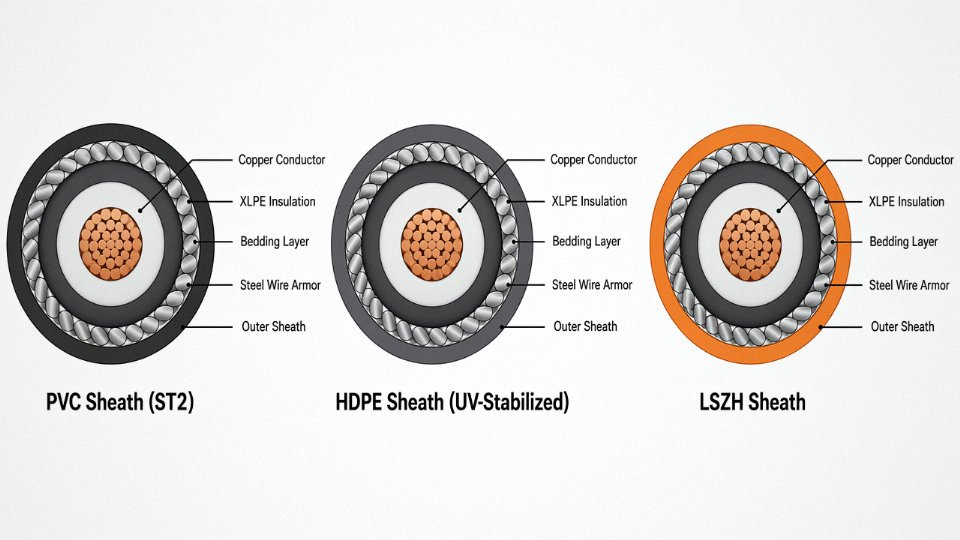
PVC Outer Sheath (ST2 Compound)
PVC is the default for a reason. It’s cost-effective, globally available, and performs acceptably in sheltered outdoor installations — think cables routed along the underside of covered walkways, in conduit, or buried where UV exposure is minimal. For a lot of industrial sites, it’s perfectly adequate.
The problems start at temperature extremes. Standard ST2 PVC compound becomes brittle below roughly -15°C, which means cold-climate installations — northern Europe, high-altitude sites, Canadian prairies in winter — carry real risk of sheath cracking during cable handling or thermal cycling. Direct sunlight accelerates degradation faster than most specs acknowledge. An unprotected standard PVC outer sheath will typically lose 30–40% of its tensile elongation after around 5 years of continuous direct UV exposure. That’s not catastrophic on day one, but it’s the beginning of moisture ingress pathways and mechanical failure under load.
UV-stabilized PVC grade changes the calculus. Properly specified UV-stabilized ST2 compound can deliver a practical service life of roughly 20–25 years in outdoor environments, which is why it remains a legitimate choice for many projects. Just confirm the grade with your supplier — not all “PVC armored cable” is UV-stabilized, and the cost difference is small enough that there’s no reason to accept the non-stabilized version for any outdoor application.
Standard PVC outer sheath loses 30–40% tensile elongation after 5 years of direct outdoor UV exposure, versus less than 10% loss for UV-stabilized HDPE sheath.True
UV degradation of PVC in outdoor environments is well-documented in polymer aging studies and cable manufacturer technical data. HDPE's superior UV resistance when compounded with carbon black stabilizers is an established material science fact used in IEC and BS cable longevity assessments.
XLPE Insulation with HDPE or Polyurethane Outer Sheath
For continuous direct sunlight exposure, the combination of XLPE insulation and an HDPE or polyurethane outer sheath is the correct specification. HDPE with carbon black UV stabilizer loses less than 10% tensile elongation under the same 5-year direct UV exposure that degrades standard PVC by a third. The temperature envelope — typically -40°C to +90°C at the conductor — makes this construction suitable for rooftop solar cable runs, outdoor substation feeders, and open cable trays in any climate zone. Polyurethane outer sheaths add abrasion resistance on top of UV stability, which matters in industrial yards where cables take mechanical abuse.
LSZH Sheath for Public Infrastructure
Low-Smoke Zero-Halogen sheath requirements sometimes catch procurement teams off guard because they associate LSZH with tunnel and indoor applications. Many outdoor public infrastructure projects — bridges, rail corridors, airport perimeter systems — now mandate LSZH compound specifically because emergency response in semi-open environments is complicated by toxic combustion gases from standard PVC. Check the project fire safety specification early. Retrofitting to LSZH after tendering adds cost and lead time.
EPR Insulation in Cold and Offshore Environments
EPR (Ethylene Propylene Rubber) insulation stays flexible at temperatures down to around -40°C, which makes it the practical choice for wind farm cable routes, offshore platform feeders, and any installation where cables are handled or flexed during cold-season maintenance. SWA cables with EPR insulation and a polyurethane or CSP sheath are essentially the standard construction for North Sea and similar offshore service — the flexibility alone prevents the installation damage that causes early failures in rigid XLPE or PVC cables at low temperatures.
The Bedding Layer — Often Under-Specified
The bedding compound, which sits between the armor and the insulated cores, is frequently treated as an afterthought. It serves two distinct functions: mechanical cushion (it prevents the armor wires from bearing directly on the core insulation under bending or crush loads) and chemical barrier. In agricultural outdoor environments specifically — irrigation infrastructure, grain handling facilities, outdoor pump stations — cables can be exposed to fertilizers, pesticides, hydraulic oils, and fuels. Standard PVC bedding swells and degrades in prolonged contact with hydrocarbon oils. For those environments, specify an oil-resistant bedding compound, usually a nitrile-modified PVC or a thermoplastic elastomer. The cost difference per meter is negligible compared to the cost of a cable replacement in a buried outdoor run.
The material stack — insulation, bedding, armor, outer sheath — has to be specified as a system for the actual environment, not pulled from a default product sheet.
Four Outdoor Installation Methods and the Armored Cable Specification Each Requires
Getting the cable type right and getting the installation method right are two separate decisions — and mismatching them is where most outdoor cable failures actually originate. A correctly specified SWA cable still fails prematurely if it’s surface-mounted without UV consideration, or pulled through a duct at excessive tension. Work through each method deliberately.
Direct Burial
Minimum trench depth is 600 mm for LV cables up to 1 kV, and 900 mm for MV up to 33 kV under IEC 60364-5-52 and BS 7671. Those aren’t suggestions — going shallower significantly raises the probability of mechanical damage from routine excavation nearby. In practice, many contractors dig to 750 mm for LV as standard to give themselves margin.
SWA with an HDPE or PVC outer sheath is the workhorse specification here. HDPE holds up better in wet or mildly acidic soils; PVC is cheaper and adequate in neutral, well-drained ground. Before finalizing the sheath, commission a soil corrosivity survey — soil resistivity below roughly 20 Ω·m, or high sulfate content near industrial sites, usually warrants an additional anti-corrosion tape wrap or a double-sheathed construction. Skipping the survey to save a few weeks during design has a habit of causing premature sheath degradation within five to eight years.
Route markers every 10–15 m and mechanical protection tiles laid 150–200 mm above the cable are non-negotiable on any run that might see future ground disturbance. It’s a cheap precaution that regularly saves expensive cable.
Surface Mounting — Walls, Trays, and Ladders
Once a cable is exposed to direct sunlight, UV degradation becomes the primary aging mechanism for the outer sheath. Standard black PVC loses flexibility and develops surface cracking within a few years in high-UV climates; specify UV-stabilized PVC or, better, HDPE sheath for anything mounted outdoors in tropical or high-altitude environments.
SWA or AWA with XLPE insulation and an HDPE outer sheath is the reliable combination. Use UV-resistant stainless steel cleats or UV-stable polymer cable ties — standard nylon ties typically become brittle within 18–24 months of continuous UV exposure.
Thermal derating matters more than most designers allow for. Per IEC 60287, a cable in direct solar radiation typically carries a derating factor of 0.9 to 0.95 depending on geographic latitude and whether the cable is shaded part of the day. In desert or equatorial installations, don’t skip this calculation. Overloading a surface-mounted cable because the derating wasn’t applied is a slow-burn failure that shows up as insulation degradation rather than an immediate trip.
Aerial Installation
Where crossing a yard, road, or between buildings without underground access, aerial spans are sometimes the only practical option. Aluminum wire armored (AWA) cable is strongly preferred over SWA here — lower weight reduces catenary sag and structural load on the support poles or brackets, which matters over spans in the 20–40 m range typical for 16–70 mm² cables.
Beyond roughly 40 m unsupported, or in areas with significant ice or wind load, a separate messenger wire carrying the cable weight is the correct approach rather than relying on the armor. Check local wind and ice load requirements against IEC 60826; a 70 mm² AWA cable that performs fine in mild climates can suffer anchor-point fatigue within a few winters in a high-ice-loading zone.
Underground Duct and Conduit Systems
Pulling SWA or STA cable through HDPE or concrete ducts combines the mechanical protection of armor with the duct’s protection against soil contact. The armor here acts as a secondary defense — if the duct cracks during ground settlement (common in clay-heavy soils that shrink and swell seasonally), the armor keeps the cable intact.
The specification detail that gets ignored most often is pulling tension. Maximum sidewall pressure should not exceed 5 kN/m during installation. Exceeding this deforms the armor wires, which can create localized stress concentrations in the insulation that won’t show up on an immediate post-installation test but will cause partial discharge issues years later. Calculate pulling tension based on conduit radius and total cable weight before the pull, not after.
Maximum sidewall pressure during duct installation should not exceed 5 kN/m for armored cablesTrue
This limit is consistent with industry practice and cable manufacturer installation guidelines to prevent armor deformation and insulation stress during pulling operations.
Demanding Outdoor Environments Beyond Standard SWA
A handful of outdoor scenarios push past what standard SWA handles reliably. Submarine coastal crossings and tidal-zone bridge trays need double-sheathed construction with a lead or aluminum water barrier and armor designed to resist both hydrostatic pressure and wave-induced mechanical abrasion. Solar farm DC string cables in large ground-mounted arrays often run in soil with high moisture variation and occasionally aggressive fertilizer contamination if the land was previously agricultural — here, double sheath with anti-termite compound is worth specifying, not just considering. Continuous corrugated aluminum armor (CCAA) suits installations where high flexibility combined with moisture blocking is needed, such as festoon systems or bridge expansion-joint crossings where a rigid SWA would fatigue at the corrugations over time.
Each of these environments has compound requirements that stack beyond a single sheath or armor upgrade — getting the full construction right at the specification stage is considerably cheaper than a mid-life cable replacement.
Moisture, Corrosion, and Chemical Resistance: What Outdoor Soil and Weather Actually Do to Armored Cable
The armor layer gets all the attention, but in buried outdoor installations, the biggest threat to service life usually isn’t mechanical — it’s electrochemical. Steel wire armor corrodes. How fast depends almost entirely on what surrounds it.
Soil Corrosion and the pH Problem
Bare or inadequately sheathed SWA in acidic soil is a slow disaster. Soils with pH below 6 — common in peaty ground, agricultural land receiving ammonium-based fertilizers, and areas with high organic decomposition — accelerate galvanic attack on steel armor wires measurably. In aggressive conditions, corrosion can reduce individual SWA wire diameter by roughly 0.05–0.10 mm per year, depending on soil resistivity, moisture content, and whether stray currents are present. That might sound minor until you do the math: a 2.5 mm² cable with 1.6 mm armor wires loses a meaningful fraction of cross-section within a decade. Mechanical integrity drops before anyone notices a fault.
Saline soils compound this. Coastal reclaimed land, salt marshes, areas flooded by seawater — all of these lower soil resistivity dramatically and accelerate corrosion rates toward the upper end of that range. In my experience, projects near tidal zones routinely underestimate how far inland saline influence extends, especially after storm surges.
Stray DC currents from nearby railway electrification or impressed-current cathodic protection (ICCP) systems add another layer of risk that often isn’t caught at the specification stage. Stray current corrosion is aggressive and localized — you can get severe pitting at discharge points even when the bulk soil chemistry looks benign.
Cathodic Protection Compatibility
If your cable route passes within roughly 50–100 m of a buried pipeline under cathodic protection, or runs parallel to electrified rail infrastructure, oversheath integrity becomes a protection requirement, not just a durability feature. The oversheath needs to resist ionic leakage between the ICCP system and the armor. IEC 60229 specifies the holiday detection and resistance testing methodology for this. Cables that fail this test — or that were never tested — can act as parasitic current paths, both accelerating their own armor corrosion and interfering with the ICCP system protecting the pipeline.
Oversheath resistance testing per IEC 60229 is required for armored cables installed near cathodic protection systemsTrue
IEC 60229 defines the oversheath electrical test for buried cables in environments with stray currents or cathodic protection systems, and compliance is specified in project standards for pipeline corridor and rail-adjacent installations globally.
Chemical Exposure in Industrial and Coastal Sites
Standard PVC sheaths hold up reasonably well against incidental moisture, but direct chemical contact is a different problem. Agricultural sites with ammonia-based fertilizer runoff, industrial yards where hydrocarbon spills are routine, and coastal installations with persistent seawater spray all expose the sheath to chemicals that PVC handles poorly over time. LSZH compounds and polyurethane sheaths outperform standard PVC in direct chemical contact scenarios — IEC 60811 test data on immersion resistance backs this up, and the difference in surface degradation after prolonged exposure is visible, not theoretical.
Water-Blocking and Moisture Wicking
One failure mode that’s underappreciated: moisture wicking along the cable core. A single pinhole in the sheath — from a stray stone during backfill, or a ground staple placed carelessly — creates an entry point. Without longitudinal water-blocking tape or filling compound, water travels along the conductor interstices for meters in either direction before anyone finds it. For outdoor buried runs in areas with high water tables, seasonal flooding, or irrigation, specifying IEC 60502-1 water penetration compliance isn’t optional. It’s a straightforward add during manufacturing and eliminates a class of failure that’s expensive to diagnose and repair after installation.
Thermal Cycling and Ground Movement Fatigue
Outdoor cables — whether buried or surface-mounted — cycle through significant temperature ranges. A range of -20°C to +50°C is not unusual across a year in continental climates, and the differential thermal expansion between steel armor and thermoplastic sheath generates cumulative mechanical stress at terminations, joints, and conduit entry points. Cable joints are particularly vulnerable because the transition from flexible cable body to rigid gland fitting concentrates movement. Installing expansion loops every 30–50 m on surface-mounted runs, and ensuring buried cables have adequate slack at joint bays, addresses this directly.
What Correct Specification Actually Achieves
The coastal wind farm benchmark is instructive. A sandy saline soil installation using aluminum wire armor (AWA) with HDPE double sheathing — inspected at the 10-year mark — typically shows less than 5% armor wire cross-section loss when sheath integrity is maintained. Equivalent runs with standard PVC single sheathing in the same soil conditions have shown 25–30% section loss over the same period. That’s not a minor difference in safety margin; it’s the difference between a cable that meets its design life and one that needs early replacement at significant cost and disruption. AWA rather than SWA also eliminates galvanic corrosion of steel in saline environments entirely, which is worth considering at the specification stage rather than as an afterthought.
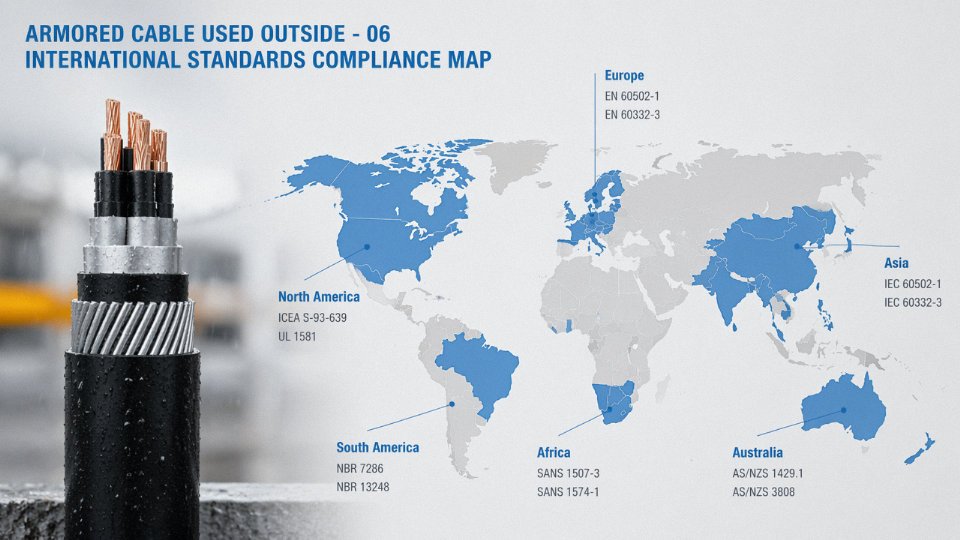
International Standards and Regional Compliance Requirements for Outdoor Armored Cable
Specifying the right armor construction and sheath compound gets you halfway there. The other half is making sure the cable you buy actually meets the regulatory framework governing the project site — and those frameworks vary enough that a cable fully compliant in the UK can fail a utility inspection in Saudi Arabia or India without any change in its physical construction. That’s a procurement headache worth avoiding early.
IEC 60502: The Baseline Most Projects Start From
IEC 60502-1 (up to 1 kV) and IEC 60502-2 (1 kV to 30 kV) are the primary international references for armored power cables. They cover conductor construction, insulation thickness, armor type, oversheath requirements, test methods, and cable marking. For outdoor use specifically, the sheath type designation matters: a cable marked with an “SWA” or “STA” designation under Part 1 tells the installer — and the inspector — exactly what armor is present and, combined with the sheath code, whether it’s appropriate for the installation environment. Outdoor direct-burial runs typically require an ST2 or equivalent oversheath designation; a standard ST1 sheath may pass factory testing but fail under sustained soil moisture and mechanical stress in the field. Procurement teams sourcing cables for IEC-governed projects should verify the full type designation string on the drum label, not just “IEC compliant” in the datasheet.
BS 5467 and BS 6724: British Standards With a Wide Regional Footprint
These two standards have an outsized global reach relative to UK market size, largely because utility specifications across the Middle East, East Africa, and South Asia were built on British engineering frameworks and haven’t fully migrated. BS 5467 covers PVC-insulated SWA and XLPE-insulated SWA cables; BS 6724 covers the LSZH (low smoke zero halogen) insulated equivalent — relevant when cables run through outdoor trenches that pass near occupied buildings or ventilation intakes. Projects in Nigeria, Kenya, Pakistan, and the UAE frequently cite BS 5467 directly in tender documents. Checking which edition is referenced matters; older utility specs sometimes cite pre-2015 editions with different oversheath thickness minimums.
North American Requirements: UL 1389 and NEC Article 330
The North American approach diverges significantly from IEC. NEC Article 330 governs Metal-Clad (Type MC) cable, and for any exposed outdoor run — surface-mounted conduit entry, above-grade aerial drops, roof installations — the cable jacket must be marked “sunlight resistant.” This isn’t a sheath compound suggestion; it’s a code requirement, and cables lacking the marking will fail inspection regardless of actual UV performance.
NEC Article 330 requires armored cables used in exposed outdoor locations to be marked 'sunlight resistant' on the cable jacket.True
NEC 330.10(A)(11) and 330.12 specify sunlight resistance as a condition for outdoor exposed installation of Type MC cable. Cables without this marking cannot be used in exposed locations per code.
The dominant outdoor armored product in North America is Type MC-HL with a continuous corrugated aluminum sheath — functionally different from SWA, and not interchangeable on a multinational project without careful review of the installation drawings and local AHJ (Authority Having Jurisdiction) requirements.
AS/NZS 5000.1: Australia and New Zealand
This standard specifies a minimum 2 mm oversheath thickness for armored cables intended for direct burial outdoor applications, alongside a mandatory UV-stabilized compound for any above-grade exposure. In practice, Australian utility contractors often require third-party test reports confirming UV stabilization, not just a manufacturer declaration. Worth building into your lead time if the project is in this region.
IEC 60364-5-52: Derating Factors Across All Outdoor Methods
This installation standard provides the reference tables used globally to calculate current-carrying capacity under real installation conditions — buried, surface-mounted, tray-installed, or aerial. Ambient temperature, grouping, soil thermal resistivity, and installation depth all feed into derating factors that can reduce rated capacity by 20–40% depending on conditions. Engineers who size conductors against cable manufacturer tables without applying the correct IEC 60364-5-52 derating method for their specific outdoor configuration regularly end up with undersized cables that run hot and fail early.
Regional Utility Specifications That Modify the Baseline
Three regional specs deserve specific attention because they impose requirements that go beyond or differ from the IEC baseline:
| Market | Governing Spec | Notable Outdoor-Specific Requirement |
|---|---|---|
| Saudi Arabia | Saudi Aramco SAES-P-104 | Specifies minimum sheath thickness increments above IEC minimums; specific armor type restrictions in hydrocarbon-exposed zones |
| South Africa | NRS 047 | Mandates specific UV and ozone resistance test protocols for outdoor LV armored cable; drum marking requirements differ from IEC |
| India | IS 1554 (Parts 1 & 2) | PVC insulation compound grade specified differently from IEC 60502; armor wire diameter and lay-length tolerances are tighter in some cross-sections |
Sourcing a cable that’s IEC 60502 compliant but not tested against NRS 047 or SAES-P-104 doesn’t automatically mean it fails those specs — but it does mean you’ll need additional documentation before a utility or EPC contractor will accept it on site.
Jinda’s Certification Position for Export Projects
For international project tenders, documentation burden is real. Jinda’s outdoor armored cable range is produced under ISO 9001:2015 quality management, with CE marking, KEMA/DEKRA type test reports, and SGS inspection available for shipments. These certifications are specifically what procurement managers need when compiling compliance packages for project banks, EPCs, or utility authorities — they reduce the back-and-forth during vendor qualification, which on large infrastructure projects can delay material approval by weeks if the paperwork isn’t in order from the start.
Sizing, Derating, and Current Capacity Calculations for Outdoor Armored Cable Runs
Getting the conductor size right for an outdoor armored cable run is genuinely harder than it looks on paper. The IEC 60502 tables give you a starting point, not a final answer — and conflating the two is one of the more expensive mistakes you can make on a project.
Base Current Capacity: The Reference Conditions Are Rarely Your Conditions
IEC 60502 tabulated current ratings for buried cable assume a soil thermal resistivity of 1.0 K·m/W and an ambient soil temperature of 20°C. For surface-mounted cable, the reference ambient air temperature is 30°C. In practice, neither condition should be accepted without checking. Soil thermal resistivity on a real site can vary from roughly 0.7 K·m/W in saturated clay to 3.0 K·m/W or more in dry desert sand — a range wide enough to shift your cable rating by 25–30% in either direction. Before you lock in a conductor size on any run above 50mm² that’s longer than 200 meters, a soil thermal survey is worth its cost. It rarely runs more than a few hundred dollars and can save you from pulling in undersized cable through conduit that you’ll never easily access again.
Solar Radiation and Ambient Temperature Derating
Surface-mounted SWA cable in direct sunlight is not operating at the rated ambient temperature printed in the data sheet. IEC 60287-2-1 requires an additional solar absorption derating factor, typically in the range of 0.90–0.95 depending on sheath color and cable diameter. That sounds modest until you stack it with an ambient temperature correction. A 95°C-rated XLPE cable installed on an exposed cable bracket in a 50°C desert environment — not unusual in the Middle East or parts of Australia — faces a combined derating that can push the usable current capacity down to 70–80% of the standard tabulated value. Black HDPE sheaths absorb more solar radiation than lighter colors; it’s a minor point in a temperate climate and a real consideration near the equator.
Grouping Derating on Outdoor Cable Trays
This is where engineers get caught out most often during the indoor-to-outdoor transition. A group of six single-core AWA cables laid flat on an outdoor cable ladder applies a grouping factor of approximately 0.73 per IEC 60364-5-52. When you’re also applying a temperature correction and a solar factor, the cumulative derating can reduce your effective ampacity well below what the cable schedule shows for a single circuit in free air. Run the calculation all the way through before finalizing the conductor cross-section, especially if the outdoor tray segment connects directly to switchgear with a fixed protective relay setting.
Soil Thermal Resistivity and Buried Cable Runs
In dry sandy soil at 2.5 K·m/W thermal resistivity, the current capacity of a direct-buried 95mm² SWA cable typically drops 20–25% relative to the standard table value. That’s roughly equivalent to dropping one conductor size class. For long agricultural or oilfield runs where soil type varies along the route, the conservative approach is to use the worst-case resistivity for the entire run unless you can actively control burial depth and backfill conditions — compacted limestone screenings or purpose-mixed thermal backfill can recover most of that lost capacity.
In dry sandy soil, a buried 95mm² SWA cable carries 20–25% less current than IEC 60502 standard table values suggest.True
IEC 60502 base ratings assume 1.0 K·m/W soil thermal resistivity. Dry sandy soil typically measures 2.0–3.0 K·m/W, which increases thermal resistance around the cable and reduces the permissible current proportionally, consistent with IEC 60287-1-1 calculation methodology.
Voltage Drop Governs Long Runs More Often Than Thermal Capacity
For outdoor runs exceeding roughly 500 meters — solar farm string cables, remote pump stations, oilfield power distribution — voltage drop frequently becomes the binding constraint before thermal capacity does. IEC 60364-5-52 recommends a maximum 4% voltage drop for final circuits, and on a 400V system that’s only 16V end-to-end. A 95mm² four-core SWA cable at 400m carrying a 200A load is borderline; at 600m you’re almost certainly stepping up to 150mm² or larger even if the thermal derating says 95mm² is fine. Run both calculations side by side, always.
Short-Circuit Withstand and Armor as a Fault Return Path
The steel wire armor on a 4-core 95mm² SWA cable can typically carry somewhere between 8 and 12 kA for one second — the exact figure depends on steel cross-section and initial temperature. That’s adequate as a protective conductor for most LV distribution circuits, but it needs to be explicitly verified against the upstream device’s actual clearing time and fault level, not just assumed. If the upstream MCCB or fuse clears at 5 cycles versus 20 cycles, your armor adequacy calculation changes materially. Document this check in your protection coordination study rather than leaving it implied.
Common Outdoor Installation Mistakes That Void Performance and Warranty
Even a correctly specified outdoor armored cable can fail within two or three years if the installation is sloppy. The cable manufacturer’s warranty typically covers material defects — not site workmanship. Knowing exactly where things go wrong in the field matters more than most specifiers want to admit.
Cutting or Nicking the Outer Sheath During Stripping and Pulling
This is probably the most common and most underestimated damage mode on any cable pull. A 1–2 mm nick in the HDPE or PVC oversheath, made during stripping or when the cable snags a sharp trench edge, looks harmless at handover. It isn’t. Moisture ingress starts immediately in wet ground, and once water reaches the steel wire armor, corrosion is a slow but relentless process — often invisible until insulation tracking or a ground fault shows up two to four years later. Estimates from field failure analysis put moisture ingress at somewhere between 30–40% of premature failures in direct burial armored cable, and in my experience that figure rings true. The fix is inspection under raking light before backfilling, and any damaged sheath section should be repaired with self-amalgamating tape and a mastic-filled heat-shrink sleeve, not ignored.
Incorrect Gland Selection at Outdoor Terminations
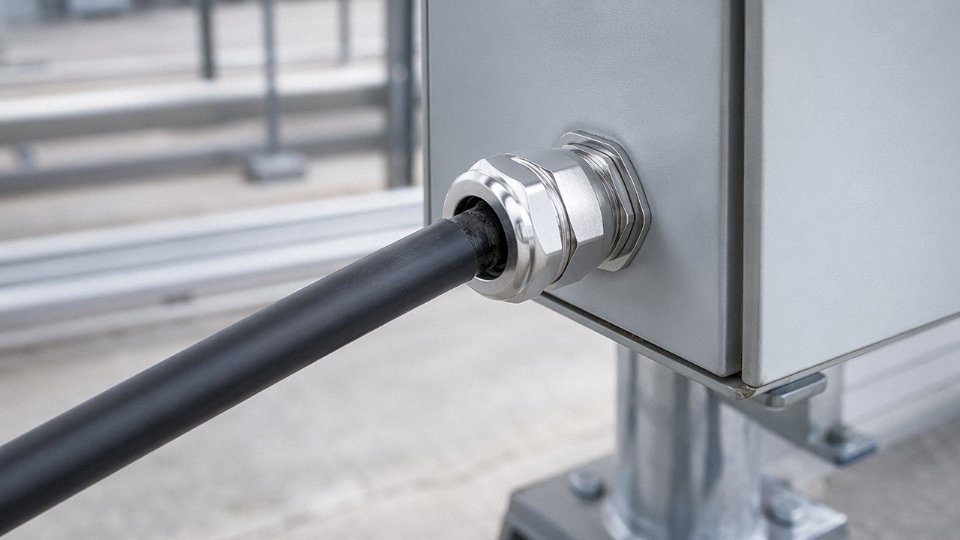
An indoor brass gland — the type you’ll find in a bag of “standard” accessories on half the sites I’ve visited — has no place at an outdoor armored cable entry. Without an IP66 or IP68 rating and a shrink-fit or mastic seal between the gland body and the outer sheath, the cable entry point is essentially an open path for water, particularly under the temperature cycling that drives capillary action overnight. The gland must clamp the armor correctly and seal the sheath. Skipping the mastic or heat-shrink infill between gland and sheath is an especially common shortcut on busy pull days.
Exceeding Minimum Bend Radius, Especially in Cold Weather
Most SWA cables have a minimum bending radius of roughly 8× the overall cable diameter. That number exists for a reason. PVC sheaths stiffen significantly below about 5–10°C, and forcing a large-section cable around a tight corner in a trench during a cold morning pull can permanently deform the armor lay and crack inner insulation. The damage may not cause an immediate fault, but it creates a stress point that will eventually fail under load or thermal cycling. Mark the minimum radius on the drum before the pull starts. It takes thirty seconds and prevents arguments later.
Omitting Sand Bedding in Direct Burial
Installing armored cable directly onto sharp stone backfill, or allowing the trench bottom to be uneven and rocky, directly violates IEC 60364-5-52 installation requirements and will void most manufacturers’ warranties outright. A 50–75 mm bed of fine sand or sieved soil beneath the cable, and the same depth of cover above it before compacted fill goes back, is not optional. Ground settlement and future excavation work will shift stones against the sheath over time. The armor provides mechanical protection — but it is not designed to act as the only line of defense against repeated point loading from angular rock.
Omitting sand bedding in direct burial armored cable installations voids manufacturer warranty under IEC 60364-5-52 requirements.True
IEC 60364-5-52 specifies installation methods including mechanical protection requirements for buried cables; deviating from these prescribed conditions removes the basis for warranty claims against material defects, as the failure mode becomes installation-induced rather than product-related.
Leaving Unarmored Tail Sections Exposed
The transition from armored cable to an unarmored flexible tail at an outdoor panel is usually the weakest point in the circuit, and it often gets the least attention. UV radiation, rain, and temperature swings will degrade an unprotected PVC or rubber sheath tail in months in a south-facing outdoor enclosure. Route the tail through UV-stabilized conduit, or use a UV-rated flexible armored section for that last run. It’s a small cost against the alternative.
Failing to Seal Drum Ends During Outdoor Storage
Cut a cable drum end and leave it unsealed in a wet compound overnight and moisture will wick into the conductor bundle — sometimes several meters in — within days, depending on conductor cross-section and stranding. Always cap cut ends with heat-shrink end caps or waterproof plugs immediately after cutting. This is especially important on site where drums sit between pull stages. A sealed end takes under a minute to apply; drying out a contaminated cable core is not recoverable.
Frequently Asked Questions About Using Armored Cable Outside
These questions come up repeatedly — from procurement managers finalizing specs to site engineers standing in front of an open trench wondering if they’ve done it right. Answers below are written to be technically usable, not just reassuring.
Does armored cable need conduit when installed outdoors?
Not always. SWA and AWA cables are self-protecting by design — the armor layer handles mechanical impact, and the outer sheath handles moisture and UV. For direct burial runs across open ground or surface mounting on a wall or cable tray, no conduit is needed if the cable is correctly rated for the environment.
That said, conduit earns its place at transition points. Wall entries, road crossings, above-ground risers coming out of a trench — these are the zones where abrasion, point-loading, and accidental impact are highest. Many local installation codes (and most utility company specifications) require conduit protection in exactly these zones even when the main run is unducted. Check your national annex or client spec before skipping it.
Can SWA armored cable be left above ground in direct sunlight permanently?
Yes — but only if the outer sheath is a UV-stabilized grade. Standard black PVC sheath compounded with a UV stabilizer handles permanent outdoor sun exposure without issue. What fails is unmodified PVC without stabilizer: expect chalking, surface cracking, and eventually sheath brittleness within roughly 3–5 years of continuous direct sunlight, depending on climate. In high-UV environments like the Middle East or tropical coastal sites, that timeline can compress. HDPE sheaths are generally the more robust option for permanent above-ground outdoor exposure.
What is the difference between SWA and AWA cable for outdoor use?
The armor wire material. SWA uses galvanized steel wires — higher tensile strength, better crush resistance (roughly 450–900 N/cm depending on conductor cross-section), and appropriate for most direct burial applications in ordinary soils. AWA uses aluminum wires, which are lighter, non-magnetic, and significantly more corrosion-resistant in wet or saline environments.
In practice, AWA is the right call for aerial installations, single-core medium- or high-voltage cables where induced currents in steel armor would be a real loss problem, and for coastal or marine sites where galvanic corrosion would eat through SWA armor faster than you’d expect. SWA costs less per meter in most markets. AWA is worth the premium when the environment justifies it.
How deep should armored cable be buried outdoors?
IEC 60364 and most national codes land at 600 mm minimum for low-voltage armored cable, 900 mm for medium-voltage. Road crossings typically require 1,000 mm plus a row of mechanical protection tiles laid above the cable. Those tiles matter — a cable sitting at the right depth but without tile protection has been hit by a subcontractor’s excavator more than once on larger sites.
IEC 60364 requires a minimum burial depth of 600mm for low-voltage armored cable and 900mm for medium-voltage cable.True
These depths are specified in IEC 60364-5-52 and are reflected in BS 7671 and most national adoption standards. Local codes may impose greater depths in high-traffic or road-crossing zones.
Can armored cable be used outdoors in freezing temperatures?
Yes, with the right compound. XLPE-insulated AWA or SWA cable with a polyethylene sheath remains flexible and installable down to around -40°C. Standard PVC-sheathed SWA is a different story — below roughly -5°C to -10°C, PVC becomes brittle enough that bending during handling can crack the sheath or even the insulation. If you’re pulling cable in winter and the temperature has dropped overnight, pre-warm the cable drum before installation. It’s a simple step that gets skipped, and the damage isn’t always visible until the next fault trace.
How long does armored cable last when installed outdoors?
A correctly specified cable — SWA or AWA with HDPE or UV-stabilized PVC sheath, properly installed — typically achieves 30–40 years above ground and 25–35 years in direct burial. Those ranges depend heavily on soil pH and moisture for buried cable, and on UV intensity and thermal cycling for above-ground runs. The life-limiting mechanisms are usually UV degradation of the sheath, galvanic or chemical corrosion of the armor, and cumulative fatigue from repeated thermal expansion cycles. None of these failures happen suddenly; they show up as insulation resistance drift during routine testing before anything catastrophic occurs — which is why periodic IR testing on long outdoor runs is worth scheduling.
Does Jinda supply armored cable tested and certified for outdoor use?
Yes. Jinda manufactures SWA, AWA, STA, and XLPE-armored cables conforming to IEC 60502, BS 5467, and a range of regional standards depending on the destination market. Type-test reports from accredited third-party laboratories are available, and Jinda’s export technical team can provide full documentation packages — test reports, material declarations, construction drawings — to support outdoor project specifications and tender submissions. For large projects or long-term supply programs, sample verification and witnessed factory testing can be arranged.
How to Source Outdoor Armored Cable for Large-Scale International Projects: Jinda’s Supply Framework
Specifying the right cable is only half the procurement problem. Actually getting it — on time, to spec, with documentation that satisfies a utility or third-party inspector — is where a lot of international projects run into trouble. The following covers how Jinda’s manufacturing and supply structure addresses the specific demands of outdoor armored cable procurement at scale.
Manufacturing Scale and Product Range
Jinda’s five production bases across China collectively produce the full spectrum of armored cable types relevant to outdoor infrastructure: SWA, AWA, STA, XLPE-armored, LSZH-armored, and MV armored cable from 0.6/1kV up through 26/35kV, with conductor cross-sections running from 1.5mm² to 630mm². That range isn’t accidental — it means a single EPC contractor can source the 4mm² SWA feeds for a substation ancillary building and the 185mm² XLPE MV feeder cables for the same site from one supplier, on the same purchase order, with consistent documentation. In practice that simplifies ITP sign-off considerably.
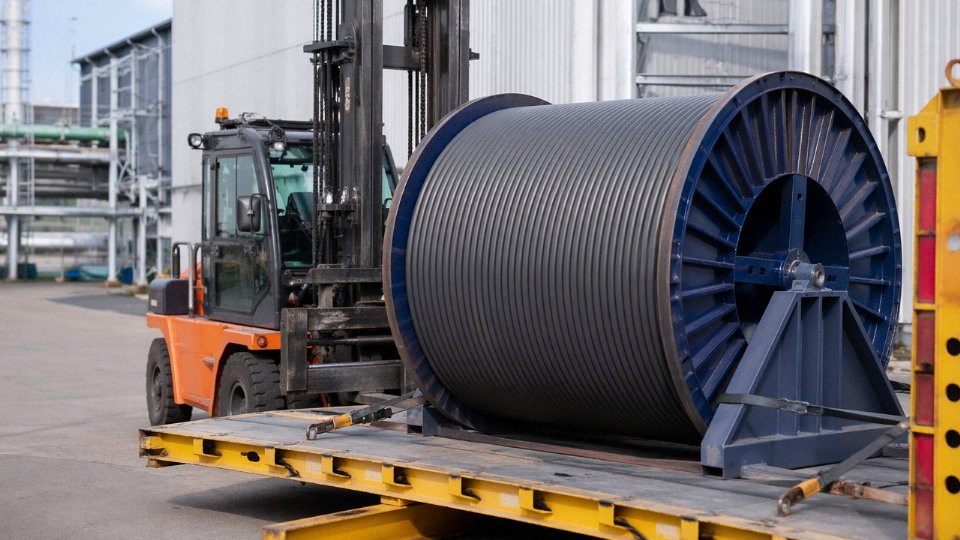
The 470,000 m² of manufacturing space matters for large-order continuity. A project requiring, say, 80–120 km of armored cable — not unusual for a utility distribution rollout — needs a supplier that won’t bump your order when a larger domestic contract appears. That’s a real risk with mid-tier cable mills.
Quality Assurance for Outdoor Performance
Every production batch of outdoor armored cable goes through spark testing on the insulation core, high-voltage conductor testing, armor coverage measurement, and sheath thickness gauging per IEC 60502. These aren’t paperwork exercises — spark test failures on extruded insulation, for instance, tend to concentrate around eccentricity defects that would cause premature failure in buried installations where you can’t easily find the fault later.
Jinda offers third-party SGS or DEKRA inspection for international outdoor cable procurement orders.True
Third-party inspection by SGS or DEKRA is available upon request for international project orders, providing independent verification of cable construction and test results beyond Jinda's in-house QA process.
For procurement managers working under a FIDIC or NEC contract with third-party inspection clauses, the ability to bring in SGS or DEKRA without a supplier argument about factory access matters more than most buyers realize until they need it.
Customization for Harsh Outdoor Environments
Standard SWA with PVC outer sheath covers a lot of situations. It doesn’t cover all of them. For projects in high-UV coastal zones, desert installations with ground temperatures exceeding 50°C, or industrial sites with hydrocarbon contamination in the soil, Jinda’s application engineers can configure UV-stabilized or oil-resistant sheath compounds, specify DSWA construction for rocky direct-burial terrain, AWA for aerial or lightweight tray applications, or FRP armor where galvanic corrosion is a design constraint. Custom color coding and meter-mark printing to match utility or project specifications are handled as standard, not as special requests that add weeks to the timeline.
Lead Times and Logistics
High-volume sizes — roughly 25mm² to 185mm², which account for the bulk of outdoor infrastructure orders — typically carry a 15–25 day production lead time from order confirmation, depending on conductor material and sheath configuration. LSZH sheath variants run toward the longer end of that window. Jinda ships on wooden cable drums in 20ft and 40ft containers from Chinese ports, with established freight forwarding partnerships to major destinations across Europe, the Middle East, Southeast Asia, and Africa. Drum sizes are confirmed against container load plans before production, which avoids the annoying situation of arriving at port with drums that won’t fit efficiently.
Technical Support and Long-Term Partnership
Jinda’s application engineering team provides pre-order cable selection support, current capacity calculation checks, and site-condition assessments at no charge, with English-language datasheets, test reports, and installation guides supplied as standard — not on request. For EPC contractors and utilities managing multi-year outdoor infrastructure programs, Jinda offers framework supply agreements with price validity periods, priority production scheduling, and dedicated account management. Thirty-seven years of manufacturing history and a customer base spanning more than 50 countries isn’t a marketing line; it’s the kind of supply continuity that matters when a project runs 18 months and you need consistent cable construction across every delivery batch.