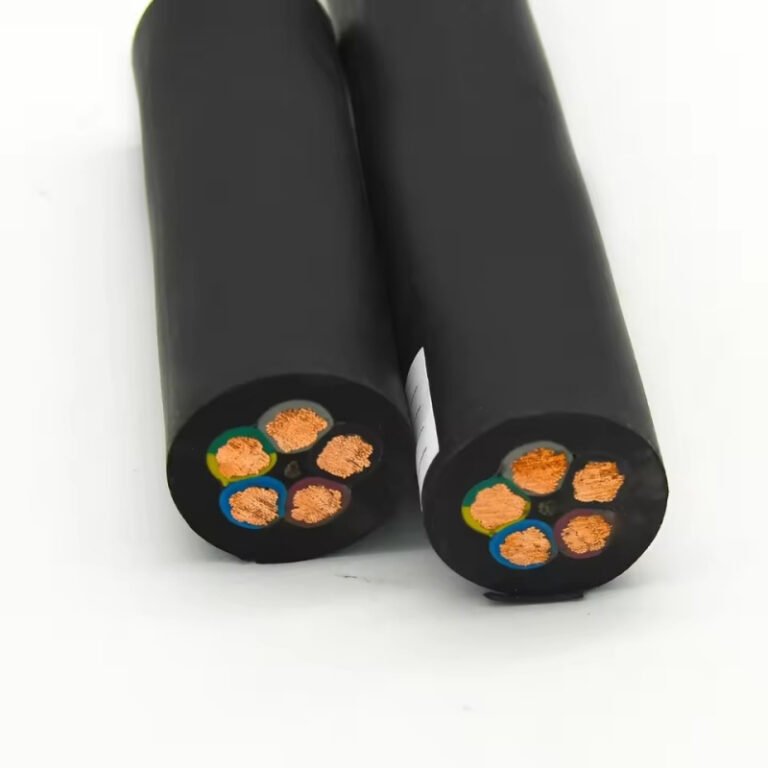
Picking the wrong wiring method on a capital project isn’t a paperwork problem — it’s a commissioning delay, a re-pull, or a ground fault three years into production that takes down a line on a Saturday night. Contractors who spec standard PVC-jacketed cable in a direct-burial trench save maybe 15 minutes on a drawing, then spend two days explaining the repair to a plant manager. On the other side, engineers who default to rigid conduit everywhere because “that’s what we’ve always done” are leaving real money on the table, sometimes $1.50–$3.00 per linear foot of unnecessary labor and material on runs that could have gone armored direct-burial without any code compromise.
Use armored cable — MC, AC, or SWA type — when the route faces mechanical abuse, direct burial, wet locations, or when conduit installation is physically impractical. Run conduit when future circuit changes are likely, when the environment demands a sealed raceway, or when certain Zone 1 hazardous-area classifications require RMC under NEC Article 344. The right answer almost always comes down to three factors: permanence of the installation, likelihood of future re-pulls, and the specific mechanical and environmental stresses on that run.
What makes this decision genuinely tricky is that neither system is universally cheaper or safer — the cost crossover point shifts depending on run length, site conditions, cable gauge, and how many bends are involved. A 200-foot outdoor run through a mechanical room hits a very different calculation than a 30-foot drop inside a clean control cabinet room. The mechanical crush ratings alone — IEC 60502-1 SWA cable handles 4,000–6,000 N per 10 cm versus under 500 N for standard PVC jacket — tell you something important about where armored cable earns its price premium and where it doesn’t.
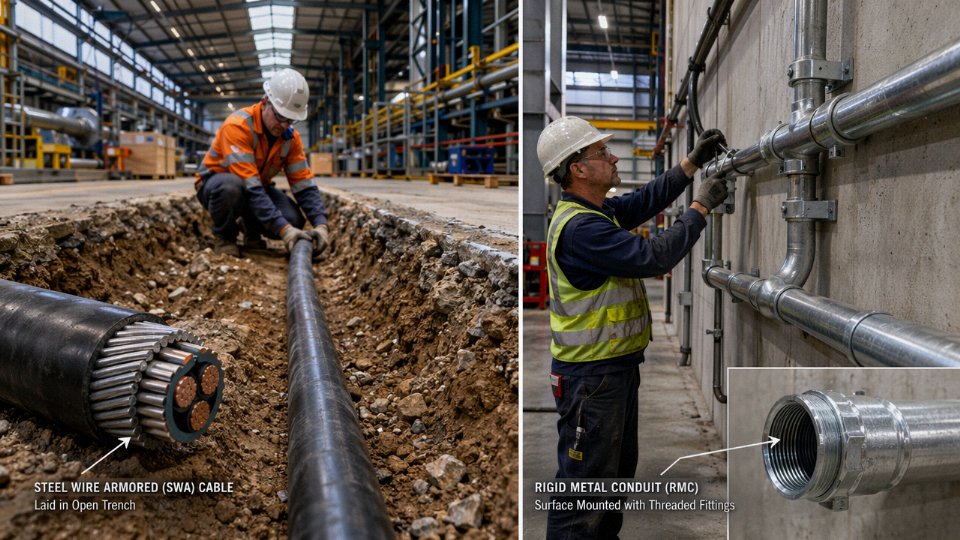
How Armor and Conduit Actually Protect Conductors: Mechanical and Environmental Mechanisms
Understanding why each system works — not just that it works — is what separates a spec written from habit from one written from hazard analysis.
Mechanical Protection: Armor Types Are Not Interchangeable
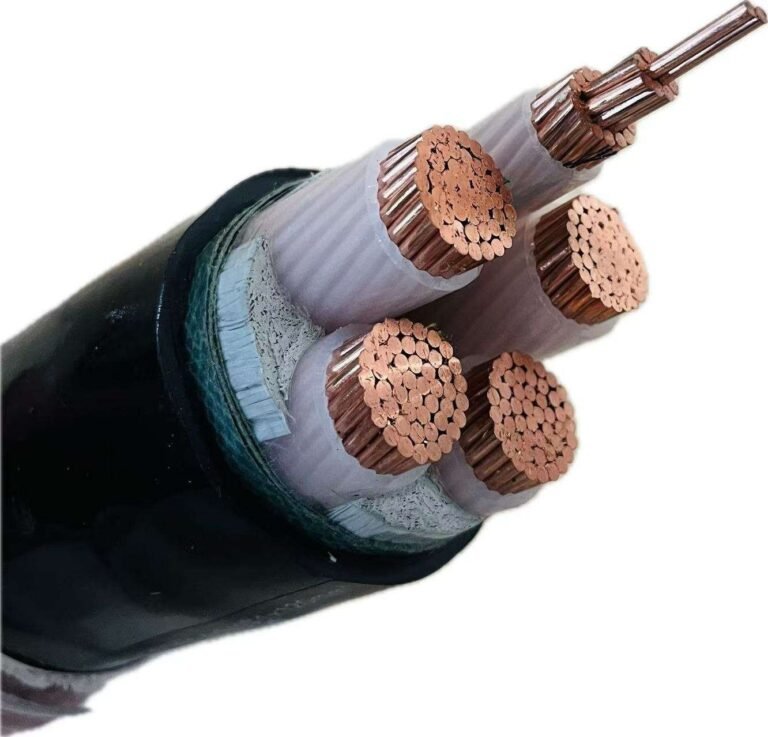
Steel wire armored (SWA) cable is the workhorse for direct burial and tray runs where crush loads and tensile stress are real concerns. The individual steel wires wound helically over the inner sheath distribute point loads across a wide arc, which is why IEC 60502-1 crush resistance for SWA runs in the 4,000–6,000 N per 10 cm range depending on wire diameter and lay — compared to a bare PVC-jacketed cable that fails below 500 N/10 cm under the same test. That difference matters in a trench with rocky backfill or under a cable bridge subject to foot traffic and dropped tools.
Steel tape armored (STA) cable swaps the round wires for two overlapping helical steel tapes. Crush resistance is comparable, but tensile strength drops significantly — STA is not appropriate for vertical runs or pulls with substantial pulling tension. I’ve seen STA specified on a 20-meter vertical shaft run because someone copied a horizontal tray spec. The result was gradual conductor displacement over two years until a ground fault ended the debate.
Aluminum wire armored (AWA) is lighter and non-magnetic, which matters on single-core AC cables where steel armor would create eddy current heating — a real efficiency and thermal problem that’s easy to overlook. The trade-off is lower crush resistance, roughly 30–40% less than equivalent SWA geometry, so AWA on a busy cable route with heavy cross-traffic isn’t the right call without mechanical protection on top.
Interlocked aluminum armor (MC cable under UL 1569) uses a corrugated aluminum strip interlocked in a continuous spiral. It handles typical commercial and light industrial mechanical abuse well and is flexible enough for equipment connections, but its crush resistance is closer to the lower end — think walkable loads, not vehicle crossings.
Conduit protects through physical separation and enclosure rather than integrated armor. The wall material changes the threat profile substantially. Rigid steel conduit (RMC/IMC) resists crush and impact loads that would flatten any cable armor — a forklift running over a steel conduit in a warehouse floor will usually deform it rather than sever conductors inside, whereas the same event over a direct-buried armored cable often cuts cleanly through. PVC conduit handles chemical environments that corrode steel, but its crush resistance under point loading and its impact resistance at low temperatures are both meaningfully worse. Aluminum conduit sits between the two on most mechanical metrics and corrodes in alkaline concrete — a detail that bites people during embedded pours.
Rodent damage is worth calling out specifically. Armored cable with a steel outer layer stops rodent penetration almost completely. Conduit made of PVC offers no resistance; rats chew through Schedule 40 PVC with surprisingly little effort, especially in warmer climates where rodent pressure is seasonal. Steel conduit wins against rodents, but requires consistent corrosion protection to stay intact in wet or chemically aggressive areas.
Moisture Ingress: The Gap Between Theory and What Actually Happens Underground
Direct-burial armored cable with a longitudinal water-blocking tape and moisture-resistant outer sheath performs predictably over time because the protection is integral — there are no joints to fail. Conduit systems depend entirely on installation practice for moisture control. EYS conduit seals and drain fittings work well when installed correctly and maintained. In practice, most conduit runs accumulate water within a few years. Condensation cycles, small fitting gaps, and ground movement all contribute. The wire inside is rated for wet locations (THWN-2, for instance), so this usually isn’t immediately catastrophic, but corrosion at terminations and at splices in pull boxes is a slow, real problem that drives maintenance callbacks nobody budgets for.
Conduit systems reliably prevent moisture accumulation over the service life of an industrial installationFalse
Even well-installed metallic conduit accumulates condensation and groundwater intrusion over time due to thermal cycling, ground movement, and fitting imperfections. Drain fittings slow the accumulation but do not eliminate it; THWN-2 wire ratings exist specifically because wet conduit is the norm, not the exception.
EMI Shielding: Bonding Quality Determines Whether Metallic Armor Actually Shields
Both metallic conduit and metallic cable armor provide EMI shielding — but only if the ground path is continuous and low-impedance. A steel conduit run with a loose coupling or a corroded bond at the panel provides almost no shielding benefit; the discontinuity breaks the Faraday cage effect. The same principle applies to SWA cable: the armor must be bonded at both ends (or one end for specific shield-grounding strategies) with a proper SWA gland, not a casual wrap of copper tape.
For VFD feeder runs, this is where the specification really matters. VFDs generate high-frequency common-mode noise that couples aggressively onto cable shields and nearby conductors. A dedicated shielded cable (SWA with an additional foil/braid shield underneath the armor, or purpose-made VFD cable) outperforms steel conduit with standard THWN wire in most high-EMI industrial environments, because the shield is 360° continuous and bonded directly at the drive and motor terminals. Steel conduit can work, but only with metallic fittings throughout, no PVC transitions, and confirmed low-impedance bonds at every junction — a discipline that most plant electrical maintenance programs don’t sustain past the first year.
Environment-by-Environment Decision Matrix: Matching System to Site Conditions
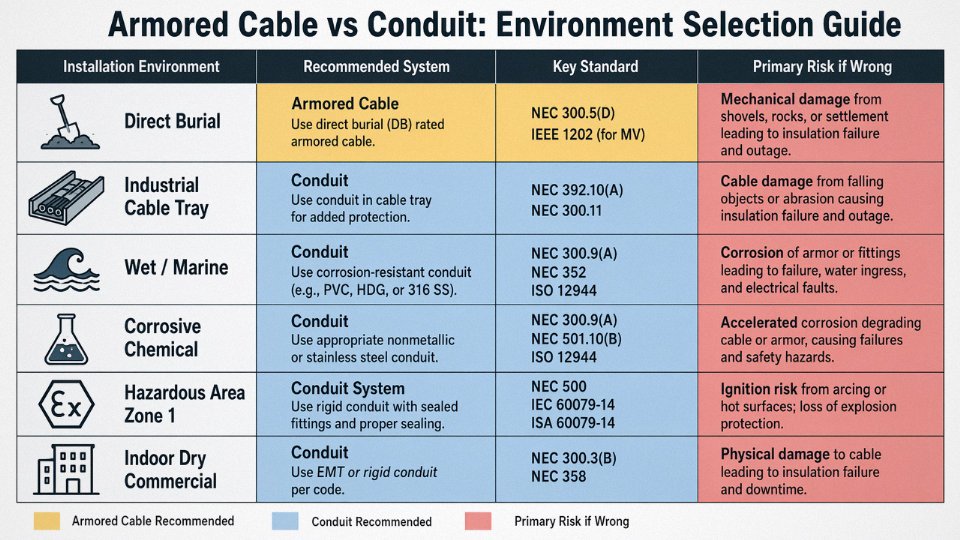
The honest answer to “armored cable or conduit?” is almost always “depends where it’s going.” What follows is organized by installation environment so you can move quickly from site condition to system recommendation without wading through theory you’ve already read.
Direct Burial and Underground Runs
Steel wire armored (SWA) or aluminum wire armored (AWA) cable eliminates the conduit entirely in most direct-burial scenarios — and that’s the point. A single-pull SWA cable rated to 4,000–6,000 N crush load per 10 cm (IEC 60502-1) can handle normal compacted-earth backfill without a duct. NEC Table 300.5 requires 24 inches of cover for direct-buried cables in most residential and commercial situations, 18 inches under concrete, and various lesser depths for specific conditions — always verify against the actual use case because the table has more rows than most people remember.
Rocky backfill changes this. If your excavation is going back in with angular stone or construction rubble, even a well-armored cable can suffer point-load damage over time. In those conditions, either specify a cable with a heavier armor layer and a thick outer jacket rated for abrasion, or pull through HDPE duct first — the duct adds maybe $0.40–$0.80 per foot depending on diameter and material, but it also lets you pull a replacement without digging. Vehicular-loading zones (parking structures, loading docks, rail crossings) generally warrant concrete-encased conduit regardless of armor rating; the dynamic impact loads are a different problem than static crush. Shared utility corridors are another exception — if you’re running parallel with gas, water, or telecom, the local authority having jurisdiction will often mandate conduit for separation and future identification.
Industrial Plant Floors and Cable Trays
Tray-rated MC cable under UL 1569 and NEC Article 392 is genuinely faster to install than conduit-and-wire in large facilities. On a greenfield petrochemical plant or an automotive assembly line with hundreds of tray runs, the difference in pull-and-terminate labor is real — rough industry estimates put tray-rated MC at 15–35% fewer labor hours versus equivalent conduit runs, though the actual gap depends heavily on run length, bend count, and crew familiarity with the system. Short drops and risers from tray to equipment still typically use liquidtight flexible metallic conduit (LFMC) — that’s the norm because it handles vibration and misalignment better than a rigid armored cable stub.
Wet and Corrosive Environments
Marine, wastewater, and chemical plant installations expose metallic conduit systems to chlorides, hydrogen sulfide, acids, and persistent humidity. Standard galvanized steel conduit corrodes faster than most maintenance schedules can catch. Here the choice often lands on one of two paths: stainless steel wire armored cable with an extruded PVC or HDPE oversheath, or — where mechanical damage risk is low and the chemical loading is severe — Schedule 80 PVC conduit with separate XHHW-2 or THWN-2 conductors. PVC conduit is cheap, chemically inert, and easy to replace sections of. Its weakness is mechanical vulnerability and the fact that it provides no EMI shielding.
Stainless steel wire armor provides meaningfully better corrosion resistance than standard galvanized carbon steel armor in chloride-rich or acidic environmentsTrue
Stainless steel (typically 316L in cable armor applications) resists chloride pitting and acid attack that rapidly degrades zinc coatings on galvanized steel armor, making it the standard specification choice for marine and chemical plant cable in environments with pH below roughly 5 or sustained salt spray exposure.
Hazardous and Classified Locations
This is where getting it wrong creates a compliance — and safety — problem, not just an inconvenience.
| Location Class | Permitted System | Notes |
|---|---|---|
| Class I, Division 1 | RMC with explosionproof fittings; Type MI cable | MC cable generally prohibited; verify AHJ |
| Class I, Division 2 | MC cable (listed for use), LFMC, RMC | Terminations must be rated; seal fittings required at boundaries |
| IEC Zone 1 | Steel wire armored cable with certified glands, or RMC | Gland selection is critical — wrong IP rating voids certification |
| IEC Zone 2 | SWA cable widely accepted; conduit also acceptable | Follow local code adoption and equipment Ex-ratings |
In Division 1 environments, rigid metal conduit with explosionproof fittings isn’t optional in many cases — it’s the only NEC-compliant path under Articles 500–501. MC cable, even the right type, doesn’t provide the containment path required to prevent ignition source propagation through the conduit system. Get the zone classification and the T-rating right before you specify anything.
Above-Ceiling, In-Wall, and Commercial Interiors
AC cable (the old “BX”) and MC cable are faster than conduit in renovation and tenant fit-out work — full stop. Cutting, routing, and securing individual sticks of EMT through an occupied ceiling takes time that armored cable doesn’t. For fire alarm and life-safety circuits, FPLR-rated cable handles most in-building plenum runs, but circuit integrity (CI) cable — which maintains function during a fire for a defined period — is a separate and more demanding specification needed for emergency lighting feeders, fire pump circuits, and similar systems. Not all MC cable meets CI requirements; specify to BS 8519 or the relevant local standard explicitly if circuit survival during fire is a design requirement. Don’t assume a generic “fire-rated” label covers it.
Code and Standards Compliance: NEC, IEC, and Regional Authority Requirements Side by Side
Getting the governing standard wrong on a cable specification isn’t a paperwork problem — it’s a rework order, a failed inspection, or in the worst case, a Class I hazardous-area installation that your AHJ (authority having jurisdiction) forces you to tear out and redo with RMC. The cost delta on a 500-foot industrial run is real. So is the schedule hit.
NEC Articles 320, 330, 342, 344, and 358: What Each Actually Permits
NEC Article 330 covers metal-clad cable (MC cable), and it’s more permissive than many engineers assume. MC cable with a listed corrosion-resistant armor is permitted in wet locations, for direct burial if the armor and jacket are specifically rated for it, and in cable trays. It also covers hazardous locations — but here’s the qualifier that catches people: not all MC cable is created equal for those applications. The jacket and armor type matter. Standard aluminum-interlocked MC with a PVC jacket is fine for a dry commercial panel room. Direct-burial MC needs a PVC over-jacket or a listed moisture-resistant construction, full stop. Specify the wrong catalog suffix and your distributor ships you something that fails inspection.
Article 320 (AC cable, the older spiral-wrapped armor) is narrower. AC cable is not listed for direct burial or wet locations. The spiral-wrap armor on AC provides decent flex protection for interior dry runs, but it offers essentially no moisture resistance — the armor isn’t sealed, and water wicks right in. Substituting AC for MC in a plant expansion where someone assumed they were interchangeable is a classic spec error; the armor looks similar on the reel.
On the conduit side: EMT (Article 358) is the everyday workhorse for indoor commercial and light industrial work, but it isn’t suitable for direct burial in concrete without additional protection in most jurisdictions. IMC (Article 342) and RMC (Article 344) step up the mechanical rating considerably, and RMC specifically is required — not just permitted, required — in some Zone 1 explosive-atmosphere installations where the conduit system itself is the raceway seal strategy. If you’re designing a paint spray booth or a petrochemical metering skid, EMT is off the table regardless of cost.
IEC 60502, IEC 61386, and the European BS 7671 Approach
Under the IEC framework, armored power cables up to 1 kV fall under IEC 60502-1; medium-voltage construction up to 30 kV under IEC 60502-2. Both specify crush resistance for steel wire armored (SWA) and steel tape armored (STA) constructions — the SWA requirement of roughly 4,000–6,000 N per 10 cm is the number to check against your trench backfill conditions and any vehicular crossing loads. IEC 61386 governs conduit systems and breaks them into a classification system (temperature rating, impact resistance, compression, flexibility) that’s more granular than the NEC tiered approach.
What surprises a lot of North American engineers working on European or UK projects is that BS 7671 — the IEC Harmonized Document-based UK wiring regulations — treats SWA armored cable as a standard primary wiring method, not a specialty product. You’ll find SWA specified for ordinary industrial circuits the way a US engineer would specify EMT. The regulatory philosophy is different: the armor is presumed appropriate unless the environment argues against it, rather than the reverse.
SWA armored cable meeting IEC 60502-1 is accepted as a standard wiring method under BS 7671 without special justification, unlike in NEC-governed installations where MC cable requires specific listed applications.True
BS 7671 (18th Edition) and the associated IEC harmonized documents treat armored cable as a default acceptable wiring system for fixed installations. NEC Article 330, by contrast, lists specific permitted uses and conditions, reflecting a fundamentally different regulatory philosophy.
GB Standards and Multi-Standard Supply Reality
For projects sourcing from China — or specifying cable for export into markets that mix IEC and GB requirements — GB/T 12706 is the governing manufacturing standard for armored power cables. It tracks IEC 60502 closely in most construction and test requirements, but there are differences in conductor class definitions and some test conditions that matter when you’re trying to certify the same product for both European and Chinese domestic markets simultaneously.
Jinda’s production bases are set up to run both IEC-compliant and GB/T 12706 product lines, which matters practically when you’re procuring for a multi-country infrastructure rollout and need one supplier relationship to cover both a European utility tender and a Southeast Asian distribution project. Splitting the order between a GB-only mill and a separate IEC-certified supplier doubles your QC overhead and your lead-time coordination problem.
Compliance Pitfalls Worth a Separate Warning
A few errors show up repeatedly on plant-floor inspections. First: termination fittings. MC cable’s armor carries the equipment ground in many NEC-governed installations, but that only works if the termination fitting is listed for grounding continuity and is actually torqued correctly. A loose MC connector at the panel end breaks the ground path. It’s a cheap fitting problem with an expensive consequence.
Second: ampacity derating at transitions. When a circuit runs partly in conduit and partly as free-air armored cable, the derated conduit section sets the limit for the entire circuit — you can’t take credit for the free-air section to justify a smaller conductor. Engineers who design the two segments independently and then connect them in the field end up with conductors that are undersized for the bundled portion, which shows up as nuisance trips or, worse, as insulation degradation over a few years of cyclic loading.
Third, and probably most common on international projects: assuming that a cable with IEC test markings is automatically compliant in a country that uses NEC or a locally amended version of IEC. Regional authorities amend standards. The UAE, Saudi Arabia, and several Southeast Asian markets have local amendments that affect armor type acceptance, burial depth requirements, and conduit fill calculations. Check the local schedule before you finalize the BOM.
Total Installed Cost Analysis: Labor, Materials, and Lifetime Maintenance Compared
The material price tag is where most cost comparisons start — and unfortunately end. That’s a mistake that leads to budget overruns and, occasionally, to facilities managers explaining a six-figure retrofit to an operations VP.
Material Cost: What the Numbers Actually Mean
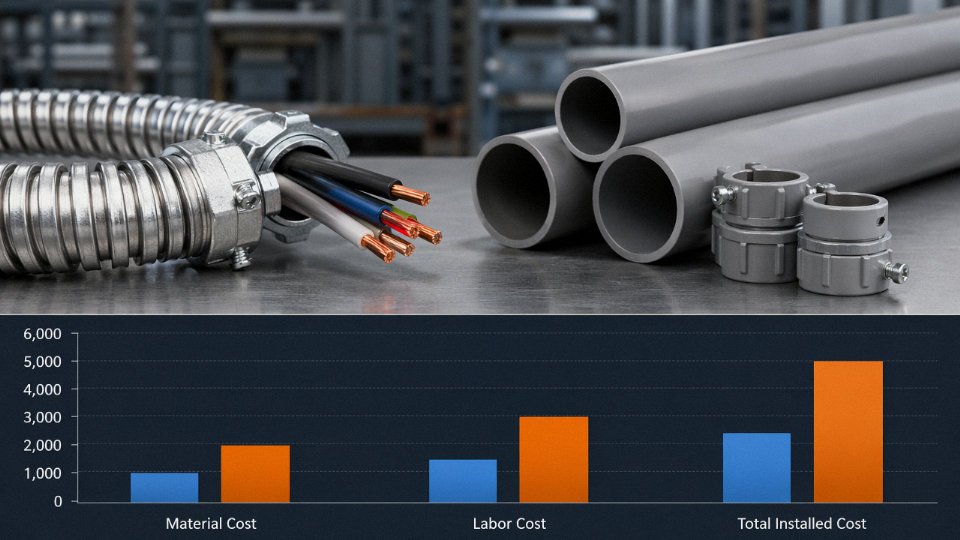
MC cable (12/3 through 4/0 AWG) runs roughly $2.50–$6.00 per linear foot installed direct-burial, all-in. EMT conduit with THWN conductors at equivalent ampacity runs $3.50–$8.00 per linear foot. On paper, armored cable looks cheaper. In practice, the spread depends heavily on conductor size, regional labor rates, and — critically — where steel prices are sitting when you’re buying. EMT is a commodity steel product, and its price can swing 15–30% between a bull and bear steel market. If you’re doing a large procurement in a year when hot-rolled coil prices spike, that conduit budget can blow out fast.
The gap between the two systems also narrows as conductor size increases. At 12 AWG, MC cable has a clear material cost advantage. By the time you’re pulling 4/0 for a 200 A feeder, the differential is much smaller — sometimes negligible — because the armor cost scales with copper weight, and large-gauge THWN in 2-inch EMT is actually pretty competitive per foot.
Labor Hours: The Variable Nobody Budgets Correctly
Electrician productivity is where armored cable frequently wins, but not universally. In complex industrial routing — think overhead cable trays with multiple direction changes, drops to machine junction boxes, routing around structural steel — MC or SWA cable installs 20–35% faster than a comparable pull-and-pipe job. You’re eliminating the conduit layout, threading, coupling, and pulling steps. An experienced wireman can terminate MC fittings quickly; the labor savings are real.
That said, conduit wins in long, straight open-plant runs. A 300-foot straight pull through 1-inch EMT with a mechanical wire puller is fast. A 300-foot run of armored cable over the same path isn’t dramatically different in labor, and in some plants with existing j-hook infrastructure, cable actually moves faster. Know your routing geometry before you assume one system saves time.
Armored cable consistently installs faster than conduit systems in all industrial environmentsFalse
Labor time depends heavily on routing complexity. In long, straight runs with efficient pulling conditions, EMT-plus-wire can match or exceed MC cable installation speed. The 20–35% faster figure for armored cable applies specifically to complex, multi-directional industrial routing.
Future Modification Cost: Where Conduit Earns Its Keep
This is the single biggest factor most engineers underweight at specification time. Adding a circuit to an existing conduit run — assuming fill capacity exists — might mean an afternoon of work. Replacing a home-run MC cable because load requirements changed means cutting, rerouting, and re-terminating the whole run. In a facility where circuit layouts evolve (office buildouts, data centers, pharmaceutical production with frequent equipment moves), conduit pays for its higher upfront cost many times over across a 10–15 year ownership period.
A rough benchmark: circuit modification in existing conduit typically costs 10–25% of what the same change costs in armored cable, depending on run length and access. For high-churn environments, that math is decisive.
Failure Consequence Cost: The ROI of Heavy Armor
In environments where a wiring failure shuts down production, the cost calculus flips entirely. Automotive assembly, semiconductor fab, food processing lines — these facilities often run at $10,000–$50,000 per hour of unplanned downtime, sometimes more. A forklift clip to an unprotected cable bundle, a coolant leak that saturates a standard-jacketed run, a chemical splash in a processing area: any of these can cause a multi-hour outage. Heavy-wall SWA cable, rated at 4,000–6,000 N crush resistance per 10 cm under IEC 60502-1, absorbs the kind of incidental mechanical abuse that destroys standard PVC-jacketed wiring without ceremony.
Over a 20-year asset life in a high-consequence environment, the upfront premium for SWA or interlocked MC with PVC jacket usually generates positive ROI through avoided downtime incidents — even if you only prevent two or three serious mechanical damage events. The math depends on your hourly production value and how honestly you assess the mechanical hazard exposure in the installation zone. Most engineers are optimistic about that second part. Don’t be.
Termination, Splicing, and Grounding: Where Most Field Errors and Failures Originate
Specification gets most of the attention. Installation inspection gets almost none — and that’s where systems actually fail. A correctly specified armored cable run becomes a ground-fault hazard the moment an electrician uses a generic liquid-tight connector rated for flexible conduit on aluminum interlocked MC armor. The armor spins loosely, contact resistance climbs, and you’ve lost the ground path you were counting on. This is not a rare scenario.
Armored Cable Termination: Connector Type Is Not Interchangeable
MC connectors and armor clamps are armor-type specific. Aluminum interlocked armor (the corrugated aluminum type common in NEC-jurisdiction commercial and industrial work) requires connectors with a saddle or jaw designed to grip the interlocked profile — a connector sized for steel wire armored cable will not engage the same way. Steel wire armored cable used on IEC projects needs compression glands rated for SWA, typically to IP66 or IP68 depending on the enclosure.
Minimum bend radius for SWA is generally 7× the overall cable diameter. Go tighter and you risk deforming the wire layer, which creates stress concentrations in the insulation beneath. On larger cables — say, 35 mm² four-core SWA — that 7× rule translates to a bend radius most crews underestimate when routing into a tight panel knockout. Mark the minimum radius on your installation drawings. Inspectors often catch this after the cable is already dressed and restrained, which means rework.
The ground path through armor is only as good as the termination at both ends. A loose gland at the panel end — hand-tightened, not torqued — means the armor floats electrically. When a fault occurs, current has nowhere predictable to go.
Jinda's standard armored cable construction includes a dedicated green/yellow insulated equipment grounding conductor, meeting NEC 250.122 requirements without relying solely on the armor for the EGC function.True
NEC 250.122 governs equipment grounding conductor sizing, and relying on armor continuity alone as the EGC is permitted only under specific conditions (NEC 250.118). A dedicated insulated EGC inside the cable assembly eliminates dependence on termination quality for ground path integrity — a meaningful construction difference on fault-sensitive circuits.
Conduit Termination and Sealing Details That Get Skipped
Reaming conduit ends is one of those steps that gets skipped when the crew is behind schedule. Inside a steel EMT cut with a rotary cutter, the burr left on the cut edge will abrade conductor insulation under vibration — not immediately, but over years. Plastic insulated bushings on conduit ends into enclosures are cheap insurance.
In classified (hazardous) locations, NEC 501.15 requires conduit seals within 18 inches of enclosures in Division 1 areas, and the seal compound must be poured and cured correctly — not just a foam plug someone improvised. This is a common audit failure.
For outdoor conduit runs exposed to meaningful temperature swings — 30 °C differential is the usual design threshold — expansion fittings are required. A 100-foot EMT run can move roughly ¾ inch over that range. Without expansion fittings, the conduit racks against supports and can pull apart at couplings.
Grounding: When Armor Alone Is Not Enough
Metallic conduit and cable armor both serve as equipment grounding conductors under specific NEC conditions (250.118), but neither is unconditionally reliable as the sole EGC. Conduit joints that corrode, armor terminations that back off slightly over thermal cycling — both increase impedance in the ground path. For circuits above 60A, or anywhere a high-impedance ground fault is a serious consequence, pull a separate green insulated EGC inside the conduit. The added material cost is negligible against the fault-clearing reliability you gain.
Splicing and Future Maintenance Access
Armored cable does not permit in-line splices outside of accessible junction boxes — full stop. If a concealed run under a concrete slab develops insulation damage, your repair options are limited: pull and replace the entire segment, or install a box. Conduit systems, by contrast, allow pulling entirely new wire through existing raceways and making splices at any existing junction box. That flexibility has real dollar value in plants that modify processes frequently.
Before specifying armored cable in embedded or inaccessible locations, ask whether a future maintenance team will be able to reach both ends. If the answer involves breaking concrete, conduit may actually be the lower lifetime cost — despite looking more expensive at bid time.
Voltage Level and Circuit Type Considerations: Low Voltage, Medium Voltage, and Control Circuits
The right answer changes completely depending on where you sit on the voltage ladder. A specification habit that serves you well on 120V branch circuits will get you into trouble on a 4,160V motor feeder, and neither of those solutions is what you want for a 4–20 mA instrumentation loop. Voltage class drives insulation thickness, armor geometry, shielding requirements, and ultimately whether armored cable or a conduit system is even a viable option.
Low-Voltage Branch and Feeder Circuits (up to 1,000 V)
In commercial construction — office buildings, retail, light industrial — MC cable dominates branch circuit work for a straightforward reason: installation speed. A journeyman can run MC from a panel to a device box faster than pulling wire through pre-run EMT, and on a job with hundreds of branch circuits the labor savings accumulate quickly. Rough-in labor for MC runs typically comes in 20–35% faster than equivalent EMT-and-THWN work, depending on building geometry and trade wage rates in the region.
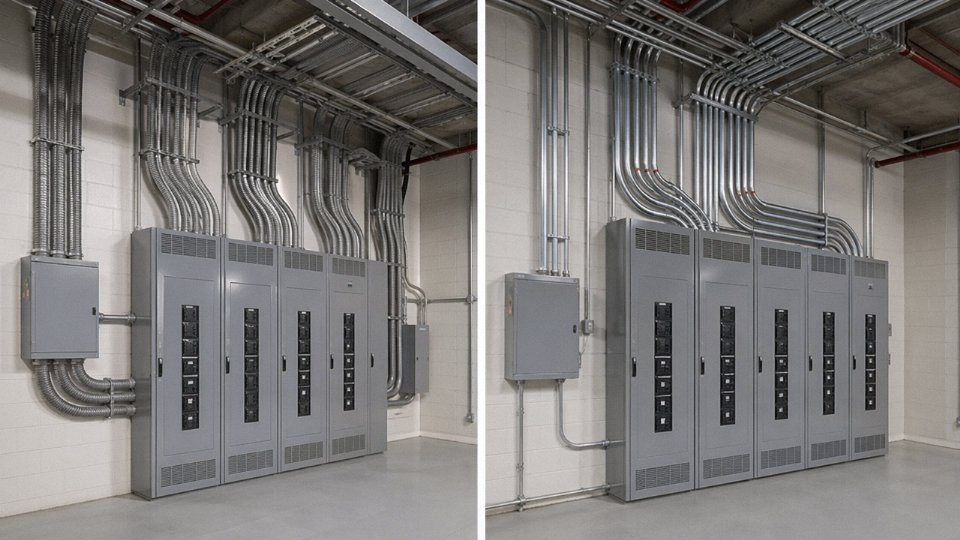
But EMT wins in high-density panel rooms, data centers, and anywhere the circuit count is likely to change. Conduit infrastructure stays fixed while conductors get swapped, added, or upsized without disturbing adjacent runs. Anyone who has tried to reconfigure a server room that was wired entirely in MC cable knows the frustration — you end up cutting and abandoning armor segments rather than just pulling new wire. In those environments, the conduit system pays for itself the first time a 20A circuit needs to become a 30A circuit.
Medium-Voltage Feeders (1 kV to 35 kV)
This is where armored cable essentially wins by default for any run longer than roughly 50 meters, and often shorter than that. Building a medium-voltage conduit system — rigid steel conduit rated for MV, sweeping bends with large enough radius for MV cable, properly supported and sealed — is expensive, slow, and overkill in most configurations. SWA medium-voltage cable manufactured to IEC 60502-2 (voltage designations 6/10 kV through 18/30 kV) is designed precisely for this application: direct burial, cable tray, or duct installation with mechanical protection built into the cable construction.
IEC 60502-2 governs medium-voltage cables rated 3.6/6 kV through 18/30 kV, specifying insulation, screen, sheath, and armor requirements for power distribution cables.True
IEC 60502-2 is the internationally recognized standard covering extruded solid dielectric insulated cables for voltages from 3.6/6 kV up to and including 18/30 kV, widely referenced in MV cable procurement specifications globally.
Jinda’s SWA MV cable range is produced to IEC 60502-2 and handles the cross-linked polyethylene (XLPE) insulation, copper or aluminum conductor, copper wire screen, and galvanized steel wire armor construction that most petrochemical, utility, and industrial substation projects require. For a 6/10 kV feeder running 200 meters across an industrial yard, specifying armored MV cable is usually straightforward. Specifying conduit for that same run adds termination chambers, rigid conduit supports every 1.5–2 meters, and MV-rated pull lubricant management — rarely worth it.
Motor Feeder Circuits with VFDs
Variable frequency drives introduce conducted high-frequency emissions that standard armor — even good SWA construction — doesn’t adequately contain. The armor provides mechanical protection but it is not a proper electromagnetic shield. IEC 61800-5-1 sets shielding and bonding requirements for VFD-connected motor cables, and the standard effectively demands a continuous, low-impedance shield with 360-degree bonded terminations at both ends.
In practice, this means either shielded MC cable with proper bonding fittings at every termination, or conduit with a dedicated shielded VFD cable inside. The conduit approach gives you more flexibility to swap cable types later if the drive changes. The shielded MC approach is faster to install but less forgiving if a termination is done carelessly — a pigtail ground instead of a full annular bond at the drive end will let common-mode noise back onto the panel ground bus and cause erratic drive faults that are genuinely difficult to trace. I’ve seen this exact failure mode blamed on the drive itself for weeks before someone checked the cable termination method.
Minimum shielding coverage for VFD cable is typically stated as 85% optical coverage or better; some drive manufacturers specify 95%+ for long runs or sensitive environments. Check the drive documentation, not just the cable datasheet.
Instrumentation and Control Cables
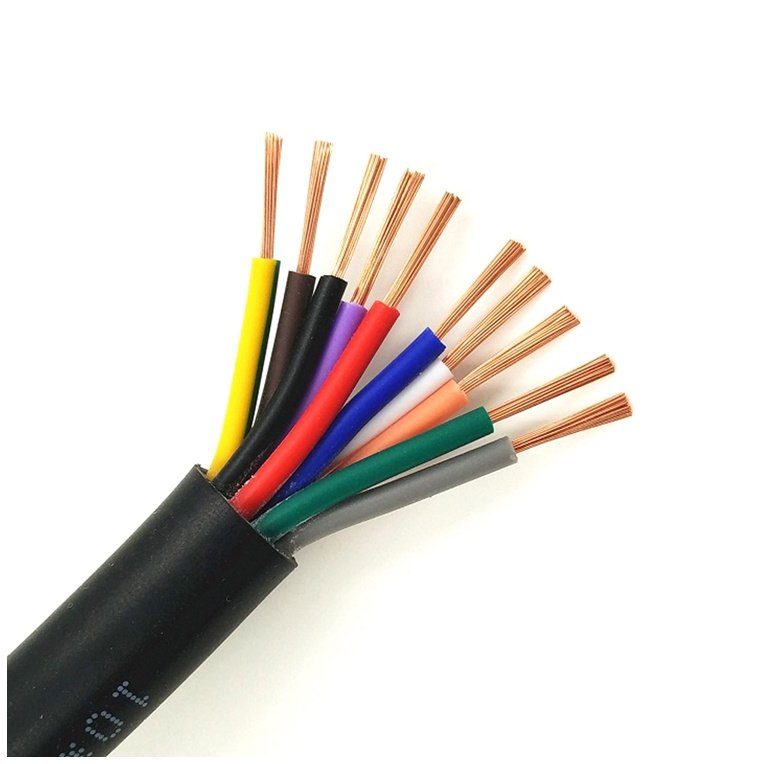
Signal cables — thermocouples, 4–20 mA loops, Modbus RTU, HART — have entirely different requirements. The threat here isn’t mechanical crush or voltage breakdown; it’s electromagnetic interference. A well-constructed multicore instrumentation cable with individual pair shielding plus an overall braid or foil shield, installed in a dedicated instrument tray with armor protecting it from physical damage, eliminates the need for conduit on most instrument tray runs.
Armored instrumentation cables with this construction — individually shielded pairs, overall shield, SWA outer armor — are standard specification on offshore platforms and petrochemical plants where running separate conduit for every instrument loop is simply not practical. Jinda’s multicore armored instrumentation cables serve exactly this market, built for the salt-air, hydrocarbon-atmosphere environments where both mechanical integrity and signal quality matter over a 20-year service life.
One operational caveat: shield termination discipline matters as much as the cable specification. An overall shield grounded at both ends on a long analog signal run will create a ground loop. Individual pair shields should typically be grounded at one end only (usually the control room end) for analog loops. This is a training and procedure issue as much as a cable selection issue, but specifying the right cable construction gives you the option to do it correctly.
Procurement and Supply Chain Strategy for Large-Scale Projects
The armored-cable-versus-conduit choice doesn’t end at the engineering drawing. It flows directly into your procurement schedule, your vendor qualification process, and — on remote or fast-track projects — your critical path. Procurement managers who treat this as purely a materials-cost question routinely get surprised when a conduit-based design requires five separate purchase orders, three suppliers, and a site crew whose workmanship determines whether the system actually meets spec.
Factory-Integrated Product Versus Site-Assembled System
Armored cable is a finished product. Armor lay, bedding thickness, conductor stranding, insulation wall — all of it is controlled under the manufacturer’s quality system and verified during factory acceptance testing per IEC 60502-1 or equivalent. A third-party test report covering crush resistance, insulation resistance, and jacket integrity travels with the drum. What arrives on site is essentially what was specified.
Conduit systems don’t work that way. The conduit itself is a commodity; quality lives in the installation. Bending radius, pull tension, connector torque, sealing at wet-location fittings — every one of those is a site variable. On a domestic project with experienced union electricians and a decent QC inspector walking the floor, that’s manageable. On a remote mining site in a developing market, or an offshore platform where your electrical crew is also doing four other trades, it becomes a real liability. In those environments, the factory-controlled quality of armored cable is not a marketing point — it’s a genuine risk reduction.
Lead Time Is Where Projects Get Into Trouble
Standard EMT, rigid steel conduit, and PVC conduit are commodity items. A local electrical distributor in most markets carries them. Lead time is measured in days, sometimes hours. THWN wire in common sizes is nearly as available.
Custom armored cable is not a shelf item. A 6 kV XLPE-insulated, steel wire armored, 3×185 mm² feeder cable with a specific outer jacket compound, or a multiconductor armored instrumentation cable with a non-standard conductor count — those run 4 to 12 weeks from an overseas manufacturer, depending on conductor size, armor material, and whether the mill is carrying your conductor alloy in stock. Shipment transit from China to most export markets adds another 3 to 6 weeks by sea freight.
The sequencing implication is straightforward but frequently ignored: armored cable for critical feeders needs to be on order before the conduit BOM is even finalized. On a project I’d describe as typical — a mid-size industrial facility with roughly 15 to 20 distinct cable types across low-voltage and medium-voltage circuits — the standard practice should be to place armored cable orders at 30% design completion for the longest-lead items, conduit orders at 60 to 70%. Reversing that sequence is probably the single most common procurement mistake on international EPC projects.
What Jinda’s Manufacturing Footprint Actually Means for a Project
Jinda operates five production bases in Shandong Province covering 470,000 m² of total manufacturing space. That scale matters in practice because it means parallel production lines — low-voltage armored cables for branch circuits and medium-voltage cables up through 35 kV for main feeders can run simultaneously rather than sequentially, compressing the overall project cable schedule.
Jinda can supply third-party test reports to IEC, BS, and AS/NZS standards for project qualificationTrue
Jinda maintains accredited third-party testing documentation to support qualification for international projects governed by IEC 60502, BS 6724, and AS/NZS 1158 or related standards, which are commonly required by project owners and EPCs for vendor approval submissions.
For procurement teams working on international projects, vendor qualification typically requires test reports, factory audit records, and traceable lot documentation. Having IEC, BS, and AS/NZS reports available from a single supplier shortens that qualification cycle considerably versus assembling a mixed vendor list where each supplier covers only part of the cable schedule.
Bulk Procurement Economics and Drum Management
Splitting a project cable schedule across multiple manufacturers creates a problem that doesn’t show up on any line-item cost comparison: drum management and lot consistency. When the same feeder type comes off three different production runs from two different mills, insulation color, jacket hardness, and pulling characteristics can vary enough to matter — particularly for medium-voltage cables where splice compatibility is critical.
Consolidating a full project cable schedule with a single manufacturer like Jinda eliminates that variability. Beyond consistency, volume pricing on a complete schedule — rather than individual purchase orders placed as design progresses — typically yields 8 to 18% reductions on material cost, depending on total volume and cable complexity. That range is wide because it depends heavily on conductor weight (copper markets move), armor material, and order timing relative to the mill’s production schedule. On large projects where the armored cable spend runs into six figures, that differential can meaningfully close the gap against locally sourced conduit-and-wire alternatives that appeared cheaper at the per-foot level.
The administrative load is real too. One supplier, one set of shipping documents, one quality dossier. On a project shipping to a port with complex import documentation requirements, that simplification has tangible value that rarely gets priced into the initial comparison.
Frequently Asked Questions About Armored Cable vs Conduit
Can I use armored cable instead of conduit everywhere?
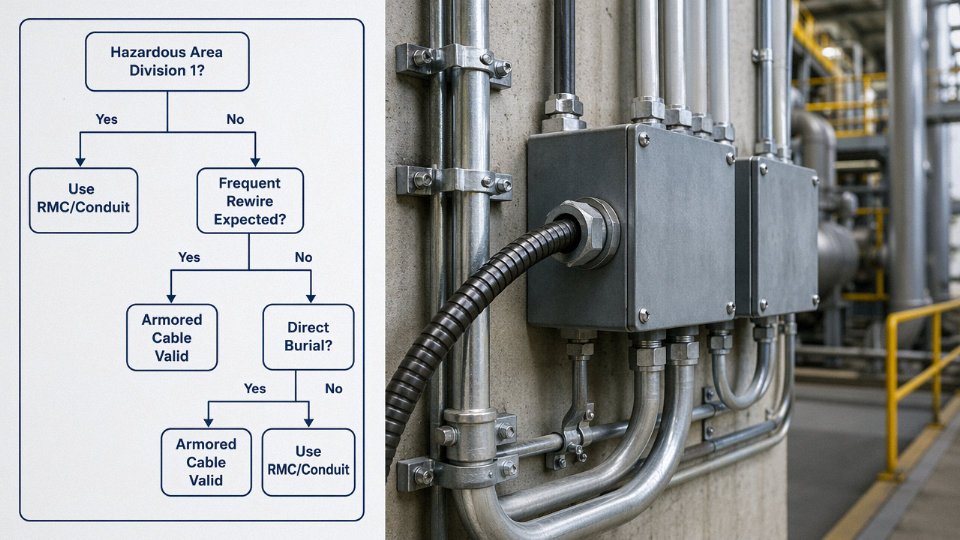
Not quite everywhere, but close. NEC Article 330 permits MC cable as a complete wiring method across a wide range of industrial and commercial environments — direct burial, wet locations, exposed runs, concealed installations — provided you select the correct armor type for the conditions. IEC 60502-series SWA cables carry similar latitude under IEC 60364 installation rules.
The places where conduit stays mandatory are specific and worth memorizing. Some Division 1 and Zone 1 hazardous-area classifications under NEC Article 501 require rigid metal conduit with explosion-proof fittings; certain listed MC cables with continuous corrugated aluminum armor can satisfy Zone 1 in limited configurations, but you need the AHJ’s sign-off before assuming that. Utility service entrance configurations often require conduit from the meter base to the first disconnect — this varies by utility and local code amendment, so check with the utility directly rather than assuming NEC alone covers it. Concrete-encased electrode conductors and some direct-buried service laterals also carry conduit requirements that armor alone doesn’t satisfy.
Outside those narrowly defined exceptions, armored cable is a valid primary wiring method. The mistake I see regularly is engineers reflexively defaulting to conduit on industrial projects because “that’s how we always do it,” not because the hazard analysis actually demands it.
Does armored cable need to be in conduit?
No. This is probably the most persistent misconception on plant floors. Armored cable — SWA, MC, or AC type — is a complete wiring method, not a supplemental layer you add around ordinary cable. The armor itself provides the mechanical protection, and the outer PVC or PE sheath handles the environmental exposure. Running SWA inside conduit is redundant in most cases and noticeably harder to pull and terminate.
That said, there are legitimate reasons to run armored cable through conduit sections: protecting a short exposed run through a high-traffic area where forklift strikes are realistic, maintaining a clean aesthetic through finished spaces, or — frankly — making future removal easier in a congested tray where the cable might need to come out cleanly. It’s a valid choice, just not a required one.
Which is safer, armored cable or conduit?
Neither is universally safer. The answer depends entirely on the threat you’re designing against.
Conduit systems with individual THWN or XHHW conductors have one genuine advantage: if insulation degrades on a single conductor — from heat cycling, chemical exposure, or age — you can pull that conductor and replace it without disturbing the rest of the circuit. In a facility running 20-year equipment cycles, that matters. Armored cable with degraded insulation typically means replacing the whole cable.
Armored cable wins on mechanical protection in exposed, mobile, or high-vibration applications. SWA cable rated to 4,000–6,000 N crush resistance per 10 cm under IEC 60502-1 simply doesn’t have an equivalent in flexible conduit. On mobile equipment, trailing cables, or installations with genuine impact risk, armor is the correct answer.
Armored cable provides superior crush resistance compared to standard PVC-jacketed cable in direct-burial applicationsTrue
IEC 60502-1 requires SWA cables to withstand 4,000–6,000 N per 10 cm crush load depending on cable size; standard PVC-jacketed cables rate below 500 N/10 cm, a roughly 10x difference in mechanical protection.
Is conduit better for future upgrades and rewiring?
Yes, decisively, if circuit changes are expected with any regularity. Pulling new conductors through existing conduit costs roughly 20–40% of the original installed cost per circuit, depending on conduit fill and run complexity. Replacing armored cable means cutting, terminating, and installing entirely new cable — typically 70–90% of original installed cost. On a facility with 50 circuits that get reconfigured every few years, that gap compounds fast.
The practical approach for mixed facilities: use conduit in areas with volatile layouts — production lines that change configuration, lab spaces, office-adjacent zones — and armored cable for fixed infrastructure runs like main feeders, outdoor distribution, and equipment that won’t move. Trying to apply one system uniformly across a complex plant usually means you’re either over-spending on flexibility you don’t need or locking yourself into cables you’ll regret cutting out in five years.
What armored cable types does Jinda manufacture and to which standards?
Jinda’s armored cable range covers SWA (steel wire armored), AWA (aluminum wire armored), and STA (steel tape armored) constructions, from 0.6/1 kV low-voltage through 8.7/15 kV and 26/35 kV medium-voltage ratings. Conductor options include plain and stranded copper and aluminum; insulation is available in XLPE or PVC depending on thermal and chemical requirements. Standards coverage includes IEC 60502-1 and IEC 60502-2, BS 6346, and GB/T 12706.
For project submittals, Jinda provides full technical data sheets, drum length tolerances, and available third-party test certifications. If your project requires specific certifications — BASEC, KEMA, or regional utility approval — that’s worth raising early in the procurement conversation since lead times for certified stock differ from standard production runs.
How do I specify armored cable correctly for a direct-burial application?
Get all of these confirmed before issuing the purchase order:
- Voltage rating — 0.6/1 kV covers most LV feeders; confirm the actual system voltage and any overvoltage category
- Conductor material and cross-section — copper vs. aluminum affects both price and termination hardware; size per voltage drop and ampacity, not just breaker rating
- Insulation type — XLPE handles higher continuous temperatures (90°C typically) and is generally preferred for direct burial; PVC is acceptable in stable-temperature soils but has lower thermal rating
- Armor type and material — SWA for most fixed direct-burial runs; AWA where stray current or weight is a concern; STA for smaller cables where flexibility during installation matters
- Outer sheath — PE sheath for direct burial or UV-exposed runs; PVC where the cable terminates indoors or in trays
- Burial depth — NEC Table 300.5 requires 24 inches minimum for direct-buried cables in most conditions, less with concrete encasement or RMC protection; IEC 60364-5-52 and local standards vary, so check the applicable code for the jurisdiction
- Warning tape or concrete encasement — many utilities and local authorities require orange warning tape 12 inches above the cable; some require concrete encasement under roads or in high-risk zones; this is easy to miss and expensive to retrofit
Skipping the sheath material call is the one I see most often on international projects where PVC-jacketed cable gets installed in direct-burial trenches that weren’t in the original scope. PE costs a little more upfront; replacing a degraded cable in a buried run costs considerably more.