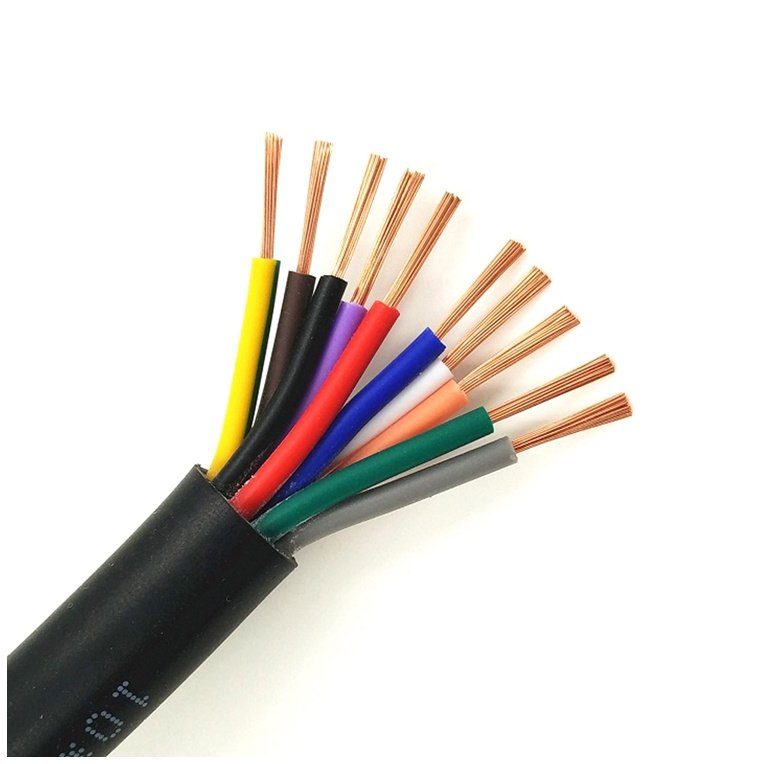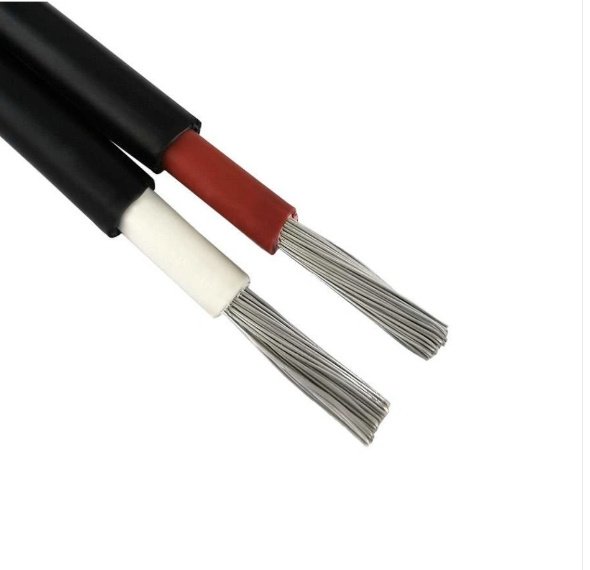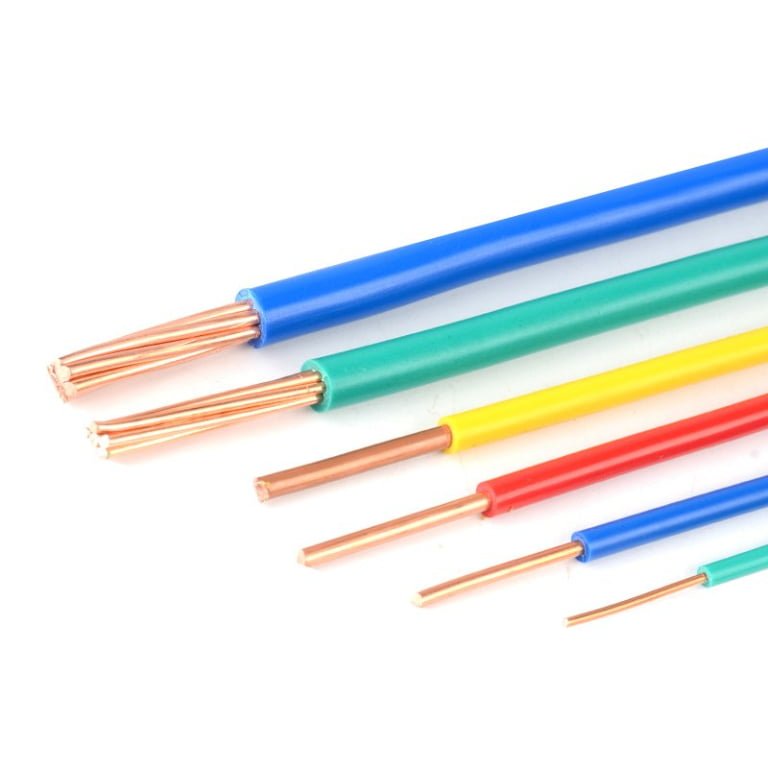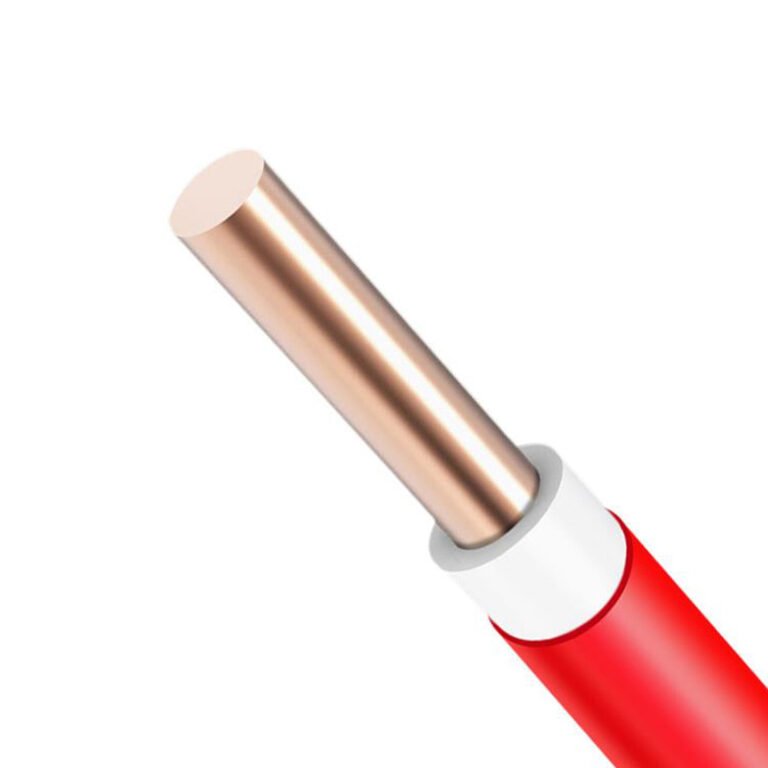
Cables fail in ways that punish you slowly before they punish you all at once. A conductor that looks fine on the reel develops micro-fractures at the termination after six months of repeated flexing, then one morning a machine trips, a shift stops, and maintenance spends three hours chasing a fault that a correct conductor class would have prevented entirely. Specify the wrong flexibility class on a trailing cable or a portable tool lead and you are not just risking nuisance downtime — you are looking at premature insulation cracking, heat buildup from elevated resistance, and in worst cases, a warranty dispute with your cable supplier that goes nowhere because the root cause was in your own procurement spec.
A Class 4 cable is a flexible cable whose stranded copper conductor meets the IEC 60228 Class 4 specification — meaning it contains a minimum of 7 strands with individual wire diameters typically between 0.10 mm and 0.41 mm depending on cross-section, giving it enough flexibility for repeated movement applications while maintaining tighter DC resistance limits than Class 5, with a maximum of 13.3 Ω/km at 20°C for a 1.5 mm² conductor.
What makes Class 4 genuinely interesting to work with is that it sits in a tension between two competing demands — flexibility and resistance — and understanding exactly where it sits relative to Class 2, Class 5, and Class 6 determines whether your cable lasts three years or three months under the same operating conditions. The cross-sectional range alone, 0.5 mm² up to 630 mm², tells you this is not a niche product.
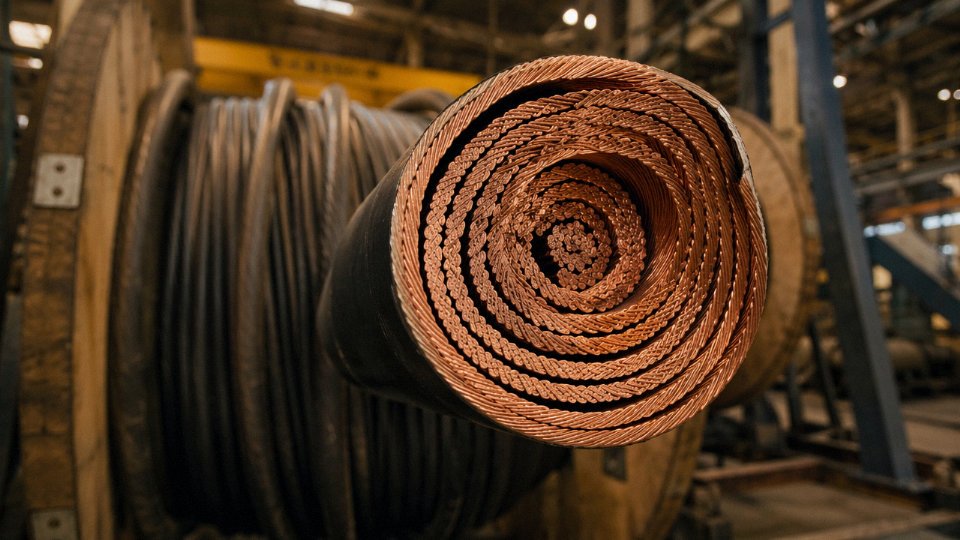
IEC 60228 Class 4 Conductor Construction: Strand Architecture, Wire Diameter Limits, and How They Differ from Class 5
The construction requirements for Class 4 are defined in IEC 60228 Table 5, and the numbers matter more than most procurement specs acknowledge. At the small end — 0.5 mm² and 0.75 mm² — the standard requires a minimum of 7 wires per conductor, with maximum individual wire diameters around 0.41 mm. Scale up to 50 mm² and you’re looking at a minimum of 19 wires; at 300 mm² that climbs to 37 wires minimum, with individual wire diameters dropping toward 0.21 mm or finer depending on the exact cross-section. At 630 mm² — the top of the practical range for Class 4 — minimum wire counts and diameter limits converge on construction geometries that begin to resemble Class 5 territory, though they never quite get there. The exact maximums shift with cross-section, so always pull the actual IEC 60228 table rather than relying on a summary like this one.
Bunching vs. Concentric Lay — Why Construction Method Changes Everything
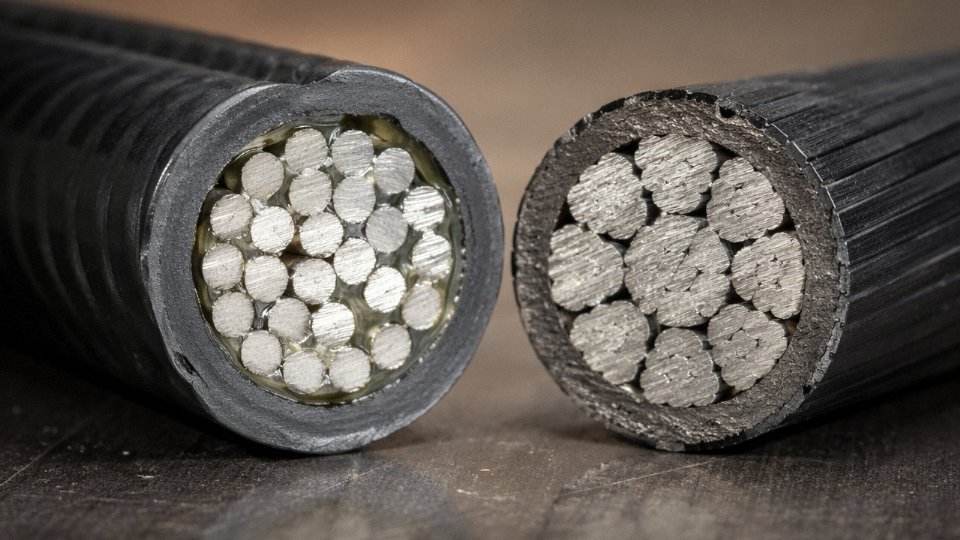
Class 4 conductors are typically built using either concentric stranding or a hybrid bunched-then-concentric approach. In concentric lay, wires are arranged in geometric layers around a central core wire — a 7-wire bundle is one center plus one layer of 6; 19 wires adds a second layer of 12. Each layer reverses twist direction relative to the one below it, which locks the geometry and resists birdcaging under tension.
Bunched construction — where a group of fine wires is first twisted together as a sub-bundle, then multiple sub-bundles are twisted into the final conductor — gives you more flexibility for a given cross-section. Class 4 cables built for trailing cable or reel applications often use this approach. The tradeoff is slightly less dimensional consistency and, in some plants, harder termination work because the sub-bundles don’t lay as cleanly into a ferrule.
Lay length (pitch) matters as well. A tighter lay ratio — the ratio of pitch length to conductor diameter, typically in the 10:1 to 16:1 range for Class 4 — improves flexibility but adds conductor length and therefore marginally increases resistance. Too tight and you accelerate work-hardening, particularly in reciprocating applications where the cable is flexed thousands of times daily. In my experience, cables with an aggressive lay ratio that look great on delivery start showing wire fractures at the outermost layer after 18 to 24 months on a machine tool tray chain, and by then the maintenance team has usually forgotten what spec was ordered.
Class 4 vs. Class 5: Where the Real Difference Sits
For the same nominal cross-section, Class 5 requires more wires at a smaller maximum individual wire diameter. At 1.5 mm², Class 4 allows wire diameters up to roughly 0.41 mm with a 7-wire minimum; Class 5 pushes minimum counts higher and wire diameters smaller — typically below 0.21 mm for the same cross-section. The result is a softer, more pliable conductor that tolerates tighter bend radii and higher flex-cycle counts.
Class 4 conductor DC resistance at 20°C for 1.5 mm² cross-section is lower than Class 5 at the same cross-sectionTrue
IEC 60228 sets a maximum DC resistance of 13.3 Ω/km for Class 4 versus 13.7 Ω/km for Class 5 at 1.5 mm² and 20°C. Slightly larger individual wire diameters in Class 4 produce marginally less inter-strand contact resistance, which is why the Class 4 limit is tighter despite the lower strand count.
That 0.4 Ω/km difference is irrelevant for a 20 m power run. In a precision 24 V DC control circuit or a low-voltage sensor loop with a long cable run, it can actually matter — which is a fact that surprises some engineers who assume Class 5 is always “better.”
Class 4 is mechanically more robust under moderate, repetitive flexing where Class 5 would be overkill — and where Class 3 or Class 2 would fracture too quickly. Think portable industrial tools, medium-duty trailing cables, and connection cables to moving machine axes that don’t require the extreme flex-cycle ratings of a proper continuous-flex class.
Conductor Material Options
Electrolytic tough-pitch copper (ETP copper, Cu-ETP per EN 13602) is the default. It’s well-characterized, terminates cleanly, and meets the conductivity assumptions baked into IEC 60228’s resistance limits. For rubber-insulated cables — EPR or polychloroprene sheathed types going into wet environments, marine installations, or elevated-temperature zones — tinned copper is standard practice. The tin layer prevents the sulfur compounds in rubber from migrating into the copper and causing the grey-black surface corrosion that degrades termination contact resistance over time. Specifying bare copper in a rubber-insulated Class 4 cable is a common oversight that shows up during commissioning when ring terminal resistance checks come back high.
Aluminum Class 4 conductors exist, mostly in large cross-sections from 50 mm² upward for cost-driven power distribution applications. They’re genuinely uncommon in flexible cable applications. Aluminum work-hardens faster than copper under repeated bending, requires larger minimum bend radii (typically 1.5 to 2 times larger than an equivalent copper conductor), and demands aluminum-rated termination hardware throughout. Unless the project economics are compelling and the flex duty is light, copper is nearly always the right call.
Applicable Product Standards and Approval Marks: Which Cable Types Use Class 4 Conductors and What Certifications to Demand
Class 4 conductors don’t exist in isolation — they show up inside specific cable product standards, each of which carries its own certification requirements. Knowing which standard governs your cable type, and which marks prove conformity, is the difference between a clean customs clearance and a rejected shipment sitting on a dock.
IEC and EN Product Standards That Reference Class 4
IEC 60502-1 covers power cables rated up to 1 kV and is probably the most common standard you’ll see cited on B2B purchase orders for industrial power distribution. It permits Class 4 conductors where moderate flexibility is required — think trailing cables on mobile equipment or cables routed through cable trays with occasional repositioning. The standard doesn’t mandate Class 4 exclusively; it allows Classes 1 through 5 depending on the intended service, so your purchase order needs to specify “Class 4 per IEC 60228” explicitly, or a supplier can legitimately ship you a Class 2 solid conductor and claim compliance.
The IEC 60245 series (rubber-insulated cables) and IEC 60227 series (PVC-insulated cables) both call on IEC 60228 for conductor classification. These series include harmonized European cable types — the H05VV-F (light-duty PVC flexible cord, typically 0.75 mm² to 2.5 mm²) and H07RN-F (heavy rubber-sheathed flexible cable, commonly 1.5 mm² up to 50 mm² or beyond for industrial use) are two that procurement teams encounter constantly. Both designations signal Class 5 conductors as standard, but Class 4 appears in certain intermediate flexible cable types within these families, especially where cost and dimensional constraints are balanced against flex requirements. Read the individual cable type designation carefully rather than assuming all harmonized flexible cables share the same conductor class.
The HAR Mark and Why It Matters for European Procurement
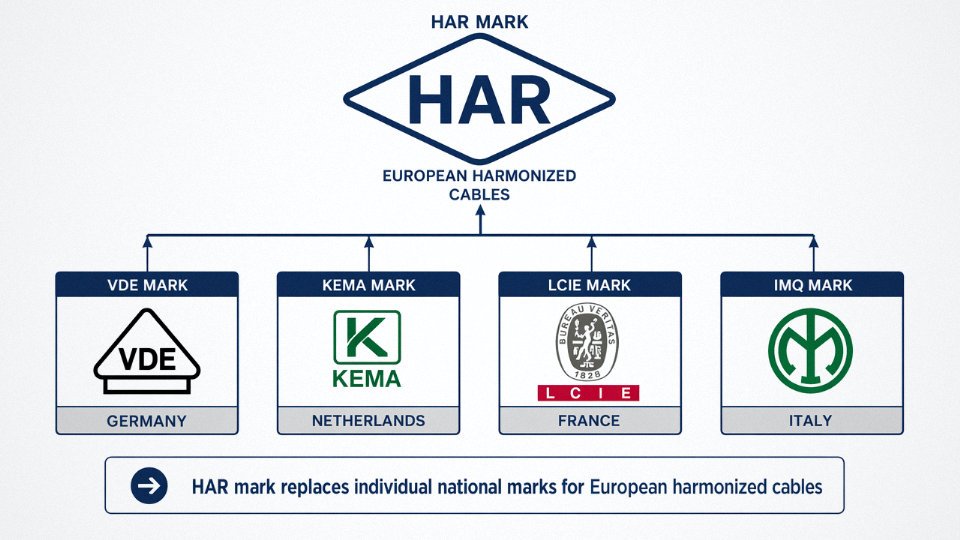
The HAR harmonization mark — a small lozenge symbol with “HAR” printed on the cable sheath — indicates that the cable conforms to a CENELEC harmonized standard tested and certified by a national body that participates in the HAR scheme. It effectively replaces individual national marks: the Dutch KEMA mark, Germany’s VDE, France’s LCIE, Italy’s IMQ, and several others. For B2B procurement into Europe, HAR is your baseline conformity signal. A cable carrying a VDE mark alone is acceptable in Germany but may face questions at the border of another EU member state. HAR cuts through that. Request it as a minimum requirement in your supply contract for European projects.
North American Equivalents: UL and CSA
The North American framework doesn’t map cleanly onto IEC conductor classes — there’s no direct “Class 4 equivalent” in UL or CSA terminology. UL 62 (flexible cords and cables) and UL 508 (industrial control wiring) govern those product categories respectively, and stranding requirements are expressed in AWG stranding classes rather than IEC class numbers. A UL 62 Type SO cord in AWG 12 will have stranding that puts it roughly in the IEC Class 4–5 flexibility tier, but they are not numerically interchangeable — don’t let a supplier tell you otherwise. For projects that need both IEC and UL compliance, specify dual-listed cables explicitly and expect a cost premium of roughly 15–35%, depending on cross-section and order volume.
Sector-Specific Certifications
Certain applications layer additional certification requirements on top of the product standard:
| Application | Required Certification | Key Issuing Bodies |
|---|---|---|
| Machinery (EU) | CE marking, Machinery Directive 2006/42/EC | Notified Bodies (varies by country) |
| Explosive atmospheres | ATEX (EU) / IECEx (international) | DEKRA, SGS, Bureau Veritas |
| Marine and offshore | Type Approval | Lloyd’s Register, DNV, Bureau Veritas Marine |
| North American installations | UL Listed or CSA Certified | UL, CSA Group |
| Mining / trailing cables | Country-specific (e.g., MSHA in the US) | MSHA, national mining authorities |
ATEX and IECEx are worth pausing on. A Class 4 conductor in a flexible cable routed through a Zone 1 hazardous area needs not just the right conductor construction but a whole cable assembly certified for that zone — conductor class alone does nothing for ATEX compliance. The certification covers the complete cable, insulation, sheath, and gland system together.
What to Check on a Drum Label and Test Report
A cable drum label that genuinely confirms Class 4 compliance will show, at minimum: the product standard number (e.g., IEC 60502-1), the conductor class (“Cl. 4” or “Class 4 per IEC 60228”), the nominal cross-section in mm², the voltage rating, and the certification mark with the issuing laboratory’s name or number. If any of those elements is missing or vague — “flexible conductor” without a class designation, for instance — treat it as unverified.
For larger orders, make IEC 60228 conductor test reports a standard item in your factory acceptance test (FAT) package. Specifically request: DC resistance measurement at 20°C (which for a 1.5 mm² Class 4 conductor should not exceed 13.3 Ω/km per IEC 60228), wire count per conductor, and individual wire diameter measurements. These three data points together confirm conductor class faster than any label. Suppliers who resist providing them on a large-volume order are telling you something.
The HAR harmonization mark on a cable sheath confirms that the cable was tested and certified by a national body participating in the CENELEC HAR scheme, and is recognized across all participating European countries without requiring additional national certification.True
The HAR scheme operates under CENELEC harmonization, and cables bearing the HAR mark have been certified by a participating national testing body (such as VDE, KEMA, LCIE, or IMQ). This mutual recognition is the purpose of the scheme and is confirmed by CENELEC's HAR agreement framework.
In practice, the procurement checklist for a Class 4 cable order should run: product standard confirmed, conductor class explicitly stated, applicable certification marks present, and test reports available on request. Miss any one of those and you’re taking someone else’s word for it.
Electrical Performance Parameters: Current Capacity, Voltage Rating, Resistance, and Capacitance for Class 4 Flexible Cables
Numbers on a datasheet mean nothing unless you know the conditions they were measured under. That’s worth stating plainly before diving in.
Current-Carrying Capacity and Correction Factors
Ampacity for Class 4 flexible cables is governed by the same thermal limits as any stranded copper conductor — the insulation system sets the ceiling, and the installation method determines how much heat you can actually dissipate. The table below uses IEC 60364-5-52 reference method B2 (single cable, free air, 30°C ambient, PVC insulation at 70°C conductor limit) as a baseline. Real plant conditions almost always require derating.
| Cross-section (mm²) | Approximate ampacity, free air, 30°C (A) | Max DC resistance at 20°C (Ω/km) |
|---|---|---|
| 1.5 | 17–19 | 13.3 |
| 2.5 | 23–26 | 7.98 |
| 4 | 30–34 | 4.95 |
| 10 | 52–57 | 1.91 |
| 25 | 88–96 | 0.727 |
| 50 | 125–138 | 0.366 |
| 95 | 188–210 | 0.193 |
Ampacity ranges here reflect variation between cable constructions (number of cores, sheath material, armoring). A four-core armored design will sit at the lower end; a single-core unsheathed cable in genuinely free circulation will sit higher.
Bundling kills headroom fast. Group correction factors under IEC 60364-5-52 run from roughly 0.80 for three cables touching down to 0.55 or lower for a tray carrying twelve or more circuits. In mobile equipment harnesses — festoon systems, cable reels on cranes — cables often coil partly on the drum, which is functionally worse than a tight bundle. On a cable drum, only the outermost layer dissipates heat freely; the IEC standard doesn’t cover this directly, and manufacturers’ derating curves vary enough that you should ask for tested data, not just calculated estimates.
Ambient temperature above 30°C requires a further correction. At 45°C with PVC insulation the factor is around 0.87; at 60°C it drops to roughly 0.71. Foundry floors, outdoor trailing cables in tropical climates, cables routed near process heating equipment — these situations are common and frequently underestimated at the design stage.
Voltage Rating: The Conductor Class Doesn’t Set It
This is a persistent point of confusion. A Class 4 conductor is just a stranding geometry. The voltage rating — 300/300 V, 450/750 V, 0.6/1 kV, up to 6/10 kV for heavy mining trailing cables — is entirely determined by the insulation system built around it. A 6/10 kV mining cable and a light portable tool cord at 300/300 V can both carry a Class 4 conductor of the same cross-section. Specifying conductor class without specifying insulation grade and applicable product standard leaves a dangerous gap in procurement documents.
Class 4 conductor classification under IEC 60228 specifies only the stranding geometry and maximum DC resistance; it does not define or restrict the cable's voltage rating.True
IEC 60228 explicitly covers conductor construction only. Voltage rating is assigned by the cable product standard (e.g., IEC 60502, IEC 60227, IEC 60245) based on insulation type and thickness.
AC Resistance and Skin Effect
At 50 or 60 Hz, skin effect is effectively negligible below about 35 mm². Above 95 mm² it becomes measurable and starts to matter for power loss calculations. The practical advantage of Class 4’s finer stranding over a Class 2 compressed conductor is most visible in the 70–240 mm² range, where the higher strand count keeps the effective AC resistance closer to the DC value. For most flexible power cable applications below 95 mm², the difference between Class 4 and Class 5 AC resistance is small enough that you won’t see it in an energy audit.
Capacitance, Inductance, and VFD Applications
Capacitance matters the moment a variable frequency drive enters the picture. PVC-insulated Class 4 cables typically show phase-to-screen capacitance somewhere between 100 and 200 pF/m — the actual figure depends on insulation wall thickness, which scales with voltage rating, and on whether there’s a copper tape screen or a wire braid. Thinner insulation means conductors sit closer to the screen, which pushes capacitance toward the upper end of that range.
High capacitance generates common-mode leakage current on long VFD cable runs. On a 100 m trailing cable driving a 37 kW motor, this is manageable. At 200 m or more, or with a drive that lacks adequate common-mode filtering, you start seeing nuisance RCD trips, EMC interference into adjacent instrumentation, and premature bearing wear from shaft currents. Low-capacitance XLPE-insulated designs exist specifically for this; the conductor class stays the same, but insulation geometry changes the electrical behavior significantly.
Inductance is rarely the limiting factor in flexible cable design at industrial power frequencies, but it becomes worth checking in long trailing cable circuits with heavy motor starting currents where the inductive voltage drop adds to resistive drop.
Voltage Drop on Mobile Equipment
Voltage drop calculation for a trailing cable or a festoon loop needs three adjustments beyond the standard textbook formula. First, conductor resistance rises with temperature — roughly 0.4% per °C above 20°C for copper — so a cable running warm under continuous load has meaningfully higher resistance than the cold IEC 60228 figure. Second, trailing cable length is variable; size for the maximum deployed length, not the average. Third, connector and termination resistance accumulates. A worn multi-pin connector in a dirty outdoor environment can add milliohms that produce a noticeable voltage dip at motor start.
A rough rule of thumb for initial sizing on three-phase 0.4 kV mobile equipment: keep resistive voltage drop under 3% at full load current at maximum cable extension, then verify at motor starting current. If the drive is a VFD, the starting current constraint relaxes, but the capacitance constraint tightens. You usually can’t optimize both simultaneously with the same cable construction, which is why VFD-rated flexible cables are a distinct product category, not just a marketing label.
Insulation and Jacket Material Options for Class 4 Cables: PVC, EPR, XLPE, Silicone, and Rubber Compared
The Class 4 conductor is only half the specification. What surrounds it determines whether the cable survives its actual service environment — and getting that wrong costs more than the cable itself, usually in unplanned downtime or a fire investigation.
PVC: The Default That Has Real Limits
Polyvinyl chloride covers the majority of Class 4 flexible cable applications in light industrial and commercial settings. Standard PVC insulation runs comfortably from around -15°C to +70°C, and HD-grade (harder compound) formulations push that upper limit to +90°C conductor temperature. It bonds well with HAR-harmonized designs like H05VV-F and H07VV-F, which simplifies pan-European procurement significantly. Oil resistance is decent for splash exposure, though continuous oil immersion will swell standard PVC compounds over time — the compound grade matters here, not just the material name.
The limitations are real and often underweighted in specs. Below about -10°C, standard PVC stiffens enough to crack at tight bend radii; anyone who has tried to drag a PVC trailing cable across a cold warehouse floor in January already knows this. The bigger issue in fire-sensitive environments is HCl off-gassing during combustion — in enclosed spaces like ships, tunnels, or data halls, this is often a hard disqualifier regardless of price advantage.
EPR: The Right Choice More Often Than It Gets Credit For
Ethylene propylene rubber handles the -40°C to +90°C range with genuinely soft, supple flexibility throughout. It doesn’t go brittle in cold storage yards or on offshore platforms where ambient can drop sharply overnight. Ozone and UV resistance are both strong, which matters for outdoor festoon systems or cables run along crane bridges where sunlight exposure is intermittent but cumulative over years.
EPR insulation is typically paired with a CPE (chlorinated polyethylene) or CSP (chlorosulfonated polyethylene) sheath — both give good mechanical toughness and chemical resistance without the HCl combustion problem that PVC presents. Mining trailing cables and offshore umbilical designs use this combination routinely. The cost premium over PVC runs roughly 20–45% depending on conductor cross-section and order volume, though that gap narrows when you factor in replacement frequency.
XLPE: Thermal Performance at Some Flexibility Cost
Cross-linked polyethylene sits in a different trade-off zone. Continuous conductor rating reaches +90°C, and short-circuit withstand can approach +250°C — numbers that matter for cables routed near heat sources or sized for fault current duty. Dielectric losses are lower than PVC, which makes a measurable difference in high-frequency or medium-voltage adjacent applications. What XLPE does not do well is flex at low temperatures; it becomes noticeably stiffer than EPR below about 0°C, so it is better suited to fixed or semi-fixed installations than true trailing cable duty.
Silicone: Extreme Range, Fragile Surface
Silicone rubber covers -60°C to +180°C continuous, sometimes higher in short bursts, with flexibility that barely changes across that entire span. Furnace door cables, welding leads run near hot workpieces, and aerospace ground support equipment are typical applications. The catch is mechanical fragility — silicone surface tears and abrades easily, so most practical designs add a fiberglass braid or protective textile sheath. Specify accordingly; bare silicone insulation in a high-traffic conduit is a maintenance headache.
TPE and TPU: The Clean-Industry Alternatives
Thermoplastic elastomers and polyurethane compounds are displacing PVC in food processing lines, medical device environments, and clean rooms where halogen-free and recyclability requirements are firm. Abrasion resistance on TPU in particular is excellent — noticeably better than standard PVC in drag-chain applications. Cost runs higher than PVC but the compounds are improving, and regulatory pressure in several markets is gradually shifting the baseline.
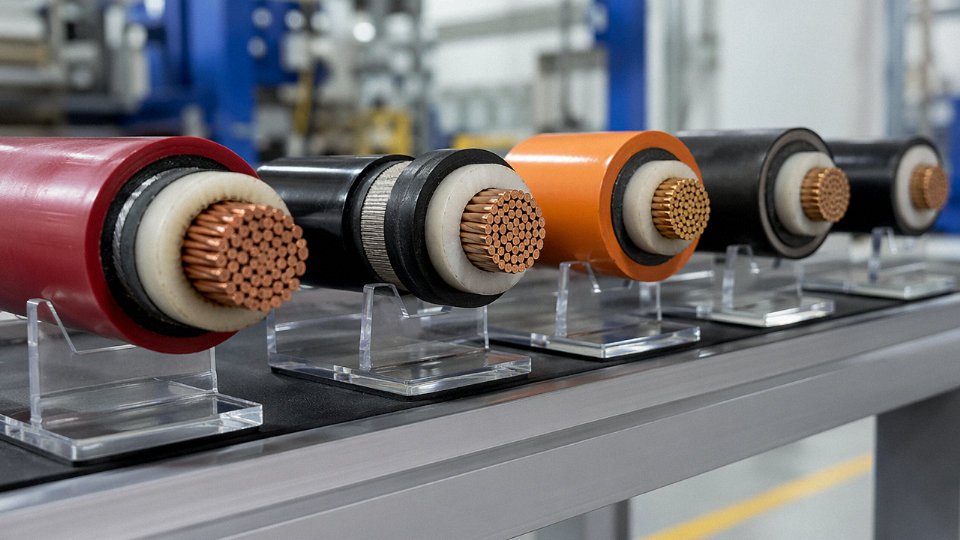
| Material | Temp Range (typical) | Cold Flexibility | Oil Resistance | UV Resistance | Halogen-Free Option | Relative Cost |
|---|---|---|---|---|---|---|
| PVC (standard) | -15°C to +70°C | Poor below -10°C | Moderate | Moderate | No | Low |
| PVC (HD/90°C) | -15°C to +90°C | Poor below -10°C | Good | Moderate | No | Low–Medium |
| EPR | -40°C to +90°C | Excellent | Good | Good | Yes | Medium–High |
| XLPE | -40°C to +90°C | Moderate | Good | Moderate | Yes | Medium |
| Silicone | -60°C to +180°C | Excellent | Poor | Good | Yes | High |
| TPE / TPU | -40°C to +90°C (varies) | Good | Good–Excellent | Good | Yes | Medium–High |
Cost index is relative to standard PVC at a given cross-section and order quantity; actual pricing shifts with compound grade, sheath thickness, and volume. The “halogen-free” column reflects availability of HF formulations, not that every standard grade qualifies.
EPR insulation maintains flexibility at temperatures as low as -40°C, making it suitable for cold-environment trailing cable applications.True
EPR (ethylene propylene rubber) is an elastomeric compound that retains its mechanical flexibility down to approximately -40°C, a characteristic well-established in cable standards and compound datasheets. This is a primary reason it is specified for offshore, mining, and cold-climate outdoor trailing cable designs over PVC.
One practical note: the insulation and sheath materials are often specified independently on flexible power cables — EPR insulation under a CPE sheath is common, but so is EPR under a PVC outer sheath in cost-sensitive designs where fire performance requirements are moderate. Confirm both layers when reviewing a datasheet, not just the headline material description.
Industrial Applications of Class 4 Flexible Cable: Machinery, Mining, Marine, Renewable Energy, and Mobile Equipment
Class 4 sits in a useful middle ground: more flexible than the solid or bunched Class 1–2 conductors used in fixed wiring, yet with slightly larger individual wire diameters than Class 5 — which turns out to matter quite a bit depending on the mechanical abuse a cable has to survive. The applications below aren’t exhaustive, but they cover the sectors where this conductor class gets specified most consistently.
Machine Tool and Factory Automation
In cable carriers — igus energy chains or equivalent — Class 4 conductors handle the repetitive flexing on CNC machining centers, robot arms, and servo-driven conveyor systems. The minimum bend radius for dynamic applications typically runs 5× to 10× the cable’s outer diameter, with the exact multiplier depending on the jacket material and how many conductors are bundled together. What makes Class 4 suitable here (and Class 2 unsuitable) is the strand architecture: the multi-strand lay keeps individual wires from work-hardening and fracturing after millions of flex cycles. Lay pitch relative to strand diameter matters — shorter lay pitches distribute bending stress more evenly across the conductor cross-section, which is why manufacturers specify lay pitch ranges in IEC 60228 rather than leaving it open.
Mining and Tunneling
Rubber-sheathed trailing cables for continuous miners, longwall shearers, and tunnel boring machines are one of the harder-service applications in any industry. These cables get dragged over rock floors, run over by heavy tracked equipment, and exposed to water, coal dust, and methane atmospheres. Operating voltages reach up to 3.3 kV in many mine power systems. Here, Class 4 is often chosen over Class 5 specifically because the slightly heavier individual wire diameter gives better crush resistance — finer wires deform more easily under point loading. The flexibility trade-off is acceptable because these cables aren’t being bent in a tight energy chain; they just need to coil and uncoil as the machine advances.
Marine and Offshore
On drillships, FPSOs, and port cranes, Class 4 flexible cables connect winch motors, thrusters, deck machinery, and subsea pump systems. The relevant product standard here is IEC 60092 (series), and Type Approval from classification societies — Lloyd’s Register, DNV, Bureau Veritas — is essentially non-negotiable for anything going onto a flagged vessel. These cables must also meet oil-resistance requirements (typically an NEO or CSP outer sheath) and pass flame-retardancy tests per IEC 60332. Offshore procurement teams should insist on seeing the actual TA certificate, not just a supplier declaration.
Class 4 cables used on offshore vessels must carry Type Approval from the relevant classification society to be compliant with IEC 60092 installation requirements.True
IEC 60092-350 and the individual society rules (Lloyd's Register, DNV, Bureau Veritas) require cables installed on classed vessels to hold valid Type Approval certificates issued by the society. A manufacturer declaration or test report alone does not satisfy this requirement.
Renewable Energy
Solar tracker systems and floating solar (floatovoltaic) installations present a specific challenge: the cables must flex continuously as panels track the sun or float with water surface movement. Class 4 DC cables handle this well across the 35 mm²–95 mm² range typical for string-to-inverter runs. Wind turbine applications are arguably more demanding — the cable running from the nacelle generator down through the tower is subject to combined torsional and bending stress every time the nacelle yaws. Conductor fatigue is a real failure mode here; Class 4’s strand count and lay geometry contribute directly to service life in this duty cycle.
Portable and Semi-Portable Industrial Equipment
Welding machines, portable air compressors, and temporary power distribution on construction sites usually reach for H07RN-F or similar rubber trailing leads — which in practice use Class 5 conductors because the cable is handled constantly. Class 4 makes more sense where the cable is semi-fixed: installed during commissioning, flexed occasionally during repositioning, but not dragged around daily. The slightly lower strand count simplifies termination at lugs and busbar connections without sacrificing enough flexibility to matter in that duty cycle.
EV Charging Infrastructure
High-current DC fast-charging cables (IEC 62196 Type 2 and CCS Combo) at 35 mm² and above are where Class 4 gets genuinely interesting. At those cross-sections, a Class 5 conductor is noticeably harder to manage — the finer wires add up to a stiffer bundle in practice, and termination reliability at the connector pin can be inconsistent if wire ends aren’t properly managed. Class 4’s coarser stranding handles the crimp ferrule more predictably and still gives the user enough flex to plug and unplug without the cable fighting back.
Emerging Applications Worth Watching
Battery energy storage systems (BESS) need interconnect cables that can be routed in tight cabinet layouts but also tolerate some movement during maintenance access. Hydrogen electrolyzer plants — a growing segment — require flexible power feeds that resist both chemical exposure and the vibration common near gas-handling equipment. Data center bus cables, particularly in high-density rack deployments, benefit from Class 4 flexible construction simply because rigid conductors are difficult to route through crowded cable management systems without exceeding the bend radius limits of the insulation. None of these are niche anymore; they’re showing up regularly in project specifications.
How to Specify and Select the Correct Class 4 Cable: A Step-by-Step Engineering Checklist
Getting the specification right before the purchase order goes out saves considerably more than it costs. A cable that’s under-specified fails early; one that’s over-specified drains budget and, in flexible applications, may actually perform worse because heavier conductors fatigue faster in tight bend radii. Work through these steps in order.
Step 1 — Define the Electrical Duty
Start with the circuit basics: rated voltage expressed as U0/U (e.g., 0.6/1 kV), maximum continuous current under worst-case load, prospective fault level, and frequency — 50 Hz, 60 Hz, or DC. Don’t skip the DC question; some variable-speed drive output cables see DC ripple, which changes your screening requirements. Confirm whether the circuit is power, control, or instrumentation, because that changes both the voltage rating and whether you need a screened or twisted-pair construction.
Step 2 — Characterize the Mechanical Duty
This step is where most specification errors actually originate. A cable used for occasional repositioning during maintenance shutdowns — say, a few dozen flex cycles per year — sits in a completely different category from a festoon cable on a crane bridge that cycles thousands of times a day. Estimate the total flex cycles over design life as honestly as you can. Get the minimum bend radius imposed by your cable carrier, drag chain, or connection geometry. Class 4’s strand architecture handles occasional to semi-frequent flexing well, but if you’re looking at continuous dynamic movement on a machine axis, you need to have that conversation about Class 5 or Class 6 before the cable ships.
Step 3 — Assess the Environment
Ambient temperature range, both minimum and maximum, determines insulation choice more than almost anything else. Cold-store installations running at −25 °C crack standard PVC sheaths; a rubber or cold-flexible PVC compound is necessary. Oil exposure — even incidental splashing from nearby machinery — rules out standard PVC. Check for ozone sources (UV lamps, corona discharge equipment), UV exposure for any outdoor routing, and whether the site carries an explosive atmosphere classification: Zone 0/1/2 for gas or vapor, Zone 20/21/22 for combustible dust. Marine installations need to be broken down further — dry accommodation spaces versus engine room wet zones versus submerged or splash-zone runs each carry different sheath and flame-retardancy requirements.
Step 4 — Select Conductor Cross-Section
Use IEC 60364-5-52 ampacity tables as your starting point, then apply correction factors for actual installation conditions: grouping, ambient temperature deviation from 30 °C reference, and thermal insulation effects. Run the voltage drop calculation over the maximum cable run length; most industrial final circuits should stay within 3–5%, though some projects set tighter limits. Don’t size purely on current — in long runs on low-voltage control circuits, voltage drop often governs the cross-section before thermal capacity does.
Step 5 — Confirm Class 4 Is Appropriate
If the cable will be permanently fixed after installation and never flexed again, Class 2 stranded is almost certainly more economical and there’s no technical reason to pay for Class 4 flexibility. Conversely, if the cable connects to a continuously moving axis with tight bend radii and high cycle counts, push toward Class 5 or Class 6. Class 4 is the right call for semi-flexible service: portable tools, trailing cables that move occasionally, connection drops that get repositioned during maintenance, and similar duties.
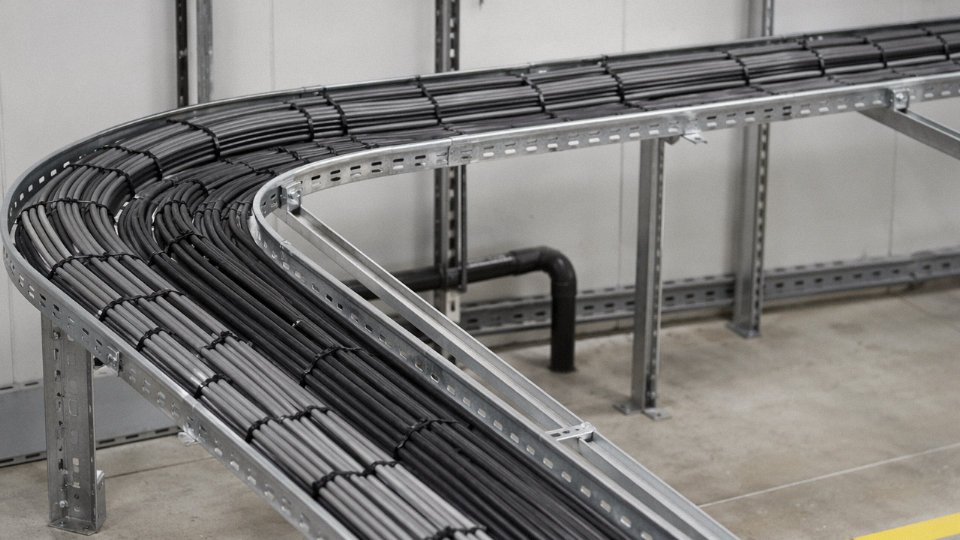
Step 6 — Select Insulation and Sheath System
Cross-reference your environmental findings from Step 3 against the material options covered in the previous section. Specify screening (braided copper, foil, or combination) if EMI immunity matters for instrumentation circuits or if the cable runs near variable-frequency drives. Add armor — steel wire, steel tape, or aramid braid depending on flexibility needs — if the routing exposes the cable to mechanical impact or rodent risk.
Step 7 — Specify Standards and Approvals
Write these as explicit line items in the purchase specification, not notes or assumptions. Name the IEC product standard (for instance, IEC 60245 for rubber-insulated or IEC 60227 for PVC), the HAR or relevant national mark, and any sector approval — ATEX certificate number, Lloyd’s or DNV type approval, UL listing. Include IEC 60228 Class 4 conductor compliance as a standalone line. Buyers who leave this implicit sometimes receive Class 5 construction labeled as “flexible,” which is not wrong per se, but it isn’t what was specified.
IEC 60228 Class 4 conductors must have a minimum of 7 strands, with individual wire diameters typically ranging from 0.10 mm to 0.41 mm depending on cross-sectional area.True
IEC 60228 defines minimum strand counts and maximum wire diameters for each conductor class. Class 4 requires at least 7 strands, and the wire diameter range cited reflects the standard's limits across the full cross-section range from 0.5 mm² to 630 mm².
Step 8 — Define Test and Documentation Requirements
Specify drum lengths and reel weight limits up front — a 500 kg reel limit matters a lot when your site has no forklift near the cable route. Require a conductor DC resistance test report at 20 °C per IEC 60228 (for a 1.5 mm² Class 4 conductor, the maximum is 13.3 Ω/km), a high-voltage test certificate, and factory quality records including material traceability. On large projects or long-lead specialty constructions, include a clause requiring third-party witness testing at the factory. It adds a small cost and a few days, but catching a batch resistance nonconformance at the factory is far cheaper than pulling and replacing cable already installed in conduit.
Procurement, Quality Verification, and Supply Chain Considerations for Class 4 Cable in International Projects
Buying Class 4 flexible cable across borders is straightforward until it isn’t. The specification looks clean on paper, the price is competitive, and then the drums arrive with conductors that flex like a garden hose and measure 20% under cross-section on the micrometer. This happens more often than most procurement managers want to admit.
Manufacturer vs. Trader — It Matters More Than the Price Sheet
A cable manufacturer with its own wire drawing, stranding, and extrusion lines controls conductor quality from copper rod to finished product. That vertical integration means process records exist for every production batch: rod diameter, drawing die sequence, strand lay length, extrusion temperature profile. A trader buying from multiple sources and repackaging under a house label has none of that. When a non-conformance surfaces — CCA core instead of bare copper, strand count matching Class 2 rather than Class 4, insulation wall 0.08 mm short of the IEC minimum — a trader typically cannot tell you which production line made the reel, let alone provide a corrective action. Qualification audits should require a plant visit or third-party factory assessment, not just a catalog.
How to Audit a Class 4 Conductor Claim
Request the IEC 60228 type test report issued by an accredited laboratory — CNAS, ILAC-MRA, or equivalent depending on your market. Pull the table for the stated cross-section and verify three things: the minimum wire count meets the Class 4 requirement (not fewer than 7 strands, with individual wire diameter within the standard’s limits for that cross-section, typically 0.10 mm to 0.41 mm depending on CSA), the measured DC resistance at 20°C sits at or below the IEC 60228 maximum (13.3 Ω/km for 1.5 mm², for instance), and the conductor diameter under the insulation matches a genuine Class 4 construction rather than a compressed Class 2 bundle.
In practice, a quick field check on arrival: cut a sample, count strands under magnification, weigh a meter length and back-calculate cross-section from copper density. It takes ten minutes and has saved more than one project from a silent substitution.
CCA (copper-clad aluminum) conductors are sometimes sold as all-copper Class 4 cable without disclosure in international marketsTrue
This is a documented market non-conformance. CCA conductors have significantly lower conductivity and tensile strength than solid copper, and their use in Class 4 flexible applications without disclosure violates IEC 60228 requirements and creates safety risks in mobile and trailing cable installations.
Common Non-Conformances Worth Watching
Understated strand count — a Class 2 construction labeled Class 4 — is probably the most common substitution because it cuts stranding time and costs less to draw. Thin conductors, where the actual cross-section runs 5–12% below declared value, reduce material cost per kilometer by roughly the same percentage, which is enough margin to make it tempting at high volumes. CCA without disclosure is the dangerous one because it’s visually indistinguishable until you do a density check or a resistance measurement.
Packaging, Drums, and Export Compliance
Class 4 cable ships on wooden drums, steel drums, or reel-on-pallet depending on cross-section and destination. For export to Australia, New Zealand, and several other quarantine-strict markets, wooden packaging requires ISPM 15-compliant heat treatment or fumigation-free alternatives — steel drums or plywood with certification. Confirm this before booking freight, not after customs holds the shipment. Drum length matters too: most standard production runs 500 m or 1,000 m per drum, but projects often need 250 m or 750 m cuts. Asking a manufacturer to accommodate non-standard cut lengths late in the order cycle costs time and sometimes a premium.
Lead Time and Copper Price Volatility
Copper rod price moves fast and cable pricing follows with roughly a 4–8 week lag depending on the manufacturer’s raw material purchasing cycle. Standard Class 4 sizes — say, 1.5 mm² to 50 mm² in common compounds — typically leave the factory 3–6 weeks after order confirmation. Large cross-sections (185 mm² and above) or cables requiring specialty compounds like EPR or silicone-rated jackets usually need 8–12 weeks, sometimes longer if the extrusion tooling needs changing or the compound requires a separate qualification run.
For projects with phased delivery schedules, a long-term supply agreement with a price adjustment mechanism tied to the LME copper index protects both sides better than spot orders renegotiated each quarter. It also gives the manufacturer visibility to pre-position copper rod, which directly compresses lead time. Specifying “IEC 60228 Class 4 compliant flexible conductor” in the purchase order — not just “flexible cable” — is the contractual baseline that makes non-conformance claims enforceable.
A manufacturer operating across five production bases with 470,000 m² of total manufacturing space can absorb demand spikes that would stall a single-plant supplier. When one production base is running heavy on a large trailing cable order, standard portable cord sizes can shift to another line without delaying shipment. That operational flexibility is real supply security for bulk or repeat international orders, not a marketing claim.
Frequently Asked Questions About Class 4 Cable
What is the difference between Class 4 and Class 5 flexible cable, and how do I choose between them?
Both classes are multi-strand flexible conductors defined under IEC 60228, but they are not interchangeable in dynamic service. Class 5 carries a higher minimum strand count and tighter wire diameter ceiling, which produces a softer, more pliable conductor that tolerates repeated bending without work-hardening and strand fracture. Class 4 is the right call for semi-flexible duty — think a portable generator feed cable that gets coiled and uncoiled a few times a week, not a cable looping through a robotic arm 400 times a shift. If the installation will see more than a few thousand genuine flex cycles over its service life, move to Class 5. Class 4 does offer marginally better abrasion resistance at the conductor level (the slightly heavier wire gauges hold up better to rough handling) and typically comes in at a small cost advantage — usually 3–8% lower conductor material cost, depending on cross-section and copper pricing at the time. Not a huge gap, but on a 50 km project order it matters.
Is a Class 4 cable the same as an H07RN-F cable?
No, and this confusion trips up buyers regularly. H07RN-F is a complete harmonized product standard for a rubber-sheathed flexible cable rated 450/750 V — and it mandates Class 5 conductors, not Class 4. Class 4 conductors show up in other product families: certain IEC 60502-1 medium-voltage power cables, heavier industrial trailing cables, and some national-standard flexible cords. The cable type name tells you almost nothing about conductor class on its own. Always pull the applicable product standard, find the conductor specification clause, and confirm the class there.
Can I use Class 4 cable in a cable carrier (energy chain)?
You can, within limits. For lightly dynamic carriers — short travel, moderate speed, infrequent cycling — Class 4 will perform acceptably provided the carrier’s minimum bend radius is at least 7.5 to 10 times the cable’s outer diameter. Push beyond roughly 100,000 cycles or travel speeds above 3 m/s and you are asking the conductor to do work it was not designed for. Strand fatigue failures in cable carriers are insidious: the cable passes continuity checks right up until it doesn’t, usually during production. For demanding energy-chain applications, specify Class 5 or Class 6 cables that have been tested to DIN EN ISO 6945 or a manufacturer’s documented dynamic protocol. That test evidence is non-negotiable on high-cycle lines.
What conductor material is standard — bare copper or tinned copper?
Bare annealed copper (electrolytic tough-pitch copper, ETP) is standard for Class 4 conductors used under PVC or XLPE insulation. Tinned copper is specified for rubber-insulated constructions — IEC 60245 cables, polychloroprene-sheathed trailing cables, and similar — because unprotected copper bonds to rubber compounds at elevated temperatures, making mid-life repair or termination needlessly difficult. Tinning also makes sense for marine and high-humidity environments where oxidation at lug contacts is a real maintenance headache. The cost premium for tinned stranding is modest, roughly 4–10% on the conductor, and it pays for itself quickly in termination reliability.
How does cross-section tolerance work — can I get exactly 10 mm² Class 4?
Yes. IEC 60228 uses a maximum DC resistance approach rather than a tight dimensional tolerance on the metallic area. A declared 10 mm² Class 4 conductor must meet a maximum resistance of 1.91 Ω/km at 20°C; the actual cross-section can vary slightly around the nominal value as long as resistance compliance is demonstrated. In practice this means you should specify the nominal cross-section and explicitly reference the IEC 60228 Class 4 resistance limit in your purchase specification — not just a dimensional drawing. A reputable supplier will provide conductor resistance test reports as routine documentation.
IEC 60228 specifies maximum DC resistance limits rather than dimensional tolerances for conductor cross-sections, so compliance is verified by resistance measurement at 20°C.True
IEC 60228:2004 Clause 1 explicitly states that conductor cross-sections are defined by their maximum resistance values, not by geometric measurement of metallic area.
Are Class 4 cables suitable for VFD applications?
Standard unscreened Class 4 power cable is not a VFD output cable. The fast-switching PWM waveforms from a variable frequency drive impose high-frequency common-mode currents and voltage spikes that can degrade ordinary insulation and cause interference in adjacent circuits — sometimes within meters. A VFD-rated Class 4 cable needs symmetrical three-conductor geometry, a copper braid or foil shield with a dedicated drain wire, and insulation rated for 600 V or 1000 V even on a 400 V system, to handle the peak transients. Treating a standard flexible power cable as a VFD cable is one of those decisions that produces hard-to-diagnose bearing failures and nuisance drive trips weeks or months after commissioning.
What is the shelf life and storage requirement for rubber-insulated Class 4 cable?
Store rubber-insulated Class 4 cables — EPR or natural rubber constructions — between 0°C and +25°C, away from UV, ozone sources (electric motors, transformers, and fluorescent ballasts all generate ozone), and any solvent vapors. Under those conditions, IEC 60811 and most manufacturers’ datasheets support a storage life of roughly 4–5 years from manufacture date before a re-test of insulation resistance and tensile properties is advisable. PVC-insulated Class 4 cables behave similarly under equivalent storage conditions, though PVC is somewhat more forgiving of mild temperature excursions. Drums stored outdoors under a tarp in a yard that swings between -10°C and +45°C seasonally — a common situation — will age faster than that guidance assumes.
Does Jinda manufacture Class 4 cables, and what certifications does Jinda hold?
Shandong Jinda Special Cable Group Co., Ltd. manufactures a comprehensive range of flexible cables with Class 4 conductors built to IEC 60228, IEC 60502-1, IEC 60245, and related harmonized European standards, covering cross-sections from 0.5 mm² up through 630 mm². Jinda holds multiple international certifications and has supplied Class 4 cables to project buyers and distributors across more than 50 countries. Technical datasheets, IEC 60228 conductor resistance test reports, and third-party approval certificates are available on request from Jinda’s technical sales team.