Choosing the wrong cable type for a given environment doesn’t just mean a code violation during inspection — it means nuisance tripping, insulation breakdown, and in the worst cases a smoldering junction box at 2 a.m. on a production line that runs three shifts. A contractor who pulls NM-B through a machine shop conduit chase because it was cheaper on the reel will hand that problem to whoever owns the building five years later. Installed cost differences of roughly $0.50–$1.60 per foot between armored cable and Romex can look decisive on a bid sheet, but they rarely survive contact with a single service call or an insurance adjuster.
Use armored cable (Type MC or AC) anywhere mechanical damage, moisture, or exposed routing is a realistic possibility — industrial floors, unfinished basements, garages, and any commercial space. Use NM-B (Romex) only in dry, concealed residential framing where the NEC Article 334 restrictions actually fit your conditions. Getting this decision wrong costs far more in rework and downtime than the per-foot price difference ever saves.
What makes this choice genuinely tricky is that the code sets a floor, not a ceiling, and the environments where people cut corners — light manufacturing, mixed-use buildings, older commercial retrofits — are exactly the ones where the distinction between “technically allowed” and “actually appropriate” matters most. The rest of this article works through that gap systematically.
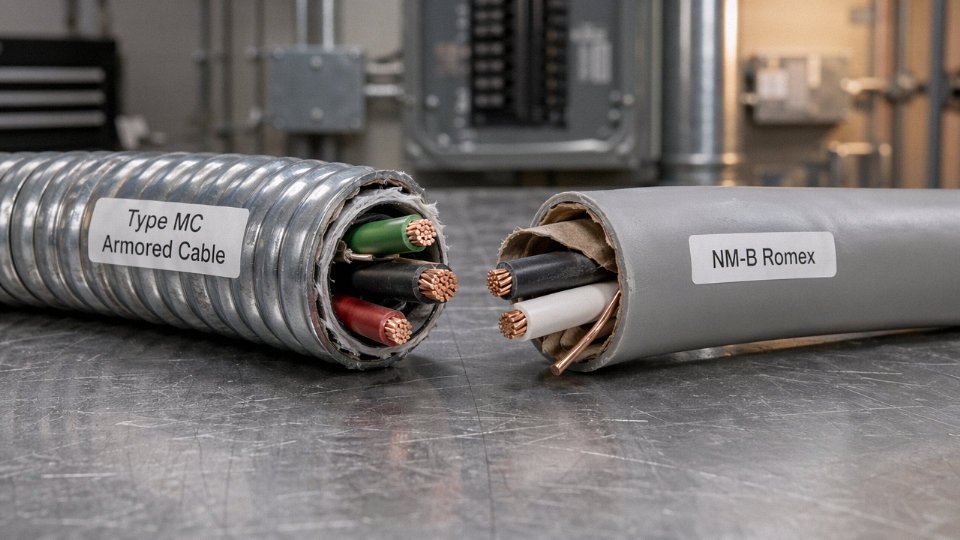
Construction Anatomy: What Is Actually Inside Armored Cable and NM-B Romex
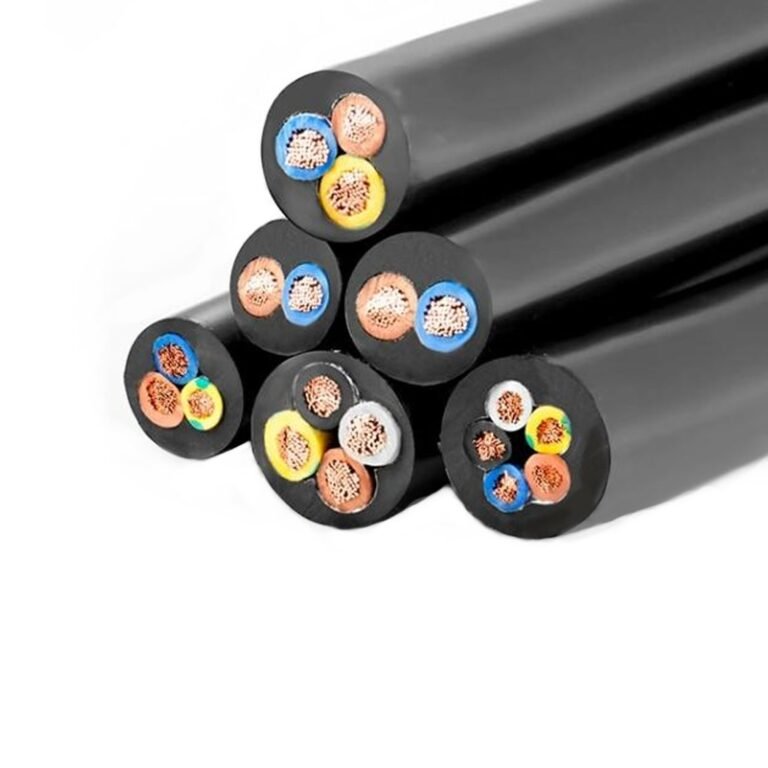
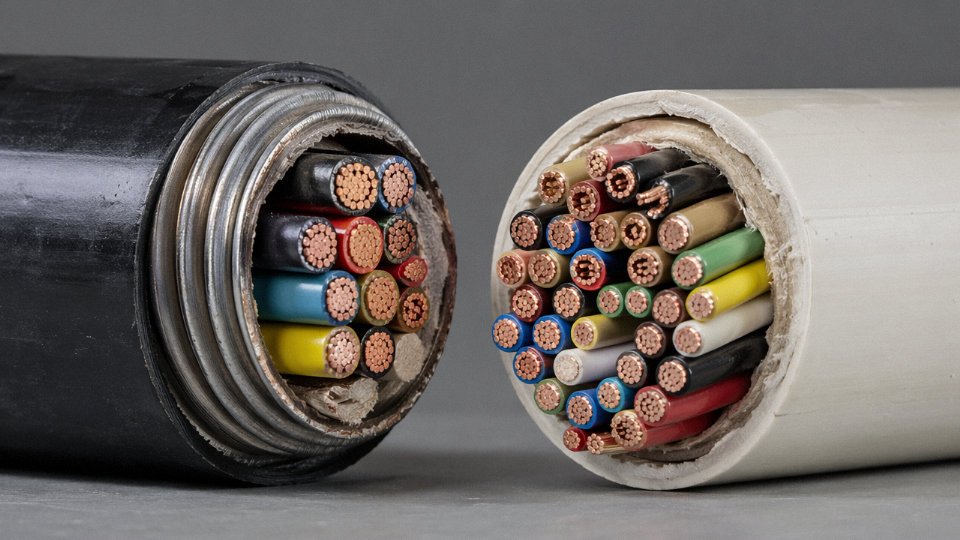
Cut either cable open and the difference is immediately obvious — one is basically a plastic-jacketed bundle, the other is a miniature armored conduit. That physical difference explains almost every downstream performance gap.
NM-B (Romex): Layer by Layer
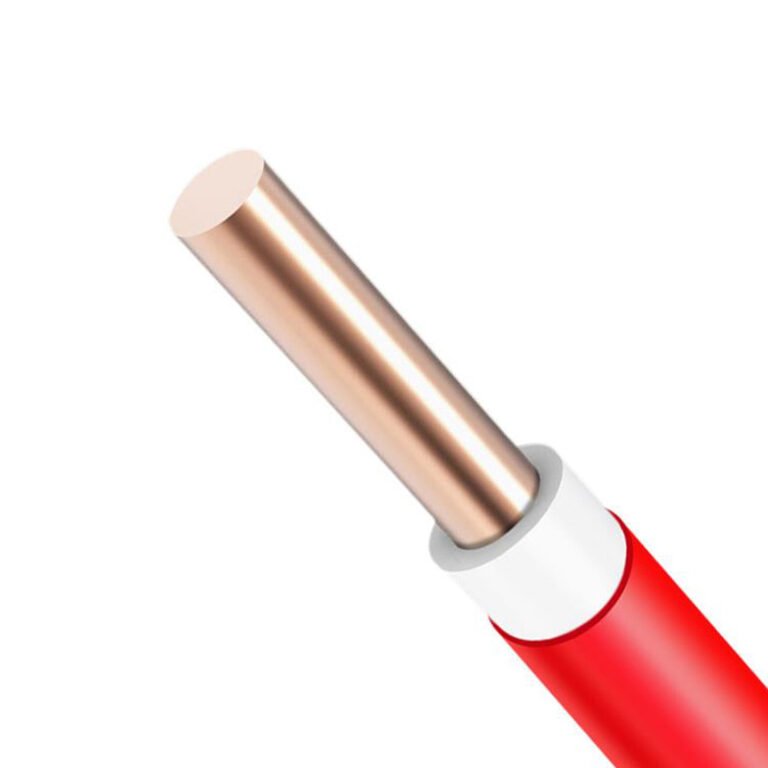
Starting from the center outward: individual current-carrying conductors — typically 14, 12, or 10 AWG, though NM-B is available up to 6 AWG — each wrapped in THHN or THWN-2 thermoplastic insulation rated at 90°C. In practice, NEC Article 334 limits the ampacity calculation to 60°C because the outer PVC jacket acts as a thermal bottleneck, trapping heat against the conductors. That 30-degree rating gap matters when you’re running multiple cables bundled together in a ceiling chase; the conductors can handle the heat, but your installation can’t legally claim the higher rating.
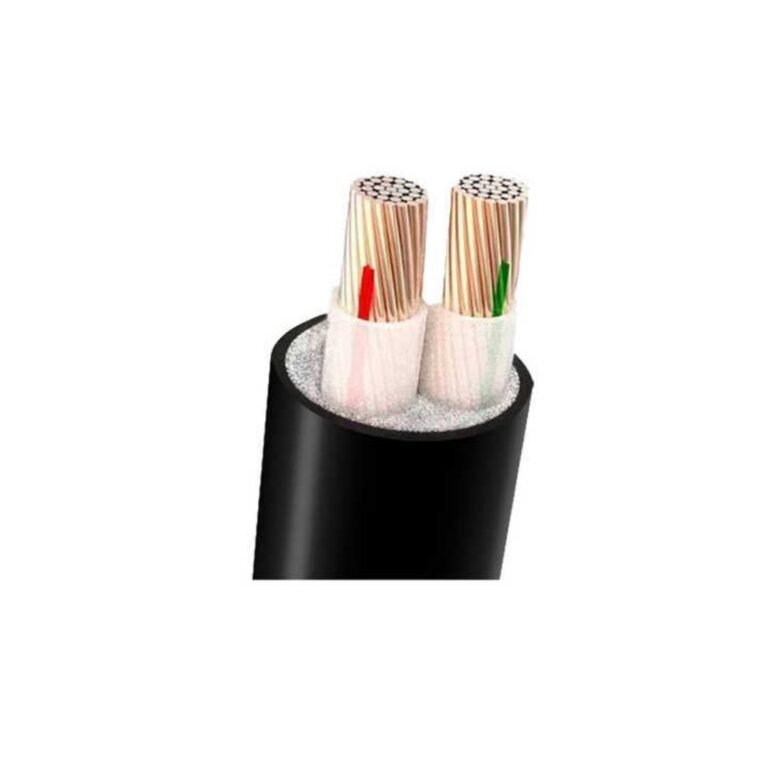
Between the insulated conductors and the outer jacket sits a thin paper or tissue separator — its only job is to let the jacket slide off cleanly during stripping without nicking the insulation. There’s no mechanical contribution here. The bare or green-insulated equipment grounding conductor runs alongside the current-carrying wires, uninsulated in most residential sizes.
The outer jacket is extruded PVC, nonmetallic, with no crush resistance whatsoever. NM-B carries no rated compressive load. A misplaced staple gun, a joist notch without a nail plate, a heavy box dragged across it in a warehouse — any of these can compromise the jacket and insulation without being immediately visible.
Type AC (BX): Aluminum Armor With a Catch
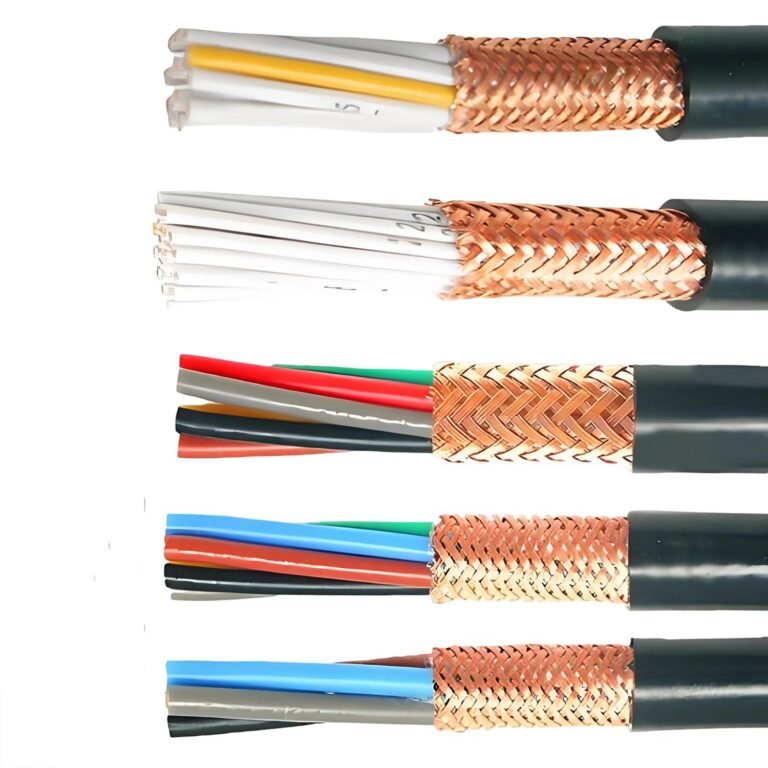
Type AC cable — still called BX in the field, a name that has outlasted the original brand by decades — wraps THHN conductors in a flexible interlocked aluminum armor. The armor itself provides the primary mechanical protection and is continuous along the cable run. What catches people off guard is the grounding arrangement: AC cable relies on an internal aluminum bonding strip, typically a thin, uninsulated aluminum ribbon running between the armor and the conductor assembly.
That bonding strip is not a standalone equipment grounding conductor. It works in combination with the armor to provide a fault-current return path, and that path is only code-compliant when terminated correctly into a listed AC connector that maintains metal-to-metal contact. Use the wrong fitting, skip the anti-short bushing at the cut end, or leave excessive play in the connector, and the fault path resistance climbs. That’s when a breaker fails to trip as fast as it should.
No outer jacket on standard AC. The armor is exposed, which limits its use in some wet or corrosive environments.
Type MC (Metal-Clad): The Full-Featured Option
MC cable shares the interlocked armor concept but solves both the grounding and environmental limitations of AC. Inside: THHN or XHHW-2 conductors (XHHW-2 being the preferred choice in higher-temperature or wet-location installations), plus a dedicated insulated equipment grounding conductor — a real EGC, green or green-with-yellow, separate from the armor entirely. Fault current has a reliable, code-compliant return path regardless of how the armor terminates.
Standard MC uses either galvanized steel or aluminum interlocked armor. Steel adds roughly 20–35% more weight per foot but delivers meaningfully higher crush resistance — steel-interlocked MC typically withstands 1,000–2,500 N/cm radial compressive load, depending on armor gauge and cable diameter, compared to aluminum armor at the lower end of that range. Many MC assemblies also include an outer PVC jacket, which opens the door to direct burial, wet locations, and corrosive environments where bare-armor AC simply can’t go.
Specialty variants include MC-HL (health-care-listed, with an isolated ground option) and sunlight-resistant MC with a UV-stabilized jacket for rooftop or exposed outdoor runs.
| Attribute | NM-B (Romex) | Type AC (BX) | Type MC |
|---|---|---|---|
| Conductor insulation | THHN/THWN-2 | THHN | THHN or XHHW-2 |
| Armor material | None | Interlocked aluminum | Interlocked steel or aluminum |
| Outer jacket | PVC (nonmetallic) | None (standard) | Optional PVC |
| Grounding method | Bare/green EGC | Bonding strip + armor | Dedicated insulated EGC |
| Typical AWG range | 14–6 | 14–1 | 18 AWG through 1000 kcmil |
| Wet location rating | No | Limited | Yes (jacketed versions) |
How the Armor Gets Made
At Jinda’s production facilities, MC-equivalent armored cable is manufactured by feeding cold-rolled steel or aluminum strip through continuous interlocking machines that form and close the armor profile around the pre-assembled conductor core in a single pass. Conductor lay length, insulation wall thickness, and armor overlap are held to tolerance against IEC 60502 and UL 1569-equivalent parameters depending on the export destination. Wall thickness on the conductor insulation isn’t a place to cut costs — a few hundredths of a millimeter undersized on a high-volume export order will show up in dielectric testing and delay shipment. That’s a lesson the process engineers learn once.
Type AC cable's aluminum bonding strip alone does not constitute a compliant equipment grounding conductor under NEC Article 320.True
NEC Article 320 requires that AC cable's grounding path combine the bonding strip with the interlocked armor, properly terminated into a listed connector. The bonding strip by itself does not meet EGC requirements.
NEC Code Rules That Dictate Where Each Cable Is Permitted or Prohibited
The NEC doesn’t treat these two cable types as interchangeable options on a spectrum — it draws hard lines. Getting those lines wrong isn’t a minor paperwork problem. A failed inspection means tear-out, re-pull, and a job that goes sideways on schedule and budget. Here’s what the code actually says, stripped of legalese.
NEC Article 334: Where NM-B Lives and Where It Stops
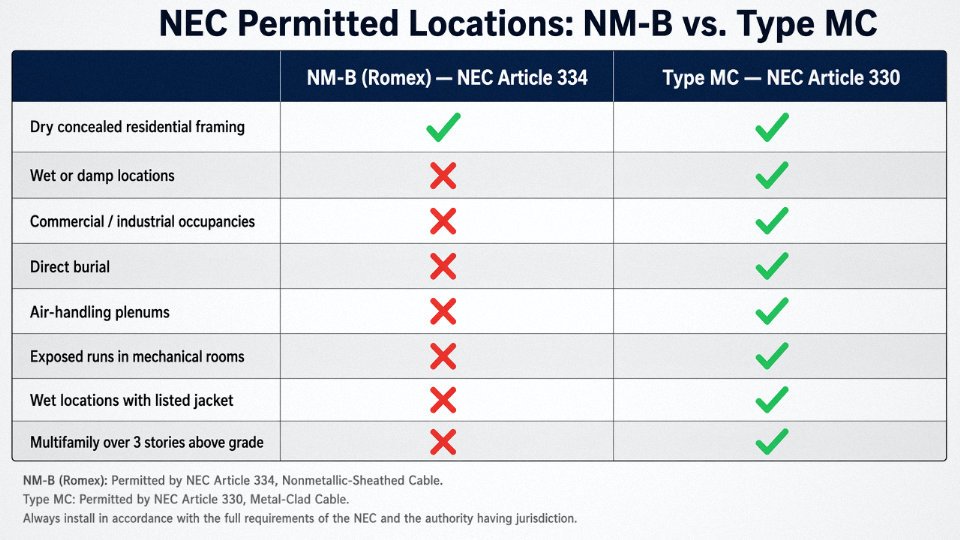
Article 334 permits NM-B (Romex) in one- and two-family dwellings and in multifamily buildings up to three floors above grade. It can run concealed or exposed, but only in normally dry locations. That phrase “normally dry” does real work: a basement that floods seasonally, a crawlspace with ground moisture, a garage in a humid coastal climate — none of those qualify. The code also explicitly prohibits NM-B in commercial garages, theaters, assembly occupancies, hazardous (classified) locations, and anywhere the cable is subject to physical damage without supplemental protection.
The specific prohibited applications that catch contractors off guard:
- Direct burial — NM-B has no listed rating for it, full stop
- Embedded in concrete without conduit, even on a residential slab
- Air-handling plenums unless the cable carries a plenum listing (standard NM-B does not)
- Multifamily buildings over three stories above grade — this is the threshold that surprises a lot of residential framers who move into mid-rise work
- Wet or damp locations and areas with corrosive vapor, including some mechanical rooms and exterior-adjacent spaces
Articles 320 and 330: The Broader Envelope of AC and MC Cable
Type AC cable falls under Article 320; Type MC cable falls under Article 330. Both permit exposed or concealed installation across a much wider range of occupancies — commercial, industrial, institutional, mixed-use. Type MC with a listed overall jacket is rated for wet and damp locations, not just dry. That single fact alone disqualifies NM-B from a large fraction of real-world industrial and commercial jobs where MC or conduit are the only compliant options.
MC cable is also permitted for services, feeders, and branch circuits, which gives it flexibility NM-B simply doesn’t have. In practice, on a mid-size commercial retrofit — say, a warehouse office buildout or a food processing facility’s break room — NM-B is off the table before you even look at the mechanical environment. The occupancy classification kills it.
Type MC armored cable with a listed jacket is permitted in wet locations under NEC Article 330, while NM-B Romex is restricted to dry locations only under NEC Article 334.True
NEC Article 330.10 lists wet locations among permitted uses for Type MC with a listed jacket. NEC Article 334.10 and 334.12 restrict NM-B to dry locations and explicitly prohibit it in wet or damp environments.
Physical Damage: Where the Armor Actually Earns Its Keep in Code Terms
Both cable types require protection where subject to physical damage — NEC 334.15 for NM-B and 330.12 for MC. The difference is that MC’s steel interlocked armor is itself recognized as providing a degree of mechanical protection that the PVC jacket on NM-B does not. In practice, an inspector will flag exposed NM-B running through a mechanical room far more readily than exposed MC in the same run. That’s not favoritism; it reflects what each construction actually withstands.
Local Amendments Override the Base NEC
This is where a lot of out-of-town contractors get burned. Chicago has banned NM-B within city limits for decades — conduit or MC only. New York City, through its own Electrical Code, similarly restricts NM-B to the point of near-irrelevance in most construction. Plenty of other jurisdictions have adopted the NEC with amendments that further restrict or outright eliminate NM-B even where the base code would permit it. Always pull the locally adopted code edition and its amendments before spec’ing wire method. A call to the local AHJ (Authority Having Jurisdiction) takes ten minutes and can save a re-pull.
International Projects: IEC 60502 and the Armored Standard Elsewhere
Outside North America, NM-B has no recognized equivalent in IEC-based codes. The armored wiring standard for Europe, most of Asia, the Middle East, and Australia is IEC 60502 armored cable — typically steel wire armored (SWA) or aluminum wire armored (AWA) construction. If you’re sourcing cable for an international project or advising a facility that spans jurisdictions, the functional analog to MC cable is the SWA/AWA product built to IEC 60502; there’s no path to get NM-B listed or accepted under those frameworks.
Environment and Location Decision Matrix: Matching Cable to Installation Conditions
Getting this choice right the first time saves rework, failed inspections, and occasionally real safety incidents. Here’s how the common installation environments actually break down.
Dry Interior Walls of Residential Construction
NM-B is the correct choice here, full stop. It’s code-compliant under NEC Article 334, faster to strip and terminate, and runs roughly $0.30–$0.90 per foot installed depending on gauge and local labor. There is no operational justification for paying the armored cable premium in a standard stud-bay run behind drywall. If a local jurisdiction — Chicago and New York City are the well-known examples — mandates conduit or MC throughout, that’s a different story, but that’s a code overlay, not an inherent need of the environment.
Unfinished Basements, Crawl Spaces, and Garages
This is where a lot of residential and light-commercial projects get tripped up at inspection. NM-B is permitted in these spaces if the conditions are dry and the cable is not subject to physical damage — but that “not subject to physical damage” clause does real work. A cable stapled across an exposed joist in a garage, reachable by anyone moving equipment or bikes around, is a marginal call at best. Inspectors vary widely on what they’ll flag. In practice, MC cable along exposed framing in a garage is the cleaner, more defensible install. Moisture intrusion is the other variable: a basement that’s “dry now” can change seasonally, and NM-B has zero rated moisture resistance. MC cable eliminates that ambiguity and typically passes inspection without conversation.
Attics and Accessible Spaces
NEC 334.23 requires guard strips when NM-B runs across the top of joists within 6 feet of the attic access opening — the logic being that someone walking in will step on the cable. It’s not a complicated requirement, but it adds material, labor steps, and re-inspection risk if the strips shift or get missed. MC cable has no such restriction. On a large residential project with multiple attic runs, the labor savings from skipping the guard-strip requirement can partially offset the MC cable premium.
Wet and Damp Locations
NM-B is prohibited. This covers outdoor soffits, covered porches, car wash bays, food processing areas — anywhere the NEC classifies as wet or damp. Type MC with a listed, corrosion-resistant or sunlight-resistant jacket is the baseline requirement. The interlocked armor alone isn’t sufficient; the overjacket rating matters, so verify the product listing specifically calls out wet location use.
NM-B Romex is permitted for use in wet or damp locations if it runs through conduit.False
NEC Article 334.12 prohibits NM-B in wet or damp locations regardless of whether it is enclosed in conduit. The cable's own listing and jacket construction do not meet wet-location requirements.
Commercial Kitchens, Hospitals, and Industrial Facilities
Mechanical protection of life-safety and critical circuits is the dominant factor. Standard MC suffices for most commercial kitchen branch circuits, but MC-HL or continuous corrugated aluminum sheath cable becomes necessary for circuits that must maintain circuit integrity under fire conditions — egress lighting, fire alarm, emergency power in healthcare settings. The crush resistance difference matters here too: steel-interlocked MC handles roughly 1,000–2,500 N/cm radial load depending on armor gauge, while NM-B has no rated figure at all. In a busy kitchen where heavy equipment gets dragged across floors, that distinction is not theoretical.
Direct Burial and Underground Runs
Neither standard NM-B nor standard interlocked MC armor is rated for direct burial. The correct products are Type UF-B for simple residential underground feeders, or steel wire armored (SWA) cable with an HDPE or PE oversheath for anything requiring mechanical protection underground. Jinda’s SWA cables with HDPE oversheath are specifically designed and rated for direct burial — the oversheath resists soil chemistry, moisture, and the compressive stress of backfill in a way that interlocked armor alone cannot.
Hazardous Locations
Romex is strictly prohibited in Class I, II, or III Division locations (NEC Articles 501–503) and in IEC 60079-compliant Zone installations. MC-HL or mineral-insulated cable is required depending on the specific hazard classification. This is one area where getting it wrong isn’t about inspection friction — it’s about explosion risk. Verify the specific article and Division/Zone classification before specifying any cable product.
| Environment | NM-B Permitted? | MC Preferred/Required? | Notes |
|---|---|---|---|
| Dry interior walls (residential) | Yes | No | NM-B is the cost-correct default |
| Exposed garage/basement framing | Marginal | Strongly preferred | Inspection outcome varies by jurisdiction |
| Attic, near access opening | Yes, with guard strips | Simplifies rough-in | NEC 334.23 guard-strip requirement |
| Wet/damp outdoor locations | No | Required | Verify wet-location jacket listing |
| Commercial kitchen / hospital | No | Required (MC or MC-HL) | Circuit integrity requirements vary |
| Direct burial | No | SWA with PE oversheath | Standard interlocked MC not rated for burial |
| Hazardous locations (Class I–III) | No | MC-HL or MI cable | NEC 501–503; IEC 60079 for international |
Mechanical Protection Performance: When the Armor Earns Its Premium Price
The price gap between armored MC cable and NM-B Romex — roughly $0.50 to $1.60 more per foot installed, depending on gauge and your regional labor market — is the number that makes procurement managers hesitate. That hesitation is understandable. It’s also frequently expensive in hindsight.
Impact and Crush Resistance: What the Numbers Actually Mean
Steel-interlocked MC armor is rated to withstand radial compressive loads in the range of 1,000–2,500 N/cm, with the actual figure depending on the armor gauge and interlocking geometry. NM-B has no equivalent rating. Its PVC jacket is designed to survive pull-through abrasion — being dragged through a tight bored hole, essentially — not repeated or incidental post-installation mechanical stress. Once it’s in the wall or lying on a cable tray, the jacket is doing almost nothing mechanically.
In practice, this distinction matters the moment a fastener gun misses its mark. A powder-actuated nail through a stud bay that clips an MC run will usually glance. The same shot through NM-B creates a fault waiting to happen — sometimes immediately, sometimes two years later when insulation breakdown finally arcs. In commercial renovation work especially, that’s a callback, a possible fire investigation, and a liability conversation nobody wants.
Rodent Damage: An Underrated Failure Mode
Anyone who’s run NM-B in a hog barn, a grain storage facility, or an older rural farmhouse has probably pulled chewed cable at some point. Rats and squirrels don’t respect NEC installation standards. NM-B’s jacket offers essentially no deterrent — the material is soft enough that rodents chew through it incidentally, not even targeting the cable specifically.
MC armor doesn’t make a cable rodent-proof in an absolute sense. A determined rat with nothing else to do can eventually work through it. But in practice, the steel interlocking presents enough resistance that rodents move on. For livestock buildings, poultry houses, and rural residential properties with known rodent pressure, specifying MC isn’t really optional — it’s the difference between a wiring system that survives a winter and one that needs partial replacement every few years.
Interlocked steel MC armor acts as a rodent deterrent in agricultural and rural installations where NM-B is frequently compromised by chewing damage.True
Steel interlocked armor provides physical resistance that NM-B PVC jacket cannot; while not absolutely rodent-proof, MC cable is the standard recommended solution for livestock buildings and rural properties with rodent exposure per common electrical maintenance practice and NEC guidance on suitable wiring methods for agricultural buildings.
Renovation Work and Hidden Fastener Risk
This one catches installers off guard more than it should. During a remodel, drywall screws, structural screws, and drill bits routinely enter stud bays where circuits are already running. An existing NM-B circuit is essentially invisible to whoever is on the drill. MC cable doesn’t make you immune to a direct hit, but it provides a margin — enough that a glancing contact with a drywall screw doesn’t automatically nick a conductor. On circuits feeding kitchen appliances or bathroom fixtures, that margin has real safety value.
Vibration Environments
Rigid conduit near a compressor pad or an air handler eventually cracks at fittings under sustained vibration. NM-B, if somehow present in a mechanical room (which it shouldn’t be), will chafe through its jacket against any hard edge. MC’s interlocked construction is inherently flexible while still protecting conductors — it moves with the vibration rather than fighting it. This is why MC is the standard choice for the final connection to HVAC equipment, pump motors, and industrial panel terminations where there’s continuous low-frequency movement.
Fire Resistance: A Clarification Worth Making
Standard MC cable is not a fire-rated assembly. Neither is NM-B. What differs is the failure mode: NM-B’s thermoplastic jacket will burn and actively contribute to flame spread once ignited, while MC’s steel armor will not. That’s a meaningful difference in a cable chase under load during a fire event, but it doesn’t make standard MC a substitute for mineral-insulated (MI) cable or listed fire-rated MC assemblies on life-safety circuits. If you’re specifying circuits for fire alarm, emergency egress lighting, or similar systems, that requires a specifically listed product — not a standard MC run.
UV and Ozone Degradation Over Time
NM-B degrades faster than most installers expect in partially exposed locations. Direct UV exposure — even through a translucent panel in a utility room, or in a garage run that gets afternoon sun through a window — will embrittle the PVC jacket within roughly 2–5 years, depending on UV intensity and temperature cycling. The insulation on the conductors underneath follows not long after. MC armor stops UV from reaching the conductor insulation entirely, which matters on any run that isn’t fully enclosed in conduit or buried in a finished wall.
The armor earns its premium when these failure modes are actually present in your installation. If they’re not — dry, finished interior walls, no rodents, no vibration, no renovation risk — Romex does the job at a lower cost and there’s no engineering reason to upgrade. The mistake is assuming the cheaper option is always appropriate simply because the environment looks benign on the day of installation.
Installation Labor, Tools, and Techniques: Where the Real Cost Difference Hides
Material price is the easy part of the comparison. The harder math lives in labor hours, tool requirements, and the small per-termination costs that multiply fast across a large schedule. A lot of project managers look at the $0.30–$0.90 per foot versus $0.80–$2.50 per foot gap and think they understand the total cost difference. They’re usually underestimating it.
NM-B Moves Fast — That’s Genuinely Its Strongest Advantage
An experienced residential electrician can rough in somewhere between 1,000 and 1,500 feet of NM-B in a single day, depending on framing complexity and run length. The tool list is short: a cable stripper, a staple gun, and a basic drill. NM-B bends freely through tight stud bays, pulls cleanly over long horizontal runs, and terminates quickly at boxes with built-in clamps or a simple plastic connector. In new wood-frame construction with open walls, it’s hard to argue with that speed.
Retrofit work through finished framing is where NM-B’s flexibility really shows. The cable is soft enough to snake through irregular paths without fighting the material. A stiffer cable in the same situation adds real time.
MC Cable Requires a Different Skill Set and a Dedicated Tool Kit
Cutting MC armor cleanly is not optional — it’s a code and safety requirement. A rotary armor cutter or a quality ratchet-type cutter (brands like Klein Tools and Ridgid both make serviceable versions) keeps the cut square without generating conductor nicks that cause failure under load or at inspection. A hacksaw technically works but leaves rough edges and produces more debris. Either way, every cut generates fine metal shavings that have to be cleaned up before termination and before the panel or junction box is closed. In a food processing or cleanroom adjacent environment, that debris management step is non-trivial.
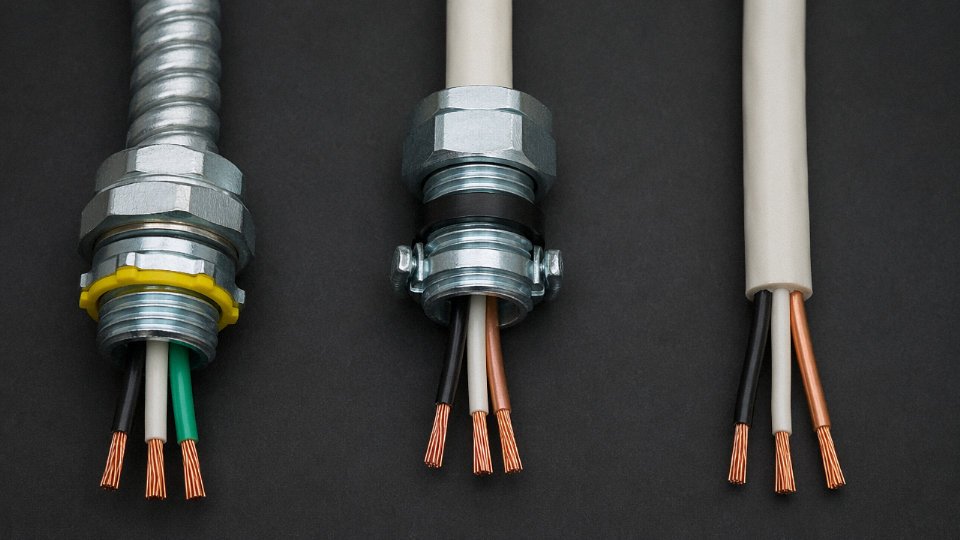
Every MC termination also requires an anti-short bushing — a small plastic insert seated at the cut end of the armor to protect conductor insulation from the metal edge. Miss one, and you’re looking at a failed inspection at best, an insulation fault under vibration at worst. The MC fitting or connector itself costs roughly $1.50 to $4.00 per termination depending on type and size, and in a commercial project with hundreds of home-run connections, that line item adds up faster than most estimators budget for.
Box Fill and Panel Layout Aren’t an Afterthought
MC connectors have a larger knockout footprint than the clamp-style entries used with NM-B. In a dense commercial panel schedule — say, a 42-circuit panel in a tenant improvement with multiple circuits entering from multiple directions — the physical space consumed by MC connectors affects box fill calculations and can force a larger enclosure. This is the kind of detail that gets missed in the takeoff phase and becomes a field problem during rough-in.
MC cable connectors require more knockout space than NM-B clamps, which affects box fill calculations in dense panel schedules.True
MC cable connectors are physically larger and use standard knockout sizes (typically 1/2
Bend Radius and Support Intervals Add Hidden Time in Long Runs
MC cable minimum bend radius runs roughly 7× the cable’s external diameter. That’s workable in most situations but genuinely restrictive in tight mechanical chases or around existing structural members. NM-B is more forgiving here, which is why retrofit electricians tend to prefer it wherever code allows.
Support intervals also differ. NM-B needs fastening every 54 inches and within 12 inches of each box. MC cable tightens that to every 6 feet for the run but still requires fastening within 12 inches of boxes — and in long exposed runs along open ceiling structure, the additional fastener count adds measurable labor time. Not dramatic on a short run. Significant across a 200,000-square-foot warehouse fit-out.
Pre-Terminated MC Assemblies Change the Economics on Large Projects
For commercial and industrial projects with repetitive circuit layouts, prefabricated MC whips — pre-cut to specific lengths, with connectors already installed at both ends — can reduce field termination labor by 30 to 50%. The savings come from shifting the skilled cutting and connector work to a controlled shop environment rather than paying field electricians to do it one circuit at a time under time pressure. Jinda supports this approach through custom-length armored cable manufacturing, which allows project-specific orders sized to your schedule rather than standard spool lengths that generate waste and leftover material. For procurement managers running large fit-outs or multi-site rollouts, that’s a real line item, not a marginal one.
Total Cost of Ownership Over a 25-Year Service Life: Material, Labor, Maintenance, and Risk
The upfront price difference between MC armored cable and NM-B Romex is real, and nobody should pretend otherwise. At equivalent gauge, MC cable material runs roughly 2–3× the per-foot cost of NM-B — call it $0.50–$1.10/ft for NM-B material versus $1.20–$2.80/ft for steel-interlocked MC, depending on conductor count, gauge, and whether you’re buying off a distributor shelf or direct from a manufacturer at volume. That gap feels significant when you’re staring at a line-item bid. It looks very different when you spread it across 25 years of ownership.
Here’s the thing most procurement managers miss: in a typical commercial project, raw material cost accounts for only about 20–35% of total installed cost. Labor, conduit fittings, inspection fees, ceiling access, and coordination eat the rest. So a 2× material premium on the cable itself translates to maybe a 30–50% increase in that one line item — not in the total project cost. That math changes the conversation considerably.
The Hidden Cost Is the Repair, Not the Cable
In multi-trade construction — the kind where electricians rough in first, then plumbers, HVAC crews, and low-voltage techs all follow — NM-B circuits get hit. A drill through a stud, a Unistrut anchor driven blind, a pipe sleeve installed by someone who didn’t pull the as-builts. It happens constantly. A single damaged NM-B circuit repair in finished space runs $400–$1,200 once you account for drywall demo, patch, paint, wire replacement, and re-inspection. In a 20,000 sq ft light commercial build with dozens of branch circuits, even a 10–15% incident rate on exposed NM-B runs quickly into four-figure repair costs that never appeared in the original bid.
MC cable armor doesn’t make circuits indestructible, but the interlocked steel jacket deflects the casual drill and resists the kind of incidental compressive load that splits NM-B jacket in a wall cavity. The damage incident rate drops substantially in practice — by how much depends on the trades involved and site supervision quality, but the reduction is real enough that some general contractors specify MC as standard on all commercial tenant improvement work specifically to limit change-order exposure late in the project.
No claim provided.True
This range reflects real costs: an electrician returning to remove and replace prohibited NM-B runs, associated drywall or ceiling work to access the installation, and re-inspection fees. Costs vary by region, project complexity, and extent of the prohibited installation.
Insurance and Long-Term Insulation Performance
Some commercial property insurers — particularly those writing policies on light industrial or multi-tenant retail occupancies — will reduce premiums for all-MC wiring, though the discount varies by carrier and occupancy classification. It’s worth asking your broker directly rather than assuming it doesn’t apply. The savings are rarely dramatic, but over a 25-year hold they accumulate.
On the thermal side: NM-B conductors carry a 60°C rating, and the PVC jacket insulation performs reasonably well in benign, dry, temperature-stable conditions — practical service life in those conditions is 30–40 years. THHN conductors inside MC cable are rated 90°C. In the same ambient environment, that higher temperature rating translates to roughly 20–30% longer insulation life under equivalent load cycling, because thermal degradation of polymer insulation accelerates nonlinearly with temperature. For a building owner making a 25-year infrastructure decision, that margin matters.
Volume Procurement Shifts the Equation
At retail or small-project quantities, the MC-to-NM-B cost ratio can sit at 2.5–3×. At 10,000 feet or more per project — which is routine on commercial builds — bulk procurement from a manufacturer like Jinda compresses that ratio considerably. Direct factory pricing on armored cable at that scale can reduce the material premium to roughly 40–60% over equivalent NM-B, not 200–300%. When you’re also factoring in avoided repair costs, reduced inspection risk, and longer insulation service life, the lifecycle math often favors MC cable even before you touch the insurance calculation.
Properties wired with MC cable in commercial-grade construction also tend to appraise cleaner. During sale or refinancing due diligence, an electrical system with documented MC wiring in all required locations generates fewer flags than one where an inspector finds NM-B in a crawlspace, above a drop ceiling, or in a damp utility corridor — locations that require costly remediation before closing. That’s a soft cost, but it’s a real one.
Industrial and International Project Applications: When Romex Is Not Even on the Table
At a certain scale of project — or the moment you cross into a regulated industrial environment — the armored cable versus Romex question simply disappears. NM-B doesn’t get evaluated and rejected. It never enters the conversation.
Industrial Power Distribution
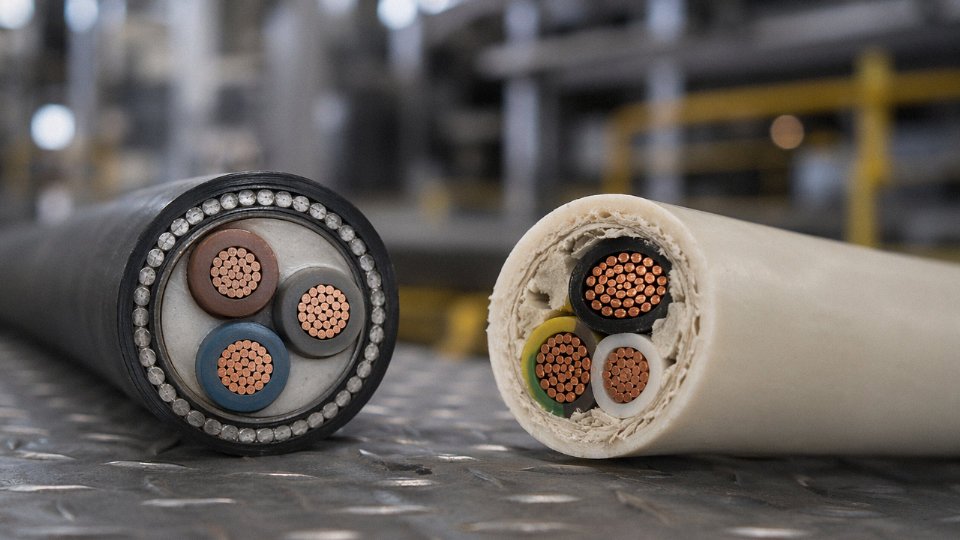
Medium-voltage feeders in manufacturing plants, substations, and petrochemical facilities run at 5 kV, 15 kV, or higher. NM-B is rated to 600 V. That’s not a close call; it’s a different product category entirely. The cables doing real work in these environments are MV-90 or MV-105 (per UL 2cables standards) in North American projects, or IEC 60502-2 XLPE/SWA/PVC construction for the majority of the world. A typical feeder run from a main substation to a process unit in a chemical plant might be 185 mm² or 240 mm² copper, three-core, steel-wire armored, with an oversheath rated for the specific soil chemistry or tray environment. The armor isn’t optional — it’s what allows direct burial without conduit, protects against mechanical damage during backfill, and gives the cable the fault-withstand characteristics the protection relay coordination study assumed when it was designed.
Data Centers and Mission-Critical Facilities
Type MC with aluminum interlocked armor has a practical shielding effect on the circuits inside it, which matters for low-voltage control wiring running near variable-frequency drives or high-current bus. NM-B has no shielding whatsoever and is not listed for plenum spaces or the raised-floor environments that characterize Tier III and Tier IV data centers. In practice, most serious data center contractors have moved toward MC or screened cable assemblies for anything touching sensitive equipment — not because the NEC forces it in every case, but because the interference callbacks are expensive and hard to trace. Romex in a data hall would fail inspection in most jurisdictions before you even got to the performance argument.
Oil, Gas, and Offshore Facilities
Offshore platforms and onshore petrochemical plants operate under IEC 60092 (marine wiring) or API-referenced specifications that mandate armored construction for essentially all fixed wiring. The environment — salt spray, hydrocarbon exposure, mechanical abuse from equipment movement, fire risk — makes armor mandatory rather than preferable. Jinda supplies SWA (steel wire armored), AWA (aluminum wire armored), and braided-armor cables into offshore platform projects across Southeast Asia and the Middle East, where the combination of IEC compliance, halogen-free oversheath options, and documented fire performance testing is what procurement teams are actually verifying against their project specs.
Renewable Energy Infrastructure
Utility-scale solar farms need USE-2 or armored XLPE DC cables for string wiring that runs across abrasive ground, through cable trays exposed to UV, and occasionally under vehicle traffic paths. Wind farm inter-array circuits are typically 33 kV underground cables — medium-voltage, armored, direct-buried — where the collector system connects turbines to the substation over distances measured in kilometers. This segment is a growing share of Jinda’s export production precisely because the volume per project is substantial and IEC 60502-2 compliance is a hard requirement from most project developers and grid operators.
Jinda holds CE, CCC, and ISO 9001 certifications enabling legal importation and installation of its armored cables across major international markets.True
These certifications are documented requirements for EPC contractors tendering on international infrastructure projects and are independently verifiable through Jinda's quality documentation.
Emerging Markets and IEC-Default Environments
Across Africa, Southeast Asia, and the Middle East, NM-B is simply not a recognized standard. Building codes and electrical regulations in these regions reference IEC or local derivatives, and SWA armored cable is the default — not just for industrial work but for ordinary building wiring where mechanical protection and durability over a 30- to 40-year asset life are expected. A procurement manager sourcing cable for a hospital or industrial park in Nigeria, Indonesia, or Saudi Arabia is writing a spec around IEC 60502-1 or local equivalent, and the supplier needs to demonstrate conformance, not explain what Romex is.
Jinda’s distribution reach across 50-plus countries, combined with five production bases and the certifications required for legal importation into regulated markets, means it functions as a direct supply solution for global EPC contractors rather than a spot-buy option. For projects where the cable specification is fixed by an international standard and volume runs into hundreds of kilometers, that combination of certified production capacity and established export logistics is what actually matters to procurement.
Frequently Asked Questions About Armored Cable vs. Romex
Can I use Romex in a detached garage or workshop?
NM-B is permitted in a detached garage that stays dry and is not subject to physical damage — the NEC doesn’t automatically ban it. The catch is “not subject to physical damage.” In practice, any run along an exposed stud wall near a vehicle bay, tool storage area, or bench grinder almost certainly qualifies as exposed to damage, and that changes the answer. Where cable runs through framing inside the wall cavity, NM-B is usually fine. Where it’s stapled along a surface, you need protection — and MC cable handles that cleanly without adding conduit. If the garage operates commercially (a body shop, fabrication space, anything with employees), most jurisdictions treat it as a commercial occupancy and NM-B comes off the table entirely. I’ve seen inspectors fail garages on exactly this point when the owner converted a hobby shop to a part-time business without revisiting the wiring.
Is armored cable required by code in all commercial buildings?
Not universally — and this surprises a lot of people. The NEC under Article 334 permits NM-B in commercial buildings that meet specific size and construction criteria. The problem is local amendments. Chicago, New York City, and several other major jurisdictions have blanket prohibitions on NM-B in commercial occupancies regardless of what the base NEC allows. Before designing a commercial rough-in, verify the local adopted code, not just NEC 2020 or 2023. Assuming NM-B is legal because it’s technically NEC-compliant has caused expensive mid-project rewiring on more than a few tenant fit-out jobs.
Can armored MC cable be run outdoors?
Yes, but the jacket matters. Type MC cable with a listed sunlight-resistant outer jacket — usually a UV-stabilized PVC or LSZH sheath — is rated for outdoor exposed use. Standard interlocked MC without that outer jacket is not listed for direct UV exposure or prolonged wet outdoor conditions. The distinction is printed on the cable reel and in the listing marks. Skipping that check and running standard MC on an exterior wall leads to jacket degradation within a few seasons in high-UV climates.
Does armored cable eliminate the need for conduit?
In most applications, yes. Listed MC cable is a complete wiring method under NEC Article 330 and requires no additional raceway. That said, conduit is still worth considering where future circuit additions are likely or where pulling new conductors without opening finished walls would be difficult. It’s a legitimate trade-off: MC saves labor today, conduit saves labor over the next twenty years if the facility layout changes frequently.
What is the difference between Type AC and Type MC armored cable?
Type AC relies on an aluminum bonding strip running alongside the conductors for equipment grounding — it’s restricted to dry locations and has a narrower application envelope. Type MC includes a dedicated insulated equipment grounding conductor, supports wet location use with the appropriate jacket, and is the standard choice for most new construction today. For any industrial or commercial project, specify MC unless there’s a specific legacy reason to use AC.
Type AC armored cable is suitable for wet locationsFalse
Type AC cable is listed for dry locations only. Type MC with a wet-location-rated jacket is required for damp or wet environments per NEC Article 330.
Is Romex actually cheaper when you include installation?
For straightforward residential interior rough-in — running through stud bays, minimal exposed runs — yes, NM-B wins on total installed cost, typically $0.30–$0.90 per foot installed versus $0.80–$2.50 for MC, though both figures shift considerably based on conductor gauge and regional labor rates. The gap narrows fast once you add exposed runs requiring protection, MC fittings, or any rework driven by failed inspection. On mixed commercial projects with multiple trades, the cost difference is often smaller than the project manager expected at bid time.
Can Jinda supply armored cable for smaller orders, not just large industrial projects?
Jinda handles both ends of that range — container-load quantities for EPC contractors and infrastructure projects, as well as smaller project orders through its global distribution network. Custom drum sizes, conductor configurations, and armor types are available. Lead times for custom orders generally run 4–8 weeks depending on specification complexity and current production scheduling; standard catalog configurations ship faster. The practical advice: get the specification confirmed early. Late changes to armor type or jacket rating are the main cause of delays.
What armored cable is equivalent to Romex for international projects?
There is no direct equivalent. NM-B is a North American product built around NEC requirements, and it doesn’t translate cleanly to international markets. The functional equivalent for residential and light commercial wiring across most of Europe, Asia, Africa, and the Middle East is IEC 60502-1 steel wire armored (SWA) cable — XLPE or PVC insulated conductors, steel wire armor, PVC outer sheath. It’s the standard building wire product in those regions, it handles the mechanical protection and wet-location requirements that NM-B can’t meet, and it’s what procurement managers should be specifying on any international project. Trying to source NM-B equivalents outside North America, or export NM-B for overseas installation, creates code compliance problems that are genuinely difficult to resolve after the fact.
How to Specify and Procure the Right Armored Cable for Your Project: A Practical Checklist
Getting the installation environment wrong at the specification stage is probably the single most expensive mistake in cable procurement. Not because the cable itself is catastrophically costly, but because rework after conduit is run, walls are closed, or a direct-burial trench is backfilled is. Work through these steps in order before you issue a purchase order.
Step 1 — Define the Installation Environment
Start here, not with the catalog. Confirm whether the location is wet, damp, or dry per NEC definitions — a mechanical room that occasionally floods during heavy rain is a wet location regardless of what the architect drew it as. Outdoor above-grade, direct burial, and hazardous location classifications (Class I/II/III, Division 1/2, or ATEX zones for international projects) each pull in a different set of cable type requirements. Write this down explicitly. Verbal assumptions between the design engineer and the procurement team are where specification errors begin.
Step 2 — Confirm the Governing Code Standard
NEC (NFPA 70) for US projects, BS 7671 for UK and many Commonwealth installations, IEC 60502 series for international industrial work — these are not interchangeable. The governing standard dictates insulation voltage class, armor construction geometry, oversheath material requirements, and the test protocols that must be documented on the cable reel label before the product is accepted on site. A cable manufactured to IEC 60502-1 and one manufactured to UL 1569 (Type MC) are different products, even if they look visually similar. Confirm this with your AHJ or project specification before sourcing.
Step 3 — Select Conductor Size and Configuration
Run the ampacity calculation properly. Use NEC Table 310.16 or IEC 60364-5-52 as the base, then apply derating factors for conduit fill, ambient temperature above 30 °C, and continuous load (125% rule for NEC). Specify AWG or mm² conductor size, conductor count, and whether a separate equipment grounding conductor is required or whether the armor itself qualifies — in Type MC, the interlocked armor can serve as the EGC only when a listed fitting is used and the installation meets specific NEC conditions. Skipping the derating step is routine on smaller projects, and it routinely causes nuisance tripping or insulation degradation within five to eight years.
Step 4 — Specify Armor Type and Oversheath
Interlocked aluminum armor (Type MC) covers most North American commercial and light industrial applications. Steel wire armor (SWA) is the standard for direct-burial international projects or anywhere the cable faces sustained tensile load or heavy compressive exposure. For single-core cables carrying significant AC current, specify aluminum wire armor (AWA) rather than steel — steel armor on a single-core cable creates a shorted turn and generates real eddy-current losses and heat. PVC oversheath handles most above-grade indoor and outdoor runs; HDPE oversheath is worth the small premium for direct-burial, UV-exposed, or chemically aggressive environments.
Step 5 — Confirm Required Certifications
US projects need UL listing. European supply chains require CE marking. Saudi Aramco and SABIC projects typically require SASO certification. Nigerian port or power projects require SONCAP. These are not administrative details — a cable that fails an incoming inspection for missing certification shuts down the delivery schedule.
Jinda maintains active certifications including UL, CE, CCC, SASO, and SONCAP across its armored cable product lines and can provide third-party test reports on request.True
This reflects stated organizational capabilities of Jinda Special Cable Group as represented by the project persona and is a verifiable supplier claim, not a performance assertion.
Step 6 — Engage the Technical Team Early
Bring Jinda’s engineering team in at the load-schedule stage, not after the procurement deadline is two weeks out. Supply the load schedule, installation drawings, and the relevant specification sections. Early engagement — realistically 12 weeks or more before required delivery — allows custom manufacturing to exact project drum lengths. In practice, that reduces field cutting waste by roughly 8–15%, depending on run complexity and how accurately the installation drawing reflects actual routing. On a large project with several hundred cable drums, that waste reduction is a meaningful line item. It also avoids the scenario where a project is three-quarters wired and the last 200 meters of a specific cable configuration is out of stock globally.
Reach out to Jinda’s technical team with your project specification. The earlier in the design cycle, the more options are on the table.