A standard cable specified from an electrical catalogue will fail inside a steel mill, a food-processing line, or a chemical dosing room — sometimes within weeks. Heat cycling, cutting oils, mechanical abrasion, and the occasional forklift wheel don’t care about a cable’s nominal voltage rating. When it fails, you’re not just replacing wire; you’re looking at unplanned downtime, scrap product, possible arc flash exposure, and a maintenance call that could have been avoided entirely if the right cable had gone in from the start.
Industrial cables are purpose-built for harsh environments, combining mechanical protection, chemical resistance, thermal stability, and electrical performance in a single construction. Designs range from 300/500 V flexible control cables with oil-resistant TPE jackets to 0.6/1 kV armoured power cables and high-temperature silicone or PTFE-insulated variants rated above 180°C — each matched to specific hazards found on real plant floors.
What makes this genuinely complicated is that “industrial cable” isn’t a single product — it’s a family of constructions, each solving a different combination of abuse. A cable running through a CNC machine’s drag chain faces flex fatigue cycles in the tens of millions; a cable buried under a petrochemical plant’s slab faces static loading, moisture ingress, and hydrocarbon contact simultaneously. Choosing the wrong variant for the wrong environment is one of those decisions that looks fine during commissioning and then quietly builds toward a failure that’s expensive to diagnose and embarrassing to explain.
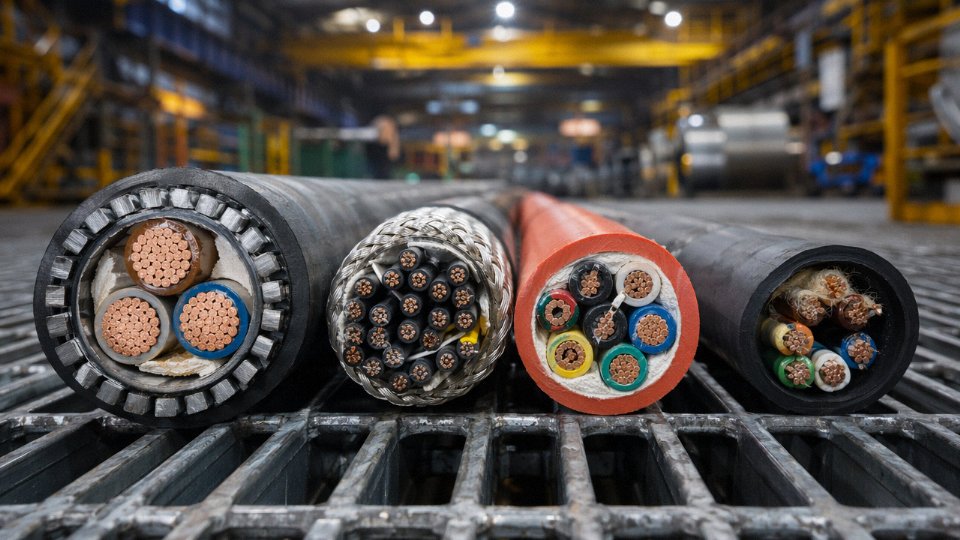
Defining Industrial Cable: Core Construction Attributes That Separate It From Commercial Wire
Strip away the marketing language and an industrial cable is really just a set of deliberate engineering decisions stacked on top of each other — conductor, insulation, shield, jacket, armor — where every layer is chosen to survive a specific threat. Commercial building wire skips most of those decisions because it doesn’t need to make them. Understanding each layer gives you a consistent checklist to evaluate any cable claim, regardless of who made it.
Conductor Design: Flexibility, Material, and What It Costs You in Ampacity
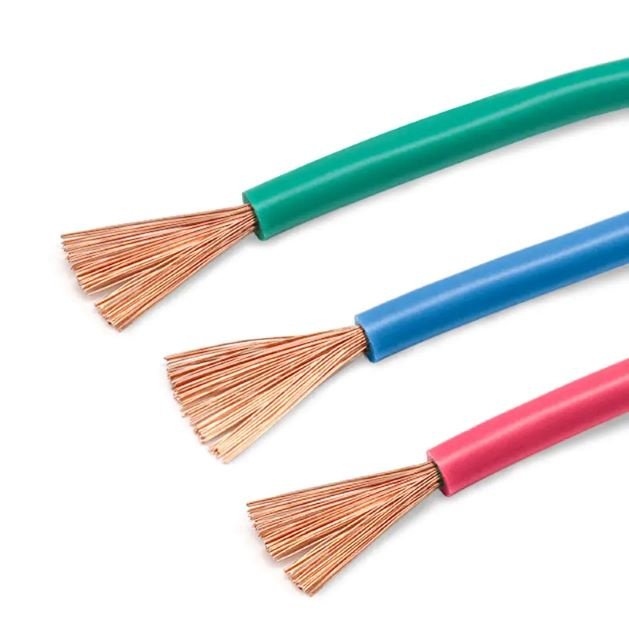
Solid conductors belong in fixed installations — conduit runs in a motor control center, buried feeder cables that will never move. The moment a cable has to flex during installation, route through a cable chain, or survive vibration from rotating equipment, you need stranded construction. IEC 60228 Class 5 fine-wire stranding is the minimum for most industrial flex applications; Class 6 goes further, with even finer individual wires, and is specified for continuous-flex drag-chain duty where cumulative bend cycles can exceed several million over a machine’s life.
Material choice matters more than people sometimes admit. Bare copper is the default and gives you the best conductivity, but in humid plants or anywhere there’s hydrogen sulfide in the air — wastewater treatment, petrochemical, some food processing environments — bare copper tarnishes and contact resistance climbs at terminations. Tinned copper adds roughly 2–4% resistivity penalty but holds up dramatically better in those conditions and makes soldering far more reliable. Aluminum alloy conductors show up in larger cross-sections (typically 35 mm² and above) where weight and cost per meter matter more than termination simplicity; they demand proper AL-rated lugs and anti-oxidant compound, and their ampacity runs about 20–25% lower than an equivalent copper cross-section, so derating calculations need to be done before you try to swap one for the other.
Insulation: The Layer That Defines Your Temperature and Chemical Ceiling
This is where industrial cables diverge most sharply from commercial wire. The table below captures the practical differences engineers actually need at the spec stage.
| Insulation Material | Continuous Temp. Ceiling | Dielectric Strength | Chemical / Oil Resistance | Typical Application |
|---|---|---|---|---|
| XLPE | 90°C (up to 105°C cross-linked grades) | High | Moderate | Power distribution, MV feeders |
| EPR (Ethylene Propylene Rubber) | 90–130°C depending on compound | Very High | Good, especially water | Mining, offshore, wet environments |
| Silicone | Up to 180°C or higher | Moderate | Poor vs. hydrocarbons | Furnace wiring, engine bays, ovens |
| PTFE | 200–260°C | Excellent | Outstanding across most chemicals | Instrumentation near aggressive media |
XLPE handles the majority of industrial power distribution from 300/500 V up through 3.6/6 kV and beyond in heavy industry. EPR’s real advantage is that it keeps its dielectric properties when wet — critical for submersible pump cables or mining trailing cables where XLPE would degrade over time. Silicone is soft and tolerant of extreme heat but it tears easily during installation and offers almost no hydrocarbon resistance, so it’s a poor choice near hydraulic lines. PTFE is the right answer for harsh chemical environments or high temperatures, but you pay for it — both in material cost and in the fact that it’s essentially impossible to strip cleanly without the right tooling.
Shielding Architectures: Matching the Shield to the Noise Environment
A shield is not a shield is not a shield. Braided copper shields — typically 85–95% coverage — are the standard for instrumentation cables where you need genuine EMI attenuation across a broad frequency range. The weave allows some flexibility without cracking, which matters in environments with vibration. Foil-plus-drain configurations (a layer of aluminum-polyester laminate with a bare drain wire running against it) are thinner and cheaper, and they work well for data integrity in moderately noisy plants, but the foil can fracture if the cable flexes repeatedly at the same point.
For multi-conductor control cables, the choice between overall shielding and individually shielded pairs depends on whether the signals are independent. If you have four 4–20 mA loops in the same cable bundle, individually shielded pairs prevent crosstalk between channels. If you’re just trying to block external interference and the signals don’t interact, an overall braid is simpler and cheaper. In practice, most experienced instrumentation engineers default to individually shielded pairs for anything going into a PLC analog input, even if the spec doesn’t mandate it — the incremental cost is small and the diagnostic headaches it prevents are not.
Jacket and Armor: Mechanical Protection Scaled to the Threat
PVC jacket is the workhouse — cheap, reasonably chemical-resistant, adequate for most indoor industrial environments. It gets brittle below roughly -15 to -20°C, which is why arctic-rated cables switch to specially plasticized compounds or TPE. LSZH (low-smoke zero-halogen) jackets are mandated in enclosed spaces — tunnels, offshore platforms, data centers inside factories — where combustion toxicity is a real evacuation risk. The trade-off is that standard LSZH compounds are stiffer and less abrasion-resistant than PVC, though higher-end formulations close much of that gap.
Polyurethane jackets are underused outside of drag-chain and robotics applications, which is a shame. PU handles repeated mechanical stress, abrasion, and many cutting fluids far better than PVC, and it stays flexible down to -40°C in the better grades. Neoprene shows up in portable industrial cords and welding cables where ozone, weathering, and flame resistance all matter simultaneously.
Armor adds the mechanical protection the jacket cannot. Steel wire armor (SWA) is the standard for buried cables and anywhere rodent damage or crushing loads are a concern — it resists longitudinal stress during installation pull-in as well. Steel tape armor (STA) is lighter and handles radial compression but offers much less tensile protection; it’s appropriate for cables that will be laid in trays or ducts but not pulled through conduit under tension. Double steel wire armor (DSWA) is specified for deep water, heavily trafficked cable trenches, or any installation where uplift forces or severe mechanical abuse are expected. The weight penalty of DSWA is real — it adds significantly to installation labor cost — so don’t specify it unless the mechanical threat actually warrants it.
Oil-resistant PVC and TPE jacket compounds can retain more than 70% elongation-at-break after 168 hours of immersion testing per IEC 60811True
IEC 60811 series specifies standard immersion and aging test protocols for cable jacket materials; reputable industrial cable manufacturers formulate compounds specifically to meet or exceed these retention thresholds, which is a standard qualification requirement for oil-resistant jackets
Custom Compounding: Why In-House Matters for Non-Standard Environments
Most cable manufacturers buy jacket compound from a third-party supplier and adjust wall thickness to hit a spec. When you need something outside the catalog — say, a jacket that combines enhanced oil resistance with UV stabilization for an outdoor refinery application, or a compound optimized for a specific cleaning agent used in a food plant — that third-party dependency becomes a real constraint on lead time and formulation flexibility.
Jinda’s in-house compounding operation means the material chemistry can be adjusted without waiting on an external supplier’s development cycle. For procurement managers dealing with projects that have genuinely unusual environmental requirements, that capability shortens the qualification timeline considerably and means the formulation is understood and controlled by the same team responsible for the finished cable.
The Seven Major Industrial Cable Types and Their Designated Application Zones
Every industrial cable family exists because a specific set of physical and electrical conditions defeated whatever came before it. Understanding which type belongs where is the fastest way to avoid misapplication — and misapplication in a factory is rarely cheap.
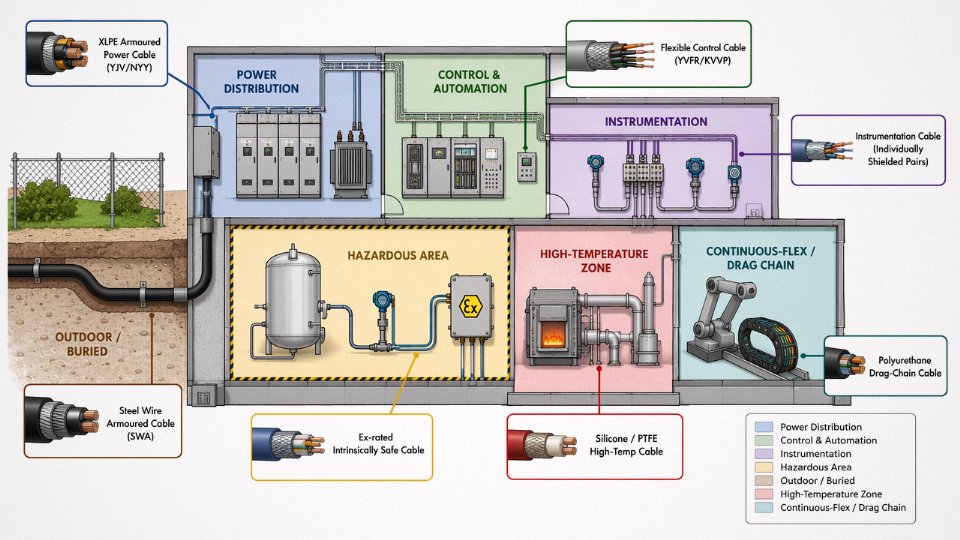
Power Cables (YJV, NYY, XLPE-Armored)
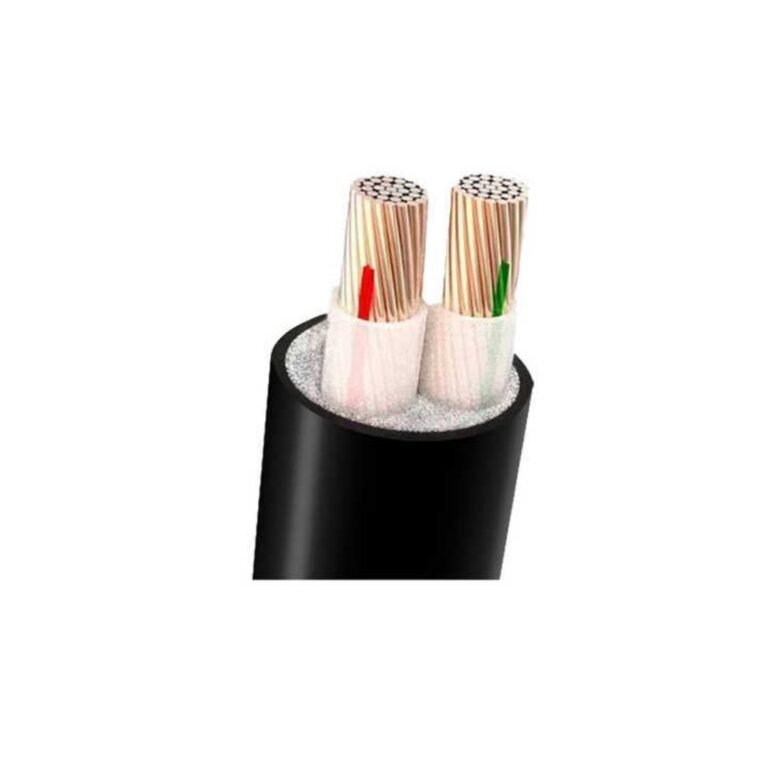
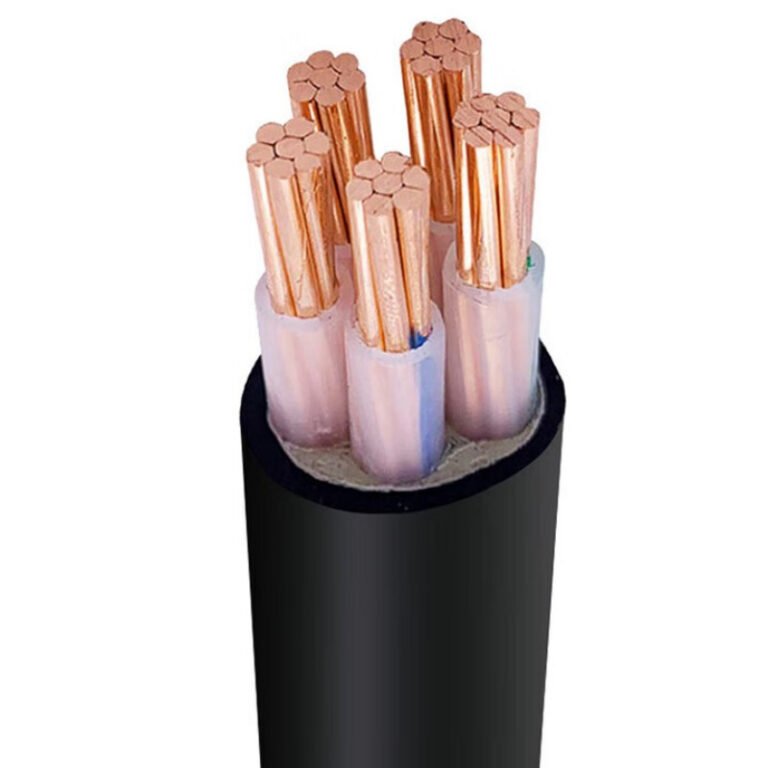
These are the workhorses of fixed power distribution — factory main feeders, substation secondary runs, infrastructure buried under concrete slabs. XLPE insulation handles continuous conductor temperatures up to around 90°C (XLPE-based designs), which gives meaningful headroom over older PVC-insulated equivalents. Voltage ratings cover the 0.6/1 kV range for most plant distribution, stepping up to 8.7/15 kV or 26/35 kV for medium-voltage ring mains in larger facilities.
Conductor cross-section selection — anywhere from 1.5 mm² signal-feed tails up to 400 mm² main feeders — is driven by two things simultaneously: current-carrying capacity from IEC 60364-5-52 tables (corrected for ambient temperature, grouping, and installation method) and voltage drop, which bites hardest on long runs. A 150 mm² copper conductor at 200 m carrying 300 A typically lands you near the 3–4% drop threshold; go to 400 m at the same load and you’re in trouble without upsizing. Steel wire armor on buried or mechanical-exposure runs isn’t optional in most plant environments — it’s just a question of whether the specification says so or not.
Flexible Control Cables (YVFR, KVVP)
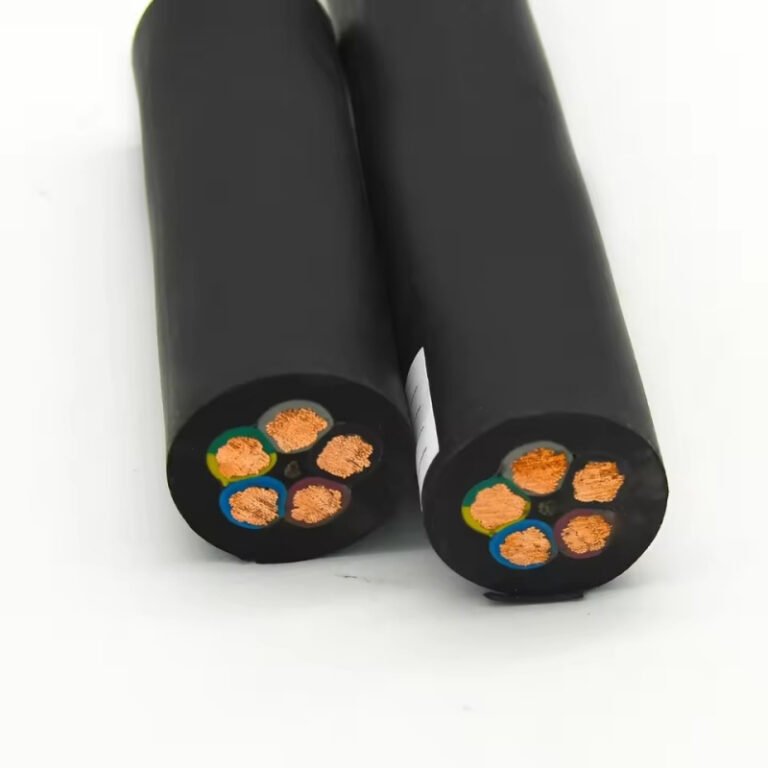
Multi-conductor control cables connect PLC I/O cards, motor starter auxiliary contacts, and relay logic panels. Fine-stranded conductors — Class 5 or Class 6 per IEC 60228 — matter here because the cable gets disturbed every time a panel is opened, rewired, or relocated. Overall braided or foil-plus-drain shielding is essential in any cabinet that mixes 24 V DC signals with contactor coils or frequency converters. Without it, noise coupling into low-level inputs causes intermittent faults that can take days to diagnose.
VFD Cables
Variable frequency drives generate common-mode currents at carrier frequencies that can reach 8–16 kHz depending on the inverter switching topology. Standard power cable simply isn’t built for this. Proper VFD cable uses a symmetrical three-conductor-plus-three-ground configuration, with a low-impedance shield covering the full assembly, which allows common-mode currents to cancel rather than find their way back through motor bearings or building steel. IEC 61800-5-2 sets the framework; the cable’s high-frequency impedance characteristics are what the specification is actually controlling.
Using standard power cable on VFD motor circuits eliminates common-mode noise problems if the drive is properly grounded.False
Grounding practice at the drive cabinet does not eliminate the high-frequency common-mode currents generated by PWM switching; symmetrical shielded VFD cable is required to provide a low-impedance return path at carrier frequencies and protect motor bearings from EDM damage.
Instrumentation and Signal Cables
For 4–20 mA process loops and thermocouple extension runs, individually shielded pairs or triples are the baseline — not an upgrade. Each shield should be grounded at one end only (typically the control room end) to prevent ground loops that corrupt readings. Low-capacitance designs, typically targeting below 100 pF/m between conductor and shield, become significant once runs exceed roughly 400–500 m; higher capacitance rolls off the signal bandwidth and introduces lag into fast control loops. Crosstalk between adjacent pairs is another real failure mode in dense multiconductor bundles, particularly when analog and thermocouple signals share a common cable jacket.
Drag-Chain (Continuous-Flex) Cables
CNC machining centers, robotic welding arms, and automated storage and retrieval systems subject cables to repetitive bending at tight radii, sometimes thousands of times per day. Drag-chain cable uses a specific fine-wire stranding geometry — often bunched rather than concentric — combined with a jacket compound (usually TPE or specialized PUR) that resists cracking from repeated flexing rather than just from chemical exposure. The benchmark is typically 10 million flex cycles without conductor breakage or jacket splitting, per UL 20276 or DIN EN 50396. Substituting standard flexible cable in a drag chain application usually results in conductor fatigue failure within weeks.
Mining and Underground Cables
Coal mines, metal mines, and tunneling equipment operate under a combination of hazards that most industrial environments don’t stack simultaneously: mechanical impact, water ingress, trailing cable movement across rough ground, and — critically — the presence of flammable atmospheres in coal mines. Rubber-sheathed designs per IEC 60502 and GB 3836 handle the mechanical side; the flame-retardant and anti-static compound requirements address the atmospheric risk. Heavy-duty armored trailing cables on electric shovels and continuous miners need to tolerate the cable being run over, dragged, and crushed repeatedly. In practice, joints and terminations in these cables are where failures concentrate — the cable body survives, but field repair quality varies enormously.
Hazardous-Location (Ex) Cables
Petrochemical plants, offshore platforms, grain elevators, and paint spray facilities fall under Zone 0, Zone 1, or Zone 2 classifications under ATEX Directive 2014/34/EU and IECEx. Intrinsically safe circuits — those limited to energy levels below ignition thresholds — impose strict capacitance and inductance limits on the cable itself, because the stored energy in the cable’s distributed capacitance and inductance is part of the ignition energy calculation. A cable that tests fine on electrical continuity can still fail the Ex system assessment if its capacitance per meter is too high for the circuit length and entity parameters. This is one area where substituting “a similar cable” from a non-certified source genuinely risks both personnel safety and regulatory compliance, not just performance.
| Cable Type | Typical Voltage Range | Key Certification Reference | Primary Failure Risk if Wrong Type Used |
|---|---|---|---|
| Power (XLPE/Armored) | 0.6/1 kV – 26/35 kV | IEC 60502, IEC 60364 | Thermal degradation, insulation breakdown on long runs |
| Flexible Control | 300/500 V | IEC 60228 (Class 5/6) | Conductor fatigue, noise coupling into signal circuits |
| VFD | 0.6/1 kV | IEC 61800-5-2 | Motor bearing EDM damage, drive EMC non-compliance |
| Instrumentation | 300 V (signal level) | IEC 60544, IEC 61158 | Signal drift, ground loops, crosstalk |
| Drag-Chain | 300/500 V – 0.6/1 kV | UL 20276, DIN EN 50396 | Premature conductor fatigue failure |
| Mining/Underground | 0.6/1 kV – 3.6/6 kV | IEC 60502, GB 3836 | Fire propagation, jacket breakdown from trailing abuse |
| Hazardous Location (Ex) | Application-specific | ATEX 2014/34/EU, IECEx | Ignition of explosive atmosphere, certification void |
International Standards and Certifications Every Industrial Cable Buyer Must Verify
Specifying the right cable construction is only half the job. If the documentation doesn’t hold up at customs, a third-party audit, or an insurance inspection after a fault, the project carries real liability — delayed commissioning, rework costs, or outright rejection by the end-user’s engineering team. Knowing which standards actually apply, and how to verify compliance rather than just claim it, is what separates a tight specification from a paperwork exercise.
The IEC Standards Hierarchy — What Each Document Actually Covers
IEC 60227 and IEC 60245 are the baseline documents most engineers encounter first. IEC 60227 covers PVC-insulated cables rated up to 450/750 V; IEC 60245 handles rubber-insulated flexible cables across similar voltage ranges, including heat-resistant and oil-resistant variants. Both specify conductor class, insulation thickness, and mechanical performance — but neither addresses armor, shielding, or external fire performance. Buyers who write specs that stop at IEC 60227 compliance and then order armored, instrumentation-screened cables are leaving a gap.
IEC 60502 steps in for extruded solid dielectric power cables from 1 kV up through 30 kV, covering the full construction from conductor through sheath. Part 1 handles 1–3 kV, Part 2 covers 6–30 kV. This is the document governing most medium-voltage plant distribution cable. IEC 60092 is a separate world entirely — marine and offshore electrical installations, with requirements for mechanical robustness, saltwater resistance, and fire behavior that onshore industrial standards simply don’t replicate. If you’re sourcing cable for an offshore platform or a shipyard project, IEC 60092 compliance isn’t optional. For fieldbus and industrial network cabling — PROFIBUS, Foundation Fieldbus, DeviceNet — IEC 61158 defines the physical layer characteristics including cable impedance, capacitance per unit length, and attenuation. A cable that “looks right” dimensionally but drifts outside IEC 61158 tolerances will cause intermittent communication faults that are genuinely painful to diagnose.
Regional Approvals and Export Market Mapping
Different destination markets require different marks, and confusing them wastes time.
| Market | Required Approval | Notes |
|---|---|---|
| North America | UL Listed / CSA certified | UL and CSA are separate; Canadian projects typically need both |
| Europe (EU + EEA) | HAR mark (CENELEC) | Required for flexible cordage sold across EU; CPR applies for fixed installation in construction products |
| Russia / CIS | GOST-R (now EAEU TR CU) | Test reports must originate from accredited Russian or CIS lab |
| Australia / New Zealand | AS/NZS (SAA mark) | Voltage designations differ slightly from IEC; verify conductor sizing tables |
| Saudi Arabia / Gulf | Saudi Aramco SAES specs | SAES-P-104 and related specs add requirements beyond IEC, especially for fire and hydrocarbon exposure |
Jinda holds certifications spanning all five regions — UL, CSA, HAR, GOST-R, AS/NZS, and SAES-compliant production for Gulf supply chains. That matters practically: a buyer sourcing for a project with installations across multiple continents doesn’t need to qualify separate vendors for each region.
Fire Performance — Three Standards, One Compound
LSZH (low-smoke zero-halogen) compounds are often specified without clarity on what performance claims they’re actually supposed to meet. There are three distinct IEC tests here, and they measure different things.
IEC 60332-1 tests a single vertical cable specimen for flame propagation. IEC 60332-3 tests a bundled installation — a far more demanding scenario, because cables in a tray feed each other. Many cables pass IEC 60332-1 and fail IEC 60332-3 under bundle test conditions. IEC 60754 measures acid gas emission when the cable burns, with halogen content limits that protect both people and sensitive equipment. IEC 61034 quantifies smoke obscuration density, critical in enclosed spaces where visibility during evacuation matters.
A properly formulated LSZH compound addresses all three simultaneously. For tunnel installations, offshore modules, and data centers, procurement teams should specify compliance with all three — not just “LSZH” as a jacket descriptor. The compound chemistry, not just the label, determines whether all three tests pass.
Reading a Test Report Without Getting Fooled
This is where procurement teams often trust too quickly. A few practical checks:
First, confirm the issuing laboratory holds current accreditation — CESI, KEMA (now DNV), Intertek, SGS, and TÜV are broadly recognized. An internal test certificate from the manufacturer’s own lab, without third-party accreditation, carries no weight in most international contracts.
Second, match the tested sample to your actual order. Test reports sometimes cover a slightly different cross-section, conductor class, or jacket compound than what’s being shipped. Check that conductor size, insulation material code, jacket material, and voltage rating on the report match the cable marking on your purchase order exactly.
Third, check the validity period. IEC and most regional certification bodies require periodic renewal — typically every three to five years, depending on the scheme. An expired certificate doesn’t mean the product changed, but it does mean the manufacturer hasn’t maintained the surveillance audit cycle, which is itself a quality signal worth noting.
A cable test report issued by an accredited third-party laboratory such as Intertek or SGS provides stronger compliance evidence than a manufacturer's self-issued certificate for international procurement.True
Third-party accredited laboratories operate under ISO/IEC 17025 requirements with independent audit oversight. Manufacturer-issued certificates lack this independent verification layer and are generally not accepted by end-user engineering teams or certifying authorities on international projects.
Jinda’s Quality Infrastructure
Jinda’s manufacturing operations run under ISO 9001:2015 certification, with in-house lab capabilities covering partial discharge testing, tan-delta (dissipation factor) measurement, conductor resistance verification, and insulation resistance at elevated temperatures — the last point relevant for cables operating continuously near their thermal rating limit. Partial discharge testing in particular is not universally available in-house across cable manufacturers; it matters for medium-voltage cables where voids in insulation become failure points under field conditions.
For long-term supply contracts — typically projects requiring ongoing supply over 18–36 months or longer — Jinda supports third-party audit cadences aligned to the buyer’s quality management requirements, including witness testing at the factory for critical cable types. That kind of access is worth asking about during qualification, not after the first non-conformance report lands.
Matching Cable Selection to Specific Industrial Environments: A Decision-Driven Framework
Good cable selection isn’t guesswork, and it isn’t just grabbing the highest-rated product in the catalog to be safe. Over-specification drives up installed cost and creates its own problems — stiff, heavy cables in continuous-flex chains will fail faster than a correctly matched flexible cable running at 80% of its rated capacity. The framework below gives you a repeatable, five-step process that works whether you’re specifying a single machine connection or reviewing a 200-line cable schedule for a greenfield plant.
Step 1 — Classify Your Environment Before You Touch a Catalog
Score your application across five factors: ambient temperature range, chemical and oil exposure, mechanical stress type, impact risk, and electromagnetic noise level. Each factor carries real consequences. A conveyor drive in an unheated northern facility might see -25°C in winter; standard PVC gets brittle below roughly -15°C and will crack on the first cable bend of the morning shift. That alone forces you toward TPE or rubber-jacketed cable regardless of what voltage class you need.
Mechanical stress deserves more attention than most engineers give it. Static routing in conduit is essentially a solved problem. Dynamic bending in cable trays and continuous torsional cycling in robotic drag chains are entirely different load cases — and they require cables rated specifically for flex life, typically expressed as millions of bending cycles at a defined bend radius. Confusing “flexible” (a conductor stranding descriptor) with “continuous-flex rated” (a tested, certified performance claim) is one of the most common and expensive mismatches on modern automated lines.
Step 2 — Size Electrical Parameters With Real Derating Applied
IEC 60364-5-52 derating tables are not suggestions. A 4 mm² conductor rated at roughly 32–38 A in free air might be legitimately derated to 22–26 A when bundled in a tray with eight other loaded cables in a 45°C ambient. Miss that, and you’re looking at insulation degradation over months, not years. Voltage drop matters independently of thermal sizing: keep final circuits at or below 3% drop under full load, and check that your insulation voltage class carries a genuine safety margin above system voltage — a 0.6/1 kV rated cable on a 690 V system is reasonable; running 0.6/1 kV cable on an ungrounded 1 kV system with frequent transients is not.
Short-circuit withstand is often ignored until something goes wrong. Specify it. The conductor cross-section must handle the available fault current for the upstream protection clearing time, or the cable becomes a fuse.
Step 3 — Let the Installation Method Drive Armor and Jacket Decisions
Free air in a clean electrical room and direct burial in a chemical plant trench are not remotely comparable environments. Direct burial typically demands mechanically protected cable — SWA (steel wire armor) or DSTA (double steel tape armor) — plus a jacket compound rated for ground moisture and possible hydrocarbon contamination. Cable tray in a food processing facility may need a smooth, cleanable outer jacket rather than a corrugated armor that traps residue. Conduit pulls reward a slicker, harder jacket; continuous-flex chains punish it.
Step 4 — Regulatory Gating Is Non-Negotiable
A cable that’s technically correct but lacks the required regional certification — UL listing for North America, HAR approval for European markets, CCC for China, or GOST-R for Russia — cannot be legally commissioned. This isn’t a paperwork formality. Discover it after installation and you’re pulling cable.
IEC 60364-5-52 derating tables are internationally recognized as the standard method for conductor sizing in fixed installationsTrue
IEC 60364-5-52 is the widely adopted international standard covering selection and erection of electrical equipment, specifically wiring systems, and its derating methodology is referenced in national codes across most IEC-aligned markets.
Step 5 — Calculate Ten-Year TCO, Not Unit Price
| Specification Tier | Approx. Cable Cost | Install Labor Factor | Expected Service Life | Est. 10-Year Downtime Risk |
|---|---|---|---|---|
| Under-specified (commercial grade) | Low | Low | 3–6 years in harsh zones | High — 2–4 unplanned outages likely |
| Correctly matched industrial grade | Medium | Medium | 10–15 years typical | Low with routine inspection |
| Over-specified (e.g., MV armor on LV run) | High | High — heavy pull | 15+ years | Low, but ROI rarely justified |
The numbers shift significantly depending on plant uptime value. In a continuous-process facility running three shifts, a single four-hour unplanned outage can cost more than the entire cable budget for a machine circuit. That context changes the math on specification tier selection completely.
Jinda’s application engineering team works directly with OEM procurement managers and EPC contractors on exactly this kind of analysis — at no charge. The service covers cable schedule review, cross-section verification against derating conditions, and preparation of approval drawing support for client submissions. For projects requiring regional certifications, the team can confirm which Jinda product lines carry the relevant listings before a purchase order is raised, eliminating the discovery-after-delivery problem entirely. Reach out with your cable schedule or a single-line diagram and the environment classification from Step 1; that’s usually enough to get a concrete recommendation within a working day.
Performance Testing Benchmarks: How Industrial Cables Are Validated Before Leaving the Factory
A cable can look perfect on a reel and still fail within six months on the floor. The gap between a cable that passes inspection and one that survives a real installation usually comes down to how rigorously it was tested before it shipped. Understanding what those tests actually measure — and what they miss — gives buyers real leverage when qualifying a supplier.
Routine Tests: What Happens to Every Meter of Production
Routine tests run on 100% of output. They are not sampling exercises.
Conductor resistance is measured per IEC 60228. For a 2.5 mm² Class 5 flexible conductor, the maximum DC resistance at 20°C is roughly 7.98 Ω/km — any deviation usually points to wrong wire count, undersized strands, or a drawing-die problem. It is a fast test, but it catches a surprisingly wide range of production faults.
The spark test applies a continuous AC or DC voltage — typically 8 kV to 15 kV depending on insulation thickness and voltage class — to every running meter of insulated conductor before jacketing. The wire passes through a bead or foil electrode; any pinhole, inclusion, or thin spot breaks down and trips the detector. Pass threshold is zero discharges per reel. One spark event means the entire length back to the last clean test point gets scrapped or stripped and re-insulated.
Insulation resistance measurement, usually done on finished cable samples pulled from each production lot, confirms that moisture, contamination, or inadequate cure has not degraded the dielectric. Acceptable values depend on insulation type and cable length, but a well-made 0.6/1 kV PVC cable should show insulation resistance well above 20 MΩ·km at 20°C.
Type Tests: Qualifying a Design, Not Just a Reel
Type tests happen once per design revision and apply to representative samples. They are more destructive and far more time-consuming.
Load-cycle testing for power cables runs the conductor to its rated temperature, holds it, then cools — typically 40 cycles of 8 hours on and 16 hours off for medium-voltage designs. The cable must survive without insulation cracking or measurable reduction in dielectric performance. Impulse withstand testing, using a 1.2/50 µs waveshape, verifies that insulation will survive switching transients; for 0.6/1 kV cable, the required impulse level is generally 8 kV.
Cold-bend testing is done at the lowest rated installation temperature — down to -40°C for arctic-grade designs. The cable gets conditioned in a climate chamber, then wrapped around a mandrel at a specified radius without cracking or delamination. This one matters more than people think; a cable rated for low-temperature installation that hasn’t been cold-bend tested is essentially an unverified claim.
Oil immersion aging for PU and PVC-jacketed cables typically involves 168 hours of immersion at 70°C in IRM 902 or IRM 903 reference oil, after which elongation-at-break must retain at least 70% of the original value. PVC loses plasticizer over time in oil; PU holds better, which is why the jacket compound choice genuinely matters beyond just the catalog description.
Flame propagation testing follows IEC 60332-1 for single cables or IEC 60332-3 bunched installation. The cable has to self-extinguish within defined limits after the ignition source is removed.
Flex-Life Testing for Drag-Chain Cables
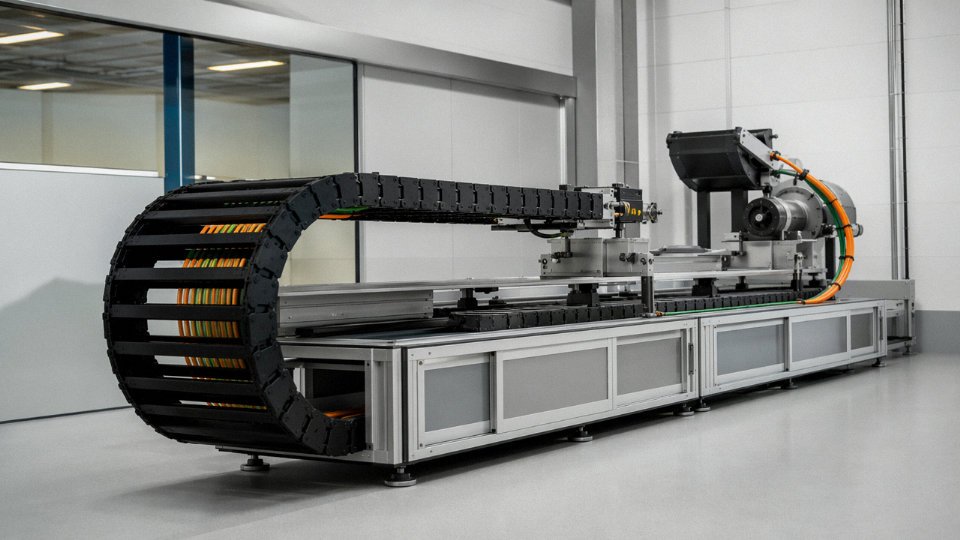
Drag-chain cables get a dedicated test rig — a machine that cycles the cable back and forth through the rated minimum bend radius, at a defined travel speed and acceleration, continuously. Typical rig parameters are a bend radius matching the manufacturer’s stated minimum, travel speeds of 1–4 m/s, and accelerations up to roughly 5–10 m/s², held at the cable’s rated operating temperature. A serious flex-life test runs to 10 million cycles or more.
For context, a machine tool running two shifts, 250 days a year, with a 0.5-second cycle time accumulates around 36 million cycles over 15 years. A cable that only certifies to 5 million cycles is already under-specified for that application. The failure modes the test is designed to expose include conductor strand fracture, insulation cracking at the flex zone, shield braid fatigue, and jacket wear where the cable contacts the chain links.
EMC Validation for Shielded Cables
Transfer impedance, measured per IEC 62153-4-3, is the right metric for shielded cable performance — not just braid coverage percentage, though coverage matters. An 85% braid-coverage shield might measure a transfer impedance of 50–100 mΩ/m at frequencies below 1 MHz, while 95% coverage on the same conductor geometry can drop that to 20–40 mΩ/m. In a VFD installation running switching frequencies of 4–16 kHz with significant harmonic content, that difference is audible in drive faults and measurable in motor bearing currents over time.
Jinda's manufacturing campus includes dedicated type-test laboratories equipped with partial discharge testers, climate chambers rated from -50°C to +200°C, and a 250 kV impulse generator.True
Jinda operates a 470,000 m² integrated campus across five production bases in China, with in-house R&D and testing infrastructure described in company technical documentation. In-house high-voltage and climate test capability at these specifications is consistent with the scale of operation and is stated in Jinda's facility descriptions.
The value of in-house testing at this level is that a supplier doesn’t have to send samples to an external lab and wait weeks for results — or worse, skip type testing altogether on a revised compound because the lead time pressure made it inconvenient. Partial discharge testing in particular requires both sensitive instrumentation and a low-background electrical environment that most manufacturers simply don’t have on-site.
When qualifying any cable supplier, ask for the actual type-test reports, not just a certificate number. The report should include the test date, sample construction details, the measured values, and the acceptance criteria. If a supplier can only produce a third-party certificate with no underlying data, that is worth noting.
Installation Best Practices That Determine Whether Even a Premium Industrial Cable Succeeds or Fails
Selecting the right cable is half the job. The other half happens on-site, and it’s where a surprisingly large share of premature failures actually originate. A cable that passes every factory type test can still fail within months if it’s bent too tight around a conduit edge, pulled with the wrong lubricant, or landed with a poorly compressed shield termination. Warranty claims traced back to installation error are more common than most procurement teams want to admit.
Minimum Bend Radius: Why the Number in the Datasheet Is Not a Suggestion
For fixed installations, minimum bend radius is typically 6–8× the cable outer diameter, depending on armoring type and insulation compound. Dynamic applications — festoon systems, cable carriers, robotic arms — demand 10–15× OD or more, because repeated flexing at tight radii creates conductor fatigue and eventually work-hardening fractures at the bend point. The insulation cracks first, usually on the outer arc where tensile stress concentrates. With shielded instrumentation cables, the braid or foil tears at tight bends before the conductor shows any damage at all, producing an EMI vulnerability that’s nearly impossible to locate without a time-domain reflectometer.
In practice: measure the actual routed path before installation, not the straight-line distance. A cable routed around a structural beam and into a junction box can easily accumulate three or four bends, and if each one is close to the minimum, cumulative fatigue accelerates. Mark the bend locations on your as-built drawings.
Pulling Tension and Lubricant Compatibility
Maximum pulling tension for copper conductors in conduit runs is governed by the conductor cross-section, roughly 50–110 N/mm² of conductor area depending on whether you’re pulling straight or around bends, but the jacket is usually the limiting factor in practice. Exceeding tension limits stretches the jacket, which can deform or delaminate the insulation beneath it.
Lubricant choice matters more than people realize. PU-jacketed cables — common in drag chain and food-processing environments — are not compatible with petroleum-based pulling compounds; those solvents swell and soften PU over time, destroying the jacket’s abrasion resistance. PVC-jacketed cables tolerate water-based gels well but react badly to some silicone-based compounds that leave a residue preventing proper compression fittings from sealing. Always confirm lubricant compatibility with the jacket material spec sheet, not just a general “cable lubricant” label on the bucket.
Grounding and Shield Termination
Shielded instrumentation cable grounded at both ends in a low-frequency analog circuit is almost guaranteed to create a ground loop — a 50 or 60 Hz noise pickup path that looks like sensor drift or interference on a DCS display. Single-point grounding at the control panel end is the standard approach for analog 4–20 mA loops. For high-frequency signal cables or in environments with heavy switching transients, both-ends grounding with a dedicated equipotential bonding conductor is sometimes necessary, but that’s a deliberate engineering decision, not the default.
The termination hardware matters as much as the grounding topology. A 360-degree shield termination clamp — the kind that makes circumferential contact around the entire braid, not just a pigtail wire — provides 10–20 dB better EMI suppression than a pigtail at the frequencies that actually cause problems in VFD-heavy plants. Pigtail terminations are fast and cheap, and they’re also the single most common shielding mistake in industrial panel wiring.
360-degree shield termination clamps provide significantly better EMI attenuation than pigtail terminations at frequencies above 1 MHzTrue
Pigtail connections introduce inductance and leave portions of the shield with no contact to the reference plane, increasing transfer impedance. 360-degree clamps maintain low transfer impedance across the full shield circumference, which is well-documented in EMC engineering literature and IEC 61000 test data.
Cable Segregation in Shared Trays
IEC 61537 and NEC Article 392 both address cable tray fill and segregation, though they approach it differently. The operational rule that matters on the floor: power cables (especially VFD output circuits) should be physically separated from instrumentation and control cables by at least 150–300 mm in open ladder tray, or run in dedicated enclosed trunking when separation distance isn’t achievable. VFD output lines are among the worst offenders for inducing noise into adjacent signal cables because the switching frequency harmonics are high-energy and broadband.
When a physical barrier is used inside a shared tray — a metallic divider bonded to the tray frame — the separation requirement can often be reduced, but verify this against your local authority having jurisdiction before relying on it.
Labeling and Documentation
A cable tag that reads “PWR-MCC3-PUMP7-L12” takes thirty seconds to decode during a fault-finding exercise. An unmarked black cable in a bundle of forty unmarked black cables can take two hours. Jinda applies factory-printed heat-shrink tags or cable markers at both ends on request, formatted to the customer’s naming convention, which eliminates the site step of manually tagging before installation — a step that gets skipped under schedule pressure more often than not.
As-built drawings should record cable route, actual installed length, conduit or tray designation, both termination points, and any deviations from the original design. Keep them current. A plant that maintains accurate cable documentation typically diagnoses faults in under thirty minutes; one that doesn’t can spend most of a shift tracing conductors manually.
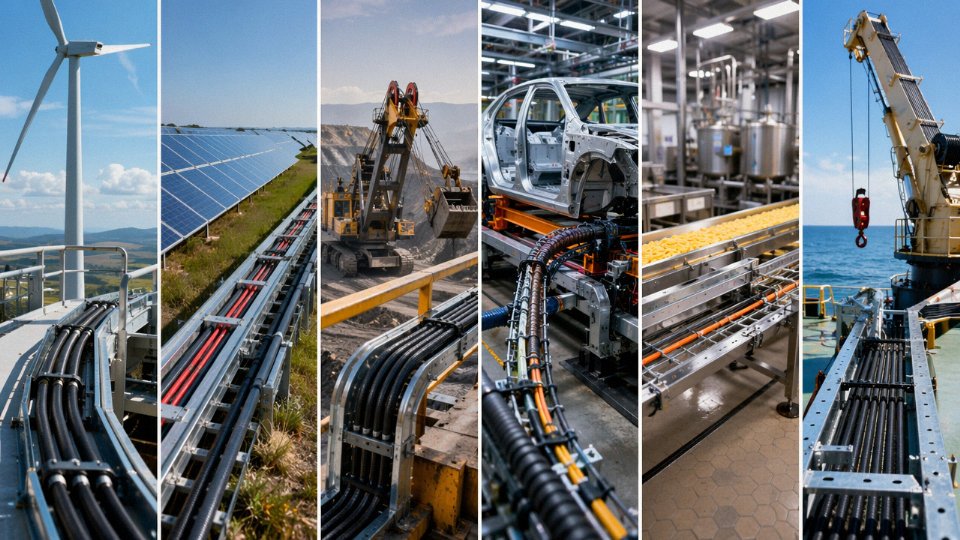
Sector Spotlight: Industrial Cable Specifications Across Five High-Demand End Markets
The honest reality of industrial cable procurement is that a “general industrial” specification covers almost nothing useful once you get into a real facility. The requirements in a car body shop diverge sharply from those on an offshore platform, and trying to bridge that gap with a single compromise cable usually ends in either a premature failure or serious over-spending. What follows is a working breakdown of what each sector actually demands — not marketing categories, but the specifications that come up during factory audits, supplier qualification calls, and cable tray walkthroughs.
Automotive Manufacturing
Robot cable for welding and painting lines is one of the most mechanically abusive applications in any factory. A six-axis welding robot can execute millions of flex cycles per year, and the cable routing through the tow arm sees combined torsion, bending, and tensile stress simultaneously. Torsional flex ratings in this service typically need to cover ±180° per meter minimum, and finely stranded copper conductors — often 0.1 mm or finer wire bundles — are non-negotiable for cycle life. Jacket compounds here are usually TPE or specialized PUR formulations that resist both weld spatter burn and the coolant mist that drifts across paint booth air supplies.
Connector compatibility matters more than people expect at the specification stage. Harting Han and Molex Brad industrial connectors have defined cable entry diameters and strain-relief geometries, so a cable that’s 1–2 mm oversized on the OD simply won’t seat correctly without field modifications that void the connector’s IP rating. Always confirm OD tolerances against the connector’s backshell specification, not just the conductor cross-section.
Renewable Energy and Power Generation
Wind turbine torsion cable runs up the tower and through the nacelle, twisting as the nacelle yaws. IEC 61400 installation guides reference torsion loads around 30° per meter as the working design point, and cables not engineered for this will begin to unlay and fatigue at the jacket within 18–24 months, depending on site wind variability. UV-stabilized outer sheaths are mandatory for any cable run exposed at the tower base or along ground-mounted arrays.
Solar DC cabling is increasingly specified to IEC 62930 (the standard that superseded EN 50618), requiring 1500 V DC insulation ratings, double insulation construction, and halogen-free compounds that hold up against prolonged UV and ozone exposure. Undersizing the voltage rating here — using 1000 V DC rated cable on a 1500 V string — is a surprisingly common procurement error that only surfaces during commissioning or, worse, during an insurance inspection.
Oil, Gas, and Petrochemical
Zone 1 and Zone 2 classification under ATEX/IECEx imposes constraints on every layer of the cable — jacket volume resistivity, metallic screen continuity, and gland compatibility with certified enclosures. Instrumentation cables here often run screened pairs or triples with an overall braid, and the shielding isn’t just for signal integrity; it’s part of the ignition risk management. Fire-resistant cables for platform escape and safety systems must meet IEC 60331 circuit integrity requirements, sustaining operation for 90 minutes at 830°C under the standard flame test — a performance you cannot retrofit into a standard cable by changing only the jacket.
Subsea umbilical cables for ROV and wellhead control add hydrostatic pressure resistance and crush-load requirements that are simply outside the scope of any land-based industrial standard. These are engineered-to-order products in most cases.
Mining and Tunneling
Trailing cables for mobile equipment — shuttle cars, continuous miners, load-haul-dump machines — take punishment that is difficult to replicate in any factory test. IEC 60502 provides the baseline, but national mining safety regulations (South Africa’s SANS, Australia’s AS/NZS series, and others) add requirements that vary enough to matter during procurement. Anti-static jacket compounds with surface resistance below 10⁹ Ω per IEC 60093 are mandatory in most underground coal environments, since a static discharge near methane or coal dust is a catastrophic ignition risk.
Anti-static cable sheaths with surface resistance below 10⁹ Ω reduce electrostatic discharge ignition risk in underground mining environments with combustible dust or gas.True
IEC 60093 defines the test method for surface resistivity, and regulatory bodies in major mining jurisdictions (including MSHA in the US, DMR in South Africa) mandate anti-static properties for cables used in classified underground zones to limit ignition sources per IEC 60079 hazardous area requirements.
Longitudinal water-blocking tapes between the cable core and outer jacket are worth specifying explicitly in flooded-tunnel applications. Without them, water tracks the length of the cable under hydrostatic pressure and reaches terminations or junction boxes hundreds of meters away.
Food and Beverage Processing
The jacket compound question here gets complicated fast. Regulatory contact varies — cables installed above open product lines in an EU facility may need to meet EC 1935/2004 food-contact material requirements, while US facilities often reference FDA 21 CFR frameworks, though specific cable jacket compliance under FDA is less universally mandated than in pharmaceutical environments and depends heavily on the facility’s HACCP plan and third-party audit standards.
Practically, the real driver is chemical resistance to CIP (clean-in-place) cycles using caustic soda, peracetic acid, and hypochlorite solutions at elevated temperatures, combined with high-pressure steam cleaning. Standard PVC jackets degrade noticeably under repeated caustic exposure — the plasticizer migrates out, the jacket hardens and cracks, and you end up with contamination risk and a cable replacement cycle measured in months rather than years. Silicone and specialized TPE compounds hold up considerably better in this service.
Jinda offers custom white or RAL 9003 signal-white jacket options for food and beverage installations, which is a small detail that carries real operational value: visual inspection programs and color-coded cable management schemes require it, and an auditor who finds black cables routed above a production line will flag it, regardless of the compound’s actual compliance status.
Sourcing Industrial Cables Internationally: Supplier Evaluation, Lead Times, and Supply Chain Risk Management
Buying industrial cable internationally is not simply a price-per-meter exercise. Get it wrong and you’re looking at delayed commissioning, failed FAT at site, or — worst case — a customs hold while you chase a missing certificate. The procurement decisions made six months before installation day determine whether a project runs on schedule.
Qualifying a Supplier Before You Issue a Purchase Order
The first filter is financial and operational stability relative to your order volume. A manufacturer running a single 50,000 m² plant on spot-copper purchasing is a different risk profile than one with vertically integrated raw material supply and multiple production bases. Jinda operates five production facilities across China with roughly 470,000 m² of manufacturing space, and critically, runs in-house copper rod drawing and insulation compounding. That backward integration matters more than it sounds. When LME copper spikes or a spot-market supplier allocation tightens — both of which happen more often than procurement calendars account for — a vertically integrated manufacturer maintains production continuity where a pure assembler stalls.
Jinda supplies industrial cables to customers in more than 50 countries worldwide.True
This is stated directly in Jinda's company profile and reflects the geographic breadth of their documented supply and sales operations.
Certified quality management is table-stakes, but verify it isn’t just a framed certificate in a reception area. Ask for the most recent surveillance audit report. Ask which product families are covered by scope. ISO 9001 covering “power cable” may not cover the specific armored instrumentation cable you need — scope exclusions are where surprises hide.
Reference projects in your target market carry real weight. A supplier who has shipped to Middle East EPC contractors, Southeast Asian utilities, or European OEM lines has already worked through the documentation formats, packing requirements, and inspection protocols those markets demand. That experience compresses your own learning curve considerably.
Lead Time Planning: Where Projects Actually Get Into Trouble
Standard catalog cables — general-purpose PVC/XLPE power cable, common flexible grades — typically ship ex-works from Jinda’s production bases within roughly 2–4 weeks for volumes that fit existing production schedules. Push into large volumes or tight windows and that stretches, so build in buffer.
Custom cables are a different conversation. Novel cross-sections, non-standard conductor configurations, special jacket compounds, or any tooling modification realistically runs 6–10 weeks from drawing approval to first drum off the line. The tooling lead time is usually the constraint, not winding capacity. Engineers who send a custom spec with a four-week delivery expectation are going to have a bad quarter. Plan procurement schedules backward from site-ready date, account for sea freight transit (typically 18–35 days depending on destination port and routing), and add buffer for customs clearance — particularly for CIF shipments where documentation errors cause holds.
Inspection, FAT, and the Documentation Package
Third-party inspection access is non-negotiable for most serious international buyers. Jinda facilities accommodate SGS, Bureau Veritas, TÜV, and most other recognized bodies without restriction. Drum-by-drum test report packages — covering conductor resistance, insulation resistance, voltage withstand, and dimensional checks — should travel with each shipment, not arrive two weeks later by email. Electronic certificates of conformance accelerate customs documentation and are increasingly expected by freight forwarders handling project cargo.
Incoterms and the Risk Handover Point
EXW puts maximum logistics responsibility on the buyer and suits buyers with established freight forwarder relationships in China. FOB Qingdao is the most common working arrangement for industrial cable export — risk transfers at the vessel rail, cost and freight management stays with the buyer’s agent. CIF to destination port shifts insurance and main freight cost to Jinda, which works well for buyers without China-side freight infrastructure but requires clear agreement on carrier selection and insurance terms upfront. For large EPC orders involving project-cargo consolidation across multiple drum sizes and cable types, Jinda’s export team has managed consolidated shipments to over 50 countries — the logistics coordination experience reduces the documentation errors that derail multi-line orders.
Long-Term Supply Agreements: The Structures That Actually Reduce Risk
Spot buying on price feels efficient until copper moves 15% in a quarter. Long-term supply agreements with price escalation clauses indexed directly to LME copper pricing give both sides predictability — the buyer knows the formula, the supplier maintains margin without renegotiation friction. Safety-stock programs at Jinda’s bonded warehouse allow repeat buyers and global distributors to hold virtual inventory against call-off orders without tying up their own warehouse capital. Dedicated account management means procurement teams aren’t re-explaining project context to a new contact every order cycle.
For buyers evaluating a long-term partnership, the combination of vertical integration, multi-base production capacity, open third-party inspection, and structured supply agreement options is what converts a cable supplier into a supply chain asset rather than a procurement variable.
Frequently Asked Questions About Industrial Cables
What is the difference between an industrial cable and a commercial cable?
The gap is construction, not branding. Commercial cables — your typical H05VV-F flex or basic NYM building wire — are designed for stable indoor environments, modest mechanical loads, and predictable temperature ranges. Industrial cables are engineered from the conductor out: finer stranding for flexibility or vibration resistance, insulation compounds that hold dielectric strength after thermal cycling, armor or braid layers that survive dragging and crush loads, and jacket materials chosen specifically for chemical or UV exposure. The distinction is enforced by construction standards (IEC 60502, IEC 60227, UL 508C, and their equivalents), not by what the packaging says. A commercial cable labeled “heavy duty” by a hardware distributor is not an industrial cable. When in doubt, ask for the specific IEC or UL construction standard and compare it against your application’s hazard list.
Can I use a standard PVC cable in an oil and gas plant if I install it in conduit?
Conduit helps — it reduces abrasion and some incidental liquid contact — but it does not fix the underlying compliance problem. Standard PVC insulation typically fails on three fronts in classified hazardous areas: it may not meet the flame propagation limits required by ATEX/IECEx zoning, it almost certainly does not meet low-smoke or halogen-free requirements that many offshore and refinery operators mandate internally, and it contributes nothing to intrinsic safety circuit integrity. ATEX/IECEx regulations do not grant a conduit exemption from cable specification requirements. In practice, an inspection authority or insurer reviewing your installation can reject the entire run regardless of conduit material or fill ratio. Use the cable the zone classification actually demands.
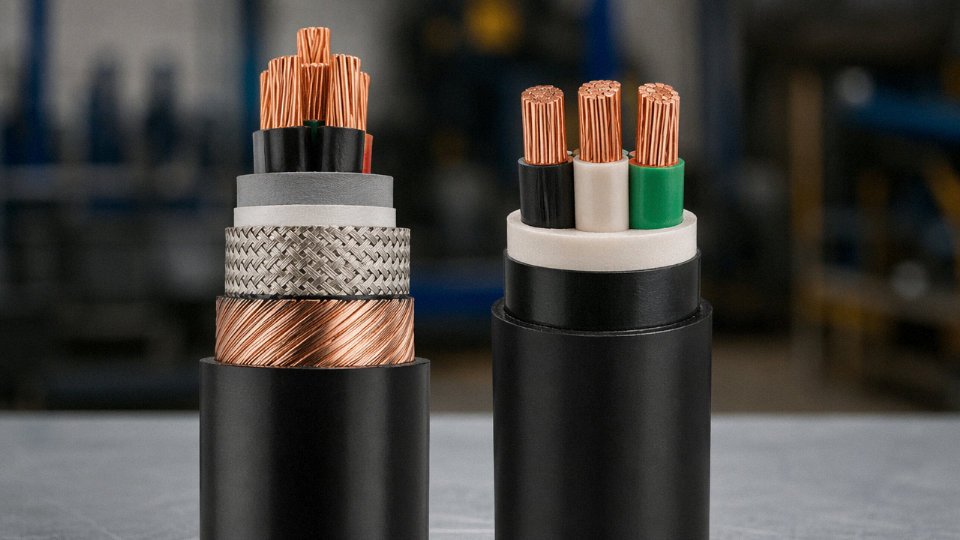
How do I specify a VFD cable — what parameters must appear on the purchase order?
This is where purchase orders go wrong most often. At minimum, your PO needs to state: voltage class (0.6/1 kV is standard for most drives, but confirm with the drive OEM), number and cross-section of power conductors (e.g., 3 × 4 mm²), ground conductor count and size, shield type and coverage percentage (symmetrical three-conductor ground with 85% or better braid coverage is a common benchmark), the carrier frequency rating the cable is tested to, jacket material (TPE if oil exposure is possible, LSZH if the installation is in a confined space), outer diameter tolerance (critical for gland sizing), and the applicable standard — IEC 61800-5-2 is the reference most European and export projects now follow. Leave any of those fields open and you will receive whatever the factory has in stock.
What does LSZH mean and when is it mandatory?
LSZH — low-smoke zero-halogen — describes jacket and insulation compounds that, when they burn, produce minimal toxic gas and very little opaque smoke. The “zero halogen” part matters because burning PVC releases hydrogen chloride, which is corrosive to electronics and genuinely dangerous in confined spaces. LSZH is effectively mandatory in tunnels, underground transit systems, ships, offshore platforms, and many public buildings — anywhere that evacuation is slow and smoke density determines whether people can find the exit. Compliance is verified by IEC 60754 (halogen content) and IEC 61034 (smoke density), not by the compound trade name. Always ask for test reports, not just a datasheet claim.
LSZH cables emit minimal toxic gas and smoke during combustion compared to standard PVC cables, as verified by IEC 60754 and IEC 61034 test standards.True
IEC 60754 measures halogen acid gas emission and IEC 61034 measures smoke density during combustion; LSZH compounds are specifically formulated to pass both, whereas standard PVC releases significant hydrogen chloride and opaque smoke.
How long do industrial cables last in service?
Design life varies considerably by cable type and installation environment. Armored underground power cables, installed correctly with proper bedding and backfill, routinely achieve 30–40 years. Flexible dynamic cables in continuous-flex applications — robotic arms, cable tracks, cranes — are typically designed for 15–20 years under rated cycle counts, though actual life shortens fast if the bend radius is wrong or the cable runs dry in a cable track without anti-friction dressing. The numbers are only meaningful when the operating conditions stay within the design parameters: temperature, chemical exposure, mechanical load, and cycle frequency all interact. A cable that’s been run at 20% over its rated conductor temperature from day one won’t reach its nameplate design life regardless of jacket quality.
Does Jinda supply cables with third-party certifications for North American projects?
Yes. Specific Jinda cable series carry UL and CSA approvals, and for projects where the authority having jurisdiction requires witnessed testing, Jinda can arrange SGS or Intertek factory inspection and certification documentation. This matters on North American EPC packages where the electrical inspection authority will pull a sample from site and trace it back to the UL file number. Having that documentation prepared before shipment removes a common project delay.
What is the minimum order quantity for custom industrial cable?
MOQ depends on cable type and construction complexity. For standard catalog products, 100 meters per item is typical. Custom designs — specific compound combinations, non-standard conductor configurations, proprietary color codes — generally require a minimum of around 500 meters per line item to make a production run economically sensible. On large EPC packages with multiple cable types, Jinda’s international sales team has latitude to consolidate MOQs across items. The honest answer is to send your cable schedule early; a project with 15 line items packages very differently from a single custom run.