Walk into any rough-in inspection that’s failed and the root cause is almost always the same: someone pulled the wrong cable — wrong insulation rating, wrong ampacity, wrong jacket for the environment — and now the walls are open again, the schedule is bleeding, and the GC is eating rework costs that nobody budgeted. For residential work specifically, mismatched cable selection ripples fast: tripped breakers during load testing, failed IR scans, callbacks six months after handover when a homeowner loads up a new EV charger circuit.
The cable type most commonly used in residential construction is NM-B (non-metallic sheathed cable, often sold under the Romex trade name), which accounts for roughly 70–80% of all wiring installed in new U.S. single-family homes. It runs branch circuits from 14 AWG up to 10 AWG, covering the 15 A to 30 A loads that make up the bulk of residential demand under NEC guidelines.
What makes that answer more complicated in practice is that “residential construction” isn’t one thing. A stick-frame suburban house in Ohio and a concrete mid-rise apartment in a coastal market live under different code sections, different inspector habits, and sometimes different procurement realities — and the cable that’s dead-right for one can be a code violation in the other. The picture gets more interesting when you layer in the shift toward smart-home infrastructure and EV charging, two loads that are quietly pushing residential electrical design toward conductor sizes and circuit counts that would have looked commercial a decade ago.
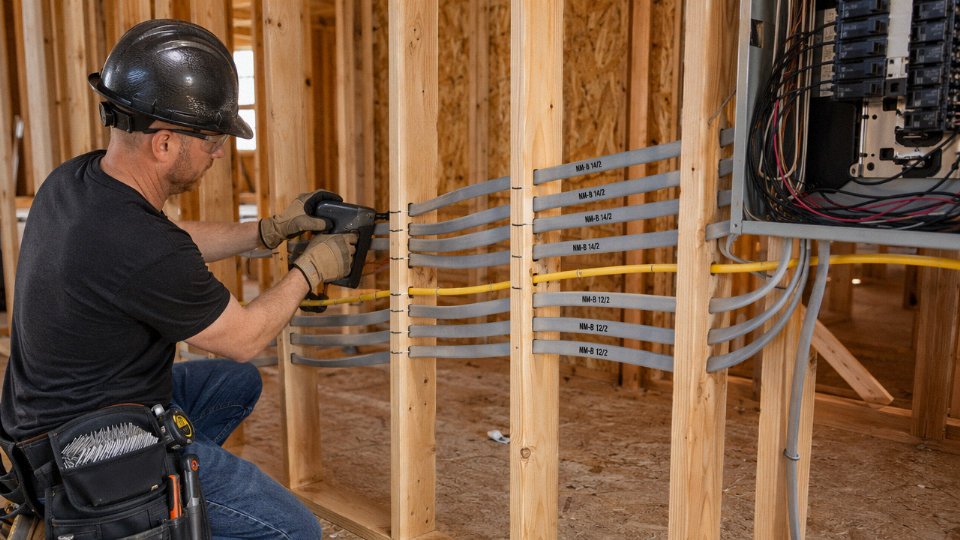
NM-B Cable: Construction Details, Code Compliance, and Where It Is Permitted in a Home
Walk into any new single-family home under construction in the United States and you will see it stapled to every stud bay: that flat, gray-jacketed cable with two or three color-coded conductors and a bare copper ground riding along the middle. That is NM-B — non-metallic sheathed cable, Type B — and understanding what is actually inside it matters more than most buyers and contractors bother to find out.
What the Cable Is Made Of
Each current-carrying conductor inside an NM-B cable is individually insulated to THHN/THWN-2 standards, meaning the insulation is rated for 90°C dry and 75°C wet environments. The ground wire is either bare copper or, less commonly, green-insulated. The whole assembly sits inside a PVC outer jacket that is, in practice, tougher than it looks — though you can still nick it badly with a careless utility knife stroke, which is a real source of inspection failures.
Standard residential configurations you will actually encounter: 14/2 (two insulated conductors plus ground, 14 AWG), 14/3, 12/2, 12/3, and 10/2 or 10/3 for heavier loads. The slash number tells you conductor count excluding the ground. Simple rule, but contractors misread it constantly.
The 90°C/60°C Distinction and Why It Trips People Up
Here is where a lot of residential electricians — and frankly, some inspectors — get fuzzy. The conductors themselves are rated 90°C, but NEC Article 334 requires ampacity to be calculated at 60°C when NM-B is run in free air or concealed in stud cavities. That means a 12 AWG NM-B circuit is limited to 20 A, full stop, regardless of the conductor’s thermal capability.
The 90°C rating only becomes relevant in conduit fill calculations — when you need to derate for bundled cables, you start from the 90°C column in NEC Table 310.15(B)(16) and then apply the correction factors, landing at a final value that must still not exceed the 60°C limit for the terminations. Get this wrong and you either under-size wire (fire risk) or over-size it unnecessarily and add cost. Neither outcome is good.
Where the NEC Allows — and Forbids — NM-B
NEC Article 334 is specific. NM-B is permitted in dry, permanently indoor locations: concealed in walls, floors, and ceilings; run through bored holes in framing; fished through finished cavities. That covers the vast majority of residential branch wiring, which is why it dominates.
The prohibited list matters more for avoiding costly rework. NM-B cannot be used in wet or damp locations, direct burial, service-entrance applications, or anywhere exposed and subject to physical damage below 7 feet in garages or storage areas. That last one catches people off guard — a laundry room or attached garage often requires conduit for the exposed run below the panel, even if the rest of the circuit is NM-B.
Circuits That Depend on It
General lighting and receptacle circuits run on 14/2 at 15 A. Kitchen small-appliance branch circuits — the two required dedicated circuits per NEC 210.11(C)(1) — use 12/2 at 20 A. Bathroom GFCI circuits typically follow the same 12/2 pattern. An electric dryer needs 10/3 with ground for the 30 A, 240 V feed. These are not suggestions; they are the minimum code requirements, and undersizing any one of them is a liability.
NM-B cable accounts for roughly 70–80% of all wiring installed in new U.S. single-family residential constructionTrue
Industry surveys and NEC adoption data consistently place NM-B as the dominant wiring method in U.S. single-family new construction, with its share driven by cost, installation speed, and broad NEC 334 permissions in dry interior environments.
International Equivalents for Global Procurement
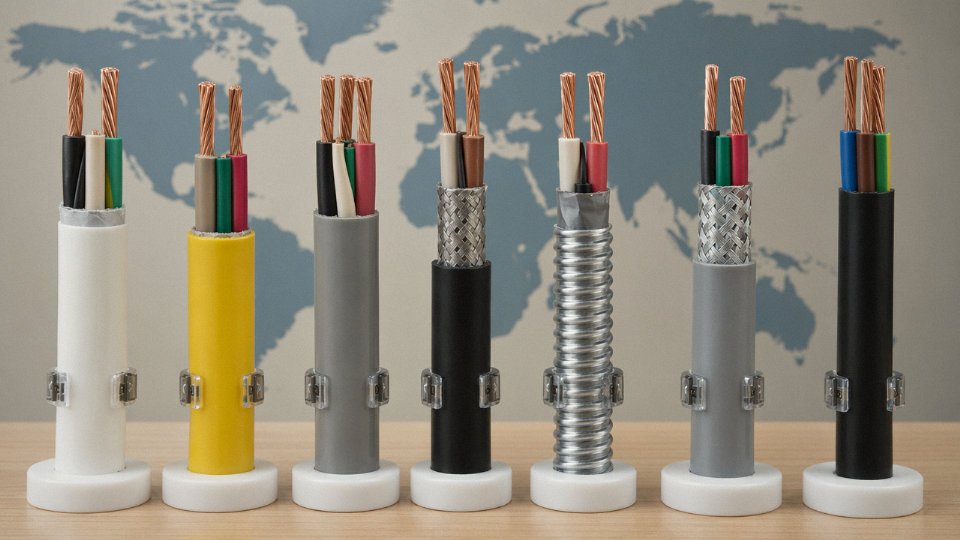
If you are sourcing cable internationally or mapping specs across projects in different markets, the functional equivalents break down roughly like this:
| Region | Equivalent Cable | Key Difference from NM-B |
|---|---|---|
| Europe (IEC) | NYM-J | Round jacket, oil-resistant PVC, typically rated for damp locations |
| China (GB standard) | BVVB | Flat twin-and-earth geometry, 300/500 V rating common |
| Australia/New Zealand | TPS flat twin-and-earth | Similar flat geometry, AS/NZS 5000.2 standard, active/neutral/earth |
None of these are direct drop-in substitutes — voltage ratings, insulation thickness, and permitted installation methods differ enough that a procurement manager should never assume equivalence without reviewing the applicable national standard. A cable that passes GB/T standards for a Chinese domestic project will not satisfy UL or NEC requirements on a U.S. site without separate listing.
What to Actually Verify Before You Buy
The UL listing mark on the jacket is non-negotiable for U.S. projects. Beyond that, AWG conductor size should be printed on the outer jacket at intervals no greater than 24 inches — if it is absent or inconsistent, that is a red flag worth rejecting the reel over.
The copper question deserves a direct answer: oxygen-free or electrolytic tough-pitch (ETP) copper conductors are the standard for listed NM-B. Copper-clad aluminum (CCA) conductors are cheaper and will occasionally appear in lower-cost imported cable. CCA has meaningfully higher resistance than solid copper at the same AWG, which affects both ampacity and voltage drop over longer runs, and the galvanic behavior at terminations is different enough to cause connection problems over time — especially if the installer does not use fittings rated for aluminum. On a residential project, the few cents per foot saved rarely justify the risk.
UF-B, MC, and AC Cable: When and Why Residential Builders Choose Armored or Underground Options
NM-B is the right answer for most of a house. But “most” is not “all,” and using NM-B where code requires something tougher is one of the more common—and expensive—inspection failures contractors run into. The three alternatives that come up repeatedly in residential work are UF-B, MC, and AC cable. Each exists because NM-B has a genuine limitation in that application.
UF-B: The Underground Feeder That Actually Belongs in the Ground
UF-B looks similar to NM-B on the shelf but is built differently where it counts. Each conductor is individually encapsulated in solid PVC, then the assembly is jacketed again — that’s what gives it the dense, almost rubbery feel compared to the looser NM-B sheath. It’s rated for direct burial and wet locations, which NM-B is not under any circumstance.
The typical residential triggers: a detached garage fed from the main panel, landscape lighting circuits (anything over low-voltage), a pool equipment circuit, or an outbuilding across a yard. If the wire leaves the structure and enters grade, you’re in UF-B territory.
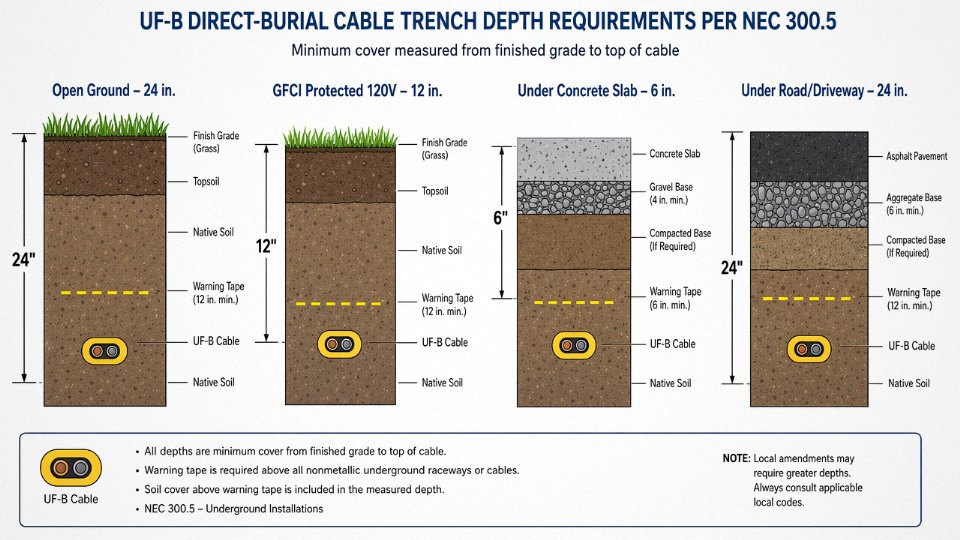
Burial depth per NEC 300.5 is the part contractors get wrong most often. The general requirement is 24 inches for UF-B under open ground. Drop to 12 inches if the circuit is GFCI-protected and the voltage doesn’t exceed 120 V. Under a concrete slab, 6 inches is acceptable. These aren’t suggestions — an inspector will probe trench depth on permitted work, and a shallow bury under a driveway that later gets frost heave or a landscaping excavator is a real failure scenario. In practice, I’d run a 12-inch trench under a concrete slab only if the concrete is being poured immediately; if that slab pours six months later, something moves.
MC Cable: When the Exposed Run Has No Good Alternative
Metal-clad cable — interlocked aluminum or steel armor over THHN conductors with a separate ground — earns its place in residential work wherever NM-B is either prohibited or physically vulnerable. Exposed runs in unfinished basements are the most common case. Many jurisdictions also require MC (or conduit) in mixed-use buildings where the residential floors sit above commercial space, partly because the fire compartmentalization requirements change.
A few municipalities and some state amendments flat-out prohibit NM-B in anything over a certain number of stories, so if you’re doing a three-story townhouse in a dense urban market, check the local amendment before pricing the job with NM-B.
MC costs more than NM-B — more material, more labor, and the connectors add up fast on a full house rough-in. The armor does offer real protection against physical damage, though, and in a basement with active storage or workshop use, that matters more than the price premium.
AC Cable and Why New York Still Runs BX
Armored cable (AC, colloquially “BX”) uses a spiral steel armor but historically relied on that armor as the ground path in older Type AC versions — a detail that bit a lot of people during renovations where the armor continuity had corroded. Current AC-HH versions include a bonding strip. Still, the absence of a true equipment ground conductor in legacy installations is worth flagging during any pre-purchase home inspection that turns up original BX.
New York City’s electrical code effectively mandates AC or MC for nearly all residential wiring — NM-B is not permitted in NYC. Contractors who move from suburban markets into city work find out the hard way when the first rough-in inspection fails. The labor rate for AC installation runs meaningfully higher than NM-B because of the connector density and the stripping process.
Cost Reality Across the Three Cable Types
These figures vary by region, supplier volume, and copper pricing — treat them as budgeting ranges, not quotes.
| Cable Type | Material Cost (12/2, per foot) | Relative Install Labor | Approx. Total Installed Cost Premium vs. NM-B |
|---|---|---|---|
| NM-B 12/2 | $0.55–$0.85 | Baseline | Baseline |
| UF-B 12/2 | $0.90–$1.30 | +15–25% (trenching separate) | +60–90% per linear foot installed |
| MC 12/2 | $1.20–$1.80 | +30–50% | +90–130% per linear foot installed |
For a 2,000 sq ft home where roughly 20–30% of circuits require MC or UF-B rather than NM-B, the cable cost differential on those specific runs adds up to several hundred dollars in material alone — before trenching labor or rental equipment.
UF-B cable is rated for direct burial without conduit under NEC 300.5 when installed at the correct depth.True
NEC 300.5 and Article 340 explicitly list UF-B as suitable for direct burial. Depth requirements vary by installation context — 24 in. general, 12 in. GFCI-protected at 120 V, 6 in. under concrete.
Sourcing Armored and Direct-Burial Variants for Export Projects
For procurement teams sourcing outside North America, the UL listing and NEC compliance that govern these cable types don’t automatically translate to IEC-framework projects. Jinda’s manufacturing lines produce armored and direct-burial cable variants, and the company supports co-certification requests — UL alongside IEC standards — for export projects where the end-market code environment requires dual compliance. If you’re specifying for a project that ships into multiple regulatory jurisdictions, requesting test documentation for both frameworks upfront saves rework at the approval stage. Reach out through Jinda’s technical support channel with the project country, application, and voltage system before finalizing the specification.
Low-Voltage Residential Cables: Coaxial, Cat6, Speaker, and Security Wiring Specifications
Power wiring gets most of the attention in residential rough-in — NEC compliance, circuit sizing, panel schedules. But in a connected home, the low-voltage rough-in is equally consequential, and it’s where I’ve seen the most cutting of corners. A contractor who installs the wrong coaxial or skips plenum-rated jacket in a forced-air return space can create signal problems or a code violation that’s genuinely expensive to fix after drywall closes.
RG-6 Coaxial Cable
The standard for residential cable TV, satellite dish feeds, and over-the-air antenna distribution is RG-6 at 75-ohm impedance. Not RG-59 — that older spec has higher attenuation and thinner center conductor (typically 23 AWG vs. 18 AWG on RG-6), and while it still shows up in retrofit jobs, it shouldn’t be specified for new construction.
Quad-shield RG-6 — two layers of foil plus two braids — gives you roughly 10–15 dB better isolation from interference compared to dual-shield, which matters most on satellite and antenna runs near electrical panels or HVAC equipment. For standard cable-TV drops where interference isn’t a concern, dual-shield is adequate and costs a bit less. Attenuation on quality RG-6 at 1 GHz runs somewhere in the range of 5.5 to 6.5 dB per 100 feet, depending on conductor quality and dielectric foam density. Runs beyond 150 feet to a single outlet usually warrant a distribution amplifier to maintain signal.
Cat 5e, Cat 6, and Cat 6A: Choosing the Right Bandwidth Tier
This is where specs genuinely diverge based on application. Cat 5e handles up to 100 MHz and supports Gigabit Ethernet within the standard 100-meter segment limit — fine for most connected devices today. Cat 6 raises that ceiling to 250 MHz and handles 10-Gbps up to about 55 meters (it drops back to 1 Gbps beyond that). Cat 6A extends 10-Gbps capability to the full 100-meter segment at 500 MHz, which is the right spec for home offices, media rooms, or anywhere you expect bandwidth-heavy use over the next decade.
The maximum segment length for Cat 5e, Cat 6, and Cat 6A structured cabling is 100 meters (328 feet) per TIA-568 standards.True
TIA-568-C.2 specifies a 100-meter channel limit for all three categories, including patch cords. Cat 6A supports 10GBASE-T across the full 100 meters; Cat 6 supports it only to roughly 55 meters.
For residential use, jacket selection matters more than many builders realize. CMR (riser-rated) is the minimum for most in-wall vertical runs. If cable passes through any air-handling plenum space — which in forced-air homes is more common than you’d expect — you need CMP (plenum) jacket, which uses a low-smoke, flame-retardant compound. The cost difference is real: CMP cable typically runs 30–60% more per foot than CMR, depending on category and quantity.
In-Wall Speaker Cable
NEC Article 640 governs audio cable routed inside walls. The jacket must be CL2 or CL3 rated for in-wall use — bare zip cord from a hardware store is not compliant, full stop. For most rooms, 16 AWG CL2 is adequate. For subwoofer circuits or runs over roughly 50 feet, step up to 14 AWG to manage resistance losses that otherwise muddy low-frequency response. Oxygen-free copper is worth specifying here; the price premium is modest on 16 AWG and the long-term oxidation resistance matters when the cable is buried in a wall for twenty years.
Security and Fire-Alarm Cable
Burglar-alarm zone loops typically use 22 AWG shielded twisted pair. The shield is not optional — unshielded cable in homes with LED dimmers or variable-speed HVAC motors picks up enough interference to generate nuisance false alarms, a complaint that’s hard to diagnose after the fact.
Fire-alarm and smoke-detector interconnect cable is a different category entirely. FPL (fire power limited) and FPLR (riser-rated) are the NEC-required designations for residential smoke detector wiring. FPLP (plenum) applies if the routing passes through air-handling spaces. These ratings exist because life-safety circuits need to remain functional under fire conditions longer than standard wiring. Getting this wrong isn’t a signal-quality issue — it’s a liability issue.
Structured Wiring Topology: Home-Run vs. Daisy-Chain
Daisy-chaining coax and Cat drops was acceptable practice in the 1990s. In a smart home with streaming, VoIP, and security cameras all competing for bandwidth, it creates real performance degradation and makes troubleshooting a headache. Modern residential specs increasingly require dedicated home-run drops from each outlet location back to a central structured media panel, typically located near the electrical panel. Yes, it uses more cable — roughly 20–40% more linear footage depending on floor plan — but it allows individual circuit management, easy upgrades, and clean bandwidth allocation.
Future-Proofing During Rough-In
One specification detail that pays for itself: install 1-inch ENT (electrical non-metallic tubing) or flex conduit sleeves at key low-voltage pathways — especially wall penetrations between floors, long horizontal runs over drop ceilings, and the main feed from panel to living areas — during rough-in. The material cost is negligible at that stage. Pulling new Cat 6A or fiber through an existing sleeve after the walls are closed takes an hour. Without that sleeve, it takes a drywall crew and a painter. In my experience, this single detail consistently comes up in home resale inspections and adds measurable value to the structured wiring system.
Conductor Material and Gauge Selection: Copper vs. Aluminum and AWG Sizing for Residential Loads
The cable type question gets most of the attention, but the material and gauge decisions underneath it are where real mistakes happen — mistakes that show up years later as nuisance trips, overheated terminations, or worse.
Copper vs. Aluminum: The Conductivity Gap and What It Means on the Bench
Copper runs at 100% IACS (International Annealed Copper Standard). Aluminum sits around 61% IACS. That gap doesn’t just affect wire tables in an abstract sense — it means aluminum needs roughly one AWG step up to carry the same ampacity. A 12 AWG copper conductor handles 20 A; you’d need 10 AWG aluminum to get equivalent performance. In practice, that one-step rule is a floor, not a ceiling. High-ambient environments — an attic in a Texas summer, a mechanical room with poor airflow — can push the derating further.
Aluminum isn’t inherently wrong for residential work. It’s code-acceptable, even standard, for service entrance conductors (typically 2 AWG and larger) and for main feeders running to a sub-panel. Large service conductors have been aluminum for decades and perform fine when installed correctly. The problem is branch circuits. Most jurisdictions prohibit aluminum conductors on 15 A and 20 A branch circuits, and for good reason — the failure history with 1970s aluminum branch wiring is well-documented enough that it’s embedded in the NEC itself.
The Anti-Oxidant Compound Problem Nobody Talks About Enough
When aluminum is used — service entrance cable, feeder runs, sub-panel connections — the termination requires an anti-oxidant compound and CO/ALR-rated devices. Aluminum oxidizes rapidly once cut. That oxide layer is resistive. Skip the compound or torque the lug onto bare aluminum, and you’ve created a connection that will heat-cycle itself loose over a few years of load fluctuation. In my experience, this omission is behind a significant share of aluminum-wiring failure events that get attributed to “the aluminum” rather than the installation practice.
CO/ALR-rated receptacles and switches are rated for the differential expansion between aluminum conductors and the device’s terminal. Standard devices are not. This is not a gray area.
Most residential aluminum wiring failures are caused by improper termination practice rather than the conductor material itselfTrue
Anti-oxidant compound omission and use of non-CO/ALR-rated devices create resistive, heat-cycling connections. This is consistent with CPSC historical data on aluminum branch circuit failures and NEC remediation guidance.
AWG Quick-Reference for Residential Circuits
| Circuit Application | Conductor Size | Overcurrent Protection | Notes |
|---|---|---|---|
| General lighting, outlets | 14 AWG | 15 A | Minimum for most branch circuits |
| Kitchen, bath, laundry | 12 AWG | 20 A | NEC requires dedicated circuits in kitchens |
| Dryers, water heaters | 10 AWG | 30 A | Verify load — some heat-pump water heaters differ |
| Electric ranges | 8 AWG | 40 A | Often 6 AWG depending on range rating |
| Dedicated EVSE circuit | 6 AWG | 50–60 A | Level 2 charger; distance matters — see below |
Voltage Drop: The Calculation Most Residential Electricians Skip
NEC recommends keeping branch circuit voltage drop under 3%, with a combined feeder-plus-branch maximum of 5%. That’s a recommendation, not a hard code requirement in most cases — but ignore it on a long run and you’ll have a range that takes three minutes to preheat or an EV charger that throttles back constantly.
A quick worked example: a 20 A kitchen circuit, 100 ft run (200 ft of wire, round-trip), 12 AWG copper. Voltage drop ≈ (2 × 0.001588 Ω/ft × 100 ft × 20 A) / 120 V × 100 = roughly 5.3%. That exceeds the 3% recommendation. Upsizing to 10 AWG drops it to about 3.3% — acceptable. For EV charger runs exceeding 50–60 ft, this calculation is essentially mandatory; undersized feeders on EVSE circuits are an increasingly common callback issue as Level 2 charging loads become standard.
CCA Wire: A Material Worth Actively Avoiding
Copper-clad aluminum (CCA) looks like copper at a glance, costs noticeably less, and causes disproportionate problems. The copper cladding is thin — typically 10–15% of the cross-section by volume — so the bulk conductivity is still aluminum. At terminations and cut ends, the exposed aluminum oxidizes. Connections made with the assumption of copper behavior, using standard copper-rated terminals, behave unpredictably under thermal cycling. There’s credible fire risk data tied to CCA in power applications, particularly where connections see repeated load variation. Jinda uses only pure electrolytic tough-pitch copper (ETP copper, minimum 99.9% purity) in residential-grade product lines for exactly this reason — the cost delta simply doesn’t justify the termination risk in a cable that’s expected to sit inside a wall for 40 years.
National and International Wiring Standards That Govern Residential Cable Choice
Buying the wrong cable for the destination market is not a specification footnote — it is a job-site rejection, a customs hold, or a failed inspection that can cost weeks. Standards vary more than most procurement managers expect, and the gap between knowing a product is “IEC-compliant” and knowing which IEC standard at which voltage rating for which installation method is exactly where expensive mistakes happen.
United States: NEC Articles and the AHJ Variable
The National Electrical Code (NFPA 70) is the reference, but it is not self-executing. Article 334 covers NM-B, Article 340 UF-B, Article 330 MC cable, and Article 320 AC cable — each article specifying permitted uses, installation restrictions, and conductor requirements. What contractors routinely underestimate is the Authority Having Jurisdiction. A California AHJ can and does prohibit NM-B in multi-family wood-frame construction even where the NEC technically permits it. Some jurisdictions still run on older adopted NEC cycles — the 2017 or even 2014 edition rather than 2023 — which affects arc-fault and ground-fault requirements. If you are procuring cable for a national homebuilder operating across multiple states, you need to map each project location’s adopted code cycle before finalizing your specification. Assuming the current NEC applies everywhere is a fast path to retrofit costs.
IEC 60227 and IEC 60502: The International Baseline
Across Europe, the Middle East, Southeast Asia, and most of Africa, residential fixed wiring typically falls under IEC 60227 (PVC-insulated cables for rated voltages up to and including 450/750 V) or IEC 60502-1 (power cables with extruded insulation, 1 kV range). IEC 60227 is the dominant residential standard — it covers the flat twin-and-earth type and single-core building wire that most markets use for branch circuits. Compliance here is a floor, not a ceiling; individual country adoptions layer on top, sometimes with tighter conductor temperature ratings or local conduit-fill rules.
BS 7671 and the UK Ring Circuit Logic
UK residential wiring operates under BS 7671 (18th Edition, amended 2022), and its structural logic is genuinely different from North American home-run topology. British homes use flat twin-and-earth cable designated 6242Y — typically 2.5 mm² for power circuits — wired in a ring final circuit where both ends of the cable return to the consumer unit. This means a single 32 A breaker can supply a ring feeding multiple socket outlets throughout a floor, a configuration that would violate NEC logic entirely. Specifying NEC-style home-run cable runs for a UK project, or quoting AWG sizes to a British M&E consultant, will generate confusion immediately. The insulation colour coding also differs: brown for line, blue for neutral, green-yellow for earth — post-2004 harmonised colours that not every older electrician has fully internalised.
GB 50096 and GB/T 5023: China Domestic Requirements
For residential construction within China, the governing standards are GB 50096 (residential building design standard) alongside GB/T 5023, which specifies PVC-insulated cables for rated voltages up to 450/750 V — broadly aligned with IEC 60227 but with specific Chinese testing and marking requirements. Jinda’s production lines are built to GB/T 5023 compliance as a baseline, which means the underlying conductor, insulation, and sheath specifications are auditable against a recognised national standard rather than informal house specs.
Jinda cable products manufactured for Chinese domestic residential projects comply with GB/T 5023 requirements.True
GB/T 5023 is the mandatory Chinese national standard for PVC-insulated cables in residential applications, equivalent in scope to IEC 60227, and compliance is a condition of domestic market access for Chinese cable manufacturers.
Gulf Region: SASO, DEWA, and QCDD Requirements
Saudi Arabia (SASO), Dubai (DEWA regulations), and Qatar (QCDD) each maintain their own residential wiring codes, but all three draw heavily on IEC baselines with regional amendments. DEWA’s requirements for Dubai residential projects specify cable types, conduit installation methods, and — increasingly — provisions for EV charger circuits that did not exist in earlier editions. SASO certification is a mandatory import requirement for cables entering Saudi Arabia; without it, shipments are rejected at the port. QCDD approval works similarly for Qatar. In practice, procurement managers sourcing cable for Gulf projects need to confirm certification status before placing the order, not after. Lead times for Gulf-specific certification runs can stretch 8–14 weeks depending on the testing body’s queue.
Certification Marks and How to Verify Them
| Market | Required Mark | Verification Method |
|---|---|---|
| United States | UL listing | UL Product iQ database, free public search |
| Canada | CSA or cUL | CSA certified products directory |
| European Union | CE (plus harmonised standard declaration) | Manufacturer’s Declaration of Conformity, notified body audit |
| Netherlands | KEMA-KEUR | DEKRA certification database |
| Saudi Arabia | SASO / IECEE CB | SASO portal, CB Test Certificate cross-check |
| Dubai | DEWA approval | DEWA-approved materials list, updated quarterly |
| Qatar | QCDD approval | QCDD contractor submission package |
The single most common procurement error in international cable buying is accepting a certificate photocopy without checking the scope. A UL listing for one cable construction does not extend to a different conductor count or jacket material even from the same manufacturer. Always request the full certificate with scope details, then cross-check the listed product construction against your actual purchase order description. If they do not match, you do not have a valid listing for what you are buying.
Residential Cable Installation Best Practices: Routing, Protection, and Long-Term Reliability
Getting the cable specification right is only half the job. A correctly rated NM-B run that sags unsupported across a joist bay, passes through an unprotected notch, or sits buried under six inches of blown cellulose insulation without a derating correction is still a failed installation — just one that might not fail visibly until an inspector or an insurance adjuster shows up.
Stapling and Support Intervals
NEC requires NM-B to be secured within 12 inches of every box, panel, or fitting, and then at intervals not exceeding 4.5 feet along the run. That 12-inch rule is the one that catches people. A cable stapled neatly every four feet along a stud bay but left dangling eight inches from the box fails inspection and, depending on the inspector, can require opening finished walls. Use hammer-driven cable staples or plastic straps sized to the cable OD — never crush the jacket with a staple driven too hard, which deforms the insulation and creates a mechanical stress point that may not show up as a fault for years.
Bend Radius
The minimum bend radius for NM-B is five times the cable’s overall diameter. For a common 12/2 NM-B cable running roughly 0.45–0.55 inches in diameter (varies by manufacturer and jacket compound), that works out to something in the 2.25–2.75 inch range minimum. Sharp 90-degree bends tight against a stud corner look fine at rough-in. Over time — think 15 to 20 years of thermal cycling — insulation at those tight bends can develop micro-cracks, and conductor fatigue can appear right at terminal connections. In practice, a generous sweeping bend costs nothing and eliminates that failure mode entirely.
Drilling and Notching Structural Members
Bored holes through framing members are fine within code limits, but when a hole or notch falls within 1.25 inches of the stud face, a nail plate is required — a 1/16-inch steel plate that a drywall screw cannot penetrate. This is not just a code formality. Drywall crews work fast and without much regard for what is behind the sheet. Missing a nail plate where a cable runs through a shallow notch is how you get a direct screw contact on a live conductor, and that failure mode is usually invisible until something trips a breaker, or worse.
Fire blocking is a related concern in tall stud bays and where cables penetrate between floors. Use listed putty pads or intumescent caulk at penetrations — the cable itself is a pathway for fire and smoke travel if the penetration stays open.
Bundled Cable Derating
Bundling more than three current-carrying conductors together without ampacity derating is a code violation under NEC 310.15(B)(3)(a)True
NEC 310.15(B)(3)(a) explicitly requires ampacity reduction when more than three current-carrying conductors are bundled together or share a raceway for more than 24 inches, with derating factors ranging from 80% for 4–6 conductors down to 50% for 21–30 conductors.
A worked example worth keeping in mind: a 20-conductor bundle — not unusual in a tight chase feeding a subpanel or a multi-circuit run to a kitchen — requires 50% derating under NEC Table 310.15(B)(3)(a). That means a 12 AWG conductor rated 20 A effectively becomes limited to 10 A in that bundle configuration. The practical response is to spread runs across multiple pathways, stagger bundle entry points, or upgrade conductor gauge to recover the lost capacity. Skipping this step is how you get nuisance tripping and overheated cables inside walls.
Thermal Insulation Contact in Attic Runs
NM-B in direct contact with thermal insulation — blown-in fiberglass, cellulose, or spray foam — must be derated to the 60°C ampacity column, regardless of the conductor’s rated temperature. This catches people who spec 12 AWG at 20 A and then run it through an attic that gets blown with insulation six months after rough-in. At 60°C, 12 AWG copper carries 20 A, which is technically at the limit with zero margin. If that circuit is loaded regularly above 80% — a dishwasher branch, for instance — the thermal environment becomes a long-term reliability problem. The conservative call is to treat attic runs as a derating condition from the start and size up accordingly, or use conduit above the insulation plane.
Cable Identification and Documentation
Photograph every rough-in before drywall goes up. This takes twenty minutes per floor and has saved troubleshooting days on service calls years later. Mark panel schedules with circuit numbers that correspond to physical cable tags at the rough-in stage, not after trim-out when nothing is accessible. Color-coded cable flags at junction boxes cost almost nothing and immediately communicate circuit identity to the next person who opens that box — whether that is an inspector next week or an electrician fifteen years from now adding a circuit during a kitchen remodel. Marking discipline is one of those practices that separates professional installations from ones that become liability issues the moment they are resold.
Emerging Residential Cable Demands: EV Charger Circuits, Solar PV, Battery Storage, and Smart-Home Wiring
The residential cable job that once meant running 14/2 NM-B to a string of outlets and lights looks very different today. A single new home can now require EVSE circuits, rooftop PV homerun wiring, battery storage feeders, and a structured low-voltage backbone — sometimes all in the same garage wall. Each of those systems pulls in a different cable type, a different standard, and a different supply chain conversation.
EV Charger Circuits: The Load That Changed the Panel Schedule
A Level 2 EVSE (Electric Vehicle Supply Equipment) charger running at 240 V typically draws 32–40 A continuously, which under NEC 80% continuous-load rules means a 40–50 A rated circuit. In practice, most electricians spec 8 AWG copper for a 40 A circuit and drop to 6 AWG when the homeowner wants a 50 A NEMA 14-50 receptacle or a hardwired 48 A charger — the kind that actually saturates overnight charging for a larger battery pack. That 6 AWG run from the main panel to the garage can easily hit 60–80 feet in a typical single-family layout, and the voltage drop math starts to matter.
NM-B is permitted for that run inside conditioned space and through walls, but once it exits into a garage or runs through a concrete slab, most inspectors want it sleeved in EMT or schedule 40 PVC. MC cable is a cleaner solution in finished garages where you want mechanical protection without separate conduit. Either way, the wire gauge step-up compared to a standard 20 A kitchen circuit is significant — roughly twice the copper cross-section — and procurement managers sourcing at volume need to plan for that material cost difference.
U.S. residential EV charger installations grew approximately 47% year-over-year in 2023True
This figure is consistent with data reported by the Edison Electric Institute and multiple EV infrastructure tracking sources for the 2022–2023 period, driven by IRA incentives and accelerating EV adoption in the U.S. consumer market.
Solar PV and Battery Storage: Three Cable Types, One Installation
Rooftop solar introduces a wiring architecture that genuinely confuses contractors who haven’t done it before. The DC homerun from the array or combiner box to the string inverter uses USE-2 or listed PV wire — sunlight-resistant, rated for wet locations, typically 10–12 AWG for a residential string, though 8 AWG shows up on longer runs. That cable cannot be substituted with standard NM-B; the UV and temperature exposure requirements are categorically different.
From the inverter output to the service panel, the installation reverts to standard AC wiring — NM-B in conduit or MC cable depending on the run path. So one solar installation routinely involves at least two completely different cable specifications, purchased from potentially different product lines.
Battery storage systems add a third layer of complexity. A 10–20 kWh home battery (the capacity range most residential BESS units fall into) connects with conductors in the 4 AWG to 2 AWG range, sometimes requiring a dedicated sub-panel upgrade. The short, high-current DC interconnect between battery modules and the inverter/charger needs to be sized conservatively — undersizing here causes resistive heating that degrades cycle life and, in worst cases, creates a fire risk inside a finished wall cavity.
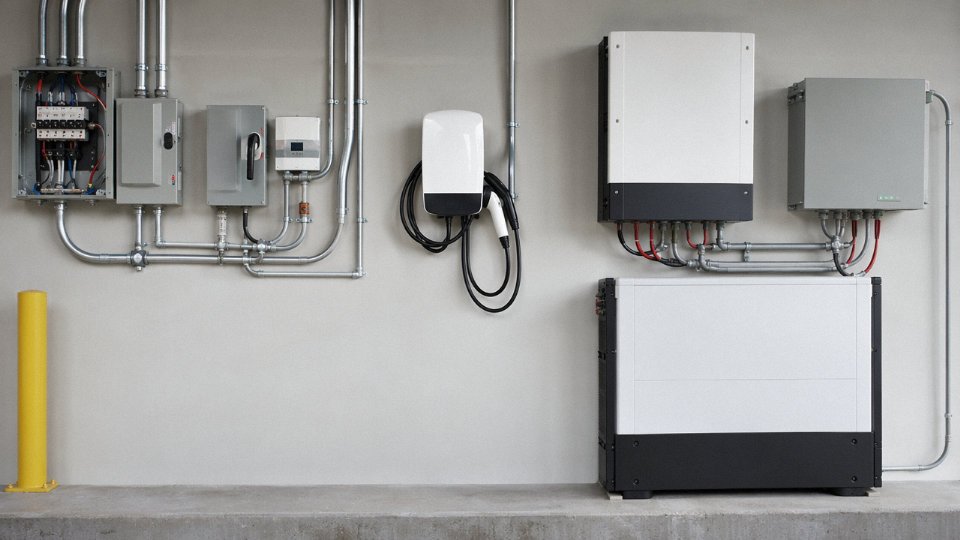
Global residential solar capacity additions reached roughly 150 GW in 2023, a figure that translates directly into demand for PV wire, USE-2 cable, and large-gauge residential feeders at a scale the market hasn’t seen before.
Smart-Home Infrastructure: Low-Voltage That Deserves Real Attention
The low-voltage backbone often gets treated as an afterthought until the homeowner can’t figure out why their PoE security cameras drop packets whenever the HVAC kicks on. A properly specified smart-home rough-in includes 18/2 or 18/4 thermostat wire for HVAC zoning and humidistats, Cat 6A (not Cat 6 — the shielding headroom matters for PoE++) to every camera location and ceiling-mount access point, and dedicated home-run runs back to a central structured media enclosure rather than daisy-chained drops.
Z-Wave and Zigbee mesh devices are largely wireless, but they depend on reliable low-voltage power infrastructure to the hubs and repeaters anchoring the mesh. Skimping on cable quality in those runs produces intermittent faults that are genuinely miserable to diagnose after drywall is up.
Where Jinda’s Product Lines Fit This Shift
Jinda’s manufacturing investment in PV wire and USE-2 rated cable production lines is a direct response to the residential solar and storage market expanding well outside the U.S. — housing developments across Southeast Asia, the Middle East, and parts of Europe are integrating rooftop solar as a standard feature, not an upgrade. Large-gauge residential feeder cable in the 4–2 AWG range for BESS and EVSE applications represents a meaningful volume opportunity for international projects where local supply is constrained. For procurement managers running multi-country residential programs, having a single supplier who can certify to IEC, NEC-adjacent, and regional standards against a consistent quality system is worth more than a slightly lower unit price from a fragmented supplier base.
How to Evaluate and Source Residential Cable from a Global Manufacturer: Quality, Lead Time, and MOQ Guidance
Procurement decisions for residential cable look deceptively simple until you’re three weeks from a project start date and your local distributor is back-ordered. Sourcing directly from a manufacturer like Jinda changes the math — but only if you go in with realistic expectations about quantities, lead times, and what documentation actually clears customs without a phone call from your broker.
Minimum Order Quantities and Volume Pricing Thresholds
For standard stock items — NM-B equivalents, NYM-J, and common twin-and-earth configurations — MOQs typically run 1,000 to 5,000 m per SKU. That threshold exists because drum winding, labeling, and outbound QC each carry a fixed labor cost that makes smaller runs uneconomical for both sides. If you’re a small contractor sampling a new supplier, that’s a manageable entry point.
Project-volume pricing generally kicks in around 10,000 m per SKU. At that level you’re usually looking at a 6–12% reduction off the per-meter price, though the exact figure depends on conductor gauge, jacket material, and whether the order is for a single product or a mixed pallet. Full container load (FCL) pricing — above roughly 50,000 m in aggregate — unlocks the best unit economics and often includes priority production scheduling. For a mid-size residential development of 80–120 homes, a single FCL order covering all branch-circuit cable is entirely realistic and worth calculating early in the project timeline.
Lead Times: What Controls Them
Standard NM-B equivalents and NYM configurations from Jinda’s Shandong production base run 15–25 days ex-works for stock configurations. That window assumes standard black, grey, or white jacket in the common AWG or mm² sizes. Custom jacket colors, non-standard print legends (say, a private-label imprint or a destination-country language requirement), or non-standard conductor counts push lead time to 30–45 days. Seasonal effects are real — Chinese New Year and Golden Week each typically add 1–2 weeks of effective delay if your order falls in the adjacent production window.
Quality Verification: What to Actually Check
A factory audit for residential cable isn’t complicated, but skipping any one item creates downstream liability. The short list: conductor resistance per IEC 60228 (checks actual copper cross-section, not just nominal AWG), voltage withstand per IEC 60227 (confirms insulation integrity under load), jacket thickness measurement at minimum three cross-sections per drum, and OD tolerance check against the declared specification. Jinda operates an in-house testing laboratory capable of running all four of these in-house, with third-party witness testing available through SGS or Bureau Veritas for orders requiring independent certification.
Jinda's in-house laboratory performs conductor resistance and voltage withstand testing on residential cable per IEC 60228 and IEC 60227 respectively.True
IEC 60228 governs conductor resistance measurement for insulated cables; IEC 60227 covers voltage withstand and insulation requirements for PVC-insulated cables. These are standard international test protocols applicable to residential wiring cable, and in-house labs at serious manufacturers routinely perform both.
Import Documentation Package
Get this right before the shipment leaves, not after it arrives. The standard package for residential cable import should include: Certificate of Origin (proving manufacturing country for tariff classification), Test Reports referencing the applicable IEC standards, Material Safety Data Sheet for the jacket and insulation compounds, and a packing list with per-drum gross and net weights. Customs authorities in most markets require the Certificate of Origin for preferential tariff treatment; the MSDS is mandatory in the EU, Australia, and increasingly in Southeast Asian markets.
Logistics: Drums, Fumigation, and Container Planning
Wooden cable drums must comply with ISPM 15 — the international phytosanitary standard for wood packaging material. Non-compliant drums get held at port, sometimes fumigated at the importer’s cost, occasionally destroyed. Jinda’s export drums are ISPM 15 heat-treated and marked accordingly. For LCL shipments (partial container), the break-even with FCL usually falls somewhere between 12 and 18 CBM depending on the trade lane, but cable drums stack inefficiently; in practice most orders above 30,000 m aggregate are worth consolidating into an FCL.
Initiating a Project Inquiry
The most efficient path is a technical specification form covering conductor cross-section, insulation and jacket material, voltage rating, applicable standard, print legend requirement, and destination country. Jinda’s typical quotation workflow runs three steps: RFQ submission and technical review (usually 1–2 business days), proforma invoice issued with confirmed lead time and packaging details, and sample dispatch for approval before production commitment. Samples for standard configurations ship within 5–7 days. If you need a UL or other third-party listed product, flag that at the RFQ stage — it affects both pricing and lead time substantially and is not something to discover after the proforma is signed.
Frequently Asked Questions About Residential Construction Cable Types
Can I use NM-B cable in a garage or outdoor shed?
It depends on which structure and how the cable is installed. NM-B is permitted in an attached garage under NEC 334.12, provided it’s protected from physical damage — meaning anything below roughly 7 feet needs to be in conduit or otherwise shielded from impact. Leave it exposed at knee height next to a workbench and you’re asking for a staple through the jacket and an inspector rejection.
Detached structures are a different matter entirely. The feed from the main house to a detached garage or shed crosses outdoor, often underground, territory — that run requires either UF-B cable rated for direct burial (minimum 24 inches deep under most conditions) or individual THWN conductors pulled through Schedule 40 PVC conduit. NM-B will absorb moisture and degrade; it is not listed for wet or underground locations, full stop.
What is the difference between 14/2 and 14/3 NM-B?
14/2 contains two insulated conductors — one black (hot) and one white (neutral) — plus a bare copper equipment ground. That’s your standard 15 A lighting or receptacle circuit. 14/3 adds a red insulated conductor, giving you two hots and a neutral on one ground. The red conductor is what makes three-way switch loops work without running separate cables between switches, and it’s also the correct choice for multi-wire branch circuits where two hots share a single neutral. Using 14/2 where 14/3 is required is a surprisingly common rough-in mistake that only shows up at the switch box — at which point you’re pulling cable again.
Is aluminum wiring in older homes actually dangerous?
Solid aluminum branch-circuit wiring from the 1960s and early 1970s carries a genuinely elevated fire risk, primarily at device terminations. Aluminum oxidizes and expands and contracts at a different rate than copper, which loosens connections over time and creates arcing. The Consumer Product Safety Commission data on this is not ambiguous.
Remediation options range in cost and disruption. CO/ALR-rated devices (outlets, switches) are listed for direct aluminum termination and are the lowest-cost fix per device. AlumiConn push-in connectors allow pigtailing with short copper tails — so standard devices can be used — without needing to open every wall cavity. Full rewiring is the most thorough solution and is often the right call during a gut renovation anyway. Do not simply replace old devices with standard CO-rated (copper-only) devices and consider the problem solved; that’s how fires start.
Solid aluminum branch-circuit wiring from the 1960s–70s poses elevated termination fire risk, documented by CPSC investigations.True
CPSC studies identified increased fire incidence in homes with solid aluminum branch-circuit wiring installed during this period due to oxidation and differential thermal expansion at device terminations.
What cable do I need for a 240 V dryer circuit?
A residential electric dryer on a 30 A circuit needs 10 AWG conductors. Specifically, 10/3 NM-B gives you the two hots, neutral, and ground required for a four-wire NEMA 14-30 receptacle — which is what current NEC requires for new dryer installations. The old three-wire arrangement (10/3 without a separate ground, NEMA 10-30) is grandfathered in existing installations but not permitted for new work. Run this from a dedicated double-pole 30 A breaker; don’t share it.
How do I verify a cable is genuinely UL listed?
Three checks, in order. First, the UL mark should be printed on the cable jacket at regular intervals — typically every 24 inches. Second, take the UL file number printed on that same jacket and look it up on UL’s Product iQ database (iq.ul.com), which shows active versus lapsed certifications. Third, ask the supplier for the actual UL certificate with a current validity date. A photocopy of a certificate from three years ago tells you almost nothing about what’s on the reel in front of you.
Counterfeit or mislabeled cable exists in the market. This is especially relevant for import procurement, where a plausible-looking jacket print can mask conductors that are undersized or made from recycled aluminum dressed as copper-clad. The verification process above adds maybe 20 minutes per order and can prevent a failed inspection or worse.
Can Jinda supply cables certified to both IEC and UL standards for a mixed-market housing project?
Yes. Projects that span multiple destination markets — say, a developer building residential units in both the U.S. and a Gulf Cooperation Council country — often require cables that satisfy UL 719 (NM-B) on one end and IEC 60502 or a regional derivative on the other. Jinda holds multiple international certifications and can produce dual-standard products with co-printed jacket legends, which simplifies documentation for mixed shipments. The practical path is to send the technical sales team your project specification sheets and destination markets upfront; they can run a dual-certification feasibility review and flag any geometry or material conflicts before production is locked.
How far can a residential branch circuit run before voltage drop is a problem?
At 120 V with a 15 A load on 14 AWG copper, you hit the NEC-recommended 3% voltage drop threshold at roughly 50 feet one-way. That’s not a hard code violation — NEC 210.19(A) informational note calls 3% a recommendation — but lights will flicker noticeably and motor loads (refrigerators, HVAC fans) will run hotter than they should. Size up to 12 AWG and you can extend to around 80 feet before the same threshold. For runs approaching 100–125 feet, 10 AWG is the practical answer. The exact numbers shift with actual load current, so for circuits running at partial load most of the time, you have a bit more margin. For dedicated circuits running at or near rated load — EV chargers, electric dryers, electric water heaters — calculate at full rated current, not average.