Mislabeling wire as cable — or ordering one when your application demands the other — quietly causes real problems: insulation failures from mechanical stress, failed inspections because the conductor class doesn’t meet IEC 60228 requirements, and procurement disputes when a shipment arrives technically correct to spec but operationally wrong for the installation. Electricians on a tight commissioning schedule don’t have time to send product back. The cost shows up in delays, rework labor, and sometimes in equipment damage that traces back to a single wrong line on a purchase order.
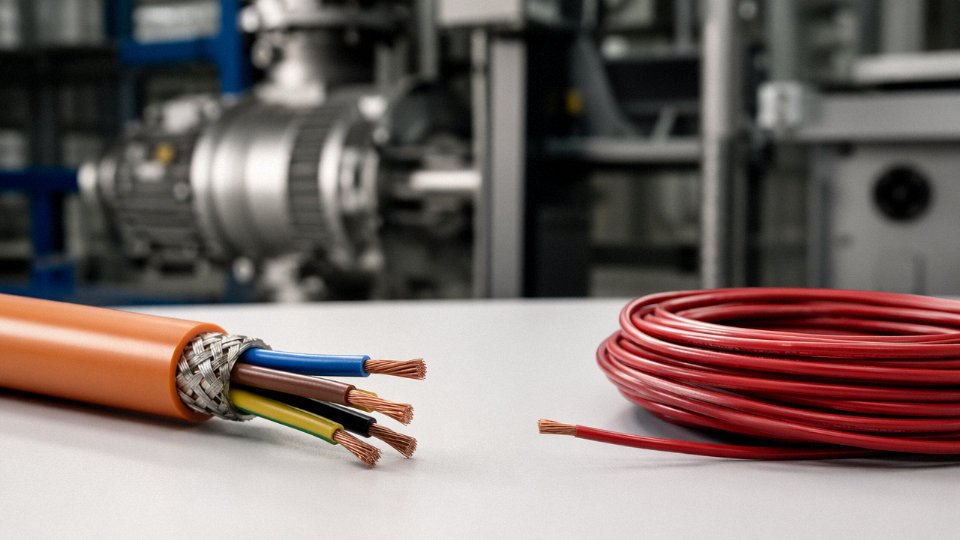
A wire is a single conductor — solid or stranded — used alone or as a component inside a larger assembly. A cable is a finished, jacketed product containing one or more insulated conductors (sometimes 37 or more) bundled together, rated and tested as a complete system, typically from 300/500 V up to 500 kV depending on application. The two terms are related but are not interchangeable in any serious technical or procurement context.
What makes the distinction genuinely interesting — and more complicated than most datasheets suggest — is that the same physical conductor can be classified as either, depending on where it sits in the assembly hierarchy and which standard you’re reading. IEC treats this differently than NEC. A flexible Class 6 conductor loose on a reel is a wire; that same conductor pulled into a multi-core screened jacket becomes part of a cable. The boundary shifts depending on context, and getting that context right is what separates a clean installation from a troubleshooting headache six months after commissioning.
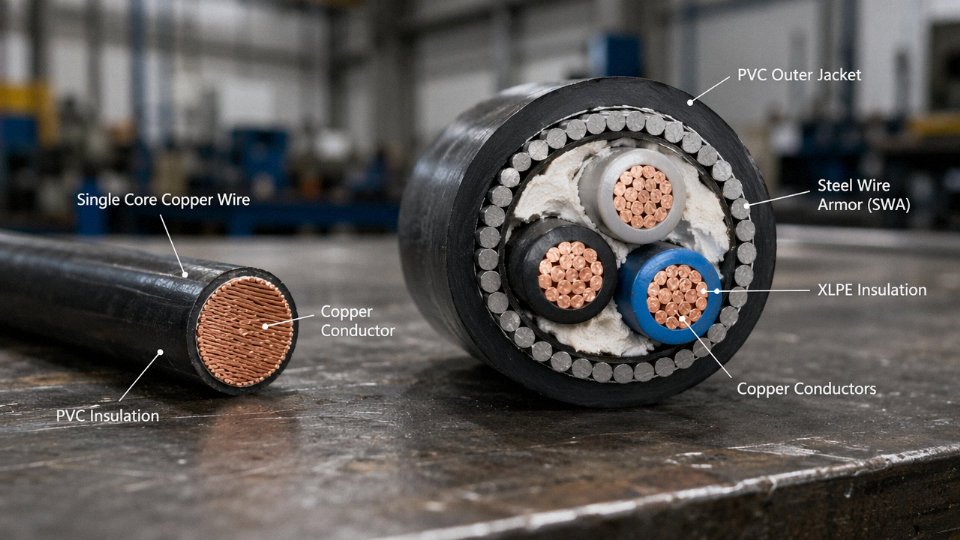
Structural Anatomy: How a Wire and a Cable Are Built Differently
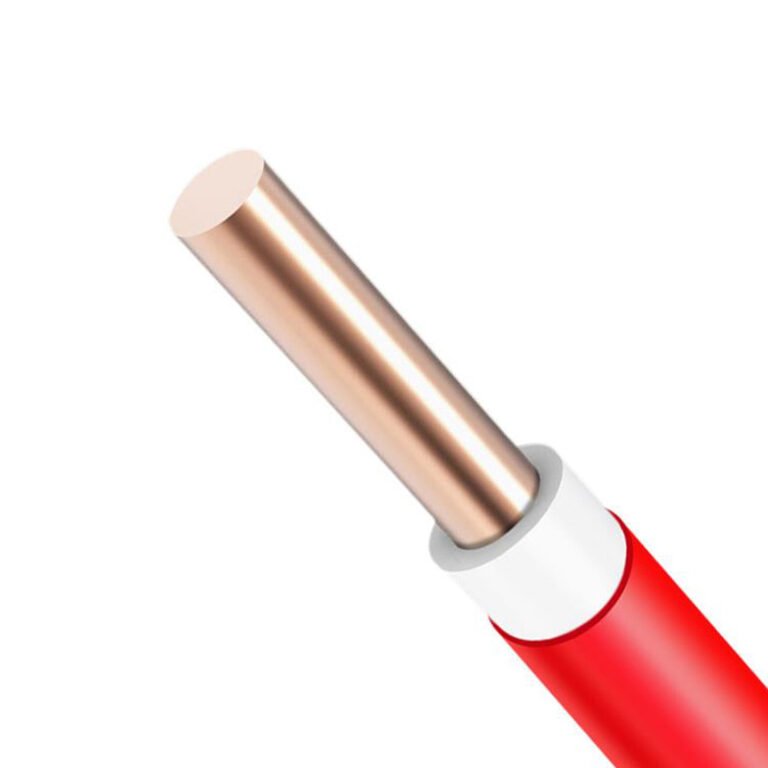
A wire, at its core, is a single electrical conductor. That conductor is either solid — one continuous rod or drawn strand of copper, aluminum, or a copper-clad aluminum alloy — or it’s stranded, meaning multiple thin wires twisted together to form a single conductive element. Stranding is primarily about mechanical flexibility; a 16 mm² solid copper conductor will crack at a conduit bend that a 16 mm² stranded conductor handles without complaint. The conductor may sit bare (busbars, earthing straps, overhead lines) or carry a basic insulation layer — PVC, XLPE, or rubber — extruded directly over it. That’s still a wire. One conductor. The insulation doesn’t change that.
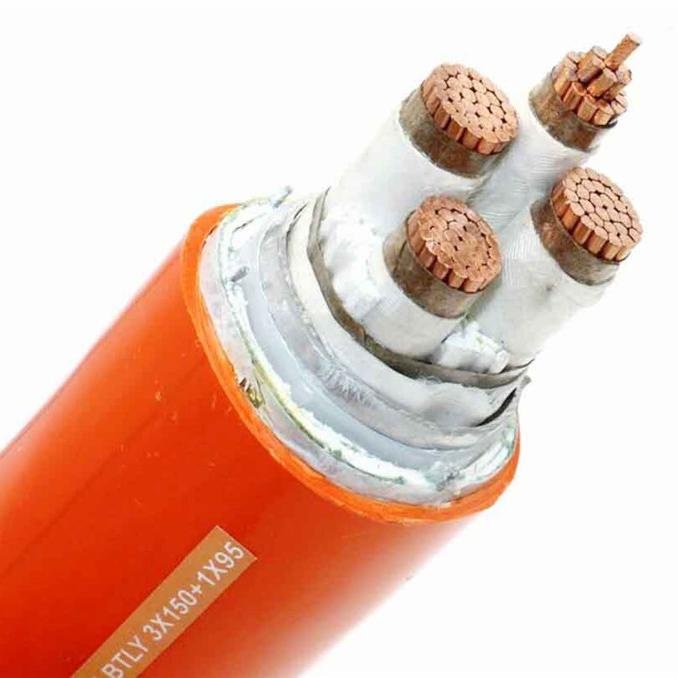
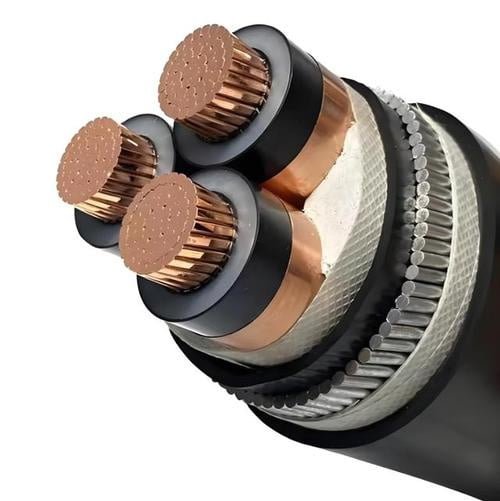
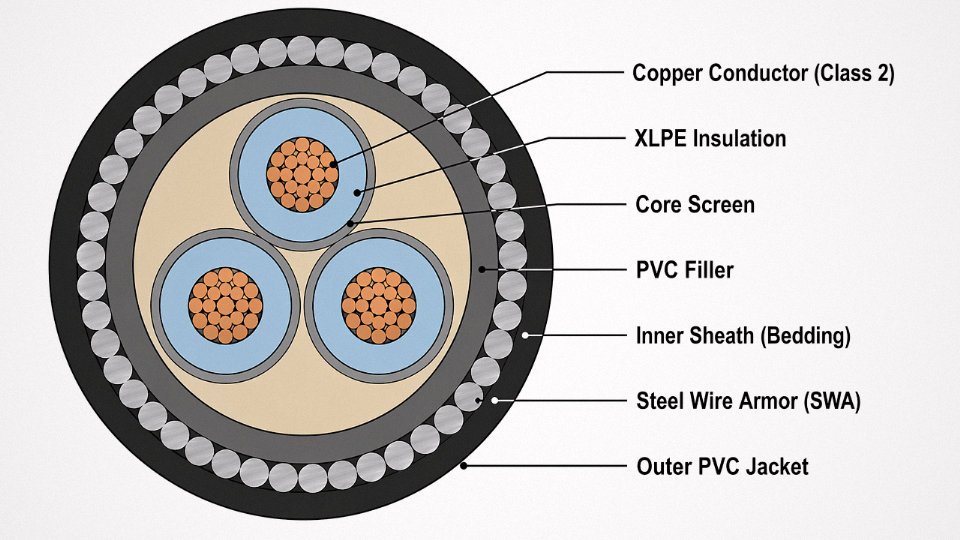
A cable is a fundamentally different construction. It’s an assembly — multiple insulated conductors grouped together, or a single conductor surrounded by enough additional functional layers (screening, armor, thick outer sheath) that the result behaves as a complete, self-contained system rather than a bare component. Strip back a standard three-core armored power cable and you’ll find: the copper conductors at the center, each wrapped in its own XLPE or PVC insulation layer, then a core screen for medium-voltage designs, then extruded or wrapped fillers that bring the assembly to a roughly circular cross-section, then an inner sheath binding everything together, then steel wire armor (SWA) or steel tape armor (STA) for mechanical protection, and finally an outer PVC or polyethylene jacket. Seven or eight distinct layers, each with a specific engineering job.
IEC 60228 Conductor Classes and What They Actually Tell You
The conductor itself — whether inside a cable or standing alone as a wire — is classified under IEC 60228, and these classes matter during procurement and installation planning:
- Class 1: Solid conductor. Lowest cost, highest rigidity. Used in fixed installations where there’s no bending after laying.
- Class 2: Stranded conductor, minimum flexibility. Still for fixed wiring, but tolerates the handling and pulling stresses of installation better than Class 1.
- Class 5: Flexible stranded. This is what you see in portable power tools and machine trailing cables — the individual strands are noticeably finer.
- Class 6: Extra-flexible. Welding cables, robotic drag chains, applications where the cable moves continuously through its service life.
IEC 60228 conductor classes apply equally to standalone wires and to the conductors within multi-core cablesTrue
IEC 60228 defines conductor construction (solid vs. stranded and the degree of stranding) regardless of whether that conductor is used alone or assembled into a multi-core cable. A cable's datasheet will specify the class of the conductors inside it.
These classes apply whether you’re buying single-core wire off a drum or specifying the conductors inside a 37-core instrumentation cable. The class governs strand count and individual strand diameter — two things that directly affect the minimum bend radius and the cable’s behavior in vibrating or flexing installations.
The Edge Case That Trips Up Specifications
Here’s where a lot of procurement specs go wrong: single-core cables. If you have one conductor, one insulation layer, and nothing else, that’s a wire. But wrap that same conductor in a metallic screen, add an extruded bedding, armor it, and sheath it — now you have a single-core cable, even though the conductor count hasn’t changed. Classification follows structural complexity, not conductor count alone. A 240 mm² single-core SWA cable for a medium-voltage feeder circuit is unambiguously a cable. Ordering it as “wire” in the purchase order creates problems at customs, at the cable tray fill calculation stage, and sometimes at the third-party inspection.
The table below captures the practical differences across common conductor assembly types:
| Assembly Type | Key Layers | Conductor Class (Typical) | Voltage Range | Typical Application |
|---|---|---|---|---|
| Single-core unarmored wire | Conductor + insulation only | Class 1 or 2 | 300/500 V | Panel wiring, fixed conduit runs |
| Three-core armored power cable | Conductor, insulation, filler, inner sheath, SWA, outer jacket | Class 2 | 600/1000 V to 33 kV+ | Industrial power distribution, underground feeder |
| Coaxial cable | Center conductor, dielectric, metallic screen, outer jacket | Class 1 or 5 | Signal-level to ~few kV | RF, CCTV, antenna feeds |
| Fiber-optic cable | Optical fibers, buffer, strength members, outer jacket | N/A (no electrical conductor) | N/A | Data transmission, telecoms |
The coaxial and fiber-optic entries are worth noting precisely because they stretch the intuitive definition. A fiber-optic cable carries no electrical current at all, yet it’s universally called a cable — the layered structural assembly is what earns it that designation.
Functional and Electrical Differences That Affect System Design
A wire stripped from its conduit and laid across a wet concrete floor is a liability. That’s not hyperbole — it’s the starting point for understanding why the wire-versus-cable distinction matters once you move beyond the drawing and into the installation.
Protection: What the Jacket and Armor Actually Do
A bare or simply insulated wire carries no inherent defense against moisture ingress, mechanical impact, or chemical attack. Its protection comes entirely from the raceway system around it — the conduit, cable tray, or enclosed duct. Remove that conduit, and the wire has no business being in a wet location, a buried trench, or anywhere near cutting fluid or industrial solvents.
A cable is engineered to stand alone. The outer jacket — PVC, LSZH, polyurethane, depending on the application — resists abrasion and most common industrial chemicals. Add steel wire armor (SWA) or aluminum wire armor (AWA) per IEC 60502, and you have a defined crush and impact resistance that conduit would otherwise have to provide. That’s why direct-burial and aerial installations spec cable, not wire. In practice, trying to substitute an unarmored wire in a direct-burial trench because the cable lead time is long is the kind of shortcut that turns into a ground fault six months into commissioning, usually at the worst possible time.
Ampacity and the Mutual Heating Problem
A standalone wire running in free air dissipates heat easily. Pack three, five, or twelve conductors inside a common jacket and you have a different thermal situation. The conductors heat each other. IEC 60364-5-52 and NEC Table 310 both address this with derating factors — typically 0.7 to 0.5 for grouped multi-core cables, though the exact multiplier depends on the number of loaded conductors, installation method, and ambient temperature. Ignoring derating when sizing a multi-core cable for a motor control circuit isn’t just a code violation; it’s how insulation ages prematurely and trips thermal protection at inconvenient loads.
Multi-core cables require ampacity derating due to mutual heating between conductors under IEC 60364-5-52.True
IEC 60364-5-52 Table B.52.17 and related tables define correction factors for cables with multiple loaded conductors grouped together, accounting for the thermal interaction that reduces each conductor's current-carrying capacity compared to a single isolated conductor.
EMI Shielding: Why Wire Alone Isn’t Enough
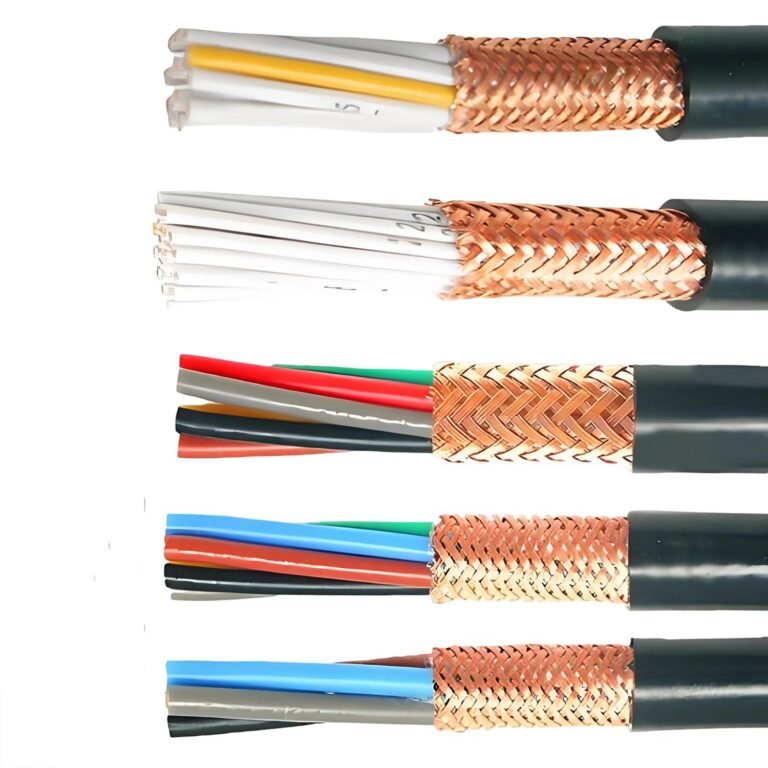
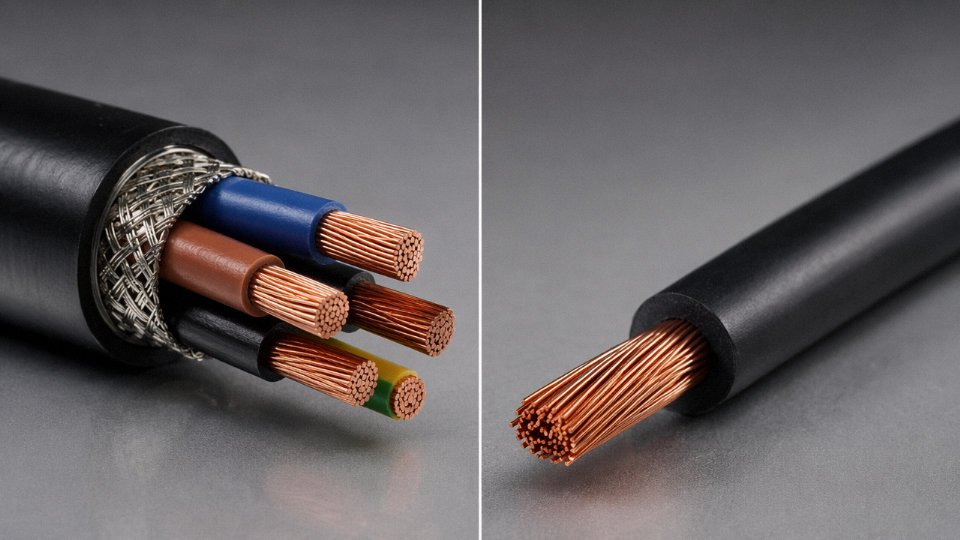
For instrumentation loops, 4–20 mA signals, thermocouple circuits, or any data transmission line running near variable-frequency drives or high-current bus bars, shielding is not optional. A screened cable — foil screen, braided copper screen, or both — contains the electric field and blocks external interference that a simple insulated wire cannot reject. The shield is only effective when grounded correctly, usually at one end for analog signals to avoid ground loops, but the point is that no amount of careful wire routing substitutes for a proper screen. That’s a physics argument, not a preference.
Voltage Designation and the U₀/U Convention
IEC cables carry a voltage designation expressed as U₀/U — for example, 0.6/1 kV. U₀ is the rated voltage between any conductor and earth; U is the rated voltage between conductors. Individual wires inside a cable assembly are typically rated to a working voltage lower than the system voltage the cable as a whole is certified for. The cable’s construction — insulation thickness, screen, jacket — bridges that gap. Specifying only a conductor working voltage when procurement needs a system cable rating is a mismatch that shows up in factory acceptance testing, not before.
Signal Integrity at High Frequency
Coaxial cable and twisted-pair cable maintain controlled characteristic impedance over distance — 50 Ω, 75 Ω, 100 Ω, depending on design. A simple wire has no such property. At frequencies above a few megahertz, impedance mismatch causes reflections, signal degradation, and data errors. For anything from Profibus to high-speed Ethernet to RF instrumentation, the cable geometry is part of the circuit. Substituting generic wire isn’t a cost saving; it’s a system design error.
International Standards That Define Wire and Cable — and Why They Differ by Region
If you’ve ever received a shipment that met the technical spec but failed the site inspector’s approval, there’s a reasonable chance a standards mismatch was the root cause. “Cable” in one framework is not always “cable” in another, and the test parameters that matter in Frankfurt look different from those that matter in Houston or Nairobi.
IEC: The Closest Thing to a Global Baseline
The IEC suite is what most international procurement documents default to, and for good reason — it’s adopted or adapted in over 60 countries. For low-voltage work, IEC 60227 covers PVC-insulated cables rated up to 450/750 V and specifies everything from insulation thickness tolerances to aging tests. IEC 60502 handles power cables from 1 kV up to 30 kV, where screen construction, jacket compound, and impulse withstand voltage become the critical parameters. Conductor construction across both standards is governed by IEC 60228, which establishes the four classes most engineers encounter: Class 1 (solid), Class 2 (stranded), Class 5 (flexible), and Class 6 (extra-flexible). Those classes are not just descriptive — they dictate minimum wire count, maximum resistance per kilometer, and whether a conductor is even eligible for use in a flexing application.
In practice, specifying “IEC 60502-1, 3.5-core, 95 mm², Class 2” eliminates most ambiguity at the procurement stage. Leaving out the class is where projects get into trouble.
NEC and UL: A Parallel Universe with Overlapping Names
North American projects operate under a fundamentally different logic. The NEC (NFPA 70) doesn’t define “wire” and “cable” the way IEC does — it assigns those terms specific code meanings tied to wiring method and installation context. A “cable” under NEC Article 300 implies a factory assembly approved for a specific wiring method (think NM-B, MC cable, or TC cable), not simply any multi-conductor product. “Wire” in NEC parlance often refers to individual conductors pulled through conduit.
UL 83 covers thermoplastic-insulated wires (the THHN/THWN family most North American electricians know by heart), while UL 44 governs thermoset-insulated constructions like XHHW-2. These UL standards set fire, crush, and temperature-rating tests that don’t have direct IEC equivalents. A cable that passes IEC 60332-1 flame testing is not automatically equivalent to a UL 1581 VW-1 or FT4 rating — the test geometries and pass criteria differ enough that you cannot assume equivalence without lab confirmation.
British Standards and the Commonwealth Legacy
BS 6004 (PVC-insulated cables, low voltage), BS 5467 (XLPE and rubber cables), and BS 7671 — the IET Wiring Regulations — remain the governing documents for UK projects and are still specified in parts of East Africa, South Asia, and the Gulf where British engineering influence persists. BS 7671 aligns reasonably well with IEC 60364, but its cable current-carrying capacity tables (Appendix 4) use specific ambient temperature and grouping correction factors that differ from IEC 60364-5-52 in ways that matter when you’re derate-stacking cables in a crowded cable tray.
GB/T: Close to IEC, but Not Identical
Chinese national standards GB/T 5023 (low-voltage, broadly paralleling IEC 60227) and GB/T 12706 (medium-voltage power cables, broadly paralleling IEC 60502) were developed with IEC as the reference, and the technical alignment is close — usually close enough that a cable manufactured to GB/T can be re-tested and certified to IEC with manageable delta. Jinda products are manufactured under GB/T as the production baseline and can be supplied with IEC, CE, or UL certifications on request, depending on the destination market and the specific product family.
The key differences to watch: GB/T ampacity tables assume Chinese ambient and installation conditions that may not match your project site, and some GB/T conductor resistance limits are slightly more permissive at the edges than IEC 60228 allows for Class 2.
A cable certified to GB/T 12706 automatically meets IEC 60502 requirements without re-testing.False
GB/T 12706 and IEC 60502 are technically aligned but not identical. Product codes, test sequences, and some tolerance limits differ. Cross-certification requires specific re-testing or witnessed testing to the target standard — it is not granted by default.
Quick-Reference Standards Table
| Standard | Governing Body | Primary Region | Typical Product Covered | Key Test Parameters |
|---|---|---|---|---|
| IEC 60227 | IEC | Global | PVC cables ≤ 450/750 V | Insulation resistance, aging, flame |
| IEC 60502 | IEC | Global | Power cables 1–30 kV | Impulse withstand, partial discharge, bending |
| IEC 60228 | IEC | Global | Conductor construction (all types) | Resistance per km, wire count, flexibility |
| UL 83 | UL / NFPA | North America | Thermoplastic building wire | Flame (VW-1/FT4), temperature rating |
| UL 44 | UL / NFPA | North America | Thermoset-insulated wire | Crush, heat aging, flame |
| BS 6004 | BSI | UK / Commonwealth | PVC cables, low voltage | Voltage test, insulation thickness |
| BS 5467 | BSI | UK / Commonwealth | XLPE/rubber power cables | Water immersion, thermal stability |
| BS 7671 | IET | UK / Commonwealth | Wiring installation rules | Derating, grouping, disconnection times |
| GB/T 5023 | SAC | China / export | PVC cables ≤ 450/750 V | Aligned with IEC 60227; some local tolerances |
| GB/T 12706 | SAC | China / export | MV power cables 1–35 kV | Aligned with IEC 60502; re-test required for IEC cert |
The Real Risk: Mixing Standards on One Project
This happens more often than it should, especially on international EPC projects where the client specifies IEC, the local authority enforces NEC, and the contractor sources product certified to GB/T. A cable that satisfies GB/T ampacity at 40 °C ambient may need additional derating under NEC Table 310.15(B)(2) for conduit fill — the methodology differs enough that you can end up undersized without realizing it until a thermal event or a failed inspection.
The fix is straightforward: nominate a single governing standard in every procurement document, state the ambient temperature assumption, and require the supplier to certify against that specific standard — not “equivalent to” it. On projects where dual certification is genuinely required (say, IEC plus UL for a US-owned plant built in Southeast Asia), verify which tests were actually conducted rather than accepting a declaration of equivalence.
Common Cable and Wire Types in Industrial and Infrastructure Projects — Mapped to Real Use Cases
Understanding the distinction between wire and cable becomes genuinely useful only when you can map it to a product sitting on a reel in a warehouse or listed on a bill of materials. Here’s how the main types break down in practice.
Wire Types You’ll Actually Encounter
Building wire — in North America, THHN and THWN dominate panel feeds, conduit runs, and branch circuits in commercial and light industrial settings. Single conductor, PVC or nylon jacket, rated for 600 V. The IEC near-equivalent is H07V-U (solid) or H07V-R (stranded), which you’ll find pulled through trunking in European and IEC-governed plants. These are wires: single conductors, typically installed inside conduit or trunking that provides the mechanical protection. Pull them without conduit in a wet area and you have a code violation waiting to happen.
Magnet wire (enameled copper or aluminum) is the conductor wound inside motors, transformers, and solenoid coils. The “insulation” is a lacquer coating — polyester, polyurethane, or polyimide depending on temperature class — measured in microns, not millimeters. Failure here usually means a winding short, which is why coil manufacturers are obsessive about the enamel build class.
Bare grounding wire is exactly what it sounds like: no insulation, solid or stranded, used for earth continuity in grounding grids, bonding straps, and lightning protection systems. Sizing follows fault-current calculations, not load current.
Thermocouple extension wire is a specific product that trips up procurement teams regularly. It must be made from the same alloy pair as the thermocouple it serves — Type K extension wire is chromel/alumel, not copper — or you introduce an accidental junction and corrupt your temperature reading. The tolerance on these wires is tighter than most people realize, and substituting a generic copper pair is a common mistake in instrumentation retrofits.
Power Cable Types by Voltage Class
Low-voltage power cables (rated 0.6/1 kV, per IEC 60502-1) cover the vast majority of industrial motor feeders, distribution boards, and lighting circuits. Multi-core, PVC or XLPE insulated, with or without steel wire armor (SWA) or aluminum wire armor (AWA) depending on burial or mechanical exposure requirements.
Medium-voltage cables (roughly 6–35 kV) feed primary substations, wind turbine generators, and large industrial facilities. XLPE insulation is now standard over paper-oil for most new installations — better handling, no oil containment concerns. Screens are mandatory: copper tape or wire screen over each core to manage the electric field gradient. Armor options include SWA, STA (steel tape), and for submarine or coastal runs, lead sheath.
High-voltage cables (66 kV up to 500 kV) are transmission-class products. These are engineered to project specifications, not off-the-shelf catalogue items. Single-core XLPE, with metallic screen, swelling tape moisture barriers, and often PE outer sheath. Installation is a project in itself — jointing is specialist work.
Flexible trailing cables are worth calling out separately. Mining, port cranes, tunnel boring — anywhere the cable moves with the machine. The conductor is IEC Class 5 or 6 stranded, the jacket is tough rubber or thermoplastic elastomer, and the whole assembly is designed for repeated flexing cycles, not just occasional movement. Using a standard fixed-installation cable here is a predictable failure: the conductors fatigue and the insulation cracks within months.
Submersible pump cables see continuous water immersion, often combined with mechanical stress from the weight of the cable drop. Flat or round, EPDM or EPR insulated, with a sheath specifically rated for immersion. Water-blocking compounds in the conductor interstices are common in deeper installations.
Control and Instrumentation Cables
These cables carry low-level signals in process plants, substations, and offshore platforms where interference is a real problem. Multi-pair screened cables come in individual-screened (IS), overall-screened (OS), or IS/OS combined configurations — the choice depends on how many independent signal circuits you need to isolate from each other. A 4–20 mA loop running alongside a variable frequency drive output needs individual pair screening; an overall screen alone won’t do the job.
Armored variants (SWA or braided armor) are used where the cable routes through cable trays shared with power cables, or in areas with rodent risk. On offshore platforms, you’ll generally see armored, overall-screened, LSOH-sheathed instrumentation cables almost everywhere outside the living quarters.
Data and Communication Cables
Cat 5e, Cat 6, and Cat 6A are always cables — twisted pairs, overall jacket, often with an internal separator or foil/braid shield in the STP/FTP versions. The difference between Cat 6 and Cat 6A matters at 10 GbE over distances beyond roughly 50 m; below that, Cat 6 usually suffices. Specifying Cat 6A everywhere “just in case” sounds prudent but adds real cost in a large building fit-out.
Coaxial cables (RG-6, RG-11) still appear in CCTV, CATV distribution, and some RF applications. They are structurally a cable — center conductor, dielectric, shield, jacket — and behave like one electrically, with characteristic impedance that has to be matched to the termination.
Fiber-optic cables, both single-mode (OS1/OS2) and multimode (OM3/OM4/OM5), are cables in every structural sense. There is no “fiber wire” — the glass strand alone is fragile and functionally useless without the buffer, strength members, and jacket the cable construction provides. Single-mode is the default for anything over roughly 300–500 m or any inter-building backbone; multimode costs less to terminate but the reach limits catch people out when they try to extend a run later.
Hybrid power-data cables — one jacket containing both copper power conductors and fiber or data pairs — are increasingly common in CCTV poles, traffic systems, and industrial cameras where running two separate cables is impractical.
Fiber-optic strands are sometimes called 'fiber wire' in informal usageFalse
A bare optical fiber strand is not a functional installation product and has no jacket, strength members, or mechanical protection. The correct term is fiber-optic cable. Using 'fiber wire' in a specification or purchase order creates ambiguity and risks receiving an incompatible product.
Specialty Cables for Demanding Environments
Fire-resistant cables per IEC 60331 maintain circuit integrity during a fire — tested at 750–950°C for 90–180 minutes depending on the class. Low-smoke zero-halogen (LSZH or LSOH) cables per IEC 60332 limit flame propagation and toxic gas emission. These are not the same standard and are not interchangeable in a specification; a cable can be LSZH without being fire-resistant, and vice versa. Both matter in tunnels, data centers, hospitals, and offshore modules where evacuation routes and smoke toxicity are life-safety issues.
Oil-resistant and UV-resistant sheathed cables use compound-specific jacket materials — often a CSP or specially compounded PVC — and are necessary in refineries, outdoor solar farms, and any installation with prolonged hydrocarbon or UV exposure. Standard PVC swells and cracks in sustained oil contact; the timeline is faster than most maintenance schedules anticipate.
Mineral-insulated cables (MICC) use compressed magnesium oxide between a copper conductor and copper or stainless tube. Completely inorganic, extremely robust, fire performance that no polymer-insulated cable can match. The trade-off is inflexibility, high installed cost, and the need for specialist termination kits. Common in boiler rooms, furnace monitoring, and fire alarm circuits in critical facilities.
High-flex drag-chain cables (sometimes called chainflex cables generically) are engineered for continuous reciprocating motion in CNC machines, robotic arms, and automated handling systems. The flex life — typically specified in millions of cycles — depends on bend radius, speed, acceleration, and conductor construction. Using a standard flexible cable in a drag chain is a short-term fix that fails on a schedule.
Quick Specification Reference
| Application | Recommended Product Type | Key Standard | Armor Required? | Shielding Required? |
|---|---|---|---|---|
| Branch circuit in conduit | Building wire (THHN / H07V-R) | UL 83 / IEC 60227 | No | No |
| Motor feeder, fixed run | LV power cable 0.6/1 kV | IEC 60502-1 | Depends on route | No |
| Underground MV distribution | MV cable 6–35 kV XLPE | IEC 60502-2 | Usually yes (SWA/STA) | Yes (core screen) |
| Process plant 4–20 mA loop | Multi-pair IS/OS control cable | IEC 60092 / BS 5308 | Depends on area | Yes (individual + overall) |
| Building LAN backbone | Cat 6A U/FTP or fiber OS2 | IEC 11801 / TIA-568 | No | Cat 6A: foil; fiber: N/A |
| Fire alarm / emergency lighting | Fire-resistant LSZH cable | IEC 60331 / IEC 60332-3 | Depends on install | No |
| Mine / port crane trailing | Flexible trailing cable | IEC 60502 / AS/NZS 1802 | No (flex armor) | Optional |
| Submersible pump | Submersible pump cable | IEC 60245 / UL 2250 | No | No |
| CNC / robotic drag chain | High-flex drag-chain cable | Manufacturer flex-life spec | No | Optional |
| Temperature measurement | Thermocouple extension wire | IEC 60584-3 | No | Often yes |
The armor column deserves a comment: “depends on route” is not a cop-out. A cable in a dedicated cable tray above a clean production floor doesn’t need armor; the same cable buried directly in a yard, shared with forklift traffic, or running through a cable duct shared with mechanical services usually does. That’s a site survey question, not a catalogue question.
How to Read a Cable Specification and Avoid Costly Ordering Mistakes
A misread specification doesn’t usually announce itself until materials arrive on site — wrong armor type, wrong insulation, conductors two cross-section steps too small. By then you’re looking at return freight, lead-time delays, and potentially re-running your load calculations. Learning to parse a cable designation string takes about fifteen minutes. The cost of not learning it can run into weeks.
Decoding a Typical IEC Designation String
Take the designation NYY 3×185/95 mm² 0.6/1 kV. Every element carries a specific meaning, and none of it is decoration.
- N — conductor material is copper (in German-origin IEC notation, “N” denotes standard copper; aluminum is typically “NA”)
- YY — both the insulation and the outer sheath are PVC; the first Y is the conductor insulation, the second is the overall jacket
- 3×185 — three power cores, each with a 185 mm² cross-section
- /95 — a reduced neutral conductor at 95 mm², sized for systems where harmonic loading doesn’t demand a full neutral
- 0.6/1 kV — rated for 0.6 kV phase-to-ground, 1 kV phase-to-phase; this is the voltage class, not the maximum instantaneous spike the cable will survive
Miss the “/95” and you may order a symmetric three-core cable where the design calls for an asymmetric four-core — or you’ll specify the wrong gland and end up with a leak path at the termination.
Cross-Section Selection and the Real Cost of Getting It Wrong
Undersizing by a single cross-section step — say, ordering 95 mm² where 120 mm² was specified — reduces ampacity typically by 12–18%, depending on installation method, ambient temperature, and grouping factors under IEC 60364-5-52. In practice, that margin often sits right at the edge of the thermal trip threshold. The circuit doesn’t fail on day one; it trips intermittently on warm summer afternoons when the cable tray is full and ambient temperature in the plant is 38°C instead of the 30°C assumed in the design.
Oversizing carries its own penalty. Stepping up from 35 mm² to 50 mm² across a large installation can increase copper spend by 25–40% on conductor material alone. That’s not a rounding error on a bulk order.
Conductor cross-section selection for cables in industrial installations must account for ambient temperature correction factors and cable grouping derating per IEC 60364-5-52, not just the nominal current rating.True
IEC 60364-5-52 explicitly provides correction factors for ambient temperature and grouped cables; ignoring these derating factors is a leading cause of nuisance tripping and premature insulation aging in industrial wiring.
Nominal vs. Actual Outer Diameter — Why It Matters for Conduit and Gland Selection
The nominal outer diameter on a datasheet is a design reference, not a manufacturing guarantee. Actual OD can run 3–8% above nominal depending on sheath extrusion tolerances and armor lay. For conduit fill calculations under IEC 61386 or NEC Chapter 9, you need the maximum actual OD, not the nominal. A cable tray sized for 40% fill using nominal diameters can easily exceed that threshold with real product. Gland selection is even less forgiving — a gland sized to the nominal OD of an armored cable will sometimes not seal on the actual cable that ships from a different production run.
Insulation Material Codes and Temperature Ratings
| Code | Material | Max Conductor Temp | Typical Application |
|---|---|---|---|
| PVC (Y) | Polyvinyl chloride | 70°C continuous | General building wiring, light industrial |
| XLPE (X) | Cross-linked polyethylene | 90°C continuous | Power distribution, MV cables |
| EPR (G) | Ethylene propylene rubber | 90°C, flexible service | Mining, trailing cables, offshore |
| LSZH (Z) | Low-smoke zero-halogen compound | 70–90°C depending on compound | Tunnels, rail, public buildings |
Ampacity tables are built around conductor temperature limits. A cable with XLPE insulation rated to 90°C will carry roughly 10–15% more current than a geometrically identical PVC cable in the same installation condition — because the thermal budget is larger. Specifying LSZH where PVC was budgeted also adds cost; LSZH compounds typically run 15–30% more expensive on the sheath material alone, depending on compound grade and order volume.
Drum Packaging and Cut-Length Tolerances
Standard drum lengths run 100 m, 500 m, and 1,000 m for most industrial cable types, though MV and HV cables commonly ship on larger drums with lengths negotiated per order. Cut-to-length tolerances are usually stated as ±0.5% to ±1% of the cut length — which on a 500 m drum means a tolerance window of 2.5 to 5 m. On a project ordering 47 cut lengths across multiple cable types, that adds up.
When writing a purchase order, always specify both a minimum acceptable length and a maximum. Without a minimum, a supplier can technically deliver a 480 m drum against a 500 m order and be within tolerance. Without a maximum, you end up with surplus that can’t be used on the next job because it doesn’t match the next run length.
The 10-Parameter Specification Checklist
Every cable purchase order should state all of these explicitly. Verbal agreements and catalog numbers alone leave gaps.
- Voltage rating (Uo/U in kV)
- Conductor material (copper or aluminum)
- Conductor class per IEC 60228 (Class 1 solid, Class 2 stranded, Class 5 flexible, Class 6 extra-flexible)
- Conductor cross-section per core (mm² or AWG)
- Number of cores and neutral configuration
- Insulation material and temperature rating
- Outer sheath / jacket material
- Armor type (SWA, AWA, wire braid, or unarmored)
- Applicable standard (IEC 60502, BS 6346, CENELEC HD, or project-specific)
- Test certification required (factory acceptance test report, third-party type test certificate, or both)
Leave any one of these off a purchase order and you’ve given a supplier latitude to ship something technically compliant but operationally wrong. In export procurement especially, where lead times run 8–14 weeks for certain cable types, there’s rarely time to re-order.
Wire and Cable Selection Criteria for Harsh Environments: Offshore, Mining, Chemical, and High-Temperature Applications
Standard building wire was never designed to survive a subsea drill deck or a chlorine-saturated processing bay. The gap between what a catalog-grade cable can tolerate and what a harsh environment actually delivers is where failures — and sometimes fatalities — happen. Selecting correctly means working through four axes of stress simultaneously, because these environments rarely attack on just one front.
Defining “Harsh” Across Four Stress Axes
Mechanical stress covers impact, crush loads, and flex cycles. A trailing cable on a mining dragline may complete 500,000+ flex cycles over its service life; a static armored cable buried in a trench sees none. Thermal stress ranges from sustained high ambient (>60°C in a glass furnace building) to direct flame exposure. Chemical stress includes hydrocarbon immersion, acid splash, ozone, and UV — each degrading different jacket materials at different rates. Electrical stress is often underestimated: variable frequency drives impose high-frequency switching transients that destroy standard wire insulation from the inside out, independent of voltage rating.
Real selection starts by scoring all four axes for the specific installation, then specifying materials and construction that survive the worst combination.
Offshore and Marine Installations
Offshore platforms demand cables that are halogen-free, mud-resistant, and flame-retardant — IEC 60092 governs shipboard wiring, while NEK 606 (the Norwegian offshore standard) is the baseline for dynamic and static subsea and topside applications. The distinction between dynamic and static service is critical for armor selection: dynamic cables on risers or umbilicals require fine-wire braided or helically-wound armor that can absorb continuous bending without fatigue cracking, whereas static buried cables can use conventional double-steel-wire armor (DSWA). In practice, using a static-service cable in a dynamic hang-off point is a premature failure waiting to happen — usually within two to three years rather than the 20+ year design life.
Mining: Trailing Cables and Reeling Cables
Underground and open-cut mining imposes continuous flexing, water ingress, ground movement, and — in gassy mines — methane explosion risk. Trailing cables for continuous miners and shuttle cars must meet IEC 62931 for reeling and trailing cable construction, and MSHA (Mine Safety and Health Administration) approval is mandatory for US operations. These cables use highly flexible Class 6 stranded conductors per IEC 60228, EPR (ethylene propylene rubber) insulation for ozone and moisture resistance, and a robust CPE (chlorinated polyethylene) outer sheath. A cable without MSHA listing used underground in a US coal mine is a compliance violation regardless of its electrical performance.
IEC 62931 specifies construction requirements for reeling and trailing cables used in mining and similar continuous-flex applications.True
IEC 62931 is the dedicated international standard for reeling and trailing cables, covering conductor flexibility classes, insulation, sheathing, and mechanical performance criteria relevant to mining and industrial reel applications.
Chemical Plants: Jacket Material Matters More Than People Assume
In hydrocarbon-rich or acid-laden environments, jacket selection is the primary defense. PTFE handles the broadest chemical range but is expensive and difficult to terminate. Silicone excels in ozone and UV but has poor abrasion resistance — not ideal where cables route across pipe racks with foot traffic. CSP (chlorosulfonated polyethylene, sold under the Hypalon trade name) strikes a reasonable balance: good oil resistance, acceptable flex life, and moderate cost. For armor in acid environments, galvanized steel wire corrodes within months; stainless steel wire armor (SSWA) is the correct specification, even though it costs roughly 30–50% more depending on wire gauge and market steel pricing.
High-Temperature Applications: Furnaces, Ovens, and Exhaust Systems
Silicone-insulated cables handle continuous service up to around 180°C and are the standard answer for oven wiring and exhaust proximity runs. When ambient temperature exceeds that — inside a glass tank furnace, near an induction heater, or in a fire-survival circuit — mineral-insulated copper-clad (MICC) cable is essentially the only reliable option. MICC is rated for 250°C continuous and retains circuit integrity during fire exposure, which is why it appears in fire alarm, emergency lighting, and critical control circuits in high-risk buildings. Its limitations are real, though: it’s rigid, requires specialist termination, and is easily damaged by moisture ingress at cut ends if terminations aren’t made promptly.
VFD Cables: A Specific Failure Mode That Catches Engineers Off Guard
Running standard THHN in conduit on a variable frequency drive output is one of the more common — and expensive — mistakes in industrial electrical work. VFDs switch at frequencies typically between 2 and 16 kHz, generating high-frequency common-mode voltage transients that cause capacitive coupling to ground, bearing current damage in motors, and insulation breakdown that standard 600 V THHN was simply not rated to handle. The correct construction is a shielded, symmetrical VFD cable: three phase conductors symmetrically arranged around three ground conductors (not one), with a 100% coverage braided or foil-plus-braid shield. This geometry minimizes EMI radiation and provides a defined return path for high-frequency current. Expect cable costs roughly 2–4× standard THHN, but compare that to a motor rewind at $8,000–$25,000 depending on frame size.
Summary: Environment-to-Specification Decision Table
| Environment | Primary Threat | Required Cable Feature | Applicable Standard | Typical Product Type |
|---|---|---|---|---|
| Offshore / Marine | Flame, halogens, mud, dynamic flex | HFFR jacket, fine-wire armor, mud-resistant | IEC 60092, NEK 606 | Dynamic submarine or topside offshore cable |
| Underground Mining | Flex fatigue, water, methane | Class 6 conductors, EPR insulation, CPE sheath | IEC 62931, MSHA | Trailing / reeling cable |
| Chemical Plant | Hydrocarbon, acid, UV | PTFE / CSP / silicone jacket, SSWA armor | IEC 60502, site-specific | Chemical-resistant armored cable |
| High-Temperature (>120°C) | Sustained heat, fire | Silicone insulation (≤180°C) or MICC (≤250°C) | IEC 60702 (MICC) | Silicone cable or MI cable |
| VFD Output Circuit | HF transients, common-mode voltage | Shielded symmetrical construction, 3+3 ground | NEMA WC 74, IEC 60034 | Dedicated VFD cable |
No single cable family covers all five rows. The procurement decision is essentially: identify the dominant threat axis, confirm the applicable regional standard, then verify that material and construction choices address secondary threats without creating new ones. That last step — checking for unintended trade-offs — is where experienced engineers earn their keep.
Procurement and Logistics Considerations When Sourcing Cable From an International Manufacturer
Buying cable internationally sounds straightforward until the container arrives three weeks late, the drums don’t match the certified test reports, or your customs broker is held up because someone classified the product under the wrong HS code. These aren’t edge cases. They happen on real projects, and most of them are preventable if you know what to ask before you issue the purchase order.
Lead Times Are Not the Same Across Product Types
Standard low-voltage power cable — your typical NYY, XLPE/SWA, or PVC-insulated 0.6/1 kV multicore — usually ships ex-works in 15 to 30 days from a stocked or fast-turn manufacturer, assuming conductor sizes are common and the order volume is reasonable. Don’t assume that window holds for medium-voltage or specialty product. Cables rated 6 kV and above, armored designs with custom cross-sections, and anything requiring screened conductors or special jacket compounds can realistically take 45 to 90 days from order confirmation to ex-works dispatch. The range depends on conductor cross-section (large cross-sections require longer extrusion runs), armoring type (wire armor is faster than tape armor for some profiles), and whether the insulation compound — say, LSZH or EPR — is already in stock at the plant.
The fix is simple: confirm production scheduling in writing at PO stage, not after. Ask for a production milestone schedule with a drum-ready date and a quality-hold release date. If your project has a fixed installation window, work backward from that date. Buffer for port congestion; it remains unpredictable at several major Chinese export hubs depending on the season and broader shipping volumes.
Third-Party Testing and Certification
Jinda can provide third-party test reports and support witness testing for large orders from certification bodies including KEMA, BASEC, UL, and SGS.True
This is standard practice for established Chinese cable exporters supplying international infrastructure projects, and aligns with the capabilities stated in Jinda's company profile.
KEMA and BASEC type-approval reports confirm that a cable design has passed independent electrical and mechanical testing — they don’t certify every production batch. UL Listing matters most for North American projects where the NEC or local AHJ requires it. CE marking under the Low Voltage Directive applies to EU-destined product but is self-declared, so it’s worth asking whether the declaration is backed by an independent test report or just an internal one. SGS factory audits verify manufacturing process and quality systems, not the cable’s electrical performance directly. For large orders — say, a project order above roughly 50 tonnes — it’s reasonable to request witness testing during production and a copy of the drum-by-drum test records. Any reputable manufacturer should accommodate that without pushback.
Shipping, HS Codes, and the Drum Problem Nobody Talks About
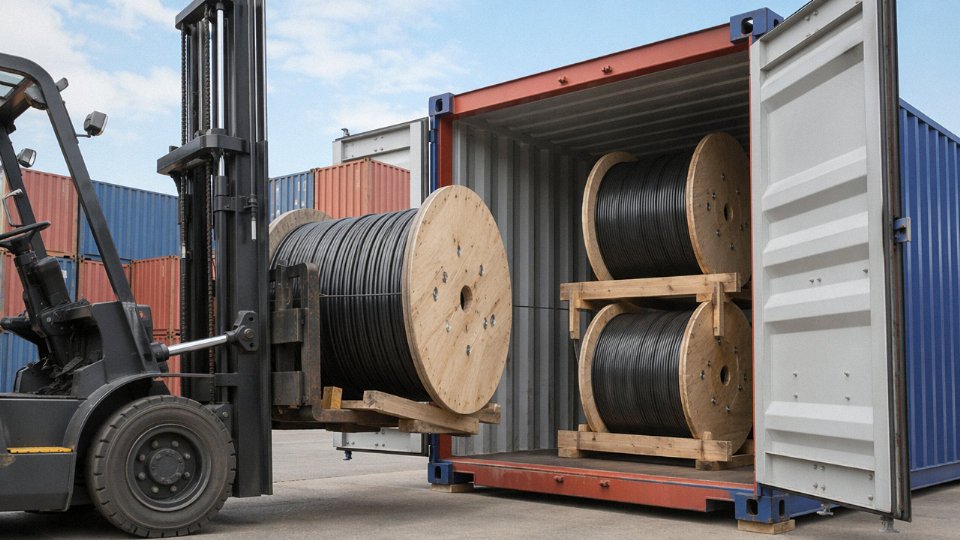
Sea freight on drums is the default for most volume cable orders. Full container load is more cost-effective once you’re shipping more than roughly 10–15 tonnes, depending on drum diameter and stacking; LCL works for smaller orders but consolidation adds time. Air freight is viable only for urgent, low-weight orders — small reels of instrument cable or a handful of specialty connectors.
HS code 8544 covers insulated wire and cable. The sub-heading matters — voltage rating, conductor material, and insulation type all affect the precise code, and misclassification is one of the more common causes of customs delay or re-inspection. Get this confirmed with your freight forwarder before shipment, not at the port.
Drum return logistics often get overlooked entirely until the invoice arrives. Wooden drums are usually non-returnable and the cost is built into the cable price. Steel drums may carry a deposit, and return freight from, say, a European buyer back to China rarely makes economic sense. Clarify upfront whether the price includes non-returnable drums or whether you’re expected to arrange return.
Verifying Cable Length on Arrival
Short-delivery on cable length is a real procurement risk that experienced buyers protect against contractually. The two practical methods for field verification are the OIML drum-weight method — weighing the full drum, subtracting tare weight and drum weight, then back-calculating length from known mass-per-metre — and reel counter verification during paying-off. Neither is perfect; the weight method depends on consistent lay and insulation density, and reel counters can drift. Specifying a tolerance band in your purchase contract — ±3% per IEC 60546 is common — gives you a clear basis for dispute resolution if a drum runs short. Some buyers tighten this to ±1.5% for large cross-section cable where the unit price per metre is high enough that the difference matters.
Jinda’s Supply Infrastructure for International Projects
With five production bases across China, roughly 470,000 m² of manufacturing space, and more than 1,000 employees, Jinda’s capacity covers both high-volume standard product and lower-volume specialty cable without the lead-time penalties that smaller operations typically impose on non-standard orders. The integrated model — R&D, production, quality, sales, and after-sales under one structure — means that a technical question raised during procurement doesn’t get lost between a trading company and a factory you never actually speak to. For buyers managing long-term supply relationships across 50-plus countries, that kind of direct manufacturer access tends to reduce the friction that accumulates over multi-year project supply agreements.
Frequently Asked Questions About Cables and Wires
Is a cable just multiple wires twisted together?
Not exactly, and this is where a lot of ordering errors begin. A cable is a complete engineered assembly — insulated conductors, yes, but also fillers to maintain a round cross-section, a binder tape, possibly a copper screen or steel wire armor, and a rated outer jacket. Simply twisting a few insulated wires together and wrapping them in tape gives you a bundle, not a cable. The outer jacket alone is what provides moisture resistance, crush resistance, and defined flame performance. Without it, you don’t have a product that any installation standard will recognize as “cable.”
Can I use wire instead of cable for underground installation?
Generally no. Direct-buried applications — trenched or plowed-in runs — need either armored cable (SWA or STA construction, typically) or a cable explicitly rated for direct burial with a thick, moisture-resistant outer sheath. Bare conductor or lightly insulated wire without conduit will absorb ground moisture, and in clay soils with seasonal movement, mechanical damage follows within a few years. If you’re running wire underground, it needs to be inside a rated conduit system, full stop. The conduit itself effectively becomes the cable’s jacket and mechanical protection. Skipping that step is a maintenance problem waiting to happen, usually surfacing as intermittent ground faults that take hours to locate.
What is the difference between a stranded wire and a flexible cable?
The strand count and individual wire diameter are what separate them in practice. IEC 60228 Class 2 stranded wire uses a relatively small number of thicker strands with a defined lay length — it’s built for fixed installations where it gets bent once during installation and then stays put. Class 5 and Class 6 flexible cables use far finer strands, sometimes dozens of them in a given cross-section, specifically to survive repeated flexing without work-hardening and cracking. Use Class 2 in a conduit run; use Class 5 or 6 on a machine tool’s trailing lead or a portable drill. Using Class 2 in a continuous-flex application will cause conductor fatigue failures, usually at a termination point.
Does cable gauge follow the same numbering as wire gauge?
The conductor cross-section is measured identically — mm² under IEC or AWG in North America — but cable datasheets express the full assembly as cores multiplied by conductor size: 3×95 mm², 4×16 mm², and so on. That notation tells you the core count and the cross-section of each conductor. AWG-based specifications follow the same logic but the format looks slightly different. What the datasheet will not automatically tell you is the overall cable diameter, which matters for conduit sizing and cable tray fill calculations — you need to pull that from the dimensional table separately.
Are fire-resistant cable and fire-retardant cable the same thing?
No, and confusing them in an emergency system design is a serious error. Fire-retardant cable (tested to IEC 60332 series) is designed to limit how far a flame spreads along a cable run. It may still lose electrical function once the fire reaches it. Fire-resistant cable (IEC 60331) is a different product category entirely — it must maintain circuit integrity, meaning it keeps carrying current, for a defined period under direct flame exposure, typically 90 minutes at 750–950 °C depending on the test variant. Emergency lighting, fire pumps, and alarm circuits need fire-resistant cable. Using fire-retardant cable in those circuits because it was cheaper or easier to source is a life-safety risk and a compliance failure.
IEC 60331 fire-resistant cables must maintain circuit integrity under direct flame exposure for a defined period, not merely resist flame spread.True
IEC 60331 specifically tests circuit integrity under fire conditions, which is a distinct and more demanding requirement than the flame propagation tests in IEC 60332. The two standards address different failure modes and are not interchangeable in safety-critical circuit design.
How do I confirm a cable is genuinely rated to the voltage I need?
Ask for the test certificate, not just the datasheet. For low-voltage cables, IEC 60502-1 routine testing requires a voltage withstand test at 2U₀ + 1 kV applied for 5 minutes — every drum should have documentation. Then physically check that the print legend on the cable jacket matches: rated voltage, standard designation, conductor cross-section. Drum labels can get mixed up in a large warehouse. A cable printed “0.6/1 kV” that was ordered as “3.6/6 kV” is not a paperwork inconvenience; it’s a live installation risk.
What is the service life of a power cable?
XLPE-insulated cables, properly installed and operated within their rated current and temperature limits, are designed for roughly 30–40 years under IEC conditions. PVC insulation is typically rated 25–30 years. Both figures assume correct installation — no tight bends at terminations, no moisture ingress at joints, no sustained overloading. In practice, cables in aggressive environments (high-humidity tunnels, direct soil contact with poor drainage, repeated thermal cycling) age faster. Overloading a cable by even 10–15% continuously accelerates insulation degradation nonlinearly. The 30-year figure isn’t a guarantee; it’s a design target under defined conditions.
Can Jinda produce custom cable constructions for non-standard projects?
Yes. Jinda’s R&D team regularly works through project-specific requirements — non-standard core counts, unusual insulation materials like EPR or silicone, special armor configurations for high-crush or high-flex environments, and dual-standard certification where a project requires both IEC and a regional standard simultaneously. Lead times for custom constructions vary depending on material sourcing and whether tooling changes are needed, but the starting point is always a detailed technical dialogue. Submitting a performance specification rather than just a construction description usually produces better results — it gives the engineering team flexibility to optimize the construction while still meeting the actual installation requirement.
Making the Right Choice: A Practical Decision Framework for Engineers and Procurement Teams
After working through voltage classes, conductor construction, armor types, regional standards, and harsh-environment selection logic, the temptation is to collapse everything into a simple question: “Do I need a wire or a cable?” That is usually the wrong first question. The right first question is: what does the installation environment, voltage class, and regulatory standard actually require? Answer that, and the wire-versus-cable distinction resolves itself almost automatically.
Here is how to work through it systematically.
Step 1 — Define the Installation Environment and Mechanical Demands
Start with where the product lives, not what it carries. Is it buried, tray-mounted, run through conduit, exposed to UV, submerged in a wet pit, draped over a cable reel that flexes 300 cycles per shift? Mechanical duty determines whether you need a single insulated conductor or a fully jacketed, armored assembly — and it narrows your conductor class selection (IEC 60228 Class 1 through Class 6) before you have touched a single electrical parameter.
A rigid, fixed installation in dry conduit is a very different animal from a trailing cable on a port crane. Getting this wrong at specification stage means you are replacing product in the field, which in an energized industrial facility typically costs 10 to 20 times the original cable procurement value once you factor in shutdown scheduling, labor, testing, and regulatory re-inspection.
Step 2 — Establish Voltage and Current Requirements
Confirm the system voltage class — including transient overvoltage exposure — and the continuous current load, accounting for grouping derating, ambient temperature, and any harmonic content in the load. Insulation voltage ratings span roughly 300/500 V for light internal wiring up to 500 kV for grid-level transmission; specifying the wrong voltage class is not a minor paperwork error, it is a fire and liability event.
Step 3 — Identify the Governing Standard for the Project Jurisdiction
A cable destined for a German industrial plant and one destined for an Australian mine may carry identical loads, but the governing standards — and therefore the required documentation, test reports, and marking — are not interchangeable. Know whether your project runs under IEC, NEC/UL, BS, AS/NZS, or GB, and confirm which edition is contractually binding. Procurement teams that skip this step routinely discover the problem at customs clearance or during final commissioning inspection.
Step 4 — Determine Shielding, Armor, and Flame/Fire Rating Requirements
Shielding needs depend on signal integrity and EMC compliance requirements. Armor selection depends on mechanical threat — rodent exposure, soil movement, impact risk, tensile loading. Flame and fire ratings (IEC 60332, IEC 60754, LSZH requirements) depend on occupancy type and the consequences of smoke generation in enclosed spaces. These are not optional refinements; in many jurisdictions they are non-negotiable for project sign-off.
Step 5 — Confirm Certification and Testing Documentation
Establish early what third-party certifications, factory acceptance test reports, and routine test certificates the project requires. Waiting until delivery to ask for documentation that was never manufactured into the production batch is a procurement failure with real schedule consequences.
Wire vs. Cable: Master Comparison Table
| Parameter | Wire | Cable |
|---|---|---|
| Structure | Single conductor, insulated or bare | Two or more conductors, individually insulated, within a common jacket |
| Typical voltage rating | Up to 600 V (general purpose) | 300/500 V up to 500 kV depending on design |
| Mechanical protection | Minimal; relies on conduit or enclosure | Integral sheath; optional armor (SWA, AWA, interlocked) |
| EMI shielding | Generally none | Foil, braid, or combined screen available |
| Installation method | Conduit, trunking, terminal wiring | Direct burial, cable tray, free-air, submarine |
| Applicable standards | IEC 60228, NEC Article 310, regional wiring rules | IEC 60502, IEC 60840, UL 1072, BS 5467, AS/NZS 1cables series, GB/T 12706 |
| Typical applications | Panel wiring, internal equipment connections | Power distribution, instrumentation, control, data, traction |
Why Specification Precision at Procurement Stage Matters More Than Most Teams Realize
A rushed or ambiguous specification pushes decisions downstream — to a distributor, a logistics agent, or worse, a site electrician working off a partial datasheet. Every step downstream from the engineer’s desk adds interpretation risk. The field replacement cost argument is not hypothetical; anyone who has coordinated a mid-project cable changeout in a running chemical plant or offshore platform knows how fast costs compound once production schedules enter the conversation.
Cable replacement in an energized industrial facility typically costs 10–20× the original cable procurement value when shutdown, labor, retesting, and regulatory re-inspection are included.True
This range is widely cited by industrial maintenance and reliability engineers. The multiplier depends on facility type, shutdown complexity, regulatory regime, and whether redundant capacity exists. Direct buried or armor-protected installations at the high end; tray-mounted accessible cable at the lower end.
Jinda as a Long-Term Supply Partner
Shandong Jinda Special Cable Group has been manufacturing cable since 1987 — long enough to have supplied multiple generations of the same infrastructure projects. Five production bases, roughly 470,000 m² of manufacturing space, and IEC/GB dual-standard production capability mean the company can support a broad project specification range from a single source rather than fragmenting procurement across multiple vendors.
Practically, that matters because it simplifies third-party inspection, consolidates quality documentation, and reduces the coordination overhead that multi-vendor cable packages routinely generate. Jinda’s technical team can support the process from initial specification review through sample approval, factory acceptance testing, and ongoing supply — not just quote-and-ship.
If you are at any point in the five steps above and need a second opinion on a specification, a sample lot, or a volume quotation, submit your technical requirements directly to Jinda’s engineering and sales team. Bring the datasheet, the installation environment description, and the governing standard. That is enough to start a useful conversation.