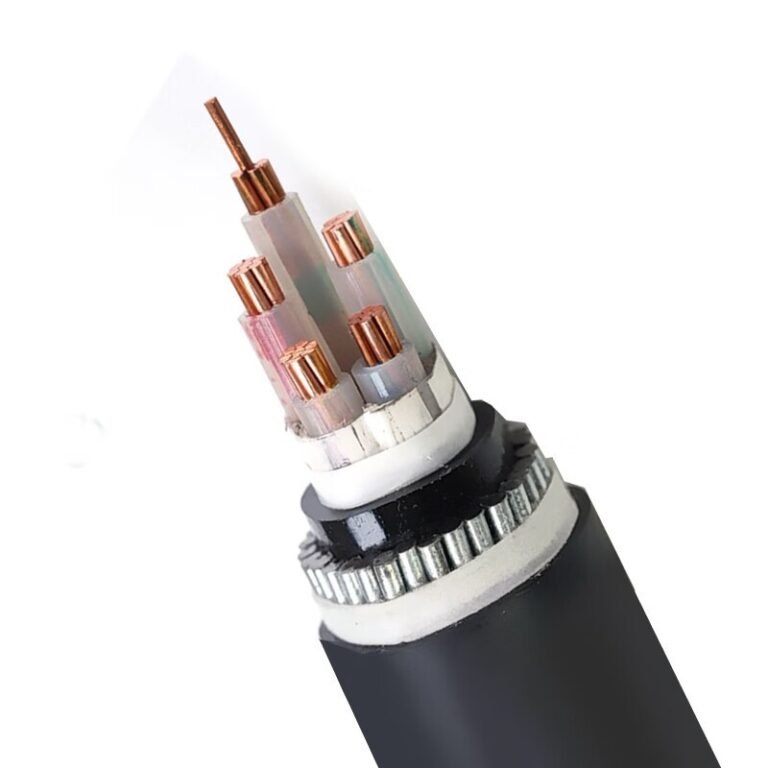
Does a Cable Wire Have Electricity? What’s Actually Flowing Through Your Cables
The honest answer is: it depends. Some cable wires carry enough electricity to kill you instantly. Some carry tiny voltages that you would never feel. Some sit dormant for years until they are switched on. And some, technically, never carry any current at all even when they are doing their job. The phrase “cable wire” covers such a broad range of products that the only safe assumption is that you do not know what is in the cable until you have tested it.
Power Cables: Yes, and Often More Than You Think
Any cable that connects to your electrical panel, your utility meter, or any wall outlet is a power cable. While the breaker is on, that cable carries the full line voltage of your local grid. In North America that is typically 120 volts on a single-pole circuit and 240 volts on a double-pole circuit feeding a dryer, oven, or central air conditioner. Industrial three-phase systems run at 208, 277, 480 volts, and higher. Utility distribution lines on overhead poles can carry anywhere from 4,160 to 34,500 volts. Transmission lines on the big steel towers run at 138,000 volts and above.
Every one of those voltages is enough to cause serious injury or death. The lower household voltages do not look dramatic but the current they can deliver is what does the damage. As little as 100 milliamps across the chest is enough to stop a heart. A 120-volt outlet circuit can deliver fifteen amps without breaking a sweat. The point is not that household wiring is uniquely dangerous; it is that the cable’s appearance gives you no reliable hint of what is inside.
Signal Cables: Usually Low Voltage, Sometimes Surprising
Cables that carry data, video, audio, or control signals operate at much lower voltages, often only a few volts. Ethernet runs at around 2 to 5 volts per pair, depending on the signaling scheme. Standard analog audio cables carry millivolts to a few volts. HDMI uses signaling levels in the same range. Touching the bare conductors of these cables is essentially harmless under normal conditions.
There are exceptions. Coaxial cable for cable television carries a DC component that powers the small amplifiers in line, typically around 60 volts. That is enough to give you a noticeable jolt if you grip the connector tip with damp skin. Power-over-Ethernet cables can carry 48 to 57 volts at meaningful current to feed cameras, phones, and access points. Long-line telephone cables historically carried 90-volt AC ringing signals, which were famous for surprising the unprepared. Always assume a signal cable might have a power-injection component until you check.
Cables That Carry No Current at Idle
A power cable that is not switched on and not connected to a hot panel carries no voltage. The cable itself is just a piece of inert metal. The same is true of a signal cable that is disconnected from any source. Many cable failures and renovation injuries happen because someone assumes “the cable wasn’t doing anything” and forgets that a different circuit, a different switch, or a battery backup is still feeding it.
The most insidious situation is the cable that is normally dead but becomes live unexpectedly. A switched outlet behind a dimmer can read zero volts at the receptacle and then carry full line voltage the moment the switch flips. A multi-wire branch circuit can carry voltage on the neutral even when the local hot is off, if a load on a different leg is energizing the shared neutral. A generator backfeed during a power outage can put 240 volts on a “dead” line. The only reliable safety procedure is to test the specific conductor you are about to touch with a meter or non-contact voltage detector, and to lock out the source if you will be in contact for any length of time.
Fiber Optic Cables: No Electricity At All
Fiber optic cables are a different animal. The signal inside a fiber is light, not electricity. The glass strand itself is an insulator and carries no current. You can touch a stripped fiber without any shock risk, though the laser light at the end of an active fiber can damage your eye if you look directly into the source, and the glass fragments from a cut fiber can become embedded in your skin.
Some fiber cables include a copper messenger wire or composite power conductors for hybrid applications, in which case those copper elements behave like any other power conductor. The fiber strands themselves remain electrically inert.
How to Tell If a Cable Wire Is Energized
Three tools cover almost every situation. A non-contact voltage tester is the first line of defense for AC line voltages from 50 volts up. You wave it near the cable; it lights up or beeps if AC voltage is present. It does not detect DC voltages or low-voltage signal cables, so its silence is not a guarantee of zero voltage. A digital multimeter set to AC and DC voltage ranges gives you a precise reading once you can safely place the probes on the conductors. A cable tracer or toner identifies which specific cable in a bundle is connected to which source, which is invaluable when you need to lock out a particular circuit before working on it.
Beyond tools, the safest workflow is to identify the source feeding the cable, switch it off at the breaker or upstream disconnect, verify zero voltage with a meter at the work location, and then put a lock and tag on the breaker so no one re-energizes it while you are still in contact. This sequence, formally called lockout-tagout, is required by OSHA in industrial environments and is good practice in any setting.
The Practical Answer
A cable wire has electricity in it when its source is connected and switched on. The voltage and current depend entirely on what the cable was built to do. A household NM-B cable from a live breaker carries 120 volts AC. A USB cable carries 5 volts DC when plugged in. A piece of cable lying on the floor of a hardware store carries nothing at all until you connect it to something. Never assume; always test. The cost of being wrong is too high for anything else.