Running conduit through an existing facility — threading it around structural steel, through fire-rated walls, across cable trays already at 80% fill — takes time that most maintenance schedules don’t have. Get it wrong and you’re looking at a re-pull, a failed inspection, or a production line sitting idle while an electrician chases a pinched conductor through 200 feet of rigid conduit. The labor hours stack up fast, and on a greenfield industrial site, the civil work alone for a full conduit-and-wire system can represent 40% or more of the installed electrical cost before a single conductor gets pulled.
In most industrial and commercial installations, armored cable does not require conduit. Standards including NEC Article 330 and IEC 60502 permit direct installation of properly rated armored cable — whether SWA, MC, or equivalent constructions — in above-ground, tray, and direct-burial applications without an additional conduit, provided depth requirements, support spacing, and fill conditions are met.
What actually trips up engineers and procurement teams is the word “most.” There are specific environments, fault-current scenarios, and local code amendments where adding conduit over armored cable is either required or genuinely worth the cost — and confusing those cases with the general rule is where expensive mistakes get made. The distinction isn’t always obvious from the cable datasheet alone.
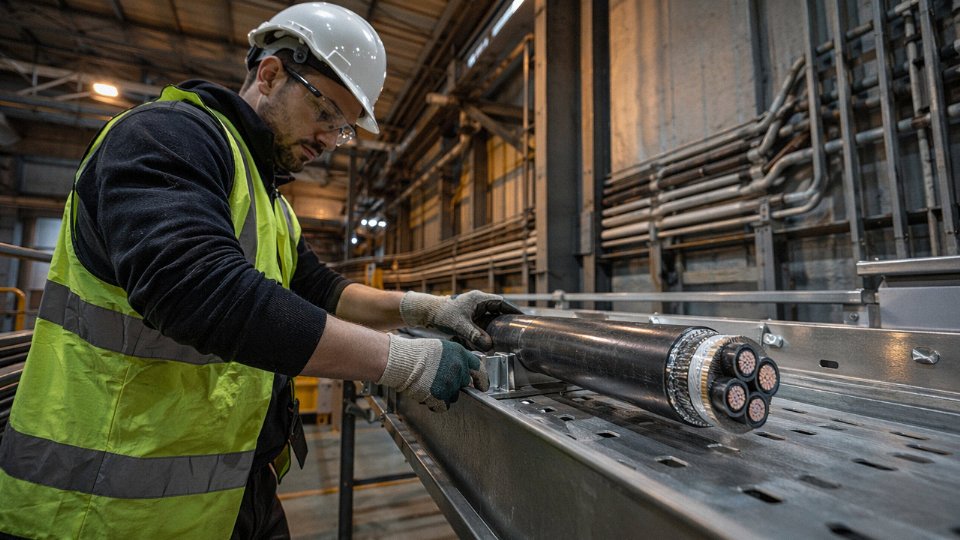
Armored Cable Construction Types and Their Built-In Protection Ratings
The decision to add conduit starts — or ends — with understanding what the armor itself actually does. Not all armored cable is built the same way, and the differences matter enormously when you’re specifying for a chemical plant trench, a rooftop cable tray, or a coastal wind farm pull.
Steel Wire Armor (SWA)
SWA is the workhorse of heavy industrial and utility installations. Galvanized steel wires are helically wound around the cable core, and the geometry of that helix is doing two jobs simultaneously: distributing radial crush loads around the circumference and providing genuine tensile strength along the cable axis. IEC 60502-1 and IEC 60502-2 define crush resistance classes — Class 1 through Class 4 — and a properly constructed SWA cable in the heavier classes handles crush loads in the range of 350–450 N/cm, depending on wire diameter and lay angle. That’s enough to resist most incidental mechanical contact from backfill compaction or light vehicular crossing at depth, which is precisely why direct burial without conduit is permissible under those standards for most LV and MV applications.
Tensile capacity is the other advantage people underestimate. For long vertical runs or cable pulls across difficult terrain, SWA wire contributes meaningful pulling strength — typically several kN of safe tensile load for medium cross-section cables, though the exact figure scales with conductor size and armor wire count.
Steel Tape Armor (STA)
STA replaces the wire helix with overlapping steel tape wound around the core. It’s lighter, cheaper, and handles radial crush loads reasonably well — but tensile strength is substantially lower than SWA. In practice, STA suits horizontal direct-burial runs where pulling tension is minimal and you’re primarily protecting against accidental dig-in. It’s not the right choice for vertical shafts or long inclined pulls without supplemental support. Crush performance in the 200–300 N/cm range is typical, though this depends on tape thickness and overlap ratio.
Aluminum Wire Armor (AWA)
AWA uses the same helical geometry as SWA but substitutes aluminum wires. For single-core cables carrying AC current, this is actually the technically correct choice — steel armor on a single-core AC cable would create a closed magnetic loop and induce circulating currents that generate heat and increase losses. AWA avoids that entirely. Mechanically, aluminum wire is softer than steel, so crush ratings run somewhat lower — roughly 250–350 N/cm depending on wire gauge — but AWA remains fully adequate for most direct-burial and cable-tray applications. Weight savings can matter on long aerial or offshore runs.
Interlocked Metal-Clad (MC) Armor
MC cable — common in North American projects governed by NEC Article 330 and UL 1569 — uses a continuous interlocked aluminum or steel strip rather than wire or tape. The interlocking profile gives flexibility while maintaining a continuous metallic sheath. Crush resistance is generally lower than SWA, but UL 1569 qualification confirms the cable’s self-protecting capability for exposed and concealed installations without conduit in most above-grade scenarios. It’s widely used in commercial and light industrial buildings precisely because it installs fast and clean.
How Jacket Materials Stack On Top
Armor alone doesn’t complete the picture. The outer jacket — PVC, LSZH, or PE — determines chemical and moisture resistance, which directly affects whether conduit is needed in aggressive environments. PE jackets handle prolonged direct burial and wet conditions better than standard PVC. LSZH matters in tunnels and confined spaces where smoke toxicity is regulated. In an oil refinery trench with hydrocarbon-contaminated soil, a standard PVC jacket may degrade over time even if the armor is intact — and that’s when conduit re-enters the conversation regardless of what the code’s baseline permission says.
SWA cable can be directly buried without conduit under IEC 60502 in most low-voltage applicationsTrue
IEC 60502-1 and IEC 60502-2 explicitly permit direct burial of SWA cable without conduit, subject to minimum depth requirements and site-specific conditions such as soil type and mechanical hazard classification.
Comparison: Armor Type vs. Protection Rating vs. Conduit Requirement
| Armor Type | Typical Crush Rating | Primary Strength | Typical Installation | Conduit Usually Required? |
|---|---|---|---|---|
| SWA (Steel Wire Armor) | 350–450 N/cm | Crush + tensile | Direct burial, cable tray, duct | No — for most direct burial and tray |
| STA (Steel Tape Armor) | 200–300 N/cm | Crush (radial) | Horizontal direct burial | No — low-tension routes only |
| AWA (Aluminum Wire Armor) | 250–350 N/cm | Crush + some tensile | Single-core AC, direct burial | No — preferred for single-core AC runs |
| MC Interlocked | Moderate (UL 1569 rated) | Flexibility + self-protect | Above-grade, commercial, exposed | No — permitted exposed per NEC 330 |
Jinda’s manufacturing program covers SWA, STA, and AWA cables produced to IEC 60502, BS 6346, and AS/NZS 1cables standards, with jacket options across PVC, LSZH, and PE — which matters when a project engineer in Australia is sourcing to AS/NZS requirements and needs documentation that will clear a local inspection without back-and-forth. Getting the armor type matched to the mechanical and electrical demands of the site is the first decision; conduit is the second.
NEC, IEC, and Global Code Requirements — Where Conduit Is Actually Required
The short answer most engineers already suspect: armored cable rarely needs conduit, but the exceptions are specific, non-negotiable, and vary enough between jurisdictions that copying one project’s design to another country has burned more than a few procurement teams.
NEC Article 330 and 338 — Permitted Uses, Hard Stops, and the Termination Problem
NEC Article 330 covers Metal-Clad (MC) cable. It’s broadly permissive — MC cable is allowed in dry, damp, and wet locations; exposed or concealed; direct-buried when listed for that use; and in cable trays. Conduit is not required for any of these in standard commercial or industrial construction. What the code does require is that where MC cable enters a box, enclosure, or cabinet, it must be secured with a listed fitting within roughly 300 mm of the entry point. That termination zone is where installers cut corners and where moisture ingress, abrasion, and grounding failures actually happen in practice.
The prohibited uses under Article 330 are worth memorizing: MC cable cannot be used where exposed to destructive corrosive conditions — certain vapors, chlorine environments, or direct contact with the soil unless specifically listed for direct burial. For those soil-contact applications, you’re looking at the listed Type MC cable variants, and even then, burial depth requirements (typically 600 mm minimum under a concrete slab, deeper in vehicle traffic zones) must be confirmed against Table 300.5. Article 338 covers Service Entrance (SE) cable under similar logic — conduit not generally required, but specific routing through masonry or concrete does mandate protection.
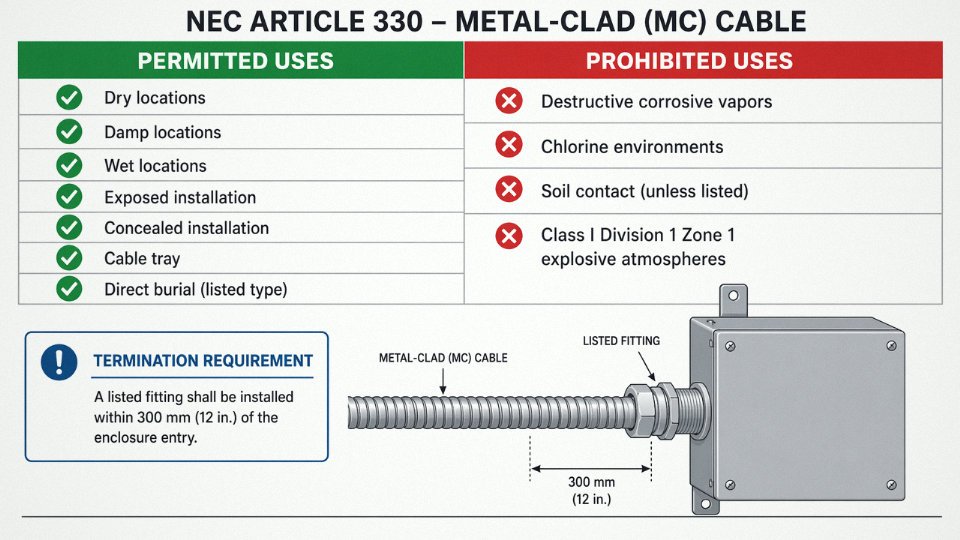
One situation that catches engineers off guard: NEC 501–505 explosive atmosphere (ATEX-equivalent) zones. In Class I Division 1 or Zone 1 areas, rigid metal conduit or Type MI cable is frequently the only compliant wiring method. MC cable, even heavy armored, generally doesn’t satisfy the seal and containment requirements those zones demand. This isn’t a gray area — it’s a hard exclusion.
IEC 60364-5-52 and the Installation Method Tables
IEC 60364-5-52 approaches this differently. Rather than listing cable types with permitted uses, it defines installation methods and assigns current-carrying capacity correction factors to each. Installation Method B2 (cable clipped directly to a surface) and Method D (direct burial) both explicitly apply to armored cables without conduit. The tables give you derating factors based on grouping, soil thermal resistivity, and ambient temperature — the engineering work is in applying those factors correctly, not in adding conduit to satisfy a code requirement that doesn’t exist.
Where IEC does push you toward mechanical protection — and conduit is one acceptable form — is in locations with risk of mechanical damage not addressed by the armor itself. Think fork truck routes inside a warehouse, or cable runs below 500 mm on an exposed wall in a high-traffic area. The standard leaves judgment to the designer, which is either flexibility or ambiguity depending on your inspector.
BS 7671 — SWA Glands Are Not Optional
Under BS 7671 (the UK’s 18th Edition Wiring Regulations), SWA cable clipped direct or buried does not require conduit in most fixed-installation scenarios. The armor itself serves as the mechanical protection and, critically, as the circuit protective conductor when terminated correctly. That last point matters: if the steel wire armor is your earth return path — which it usually is in single-phase and three-phase SWA installations — the gland must be a proper SWA gland with a brass locknut and earth tag arrangement. A standard cable gland won’t grip the armor wires. It’s an embarrassingly common error on fast-moving projects and it fails earth continuity testing immediately.
BS 7671 does not require conduit for SWA cables in standard clipped or buried fixed installationsTrue
BS 7671 Table 4A2 lists 'clipped direct' and 'buried in ground' as recognized installation methods for armored cables without conduit, provided terminations are made with correctly rated SWA glands maintaining armor continuity.
Exceptions That Override Everything Above
A few scenarios mandate conduit regardless of what the armor spec sheet says. Chemical exposure above the jacket’s rated resistance — concentrated sulfuric acid, certain solvents in chemical processing — will degrade PVC or LSOH outer sheaths in months, and armor alone won’t save the cable. Vehicular loading above roughly 10–12 tonnes axle load over direct-buried cable generally requires either concrete encasement or conduit to distribute the load, unless you’ve done the soil bearing calculation and it closes. Some high-rise building codes — particularly in Southeast Asia and the Gulf — require cables in vertical shafts to be run in conduit or enclosed trunking regardless of armor type, partly for fire compartmentalization.
Regional Variations Across Jinda’s Export Markets
Engineers procuring cable for projects outside their home market need to check this specifically. AS/NZS 3008 in Australia follows a similar installation-method logic to IEC 60364 and generally permits armored cable without conduit in direct burial and surface-clipped applications, but the burial depth and cover requirements differ from IEC defaults. Canadian CSA C22.1 (the Canadian Electrical Code) permits armored cable broadly but has specific rules around aluminum-armored cable in concrete that differ from NEC. In Saudi Arabia, SASO standards and KAHRAMAA specifications (used in Qatar) often impose additional mechanical protection requirements in outdoor and substation environments — not because the standards themselves prohibit bare-armored cable, but because project-specific employer requirements layer on top of the base standard. On Gulf projects in particular, it’s worth getting the employer’s technical specification, not just the national standard reference, before finalizing the cable design.
Direct Burial Without Conduit: Depth, Bedding, and Soil Conditions That Govern Safety
Burial depth is the first number anyone asks about, and it’s also the one most often shortcut on tight-schedule civil works. Under NEC Table 300.5, SWA or MC-type armored cable in direct burial generally requires 600 mm (24 in) minimum cover under pedestrian and general landscape areas, rising to 900–1000 mm under roads and paved surfaces subject to vehicle traffic. IEC 60364-5-52 lands in the same ballpark — 600 mm is the de facto standard reference depth across most IEC-aligned jurisdictions, though local amendments in markets like the UK (BS 7671) or Australia (AS/NZS 3000) can push that to 700 mm depending on cable voltage rating. Conduit-enclosed cable, by contrast, often qualifies for reduced cover — typically 450 mm under NEC — because the conduit itself absorbs incidental mechanical loading. That difference matters when you’re crossing a site with variable ground cover and some sections simply can’t go deep enough.
Soil Type Changes the Calculus More Than Most Engineers Expect
Clean, compacted sand is essentially the ideal bedding medium — low chemical activity, no sharp edges, uniform load distribution around the cable jacket. Rocky or stony ground is the real problem. Even with sufficient burial depth, angular aggregate can concentrate point loads on the armor wires over time, particularly when freeze-thaw cycles cause soil movement. In those conditions, a 75–100 mm sand bed beneath the cable and a 150 mm sand layer above it before backfill is not optional — it’s the difference between a 25-year service life and a premature insulation fault you’ll spend days tracing.
Clay-heavy soils introduce a different issue: swelling. Dense clay can exert lateral pressure on cable runs during wet seasons, and if the trench isn’t properly graded for drainage, you end up with a cable sitting in standing water through winter. SWA armor handles the compressive load fine, but the concern shifts to the outer sheath — PVC sheaths hold up reasonably well, but if the cable spec calls for PE outer sheath, make sure the compound is rated for sustained immersion. Check that before ordering, not after delivery.
Chemically contaminated ground — near fuel storage, industrial waste sites, or land with a history of agricultural chemical use — may require an MDPE or HDPE sheath and, depending on severity, a full conduit sleeve through the affected zone. Armor alone does not stop chloride or sulfate penetration of the sheath over a 20-year span.
Marker Tape and Cable Tiles Are Not Optional Extras
At 300 mm below finished grade, a continuous run of yellow warning tape (“CAUTION: BURIED CABLE”) is standard practice and explicitly referenced in most utilities codes. Cable tiles — interlocking concrete or plastic covers laid directly above the cable — serve a harder mechanical role: they deflect a spade or excavator bucket before it contacts the armor. These two layers together functionally replace a large share of what conduit provides for third-party mechanical protection. Without them, the buried armor is still vulnerable to careless excavation, and in a warranty or insurance dispute after a dig-in, the absence of tile and tape will be held against you.
Water Table, Flooding, and Why Conduit Can Actually Introduce Risk
This is where the conduit-versus-no-conduit decision gets counterintuitive. A continuous armored cable pulled from trench to panel has no joints underground. A conduit system has couplings, and unless those couplings are fully sealed — which they rarely are in practice after a few thermal cycles — moisture wicks in and pools at low points.
A continuous armored cable run without underground conduit joints can reduce moisture ingress risk compared to a jointed conduit system in high water-table installations.True
Conduit couplings are common ingress points; a continuous cable sheath with no underground joints eliminates that failure mode, provided the cable entry into junction boxes and panels is properly sealed with glands rated for the installation environment.
On flood-prone sites, SWA cable with a rated IP-class outer sheath actually performs more predictably than a conduit system that may fill, drain slowly, and trap sediment around the wire insulation.
Decision Logic: Reading the Site Before Committing to a Method
| Site Condition | Burial Depth Achievable | Soil/Chemical Risk | Recommended Approach |
|---|---|---|---|
| Clean soil, pedestrian only | ≥ 600 mm | Low | Direct burial, sand bed, marker tape + tile |
| Rocky ground | ≥ 600 mm | Low–Medium | Sand bed mandatory; consider conduit sleeve at rocky zones |
| Road crossing | ≥ 900 mm | Low | Direct burial acceptable; heavy-duty tile layer |
| Road crossing, shallow utilities conflict | < 900 mm achievable | Low | Conduit required to meet reduced-cover exemption |
| Contaminated / aggressive soil | Any | High | HDPE-sheathed SWA + conduit sleeve through contaminated zone |
| High water table, flood zone | ≥ 600 mm | Medium | Continuous direct burial preferred over jointed conduit; sealed glands critical |
The honest answer is that direct burial without conduit is both code-compliant and operationally sound across a wide range of conditions — but only if the bedding, depth, and mechanical warning systems are executed properly. Skimping on sand bedding to save an hour of site labor is the kind of decision that surfaces as an unexplained fault five years later, usually in the worst possible location.
Above-Ground and Tray Installations: Clipped, Ladder, and Exposed Surface Routing
For most industrial facilities, above-ground cable runs are where the conduit-versus-armor debate gets decided in practice — and armored cable wins the majority of those arguments on cost, installation speed, and long-term reliability.
Cable Tray and Ladder Rack: Fill Ratios and Support Spacing
On cable tray and ladder rack, SWA and MC cables can be installed without any conduit provided two parameters stay inside code limits: fill ratio and support spacing. NEMA FG1 sets the framework for North American tray systems; IEC 61537 and BS EN 50085 cover European and international practice. The fill ratio ceiling is typically 50% of usable tray cross-section for single-layer installations — exceed that and you create heat-trapping conditions that force derating, which then forces upsizing, which costs more than a wider tray would have in the first place.
Support spacing for heavy SWA (95 mm² and above) usually runs every 500–900 mm on ladder rack, tighter toward 500 mm for the larger, heavier multicore constructions. Get this wrong and the cable sags between rungs under its own weight, creating stress concentrations at the armor layer over time. Lighter single-core SWA can tolerate spacing toward the wider end, but check the manufacturer’s published spanning tables — don’t assume.
Surface Clipping on Walls and Structures
Saddle clamps at consistent intervals hold SWA flat against concrete, steelwork, or cable ladder uprights. Spacing follows a similar logic to tray support: roughly every 300–600 mm depending on cable diameter and the vertical or horizontal orientation of the run. The minimum bend radius matters more than people realize at installation time — for SWA it’s typically 6–8× the overall cable diameter, and cutting that corner during a pull creates internal stress on the conductors and can crack or deform the armor wires locally, reducing the very crush protection you’re relying on.
In areas with routine foot traffic, SWA armor alone is generally adequate for surface-clipped routes at heights above 1.5 m. Below that, in corridors where tool carts or ladders get dragged along walls, adding a mechanical guard channel (not full conduit) is the practical call. Where forklifts operate, armored cable below 2.5 m height needs either a dedicated cable guard or a conduit sleeve at the vulnerable section — armor survives a lot, but a 3-tonne forklift mast catching a cable run is not a scenario it’s designed for.
SWA cable armor provides sufficient mechanical protection for most above-ground industrial surface installations without conduit, under IEC 60502 and NEC Article 330 provisions.True
Both standards explicitly permit conduit-free installation in above-ground scenarios provided support spacing, bend radius, and routing height requirements are observed. The steel wire armor layer provides the mechanical protection that conduit would otherwise supply.
Aerial and Self-Supporting Spans
Overhead aerial runs using AWA (aluminum wire armored) or genuinely self-supporting designs — sometimes incorporating a separate steel catenary messenger — can clear spans of 60–80 m without conduit or intermediate support structures. This is routine in water treatment plants, outdoor process areas, and mining sites where running conduit across open bays would require expensive structural steelwork. The catenary carries the mechanical load; the cable armor handles localized abrasion at clamping points.
Why Petrochemical and Mining Plants Prefer Tray Over Conduit
Here’s something that doesn’t always appear in the code textbooks: in humid, chemically aggressive environments — offshore platforms, coastal petrochemical plants, underground mining roadways — conduit systems often fail faster than SWA cable does. Threaded conduit joints trap condensate. That standing moisture corrodes the conduit from inside, and eventually migrates toward the cable. SWA in open tray, properly supported and with corrosion-resistant bedding material at contact points, gives maintenance teams a system they can visually inspect and doesn’t create hidden water traps.
The One Exception: Wall and Floor Penetrations
Even in fully above-ground armored cable installations, short conduit sleeves are required where cables pass through fire-rated walls or floors. This is about fire compartmentalization, not mechanical protection. The conduit sleeve — fitted with an intumescent seal — maintains the compartment’s fire rating. The armor’s crush resistance is irrelevant here. Most codes require this regardless of cable type, and it’s a separate requirement that catches people off guard when they’ve correctly specified conduit-free cable throughout the rest of the route.
When Adding Conduit to Armored Cable Is the Right Engineering Decision
Armored cable can stand alone in most installations — that’s been established. But experienced engineers know that “can” and “should” aren’t the same thing. There are real-world scenarios where running armored cable inside conduit isn’t redundant over-engineering; it’s the smarter lifecycle decision.
Chemical Environments That Overwhelm the Jacket
A standard SWA cable with HDPE or PVC outer jacket handles incidental chemical contact reasonably well. What it doesn’t handle indefinitely is continuous immersion or splash exposure to concentrated sulfuric acid, aromatic hydrocarbons, chlorinated solvents, or aggressive alkalis — the kind of conditions found in cable trenches running beneath chemical dosing areas, fertilizer plants, or solvent recovery zones.
In those environments, even a compliant HDPE-jacketed SWA cable benefits from being pulled through an HDPE or fiberglass conduit. The conduit acts as a sacrificial outer barrier. When the conduit degrades — and it will, eventually — you replace the conduit, not the cable. That’s a fundamentally different maintenance equation. Fiberglass conduit in particular holds up well against a broad spectrum of industrial chemicals, and its smooth bore makes future cable pulling straightforward. The upfront cost is real, but it shifts the risk to the cheaper, replaceable component.
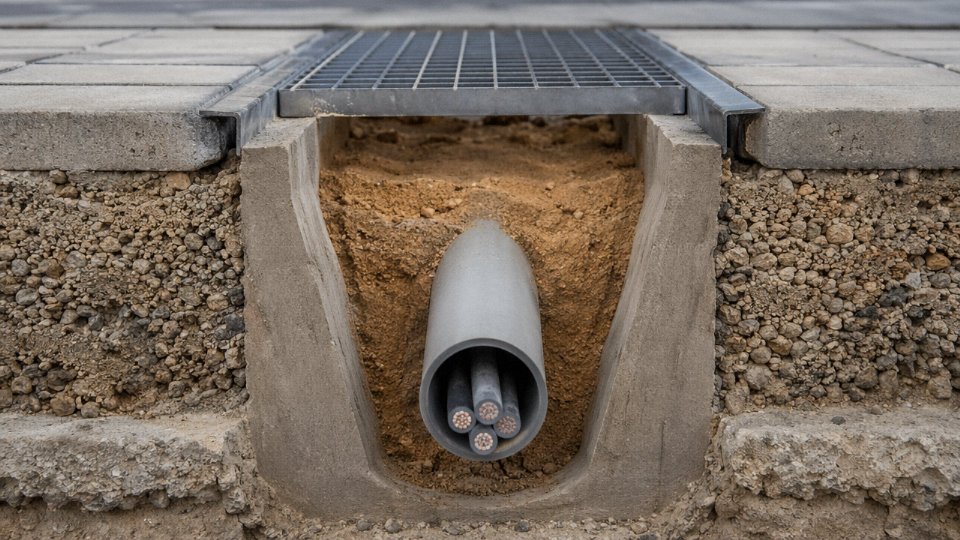
The Replaceability Argument in Concrete and Inaccessible Voids
This one is underappreciated during initial construction and painfully obvious fifteen years later. When a cable route passes through a concrete slab, an in-fill floor, a buried duct bank under a roadway, or a structural void that can’t be accessed without major disruption, the future maintainability of that route matters as much as the initial installation cost.
Armored cable in those locations is structurally fine — it doesn’t need conduit for protection. But if you encase it in concrete without a conduit sleeve, and that cable eventually fails or the load grows and you need a larger conductor, you are breaking concrete. That’s expensive, disruptive, and in a live facility, potentially a production stopper. Pulling a new armored cable through an existing conduit takes hours. Breaking out a slab takes days, minimum, and that’s before you account for permits, structural review, and facility downtime.
The lifecycle cost argument here is straightforward: the 40–70% upfront premium for conduit-plus-armor on those specific segments can pay back in a single avoided remediation event over a 25-year asset life.
In accessible above-grade cable tray runs, the replaceability argument for adding conduit to armored cable does not apply — cable replacement in open tray is already straightforward.True
Conduit-inside-tray adds cost and reduces tray fill capacity without meaningful lifecycle benefit in accessible locations; the replaceability argument is specific to encased or inaccessible routes.
EMI Shielding in High-Frequency Environments
Standard armored cable — SWA, STA, or interlocked aluminum armor — provides useful low-frequency electromagnetic shielding but isn’t optimized for high-frequency EMI suppression. In data centers, broadcast transmission facilities, or any environment with dense variable-frequency drives, the armor alone may not be sufficient. Running armored cable inside a continuously grounded metallic conduit creates a double-layer shielded system: the armor handles mechanical protection and provides one grounding path, while the conduit adds a second shielding envelope and an independent ground reference. In practice this matters most above roughly 100 kHz, where skin-depth effects reduce the armor’s shielding effectiveness.
Retrofit Logic — Working With Existing Infrastructure
Expansion projects have their own economics. If a facility already has installed conduit infrastructure — say, a conduit bank sized for future growth — pulling armored cable into that existing conduit is almost always cheaper and code-simpler than designing a new parallel conduit-free route. The armor provides additional mechanical protection inside the conduit and makes the pull more tolerant of rough conduit sections, damaged couplings, or partial blockages from debris accumulation. It’s a practical combination, not a theoretical one.
| Scenario | Conduit Added to Armor? | Primary Reason |
|---|---|---|
| Chemical trench, continuous solvent exposure | Yes — HDPE or FRP conduit | Sacrificial barrier, jacket longevity |
| Cable encased in concrete slab | Yes | Future replaceability, avoid slab demolition |
| High-frequency EMI environment (VFD-dense, broadcast) | Yes — grounded metallic conduit | Double-layer shielding |
| Retrofit into existing oversized conduit bank | Yes | Reuse infrastructure, lower cost |
| Open cable tray, accessible, dry indoor environment | No | No lifecycle benefit justifies added cost |
The decision isn’t armor versus conduit. In aggressive environments, complex routing, or facilities where future access is limited, both together is the right call — and a defensible one on both technical and financial grounds.
Termination, Transition, and Junction Box Details That Code Inspectors Check
Inspectors who see a clean cable run through a plant will often walk right past it — then stop dead at the termination. That’s where most armored cable installations actually fail. The gland selection, the fitting listing, the last 300 mm of jacket, the bend radius at the final cleat: these details are what trigger re-inspection calls, and none of them are optional.
Gland Selection for SWA and Armored Cable
For steel wire armored cable, the gland does three jobs simultaneously: it grips the armor wires mechanically, seals the jacket, and provides the earth continuity path back through the armor. Brass glands are the default choice in most industrial environments — they’re cost-effective, widely stocked, and compatible with standard SWA. Switch to stainless steel glands in aggressive chemical environments, coastal installations, or anywhere chloride exposure is realistic. Nickel-plated brass sits in between: better corrosion resistance than bare brass at a lower cost than stainless, which makes it a sensible choice for food processing or light wash-down areas.
IP rating on the gland has to match the enclosure’s rated IP, not just approximate it. Specifying IP66 glands on an IP68-rated junction box is a common procurement shortcut that fails the first time the enclosure gets submerged during a site flood. In wet areas, confirm the gland’s IP rating was tested assembled, not rated for the body alone.
The earth continuity tag — the brass tag or lug that clamps to the armor wires at the gland — is not decorative. It is the ground fault return path. Skip it or leave it loose, and you have an ungrounded armor, which means a fault on the cable could energize the armor itself. In some designs, a separate earth conductor is also bonded inside the enclosure. Either way, the continuity needs to be verified with a resistance test after assembly; a visual check alone won’t satisfy most inspection regimes.
NEC Listed Fittings and Why Tape Is Not a Fix
Under NEC Article 330, MC cable terminations require connectors listed to UL 514B. That listing matters because it confirms the connector holds the armor mechanically under pull-out loads, maintains the ground path, and protects the conductors from the cut armor edge. Wrapping the end of the armor in electrical tape and pushing it through a knockout is not a listed termination — it is a violation, full stop. Inspectors see it regularly on retrofit jobs where someone ran out of correct connectors on a Friday afternoon. Budget for proper fittings from the start; a UL 514B-listed MC connector costs a few dollars and avoids a re-inspection that costs significantly more.
The LFMC Transition at Panels and Motor Connections
Even when the entire cable run required no conduit, a short section of liquid-tight flexible conduit (LFMC) is frequently required — and operationally sensible — at the equipment end. At switchboards and panelboards, most knockouts have limited angular tolerance, and pulling the armored cable tight into a fixed connector puts bending stress directly at the termination. A 300–600 mm pigtail of LFMC between the last fixed cleat and the panel knockout absorbs that angle cleanly and gives the inspector a neat, code-compliant entry.
At motors and compressors, this is not optional — it’s basic vibration management. Armor fatigue cracking at motor terminals is a real failure mode, and it happens faster than most people expect, typically within 2–5 years on high-vibration equipment if the cable is clamped rigid right to the terminal box. LFMC or a purpose-made anti-vibration connector breaks the vibration transmission path before it works on the armor wires.
Electrical tape wrapped around cut SWA armor ends substitutes for a UL 514B-listed MC cable connector under NEC Article 330.False
NEC Article 330 requires MC cable termination fittings listed under UL 514B. Tape provides no mechanical retention, no listed ground continuity path, and no protection of conductors from cut armor edges. It is a code violation and will fail inspection.
The Inspection Checklist That Gets Overlooked
Before calling for inspection, run through these points yourself. Armor continuity: test with a low-resistance ohmmeter from gland to gland on the full run; values above roughly 1–2 Ω on a short industrial run deserve investigation. Gland torque: most manufacturers specify a torque range — under-torqued glands pass a pull-out test by hand and then loosen under vibration or thermal cycling; over-torqued glands crack the armor cone and compromise the seal. Jacket condition: the outer jacket should be intact to within about 25 mm of the gland entry point, not stripped back further for “easier” installation. Finally, the bend radius at the last support before termination — maintaining the manufacturer’s minimum bend radius (typically 6–8× cable OD for SWA, depending on conductor count and voltage rating) prevents insulation stress that won’t show up immediately but will shorten cable service life.
These are the points that generate NCRs. Get them right at installation and the armored cable system delivers the service life it was specified for.
Armored Cable Selection Guide for Common Industrial and Infrastructure Projects
Pulling together everything in the earlier sections, what follows is a working reference for matching armored cable construction to project type — because the right cable chosen upfront eliminates most of the conduit debates before they start.
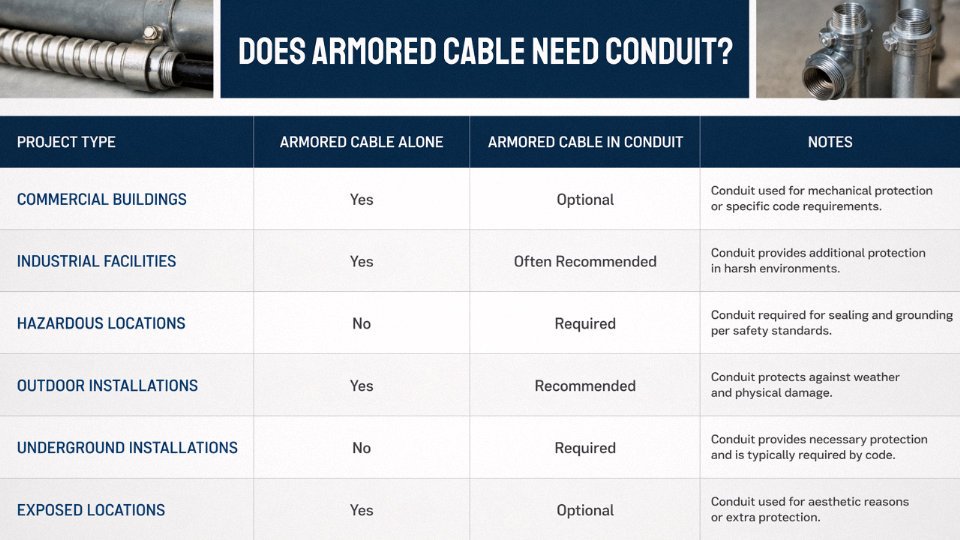
Project-Type Selection Matrix
Underground power distribution is the clearest case for SWA direct burial. A 0.6/1 kV or 3.6/6 kV SWA cable with a heavy-duty PVC oversheath, laid at 600–900 mm depth in compacted sand bedding, handles the vast majority of MV feeder and LV ring-main runs without conduit — provided the route avoids crossing live vehicle traffic without mechanical protection tiles. Trench costs run 30–50% lower than conduit-and-wire systems when you fold in labor, and that gap widens on long rural runs.
Offshore and marine platforms change the picture fast. Corrosive atmosphere, constant vibration, and the genuine risk of mechanical impact from equipment movement push you toward double SWA (two wire layers, counter-wound) with an LSZH outer jacket rated for hydrocarbon-resistant environments. Above-deck runs on cable ladders typically don’t need conduit. At bulkhead penetrations, watertight conduit stubs or stuffing glands are non-negotiable — fire and gas integrity of the bulkhead depends on it, not just the cable rating.
Mining is arguably the harshest environment in this list. SWA with a heavy-duty PVC or CSP sheath handles routine routing in roadways and along conveyors. In zones classified as potentially explosive under IEC 60079 or equivalent national standards, conduit is required regardless of armor — the conduit is serving an ignition-containment function that the armor alone was never designed to provide. Don’t conflate mechanical protection with explosion protection. They are separate requirements.
Solar farms are currently one of the fastest-growing application areas for aluminum wire armored (AWA) cable with a UV-stabilized HDPE jacket. Open-array DC string cables and AC collector cables routed across ground-mounted structures rarely need conduit; direct burial or cable trays between tracker rows are both workable. UV resistance matters more than people initially expect — HDPE outer sheaths rated for prolonged solar exposure, not standard black PVC, are the correct specification here.
Building services — commercial high-rise, data centers, hospitals — typically use MC cable (North America) or STA (steel tape armored) for internal runs. Conduit is generally required only where the cable is embedded in concrete or passes through fire-rated slabs; surface and tray routing inside the building envelope is usually conduit-free.
IEC 60287 derating factors for grouped armored cables in open air differ significantly from those for cables enclosed in conduit, and ignoring this distinction leads to undersized conductors.True
IEC 60287 applies separate thermal resistance models for cables in free air versus cables inside conduit. Conduit restricts convective and radiative heat dissipation, increasing effective thermal resistance and reducing allowable current. A cable correctly sized for open-tray installation may be 15–25% oversized if later rerouted into conduit — or dangerously undersized if the reverse happens.
Conductor and Armor Material — Galvanic Corrosion Is a Real Failure Mode
Aluminum conductors paired with steel wire armor create a bi-metallic contact path that, in wet or buried conditions, accelerates corrosion at cut ends and joint boxes. The practical fix is straightforward: specify aluminum conductor with aluminum wire armor (AWA) when the installation is wet-rated or direct-buried, and use copper conductor with SWA where mechanical loads demand steel. This isn’t always obvious in a datasheet comparison — ask for it explicitly in procurement specifications.
Voltage Class and Screening
At 0.6/1 kV, armored cables carry no metallic screen layer, so conduit-need decisions are purely mechanical and code-driven. Step up to 6/10 kV or 8.7/15 kV and the cable now includes a conductor screen, insulation screen, and often a copper wire or tape screen beneath the armor. That screen must be earthed at terminations, and at cable joints the screen continuity and earthing arrangement become inspection points in their own right. The presence of a screen doesn’t make conduit more or less necessary per se, but it does mean that any physical damage to the outer sheath is more consequential — a breached sheath at MV exposes a live screen, not just insulation.
Sizing Under Derating — Get This Right Before You Order
Current-carrying capacity between a direct-buried armored cable and one enclosed in conduit can differ by 15–25% depending on grouping, ambient soil temperature, and burial depth, per IEC 60287 methods. A 95 mm² copper SWA cable buried alone at 800 mm in average soil carries a different continuous rating than the same cable in a buried conduit bundle of four circuits. If your project design was based on free-air or open-tray ratings and site execution later routes cables through conduit, you may be undersized without realizing it. This is worth a formal check at IFC (Issued for Construction) stage, not after commissioning.
Factory Testing and Procurement Quality Assurance
For project procurement, factory test certificates matter as much as the construction spec. Partial discharge testing, insulation resistance, and conductor resistance verification per IEC 60502-1 and -2 should be standard deliverables on any MV armored cable order, and on LV cable for critical infrastructure. Jinda supplies project-specific armored cable drums with full routine test documentation traceable to individual drum numbers — which simplifies ITP (Inspection and Test Plan) sign-off and gives site teams a defensible paper trail if a cable failure claim arises years later.
Cost Comparison: Armored Cable Direct Install vs. Conduit-and-Wire Systems
Numbers are where decisions get made. The engineering case for armored cable is solid, but on most projects the conversation shifts to cost the moment you walk into a budget review.
Breaking Down a Representative 100 m, 3-Phase 95 mm² Circuit
Take a concrete example: a single 100 m, 3-phase 95 mm² power run — the kind of circuit that feeds a medium-sized motor control center or a process pump station. Three realistic installation methods are worth comparing directly.
SWA direct burial — cable, trench, sand bedding, warning tape, backfill, termination glands. Material cost for the cable itself typically runs in the range of $18–32 per meter depending on copper pricing, armor specification, and order volume. Civil work (open-cut trench in average ground, not rock) adds roughly $8–15 per linear meter. Termination hardware at both ends, $120–280 total for the circuit. No conduit material at all.
XLPE wire in PVC conduit encased in concrete — you’re now buying the conductors, the conduit (typically 63–75 mm for this conductor cross-section), concrete encasement, formwork where needed, and the labor to thread and pull. Conduit and concrete add $22–38 per meter on top of the conductor cost. The conductor itself is cheaper than an equivalent armored cable by roughly 15–20%, but that delta disappears fast once you price the civil work.
XLPE wire in GRC (glass-fiber reinforced concrete) duct direct burial — preformed duct systems cost more than plain PVC conduit, usually $28–45 per meter installed including the duct, bedding, and jointing. Pull-through conductors are the same cost as the PVC scenario.
Stack it up across the full 100 m and the SWA direct-burial option typically comes in 30–50% lower in total installed cost than the conduit-encased alternatives. That range depends heavily on local labor rates, ground conditions, and whether you’re in a greenfield trench or retrofitting around existing infrastructure.
Direct-burial SWA cable installation costs 30–50% less per linear meter than equivalent conduit-and-wire systems when labor and civil work are included.True
This range is consistent with NEC and IEC installation practice data and reflects combined material, labor, and civil cost differentials documented across industrial projects. The lower end applies in easy-access greenfield sites; the upper end applies where conduit encasement in concrete is the alternative.
Labor Hours Are Where the Gap Really Opens
Conduit systems are labor-intensive in a way that’s easy to underestimate at the estimate stage. Threading individual conductors through a 100 m run, sealing conduit entries at enclosures, managing expansion fittings — in practice, a 10 m section of conduit-pull work in a congested industrial environment takes 3–5 labor-hours per 10 m. Armored cable on the same route, direct-pulled and clamped, runs 1.5–2.5 labor-hours per 10 m. That’s not a marginal difference; on a large project it dominates the schedule.
Project-Scale Economics
On a 500-circuit industrial substation project — the scale where procurement strategy actually matters — switching from conduit-and-wire to SWA direct burial has consistently reduced electrical installation cost by roughly 18–28% and compressed the installation schedule by 15–20%. The schedule compression alone has real downstream value in projects with liquidated damages clauses or phased energization milestones.
| Installation Method | Relative Material Cost | Relative Labor Cost | Civil Work Complexity | Typical Total Installed Cost Index |
|---|---|---|---|---|
| SWA direct burial | Moderate–High | Low | Low–Moderate | 1.00 (baseline) |
| XLPE in PVC conduit, concrete encased | Low–Moderate | High | High | 1.45–1.75 |
| XLPE in GRC duct, direct burial | Low–Moderate | Moderate–High | Moderate | 1.35–1.60 |
Indices are relative to SWA direct burial; actual values depend on site conditions, conductor size, and regional labor rates.
Twenty-Five Year Life-Cycle View
Initial installation cost is only part of it. Conduit systems develop joint corrosion, seal failures, and water ingress — particularly in humid climates or where there’s any ground movement. Maintenance on conduit joints and entries typically runs somewhere in the range of 2–4% of the original conduit system cost per decade, based on industrial facility maintenance budgets I’ve seen. Armored cable avoids most of that entirely.
There’s also a load-growth scenario worth considering. If your process load increases and you need to re-rate the circuit thermally, armored cable in open-cut burial can sometimes be re-rated by adjusting grouping or burial depth without touching the hardware. Conductors trapped inside concrete-encased conduit give you no such flexibility — you’re pulling new wire or adding a circuit.
Procurement Volume and Cable Joint Frequency
One cost factor that rarely shows up in early estimates is cable joint frequency. Short or inconsistent drum lengths force joints into the route, and each joint adds materials, labor, and a future maintenance liability. Jinda’s five production bases and 470,000 m² of manufacturing capacity support continuous production runs that allow consistent, project-matched drum lengths — reducing imposed joint frequency on long cable routes. On a 2 km substation ring main, the difference between 500 m drums and 250 m drums means four fewer joints, which at typical industrial joint installation costs represents a meaningful line item.
The economic case for armored cable without conduit isn’t theoretical. It’s visible in the line items.
Frequently Asked Questions About Armored Cable and Conduit
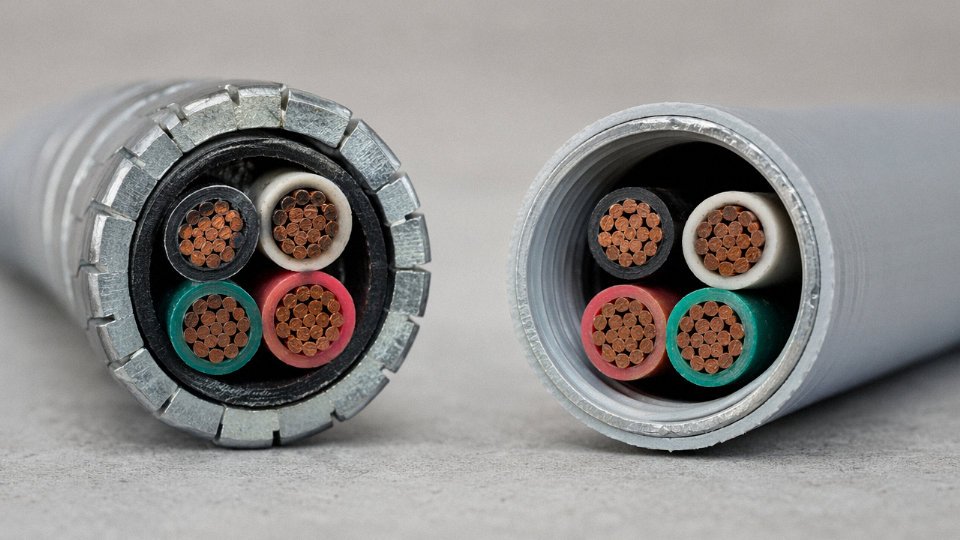
Can I run SWA cable on the surface of a wall without conduit?
Yes — and this is one of the most common surface-wiring approaches in industrial plants. SWA cable can be clipped directly to a wall, cable tray, or structural steelwork without conduit, provided the clips are spaced correctly (typically 350–500 mm for horizontal runs, 450–600 mm vertical, depending on cable diameter and manufacturer data) and the cable is protected against physical impact up to roughly 1.5 m above floor level in areas accessible to personnel or vehicles. In practice, that last point matters more than people realize. A cable clipped at proper intervals but left unprotected at 600 mm height in a forklift aisle is an incident waiting to happen. Some sites use slotted steel trunking or a mechanical guard over just the lower section rather than running the whole route in conduit — that’s a reasonable compromise, and inspectors generally accept it if the armor type is rated for the ambient environment (UV-stabilized outer sheath outdoors, for instance).
Does MC cable need conduit in a commercial ceiling plenum?
Standard MC cable does not carry a plenum air-handling rating, so NEC Article 300.22 requires it to be installed in conduit or enclosed in a listed raceway when routed through plenum spaces. The exception is MC cable with an MCAP listing — metal-clad cable listed specifically for air-handling ceiling plenum environments.
Standard MC cable can be run freely in a plenum ceiling without conduitFalse
NEC 300.22 requires conduit or listed raceway for standard MC in plenum spaces; only MCAP-listed MC cable is permitted without conduit in plenum air-handling areas.
Get the cable listing wrong on this one and you’re pulling the whole run out after inspection. Check the cable jacket print for the MCAP marking before the spool even ships to site.
Is armored cable the same as conduit?
No, and the confusion is understandable but consequential. Armor is a mechanical protection layer manufactured directly onto the cable at the factory — it moves with the cable, is part of the cable assembly, and cannot be removed or reused separately. Conduit is an independent raceway installed first, through which cable is later pulled. The two serve overlapping protective functions but are structurally distinct. Running armored cable inside conduit gives you both protections simultaneously, which is exactly what some high-risk environments — chemical plant cable bridges, below-grade road crossings — actually call for.
Can armored cable be buried without conduit under a driveway or road?
Yes, but the rules tighten significantly. Standard direct-burial depth for armored cable in open ground is typically 600–750 mm; under roads, driveways, or areas subject to vehicle loading, most highway authorities and codes (BS 7671, local DOT requirements, NEC Table 300.5) push minimum cover to 900–1,000 mm. More importantly, most highway authorities require a HDPE conduit sleeve or reinforced concrete cover slab over the crossing section regardless of armor rating. The armor protects against soil movement and incidental contact — it’s not rated for repeated dynamic load from heavy vehicles at shallow depth. Plan the sleeve into the trench design from the start; adding it as an afterthought once the trench is open costs almost nothing; retrofitting it after backfill costs real money.
What armor type is best for direct burial in coastal or high-moisture soil?
Double SWA or aluminum wire armored (AWA) cable with an LSZH or HDPE outer jacket, manufactured to IEC 60502-1 or IEC 60502-2, is the defensible choice in aggressive ground conditions — waterlogged clay, saline coastal soils, or ground with elevated sulfate content. Single SWA with standard PVC jacket performs acceptably in neutral, well-drained soils, but PVC is permeable to chloride ions over time, and in coastal environments the armor corrosion you find at year eight isn’t always visible at year two. If there’s any doubt about soil chemistry, specify the HDPE or LSZH oversheath. The cost delta is modest compared to a cable replacement excavation.
Does armored cable need to be grounded at both ends?
For low-voltage SWA installations, yes — the armor must be earthed at both termination points to provide a continuous fault-current return path. Single-point grounding applies to screened cables typically above 1 kV, where bonding both ends of the screen would create a circulating current loop and generate heat. Getting this backwards on an LV SWA run means a ground fault may not clear fast enough to trip the protective device, which is a genuine safety failure. Armored cable glands must be correctly selected for earthing continuity; a brass gland that doesn’t make positive contact with the armor wires is worse than useless from a protection standpoint because it implies continuity that doesn’t exist.
How does Jinda support international projects requiring hybrid conduit and armored cable designs?
EPC contractors managing infrastructure projects across multiple code jurisdictions — a power plant in Southeast Asia, a data center in the Middle East, an industrial complex under both IEC and local NEC-derived codes — regularly deal with specifications that mix armored cable in direct-burial sections and conduit-and-wire in congested electrical rooms. Jinda’s technical team provides specification review at the design stage, project-specific drum lengths to minimize field joints, third-party test certificates (KEMA, SGS, CESI depending on destination market), and documentation in the formats procurement and customs teams actually need. For hybrid designs, having a single cable supplier who can cover the armored cable portion while cross-referencing compatibility with the conduit runs simplifies the submittal process considerably.