Specifying the wrong cable type isn’t just a paperwork error — it stalls commissioning, forces emergency re-procurement at spot prices, and in harsh environments can cause insulation failure within months of installation. Procurement managers working across multiple projects often inherit a warehouse where four or five fundamentally different cable families sit on the same rack, tagged inconsistently, and nobody on shift can tell a flexible control cable from a instrumentation pair without pulling the datasheet. That confusion compounds fast: wrong conductor cross-section means nuisance tripping or overheating; wrong jacket chemistry means cracking in a cold store or chemical plant; wrong shielding means noise on a process line that takes a week to diagnose. The global wire and cable market runs north of USD 225 billion annually and is growing — which means the range of products flooding distributor warehouses is wider than it’s ever been, and the cost of misidentification keeps climbing with it.
The five main types of wire and cable found in a warehouse are: building wire (including single-core and multi-core power cable), flexible control cable, instrumentation and signal cable, armoured power cable, and specialty or application-specific cable. Each family differs in conductor construction, insulation material, shielding, and mechanical protection — and those differences directly determine whether a cable is safe and compliant for a given installation.
What makes this harder than it sounds is that several of these categories overlap at the edges. A screened multi-core control cable and a basic instrumentation cable can look nearly identical on a spool end, yet one will meet your EMC requirements and the other won’t. The conductor sizing standards under IEC 60228 run from 0.5 mm² all the way to 2,500 mm², and copper still dominates roughly 65% of industrial conductor volume — but none of that tells you which cable belongs where. That’s exactly what the sections below work through.
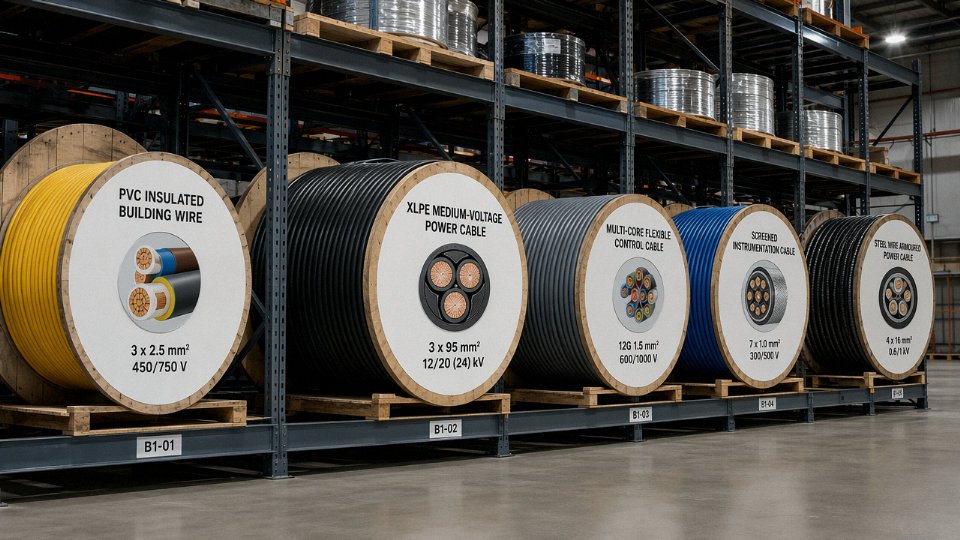
Type 1 — Building Wire and House Wire: The Backbone of Every Fixed Electrical Installation
Walk into almost any general-purpose cable warehouse and the single largest category by spool count — and usually by linear meters — is building wire. It’s unglamorous, it’s everywhere, and it’s the one type that procurement managers tend to under-specify until a project stalls because someone ordered solid conductor where stranded was needed, or accepted off-brand drums with no traceable certification. Getting this category right is foundational.
What Building Wire Actually Is
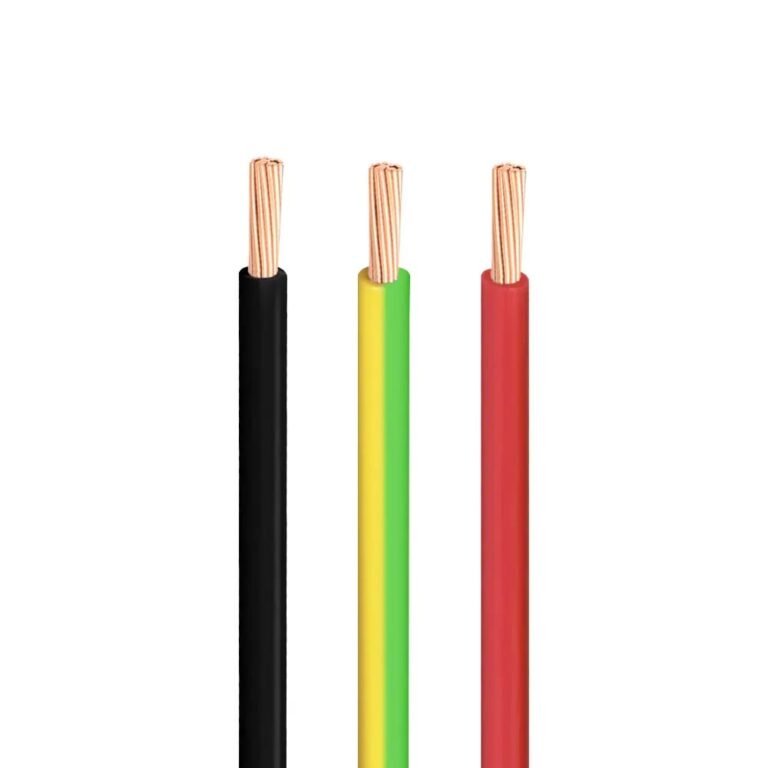
Building wire (called house wire in some markets, BV in GB/IEC-aligned nomenclature) covers single or multi-core copper conductors with PVC insulation, designed for fixed installation inside walls, conduits, and cable trays. Voltage ratings sit at either 300/500 V or 450/750 V depending on the application tier — the 450/750 V rating is standard for most Chinese-market BV and aligns with IEC 60227. Cross-sections typically run from 1.5 mm² up to 95 mm² for building wire proper, though 1.5, 2.5, 4, 6, and 10 mm² account for the overwhelming majority of residential and light commercial consumption. Anything above 35 mm² starts crossing into power cable territory operationally, even if it technically still meets the building wire standard.
IEC 60228 defines standard conductor cross-sections from 0.5 mm² to 2,500 mm², covering the vast majority of industrial and building wire applicationsTrue
IEC 60228:2004 (and its national equivalents) specifies conductor dimensions and resistance values across this range; the claim accurately reflects the standard's scope and is widely verified in procurement documentation.
Copper dominates here — roughly 65% of all industrial conductor material globally is copper, and in building wire specifically that share is higher still, because the application demands reliable conductivity in confined spaces where aluminum’s larger cross-section penalty becomes impractical.
The Sub-Categories Your Warehouse Actually Needs to Stock
These are not interchangeable. Issuing BV when the job calls for BVR causes real problems — stiff solid conductors crack at bend points in junction boxes, especially in cold weather.
| Designation | Conductor Type | Insulation | Voltage Rating | Typical Application |
|---|---|---|---|---|
| BV | Solid copper | PVC | 450/750 V | Fixed runs in conduit, walls |
| BVR | Stranded copper (Class 2) | PVC | 450/750 V | Flexible routing, panel wiring |
| BVVB | Stranded or solid, flat twin+earth | PVC insulation + PVC sheath | 300/500 V | Surface-mounted domestic wiring |
| RV / RVV | Fine-stranded (Class 5) | PVC | 300/500 V | Appliance connections, light flexible cords |
BV is your workhorse for conduit installations — solid conductor, cheaper per meter, easier to terminate in screw terminals. BVR makes life easier when you’re routing through a crowded panel or making a 90-degree turn inside a shallow back-box. BVVB is the flat, sheathed twin-and-earth that electricians reach for on surface-mounted domestic circuits. RV and RVV are flexible cords; they don’t belong in fixed installation conduits, and occasionally a rushed site crew will use them there anyway — worth flagging in your issue procedures.
Procurement Checkpoints That Actually Matter
First thing to verify on any incoming drum: the GB 5023 or IEC 60227 certification mark. Not a sticker someone printed, but a traceable mark tied to a test report. Reputable manufacturers print the standard designation, voltage rating, and conductor cross-section continuously along the insulation jacket — if that print is absent or smears under your thumb, that’s a warning sign worth acting on before the drums leave goods-in.
Conductor resistance is the other checkpoint most warehouses skip. IEC 60228 Class 1 (solid) and Class 2 (stranded) set maximum DC resistance per kilometer at 20°C. A 2.5 mm² solid conductor should read no more than roughly 7.41 Ω/km. Values above that tolerance usually mean undersized conductor cross-section — a common cost-cutting move in commodity building wire. A basic resistance bridge at goods-in pays for itself quickly on high-volume orders.
Color coding compliance sounds trivial until a maintenance electrician on a fast job trusts the colors and finds them wrong. Green-yellow stripe is protective earth, full stop. Blue is neutral. Brown, black, or gray for line conductors. Any drum deviating from this — especially in mixed-market warehouses where some stock follows older national conventions — should be clearly quarantined and labeled.
Storage deserves a practical note. Drums stored directly on concrete floors absorb moisture through the drum flanges, which eventually wicks into the conductor ends. Pallets or racking, covered from direct UV (PVC plasticizes degrade faster than most people expect under sustained sun exposure), and strict first-in-first-out rotation. Building wire has a comfortable shelf life if stored correctly — typically five to seven years before PVC flexibility becomes a handling concern — but that clock runs faster in hot, humid climates or outdoor laydown areas.
One practical stocking ratio from general-purpose warehouse experience: for every 10 units of BV at 2.5 mm², you’ll typically move 4–6 units of BVR at the same cross-section and 2–3 units of BVVB. That ratio shifts toward BVR-heavy in markets with more panel-building activity. Know your project mix before setting minimum stock levels, because building wire is cheap per meter but capital-intensive at volume — a warehouse carrying the wrong sub-type ratio ties up cash without serving anyone.
Type 2 — Power Cable (Medium and High Voltage): Specifications and Selection Logic for Industrial and Infrastructure Projects
Power cable is where warehouse management gets genuinely complicated. Unlike building wire, which is relatively forgiving in terms of handling and substitution, medium- and high-voltage cable carries enough specification complexity that a single wrong selection can mean a failed site acceptance test, a rejected drum, or — worst case — an insulation failure at energisation that takes a substation offline for weeks.
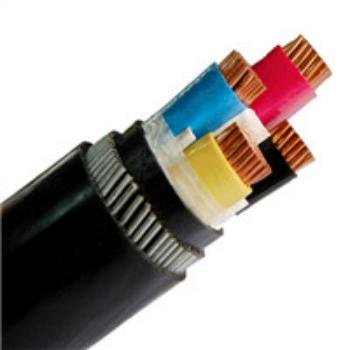
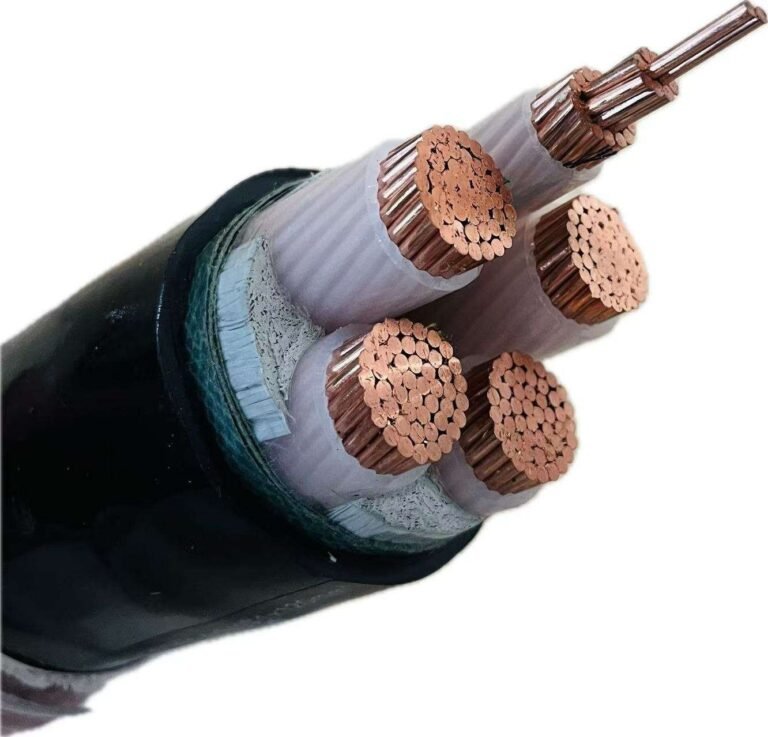
For this guide, “power cable” means XLPE- or EPR-insulated, PVC- or PE-outer-sheathed cables rated from 1 kV up to 35 kV: the range that covers industrial plant distribution, utility feeder runs, wind farm collector circuits, and infrastructure substation connections. The governing standards are IEC 60502-1 (up to 3 kV), IEC 60502-2 (covering the 3.6/6 kV through 20.8/36 kV band), and GB/T 12706 for projects specifying Chinese national standards — which, in practice, most export projects sourced from Chinese manufacturers will reference alongside IEC. Single-core and multi-core configurations both appear in the same warehouse rack; you need clear labelling systems or they will get mixed.
The Selection Matrix: Voltage, Installation Method, and Conductor Material
Voltage class is the first cut, and it drives insulation wall thickness directly. A 6/10 kV XLPE cable under IEC 60502-2 requires a minimum insulation thickness of 3.4 mm. Bump the application to 12/20 kV and you’re looking at 5.5 mm minimum, roughly. These are not designer choices — they are mandated minimums, and going one voltage class light to save cost is the sort of shortcut that shows up as partial discharge activity within two or three years of energisation.
Installation method is the second decision, and it determines armouring:
| Installation Environment | Armouring Recommendation | Notes |
|---|---|---|
| Direct buried in soil | Steel wire armor (SWA) | Mechanical protection against dig-in; galvanised for corrosion resistance |
| Cable tray or ladder rack (indoor) | Unarmored, reinforced outer sheath | Saves weight and cost; tray provides mechanical protection |
| Duct/conduit pull | Unarmored or AWA | Aluminum wire armor preferred where weight matters; easier to pull |
| Underwater / river crossing | Lead sheath or double-steel armor | Moisture ingress is the primary failure mode; lead remains the reliable barrier |
| Vertical riser (>20 m drop) | SWA with steel wire suspended grip | Armor carries mechanical load; termination method changes |
Conductor material is the third variable. Copper dominates medium-voltage power cable in most industrial specifications, and for good reason — the termination hardware is more straightforward, the current density is higher, and jointing copper in the field is more tolerant of less-than-ideal conditions. Aluminum costs less per metre (sometimes 30–45% less on large cross-sections, depending on LME pricing at the time) and weighs significantly less per drum, which matters when you’re handling 240 mm² three-core cable. The trade-off is that aluminum oxide forms immediately on a cut surface, so termination requires proper compound, correct lugs, and a crew that knows what they’re doing. On a price-driven bulk procurement, aluminum 3×240 mm² XLPE-SWA at 35 kV is attractive. On a critical industrial feeder where the jointing crew is variable, copper is usually the right call regardless of the cost difference.
A 6/10 kV XLPE cable under IEC 60502-2 requires a minimum insulation thickness of 3.4 mm.True
IEC 60502-2 Table 2 specifies nominal insulation thicknesses by voltage class; 6/10 kV XLPE (Category A) requires 3.4 mm nominal insulation wall thickness for conductor cross-sections in the typical industrial range.
Warehouse Logistics: These Drums Are Not Easy
A loaded drum of 35 kV 3×240 mm² XLPE-SWA cable can exceed 4,000 kg — sometimes significantly, depending on drum dimensions and the length wound. That is not a two-person job with a pallet truck. Crane or forklift handling is non-negotiable, and the warehouse floor loading capacity needs to be confirmed before you start stacking drums. I’ve seen warehouses where a row of large MV drums sat directly on unrated concrete for six months; the floor cracking was a secondary problem; the real issue was that nobody could safely move them when the project started.
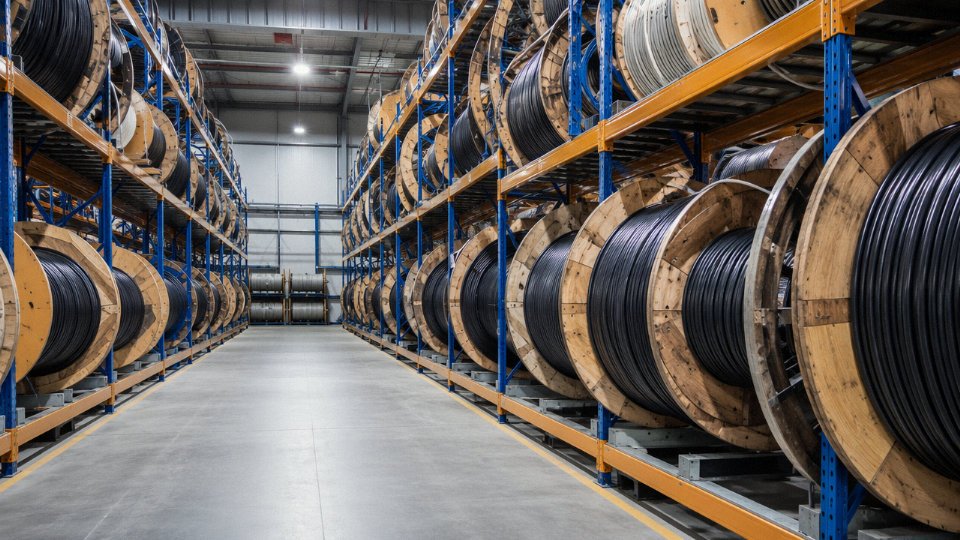
Storage practice matters more than most procurement managers realise. Drums should sit on ‘A-frame’ cradles or timber bearers, never flat on the flange, to prevent drum deformation and to allow rotation during inspection. Both cable ends should be sealed — heat-shrink boots or proper end caps — because XLPE absorbs moisture at cut surfaces over time, and moisture ingress into the insulation wall is exactly what a tan-delta test will find eight months later when the cable is about to be installed.
Every drum that enters the warehouse needs its drum number, cable length marks (metre markings stamped on the outer sheath), drum card, and — critically — the factory test certificate logged into the inventory system at goods-in. That certificate should include partial discharge test results and, for cables 6 kV and above, tan-delta (dissipation factor) values. If the test certificate is missing or the partial discharge level is recorded above the IEC 60502-2 threshold, the drum should not leave the warehouse until the discrepancy is resolved with the manufacturer. Chasing this after the cable is already in the ground is considerably more expensive.

One practical note on inventory: power cables at different voltage ratings look nearly identical from the outside once the drum label is obscured or damaged. Colour-coding the drum end-caps by voltage class (a simple site convention, not a standard) is a low-cost habit that prevents the wrong cable being issued to the wrong installation crew — something that is much more common on busy infrastructure sites than anyone likes to admit.
Type 3 — Control Cable and Instrumentation Cable: Keeping Industrial Processes Accurate and Responsive
These two cable families sit on almost every industrial warehouse shelf, often on adjacent racks, and they get mixed up constantly. The confusion is understandable — both are multi-core, both run between control panels and field devices, and both tend to look like small-diameter, individually colored cores bundled under a common jacket. But their jobs are fundamentally different, and installing one in place of the other is a reliable path to process upsets, ghost alarms, or relay mis-operation that can take days to trace.
What Control Cable Actually Does
Control cable — built to GB/T 9330 in Chinese manufacture, or to IEC 60092-350 in marine contexts, with direct equivalents in IEC 60227 for fixed-wiring applications — carries switching and interlock signals. Think motor start/stop commands, contactor coil circuits, pilot light wiring, solenoid valve switching. Voltage ratings sit at 450/750 V or thereabouts. Conductor cross-sections typically run 1.5 mm² to 10 mm², though most panel wiring lands somewhere between 1.5 and 4 mm². Common designations you’ll see on warehouse reels include KVV (unshielded, PVC insulation, PVC jacket) and KVVP (with overall copper braid shield). The currents are modest but the circuit integrity matters — a miswired or degraded control cable won’t just trip one motor; it can lock out a whole production line while maintenance chases a control-voltage fault.
Instrumentation Cable Is a Different Problem
Instrumentation cable carries signals that are genuinely fragile: 4–20 mA analog loops, 0–10 V process signals, thermocouple millivolt outputs, RTD resistance measurements. We’re talking about signal levels in the millivolt range riding on conductors as small as 0.5 or 0.75 mm². Any injected noise — whether from a nearby VFD cable, a transformer, or even fluorescent ballasts in a poorly routed cable tray — directly corrupts the measured value. At 4–20 mA, just a few milliamps of noise shifts a flow reading or a temperature output enough to cause false shutdowns or, worse, process drift that nobody notices until product is off-spec.
The construction reflects this sensitivity. Instrumentation cables use individually screened twisted pairs (IS), each pair wrapped in its own foil shield with a drain wire, often with an additional overall shield (OS) on top. That IS+OS construction is not optional in VFD-dense environments. Variable-frequency drives generate conducted and radiated EMI that can push noise floors 60 dB or more above a millivolt-level signal — without both layers of shielding, the signal is simply not recoverable. One thing that trips up even experienced electricians: for analog signals, shields must be grounded at one end only, typically the panel end. Ground both ends and you’ve created a ground loop that actually introduces the 50/60 Hz hum you were trying to prevent. It’s a common mistake, and it’s particularly infuriating to diagnose after the cable is pulled and terminated.
Individually screened plus overall shielded (IS+OS) instrumentation cable is required in VFD-heavy industrial environments to maintain signal integrityTrue
VFDs generate broadband EMI; IS shields attenuate inter-pair crosstalk while the OS provides a Faraday cage against external field coupling — using either alone leaves measurable noise injection on low-level analog signals per IEC 61000-5-2 test data
The Four Shielding Options Warehouse Staff Need to Recognize
Not every cable needs full IS+OS, and over-specifying adds cost without benefit. A quick field guide:
| Shielding Type | Code | Typical Use | When It’s Enough |
|---|---|---|---|
| Unshielded | U | Short inter-panel runs, digital switching signals | Clean electrical rooms, no adjacent power cable |
| Overall shield only | OS | General instrumentation, moderate EMI | Single analog loop, >300 mm from power cables |
| Individually shielded pairs | IS | Multi-pair analog runs, mixed signal types | Low-EMI plants, thermocouple or RTD circuits |
| IS + overall shield | IS+OS | VFD environments, long runs, critical process loops | Mandatory where EMI noise floor is a documented concern |
Stocking and Warehouse Handling
Instrumentation cable typically arrives on small reels or boxed coils — 100 to 500 m per unit, sometimes less for specialty types. Pair count matters enormously at goods-in: a 12-pair cable mislogged as 10-pair causes a field installation shortage that nobody catches until the drawing doesn’t match the cable. Count pairs, verify screen continuity with a simple end-to-end resistance check before the reel goes on the shelf, and log the result. Moisture-barrier end caps on individually screened cables are not optional in humid climates or cold-store warehouses — exposed foil screens wick moisture, and a corroded drain wire defeats the shield before the cable reaches site.
Segregation in the racking system is worth enforcing strictly. IEC 61000-5-2 guidance suggests a minimum 300 mm physical separation between instrumentation cable and unshielded power cable in a shared cable tray — and even that assumes the power cable isn’t a VFD output. In practice, many warehouses rack everything together by diameter, which means instrumentation reels end up touching medium-voltage power cable. That’s fine for storage if the reels are sealed, but it creates habits: if it’s stored together, it tends to get routed together, and that’s where signal quality problems start.
Keep control cable and instrumentation cable in clearly labeled bays, even if the physical space is tight. A single misrouted reel on a greenfield project can generate noise complaints that trace back to the warehouse pull-out, and at that point the cable is in a conduit and the rework cost is real.
Type 4 — Flexible and Rubber-Sheathed Cable: Powering Mobile Equipment, Harsh Environments, and Temporary Installations
Fixed wiring handles the permanent load. Flexible cable handles everything else — the welding machine that moves bay to bay, the overhead crane trailing a festoon loop, the temporary distribution board on a construction site in January. This family of cables is probably the most varied in any well-stocked industrial warehouse, and also the most frequently misapplied, because “it’s flexible, it’ll do” is not a specification.
The Main Types and Where They Actually Live
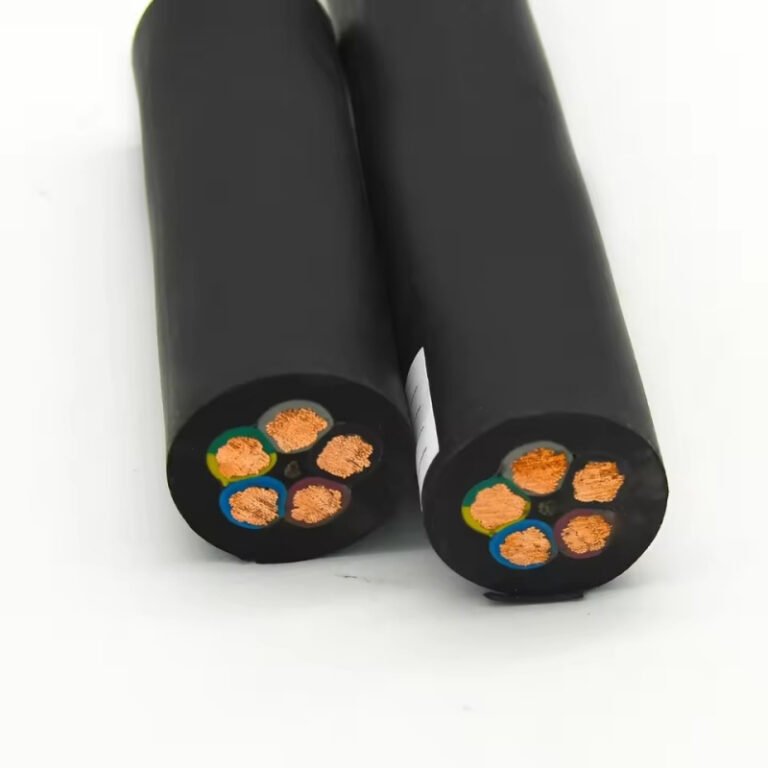
H05RR-F and H07RR-F are the workhorses. Both are rubber-sheathed flexible cords defined under IEC 60245 — H05 rated to 300/500 V, H07 to 450/750 V. The natural rubber or polychloroprene (neoprene) sheath handles moderate mechanical abuse, oil splash, and temperature swings from roughly −25°C to +60°C. You’ll find these on portable tools, workshop extension leads, and light-duty machine connections. H07RR-F is the one most warehouse managers default to when someone asks for “a flexible cable,” and most of the time that’s fine. Where it fails is in continuous heavy-duty trailing service — it wasn’t designed for that.
EPR-insulated trailing cables are a different animal entirely. Ethylene propylene rubber insulation, typically with a reinforced sheath (CSP or HOFR compound), built to IEC 60502 or — for marine and offshore — IEC 60092. These cables are designed for continuous dynamic use: port gantry cranes, open-cast mining equipment, ship-to-shore connections. Voltage ratings typically run from 1 kV up to 6.6 kV or 11 kV depending on the application. The sheath compounds resist ozone, UV, and the kind of crushing contact loads you get when a cable runs across a quay deck. Stocking these requires knowing the voltage class and the trailing length — a 500 m drum of 3.8/6.6 kV EPR trailing cable is a significant procurement commitment and should be sized to a specific project, not held as generic stock.
Silicone-insulated cables rated to 180°C or 200°C continuous (per UL 3212 or IEC 60092-354 where applicable) serve furnace connections, kiln instrumentation, and exhaust-adjacent wiring where PVC or standard rubber would degrade within months. Silicone is soft, has poor abrasion resistance, and is expensive — roughly 2× to 4× the cost of equivalent EPR cable depending on cross-section and order volume. Don’t overstock it. It should be pulled for specific thermal applications only.
PUR drag-chain cables are purpose-engineered for automated machinery — pick-and-place systems, robotic arms, CNC gantries. Polyurethane jackets combined with specially stranded fine-wire conductors (often Class 6 per IEC 60228) give these cables rated flex lives of 5–10 million cycles at dynamic bend radii as tight as 5× cable OD. Standard flexible cable in a drag chain will work for a few months; then you start seeing conductor strand fractures and intermittent faults that are genuinely difficult to diagnose. The cost difference between PUR drag-chain cable and general flexible cable is small. The downtime cost of using the wrong one is not.
Reading the Mechanical Ratings — What the Numbers Actually Mean
Flexible cable datasheets carry ratings that are easy to overlook during procurement. These five parameters are the ones that matter for service life:
| Parameter | H07RR-F (IEC 60245) | EPR Trailing Cable (IEC 60502) | PUR Drag-Chain Cable |
|---|---|---|---|
| Min. bend radius (static) | 4× OD | 6× OD | 7.5× OD |
| Min. bend radius (dynamic) | Not rated for continuous flex | 8–10× OD (application dependent) | 5× OD |
| Torsion angle | Not rated | Limited; check manufacturer | ±180°/m for spiral versions |
| Tensile load rating | Low; typically <50 N/mm² conductor area | Medium–high; varies by armoring | Medium; typically specified per cable OD |
| Operating temp range | −25°C to +60°C | −40°C to +90°C (Arctic grades available) | −40°C to +80°C typical |
Arctic-grade EPR trailing cables rated to −40°C are stocked in smaller quantities but matter enormously if you’re supplying port equipment in northern Europe or northern China in winter — sheath brittleness at low temperature is a real failure mode, not a theoretical one.
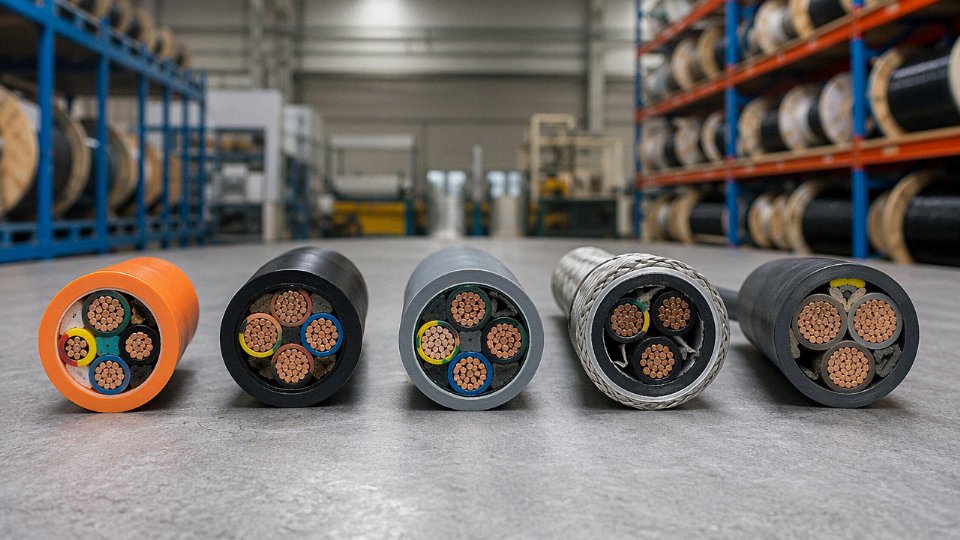
Warehouse Storage and Issue Controls
Coiling diameter is something warehouse staff get wrong constantly. Flexible cable stored on too small a former — or casually heaped in a bin — can develop permanent set in the conductors even before it’s installed. The minimum storage coil diameter should respect the static bend radius, which for H07RR-F on a 2.5 mm² cable is typically around 60–80 mm minimum; check the datasheet rather than guessing.
Rubber-sheathed flexible cable stored beyond 24 months should undergo a spot insulation resistance check before issue, with IR values expected to exceed 1 MΩ under IEC 60245 guidance.True
Rubber and polychloroprene compounds age through oxidation and ozone attack even in storage. IEC 60245 test protocols reference 1 MΩ as a minimum acceptance threshold; cables showing degraded IR in storage are a genuine fault risk once energized in portable equipment.
Color coding is another issue that bites international project sites. IEC 60083 regional conventions differ — brown/blue/green-yellow is standard across most of Europe and increasingly in export markets, but older stock and certain regional variants use different schemes. Verifying color coding at goods receipt prevents the situation where a site electrician in one country receives extension cables assembled for another market and connects them with an incorrect assumption about phase and neutral. On a multi-national project site, this is not a hypothetical.
In practice, a well-managed warehouse will carry H07RR-F in 1.5, 2.5, and 4 mm² as standard stock, hold EPR trailing cable against specific project orders, and treat silicone and PUR drag-chain cable as project-specific items rather than general inventory. That balance keeps working capital reasonable without leaving maintenance teams scrambling.
Type 5 — Specialty and Low-Smoke Zero-Halogen (LSZH) Cable: Fire Safety, Marine, Solar, and Mission-Critical Applications
This is the category where a warehouse substitution error stops being a paperwork problem and becomes a fatality risk or a six-figure rip-out. Every other cable type has some margin for error. LSZH and specialty cables do not.
What LSZH Actually Means — and Why the Chemistry Matters
LSZH (also written LSOH or LS0H depending on the standard body) is defined by three measurable fire-performance properties, each with its own test method. Low smoke emission is verified under IEC 61034-2: the cable must achieve at least 60% light transmittance in a three-meter burn chamber, meaning smoke density stays low enough that occupants can see and move. Zero halogen content is confirmed under IEC 60754-1, which sets HCl release below 0.5% by mass — because halogen-based combustion gases are corrosive and toxic at concentrations that incapacitate people before fire spreads. Flame retardancy is governed by IEC 60332-3, with categories A, B, or C assigned based on cable fill density in a bundled installation; a tightly packed cable tray in a data center demands Category A, the most stringent.
The reason this matters most in confined spaces — rail cars, ship engine rooms, road tunnels, offshore platform cable decks, underground metro signaling rooms — is consequence logic. In an open warehouse fire, smoke disperses. In a sealed subway car or a submarine cable run, toxic combustion products from burning PVC sheathing reach lethal concentrations within two to three minutes. People are incapacitated long before flames arrive. LSZH insulation buys evacuation time. That is the only reason it exists, and it is sufficient.
The Specialty Sub-Categories a Serious Warehouse Should Stock
Marine shipboard cables built to the IEC 60092 series carry mud- and oil-resistant outer sheaths, and the better grades are also flame-retardant to IEC 60332. If your customers include shipyards or offshore operators, you need DNV GL or Bureau Veritas test marks physically present on the drum documentation — not just claimed on a spec sheet.
Photovoltaic solar cables have become a high-volume specialty line almost overnight. Rated for DC voltages up to 1,500 V (IEC 62930, EN 50618, TÜV 2 Pfg 2279), they require UV resistance, ozone resistance, and cross-linked insulation that holds up across temperature swings of roughly -40°C to +90°C over a 25-year installation life. Standard building wire will degrade in rooftop UV exposure within three to five years, sometimes faster in equatorial climates.
Fire-resistant cables — not to be confused with flame-retardant — must maintain circuit integrity at 750°C for a minimum of three hours under IEC 60331-21. These go to fire pump circuits, emergency lighting, smoke extraction fan controls: anything that must keep working while the building burns. The mineral insulation or mica-tape construction that achieves this is completely different from LSZH sheathing, and the two properties are sometimes combined in a single cable for critical infrastructure. Always check: does the drum label show both IEC 60332-3 (flame retardancy) and IEC 60331-21 (circuit integrity under fire) certification? Many cables claim one but not both.
Data center structured cabling — Cat 6A copper or OS2 single-mode fiber — rounds out the specialty inventory for a globally oriented warehouse. Certification here shifts from fire performance to transmission performance (TIA-568-C.2, ISO/IEC 11801), though LSZH jacket requirements are standard in most European and Asian data center specifications.
Documentation and Segregation — Where Most Warehouses Fail
PVC cable installed in place of LSZH cable in a subway signaling room has triggered full rip-out projects costing upward of USD 500,000 per incident after fire safety audits.True
This is consistent with documented outcomes from transit authority fire compliance audits in multiple countries, where non-compliant cable substitutions in safety-critical zones require complete removal and reinstallation under traffic disruption conditions, with costs driven by confined-space labor rates, traffic management, and system recertification.
That figure is not hypothetical. The labor cost of cable removal in a live subway environment — confined access, possession windows measured in hours, recertification requirements — routinely exceeds the cable material cost by a factor of ten or more.
Specialty cable requires its own warehouse zone, physically separated and labeled “HIGH-SPEC — DO NOT SUBSTITUTE.” Third-party test reports (BASEC, DNV, Bureau Veritas, CCS) travel with the drum, not just the datasheet. Material composition declarations covering REACH and RoHS compliance should be on file before any shipment clears customs into the EU or into jurisdictions with active chemical substance controls.
The mandatory cross-reference protocol is simple but frequently skipped: any maintenance or project pick against a specialty cable part number requires a second sign-off confirming the replacement spool carries identical fire-test certification. In practice, a rushed night-shift electrician grabbing a visually similar cable from the wrong rack is exactly how these failures happen. Labeling and physical separation are not bureaucratic excess — they are the only reliable barrier.
How to Build a Five-Type Cable Classification System for Your Warehouse: Racking, Labeling, and Inventory SOPs
Getting the taxonomy right on paper is one thing. Getting it to work on a concrete floor, at 6 a.m., when a site crew is waiting on 400 meters of armored cable that someone stored in the wrong aisle three months ago — that’s the real test.
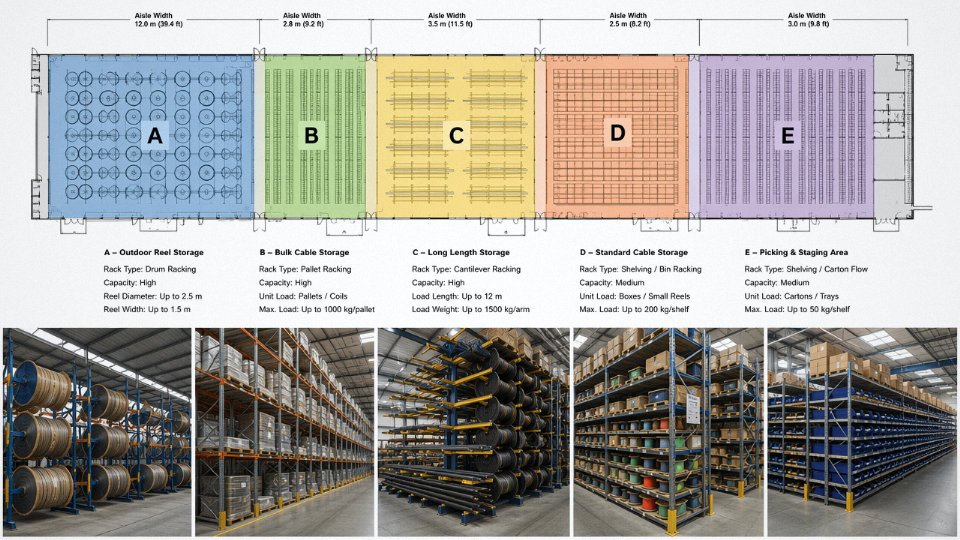
Zone-Based Racking: Match the Physical Format to the Cable Type
Start with the physical reality: different cable types arrive in wildly different formats, weights, and frequencies of movement. Forcing them onto identical racking is how you end up with a forklift nudging a 2-tonne MV drum past a shelf of delicate instrumentation reels.
Zone A — Building Wire. Highest throughput, lowest unit value. Horizontal cantilever racks with drum rollers work best here; they let a two-person team spin a spool and pull length without lifting. Aisle width should be at least 3.5 m to allow a powered pallet jack to maneuver loaded drums. Rack bays should be rated for a minimum of 500 kg per arm — typical 300 mm² building wire drums run 200–350 kg depending on spool size and conductor material.
Zone B — Medium and High Voltage Power Cable. Heavy drums — anything from 800 kg to over 3 tonnes — belong on ground-level A-frame cradles, steel welded, not bolted knock-down frames that walk under load. Forklift access lanes of at least 4 m clear width are non-negotiable; a standard counterbalance truck needs that room to approach at angle. Keep this zone near the goods-in bay. Rolling a 2-tonne drum across a warehouse floor is a injury waiting to happen.
Zone C — Control and Instrumentation Cable. Lighter reels, often 20–80 kg, but they need individual protection. Bin shelving at 200–300 kg per shelf is adequate. Bag the cut ends — conductor oxidation and moisture ingress at an open end can compromise signal integrity, especially on low-capacitance instrumentation cable. Separate control cable from instrumentation cable within the zone; they look nearly identical and get transposed constantly.
Zone D — Flexible and Rubber-Sheathed Cable. Coil hangers and reel stands rather than flat shelving — coiling flexible cable over a sharp shelf edge accelerates jacket cracking. If you’re stocking rubber-sheathed cable (neoprene, CPE, or EP rubber), temperature matters. Storage above roughly 40°C accelerates compound aging; in warm climates or near furnace bays, a temperature-controlled area or at least roof insulation above this zone is worth the cost. Minimum 250 kg/m² floor load for reel stand clusters.
Zone E — Specialty and LSZH Cable. Enclosed shelving with lockable access. This is not bureaucracy — it prevents inadvertent substitution of standard PVC cable into a fire-rated circuit. A documentation pouch on every drum or reel, containing the test certificate and fire-performance declaration, is mandatory. If the pouch is empty, the cable doesn’t move. That rule needs to be written into the SOP, not left to individual judgment.
Seven-Field Label Schema and QR Integration
Every drum and reel in the warehouse should carry a label encoding seven fields: (1) supplier product code, (2) cable type classification using the shorthand BW / PWR / CTL / FLX / SPC, (3) conductor size and core count, (4) voltage rating, (5) applicable standard and certification number, (6) drum or reel serial number cross-referenced to the test certificate, and (7) remaining length in meters — updated after every partial issue, by the person who made the cut, before the drum goes back to the rack.
Encode all seven fields into a single QR code. Most WMS platforms — SAP EWM, Fishbowl, inFlow — can generate and scan these without custom development. The QR scan at point of issue should auto-deduct the cut length from the WMS record. If your warehouse is still using pen-and-paper length logs, the remaining-length field is the one that will drift most, and a 50-meter discrepancy on an MV power cable drum has real project cost implications.
A seven-field QR label updated at every partial issue eliminates the most common warehouse cable discrepancy — remaining length mismatch — which can cause project delays and incorrect procurement reorders.True
Partial-issue logging failures are the primary source of WMS-to-physical inventory mismatches for cable stock, where length rather than unit count is the inventory unit. Real-time QR-updated records prevent over-ordering and stockouts on active projects.
Three SOPs That Actually Get Used
Receipt Inspection SOP. When a delivery arrives: visual check of the outer sheath for transit damage, measurement of overall diameter against the spec sheet (a caliper takes 30 seconds and catches wrong-grade substitutions), and an insulation resistance test on a 10% sample of drums — IR values vary by cable type and voltage rating, so use the manufacturer’s minimum stated value as the acceptance threshold, not a generic number. Match every drum serial number to its test certificate before the goods-in stamp goes on. No certificate, no entry into Zone E under any circumstances.
Issue SOP. WMS pick confirmation before the cable moves. After cutting, log the exact cut length, reseal the drum end with an appropriate end-cap — a rubber push-in cap for larger conductors, heat-shrink for smaller cores — and return the drum to its rack position before processing the next pick. Leaving cut drums on the floor in a busy warehouse guarantees jacket damage and length confusion.
Annual Audit SOP. Any cable stored beyond 18 months gets a full IR re-test before it’s issued to a project. Compare physical remaining lengths against WMS records and investigate discrepancies above 2–3%. Cables with damaged insulation, compromised end-seals, or expired fire-performance shelf-life certificates — some LSZH and halogen-free compound cables carry a stated shelf life of 5–10 years from manufacture date, not from installation — go to a quarantine bay pending disposal. Disposing of a $400 reel is painful. Pulling it out of a live installation because it failed an IR test is far more expensive.
Sourcing and Quality Assurance: What to Demand from a Cable Manufacturer Before Committing to a Bulk Order
Bulk cable procurement is one of the highest-risk purchasing decisions in any capital project. The unit cost looks manageable on a line item, but a single non-compliant drum discovered mid-installation — failed insulation resistance, undersized conductor cross-section, wrong fire class — can cascade into rewiring costs, project delays, and in the worst cases, certification rejection of an entire installation. Before any purchase order is raised, the supplier evaluation process deserves the same rigor you’d apply to a pressure vessel or a switchgear panel.
The Six Non-Negotiable Quality Credentials
ISO 9001 certification is the baseline. Not a talking point — a dated, scope-specific certificate from an accredited registrar, valid at the time of order. Ask for the certificate number and verify it against the registrar’s online database. A surprising number of suppliers present lapsed or out-of-scope certificates.
Product certifications must match your target market. This is where specification errors actually happen. CCC covers China domestic distribution; CE marking with a CPR Declaration of Performance is mandatory for construction products entering the EU under the Construction Products Regulation; UL listing applies to the North American market and is not interchangeable with CE; DNV or Bureau Veritas type approval is required for marine cable; TÜV or equivalent IEC 61215/61730-aligned certification is expected for PV cables going into bankable solar projects. A cable bearing the wrong certification — or no certification — is not a minor paperwork gap. It’s a liability that can void your insurance and delay grid-connection approvals.
In-house accredited test laboratory with traceable calibration records. Ask specifically for conductor resistance test results (per IEC 60228 class), insulation resistance, high-voltage AC withstand, and — for LSZH or fire-rated cables — oxygen index, smoke density, and halogen acid gas emission test data. The key word is traceable: every instrument in that lab should have a current calibration certificate referencing a national or international standard. Some suppliers have a room labeled “lab” with equipment that hasn’t been calibrated since the previous decade.
Raw material traceability. You need a documented chain from copper rod lot number through drawing, stranding, and extrusion to the finished drum serial number. This matters when a quality problem surfaces at the installation site — without traceability, you cannot determine whether it’s a batch problem affecting ten drums or an isolated defect on one.
Process control records. Request extrusion temperature logs and spark test pass rates for recent production batches. World-class manufacturers typically run below 0.5% spark test rejection on insulation — if a supplier can’t give you a percentage, that’s a red flag. Extrusion temperature deviation records tell you whether the process is actually under control or just appears to be.
Third-party factory audit within the previous 24 months, conducted by a body the buyer recognizes — SGS, Bureau Veritas, Intertek, TÜV SÜD. An audit report, not just a certificate. Read the non-conformances section, not just the summary.
What to Look for During a Factory Visit
For high-value or long-term contracts, a physical visit is worth the airfare. On the conductor drawing lines, verify the machines can produce Class 5 or Class 6 fine-wire conductors — not every plant that claims flexible cable capability actually has the fine-wire drawing capacity to do it properly. On extrusion lines, check for laser micrometer feedback loops providing real-time wall-thickness measurement; manual sampling alone is insufficient for consistent production. On armouring lines, confirm that lay-length verification gauges are in active use, not sitting on a shelf. In the finished goods warehouse, look at how drums are stored — timber-lagged drums on bare concrete exposed to standing water is a moisture ingress problem waiting to happen, and it’s more common than you’d think.
Jinda’s Supply-Chain Position for International Procurement
Shandong Jinda Special Cable Group operates five production bases across China with a combined manufacturing footprint of approximately 470,000 m², supporting simultaneous multi-project supply across power, petrochemical, rail, marine, and renewable energy sectors.True
This reflects Jinda's publicly documented manufacturing capacity and facility data as stated in company materials.
Geographic redundancy across five bases matters more than it sounds. When a single-site supplier hits a production bottleneck — a raw material shortage, a major domestic order, a maintenance shutdown — your shipment gets deprioritized. Capacity spread across multiple sites gives a manufacturer actual flexibility to protect international commitments.
For cross-border procurement specifically, Jinda’s international team handles the documentary requirements that trip up first-time importers: letter-of-credit terms, SGS or Bureau Veritas pre-shipment inspection coordination, and sea-freight drum packaging to ISO standards that protect cable integrity through multi-week ocean transit. A 35-year operating history across more than 50 countries means the paperwork is not a new problem — the procedures exist because they’ve been stress-tested across enough projects and shipping routes to matter.
The technical support function is worth asking about during supplier evaluation. Can they provide application engineering input if your project specification has an unusual combination of requirements — say, LSZH insulation on a medium-voltage armored cable for a tunnel installation? Manufacturers who only sell from a catalogue are a poor fit for projects with any specification complexity.
Frequently Asked Questions About Warehouse Wire and Cable Types
These questions come up constantly — from procurement managers who’ve just been handed a cable BOM for the first time, to experienced warehouse supervisors dealing with a substitution request at 11 PM before a morning shutdown. The answers below reflect how these situations actually play out on site.
Can I substitute a standard PVC cable for an LSZH cable if the LSZH type is out of stock?
No. Full stop. IEC 60332 (flame propagation), IEC 61034 (smoke density), and IEC 60754 (halogen acid gas emission) are not preferences — in most contract documents for rail, marine, offshore, and public building installations, they are binding specification obligations. A standard PVC cable will fail all three halogen and smoke tests. Beyond the technical failure, substituting PVC in a regulated environment voids insurance coverage, creates a contractual breach that can trigger significant delay claims, and in the worst case puts occupants at risk during a fire event. The right answer operationally is to prevent the situation from arising: maintain a minimum safety stock buffer of LSZH cable sized to your typical lead time from the manufacturer, usually 8–14 weeks for non-standard constructions. If you’re already out of stock and under pressure, the only defensible route is a formal engineering deviation request reviewed by the responsible engineer — never a quiet swap by the warehouse team.
What is the shelf life of cable stored in a warehouse, and when should stock be retested?
PVC-insulated cables stored correctly — dry, UV-protected, above 0°C, on undamaged drums — have a practical shelf life of roughly 10–15 years. Most manufacturers and IEC guidance notes recommend an insulation resistance re-test after 5 years of storage, regardless of appearance. Rubber and LSZH compounds are more sensitive to ozone and UV degradation; 3–5 years is the reasonable retest window for those. EPR and silicone-insulated cables are considerably more thermally stable and can maintain their properties for 20-plus years under ideal conditions, though “ideal” is doing a lot of work in most warehouses. Seasonal temperature cycling, a leaking roof one winter, a forklift that nudged a drum — all of these shorten effective life. Always check the manufacturer’s storage recommendation printed on the drum label; it overrides any generic rule of thumb.
How do I quickly identify whether a cable is copper or aluminum conductor without stripping it?
Weight is the fastest field indicator by far. Aluminum conductor cable is roughly 48% lighter than an equivalent copper cable for the same cross-section and length. A 500 m drum of 4×95 mm² aluminum cable weighs somewhere in the 280–300 kg range; the copper equivalent runs 700–720 kg. Pick up one end of a 10 m offcut — you’ll know immediately. Cut ends also tell you something: copper holds a bright reddish-brown color for a while after cutting, while aluminum oxidizes to a dull gray-white patina within hours. That said, the drum label and test certificate are the authoritative source. Relying on a visual check alone on aged or dirty cable ends is asking for trouble.
IEC 60228 defines standard conductor cross-sections from 0.5 mm² to 2,500 mm², covering the vast majority of industrial cable applications.True
IEC 60228:2004 is the internationally recognized standard for conductors in insulated cables and specifies nominal cross-sectional areas from 0.5 mm² through 2,500 mm² across all conductor classes.
What is the difference between a screened cable and a shielded cable?
In most international usage, the terms are functionally interchangeable — both refer to a conductive layer surrounding the conductors to block electromagnetic interference. The distinction that sometimes matters in practice: “screen” tends to refer to foil constructions (aluminum or copper foil laminated to a carrier), while “shield” more often describes braided wire constructions. Foil screens give near-100% coverage but higher transfer impedance at elevated frequencies. Braid shields typically provide 85–98% coverage depending on braid density, but they handle mechanical flexing better and give you a lower-resistance path for the drain wire connection. For VFD-fed motor circuits operating above roughly 10 kHz, a braid shield or combined foil-plus-braid construction is worth specifying — foil-only screens can be inadequate for the high-frequency noise those drives generate.
How much of each cable type should a project warehouse hold as minimum safety stock?
The right number depends heavily on your supplier’s lead time and minimum order quantity, but a working rule for large EPC projects: hold 15–20% above the project BOM quantity for building wire and control cable, since waste cuts, rework, and late change orders eat into those quantities faster than engineers expect. Power cable buffers can be tighter — around 10% above BOM — because the higher unit cost and longer lead time make over-ordering expensive, and the quantities are usually better defined early. Specialty cables, particularly LSZH and fire-resistant types, warrant 25–30% over BOM despite the higher holding cost, because manufacturing lead times are longer and substitution is simply not an option. Getting caught short on LSZH cable two weeks before system commissioning is a problem no procurement team wants to explain.