You pull a reel of coaxial cable off the shelf, run it through a 30-meter conduit to the distribution amp, and signal levels come back soft — maybe 3 dB lower than spec. The installer blames the splitter. You blame the amp. Nobody thinks to question the cable itself until someone finally cuts the end and notices the conductor has that slightly grey, lighter-than-it-should-be look of copper-clad aluminum rather than solid copper. That discovery, made after the wall is closed, turns a one-hour job into a half-day rework, and in a multi-unit residential install, it multiplies fast.
Most TV coaxial cable uses copper as the primary conductor material, but not always solid copper. The center conductor may be solid bare copper, copper-clad aluminum (CCA), or copper-clad steel, depending on the cable grade and intended application. The outer braid or foil shield is typically aluminum or aluminum-plus-copper braid. Only premium or broadcast-specification cables use copper throughout all conductive layers.
What makes this worth understanding is that the difference between conductor types is not just a materials trivia question — it shows up directly in attenuation figures, low-frequency performance, and long-run signal integrity in ways that matter whether you’re speccing cable for a headend distribution system or buying 500 reels for a hotel fitout. And the market does not make it easy to tell them apart at a glance.
Copper vs. Copper-Clad Aluminum vs. Tinned Copper: Conductor Material Compared for TV Signal Applications
The conductor at the heart of a coaxial cable is not a commodity detail — it determines how much signal reaches the end of the run, how long the installation stays reliable, and ultimately whether you need amplifiers you wouldn’t otherwise have paid for. Three materials dominate real-world TV cable production: solid bare copper, copper-clad aluminum (CCA), and tinned copper. They are not interchangeable, and the differences matter more than most spec sheets admit.
Solid Bare Copper
Pure copper sits at roughly 58 MS/m conductivity — that’s the IACS 100% reference point, the benchmark everything else is measured against. In practice, a well-drawn oxygen-free copper conductor in an RG-6 coaxial cable will exhibit attenuation in the range of about 2–6 dB per 100 feet across the 50 MHz to 1 GHz band, though the actual figure depends on stranding, dielectric quality, and shielding configuration, not just the conductor alone.
Broadcast headends, CATV trunk lines, and permanent AV infrastructure almost always specify solid bare copper. The raw material cost is higher — typically 30–60% more than CCA on a per-meter basis, depending on copper pricing at the time of procurement — but the total installed cost often ends up lower. Fewer amplifiers, fewer distribution amps spaced farther apart, lower power draw over the life of the system. On a 200-meter CATV feeder run, the difference in accumulated signal loss between solid copper and CCA can push you into needing an extra amplifier stage that solid copper would have avoided entirely.
Copper-Clad Aluminum (CCA)
CCA is aluminum rod with a thin copper layer bonded to the outer surface, typically 10–15% of the conductor radius by volume. The physics behind it are real: at RF frequencies from about 50 MHz upward, current concentrates in the outer skin of the conductor — the skin effect. At 100 MHz, skin depth in copper is on the order of 6–7 micrometers. CCA exploits this by putting copper exactly where the RF current flows, while keeping the core mass in cheaper, lighter aluminum.
It works, within limits. For runs under roughly 30–50 meters, CCA performance in TV signal applications is often acceptable. Past that threshold, the resistivity penalty — CCA runs 40–45% higher than solid copper — accumulates into measurable dB losses that solid copper wouldn’t produce. The weight saving is real (aluminum is about one-third the density of copper), which matters for aerial span installations and labor on large pulls.
CCA conductor can fully match solid copper performance on any coaxial cable runFalse
CCA resistivity is approximately 40–45% higher than pure copper. While the skin effect partially compensates at RF frequencies on short runs, the performance gap becomes significant on cable runs exceeding 30–50 meters, leading to higher attenuation and potential need for additional amplification.
Tinned Copper (TC)
Bare copper oxidizes. In a humid equipment room or a coastal outdoor antenna installation, bare copper strands can develop a resistive oxide layer at the strand interfaces over a period of years, gradually degrading conductivity in ways that aren’t immediately obvious until signal levels start drifting. Tinned copper addresses this by coating each strand with a thin tin layer — usually a few micrometers — before stranding.
The conductivity penalty is small, roughly 5–8% below bare copper depending on tin thickness and plating uniformity. For most TV antenna and satellite dish drop cable applications, that’s a trade you take without hesitation in humid, marine, or direct-burial environments. Tinned copper is also significantly easier to solder cleanly, which matters during field termination.
Skin Effect and Why It Defines the CCA Debate
The skin effect is not a loophole — it’s a frequency-dependent physical phenomenon. At DC or low audio frequencies, current distributes across the full conductor cross-section, so aluminum’s bulk conductivity disadvantage is fully exposed. As frequency climbs into the TV band (54 MHz and above for terrestrial broadcast, up past 950 MHz–2.15 GHz for satellite IF), current migrates to the surface, and the thin copper cladding on CCA carries more of the load. This is why CCA can legitimately serve short TV drops but is a poor choice for CATV distribution networks where trunk runs extend hundreds of meters.
Conductor Material Comparison: TV Cable Applications
| Property | Solid Bare Copper | Copper-Clad Aluminum (CCA) | Tinned Copper |
|---|---|---|---|
| Conductivity (approx.) | ~58 MS/m (IACS 100%) | ~35–38 MS/m effective | ~53–55 MS/m |
| Weight per meter (relative) | High (1.0×) | Low (~0.4×) | High (~1.0×) |
| Typical cost index | High | Low–Medium | Medium–High |
| Recommended max run (TV signal) | 200+ meters | 30–50 meters (unamplifed) | 150–200 meters |
| Best application | CATV trunk, broadcast, pro AV | Short indoor drops, budget installs | Marine, outdoor, humid environments |
| Corrosion resistance | Moderate | Moderate (depends on cladding integrity) | High |
The Procurement Reality
Here is where procurement managers get burned: a cable labeled “RG-6” or even “coaxial TV cable” tells you the impedance geometry, not the conductor material. In some market segments — particularly lower-cost import product — CCA is used without prominent labeling, and the difference is invisible until the installer measures attenuation at the end of a long run and wonders why it’s 4 dB worse than expected.
Specify conductor material explicitly in every purchase order and request mill certificates or third-party test reports confirming conductivity. A quick DC resistance test per unit length in incoming QC — simple, fast, requires only a basic bridge meter — will immediately flag CCA substitution on a supposedly solid-copper order. Don’t rely on visual inspection alone; the copper surface of CCA looks identical to solid copper at the cut end unless you look for the aluminum core.
RG-6, RG-59, and RG-11: Which TV Coaxial Cable Uses Which Copper Configuration
The “RG” designation — originally a U.S. military shorthand from the 1940s — tells you remarkably little on its own. What actually matters for TV signal delivery is the center conductor diameter, the conductor material, the dielectric geometry, and the shielding architecture. These four variables interact. Get one wrong and the others can’t compensate.
RG-59: The Legacy Standard That Hasn’t Quite Died
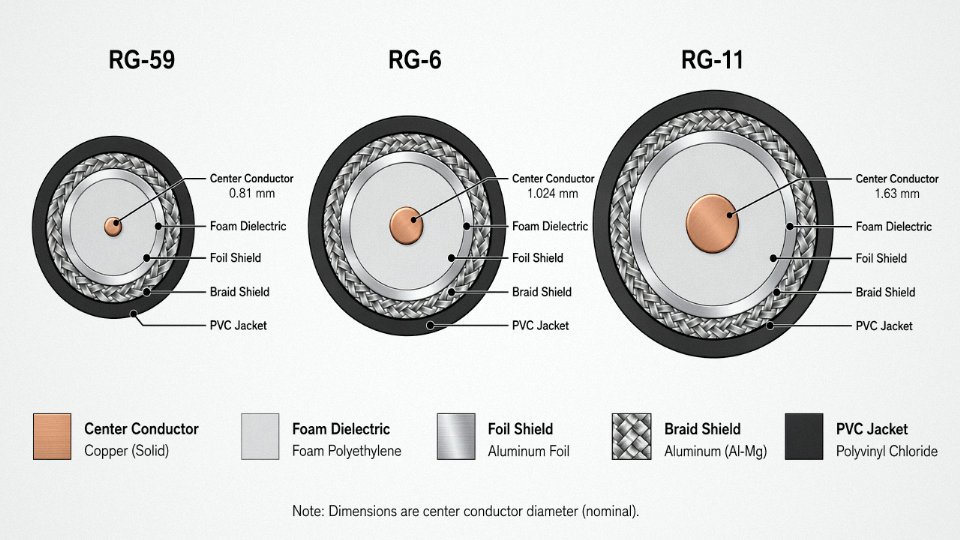
RG-59 carries a 0.81 mm center conductor, typically solid copper or, in cheaper stock, CCA. The 75-ohm impedance is the same as RG-6 and RG-11 — that part is standardized — but the thinner conductor means higher attenuation per unit length. In practice, RG-59 starts becoming a real liability somewhere beyond 150 feet, especially once you’re pushing frequencies above 100 MHz. For analog CCTV and older baseband cable TV feeds running composite video, that limitation rarely mattered. Runs were short, frequencies were low, and the install base is enormous, so you still see it in legacy buildings everywhere.
Specifying RG-59 for a new digital cable or satellite installation is a mistake. The math just doesn’t work at 950–2150 MHz satellite IF frequencies. Swap it out.
RG-6: The Workhorse of Modern TV Cabling
This is the cable that actually runs residential and light-commercial TV signal distribution today. The center conductor is nominally 1.024 mm — roughly 18 AWG — in solid copper or CCA. That extra diameter compared to RG-59 drops the attenuation meaningfully: a solid-copper RG-6 typically measures somewhere in the 2–6 dB per 100 feet range across 50 MHz to 1 GHz, depending on conductor purity and dielectric foam uniformity. The upper end of that range often reflects CCA construction or inconsistent foam density, not just frequency.
RG-6 handles digital cable, over-the-air antenna signals, and satellite IF bands up to roughly 2.15 GHz without major issues on runs under 300 feet. The shielding options matter here. A basic 60% aluminum braid with a foil layer (dual-shield) is adequate for most residential installs away from strong RF interference. Quad-shield — foil plus 60% braid, foil again, then another 40–60% braid layer — is worth the modest cost premium in commercial environments, near cellular infrastructure, or in any building with dense electrical noise. The copper braid specifically, rather than aluminum, provides a meaningful improvement in low-frequency interference rejection below roughly 10 MHz, which matters for installations near power distribution equipment.
RG-11: When the Run Is Too Long for RG-6 to Handle
RG-11 uses a center conductor around 1.63 mm — roughly 14 AWG solid copper — and that larger cross-section is the whole point. Lower conductor resistance, lower attenuation per foot, better signal preservation on long trunk runs. CATV distribution systems, satellite MDU (multi-dwelling unit) head-end feeds, and campus installations regularly spec RG-11 for any run beyond 150–200 feet where you can’t or don’t want to add an amplifier. Runs up to 800–1000 feet are feasible depending on frequency and acceptable signal budget.
The tradeoff is real. RG-11 is stiffer, heavier, harder to route through conduit bends, and costs noticeably more per foot. Most installers treat it as a backbone cable — main trunk from the dish or head-end to a splitter closet — then transition to RG-6 for the final drops to individual units or rooms.
Impedance Stability and Why Conductor Material Isn’t Just About Loss
Here’s something that gets overlooked in purely attenuation-focused comparisons. Solid copper maintains the 75-ohm characteristic impedance more consistently across temperature swings than CCA. Aluminum’s thermal expansion coefficient is about 35–40% higher than copper’s. In an outdoor trunk run cycling between, say, -20°C in winter and 60°C on a sun-exposed roof in summer, that differential expansion creates micro-variations in the conductor-to-dielectric geometry, which in turn cause small impedance discontinuities. In a simple two-device setup you’d never notice. In a distribution network with cascaded splitters and long runs, those reflections accumulate and can push signal quality below acceptable thresholds — particularly in DOCSIS cable modem systems that are sensitive to return-path signal integrity.
Solid copper center conductors maintain more consistent 75-ohm impedance across temperature fluctuations compared to CCA conductors in coaxial cableTrue
Aluminum's higher thermal expansion coefficient (~23.1 µm/m·°C vs. copper's ~16.5 µm/m·°C) causes greater dimensional change in CCA conductors under temperature cycling, introducing geometric variation in the conductor-dielectric interface and resulting in impedance inconsistencies that can produce signal reflections in complex distribution networks.
Manufacturing Tolerances: Where These Cables Succeed or Fail
Producing RG-6, RG-59, and RG-11 to specification isn’t complicated in concept — but tolerance stack-up is where cut-rate production shows up in the field. The center conductor diameter has to hit its nominal within roughly ±0.01–0.02 mm. Dielectric foam density directly affects the velocity of propagation and the dielectric constant, both of which feed into attenuation and impedance calculations. Braid coverage angle has to be consistent; a braid laid at the wrong helix angle doesn’t achieve its rated coverage percentage, and 60% braid that’s actually covering 48% is a different cable than what was specified.
Vertical integration — specifically in-house wire drawing — gives a manufacturer direct control over conductor diameter and surface finish before the dielectric is ever applied. That’s not a minor detail. Conductor surface roughness at microwave frequencies contributes to skin-effect losses, and a wire drawing process optimized for signal cable is different from one optimized for power cable. In a plant running both, the process discipline has to be maintained separately.
How Conductor Material Directly Affects TV Signal Quality, Attenuation, and Transmission Distance
Signal attenuation is simply energy lost as the signal travels down the cable — expressed in dB per 100 feet or per 100 meters, depending on which part of the world you’re specifying for. Lower attenuation means more signal arrives at the tuner, splitter, or head-end receiver, and it directly determines whether you can reach a given terminal without bolting on an amplifier. That last part matters more than most people realize on large installations.
What the Numbers Actually Look Like
Solid copper RG-6 — the real stuff, not the shiny knockoff on the pallet — runs roughly 1.5 dB/100 ft at 100 MHz, around 2.8 dB/100 ft at 400 MHz, and approximately 5.5 dB/100 ft at 1 GHz. Those figures shift depending on dielectric quality, shield construction, and how consistently the center conductor diameter was held during extrusion, but they’re a reasonable working baseline for specifying headroom.
CCA (Copper-Clad Aluminum) versions of nominally the same cable typically show 15–25% higher attenuation at equivalent frequencies. On a 50-foot drop in a hotel room? Probably irrelevant. On a 200-foot trunk run feeding three splitters in a residential MDU or a small commercial installation, that penalty compounds fast.
CCA coaxial cable exhibits noticeably higher signal attenuation than solid copper coaxial cable of the same designationTrue
CCA conductors have approximately 40–45% higher resistivity than pure copper, directly increasing ohmic losses along the conductor, which raises attenuation figures by roughly 15–25% depending on frequency and cable construction.
CATV systems typically require a minimum signal level somewhere in the +3 to +5 dBmV range at the terminal device. Run your numbers on a 200-foot pull at 750 MHz — a completely normal distance in a mid-rise building or a house with a detached garage — and the gap between solid copper and CCA can be the deciding factor between passing the minimum threshold or not, before you’ve even accounted for connectors and splitter insertion loss. In practice, that failure mode shows up as pixelation or outright signal dropout, and the first instinct of the installer is usually to blame the dish or the head-end, not the cable they specified cheaply.
Satellite Runs Add a Second Failure Mode
For satellite installations, the center conductor isn’t just carrying signal — it’s carrying DC power to the LNB (Low Noise Block downconverter) at the dish. LNBs typically draw supply voltage in the 13–18 V DC range, and that voltage rides up the same center conductor your signal comes down. CCA conductors have roughly 1.5 times the DC resistance of solid copper at equivalent AWG, so on runs over about 30–40 meters you start seeing enough voltage drop that the LNB either switches into the wrong polarization band or fails to power up at all. I’ve seen this cause an entire satellite system to behave intermittently with temperature — works fine in winter, drops signal on hot afternoons — because aluminum’s higher thermal expansion coefficient changes the connector contact resistance at the crimp or compression fitting seasonally. The installer replaces the LNB. Sometimes twice. The cable was the problem the whole time.
Dimensional Stability Under Stress
Solid copper’s mechanical stiffness, while occasionally irritating during tight conduit pulls, is actually an asset for long-term signal integrity. The center conductor maintains its position within the dielectric foam more consistently when the cable is bent, routed around corners, or thermally cycled. That geometric consistency directly supports return loss and VSWR performance across the operating band — both of which matter in any installation where reflections can cause standing waves bad enough to affect signal quality. CCA’s lower modulus of elasticity means the conductor can shift slightly under repeated mechanical or thermal stress, and once the dielectric geometry drifts, return loss degrades in ways that are difficult to diagnose without a vector network analyzer that most field crews don’t carry.
For professional broadcast infrastructure, this is why solid copper remains the specified material — not nostalgia, not conservatism, but because the failure modes of CCA are slow, intermittent, and expensive to troubleshoot once the cable is inside a wall or conduit run.
How to Identify Whether Your TV Cable Wire Contains Real Copper: Field and Lab Methods
Knowing what a cable claims to contain and knowing what it actually contains are two different things — and the gap between them is where installers, procurement teams, and factory QC engineers lose money. Here are the methods that actually work, roughly ordered from fastest-and-cheapest to most rigorous.
Visual Inspection After Cutting
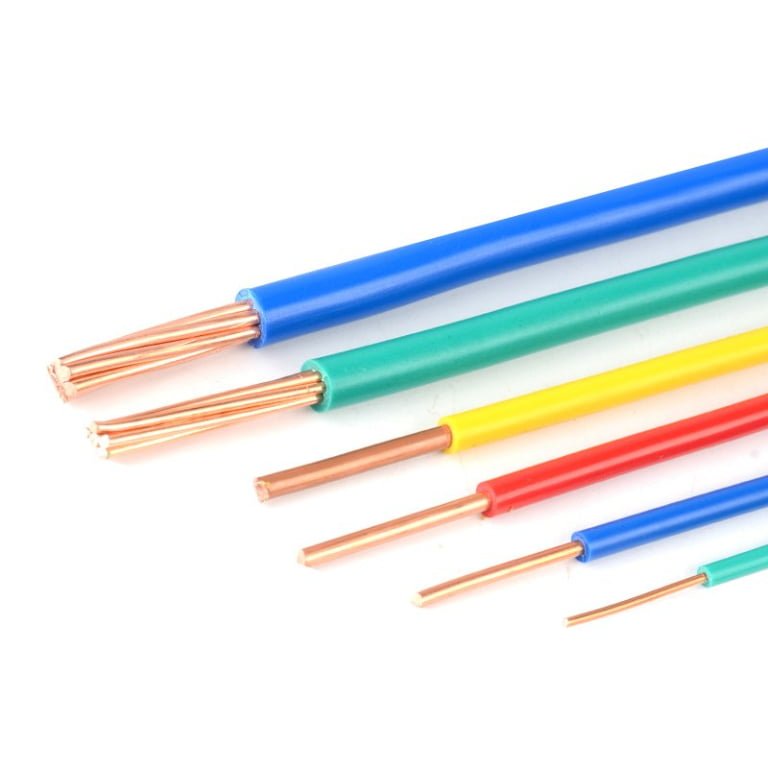
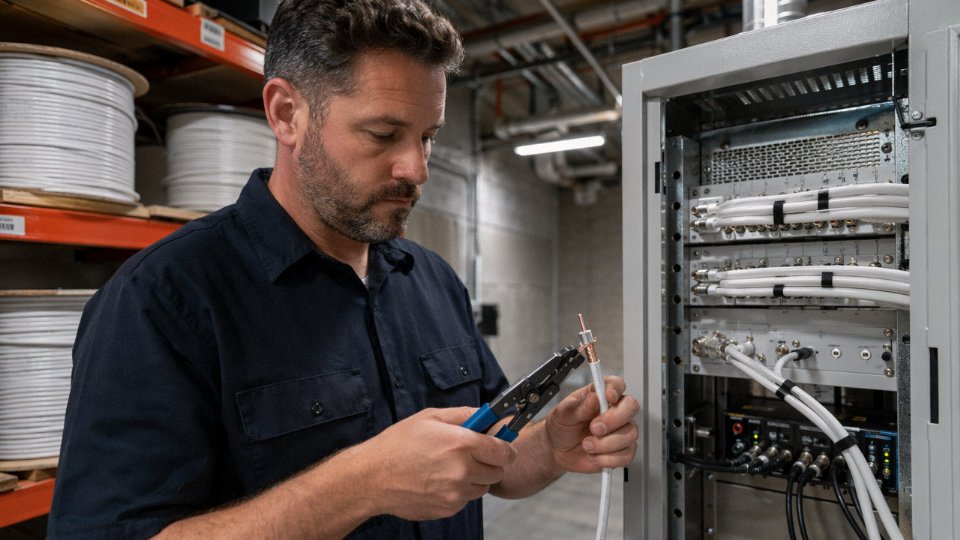
Cut the cable cleanly with a sharp blade or cable stripper and look at the center conductor’s cross-section under decent lighting. Solid copper shows a uniform, warm reddish-orange color all the way through — no layering, no color gradation. CCA (Copper-Clad Aluminum) tells on itself immediately: the core is silvery-gray aluminum, with only a thin copper surface layer visible, and that layer is often thin enough that you need a loupe or a 10× jeweler’s magnifier to see it clearly. The transition line between the copper cladding and the aluminum core is usually visible as a faint ring under magnification.
This is the fastest field check and, in my experience, it catches the obvious substitutions in about 30 seconds. Keep a loupe in your site bag if you’re doing any volume cable inspection work.
The Magnet Test — and Why It Gets Misused
You’ll see this one on YouTube constantly, and it’s mostly useless for distinguishing copper from CCA. Both pure copper and aluminum are non-magnetic, so a magnet that doesn’t stick tells you nothing useful beyond ruling out steel-core conductors (which do exist in some extremely cheap cable). The test cannot distinguish solid copper from CCA. Full stop.
A magnet test can confirm whether a TV cable conductor is solid copper or copper-clad aluminum.False
Both copper and aluminum are non-magnetic materials. A magnet that fails to stick to the conductor confirms only that it is not a ferrous/steel core. It cannot differentiate between solid copper and CCA, making this test unreliable for conductor material identification.
Flame and Heat Testing — Lab Use Only
In a controlled setting — not on a job site, and definitely not in a finished installation — heating behavior can help. Copper oxidizes to a dark, dull surface when heated and returns to a recognizable reddish tone on cooling. Aluminum melts at roughly 660°C versus copper’s ~1085°C, and aluminum oxidizes to a powdery white Al₂O₃ residue rather than the darker copper oxide. A qualified lab technician can distinguish these behaviors with a small sample and a calibrated torch.
That said, this method has no business being used by a consumer or an installer in the field. It destroys the sample, creates fume hazards, and tells you little more than a careful visual inspection would.
Weight as a Proxy Check
Copper has a density of 8.96 g/cm³; aluminum sits at 2.70 g/cm³. A 100-meter reel of RG-6 with a solid copper center conductor typically weighs somewhere in the range of 8–11 kg depending on jacket material and shielding construction. The CCA equivalent for the same reel length usually comes in noticeably lighter — roughly 15–25% less, give or take, depending on cladding thickness. This is not a precise test, but if you’re buying 50 reels and they feel suspiciously light compared to a reference reel from a verified supplier, that’s a red flag worth investigating further.
DC Resistance Measurement with a Digital Multimeter
This is the most practical quantitative field test. Measure the DC resistance of the center conductor over a known length — 100 meters is a convenient benchmark. For a standard 18 AWG solid copper conductor (typical RG-6 center), you’d expect roughly 20–21 Ω per 1,000 meters, or about 2.0–2.1 Ω per 100 meters. CCA conductors of the same nominal AWG will read noticeably higher due to aluminum’s higher resistivity — CCA conductor resistivity runs approximately 40–45% above solid copper. A reading that deviates more than 20% above the published spec for solid copper of that gauge is a strong indicator you’re not looking at solid copper.
Measure both ends shorted together for a loop resistance reading, divide by two for single-conductor resistance, and account for temperature (resistance increases roughly 0.4% per °C above 20°C — worth correcting for if you’re measuring in a hot warehouse in July).
Third-Party Documentation and Markings for Bulk Procurement
For procurement engineers buying cable at volume, none of the above physical tests are substitutes for proper documentation. Look for UL, ETL, CE, or RoHS markings on the cable jacket, and then verify them — counterfeit markings are not rare in commodity cable markets. Request the manufacturer’s test reports showing conductor purity and conductivity measured per IEC 60228 or ASTM B3 for copper. A credible manufacturer will have these on file without hesitation. If a supplier stalls, hedges, or sends a generic spec sheet without traceable test data, treat that as a procurement risk and qualify a second source before committing to volume.
| Test Method | Distinguishes Cu from CCA? | Field-Practical? | Cost |
|---|---|---|---|
| Visual cross-section inspection | Yes (clearly) | Yes | Near zero |
| Magnet test | No | Yes | Zero |
| Flame/heat test | Yes | No (lab only) | Low, but risky |
| Weight comparison | Partial (indicative) | Yes | Zero |
| DMM resistance measurement | Yes (quantitative) | Yes | ~$20–50 meter + multimeter |
| Manufacturer test report / cert | Yes (definitive) | Procurement stage | Admin time |
The resistance measurement and the documented test report together cover most professional needs. Visual inspection covers the rest of the quick field calls.
Coaxial Cable Construction Standards, Certifications, and Specifications Buyers Must Verify
Procurement managers dealing with coaxial cable at volume have one recurring problem: the specification sheet says “copper conductor,” the price looks reasonable, and then a few months into the project — or worse, after installation — performance falls short. Getting this right means knowing exactly which standards to invoke, what test data to demand, and where the documentation chain can quietly break down.
International Standards That Actually Define What You’re Buying
IEC 61196 is the primary series governing coaxial communication cables, covering electrical characteristics, mechanical requirements, and test methods. Different parts of the series address specific cable types, so specifying “IEC 61196 compliant” in a purchase order without citing the relevant part number is vague enough to be nearly useless. Pin down the part that matches your application — drop cable, trunk cable, flexible jumper — and reference it explicitly.
IEC 60228 handles conductor classification and cross-section, defining conductor classes (Class 1 for solid, Class 2 for stranded) and the resistance limits that go with each. If your contract doesn’t reference IEC 60228, a supplier can deliver a conductor that looks right dimensionally but fails on DC resistance — and technically hasn’t violated any agreed specification. That’s a gap worth closing before you issue the purchase order, not after.
For CATV applications specifically, SCTE 74 (coaxial drop cable) and ANSI/SCTE 02 (indoor drop cable) are the standards that matter most to North American projects and to any international project using North American headend equipment. SCTE 74 sets requirements for conductor diameter, dielectric, shielding, and jacket, and it distinguishes clearly between bare copper and copper-clad aluminum conductors — which is exactly the ambiguity you’re trying to eliminate.
Certification Marks and What They Actually Guarantee
UL 1655 covers community antenna television cables; UL 13 covers power-limited circuit cables. Both require production-line testing, not just a one-time type test, and the listing authorizes periodic factory follow-up inspections. ETL listing (issued by Intertek) is a legitimate alternative to UL listing and is accepted by the same National Electrical Code jurisdictions — some buyers reflexively reject ETL marks out of habit, but the technical rigor behind the listing process is comparable.
For EU supply, CE marking under the Low Voltage Directive and the EMC Directive is required. CE marking is self-declared, not third-party certified in most cable cases, so it carries less inherent verification weight than UL listing. Pair it with a Declaration of Conformity and, where budget allows, test reports from an accredited European laboratory.
A UL listing mark on a cable carton guarantees the conductor is bare copper rather than copper-clad aluminum.False
UL listing confirms the cable meets the safety and performance requirements of the relevant standard, but does not itself prohibit CCA conductors unless the specific standard explicitly requires bare copper. The conductor material specification must be stated separately in the purchase contract and verified through mill certificates and conductor DC resistance testing.
What to Require in Factory Test Reports
Don’t accept a generic datasheet. For each production lot, the test report should include conductor DC resistance (Ω/km), velocity of propagation (expressed as a percentage of the speed of light, typically in the 82–87% range for standard foam-dielectric RG-6), characteristic impedance (75 Ω ± 3 Ω for most TV coaxial), capacitance (pF/m), attenuation at multiple spot frequencies, and shield coverage percentage. Attenuation figures mean very little without the test frequency stated — a supplier reporting only 200 MHz results while your application runs to 1 GHz is not hiding it exactly, but they’re not helping you either.
For conductor purity, specify a minimum of 99.9% Cu, which corresponds to C11000 electrolytic tough pitch copper. Request mill certificates with chemical composition analysis on bulk orders. Any competent wire rod supplier issues these routinely; reluctance to provide them is itself a signal.
Red Flags in Supplier Sourcing
Pricing significantly below prevailing copper rod market rates is the clearest warning. Copper rod trades on public commodity exchanges — if the cable price implies a raw material cost that doesn’t add up against current LME copper, something in the bill of materials isn’t what you think it is. Vague material descriptions (“copper conductor” without specifying BC versus CCA) should trigger a formal clarification request before contract signature, not an assumption in your favor.
Non-traceable certification marks — a UL-style logo that doesn’t appear in UL’s online Product iQ database, for instance — come up more often than buyers expect, especially on spot-market purchases. Inability to provide conductor purity test reports, or reports that list conductor material but omit the chemical assay, should be treated as a disqualifying condition on contracts above a few hundred meters.
How Jinda Supports Procurement Verification
With five production bases and an in-house laboratory infrastructure built to support export orders across more than 50 countries, Jinda issues a full documentation package covering conductor test certificates, DC resistance data, and third-party inspection accommodation as standard practice for bulk orders. Customer-specified standards — whether IEC, SCTE, UL, or project-specific requirements — are incorporated into the production and QC workflow, not applied retrospectively to generic product. For procurement managers running large-scale projects who need documentation that holds up under owner or consultant review, that traceability from rod mill to finished reel is what actually closes the verification loop.
Copper TV Cable Applications Across Residential, Commercial, Broadcast, and Satellite Infrastructure
The right cable specification for a rooftop antenna job is almost never the right spec for a broadcast studio, and procurement managers who treat coaxial cable as a single commodity will eventually learn that lesson through a warranty claim or a service call. Context drives specification. Here’s how copper conductor choice maps to real installation environments.
Residential OTA Antenna Installations
RG-6 with a solid copper center conductor is the standard recommendation for roof-mounted or attic antenna runs, particularly where the drop exceeds 15 meters. In practice, most residential OTA runs land somewhere between 15 and 30 meters — enough distance that the roughly 40–45% higher resistivity of CCA conductors starts producing a measurable signal level difference, especially at UHF frequencies where 4K ATSC 3.0 broadcasts sit.
CCA is technically functional on shorter runs, and plenty of homes have been wired with it for years without the homeowner ever noticing. But if you’re installing for a customer who asks about 4K or future 8K reception, solid copper is the defensible choice. The upgrade cost at installation time is small. Pulling new cable through a finished wall later is not.
Residential CATV and Satellite Dish Connections
RG-6 quad-shield with a solid copper center conductor has been the de facto industry standard for CATV drop cables and satellite dish connections for a long time. The quad-shield construction matters for ingress rejection — RF interference from cellular and LTE signals can corrupt satellite reception on poorly shielded cables — but the center conductor material matters just as much, for a reason that doesn’t come up in every spec sheet.
Satellite LNBs (Low-Noise Block downconverters) receive their DC supply voltage — typically 13 V or 18 V, depending on polarization — through the coaxial center conductor itself. On a 40-meter run, CCA’s higher resistance creates a measurable voltage drop. If the LNB drops below its minimum operating threshold, you get intermittent signal, wrong polarization switching, or no signal at all. Solid copper keeps that voltage drop in a safe range. On runs exceeding 30 meters, this is not a marginal concern — it’s a functional one.
Commercial and MDU Distribution Networks
Multi-dwelling unit buildings are where cable choice really compounds. A typical large MDU might have a 4-way split feeding floor amplifiers, then 8-way splits at each floor, distributing to individual units. The signal budget for a 16-way passive split is already tight — you’re working with around 12–14 dB of splitting loss before you even account for cable attenuation.
RG-11 solid copper trunk cables from the headend to the first distribution point are essentially non-negotiable in these configurations. The larger center conductor diameter — 1.63 mm versus RG-6’s 1.02 mm — delivers meaningfully lower attenuation. Standard RG-6 attenuation runs roughly 2–6 dB per 100 feet across 50 MHz to 1 GHz; RG-11 solid copper cuts that by roughly 30–40%, depending on frequency. On a building with 60 or 80 units, those decibels add up fast.
Broadcast, Studio, and Professional AV Infrastructure
In broadcast environments, CCA is simply not a consideration. Studios, mobile broadcast units, and live production environments use precision-manufactured solid bare copper coaxial cables held to tight impedance tolerances — 75 ± 1 Ω is the standard for HD-SDI, 3G-SDI, and 12G-SDI video transport. At 2.97 Gb/s for 3G-SDI or 11.88 Gb/s for 12G-SDI, any impedance discontinuity causes reflections that manifest as visible picture artifacts or outright signal failure.
Solid bare copper is required for 12G-SDI coaxial infrastructureTrue
12G-SDI operates at 11.88 Gb/s over 75 Ω coaxial cable; the tight impedance tolerance and low-loss requirements at these frequencies make solid bare copper the only commercially viable center conductor material — CCA's higher resistivity and the potential for inconsistent copper layer adhesion at connectors both disqualify it from professional broadcast use.
Professional cable looms in broadcast facilities also see repeated bending, routing, and repatching. The mechanical fatigue characteristics of solid copper outperform CCA significantly in high-flex environments; aluminum fatigues faster and the copper cladding can crack at the connector termination point, which creates a subtle, intermittent resistance increase that is genuinely difficult to troubleshoot.
CATV Hardline and Trunk Infrastructure
Hardline coaxial cable — the large-diameter, semi-rigid cable running through underground conduit or on aerial strand between distribution points — represents the longest service life expectation in any copper cable category. These cables are designed for 40-year operational life. The center conductor is solid copper, full stop, and the outer conductor is typically either corrugated solid copper or an aluminum-copper composite, depending on the network operator’s design philosophy and burial environment.
The outer conductor choice involves a trade-off: corrugated copper provides superior shielding effectiveness and corrosion resistance; aluminum-copper composites save weight and cost on long aerial runs. Neither uses CCA on the center conductor.
DOCSIS 3.1 and 4.0 Upgrades
Cable operators extending their coaxial plant to support DOCSIS 3.1 (spectrum to 1.2 GHz) or DOCSIS 4.0 (extending to 1.8 GHz and above) are discovering that existing CCA-containing infrastructure creates problems that didn’t matter at legacy analog or DOCSIS 2.0 frequencies. Attenuation increases steeply with frequency, so a conductor that performed adequately at 550 MHz may produce unacceptable loss at 1.0–1.2 GHz. Network operators auditing their plant for DOCSIS 4.0 readiness are frequently replacing CCA-containing drops with solid copper RG-6 as part of the upgrade. It’s cheaper to do it once during the plant upgrade than to troubleshoot broadband speed complaints unit by unit after cutover.
Copper Supply Chain, Pricing Dynamics, and Their Effect on TV Cable Wire Costs
Copper is a globally traded commodity, priced daily on the London Metal Exchange, and that single fact ripples through every coaxial cable quote you receive. The LME copper price bottomed out around $4,500/tonne in 2016, climbed past $10,000/tonne briefly in 2022, and has been grinding somewhere in the $8,000–$9,500/tonne range through much of 2024 — though the actual number on any given day depends on macroeconomic sentiment, energy costs in smelting regions, and supply disruptions from major mining countries. For a procurement manager trying to hold a project budget together across a 12-month construction timeline, that kind of swing is not academic. It’s a real line-item problem.
How Much Copper Is Actually in a TV Cable
A standard RG-6 coaxial cable contains roughly 2.5–3.5 kg of copper per 100 meters when you account for both the center conductor and the copper braid shield. The exact figure depends on conductor gauge, braid coverage percentage (95% braid vs. 60% braid makes a difference), and whether the outer shield is foil-only or foil-plus-braid. On a 10,000-meter spool order — not unusual for a mid-size residential or hotel project — you’re looking at 250–350 kg of copper per product line. At current LME prices, that puts the raw copper material cost somewhere in the $2,000–$3,300 range per 10 km reel, before drawing, insulation, jacketing, overhead, or margin. Copper is not a minor input. On some cable types, it represents 40–60% of total manufactured cost.
Why CCA Entered the Market and What It Actually Costs You
When copper spiked, CCA looked attractive on paper. The conductor material saving is real — roughly 30–40% on the conductor itself. But the total installed cost calculus usually doesn’t hold up over a 10–15 year installation life. Higher resistivity (approximately 40–45% above solid copper) means you hit attenuation thresholds sooner, which forces either shorter cable runs or additional amplifiers. Amplifiers add capital cost, draw power continuously, and introduce new failure points. In practice, a building that was specified with CCA to save on initial cable cost often ends up with a service call within five to seven years because signal margins have eroded, especially at the high-frequency end of the spectrum where the skin effect makes conductor conductivity matter most.
CCA coaxial cable costs less upfront than solid copper cableTrue
CCA conductor material is genuinely 30–40% cheaper than solid copper on a per-meter basis, which is why it exists in the market. The caution is that upfront material savings often do not reflect total installed cost over the cable's service life.
Procurement Strategies That Actually Work
Locking in copper-indexed pricing with scheduled release orders is the most reliable hedge for large projects. Rather than buying at spot on the day your contractor needs cable on site, negotiate a blanket purchase order tied to LME average price over a defined window — typically a rolling 30-day average — with scheduled delivery releases against a fixed volume commitment. This approach shifts you from spot exposure to a known, budgetable variable.
Specifying cable to IEC or SCTE standards with conductor purity certificates written into the purchase order is equally important. A certificate of conformity stating conductor material is electrolytic tough-pitch copper (ETP, typically 99.9% Cu minimum) is not difficult to obtain from a serious manufacturer and eliminates the ambiguity that allows CCA to slip into a project specification undetected.
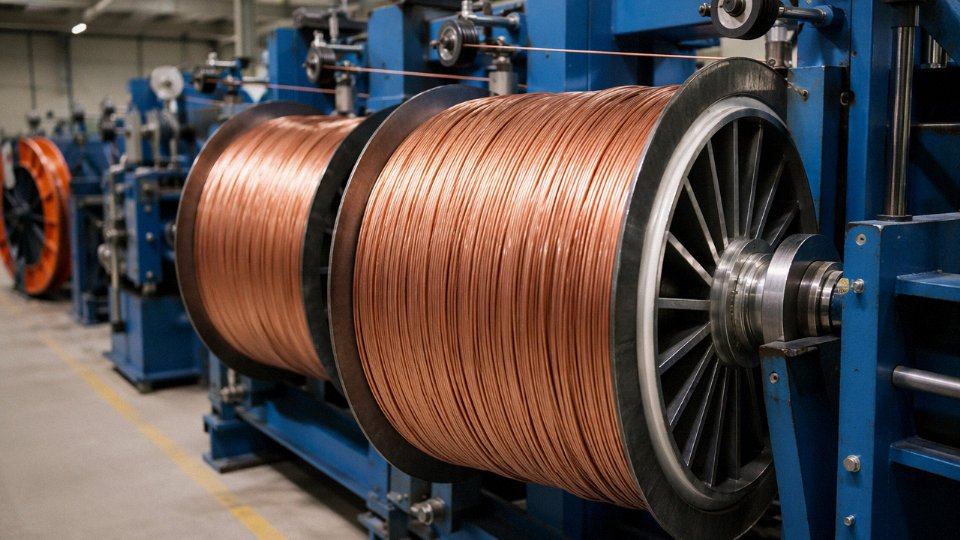
Jinda’s vertically integrated operations — covering copper rod drawing, multi-pass wire drawing, and annealing across five production bases — provide a meaningful buffer against short-term spot volatility. When copper prices spike, manufacturers who buy rod on the open market pass that cost straight through. Controlling the rod-to-finished-conductor chain compresses the exposure window and supports more stable quoted pricing across longer contract periods.
Copper’s End-of-Life Value Is Part of the Asset Calculation
Copper is infinitely recyclable with no degradation in electrical properties. End-of-life RG-6 or RG-11 stripped from a building refurbishment carries scrap value at roughly 90–95% of primary copper price — which, at current market levels, is meaningful. CCA scrap is harder to process; the aluminum core complicates smelter sorting, and many recyclers discount it heavily or reject it outright. For infrastructure owners thinking in decades rather than quarters, solid copper cable is not just a performance decision. It’s a recoverable asset.
Frequently Asked Questions About TV Cable Wire and Copper Content
Is all coaxial cable copper?
No — and this trips up buyers more often than you’d expect. The center conductor in a coaxial TV cable may be solid bare copper, copper-clad aluminum (CCA), or tinned copper. The shielding layer is a separate story entirely: you might get a copper braid, an aluminum foil, a combination of both, or in cheaper assemblies, an aluminum braid that looks copper-toned under certain lighting. Always pull the spec sheet. If a supplier can’t produce one, that tells you something.
All coaxial TV cables use a copper center conductorFalse
Coaxial cables are commonly manufactured with CCA (copper-clad aluminum) center conductors, particularly in cost-reduced versions. The conductor material must be verified against the cable specification sheet or test report.
Can I use CCA coaxial cable for satellite TV?
For a short drop — say, under 25 meters from dish to receiver — CCA RG-6 will usually work. The signal loss difference over that distance is marginal. The real problem is DC power. Satellite LNBs require 13–18 V fed up the coaxial cable from the receiver or switch, and CCA’s resistivity runs roughly 40–45% higher than solid copper. On a 30–40 meter run, especially in cold weather (resistance climbs as temperature drops), you can end up delivering insufficient voltage to the LNB, which either causes intermittent switching between polarizations or kills the signal entirely. It’s a frustrating fault to diagnose because it’s intermittent and temperature-dependent. Solid copper center conductor is strongly recommended for any satellite installation, full stop.
How much copper is actually in a TV cable?
More than most people assume. A 100-meter reel of RG-6 with a solid copper center conductor (18 AWG, nominally 1.024 mm diameter) and 60% copper braid shielding typically contains roughly 2.5–4 kg of copper, depending on braid coverage density and whether the foil layer is copper-laminated or aluminum-laminated polyester. That range matters for procurement: a 500-reel order swings by hundreds of kilograms of copper content depending on spec, which directly drives cost and scrap recovery value at end of life.
Why does my new TV cable look silver inside instead of orange?
A silver-colored center conductor means one of two things: tinned copper or CCA. To tell them apart, scrape the surface with a knife or nail. Tinned copper reveals the characteristic reddish-orange copper core underneath the bright silver tin layer. CCA shows a dull gray aluminum core. This two-second scratch test is genuinely reliable on a freshly cut end and requires no equipment.
Does the type of copper affect 4K or 8K reception?
For over-the-air digital TV, terrestrial broadcast frequencies top out around 700 MHz or so depending on your regional band plan. At those frequencies, attenuation differences between solid copper and CCA over a 15-meter antenna drop are small — probably not perceptible. Stretch that run to 20–25 meters or add a couple of barrel connectors, and marginal signal levels can push a 4K HEVC broadcast into decode errors. CCA won’t necessarily fail, but it gives you less headroom. On a tight link budget, that margin is worth preserving.
What’s the difference between bare copper and tinned copper for outdoor installations?
Bare copper oxidizes. Over a few seasons outdoors, the center conductor and braid develop a surface oxide layer that increases contact resistance at F-connectors and crimp terminations — exactly where you can least afford it. Tinned copper (TC) resists oxidation well and is the standard choice for outdoor antenna cables, aerial distribution plant, and marine TV runs. The tin layer adds a small cost, but the alternative is corroded connectors and a service call two winters from now.
How do I specify solid copper TV cable for bulk orders?
Be explicit in the purchase specification. Vague language like “copper conductor” leaves room for CCA substitution. Write it out: conductor material “solid bare copper (BC) per IEC 60228 Class 1,” minimum conductor purity 99.9% Cu (C11000 alloy), conductor diameter per the applicable AWG or millimeter specification, DC resistance conforming to IEC 61196. Require factory test reports and a conductor composition certificate with each shipment lot. If the order is large enough, a third-party incoming inspection — including a spot XRF verification of conductor material — is worth the cost. It’s a lot cheaper than pulling 10,000 meters of substandard cable out of a finished installation.
Why Jinda’s Manufacturing Infrastructure Supports Reliable Copper TV Cable Supply at Scale
Buying coaxial cable at scale is not simply a price exercise. Any procurement manager who has dealt with a mid-project conductor substitution — discovering CCA where solid copper was specified, or receiving reels with inconsistent impedance that only show up after installation — knows that the real cost is measured in rework labor, project delays, and credibility with the end client. The manufacturer’s production infrastructure either solves that problem before the reel leaves the factory, or it doesn’t.
Jinda has been manufacturing cables in Shandong, China since 1987. That’s over 35 years of continuous production, which matters in a more tangible way than the number suggests: the institutional knowledge of how copper rod behaves seasonally, how die wear affects conductor diameter tolerances, and how insulation extrusion speeds interact with dielectric consistency — that kind of knowledge doesn’t come from a datasheet. It accumulates on the shop floor.
Vertical Integration From Rod to Reel
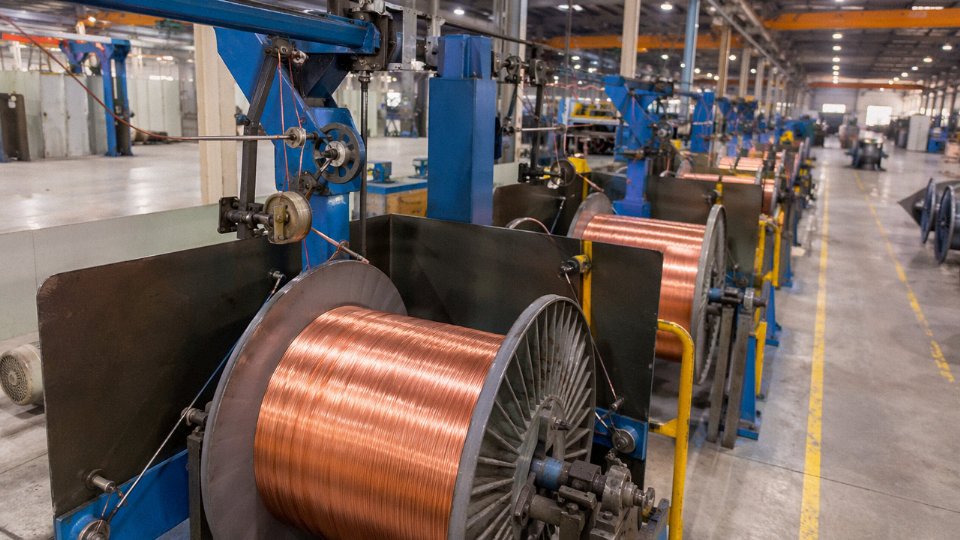
Most cable factories buy finished conductor wire from an external wire drawer and start production at the stranding or extrusion stage. That arrangement introduces a variable Jinda has eliminated. In-house wire drawing and annealing facilities process copper rod through to finished conductor at precisely controlled diameters, with mechanical properties — tensile strength, elongation, and conductivity — held to IEC 60228 tolerances throughout. When a buyer specifies Class 1 or Class 2 solid copper conductor for RG-6 or RG-11 production, the control over that specification begins at the rod stage, not partway down the chain.
Annealing is where conductivity is recovered after cold working, and it’s easy to underanneal to save energy or cycle time. Jinda’s process monitors ensure the target conductivity — close to the pure copper benchmark of roughly 58 MS/m (IACS ~100%) — is consistently achieved rather than left to batch variation.
Capacity Without Bottlenecks
Five production bases covering a combined 470,000 m² of manufacturing space is not just a headline figure. For an EPC contractor or distributor placing an order that spans RG-6, RG-11, and a low-loss satellite cable variant simultaneously — potentially for a hotel infrastructure rollout or a national cable TV operator upgrade — the ability to run multiple cable families in parallel is operationally significant. Single-facility manufacturers frequently push delivery dates when a large order requires switching lines between product types. Parallel capacity removes that constraint.
R&D That Tracks Where the Market Is Going
Broadcast and satellite infrastructure isn’t static. DOCSIS 4.0 coaxial requirements, Ka-band and Ku-band satellite applications, and fire-resistance classifications for buildings in export markets like the EU, Middle East, and Southeast Asia all place specific demands on cable construction that standard RG-6 designs don’t automatically meet. Jinda’s R&D teams work on these variants — low-loss designs for higher-frequency satellite bands, fire-resistant constructions to comply with IEC 60332 and local building codes — so the product range stays ahead of what specifiers are starting to require rather than reacting once a project is already tendered.
Quality Assurance and Third-Party Verification
Full batch traceability from copper purchase lot to finished reel, in-line electrical testing at extrusion and stranding, and end-of-line verification of conductor resistance, insulation resistance, characteristic impedance, and attenuation are standard practice. For international projects where the client or EPC requires independent verification, Jinda accommodates third-party inspection by agencies including SGS, Bureau Veritas, and TÜV. That accommodation isn’t unusual to request, but not every manufacturer has the process documentation and floor access protocols to support it smoothly.
Jinda's manufacturing facilities support third-party inspection by agencies such as SGS, Bureau Veritas, and TÜV for international project requirements.True
This is a stated operational capability consistent with export-oriented manufacturers seeking IEC-compliant certification and international project qualification — verifiable through direct engagement with Jinda's technical and sales teams.
Long-Term Supply Partnership, Not Spot Transactions
With over 1,000 employees and a dedicated international sales and technical support team, the structure is built for ongoing relationships with distributors, cable TV operators, and contractors who need consistent quality, documentation, and delivery reliability across multiple orders — not a single shipment at the lowest price that quarter. Cable TV infrastructure, satellite head-end builds, and commercial AV installations require documented material consistency across project phases that can span 12 to 24 months. That kind of continuity requires a supply partner with the organizational depth to maintain it.