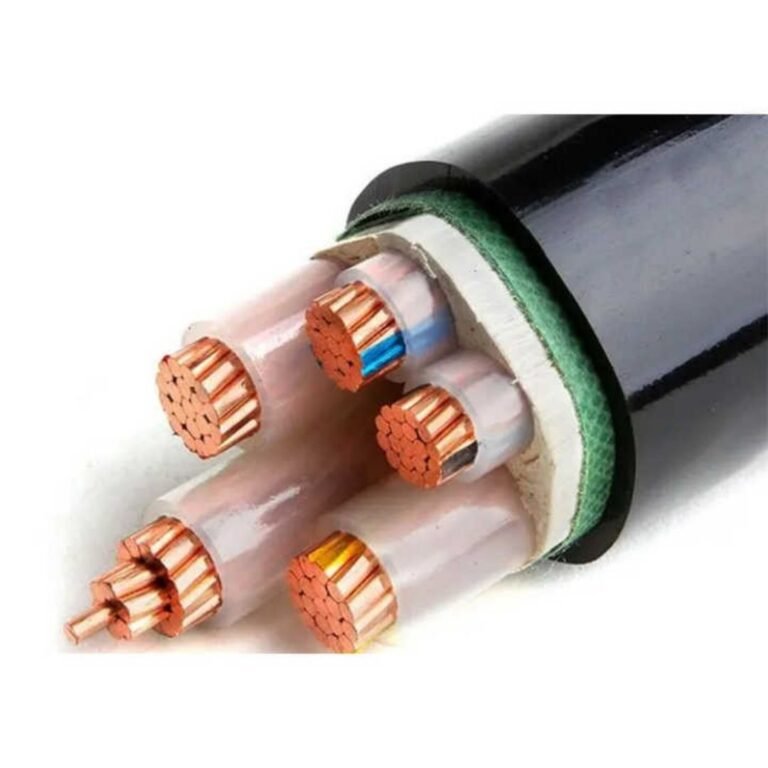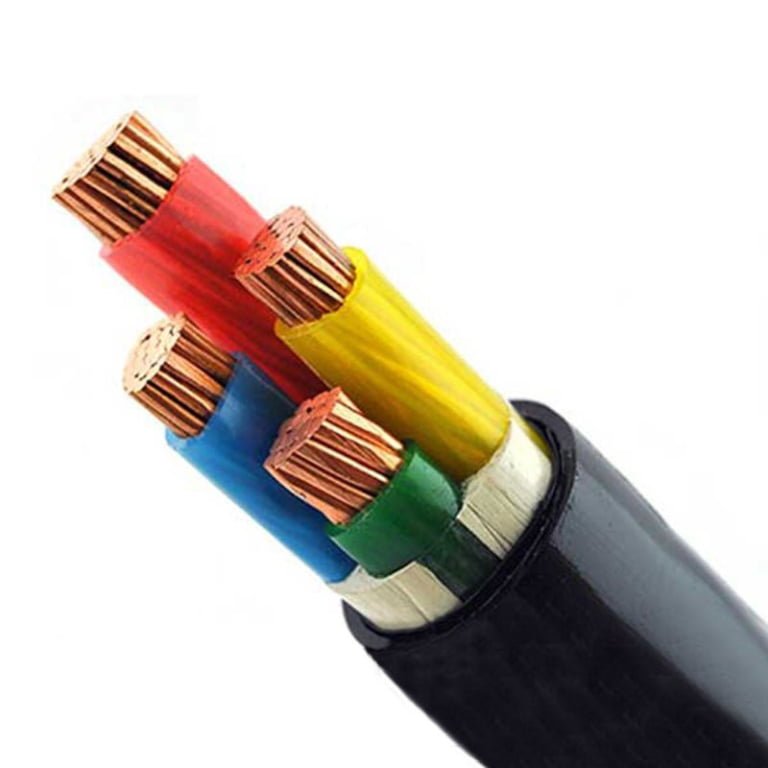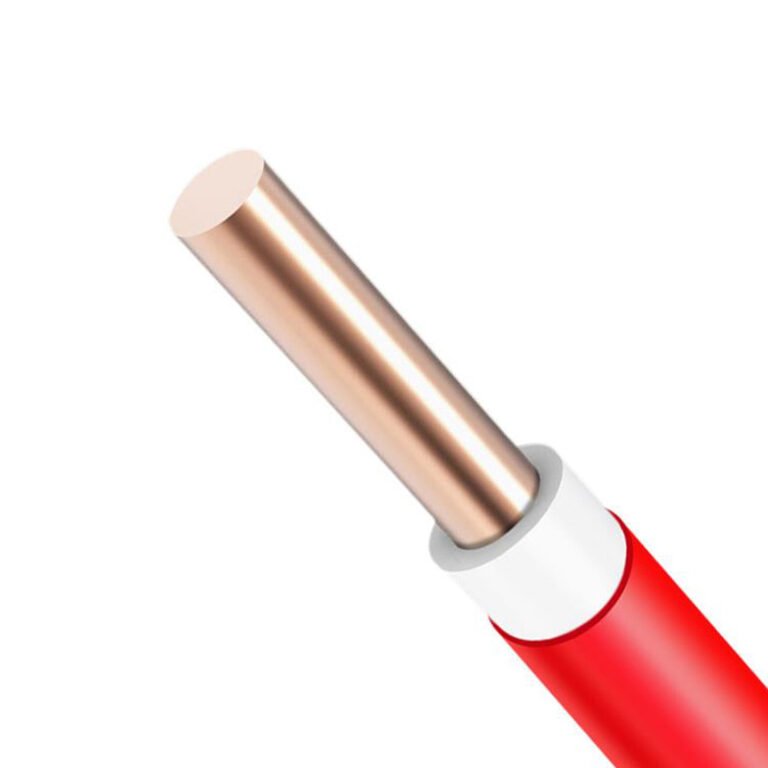
Specify the wrong cable type on a procurement order and you might not know about it until a contractor is standing on-site with incompatible terminations, or worse, until an insulation failure trips a feeder six months into operation. Getting the cable category right — conductor material, insulation system, voltage rating — is not a paperwork formality. It determines installation cost, service life, and whether your maintenance crew will be chasing intermittent faults for years. The global wire and cable market ran roughly USD 225 billion in 2023 and is tracking toward USD 300 billion by 2030, which tells you how many procurement decisions are being made, and how many of them are probably made on incomplete information.
The most common type of cable worldwide is the copper-conductor, XLPE-insulated power cable. Copper conductors account for roughly 60–65% of all cable installations by volume globally, and within the medium- and high-voltage segment, XLPE insulation holds an estimated 70–75% share of new installations. For the vast majority of power distribution, industrial, and infrastructure projects, this combination is the de facto standard.
That said, “most common” shifts depending on whether you’re talking about a residential development in Southeast Asia, a utility transmission corridor in Europe, or an industrial plant in the Middle East — and understanding why this cable type dominates, where it doesn’t, and what the real alternatives look like is what separates a defensible specification from one you’ll have to explain later.
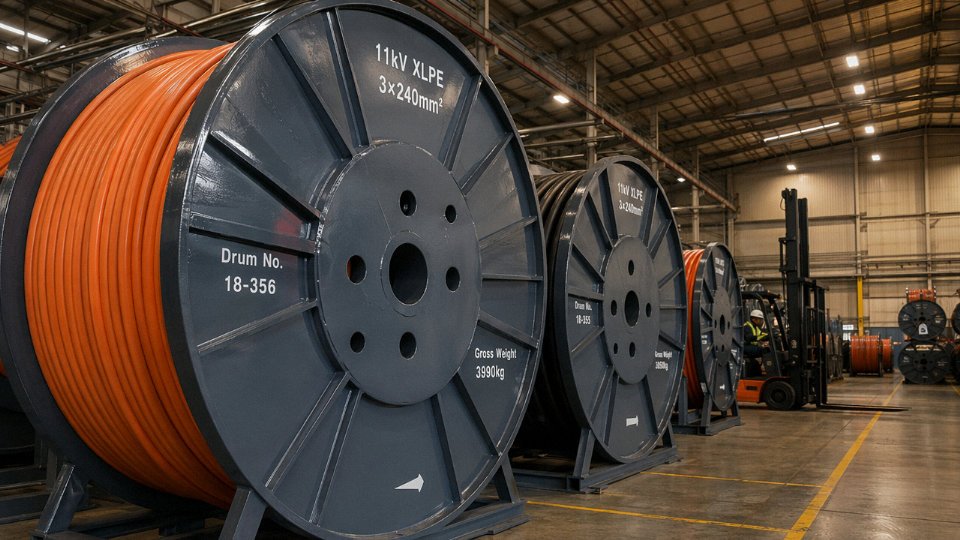
Defining ‘Common’: Unit Volume, Installed Length, and Revenue Compared Across Cable Families
Ask ten engineers which cable type is “most common” and you’ll get three or four different answers — and they’ll all be technically correct, depending on what they’re measuring. This isn’t semantic pedantry. If you’re a procurement manager sourcing by reel quantity, your answer looks nothing like a grid operator’s who thinks in kilometers of installed circuit. Getting the measurement basis wrong leads to skewed category decisions, wrong supplier shortlists, and occasionally some embarrassing specification errors.
Three Ways to Count — Three Different Winners
Unit count (pieces shipped per year) favors short, discrete items. Patch cables, structured cabling jumpers, and appliance leads are manufactured and sold in enormous quantities — a single data center fit-out might consume tens of thousands of RJ45-terminated Cat6 patch leads, each logged as one unit. By this metric, data and communication cables dominate, probably by an order of magnitude over any other family. Rough industry estimates put global patch cable shipments well into the billions of units annually, though the figure shifts considerably depending on whether you include retails-packaged consumer leads.
Installed length (meters per year) tells a completely different story. Low-voltage power cable — the kind running through conduit in every commercial building, factory floor, and residential development on the planet — wins here, and it’s not close. A single mid-size industrial facility might pull 50–150 km of LV cable during construction, give or take depending on equipment density and layout complexity. Aggregated globally, LV power cable installed length dwarfs every other category. Data cable installation lengths are comparatively short per project; the unit count is high because the runs are short and there are many of them.
Revenue share skews yet again toward specialty and high-voltage cable. A kilometer of 132 kV XLPE-insulated transmission cable can carry a price tag 40–80× higher per meter than standard 1 kV building wire, depending on conductor cross-section, sheathing spec, and whether armor or special fire performance is required. Subsea and umbilical cables push this further. So the cable families that represent a relatively small fraction of total installed meters account for a disproportionate slice of the roughly USD 225 billion global market — and that market is on a trajectory toward USD 300 billion by around 2030, driven largely by grid investment and offshore energy.
Comparison Across the Five Main Cable Families
| Cable Family | Unit Volume Rank | Installed Length Rank | Revenue Share (est.) | Typical Voltage Class |
|---|---|---|---|---|
| LV Power Cable | 2nd | 1st | 30–35% | Up to 1 kV (IEC) / 600 V (NEC) |
| Data & Comms Cable | 1st | 3rd | 15–20% | Signal / low voltage |
| MV/HV Power Cable | 4th | 4th | 25–30% | 1 kV–500 kV+ |
| Control & Instrumentation | 3rd | 2nd | 10–15% | Generally ≤1 kV |
| Specialty / Subsea | 5th | 5th | 8–12% | Varies widely |
Revenue figures depend heavily on regional infrastructure spend cycles and commodity copper pricing in a given year.
IEC vs. NEC Classification — Why It Matters for International Projects
IEC 60228 governs conductor classification (Class 1 through Class 6, essentially rigid to fine-stranded), while IEC 60502 covers extruded power cables from 1 kV up to 30 kV. NEC Article 310 in North America uses a parallel but non-identical system — THHN, XHHW, USE-2 designations encode insulation type, temperature rating, and permitted installation environment simultaneously. A procurement manager importing IEC-rated cable for a North American project, or vice versa, needs explicit equivalency confirmation; the voltage classes and test regimes don’t map one-to-one. In practice, most international EPC contractors maintain a cable schedule that lists both designation systems side by side precisely to avoid this.
General-Purpose vs. Application-Specific: Why LV Power Cable Owns the Volume Numbers
“General-purpose” cable — think standard NYY, NYMHY, or THHN building wire — is engineered to work across an enormous range of ordinary installation conditions. It requires no special termination hardware, no exotic handling procedure, no restricted bending radius that needs a specialist on site. Application-specific cables (fire-resistant, instrumentation, high-flex robotic, subsea) solve a narrower problem better, but they represent a thin slice of total cable-meters-installed precisely because most of the world’s wiring jobs are, frankly, ordinary. That structural reality — millions of buildings, factories, and infrastructure projects all pulling the same few standard cable constructions through conduit — is why LV power cable consistently ranks first when you measure by installed length, and why copper conductors account for roughly 60–65% of all cable installations worldwide by volume.
Low-voltage power cable accounts for the greatest installed length of any cable family globallyTrue
LV power cable serves virtually every building, industrial facility, and infrastructure project; per-project run lengths are high and the installation base spans every country, making cumulative installed length greater than any other cable family even though data cables ship in higher unit counts.
PVC-Insulated Low-Voltage Power Cable: Construction, Standards, and Why It Dominates Global Volume
Walk into any electrical contractor’s warehouse on any continent and you’ll find it stacked floor to ceiling with PVC-insulated low-voltage power cable. This is the workhorse — the cable type that accounts for the overwhelming majority of installed meters globally, spanning residential wiring, commercial fit-outs, light industrial distribution panels, and general-purpose fixed installations. Understanding why it dominates, and where it falls short, is fundamental to procurement decisions and installation design.
Full Construction Stack
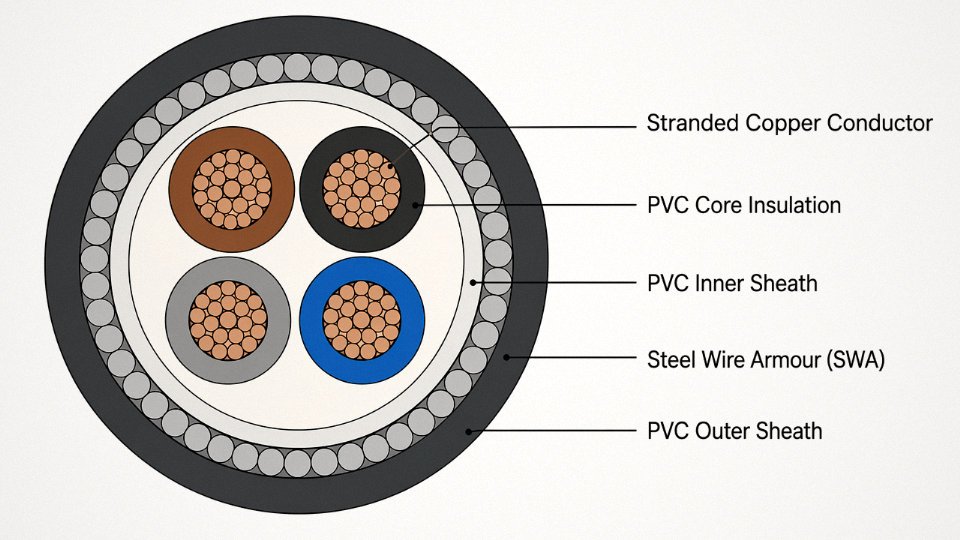
The construction is straightforward, which is partly the point. At the center sits either a copper or aluminum conductor — stranded for flexibility in larger sizes (typically 16 mm² and above), solid for smaller fixed-wiring sizes (1.5 mm² to 6 mm² in most markets). Stranding class varies by application: Class 1 solid and Class 2 stranded per IEC 60228 cover the bulk of fixed-installation demand. Conductor choice matters economically; aluminum runs roughly 40–60% cheaper by weight than copper, though you’re trading off conductivity, jointing complexity, and ampacity per cross-section.
Over the conductor goes the PVC insulation, applied by extrusion to a controlled thickness governed by the relevant standard — IEC 60227 being the primary international reference. Multi-core constructions then lay up the insulated cores, usually with a filller compound to maintain a round profile, and apply a PVC inner sheath over the assembly. Armoring is optional but common in industrial and underground applications: steel wire armor (SWA) for mechanical protection in direct duct or trench runs, aluminum wire armor (AWA) where magnetic interference is a concern in single-core circuits. A PVC outer sheath finishes the cable, available in various color codes depending on the destination market.
Why PVC Became the Default
PVC compounds have been cable insulation since the 1940s, and they’ve earned their position — not through marketing, but through genuinely good engineering economics. Raw PVC is cheap and abundantly available. It extrudes cleanly at moderate temperatures on standard tooling, which keeps production costs down and output rates high. Inherent flame retardance (PVC contains chlorine, which disrupts combustion chemistry) meant early compliance with building codes without expensive additive packages. Decades of field data have given specifiers and inspectors confidence in its long-term performance.
The thermal ceiling, however, is real: 70°C continuous conductor temperature under IEC 60227. Push beyond that — through sustained overload, tight bundling without derating, or installation in a high-ambient enclosure — and the insulation plasticizes, hardens over time, or cracks. In practice, in hot climates or tightly packed cable trays, the 70°C ceiling becomes the binding constraint before ampacity tables even come into play.
Key International Standards
IEC 60227 is the backbone globally, but export projects require attention to regional equivalents. Jinda’s cables are certified across multiple frameworks specifically to avoid the lead-time hit of re-certification when a project specification changes mid-procurement.
Jinda's PVC-insulated LV power cables are certified to IEC 60227, BS 6004, AS/NZS 5000.1, UL 83, and SANS 1507.True
Multi-standard certification is a stated Jinda capability supporting export to the UK, Australia/New Zealand, North American, and South African markets — each with distinct test and marking requirements.
Conductor Cross-Section Range and Application Matching
| Cross-Section | Typical Current Range* | Common Application |
|---|---|---|
| 1.5 mm² | 14–18 A | Lighting circuits, small socket outlets |
| 2.5 mm² | 18–25 A | General socket ring/radial circuits |
| 6 mm² | 32–40 A | Cooker circuits, small sub-panels |
| 16 mm² | 55–75 A | Distribution boards, HVAC feeds |
| 70 mm² | 150–190 A | Sub-main distribution, light industrial |
| 150 mm² | 260–320 A | Main LV feeders, transformer secondaries |
| 240–400 mm² | 350–500 A+ | Heavy industrial mains, large commercial |
*Current ranges depend on installation method (clipped direct vs. in conduit vs. buried), ambient temperature, grouping factor, and national derating tables. These are indicative, not substitutes for a proper cable schedule calculation.
Real Limitations Worth Flagging
Direct burial without additional mechanical protection is a common site mistake. PVC outer sheaths resist moisture reasonably well, but unarmored cable in direct soil contact is vulnerable to ground movement, rodents, and incidental excavation damage. Specify SWA or route through rated conduit — the cost difference at installation is trivial compared to a fault location and excavation job two years later.
The plasticizer migration issue is slower-burn but real, particularly in contact with some foam insulation materials or certain cable management plastics. Over 15–20 years in a warm loft space or a poorly ventilated plant room, older PVC formulations can leach plasticizer into adjacent materials, leaving the insulation brittle. Modern low-migration compound formulations have largely addressed this, but it’s worth confirming compound specification on long-lifecycle projects — infrastructure, data centers, anything with a 25-year design life expectation.
XLPE Power Cable: The Fast-Growing Challenger Taking Over Medium- and High-Voltage Infrastructure
PVC does the heavy lifting in sheer installation volume, but step up to 6 kV and above and the conversation changes entirely. XLPE — cross-linked polyethylene — has effectively won the medium- and high-voltage market. That 70–75% share of new MV/HV installations isn’t marketing language; it reflects two decades of grid operators, utility engineers, and industrial plant designers choosing it as the default and rarely looking back.
What Cross-Linking Actually Does to the Polymer
Standard polyethylene is thermoplastic. Heat it enough and it flows, which puts a hard ceiling on operating temperature and load capacity. Cross-linking breaks that ceiling by forming covalent bonds between adjacent polymer chains — turning what was essentially a wax-like structure into something closer to a three-dimensional network. The cable can now run continuously at 90°C conductor temperature versus roughly 70°C for PVC-insulated cables at comparable voltages, and can handle 250°C under short-circuit conditions without the insulation collapsing.
The two dominant cross-linking routes you’ll actually see in cable plants are peroxide (chemical) cross-linking, typically done in a continuous vulcanization (CV) tube with steam or dry nitrogen, and silane cross-linking, which is more common in smaller-diameter, lower-voltage products. Peroxide CV is the workhorse for serious MV and HV production. The dielectric properties that result — a dissipation factor typically below 0.001 and relative permittivity around 2.3, give or take — are genuinely superior to PVC and make XLPE suitable all the way up to 500 kV EHV systems. PVC at those voltage levels would simply fail.
Construction Layer by Layer
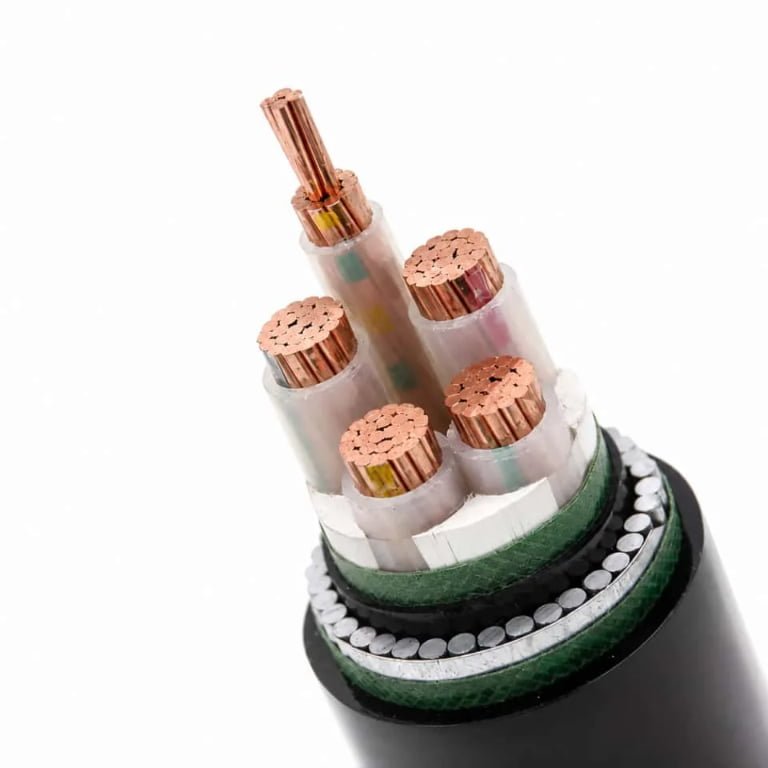
A textbook 33 kV XLPE cable for a substation feeder circuit looks something like this, working from the inside out: stranded copper or aluminum conductor (aluminum is common in utility transmission to save weight and cost; copper preferred in industrial plants where termination space is tight), a semiconductive conductor screen to smooth the electric field gradient, the XLPE insulation itself, a semiconductive insulation screen, copper tape or copper wire metallic screen for fault current return and electrostatic shielding, a bedding layer, steel wire or tape armor depending on installation method, and a polyethylene or PVC outer sheath. Each layer is there for a specific reason. Skip or scrimp on the semiconductive screens and you get field concentration, partial discharge, and insulation failure — maybe not in year one, but certainly within a decade.
Wall thickness of the insulation increases with voltage class. At 11 kV you might see 5.5–6 mm; at 33 kV, closer to 10–12 mm. These values depend on conductor cross-section and the specific standard revision in use.
Replacing PILC: A Transition That’s Still Happening in Some Grids
Paper-insulated lead-covered cable was the MV standard for most of the twentieth century and there is still an enormous amount of it in the ground in older European and South Asian grids. It works, but maintaining it is genuinely unpleasant — lead sheath corrosion, oil migration in vertical runs, joints that require skilled cable jointers who are increasingly hard to find, and the chronic risk of moisture ingress after any ground disturbance. An XLPE cable of equivalent rating weighs roughly 30–50% less than its PILC counterpart depending on voltage and cross-section, which matters on cable bridges and in duct systems where pulling tension is already marginal.
Service life for XLPE, properly installed and terminated, is commonly quoted at 40 years or more. In practice that figure depends heavily on installation quality — a poorly made joint or a termination done in wet weather can initiate partial discharge that erodes insulation over years, invisibly, until a fault. IEEE 400 provides the diagnostic framework for tan-delta and partial discharge testing on installed cables, and any serious asset owner should be using it.
XLPE-insulated MV/HV cables hold approximately 70–75% of new medium- and high-voltage cable installations globallyTrue
This estimate is consistent with market research across multiple industry sources and reflects utility procurement patterns in Europe, China, the Middle East, and North America over the past decade, driven by XLPE's superior thermal and electrical performance versus legacy insulation systems.
Standards That Actually Govern Procurement
IEC 60502 covers rated voltages from 1 kV through 30 kV and is the reference standard for the majority of industrial and distribution grid projects worldwide. Above 30 kV, IEC 60840 takes over, with more stringent requirements on type testing, partial discharge levels, and insulation qualification. Both specify construction details, test voltages, and acceptance criteria that procurement specs should reference explicitly — a cable quoted generically as “XLPE 33 kV” without an IEC 60840 type test certificate is not the same product as one with that documentation.
Jinda’s production capability runs from 1 kV through 110 kV across these standards, which covers the bulk of grid infrastructure and large industrial substation work where these specifications are routinely enforced.
The Renewable Energy Effect
This is where the demand growth numbers get interesting. Wind farm collection systems — the cables running from individual turbines back to the onshore or offshore substation — are almost universally 33 kV or 66 kV XLPE. Utility-scale solar farms need MV AC collection cables and increasingly DC cables at 1.5 kV–3 kV for string and combiner circuits. The clean energy build-out is not a niche; it is reshaping cable market volumes. Annual demand growth for XLPE MV cables in the renewable energy segment is running at roughly 15–20%, depending on the region and how aggressively that country is adding generation capacity. That number will fluctuate with project pipelines, but the directional trend has been consistent for several years now and there is no obvious reason to expect it to reverse.
For a procurement manager specifying cables for a new wind or solar project: IEC 60502-2 for the MV collection cables, confirm the specific voltage class and armor type for your installation method (direct buried, duct, submarine), and do not skip the factory acceptance testing even if it adds two weeks to your schedule. Finding a partial discharge failure on a test bench is inconvenient. Finding it after the cable is buried under a wind farm access road is a serious problem.
Control, Instrumentation, and Signal Cables: The Unsung Workhorses of Industrial Automation
Walk through most process plants or manufacturing facilities and you’ll find power cables outnumber everything else by sheer conductor cross-section — but count the individual cable runs, and control and instrumentation cables win easily. In a mid-sized petrochemical plant, it’s not unusual to see a 4×150 mm² feeder cable share a tray with 40 or 50 shielded pair cables running to transmitters, analyzers, and PLC I/O modules. Procurement teams who don’t distinguish between these families routinely cause problems that show up weeks later as ground loops, erratic sensor readings, or nuisance trips on safety systems.
Control Cable vs. Instrumentation Cable: Not the Same Thing
Control cables are multiconductor cables — typically 2 to 48 cores, with individual conductor cross-sections ranging from 0.75 mm² up to around 6 mm², occasionally larger for motor starter control circuits. They carry discrete signals: 24 V DC logic, 110/230 V AC control power, solenoid valve coils. Current draw per core is low relative to power cables, but it’s not millivolt-level. IEC 60227-5 and IEC 60502-1 govern most of the world’s control cable production; NEMA WC 55 covers the North American instrumentation variant.
Instrumentation cables are fundamentally different animals. Each circuit is a twisted pair or twisted triple (triad), and the signals they carry — 4–20 mA loops, thermocouple outputs, RTD bridges, strain gauge outputs — run at millivolt to milliamp levels. Impedance matching, capacitance balance, and shielding effectiveness matter in ways they simply don’t for a 110 V control circuit. Substituting a standard unshielded control cable for an instrumentation cable on a Pt100 temperature loop feeding a PID controller is one of the classic commissioning errors. The loop often appears to work fine during factory acceptance testing, then starts drifting or oscillating once installed near a VFD panel or a high-current busbar. By that point, the cable is pulled through conduit or buried in a tray and is genuinely painful to replace.
Shielding: The Decision That Gets Made Too Late
Shielding specification is where the real engineering decisions live. Three main configurations come up repeatedly in project specs:
Overall aluminum-foil shield with a drain wire is the baseline for general-purpose control cable and low-noise instrumentation runs. It’s adequate for most PLC wiring in reasonably clean electrical environments — think motor control centers in a light manufacturing plant.
Individual pair or triple shields (each circuit gets its own foil or braid) isolate circuits from each other. This matters enormously in multiconductor instrumentation cables carrying mixed signal types. A thermocouple pair and a 4–20 mA loop sharing the same cable jacket but without individual shields will crosstalk. Individually shielded designs cost more — roughly 15–30% more per meter depending on core count and whether braid or foil is used — but on a 2,000-meter instrument cable run in a process plant, rework costs dwarf that premium.
Individual-plus-overall shielding (IOS) is the belt-and-suspenders approach: each pair or triple has its own shield, and the entire bundle has an outer overall shield. This is standard on fire alarm system cables in many jurisdictions, on thermocouple extension cables running near high-frequency drives, and on signal cables in offshore and mining environments where interference sources are severe and cable replacement is expensive.
Application Matrix: Matching Cable Type to the Job
| Application | Recommended Cable Type | Minimum Shielding |
|---|---|---|
| PLC digital I/O wiring | Multiconductor control cable, 1.5 mm² | Overall foil + drain |
| Motor starter control circuits | Multiconductor control cable, 1.5–2.5 mm² | Overall foil or none (short runs) |
| 4–20 mA transmitter loops | Individually shielded twisted pair (ISTP) | Individual pair + overall |
| Thermocouple extension | Compensating/extension cable, matched alloy | Individual pair + overall |
| RTD / Pt100 circuits | Instrumentation cable, twisted triple | Individual triple + overall |
| Flow meter pulse output | Instrumentation cable, twisted pair | Individual pair + overall |
| Conventional fire alarm | Fire-rated multiconductor, per local code | Overall + armor where required |
In practice, a lot of plants standardize on IOS instrumentation cable across the board for analog signals, just to avoid the argument at commissioning. It slightly over-engineers the simple loops but eliminates troubleshooting headaches.
Construction Standards and Production Flexibility
Most international projects reference IEC 60502-1 for the insulation and jacket system, IEC 60228 for conductor class, and IEC 60332 for flame performance — with LSZH jacketing increasingly specified in confined or occupied spaces. Custom core counts (say, 7 pairs individually shielded with an overall braid, LSZH outer jacket, armored) are where standard catalog products fall short. Jinda’s five-factory manufacturing structure means that standard configurations and non-standard builds — different insulation materials, non-catalog core counts, dual-armor constructions — can run simultaneously across facilities without competing for the same extrusion or stranding equipment. For large EPC projects where instrument cable schedules run to hundreds of line items, that production flexibility compresses delivery schedules meaningfully.
Substituting an unshielded power cable for a shielded instrumentation cable on analog signal loops will cause measurement errors and interference in industrial environments.True
Analog instrumentation signals (millivolt to milliamp range) are highly susceptible to electromagnetic interference. Shielding in instrumentation cables — individual pair shields and overall shields — is specifically designed to attenuate this interference. An unshielded power cable provides no such protection and its construction (conductor sizing, capacitance, impedance) is optimized for current-carrying capacity, not signal integrity.
The procurement mistake to avoid is treating control and instrumentation cables as a single line item. They’re not. A project BOM that lists “control/instrument cable” without specifying shielding configuration, conductor cross-section, insulation system, and applicable standard will generate RFI delays and, worse, substitutions that pass inspection but degrade system performance over time.
Flexible Cords and Building Wiring Cables: The Highest-Volume Consumer and Commercial Segment
If you measure by meters produced per year, this is the category that wins — and it isn’t particularly close. Domestic wiring and flexible cords collectively account for an estimated 25–30 billion meters of cable manufactured annually worldwide, a figure that dwarfs industrial and utility segments when counted by installed length rather than revenue or conductor cross-section weight. The exact number shifts depending on how you classify drop cords and appliance leads, but even on a conservative count, building wire and flexible cord represent the largest single cable category on earth.
Flexible Cords vs. Fixed Wiring: Why the Distinction Is Not Pedantic
The split between flexible cords and fixed building wiring matters practically, not just taxonomically. IEC 60227-5 covers PVC-insulated flexible cords — the H05VV-F (300/500 V, light duty) and H07RN-F (450/750 V, rubber-insulated, suitable for outdoor and heavier-duty use) designations are the ones you’ll see most on export documentation. Fixed wiring types like NYM (PVC sheathed, Europe), NYY (armored or direct-burial variant), NMB and Romex-type (North America, non-metallic sheathed) are designed for permanent installation in conduit, trunking, or direct in walls. Using a flexible cord in a fixed installation isn’t just a code violation — in practice it means the conductor will eventually loosen at terminations as the stranding flexes under thermal cycling, which causes arcing and fires. The insurance claim always says “electrical fault.” Usually it was the wrong cable in the wrong application.
Conductor Construction and What It Actually Means for Fatigue Life
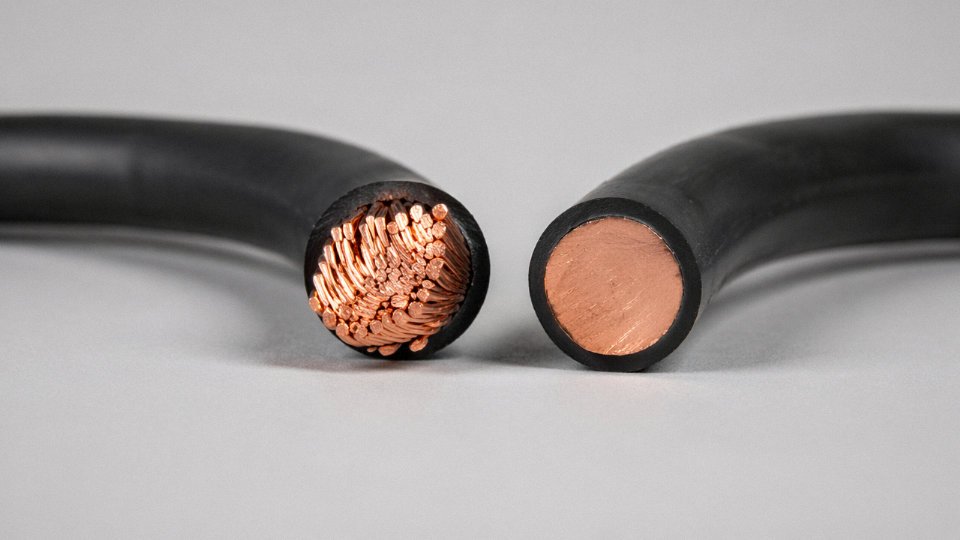
This is where procurement teams sometimes make expensive mistakes. Flexible cords use fine-stranded conductors — Class 5 or Class 6 per IEC 60228 — with individual wire diameters often below 0.2 mm, sometimes well below. That fine stranding is what allows the cable to survive tens of thousands of bend cycles without conductor fatigue fracture. A Class 1 or Class 2 solid or coarse-stranded conductor, standard in fixed wiring, will crack internally after surprisingly few flex cycles. Current ratings also differ: a fine-stranded flexible conductor runs slightly cooler at equivalent cross-section in free air because the total surface area across all strands is higher, but the termination resistance can be greater if ferrules aren’t used properly. In industrial settings, missing ferrules on fine-stranded conductors in screw-type terminals is one of the more common causes of intermittent faults that take forever to diagnose.
The Standards Landscape and Regional Compound Switching
Four standards frameworks dominate global trade in this segment: IEC 60227 (international baseline), VDE 0281 (Germany, widely adopted across Europe), BS 6500 (UK and many Commonwealth markets), and UL 62 (North America). The voltage ratings, insulation thickness callouts, and color code requirements differ enough between them that a cable built to IEC 60227 will fail a UL 62 listing test and vice versa. For a manufacturer exporting to multiple regions simultaneously, this creates a real production challenge — the compounding recipe, the conductor lay length, and the print legend on the jacket all need to change.
Jinda's export production lines can switch between regional insulation compound recipes — IEC, VDE, BS, and UL-specification — without full retooling, using pre-qualified compound batches and modular extrusion tooling.True
Multi-region flexible cord and building wire production requires pre-validated compound inventories and tooling sets sized for each standard's insulation thickness; lines configured this way avoid the qualification delays that affect single-standard producers when entering new export markets.
The HFFR/LSZH Shift Is Real and Accelerating
EU Construction Products Regulation (CPR) Euroclass requirements — Eca through B2ca — have pushed a meaningful share of European building wire procurement toward halogen-free flame-retardant compounds over the past several years. Similar pressure is appearing in the Middle East (particularly Gulf Cooperation Council fire codes for commercial buildings) and in parts of Southeast Asia updating their national electrical codes. HFFR and LSZH compounds cost roughly 20–40% more than standard PVC depending on the silane-crosslinked or polyolefin formulation and current ethylene-vinyl acetate pricing. That premium is real. But in a corridor fire, conventional PVC cable produces hydrogen chloride gas that incapacitates occupants before the flames reach them — which is the entire engineering argument for the shift, and it tends to be persuasive once a project engineer has read a post-incident forensic report.
How to Select the Right Cable Type: A Practical Decision Framework for Project Engineers and Procurement Teams
Getting the cable selection wrong costs money in two distinct ways — you either over-specify and pay for performance you’ll never use, or you under-specify and pay with downtime, shortened service life, or a failed inspection at the destination port. Neither is acceptable on a serious project. The five questions below act as a filter, and working through them in order usually narrows the choice to one or two cable families before you’ve touched a datasheet.
The Five-Question Selection Filter
Voltage level is always first. Low-voltage applications (up to 1 kV) can typically be served by PVC-insulated or XLPE-insulated LV power cable. The moment you cross into medium voltage — roughly 6 kV to 35 kV — you’re in XLPE territory for new installations almost by default. PVC insulation becomes impractical above 3 kV due to dielectric losses and thermal limitations that stack up fast under load.
Current load and ambient temperature come second, and these two interact more than most procurement specs acknowledge. A cable rated at 200 A in open air might be derated to 140–160 A in a buried duct bank at 30 °C soil temperature, depending on soil thermal resistivity and grouping factors. Under-specifying here cuts service life by 50% or more in high-ambient environments — the insulation ages thermally at roughly double the rate for every 8–10 °C above its rated operating temperature. That’s not a conservative engineering hedge; that’s Arrhenius chemistry.
Installation environment is where a lot of errors creep in, especially on international projects where site conditions are described loosely in early-stage specifications. Direct buried needs a mechanically protected, moisture-resistant construction — armored XLPE or HDPE-jacketed cable depending on voltage. Cable tray in a chemical plant calls for something flame-retardant and often low-smoke. Free-air in direct sunlight in Southeast Asia demands UV-resistant jacketing. Underwater, including shallow marine crossings, is a category on its own. Getting this question answered before the bill of materials is finalized is non-negotiable.
Signal or power separates the control and instrumentation cable family from the power cable family. This sounds obvious but procurement teams routinely conflate them when consolidating purchase orders. A multi-pair shielded instrumentation cable running a 4–20 mA loop is not interchangeable with a power cable, even if the conductor cross-section looks similar. The shielding, pair geometry, and jacket material are doing entirely different jobs.
Required certifications for the destination country close the filter. IEC 60502 covers most of the world for power cable. UL 83 or UL 1277 matters for North American projects. Australia requires AS/NZS 5000. Solar projects increasingly demand IEC 62930 for DC solar cable. Getting this wrong means the cable clears customs and then fails the inspector’s audit on-site — a scenario that causes costly delays.
Copper vs. Aluminum: The Conductor Material Decision
Aluminum has a justified reputation problem — it earned it with the AA-1350 alloy failures in residential wiring during the 1970s. Modern AA-8000 series aluminum alloy conductors per ASTM B801 are a different material. Creep resistance, tensile strength, and connection behavior are substantially improved. For large cross-sections (95 mm² and above) in MV feeders, tray runs, or service entrances, aluminum alloy conductors deliver roughly 40–50% lower conductor cost at the expense of a one or two cross-section step-up to match copper ampacity. On a 10 km MV feeder project, that trade-off is hard to ignore.
AA-8000 series aluminum alloy conductors per ASTM B801 significantly reduce creep and connection failures compared to AA-1350 alloy used in older aluminum wiring.True
AA-8000 alloys incorporate elements such as iron and silicon to improve mechanical properties and reduce cold-flow (creep) at connection points, which was the primary failure mechanism in earlier aluminum wiring installations. This is well-documented in ASTM standards and industry research.
Cost of Over- and Under-Specification
Choosing XLPE insulation where a PVC-insulated LV cable suffices adds roughly 15–25% to material cost — the spread depends on cable size, voltage rating, and order volume. That premium is worth paying for MV applications or aggressive thermal environments. It is not worth paying for a 0.6/1 kV lighting circuit in a climate-controlled building. Equally, the penny-saving instinct to run standard PVC cable through a 70 °C ambient environment (not unusual near industrial furnaces or in rooftop conduit in tropical climates) creates a cable that’s degrading from day one. The maintenance call comes sooner than anyone budgets for.
A Mixed-Package Solar Project: How the Framework Applies
A 50 MW solar farm in Southeast Asia illustrates the methodology cleanly. The MV collection network — aggregating output from string inverters to the main step-up transformer — requires XLPE-insulated cables rated at 33 kV, armored for direct burial in laterite soil with moderate moisture. The DC side, from panels to string inverters, demands cables certified to IEC 62930: tinned copper conductors, cross-linked insulation rated for continuous 90 °C operation, UV-stabilized jacket, and a design life of 25+ years matching the panel warranty. The control and protection cabling throughout the switchgear and SCADA infrastructure needs LSZH (low-smoke zero-halogen) jackets given the enclosed inverter buildings and the fire-safety requirements common in that regulatory environment.
Treating this as a single cable type would mean either over-specifying the entire project to MV XLPE standards (unnecessary cost) or under-specifying the DC and control runs (regulatory failure and long-term reliability risk). Jinda’s approach for projects like this is to map each cable family to the relevant product series — MV XLPE collection cables, IEC 62930-compliant solar DC cables, and LSZH multicore control cables — and supply unified documentation covering all three, which simplifies inspection and reduces the procurement team’s coordination burden across multiple vendors.
Quality Assurance, Testing Protocols, and Certifications That Define Reliable Cable Supply
A cable that passes the voltage test on the factory floor but fails in the field two years later is not a quality cable — it’s a deferred liability. Understanding what separates a genuinely tested product from one that simply looks compliant is arguably more useful for procurement teams than any datasheet comparison.
Routine Testing: What Happens on Every Production Drum
For LV power cables manufactured to IEC 60227 and IEC 60502-1, routine tests run on every completed length before it leaves the production line. The sequence is not optional and not random-sampled — it’s 100% per drum.
Conductor resistance is measured at 20 °C against IEC 60228 maximum values. For a 4 mm² copper conductor, the limit is 4.61 Ω/km; an undersized or low-purity conductor will fail this immediately, which is precisely why it catches substitution fraud. The spark test follows: every meter of insulated core passes through a high-frequency electrode at voltages typically in the 6–10 kV range (exact value depends on insulation wall thickness and compound type), and a single pinhole trips the line. On the completed drum, a DC or AC high-voltage withstand test is applied across the full length. Insulation resistance — measured in MΩ·km — is checked after the HV test. Dimensional verification closes the sequence: wall thickness and overall diameter measured at multiple cross-sections per reel, checked against the minimum values in the relevant standard.
These aren’t bureaucratic checkboxes. A missed spark test on a single batch of building wire has caused fires. The routine test record should follow the drum.
Type Tests: Proving the Design, Not Just the Sample
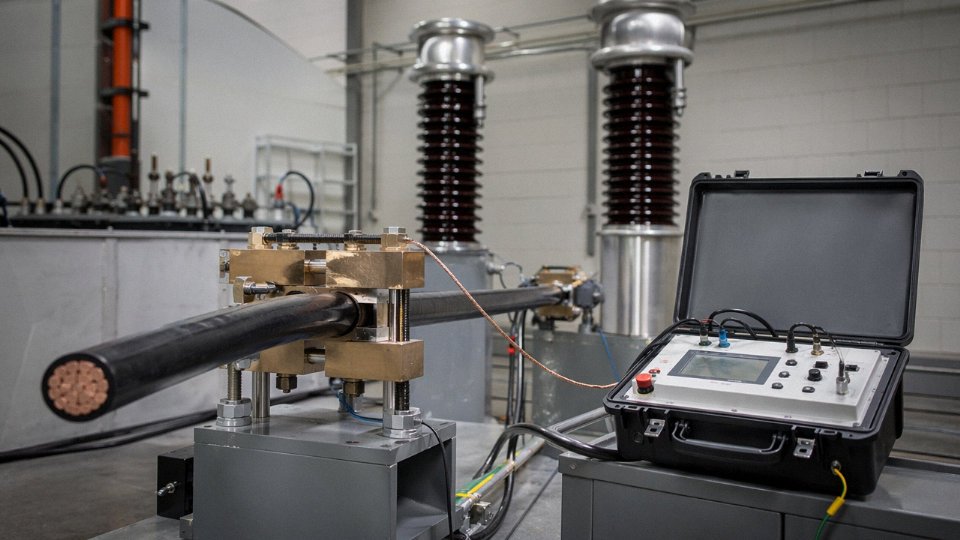
Type tests are done once per cable design — or whenever the compound, geometry, or conductor class changes in a meaningful way. Short-circuit temperature rise testing confirms the conductor and insulation can survive the fault current the cable is rated for without destructive degradation; for PVC insulation this means staying below 160 °C, for XLPE below 250 °C (values depend on conductor cross-section and fault duration assumptions). The bending test applies repeated flexing around a mandrel of prescribed diameter to verify that insulation and sheath don’t crack at low temperatures — a particularly relevant test for cables destined for outdoor installations in northern climates or high-altitude sites. Thermal stability of the PVC or XLPE compound is tested per IEC 60811 series. Flame propagation is tested per the IEC 60332 series: 60332-1-2 for single-wire vertical flame, 60332-3 categories A/B/C/D for bunched cables, which matters enormously in cable trays inside buildings or tunnels.
Certifications and Market Approvals
Jinda holds ISO 9001:2015 certification, CE marking under the EU Construction Products Regulation (CPR), IEC certification, SASO approval for the Saudi Arabian market, and SONCAP certification for Nigeria, along with country-specific approvals across Southeast Asia and the Middle East.True
These certifications reflect documented third-party audits and product testing requirements specific to each market's regulatory framework, and are verifiable through the relevant certification bodies.
Each approval has real market access consequences — SONCAP, for instance, is a mandatory pre-shipment conformity requirement for cables entering Nigeria; without it, customs clearance stalls. SASO similarly governs product registration in Saudi Arabia. CE under CPR is not just a formality for European projects; it requires declared performance on reaction-to-fire classification, which specifies the Eca, Dca, or Cca class that appears in tender documents.
What Buyers Should Actually Request and Check
Production Batch Test Reports (PTRs) should accompany every shipment. Request them specifically — not a generic factory certificate, but the actual test results for the production batch on that drum, with the drum serial number and manufacturing date code cross-referenced on the DRUM tag attached to the reel itself. Jinda provides PTRs and drum tagging as standard documentation, not as a special request.
On arrival, a reel-end conductor resistance spot check takes roughly ten minutes with a calibrated micro-ohmmeter and a tape measure, and it will immediately flag a conductor that’s been drawn undersized. Weight-per-meter is even simpler — weigh a 10-meter sample and compare against the IEC theoretical value for that cross-section, conductor material, and insulation type. Genuine 16 mm² copper cable has a known weight per meter; if the sample comes in 15–18% light, the conductor cross-section almost certainly doesn’t meet nominal.
The Counterfeit Cable Problem Is Larger Than Most Buyers Assume
Undersized conductors — actual cross-section running 15–20% below nominal — are the most common form of cable fraud encountered in price-driven procurement. Thin insulation walls, often 10–15% below IEC minimums, are the second. Neither is visible without measurement. The problem is widespread enough in certain supply channels that IEC published guidance on it, and several national grid operators have mandated incoming inspection protocols. A cable that saves 8% on unit price but carries 18% less copper is not a deal — it’s a thermal overload waiting to happen, and in a bundled cable tray installation, the margin between rated current and ignition temperature is not as wide as people assume.
The weight-per-meter check costs nothing and catches most substitution. Do it.
Frequently Asked Questions About Common Cable Types
What is the difference between a cable and a wire?
A wire is a single conductor — bare or with a thin layer of insulation over it. A cable is an assembly of two or more conductors, or in some definitions a single insulated conductor fitted with additional protective layers such as a screen, armour, or outer sheath. IEC 60050-461 formalizes this boundary, and it matters in procurement because ordering “wire” when you need “cable” gets you something that fails a site inspector’s first glance. In practice, the terms get used interchangeably on the plant floor all the time, which causes real confusion when a datasheet specifies one and the purchasing order quotes the other.
Is copper or aluminum conductor more common worldwide?
Copper dominates in low-voltage building wire, industrial control cable, and anywhere the route is short and current density matters. Aluminum, though, beats copper by total conductor weight shipped annually — largely because overhead distribution lines and long-haul underground MV feeders use aluminum extensively, and those conductors are heavy and run for hundreds of kilometers at a stretch. The cost gap is significant: aluminum typically runs 40–60% cheaper per kilogram than copper, depending on market timing, and that arithmetic becomes hard to ignore when you’re specifying a 50 km underground MV circuit. The tradeoff is that aluminum connections require anti-oxidant compound and proper torque management; a poorly terminated aluminum joint will fail by creep within a few years. Copper still dominates by installed value, which is why the 60–65% figure for copper cable by volume in building and industrial segments holds up even while aluminum leads on raw tonnage.
Aluminum conductor exceeds copper conductor in total conductor weight shipped globally each yearTrue
Overhead transmission and distribution lines, which account for enormous conductor volumes, are predominantly aluminum (ACSR and AAC types). While copper dominates by value in the low-voltage and industrial segments, aluminum's use in high-voltage overhead infrastructure pushes its annual shipped tonnage above copper globally.
What does LSZH (also written LSOH or HFFR) mean, and when is it actually required?
Low-smoke zero-halogen — the compound releases no corrosive halogen gases during combustion and generates dramatically less smoke than standard PVC. That matters in tunnels, offshore platforms, data centers, and enclosed public transport systems where evacuation is difficult and corrosive combustion gases destroy electronics and injure people. IEC 60754 tests halogen acid gas emission; EN 50575 governs flame propagation performance for building cables in Europe. Specifying LSZH where PVC is perfectly adequate adds roughly 15–30% to cable cost, so don’t over-specify it — but in a subway cable tray or an offshore HVAC panel, PVC is genuinely the wrong choice and can disqualify a project from insurance coverage.
Can the same cable handle both power and control functions?
Technically possible in some configurations, practically inadvisable in most industrial settings. IEC 60364-5-52 and NEC Article 725 both provide derating and separation guidance, but the real problem is electromagnetic interference: a power conductor carrying switching transients will couple noise into an adjacent control pair and cause spurious trips or sensor errors that are notoriously difficult to diagnose. Use separate cables. The cost of running a dedicated control cable is trivial against the downtime cost of chasing a ghost fault in a PLC input for two shifts.
How do I verify a cable manufacturer’s production capacity before a large order?
Ask for a factory audit — a virtual one is acceptable for a first pass, but a physical visit before committing to 500 km+ is worth the airfare. Specifically request the ISO 9001 certificate with its scope statement (a certificate covering only one product line is not equivalent to one covering full production), a declared annual capacity by conductor size range, and reference project contacts you can actually call. Jinda provides all of this as standard pre-qualification documentation, including end-user references from international projects.
What is the typical lead time for custom or large-volume cable orders?
Standard catalog constructions — a common LV PVC armored cable in a stocked cross-section — can ship in 15–30 days from a manufacturer carrying raw material inventory. Custom constructions involving special insulation compounds, unusual conductor configurations, or non-standard voltage ratings typically run 45–75 days. Very large orders, say 500 km or more of a single construction, can stretch to 90 days because production scheduling, copper or aluminum rod procurement, and drum logistics all have to align. Seasonal effects are real: copper rod supply and shipping container availability both tighten in Q4, so large projects with hard commissioning deadlines should confirm lead times early rather than assuming the catalog figure applies.
Why do cables carry both a voltage rating and a temperature rating?
Because they govern two completely separate failure modes. Voltage rating — expressed as U₀/U in volts, such as 0.6/1 kV — determines the insulation wall thickness and the dielectric strength required to prevent breakdown under electrical stress. Temperature rating, typically 70 °C, 90 °C, or 105 °C for common insulation compounds, defines how much thermal stress the insulation can sustain continuously before it degrades, embrittles, and eventually cracks. Both limits must be respected simultaneously. A cable rated 0.6/1 kV, 90 °C run at 95 °C ambient will fail thermally long before it ever sees a dielectric problem — and the failure mode is slow, invisible degradation rather than an immediate trip, which makes it particularly dangerous in buried or inaccessible installations.
Jinda’s Global Supply Capability: From Single-Reel Samples to Long-Term Infrastructure Contracts
Scale matters less than how it’s organized. A manufacturer can have a million square meters of floor space and still ship the wrong drum configuration, fail a destination-country test, or go dark when a project engineer needs a technical submittal at 11 p.m. What follows is a straightforward account of how Jinda is structured — what it can actually do, and how buyers typically engage with it across different project sizes.
Five Production Bases, One Integrated Quality System
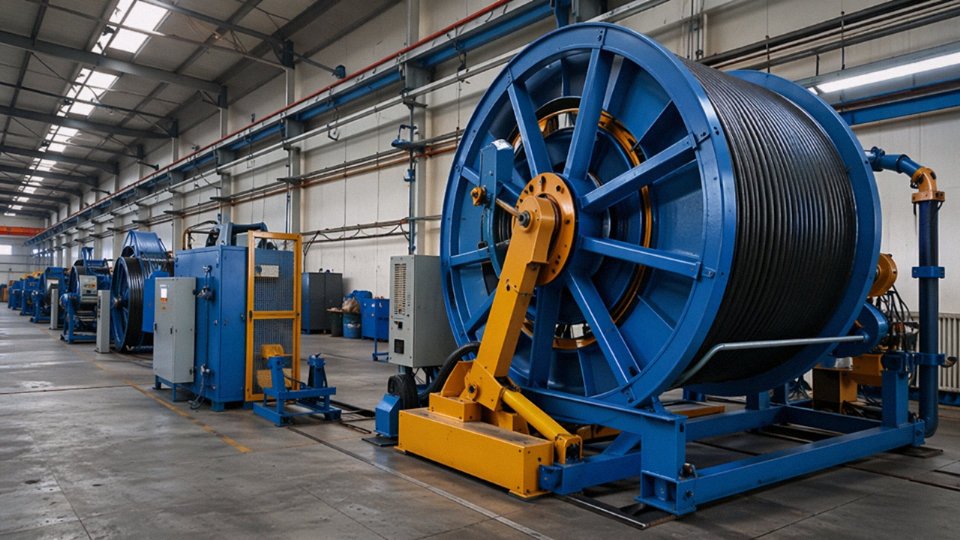
The five manufacturing sites spread across Shandong province collectively cover roughly 470,000 m² of production floor — not office space, not warehouse aprons, but working manufacturing area. Each base handles a defined segment of the product range, but all of them operate under a single quality management umbrella, which matters more than most buyers realize at first.
Vertical integration runs deep here. Copper rod drawing, insulation and jacket compound mixing, conductor stranding, cabling, armoring (steel wire, steel tape, and aluminum wire configurations), and drum finishing all happen in-house rather than being bought in from sub-suppliers. In practice that means the team has direct control over the two variables that cause the most field failures: conductor surface quality before insulation is applied, and compound formulation consistency from batch to batch. Outsourced compounding, in particular, is a hidden risk in cheaper cable supply chains — the virgin resin specification looks fine on paper, but the actual compound rheology drifts between deliveries, and you only find out when insulation thickness runs thin at the extruder.
Product Portfolio: More Than 5,000 SKUs Across Every Major Application
The catalog spans low-voltage building and industrial power cables at the high-volume end, through medium-voltage cables rated to 35 kV that cover the bulk of substation and distribution work, up to 110 kV high-voltage XLPE cables for transmission-level projects. Fire-resistant and low-smoke zero-halogen (LSZH) cables for tunnels, public buildings, and offshore platforms. Mining cables built for continuous flexing and mechanical abuse. Marine cables certified to IEC 60092. Solar DC cables to EN 50618 / TÜV 2Pfg 1169. Wind turbine torsion cables. Railway signaling and trackside cables. Special-purpose instrumentation cables with individual and overall shielding configurations.
That breadth is genuinely useful for procurement teams running multi-category tenders, because consolidating to fewer suppliers reduces the coordination overhead considerably — fewer QA audits, fewer logistics handoffs, fewer sets of documentation to chase.
Logistics Built Around How Cables Actually Ship
Standard export wooden drums are sized and load-rated for 20-foot and 40-foot FCL container loading, including the stacking configurations that maximize container utilization without overloading drum flanges. Smaller orders that don’t justify a full container go out on palletized reels sized for LCL consolidation — this is often where smaller distributors and contractors get into trouble with other suppliers, because drums dimensioned for FCL don’t consolidate cleanly. Oversized MV and HV cable drums for large infrastructure projects require project cargo coordination: flat-rack or open-top container booking, loading calculations, and in some cases port-of-destination cradle arrangements. Jinda’s export logistics team handles this routinely rather than treating it as an exception.
Technical Support That Goes Beyond Sales
Jinda assigns dedicated international project engineers to review customer specifications, prepare technical submittals, and coordinate with third-party testing laboratories in the destination country.True
This is a stated operational capability of Jinda's international business model, reflecting a consultative supply approach rather than purely transactional order fulfillment.
This distinction is worth emphasizing. A technical submittal — conductor cross-section confirmation, insulation system data sheets, drum schedule, test reports from the relevant standard — can take a junior procurement team days to compile from a supplier that doesn’t have the process in place. When a project engineer in, say, a Southeast Asian utility or a Gulf contractor’s office needs IEC test certificates cross-referenced against a local grid operator’s specification, that coordination falls to someone. Having a supplier-side engineer who knows what a technical submittal package needs to look like for different destination markets cuts weeks off approval cycles.
Partnership Tiers: From First Sample to Long-Term Program
One-time project supply is straightforward: submit specifications, receive a proposal, approve samples, ship. For buyers who expect repeat volume, AVL registration with annual pricing agreements gives price visibility and locks in lead times across a 12-month horizon — useful when copper prices are volatile and budget cycles require some certainty. Distributors and regional wholesalers can access co-branding or OEM supply arrangements, which keeps their own product identity intact while drawing on Jinda’s manufacturing base. At the infrastructure program level — grid expansion projects, industrial park development, multi-year EPC contracts — Jinda can hold buffer stock against a rolling forecast, reducing the lead time exposure that typically forces contractors to over-order and tie up working capital in cable yards.
The starting point is usually a sample reel and a specification review. That’s a low-commitment way to stress-test the supply relationship before anything larger is at stake.