Specify the wrong cable type on a procurement order — or let a site electrician substitute “something similar” — and you are not just looking at a rework bill. You are looking at insulation breakdown under load, ground faults mid-shift, tripped protection on a line that cannot afford downtime, and in the worst cases, a fire investigation that voids your insurance. The cable market now sits somewhere around USD 167 billion annually and is climbing toward USD 260 billion by the early 2030s, which tells you how much infrastructure is being built or rebuilt right now. Most of that spending is reactive: people buying what they think they need rather than what the application actually demands.
The five main types of cable are power cable, control cable, instrumentation cable, data and communication cable, and fiber optic cable. Each is engineered for a specific combination of voltage, current, signal type, environmental exposure, and mechanical stress. Selecting the wrong category does not just affect performance — it affects safety certification, insurance validity, and regulatory compliance on the installation.
What makes this genuinely complicated is that the five categories are not clean buckets. A cable that works perfectly in a dry indoor substation may fail within a season in a coastal wind farm cable tray. Low-voltage power cables alone account for roughly 45–50% of all cable installations worldwide by volume, yet even within that single category the conductor sizing, insulation material, armoring, and jacketing choices branch into dozens of configurations. Fiber optic deployment has been growing north of 10% per year through the early 2020s, largely pushed by 5G buildout and data center expansion, and that growth is pulling a new generation of procurement managers into a cable type they have limited hands-on experience with. The sections below walk through each type the way a plant engineer would think about it — what it actually does, where it fails, and what to pin down before you write the spec.
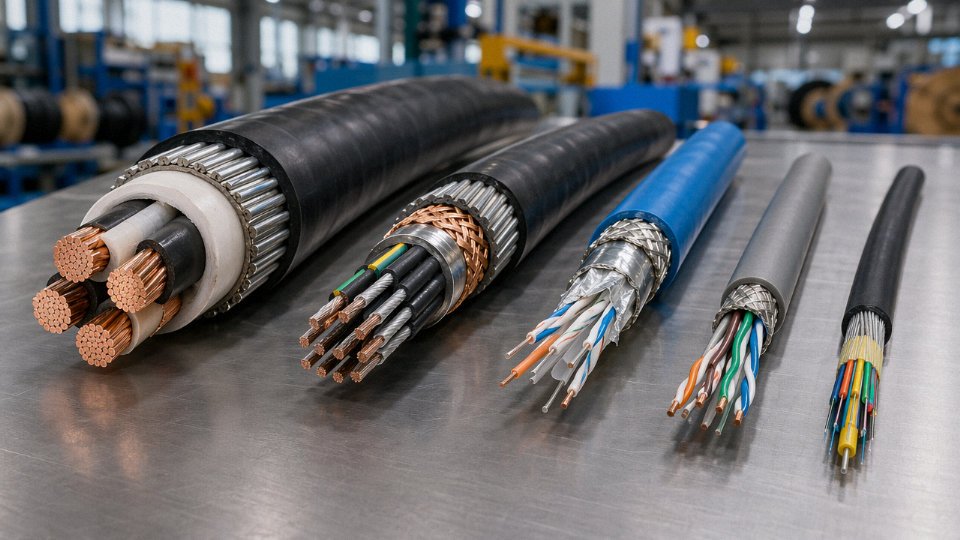
Type 1 — Power Cables: Voltage Grades, Conductor Materials, and Core Construction Explained
Power cables are the backbone of every electrical installation, from a single-story warehouse to a 500 kV transmission corridor. Getting the specification wrong doesn’t just waste money — it causes insulation failure, nuisance tripping, or in serious cases, fire. So it’s worth understanding how the voltage classification system actually maps to the real world before touching a bill of materials.
Voltage Classification Bands and Where Each Gets Used
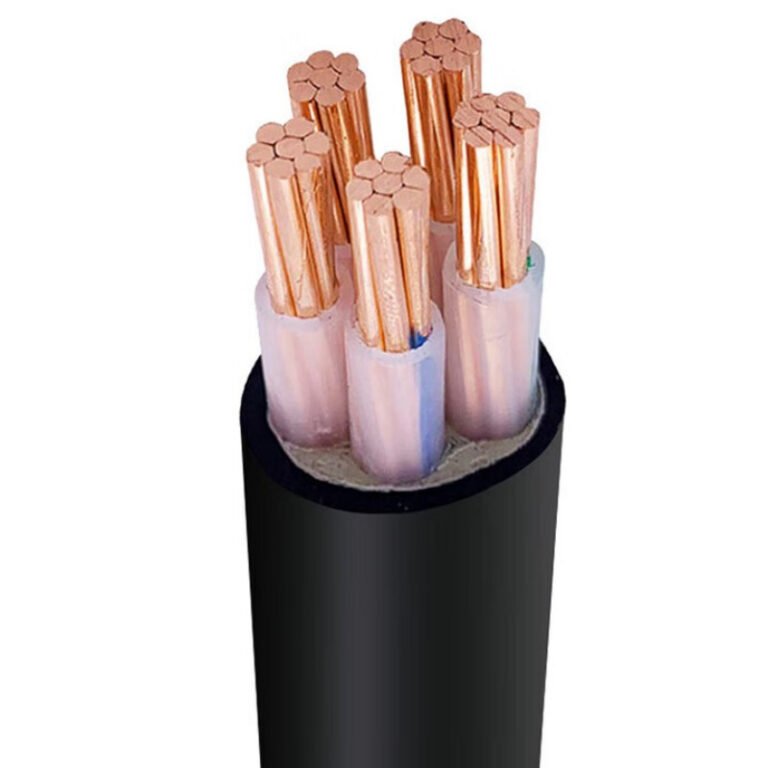
The industry breaks power cables into four working bands. Low-voltage (LV) covers everything up to 1 kV — building wiring, motor feeders, panel distribution, the vast majority of factory floor work. This band represents roughly 45–50% of global cable volume by installation, which makes sense when you think about how many square meters of commercial and industrial space get wired every year. Medium-voltage (MV, 1–35 kV) handles distribution feeders, ring main units, substations, and campus-level infrastructure. HV (35–220 kV) moves into utility transmission and large industrial tie-lines. EHV above 220 kV is specialist territory — national grid transmission, offshore wind collection systems, long-distance HVDC links — where cable design is essentially an engineering project in itself, not a catalogue pick.
Each step up in voltage demands thinner, more controlled conductor stranding, heavier and more precisely extruded insulation walls, and tighter quality control on eccentricity. A 10% variation in insulation wall thickness that’s tolerable at 1 kV becomes a dielectric failure risk at 110 kV.
Copper Versus Aluminum: The Trade-Off Nobody Fully Prices In
Copper runs around 58 MS/m conductivity; aluminum sits near 35 MS/m. That 40% gap means an aluminum conductor needs a larger cross-section to carry the same current — roughly 1.5–1.6× the cross-sectional area for equivalent ampacity, depending on installation method and ambient temperature. But aluminum is about one-third the weight and, in bulk procurement, typically 30–50% cheaper per kilogram at current metal prices (the exact gap shifts with LME movements, so lock in pricing carefully).
In practice, aluminum makes a lot of sense for large-section overhead or underground feeders where the cable is laid straight and termination frequency is low. Where you have frequent joints, tight conduit bends, or repeated mechanical disturbance, copper is less forgiving of mistakes but more forgiving of the installation. Aluminum oxide forms fast on cut ends and is resistive — skip the proper compression lugs or anti-oxidant compound and you’ll see connection heating within a year or two. That’s not a hypothetical; it’s a recurring finding in maintenance audits on aluminum-fed distribution boards.
Insulation Systems: Temperature Ratings and Moisture Behavior
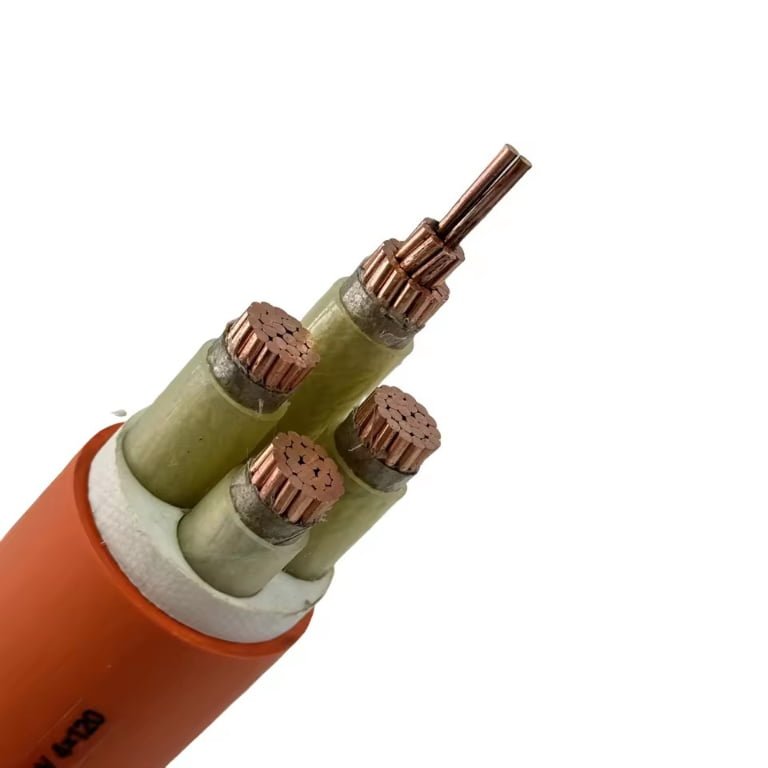
PVC insulation is cost-effective and widely available, rated for 70°C continuous conductor temperature. It’s fine for most building and light industrial work, but it softens under sustained heat and doesn’t handle moisture ingress over long cable runs particularly well. XLPE (cross-linked polyethylene) is the workhorse for serious MV and HV work — 90°C continuous rating, excellent dielectric strength, and substantially better moisture resistance because the cross-linked molecular structure resists water treeing far longer than thermoplastic alternatives. EPR (ethylene propylene rubber) gives up a little on dielectric performance compared to XLPE but stays flexible at low temperatures and tolerates movement, which is why you see it on offshore platform cable trays and shipboard installations where the cable bends repeatedly.
Jinda’s five production lines across its manufacturing bases handle all three insulation systems, which matters for export orders where a single project bill of materials might mix LV PVC-insulated building cables with MV XLPE feeder cables and EPR-insulated flexible connections.
Armoring Options and When Each Is Required
Steel wire armour (SWA) is the standard choice for direct burial and general mechanical protection — it handles longitudinal tensile stress reasonably well and is straightforward to terminate. Steel tape armour (STA) offers crush resistance for cables in ducts or trays where you don’t need tensile strength. When the installation runs near sensitive instrumentation or in environments where induced currents in a magnetic armour would cause problems, aluminum wire armour (AWA) is specified instead; it provides mechanical protection without the magnetic effects of steel.
The choice isn’t purely engineering — some contracts mandate AWA by specification regardless of actual magnetic interference risk, so check the project spec before assuming SWA is acceptable.
Standards Compliance Across Markets
IEC 60502 governs LV and MV power cables and is the reference most international projects default to. IEC 60840 covers HV cables above 30 kV. GB/T 12706 is the Chinese national standard that largely parallels IEC 60502 in structure. BS 6346 remains relevant on projects with British or Commonwealth engineering heritage. The practical challenge for an export manufacturer is that a single order might require dual or triple certification — IEC plus BASEC marking for UK projects, for instance.
Jinda's R&D-integrated production process enables multi-standard compliance, allowing power cables to be manufactured and tested against IEC, GB/T, and customer-specified standards within the same production run.True
Vertically integrated manufacturers with in-house testing labs and documented QMS procedures can produce dual-certified cables by running the same conductor and insulation system through test protocols for multiple standards, provided the design meets the more conservative requirement of whichever standard is stricter.
Type 2 — Control Cables: Signal Integrity, Multi-Core Configurations, and Industrial Automation Demands
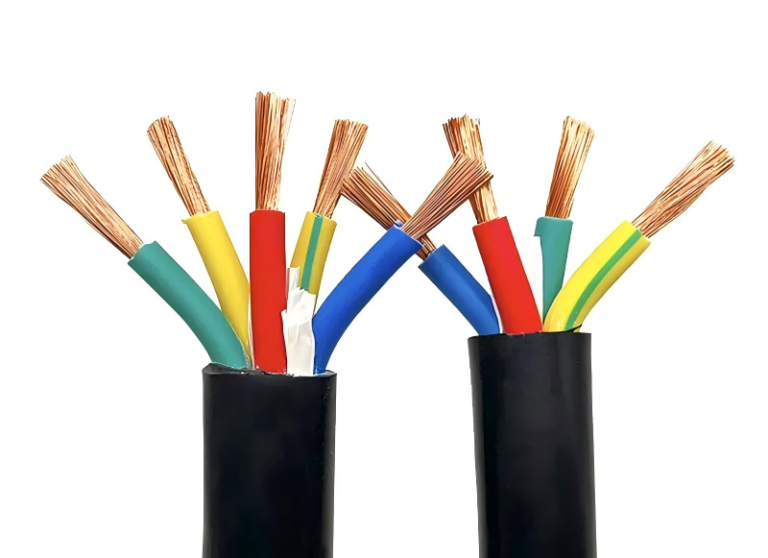
Control cables are not power cables with smaller conductors. That distinction matters more than it sounds. Where power cables move bulk energy from source to load, control cables carry the nervous system of a machine — command signals, feedback loops, interlock circuits, 4–20 mA analog outputs from field instruments, and digital I/O between PLCs and their actuators. Conductor cross-sections typically run from 0.5 mm² up to around 6 mm², occasionally 10 mm² for heavier relay circuits, and voltage ratings generally sit at 300/500 V or 600/1000 V. The current involved is low. The consequences of getting it wrong, though, are anything but.
What Control Cables Actually Do in a Plant
Think of a motor control center feeding a conveyor drive. The power cable delivers 400 V three-phase to the drive. The control cable — maybe a 12-core 1.5 mm² shielded run — carries the start/stop command from the PLC, the speed reference signal, the thermal overload feedback, and the emergency-stop interlock back to the panel. If that cable picks up noise from a nearby VFD, the drive can fault spuriously, or worse, receive a ghost signal. Downtime from misdiagnosed “PLC faults” that turn out to be cable interference is genuinely common in plants where someone specced unshielded control cable to save a few cents per meter.
Multi-Core Configurations and Twisted-Pair Grouping
Control cables come in configurations from 2-core up through 12, 24, 37, 48, 61 cores and beyond — sometimes custom-counted for OEM panels. The raw core count tells you relatively little. What matters is how those cores are arranged internally.
For analog signals and instrumentation loops, twisted-pair construction is usually non-negotiable. Twisting reduces inductive coupling because the opposing half-twists cancel out induced voltages from adjacent conductors. A pair twisted at roughly 10–20 twists per meter in a plant environment can reduce crosstalk interference by 20–40 dB compared to untwisted parallel cores — the exact figure depends on twist rate, signal frequency, and how close the cable runs to variable-frequency drives or bus bars.
Color-coding per IEC 60446 is not just a bureaucratic requirement. In practice, it’s a maintenance safety issue. When a technician is tracing a fault in a 37-core cable at 2 AM, consistent color sequencing and pair numbering is what keeps an isolation error from becoming an arc flash. Jinda cores control cables to IEC 60446 sequencing as standard, with custom jacket and core coloring available for OEM customers who need their own identification schemes.
Shielding: Foil, Braid, or Combined?
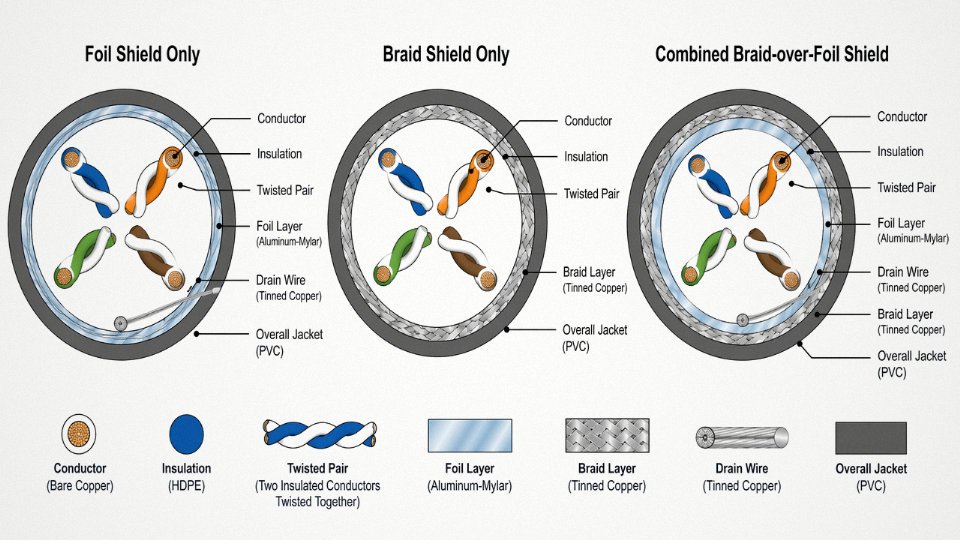
An overall aluminum-Mylar foil shield with a drain wire is the baseline for most industrial control cables — lightweight, adds maybe 3–6 dB of common-mode noise rejection at typical VFD switching frequencies. Individual pair shielding (each twisted pair wrapped in its own foil) steps that up significantly, often 15–25 dB improvement in isolation between pairs in a multi-pair cable, which matters when you’re running both analog 4–20 mA and 24 V digital signals in the same cable run. A combined braid-over-foil construction gives you the highest shielding effectiveness across a wider frequency range and is worth the cost premium in genuinely hostile environments — near large motors, in switchrooms with dense VFD populations, or in steel mills.
Braid-plus-foil shielded control cables provide measurably better high-frequency noise rejection than foil-only shields in industrial automation environments.True
Foil shielding is effective mainly at lower frequencies and suffers from coverage gaps at braid connection points; adding a braid layer improves coverage and extends effective attenuation into the MHz range, which matters for VFD and servo drive applications.
Specialized Variants for Harsh Environments
Oil-resistant jackets (typically PUR or oil-rated PVC compounds) matter in machine tool and hydraulic press applications where cable trays collect coolant. In petrochemical plants, flame-retardant (FR) or fire-resistant (FRI) designations become mandatory — not optional — under many facility safety codes. LSZH (low-smoke zero-halogen) jackets are specified for tunnels, offshore platforms, and data centers where halogen combustion products during a cable fire would be as dangerous as the fire itself. Armored control cables — SWA or AWA construction — get used in underground trench runs between buildings and in marine installations where mechanical damage risk is real.
Jinda manufactures control cables against IEC 60227, IEC 60228, and EN 50525 standards across these variants, and accommodates custom conductor counts, jacket compounds, and identification schemes for OEM customers and bulk procurement projects. Lead times and minimum order quantities for custom configurations depend on core count and jacket material — worth confirming early in a project schedule rather than assuming standard-product availability.
Type 3 — Instrumentation Cables: Noise Rejection, Pair Stability, and Process Industry Requirements
Instrumentation cables get misspecified more often than almost any other cable type. The mistake is usually the same: a project engineer treats them as light-duty control cables and orders based on conductor count and voltage rating alone. That works fine for running a conveyor start/stop signal. It fails badly the moment you’re transmitting a 4–20 mA loop from a pressure transmitter 300 meters away past a variable-frequency drive cabinet, and your DCS reads 4.3 mA when the actual process value is 4.0. In a flow-control loop that’s managing feed to a reactor, that kind of offset isn’t a calibration nuisance — it’s a process upset waiting to happen.
Why the Signal Level Changes Everything
The fundamental difference is voltage magnitude. Power cables operate in the hundreds of volts. Control cables typically carry 24 VDC or 120/240 VAC discrete signals where a few millivolts of interference is irrelevant. Instrumentation cables carry signals in the 1–100 mV range (thermocouple EMFs, bridge outputs) or the 4–20 mA analog range where loop resistance tolerances matter, and where 5 mV of induced noise can represent a real measurement error of 0.3–1% of span, depending on transmitter range. RTD circuits are even more sensitive — a 2-wire PT100 circuit seeing unexpected lead resistance from a poorly matched conductor adds directly to the temperature reading as a fixed offset.
This is why instrumentation cable construction is fundamentally a noise-rejection architecture, not just a wiring convenience.
Twisted-Pair Construction and Layered Shielding
The baseline for any instrumentation cable is individually twisted pairs (or triads for 3-wire RTD circuits), each with its own foil-and-drain-wire shield. Individual pair shielding handles the high-frequency noise that couples differentially between signal conductors — the kind generated by nearby VFDs and contactors switching at 2–16 kHz. The collective overall shield, which wraps the entire multi-pair assembly, handles lower-frequency common-mode interference and provides a second barrier against electrostatic coupling from power conductors running in parallel cable trays.
Done correctly, this layered architecture achieves roughly 60–80 dB of noise attenuation across the 50 Hz to 100 kHz range, though the actual figure depends on shield coverage percentage (aim for 100% foil coverage, not braided), drain wire resistance, and grounding practice. Grounding matters enormously — shield drain wires should connect at one end only in most analog installations to avoid ground loops. I’ve seen sites where a field technician grounded both ends of every shield “to be safe” and created more interference than they eliminated.
Thermocouple Extension, RTD, and Fieldbus Types
Thermocouple extension cables require conductors made from the same alloy pair as the thermocouple itself — Type K uses Chromel/Alumel, Type J uses iron/Constantan, and so on, per IEC 60584. Substituting standard copper conductors introduces a parasitic thermocouple junction at the connection point, adding a temperature-dependent error that drifts with ambient conditions in the field junction box. This is a surprisingly common installation error.
RTD cables need something different: low-resistance copper conductors, closely matched in resistance from conductor to conductor across the reel length. For a 3-wire PT100 circuit, resistance mismatch between the two “return” legs produces a direct measurement offset. Consistent conductor resistance across a large batch — reel to reel — becomes a real procurement specification, not a footnote.
HART and Foundation Fieldbus signal cables add a further requirement: controlled characteristic impedance (typically 100–150 Ω for FF-H1) and capacitance limits to preserve the digital signal integrity overlaid on the 4–20 mA loop.
Hazardous Area Installations
In Ex zones, instrumentation cables for intrinsically safe circuits must meet IEC 60079-14 requirements: defined capacitance per unit length (often ≤ 200 pF/m) and inductance limits to keep the total loop energy within Exi or Exia parameters. The blue outer sheath is a convention widely recognized in the process industry as the visual marker for IS circuits — it’s not a universal legal requirement everywhere, but deviating from it on a plant where maintenance teams rely on color identification creates real safety risk during cable replacement.
Instrumentation cables for intrinsically safe circuits must comply with IEC 60079-14 capacitance and inductance limits to remain within Exi/Exia parameters.True
IEC 60079-14 specifies installation requirements for electrical equipment in explosive atmospheres, including cable capacitance and inductance constraints that are fundamental to maintaining intrinsic safety approval limits for IS circuits.
Procurement Realities on Large Projects
A grassroots process plant might require 80–150 distinct instrumentation cable part numbers across thermocouple extension, RTD, multi-pair analog, and IS variants. Sourcing those from four different suppliers means four different production batches, four different quality systems, and potentially four different interpretations of “matched conductor resistance.” Batch-to-batch inconsistency shows up as unexplained calibration drift after commissioning — the kind that generates weeks of instrument technician time hunting a problem that was built into the cable.
Jinda’s fully integrated manufacturing — covering conductor drawing, insulation extrusion, stranding, and shielding under one roof — means conductor resistance matching is controlled across the full project supply, with factory test reports issued per reel. For a procurement manager building a complete instrument cable package for a refinery or chemical plant, that traceability simplifies FAT documentation and gives the end-user a single point of accountability if field issues arise.
Type 4 — Communication and Data Cables: From Structured Cabling to Industrial Ethernet and Fiber Optics
Structured cabling is one of those disciplines where the standards actually matter in day-to-day procurement decisions, not just in the spec sheet. ANSI/TIA-568 in North America and ISO/IEC 11801 internationally define the performance tiers that determine whether your horizontal runs will support the bandwidth your switches can push. Getting this wrong usually shows up three or four years after installation, when someone tries to upgrade to 10 Gbps and discovers the Cat 5e they buried in conduit simply can’t get there reliably — and now the cable is inaccessible.
Structured Cabling Categories and What They Actually Buy You
Cat 5e handles 1 Gbps out to 100 m under TIA-568 channel requirements, which is still adequate for general office endpoints and building automation backbones where bandwidth density is low. Cat 6 raises the alien crosstalk headroom significantly — same 1 Gbps, same 100 m, but with margin that matters in bundled cable trays. Cat 6A is the practical choice for new commercial builds; it supports 10 Gbps at the full 100 m and is backward compatible with everything below it. The tradeoff is diameter: Cat 6A cables typically run 7–8 mm versus 5–6 mm for Cat 5e, which affects fill ratios in conduit and the stiffness of patch panels.
Cat 8 is genuinely a data center product. 40 Gbps, but only to roughly 30 m, which is fine for top-of-rack switch interconnects but irrelevant in a campus run. If a salesperson is pushing Cat 8 for a hospital floor wiring project, that’s a flag.
UTP, FTP, SFTP, SSTP — Matching Shield to Environment
Unshielded twisted pair (UTP) works well in clean office environments. In a plant or a building with variable-frequency drives, fluorescent lighting on the same tray, or adjacent power cables, you need to think harder. FTP (foil overall) gives you a basic shield against external EMI but does nothing to prevent pair-to-pair crosstalk internally. SFTP adds a braided outer shield over the foil — better low-frequency rejection, more robust mechanically. SSTP goes further with individually shielded pairs, which is what you want in high-EMI manufacturing environments or anywhere you’re routing alongside motor feeder cables.
The installation discipline matters as much as the cable spec. A broken shield drain wire, an improperly terminated ground connection, or a shield bonded at both ends in a high-noise environment can make SFTP perform worse than UTP. In practice, I’ve seen installers skip the drain wire termination entirely because they were in a hurry, and the resulting noise floor on a Modbus RTU link was enough to corrupt readings sporadically — the kind of fault that takes days to diagnose.
Industrial Ethernet: A Different Animal
PROFINET, EtherNet/IP, and CC-Link IE are all Ethernet at the physical layer, but the cabling requirements are nothing like office IT. These cables need to survive continuous flexing in drag chains (typically rated for 5–10 million flex cycles at bend radii down to 4× the cable OD), resistance to coolants and cutting oils, and connector systems that maintain IP67 even after repeated mating cycles. PUR jackets handle these environments better than standard PVC; TPE is an alternative in wider temperature ranges. Overmolded RJ45 connectors in M12 D-coded format are the standard approach on the machine side.
Standard Cat 6 UTP office cable is not suitable for use in a cable drag chain application, even at low flex cycle counts.True
Standard Cat 6 UTP uses a PVC jacket and internal geometry optimized for static installation. Repeated flexing causes conductor fatigue and insulation cracking; drag-chain rated industrial Ethernet cables use stranded conductors, PUR jackets, and a construction specifically tested for dynamic flex life.
Fiber Optic Cable: Single-Mode, Multimode, and Construction Types
Single-mode fiber (OS2, 9/125 µm) is the backbone choice for anything beyond roughly 300–500 m, and it’s the only sensible option for campus rings, inter-building links, and long-haul telecom where attenuation needs to stay under 0.2 dB/km at 1550 nm. Multimode OM3 and OM4 (50/125 µm) are cost-effective inside data centers where VCSEL-based transceivers dominate and runs rarely exceed 100–300 m. OM5 extends that wideband window to support shortwave wavelength division multiplexing, which is relevant if you’re planning for 400G or higher density in a new build. Attenuation across multimode typically ranges from 2 to 3.5 dB/km at 850 nm depending on grade — a real figure to plug into your optical link budget, not an afterthought.
Construction type determines how fiber gets deployed. Tight-buffered cables are easy to terminate in the field and suit indoor risers and patch runs. Loose-tube gel-filled construction is standard for outdoor plant and direct burial because the gel protects the fibers from moisture ingress and the loose tube accommodates thermal expansion — the fibers don’t strain when the jacket shrinks in cold weather. Ribbon fiber packs higher strand counts into smaller diameters, valuable for high-density runs in data centers or underground ducts where space is constrained.
For hybrid applications — a wind turbine tower, a smart grid node on a distribution pole, a remote monitoring station — a single cable carrying both power conductors and fiber elements simplifies installation dramatically. Jinda’s R&D work in composite power-and-fiber cables for wind energy addresses exactly this: one cable route from nacelle to base that handles both the power output and the SCADA fiber link, reducing hardware, termination points, and long-term maintenance exposure.
Type 5 — Specialty and Application-Specific Cables: Welding, Mining, Submarine, Elevator, and Solar PV
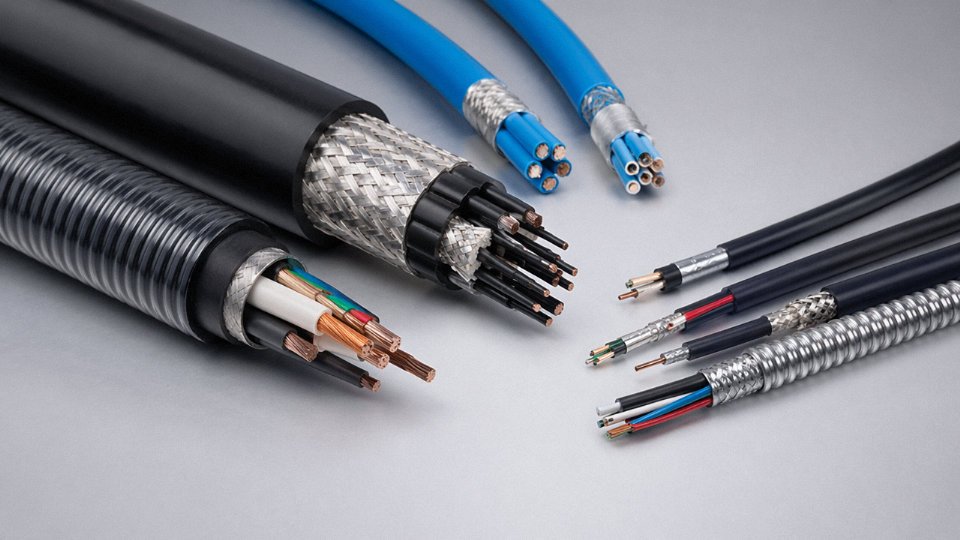
Standard power, control, instrumentation, and data cables cover the bulk of what most facilities need. But a meaningful share of real-world projects — renewable energy farms, underground mines, offshore wind foundations, high-rise elevators, industrial welding bays — operate under conditions that standard construction simply cannot survive. Specialty cables exist because the physics of those environments demand it.
Welding Cables
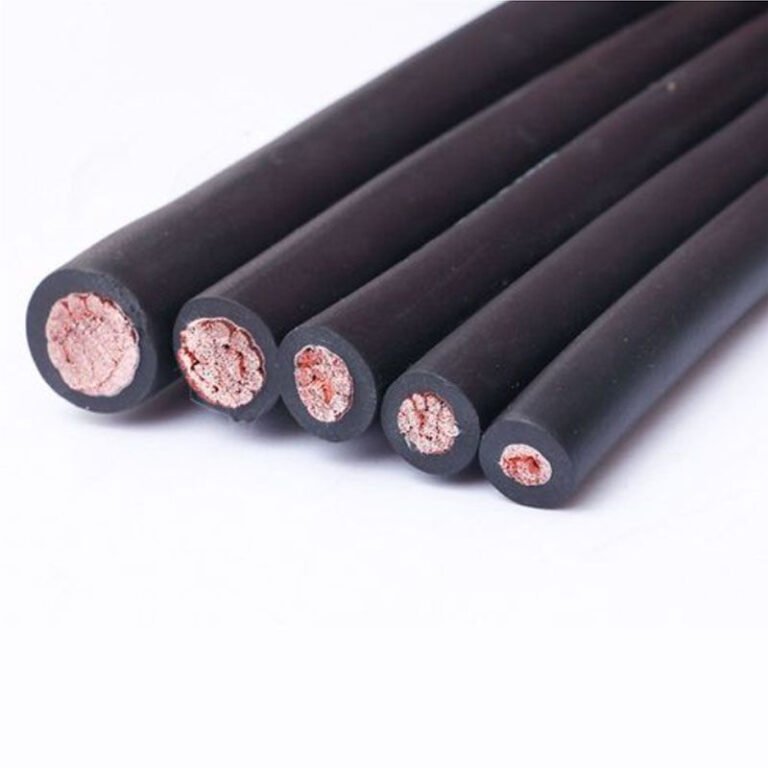
A welding cable carries short, intense current bursts — rarely continuous. That distinction matters enormously for sizing. Unlike a power feeder rated for continuous load, welding cable ampacity is corrected by a duty-cycle factor: a cable rated 300 A at 100% duty might legitimately carry 500 A or more at 20% duty, which is typical for manual MIG or stick welding. Miss that calculation and you either over-specify (wasted cost) or, more dangerously, run a cable that gets hot enough to degrade insulation over weeks of use without triggering an obvious fault.
Construction reflects the physical abuse these cables take — dragged across concrete floors, looped around fixtures, stepped on. Conductors are Class 6 per IEC 60228: ultra-fine stranded copper, sometimes 1,600+ individual wires in a cross-section, giving the cable a limp, almost rope-like feel. Insulation is natural or synthetic rubber rated to roughly 85–110°C depending on compound, and the outer sheath is designed for cut and abrasion resistance. In practice, the sheath failure rate in a busy fabrication shop is much higher than conductor failure — the cable dies from the outside in.
Mining Cables
Underground coal and metalliferous mines combine methane gas, high humidity, mechanical crushing, and the constant movement of heavy equipment. Every one of those factors shows up in the cable specification. Flame-retardant and anti-static outer sheaths per IEC 60079 (and national equivalents such as GB 3836 for China, BS 6500 group for the UK) are non-negotiable. Armouring — usually heavy-duty steel wire or steel tape — protects against rockfall and haulage equipment.
The earthing continuity requirement is worth flagging separately. Mining cables for portable equipment typically include a dedicated earth conductor sized to carry fault current long enough for protection to operate, because a broken earth in a gassy heading is a potential ignition source. Specifying a standard industrial armoured cable here is the kind of shortcut that ends badly.
Submarine and Offshore Cables
Offshore wind array cables — the inter-turbine runs at 33 kV or 66 kV — face seabed abrasion, trawl-gear impact, and decades of wet immersion. Lead or copper moisture barriers prevent water treeing in the XLPE insulation. Double-layer steel wire armour handles the mechanical loads. IEC 60502-4 and CIGRE B1 working group publications set the framework; actual designs get refined project by project based on water depth, seabed type, and installation vessel tension limits.
Offshore wind array cables require cathodic protection compatibility to prevent galvanic corrosion between the cable armour and subsea structures.True
Steel wire armour on submarine cables can form a galvanic couple with aluminium alloy or other subsea hardware. Specifying cathodic protection-compatible armour coating and joints is standard practice in offshore project engineering to prevent accelerated corrosion over a 25–30 year design life.
Elevator (Traveling) Cables
A traveling cable in a high-rise elevator flexes continuously — over a million bending cycles across the cable’s service life, per EN 81-20/50. The construction is typically flat, combining power cores, control pairs, and sometimes a telephone circuit in a single assembly. Steel tape or braided textile reinforcement prevents the cable from rotating or kinking as the car travels. One thing installers sometimes overlook: the neutral axis placement in the flat construction determines fatigue life at the bend sheave. A cable installed with the wrong face inward will fail in a fraction of its rated cycle life.
Solar PV DC Cables
DC cable in a photovoltaic system sits outdoors, exposed to UV, wide temperature swings (-40°C to roughly 90°C on a rooftop in summer), and sometimes 1500 V DC continuous voltage. XLPE or EVA insulation handles the thermal and electrical demands; the outer sheath is UV-stabilized LSZH. Tin-plated conductors resist the slow oxidation that plain copper develops in humid or coastal environments, where contact resistance at connectors gradually increases and becomes a hotspot risk.
Certification matters here. TÜV Rheinland (EN 50618) and UL 4703 are the benchmarks buyers should require. An uncertified “solar cable” is often just a repurposed flexible power cable with a marketing label — and on a 20-year system, that distinction shows up in degraded insulation and failed MC4 connectors, usually around year 8–12 when nobody wants an unplanned re-wiring job.
High-Temperature and Fire-Resistant Cables
At the extreme end sits mineral-insulated copper-clad (MICC) cable: a seamlessly drawn copper tube filled with compacted magnesium oxide, with one or more copper conductors through the centre. It handles temperatures up to around 1000°C and is practically indestructible under normal mechanical loads. The tradeoff is inflexibility and termination complexity — MICC terminations require proper sealing or moisture absorption in the MgO causes insulation resistance to collapse, which is a classic commissioning failure on new installations.
For fire survival circuits — emergency lighting busbars, smoke extraction motor feeds, stairwell pressurisation systems — circuit integrity cables per IEC 60331 (90-minute survival at 750–850°C) are more practical and far easier to install than MICC. The spec exists to keep evacuation systems running long enough for people to get out. Under-specifying this cable type, or substituting a standard LSZH cable because it looks similar, is the kind of error that only becomes visible during a fire.
Side-by-Side Comparison: How to Match Each Cable Type to Your Project’s Electrical, Mechanical, and Environmental Demands
Specifying the wrong cable type — or worse, accepting a substitution from a supplier who doesn’t flag the difference — is one of the more expensive mistakes a procurement engineer can make. The rework cost alone is painful. The downtime cost is worse.
The table below compresses the critical specification dimensions across all five types into a single reference. Use it as a first-pass filter, not a final datasheet.
Comprehensive Specification Comparison
| Parameter | Power Cable | Control Cable | Instrumentation Cable | Communication / Data Cable | Specialty Cable |
|---|---|---|---|---|---|
| Primary function | Carry load current to equipment | Transmit switching/control signals | Carry low-level analog or digital process signals | Network data, voice, video | Application-defined (welding, PV, elevator, mining, subsea…) |
| Typical voltage range | LV ≤1 kV up to EHV 500 kV+ | Usually ≤600 V (signal level) | ≤300 V signal circuits | Typically ≤100 V (data); fiber carries none | Varies widely — welding cables at high current/low V; PV DC up to 1.5 kV |
| Conductor size range | Roughly 1.5 mm² to 2,000 mm²+ | 0.5–6 mm²; typically 1–2.5 mm² | 0.5–1.5 mm², twisted pairs | 22–24 AWG (copper data); fiber counted in strands | Application-driven; welding cables can reach 120 mm² |
| Insulation options | XLPE, EPR, PVC, HDPE | PVC, LSZH, XLPE | XLPE, FEP, PTFE, PVC | LSZH, PE, riser-rated PVC; fiber: tight/loose buffer | Silicone, EPR, TPE, XLPE-PV (halogen-free for PV) |
| Shielding available | Rarely on LV; yes on some MV signal cores | Collective or individual foil/braid | Nearly always — individual pair + overall shield standard | STP (shielded twisted pair), foil, drain wire; fiber inherently immune | Application-dependent; some mining and subsea versions shielded |
| Armoring options | SWA, STA, AWA, DSTA | SWA, GSWB, braid armor | SWA or stainless braid on harsh-environment types | Steel wire or Kevlar strength member (fiber); SWA for direct buried copper | Heavily armored for mining/subsea; flexible spiral for elevator/welding |
| Key standards | IEC 60502, IEC 60840, BS 6622, UL 1072 | IEC 60227, BS EN 50525, UL 508 | IEC 60811, ISA 50.02, BS 5308 | ISO/IEC 11801, IEC 61156, IEEE 802.3 (Ethernet); IEC 60794 (fiber) | IEC 62930 (PV), IEC 60502-1, AS/NZS 1125 (mining), IEC 60092 (marine) |
| Typical environments | Trenched, duct, cable tray, substation | Control panels, cable tray, conduit | Instrument junction boxes, tray, conduit in process plants | Data centers, structured cabling, industrial Ethernet networks | Subsea, roof-mounted PV arrays, elevator shafts, mine roadways |
| Indicative price tier | Mid–high (rises sharply with voltage class and conductor cross-section) | Low–mid | Mid (shielded pairs add cost; PTFE insulation significantly higher) | Low–mid for copper Cat; fiber cost depends on strand count and connector type | High — specialty compounds and testing add 30–80% over equivalent standard cable |
Price tiers depend heavily on copper spot price at time of order, insulation compound, order volume, and whether third-party certification testing is required. Don’t lock in a budget figure without knowing your procurement window.
The Five-Question Selection Checklist
Working through these in order prevents most substitution errors before they happen.
Question 1 — What voltage and current will it carry? This separates power cable from everything else immediately. If the answer is “just signals,” you’re looking at control, instrumentation, or data cable. If you’re running a 6 kV feeder to a pump motor, you’re in medium-voltage power territory with full insulation screening requirements.
Question 2 — Is it carrying power or a signal, and what kind of signal? Analog 4–20 mA process signals demand individual pair shielding and tight capacitance balance — instrumentation cable. High-speed industrial Ethernet at 100 Mbps or beyond needs certified Cat 6 or industrial Ethernet cable with controlled impedance. Bulk switching commands through a PLC panel use control cable. Conflating these is a common error on mixed-discipline projects where electrical and instrumentation scopes are specified by different teams.
Question 3 — What mechanical stresses will it face? Static buried runs are the least demanding — a basic armored cable handles them fine. Continuous flexing in a cable track, like a robotic arm or a traveling crane, demands a high-flex construction with finely stranded conductors and a TPE or special PVC jacket rated for millions of flex cycles. Submerged or subsea applications add hydrostatic pressure and potentially marine organism attack. Getting this wrong creates jacket cracking and insulation failure within two to three years rather than the 25–30 year design life.
Question 4 — What environmental hazards exist? UV exposure eliminates standard PVC jackets — you need carbon-black-loaded PE or a UV-stabilized compound. Chemical splash in a process plant may require PTFE or FEP insulation. Explosive atmosphere zones require cables that are either intrinsically safe rated or meet IECEx/ATEX mechanical and thermal requirements. High ambient temperature — above roughly 70–80°C continuous — rules out standard PVC and pushes you toward XLPE, silicone, or EPR. Seasonal temperature swings matter too; a cable spec that passes summer commissioning can become brittle at -20°C winter startup if the compound isn’t rated for it.
Question 5 — Which standards govern the project? This is non-negotiable for export projects and for anything going into a regulated facility. IEC, BS, UL, NEC, and local national standards don’t always accept each other’s test reports. An EPC contractor delivering into the Middle East market will usually need IEC 60502 compliance with third-party IECEE CB scheme test certificates. A US data center project needs UL-listed cable. Confirm the governing standard before issuing the purchase order, not after.
Two Worked Examples
Petrochemical plant — hazardous area instrumentation and MV power package. A grass-roots refinery typically needs all of the following simultaneously: ATEX/IECEx-compliant armored instrumentation cable for Zone 1 and Zone 2 field instrument loops, 6 kV or 11 kV XLPE armored power cable for MV motor feeders, LV XLPE armored cable for lighting and small-power distribution, and LSZH control cable for the DCS/ESD marshalling cabinets. The instrumentation cable runs in dedicated trays separated from the power runs — this isn’t optional, it’s required by IEC 61511 and basic EMI hygiene. Getting the shielding grounding scheme wrong on the instrumentation cable (grounding at both ends rather than single-ended at the control room) introduces a ground loop that shows up as a 50 Hz or 60 Hz noise offset on your 4–20 mA loops. It looks like a transmitter fault. It’s actually a cable installation error.
Utility-scale solar farm — PV DC, LV AC collection, and fiber monitoring. The DC string cables running from panels to combiner boxes need IEC 62930-compliant (formerly EN 50618) halogen-free XLPE insulation rated for continuous operation at 90°C, UV resistance, and typically 1.5 kV DC rating. The AC collection cables from combiner boxes or string inverters to the MV transformer are standard LV XLPE armored power cables, but the current calculations need to account for continuous full-load operation — unlike commercial building wiring which is intermittent. The fiber optic monitoring cable, usually a loose-tube outdoor cable with a PE jacket and a steel or Kevlar central strength member, carries SCADA sensor data and inverter comms across the site. Three different cable types, three different standards, potentially three different suppliers — unless the procurement team consolidates.
A single-source cable supplier covering all five cable types can reduce EPC procurement lead time on large projects.True
Consolidating cable supply eliminates parallel qualification processes, reduces the number of shipping consignments, simplifies quality documentation packages, and allows combined factory acceptance testing scheduling — all of which compress the overall procurement timeline on projects with 50+ cable line items.
How Integrated Supply Changes the Procurement Equation
Large EPC contractors managing a refinery, wind farm, or data center fit-out typically deal with 40 to 120 individual cable line items across multiple types. Splitting that across four or five specialist suppliers means four or five sets of mill certificates, four or five factory inspection visits, four or five shipping consignments with potentially different lead times and Incoterms, and four or five warranty contacts when something fails in the field.
Jinda’s model — five production bases in China covering power, control, instrumentation, communication, and specialty cable under a single quality management system — means a project can issue one consolidated purchase order, receive one combined test certificate package, and ship in a single consolidated consignment where volumes allow. For procurement managers under schedule pressure, that compression in documentation and logistics overhead is real. It’s not always the cheapest option per unit on a line-by-line comparison, but the total procurement cost — including engineering hours, expediting time, and inspection travel — usually looks different once those factors are included.
International Standards, Quality Certifications, and What They Mean for Your Cable Procurement
Specifying the right cable type is only half the job. The other half is verifying that what arrives on site actually matches what you ordered — and that it will behave correctly in a fire, pass an insurance inspection, or satisfy a project engineer on the other side of the world who has never heard of your supplier. Standards and certifications are how that verification happens, and understanding what they actually test (versus what they merely describe) will make you a sharper buyer.
Design Standards vs. Performance Test Standards — Not the Same Thing
This distinction matters more than most procurement managers realize. Design standards — IEC 60502 for extruded-insulation power cables, IEC 60227 for PVC-insulated low-voltage cables, IEC 60228 for conductor construction, ISO/IEC 11801 for structured cabling — define what the cable is made of and how it is built. Conductor cross-section tolerances, insulation wall thickness, number of cores, screen coverage: all of that lives in design standards. They tell a manufacturer how to construct the product.
Performance test standards are different. They tell you how the cable behaves when something goes wrong. IEC 60332 (flame propagation) has multiple parts — a single-cable vertical burn, a bunch test for installed cables — and passing one part does not imply passing the others; specify the right sub-clause for your installation density. IEC 60331 tests fire resistance under mechanical shock while the cable is energized, which is what you need for emergency circuits in tunnels, hospitals, or high-rise stairwells. IEC 60754 measures halogen content in combustion gases — critical in confined spaces where hydrogen chloride from burning PVC can incapacitate occupants faster than the fire itself. A cable can comply with IEC 60502 in every dimensional respect and still fail IEC 60332-3 under a real bunch-fire scenario. Buyers who treat design compliance as sufficient have been surprised on commissioning audits.
Certifications: What Each One Actually Unlocks
CE marking is a self-declaration of conformity to EU directives (primarily the Low Voltage Directive and CPR — Construction Products Regulation for fixed installations). It is a legal requirement for selling into the EU, not a third-party quality guarantee by itself. UL listing for North America involves product testing and ongoing factory follow-up inspections by UL; NEC-compliant projects in the US will typically require it. CCC (China Compulsory Certification) applies to cables sold into the Chinese domestic market across certain categories — if you are sourcing from China for re-export, confirm whether CCC scope overlaps your product or whether IEC/EN certification is what your end-market actually needs.
For offshore and marine projects, Lloyd’s Register and DNV type approval are effectively non-negotiable. Certifying a cable to DNV-GL requires design review, witnessed factory testing, and periodic surveillance — which is why a marine cable with valid DNV type approval from a credible body carries real weight when an offshore EPC contractor reviews your material submittals. TÜV certification for solar PV cables (covering UV resistance, thermal aging, and wet insulation resistance per EN 50618 / IEC 62930) has become a baseline expectation for utility-scale solar projects in Europe and across much of the Middle East and Southeast Asia.
A cable marked CE-compliant under the EU Construction Products Regulation has undergone declared performance testing for reaction-to-fire properties.True
CPR requires manufacturers to declare performance against harmonized standards such as EN 50575, which covers fire-related cable characteristics. However, the level of rigor varies by declared class (Aca through Fca), and CE marking alone does not guarantee third-party witnessed testing unless the applicable Assessment and Verification of Constancy of Performance (AVCP) system requires a Notified Body.
What a Solid FAT Package Should Include
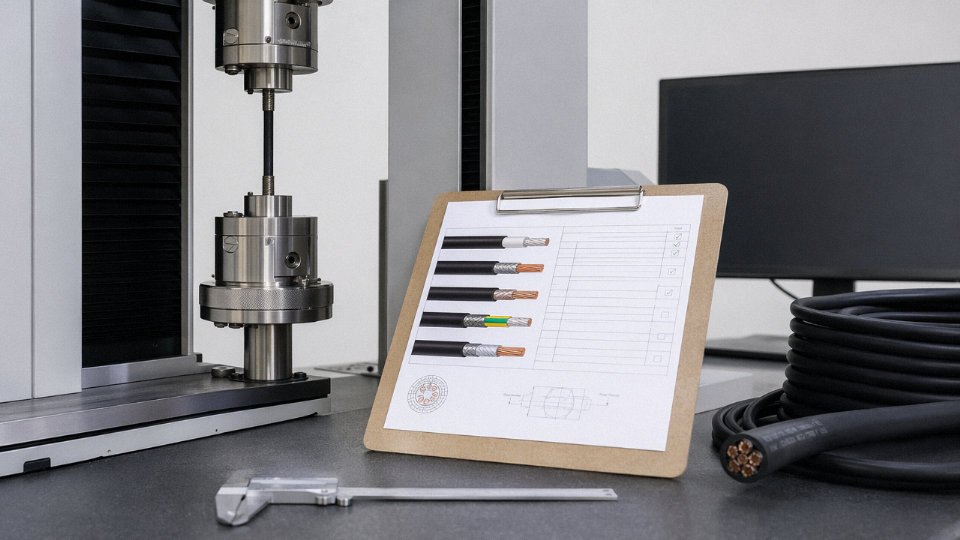
On large cable orders — anything where replacement lead time is measured in weeks and installation labor is not trivial — insist on a Factory Acceptance Test package before shipment. At minimum it should cover conductor resistance per IEC 60228 (confirming actual conductor cross-section, not just nominal), a high-voltage withstand test at the appropriate AC or DC level for the voltage grade, and insulation resistance. For medium- and high-voltage cables, partial discharge testing is essential; a cable with voids or contaminants in the insulation can pass a simple withstand test and still fail within months of energization. Instrumentation and data cables should add capacitance, inductance, and crosstalk measurements. If you specified a flame or fire-resistance rating, those test reports should be present and traceable to a recognized test laboratory — not just a manufacturer self-declaration.
Jinda’s Quality Infrastructure in Practice
Shandong Jinda operates an ISO 9001-certified quality management system across its production bases, which provides the documented process discipline that makes test results repeatable batch to batch. The in-house high-voltage test laboratory is rated to 220 kV, covering the full range from low-voltage distribution cables through transmission-grade HV cables without needing to outsource routine type and routine tests to a third-party lab — which typically shortens test cycle time and reduces scheduling uncertainty on project timelines.
For international project documentation requirements, Jinda provides full material traceability reports and test certificates in English. Third-party witness testing can be arranged for buyers whose project specifications or insurance underwriters require an independent inspector present during FAT. That capability matters on EPC contracts where the client’s engineer has approval authority over material submittals — a test certificate that cannot be cross-referenced to raw material batch records or is only available in the supplier’s domestic language tends to generate RFIs and delays at the worst possible point in a project schedule.
Frequently Asked Questions About Cable Types, Selection, and Procurement
Can I use a power cable as a control cable?
You can, technically — but you’re paying for capacity you don’t need. A 4 mm² power cable run to a PLC input signal is pure cost waste. The reverse is the genuine hazard: a control cable rated at 300/500 V driving a 415 V motor feed. Control cables typically aren’t rated for the sustained current load, and their thinner conductors will overheat under power-circuit ampacity demands. Keep the application boundaries clean. Voltage and current ratings are not interchangeable across types.
What is the difference between XLPE and PVC insulation?
PVC is cheaper, easier to process, and adequate up to around 70 °C conductor temperature. XLPE handles 90 °C continuous (and 250 °C short-circuit), resists moisture ingress far better, and holds its mechanical properties over a wider temperature swing. In wet duct runs or direct burial, PVC can absorb moisture over time and degrade dielectric strength — XLPE doesn’t. The trade-off is cost (XLPE compound runs roughly 20–40% more than PVC depending on grade and copper price at time of order) and end-of-life recycling: cross-linked materials can’t be remolded, which matters for some European waste-management schemes. For anything above 1 kV or operating in warm ambient environments, XLPE is usually the right call. PVC still makes sense for cost-sensitive low-voltage indoor fixed installations where temperature is controlled.
How do I calculate the correct cable cross-section?
Start with your load current, then derate it. IEC 60364-5-52 gives grouping factors — six cables bundled in a duct can derate ampacity by 40% or more compared to a single cable in free air. After you’ve established the derated ampacity, check voltage drop: most codes accept 3–5% drop from source to load, and on long LV runs this often governs sizing more than thermal capacity does. Finally, run a short-circuit withstand check using the adiabatic equation (conductor size versus fault current and clearance time). In practice, engineers often size for voltage drop and find the thermal check is already satisfied — but skip that last step and a downstream fault can anneal your conductor before the breaker clears.
What does LSZH mean, and when is it mandatory?
Low Smoke Zero Halogen cables, when burned, don’t emit hydrogen chloride or other halogenated gases. IEC 60754-1 and -2 test HCl emission and gas corrosivity respectively. In enclosed spaces with limited egress — tunnels, offshore platforms, metro stations, hospital corridors — building codes or project specifications typically mandate LSZH because halogen combustion products at smoke-level concentrations cause rapid incapacitation and corrode sensitive electronics nearby. It’s not just a comfort specification; on offshore projects it’s usually a non-negotiable insurance and classification society requirement.
What is the typical lead time for a large custom cable order?
It depends heavily on conductor material availability and whether a manufacturing slot is already open. Copper rod prices and spot availability genuinely drive schedule on medium-to-large orders — a tight copper market can add three to six weeks to raw material lead time alone. For standard catalog constructions in modest quantities (a few hundred meters), four to eight weeks is realistic from a well-stocked manufacturer. Custom constructions — unusual core counts, special compound jackets, armoring to a niche standard — commonly run ten to sixteen weeks, sometimes longer if a specific certification witness test is required.
A manufacturer operating multiple production bases can allocate orders across facilities to avoid bottlenecks that would delay a single-plant supplier.True
Multi-site manufacturers can shift production between lines or facilities when one is at capacity or awaiting materials, reducing schedule risk on large or time-sensitive orders. This is standard supply chain logic in high-volume cable manufacturing.
Jinda’s five production bases across China and 470,000 m² of manufacturing floor make it genuinely easier to absorb large parallel orders without pushing customers into a six-month queue.
How should cables be stored and transported before installation?
Keep drums upright — never lay them flat, because the lower coils take the full drum weight and deform. Store indoors or under cover: UV degrades PVC jackets faster than most engineers expect, and even six months of direct sun can cause surface cracking that fails a visual inspection. Drum storage temperature should stay between roughly −10 °C and +50 °C for most standard insulation types. During transport, prevent drum flanges from taking impact loads, and on reel payoff, always rotate the drum in the direction of the cable lay — pulling from a stationary drum induces twist that can stress individually screened pairs in instrumentation cables.
What is the difference between a screened cable and a shielded cable?
In practice, most suppliers and engineers use the terms interchangeably. The distinction worth preserving is this: “screen” usually refers to an overall foil or braid applied around the complete cable assembly, while “shield” can describe individual pair or conductor screens within a multi-pair cable. In a precision instrumentation cable you might have both — individually shielded pairs plus an overall screen. Specifying which layer you need matters when the interference source is crosstalk between internal circuits versus external radiated EMI.
Are there cables rated for both AC and DC?
AC-rated cables can generally operate at equivalent or lower DC voltages because DC partial discharge inception voltage is higher — the insulation actually sees less electrical stress at the same nominal voltage. The wrinkle is photovoltaic systems: PV DC cables carry specific requirements for UV resistance, single-polarity stress, and connector compatibility (EN 50618 / IEC 62930) that a generic AC LV cable doesn’t address. Don’t assume your standard building wire is PV-rated just because the DC voltage is below its AC rating.
How do I verify that a cable supplier’s certifications are genuine?
Don’t rely on a PDF the supplier emails you. Check IEC/EN certificates through the issuing body’s public database (KEMA, BASEC, and others maintain searchable registries). UL certificates are verifiable through UL Product iQ. China CCC certificates can be checked on the CNCA portal. For DNV or Lloyd’s type approvals, both classification societies have online certificate finders. Request the original third-party test report — not a summary, the actual report with the lab’s stamp and a traceable test reference number. Any supplier reluctant to provide that is a warning sign.
What information does Jinda need to provide an accurate cable quotation?
Give them: cable type and applicable standard (IEC, BS, ASTM, etc.), rated voltage (U₀/U), conductor cross-section and material (copper or aluminum), number of cores, any screening or armoring requirements, jacket material (PVC, XLPE, LSZH, or other), drum length, total quantity, required delivery port or Incoterms basis, and any project-specific approvals needed — DNV GL, Lloyd’s, TÜV, or similar. Missing any one of these, especially the approval requirement, can result in a price that changes significantly once the real spec is clarified. Get the full spec on the table upfront.
How Jinda’s Five-Base Manufacturing Network Supports Global Cable Supply at Scale
Sourcing cables for a large EPC project from multiple vendors sounds manageable on paper. In practice, it usually isn’t. Specification mismatches between suppliers, staggered delivery windows, inconsistent test documentation, and no single point of accountability for a mixed cable package — these are the problems that quietly erode project schedules and inflate costs. A manufacturer with genuine multi-type production capability under one roof, or across coordinated facilities, changes that equation substantially.
Geographic Distribution and Port Access
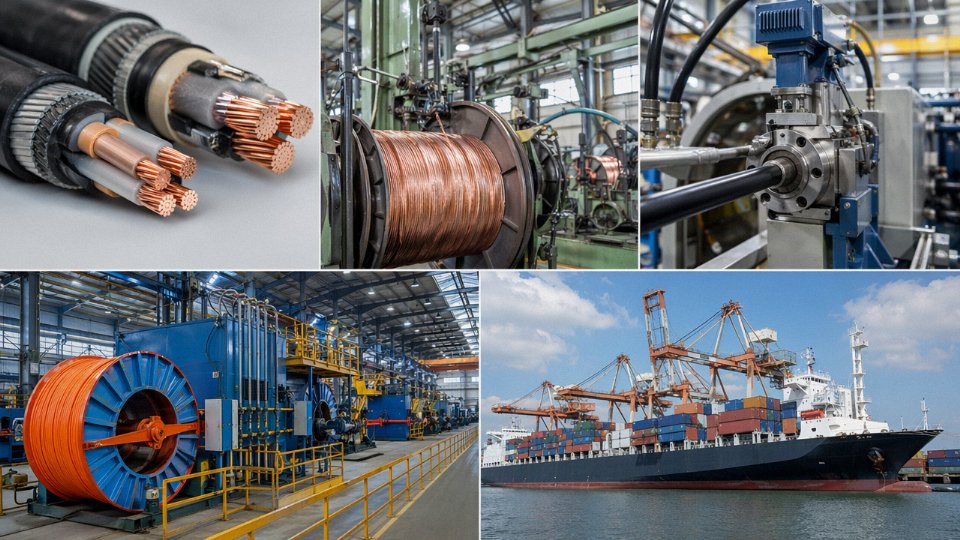
Jinda operates five production bases across China, and the spread is deliberate rather than incidental. Facilities positioned across eastern and coastal China mean road distance to the country’s principal export ports — Shanghai, Tianjin, Qingdao, Guangzhou — stays manageable, typically within a range that supports flexible container booking and last-minute shipment consolidation. That matters when a project’s cable schedule changes (and they always change). A single-site manufacturer running at capacity has almost no flex. A distributed network can shift production loading between bases and still hit an agreed shipping window.
The geographic spread also reduces genuine single-point-of-failure risk. A local grid interruption, a regional logistics disruption, a seasonal labor shortage around Chinese New Year — any of these can stall a single-site operation for days. Distributing production across multiple bases doesn’t eliminate that risk, but it contains it.
Production Scale and Single-Source Supply
The combined manufacturing footprint runs to 470,000 m², with a workforce exceeding 1,000 people. Dedicated production lines cover the full cable type spectrum: low-voltage power, medium- and high-voltage power, control, instrumentation, data and communication, and specialty cables including solar PV, mining, and flexible welding types. That breadth is operationally significant. An EPC contractor putting together a cable package for, say, a combined-cycle power plant or a refinery expansion typically needs all five cable types simultaneously — and needs them to a consistent quality standard with unified test documentation. Placing that entire schedule with one qualified manufacturer collapses the administrative burden considerably: one quality audit, one set of material certifications, one shipping coordination contact.
Jinda supplies all five major cable types from a single integrated manufacturing network spanning five production bases across ChinaTrue
The company operates dedicated production lines for LV/MV/HV power, control, instrumentation, data/communication, and specialty cables across its five bases, enabling single-source supply for complete cable packages
R&D Integration and Technical Sales Support
What gets less attention in supplier brochures but matters significantly in practice is what happens before and after the order. Jinda’s model runs from in-house materials research — including compound development for new insulation systems — through pilot production for product qualification, all the way to post-shipment technical support. The technical sales team reviews project specifications before quoting, which means obvious substitution risks get caught early rather than discovered during installation. Post-shipment installation guidance is available in English, which is not a given with every Chinese manufacturer and genuinely matters for international contractors working in the Middle East, West Africa, or Southeast Asia where the engineering team may not have a Mandarin speaker.
Export Experience Across Diverse Markets
Cables have shipped to infrastructure and industrial projects in more than 50 countries. That breadth of export experience — across the Middle East, Southeast Asia, Africa, Europe, and the Americas — means the team has worked through the documentation complexity that trips up less experienced exporters: country-specific import certifications, material test report formats that satisfy local inspection authorities, and packing requirements for humid climates or long sea transits.
Starting a Procurement Conversation
If you’re building a cable schedule for an upcoming project, the most efficient first step is straightforward: send Jinda’s international sales team your specification package or cable schedule. The technical team will review it, flag any specification questions, and return a comprehensive multi-type quotation covering all the cable types your project requires. Long-term supply partnerships — structured around blanket orders, agreed lead times, and reserved production capacity — consistently outperform spot purchasing for projects with ongoing cable demand. The conversation costs nothing and frequently surfaces specification options that save meaningful money without compromising performance.