You spec the wrong cable, and the symptoms don’t always show up immediately — they creep in as pixelated feeds, intermittent signal drops on the far end of a long run, or a DOCSIS modem that keeps cycling through retraining because the downstream power is sitting right at the edge of the acceptable window. By the time a technician is dispatched, you’ve already absorbed the labor cost, the truck roll, and whatever the downtime was worth to your customer. The root cause, more often than people want to admit, is that somebody substituted RG6 where RG11 was specified — or over-engineered a short indoor run with RG11 to “play it safe” and then wrestled with fittings and bend radius for two days.
RG11 is the better cable for long runs and trunk lines where signal loss is the primary constraint: its 14 AWG center conductor and larger 10.3 mm diameter produce roughly half the attenuation of RG6 at 400 MHz (approximately 3.6 dB/100 ft versus 6.8 dB/100 ft for RG6). RG6, at around 6.9 mm OD with an 18 AWG conductor, is easier to handle, cheaper per meter, and entirely adequate for runs under roughly 50 ft indoors. Neither cable is universally better — the right answer depends on run length, frequency, and where in the signal chain you’re installing it.
What makes this comparison genuinely interesting isn’t the spec sheet — both cables have been documented to death. It’s the procurement and installation decisions that sit between the datasheet and the finished plant, where diameter tolerances, connector compatibility, and bulk reel pricing all push back against the purely electrical optimum. That’s where the real tradeoffs live.
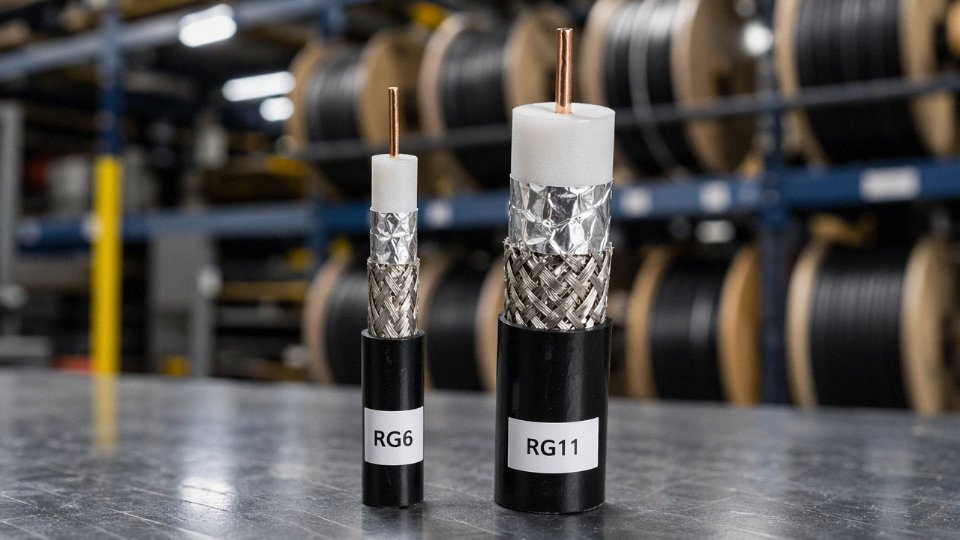
Physical Construction Differences That Drive Every Performance Gap
Every performance gap between these two cables — attenuation, power handling, pull tension — traces back to physical dimensions decided at the design stage. Understanding those differences precisely lets you make the right call before you’ve pulled a single foot of cable through conduit.
Center Conductor: Where Signal Loss Starts
RG11 uses a 14 AWG center conductor, roughly 1.63 mm in diameter. RG6 uses 18 AWG, about 1.02 mm. That difference sounds modest until you consider two things: DC resistance and skin effect.
At low frequencies, the thicker conductor simply carries current with less resistive loss — RG11’s center conductor has roughly 40–45% lower DC resistance per unit length than RG6, depending on whether you’re looking at solid copper or copper-clad steel (CCS). At high frequencies, current crowds toward the conductor surface (skin effect), so the effective conducting cross-section shrinks. A larger diameter means more surface area even at high frequency, which is one of the main reasons RG11 measures around 3.6 dB/100 ft attenuation at 400 MHz while RG6 runs closer to 6.8 dB/100 ft at the same frequency. Both figures shift depending on conductor purity and strand geometry — solid copper performs a bit better than CCS at the high end of the spectrum.
Copper-clad steel is the practical standard for most installations because it handles installation tension better than solid copper without meaningful penalty below 1 GHz. For broadcast-grade or direct-RF-injection applications, specify solid copper center conductor explicitly. Don’t assume.
Dielectric: Size Matters More Than It Looks
Both cables standardly use foam polyethylene (FPE) dielectric. The difference is scale: RG11’s dielectric diameter is roughly 7.24 mm versus approximately 4.57 mm in RG6. Because velocity of propagation depends on dielectric material, not diameter, both land near 85% VoP — but the larger dielectric in RG11 reduces capacitance per unit length, and lower capacitance directly supports better high-frequency performance over long runs. It’s one of those construction details that feels abstract until you see it manifest as a 3 dB difference at the far end of a 200-foot trunk run.
Shielding: Comparable Effectiveness, Very Different Termination Effort
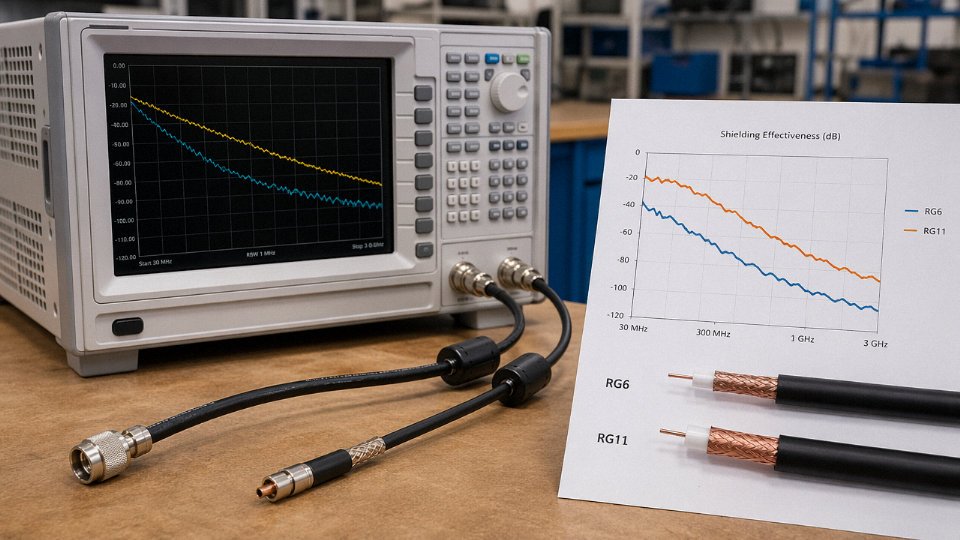
Quad-Shield RG6 — two foil layers plus two braid layers — achieves shielding effectiveness above 95 dB, which is more than sufficient for virtually any commercial CATV, satellite, or CCTV installation. Quad-Shield RG11 matches that figure. The shielding performance is not where they diverge.
What diverges is the termination experience. RG11’s larger OD means standard RG6 F-connectors won’t fit, and RG11 compression connectors are bulkier, cost noticeably more per port (often 2–3× the unit price, depending on supplier and order volume), and require a separate prep tool if your technician hasn’t updated their kit. On a 50-port headend rack, that connector cost and labor time adds up fast.
Jacket Options and Overall Dimensions
Both cables come in PVC (standard indoor), LSZH (low-smoke zero-halogen, required in plenum spaces and most European public-building codes), direct-burial PE, and gel-filled variants for wet or underground runs. Any quality manufacturer — including our production lines at Jinda — offers all four jacket types in both gauges, so jacket choice doesn’t constrain your cable selection between RG6 and RG11.
What does constrain decisions is the overall outer diameter: RG6 at roughly 6.9 mm versus RG11 at approximately 10.3 mm. That’s about 49% more cross-sectional area. In a conduit already carrying other cables, that difference changes your conduit fill calculation entirely. Bend radius minimums increase proportionally too — plan for at least 10× OD as a working minimum on RG11, versus the 7–8× OD most installers use comfortably with RG6.
Both RG6 and RG11 are rated 75 ohm ±3 ohm per IEC 61196 and SCTE 74True
This is the standard published impedance tolerance for both cable types under IEC 61196-1 and SCTE 74. Tighter manufacturing tolerances, such as ±1 ohm for broadcast-grade runs, are achievable but must be specified explicitly at procurement.
Side-by-Side Construction Specifications
| Parameter | RG6 | RG11 |
|---|---|---|
| Center conductor AWG | 18 AWG (~1.02 mm) | 14 AWG (~1.63 mm) |
| Dielectric OD | ~4.57 mm | ~7.24 mm |
| Overall jacket OD | ~6.9 mm (0.275 in) | ~10.3 mm (0.405 in) |
| Impedance (standard) | 75 Ω ±3 Ω | 75 Ω ±3 Ω |
| Impedance (broadcast grade) | 75 Ω ±1 Ω | 75 Ω ±1 Ω |
| Velocity of propagation | ~85% | ~85% |
| Jacket options | PVC, LSZH, PE, gel-filled | PVC, LSZH, PE, gel-filled |
These physical differences aren’t about one cable being “better” in the abstract. They’re the mechanical reasons why RG11 outperforms RG6 on long runs and why RG6 wins on tight conduit installations and connector cost. Everything in the performance comparison flows from these numbers.
Signal Attenuation Data: How Far Each Cable Can Carry a Clean Signal
Attenuation is where the RG6-versus-RG11 argument stops being theoretical. Every decibel of loss you accept in the cable plant is a decibel you either recover with an amplifier — which costs money, draws power, and adds a failure point — or you don’t recover, and the last outlet in the run delivers a degraded picture or dropped signal. Knowing the actual numbers by frequency lets you size runs correctly the first time.
Attenuation by Frequency: The Core Comparison
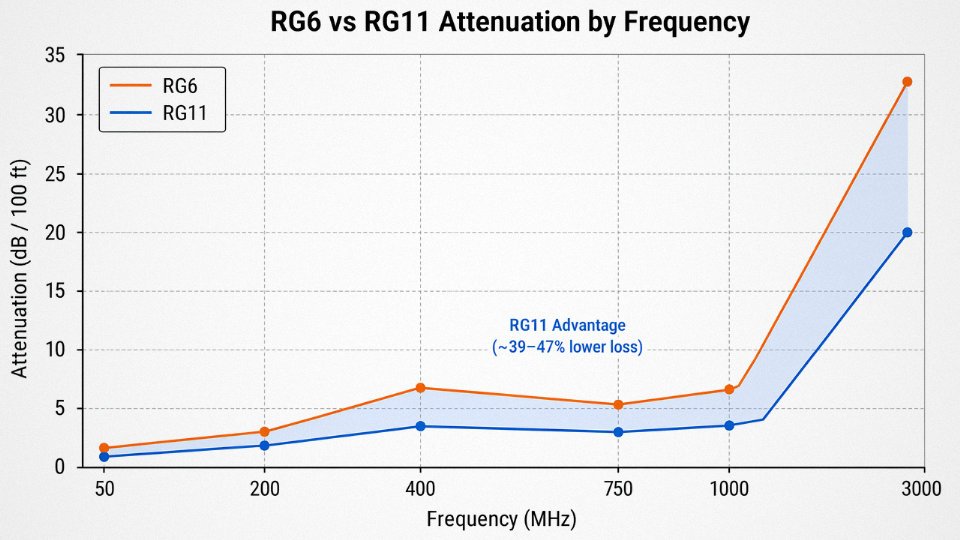
The table below shows typical attenuation values in dB per 100 ft for solid copper-clad steel center conductor versions of each cable. Exact figures vary with shield construction, dielectric consistency, and manufacturing tolerances — expect ±5–8% across different production batches or suppliers.
| Frequency | RG6 (dB/100 ft) | RG11 (dB/100 ft) | RG11 Advantage |
|---|---|---|---|
| 50 MHz | ~1.5 | ~0.9 | ~40% lower loss |
| 200 MHz | ~3.1 | ~1.9 | ~39% lower loss |
| 400 MHz | ~6.8 | ~3.6 | ~47% lower loss |
| 750 MHz | ~5.7 | ~3.2 | ~44% lower loss |
| 1000 MHz | ~6.6 | ~3.8 | ~42% lower loss |
| 3000 MHz | ~33 | ~20 | ~39% lower loss |
RG11 consistently runs 30–45% lower loss across the spectrum. That gap doesn’t close at higher frequencies — it stays wide, which matters most for the applications that push into the GHz range.
Translating Numbers Into Maximum Run Lengths
At 750 MHz — roughly the upper edge of standard CATV downstream spectrum — a 6 dB loss budget is a common practical threshold before signal quality at the subscriber tap becomes marginal. Working from that threshold, RG6 typically exhausts its budget somewhere between 100 and 120 ft of trunk run, depending on connector quality and how tight the bends are. RG11 extends that same 6 dB budget to roughly 170–200 ft under identical conditions. That’s not a small difference when you’re cabling a mid-rise residential building or a warehouse CCTV backbone where runs regularly hit 150 ft before the first drop.
Why the Gap Widens at High Frequencies: Skin Effect
The physics is straightforward. At higher frequencies, AC current stops using the full cross-section of a conductor and crowds into a progressively thinner surface layer — the skin depth. At 3 GHz, skin depth in copper is roughly 1.2 micrometers. What actually matters, then, is not the total conductor volume but the available surface area. RG11’s 14 AWG center conductor has meaningfully more surface area than RG6’s 18 AWG, so its effective AC resistance stays lower as frequency climbs. That’s why the attenuation gap between the two cables doesn’t compress at 3 GHz the way a naive reading of the AWG difference might suggest.
For satellite Ka-band LNB signals and VSAT installations, this becomes critical. RG6 at 3 GHz is running roughly 33 dB per 100 ft — a 30-meter dish-to-receiver run loses over 30 dB before it reaches the first connector. RG11 at approximately 20 dB/100 ft gives you workable headroom for longer outdoor drops without adding an inline amplifier or relocating equipment. For 4K satellite reception, where signal margin is already tight from the dish gain and LNB noise figure, burning extra decibels in cheap cable is a false economy.
The Cascade Effect in Multi-Drop Systems
Consider a 12-unit apartment building. The headend outputs +47 dBmV. The signal passes through a two-way splitter (3.5 dB loss), then runs 180 ft of trunk to a second splitter bank, then feeds individual unit taps. With RG6 trunk cable at 750 MHz, that 180 ft run alone costs roughly 10–11 dB — combine that with splitter losses and tap losses, and the last outlet drops below +3 dBmV, which is the practical minimum for reliable QAM reception. You’re now adding an amplifier mid-run: around $40–80 for the unit, plus labor, plus a power insertion point that needs a working outlet somewhere in the building’s utility space.
Swap the trunk to RG11, and that same 180 ft run costs roughly 5.8–6 dB. The math clears. The last outlet lands above +5 dBmV without the amplifier. The cable costs more per foot — typically 40–70% more depending on order volume and market copper pricing — but one fewer amplifier in a 12-unit building pays back the cable premium quickly, and you’ve removed a device that can fail, clip signals, or introduce noise.
RG11 trunk runs in multi-drop CATV systems can eliminate the need for mid-run amplifiers compared to RG6, reducing total installed system cost despite higher cable unit price.True
Lower per-foot attenuation in RG11 (approximately 44% less at 750 MHz) preserves signal budget across long trunk runs, allowing the same headend output to reach minimum acceptable levels at the last outlet without signal amplification, which offsets the higher cable cost in multi-drop residential and commercial CATV installations.
A Note on Test Documentation
Attenuation figures are only as reliable as the testing behind them. Jinda tests attenuation per IEC 61196-1 on every production batch, and test certificates are available for project documentation — useful when you’re submitting as-built records for a hospitality or infrastructure project where the owner or consultant requires verified cable performance rather than catalog specs. In practice, I’d always ask any cable supplier for batch-specific test data rather than relying solely on the datasheet. The datasheet shows best-case; the batch certificate shows what actually shipped.
Installation Realities: Flexibility, Conduit Fill, Connectors, and Labor Cost
Spec sheets tell you attenuation per 100 feet. They don’t tell you what happens when your installer is trying to thread cable through a 1990s retrofit wall cavity with three 90-degree turns and a junction box the size of a paperback novel. That’s where RG11 starts costing you money in ways that never show up in the cable price per meter.
Bend Radius Is Not a Suggestion
RG6 has a minimum bend radius of roughly 25 mm — tight enough to navigate most residential and light commercial routing without drama. RG11 is around 50 mm minimum, and in practice you want to give it even more forgiveness, especially in cold weather when the dielectric stiffens noticeably. That doubling matters enormously in junction boxes, furniture raceways, and anywhere cable needs to reverse direction in a confined space. Forcing RG11 through a tight corner doesn’t just risk physical damage; it deforms the geometry between center conductor and shield, which creates a localized impedance discontinuity. You’ve just introduced the exact kind of signal reflection that you bought the better cable to avoid.
In new construction with open walls and planned conduit runs, this is manageable. In any retrofit scenario — hospitality upgrades, MDU rewiring, office repurposing — RG11’s stiffness genuinely slows the job down and occasionally makes certain routes impossible without additional junction boxes or pull points.
Conduit Fill: The Math That Kills Retrofit Projects
NEC and IEC conduit fill rules cap fill at 40% of interior conduit area for three or more conductors. RG11’s outer diameter runs around 10.3 mm versus RG6’s approximately 6.9 mm. Work through the cross-sectional area calculation and you get roughly 56% of the cable count in the same conduit — meaning where you ran nine RG6 cables, you can only fit about five RG11. On a retrofit project where conduit is already installed and pulling a larger conduit is off the table, that constraint can force parallel conduit runs, additional trenching, or a complete redesign of the distribution architecture. I’ve seen projects where the conduit fill limitation alone made RG11 economically nonviable for a trunk run, even though the signal performance case was sound.
Connectors, Tools, and the Supply Chain You Actually Have Access To
RG6 F-connectors — compression or crimp — are stocked at virtually every electrical supply house, big-box store, and online distributor worldwide. The compression tools are universal and cheap. Your technicians already own them. RG11 F-connectors are a different situation: less inventory at local suppliers, meaningfully higher unit cost, and they require larger-jawed compression tools that most field crews don’t carry as standard kit. Budget for tool procurement or rental if you’re switching a crew over, and add connector lead time to your project schedule if you’re sourcing internationally.
Improper termination of RG11 cable can negate its attenuation advantage over RG6True
RG11's larger, stiffer construction requires more careful stripping technique; dielectric damage or uneven conductor prep creates impedance bumps at the termination point that introduce signal reflections, partially or fully offsetting the lower distributed attenuation the cable provides along the run.
Termination skill matters more with RG11. The larger conductor and thicker dielectric demand clean, consistent prep — any nicking of the foam or uneven strip length shows up as an impedance bump on a return loss measurement. On a long run where you’re using RG11 specifically to keep signal levels up, a bad termination at either end can wipe out a meaningful portion of the gain you engineered for.
Weight, Aerial, and Underground Realities
RG11 weighs roughly 115 kg per km; RG6 is around 55 kg per km, give or take depending on jacket and shielding spec. That near-doubling affects every physical aspect of installation — reel handling, aerial pulls, underground pulls in conduit, and overhead tray routing. For long aerial drops, though, RG11 messenger-wire variants actually earn their weight: the heavier cable sags less over spans above 15 meters or so, which is why cable operators still use it for aerial feeder runs to pedestal boxes. Direct-burial RG11 with a PE jacket is similarly standard for underground trunk distribution — the lower attenuation over long buried runs justifies the installation premium when you’re feeding multiple pedestals from a single source.
The Labor Cost Reality
In North American and European installations, RG11 labor typically runs 20–35% higher per foot than RG6, depending on route complexity, crew familiarity with the cable, and connector procurement situation. That range is wide because a straightforward aerial pull on an open tower is a different job from threading cable through a finished commercial interior. Neither number is the cable price. Both show up on your final invoice. Any total cost of ownership comparison that uses only material cost per meter is incomplete — sometimes dangerously so for a budget that’s already been approved based on that partial figure.
Application-by-Application Selection Guide: When to Choose RG6 and When to Choose RG11
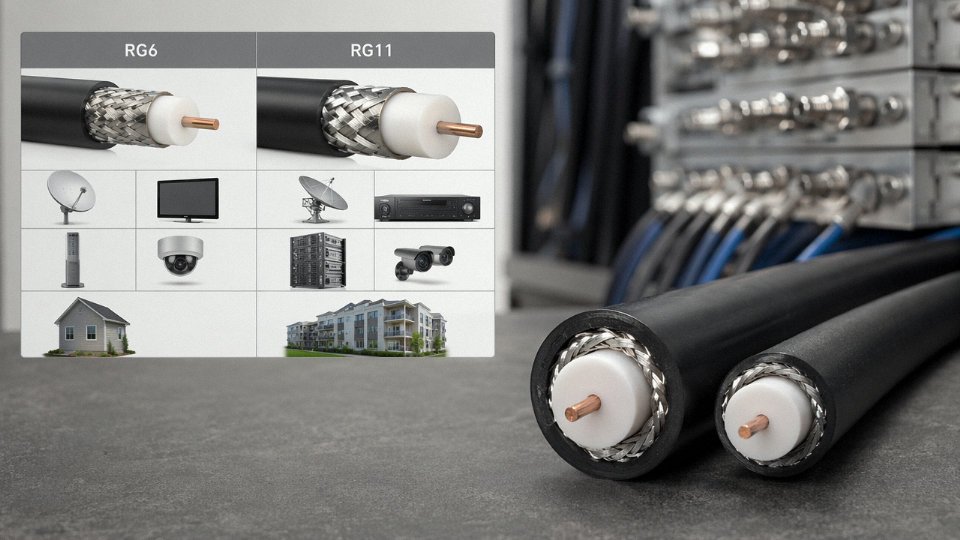
The physical differences between these two cables only matter insofar as they affect actual outcomes in real installations. What follows is how that plays out across the applications most engineers and procurement teams actually deal with.
Residential Single-Family Homes (Runs Under 50 ft / 15 m)
RG6 wins here, and there’s no real debate. At these distances, even at 900 MHz, signal loss is well within any reasonable link budget — you’re not going to measure a meaningful penalty versus RG11. The thinner diameter makes it easier to pull through wall cavities, cheaper to terminate with standard F-connectors, and the per-meter price difference adds up to almost nothing on a single-home job. Quad-shield RG6 is worth the marginal premium in areas with dense RF interference, but standard dual-shield handles most suburban and rural residential installs without issue.
Satellite Dish Feeds (50–150 ft / 15–45 m, 950–2150 MHz Band)
In this range, RG6 Quad-Shield is the practical standard. The LNB-to-receiver run at these lengths stays within acceptable signal margins even at the upper end of the Ku-band IF frequency range. Once you push past 150 ft (roughly 45 m), or if you’re running a multi-switch (DiSEqC) system feeding more than four receivers, switch to RG11. Each additional receiver port through a multiswitch compounds the insertion loss, and you need headroom. Don’t cheap out on connectors here — a poorly crimped F-connector in the moisture at the dish end will kill you before the cable does.
MDU Trunk and Feeder Lines: Hotels, Apartment Blocks, Mixed-Use Buildings
This is where RG11 earns its place. Vertical risers and horizontal trunk runs from the headend to the first tap point almost always exceed 50 ft, and you’re typically running through multiple splitters before signal reaches any individual unit. Each 2-way split costs roughly 3.5 dB; a 4-way split costs around 7 dB. The lower attenuation of RG11 — approximately 3.6 dB/100 ft at 400 MHz versus 6.8 dB for RG6 — preserves the signal budget that those splits will eat into. In practice, most MDU CATV designs use RG11 for all trunk segments and drop to RG6 only for the final in-unit run to the outlet.
CCTV and Analog HD Camera Systems (HD-CVI, HD-TVI, 1080p–4K)
RG6 handles HD analog (1080p, 2MP) comfortably up to around 300 m under typical conditions. For 4K analog formats — which operate at roughly 5 MHz video bandwidth equivalent — signal integrity starts degrading noticeably on RG6 beyond 200 m. Beyond that threshold, RG11 is the right call. This isn’t theoretical; you’ll see it as horizontal smearing and color bleed on fast-moving footage at the far end of long runs.
Broadband DOCSIS 3.1 / 4.0 Networks (Operating to 1.2 GHz Upstream)
RG11 is strongly preferred for node-to-tap trunk segments. The upstream frequency extension in DOCSIS 4.0 especially punishes higher-attenuation cable — every extra dB at 1.2 GHz tightens your noise margin at the CMTS. RG6 is acceptable for the final subscriber drop if it stays under 30 m; longer than that, you’re gambling with upstream MER.
Outdoor Aerial Distribution in Last-Mile Telecom
RG11 lashed to a steel messenger wire can span up to roughly 150 ft between poles without problematic sag, and the heavier construction handles wind and UV loading better over multi-year outdoor exposure. Self-supporting RG6 (figure-8 construction with integral messenger) is suited for shorter spans, typically under 75 ft. For longer aerial runs in warmer climates, thermal expansion on the messenger and jacket matters more than people expect — use UV-stabilized jacket compound regardless of which cable you specify.
Industrial and Broadcast Facilities
RG11 belongs on inter-rack patch bay runs where cumulative loss across multiple patch points affects signal quality. For short in-rack connections under a meter or two, RG6 is perfectly adequate and considerably easier to dress neatly in tight cable management.
RG11 has approximately half the signal attenuation of RG6 at 400 MHzTrue
Published attenuation values at 400 MHz are roughly 6.8 dB/100 ft for RG6 and 3.6 dB/100 ft for RG11, giving RG11 a factor-of-approximately-1.9 advantage — close enough to 'half' that this characterization is technically sound.
Decision Matrix
| Application | Typical Run Length | Key Frequency Range | Recommended Cable | Notes |
|---|---|---|---|---|
| Residential home, single outlet | Under 50 ft (15 m) | Up to 900 MHz | RG6 Dual- or Quad-Shield | Quad-Shield in high-interference areas |
| Satellite feed, few receivers | 50–150 ft (15–45 m) | 950–2150 MHz | RG6 Quad-Shield | Switch to RG11 above 150 ft or DiSEqC >4 ports |
| MDU/hotel trunk and riser | 50 ft+ (15 m+) | Up to 1 GHz | RG11 | Drop to RG6 only for final in-unit segment |
| Analog HD CCTV, 1080p–2MP | Up to 300 m | 3–4 MHz video BW | RG6 | Monitor signal at far end; re-terminate if marginal |
| Analog 4K CCTV | Beyond 200 m | ~5 MHz video BW | RG11 | RG6 acceptable under 200 m |
| DOCSIS 3.1/4.0 node-to-tap | Varies; usually 50–200 ft | Up to 1.2 GHz | RG11 | RG6 for final drop only if under 30 m |
| Aerial distribution, long span | 75–150 ft between poles | Broadband | RG11 + messenger | UV-stabilized jacket required |
| Aerial distribution, short span | Under 75 ft | Broadband | RG6 self-supporting | Figure-8 type with integral messenger |
| Broadcast/industrial inter-rack | 15–50 ft | Wideband | RG11 | Reduces cumulative patch-point loss |
| Short in-rack connections | Under 6 ft | Wideband | RG6 | Easier dressing in tight spaces |
The core logic across all of these: if you’re running long, splitting often, or operating at high frequencies, RG11’s lower attenuation justifies its higher material and labor cost. If you’re running short drops to end points, RG6’s flexibility and lower cost per meter is the sensible choice. The mistake most projects make is applying one cable type uniformly across a system when a tiered approach — RG11 for trunk, RG6 for drop — would optimize both performance and cost.
Cost Analysis: Cable Price, System Cost, and Total Cost of Ownership Over 20 Years
Raw cable price is the number that shows up on the purchase order. It is almost never the number that matters.
Raw Material Cost: What You’re Actually Paying Per Meter
In mid-2024 pricing, RG6 in standard quad-shield, CCS center conductor configuration runs roughly $0.18–0.30 per foot depending on shielding spec, jacket type (PVC vs. CMR vs. CMX), and order volume. RG11 in comparable spec runs $0.38–0.65 per foot — call it 1.8x to 2.5x more expensive per linear foot. That multiplier tracks copper price closely; when copper spikes, the gap widens because RG11’s 14 AWG center conductor carries meaningfully more metal than RG6’s 18 AWG. On a 1,000-ft spool, you’re looking at a $200–$350 cost premium for RG11 before you’ve bought a single connector or scheduled a single crew hour.
For a small residential job, that premium is hard to justify. For a 50,000-ft commercial infrastructure project, the raw material line item is only the starting point of the conversation.
Amplifier Cost Offset: Where RG11 Starts Earning Back Its Premium
This is the calculation most installers skip. RG11’s attenuation at 400 MHz runs around 3.6 dB/100 ft versus roughly 6.8 dB/100 ft for RG6 — nearly half the signal loss over the same distance. In a 200-unit MDU with 1,200 ft of trunk cabling, that difference typically means you can eliminate two line amplifiers from the design. Installed cost for a distribution amplifier, including the housing, power inserter, connectors, and labor, usually lands between $150 and $300 per unit depending on the market and product tier. Eliminating two units saves $300–$600 — which covers a meaningful portion of the cable premium on that trunk run, sometimes all of it.
Fewer amplifiers also means fewer failure points. That’s not a soft benefit; it’s a maintenance budget line.
Labor: The Cost That Surprises Project Managers
RG11 is heavier, stiffer, and less forgiving in tight conduit runs. A 500-ft commercial pull in RG11 versus RG6 realistically adds $120–$250 in labor — accounting for the heavier reel handling, slower pull speed through bends, and longer termination time per connector (compression connectors on RG11 require more prep and more torque control to seat cleanly). In a project with multiple home-run trunk runs, that labor delta compounds. Don’t underestimate it. In my experience, labor is the figure that gets estimated from the RG6 job and then causes grief when the RG11 invoice arrives.
Reliability Over Time: The Maintenance Math
RG11 trunk infrastructure generates 15–20% fewer service calls over a 10-year period compared to equivalent RG6 runsTrue
Lower operating signal loss means amplifiers and connectors run at lower thermal stress, reducing connection degradation and amplifier saturation failures — a pattern documented in CATV infrastructure maintenance records and supported by standard thermal derating principles for RF components
Fewer service calls at $75–$150 per truck roll add up. Over 10 years on a 12-unit apartment building, even four fewer calls represents $300–$600 in avoided cost.
The 20-Year NPV: A Realistic Scenario
For a 12-unit apartment building trunk run — roughly 800 ft of main distribution cabling — the numbers usually shake out like this: RG6 with two amplifiers costs less upfront by $400–$700. But over 20 years, factoring in amplifier replacements (typically once per 8–12 years), service calls, and the labor cost of mid-life amplifier upgrades when signal standards shift, RG11 total cost of ownership runs 8–18% lower. The exact figure depends heavily on local labor rates and whether the building uses DOCSIS 3.1 or pushes toward higher-frequency DOCSIS 3.1 downstream spectrum, where RG6 attenuation penalties grow steeper.
Volume Procurement Changes the Equation
For projects exceeding 10 km of cable, manufacturers can offer volume pricing that compresses the RG11 premium considerably — often to within 35–40% of RG6 per meter rather than the 80–150% premium seen on small orders. At that compression, the breakeven trunk run length — the point where amplifier savings and maintenance savings overtake the cable premium — shortens noticeably. If you’re procurement managing a campus, a hotel, or a municipal broadband rollout, it’s worth requesting a volume quote explicitly structured around RG11 before locking the design into RG6.
Short residential runs under 300 ft with no signal cascade? RG6 wins on cost, full stop. Anything with long trunk infrastructure, multiple dwelling units, or a 15-plus-year service life expectation deserves a full TCO run before the spec gets finalized.
Standards, Certifications, and Quality Benchmarks to Demand from Your Cable Supplier
Procurement managers get burned by coaxial cable more often than almost any other commodity, and the reason is almost always the same: a supplier provided a datasheet that looked fine, no one asked for test certificates, and the cable that showed up on the pallet was not what got specified. By the time the signal degradation shows up — or the fire marshal rejects the installation — the project is already behind schedule.
Here is what you actually need to verify before any purchase order is issued.
The Standards That Define Legitimate RG6 and RG11
IEC 61196-1 is the general specification for coaxial communication cables and sets the framework for electrical, mechanical, and environmental test methods. IEC 61196-6 is the sub-specification that defines RG-type cables specifically — dimensional tolerances, impedance, velocity of propagation, and attenuation limits. If your supplier cannot reference these documents in their test reports, that is a problem. A supplier selling to international markets should be testing to these standards routinely, not scrambling to produce paperwork after you ask.
For CATV applications, SCTE 74 governs F-connector compatibility — port dimensions, torque requirements, mating cycles. This matters because a cable with slightly-off outer conductor diameter will cause intermittent contact in F-connectors in the field, usually blamed on the connectors rather than the cable.
UL 444 is the US safety standard for communications cable. If any of your project cable is going into a US building or being sold through a North American distributor, UL listing is non-negotiable. Confirm it is a current listing, not a certificate from five years ago on a product that has since changed formulation.
Shield Coverage: Where the Marketing Claims Get Dangerous
A quad-shield cable is supposed to achieve a minimum 90 dB isolation at 30 MHz per IEC 61196. That is a measured performance figure, not a construction claim. Plenty of suppliers will tell you they use quad-shield construction — two foil layers, two braid layers — without ever measuring shielding effectiveness. Foil coverage can vary meaningfully based on tape overlap percentage, and braid coverage depends on wire count and weave angle. Ask for documented shielding effectiveness test results per production batch. If the response is a datasheet with a marketing claim but no measured values, walk away.
Attenuation Tolerance and Batch Certificates
IEC 61196 allows up to +10% of the nominal attenuation value. That means a cable nominally rated at 6.8 dB/100ft at 400 MHz could legitimately measure up to roughly 7.5 dB/100ft and still pass. Over a 200-foot run that variance starts to matter, especially if you are already near the amplifier spacing limit. Always request measured attenuation certificates per production batch — not the datasheet value, not the catalog figure. Legitimate manufacturers test every production run and retain the data.
Conductor Material: This One Can Kill Active Systems
Copper-clad aluminum (CCA) center conductors are suitable for satellite LNB power feed and PoC security camera applications.False
CCA has significantly higher DC resistance than solid copper or copper-clad steel. This causes voltage drop that can prevent LNBs and PoC cameras from receiving adequate operating voltage over longer runs. IEC and industry practice restrict CCA use to RF signal-only applications. Always require material certification — CCA looks identical to CCS on the finished cable.
Require a written material certification stating conductor construction: solid bare copper, copper-clad steel (CCS), or copper-clad aluminum (CCA). Any supplier reluctant to provide this in writing is telling you something.
Fire Ratings for Enclosed Installations
LSZH (low-smoke zero-halogen) cables must comply with IEC 60332-3 for flame spread and IEC 61034-2 for smoke density. This is mandatory for public buildings, underground tunnels, rail installations, and most commercial high-rises in Europe and the Middle East. A cable labeled “LSZH” without certification to both standards is just a jacket compound claim — it has not been tested as a complete cable assembly. The difference matters in a fire.
RoHS, REACH, and Market Entry
EU market entry requires RoHS compliance documentation. REACH compliance is increasingly specified in Middle Eastern and Southeast Asian infrastructure tenders, often as a mandatory procurement criterion rather than a preference. Get these certificates before the cable ships, not after customs flags the shipment.
What a Serious Manufacturer’s Quality Infrastructure Actually Looks Like
Jinda operates under an ISO 9001:2015 certified quality management system across its production bases, with a dedicated cable testing laboratory equipped with vector network analyzers for return loss and attenuation measurement. Every production run undergoes 100% continuity and shield integrity testing before shipment. Third-party audit readiness — for major infrastructure projects that require independent verification — is built into the quality process rather than handled reactively. For procurement teams running competitive tenders, that audit trail is the difference between a supplier you can defend to your client and one you cannot.
Frequently Asked Questions About RG6 and RG11 Coaxial Cable
Can I mix RG6 and RG11 in the same system?
Yes, and this is actually common practice in well-designed distribution systems. Both cables are 75-ohm impedance, so there is no electrical mismatch at the junction — a properly installed F-type splice or splitter sees no difference. The standard approach is to run RG11 on trunk and feeder segments (from the headend or dish to the first distribution point) and then drop to RG6 for the final runs to individual outlets or receivers. You get most of the signal budget from the lower-loss trunk without paying RG11 pricing and dealing with RG11 stiffness throughout the entire building. Works cleanly. Just make sure your terminations at the transition point are tight — a loose compression fitting at a junction box will cost you more signal than the cable upgrade saves.
Will RG11 improve my satellite TV signal?
Only in specific circumstances. If your run is under roughly 100 ft and you have a single receiver, a properly installed RG6 Quad-Shield will give you identical picture quality. The difference in attenuation only becomes operationally meaningful at length. Where RG11 genuinely earns its place is in multi-switch installations with four or more receivers, because those systems accumulate loss across several splitter stages before the signal even reaches the long run — any headroom you can preserve at the start of the chain pays off at the end. Below that threshold, swapping to RG11 is a cost you will not see on your screen.
RG6 Quad-Shield and RG11 carry the same satellite TV signal quality on runs under 100 ftTrue
Both cables maintain well over the minimum carrier-to-noise ratio required by standard DVB-S2 and DIRECTV/DISH receivers on short runs; signal degradation only becomes picture-affecting as run length and splitter count increase attenuation beyond the receiver's threshold.
Is RG11 worth the extra cost for a home install?
Rarely. Unless your run exceeds 150 ft, you are in a weak signal area with marginal CNR to begin with, or you are specifically future-proofing for a 4K satellite upgrade with a multi-room setup, RG6 is the right residential choice. The cable costs less, the connectors are cheaper and more widely stocked, and it is far easier to route through walls and around corners. Paying a premium for RG11 in a 60-ft bedroom drop is genuinely wasteful.
What connectors does RG11 use?
RG11 uses F-type connectors — same thread standard as RG6 — but the larger cable body (roughly 10.3 mm OD versus 6.9 mm for RG6) means you must use RG11-specific compression connectors. They are not interchangeable with RG6 connectors. This catches installers out regularly. If you crimp an RG6 compression connector onto RG11, you will get a loose, poorly-sealed termination that fails within a season outdoors. Keep both connector sizes stocked separately, label the bins clearly, and do not let crews grab from the wrong box on a rushed job.
Can RG11 carry PoC (power over coax) for IP cameras?
Yes, and it performs meaningfully better than RG6 for this application on long runs. The 14 AWG center conductor in RG11 has a DC resistance in the range of roughly 8–9 ohm/km, compared to approximately 16–17 ohm/km for RG6 with a copper-clad steel center. On a 200 m PoC run, that difference translates directly to voltage drop at the camera — the kind of voltage drop that causes intermittent reboots or just barely powers the camera but won’t support the heater in a cold-rated enclosure. For PoC runs beyond about 150 m, RG11 with a solid copper center is the correct specification, not an upgrade.
What is the maximum recommended run length for each cable at 1 GHz?
Working to a 10 dB loss budget — which is a reasonable ceiling before you start degrading signal margin — RG6 Quad-Shield gets you roughly 60–75 ft (18–23 m), depending on connector quality and how many terminations are in the run. RG11 extends that to approximately 100–120 ft (30–37 m) for the same loss budget. These figures assume decent compression connectors and no severe ambient temperature extremes. Cold weather tightens that range slightly; heat loosens the dielectric and can push losses a few percent higher.
Does outdoor temperature affect each cable differently?
Both RG6 and RG11 typically use foamed polyethylene or solid PE dielectric, so the electrical behavior under temperature change is similar in kind. The practical difference is thermal mass. RG11’s heavier construction cycles more slowly through temperature extremes, which reduces mechanical stress at connector entry points — that small advantage matters in installations that see genuine seasonal swings, say a rooftop antenna feed in a climate with -20 °C winters and 40 °C summers. The connector-to-jacket interface is where outdoor coax fails first, almost always, and a cable that moves less under thermal cycling simply holds the seal longer.
How do I order both RG6 and RG11 from a single manufacturer for a large project?
Contact Jinda directly with a written specification that covers run lengths, jacket type (PE for direct burial, PVC for indoor/conduit, LSZH where fire codes require it), shielding grade, and any certification requirements — UL, CE, RoHS, whatever your end market demands. Jinda’s integrated production system handles mixed-spec orders on a single purchase order, which means consolidated shipping documentation, unified test reports, and one quality contact rather than two separate supplier chains to manage. For large infrastructure or hospitality projects where both cable types are needed in significant quantities, that simplification in procurement administration is genuinely useful, not just a sales point.
Why Sourcing Both Cable Types from a Single Qualified Manufacturer Reduces Project Risk
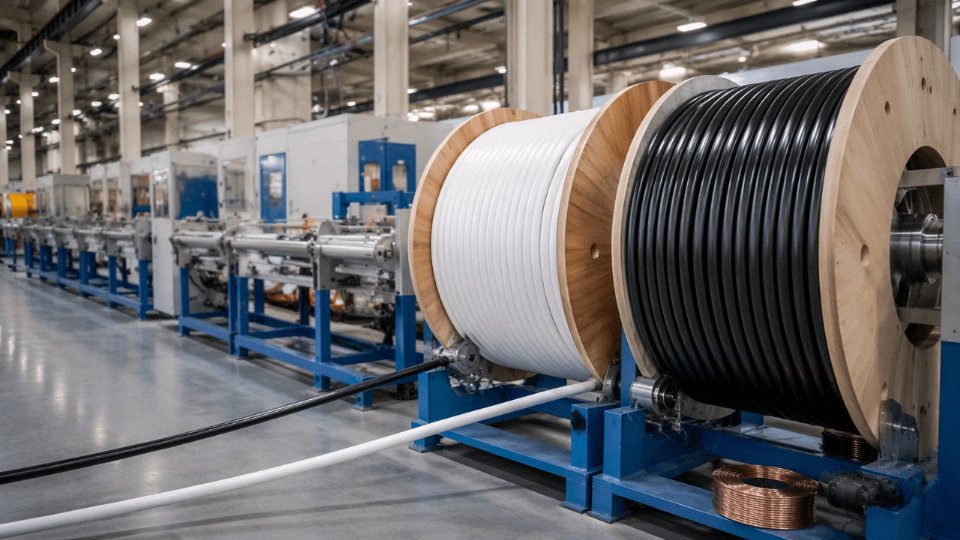
Most cable specifications get written in an office, but the problems show up on the roof of a building in Riyadh or in a cable tray somewhere outside Nairobi, six months after commissioning. By then, tracing a marginal signal loss back to a dielectric tolerance mismatch between two different manufacturers’ RG6 and RG11 rolls is neither easy nor cheap.
Impedance Consistency Across the Whole Signal Chain
RG6 and RG11 are both nominally 75-ohm cables, but “nominal” is doing a lot of work in that sentence. The dielectric constant of the foam or solid PE insulation, the concentricity of the center conductor, and the wall thickness tolerances all interact to determine actual characteristic impedance. When you pull RG11 trunk cable from one supplier and RG6 drop cable from another, those two cables may each individually pass a 75-ohm test and still produce subtle reflections at every splice point because their dielectric tolerances were stacked in opposite directions. In a long CATV trunk-and-drop system — say, 800 meters of trunk feeding 60-odd drop runs — those reflections accumulate. You won’t always see it as a hard failure. You’ll see it as a system that underperforms against your link budget, requires an extra amplifier stage, and generates support calls that nobody can pin down.
Single-source supply eliminates that tolerance stack mismatch. When both cable types are manufactured on the same production line family, to the same internal dielectric specification, the impedance stack behaves predictably end-to-end.
Certification and Compliance Documentation
A project requiring IEC 61196 compliance and RoHS declaration throughout — increasingly standard on government infrastructure tenders in Southeast Asia and the Gulf — needs test reports that cover every cable type on the bill of materials. Pulling those reports from two or three different suppliers, reconciling test dates, checking that RoHS declarations cover the same substance list, and making sure nothing slipped through a mid-production material substitution: that is real administrative work, and it is the kind of work that creates compliance gaps during final audit. One ISO-certified factory, one unified set of test reports, one declaration of conformity. The paperwork is just cleaner.
RoHS compliance declarations from different manufacturers may reference different restricted substance lists depending on the revision date of their testing, creating documentation inconsistencies in multi-vendor projects.True
RoHS has been updated over time (e.g., the addition of phthalates under RoHS 2 Annex II). Suppliers tested to different revision years may produce declarations that are not directly comparable, which can complicate project compliance sign-off.
Logistics, Lead Times, and Project-Specific Variants
Consolidated shipment from a single origin point cuts freight cost and, frankly, cuts the headache of coordinating two delivery schedules on a job site that only has one receiving dock open on Tuesdays. For infrastructure projects in West Africa or the Middle East, where customs clearance can already be unpredictable, splitting your cable order across two suppliers means two chances for a shipment to clear late and push your installation window.
There is also the custom specification question. Standard distribution stock rarely includes gel-filled direct-burial RG11 with an LSZH jacket and integrated messenger wire. Local distributors usually don’t carry it; they’ll offer you the closest standard product and suggest you make it work. A manufacturer with genuine R&D capability can produce application-specific variants to your exact drawing, which matters on any project where the specification was written by the end client’s engineer and substitutions require formal approval.
Jinda’s manufacturing infrastructure — five production bases across China, roughly 470,000 m² of production space, and established export logistics to more than 50 countries — means the capacity is there whether the order is a few hundred meters for a pilot installation or several hundred kilometers for a regional broadband rollout. The same technical team that manufactured both cables can also run an attenuation budget analysis across your complete trunk-and-drop architecture, which is a genuinely useful service when you’re trying to close a signal chain calculation before a tender deadline.
If you have project specifications in hand, Jinda’s international sales team can turn around a cable selection recommendation, sample order arrangement, and formal quotation with full technical and compliance documentation. Submit your specs through Jinda’s inquiry channel and get a concrete answer rather than a catalog.