You’ve got a roll of Romex sitting on the shelf, a thermostat wire run to finish, and a schedule that doesn’t have room for a supply-house trip. Using what’s on hand feels like a reasonable call — until the inspector flags it, or worse, until the system behaves badly for years and nobody can figure out why. Signal degradation, failed AV equipment, and unnecessary rework on low-voltage runs have all been traced back to this exact shortcut. The cable mismatch costs real money, not just in material but in callbacks and re-inspection fees.
You can technically pull Romex through a low-voltage run in some limited situations, but it is rarely the right tool and often a code violation. NEC Article 725 governs Class 2 low-voltage circuits (30V or less, under 100VA), and purpose-built cables like 22 AWG thermostat wire or CL2-rated speaker cable are the correct, listed products for those systems. Romex NM-B is designed and rated for 600V branch circuits — roughly 20 times the voltage headroom most low-voltage systems ever see — and using it adds unnecessary cost, bulk, and compliance risk.
What makes this question genuinely tricky is that “low voltage” covers a wide range of real-world systems — 12V DC LED drivers, 24V AC thermostats, 48V PoE runs, irrigation controllers — and the answer shifts depending on which system you’re wiring, which jurisdiction you’re in, and whether the installation is new construction or a retrofit. The cost gap alone is worth understanding before you decide: Romex 14/2 runs $0.25–$0.65 per foot at retail versus purpose-built thermostat wire at roughly $0.05–$0.15 per foot, a 4x to 10x premium for cable that is, in most of these applications, genuinely oversized for the job.
What Romex (NM-B) Is Actually Engineered to Do
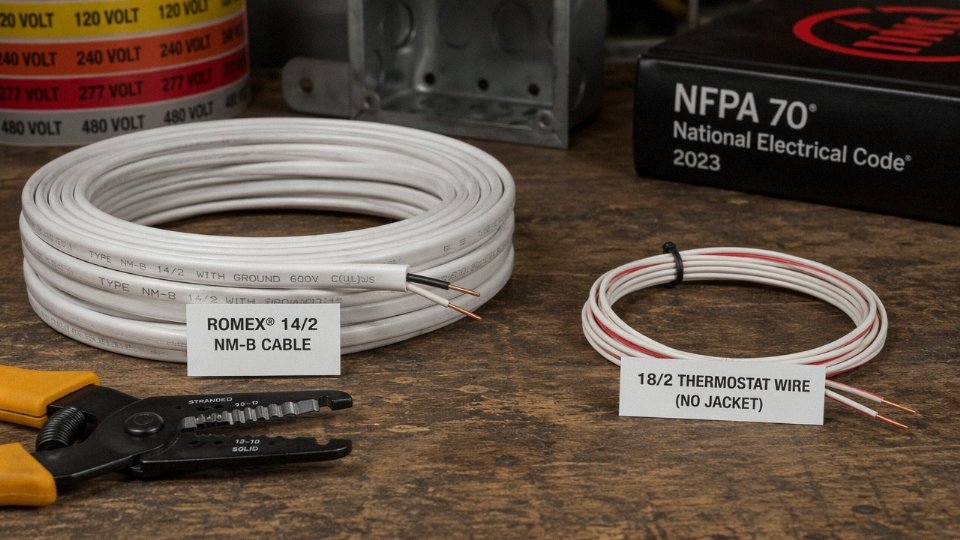
Romex — the trade name Southwire and others use for Type NM-B (nonmetallic-sheathed) cable — was designed from the ground up for one specific job: residential branch circuit wiring at 120V or 240V AC. Everything about its construction reflects that mission. Understanding what it’s actually built for is the only honest way to evaluate whether it belongs in a low-voltage rough-in.
Construction: More Layers Than You Probably Need
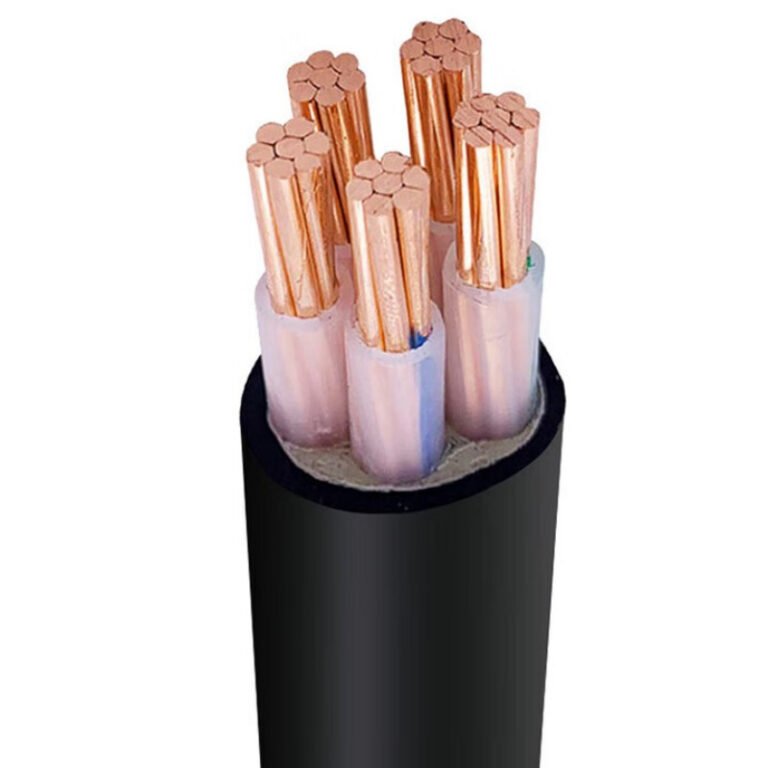
A typical 14/2 NM-B cable contains two current-carrying conductors plus a bare equipment ground. Each insulated conductor is THHN or THWN-2 rated, meaning it gets individual PVC insulation plus a nylon (polyamide) jacket over that insulation — that nylon layer is what earns the “N” in THHN and gives the wire its characteristic slippery feel when you’re pulling through conduit. Around all three conductors sits a paper wrap, then the outer PVC or nylon sheath that holds the assembly together.
That outer sheath is color-coded by conductor size in most product lines — yellow for 12 AWG, white for 14 AWG, orange for 10 AWG — which makes it easy to identify on a job site but doesn’t change what it’s built for.
Electrical Ratings: Built for 600V, Not 24V
The insulation system on NM-B is rated for 600V. That’s the core spec. Temperature ratings break down by environment: 60°C in wet locations, 90°C in dry. In practice, inside a conditioned wall cavity, the 90°C dry rating applies, though NEC 310.15 ampacity correction tables will derate you back toward 60°C or lower if the cable runs through an attic that sees summer temperatures over 30°C — something installers in Texas or Arizona learn the hard way after a first inspection fails.
Ampacity under NEC 310.15 for NM-B in a typical residential application runs 15A for 14 AWG, 20A for 12 AWG, 30A for 10 AWG. These aren’t conservative estimates; they’re the code-defined maximums for the conductors in normal residential thermal conditions. A thermostat circuit pulling 100mA or a doorbell transformer drawing 500mA never comes close to stressing these conductors electrically. The copper doesn’t know or care that it’s underloaded.
Mechanical Ratings: Where the Limitations Start
This is where Romex’s restrictions become operationally relevant. NM-B is explicitly not rated for direct burial, not approved for wet or damp locations without conduit protection, and under NEC 334.10, it cannot be used in commercial or industrial occupancies at all — full stop. You can’t run it in a warehouse, a retail space, or a light manufacturing environment regardless of voltage. The code doesn’t make exceptions based on load.
It’s also stiff. The multi-layer construction — individual insulation, nylon, paper wrap, outer sheath — produces a cable assembly that resists tight bends. For a branch circuit that runs point-to-point inside wall cavities, that’s fine. For the kind of routing you do in AV or security work, where you’re threading cable through finished walls, around 90° bends in shallow boxes, and through cable management channels, NM-B fights you. Experienced low-voltage techs avoid it partly for this reason alone.
Romex NM-B can be used in commercial occupancies for low-voltage circuits because the lower voltage reduces the hazardFalse
NEC 334.10 prohibits NM-B in commercial and industrial occupancies regardless of the voltage level of the circuit. The restriction is based on occupancy type, not circuit voltage.
Conductor Sizing: Technically Adequate, Practically Wasteful
14 AWG copper can handle far more current than any Class 2 low-voltage circuit will ever demand. That’s not a safety problem — the wire won’t overheat pulling 200mA. But you’re paying for copper you don’t need. A rough comparison puts the cost premium in context:
| Cable Type | Voltage Rating | Conductor Size | Flexibility | Approx. Cost/ft (2024) | NEC Article |
|---|---|---|---|---|---|
| Romex 14/2 NM-B | 600V | 14 AWG | Low | $0.25–$0.65 | Article 334 |
| 18/2 Thermostat Wire | 300V | 18 AWG | Medium | $0.05–$0.15 | Article 725 |
| Cat6 UTP Ethernet | 300V | 23 AWG | Medium-High | $0.08–$0.20 | Article 800 |
Cost per foot varies by region, supplier volume, and copper spot price — a contractor buying a 1,000-foot spool gets a different number than someone pulling a 25-foot retail coil at a box store. But even at the low end, Romex runs roughly 4x to 10x the cost of purpose-built low-voltage cable for the same linear run.
The Overengineering Problem in Plain Terms
Romex is overbuilt in voltage rating, conductor mass, and mechanical rigidity for virtually every low-voltage application you’d encounter — security panels, HVAC controls, LED drivers, AV distribution, irrigation controllers. The cable assembly will carry the current without complaint. But overengineering a product into the wrong application isn’t automatically safe or smart; it creates code exposure, adds unnecessary material cost, and introduces real installation friction that slows the job down. That’s the baseline to carry into every code and application comparison that follows.
NEC Code Rules That Govern Low-Voltage Wiring Decisions
The NEC doesn’t have one single article that covers “low voltage.” That’s the first thing most people miss. Depending on what you’re wiring — a thermostat, a security camera, a fire alarm loop, or an LED landscape system — you may be governed by Article 725, 760, 800, 820, or 411, and each one has its own cable listing requirements. Romex (NM-B) appears in exactly none of those requirement lists as an acceptable cable. That’s not an oversight. It’s by design.
NEC Article 725: The Primary Framework for Class 2 and Class 3 Circuits
Article 725 covers remote-control, signaling, and power-limited circuits — which is most of what installers are actually running when they ask about low-voltage wiring. Class 2 circuits, defined at 30V or less and no more than 100VA, must use cable listed specifically as CL2, CL2R (riser-rated), or CL2P (plenum-rated). Class 3 circuits (up to 150V, higher VA) require CL3, CL3R, or CL3P.
NM-B is not on this list. Not as a primary option, not as a fallback.
Section 725.48(B) does establish a substitution hierarchy — CL3 can substitute for CL2, for instance, and plenum-rated cable can substitute for riser-rated — but this hierarchy is defined and closed. NM-B is not in it. A general-purpose branch-circuit cable rated at 600V doesn’t become an acceptable Class 2 substitute just because it’s physically capable of carrying the current. Listing and labeling matter to the inspector, and they should matter to you too.
Romex NM-B cable is listed as an acceptable substitute for CL2 or CL3 cable under NEC Article 725.48(B).False
The NEC 725.48(B) substitution hierarchy includes higher-rated listed low-voltage cables (e.g., CL3 for CL2, PLFA in some cases) but does not include NM-B or any general-purpose branch-circuit cable. NM-B carries no Class 2 or Class 3 listing.
Articles 800, 820, and 411: Separate Rules, Same Answer
Article 800 governs communications circuits — think structured data cabling, telephone runs, low-voltage network drops. The required cable types are CM, CMR, or CMP series. Article 820 covers coaxial and CATV systems. Neither article recognizes NM-B as an acceptable wiring method.
Article 411 is the one that catches landscape lighting and low-voltage LED system installers off guard. It applies to lighting systems operating at 30V or less, and it requires listed low-voltage lighting cable. Not “any insulated conductor that can handle the voltage.” Listed cable, with the marking to prove it.
Article 760: Where Romex Is a Hard No
Fire alarm circuits fall under Article 760, and this is where there’s no ambiguity at all. Fire alarm cable must be FPLP (plenum), FPLR (riser), or FPL — all of which carry specific flame and smoke ratings developed specifically for life-safety systems. Using NM-B in a fire alarm pathway isn’t a gray area that a lenient inspector might overlook. It’s a rejection, full stop, and potentially a liability issue if anything goes wrong downstream.

AHJ Discretion and Why You Shouldn’t Rely on It
Some engineers working in rural jurisdictions or unincorporated areas have run into inspectors who wave through non-standard installations. It happens. But building a compliance strategy around a particular inspector’s tolerance is genuinely bad practice — the AHJ can change, the building can be sold, and the liability stays with the installer of record. If you’re a contractor or an engineer stamping drawings, “the inspector didn’t object last time” is not a defensible position.
A Practical Compliance Check Before You Pull Any Cable
Confirm the circuit’s operating voltage and total VA. That tells you which NEC article governs. Then verify the cable listing mark — CL2, CL3, CM, FPL, whatever the article requires — is actually printed on the jacket, not just claimed on a spec sheet. Document the cable type used on your as-built drawings. Inspectors in commercial and light-industrial settings increasingly ask for this, and having it ready saves a re-inspection visit.
One note on international projects: the NEC is a North American standard. Most of the rest of the world operates under IEC frameworks — IEC 60227 covers insulated cables for general wiring, and IEC 60332 addresses flame propagation requirements. A cable manufactured to IEC standards for a project in Europe, Southeast Asia, or the Middle East will carry different markings and meet different test criteria than NEC-listed cable. They’re not interchangeable on paper, even if the physical construction looks similar. Specifying cable to the correct governing standard for your jurisdiction isn’t a paperwork formality. It’s the difference between a system that passes commissioning and one that doesn’t.
System-by-System Verdict: Thermostats, Doorbells, Security, Landscape Lighting, and AV
The question “can I use Romex here?” usually gets asked once, in a garage or attic, when someone is already holding a roll of 14/2 and doesn’t want to make another hardware store trip. What follows is a direct answer for each major low-voltage system — no hedging, but with the real reasons behind each verdict so you can explain it to an inspector or a subcontractor.
Thermostat Wiring (24V AC, HVAC Control)
Not acceptable. Full stop.
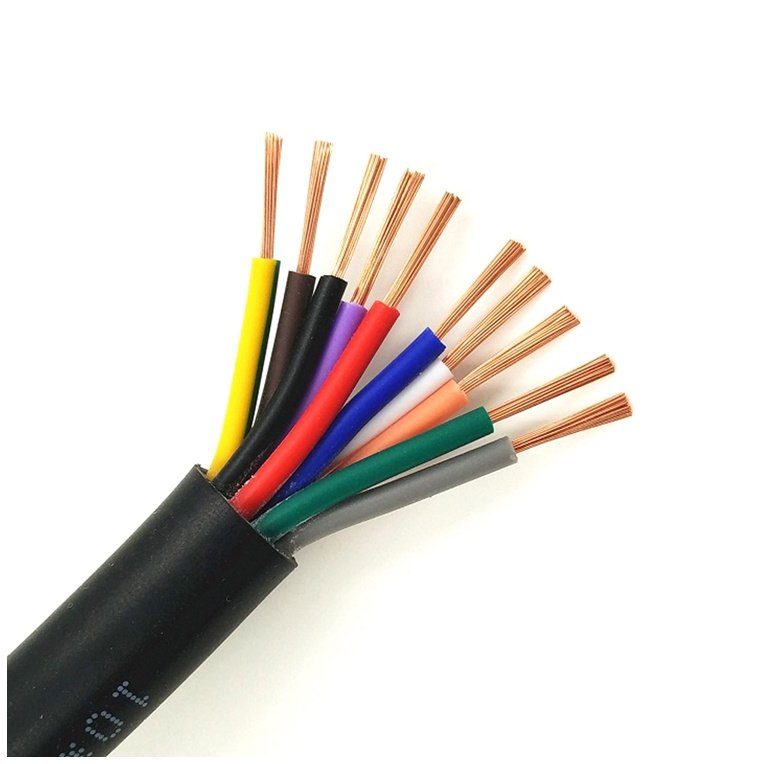
The standard for residential and light-commercial HVAC control is 18/5 or 18/8 thermostat cable — five to eight conductors in one sheath, each carrying a dedicated signal: R (24V hot), C (common), G (fan), Y (cooling), W (heat), plus O/B and auxiliary terminals on heat pump and zoned systems. A Nest or Ecobee typically needs six to eight of those conductors. Romex 14/2 gives you two current-carrying conductors and a ground. That’s it. You physically cannot wire a modern smart thermostat with it, aside from the code problem. NEC Article 725 requires Class 2 listed cable for these circuits; NM-B carries no such listing. Verdict: impractical, non-compliant, and the wrong tool by design.
Doorbell Wiring (16V AC Transformer Secondary)
This is the closest thing to a gray area on this list, and it still fails. An 18/2 bell wire or a spare run of thermostat cable is the correct material — inexpensive, flexible, and easy to fish through door frames and hollow-core doors. Romex 14/2 could carry the milliamp-range current from a standard 16V doorbell transformer without any thermal issue. But NM-B is not listed for Class 2 circuits, the stiff jacket makes it genuinely awkward to route through a 1.5-inch door-frame void without chewing up the sheath, and no AHJ I’ve ever heard of will sign off on it. Verdict: technically functional at the electrons level, code non-compliant in practice.
Security and Alarm Systems (12V DC, Class 2/3)
Prohibited — and the code reason is only part of the problem. Security panels require CL2 or CL3 listed cable, and Romex carries neither listing. The operational issue is arguably worse: NM-B bundles its conductors in an unshielded, non-twisted geometry designed for power delivery, not signal integrity. Run it alongside or sharing a path with other wiring in a wall cavity, and you’ll pick up induced noise that manifests as false triggers on PIR sensors and door contacts. In a plant-floor security context that’s an annoyance; in a residential intrusion system it erodes confidence in the whole installation. Verdict: prohibited by listing requirement and operationally unreliable.
Landscape Low-Voltage Lighting (12V AC or DC, NEC Article 411)
This is where the hazard level jumps. NEC Article 411 requires listed low-voltage lighting cable rated for the exposure — wet location, and direct burial where the cable goes underground. NM-B is explicitly excluded from both wet locations and direct burial. Bury it in a garden bed and the PVC jacket degrades within a season or two depending on soil chemistry and moisture; the conductors corrode, the insulation cracks, and you have an energized fault in damp soil.
NM-B (Romex) is rated for direct burial in outdoor landscape applicationsFalse
NEC and the NM-B product listing explicitly prohibit use in wet locations or direct burial. Landscape lighting cable must carry a wet-location and direct-burial listing per NEC Article 411.
Verdict: prohibited, and a legitimate shock and fire hazard if buried.
Home AV Distribution (Speaker Wire, HDMI Balun, Structured Media)
Two separate problems here. First, NEC 725 requires CL2 or CL3 rated cable for in-wall AV runs; Romex is not listed to either. Second — and this matters to anyone who has actually pulled wire for a home theater — Romex conductors are solid, untwisted, and unshielded. Run 14/2 as speaker wire and you will hear 60 Hz hum if there’s any AC wiring nearby in the same stud bay, which there almost always is. Signal degradation on HDMI balun control lines is subtler but real. Verdict: prohibited and performance-degrading.
PoE (Power over Ethernet, 48V DC, up to ~60W Class 6)
Completely incompatible, not merely non-compliant. PoE depends on the twisted-pair geometry of Cat5e, Cat6, or Cat6A to cancel common-mode noise, balance the differential signal pairs, and meet TIA-568 transmission specs. Romex has no twisted pairs, no communications listing under NEC Article 800, and the wrong conductor gauge for Ethernet impedance matching. You cannot make PoE work with it under any circumstances. Verdict: wrong cable category entirely.
Summary Decision Matrix
| System | Voltage | Required Cable Type | Romex Verdict | Risk Level |
|---|---|---|---|---|
| Thermostat (HVAC) | 24V AC | 18/5 or 18/8 thermostat cable (Class 2 listed) | Not acceptable — wrong conductor count, not listed | Low shock, high non-compliance |
| Doorbell | 16V AC | 18/2 bell wire or thermostat wire (Class 2 listed) | Non-compliant — functional but code failure | Low shock, moderate non-compliance |
| Security / Alarm | 12V DC | CL2 or CL3 listed alarm cable | Prohibited — listing failure + false-alarm risk | Operational + code |
| Landscape Lighting | 12V AC/DC | Listed wet/direct-burial low-voltage cable | Prohibited — explicit wet/burial exclusion | Shock + fire hazard |
| Home AV (in-wall) | Signal / 12–48V | CL2 or CL3 rated AV/speaker cable | Prohibited + signal degradation | Code + performance |
| PoE (Ethernet) | 48V DC | Cat5e / Cat6 / Cat6A, TIA-568, NEC Art. 800 | Completely incompatible | Total system failure |
The pattern across all six is the same: Romex is over-built for voltage and current, under-built for conductor count and flexibility, and not listed for any of these circuit classes. The cost premium for using it where it doesn’t belong runs roughly 4x to 10x versus purpose-built low-voltage cable — and that’s before accounting for the re-pull labor when an inspector rejects it.
The Physical and Performance Penalties of Forcing Romex Into Low-Voltage Runs
Code compliance gets most of the attention in this debate, but the physical reality is just as damning. Even in the cases where a local inspector might pass NM-B on a low-voltage run, the cable will underperform — sometimes mildly, sometimes in ways that cause real operational problems.
Voltage Drop Math Doesn’t Work in Your Favor
Start with the numbers. At 12V DC with a 1A load over a 100-foot run of 14 AWG, you’re looking at roughly 0.85V of drop — about 7% of your supply voltage. That’s already at the edge of what most 12V LED drivers and control boards tolerate before behavior gets erratic. Now consider that the same run carrying a 50mA LED driver signal through 22 AWG purpose-built cable produces a drop so small it’s essentially irrelevant — a few millivolts. The conductors in Romex are sized for 15–20A branch circuits. At 50mA to 1A, they’re grotesquely oversized, and the voltage drop calculation framework most low-voltage designers use (often based on 3% or 5% tolerance at system voltage) exposes that mismatch immediately. Bigger wire doesn’t always mean better performance when you’re working at the wrong voltage tier.
Signal Integrity: Impedance and What “Undefined” Actually Costs You
This is where the gap between “it’ll work” and “it’ll work correctly” opens up. Coaxial cable for CATV is engineered to 75 ohms characteristic impedance. Ethernet runs on differential pairs at 100 ohms. These aren’t arbitrary specs — they’re matched to the transmitters, receivers, and connectors at both ends of the run. Romex’s two parallel conductors have no defined characteristic impedance at signal frequencies. At anything above roughly 1 MHz, that mismatch causes signal reflections and insertion loss that degrade the link. In practice, a 75-foot Romex run substituted for RG-6 will show visible picture artifacts on CATV and will almost certainly fail a wiremap test for Cat 5e or Cat 6 Ethernet. Don’t expect it to “mostly work” — structured cabling test equipment will fail it outright.
Capacitance, Cross-Talk, and Audio Roll-Off
Untwisted parallel conductors accumulate distributed capacitance along their length. Above about 10 kHz in audio applications, that capacitance starts rolling off high-frequency content — measurable with a basic frequency sweep, audible in some installations. For data signals above 1 MHz, it’s not a gradual degradation; it’s a cliff. The twisted-pair geometry in purpose-built data and audio cable isn’t just marketing — it actively cancels induced noise and controls capacitance per foot to a specified value. Romex was never designed to that spec and can’t meet it.
Mechanical Routing in the Real World
14/2 NM-B has a minimum bend radius around 1.5 inches. That sounds manageable until you’re pulling cable through a 4-inch deep junction box, routing behind a thermostat sub-base, or fishing through a retrofit conduit with 90-degree sweeps. Low-voltage cable — 18 or 22 AWG, usually stranded — bends comfortably in spaces where Romex kinks or holds a stress set. Seasonally disturbed thermostat wiring is a good example: the sub-base comes off once or twice a year for filter changes or HVAC service, and the stiff solid conductor in NM-B eventually develops micro-cracks at the repeated flex point. Purpose-built thermostat wire uses finer stranding and thinner, more flexible insulation specifically because this cycle happens.
Termination Fit and Connector Compatibility
Thermostat control boards, security panel terminals, AV patch panels, and landscape lighting connectors are all designed around 18–22 AWG stranded wire. A 14 AWG solid conductor from NM-B will not seat correctly in most screw-clamp terminals on these devices — the conductor is too stiff to wrap cleanly, too large for the wire gauge range stamped on most push-in connectors, and incompatible with IDC (insulation displacement) connectors entirely. You end up with a mechanically unreliable termination, which in a security or fire-alarm context isn’t a nuisance — it’s a liability.
14 AWG solid Romex conductors are compatible with standard low-voltage push-in connectors rated for thermostat and security panelsFalse
Most push-in and IDC connectors used in low-voltage control panels are rated and tested for 18–22 AWG stranded conductors. A 14 AWG solid conductor exceeds the gauge range, may not actuate the contact correctly, and creates a mechanically unreliable connection.
Thermal Mass in Dense Cable Bundles
At 50mA to 1A, the resistive heat generated in Romex conductors is negligible — that’s not the issue. The thick PVC jacket is. In data closets or cable trays with high bundle density, the added thermal mass of oversized jackets reduces the bundle’s ability to dissipate ambient heat. It’s a minor factor in most residential installs, but in a dense commercial data cabinet where you’re already managing ambient temperature, substituting NM-B for proper low-voltage cable adds unnecessary insulation mass that works against you.
The bottom line on performance: Romex doesn’t just fail code requirements in most low-voltage applications — it genuinely underperforms the cable it would replace, often in ways that cause troubleshooting headaches months or years after installation.
When Romex Conductors Are Legitimately Repurposed for Low-Voltage Circuits
The honest answer here is that “never use Romex for low voltage” is too blunt a rule. There are narrow situations where it’s permissible, defensible, or at least not the safety hazard that blanket prohibitions imply. The key is understanding which scenarios those are — and being clear-eyed about what you’re accepting when you go down that road.
Temporary Construction Wiring Under NEC Article 590
NEC 590 gives contractors meaningful latitude during the construction phase. Temporary wiring for construction purposes is explicitly exempt from many of the installation method requirements that govern permanent work, and a 24V control circuit run with NM-B conductors during HVAC rough-in — say, powering a temporary thermostat to test a forced-air unit before drywall closes — falls within that tolerance. In practice, most AHJs won’t raise an eyebrow if the conductor is appropriate gauge, properly terminated, and clearly temporary.
The hard requirement: it comes out before final inspection. Leaving it in place converts a compliant temporary installation into an unlisted permanent one. I’ve seen this bite contractors when a punch-list walk reveals a temp circuit that got drywalled over and forgotten. That’s a failed inspection at minimum, and a rework conversation nobody wants.
Existing NM-B Re-Designated for Class 1 Control Circuits
This is the scenario most electricians don’t know about. If you have an existing NM-B run in a wall cavity that’s been decommissioned from its original branch-circuit use, it can potentially be re-designated as a Class 1 low-voltage control circuit — not Class 2, Class 1 — under NEC 725.41. Class 1 circuits allow up to 600V and are not power-limited, which means NM-B’s 600V rating and conductor sizing are technically appropriate.
The catch is real: this requires explicit AHJ sign-off, and not every inspector will give it. You need to verify the circuit characteristics actually meet 725.41 requirements, and you need documentation. Don’t assume approval; ask in writing.
Stripping THHN Conductors Out of NM-B for Conduit Work
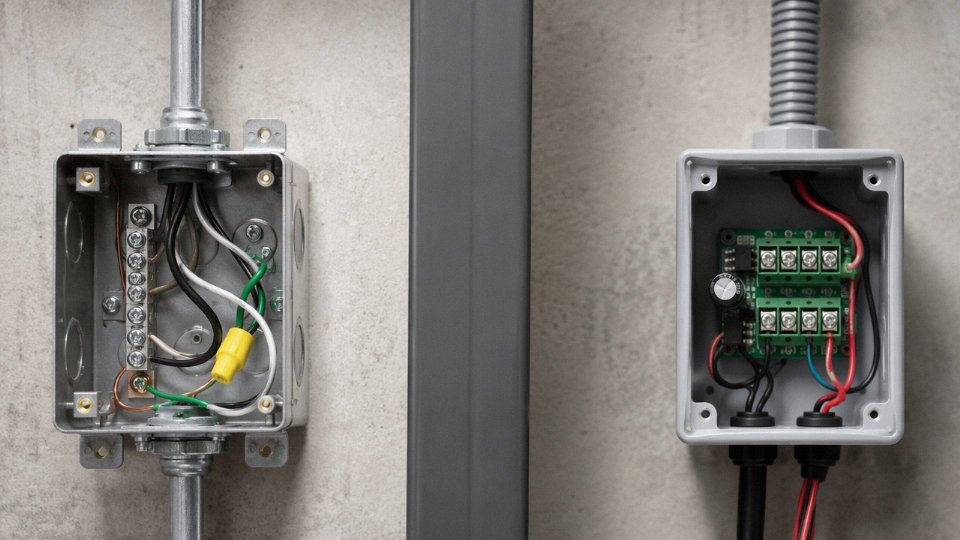
This one surprises people. The individual conductors inside NM-B cable are THHN/THWN-2 listed wire. The restriction on NM-B as an assembly is primarily about the outer sheath and its permitted installation methods — it’s not a conduit wiring method, it can’t be used in wet locations, and so on. Strip that outer jacket off, pull the individual THHN conductors, and install them in conduit for a Class 1 circuit, and you now have a legitimate, listed installation.
In practice, this is rarely worth the labor. THHN on a spool is cheap and you get clean wire pulls. But if you’re on a job site with leftover NM-B and you need to make a control circuit work today, this is a real option — not a workaround.
Owner-Occupied Residential Projects Without a Permit
Some jurisdictions allow owner-occupants of single-family homes to do their own low-voltage work without pulling a permit. In those cases, Romex conductors at 12V or 24V aren’t creating a safety hazard in any meaningful sense — the voltage and current are nowhere near dangerous, and the insulation is dramatically over-rated for the application.
That said, this isn’t a professional recommendation.
Repurposing Romex conductors for low-voltage circuits eliminates any listing or code violation as long as the voltage is below the conductor's rating.False
A conductor's voltage rating is only one factor in listing compliance. NEC listing violations also involve installation method, circuit classification (Class 1 vs. Class 2 under Article 725), and whether the cable assembly as a whole is listed for the intended use. Using NM-B in a Class 2 circuit remains a listing violation regardless of whether the voltage is within the conductor's rating.
The Liability Problem Nobody Mentions
Re-purposing Romex for low voltage — even in scenarios where it physically works — leaves you with an un-inspectable installation. When that property sells, a home inspector will flag it. Your insurance carrier may have opinions. The cost argument alone should close this debate: 500 feet of 18/2 thermostat wire runs somewhere in the $25–$50 range depending on supplier and whether you’re buying retail or off a contractor spool. A hundred feet of 14/2 NM-B costs more than that. Using the right cable isn’t just code-correct, it’s cheaper. The “I’ll just use what I have” logic only holds if you’re genuinely out of options.
Selecting the Right Cable for Each Low-Voltage Application: Specifications and Sourcing Guide
Once you’ve confirmed Romex doesn’t belong in a given low-voltage run, the next question is immediate and practical: what cable does go there, and how do you specify it correctly for procurement? Getting this wrong — ordering 18/5 when the heat pump needs 18/8, or specifying a dry-location jacket for a direct-burial landscape run — creates rework that costs far more than the cable itself.
Thermostat and HVAC Control Cable
For conventional single-stage heating/cooling systems, 18 AWG 5-conductor (18/5), CL2 rated with 300V PVC insulation is the standard. The moment you’re dealing with multi-stage systems, heat pumps, or equipment with auxiliary heat strips, step up to 18/8 — you’ll use conductors for O/B reversing valve, Y2 second-stage cooling, W2 auxiliary heat, and so on. Running 18/5 to a heat pump and discovering you’re two conductors short after the drywall is closed is an avoidable problem. UL Listed is required for US installations; confirm conductor count from the equipment wiring diagram, not from what the last installer used.
Security and Alarm Cable
The usual spec is 22 AWG 2- or 4-conductor for door/window contacts and passive sensors, CL2 rated, 300V. Motion detectors and panel-to-keypad runs typically want 22/4 or 18/4. In electrically noisy environments — near VFDs, fluorescent ballasts, or elevator machinery — specify shielded cable with a drain wire and terminate the drain at one end only to avoid ground loops. For open-ceiling commercial spaces, you need CL2P (plenum-rated) to satisfy NEC Article 725 and building code fire-stop requirements. Plenum jacket costs more; skipping it in a plenum space is a code violation that will show up on inspection.
Landscape and Outdoor Low-Voltage Lighting
Most residential low-voltage landscape systems run off 12V AC transformers, and 12 AWG or 14 AWG 2-conductor direct-burial cable is the correct choice. The jacket needs to be rated for wet location and direct earth contact — UV-stabilized polyethylene or XHHW insulation, not standard PVC, which degrades in sunlight and soil within a few seasons. Voltage rating depends on transformer output and total run length; runs over roughly 50–60 feet at 12V often need 12 AWG to keep voltage drop under 10%. Confirm wet-location listing explicitly; not all “outdoor” cable is rated for burial.
Speaker and In-Wall AV Cable
In-wall speaker cable should be 16 AWG CL2 or CL3 rated for shorter runs (under roughly 50 feet), stepping to 14 AWG for longer distances where resistance-induced high-frequency rolloff becomes audible. Oxygen-free copper isn’t magic, but it does reduce oxidation at termination points over time — worth specifying for permanent in-wall installations you won’t be pulling again. Parallel construction is fine for most residential AV; twisted pairs matter more for balanced audio in commercial installs.
Structured Data and PoE Cable
Cat6 (23 AWG solid copper, 250 MHz, U/UTP) handles standard PoE and PoE+ cleanly. If you’re deploying IEEE 802.3bt PoE++ devices — access points, PTZ cameras, thin clients drawing up to 90W — specify Cat6A (500 MHz, F/UTP shielding) and pay attention to installation temperature ratings, since higher current through 23 AWG conductors generates real heat in bundled runs. CMR (riser) is the baseline for vertical in-wall runs; CMP (plenum) for air-handling spaces. Don’t substitute Cat5e in a PoE++ installation and expect consistent performance.
Doorbell, Intercom, and Fire Alarm Cable
Doorbell and intercom runs typically take 18 AWG 2- or 4-conductor CL2 with flexible PVC jacket — flexibility matters because these routes often thread through finished walls with tight bends. Fire alarm cable is a different category entirely: 18 AWG 2-conductor shielded, FPLR or FPLP listed per NFPA 72, red jacket by convention (not always mandatory, but nearly universal in practice, and inspectors notice when it’s missing). Don’t substitute generic alarm cable for FPLR/FPLP in a fire alarm circuit; the listing is a life-safety requirement.
A cable manufactured to IEC 60227 does not automatically qualify as UL Listed for US installations and may require additional documentation for permit approval.True
UL Listing and IEC 60227 compliance are separate certification schemes. A cable tested to IEC standards meets international requirements but must undergo separate UL evaluation and listing to satisfy NEC-based US inspection requirements.
Sourcing Internationally: What to Verify Before the Order Ships
Jinda Special Cable Group manufactures low-voltage control cable, building wire, security cable, and industrial signal cable across five production bases in China, supplying projects in more than 50 countries. Custom conductor counts, jacket colors, and certification packages — UL, CE, IEC — are available for bulk and project orders, which matters when a project spec calls for non-standard conductor counts or a specific jacket color convention.
When sourcing any low-voltage cable internationally, the single most common procurement mistake is assuming that a quality cable built to IEC 60227 or GB/T standards satisfies a US building permit. It doesn’t, automatically. Verify that the cable listing matches the jurisdiction of installation: UL Listed for North America, HAR or VDE for European installations, CCC for China domestic use. Ask the manufacturer for documentation before the shipment leaves the factory — getting listing paperwork corrected after goods arrive at a US port is slow and expensive.
Installation Best Practices: Routing, Termination, and Labeling Low-Voltage Wiring
Getting the cable selection right is only half the job. Plenty of low-voltage installations fail inspection — or fail silently in service — because the physical installation ignored rules that apply just as firmly to 24V thermostat wire as to 120V branch circuits.
Separation From Power Conductors
NEC 725.136 is the rule that catches most people off guard. Class 2 and Class 3 cables cannot share a conduit or raceway with Class 1 power conductors (your 120V/240V circuits) unless those power cables are individually shielded, or the two cable types run in separate raceways within a shared enclosure. In practice, this means you cannot pull thermostat wire or security cable through the same conduit as a Romex home run, full stop. Even in an open stud bay, keeping them physically separated is good habit — inspectors notice, and bundling them invites inductive noise pickup on sensitive signaling circuits anyway. Run them on opposite sides of the stud if routing allows.
Bend Radius and Pulling Tension
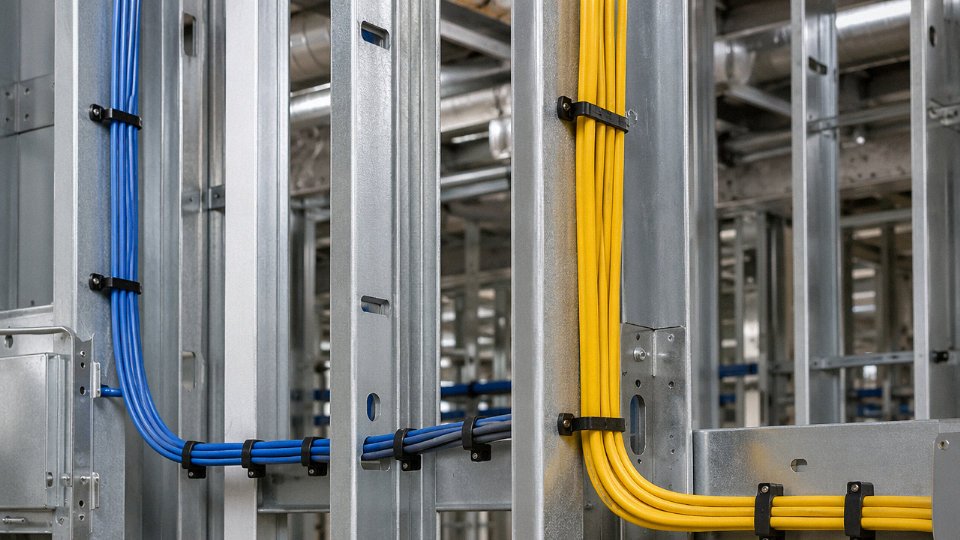
This is where inexperienced installers quietly destroy a cable they cannot see they’ve damaged. Cat6 and most structured security cables have a minimum bend radius of roughly 4× the cable’s outer diameter — for a typical 6 mm Cat6 cable, that’s about 24 mm. Pulling tension limits for 4-pair data cable are usually around 25 lbf; exceed that yanking a cable through a tight conduit bend and you stretch the pairs, change their twist geometry, and introduce impedance variations that will show up as marginal link performance or intermittent failures months later. The damage is invisible to the eye. Use a fish tape or pull cord, lubricate long conduit runs, and never tie off a come-along to data cable.
Thinner security and AV cables — 22 AWG shielded, for example — are even less forgiving. A sharp 90° bend over a conduit edge is enough to crack the foil shield and introduce ground noise.
Firestop Penetrations
Any time low-voltage cable passes through a fire-rated wall or floor-ceiling assembly, it must be sealed with a listed firestop system. This requirement does not have a carve-out for low voltage. Inspectors in commercial and multifamily projects flag unsealed low-voltage penetrations routinely. Use an intumescent putty pad or a listed caulk rated for the assembly type, and photograph it before closing the wall — you’ll want that documentation.
Firestop requirements apply to low-voltage cable penetrations through fire-rated assemblies, not just power wiring.True
NEC 300.21 and building code fire-rated assembly requirements apply based on the assembly's fire rating, regardless of the circuit voltage class passing through it.
Labeling Both Ends
NFPA 72 mandates labeling for fire alarm signaling cable, and the same discipline should apply universally. Label every cable at both ends at the time of installation — not after commissioning, when half the labels get skipped. A durable heat-shrink label or a Brady-style wire marker with the circuit ID, destination, and cable type takes about 30 seconds and saves hours during a service call two years later. The number of callbacks that trace back to unlabeled cables is genuinely embarrassing in this trade.
Termination Torque
Terminating 18–22 AWG conductors demands more care than most technicians give it. Screw terminal torque for small conductors typically runs 0.5–0.8 N·m — consult the device manufacturer’s spec, because that range matters. Over-torquing a thin conductor on a large terminal screw nicks or partially severs the wire at the screw shoulder, leaving a joint that passes initial continuity but develops high resistance under thermal cycling. That shows up as a device that works fine in summer and starts acting erratically in January. Nicking is especially common when someone uses a heavy-duty screwdriver with no feel for small terminals.
Testing Before Closing Walls
For Class 2 signaling cable, run a continuity test and an insulation resistance test. A 500V megger is appropriate here even though the operating voltage is 24V or less — the higher test voltage reveals insulation damage from staples, nail strikes, or sharp conduit edges that a simple continuity check misses entirely. For structured data cable, perform a full TIA-568 link test with a calibrated field tester; a pass/fail wire map is not sufficient for anything that will carry network traffic. Document the results.
Stapling and Mechanical Protection
Use staples rated for the cable’s actual diameter. Drive them snug, not tight — the insulation jacket should not be visibly compressed. A compressed jacket indicates the conductor may have been nicked or deformed, and insulation resistance at that point is compromised. This matters more for thin-jacketed low-voltage cable than for Romex, which has a tougher outer sheath. Ironically, if someone has mistakenly run Romex for a low-voltage application and is now stapling it, the stiffer, thicker NM-B jacket is actually more likely to transfer staple force to the conductors inside rather than deforming around them — the jacket doesn’t cushion the way flexible low-voltage insulation does.
Secure cable every 4–6 feet on horizontal runs and at supports on vertical runs. Unsupported cable that sags and rubs against sharp sheet-metal edges over years of building movement will eventually fail — usually at the worst possible time.
Frequently Asked Questions About Romex and Low-Voltage Wiring
Can I use Romex for a 12V LED cabinet lighting circuit?
The conductors will handle the current — a 14 AWG solid copper wire rated at 15A is not going to overheat running a 2A LED strip. That is not the issue. The issue is that NM-B is not a listed cable type under NEC Article 411 (lighting systems operating at 30V or less) or Article 725 (Class 2 circuits). An inspector looking at undercabinet lighting wired with Romex will write it up regardless of the actual load. Use listed 18/2 or 16/2 low-voltage cable — it is cheaper, more flexible, and correct for the application. The 14 AWG conductor in Romex is also genuinely awkward to terminate in the small connector blocks most LED drivers use.
Is it safe to use Romex on a doorbell transformer secondary?
Honestly, from a pure voltage-stress standpoint, running 16V AC through 600V-rated insulation is not a safety hazard in any practical sense. The insulation has enormous headroom. The problem is that “safe to touch” and “code compliant” are different standards, and your AHJ (authority having jurisdiction) cares about the latter. NEC 725.130 requires listed Class 2 cable on the secondary side of a doorbell transformer. Romex is not on that list. The safety risk is low; the code risk is real and will surface at inspection or during a homeowner’s insurance claim after any unrelated incident.
Romex NM-B is safe to use on a 16V doorbell secondary because the insulation voltage rating far exceeds circuit voltageFalse
Safety margin on insulation voltage is not the deciding factor. NEC 725.130 requires listed Class 2 cable for power-limited circuits. NM-B does not carry a Class 2 listing, so it fails the compliance test regardless of actual operating voltage.
Can I strip the Romex sheath and use the individual conductors for a thermostat?
This comes up surprisingly often. Stripping the outer jacket leaves you with 14 AWG solid THHN conductors — and that creates two problems immediately. First, solid 14 AWG is too stiff and too large for the push-in terminals on virtually every smart thermostat on the market; Ecobee, Nest, Honeywell T6 — they all specify 18–22 AWG. Second, a standard 14/2 NM-B gives you two current-carrying conductors plus a ground. A modern multi-stage thermostat needs five to eight conductors (R, C, Y, W, G, and sometimes more). Just buy 18/5 CL2 thermostat cable. It is roughly $0.10 per foot at any electrical distributor and designed for exactly this.
Why is the inspector rejecting my Romex run to a security panel?
Because NEC 725.130 is not ambiguous. Power-limited signaling circuits — everything from door contacts to motion detectors to panel communication wiring — require listed Class 2 or Class 3 cable. NM-B is a branch-circuit cable with no Class 2 listing. The actual operating voltage of the run is irrelevant to that determination. I have seen contractors argue the voltage point on the job site and lose every time.
Does a higher voltage rating (600V vs. 300V) make Romex the safer choice?
No. This is a logical inversion that trips up a lot of people. A cable’s listing classification — not its insulation voltage rating — determines where it can be installed under code. A 300V CL2-listed thermostat cable is the correct choice for a Class 2 circuit. Using 600V NM-B does not make the installation more compliant or more robust; it makes it non-compliant while costing you four to ten times more per foot.
Can I use Romex outdoors for a landscape lighting run?
NM-B is explicitly prohibited in wet or damp locations under NEC 334.12. It is not rated for direct burial under any condition. Outdoor low-voltage landscape lighting requires direct-burial rated cable — UF-B construction, listed landscape lighting cable, or XHHW in conduit depending on depth and local amendments. Running Romex through a yard, even in conduit that might collect moisture, is a code violation and a genuine long-term degradation risk. The jacket will not hold up.
What is the cheapest code-compliant option for a long thermostat run?
Standard 18/5 CL2 thermostat cable. At roughly $0.08–$0.15 per foot depending on quantity and supplier, it is far cheaper than 14/2 Romex at $0.25–$0.65 per foot, it will pass inspection without question, and the five conductors give you enough flexibility for any conventional or smart thermostat on the market. Long runs — say, 75 feet or more in a large house — may warrant checking voltage drop at 18 AWG, but for most residential applications it is the default correct answer.
Does Jinda manufacture low-voltage control and security cable for international projects?
Yes. Shandong Jinda Special Cable Group produces CL2-equivalent control cable, security cable, and building wire to IEC, UL, and CE standards — covering the range of applications discussed throughout this article, from HVAC control wiring to building security systems. With five production bases and over 470,000 m² of manufacturing capacity, Jinda supports bulk procurement for international contractors and distributors in more than 50 countries. Custom conductor counts, jacket materials, and compliance documentation are available through their technical support team. For project-specific specifications or volume pricing inquiries, contact Jinda directly.
Summary: The Engineering and Code Case for Always Using Purpose-Built Low-Voltage Cable
The verdict across every section of this article lands in the same place: Romex NM-B is not listed for low-voltage signaling, control, or Class 2 circuits, it is not engineered for them, and in nearly every North American jurisdiction it is not code-compliant for them. Full stop. That 600V insulation rating — the detail that makes Romex feel like a safe, conservative choice — is completely irrelevant to how inspectors and insurers actually evaluate the installation. They check the listing classification, not the voltage headroom. NEC Article 725 defines Class 2 circuits and calls for cable types listed specifically to that article. Romex carries no such listing. An inspector who finds NM-B pulling a 24V thermostat circuit or a 12V security run does not look at the insulation thickness and shrug. He writes it up.
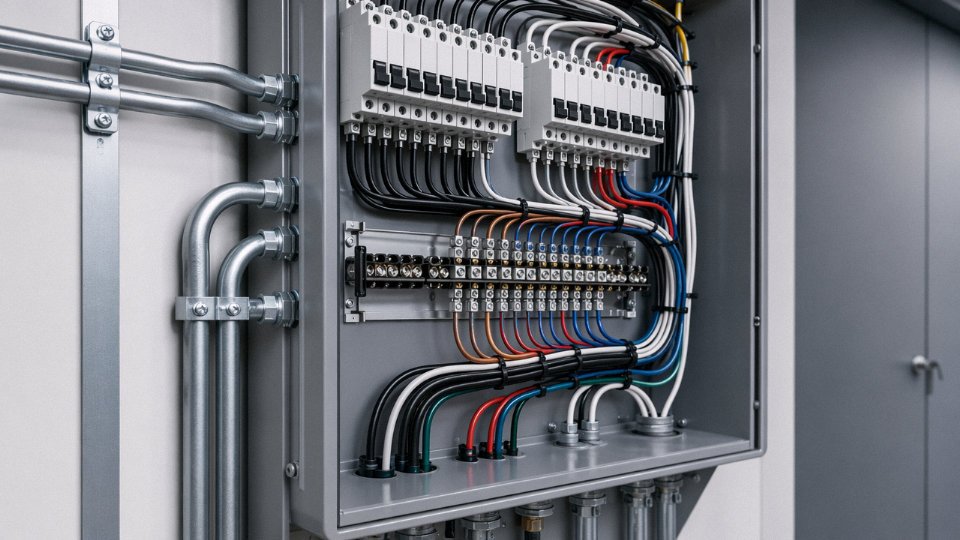
Purpose-built low-voltage cable (e.g., 18/2 thermostat wire or 22 AWG security cable) costs 4 to 10 times less per foot than Romex NM-B for the same run length in typical North American retail markets.True
No explanation available.
The cost math deserves to be said plainly, because it eliminates the last argument for substitution. Romex costs somewhere between four and ten times more per foot than the correct cable for the same run — and that is before labor. A 200-foot thermostat run in NM-B might cost $50–$130 in material alone versus $10–$30 in proper 18/2 cable. Nobody who has done the arithmetic chooses Romex for a low-voltage run on purpose. Usually the substitution happens out of habit, or because a partial roll of NM-B was sitting on the truck. Neither reason survives a re-inspection or an insurance adjuster’s visit.
Performance is the other half of this. Low-voltage control and signaling systems depend on conductor geometry that Romex was never designed to provide. Twisted-pair construction for noise rejection, small-gauge conductors (18 AWG to 22 AWG) that match the actual current draw of 50 mA to 5 A loads, flexibility for routing through tight conduit and behind panels, multi-conductor configurations for zoned systems — Romex gives you none of these. Forcing 14 AWG solid copper into a 24V irrigation controller terminal block is a mechanical problem before it is ever an electrical one. Terminals crack, connections loosen over seasonal thermal cycling, and the stiff geometry makes bundling and re-routing nearly impossible without damage.
Then there is the liability dimension, which is where the real money lives. Any insurance claim involving fire or water damage in a structure triggers a code compliance review. Any property sale with a disclosure requirement surfaces wiring installations to inspectors. Romex found in a Class 2 application is a code violation that requires remediation — tear-out, re-pull, reinspection — at a cost that easily runs into the thousands once labor is factored in. The correct cable, bought upfront, is the only financially rational choice.
For contractors and engineers working on international projects or larger-scale procurement, specification discipline matters even more. Sourcing cable to the correct standard — NEC-listed for North American work, IEC 60227 or IEC 60332 compliant, CE-marked for European installations — from a manufacturer with certified production traceability is what keeps a project inspectable across jurisdictions and across its full service life.
Jinda Special Cable Group has been manufacturing specialty and control cable since 1987, operating across five production bases with over 470,000 m² of manufacturing capacity and export experience in more than 50 countries. Whether the project calls for thermostat cable, multi-conductor security cable, shielded instrumentation cable, or structured low-voltage infrastructure at volume, Jinda’s engineering and technical sales teams can work through specifications, certifications, and custom configurations with you directly. Contact Jinda Special Cable Group for technical consultation and bulk pricing.