Running low voltage wire through a finished wall sounds simple until you pull a permit, fail an inspection, or — worse — trace a ghost fault back to a thermostat cable stapled two inches from a 120V circuit for the past eight years. Interference, induced noise on control signals, and code violations that void your insurance are the quiet consequences nobody talks about until something goes wrong. Rework on a finished wall runs from a few hundred dollars to several thousand depending on stud-bay access and finish material, and that’s before you factor in the HVAC downtime or the security system that’s been dropping signal since the remodel.
Yes, you can run low voltage wire inside a wall, but it must comply with the applicable electrical code for your jurisdiction. In North America, NEC Article 725 governs Class 2 and Class 3 circuits — typically anything operating at 50V AC or below — and requires minimum 2-inch separation from standard 120V/240V power wiring when run parallel in the same wall cavity, unless you use a listed barrier or a higher-rated jacket. The wire itself must carry the correct voltage rating, usually 300V CL2 or 500V CL3 depending on the application.
What most installers and even some licensed electricians get wrong isn’t whether it’s allowed — it is — but the specifics that determine whether the installation stays safe, passes inspection five years from now, and actually performs the way the system designer intended. Gauge selection, jacket rating, separation rules, and a few application-specific wrinkles are where the real decisions live.
Low Voltage Wire Types Approved for In-Wall Installation: Jacket Ratings Decoded
The single most expensive mistake I see on commercial fit-outs — and honestly on residential jobs too — is pulling the wrong jacket rating through a wall cavity and only discovering it during inspection. Ripping out finished drywall to replace cable that tested fine electrically but failed on fire classification is a real, avoidable cost. So here is how the system actually works.
The NEC Marking System: What Those Letters Mean on the Jacket
NEC Article 725 governs Class 2 and Class 3 signaling circuits; Article 800 covers communications cable. Both use a tiered jacket rating system built around fire-propagation risk, not electrical performance. The ratings, from least to most stringent:
CM (general-purpose communications/signaling) — tested to UL 1581 vertical flame. Approved for most single-floor, in-wall horizontal runs where the cable does not pass through a floor or ceiling plenum. This is the baseline. Cheap, widely available, and fine for the vast majority of residential low-voltage work.
CMR (riser-rated) — tested to UL 1666, which applies a sustained flame to a vertical cable bundle in a shaft. Required any time cable runs vertically through a floor-to-floor penetration or a wall chase that connects two floors. The test is harder to pass, the jacket compound is typically thicker or uses a more char-resistant material, and you’ll pay roughly 15–35% more per foot than CM, depending on conductor count and gauge.
CMP (plenum-rated) — tested to NFPA 262, the most demanding standard in the series. Required in any air-handling plenum space. Price premium over CM is typically 40–80%, sometimes more for larger multi-pair bundles.
The hierarchy is strict and one-directional: CMP can substitute anywhere CMR or CM is required. CMR can substitute where CM is required. You cannot run it the other direction. Ever. Pulling CM-rated cable in a riser because it’s what the supply house had on the truck is a code violation, regardless of whether it ever sees a flame.
Jacket Rating Comparison Table
| Jacket Rating | Approved Location | Fire Test Standard | Typical Price vs. CM Baseline | Can Substitute For |
|---|---|---|---|---|
| CM | Single-floor in-wall, non-plenum | UL 1581 | Baseline | Nothing above it |
| CMR | Riser / floor-to-floor vertical runs | UL 1666 | +15–35% | CM |
| CMP | Plenum air-handling spaces | NFPA 262 | +40–80% | CM and CMR |
| CL2 / CL3 | Voltage class marking (paired with above) | — | — | — |
CL2 and CL3 are voltage class designations — 300V and 500V respectively — and they appear combined with the location rating: CL2R means riser-rated, Class 2 voltage. CL3P means plenum-rated, Class 3. You need both designations to match your installation.
The Plenum Question Is Where Most People Get It Wrong
A dropped ceiling is not automatically a plenum. The deciding factor is whether the space is used as part of the HVAC return-air path. If conditioned air circulates through that ceiling cavity back to the air handler — no ductwork required, just open circulation — that is a plenum, and CMP is mandatory regardless of what voltage the cable carries. A thermostat wire, a speaker run, a security sensor loop: all need CMP in that space. Local inspectors vary on enforcement, but the code is not ambiguous.
A standard CM-rated cable can be used in a plenum ceiling if the voltage is under 30V.False
Jacket rating requirements in NEC Article 800 and Article 725 are based on fire-propagation risk in air-handling spaces, not on operating voltage. Even 12V thermostat wire requires CMP rating in a plenum ceiling.
LSZH: The International Variable
If you’re specifying cable for a project in Europe, the Middle East, or parts of Asia, the NEC system doesn’t apply — but the fire-safety logic is similar. IEC 60332 and EN 50575 classifications (Eca through Aca) govern flame propagation and smoke/toxicity in European installations, with low-smoke zero-halogen (LSZH) jacket compounds increasingly specified for enclosed spaces and tunnels. LSZH reduces toxic gas and dense smoke during a fire, which matters enormously for human evacuation in confined runs.
Jinda’s international product range covers both tracks — NEC-classified CM/CMR/CMP cables for North American projects and IEC 60332 / EN 50575 compliant LSZH options for European and Middle Eastern specifications. For bulk procurement across multiple regions, confirming dual-classification availability from a single supplier avoids the logistical mess of managing two separate cable specs for what is functionally the same installation.
A Word on Outdoor and Direct-Burial Cable
Outdoor-rated or direct-burial cable sometimes ends up inside walls when a contractor grabs whatever is on the reel. The polyethylene or HDPE jacket compounds used for UV and moisture resistance in outdoor cable often have poor flame-spread characteristics — they can actually perform worse in a fire test than standard CM. Unless the cable carries an explicit in-wall listing on the jacket print, don’t run it inside a finished wall cavity. The outdoor rating tells you nothing useful about interior fire compliance.
NEC Code Requirements and Permit Rules for In-Wall Low Voltage Wiring
The code framework for low voltage in-wall wiring is spread across several NEC articles, and conflating them is where installers get into trouble during inspections. Each article covers a distinct cable family, and the requirements — while similar in spirit — differ in ways that matter on the job.
NEC Article 725: The Foundation for Most Low Voltage Signal Wiring
Article 725 governs remote-control, signaling, and power-limited circuits. This is where thermostats, door access controls, security sensors, and similar building automation wiring live. The classification breaks into three tiers. Class 1 circuits operate up to 600V and are essentially treated like line voltage — conduit, boxes, the full treatment. Most installers won’t be running those in a residential or light commercial wall cavity. Class 2 and Class 3 are the practical categories: Class 2 is limited to 100VA and 30V (or 150VA for some AC configurations), Class 3 allows higher voltage and power but imposes stricter jacket requirements. The code allows these cables to be run in wall cavities without conduit, provided the jacket is appropriately listed — which is exactly why the CL2/CL3 rating on the cable matters and isn’t just marketing.
Articles 800, 820, and 830: Communications and Coax Have Their Own Rules
Ethernet and telephone cable falls under Article 800 (communications wiring). Coaxial cable for CATV and antenna systems falls under Article 820. Network-powered broadband — think fiber with a powered component — is Article 830. Each of these has its own in-wall listing requirements (CM, CMR, CMP for communications; CATV, CATVR, CATVP for coax), but the core physical installation rules are consistent: cables must be listed for the application, plenum-rated where required, and kept clear of line voltage conductors. One practical detail Article 800 adds is a grounding requirement for network interface equipment — easy to overlook when you’re focused on the pull.
The 2-Inch Separation Rule — and the Workarounds
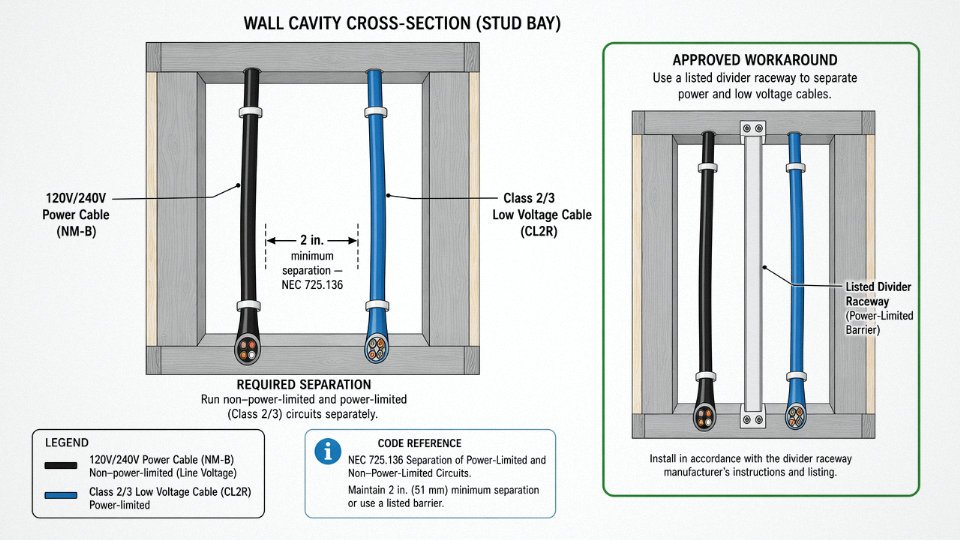
NEC 725.136 requires a minimum 2 inches of separation between Class 2/3 cables and conductors operating at 120V/240V when run parallel inside a wall cavity. This isn’t a suggestion. In practice, walls filled with existing power wiring make this difficult to guarantee — especially in older construction where the wiring path is unpredictable. The NEC provides two legitimate workarounds: use a listed divider or raceway that physically separates the cables, or specify a low voltage cable with an insulation rating equal to that of the line voltage conductors (typically 300V minimum for the jacket). Some installers default to CL3 cable in any mixed-wall situation just to cover this without hardware.
Fire Stopping: Non-Negotiable at Penetrations
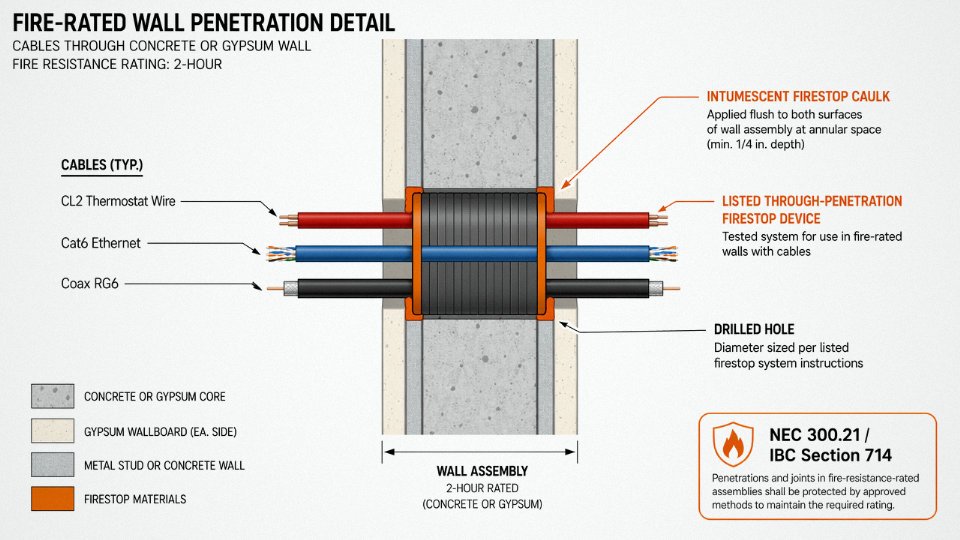
NEC 300.21 and IBC Section 714 require that any penetration of a fire-rated wall or floor assembly — regardless of the voltage of the cable — be sealed with a listed fire-stop assembly. A drilled hole stuffed with spare insulation does not qualify. Approved materials include intumescent putty pads, fire-stop caulk rated for the specific wall assembly, and listed through-penetration devices. In a multi-story building this is enforced hard during rough-in inspection. Miss it and you’re patching drywall.
NEC 300.21 requires fire-stop sealing at all penetrations of fire-rated assemblies regardless of cable voltage.True
NEC 300.21 explicitly states that electrical installations in hollow spaces, vertical shafts, and ventilation ducts must be made so that fire or products of combustion will not spread through fire-rated assemblies, and this applies to all wiring regardless of voltage class.
Permit Requirements: More Nuanced Than Most People Assume
Here’s where jurisdiction matters enormously. A straight ethernet pull to add a home office drop — most U.S. jurisdictions won’t require a permit. Speaker wire, doorbell replacement, adding a thermostat wire: typically no permit. But security systems, particularly monitored fire alarm circuits (Class CI under Article 760), almost always trigger permit and inspection requirements because they’re life-safety systems. Structured wiring panels with multiple subsystems bundled together frequently require a permit too, depending on the authority having jurisdiction (AHJ). When in doubt, a quick call to the local building department costs nothing and prevents a failed inspection later.
Local amendments are genuinely significant. California’s Title 24 adds energy code implications that affect low voltage control wiring for HVAC and lighting systems. New York City’s electrical code has historically required licensed electricians for work that other jurisdictions allow homeowners to self-perform. Chicago enforces conduit requirements that effectively eliminate most non-metallic wiring methods that are standard elsewhere. If you’re bidding a project in an unfamiliar jurisdiction, verify the local amendments before speccing the cable type.
Cross-Referencing for International and Multinational Projects
For buyers or contractors working across markets, the NEC’s Class 2/3 framework has rough equivalents in other standards. IEC 60364-4-41 addresses protection against electric shock and handles circuit classification through a voltage-band system rather than the NEC’s power-limitation model, but the practical installation outcome — separation from line voltage, appropriate insulation — is similar. AS/NZS 3000 (the Australian/New Zealand “Wiring Rules”) permits extra-low-voltage (ELV) wiring in wall cavities under conditions that largely align with NEC Class 2, though the listing and marking requirements differ. BS 7671 (the UK IET Wiring Regulations) defines Band I circuits (typically low voltage signal and telecom) and requires separation from Band II (mains voltage) conductors — a direct functional parallel to NEC 725.136. When sourcing cable for multinational projects, confirm that the jacket rating and marking on the reel satisfies the specific standard called out in the project specification, not just the country of installation. A cable listed only to UL 444 won’t satisfy BS EN 50575 flame propagation requirements without separate testing, and that gap can delay customs clearance or fail a third-party inspection.
Step-by-Step Installation Method: Fishing Low Voltage Wire Through Finished Walls
Fishing wire through a finished wall is where the job separates the experienced installer from the frustrated one. The wall is already closed, the drywall is painted, and every mistake costs either a patch job or a do-over. Get the sequence right and it goes smoothly. Skip the planning steps and you’ll be drilling blind into a fire block or, worse, an HVAC duct.
Tools You Actually Need Before You Start
Don’t improvise the tool list here. You need a quality magnetic stud finder — the cheap ones miss doubled studs and metal bridging — plus a drill with a flexible shaft extension carrying either a 5/8-inch or 1-inch bell hanger bit. The bell hanger bit cuts a clean hole through a top or bottom plate without wandering, which matters when you’re drilling at an angle in a tight attic. Fish tape works for shorter, straighter runs (30 feet or less, roughly); fish sticks are better for navigating around insulation batts in shorter cavities where tape buckles and jams.
Electrician’s pulling lubricant — the gel type, not spray — is not optional on runs longer than about 20 feet through a cavity with any bends. Add a set of low voltage old-work mounting brackets (sometimes called “low voltage rings” or “mud rings”), a wire labeler, and a non-contact thermal camera or at minimum a simple probe thermometer. The thermal camera earns its rental cost the first time it shows you a duct you would have drilled into.
Map the Wall Before You Drill Anything
Mark every stud across the entire run with tape on the baseboard. Then check for fire blocking — horizontal 2×4 blocking at roughly mid-wall height, extremely common in California construction and in any wall assembly built to fire-rated standards. You can often detect blocking by tapping the wall and listening for the dead thud, or by running a stud finder slowly and watching for hits at unusual heights. A flexible drill bit does not save you from a fire block; you have to locate it first, drill through it deliberately, and then re-firestop it after the wire is pulled. Using a low-expansion fire-rated caulk or an intumescent putty pad restores the assembly. Skipping that re-firestop step is a real inspection failure point.
The Top-Plate Method for Multi-Story and Single-Story with Attic Access
Where attic access exists, this is the cleanest approach by a wide margin. Drop into the attic, locate the top plate directly above your target wall run, and drill down through the plate with the bell hanger bit at a slight angle toward the wall cavity. Feed the fish tape or a weighted pull string down through the hole, then have someone at the outlet location cut a small drywall opening, fish out the string, and pull the cable back up. On a 20- to 30-foot run with no blocking, a two-person team can complete this in under an hour. The critical detail: keep the drill hole tight to the plate to avoid creating a gap that compromises the thermal or fire envelope.
Baseboard Raceways as a Practical Alternative
When the wall genuinely can’t be fished — dense-pack insulation, no attic, fire blocks every 4 feet — don’t spend three hours fighting it. Paintable PVC raceways mounted at the baseboard line are a legitimate, code-acceptable method. They’re not pretty on close inspection, but in a utility room or behind furniture, they’re invisible and serviceable. Wiremold and similar brands make corner pieces and connectors that let you navigate inside corners cleanly. Fill them to roughly 40–50% of their internal volume to avoid heat buildup on longer runs.
Mounting Brackets: Old-Work vs. New Construction
Old-work low voltage rings (the plastic or metal rings with flip-out wings) are designed for exactly this scenario — cutting into finished drywall. Set the bracket depth so the face sits flush with the drywall surface, then tighten the wings snug but not so hard the drywall crushes. For 1/2-inch drywall, roughly 3/4-inch clamping depth is typical. New-work nail-on brackets go on the stud face before drywall closes; using one in a finished wall is not an option.
On fill capacity: a single low voltage ring is rated for multiple cables but not unlimited. Running four or five cables through one bracket starts to create a compressed bundle that creates heat and makes future pulls difficult. Two brackets side by side is a cleaner solution.
Bundling and Derating — A Detail Most People Miss
Bundling more than three current-carrying low voltage conductors together in a tight group over 24 inches requires derating under NEC guidelines.True
NEC 310.15(C) and related Class 2/3 circuit guidance address conductor bundling and thermal derating. While Class 2 circuits carry low energy loads, the derating principle applies at cable termination points where conductors are densely grouped inside enclosures or raceways.
Low voltage cables of the same class can be bundled freely across a wall run — that’s fine for a cable bundle containing your thermostat wire, a doorbell lead, and a speaker run traveling the same path. The concern appears at termination points: where cables bunch tightly inside a box or behind a panel, heat can accumulate. Space them loosely at the termination end and avoid zip-tying bundles into a compressed cylinder over any meaningful length.
Label every wire at both ends before the wall closes. A wire labeler takes two minutes per run. Tracing an unlabeled 22 AWG wire three years later takes considerably longer.
Separation, Bundling, and Interference Rules When Mixing Wire Types in the Same Wall
This is where most DIY and even some trade installations go wrong — not in the fishing, not in the terminations, but in how different cable types coexist once they’re inside the wall cavity.
The 2-Inch Rule and What It Actually Means in Practice
NEC Article 725.136 establishes the core separation requirement: low voltage Class 2 and Class 3 conductors must maintain a minimum 2-inch physical separation from 120V or 240V power wiring during any parallel run inside a wall, ceiling, or floor cavity. The language matters here — parallel run. When low voltage wire crosses power wire at roughly 90 degrees, no minimum separation is required. A right-angle crossing is considered acceptable because the exposure length is essentially zero.
In real walls, maintaining a consistent 2-inch gap during a long parallel run is harder than it sounds. Studs, blocking, and existing insulation will push cables together. The practical approach is to use one side of the stud bay for power and run your low voltage wire along the opposite face of the same bay, stapled or clipped close to the drywall surface. That usually gets you well past 2 inches without any special barrier. If geometry forces the cables closer — a narrow bay stuffed with existing wiring — NEC permits a listed raceway or barrier to substitute for the air gap. Not just any conduit; it needs to be a listed barrier product for this application.
EMI and Signal Degradation: The Problem Beyond Code
Code compliance gets you through inspection. It doesn’t guarantee a quiet audio system or a stable security camera feed.
A 120V branch circuit running parallel to an unshielded RCA audio cable for 10–15 feet will typically induce a 60 Hz hum into that audio signal — audible at most amplifier gain settings. The longer the parallel run and the closer the cables, the worse it gets. For 240V circuits (HVAC, ranges, dryer lines), the field strength is higher and the problem shows up at shorter parallel distances. This isn’t a code violation if you’ve maintained your 2 inches; it’s just a bad installation.
Twisted-pair construction — standard in Cat5e/6 ethernet and in most quality security camera cable — cancels much of this induced noise because the twist rate causes alternating polarity pickup that largely cancels itself. Shielded cable (STP, or individually shielded pairs) adds a foil or braid layer that reflects external fields. For audio home runs, shielded 2-conductor is worth the modest extra cost. Unshielded 16 AWG speaker wire run parallel to a 240V dryer circuit is asking for trouble even at 3 or 4 inches.
What Can Share a Raceway and What Cannot
This trips up experienced installers.
Unshielded Class 2 audio cable cannot share a raceway with power conductors — period, no workaround short of using a cable with a specific dual listing. Certain composite or hybrid cables designed for shared raceways exist (some plenum-rated structured wiring bundles carry this listing), but you need to verify the cable’s listed markings, not the vendor’s sales sheet.
Ethernet (data) cable and speaker wire can share a raceway, because both are Class 2 systems operating below the NEC power threshold. In practice, keep them loosely arranged rather than tightly bundled to minimize any capacitive coupling between runs.
Fire alarm wiring is the hard exception. NEC Article 760 is unambiguous: fire alarm conductors (Class CI and related categories) must run in entirely separate raceways, enclosures, and cable trays from all other wiring — other low voltage systems included. Not a 2-inch gap. Completely separate. An inspector will fail this on sight, and for good reason.
| Cable Type | Share Raceway with Power? | Share Raceway with Other LV? | NEC Reference |
|---|---|---|---|
| Unshielded Class 2 audio | No | Yes (non-fire alarm) | 725.136 |
| Cat5e/6 ethernet | No | Yes (non-fire alarm) | 725.136, 800.133 |
| Listed composite/plenum hybrid | Check listing | Check listing | 725.136(B) |
| Fire alarm (Class CI) | No | No | Article 760 |
| Shielded security coax (RG59/RG6) | No | Yes (non-fire alarm) | 725.136 |
Grounding Cable Shields Inside Walls
If you’re pulling shielded cable — STP ethernet, shielded audio, or foil-wrapped security cable — the drain wire needs to be grounded at one end only. Typically that’s the equipment end: the patch panel, the amplifier chassis, the DVR. Ground both ends and you’ve created a loop antenna. In a building with any meaningful current differential between ground points (common in older commercial buildings, occasionally in residences with long runs or subpanel arrangements), a ground loop will inject exactly the low-frequency hum you were trying to avoid by using shielded cable in the first place.
Shielded cable with drain wires grounded at both ends eliminates EMI better than single-end grounding.False
Grounding shield drain wires at both ends creates a ground loop, which can actually introduce 60 Hz hum and low-frequency noise into sensitive audio and video circuits. Single-end grounding at the equipment end is the correct practice for analog signal cables.
Inside the wall, the shield should be continuous and unterminated — just passing through. Do the termination decision at the device end when you’re making up your connections, not mid-run.
Application-Specific In-Wall Wiring Guide: Thermostat, Speaker, Security, Ethernet, and Doorbell
General rules only get you so far. Once you’re standing in front of a wall cavity with a specific project in mind, you need wire specs and installation constraints for that application — not a survey of everything that might apply.
Thermostat Wire (18/5 or 18/8, CL2-Rated)
Most residential HVAC runs use 18 AWG multi-conductor thermostat cable, and for a conventional heat/cool/fan system, 18/5 is usually sufficient. If you’re installing a communicating smart thermostat — Ecobee, Honeywell T6 Pro, anything that carries a C-wire plus data over the same bundle — 18/8 gives you the spare conductors without a second pull. That matters on a finished-wall job where fishing wire twice is genuinely painful.
Voltage drop is a real issue on 24V AC control circuits, and it gets ignored more often than it should. At 18 AWG, runs beyond roughly 100 feet start accumulating enough resistance to cause erratic behavior on some thermostats, particularly communicating models that are more sensitive to voltage sag. For runs in the 100–150-foot range (not unusual in larger homes or light commercial), drop to 16 AWG or verify that the transformer output is at the high end of its range. What the actual limit is depends on the transformer VA rating, wire length, and thermostat model — check the equipment manufacturer’s minimum voltage spec rather than guessing.
Speaker Wire (CL2 or CL3, 16 AWG or 14 AWG)
Standard zip cord — the kind sold in bulk at home improvement stores — has no in-wall listing. Full stop. It lacks the flame-retardant jacket required by NEC Article 725, and using it inside a wall cavity is a code violation that could void your homeowner’s insurance if there’s ever a fire investigation.
Properly rated in-wall speaker wire is available from most decent cable suppliers in 16 AWG (fine for runs up to roughly 50–60 feet at 8-ohm loads) and 14 AWG (better for longer runs or 4-ohm speakers that draw more current). The audible effect of undersized wire isn’t always dramatic at first — you lose headroom and dynamics before you notice obvious distortion — but a high-current amplifier driving a 4-ohm speaker through 80 feet of 16 AWG will clip earlier than it should. Use 14 AWG for anything over 50 feet or any sub-4-ohm load.
Structured Wiring / Ethernet (Cat5e, Cat6, Cat6A — CMR or CMP Rated)
The TIA-568 channel limit is 295 feet (roughly 90 meters) total — that includes patch cords at both ends, so your in-wall home run should stay under about 270 feet. Cat6A requires a minimum bend radius of four times the cable diameter, which works out to about 1.2–1.4 inches depending on the cable’s outer diameter. That’s noticeably more than Cat6, and it’s why pulling Cat6A through tight bends or small conduit can be frustrating.
Ethernet cable pulling tension must stay below 25 lbf for unshielded twisted pairTrue
Exceeding 25 lbf of pulling tension can deform the twisted pairs inside UTP cable, increasing return loss and pair-to-pair crosstalk, which degrades link performance and can prevent Gigabit or 10G negotiation even though the cable passes a basic continuity test.
Staple spacing matters more than people think. Keep staples at 4–6 inches from boxes and every 4–5 feet along the run; cinching a staple too tight crushes the cable and causes the same pair deformation as overpulling.
Security and Alarm Sensor Wire (22/2 or 22/4, CL2 or FPLR-Rated)
For hardwired door/window contacts and motion sensors, 22 AWG 2-conductor is standard. Four-conductor (22/4) gives you the option of adding a tamper loop without a separate pull. Use FPLR-rated cable in riser applications — it’s the fire-alarm-rated equivalent to CMR for data cable.
Supervised loop resistance budgets vary by panel, but most conventional panels allow loop resistance up to around 50–100 ohms before fault conditions trigger. On a long 22 AWG run (say, 300+ feet total loop length), you’ll eat up resistance fast. Measure before you close the wall. One thing worth knowing: routing alarm wire directly alongside or inside metal conduit can induce signal issues on some wireless-hybrid panels that use the wire for both sensor power and RF communication — keep those runs separated where possible.
Doorbell Wire (18/2, CL2)
A traditional wired doorbell is among the simpler runs in the house. Standard 18/2 CL2 handles it fine for most residential distances. Where people run into trouble is upgrading to a video doorbell like a Ring or similar device, which draws significantly more current — often 500mA to 1A depending on whether it’s recording or in standby. If your existing doorbell wire is 22 AWG (older homes occasionally have this), it may cause intermittent power issues or constant low-voltage warnings. Replacing with 18 AWG is the right fix, not replacing the transformer first.
Transformer location should be accessible — inside the electrical panel room, utility room, or mounted visibly on an outlet box, not buried in a wall cavity. Inspectors in many jurisdictions will flag a transformer that can’t be serviced without demolition.
HDMI and AV Control Wiring
Passive HDMI cable runs over roughly 20–25 feet become unreliable, especially at 4K/60Hz. The physics of high-frequency signal attenuation are unforgiving, and a cable that tests fine at 1080p may drop frames or lose handshake entirely at higher resolutions. For in-wall runs over 25 feet, you have two viable options: an active HDMI cable (powered from the source end, still requires CL2 or CL3 jacket for in-wall use) or an HDBaseT system, which runs the HDMI signal over Cat6 or Cat6A with much lower attenuation. HDBaseT extender cables used in-wall need to meet the same CMR or CMP rating requirements as any other data cable in that location.
In-wall HDMI cables must carry a CL2 or CL3 jacket marking — off-the-shelf HDMI cables sold for rack or desktop use have no such rating and don’t belong inside a wall cavity regardless of brand or price.
How to Select the Right Low Voltage Cable for In-Wall Projects: Conductor, Insulation, and Jacket Specifications
Getting the installation method right is only half the job. If you spec the wrong cable construction, you’re looking at signal degradation, failed inspections, premature insulation breakdown, or — in the worst case — a jacket that adds fuel load in a plenum or rated assembly. Here’s what actually matters when you’re writing a purchase spec or evaluating a supplier’s data sheet.
Conductor Material: Why Bare Copper Is Non-Negotiable for Permanent In-Wall Runs
Copper-clad aluminum (CCA) cable is cheap. It will also get you into serious trouble on a permanent in-wall installation. CCA uses an aluminum core with a thin copper coating, which reduces weight and cost but introduces higher resistivity — roughly 40–60% higher than solid copper for equivalent gauge — and, more critically, creates a galvanic junction wherever the conductor terminates. In security and structured wiring applications, that junction corrodes over time, especially in humid wall cavities near exterior walls or in climates with seasonal temperature swings.
Several jurisdictions explicitly prohibit CCA for in-wall use in safety-critical circuits. California, for instance, has taken a hard line, and many AHJs (Authorities Having Jurisdiction) across the U.S. will fail an inspection if they pull a cable end and see the gray aluminum core. For any permanent installation — thermostat, security, speaker, data — write “100% bare annealed copper” into your specification and don’t accept substitutions. The cost delta over a full project is usually minor; the callback cost when something fails behind drywall is not.
Copper-clad aluminum (CCA) wire has approximately 40–60% higher electrical resistivity than solid bare copper of the same gauge.True
Aluminum has a resistivity of roughly 2.65 × 10⁻⁸ Ω·m versus copper at 1.68 × 10⁻⁸ Ω·m. A CCA conductor, depending on cladding thickness, falls between these values but significantly closer to aluminum in practice.
Solid vs. Stranded: Match the Construction to the Application
For Cat5e, Cat6, and Cat6A ethernet runs inside walls, solid conductors (typically 23 AWG or 24 AWG) are the correct choice. Solid conductors punch down cleanly into 110-type IDC connectors and maintain tighter dimensional tolerances inside the twist structure — both matter for hitting Cat6 attenuation specs. Stranded ethernet cable is for patch cords and equipment jumpers, not structural runs.
Thermostat and speaker wire is different. You’re often pulling those cables through curved pathways, around fire-blocking, through grommets. Stranded construction — 16 AWG/7-strand or 18 AWG/16-strand are common — survives that flex without work-hardening and cracking the way a solid conductor will if it gets bent repeatedly during installation.
Insulation: Temperature Ratings and Dielectric Properties Matter More Than Most Buyers Realize
Standard PVC insulation carries a 60°C temperature rating. That’s fine for most residential interior walls. But a wall cavity adjacent to an HVAC air handler, or a run through an attic in a southern climate, can see sustained temperatures that push or exceed that limit. In those locations, specify 75°C or 90°C-rated insulation — XLPE (cross-linked polyethylene) handles this well and also offers better resistance to moisture ingress than standard PVC.
For data cables, the insulation dielectric constant directly affects capacitance and attenuation. Foamed high-density polyethylene (FHDPE) insulation, used in quality Cat6 and Cat6A cables, has a lower dielectric constant than solid PVC — roughly 1.5 vs. 3.5 — which reduces capacitance per unit length and allows the cable to meet attenuation specs at longer runs. If a supplier quotes you a Cat6 cable with PVC-insulated conductors at a suspiciously low price, that’s where the cut is likely being made.
Outer Jacket Compounds: Flame Performance vs. Field Flexibility
The jacket compound is where building code and installation reality collide most visibly. Standard CM-rated cable uses a conventional PVC jacket — flexible, easy to pull, inexpensive. CMR (riser) and CMP (plenum) cables require jacket compounds with significantly higher flame-spread and smoke-density performance. For CMP, you’re typically looking at fluoropolymer (FEP or equivalent) or low-smoke PVC formulations. LSZH (low-smoke, zero-halogen) jackets are increasingly common in commercial projects and are required or preferred in occupied spaces in many European and Asian markets.
The trade-off with LSZH is real: these jackets are stiffer, especially below about 10°C. If your crew is pulling cable in an unheated building in January, LSZH can feel like pulling garden hose. Experienced installers pre-warm cable reels in cold conditions or specify a more flexible LSZH compound upfront. It’s worth asking your supplier for minimum installation temperature ratings — a spec detail that often gets omitted from basic data sheets.
Pair Construction and Twist Rate in Data Cables
For structured cabling, the number of twists per inch (TPI) in each pair — and the deliberate variation in TPI between pairs — is what controls near-end crosstalk (NEXT) and far-end crosstalk (FEXT). A quality Cat6 cable will have each pair twisted at a different rate, somewhere in the range of 2–6 TPI depending on the pair, to prevent resonant coupling. When that cable gets kinked around a bend radius that’s too tight, or bundled and compressed over a long parallel run inside a wall, the twist geometry deforms and crosstalk performance degrades. This is why bend radius minimums (typically 4× the cable OD for Cat6) aren’t arbitrary — they protect the pair geometry that the TPI spec was designed to create.
Specifying Cable for Global Projects: What an Integrated Manufacturer Offers
For procurement teams sourcing in volume, the ability to specify exact conductor counts, jacket colors, and certification packages from a single supplier matters more than it might seem. Jinda Special Cable Group operates five production bases across China with a combined 470,000 m² of manufacturing space, which gives meaningful capacity flexibility for large orders without the lead-time compression problems that come with single-line producers. Their integrated structure — R&D, production, quality, sales, and after-sales under one organization — means custom specifications (non-standard conductor counts, project-specific jacket colors, dual UL/CE marking, RoHS compliance documentation) don’t require coordinating across separate entities. For procurement managers writing international specs, that kind of supply-chain consolidation reduces qualification burden and audit overhead considerably.
The practical point: write your conductor material, stranding, insulation class, temperature rating, jacket compound, and fire rating classification into the specification before you solicit quotes. Leaving those fields open invites substitutions that look equivalent on a summary sheet but fail in the wall.
Common Code Violations and Installation Mistakes That Fail Inspection
Inspectors have seen it all. After enough re-inspection calls, most AHJs develop a very short list of things they go straight to — and low voltage rough-ins tend to fail on the same handful of issues every time. Getting these wrong doesn’t just cost you a re-inspection fee; it can mean tearing out freshly installed drywall, rescheduling trades, and explaining to a client why the job is two weeks behind.
Using Non-Rated or Outdoor Wire Inside Walls
This is the single most cited low voltage violation, and it’s almost always a cost-cutting decision that backfires badly. The fix is cheap upfront — listed in-wall cable costs maybe 10–20% more than bulk direct-burial or outdoor-rated wire — but the correction after drywall is expensive and embarrassing.
Identifying the problem is straightforward. Legitimate in-wall cable will print its rating — CL2, CL3, CM, CMR, or CMP — on the jacket at regular intervals, typically every 12 to 24 inches. If you’re looking at a reel of wire and you can’t find that marking, it doesn’t belong inside a wall cavity. Full stop. Inspectors know this and they’ll check, usually at every accessible run they can reach.

Unsealed Penetrations Through Fire-Rated Assemblies
Inspectors probe wall and floor penetrations. Literally — they carry a pick tool and will poke at anything that looks like it might be open. An unsealed hole through a fire-rated assembly is an automatic failure and requires a re-inspection after correction.
The fix is intumescent putty pads around cables at rated assemblies, or listed fire-stop caulk for larger openings. The specific product matters; not every caulk or foam sealant carries a UL listing for fire-stop applications. Check the manufacturer’s listing documentation before you specify.
Stapling Through or Over-Driving Cable Staples
Standard framing staples will cut right through a low voltage jacket. Even “cable staples” cause problems when driven too hard — crushed conductor pairs create intermittent faults that are nearly impossible to trace once the wall is closed up. In practice, a thermostat wire with a kinked pair might not show any fault at installation but starts acting up the first time a HVAC tech cycles through a full heating season.
Use listed low voltage cable staples driven to snug, not tight — the cable should not deform. J-hooks are a cleaner solution in commercial work and eliminate the compression risk entirely.
Running Low Voltage in the Same Raceway as Line Voltage
NEC 725.136 is specific: Class 2 and Class 3 cables generally cannot share a conduit or raceway with standard 120V/240V branch circuit wiring. The violation shows up regularly when someone pulls an Ethernet run through a conduit that already has romex in it, thinking “it’s just data.” Inspectors cite this consistently. The solution is a separate raceway, a listed barrier, or a composite cable specifically rated and listed for combined use — and those are application-limited.
NEC 725.136 prohibits Class 2 and Class 3 low voltage cables from sharing a raceway with standard line voltage power wiring in most applications.True
NEC Article 725.136 establishes separation requirements between Class 2/3 circuits and power conductors. Exceptions exist only for listed composite assemblies and specific barrier conditions, not for general co-location.
Excessive Untwisted Pair Length at Terminations
On Cat6 and above, leaving more than roughly an inch of untwisted pairs at a keystone jack or patch panel will cause measurable NEXT (near-end crosstalk) failures. This one gets overlooked because it’s invisible behind the faceplate, but a link certification tester will catch it immediately. Untwist only what you absolutely need to seat the conductors in the punch-down tool, and no more.
Mixing Fire Alarm Cable with Other Low Voltage Wiring
NEC Article 760 requires strict separation between fire alarm circuit conductors (FPLR, FPLP) and other low voltage systems. You cannot bundle fire alarm cable with speaker wire, security cable, or data cable in the same conduit or raceway. This comes up in commercial tenant improvement work constantly, usually when a subcontractor pulls what’s available rather than what’s specified.
Overcrowding Low Voltage Brackets and Old-Work Rings
This last one sounds minor but creates real maintenance headaches. Forcing six cables through a single old-work mounting ring deforms cable geometry, creates sharp bend radii, and makes future troubleshooting a genuine mess. Plan one cable type per bracket opening where possible — the hardware is cheap and the labor to fix it later is not.
Frequently Asked Questions About Running Low Voltage Wire in Walls
Do I need a permit to run low voltage wire in my walls?
It depends heavily on the jurisdiction and the system type. For a basic speaker run or a single ethernet drop, most U.S. building departments won’t require a permit and won’t ask questions. That said, security alarm systems, fire alarm wiring, and anything tied to a structured wiring panel with a distribution device often cross into permit territory — sometimes because the work connects to life-safety systems, sometimes just because that particular AHJ is thorough. I’ve seen counties where a doorbell replacement triggers a form, and others where running a whole home audio system goes completely uninspected. The only reliable answer is a five-minute phone call to your local AHJ before you open a single wall. Don’t assume the neighbor’s experience applies to your building department.
Can low voltage wire touch or share a conduit with 120V electrical wire?
No. NEC requires a minimum 2-inch separation between low voltage wiring and standard line voltage conductors when run parallel in an open wall cavity, and sharing conduit is prohibited unless the low voltage cable carries a specific listing for that application — which almost none of the common in-wall cables do. Bundling them together is one of the most common violations inspectors catch, and it creates real problems beyond the code issue: induced noise on audio and data cables, and a shock hazard if insulation degrades over time on the line voltage side.
CL2-rated cable can legally substitute for CL3-rated cable in the same installation location.False
The substitution works only in one direction. CL3 can replace CL2 because it meets a higher power and fire-resistance standard. CL2 cannot substitute for CL3. Using CL2 where CL3 is required is a code violation that inspectors will cite.
What is the difference between CL2 and CL3 rated wire for in-wall use?
CL3 is rated for higher power handling — up to 100VA at voltages up to 150V — and carries a stricter flame-spread requirement than CL2. In practice, CL3 is the safe universal choice: it can legally substitute anywhere CL2 is specified, but the reverse is not true. For speaker wire runs and most security cable, CL3R (riser-rated) is what you want in a multi-story installation. CL2 is fine for many single-floor residential pulls, but if you’re unsure which the application calls for, just spec CL3 and move on.
Can I use outdoor or direct-burial low voltage cable inside a wall?
Generally no. Outdoor and direct-burial jackets — usually PE or a heavy PVC compound — are formulated to resist UV, moisture, and soil chemistry, not to meet interior flame-spread tests. They typically lack the UL listing mark required for in-wall use. Running them inside a wall cavity is a code violation and a genuine fire risk, since some of those jacket compounds will contribute to flame propagation in a way that a listed CMR or CL3 jacket won’t. Always look for the explicit in-wall listing printed on the jacket itself, not just the voltage rating.
How do I run wire through a wall with insulation already installed?
This is where most DIY pulls go sideways. Insulation — whether fiberglass batt or blown-in cellulose — packs around fish tape and kills your ability to retrieve it. A heated flex drill bit combined with a vacuum attachment at the outlet box helps considerably. With blown-in insulation especially, plan your entry and exit points carefully before drilling, because retrieval gets exponentially harder once the fish tape is tangled in dense material. Some installers use a weighted pull string dropped from above through a small exploratory hole. It’s slower but far less frustrating than fighting a stiff fish tape through a cellulose-packed cavity for an hour.
Is ethernet cable considered low voltage?
Yes. Cat5e, Cat6, and Cat6A all operate well under 50V — typical PoE runs top out around 48–57V depending on the standard — which places them squarely in low voltage territory under most codes. NEC classifies structured wiring under Article 800 as communications cable. For permanent in-wall installation, you need CMR (riser) rating at minimum, or CMP (plenum) rating if the cable passes through an air-handling space. Using non-rated bulk cable pulled off an unmarked spool is one of the more common violations in retrofit commercial work.
How many low voltage cables can I run through one hole in a stud?
NEC doesn’t impose a specific count limit for low voltage cables the way it does for power conductors, but there’s a practical ceiling driven by a few factors: the bend radius requirements for Cat6A and higher-category data cables (tight fills force sharp bends that degrade performance), the structural integrity of the stud if the hole is oversized, and simple physical realism about what you can actually pull through. In practice, four to six cables through a standard 5/8-inch bore is workable; beyond that you’re fighting the pull and risking kinks. Stagger the holes in adjacent studs when you’re running a bundle — it distributes the load and keeps each cable’s bend radius more manageable.
What gauge wire should I use for a thermostat run longer than 100 feet?
Standard 18 AWG thermostat wire handles most residential runs comfortably up to roughly 100 feet at 24V. Past that, voltage drop starts affecting the reliable operation of the transformer and equipment — particularly on communicating smart thermostats that are more sensitive to supply voltage variation than old single-stage systems were. For runs in the 100–200-foot range, 16 AWG is the practical step-up. Beyond 200 feet, verify against the thermostat manufacturer’s published wire length specification, because some communicating systems impose their own limits regardless of gauge. The wire cost difference between 18 AWG and 16 AWG over a 150-foot run is negligible compared to a callback caused by intermittent thermostat behavior.
Sourcing In-Wall Low Voltage Cable for Large Projects: What International Buyers Should Verify
Buying a few hundred feet of CL2 cable from a local distributor is one thing. Procuring 150,000 linear feet of in-wall speaker and security wire for a multi-family residential tower — across multiple SKUs, on a fixed construction schedule — is an entirely different operation. The mistakes that hurt projects at this scale aren’t usually about picking the wrong gauge. They’re about certification gaps, short reels, and freight timelines that someone assumed were shorter than they actually are.
Certification Verification: Go Deeper Than the Data Sheet
A supplier’s sales sheet saying “UL Listed” means almost nothing without verification. Every genuine UL listing carries an E-file number — a unique identifier you can trace directly on UL Product iQ. Pull the E-number, confirm the exact product category (CL2, CL3, CMR, CMP), and check that the listing is current and not suspended. I’ve seen shipments arrive with a UL mark that was technically valid for a slightly different construction than what was invoiced. That’s a problem when the AHJ shows up.
For European projects, request the full CE Declaration of Conformity — not a one-line statement, but the actual declaration citing the specific directives (typically the Low Voltage Directive and the Construction Products Regulation for fixed installations). RoHS compliance should come with material test reports, not just a checkbox. And if you’re sourcing from a factory you haven’t visited, a third-party audit report from SGS, Bureau Veritas, or an equivalent body gives you a real picture of manufacturing controls. Self-declarations from the supplier’s own QA department are worth roughly what they cost you.
Reel Length, Packaging, and the Short-Reel Problem
Standard packaging for in-wall data cable runs 500-foot and 1,000-foot pull boxes; thermostat and speaker wire typically ships on 500-foot reels. Those are nominal figures. In practice, reel-to-reel length variation at the manufacturing stage can run ±2–3%, and some suppliers treat that tolerance as a floor rather than a midpoint.
On a 500,000-foot order, a consistent 2% short-reel problem means you’re actually receiving 490,000 feet and finding out mid-project. Specify a minimum net length tolerance — something like “no reel shall be less than 98% of stated length” — explicitly in the purchase order. Get the supplier to acknowledge it in writing. It sounds bureaucratic until you’re three floors short on pull day.
What to Write Into Your Technical Specification
Bare copper conductor matters more than most buyers realize. Copper-clad aluminum (CCA) conductors will pass a visual inspection and even a basic resistance check if the tester isn’t calibrated correctly, but they have roughly 40–50% higher resistance per unit length than solid ETP or OFC copper, which affects both signal integrity and current-carrying capacity. Specify “bare annealed copper per ASTM B3/B8, no CCA” explicitly.
Insulation thickness should reference UL 1581 Table 20.1 minimums for the applicable voltage rating. Jacket compound matters for specific environments: FR-PVC is standard for most dry in-wall residential and light commercial applications, while LSZH (low smoke, zero halogen) is increasingly required in plenum-adjacent or high-occupancy spaces where toxic combustion byproducts are a concern — check your local code before defaulting to FR-PVC.
Printed jacket legend compliance is a surprisingly common inspection failure. NEC requires the cable type designation (CL2, CMR, etc.), voltage rating, and conductor gauge to be marked on the jacket at regular intervals. If the printing is absent, wrong, or fades under normal handling, the cable fails — regardless of its actual electrical performance.
Lead Time and Freight Reality
For a commercial or multi-family project requiring 50,000 to 500,000 linear feet of in-wall cable with custom specifications, budget 4–8 weeks for production lead time, depending on construction complexity, conductor count, and current factory loading. Ocean freight from Chinese ports to major destinations — Los Angeles, Rotterdam, Dubai — runs roughly 3–5 weeks depending on routing and carrier availability, and that’s assuming no port congestion or customs delay. A realistic end-to-end timeline from confirmed purchase order to cable on-site is 8–14 weeks for most custom-spec orders. Plan accordingly; contractors who don’t factor this in end up air-freighting cable at three to four times the ocean rate.
What Jinda Special Cable Group Can Support
Shandong Jinda Special Cable Group, established in 1987, operates five manufacturing bases across China with over 470,000 m² of production space and more than 1,000 employees. Their export operation serves customers in 50-plus countries, with infrastructure for custom reel lengths, OEM jacket printing, mixed-SKU container loading, and project-specific technical documentation — the kind of package that matters when a general contractor needs cable conformance records tied to specific building permit files.
Jinda Special Cable Group has been manufacturing cables since 1987 and exports to more than 50 countries worldwide.True
This is consistent with the company's publicly stated founding date and international distribution reach, reflecting decades of manufacturing and export experience.
After-Sales Traceability and Batch Documentation
Reputable suppliers ship batch-specific test reports with every order — conductor DC resistance, insulation resistance, voltage withstand, and for data cable, attenuation and return loss measured against TIA-568 or equivalent standards. “Batch-specific” means tied to the actual production run, not a generic template. Ask how long traceability records are maintained; five years minimum is a reasonable standard for commercial projects where warranty claims or inspection audits can surface well after installation.
If a supplier can’t produce those records on request, that’s your answer about their quality system.