Choosing SY when a plain YY cable would do ties up budget and makes panels harder to dress; choosing YY where a cable is dragged, rubbed, or exposed to light mechanical abuse can mean nuisance faults, crushed cores, and weekend callouts. The cost is rarely just the cable reel. It shows up as downtime, re-termination, disputed warranty claims, and emergency buying, so the right starting point is construction and environment, not habit.
YY cable is an unscreened flexible control cable for protected, low-mechanical-risk installations. SY cable is similar in control-cable duty but adds a galvanized steel wire braid for mechanical protection, not reliable EMC screening. If electrical noise control is the issue, CY or another properly screened cable is usually the better comparison.
That sounds simple until the job has moving trays, inverter drives, export documentation, or a buyer asking for “SY armoured” on a specification that was copied three projects ago. The useful answer is not just what the letters mean, but where each cable stops being the safe commercial choice and where procurement should challenge the drawing before issuing the purchase order.

Cable construction differences
YY and SY cables usually start with the same basic control-cable core package, but SY adds a steel wire braid and the bedding needed to support it. That extra braid changes the cable’s abuse resistance, pulling behavior, outside diameter, termination work, and sometimes flexibility. You are not just buying “screened versus unscreened”; you are buying a different mechanical construction.
YY cable construction: flexible control cable without metallic braid
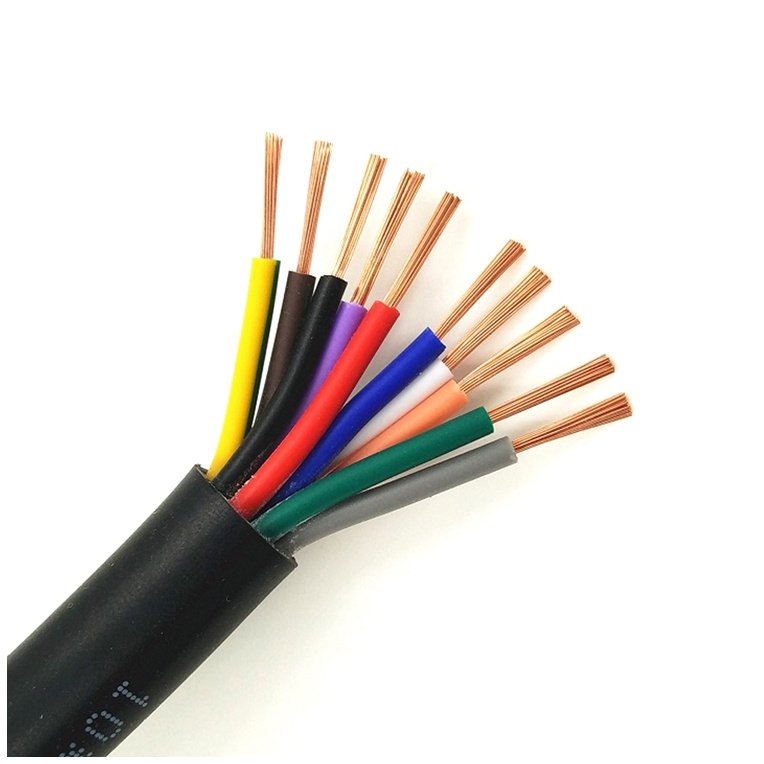
A typical YY cable is built as a flexible multi-core control cable with these layers:
- Fine-stranded copper conductors
Most YY control cables are supplied with flexible copper conductors, commonly Class 5 under IEC-style conductor classification. The fine stranding helps the cable tolerate panel-door movement, machine wiring bends, and routing through tray or trunking better than solid or coarse-stranded conductors. - Core insulation
Each conductor is insulated, most often with PVC or an equivalent thermoplastic compound. The insulation thickness and material grade are tied to the declared voltage rating and temperature rating, so do not treat two “YY” cables as interchangeable unless the datasheets match. Laid-up cores
The insulated cores are twisted or laid together to form the cable bundle. In higher core counts, the lay length, filler use, and core arrangement affect how round the cable stays and how cleanly it strips. Cheap cable that looks acceptable on the drum can become annoying at the bench if the cores untwist badly or fillers tear into the insulation.Optional wrapping, separator tape, or fillers
Some constructions include a polyester tape, powder, binder, or filler to improve roundness and sheath release. This is not just cosmetic. A rounder cable pulls more predictably through glands and conduits, and a clean separator can save time during repetitive panel termination.Outer sheath
YY normally has a PVC outer sheath without metallic braid. Grey is common in many control-cable markets, but black and other colors are also supplied depending on UV requirement, plant convention, and manufacturer range.
That lack of braid is the defining construction difference. YY is simpler, usually easier to strip, usually smaller in outside diameter for the same core count and conductor size, and often easier to dress inside a panel. The trade-off is that the sheath alone must handle abrasion, scuffing, mild impact, and dragging during installation.
SY cable construction: YY-like core package plus steel wire braid
SY cable normally uses a similar flexible core package but adds mechanical reinforcement around it. The common build is:
- Fine-stranded copper conductors
Like YY, SY is commonly supplied with flexible copper conductors for control and instrumentation-style machine wiring. The conductor class should still be checked on the datasheet; do not assume flexibility from the product name alone. PVC or specified core insulation
Standard SY cables often use PVC insulation. Special versions may use oil-resistant, heat-resistant, or low-smoke zero-halogen materials where specified by the buyer or required by the project environment.Laid-up cores with bedding or inner sheath
Before the braid is applied, the core assembly normally needs bedding, an inner sheath, or a wrapped layer to create a stable surface. This layer protects the insulated cores from braid pressure and helps the braid sit evenly.Galvanized steel wire braid
The steel wire braid is the construction feature most buyers associate with SY. It improves resistance to abrasion, crushing, and tensile stress compared with a plain YY cable. It also gives the cable some protection against rough handling around machines, conveyor frames, workshop floors, and moving equipment where a plain sheath would be nicked too easily.Outer PVC sheath, often transparent
Many SY cables are supplied with a transparent outer sheath so the galvanized braid remains visible. Some manufacturers and markets offer colored outer sheaths instead. Procurement teams should not use sheath transparency alone as the specification; the braid material, coverage, sheath compound, voltage rating, and approvals matter more.
The steel braid is mechanically useful, but it is often misunderstood.
SY cable steel wire braid is the same as conventional power cable armouring for fault-current protection.False
SY braid improves mechanical resistance, but it should not be assumed to provide the same fault-current carrying performance, installation rules, or protective-earth function as dedicated power cable armour. Earthing and protection requirements must be checked against the cable standard, project specification, and local wiring rules.
In practice, I have seen SY specified because someone wanted “a tough cable,” then later rejected by an electrical inspector because the project actually required a recognized armoured power cable type. That is an expensive way to learn the distinction.
Conductor class and flexibility are not decided by the name alone
Both YY and SY are commonly bought as flexible control cables with Class 5 copper conductors, but bending behavior depends on the whole cable build, not only the conductor strand count. A 3-core 1.5 mm² YY cable and a 25-core 1.5 mm² SY cable may both be “flexible” on paper, yet they handle completely differently when an electrician is trying to dress them into a compact terminal box.
The main factors are:
- Core count: More cores increase bundle diameter and internal friction during bending.
- Conductor cross-section: Larger conductors resist bending more strongly, even with fine stranding.
- Sheath compound: Softer PVC bends more easily; harder, oil-resistant, or low-temperature compounds can change handling noticeably.
- Braid design: Wire diameter, braid angle, and coverage affect stiffness and torsional behavior.
- Overall diameter: Bending force rises quickly as cable diameter increases.
- Temperature during installation: A cable that feels manageable in a warm workshop can become stubborn in an unheated warehouse in winter.
The counter-intuitive part is worth spelling out: a braided SY cable is not automatically the more flexible cable. The braid helps when the cable is pulled, rubbed, or exposed to mechanical knocks, but it can make the cable springier and harder to route around tight corners. In small sizes this may barely matter. In larger cross-sections or high-core-count machine cables, it can mean bigger tray space, larger glands, more installation time, and a few choice words from the fitter standing on the ladder.
Insulation and sheath material options
Standard YY and SY cables are often PVC/PVC constructions because PVC is cost-effective, easy to process, flame-retardant in many formulations, and familiar to panel shops. It is a sensible default for indoor control wiring, dry factory areas, general machine connections, and protected cable routes.
Material choice starts to matter when the plant is less friendly:
| Environment or requirement | Common construction response | Practical implication |
|---|---|---|
| General indoor machinery | Standard PVC insulation and sheath | Lowest complexity and usually easiest procurement route |
| Oily machine areas | Oil-resistant PVC or equivalent compound | Reduces swelling, softening, and premature sheath failure from lubricants or cutting fluids |
| Cold installation or cold operation | Cold-flexible sheath compound where specified | Prevents cracking during handling; verify minimum installation and operating temperatures |
| Damp or washdown-adjacent areas | Suitable sheath, glands, and routing design | Cable jacket alone does not make the whole installation waterproof |
| Public buildings or escape routes | Low-smoke zero-halogen alternative where required | May be required by project specification, but handling and cost differ from standard PVC |
| Outdoor exposure | UV-resistant sheath and suitable temperature/water rating | Ordinary indoor grey PVC should not be assumed suitable for sunlight and weather |
There is a commercial trade-off here. Standard PVC is usually easier to source and more economical. LSZH, oil-resistant, UV-resistant, or cold-flexible versions may be technically correct but can narrow supplier options, increase minimum order quantity, and extend lead time. The preferred choice flips when the cost of cable replacement, downtime, or compliance failure exceeds the saving from buying the standard compound.
This conclusion stops holding where a project specification, national wiring rule, fire requirement, food-grade requirement, rail or marine approval, or machine builder standard defines the compound. In those cases the environment does not merely “influence” the selection; it governs it.
Core identification and termination details
Core identification looks like a small purchasing detail until the panel shop opens the drum. Then it becomes labor time, wiring errors, and sometimes rework.
Common options include:
- Numbered black cores: Very common in multi-core control cables. Good for panel wiring where drawings call out terminal numbers and wire references.
- Color-coded cores: Useful in low-core-count cables or where maintenance teams expect conventional color recognition.
- Green-yellow protective conductor included: Often specified as “G/Y” or similar. Confirm whether the required core count includes or excludes the protective conductor.
- Cables without green-yellow: Used where all cores are control conductors and protective earth is provided separately.
- Pair or group identification: Needed in some signal or control applications where paired circuits must stay together.
- Custom identification: Possible from some manufacturers on project volumes, but it must be controlled through drawings, purchase specification, and inspection documents.
A typical procurement mistake is ordering “12-core SY” when the drawing needs 11 numbered control cores plus one green-yellow protective conductor, or the reverse. Another is mixing numbered-core and color-coded-core cable across panels in the same project. Either one slows termination, and worse, it creates maintenance confusion years later when nobody remembers why Cabinet 4 is different.
What the visible outer sheath tells you, and what it does not
Procurement teams often notice the outer sheath first. YY is commonly supplied in grey, black, or another solid color. SY is often supplied with a transparent PVC sheath over the steel braid, especially in markets where installers expect to see the braid at a glance.
That visual clue is useful for stores and incoming inspection, but it is not enough for acceptance. Check the drum label, sheath marking, datasheet, and test documents against the purchase order. At minimum, confirm:
- Cable type and manufacturer designation
- Number of cores and conductor cross-section
- Voltage rating
- Conductor class
- Insulation and sheath material
- Presence or absence of green-yellow core
- Braid material and, where specified, braid coverage
- Temperature rating
- Relevant test report or declaration required by the project
- Packaging length, drum condition, and marking continuity
Layer by layer, the choice is fairly simple: YY is the cleaner, lighter, unbraided flexible control cable; SY is the mechanically reinforced version with a steel wire braid and the extra construction needed to carry it. The hard part is not naming the cable type. It is making sure the construction details match the machine environment, the panel drawings, the termination hardware, and the compliance route before the cable is already cut to length.
Mechanical protection and flexibility
SY cable normally tolerates exposed industrial routing better than YY because the galvanized steel wire braid adds resistance to scraping, light impact, and local crushing. YY is usually the cleaner choice where the cable is protected inside panels, trunking, cabinets, or machine frames. The mistake is treating SY as “armoured cable”; it is tougher than YY, not a substitute for heavy mechanical protection.
In plant terms, the difference shows up around the ugly parts of an installation: the last metre into a machine, the drop from tray to junction box, the section behind a guard panel that maintenance staff keep removing, or the cable passing near a conveyor leg where boots, tools, and steel parts occasionally catch it. A YY cable in those locations relies mainly on its PVC sheath and insulation system. Once the sheath is gouged, flattened, or repeatedly rubbed, there is not much spare mechanical defence before the cores are at risk.
SY has the steel braid sitting under the outer sheath, so a scrape or knock has to work through the sheath and then meet a metallic layer before it reaches the insulated cores. That braid also helps spread some local force along the cable instead of letting all of it concentrate at one point. In practice, this can be the difference between a cable surviving years beside a machine frame and a YY cable showing jacket damage after a few maintenance shutdowns.
Typical exposed locations where SY earns its keep include:
- Floor-adjacent routes where cables may see light contact from trolleys, pallets, dropped tools, or cleaning equipment.
- Cable tray exits and vertical drops where the cable leaves a protected route and becomes vulnerable to snagging.
- Machine interfaces such as sensor boxes, local isolators, small motors, solenoid banks, and auxiliary control connections.
- Short unprotected runs across frames where conduit would be awkward and YY would be too easily scuffed.
- Areas with occasional vibration or minor rubbing against brackets, provided the cable is still clamped correctly and not left sawing against a sharp edge.
That last condition matters. Steel braid improves mechanical survival, but it does not cancel bad routing. A cable tied tight over a punched cabinet edge, rubbing against a painted frame, or hanging from its own weight into a vibrating gland will still fail. The braid may delay the failure, which can be worse from a maintenance point of view because the damage hides until insulation resistance drops or a core breaks.
SY cable can replace armoured power cable in mechanically harsh industrial areas.False
SY braid gives light mechanical protection for control and instrumentation-style service, but it is not the same design intent as heavy-duty steel wire armoured power cable, conduit systems, mining cable, reeling cable, or purpose-built drag chain cable.
The practical boundary is light mechanical stress. SY is sensible for exposed control wiring where the risk is scraping, nuisance knocks, and moderate handling abuse. It is not the right answer where the cable may be crushed by vehicles, pulled under load, dragged across concrete, buried, reeled, suspended over long unsupported spans, or run through an aggressive moving mechanism. For those cases, the proper choice may be armoured power/control cable, flexible conduit, festoon cable, PUR drag-chain cable, rubber reeling cable, or a cable built to a project-specific mechanical standard.
YY can still be the better mechanical choice when protection already exists. Inside a control cabinet, for example, the cable is usually supported by ducting, DIN rail layouts, trunking fingers, cable ties, and gland plates. There is little benefit in paying for and wrestling with braid if the cable never sees abrasion or impact. YY is also easier to dress neatly through cabinet wireways and small termination spaces, which matters more than people admit during a panel build with hundreds of terminations.
Good YY applications include:
- Fixed wiring inside control panels and MCC compartments.
- Protected cabinet-to-cabinet links inside trunking or duct.
- Short internal machine runs behind covers or within guarded frames.
- Signal and control circuits in clean indoor areas where external damage risk is low.
- OEM machine wiring where cable routing is controlled and repeatable.
There is a trade-off here: SY buys mechanical tolerance but costs time and space. The braid makes the cable stiffer, usually increases the outside diameter, and takes more care to strip without nicking cores or leaving stray wires. Glanding can also be slower because the braid must be handled properly, especially if the installation needs continuity, bonding, or a specific gland design. YY is faster to cut, strip, bend, gland, and terminate; in a protected panel build, that labour saving can be more valuable than unused mechanical strength.

Movement is another common trap. Ordinary YY and ordinary SY are often described as flexible control cables, but “flexible” does not automatically mean suitable for continuous flexing. A cable can be easy to route during installation yet unsuitable for millions of bending cycles in a drag chain. Continuous flexing works the copper strands, insulation, fillers, sheath, and any braid through repeated strain. If the cable is not designed for that duty, conductors can break internally while the outside still looks acceptable.
Do not assume either ordinary YY or ordinary SY is suitable for:
- Drag chains or energy chains.
- Robotic arms with torsion.
- Elevator travelling cables.
- Reeling drums.
- Festoon systems.
- Rotating tables.
- Continuously moving gantries.
- High-cycle pick-and-place equipment.
For those duties, the datasheet should explicitly state the dynamic application, bend radius under motion, permitted acceleration or travel speed where relevant, torsion rating if applicable, and expected test basis. If it only lists a static minimum bending radius and a general voltage rating, treat it as a fixed or occasional-movement cable, not a motion cable.
Bend radius is where many otherwise tidy installations get damaged on day one. Installers see a “flexible” control cable and pull it tightly around a small gland, a cabinet corner, or a tray edge. The copper may accept the bend once, but the insulation and sheath can be compressed on the inside radius and stretched on the outside. With SY, the braid also has to deform; bend it too tightly and the braid can open, bunch, or print through the sheath over time.
Follow the manufacturer’s datasheet for both installed and moving bend radius. Static bending, occasional repositioning, and continuous flexing are different conditions, and the allowable radius can change sharply between them. If the datasheet does not separate these cases, ask the supplier before approving the cable for a moving application.
Tensile load is just as important as bend radius. A vertical drop from a tray to a machine should not be hanging on the copper conductors or on the gland seal. Use proper cable glands, clamps, cleats, saddles, or strain-relief brackets close to the termination. YY needs particular care because there is no metallic braid layer to help distribute abuse along the cable body. With either type, a gland is not a lifting eye; if maintenance staff can tug the cable during motor replacement or sensor adjustment, give the cable a supported route and a service loop.
One visible braid-related misunderstanding deserves calling out. SY looks rugged because the steel braid can often be seen through a transparent or semi-transparent sheath, but the sheath still has to match the environment. Oil, coolant mist, UV exposure, low temperature, washdown chemicals, welding spatter, and outdoor weathering can ruin the sheath long before the braid itself is the limiting factor. A cable with the wrong sheath compound can crack, swell, harden, or lose abrasion resistance even though it “looks industrial” when new.
For machine builders and buyers, the practical selection line is fairly simple: use YY where the route is protected and installation speed matters; use SY where light external mechanical damage is credible and the extra handling effort is justified. Once the cable is expected to move continuously, carry load, survive crushing, or tolerate harsh chemicals or outdoor exposure, stop comparing YY versus SY and specify the duty first. The cable type should follow the mechanical environment, not the other way around.
Electrical and EMC behavior
YY and SY should be selected electrically from the circuit duty first, not from how tough the cable looks. Both can carry control, signal, auxiliary power, or light instrumentation circuits when the conductor size, insulation system, voltage rating, temperature rating, and applicable standard match the installation; the steel braid on SY does not automatically make it a screened EMC cable or a protective bonding path.
For ordinary control wiring, buyers often see YY and SY offered in low-voltage control cable classes such as 300/500 V, with some manufacturer-specific variants and national-market specifications using different markings. That number is not a universal property of “YY” or “SY” as a name. It belongs to a specific cable design, test regime, insulation thickness, sheath compound, and manufacturer’s declaration.
The sensible engineering check is straightforward:
- Confirm the rated voltage, such as 300/500 V or the specified equivalent in the project document.
- Match conductor cross-section to load current, voltage drop, protective device behavior, and terminal capacity.
- Check conductor class where flexibility matters, usually stranded conductors for machinery and panel wiring.
- Verify insulation and sheath material against oil, coolant, UV, flame behavior, and ambient temperature.
- Confirm the installation standard or customer specification, especially for export equipment or public infrastructure.
- Do not treat braid presence as proof of screening, earthing suitability, or fault-current capacity.
A plant maintenance team may only see two grey cables on a tray, one plain and one braided under the sheath. Electrically, those two cables can behave quite differently from what the eye suggests. The YY may be perfectly acceptable for a 24 V DC control circuit in a clean panel run, while the SY may still be a poor choice for an encoder feedback line running beside a drive output cable.
What does the SY braid really do electrically?
The steel wire braid in SY cable is mainly valued for mechanical reinforcement. It can offer some metallic coverage around the cores, so in some installations it may reduce a portion of electric field coupling or provide a partial drain path if properly bonded, but that is not the same as a designed EMC screen.
The mechanism matters. Effective EMC screening depends on:
- Coverage percentage and consistency around the cable circumference.
- Material conductivity.
- Contact resistance at terminations.
- Transfer impedance across the frequency range of concern.
- Whether the screen is bonded 360 degrees or only via a pigtail.
- The layout of the panel earth, gland plate, and protective bonding network.
Steel is mechanically useful but electrically less conductive than copper. A steel braid may survive abrasion and handling better than a delicate foil screen in rough machinery areas, but it will usually be electrically inferior to a properly designed and terminated copper braid or foil-plus-drain screen for high-frequency noise control. The word “braided” describes construction; it does not, by itself, define EMC performance.
That trade-off shows up around variable frequency drives. If the goal is to reduce nuisance trips, encoder count errors, analog signal drift, or network communication faults, a cable chosen mainly for SY-style mechanical braid can disappoint. A CY cable, or another cable specifically designed and documented for EMC performance, is normally the better candidate where screening is the primary requirement.
| Installation condition | YY behavior | SY behavior | Usually better choice |
|---|---|---|---|
| General control wiring inside machinery, away from high-noise circuits | Suitable if voltage, temperature, and sheath rating match | Also suitable, but braid may be unnecessary cost and handling effort | YY or SY based on mechanical exposure |
| Routing near VFD output cables or servo motor cables | No inherent screening; spacing and segregation become critical | Steel braid may help only in a limited and installation-dependent way | CY, screened drive cable, or specified EMC cable |
| Sensitive analog instrumentation, load cells, thermocouples, low-level sensors | Risk of induced noise if routed poorly | Not a guaranteed screen | Instrumentation cable with proper screen design |
| Industrial networks, encoder feedback, pulse signals | Depends heavily on protocol, routing, and termination | Braid does not replace protocol-approved cable | Network-approved or encoder-rated screened cable |
| Harsh handling where abrasion is the main risk | Mechanically exposed unless protected by conduit or tray | Braid gives useful reinforcement | SY if electrically acceptable |
The table is intentionally cautious because EMC faults are rarely caused by the cable alone. They come from the cable, the route, the termination, the cabinet bonding, the drive switching frequency, the earthing system, and sometimes a 30-minute maintenance “temporary fix” that stays in service for five years.
An SY steel braid is equivalent to a copper EMC screen.False
SY braid can provide mechanical reinforcement and may give limited screening under certain termination conditions, but it is not the same as a copper braid, foil screen, or purpose-designed EMC construction with documented screening performance.
Why CY is usually the safer EMC answer
Where electromagnetic interference is a real design concern, CY normally moves ahead of SY because its metallic screen is intended for electrical screening rather than just mechanical protection. In many market versions, CY cable uses a tinned copper wire braid over the insulated cores, sometimes with specified coverage. The exact construction still needs to be checked on the datasheet, but the design intent is different.
Typical areas where CY or another screened cable should be considered include:
- Variable frequency drive control wiring and nearby low-level circuits.
- Servo drive systems, especially with encoder, resolver, or brake feedback cables.
- Analog inputs such as 4-20 mA, 0-10 V, millivolt sensors, weighing systems, and pressure transducers.
- High-speed pulse circuits and position feedback.
- Industrial Ethernet, fieldbus, and other network cables where the protocol has defined cable requirements.
- Mixed panels where drive outputs, contactors, solenoids, and sensor wiring are packed into the same trunking.
In practice, the preferred choice flips when the installation hazard changes. If the cable will be dragged over a welded machine frame, exposed to light impact, and only carries robust on/off control signals, SY may be the more practical cable. If the same run carries an analog sensor beside a VFD output, the mechanical advantage of SY is less valuable than a proper EMC screen, route separation, and correct bonding.
Grounding, bonding, and fault-current assumptions
The SY braid should not be assumed to be a protective conductor, equipotential bonding conductor, or reliable fault-current path unless the project design, applicable standard, manufacturer’s documentation, terminations, and verification tests explicitly permit it. That is a safety and compliance issue, not a preference.
A braid can look substantial, but fault current behavior depends on cross-sectional area, material, continuity, contact resistance, thermal withstand, protective device disconnection time, and how the braid is terminated at both ends. A loose gland biting unevenly into the braid, paint under a gland plate, corrosion in a washdown zone, or a long pigtail to a DIN rail earth terminal can change performance sharply.
Common mistakes I still see in panels and machine rebuilds include:
- Cutting the braid back and leaving it floating because it was inconvenient to terminate.
- Twisting braid into a thin tail and landing it under a small terminal screw.
- Relying on a nylon gland where metallic continuity was assumed in the design.
- Bonding at one end without understanding whether the circuit needs EMC bonding, safety bonding, or both.
- Mixing protective earth conductors and signal screen drains casually on the same terminal strip.
- Using SY as a substitute for an armoured power cable where the installation actually requires a cable with defined armour and earthing performance.
A correctly selected separate protective conductor is often cheaper than arguing with an inspector, a commissioning engineer, or a tripping fault at 2 a.m. If the braid is expected to perform any safety-related function, it needs formal verification, not a visual judgement.
Termination quality often decides the result
Even a good screened cable performs badly when terminated badly. The most common EMC downgrade is taking a full screen and connecting it through a long pigtail. At low frequencies that pigtail may look harmless; at higher noise frequencies it adds inductance, raises impedance, and lets common-mode noise find other paths through the control system.
For metallic layers to work consistently, check the details that procurement drawings sometimes leave vague:
- Use the gland type specified for braid or screen termination, not just any gland with the right thread.
- Prefer 360-degree screen contact where EMC performance is required.
- Keep bonding paths short, wide, and mechanically secure.
- Remove paint or use proper serrated washers and conductive gland plates where required.
- Separate dirty power earth currents from sensitive signal reference points according to the panel design.
- Inspect braid continuity after stripping; damaged or thinned braid at the gland is a common hidden defect.
- Confirm whether both-end bonding, single-end bonding, or a hybrid method is required for the circuit type and site earthing system.
There is no universal rule that one-end or both-end bonding is always correct. For many high-frequency EMC problems, both-end 360-degree bonding is often more effective. For some low-level analog systems, designers may use different screen-drain strategies to avoid low-frequency ground-loop problems. The decision belongs in the electrical design, not with the installer on the day of pulling cable.
Circuit segregation still matters
Choosing SY over YY does not remove the need for sensible cable routing. Low-level signals, control circuits, auxiliary power, and drive outputs should be segregated according to the electrical noise risk and the applicable installation rules.
A practical routing hierarchy looks like this:
- Keep VFD and servo motor output cables away from sensor, encoder, and analog signal cables.
- Cross noisy and sensitive cables at roughly 90 degrees where separation cannot be maintained.
- Use separate trunking or tray sections for power and signal where space allows.
- Avoid bundling long parallel runs of solenoid, contactor, drive, and instrumentation cables.
- Use screened alternatives for sensitive circuits instead of hoping an SY braid will compensate for poor routing.
- Verify the equipment supplier’s requirements for industrial networks and motion feedback; many require specific cable impedance, pair twist, shielding, and connector systems.
The boundary is simple enough: for robust low-voltage control circuits in a moderate electrical environment, YY and SY selection may be driven mainly by mechanical exposure and installation practice. Once the installation includes fast-switching drives, sensitive measurement, high-speed communication, or strict EMC compliance targets, cable naming shorthand is not enough; the design has to specify the screen construction, termination method, routing rules, and verification evidence.
Standards and compliance checks
A purchase description like “SY cable” or “YY cable” is not enough for international procurement. Treat those names as trade shorthand, not proof of compliance: the acceptable cable is the one whose datasheet, jacket marking, test evidence, and project approval route match the installation rules in the country and site where it will be used.
In practice, two cables sold under the same SY or YY label can differ in conductor class, PVC compound, braid coverage, flame performance, voltage rating, oil resistance, temperature rating, and marking format. That variation is not automatically dishonest; it often reflects different market conventions. The risk appears when a buyer assumes that the trade name carries the same legal or technical meaning everywhere.
An SY cable with a steel wire braid is automatically approved wherever a YY control cable is accepted.False
The braid may improve mechanical protection, but approval depends on the specified standard, fire classification, installation method, local code, and project authority requirements.
Check the standard, not just the cable name
Start with the datasheet and the cable sheath marking. If the relevant standard is missing, vague, or replaced by marketing language, the buyer has no firm basis for design approval or incoming inspection. For a control cable package, I would normally expect the technical file to identify, where applicable:
- Conductor standard and class
Common references include IEC 60228 or an equivalent national conductor standard. The class matters because fine-stranded flexible conductors terminate differently from solid or coarse-stranded conductors. A panel shop using bootlace ferrules may be comfortable with Class 5 conductors; a building inspector looking at fixed wiring terminals may not be. Voltage rating
The rating must match the circuit and installation category, not just the load current. Many SY and YY control cables are used in low-voltage control and auxiliary power circuits, but the exact rated voltage must be verified on the datasheet and jacket.Insulation and sheath requirements
PVC, oil-resistant PVC, LSZH, PUR, or other compounds behave differently under heat, oil mist, coolant, UV exposure, and fire conditions. A cable that survives inside a clean control cabinet may age badly beside a washdown line using alkaline detergent.Flame-retardance test evidence
Look for the stated test method, not only the phrase “flame retardant.” IEC 60332 single-cable flame testing is not the same as bundled-cable fire performance, CPR classification, plenum requirements, or low-smoke halogen-free performance.Country or region-specific electrical rules
European, UK, North American, Middle Eastern, marine, and mining projects often treat cable approval differently. A CE-related declaration, where applicable, does not replace NEC, CEC, local civil defense approval, a consultant’s specification, or a marine class requirement.
The mechanism behind this is simple but expensive when missed: inspectors and consultants approve an installation by matching documents and markings against the rule set in the project file. If the cable marking does not show the expected rating, standard, or flame class, the installed cable can become a nonconformance even if it is electrically sound. At that point the argument is no longer about engineering preference; it is about whether the owner, insurer, or authority having jurisdiction will accept the installation.
Project rules can be stricter than the cable catalogue
The cable may be technically good and still wrong for the job. Consultant specifications, plant engineering standards, marine or offshore rules, machinery safety requirements, building regulations, insurance audits, and local inspection habits can all override a supplier’s general recommendation.
A few common traps:
- Machine approval does not equal building-wiring approval
A cable accepted inside a machine harness or control panel may not be approved for fixed building wiring in tray, conduit, riser, or concealed spaces. Control cable approval does not equal hazardous-area suitability
Explosive atmospheres, gas groups, dust zones, gland certification, earthing practice, and mechanical protection rules need a separate review. Do not treat SY braid as a substitute for certified armouring or hazardous-area cable selection.General industrial use does not equal direct burial
Soil pressure, moisture, rodents, chemical contamination, and water migration change the requirement. Standard YY and many SY constructions are not automatically suitable for direct burial unless the manufacturer and project standard explicitly allow it.Flame-retardant does not equal fire-survival
Fire alarm, emergency lighting, smoke extraction, and escape-route circuits may require circuit integrity or special fire performance. A normal control cable, even a tidy one with a braid, is not a fire-resistant safety cable unless tested and marked for that duty.Panel wiring acceptance does not equal offshore or marine acceptance
Marine projects may require class society acceptance, specific sheath compounds, oil and mud resistance, low-smoke halogen-free materials, or fire test regimes beyond ordinary factory automation practice.
A more physically robust SY cable can be less acceptable than a simpler YY cable if the SY version lacks the required standard reference, fire classification, or installation approval. This is the counter-intuitive procurement point. Mechanical toughness helps during routing and maintenance, but compliance is decided by the rule set, not by how substantial the cable feels in the hand.
Documents to request before placing the order
For bulk orders, export projects, or any job with third-party inspection, ask for documents before shipment rather than after the cable is on site. The minimum package should normally include:
- Technical datasheet
Confirm construction, conductor size, core count, conductor class, insulation, sheath, braid details for SY, temperature rating, voltage rating, minimum bend radius, and intended installation conditions. Declaration of conformity, where applicable
Useful for regulated markets, but it must refer to the correct product and applicable directives or regulations. Generic company declarations are weak evidence.Routine test report or factory test certificate
This should identify the cable batch or order and cover relevant electrical tests such as conductor resistance and voltage withstand, according to the declared standard.Flame test evidence
Ask which test was used and whether it applies to the exact cable family, sheath compound, and construction supplied.Material compliance statement
Depending on the market, this may cover RoHS, REACH, halogen content, oil resistance claims, UV resistance, or restricted substances. Do not assume all PVC compounds are interchangeable.Quality certificate
A certificate tied to a quality system is useful, but it does not replace product-specific test evidence.Packing list and drum schedule
Check lengths, drum numbers, gross weight, net weight where relevant, and project tag references. This prevents a common site problem: correct cable type, wrong cut length.Traceability information
Batch number, production date, meter marking, drum number, and inspection record matter when a defect, shortage, or document query appears three months later.
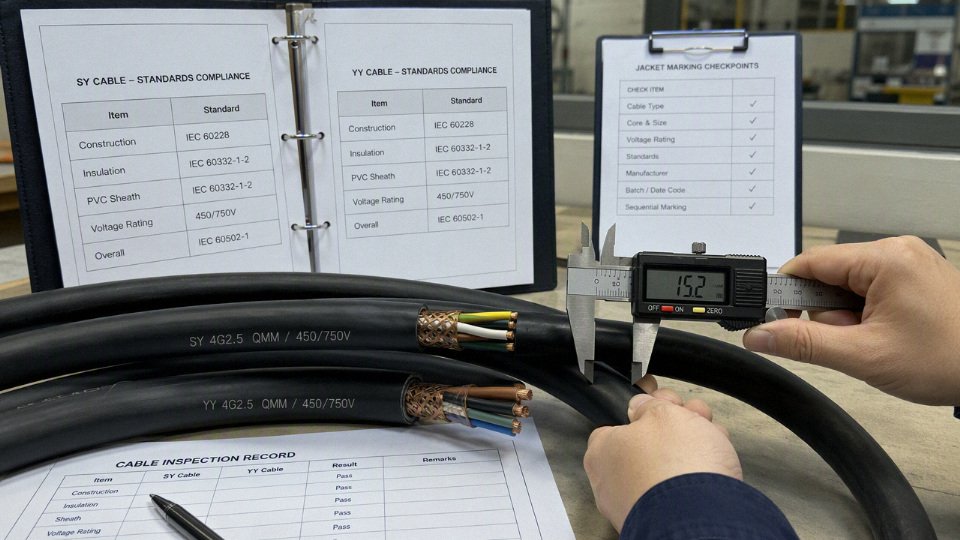
Jacket markings worth inspecting on arrival
Incoming inspection should include a physical check of the cable sheath, not just paperwork. I have seen good procurement teams catch wrong voltage classes and missing meter marks before the cable reached the electricians; that is much cheaper than discovering it halfway through tray pulling.
Check the jacket for:
- Manufacturer name or identifiable brand
- Cable type designation, such as YY or SY, if used
- Number of cores and conductor cross-sectional area
- Voltage rating
- Standard reference, where claimed
- Batch number, production code, or traceability mark
- Meter marking or sequential length marking
- Flame classification or material classification, where applicable
- Sheath material or special compound marking, if specified
- Certification marks, only where genuinely certified for that product
A printed standard reference on the jacket is not automatically proof of certification, but its absence can create approval problems. Match the sheath marking against the datasheet, test report, purchase order, and project specification. If one says 300/500 V and another says 450/750 V, stop and resolve it before cutting the drum.
Export and import reality
For exporters and importers, the same cable family may need different documentation, labeling, or compound selection depending on destination. A cable accepted for factory automation in one European project may not satisfy a Gulf building project, a North American panel build, a marine installation, or a public infrastructure job. The differences are not academic; they affect customs documentation, consultant submittals, site inspection, insurance sign-off, and warranty exposure.
The trade-off is between standardization and local compliance. Standardizing one YY or SY construction across many countries improves purchasing leverage, stock control, and maintenance familiarity. The preferred choice flips when a destination market demands a different fire class, local certification, sheath compound, conductor identification system, or installation approval. At that point, buying the globally convenient cable can create more cost than it saves.
This guidance stops holding only where the project authority has already named an exact approved cable type, standard, and installation method, and the supplier can prove full conformity to that requirement. Until then, the safe procurement habit is to approve the cable by specification package and marking evidence, not by the familiar SY or YY name.
Application fit by environment
YY fits best where the cable is physically protected; SY earns its keep where light mechanical exposure, vibration, or occasional contact is part of the job. Neither name alone proves suitability for oil, sunlight, continuous flexing, fire performance, EMC, or hazardous-area use, so the environment should drive the final selection more than the catalogue family name.
Protected control panels and cabinets
Inside a well-built control panel, YY is often the sensible choice for low-risk control wiring: door interlocks, push-button circuits, PLC I/O extensions, short internal links, and connections routed in trunking or clipped neatly to backplates. The cable is easy to dress, gland, identify, and terminate without fighting the extra diameter and springiness of a steel braid.
The boundary is simple: YY should not be used just because the panel is “indoors.” Check the actual rating and documentation for:
- Voltage class and conductor temperature rating
- Flame performance required by the panel specification
- Core identification system, including numbered cores or color code
- Minimum bend radius at terminals and wireway exits
- Sheath compound, especially if the panel sees oil mist, washdown drift, or solvent vapors
In practice, a YY cable that is perfectly acceptable inside a dry MCC room may be a poor choice once it leaves the enclosure and hangs down to a vibrating limit switch. That transition point is where many maintenance failures start.
Machine tool wiring
SY is commonly considered for exposed machine-side control wiring because the galvanized steel wire braid gives some resistance to abrasion, snagging, and rough handling. Around machine tools, that can matter: cables rub against sheet-metal guards, operators move pendant arms, coolant residue builds up around glands, and vibration loosens anything that was only “finger tight plus hope.”
The braid is mechanical reinforcement, not magic armor. If the sheath is not oil-resistant, coolant and tramp oil can harden or swell the jacket over time, and the braid underneath will not save it. If the machine has moving axes or repetitive cable cycling, confirm whether the cable is rated for that motion; many standard SY products are better described as flexible for installation and occasional movement, not continuous dynamic service.
A useful plant-floor test is to look at the failure mode you are trying to prevent:
- Outer sheath scuffing from guards or brackets: SY may be a reasonable upgrade over YY.
- Coolant attack, oil soak, or cleaning chemical exposure: sheath compound matters more than braid.
- Repeated flexing on a moving head or pendant: use a cable designed for dynamic flexing.
- Impact from dropped tooling or forklift contact: step up to a heavier cable route, conduit, guard, or armoured design.
Automation and conveyor systems
For conveyors, packaging lines, sorters, and general automation, the best answer is often mixed: YY in protected trunking or inside enclosures, SY on short lightly exposed drops to sensors, valve banks, small motors, or local control stations. That split keeps installation cost and termination time under control while putting mechanical protection where the cable actually needs it.
The mechanism is straightforward. A braided SY cable has a larger outside diameter and is slower to strip, gland, and terminate than a comparable YY cable. On a long conveyor with hundreds of I/O points, using SY everywhere can add cost, panel congestion, and labor without improving reliability in enclosed cable tray or duct. Use it where abrasion and handling risk exist, not as a blanket substitute for route planning.
Continuous movement changes the decision. Drag chains, robot dress packs, shuttle tables, telescopic conveyors, and reciprocating pick-and-place equipment usually need purpose-built dynamic cable with validated bend radius, torsion behavior, conductor stranding, jacket material, and service life testing. Standard YY or SY may work for the first month and then fail by copper strand fatigue near the chain entry point.
HVAC, pumps, and general plant equipment
For HVAC skids, pumps, fans, compressors, and utility equipment, the routing usually decides more than the equipment name. A YY cable may be fine from a local isolator into a protected control box. SY becomes more attractive if the cable exits the panel into an exposed plant room, crosses a vibrating base frame, or passes near maintenance access where boots, hoses, and tools are part of normal life.
Check the small details that make or break these installations:
- Cable gland type and strain relief
- Drip loops and water entry paths
- Vibration isolation between fixed building steel and moving equipment
- Clearance from hot pipework, belt guards, and sharp tray edges
- Whether maintenance staff will remove covers or motors frequently
I have seen good cables fail early because the gland was wrong, the bend was too tight, or the cable was used as a convenient lifting handle during pump removal. SY gives a little more tolerance for abuse, but it does not replace proper support and routing.
Variable frequency drive environments
Do not assume SY is adequate as a drive output cable just because it has a metallic braid. VFD motor leads need to be assessed for EMC performance, earth continuity, capacitance, insulation stress, termination method, and drive manufacturer requirements. In many cases, CY, EMC-specific motor cable, or shielded power cable with the correct screen termination is the safer engineering route.
SY cable braid should not automatically be treated as an EMC screen for VFD motor outputs.True
SY braid is primarily selected for light mechanical protection. EMC performance depends on braid coverage, material, transfer impedance, termination method, frequency range, and the drive manufacturer's installation instructions.
The trade-off is cost versus risk. A generic braided cable may look cheaper on the purchase order, but nuisance drive trips, encoder interference, bearing current problems, radio noise complaints, or failed acceptance tests can cost more than using the specified motor cable from the start.
Clean production, damp areas, and outdoor exposure
Food, beverage, pharmaceutical, and clean production areas should not be selected by YY versus SY alone. Sheath cleanability, chemical resistance, oil resistance, low-toxicity compounds, migration concerns, and any required hygiene or material certifications can override the basic construction choice. A smooth, chemically resistant sheath may be more valuable than a braid if the cable is near washdown zones or product contact risk areas.
Outdoor and damp locations need the same discipline. Standard PVC YY or SY may not be suitable for long-term sunlight, standing water, condensation cycling, or freezing exposure unless the manufacturer documents that performance. Verify:
- UV resistance
- Water resistance or wet-location approval
- Temperature range for installation and operation
- Sheath resistance to cleaning agents, oils, and site chemicals
- Whether the cable is approved for fixed outdoor installation
- Compatibility with glands, seals, and enclosure IP rating
Seasonal effects are easy to underestimate. A cable that dresses nicely in a warm workshop can become stiff during winter installation, and a slightly damaged sheath outdoors can let moisture track into a gland over months.
Public buildings, infrastructure, and hazardous areas
Public buildings, transport infrastructure, tunnels, commercial facilities, and evacuation routes may impose fire-performance requirements that make standard PVC YY or SY unsuitable. Low-smoke zero-halogen compounds, flame propagation limits, CPR classification in applicable markets, and project-specific fire engineering rules must be checked before procurement. The cable type name does not prove compliance.
Hazardous or explosive atmospheres are stricter still. Generic YY or SY designation should not be used as the basis for selection in classified areas. Use cables, glands, seals, and installation methods approved for the hazardous-area classification, gas or dust group, temperature class, mechanical protection requirement, and local code. The gland system is part of the safety case, not an accessory to buy at the end.
Heavy mechanical environments
Where cables may be crushed, dragged, reeled, run across floors, exposed to heavy impact, buried, used on cranes, installed in mining areas, or placed near mobile equipment, SY is usually outside its comfort zone. Select armoured, screened armoured, rubber-sheathed, PUR, reeling, festoon, mining, marine, or other specialized cables according to the actual stress pattern.
The practical selection rule is to match the cable to the worst credible exposure, not the neatest route shown on the drawing. If the installed cable will live behind covers and inside trunking, YY may be entirely appropriate. If it sits on the machine edge where maintenance, vibration, oil, washdown, and operators all meet, SY may be the starting point — and sometimes the correct answer is neither.
Specification and buying checks
A good SY or YY inquiry starts with the circuit duty, not the cable nickname. If the RFQ only says “SY cable, 12-core, 1.5 mm²,” suppliers can quote very different constructions that look comparable on price but behave differently in a cabinet, on a machine frame, or in export documentation.
Use the cable type as the family, then lock down the engineering details that affect safety, installation time, service life, and approval risk.

Define the circuit before selecting the cable
State what the cable is actually doing. A control cable for pushbuttons, a low-level instrumentation cable, an auxiliary power feed, a safety circuit, and a drive-related connection do not carry the same electrical and noise risk just because the core count matches.
For an RFQ or project datasheet, identify the circuit as one of these categories:
- Control circuit for relays, contactors, limit switches, sensors, valve islands, or machine interlocks.
- Signal circuit for PLC I/O, encoder feedback, analog signals, or low-voltage communication.
- Auxiliary power circuit for small motors, actuators, lighting, heaters, or control transformers.
- Instrumentation circuit where noise pickup, pair lay-up, screen continuity, and segregation matter.
- Drive-related circuit near VFD outputs, servo cables, braking resistors, or motor power wiring.
- Safety circuit where color identification, documentation, approvals, and maintenance clarity are critical.
- Mixed-use cable, which should be treated cautiously because power and signal cores inside one sheath can create noise, heat, and maintenance problems.
In practice, mixed-use cables are where buying mistakes hide. The drawing may show “machine cable” as one line, but the actual bundle may contain 24 V DC sensors beside a solenoid feed or a small AC load. That can work in a short, protected run, but it should be reviewed rather than copied from an old bill of materials.
Lock down the core design
Give the supplier the exact core count and conductor cross-section. Include spares deliberately, not as an afterthought added by the electrician during commissioning.
A clean inquiry should state:
- Number of cores, such as 4, 7, 12, 18, 25, or project-specific counts.
- Nominal conductor cross-section, for example 0.5 mm², 0.75 mm², 1.0 mm², 1.5 mm², or larger where current and voltage drop require it.
- Conductor class or flexibility requirement, such as fine-stranded flexible conductors where repeated handling or tight routing is expected.
- Whether a protective conductor is required, and whether it must be green/yellow.
- Core identification method:
- numbered black cores,
- color-coded cores,
- green/yellow protective conductor plus numbered cores,
- customer-specific marking.
- Spare core requirement, commonly one or two spares for control systems, more for large machine looms where future modification is likely.
- Pair, triad, or group arrangement if the circuit is instrumentation or signal-related.
The mechanism is simple but expensive when missed: conductor size affects resistance, voltage drop, heating margin, termination fit, and short-circuit withstand. Oversizing improves margin and mechanical robustness, but it increases diameter, bend force, gland size, copper cost, and cabinet congestion. The preferred choice flips when the run length, load current, or terminal size becomes the limiting factor rather than cable price.
Specify construction and performance requirements
Do not assume all YY or SY cables use the same compounds or sheath thickness. Ask for the properties that matter at the installation point.
| Buying item | What to specify | Why it matters in service |
|---|---|---|
| Voltage rating | Rated voltage and required test voltage | Avoids quoting a cable suited only to a lower-duty control circuit |
| Temperature range | Fixed and flexing conditions if different | PVC compounds can stiffen in cold areas and age faster near heat sources |
| Minimum bend radius | Installed bend radius and handling radius where relevant | Prevents cracked sheath, ovalized cable, and stressed terminations |
| Flame performance | Required flame-retardant behavior and applicable test reference | Needed for panels, tunnels, public projects, and export acceptance |
| Insulation material | PVC or specified alternative | Affects dielectric behavior, heat aging, stripping, and cost |
| Sheath material | Standard PVC or enhanced compound | Drives oil, abrasion, UV, water, and chemical resistance |
| Environmental resistance | Oil, coolant, cleaning chemicals, sunlight, moisture, or water exposure | Plant fluids vary; soluble coolant mist is not the same as occasional clean water |
| Marking | Manufacturer, size, voltage, standard reference, batch or meter marking | Helps receiving inspection, maintenance, and traceability |
Be careful with oil and chemical claims. A cable that survives light hydraulic oil in a protected tray may not tolerate hot cutting fluid spray at a machine door for years. If exposure is continuous, ask for compound data, previous qualification evidence, or a sample test in the actual fluid.
Extra checks for SY cable
For SY cable, the steel wire braid is a construction feature that must be described, not just assumed. State:
- Braid material, normally galvanized steel wire unless another material is specified.
- Required braid coverage or braid density where the project has a mechanical protection target.
- Inner sheath or bedding construction under the braid.
- Outer sheath color, including whether transparent outer PVC is required so the braid remains visible.
- Compatibility with the specified cable glands, including clamping range, braid termination method, ingress rating, and panel entry arrangement.
- Whether the braid must be bonded for functional reasons or only treated as mechanical reinforcement.
The gland detail is not paperwork. A poor gland choice can leave the braid badly clamped, cut into the sheath, or floating with no reliable termination. On a vibrating machine, that becomes a maintenance call rather than a neat installation.
Extra checks for YY cable
For YY cable, specify whether a standard-duty sheath is enough or whether enhanced sheath performance is needed. This matters once the cable leaves a protected cabinet, crosses a machine opening, drops to a pendant, or sits near swarf, coolant, fork-truck traffic, or sharp tray edges.
YY can be the cleanest, easiest, and most economical choice inside panels and protected routes. Its advantage weakens when the sheath becomes the only line of defense against abrasion, pulling damage, oil, or careless maintenance habits such as using cable ties as strain relief.
Ask for manufacturing and consistency evidence
For serious procurement, especially repeat builds or export projects, ask suppliers how they control the product batch to batch. Useful evidence includes:
- Routine electrical testing records.
- Conductor resistance control.
- Insulation thickness control.
- Spark testing during insulation or sheath production.
- Sheath extrusion quality checks for surface finish, concentricity, and defects.
- Copper conductor material control and stranding consistency.
- Batch traceability from production to packing.
- Test reports and certificates in the format required by the project.
This is where a supplier’s manufacturing base matters. Shandong Jinda Special Cable Group Co., Ltd. has operated since 1987, with five production bases, 470,000 m² of manufacturing space, more than 1,000 employees, and an integrated structure covering R&D, production, sales, technical support, and after-sales service. For buyers placing bulk orders or customized cable specifications, that kind of manufacturing profile supports capacity discussion, documentation control, and long-term supply planning better than a spot trader with limited production visibility.
Compare quotations by verified value, not only meter price
The cheapest quote often becomes expensive through scrap, delays, rework, or documentation rejection. Compare each offer against the same technical basis:
- Confirmed standard or project specification compliance.
- Copper quality and conductor flexibility.
- Insulation and sheath compound grade.
- Braid construction for SY cable.
- Cable outside diameter and weight, because these affect glands, trays, shipping, and handling.
- Marking content and language.
- Packing method and drum length.
- Lead time and production capacity.
- Test documentation and inspection availability.
- After-sales and technical support responsiveness.
A fair comparison is not “price per meter”; it is delivered, documented, installable cable that matches the drawing and can pass receiving inspection. This rule stops holding only when the cable is a low-risk, short-run maintenance purchase with no approval burden and no repeat-production consequence.
Large international order details
For container shipments, project tenders, or multi-site machine builds, add commercial and logistics controls to the technical specification:
- Drum length and acceptable length tolerance.
- Whether short lengths are allowed.
- Drum type, palletizing, wrapping, and moisture protection.
- Export packing requirements for sea freight or long inland transport.
- Cable marking language and label format.
- Inspection plan before shipment.
- Sample approval process before mass production.
- Required documentation format, such as PDF certificates, test reports, packing lists, and batch references.
- Country-specific receiving requirements, if the end user or contractor has them.
A little extra specification work at inquiry stage saves arguments later. It gives engineering, purchasing, the supplier, and the site electrician the same target, which is exactly what SY and YY cable buying needs.
Installation and inspection practices
- Plan the route before the drum is opened.
Walk the tray, machine frame, panel entry, and final termination points first. The weak spots are usually not the straight tray runs; they are:- Sharp tray exits and punched enclosure holes without proper edging
- Hot surfaces near motors, heaters, ovens, steam lines, or hydraulic packs
- Moving guards, cylinders, cable chains, robot axes, and sliding machine beds
- Unsupported vertical drops into sensors, junction boxes, or pendant stations
- Floor-level runs where maintenance staff step on the cable or roll tool carts over it
- Places where future access panels will crush the cable when refitted
A YY cable in a protected panel or closed conduit can give years of service. The same cable draped across a vibrating machine base with no strain relief will often fail early, then get blamed on “bad cable.” In practice, many failures start at a tray edge, a gland entry, or a bend that looked harmless during installation.
Respect bend radius and pulling-force limits from the cable manufacturer.
Do not use a generic rule from an old site standard unless it matches the exact cable construction and installation condition. Multi-core SY cable deserves special care because the galvanized steel braid and inner sheath can hide local damage during pulling; the outer sheath may look acceptable while the braid has been distorted or the cores have been compressed underneath.The mechanism is simple: tight bending shifts load unevenly through the cable layers. The outer side of the bend stretches, the inner side compresses, and the conductor bundle tries to ovalize. With SY, the braid adds abrasion resistance and some mechanical toughness, but it also makes the cable less forgiving if it is forced around a small radius or pulled around a rough corner. Mechanical protection is not permission to install the cable harshly.
There is a trade-off here. A tighter route saves tray space and makes panel work look neat, but it raises stress at the sheath, braid, and conductor insulation. A larger loop needs more space and better dressing, yet it normally gives better service life and easier replacement. This guidance stops being enough for continuous-flex motion; for drag chains, servo axes, and repetitive bending, select a cable specifically rated for that duty rather than treating YY or standard SY as a motion cable.
Use glands and strain relief that match the cable construction.
For YY cable entering a protected enclosure, a correctly sized compression gland may be sufficient if it seals on the outer sheath and provides strain relief. For SY, gland selection is more sensitive. The gland must seat properly on the sheath and manage the braid without leaving loose wires, uneven clamping, or a poor mechanical path where braid continuity is required by the project design.Watch for these common gland mistakes:
- Using a gland too large, then over-tightening it to compensate
- Clamping onto an uneven braid instead of the intended sheath or gland component
- Leaving braid strands long enough to touch terminals, ferrules, or live conductors
- Allowing the cable weight to hang from terminal screws instead of the gland or support
- Mixing gland types across a panel so maintenance crews cannot repeat the method later
- Strip and terminate SY with slower hands than YY.
YY cable is usually quicker to prepare because there is no braid layer to dress back. SY needs a cleaner termination routine:- Score the outer sheath lightly; do not cut deeply toward the braid and inner layers.
- Open the braid without tearing it into uncontrolled strands.
- Trim or fold the braid according to the gland maker’s instructions.
- Check for sharp wire ends before closing the gland.
- Inspect every core for insulation nicks before ferruling.
- Keep braid wires away from live terminals and spare cores.
A rushed SY termination can create faults that are intermittent and ugly to diagnose. One loose braid strand may sit harmlessly during commissioning, then move under vibration and create a short, earth fault, or nuisance trip weeks later.
Separate cable groups by function, not by convenience.
Follow the equipment manufacturer’s wiring instructions and good industrial wiring practice for separating:- Motor power and drive output cables
- General control wiring
- Encoder, sensor, analogue, load cell, and communication cables
- Safety circuits where routing rules are specified by the machine design
- Earthing and bonding conductors
The SY braid should not be treated as a substitute for proper segregation or a screened instrumentation cable. If variable-speed drive noise, encoder faults, or analogue instability are concerns, the cable type, screen termination method, routing distance, and drive manual all matter. A tidy tray with mixed power and sensitive signals can still be electrically poor.
Inspect the installation before energizing and again after early operation.
First inspection should include:- Outer sheath cuts, gouges, swelling, or flattening
- Exposed braid on SY cable
- Crushed sections near clamps, doors, glands, and tray covers
- Cable ties pulled tight enough to deform the sheath
- Unsupported bends at panel entries and sensor drops
- Moisture paths into downward-facing glands or outdoor junction boxes
- Missing ferrules, loose terminals, and weak core identification
- Poor termination labels that will slow fault-finding later
After a few production shifts, recheck high-vibration areas, moving guards, and machine entries. Fresh witness marks on the sheath tell you where the plant is rubbing the cable; do not wait until copper is exposed.
Keep records that procurement and maintenance can actually use.
Record the cable route, cable type, core count, conductor size, voltage rating, batch or drum number, test reports, gland type, termination location, and as-built drawing reference. Photos of panel entries and tray transitions are useful, especially on export machines or plants with multiple maintenance teams.
Many failures blamed on poor SY or YY cable quality originate from installation details such as mismatched glands, overbending, unprotected tray exits, or using ordinary flexible control cable for continuous motion.True
This is consistent with common industrial maintenance experience, but the exact cause on any site should be confirmed by inspection, continuity testing, insulation testing where appropriate, and review of the cable duty against the manufacturer’s data.
Frequently asked questions
What is the main difference between SY and YY cables?
YY cable is a flexible control cable with insulated cores and an outer sheath. SY cable has a similar control-cable base construction but adds a galvanized steel wire braid under the sheath for extra mechanical protection.
In plant terms, YY is easier to pull, bend, strip, and terminate. SY is tougher against rubbing, light impact, and rougher routing, but it is bulkier and takes more care at glands and terminations.
Is SY cable armoured?
SY cable is often called “braided” or “mechanically protected,” but it should not be treated as the same category as a proper armoured power cable unless the applicable standard, project specification, or authority accepts it that way.
The steel braid helps with abrasion and minor mechanical abuse. It does not automatically replace steel wire armour, conduit, tray cover, or a cable designed for direct burial or high-impact locations.
SY cable has a steel wire braid, but that does not automatically make it equivalent to a certified armoured cable.True
Armour status depends on the applicable standard, cable design, test evidence, and project approval, not only on the presence of metal braid.
Can the steel braid in SY cable be used as an earth conductor?
Do not assume the SY braid can be used as the protective earth. In most projects, the protective conductor should be a correctly sized green/yellow core or separate earth conductor, verified against the wiring rules and fault-current requirements.
The braid may need bonding for safety or noise reasons, but bonding and using it as the earth conductor are not the same decision. Check the cable datasheet, gland arrangement, continuity path, fault loop requirement, and local electrical code.
Is SY cable better than YY cable?
SY is better only where the braid solves a real mechanical problem. If the cable is inside a clean control cabinet, a protected panel trunking run, or a low-abuse machine harness, YY is often the cleaner and cheaper choice.
SY adds cost, diameter, stripping time, and termination discipline. On a job with hundreds of terminations, that extra labour is not academic; it shows up in panel build hours and maintenance frustration.
When should I use YY cable instead of SY cable?
Use YY where the route is protected and flexibility, easy termination, and cost control matter more than abrasion resistance.
Typical YY-friendly locations include:
- Control panels and internal machine wiring
- Cable ducts, trunking, and enclosed trays
- Sensor and actuator wiring in clean areas
- Light-duty control circuits with no regular rubbing or impact
- OEM machine harnesses where space is tight
If the cable will drag over a frame, sit near forklift traffic, or rub against a vibrating bracket, YY is usually the wrong place to save a few cents per metre.
Is SY cable suitable for outdoor use?
Only if the sheath material and cable datasheet confirm outdoor suitability. The word “SY” by itself does not prove UV resistance, water resistance, low-temperature flexibility, oil resistance, or long-term weathering performance.
For outdoor runs, ask about:
- UV-resistant sheath compound
- Temperature range
- Water exposure rating
- Oil and chemical resistance
- Required gland sealing
- Whether the braid is protected from corrosion at cut ends
In a wet yard, a poorly sealed SY termination can corrode at the braid faster than the buyer expects.
Is YY cable suitable for moving machinery?
YY can suit flexible connections with occasional movement, but it is not automatically a drag-chain or continuous-flex cable. Repeated bending, torsion, and tight-radius cycling need a cable designed and tested for that duty.
For moving machinery, confirm bend radius, conductor class, cycle life expectations, acceleration, travel length, torsion, and whether the cable will be clamped correctly. A cable that survives nicely during commissioning can fail after three months on a busy shuttle axis.
What is the difference between SY and CY cable?
SY uses a steel wire braid mainly for mechanical protection. CY cable normally uses a copper braid or screen aimed at electromagnetic shielding.
That distinction matters around PLC inputs, encoders, analog signals, servo drives, and variable frequency drives. If the problem is physical abuse, SY may help. If the problem is electrical noise, CY or a drive-specific screened cable is usually the more relevant discussion.
Can SY cable be used with variable frequency drives?
Do not select SY for a variable frequency drive just because it has a metal braid. VFD output cables need controlled screening, correct earthing, suitable insulation, and compatibility with drive manufacturer instructions.
For motor feeds from VFDs, ask the drive supplier or project engineer what cable type is approved. In many cases, a purpose-designed screened power cable will be preferred over general-purpose SY control cable.
What documents should I request before buying SY or YY cable?
Request documents before price comparison, not after delivery. At minimum, ask for:
- Full technical datasheet
- Applicable standard or declared construction specification
- Conductor class and material
- Core identification details
- Voltage rating
- Sheath material and temperature range
- Braid material and coverage for SY
- Routine test report or certificate of conformity
- Drum or coil marking details
- Packaging, length tolerance, and batch traceability
For regulated projects, also ask for any required third-party approvals, fire-performance evidence, or country-specific compliance documents.
Can Jinda manufacture SY and YY cables for international projects?
Jinda is a cable manufacturer with integrated R&D, production, sales, technical support, and after-sales service, supplying customers in more than 50 countries. For SY and YY enquiries, the practical route is to submit the required construction, rating, sheath material, marking, packaging, and compliance documents so the factory can confirm manufacturing scope and quotation basis.
For bulk procurement, do not send only “SY cable price” or “YY cable needed.” Send the operating environment and the project specification as well.
How do I confirm whether a cable is acceptable in my country or project?
Start with the project specification, local electrical code, and any authority or client approval list. Then compare the offered cable against those requirements line by line.
A sensible acceptance check includes:
- Confirm the required cable standard or approved equivalent.
- Check voltage rating, conductor size, and number of cores.
- Verify flame, smoke, halogen, UV, oil, or temperature requirements if specified.
- Confirm whether braid, screen, armour, or earth conductor rules apply.
- Review datasheets, markings, and test documents before purchase.
- Get written acceptance from the project engineer, consultant, or inspector where approval is uncertain.
Trade names are convenient in conversation, but inspectors approve documented compliance.
Verify your cable choice
For most protected control wiring inside machines, panels, and cable trays, YY is the economical starting point. Move to SY when the route faces light mechanical rubbing or handling damage, and move to CY or another properly screened cable when electrical noise, signal integrity, or EMC compliance is the real driver. If the cable may see impact, outdoor exposure, burial, heavy plant traffic, or a regulated fire-performance requirement, neither the SY nor YY trade name is enough.
Do not approve a cable from the SY or YY label alone. The correct choice has to match the circuit duty, installation route, movement pattern, mechanical risk, fire behavior, ambient temperature, voltage class, termination method, and the compliance rules in the destination market. I have seen projects lose more time from vague cable descriptions than from cable price disputes; “SY cable, 12-core” is not a procurement specification.
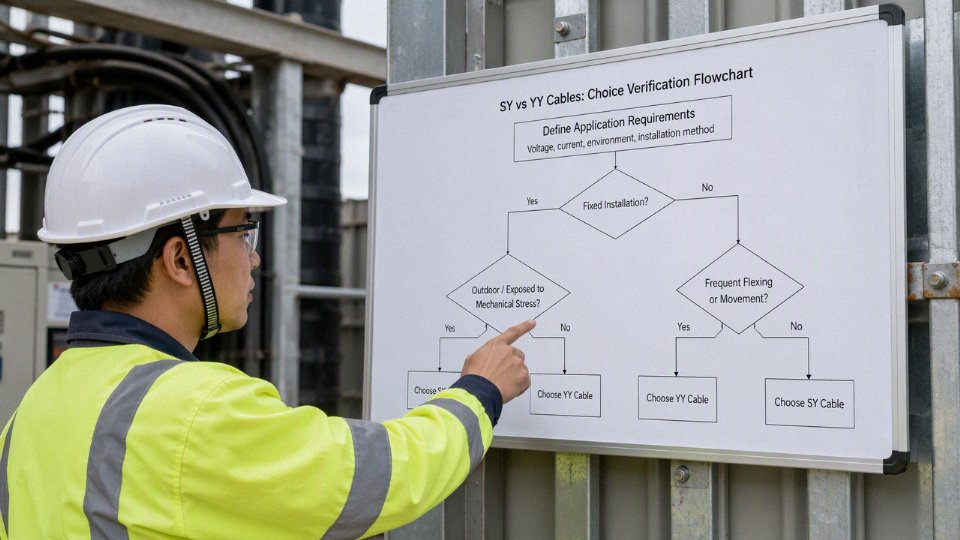
Use this sequence before releasing an inquiry or purchase order:
- Identify the circuit type
- Control power, interlock, instrumentation, sensor feedback, encoder, motor control, safety circuit, or low-voltage signaling.
- Check whether the circuit is noise-sensitive or just needs reliable switching/control continuity.
- Define the installation exposure
- Inside cabinet, fixed machine wiring, cable tray, drag-prone machine area, wet area, oil contact, outdoor route, or plant zone with welders, drives, and large motors nearby.
- A clean panel shop answer is often wrong once the cable drops onto a machine frame near coolant and forklift traffic.
- Check mechanical stress
- YY suits protected flexible routing.
- SY gives light mechanical protection from its galvanized steel wire braid, but the braid adds diameter, weight, and termination effort.
- Armoured or more robust industrial cable should be considered where crushing, impact, burial, or frequent abuse is expected.
- Check EMC needs
- If the purpose is screening, do not treat an SY steel braid as a substitute for a designed EMC screen.
- CY, screened control cable, or another shielded construction is usually the better route, provided the gland, bonding, and earthing method support the screen properly.
- Confirm voltage and temperature rating
- Match the declared rating to the actual circuit and installation category.
- Check conductor class, insulation material, sheath material, minimum bend radius, and operating temperature against the latest supplier datasheet.
- Confirm standards, markings, and project rules
- Ask for applicable test reports, markings, declarations, and any destination-market requirements before shipment.
- Fire performance, CPR-related requirements, UL/CSA needs, or project-specific rules must be verified; they cannot be assumed from a common cable name.
- Review termination method
- Confirm gland type, braid handling, screen bonding, ferrules, core identification, panel space, and whether maintenance staff can repeat the termination consistently in the field.
For a useful engineering review or quotation, send the drawings, cable schedule, existing datasheets, installation photos, operating conditions, quantity, destination market, required markings or certificates, packaging preference, and any failure history if this is a replacement job. Clear photos of the route and terminations are often enough to catch problems that never appear in a bill of materials.
Jinda can support the next step with cable selection guidance, manufacturing review, sample confirmation, bulk production planning, quality documentation, export packing, and after-sales technical support for international projects. Request an engineering review or quotation for SY, YY, CY, or customized industrial control cable based on your project specification.