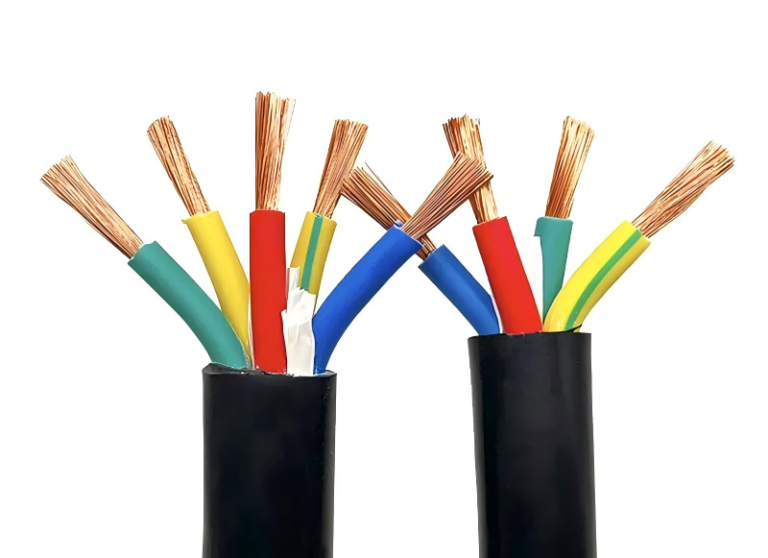
Procurement specs arrive with half a dozen different names for the same product — “mains cable,” “feeder cable,” “wiring cable,” “electrical cable” — and if your team isn’t aligned on what each term actually covers, you end up quoting the wrong product, ordering the wrong voltage class, or worse, installing something that fails inspection and gets pulled from the wall. That’s not a paperwork problem. Rework on a medium-voltage feeder run can cost weeks of downtime and easily erase the margin on an entire project.
The most widely used synonyms for power cable are mains cable, electrical cable, feeder cable, supply cable, and wiring cable. Each term tends to cluster around a specific voltage range or application context — mains cable usually implies low-voltage building supply (up to 1 kV), feeder cable suggests a distribution or sub-transmission role, and electrical cable is the broadest catch-all used across standards from IEC to NEC.
What makes this more than a vocabulary exercise is that the terminology often tracks real engineering differences — conductor material, insulation system, shielding requirements, and the voltage class the cable is rated for. A procurement manager who treats “power cable” and “wiring cable” as interchangeable on a bill of materials is working with a gap that can surface anywhere between the factory gate and the switchgear room.
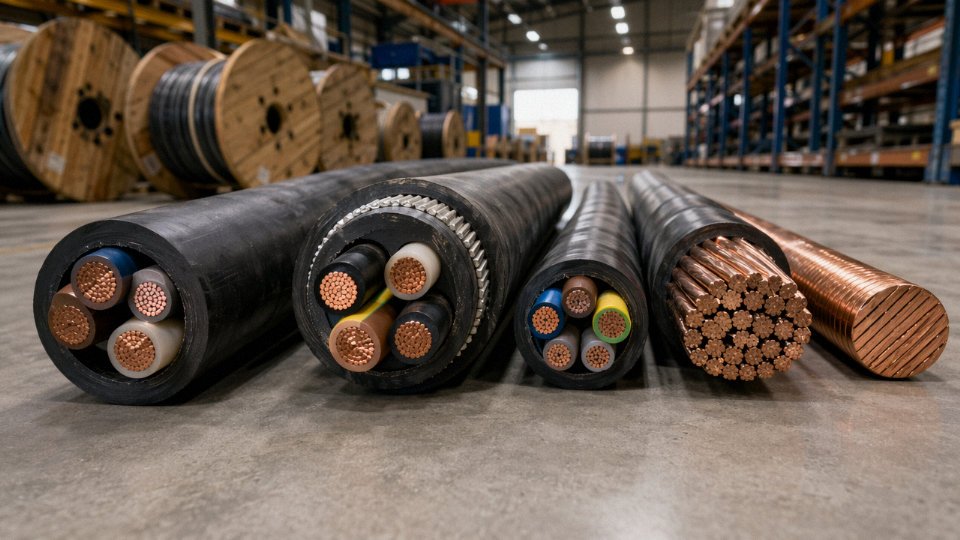
Electrical Cable vs. Power Cable: Mapping the Terminology Overlap and Technical Boundaries
“Electrical cable” is probably the single most common synonym engineers reach for when they mean power cable — and most of the time, in casual conversation, it works fine. On a purchase order or a specification sheet, though, the overlap gets messy fast.
Where the Terms Actually Overlap
In the broadest engineering sense, “electrical cable” describes any assembly of one or more insulated conductors built to carry electrical energy or signals. That definition is intentionally wide. It covers your 0.5 mm² screened instrument cable running 4–20 mA signals across a control panel just as comfortably as it covers a 240 mm² XLPE-insulated medium-voltage feeder buried under a substation yard. “Power cable,” by contrast, carries a functional qualifier: it conveys electrical energy specifically for load supply or transmission, not for signaling or data. The overlap exists because every power cable is an electrical cable, but the reverse is emphatically not true.
That distinction sounds obvious until someone on your procurement team issues an RFQ that reads “please quote electrical cable, 3-core, per IEC standard” — and you receive bids ranging from multicore control cables at 0.6/1 kV all the way up to medium-voltage armored cables rated to 8.7/15 kV. Both suppliers are technically correct. Evaluation complexity jumps immediately, and lead times quoted for entirely different product families start cluttering your comparison table.
What IEC and NEC Actually Say
IEC 60228 covers conductor requirements — cross-sectional classes, resistance limits, stranding — and it applies across a wide range of cable types without distinguishing power from signal. IEC 60502, which most international procurement teams reference for PVC- and XLPE-insulated power cables from 0.6/1 kV up to 30 kV, uses “power cable” as a defined scope boundary. Applying IEC 60502 insulation thickness and test voltage requirements to a cable that was really intended as a control or instrumentation cable will either over-specify (and inflate cost) or, worse, create a situation where someone selects a cable rated for control-circuit use and applies it in a power distribution role — where the insulation system, particularly at medium voltage, may be entirely inadequate.
IEC 60502 defines specific insulation and sheath requirements for power cables up to 30 kV that are not interchangeable with IEC 60227 requirements for ordinary PVC-insulated cables used in wiring applications.True
IEC 60502 and IEC 60227 address fundamentally different cable constructions, voltage classes, and test methods; conflating them in a specification is a recognized source of misapplication errors during procurement and installation.
North American usage fragments further. The NEC (NFPA 70) doesn’t use “power cable” as a defined term with a single meaning. Instead, it carves the space into service-entrance cable (SE, USE), feeder cable configurations, and branch-circuit wiring — each with its own ampacity tables in Articles 310 and 338. All of these fall under the colloquial umbrella of “electrical cable,” yet they have different construction requirements, installation methods, and burial depth rules. An engineer trained on IEC vocabulary who specifies “electrical cable” on a North American project without specifying NEC cable type and voltage rating is essentially leaving the contractor to make the construction decision.
Side-by-Side Construction Reality
| Parameter | “Electrical Cable” (broad) | “Power Cable” (specific) |
|---|---|---|
| Conductor materials | Copper, aluminum, CCA | Copper (2–5 A/mm²), aluminum (~60–65% ampacity of copper) |
| Insulation types | PVC, PE, LSZH, silicone, rubber | XLPE, EPR, PVC (voltage-class dependent) |
| Voltage scope | Signal levels up to HV | 0.6/1 kV through 220 kV+ |
| Armor | Optional, application-driven | SWA, AWA, wire screen per installation method |
| Applicable standards | IEC 60227, 60228, 60332 family | IEC 60502, 60840, NEC Article 310/338 |
EPR insulation, worth mentioning, tends to appear in power cable specs for wet or high-flexibility applications — mining trailing cables, offshore feeders — where XLPE’s lower flexibility in cold environments becomes a maintenance headache.
The practical takeaway for anyone writing an international RFQ: specify voltage class (e.g., 0.6/1 kV or 6/10 kV), the governing standard, conductor cross-section, and whether you mean power or control/instrumentation service. “Electrical cable” alone, without those anchors, is not a specification — it is an invitation for a confusing inbox.
Mains Cable, Supply Cable, and Feeder Cable: Regional Synonyms and Their Voltage-Class Implications
The frustrating reality of international cable procurement is that two engineers can be asking for exactly the same product and use completely different words to describe it — or, worse, use the same word to mean different things. “Mains cable,” “supply cable,” and “feeder cable” are the clearest examples of this: all are synonyms for power cable in specific contexts, but each carries technical and geographic baggage that matters the moment you’re writing a specification or raising a purchase order.
Mains Cable: A British Standards Term with a Specific Scope
In the UK and Commonwealth countries operating under BS 7671 (the IET Wiring Regulations) and aligned IEC frameworks, “mains cable” refers specifically to the cable connecting a building or installation to the public electricity supply network. Voltage is almost always 230 V single-phase or 400 V three-phase AC at the point of use. The term implies a hard boundary: mains side versus installation side, with the metering equipment sitting roughly at that boundary.
In practice, a British-trained electrician and an Australian site engineer will both say “mains cable” and mean roughly the same thing — the incoming supply conductors before the main distribution board. Cross-sectional areas here typically run from 16 mm² up to 300 mm² or more depending on the building load, and insulation is usually XLPE or PVC to BS 5467 or equivalent. The term does not, in normal British usage, extend to medium-voltage distribution; once you’re above 1 kV, engineers switch to “HV cable” or “LV distribution cable” almost automatically.
Supply Cable: The Utility Distribution Layer
“Supply cable” sits one step upstream. In utility and DNO (distribution network operator) usage — common across the UK, Australia under AS/NZS 3008, and parts of Africa and the Middle East — it describes the cable run from a distribution transformer or substation out to the metering point of a facility or housing development. Operating voltages here are typically 6.6 kV, 11 kV, or 33 kV, though 22 kV is common in parts of Australia. These are medium-voltage runs, often direct-buried or pulled through concrete ducts, and the cable construction shifts accordingly: armored, with semiconducting screens, XLPE insulation rated to the relevant voltage class.
The distinction matters operationally. Specifying a “supply cable” on a Nigerian grid connection project implies a product engineered for medium-voltage outdoor service with fault-level withstand ratings your procurement team needs to confirm against the local utility’s network protection settings. Specifying “mains cable” on the same drawing, without clarification, risks a vendor quoting a low-voltage product.
Feeder Cable: Substation and Industrial Distribution
“Feeder cable” is the term you’ll hear most in substation design offices and heavy industrial plants. It describes a cable that originates at a bus, switchboard, or switchgear assembly and delivers power to a downstream panel, motor control center, or large motor load — with no intermediate branching along its run. That last point is the defining characteristic: a feeder feeds one downstream destination. It is not a distribution cable in the branching sense.
Current density on copper feeder cables typically falls between 2 and 4 A/mm² in continuous industrial service, depending on installation method, ambient temperature, and grouping — laying six feeders in a tray derated from a single-cable rating is the kind of calculation that gets skipped under schedule pressure and then causes nuisance tripping six months into operation.
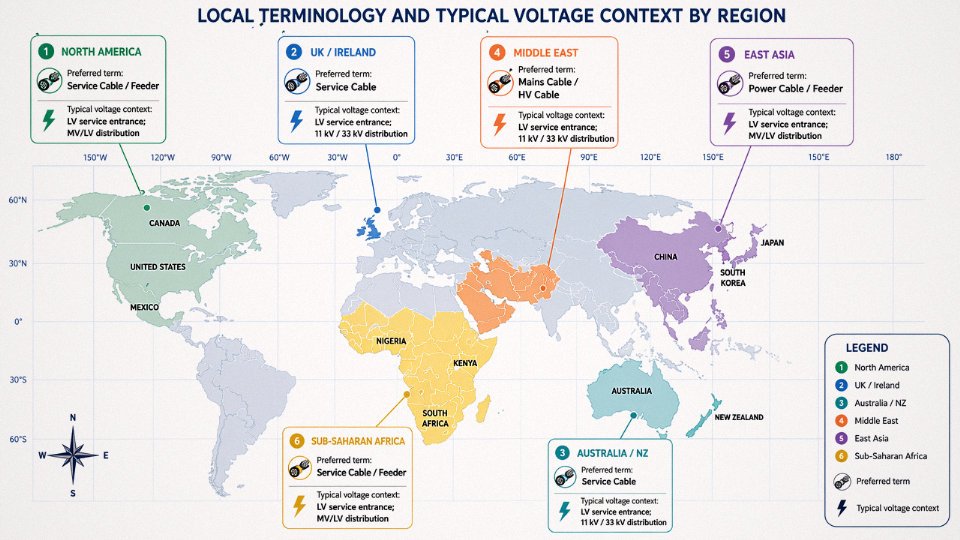
How Regional Terminology Plays Out in Export Practice
The geographic pattern, roughly, looks like this:
| Region | Preferred Term | Typical Voltage Context |
|---|---|---|
| North America | Service cable / Feeder | LV service entrance; MV/LV distribution |
| UK / Ireland | Mains cable / HV cable | LV connection; MV distribution |
| Australia / NZ | Mains cable / Supply cable | LV–33 kV utility distribution |
| Middle East (BS-influenced) | LV distribution cable / HV cable | LV–33 kV, often to IEC/BS |
| East Asia (IEC-influenced) | Power cable / Distribution cable | Follows IEC 60502 series |
| Sub-Saharan Africa | Mains supply cable / Feeder | Mixed BS and IEC, voltage varies |
This is not perfectly clean — a UAE project might have a British consultant writing “feeder cable” on one drawing and “HV supply cable” on another, referring to the same physical product.
Regional terminology differences for power cable synonyms can cause specification mismatches that result in incorrect product procurement.True
Terms like 'mains cable,' 'supply cable,' and 'feeder cable' imply different voltage classes and construction standards depending on the regional framework in use. A procurement team unfamiliar with these distinctions may source a low-voltage product when a medium-voltage cable was required, or vice versa, leading to failed inspections, project delays, or safety hazards.
Navigating this is a genuine operational challenge, not a theoretical one. Jinda’s export teams, supplying customers across more than 50 countries, have had to build real fluency in this regional vocabulary — making sure that a procurement manager in Nigeria asking for a “mains supply cable” at 11 kV and an electrical engineer in the UAE requesting a “feeder cable” for a 33/11 kV substation both receive a correctly specified product, not just a cable that loosely fits the description. That means front-end conversations about voltage class, installation environment, and the applicable standard before a single meter of cable is quoted. The terminology is the first handshake; getting it wrong there tends to compound downstream.
Transmission Cable, HV Cable, and EHV Cable: Synonyms at the High-Voltage End of the Spectrum
At the transmission end of the grid, terminology tightens considerably. Engineers and grid operators stop using casual labels and start reaching for terms that carry genuine technical weight — and the synonyms in this voltage class matter more than most, because a specification written with the wrong term can send a procurement team in the wrong direction entirely.
What “Transmission Cable” Actually Means on a Spec Sheet
A transmission cable is engineered to carry bulk electrical power over significant distances at voltages typically ranging from 66 kV up through 500 kV and beyond. That upper threshold isn’t fixed — some ultra-high-voltage DC projects now push past 800 kV — but the practical dividing line between distribution and transmission sits around 36 kV. Below that, you’re in distribution territory; the cable construction, jointing methods, testing protocols, and installation logistics are fundamentally different. Calling a 33 kV feeder cable a “transmission cable” on a bill of materials isn’t just imprecise, it can trigger the wrong IEC or IEEE standard reference and, downstream, the wrong factory test regime.
HV Cable and EHV Cable: How Grid Operators Use These Terms
“HV cable” — high-voltage cable — covers roughly 36 kV to 220 kV in most grid operator vocabularies, though some utilities stretch it to 400 kV before switching to “EHV cable.” Extra-high-voltage cable, EHV cable, typically denotes 220 kV and above. Neither term is formally standardized in isolation; what matters is how the voltage class maps to insulation system and construction standard, usually IEC 60840 (above 30 kV up to 150 kV) or IEC 62067 (above 150 kV).
The insulation technology split is worth understanding. The dominant design today is XLPE — cross-linked polyethylene — which handles dry, thermally stable environments well, has no fluid containment requirements, and suits both land and submarine applications. The alternative you still encounter in legacy urban grids, particularly in older European and some East Asian networks installed before the 1990s, is oil-filled cable, formally called self-contained fluid-filled cable (SCFF). These rely on pressurized dielectric fluid to suppress partial discharge and require feeding tanks, fluid monitoring, and a maintenance discipline that modern utilities increasingly want to retire. Jointing an SCFF cable on a busy urban underground route is one of those jobs that cable teams remember for the wrong reasons — messy, slow, and pressure-sensitive in more ways than one.
Construction Layers That Are Non-Negotiable at This Voltage Class
A transmission-class XLPE cable isn’t simply a larger version of a distribution cable. The conductor itself is usually Milliken-stranded — a segmented configuration of five or six keystone-shaped elements, each individually insulated and twisted — specifically to reduce AC skin effect losses at large cross-sections, typically 800 mm² to 2,500 mm². Below that, you see round milliform stranding. Both copper and aluminum conductors are used; aluminum dominates in projects where weight and cost per kilometer are primary drivers, though its lower conductivity means a roughly 60–65% ampacity compared to an equivalent copper cross-section, and that gap has real consequences for duct sizing and thermal calculations.
Around the conductor sits a semi-conductive screen, then the XLPE insulation body — wall thickness running from around 15 mm at 110 kV to upward of 27–30 mm at 400 kV, depending on the insulation stress design. Another semi-conductive screen follows. The metallic sheath — extruded lead or corrugated aluminum, each with its own application logic — provides both electrostatic shielding and moisture exclusion. Lead sheaths are heavier and more flexible for complex routing; corrugated aluminum sheaths are lighter and mechanically tougher, preferred in direct-buried and submarine applications. An outer jacket of polyethylene or, in some fire-sensitive tunnel installations, LSZH compound finishes the assembly.
Skip or under-specify any of these layers and the consequences are not gradual — partial discharge develops, insulation degrades, and a fault on a 220 kV circuit means a grid event, not just a blown fuse.
Underground Transmission Cable and Offshore Export Cables
“Underground transmission cable” has become a near-standard synonym in the context of urban grid modernization and the renewable energy buildout, particularly in Europe where overhead line replacement projects at 132 kV and 400 kV have been running steadily. Offshore wind farm export cables fall into the same category — long-length, high-voltage submarine cables connecting generating arrays to onshore substations, typically at 132 kV to 220 kV AC or, for longer distances, high-voltage DC (HVDC).
A single-circuit 220 kV XLPE underground transmission cable with a 1,200 mm² aluminum conductor can carry approximately 600–800 MVA under favorable thermal conditions.True
Actual capacity depends on installation method, soil thermal resistivity, ambient temperature, and whether continuous or cyclic loading is assumed. The range aligns with published IEC and utility technical literature for this voltage and cross-section combination.
That capacity figure — 600 to 800 MVA from a single underground circuit — is roughly comparable to what a 400 kV overhead line delivers in certain configurations. Understanding that equivalence is precisely why engineers and procurement managers need to use these synonyms accurately from the first line of a specification. A project that lists “power cable” where it means “400 kV XLPE single-core underground transmission cable, Milliken aluminum conductor, lead sheath, PE outer jacket” is a project that will spend weeks in RFQ clarification that it didn’t need to.
Power Cord, Flexible Cable, and Trailing Cable: Synonyms for Portable and Mobile Power Applications
The moment a cable needs to move — even occasionally — the terminology shifts, and so do the construction requirements. “Power cord,” “flexible cable,” “trailing cable,” and “extension cable” are all synonyms or close relatives of “power cable,” but each carries specific engineering implications that matter the second you’re writing a procurement specification or troubleshooting a failure on a job site.
Power Cord: The Consumer-Facing Synonym
A power cord is what most people picture when they hear “cable” at all — the factory-assembled lead connecting a laptop, appliance, or piece of light equipment to a wall outlet. The term is nearly universal in North American English; in British and Australian usage you’ll hear “mains lead” or “appliance cord” just as often.
What defines a power cord technically is the combination of a flexible multi-stranded conductor, molded or fitted connectors, and a specific safety approval for the intended market. IEC 60320 governs the connector shapes (C13/C14, C19/C20, and so on), but the cable assembly itself still needs a national-market approval — UL listing in the US, CE Declaration of Conformity in Europe, CCC certification in China, SAA approval in Australia. Get that wrong on an import shipment and customs holds the container. It happens more often than importers expect.
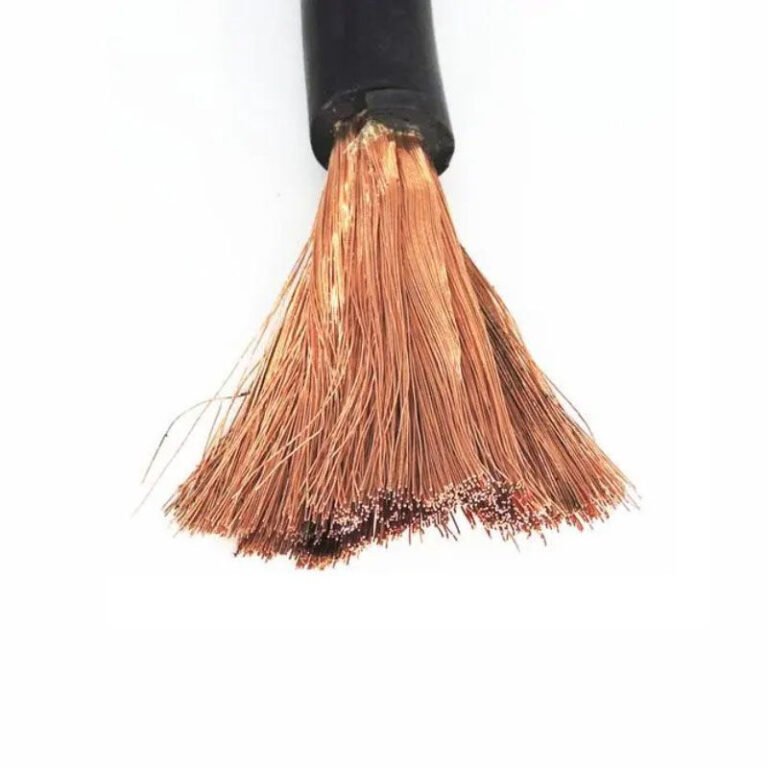
Conductor cross-sections in power cords typically run from 0.75 mm² up to about 2.5 mm², depending on the rated current. The insulation is almost always PVC, which is adequate for indoor, relatively static use, but degrades faster than rubber under UV or repeated tight bending.
Flexible Cable: The Engineering Synonym for Repeated Movement
Step up from a power cord and you’re in the territory of flexible cable — a broader class defined primarily by conductor stranding. IEC 60228 Class 5 (fine stranded) and Class 6 (extra-fine stranded) are the relevant categories. The finer the stranding, the more bend cycles the conductor survives before work-hardening causes individual wire breaks.
The workhorse here in construction and outdoor events is the H07RN-F rubber-insulated flexible cable — 450/750 V rated, natural rubber or polychloroprene sheath, handles everything from temporary site distribution boards to stage power at outdoor festivals. It tolerates being coiled on a drum, run across a muddy floor, and stepped on in a way that a PVC-insulated cord simply doesn’t. The minimum bend radius on H07RN-F is roughly 7.5× the overall cable diameter during installation; push tighter than that repeatedly and you’ll see conductor fatigue within months rather than years.
Trailing Cable: Heavy-Duty Synonym for Mobile Mining and Port Equipment
Trailing cable is a genuinely different animal. In mining — draglines, continuous miners, shuttle cars — and in port crane applications like ship-to-shore cranes, the cable literally trails behind a moving machine, picking up and paying out thousands of times over its service life. The mechanical demands are severe in a way that “flexible cable” in the construction sense doesn’t capture.
Construction typically involves extra-flexible copper conductors (Class 6 or sometimes a custom finer class), thick EPR (ethylene propylene rubber) insulation for electrical resilience, and a heavily reinforced outer sheath resistant to abrasion, crushing, and oil contamination. Voltage ratings for mining trailing cables range from 1.1 kV up to 11 kV depending on the equipment. A trailing cable on a dragline at a coal operation might carry 3,300 V and flex hundreds of thousands of times over a three-to-five year replacement cycle. Sheath failure before conductor failure is the usual mode — an operational warning worth noting if you’re specifying replacement intervals.
Class 6 stranded conductors significantly outlast Class 5 in trailing cable applications subject to continuous flexing cyclesTrue
IEC 60228 Class 6 uses finer individual wire diameters than Class 5, reducing bending stress per wire and extending fatigue life under repeated flexure — a principle well established in flexible cable engineering and confirmed by failure analysis in mining cable applications.
Extension Cable and Festoon Cable: Related Synonyms Worth Distinguishing
These two get conflated and they shouldn’t be. An extension cable is a temporary supply extension — a flexible cable with plug on one end and socket on the other, used to reach a power outlet that’s too far from the tool or appliance. Industrial-grade versions are heavier than domestic ones, often H07RN-F or thermoplastic elastomer (TPE) sheathed, and rated for outdoor use. Domestic extension cords with PVC insulation used on construction sites are a persistent hazard; the sheath cracks in cold weather, joints fail under tension, and the result is earth faults that trip RCDs or, worse, don’t.
Festoon cable is different in operation. In overhead crane systems in steel mills and warehouses, festoon cables loop between hangers on a rail, extending and compressing as the trolley travels. The cable needs Class 6 conductors, a jacket with good flexural fatigue resistance (TPE or polychloroprene are common), and consistent outside diameter so the festoon loops hang evenly. Uneven loop geometry causes localized bending stress at the hangers — a slow failure mode that often goes unnoticed until a conductor open-circuits mid-shift.
Selecting Among These Synonyms: What Actually Drives the Choice
The table below maps the key selection parameters.
| Synonym | Conductor Class (IEC 60228) | Typical Insulation | Primary Hazard Addressed | Voltage Range |
|---|---|---|---|---|
| Power cord | Class 5 | PVC | Low mechanical stress, plug compatibility | Up to 250–300 V |
| Flexible cable (H07RN-F) | Class 5 or 6 | Rubber / polychloroprene | Repeated bending, outdoor exposure | 450/750 V |
| Trailing cable | Class 6 or finer | EPR + heavy rubber sheath | Continuous flexing, abrasion, oil | 1.1–11 kV |
| Extension cable | Class 5 | PVC or TPE | Temporary use, portability | Up to 415 V |
| Festoon cable | Class 6 | TPE or polychloroprene | Cyclic loop bending, consistent OD | Up to 690 V |
Insulation material is often the deciding factor in cost, not conductor cross-section. Rubber and EPR compounds run noticeably more expensive than PVC, but the abrasion resistance and flexibility retention at low temperatures (some EPR grades stay usable down to around −40 °C) justify the premium in harsh environments. TPE sits in between — better cold-weather performance than standard PVC, easier to recycle than rubber, and increasingly common in festoon and industrial extension applications.
Armored Cable, SWA Cable, and MC Cable: Synonyms Defined by Mechanical Protection Layer
Not every synonym for power cable is voltage-driven. This family of terms is defined by something more tactile: the mechanical protection layer wrapped around the insulation assembly. An electrician in Lagos, a procurement manager in Dubai, and a plant engineer in Ohio might be specifying functionally similar cables for direct burial or industrial tray runs — and calling them completely different things.
Armored Cable: The Generic Term
“Armored cable” is the broadest synonym in this group. It refers to any power cable that incorporates a mechanical protection layer — steel wire, steel tape, aluminum wire, or interlocked aluminum strip — positioned between the insulation assembly and the outer PVC or PE sheath. The armor serves two purposes that often get conflated: physical protection against impact, rodent damage, and installation stress, and in some constructions, an earth fault return path. What specific armor type you’re dealing with depends entirely on which regional standard governs the project. Calling it “armored cable” in a purchase order without specifying construction invites the wrong product on site. I’ve seen this happen on African infrastructure tenders where a contractor assumed SWA and received steel tape armored cable instead — different pull tension limits, different termination hardware.
SWA Cable: The IEC-Governed World Standard
In the UK, Europe, the Middle East, Africa, and most of Asia, the dominant synonym is SWA — steel wire armored cable. The construction is well-defined: stranded copper or aluminum conductors, either PVC or XLPE insulation over each core, a bedding layer, then a layer of galvanized steel wires (not tape — wires, which is the key structural difference), and a PVC outer sheath. Available in 2-core, 3-core, and 4-core configurations for single-phase and three-phase distribution alike.
The steel wire armor layer in SWA provides meaningful tensile strength — roughly 15–25 kN pulling force capacity depending on cable diameter and armor wire gauge — which makes direct burial without duct viable in most soil conditions. The armor also functions as the circuit protective conductor (CPC) in many IEC installations, provided the armor cross-section meets the requirements of IEC 60364. That said, relying solely on armor as an earth path is a decision that depends on the installation environment; high-corrosion or chemically active soils can degrade the armor over years and compromise the earth path integrity long before the insulation fails.
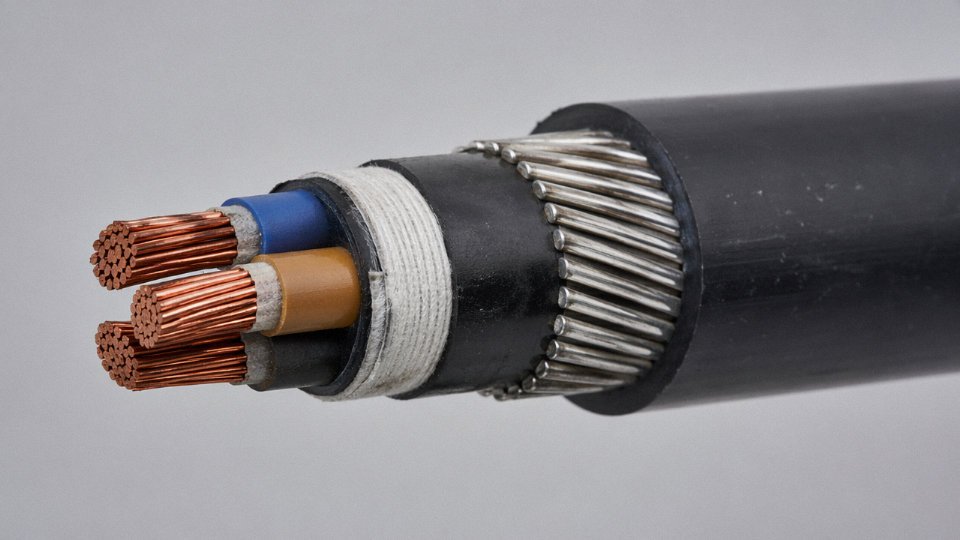
Voltage range for SWA cable spans from 0.6/1 kV distribution cable right through medium voltage classes at 3.8/6.6 kV, 6.35/11 kV, and 8.7/15 kV under IEC 60502-1 and IEC 60502-2. Cross-sections commonly run from 1.5 mm² up to 400 mm², though for large conductor sizes aluminum becomes the practical choice on cost grounds — aluminum SWA at 240 mm² is significantly lighter to handle on a cable drum pull and roughly 40–50% cheaper per meter than copper equivalents at similar ampacity ratings.
Jinda’s SWA production covers the full range from 0.6/1 kV through 8.7/15 kV, in both PVC-SWA-PVC and XLPE-SWA-PVC constructions, with conductor cross-sections from 1.5 mm² to 400 mm². Testing follows IEC 60502-1 for low voltage and IEC 60502-2 for medium voltage, including voltage withstand, partial discharge, and armor continuity checks. These cables ship regularly to power distribution projects across sub-Saharan Africa, Southeast Asia, and the Middle East — markets where IEC governs, direct burial is common, and the SWA synonym is universal among specifiers and contractors.
SWA cable armor can serve as a circuit protective conductor in IEC installationsTrue
IEC 60364-5-54 permits armor as a protective conductor provided its cross-sectional area satisfies the adiabatic equation for the prospective fault current and disconnection time. This must be verified by calculation, not assumed.
MC Cable: The North American Equivalent
Across the Atlantic, the equivalent term is MC cable — metal-clad cable, governed by UL 1569 and installed under NEC Article 330. The armor here is fundamentally different in construction: an interlocked aluminum strip wound helically around the cable assembly, rather than laid parallel wires. This gives MC cable a flexible, corrugated feel that makes field bending practical without a bending tool, which partly explains its popularity in commercial construction where runs change direction frequently.
MC cable must contain a separate insulated equipment grounding conductor (EGC) — this is a hard NEC requirement and the key distinction from its older relative. The aluminum interlocked armor itself is not listed as the sole ground path. Terminations require listed MC cable connectors, and in wet locations you need a listed wet-rated version; standard MC isn’t suitable for direct burial without conduit protection.
BX Cable: The Colloquial Survivor
“BX” is what a lot of American electricians still call armored cable generically, despite the fact that BX — formally Type AC cable under NEC Article 320 — is a distinct product. Type AC uses a spiral steel armor and relies on the combination of armor plus an internal bonding strip (a bare aluminum strip running along the conductors) as the ground path. There is no separate insulated ground wire. That distinction matters for fault current calculations and for compatibility with modern electronic equipment that requires a dedicated ground conductor.
In practice, “BX” on a job site often means whatever armored cable is in the truck. That looseness in usage is exactly why procurement documents should specify Type AC or Type MC explicitly, reference the applicable NEC article, and call out whether a separate EGC is required.
| Term | Region | Armor Type | Standard | Separate Ground Wire? |
|---|---|---|---|---|
| SWA Cable | IEC markets (UK, EU, ME, Africa, Asia) | Galvanized steel wires | IEC 60502-1/2 | Separate PE core (or armor as CPC where permitted) |
| MC Cable | North America | Interlocked aluminum strip | UL 1569 / NEC Art. 330 | Required (insulated EGC) |
| BX / Type AC | North America (historical/colloquial) | Spiral steel | NEC Art. 320 | No — bonding strip only |
| Armored Cable | Generic / cross-regional | Varies | Varies by region | Depends on construction |
The terminology here is less about voltage class and more about what the installation demands mechanically and what standard the local inspector will accept. Specifying “armored cable” without the regional qualifier is a reasonable shorthand in internal engineering notes. In a purchase order or a bill of materials going to a fabricator or distributor, you need the specific synonym — SWA, MC, or Type AC — along with the governing standard. Anything less and the wrong product shows up, and armored cable terminations are not the kind of rework you want to discover during commissioning.
How Synonym Choice Affects Cable Procurement Specifications, RFQ Accuracy, and Supplier Qualification
Terminology isn’t just a language problem. On a live procurement, the wrong synonym — or a vague one — can trigger a cascade of mismatched bids, clarification delays, and in the worst case, cable arriving on site that technically meets the written spec but is completely wrong for the installation environment.
The Specification Error That Wastes Three Weeks
Here’s a scenario that plays out more often than most procurement teams want to admit. A project engineer drafts a cable RFQ and writes: “electrical cable, 3-core, 16 mm², 600 V.” That’s it. No insulation code, no standard reference, no armor designation.
What comes back from four suppliers? One quotes PVC/PVC unarmored to a national low-voltage standard. A second quotes XLPE/SWA/PVC to IEC 60502-1, 0.6/1 kV — which is actually a different voltage designation than the “600 V” written in the RFQ, though in practice the two are often equivalent. A third supplier interprets “electrical cable” as allowing rubber insulation and submits a flexible cable price. The fourth assumes direct burial and adds a bedding layer. Now you have four bids for four different products, none of them directly comparable, and the technical clarification rounds eat 2–4 weeks minimum before the project engineer can even issue a revised specification.
That delay compounds. Production scheduling at the factory side gets pushed. If the project has a tight commissioning window — say, a substation energization tied to a grid connection deadline — that clarification lag can become genuinely expensive.
An imprecise cable synonym or missing standard reference in an RFQ can extend supplier clarification rounds by 2–6 weeks depending on project complexity and number of bidders.True
This range is consistent with standard procurement practice in international cable supply: factories cannot confirm raw material grades, production line allocation, or test requirements until the specification is fully resolved, and back-and-forth clarification across time zones routinely consumes 10–30 working days on complex projects.
A Practical RFQ Framework That Actually Works
Getting this right isn’t complicated, but it does require discipline. A complete cable line item in an RFQ should include, in order:
- Cable type name tied to a specific standard — e.g., “SWA power cable to IEC 60502-1” or “XLPE insulated armored cable to BS 6724”
- Voltage designation — use the standard format: 0.6/1 kV, 3.6/6 kV, 8.7/15 kV; not just a single nominal voltage figure
- Conductor material and cross-section — copper or aluminum, in mm²; worth specifying stranding class if flexibility matters
- Number of cores — and whether a reduced neutral is acceptable for 4-core designs
- Insulation and sheath material codes — XLPE, PVC, LSF, EPR; these matter for temperature rating and fire performance compliance
- Armor type if required — SWA, STA, wire braid; omitting this leaves the supplier to choose
- Test certifications required — BASEC, UL listing, RCM, KEMA, etc., depending on the destination market
- Drum length and packaging — standard drum lengths vary by supplier; specifying 500 m or 1,000 m reels avoids mid-run joints
Certification Triggers Tied to Synonym Choice
This is the part procurement managers often underestimate. A cable described as a “mains cable” destined for the UK market carries an implicit expectation of BASEC or LPCB certification — UK contractors and inspectors know this, and a product without it will face site rejection regardless of its electrical performance. Ship the identical construction to Australia under the description “supply cable” and the applicable mark is RCM (formerly SAA), with AS/NZS 5000.1 as the governing standard. The physical cable might be nearly the same. The certification path, test documentation, and factory audit requirements are not.
Getting the synonym right in the purchase order isn’t pedantry. It’s the signal that tells the factory which certification file to pull, which test lab to engage, and whether the product can ship from existing stock or needs a full production run against a specific standard.
How Jinda Handles Specification Ambiguity
Jinda’s technical support team regularly receives inquiries where the cable description is, frankly, incomplete — a voltage, a cross-section, sometimes just a photograph of an existing cable. The integrated R&D and specification team provides free pre-production specification review for international buyers: taking a loosely worded description and working it back to a fully defined IEC, BS, or AS/NZS specification before a single meter of cable is manufactured. This matters most on first-time orders to a new market, where the buyer may not know which certification mark applies or whether a standard IEC 60502-1 product will satisfy local grid operator requirements. Getting that alignment done before production starts — rather than after the drums arrive at port — is where the real lead-time and cost savings happen.
Renewable Energy and EV Charging Applications: Emerging Synonyms Redefining Power Cable Terminology
The vocabulary around power cables has never been static, but the last decade accelerated terminology fragmentation faster than most standards bodies could keep up. Solar farms, grid-scale battery storage, offshore wind, and EV charging infrastructure all arrived at scale within roughly the same window — and each brought its own synonym set, often coined by engineers in the field before formal standards caught up.
DC Power Cable: A Synonym Born from Polarity Constraints
“DC power cable” is not just marketing shorthand. It describes a genuinely distinct product category, and confusing it with a standard AC power cable can cause insulation degradation within months. DC voltage stress is fundamentally different — no zero-crossing means partial discharge behavior is more aggressive over time, and the insulation system has to be rated accordingly. IEC 60840 and related standards have historically been written around AC transmission; HVDC and battery storage applications forced manufacturers to revisit conductor screening, insulation compound selection, and sheath materials for continuous DC stress at voltages from 1 kV up through 525 kV in HVDC links.
In a BESS installation, the cables between battery racks and the inverter string — sometimes called “battery interconnect cables” — are short, flexible DC power cables carrying high current at relatively low voltage, typically 48–1500 V DC depending on system architecture. Getting the cross-section wrong here is expensive. Undersized conductors mean resistive losses that compound across thousands of operating hours; oversized conductors waste money on copper that never works. Current density for copper in these runs typically falls in the 2–4 A/mm² range depending on ambient temperature, bundling factor, and cycle frequency.
Solar Cable (PV Cable): IEC 62930 Makes the Synonym Official
IEC 62930 — which replaced EN 50618 in most markets — codified “solar cable” or “PV cable” as a distinct product with specific performance requirements: single-core, flexible class 5 conductor, UV and ozone resistant outer sheath, halogen-free, rated at 1.5 kV DC, tested for 25-year outdoor service life. That last requirement is what separates a genuine solar cable from a general-purpose H07RN-F rubber cable someone might substitute in the field.
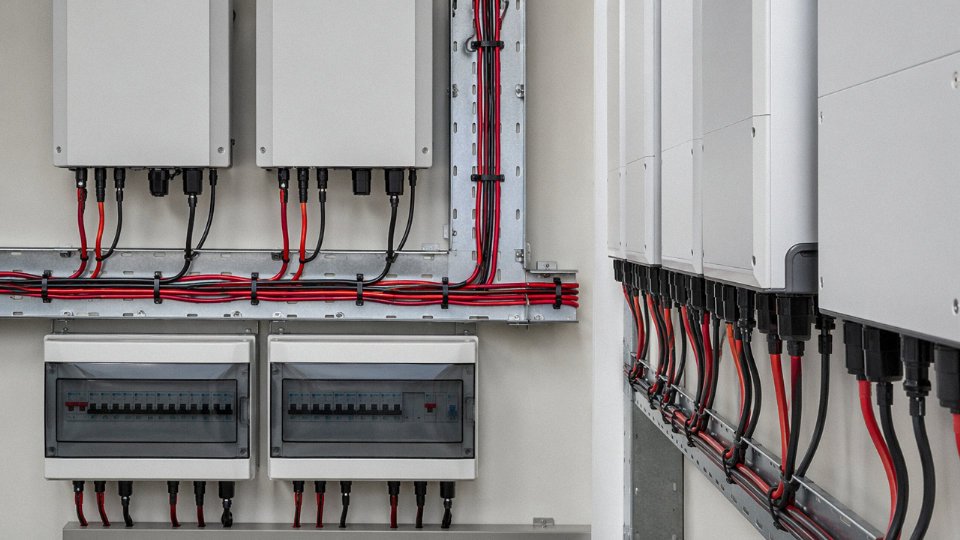
The scale of demand here is hard to overstate. Global installed solar PV capacity passed roughly 1.4 TW by end of 2023, and the rule of thumb on the installation side is somewhere between 2 and 4 km of DC solar cable per megawatt — the range depends heavily on array string length, row spacing, and whether it’s ground-mount or rooftop. At 3 km/MW as a midpoint, that’s over 4 million kilometers of solar cable already deployed worldwide. A manufacturer without an IEC 62930-certified production line is effectively locked out of utility-scale solar procurement, full stop.
IEC 62930 solar cable is rated at 1.5 kV DC and mandates a minimum 25-year service life under outdoor UV exposureTrue
IEC 62930:2019 (which superseded EN 50618) specifies 1.5 kV DC voltage rating, UV resistance testing, and a design service life target of 25 years for PV cables used in string wiring applications within photovoltaic systems.
EV Charging Cable: Two Different Products, One Synonym
This is where procurement managers get tripped up regularly. “EV charging cable” means the flexible, vehicle-side cable connecting the charging station to the car socket — governed by IEC 62196 — when a consumer or a facilities manager says it. It’s a low-voltage flexible cable, often 32 A or 64 A at 230–400 V AC, with a specific connector assembly.
But an infrastructure engineer specifying the underground supply to a DC fast-charger means something else entirely. A 350 kW DC fast-charger draws real power — roughly 400–500 A at 800 V DC from the rectifier side, or a medium-voltage AC feed upstream of the transformer. The supply cable feeding the DC charger pad might be a 1 kV DC cable or a 10–33 kV AC medium-voltage cable depending on where in the power chain you’re working. Specifying the wrong synonym on an RFQ wastes everyone’s time and occasionally results in a completely wrong product being quoted.
Wind Farm Cable and Offshore Array Cable
“Wind farm cable” and “offshore array cable” are both in active use for the medium-voltage submarine cables interconnecting turbines within a wind farm. The dominant voltage class has shifted from 33 kV toward 66 kV as individual turbine ratings climbed past 10–15 MW, because the higher collection voltage reduces I²R losses over the inter-array distances involved. Construction is typically three-core copper conductor, XLPE insulation, fiber optic elements integrated for monitoring, lead or copper wire screen, and double steel wire armor for seabed laying and protection against drag anchors and fishing gear.
In practice, the armor specification depends heavily on water depth and seabed type — a sandy North Sea seabed at 30 m depth needs different armor weight than a rocky shelf at 80 m. The “offshore array cable” synonym tends to appear in developer and EPCI contractor documents, while “wind farm cable” is more common in utility and transmission operator language. The technical object is identical; the vocabulary depends on who’s writing the spec.
Frequently Asked Questions About Power Cable Synonyms and Terminology
The questions below come up constantly — in RFQ review meetings, on inspection reports, in emails between a procurement manager and an overseas supplier who are clearly talking about different things. Short answers only where that’s all that’s needed; more depth where the wrong answer costs money.
Is “power cable” the same as “electric cable”?
In casual conversation, yes, people use them interchangeably. Technically, no. “Electric cable” is the broader category — it includes signal cables, instrumentation cables, control cables, and data cables, none of which are designed to carry meaningful amounts of energy. “Power cable” is the specific term for a conductor system whose primary function is energy transfer, whether that’s a 1 kV distribution cable or a 400 kV XLPE transmission circuit.
The practical fix is simple: never let either term stand alone in a specification. Add a voltage class and a standard reference — “LV power cable per IEC 60502-1” or “medium-voltage electric cable per IEC 60502-2” — and the ambiguity disappears entirely.
What is the difference between a “power cord” and a “power cable”?
A power cord is a short, flexible, factory-assembled assembly — connector at each end, typically rated to IEC 60320, designed to plug an appliance into a wall outlet. It is not permanently installed. It gets replaced, not rewired.
A power cable is a fixed-installation conductor system. It may be armored, direct-buried, pulled through conduit, or laid in a cable tray. It is governed by standards like IEC 60502 or ICEA S-93-639 depending on the region, and it is expected to remain in service for 30 to 40 years, give or take, depending on thermal loading and installation conditions. Swapping the two terms on a bill of materials is the kind of mistake that sends the wrong product to site and stalls commissioning.
Why do British engineers say “mains cable” when Americans say “service cable”?
Both terms describe the conductor run from the utility network into a building. The difference is everything downstream of that phrase. British practice follows BS 7671, the IET Wiring Regulations, designed around a 230/400 V TN-S or TN-C-S system. American practice follows NFPA 70 (NEC), typically a 120/240 V single-phase split system for residential, with different earthing arrangements, different color codes, and different conductor sizing conventions. The cables that satisfy each standard are not always interchangeable even if the ampacity looks similar on paper. A procurement manager sourcing “mains cable” from a North American supplier — or vice versa — needs to resolve which standard governs before anything else.
Is “HV cable” a synonym for “transmission cable”?
Partially. “HV cable” in IEC terminology technically spans from roughly 36 kV upward, though many engineers use it loosely to cover anything above 1 kV. True transmission cables — the ones carrying bulk power between substations or across regions — operate at EHV, generally above 150 kV, sometimes at 220 kV, 400 kV, or higher. Calling a 33 kV distribution cable a “transmission cable” is not strictly wrong in a colloquial sense, but it will generate confusion in a substation engineering context where transmission implies a specific voltage class, insulation system (usually XLPE at those voltages), and installation method. Use the voltage figure. It settles the argument every time.
Can I use “armored cable” and “SWA cable” interchangeably on a purchase order?
Not safely. “Armored cable” is a generic descriptor that covers several distinct armor constructions: steel wire armored (SWA), steel tape armored (STA), aluminum wire armored (AWA), and interlocked armor (common in North American MC cable). Each has different mechanical crush resistance, different magnetic losses on AC circuits, and different suitability for direct burial versus tray installation. If you write “armored cable” on a PO without further qualification, a supplier working to a different regional convention can legitimately deliver something that meets the literal description but not your actual installation requirement.
Write “SWA to IEC 60502-1” if that’s what you need. Three extra characters on a purchase order can prevent a container of the wrong product arriving on site.
What does Jinda classify as a “special cable,” and how does it differ from a standard power cable?
Functionally, special cables are still power cables — they conduct and deliver electrical energy. The distinction is in the additional performance envelope they must satisfy beyond basic current-carrying and insulation requirements. Jinda’s special cable range includes fire-resistant cables tested to IEC 60331 (circuit integrity under flame), halogen-free flame-retardant cables tested to IEC 60754 (corrosive gas emission during combustion), mining trailing cables built for repeated flexing in wet, gassy environments, and high-temperature cables for industrial furnace or process applications. Each carries certifications that a standard IEC 60502 cable does not. In a tunnel, a data center, or an underground coal operation, the difference between a “standard power cable” and the correct special cable is not academic.
How should I reference power cable synonyms in an international tender document?
Anchor everything to the IEC standard designation. A line like — “LV power cable per IEC 60502-1, 0.6/1 kV, 3-core × 95 mm² copper conductor, XLPE insulation, SWA, PVC outer sheath, black, drum lengths of 500 m” — leaves almost no room for misinterpretation regardless of whether the responding supplier is in Germany, India, or China. Then append the destination-country certification requirement: CE marking for Europe, CCC for China, UL listing for the US, SASO for Saudi Arabia, and so on.
Using IEC standard designations as the anchor reference in tender specifications reduces bid-clarification cycles and mismatched product deliveries in international cable procurement.True
IEC designations specify voltage class, conductor material and cross-section, insulation type, armor type, and sheath material in a single standardized string, leaving suppliers in any country with a common technical baseline rather than a regionally interpreted synonym.
The synonym you use in casual conversation is fine. The synonym that ends up in a signed purchase order needs to be specific enough that any qualified manufacturer on any continent builds the same product.
Why Jinda’s 37-Year Manufacturing Legacy Supports Every Synonym Category Globally
Terminology only matters when there’s a manufacturer behind it who can actually deliver. Knowing the difference between a feeder cable and a transmission cable is useful in a specification document — it’s only actionable when your supplier’s production line can build both to the right standard, with the right test evidence, and ship them on a schedule your project can live with.
Jinda has been doing exactly that since 1987.
Five Production Bases, One Integrated Supply Chain
The Shandong headquarters is where conductor drawing and high-precision stranding equipment have operated for decades, but the broader manufacturing footprint now spans five sites across China, totaling roughly 470,000 m² of covered production space. That scale matters operationally, not just as a headline figure. It means conductor drawing, insulation extrusion, armoring, and drum-winding can run in parallel across facilities rather than queuing through a single bottleneck — which, in practice, is what separates a supplier who can quote a mixed-product bulk order from one who quietly re-brokers half of it.
Each site is tooled for different product families. Some lines are configured for large-conductor MV and HV XLPE cables where the extrusion process runs slowly and requires tight temperature profiling; others are set up for the faster throughput of LV armored cables and flexible trailing cable constructions. The separation keeps quality consistent and reduces cross-contamination of specifications between product types — something that’s easy to overlook until you receive a drum of supposedly LV cable with an insulation wall thickness that belongs on a different product.
Every Synonym, a Real Certified Product
This article has worked through a long list of synonyms — mains cable, feeder cable, armored cable, SWA, solar cable, EV charging cable, trailing cable, transmission cable. Each of those terms maps to a certified product in Jinda’s range, not a speculative capability.
LV and MV power cables are manufactured to IEC 60502-1 and IEC 60502-2. SWA armored cables follow IEC 60502-1 with steel wire armor constructions suited to direct burial and mechanical-exposure installations. Fire-resistant and LSZH variants are tested to IEC 60331 and IEC 60754 respectively — relevant for any project where cable route passes through occupied buildings or enclosed infrastructure. Solar PV cables carry IEC 62930 certification, which covers UV resistance, temperature cycling, and the DC-specific aging conditions that a standard LV cable spec doesn’t address. Flexible and trailing cables are built to IEC 60245. Transmission-class XLPE cables reach IEC 60840 territory for voltages above 36 kV.
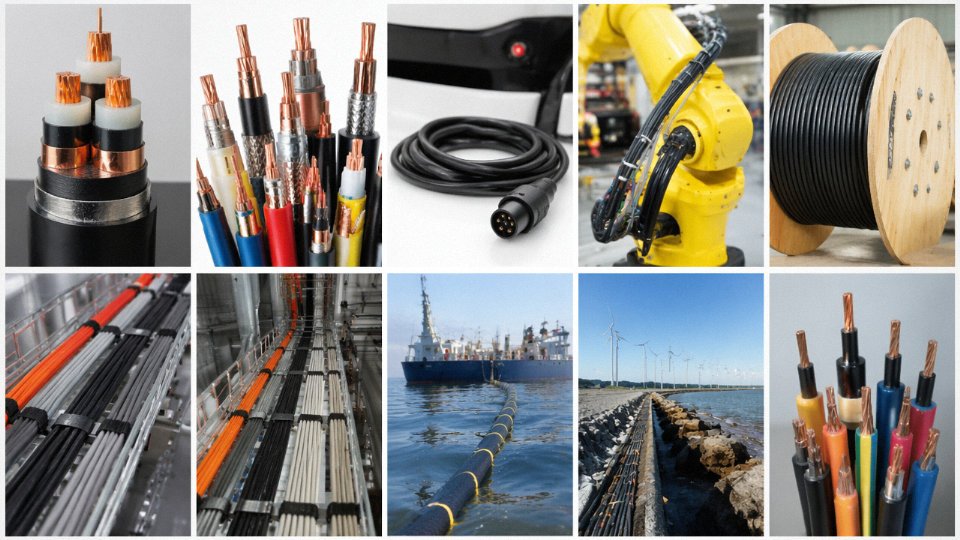
Jinda holds ISO 9001 quality management certification and ISO 14001 environmental management certification, along with CE marking and product-specific approvals enabling export to Europe, the Middle East, Africa, Southeast Asia, South America, and Oceania.True
These certifications are verifiable through Jinda's official documentation and are standard requirements for the international markets listed.
How the International Support Model Actually Works
Export certifications get a cable to the port. Getting it onto a project requires something more — documentation that matches the destination country’s customs requirements, test reports in a format the consulting engineer will accept, and a contact who understands whether the project is specifying to BS 7671, NFC 33-226, or a Gulf KAHRAMAA standard.
Jinda’s regional sales engineers are assigned by geography, not rotated generically. Factory acceptance testing is available for bulk orders, coordinated on-site at the relevant production base. Third-party inspection through SGS, BV, or TÜV can be arranged as part of the pre-shipment process — not as an afterthought. Full documentation packages, including material certificates, routine test reports, and packing lists formatted for the destination country’s import requirements, are standard on export orders.
Whether the project calls it a mains cable for a UK residential development, a feeder cable for a Gulf substation, a transmission cable for a Southeast Asian grid upgrade, or a solar cable for a utility-scale PV farm, the underlying need is the same: a manufacturer who built the product correctly, tested it, and can prove it. Reach out to Jinda’s technical team for specification support, sample requests, or bulk pricing — the terminology question is already answered; the supply question is theirs to solve.