Specify the wrong wire type on a panel schedule, or let a procurement shortcut substitute TW for THHN without an engineering sign-off, and you are looking at insulation that softens and fails years before it should — sometimes months. Conduit fill tightens, heat buildup accelerates, and one overloaded circuit on a summer afternoon can cascade into a tripped breaker, a scrap batch, or a multi-day shutdown while maintenance chases a fault that was baked in from day one. The cost difference between the two wire types at the point of purchase is real but modest. The cost difference after a failure is not.
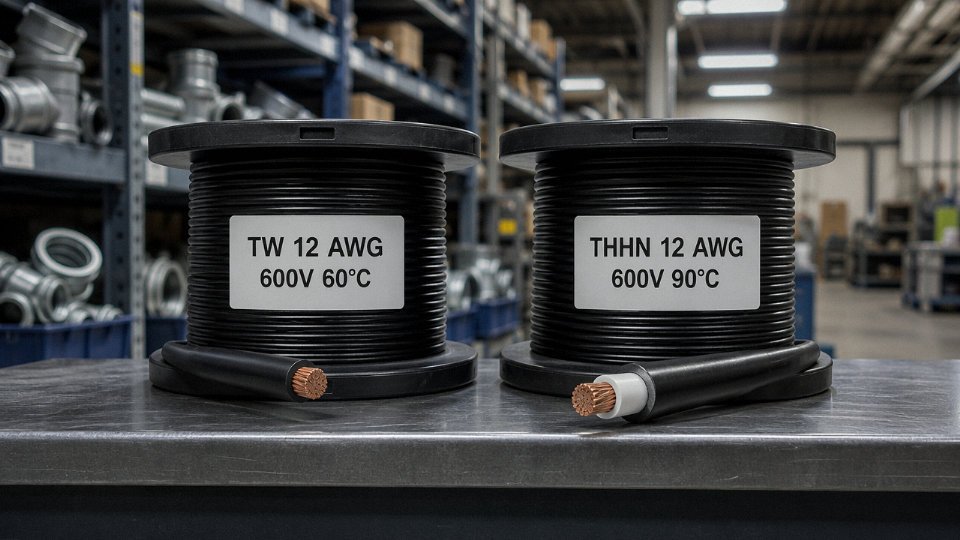
TW wire is rated for 60°C operation and suits basic indoor, dry, low-temperature wiring in conduit. THHN wire is rated 90°C dry / 75°C wet, carries meaningfully higher ampacity for the same conductor gauge — roughly 30A versus 20A on 12 AWG copper under NEC Table 310.15(B)(16) — and handles conduit runs, light commercial, and industrial environments that TW simply was not designed for. For most new installations, THHN is the practical default; TW survives mainly in legacy systems and cost-constrained residential work where thermal conditions stay genuinely mild.
What makes the comparison worth a closer look is that the numbers above are only part of the story. Conduit fill ratios, ambient temperature derating, moisture exposure, and the nylon jacket that separates THHN from plain TW all interact in ways that bite engineers and procurement managers who treat wire selection as a checkbox rather than an engineering decision. The sections below work through each factor in enough detail to make a defensible specification — or to challenge one that landed on your desk already made.
Side-by-Side Technical Specifications: Temperature Ratings, Insulation Layers, and Physical Construction
These two wire types share a voltage class and often a conduit, which is exactly why engineers occasionally conflate them — until a thermal problem surfaces. The differences that matter live in the insulation stack, the temperature rating, and the physical envelope each wire occupies.
Temperature Ratings: Where the Real Gap Lives
TW is rated 60°C across the board, wet or dry. That ceiling doesn’t move. THHN carries a 90°C rating in dry locations and drops to 75°C when the installation is classified as wet — a distinction the NEC enforces strictly, and one that catches people out on outdoor conduit runs exposed to condensation or direct rain ingress.
The practical consequence is ampacity. For 12 AWG copper under NEC Table 310.15(B)(16), THHN at its 90°C column yields roughly 30 A; TW at 60°C comes in at 20 A. That 50% gap on a single conductor size is not trivial — it can be the difference between pulling one circuit versus two through an already-crowded panel. Worth noting: that 90°C THHN ampacity number almost always gets derated in practice. Bundle more than three current-carrying conductors in a conduit, work in an ambient above 30°C, or run in a wet location, and you’re applying correction factors that push the effective rating back toward the 75°C column or lower. NEC 310.15 bundling derates are not optional arithmetic.
THHN wire is rated 90°C in dry locations and 75°C in wet locations per NEC standards, with further derating required under NEC 310.15 bundling rules.True
This is directly codified in NEC Table 310.15(B)(16) and reflected in the THHN designation itself — the second 'H' stands for the 90°C heat rating, while the 'N' designates the nylon jacket.
Insulation Construction: One Layer vs. Two
TW uses a single extruded PVC layer. The construction is straightforward and economical, but that single layer does all the work — dielectric protection, environmental sealing, and mechanical protection share the same material with no backup.
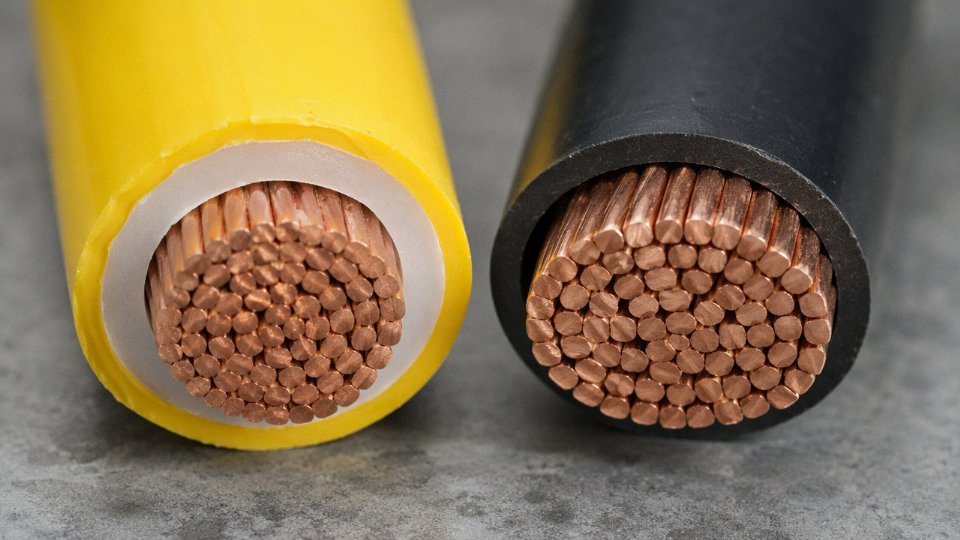
THHN layers a thin nylon (polyamide) jacket over the PVC primary insulation. That nylon skin adds meaningful abrasion resistance — important in long conduit pulls where wire drags against fittings and other conductors — and it provides a degree of chemical resistance against the light oils and cutting fluids common in industrial environments. The nylon jacket is also what enables the higher heat tolerance. Combined wall thickness on THHN runs roughly 15–20% thicker than TW at equivalent AWG, which has a direct effect on conduit fill calculations. On a 1-inch EMT filled with twelve 10 AWG conductors, that extra wall adds up fast.
Voltage Rating and Conductor Options
Both types are rated for 600 V service. In most low-voltage residential, light commercial, and panel-to-subpanel work, voltage class is simply not a differentiator — both wires are adequate, and specifying one over the other on voltage grounds alone wastes the conversation.
Conductor options run parallel: solid or stranded copper, and aluminum. Class B stranded copper is the default for THHN in commercial and industrial work — it pulls easier and tolerates vibration better than solid. Aluminum is selected on large feeders (typically 2 AWG and heavier) when cost reduction matters more than conductor size, since aluminum conductivity sits around 61% of copper IACS, requiring a larger AWG to carry equivalent current. A 250 kcmil aluminum THHN feeder in place of 3/0 copper is a legitimate engineering trade on a long service entrance run; aluminum in branch circuit sizes is a different conversation entirely.
TW is commercially available in the 14 AWG through roughly 2/0 AWG range — adequate for branch circuits and light feeder work. THHN spans 14 AWG through 1000 kcmil, covering everything from branch circuits to service entrance conductors and large industrial feeders. That breadth is one reason THHN became the de facto standard for most commercial and industrial conduit work.
Comparative Specification Table
| Parameter | TW | THHN |
|---|---|---|
| Insulation type | Single-layer PVC | PVC primary + nylon (polyamide) jacket |
| Temperature rating — dry | 60°C | 90°C |
| Temperature rating — wet | 60°C | 75°C |
| Voltage rating | 600 V | 600 V |
| AWG range available | 14 AWG – 2/0 AWG (typical) | 14 AWG – 1000 kcmil |
| Conductor material | Copper or aluminum | Copper (Class B stranded common) or aluminum |
| NEC designation | TW | THHN / THWN-2 (combined listings common) |
| Outer diameter impact | Baseline | ~15–20% larger at equivalent AWG; check conduit fill |
One operational note worth flagging: most wire sold in North American distribution today carries a combined THHN/THWN-2 listing, meaning it meets both wet and dry ratings. Pure TW is increasingly a special-order item rather than something sitting on a distributor’s rack — a supply chain reality that affects both availability and lead time for any sizeable procurement.
Ampacity Tables Decoded: How the 60°C vs. 90°C Rating Translates to Real Current-Carrying Capacity
NEC Table 310.15(B)(16) is the document every electrician dog-ears and every engineer references when sizing branch circuits and feeders. What the table actually does is list allowable ampacities organized by conductor size and by insulation temperature rating — 60°C, 75°C, and 90°C columns. The column you’re permitted to use is determined by the temperature rating of the insulation itself. TW is a 60°C wire, full stop, so you use the 60°C column. THHN is rated 90°C in dry locations, so in theory you can pull from the 90°C column — though there’s a catch we’ll get to shortly.
The gap between those two columns is not trivial.
Copper Ampacity by AWG: Where the Numbers Land
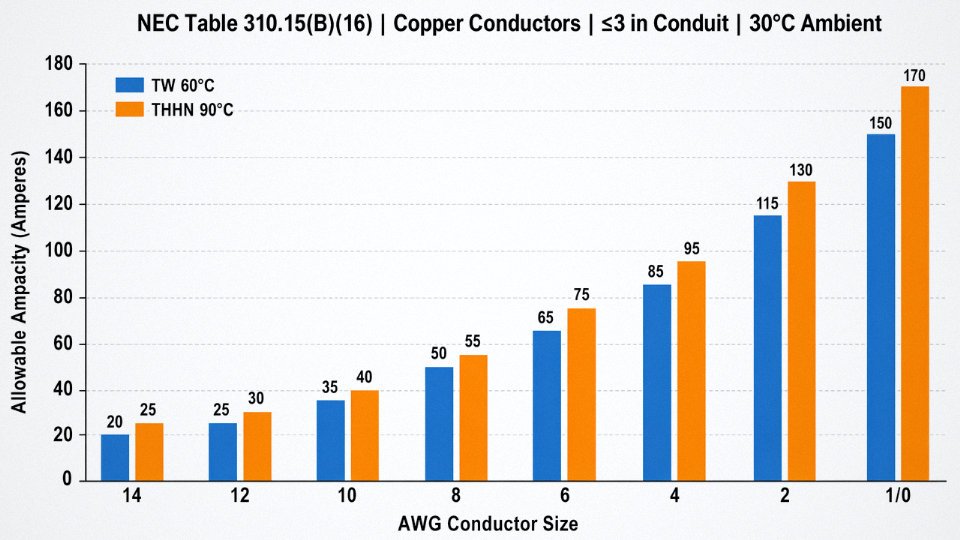
For copper conductors, the comparison across common sizes looks roughly like this (values per NEC Table 310.15(B)(16), not-more-than-three conductors in conduit, 30°C ambient):
| AWG | TW — 60°C (A) | THHN — 90°C (A) | Advantage |
|---|---|---|---|
| 14 | 15 | 25 | ~67% |
| 12 | 20 | 30 | ~50% |
| 10 | 30 | 40 | ~33% |
| 8 | 40 | 55 | ~38% |
| 6 | 55 | 75 | ~36% |
| 4 | 70 | 95 | ~36% |
| 2 | 95 | 130 | ~37% |
| 1/0 | 125 | 170 | ~36% |
Across the range most commonly specified in commercial and light industrial work — say, 10 AWG through 4 AWG — THHN consistently delivers somewhere in the 33–40% more ampacity from the same copper cross-section. For large wire pulls that number starts to matter in material cost.
The Terminal Temperature Rule: Where THHN’s 90°C Rating Gets Clipped
Here’s where engineers who are new to NEC sometimes trip up. Most standard circuit breakers, panelboards, and equipment terminals — particularly anything rated under 100A and a fair amount of gear rated above that — are marked for 60°C or 75°C terminations. NEC 110.14(C) requires that the conductor ampacity be based on the lower of the conductor’s insulation rating or the equipment’s terminal rating.
In plain terms: you ran THHN, which is rated 90°C, but your breaker terminals are marked 60°C only. You’re back to the 60°C ampacity column for that circuit, regardless of what the wire jacket says. In residential work this scenario is almost universal — most residential-grade breakers are 60°C devices. Commercial equipment is more likely to carry a 75°C terminal rating, which at least gives you access to the 75°C column (still not the full 90°C figure, but better than 60°C).
The practical implication: for residential circuits, THHN’s insulation rating advantage is partially negated at the termination point. Its real benefit there is physical durability and easier pulling — not necessarily a fatter ampacity number you can design to. In commercial and industrial settings with 75°C-rated equipment, you recover meaningful ground.
Derating Under Conduit Fill: THHN’s Headroom Advantage
When more than three current-carrying conductors share a conduit, NEC requires derating. Four to six conductors: multiply by 0.80. Seven to nine: 0.70. This applies to both wire types. The difference is that THHN starts higher, so after the same percentage derating it ends up with more usable ampacity remaining.
Take a conduit run with six current-carrying 10 AWG copper conductors. TW at 60°C starts at 30A, derated to 24A. THHN at 90°C starts at 40A, derated to 32A — assuming 75°C terminal ratings, you’d actually use the 75°C base of 35A, derated to 28A. Still comfortably ahead of TW in the same conduit with the same fill condition.
Worked Example: The 40A Circuit Decision
A 40A circuit — a small compressor, a commercial HVAC unit, a welding receptacle. You’re sizing for 8 AWG copper.
With TW at 60°C, 8 AWG is rated exactly 40A. Zero margin. Any conduit fill beyond three conductors, any ambient temperature correction above 30°C, and you’re forced to upsize to 6 AWG. In a warm equipment room or a conduit shared with other circuits, that’s a near-certainty on most plant floors I’ve seen.
THHN at 90°C gives you 55A on 8 AWG — or 50A if you’re holding to a 75°C terminal limit. Either way you have real derating headroom without touching conductor size. That 40A load sits comfortably, with room for conduit fill correction and ambient temperature adjustments.
THHN 8 AWG copper is rated 55A at 90°C under NEC Table 310.15(B)(16), compared to 40A for TW 8 AWG at 60°CTrue
NEC Table 310.15(B)(16) lists 8 AWG copper at 40A in the 60°C column and 55A in the 90°C column, for not-more-than-three current-carrying conductors in a raceway at 30°C ambient.
The Material Cost Offset Worth Running
THHN costs more per foot than TW — typically 10–20% more depending on order volume, jacket material pricing at the time, and supplier. But if THHN’s higher ampacity lets you specify one AWG size smaller for an equivalent load, the conductor cost per foot can drop enough to offset the insulation premium and then some, especially on long runs or large-quantity projects. On a 200-foot home-run feeder, dropping from 6 AWG TW to 8 AWG THHN for the same usable ampacity can translate to meaningful copper savings — though whether that arithmetic works depends on current copper pricing, the specific terminal ratings involved, and whether derating conditions actually allow you to ride the smaller conductor size all the way to the panel.
Run the numbers project by project. The answer isn’t always obvious, but THHN’s ampacity headroom makes it the starting point worth defending.
Installation Environments Where Each Wire Type Is Permitted or Prohibited by Code
Getting the environment wrong is where real money gets lost. Not in the spec sheet, not in the bid — on the job, when an inspector rejects the installation or, worse, when insulation degrades six months after commissioning and you’re pulling wire out of conduit you just installed.
What “Wet Location” Actually Means Under NEC
The NEC defines wet locations broadly enough that it catches a lot of people off guard. Any area subject to saturation with water or other liquids qualifies — that includes direct weather exposure, below-grade installations, areas with persistent condensation, and interior spaces where water can accumulate (think unheated equipment rooms in humid climates, or conduit runs through a food processing plant). Damp locations are a separate, less severe category covering spaces protected from weather but still subject to moderate moisture — think covered loading docks or unheated warehouses where condensation forms seasonally.
The practical consequence: if there’s any reasonable chance a raceway sees standing water or regular condensation, you need wet-rated insulation. Full stop.
TW in Wet Environments: Permitted, With Limits
TW’s “W” suffix is exactly what it sounds like — wet-location listing at 60°C. That makes it a legitimate choice for outdoor conduit runs exposed to rain, damp basements, and similar conditions where moisture contact with the conductor is possible. Electricians have used it in these settings for decades, and it works fine when installed correctly.
What it does not mean is direct burial. TW wire in conduit can survive a wet raceway; TW wire shoved directly into earth is a different matter entirely. Neither TW nor THHN is rated for direct burial without conduit — that requires USE-2 or UF cable, full stop.
TW wire is approved for wet locations at 60°C when installed in conduitTrue
The NEC lists TW as a wet-location conductor rated 60°C. The W suffix designates wet-location suitability, provided the wire is installed in a raceway system, not direct buried.
THHN in Wet Environments: The Dual-Rating Situation
Here’s where a lot of procurement errors happen. Pure THHN — the 90°C dry-rated designation — is not listed for wet locations. If you specify “THHN” on a drawing for an outdoor conduit run or a below-grade installation, you’ve technically specified the wrong wire for a wet location.
In practice, almost every THHN wire sold in North American markets today is dual-stamped THHN/THWN-2, which adds a wet-location rating of 75°C. When a distributor quotes you “THHN,” this dual-rated product is almost certainly what you’re getting — but confirm it on the reel label before it goes in the wall, especially on imported product where the dual-rating may not be stamped. Don’t assume.
The 75°C wet rating matters for ampacity calculations too. If the installation is wet, you use the 75°C column, not 90°C, which slightly reduces the ampacity advantage over TW.
Conduit Runs: Where THHN’s Nylon Jacket Earns Its Keep
Both wire types are designed for raceway installation — EMT, IMC, rigid metal conduit, rigid PVC. Neither is intended for exposed free-air applications without a raceway or some form of mechanical protection.
That said, THHN pulls better in long runs. The nylon jacket over the PVC insulation reduces friction noticeably, and in a 200-foot EMT run with multiple bends, that difference matters. Bare PVC on TW drags, especially if the conduit has been sitting in the sun and the wire warms up slightly during the pull. In my experience, anything over roughly 150 feet with more than two 90-degree bends benefits from THHN’s lubricity — or you’re adding wire pulling lubricant regardless.
Prohibited Applications for Both
Neither wire type belongs in plenum airspaces. Plenum cable requires CMP or FPLP ratings; standard PVC insulation generates toxic smoke under fire conditions, which is precisely what plenum ratings address. This is a code issue and a life-safety issue simultaneously.
Service entrance applications require SE or SER cable or conductors with additional mechanical protection — not TW or THHN off the reel.
High-Ambient Industrial Locations
This is where TW quietly becomes a liability. Near motors, boilers, packaged HVAC units, or industrial ovens, ambient temperatures in conduit runs regularly push 40–50°C. At those ambients, TW requires significant derating per NEC correction factors, and the conductor sizing can jump a full AWG or more to compensate. THHN’s 90°C rating starts with more thermal headroom, so the derating hits less hard. In a panel room adjacent to a boiler, the difference between specifying TW and THHN/THWN-2 can realistically mean the difference between 10 AWG and 12 AWG copper across a large number of circuits — a material cost difference worth calculating before the order goes out.
Mechanical Durability, Pull Strength, and Chemical Resistance in Conduit Systems
The difference in how these two wires behave during installation — and over the following fifteen or twenty years — comes down almost entirely to that thin nylon jacket on THHN. It looks like a minor detail on a spec sheet. On the job site, it isn’t.
What the Nylon Jacket Actually Does
Polyamide (nylon) has a much lower coefficient of friction than bare PVC against the inside of steel or PVC conduit. In practice, this reduces pulling tension by roughly 20–30% on typical conduit runs with two or three 90° bends, though the actual number depends on conduit fill, lubricant use, conductor size, and how cleanly the bends were made. On a 200-foot run through a crowded panel room with tight offsets, that friction difference can be the margin between a clean pull and a damaged conductor or a blown conduit fitting.
The nylon layer also resists tearing when wire drags across a conduit edge, a pulled fitting, or a sharp knockout that wasn’t fully deburred. Anyone who has pulled wire through older EMT in a retrofitted industrial building knows how rough those interiors can be. THHN handles it. TW, less so.
TW’s Vulnerability to Abrasion
Single-layer PVC insulation on TW is softer and more prone to nicking during installation, particularly in high-fill conduit systems where wires rub against each other and against the conduit wall. A small nick from a burr on a coupling, or deformation at a tight bend in a crowded 1-inch conduit stuffed with four or five conductors, can create a thin spot that passes initial continuity testing but degrades under thermal cycling over the next few years. In my experience, this is more common than most people admit — it rarely causes an immediate fault, but it shortens service life quietly.
Chemical Exposure: Where TW Falls Short in Industrial Settings
Bare PVC does not hold up well against petroleum-based fluids, cutting oils, or common industrial solvents. Gasoline and mineral oil will swell and soften standard TW insulation over time, especially with repeated or prolonged exposure. THHN’s nylon jacket resists these fluids substantially better — not indefinitely, and the actual resistance depends on concentration and contact duration, but the performance gap is real and well-documented.
This matters enormously in machine shops, automotive assembly areas, and anywhere near hydraulic lines that are known to weep. Specifying TW in a conduit that runs below a CNC machining center or along a lube oil header is a choice that tends to show up as a fault three years later.
THHN's nylon jacket provides better chemical resistance to petroleum-based fluids and cutting oils than TW's single PVC layer.True
Nylon (polyamide) has well-established resistance to aliphatic hydrocarbons and many mineral oils, whereas standard flexible PVC compounds used in TW insulation are susceptible to plasticizer extraction and swelling when exposed to petroleum-based fluids over time.
The Moisture Absorption Counterintuitive
Here is a point that trips people up: nylon absorbs slightly more moisture than PVC over long exposure periods. That is exactly why THHN, despite all its other advantages, is not rated for wet locations on its own. TW, with its simpler PVC jacket, handles prolonged moisture exposure better. So the wire that wins on chemical resistance loses on standing water — which is why THWN-2 exists and why the application environment should always drive the selection, not a blanket “THHN is better” assumption.
Flexibility, Stranding, and Long-Term Thermal Life
Stranded THHN — Class B or Class C stranding — is noticeably more flexible than solid TW conductors of the same gauge, which matters for panel wiring, equipment drops, and any installation with vibration. Solid TW, on the other hand, is actually easier to handle in straight conduit runs: the rigidity helps guide it through without bunching. Neither is universally superior here; it depends on the run geometry.
Over a 20- or 30-year service life in a continuous-load application — say, a feeder running at 80% of rated ampacity — THHN’s dual-layer insulation system and higher temperature rating mean the insulation experiences significantly less cumulative thermal stress than TW insulation would under the same load. Thermal degradation in PVC is gradual and cumulative. The wire that runs cooler simply ages more slowly.
Cost Analysis: Material Price, Labor Efficiency, and Total Project Economics for TW vs. THHN
Raw material price is where most procurement conversations start — and, unfortunately, often end prematurely. TW wire typically runs 5–15% less per linear foot than equivalent-AWG THHN copper, depending on lot size, market copper pricing at the time of order, and whether you’re buying domestic or offshore stock. That gap narrows when copper prices spike, because insulation cost becomes a smaller fraction of the total; it widens slightly on fine-stranded builds where the nylon jacket adds meaningful process cost. The simpler single-layer PVC construction genuinely does cost less to manufacture. That’s real. But treating that per-foot delta as the whole story will get you in trouble on any project above a trivial scale.
Conductor Downsizing: Where THHN Pays for Itself
Here’s where the math flips. Because THHN’s 90°C rating yields higher allowable ampacity under NEC Table 310.15(B)(16), there are real-world circuits where you can legitimately specify one AWG size smaller with THHN than you’d need with TW.
Work through a straightforward example: a 500-foot feeder circuit sized for 95A continuous load. Under the 60°C column, that load pushes you to 2 AWG copper TW (rated 95A at 60°C). Under the 90°C column, 4 AWG THHN handles 95A comfortably. The copper weight difference between 2 AWG and 4 AWG is roughly 40–45% per foot. On a 500-foot, three-phase, four-wire feeder — four conductors — you’re talking somewhere around 2,000 linear feet of conductor total. At current copper rod pricing, that AWG reduction typically saves $300–$600 or more in raw copper cost alone, depending on the commodity market at contract time. The THHN insulation premium on 4 AWG over TW 4 AWG might add $80–$130 on that same run. The net result: the conductor downsizing more than offsets the insulation cost premium. This doesn’t apply to every circuit, but on larger feeders and branch panels in commercial or light industrial work, it comes up often enough to justify running the numbers before defaulting to TW.
Pulling Labor and Conduit Fill
THHN’s nylon jacket doesn’t just resist abrasion — it reduces friction against conduit walls. On straight runs, the difference is modest. On runs with multiple bends over 100 feet, pulling tension accumulates fast, and installers typically apply more lubricant and work in shorter sections with TW or with upsized bare PVC insulation. Field estimates from commercial electrical contractors suggest a 10–20% reduction in pull time with THHN on runs exceeding 100 feet in EMT or rigid conduit — the range depends on bend count, conduit fill percentage, and crew experience. On a large commercial project with dozens of long feeder and branch runs, that labor savings compounds. Electrician labor rates vary considerably by region and project type, but even at modest rates, shaving 15% off pull time across 50 conduit runs matters.
Conduit fill is a related factor that procurement managers often overlook entirely. When TW requires a larger AWG to meet ampacity, the fatter conductors consume more conduit cross-section. On multi-circuit runs where you’re trying to fit four or six current-carrying conductors into a single conduit, upsized TW can force you into the next conduit trade size — say, from 1-inch to 1¼-inch EMT — adding material cost and potentially requiring upsized fittings, boxes, and supports throughout the run.
Ambient Temperature and Long-Term Derating Costs
In plant environments running above 40°C ambient — common near process equipment, boilers, or in poorly ventilated electrical rooms — NEC derating factors reduce allowable ampacity further. TW’s 60°C baseline leaves almost no thermal headroom once you apply a derating multiplier for elevated ambient or conduit bundling. You upsize conductors, often by one or two AWG steps, to recover compliant ampacity. THHN’s 90°C rating absorbs that derating hit with substantially more margin. Over a multi-panel industrial installation, that upsizing requirement on TW translates to measurably higher copper tonnage per project.
THHN wire's higher temperature rating frequently results in lower total installed cost than TW wire despite a higher per-foot material price, due to conductor downsizing, reduced labor, and conduit fill advantages.True
NEC ampacity tables confirm the AWG reduction potential; the cost logic follows directly from copper weight differences and documented labor efficiency gains in conduit installation.
Bulk Procurement Considerations
For international projects sourcing wire in volume, consistency across production batches matters as much as unit price. Jinda’s vertically integrated process — copper rod drawing, PVC compounding, nylon jacketing, and stranding all under one manufacturing system — means the insulation wall thickness and nylon jacket weight stay consistent lot to lot, which affects both electrical performance and pulling behavior in the field. Spot-buying mixed-lot wire from multiple sources often produces subtle dimensional variation that compounds into real installation headaches. On large orders, locking in a supply agreement with a manufacturer who controls the full process chain is usually worth more than chasing a marginal per-foot discount from a converter who sources components externally.
Application Selection Guide: Matching TW or THHN to Residential, Commercial, and Industrial Projects
Knowing the specs is one thing. Knowing which wire to pull for a specific job is where the real decisions happen — and where wrong choices turn into change orders, failed inspections, or overheated conductors three years after commissioning.
Residential Branch Circuits: Lighting and Receptacles
Both TW and THHN are code-legal for residential conduit wiring, so this is genuinely a judgment call. In practice, most residential electricians reach for THHN almost automatically, and not just because of the ampacity headroom. The nylon jacket makes it noticeably slicker in conduit, which matters when you’re pulling six circuits through a 3/4-inch EMT on a hot afternoon. The 12 AWG THHN still gets derated to the 60°C terminal rating at devices and panels, so you don’t actually gain the full 30 A advantage at the endpoint — but you do gain easier pulls, less insulation damage on bends, and a wire that handles the job site a bit more forgivingly.
TW is not wrong here. For a short homerun in dry interior conduit with minimal bundling and a modest load, it does the job and costs less per foot.
Residential Service Entrance and Panel Feeders
This is where TW starts to show its limits in a concrete way. A 200 A residential service in conduit requires conductors that can handle both the ampacity demand and potential moisture exposure between the meter base and the main panel — an environment that can see condensation, wind-driven rain, or direct splash depending on the installation. THHN/THWN-2 dual-rated wire is the standard selection here. Using TW forces you up one or two conductor sizes to meet the ampacity requirement on a 200 A service, which adds material cost, increases conduit fill, and can push you into a larger conduit size. The economics rarely favor TW on service entrance work.
Commercial Lighting and Branch Circuits
THHN is the overwhelming default in commercial construction, and there are several compounding reasons why. Drop ceilings in retail and office buildings can run 10–15°C above the listed ambient on a summer afternoon, eroding the derating margin on TW faster than most engineers account for during design. Long wire pulls through 100+ feet of conduit in a multi-story building are genuinely easier with the nylon jacket — a detail that shows up in labor time. Inspectors in commercial jurisdictions expect THHN and occasionally flag TW in commercial panels simply because it looks out of place, which creates unnecessary friction even when it’s technically compliant.
Industrial Motor Branch Circuits and Feeders
Don’t spec TW in a motor control center. Full stop. Industrial environments combine elevated ambient temperatures near machinery, bundled conductors in wireway or conduit, and frequent exposure to cutting oils, hydraulic fluid, or cleaning solvents — conditions that degrade TW insulation measurably faster and push its thermal margin uncomfortably thin. THHN’s oil resistance and the derating headroom from the 90°C base rating are not optional luxuries in a panel feeding 10 or 15 motor loads. When conduit fill is high and ambient runs 40°C or above near a machine tool, TW’s effective ampacity can derate to a point where conductor sizing becomes impractical.
TW wire should not be used for industrial motor feeder applications in environments with elevated ambient temperatures or chemical exposure.True
TW's 60°C rating combined with NEC derating requirements for bundled conductors and elevated ambient temperatures can reduce effective ampacity to the point of impracticality, and its single-layer PVC insulation lacks the chemical resistance of THHN's nylon jacket in oil-present environments.
Outdoor Wet-Location Conduit Runs
This is a specification error that shows up more than it should. Standard THHN carries a dry/damp location rating. Once that conduit is exposed to outdoor weather — buried in PVC below grade, running up an exterior wall, crossing a rooftop — moisture can and does enter, and plain THHN is not rated for that condition. The wire you need is dual-listed THHN/THWN-2, and you verify this by reading the reel label, not by assuming. Many reels sold as “THHN” in North American distribution are in fact dual-listed, but check before you pull. A wet-location failure on a supply circuit can mean ground faults, nuisance tripping, and insulation breakdown that isn’t immediately visible.
Budget-Sensitive, Simple Dry-Location Applications
TW still has a legitimate role. For straightforward dry indoor conduit — a small accessory panel in a temperature-controlled storage room, a short branch circuit in a climate-controlled office renovation, a low-load lighting circuit with minimal bundling — TW meets code, costs less, and there is no engineering reason to over-specify THHN. The discipline is in the conditions: ambient stays reliably below 30°C, bundle counts are small, and the load is well within the 60°C ampacity without heavy derating. When all three conditions hold, TW is a reasonable cost control. When any one of them is uncertain, the price difference between TW and THHN rarely justifies the risk.
| Application | Recommended Wire | Key Reason |
|---|---|---|
| Residential branch circuits (dry conduit) | THHN preferred, TW acceptable | Pull ease, ampacity headroom, marginal cost difference |
| Residential service entrance (conduit) | THHN/THWN-2 | Wet-location rating + ampacity on 200 A service |
| Commercial lighting/branch circuits | THHN | Elevated ambient, long pulls, inspection expectations |
| Industrial motor feeders and MCC wiring | THHN required | Chemical exposure, derating margin, thermal environment |
| Outdoor conduit (any wet exposure) | THHN/THWN-2 dual-listed only | Wet-location code requirement — verify reel label |
| Simple dry indoor low-load circuits | TW acceptable | Cost savings justified when all thermal conditions are benign |
Jinda’s TW and THHN Wire Manufacturing Capabilities and International Supply Advantages
Sourcing TW or THHN wire for a large project — a commercial building fit-out, an industrial plant expansion, a utility infrastructure job — puts procurement managers in a familiar bind: the specification is tight, the schedule is tighter, and most distributors can’t tell you where the wire actually came from or whether the dimensions will hold across the full reel order. That’s where manufacturing origin and vertical integration start to matter more than the catalog price.
Production Scale That Can Actually Fill a Large Order
Jinda operates five production bases across China with roughly 470,000 m² of combined manufacturing floor space. In practical terms, that footprint supports simultaneous production runs across multiple wire families without the line-scheduling conflicts that force smaller manufacturers to make you wait while they finish someone else’s order. The full AWG range — 14 AWG through 1000 kcmil — is in active production for both TW and THHN/THWN-2 constructions, so a project-spec calling for five or six different conductor sizes doesn’t require sourcing from multiple suppliers and hoping the insulation colors and reel lengths align at the job site.
Why Vertical Integration Changes the Dimensional Consistency Conversation
A point that doesn’t get enough attention in procurement: THHN wire destined for high-fill conduit applications — 40% fill is already tight, and real installations often push toward that limit — is sensitive to outer diameter variation across reel lots. When a manufacturer buys PVC compound from one vendor, nylon pellets from another, and copper rod from a third, dimensional tolerances accumulate. Small variances in each input stack up into real problems during a long conduit pull.
Jinda controls the full chain internally: copper rod drawing, PVC insulation compounding, nylon jacketing extrusion, stranding, and finished reel packaging. That’s not a marketing claim — it’s the operational reason why lot-to-lot OD consistency is achievable at scale. For engineers sizing conduit on a dense industrial panel schedule, that consistency is worth something concrete.
Jinda's THHN wire is manufactured in compliance with UL 83 standard requirements and ASTM B8 conductor specifications.True
UL 83 is the standard for thermoplastic-insulated wires and cables accepted under NEC listings; ASTM B8 covers concentric-lay stranded copper conductors. Compliance with both is required for THHN wire to be listed and accepted on North American projects.
Certifications and the North American Market
Jinda’s THHN production is manufactured in compliance with UL 83 and ASTM B8 requirements, with NEC listing requirements met for acceptance on North American projects. CE certification covers European market requirements. For procurement teams submitting wire documentation to a general contractor or a third-party inspector, the ability to produce factory test reports, material certifications, and country-of-origin documentation — quickly, not three weeks after the shipment lands — is what separates a workable supplier relationship from a headache.
Export Logistics Built Around Project Timelines
With customers in more than 50 countries, Jinda’s export operation handles the documentation stack that international procurement actually requires: certificates of origin, third-party test reports, packing lists formatted for customs clearance, and coordinated container loading schedules. For construction and utility projects where wire delivery sits on the critical path, a supplier whose logistics team understands how to sequence a shipment to hit a project window is genuinely valuable. In practice, Jinda’s export team has managed time-sensitive deliveries for industrial and infrastructure customers across North America, the Middle East, Southeast Asia, and Europe.
Reel Configurations and Custom Packaging
Standard 500-foot and 1,000-foot reels are available across the AWG range. For large contractors, bulk spool configurations reduce handling on site. Project-specific AWG combinations — say, a purchase order calling for 12 AWG, 10 AWG, and 6 AWG THHN in specific colors and footage totals — can be packed per order to arrive job-site ready rather than requiring re-sorting at the warehouse. That’s a real labor saving on larger installations.
Jinda’s engineering team is available for pre-order technical consultation: application-specific wire selection, clarification of which construction (TW, THHN, or THHN/THWN-2) fits a given environment, and documentation support for project submittals or import compliance review. Requesting samples before committing to a volume order is a standard part of the process.
Frequently Asked Questions About TW and THHN Wire
Can I use THHN wire in a wet location?
Not by itself — and this mistake shows up more often than it should. Standard THHN alone carries a dry-location listing only. If you’re pulling wire into an outdoor conduit, a underground riser, or any raceway where moisture can accumulate, you need wire that is dual-rated THHN/THWN-2. That designation means the same wire is listed for 90°C in dry conditions and 90°C in wet conditions under the newer THWN-2 standard (the older THWN wet rating was only 75°C, which matters when you’re calculating ampacity in a damp feeder run). Always read the reel label before installation, not after. A reel marked “THHN” only, with no THWN or THWN-2 suffix, has no wet-location listing regardless of what a distributor tells you.
Standard THHN wire without a THWN or THWN-2 dual listing is not code-compliant for wet or damp locations under NEC.True
NEC Article 310 and UL 83 restrict THHN to dry locations only. Wet-location installations require the THWN or THWN-2 designation to be explicitly listed on the wire.
Is TW wire still used, or has THHN basically replaced it?
TW is still manufactured and remains code-compliant for certain applications — light residential branch circuits, simple dry-location conduit work, some retrofit projects where existing conduit fill calculations were based on TW’s slightly smaller diameter. In practice, though, THHN/THWN-2 has become the dominant general-purpose building wire in North America. The pricing gap has narrowed enough that specifying TW for a new commercial or industrial project is rarely justified. The ampacity penalty is real: a 12 AWG TW copper conductor is limited to around 20A at 60°C, while the same 12 AWG in THHN delivers roughly 30A at 90°C. You’re leaving capacity on the table for minimal savings.
Can TW and THHN be mixed in the same conduit?
Yes, NEC permits mixed insulation types in a conduit. The catch is that the ampacity of every conductor in that conduit must be calculated using the lowest temperature rating present. Pull one TW wire in with four THHN conductors, and suddenly all five conductors must be derated to 60°C values. The THHN’s higher rating becomes irrelevant. This is the kind of thing that happens on a job site when someone makes a last-minute substitution without flagging it to the engineer of record — and the result is either a code violation discovered at inspection or, worse, a thermally overloaded conduit that nobody notices until something fails.
Which is better for aluminum conductors — TW or THHN?
For aluminum, THHN is the clear choice, particularly at 1/0 AWG and above where large feeders are involved. Aluminum already carries roughly 60–65% of the current capacity of equivalent-sized copper. The 90°C rating in THHN partially compensates by allowing higher ampacity values, which reduces the degree of conductor upsizing required relative to copper. TW aluminum at 60°C compounds the conductivity disadvantage with a lower temperature ceiling, making it a poor fit for any feeder application where you’re watching conduit fill or trying to minimize conductor weight.
Does THHN cost significantly more than TW?
The premium is real but not dramatic — typically 5–15% higher per foot for the same AWG copper conductor, depending on order volume, market timing, and copper spot prices at the time of purchase. Where it gets interesting is conductor sizing: because THHN’s higher ampacity often lets you drop one AWG size and still meet the load requirement, the total material cost can come out roughly equal or even slightly lower than TW. Run the numbers on your specific circuit before assuming TW is the budget option.
What does the dual designation THHN/THWN-2 mean on a wire reel?
It means the wire carries listings under both standards simultaneously. Rated 90°C in dry locations as THHN, and 90°C in wet locations as THWN-2. The original THWN wet rating was 75°C — THWN-2 upgraded that to 90°C, which is relevant for high-load runs in damp conduit where every degree of thermal headroom counts. For most new installations, specifying THHN/THWN-2 dual-listed wire is simply the safer procurement default. It covers both environments and eliminates any ambiguity during inspection.
Is THHN suitable outside the United States?
THHN is a UL/NEC designation and isn’t directly referenced in IEC-based national codes. The functional equivalent varies by country — IEC 60227 and 60245 cover PVC-insulated building wires, and designations like H07V-K or H07RN-F serve comparable roles in European and many Asian markets. Jinda manufactures wire to both NEC/UL and IEC standards and can advise on the correct specification for a given national code requirement. Don’t assume a wire that meets UL 83 automatically satisfies a buyer’s local approval authority without verification.
How do I verify quality from an overseas THHN manufacturer?
Ask for UL listing documentation or third-party test reports explicitly referencing compliance with UL 83 and ASTM B8 for conductor construction. Spot-check conductor DC resistance against ASTM B3 or B8 tables — this is one of the fastest ways to detect undersized or impure conductors. Measure insulation wall thickness against UL 83 minimums. Check that the nylon jacket is continuous with no holidays. For bulk orders, pre-shipment third-party inspection by a recognized agency (SGS, Bureau Veritas, or similar) adds meaningful protection. Jinda provides factory test reports as standard and can accommodate third-party inspection arrangements for large international orders.