Specifying or sourcing the wrong 240V cable — wrong color code for the destination country, undersized conductor, incorrect insulation voltage class — doesn’t just fail an inspection. It causes rework on the reel, delays commissioning by days or weeks, and in a worst case puts an energized conductor inside a building with the wrong labeling. Procurement teams that skip the visual and structural details pay for it later in returned goods, re-termination labor, or a failed site audit.
A 240V cable is typically identified by its conductor color coding (brown for live, blue for neutral, green/yellow for earth in IEC markets; varies by country), a conductor cross-section between 1.5 mm² and 95 mm² depending on the load, and an insulation voltage rating of 300/500 V, 450/750 V, or 0.6/1 kV printed on the outer sheath. Physical construction — flat twin-and-earth, circular multicore, armored, or flexible cord — depends on the installation environment.
What makes this genuinely tricky is that two cables sitting side by side on a distributor’s shelf can both be rated for 240V service, look nearly identical from the outside, and be entirely wrong for each other’s application. The differences are in the sheath markings, the conductor geometry, and the insulation class — details that are easy to miss if you don’t know what you’re reading.
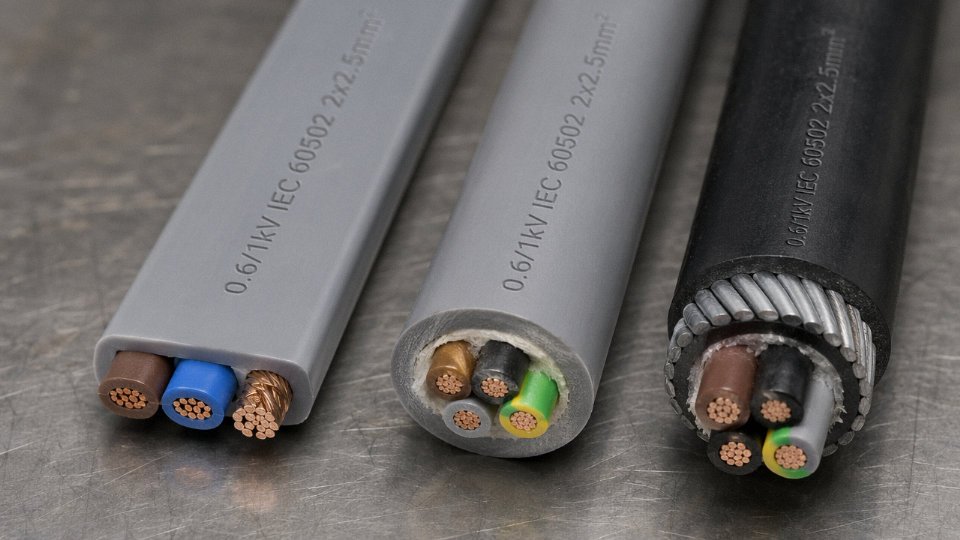
Core Visual Anatomy: Layers You Can See and Touch on a 240V Cable
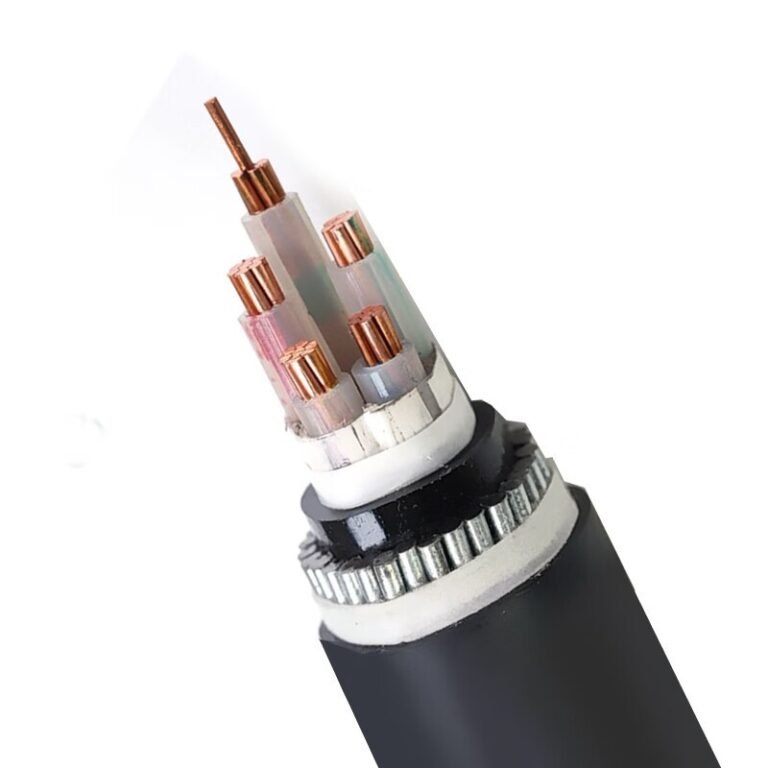
Strip back a 240V cable on the bench and you’re looking at a deliberate sequence of layers, each one doing a specific job. Getting familiar with that sequence — what each layer looks like, feels like, and tells you — is genuinely useful before you spec a job, receive a delivery, or troubleshoot a wiring fault.
The Outer Sheath
This is what you handle first. On fixed-wiring twin-and-earth used in the UK and Australia, the sheath is almost always grey PVC. Black sheaths appear on underground and outdoor-rated cables, orange on high-visibility flexible cords and mining-service cables, white occasionally on surface-wiring or conduit applications in some markets. The surface texture varies: standard PVC sheath is smooth, while some heavy-duty or industrial types are lightly ribbed to improve grip and resist kinking during installation.
Look at the print on that sheath carefully. A properly marked cable will show the voltage rating (e.g., 300/500 V or 0.6/1 kV), the applicable standard (IEC 60227, IEC 60502, AS/NZS 5000, BS 6004, or similar), the conductor configuration written as count × cross-section (say, 2×2.5 mm² + E, or 3×6 mm²), and the manufacturer’s name or mark. Embossed text is common on quality PVC sheaths; printed ink lines are used on others. If the sheath is blank or carries only partial marking, that’s a red flag — not a minor one.
Bedding and Filler
Peel the sheath back and you’ll encounter the bedding layer — a soft, often white or natural-coloured PVC or non-woven tape wrap that holds the conductors in formation and fills the interstitial voids between them. On a three-conductor cable this filler is what gives the cable its round cross-sectional profile rather than a lumpy, irregular one. Oval twin-and-earth has less filler because the geometry is already close to flat. The bedding tears away fairly easily with a fingernail; it has no insulating function and isn’t meant to. Its presence (or absence, on cheap cable) tells you something about build quality.
The bedding/filler layer in a 240V cable provides primary electrical insulation.False
Bedding and filler serve a mechanical and form-keeping function only. Electrical insulation is provided by the individual conductor insulation layers, not the bedding. Relying on bedding for insulation is a dangerous misunderstanding.
Individual Conductor Insulation
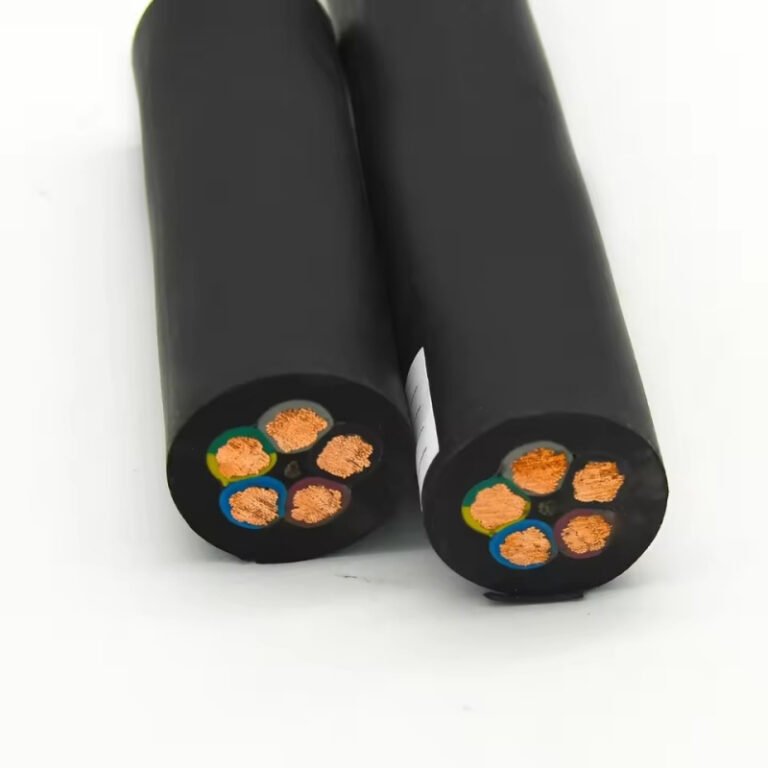
Each conductor carries its own insulation sleeve. Under IEC 60446 and AS/NZS 3000, the live conductor is brown, neutral is blue, and the protective earth — if insulated — is green-and-yellow striped. Older installations in some countries (pre-2004 UK harmonisation) will show red for live and black for neutral; knowing both colour schemes matters in retrofit work.
Insulation thickness scales with conductor size. On a 1.5 mm² conductor it’s noticeably thin — roughly 0.7 mm on a typical 300/500 V rated core. By the time you’re handling a 16 mm² or 25 mm² conductor the insulation wall is visibly thicker and the sleeve feels more substantial between your fingers. Some insulation is opaque; on a few flexible cord types it can be slightly translucent, which lets you faintly see the stranding beneath.
The Earth Conductor
In twin-and-earth cable the earth is usually bare copper — no insulation sleeve at all. Fresh bare copper is bright, almost reddish; tinned copper earth conductors look silver-grey and resist oxidation better in damp or industrial environments. Both are legal depending on the applicable standard and application. A green-and-yellow sleeved earth is standard on three-core flex and on industrial cables where the conductor needs individual identification throughout its run. When terminating bare earth conductors, green-and-yellow sleeving must be fitted at the ends — that’s required, not optional, under most installation codes.
Conductor Stranding at Cut Ends
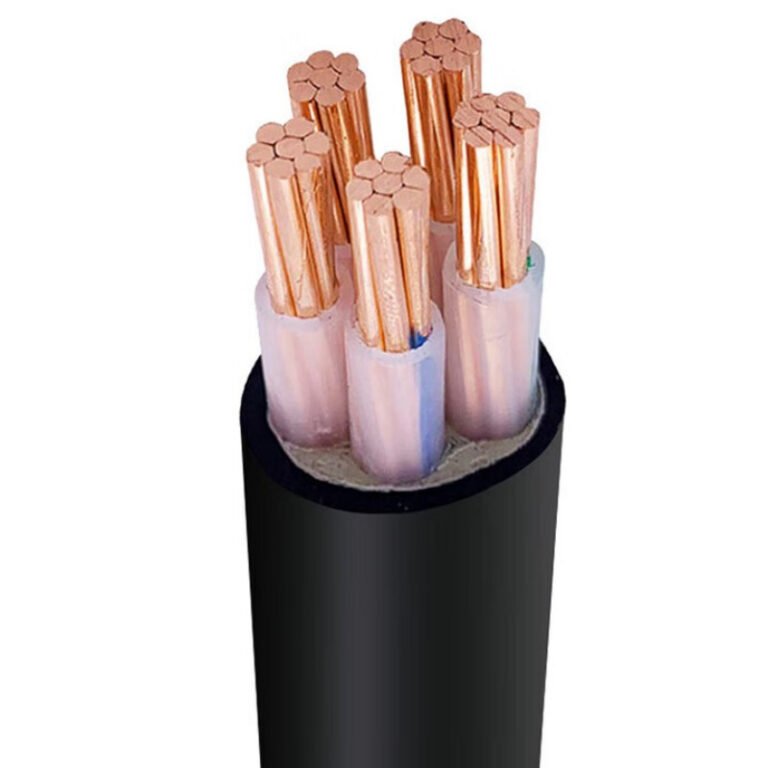
Cut the cable cleanly and look at the end face under normal light. Fixed-wiring conductors — the sort used in walls and conduit — are either solid (a single round wire, common at 1.5 mm² and 2.5 mm²) or coarse-stranded (a small number of heavier strands, typical up to roughly 16 mm²). Flexible cords use fine stranding: many thin wires bundled together, which gives a softer, almost brushy appearance at the cut end and allows repeated bending without wire fatigue. Mixing these up — installing a fine-strand flexible cord in a fixed conduit run, or using rigid solid-conductor cable on a moving machine connection — causes problems ranging from poor termination contact to premature conductor fracture.
A simplified cross-section, from outside in, looks like concentric rings: outer grey sheath, then the bedding/filler in white or natural colour, then three insulated cores (brown live, blue neutral, green-yellow or bare earth) arranged in a triangular cluster at the centre. That mental image is worth having before you pick up a stripper or place a procurement order.
Conductor Color Codes by Region: What the Wire Colors Inside a 240V Cable Tell You
Color coding is where most field identification errors happen. An electrician pulls a cable from a conduit, sees brown and blue conductors, and assumes it’s a modern European installation. Except it’s from a 1990s Australian job rewired partway through, and the neutral is actually red under a replacement sleeve. That kind of ambiguity causes real incidents. Understanding what the colors should be — and why they sometimes aren’t — is not pedantic. It’s basic risk management.
UK and Europe: The Post-2004 Harmonized Scheme
Since 2004, the UK adopted IEC 60446 harmonized colors across all new fixed wiring: brown for live, blue for neutral, green-and-yellow stripe for earth. The same scheme applies across most of continental Europe. Before that, British practice used red (live), black (neutral), and bare or green-yellow (earth) — a combination still present in millions of properties built before the changeover. Both generations of cable are legal in existing installations, which means any building constructed or extended before roughly 2006 may contain both old and new color schemes running in the same distribution board.
That’s not a hypothetical. In practice, a UK rewire that touches only part of a house will often leave old red-black T&E feeding ring circuits upstairs while new brown-blue cable runs downstairs. No code violation, but a serious identification hazard for anyone who doesn’t check both ends of every circuit before touching it.
Australia and New Zealand
AS/NZS 3000 (the “Wiring Rules”) historically used red for active, black for neutral, and green-yellow for earth. Since the 2007 revision aligned Australia and New Zealand closer to IEC practice, brown is now the preferred active color and blue the preferred neutral in new installations, mirroring Europe. Both old and new colors remain permitted for fixed wiring, so Australian buildings — particularly anything industrial put up before 2010 — frequently contain both systems.
Three-phase 415 V systems (derived from the same 240 V phase-to-neutral base) add phases coded red, white, and blue under the older scheme, or brown, black, and grey under the newer one. If you’re procuring multicore cable for an Australian industrial customer, confirm which scheme their site uses before specifying conductor colors. Getting it wrong means re-labeling at minimum, rewiring terminations at worst.
Export and Asia-Pacific Manufacturing Cables
For cables manufactured in China destined for export — including Jinda’s international supply projects — IEC harmonized coloring (brown/blue/green-yellow) is the standard default for single-phase product. That said, Middle Eastern customers frequently specify black for neutral per historical British influence in those markets, and some Southeast Asian projects still request red active conductors under older regional conventions. African markets vary considerably by country depending on whether the colonial-era British, French, or Belgian electrical tradition dominates the local code.
IEC 60446 harmonized colors (brown live, blue neutral, green-yellow earth) are the default for export cables manufactured to international standardsTrue
IEC 60446 is the internationally adopted standard for conductor identification colors and is referenced by BS 7671, AS/NZS 3000 (new work), and most national standards bodies outside North America.
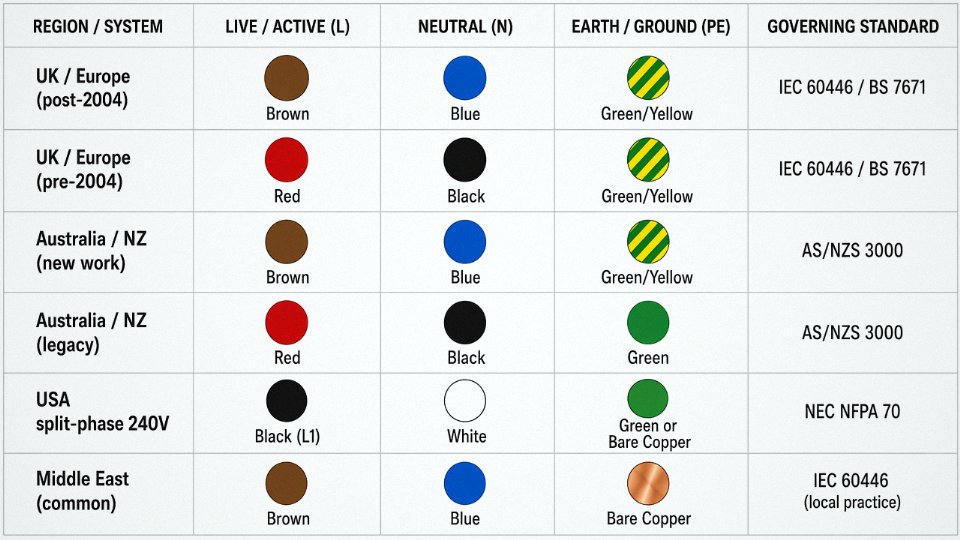
North American Split-Phase 240V: A Different Animal
US 240V looks nothing like European or Australian cable. American residential 240V is a split-phase system — two hots tapped from opposite legs of a center-tapped transformer. Inside the cable you’ll find black and red (both hot), white (neutral), and green or bare copper (earth). There is no single “live” conductor in the European sense. Buyers comparing an imported IEC-standard cable to a US job requirement need to understand this immediately, because the conductor count, color sequence, and termination logic are genuinely different, not just cosmetically different.
Regional Color Code Reference
| Region | Live / Active | Neutral | Earth | Governing Standard |
|---|---|---|---|---|
| UK / Europe (post-2004) | Brown | Blue | Green-Yellow | IEC 60446 / BS 7671 |
| UK / Europe (pre-2004) | Red | Black | Green-Yellow or bare | Old BS 7671 |
| Australia / NZ (new work) | Brown | Blue | Green-Yellow | AS/NZS 3000 (2007+) |
| Australia / NZ (legacy) | Red | Black | Green-Yellow | AS/NZS 3000 (pre-2007) |
| USA (split-phase 240V) | Black + Red | White | Green or bare | NEC (NFPA 70) |
| Middle East (common) | Brown or Red | Black | Green-Yellow | Varies by country |
The Outer Sheath Color Tells You Almost Nothing
Grey sheath, white sheath, black sheath — none of these reliably indicate voltage rating, circuit type, or even the conductor color scheme inside. A grey outer jacket might be a standard 300/500 V flex or a 0.6/1 kV armored cable. Black sheath appears on everything from low-voltage T&E to medium-voltage underground feeders.
Always read the printed legend on the outer sheath — the voltage rating, standard compliance, and cross-section are printed there. Then strip back a short section and physically confirm the conductor colors before making any assumptions. In a mixed installation, cable installed by multiple trades over twenty years, or any imported reel without a clear data sheet, this step is not optional.
Size, Diameter, and Weight: How to Gauge a 240V Cable’s Cross-Section by Eye and by Measurement
Getting the cross-section wrong is one of the most common — and most expensive — mistakes on a 240V installation. A circuit wired with 1.5 mm² where 2.5 mm² is required won’t fail immediately. It’ll run warm, trip MCBs intermittently, and eventually damage insulation or cause a fire. So knowing how to read conductor size, either visually or with a caliper, is a genuinely practical skill.
Conductor Sizing Logic for 240V Circuits
The sizing hierarchy in UK and Australian domestic wiring is fairly consistent and worth internalizing. Lighting circuits run on 1.5 mm² — low current loads, short runs, straightforward. Socket outlet circuits use 2.5 mm², the workhorse size you’ll encounter most often on the plant floor or in any commercial fit-out. Cookers and electric showers typically demand 4–6 mm², sometimes higher depending on rated load and run length. Sub-main feeds — the cable between the consumer unit and a distribution board further into the building — usually sit at 10–16 mm², and on larger industrial installations you’re looking at 25 mm² and above.
Hold a 1.5 mm² conductor next to a 6 mm² and the difference is obvious. The 1.5 mm² is roughly 1.38 mm in diameter; the 6 mm² is about 2.76 mm. That’s a 2× difference in diameter but a 4× difference in cross-sectional area, which catches people out. The relationship between diameter and area is quadratic — A = π × (d/2)² — so small diameter differences compound quickly.
Overall Cable Outer Diameter as a Field Check
For flat twin-and-earth (T&E) cable, the outer dimensions give you a fast sanity check without stripping anything. A 2.5 mm² 2-core-and-earth T&E typically measures roughly 10–11 mm across the flat face; a 4 mm² version runs about 12–13 mm; 6 mm² comes in around 14–15 mm. These figures shift depending on insulation wall thickness, sheath compound, and manufacturer tolerances, so treat them as orientation rather than gospel. If your site cable reads 11.4 mm and the label says 2.5 mm², that’s plausible. If it reads 8 mm, start asking questions.
Weight Per Meter for Procurement Estimation
Weight matters when you’re ordering 500 m reels and calculating freight. A 2.5 mm² twin-and-earth cable typically weighs roughly 90–110 g/m, depending on sheath density and whether the earth conductor is bare or insulated. A 6 mm² equivalent comes in around 160–190 g/m. A 500 m reel of 6 mm² T&E therefore lands somewhere in the 80–95 kg range — worth knowing before you specify a delivery vehicle or a reel stand that tops out at 50 kg.
Measuring Conductor Diameter with a Caliper
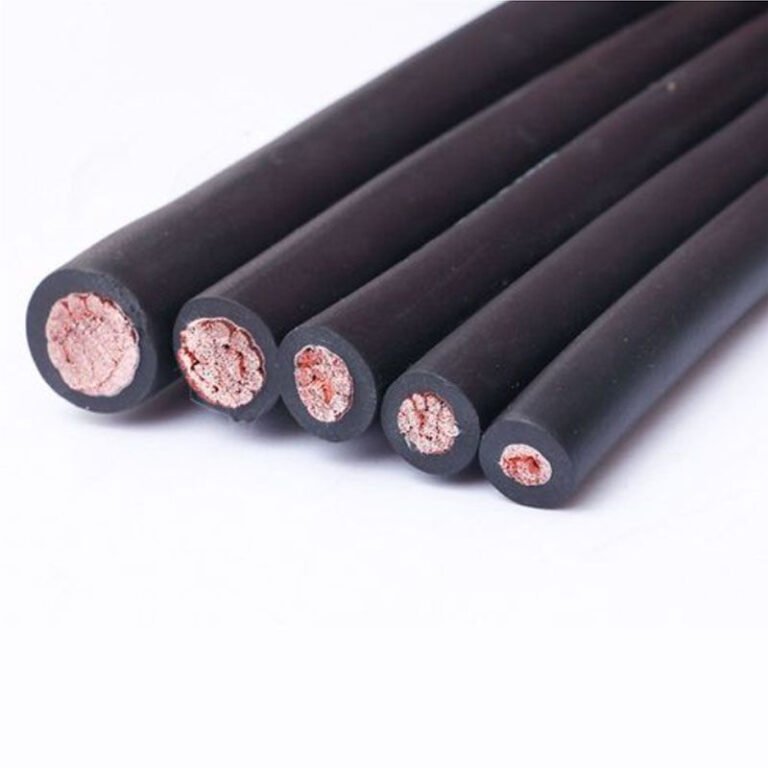
Strip back 20–30 mm of insulation, take a digital vernier caliper or micrometer, and measure across the bare conductor. For a solid 2.5 mm² copper conductor the reading should be approximately 1.78 mm — though in practice you’ll see anywhere from 1.7 to 1.85 mm depending on drawing tolerances. Apply the formula: A = π × (d/2)². Plug in 1.78 mm and you get approximately 2.49 mm². Close enough to confirm 2.5 mm² nominal.
Stranded conductors need a slightly different approach. Measure the overall stranded bundle diameter, then apply a compaction factor — typically 0.85–0.93 depending on stranding configuration — before running the area calculation. Better yet, count the strands and measure a single wire, then multiply.
Solid vs. Stranded: What the Cut End Tells You
This is immediately visible and genuinely useful. A solid 2.5 mm² conductor cut cleanly shows a single bright copper disc — clean, uniform, no gaps. A 7-strand 2.5 mm² conductor at the cut end looks like a small flower: six outer wires arranged around one center wire, with visible gaps between them. Both carry the same nominal cross-section, but the 7-strand version is more flexible, more forgiving in conduit pulls, and what you’d expect in a flex or multicore cable rather than fixed wiring.
The Aluminum Trap
Aluminum conductors are larger in diameter than copper for equivalent current-carrying capacity — typically by a factor of around 1.3–1.6× in cross-sectional area. A 16 mm² aluminum conductor will physically look similar to a 10 mm² copper conductor. This catches procurement teams when sourcing internationally, particularly when a supplier quotes in mm² without specifying conductor material.
Aluminum conductors used for the same current rating as copper must have a larger cross-sectional area due to aluminum's lower conductivity.True
Aluminum has an electrical conductivity of approximately 35 m/(Ω·mm²) versus approximately 56 m/(Ω·mm²) for annealed copper, meaning aluminum requires roughly 1.5–1.6× the cross-sectional area to achieve comparable resistance per unit length.
Jinda’s export documentation for cross-regional projects specifies both mm² and AWG equivalents on every cable data sheet — not because one system is better, but because a procurement manager in Houston and an installer in Melbourne are working from different mental models, and ambiguity at that stage costs real money.
Sheath and Insulation Materials: How PVC, XLPE, and Rubber Change the Cable’s Look and Feel
Material choice is where a lot of procurement mistakes get made. Two cables can carry identical conductor sizes and color codes, look nearly the same on a reel, and yet perform completely differently once installed — because one is rated for 70 °C continuous operation and the other for 90 °C, or one will turn brittle in an unheated warehouse after a winter and the other won’t. Knowing what you’re looking at before you cut the drum seal matters.
PVC: The Baseline Most People Are Handling
Standard PVC-sheathed 240V cable — your typical flat twin-and-earth for residential fixed wiring, your grey round cable for a sub-board feed — has a surface that ranges from noticeably glossy on freshly manufactured stock to semi-matt after a few months on a shelf. The feel is smooth, slightly waxy, and at room temperature the sheath has a mild rigidity to it; you can flex it, but it pushes back. Colors are almost always grey, white, or black depending on the market and application. UK and Australian T&E runs predominantly grey. Outdoor armored SWA typically sheaths in black.
PVC softens predictably with heat and stiffens significantly in cold. Below roughly 0–5 °C it becomes noticeably harder, and at −10 °C or colder it can crack if forced around a tight bend during installation. That’s not a theoretical concern — it happens on winter construction sites when installers pull cable through conduit first thing in the morning without letting the drum warm up.
XLPE Insulation: Harder, Crisper, Faster to Spring Back
XLPE is used as the conductor insulation layer on 0.6/1 kV rated cables, often under a conventional PVC or LSZH outer sheath, so you won’t always see it until you strip the outer. What distinguishes it from plain PVC insulation on individual cores is texture and recovery: XLPE feels harder and less glossy, and when you bend a stripped core and release it, it springs back to shape noticeably faster. PVC tends to hold its deformed position a little longer.
Why does this matter operationally? XLPE-insulated cables are typically rated for continuous conductor temperatures up to 90 °C versus 70 °C for standard PVC insulation. Running a 240V feed to a high-draw industrial load — a compressor, a commercial HVAC unit, a large motor — on undersized PVC-insulated cable that approaches its thermal limit accelerates insulation degradation faster than most people expect. The cable doesn’t fail dramatically; it slowly carbonizes and becomes brittle, usually noticed only when a fault forces inspection.
LSZH: Duller, Slightly Tacky, and Mandatory in Certain Environments
Low-smoke zero-halogen sheath material looks noticeably different from standard PVC once you know what to compare it against. The surface is duller — almost matte — and has a faintly rubbery quality. If you press a fingernail lightly into a LSZH sheath it yields slightly softer than PVC, and the surface can feel mildly tacky, especially in warm environments. It’s not sticky in any practical sense, but it’s enough to notice.
LSZH is not optional in tunnels, public transport infrastructure, marine cable runs, and most public buildings in jurisdictions following IEC 60332 requirements. The reason is straightforward: PVC burns and releases hydrogen chloride gas, which is toxic and corrosive to electronics and escape route signage. LSZH cables are designed to limit both flame spread and toxic smoke generation. Jinda’s LSZH cables are produced to IEC 60332-1 flame-retardant requirements, which govern single-cable vertical flame propagation — the minimum threshold for most building and marine specs.
LSZH cable sheath produces significantly less toxic gas and smoke than standard PVC sheath during combustionTrue
This is established by IEC 60754 (halogen acid gas emission) and IEC 61034 (smoke density) test standards; LSZH compounds are specifically formulated to meet these thresholds, and the difference in smoke opacity versus PVC during flame testing is substantial and measurable.
Rubber and Neoprene: The Flex-Cord Feel
Pick up a rubber-sheathed extension cord or an appliance flexible lead and the difference from a fixed-wiring PVC cable is immediately obvious. Rubber and neoprene sheaths are darker — typically deep grey or black — matte in finish, and have a faintly textured surface rather than the smooth waxy feel of PVC. More than anything else, the giveaway is flexibility: rubber-sheathed cable moves freely at virtually any temperature you’d encounter in normal use. It drapes. PVC cable at the same conductor size holds more of a set.
This flexibility comes at a cost in mechanical toughness. Rubber sheaths nick and abrade more easily under repeated dragging across rough floors — something any site electrician running portable tools knows well. In practice, neoprene-sheathed cords hold up better in harsh industrial environments, but both are wrong choices for fixed installation, where PVC or LSZH is appropriate.
Aging and Weathering: What Degraded Sheath Looks Like
UV exposure and heat cycling eventually show on PVC sheath as yellowing, surface chalking (a powdery residue that wipes off but comes back), and fine surface cracking along flex points. On outdoor cable that’s been in service five to ten years without UV-stabilized compound, you’ll sometimes see the sheath surface look almost bleached or faded in patches. Any visible cracking — even hairline — is a rejection criterion. The cracks propagate inward under continued flexing and eventually breach insulation integrity.
During incoming inspection at Jinda’s quality control stage, sheath surface condition on returned or sampled production reels is checked visually and dimensionally, partly for this reason. A sheath that’s already showing stress marks before installation has almost certainly been stored or transported incorrectly — too cold, too long in direct sun on a loading dock, or over-tensioned on a small-diameter reel.
When cable markings are worn, dirty, or completely illegible — which happens more often in field conditions than anyone in procurement likes to admit — a quick bend-and-feel test gives a rough material read: stiff and waxy suggests PVC, hard and crisp with fast rebound suggests XLPE insulation underneath, soft and dull suggests LSZH, and pliable with a matte dark surface points toward rubber or neoprene. It’s not a substitute for documentation, but it’s a starting point that’s kept more than a few miswired panels from going energized.
Armored and Underground 240V Cables: What SWA, AWA, and XLPE-Armored Cables Look Like
If there’s one place where misidentifying a cable causes genuinely serious consequences, it’s here. Pulling unarmored T&E into a trench because it “looked about the same diameter” as the spec sheet isn’t just a procurement error — it’s a failure that typically surfaces months later, after ground movement or rodent damage, and the remediation cost dwarfs whatever was saved on cable.
Steel Wire Armored (SWA) Cable
SWA is the most visually distinctive cable type you’ll encounter in industrial and underground 240V applications. The outer surface is a corrugated, silver-grey metallic layer formed by helically wound steel wires sitting over a black or grey PVC bedding layer. You can see and feel the individual wire ridges when you run your hand along the cable — there’s a consistent, rope-like texture to it. Under site lighting, it catches the light in a way that plain sheathed cable never does.
Size matters here more than people expect. A 4 mm² 2-core SWA in the 0.6/1 kV class typically runs 18–20 mm overall outer diameter, depending on conductor stranding and bedding thickness. Compare that to an equivalent unarmored 2-core at roughly 10–12 mm and the difference is immediately obvious on the reel. Weight per meter is another giveaway: a 4 mm² 2-core SWA can weigh somewhere around 0.55–0.75 kg/m, varying with manufacturer tolerances and armor wire count. You feel it in the cable drum before you read a single label.
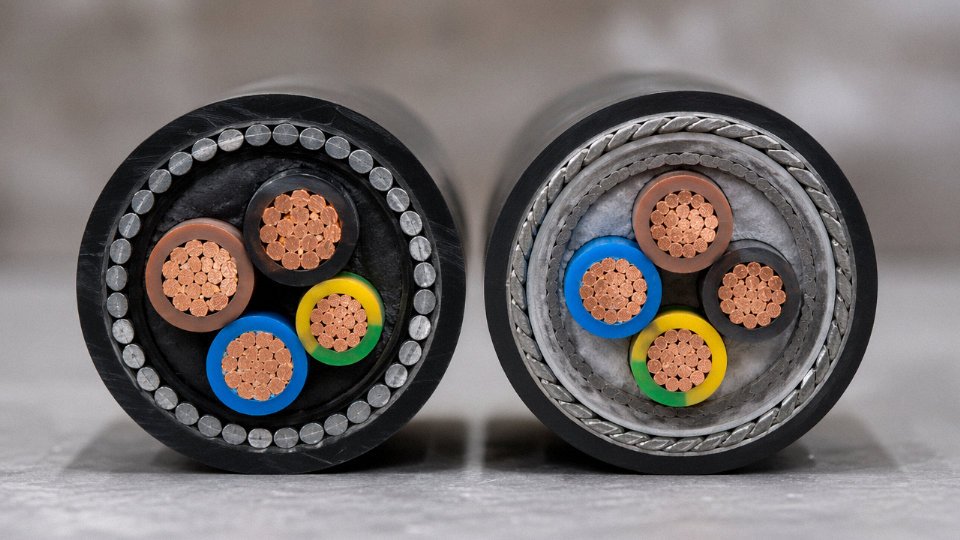
Aluminum Wire Armored (AWA) Cable
AWA looks superficially similar to SWA but the color difference is real and useful. The aluminum wires have a lighter, more reflective silver finish — noticeably shinier than the duller grey of galvanized steel. In direct comparison the distinction is easy; on its own, in a dimly lit cable cellar, you want to confirm by weight. AWA is meaningfully lighter than SWA of the same cross-section, which is exactly why it’s specified in tray installations where cumulative load matters, or in single-core runs where steel armor would create unacceptable eddy current losses. If someone hands you a coil and says “armored 4 mm²” without specifying, a quick lift tells you a lot.
AWA armor eliminates induced current losses in single-core AC cables that SWA would causeTrue
Steel armor on a single-core AC cable creates a closed magnetic circuit around the conductor, inducing circulating currents that generate heat and reduce effective current-carrying capacity. Aluminum is non-magnetic, so AWA armor does not exhibit this effect, making it the correct choice for single-core installations.
Steel Tape Armored (STA) Cable
STA uses flat steel tape wound helically rather than round wires, and the surface character is completely different — much smoother, almost like a corrugated-but-ironed-out finish, with faint longitudinal seam lines rather than the rope texture of SWA. It feels less “grippy” in your hand. STA is common in medium-voltage export ranges but Jinda also produces 0.6/1 kV STA versions for projects where crushing resistance rather than tensile protection is the primary concern, such as under-slab installations.
Underground Direct Burial Cables Without Armor
XLPE-insulated, PVC-oversheathed direct burial cables occupy a middle ground that trips people up. There’s no visible armor layer at all — what you see is a plain, typically black outer sheath, usually noticeably thicker and stiffer than domestic flat T&E. Reputable manufacturers print “SUITABLE FOR DIRECT BURIAL” or the equivalent standard marking directly on the sheath. The stiffness is a practical identifier: these cables resist bending radius much more than flexible cord but yield more than SWA. If you can bend the cable around your forearm with moderate effort, it’s almost certainly unarmored. SWA at any practical cross-section resists that test completely.
That flex test is roughly how experienced installers sort cables on a crowded job site without reaching for calipers: rigid means armored steel, slight give suggests AWA or STA, and easy bend means you’re holding an unarmored cable that does not belong in a direct burial trench.
Jinda manufactures SWA and AWA cables in the 240V / 0.6–1 kV class across its five production bases to IEC 60502-1, BS 5467, and customer-specific standards, with a significant share going to infrastructure projects in the Middle East, Africa, and Southeast Asia where burial conditions, soil corrosivity, and project specification variance demand tight quality control at the manufacturing stage rather than reliance on field inspection alone.
Reading the Print Legend on a 240V Cable: How to Decode Every Mark on the Outer Sheath
Most installers glance at the sheath print and move on. That’s a mistake. The legend stamped or ink-jetted onto a cable’s outer jacket is effectively a compressed datasheet — conductor count, cross-section, voltage class, material system, governing standard, manufacturer, and production year, all in one line. Learning to read it takes about ten minutes and can save you from specifying the wrong product, accepting a substandard reel, or failing an inspection.
Breaking Down a Typical Legend String
Take a legend like this: 2 × 2.5 mm² 300/500V PVC/PVC IEC 60227 JINDA 2024
Each element carries specific meaning. “2 ×” tells you conductor count — two cores, so this is a twin cable without a separate earth, common in Class II equipment cords and some European appliance flexes. “2.5 mm²” is the nominal conductor cross-section. “300/500V” is the voltage designation (more on that below). “PVC/PVC” describes insulation material over the conductor followed by the outer sheath material — when you see XLPE/PVC or EPR/CPE, that tells you both the thermal class and the environmental suitability at a glance. The standard reference, “IEC 60227,” confirms this is a harmonized flexible cord built to that family of specifications. Manufacturer name and year round it out for traceability and batch identification.
Voltage Rating Codes Are Not What Most People Think
The paired voltage designation confuses a lot of people on first encounter. “300/500 V” does not mean the cable is rated for only 300 volts. It means 300 V phase-to-earth and 500 V phase-to-phase. A standard 240 V single-phase system fits comfortably within that envelope, which is why 300/500 V is the common designation for flexible cords and light wiring accessories. Step up to “450/750 V” and you’re looking at heavier single-core building wire used in conduit or trunking — suitable for the same 240 V system but with a larger safety margin and often better thermal endurance. For armored underground cables, “0.6/1 kV” is typical; the extra headroom matters in long runs with harmonic loading or in environments where transient overvoltages are realistic.
Standard Designations and What They Signal About Construction
The standard code isn’t just a compliance stamp — it describes the construction. H05VV-F is a harmonized designation: “H” means harmonized, “05” maps to the 300/500 V voltage class, “VV” means PVC insulation and PVC sheath, “F” means flexible (stranded) conductor. NYM is a German-origin fixed-wiring cable with a PVC-filled inner sheath — recognizable by its slightly rounded, solid profile and common across Central and Eastern European projects. NYFGBY adds steel wire armoring and is the armored counterpart. UK cables often carry BS 6004 (thermoplastic insulated) or BS 5467 (XLPE insulated, armored) markings; if you’re buying for a UK site and neither appears, that’s worth a conversation with your supplier before the order ships.
Meter Markings: More Useful Than They Look
Sequential length numbers — printed every 1 m or 2 m along the sheath — serve two practical purposes. During installation they let you cut accurately without unspooling the entire drum. During procurement they help you verify you’re getting a full, uncut length. If the numbers jump (say, from 147 m to 312 m midway through a reel), the cable has been spliced or the drum has been partially used and re-wound. That’s an automatic rejection event in our outgoing QC process, and it should be in yours too.
Sequential meter markings on cable sheath can be used to detect re-drummed or spliced cable by checking for numbering continuity along the full reel length.True
Legitimate factory-wound drums carry continuous sequential markings from the outer wrap to the drum core. A gap or reset in the sequence is a reliable indicator that the cable is not a virgin factory length, which matters for both installation integrity and billing accuracy.
Certification Marks on the Sheath
These appear as small embossed logos or abbreviated text, sometimes easy to miss on darker sheath colors. CE confirms the product meets EU Low Voltage Directive requirements and is required for cables sold into European markets. RoHS compliance (often printed as “RoHS” or indicated by a crossed-out waste bin symbol on accompanying documentation) limits hazardous substances. CCC — China Compulsory Certification — applies to cables sold within mainland China and will appear on domestically distributed product; you won’t typically see it on export cables unless specifically requested. Independent third-party marks like BASEC (UK) or KEMA (Netherlands, now part of a broader certification body) indicate the product has been tested against the claimed standard by an external laboratory, not just self-declared. In practice, BASEC-marked cable gets through UK contractor specifications without argument. Unmarked cable, even if technically compliant, often doesn’t.
Red Flags That Should Trigger Rejection
A missing voltage rating on the sheath is a hard no. So is an absent or unreadable standard reference. Smudged, faded, or inconsistently spaced printing can indicate ink-jet equipment running out of calibration — minor cosmetically, but it suggests a production environment that tolerates process drift, which is a fair proxy for other quality shortcuts. Legends that list only a manufacturer name and conductor size, with nothing else, are essentially anonymous cable. You have no idea what compound was used, what standard it was built to, or what voltage class it belongs to. Jinda’s internal QC holds each outgoing drum to a legibility check precisely because the print legend is the first thing an end-customer or site inspector will read. If it’s wrong on the outside, the burden of proof for everything on the inside immediately increases.
How to Visually Distinguish Genuine 240V Cable from Substandard or Mislabeled Cable
Procurement fraud in cable supply is not hypothetical. Undersized conductors, CCA cores sold as solid copper, and dangerously thin insulation walls reach real job sites every year — often stamped with plausible-looking certification marks. The checks below require nothing more exotic than a sharp knife, a postal scale, and a set of calipers. Run them before the cable goes into conduit.
Insulation Wall Thickness: Cut the End and Measure
IEC 60227 and BS 6004 both specify minimum insulation wall thickness by conductor cross-section. On 2.5 mm² conductors, the nominal insulation wall should be 0.7 mm; on 1.5 mm², it’s 0.7 mm as well; step up to 6 mm² and you’re looking at 1.0 mm. Substandard cable routinely comes in 15–25% under those figures, and the problem is usually visible to anyone who makes a clean cross-cut with a fresh blade and looks at it under decent light. The wall won’t just measure thin — it often looks uneven, thicker on one side than the other, which is a production process failure in its own right.
A micrometer across the insulation at the cut face costs about 30 seconds and gives you hard evidence. If the wall reads under the standard minimum, walk away from the reel.
Conductor Weight as a Fraud Test
Pure copper has a density of 8.96 g/cm³. That means a 2.5 mm² copper conductor, running one meter, should weigh roughly 22 g — give or take a gram depending on stranding. Cut exactly one meter, strip the insulation, weigh the bare conductor. If it comes in at 16–18 g, the conductor is undersized. If it’s around 10–12 g, you very likely have CCA.
This test works because filing down the geometry is the easiest way to save cost at the production stage. Manufacturers who shave conductor cross-section by 10–15% while printing the full size on the sheath are betting that nobody weighs. Weigh.
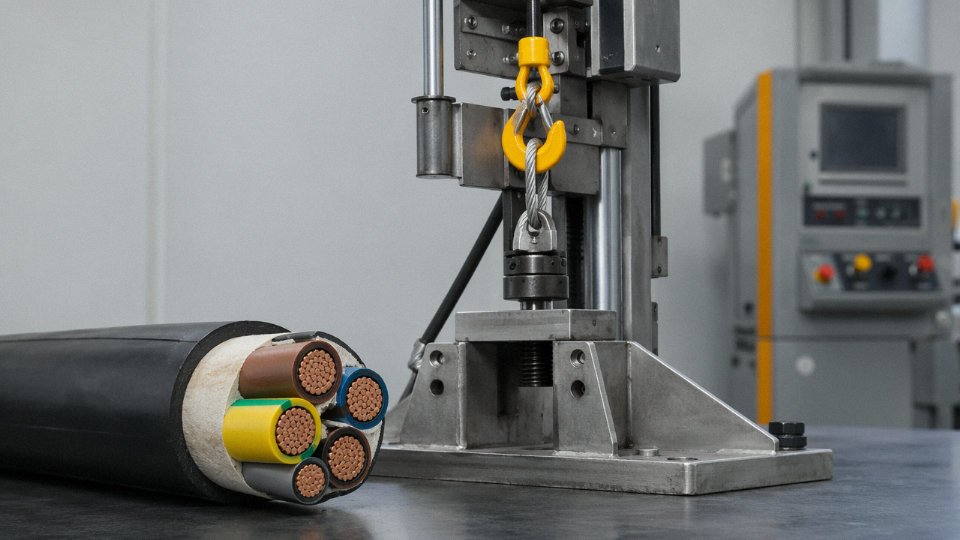
Identifying CCA (Copper-Clad Aluminum) in Fixed Wiring
CCA conductors look copper at first glance — the cladding is genuine copper and the freshly cut face has a bright orange ring around the outside. The giveaway is the center, which will show a noticeably duller, silver-grey aluminum core once you examine it closely or scrape the face with a blade. If the cable has been sitting on a reel for a while and the cut is slightly oxidized, the aluminum core goes dull much faster than pure copper would.
A sharper test: bend a short length tightly around a screwdriver shank. CCA is stiffer and the outer copper layer can visibly crack or peel at the bend point. Pure copper work-hardens but doesn’t peel.
CCA conductors are prohibited for fixed 240V wiring under IEC 60364, BS 7671, and AS/NZS 3000 because their lower conductivity requires a larger cross-section to carry the same current as copper, and thermal cycling causes connection failures at terminals.True
All three standards require conductors to be rated for the design current at the stated cross-section. CCA's conductivity is roughly 61% of pure copper's, meaning a labeled 2.5 mm² CCA conductor performs closer to 1.5 mm² copper in service — a serious underrating with real fire risk at terminals.
Sheath Concentricity: The Roll Test
Place a straight 500 mm length of cable on a flat bench and roll it slowly. If the conductor is significantly off-center inside the sheath, the cable will wobble visibly as it rolls — same principle as an out-of-round tire. IEC 60228 allows limited eccentricity, but cables that wobble noticeably during this test have a production fault that typically accompanies other shortcuts.
Color Consistency After Stripping
Strip roughly 100 mm of outer sheath and then 50 mm of insulation from each conductor. The colors should be saturated, consistent along the length, and match exactly what the sheath print legend claims. Dye bleed-through — where the blue of a neutral has bled a faint tint into an adjacent conductor’s insulation — indicates poor-grade PVC compound. Faded or off-hue colors (a grey that should be black, a washed-out brown) point to inadequate pigment loading, which usually correlates with a cheaper base resin that won’t hold rated temperature performance either.
Reading a Genuine Third-Party Test Report
A real IEC type-test report from a CNAS- or ILAC-accredited laboratory carries specific markers: the lab’s accreditation number printed on the header (verify it on the ILAC MRA database), a tested sample identification that matches the cable’s print legend character for character, witness signatures or auditor sign-off on each test page, and a test date within a reasonable recertification window — typically three to five years for an active product line.
What you often receive from substandard suppliers instead is a single-page certificate with a stock photo of a cable, no sample identification, and a lab name that doesn’t appear in any accreditation database. Jinda provides full IEC type-test reports for every export product line, with sample IDs traceable to the specific cable specification, from accredited third-party laboratories — available before order confirmation, not after delivery.
If a supplier hesitates to share the actual test report (not just the certificate), that hesitation is the answer.
Frequently Asked Questions About What 240V Cable Looks Like
Can I identify 240V cable just by the outer sheath color?
No — and this mistake gets made constantly on busy sites. Sheath color is a manufacturer and regional convention, not a voltage encoding standard. Grey, white, black, and various shades of beige all appear on 240V cables depending on where they were made and what application they were designed for. A grey flat T&E sheath in the UK tells you roughly what you’re looking at, but only because that’s a local habit, not a binding rule. The only reliable identification method is reading the printed legend on the outer sheath and, once stripped, checking that conductor colors match the regional code for your installation. If you’re working with cable from an overseas source that you haven’t used before, do both before anything gets terminated.
Outer sheath color alone cannot confirm a cable's voltage rating.True
IEC and national wiring standards specify conductor insulation colors and sheath markings but do not universally mandate sheath color by voltage class. Sheath color conventions vary by country, cable type, and manufacturer.
What does 240V cable look like compared to 110V cable?
Construction-wise, they’re essentially the same — same layers, same materials, often the same conductor sizes for equivalent load ratings. The practical visual difference on UK construction sites is that 110V reduced-low-voltage cables are conventionally yellow-sheathed, which makes them easy to spot in a cable tray full of grey domestic cable. But that yellow convention is a site-safety habit, not a legal requirement tied to the voltage itself. Outside the UK, 110V cable may not be yellow at all. The definitive differentiators are always the voltage rating stamp on the legend (look for 300/500V, 450/750V, or 0.6/1kV) and the actual marking — relying on color alone has caused more than a few wrong-cable-on-wrong-circuit problems.
How thick is a standard 240V cable?
Depends almost entirely on conductor cross-section. A 2-core-and-earth 2.5 mm² flat T&E — the bread-and-butter domestic ring-main cable in the UK — runs roughly 10–11 mm across its widest face. Move up to 6 mm² and you’re looking at around 14–15 mm. Armored versions of the same conductor size add another 3–6 mm to overall diameter because of the bedding, armoring layer, and outer sheath stacked on top. Heavy industrial singles at 95 mm² can reach 25–30 mm in overall diameter. These are estimates — actual dimensions vary by manufacturer tolerances and whether the cable is circular or flat-profile.
What color is the live wire in a 240V cable?
Brown in current UK wiring (post-2004), current Australian wiring (post-2000 for new installations), and throughout IEC-compliant installations globally. Red in older UK and Australian installations and in some Southeast Asian markets that haven’t fully migrated standards. Black in older continental European cables. In practice, on a retrofit or extension job, you can encounter red and brown lives in the same building. Always verify against the applicable regional standard and confirm visually at the point of termination — never assume based on installation age alone.
Does 240V cable look different from 415V three-phase cable?
Usually yes, and fairly obviously once you know what to count. Single-phase 240V cable runs 2 cores (live and neutral) or 3 cores (live, neutral, earth), so it’s relatively slim. Three-phase 415V cable carries 4 cores (three phases plus earth) or 5 cores (three phases, neutral, earth), and the larger core count combined with typically larger conductor sizes makes the overall cable noticeably bulkier and heavier per meter. A 4-core 16 mm² SWA cable is a chunky thing to handle compared to a 3-core 6 mm² T&E. The core count visible at a cut end is the fastest check.
How do I tell if a cable is rated for outdoor or underground use just by looking at it?
Several cues compound. UV-resistant or direct-burial cables almost always have a black outer sheath — black carbon-loaded PVC or HDPE resists UV degradation far better than grey or white compounds, and most manufacturers default to black for outdoor-rated products. The legend will typically include wording such as “outdoor,” “direct burial,” “UV resistant,” or reference to a standard like IEC 60502 or BS 5467. The sheath itself will be noticeably thicker and stiffer than a flat indoor T&E — you can feel the difference when you try to flex it. Steel wire armoring (SWA) or aluminum wire armoring (AWA) adds a visible metallic layer under the outer sheath, detectable as a rigid, corrugated feel even before you strip anything. If all four indicators are absent, assume the cable is indoor-rated only.
What should I look for when buying 240V cable in bulk from an overseas manufacturer?
Start with the printed legend on the drum sample — it should exactly match your purchase specification in conductor size, voltage class, and applicable standard. Then do a cut-end check: measure the conductor diameter physically and cross-reference against the expected value for the stated cross-section (a 2.5 mm² solid conductor is approximately 1.78 mm in diameter; stranded versions vary by strand count). Weight-per-meter testing against the manufacturer’s datasheet catches conductor undersizing that visual inspection misses. Request IEC-accredited third-party type-test certificates, not just in-house test reports — the difference matters when a project specification or an insurer asks questions later. Verify the manufacturer’s actual export track record. Jinda, for instance, supplies cable into more than 50 countries and provides full third-party documentation as standard, which is the kind of paper trail that protects a procurement manager when a consignment hits customs or a project auditor. Factories with genuine export depth have dealt with these documentation demands before; ones without it usually show gaps quickly when you ask specific questions.
Specifying and Sourcing 240V Cable for International Projects: What Jinda’s Production Range Covers
By the time you’ve worked through the visual anatomy, color codes, sheath materials, and armoring types covered earlier in this article, you should be able to pick up almost any 240V cable and read it like a spec sheet. The next practical question is: where do you source it at volume, with documentation that will satisfy a project engineer, a local authority inspector, or a shipping auditor?
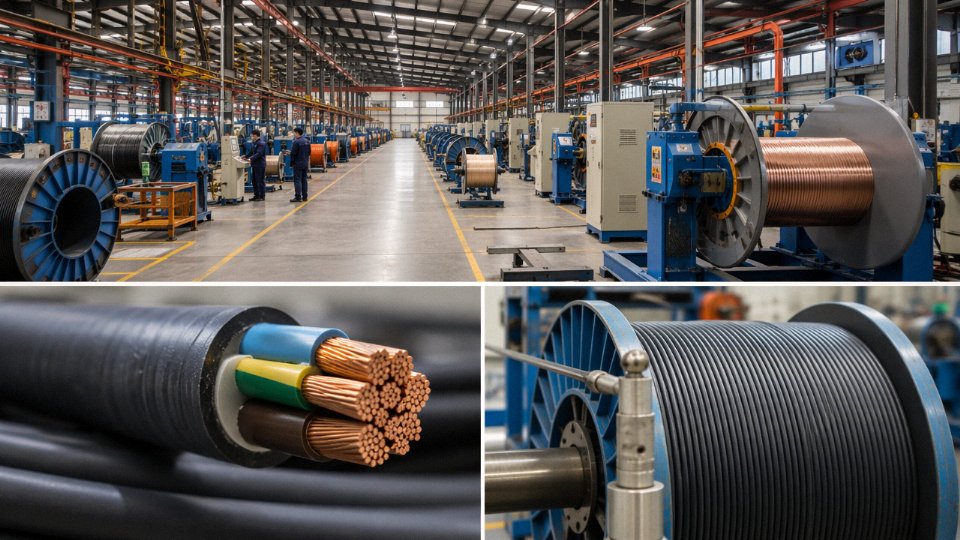
Portfolio Coverage Across the Cable Types Described in This Article
Jinda’s low-voltage and 240V product range maps closely onto the construction types discussed throughout this article. Fixed-wiring PVC cables to IEC 60227 and BS 6004 — the flat twin-and-earth profiles and multicore round cables most readers will be specifying for building installations — are standard production items. Flexible cords to IEC 60245, including the rubber-sheathed and PVC-sheathed types with the fine-stranded conductors that give them their distinctive pliability under a fingernail test, run on dedicated extrusion lines. SWA and AWA armored power cables to IEC 60502-1 and BS 5467 cover the underground and industrial feed segment, available in aluminum wire armoring for lighter weight or steel wire armoring where mechanical crush resistance is the priority. LSZH constructions to the IEC 60332 series — identifiable by their matte, slightly chalky sheath surface and the absence of the acrid smell PVC gives off when heated — are produced for tunnel, transit, and high-occupancy building projects where fire performance certification is a tender requirement, not an option.
Conductor cross-sections run from 1.5 mm² household circuit sizes up through 95 mm² and beyond for industrial feeds, in both copper and aluminum conductors depending on the application and the buyer’s cost targets. Aluminum conductor pricing can shift a large-volume cable bill noticeably, and for long underground runs that tradeoff is worth running through your load calculation before locking in the spec.
Production Scale and What It Means for Lead Times
Five manufacturing bases across China, roughly 470,000 m² of floor space combined, and a workforce exceeding 1,000 people means Jinda is not a trading company re-labeling product from spot market stocks. Large-volume orders — the kind a regional distributor or a major construction project generates — can be scheduled into production without the lead-time penalties that smaller operations charge implicitly through long queues. Custom constructions, including non-standard sheath colors or unusual conductor configurations, typically need more lead time than catalogue items, but the base capacity exists to handle them without displacing standard production.
Certifications That Procurement Managers Actually Need
Jinda provides CNAS-accredited test reports for its low-voltage cable products.True
CNAS (China National Accreditation Service for Conformity Assessment) accreditation is a verifiable, government-administered credential; Jinda's manufacturing and testing infrastructure supports this level of third-party validation for its LV cable range.
Available documentation includes CE Declarations of Conformity, RoHS compliance statements, and CCC certificates for any orders destined for the Chinese domestic market. For projects where the specifying engineer or the end client wants independent verification, Jinda can arrange third-party witness testing — a sample pulled from the production run, tested in front of a nominated inspector or at an accredited external lab. That arrangement adds time and cost, but it closes the audit loop that some infrastructure and utility projects demand.
Customization Options That Show Up Visually
Sheath color can be specified: orange for mining and hazardous-area applications, yellow for temporary works and hire-fleet cables, blue for water industry installations. Custom legend printing — project name, cable tag number, or a client-specific code block alongside the standard IEC designation — is available, as is sequential meter marking for accurate as-built documentation. These aren’t cosmetic preferences; they’re the kind of details that prevent a site crew from pulling the wrong cable through a duct or a commissioning engineer from having to trace an unmarked circuit by hand.
Requesting Samples Before Committing to a Bulk Order
Jinda’s standard sample provision is a 1-meter cut section per requested cable type, with both ends stripped back to expose conductor colors and cross-sections for direct visual verification against the color-code and sizing information covered earlier in this article. Each sample ships with a printed copy of the applicable type-test report and a dimensional datasheet. That combination — physical sample plus documentation — is usually enough to satisfy a specification review before a purchase order is raised.
Procurement teams, project engineers, and distributors with active or upcoming 240V cable requirements are welcome to contact Jinda’s international sales team directly for specification review, volume pricing, and supply timeline discussion.