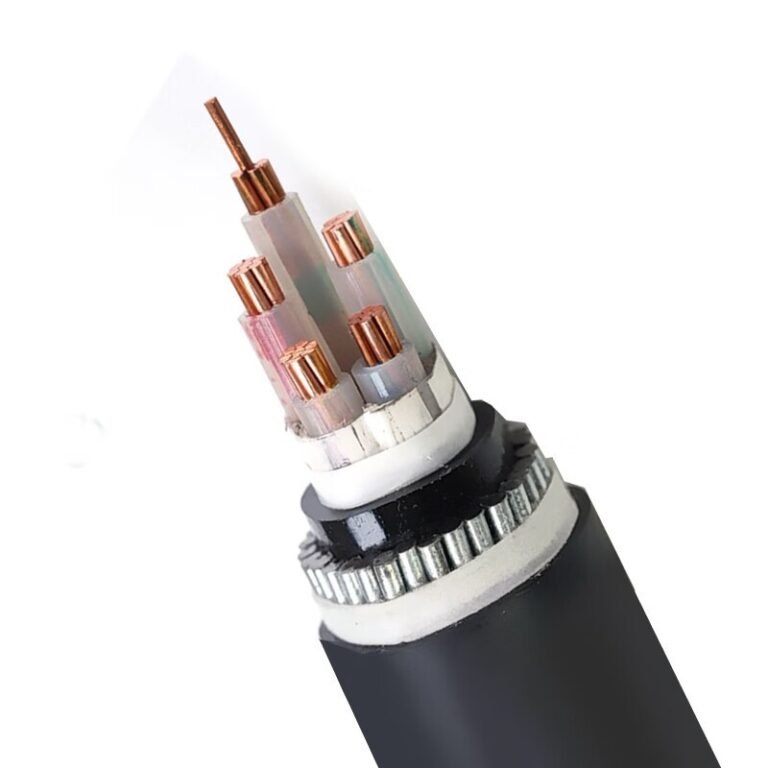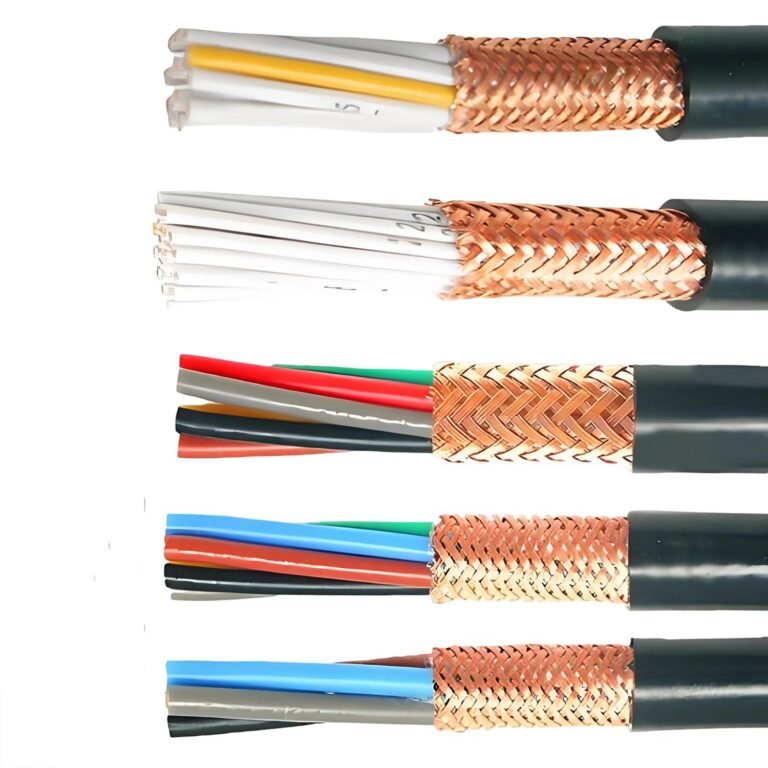
You pull an existing cable spec off the shelf for a building retrofit, hand it to procurement, and three months later the electricians are on-site discovering the installed cable can’t carry the VoIP signaling reliably — or worse, someone ordered Cat 3 thinking it would handle a modern switched Ethernet backbone. Either mistake costs you re-pull labor, conduit access fees, and schedule days you didn’t have. Understanding exactly what Cat 3 cable is, what it was designed to do, and where it still makes sense today prevents that kind of expensive confusion before the purchase order goes out.
Category 3 cable is a twisted-pair copper cable standardized under TIA/EIA-568-B and ISO/IEC 11801, rated for a maximum bandwidth of 16 MHz and data speeds up to 10 Mbps on 10BASE-T Ethernet. It uses 24 AWG solid or stranded conductors at 100-ohm characteristic impedance and remains actively used for analog telephone wiring, ISDN lines, and legacy 10BASE-T systems in commercial buildings, even though Cat 5e and Cat 6 have replaced it in new data network installations.
What keeps Cat 3 relevant — despite being technically outclassed for decades — is the sheer volume of it still running through the walls of mid-century office buildings, hotel telephone infrastructure, and industrial intercom systems worldwide. Knowing its real electrical limits, not just the headline spec, is what separates a sound reuse decision from a callback.
Governing Standards: TIA/EIA-568, ISO/IEC 11801, and What Compliance Actually Requires
Standards for structured cabling can feel like alphabet soup, and Cat 3 has accumulated more revision history than most categories. Knowing which document governs what — and which ones are now effectively retired — matters when you’re writing a specification or challenging a supplier’s compliance claim.
How the Standards Evolved
TIA/EIA-568-A, published in 1995, was the document that formally codified Category 3 as a defined performance tier. It established the electrical parameters, test methods, and installation rules that gave the industry a common baseline. Before that, manufacturers were largely working from drafts and proprietary specs, which created real interoperability headaches.
TIA/EIA-568-B.2 followed in 2001 and retained Cat 3 as a recognized category, though by that point Cat 5e was already pushing Cat 3 out of horizontal data runs. 568-B kept Cat 3 alive primarily for voice-grade applications — telephone backbone cabling, where 16 MHz bandwidth is genuinely sufficient and the economics favor it.
The more significant change came with TIA-568.2-D in 2018. That revision effectively deprecated Cat 3 for new horizontal data cabling installations. It’s not banned; it’s simply no longer recognized as an acceptable choice for new structured data cabling. Voice backbone work is still explicitly permitted. In practice, this means any specifier writing a greenfield office network today cannot cite TIA-568.2-D compliance and specify Cat 3 for data — the standard won’t back them up.
ISO/IEC 11801 Class C and European Alignment
The international equivalent is ISO/IEC 11801 Class C, which maps directly to Cat 3 performance: same 16 MHz upper bandwidth limit, same 100-ohm characteristic impedance (±15%), same general conductor geometry. If you’re procuring for a project in Europe, you’ll more commonly see CENELEC EN 50173-1 cited — that standard aligns with ISO/IEC 11801 and is what European specifiers typically reference in tender documents. Functionally, a cable meeting TIA Cat 3 and one meeting EN 50173-1 Class C should perform identically; the test methods differ slightly at the margins, so check which standard your verification lab used.
The Electrical Parameters That Actually Matter
A compliant Cat 3 cable must meet all of the following, not just one or two:
| Parameter | Limit | Frequency / Condition |
|---|---|---|
| Attenuation (insertion loss) | ≤ 11.5 dB per 100 m | At 10 MHz |
| NEXT loss | ≥ 26 dB | At 10 MHz |
| DC resistance | ≤ 9.38 Ω per 100 m | 24 AWG solid, 20 °C |
| Characteristic impedance | 100 Ω ± 15% | 1–16 MHz |
Return loss requirements exist as well, though they’re less commonly cited in supplier datasheets — worth requesting explicitly if you’re qualifying a new source. Attenuation climbs with temperature, so that ≤11.5 dB figure assumes roughly 20°C; in a plant environment running 40–50°C, derate accordingly.
Third-Party Verification: What the Marks Mean
UL Listing and ETL Verification are both recognized third-party marks in North American markets. UL Listed means the cable has been tested and the manufacturer’s production is subject to periodic follow-up inspection. ETL Verified (Intertek) carries equivalent weight. Neither is legally mandatory for most commercial installations, but any serious procurement spec should require one of them — it’s the only way to know the cable was actually tested rather than self-declared.
CE marking is required for product sold into the EU market under the Low Voltage Directive and the RoHS Directive (Restriction of Hazardous Substances). RoHS compliance means lead, cadmium, hexavalent chromium, and certain brominated flame retardants are restricted to defined thresholds. This is not optional for EU sales, full stop.
Reading the Cable’s Printed Legend
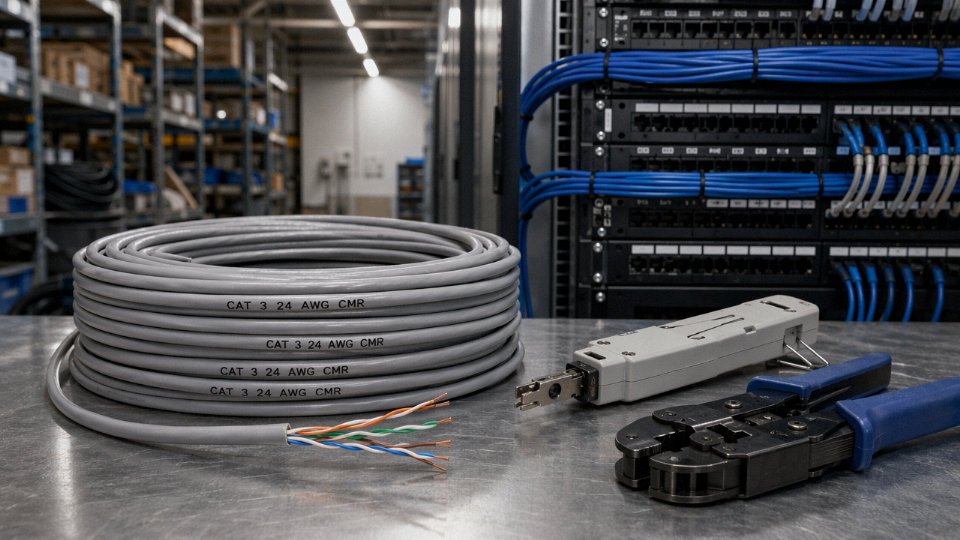
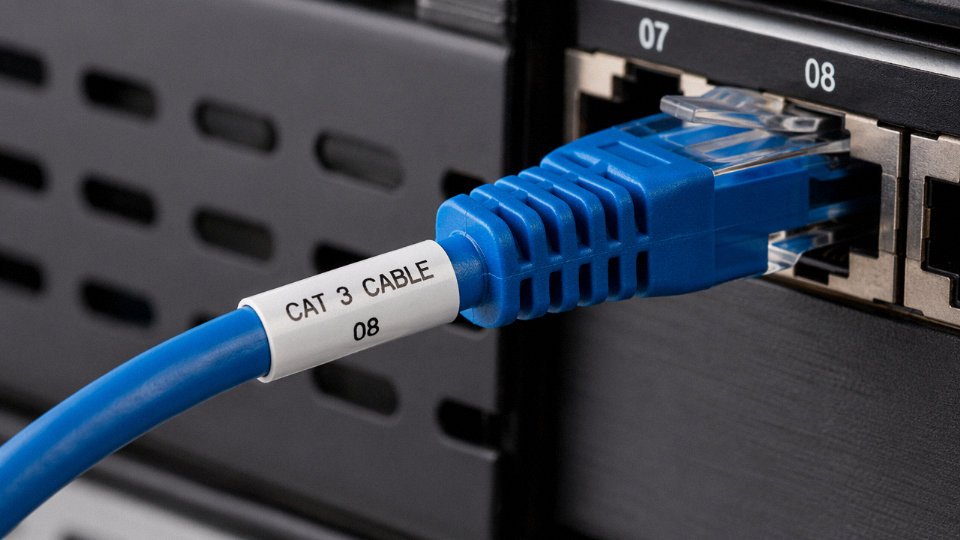
Every compliant Cat 3 cable should have a continuous print legend on the jacket. At minimum, look for the category designation (CAT 3 or Category 3), conductor AWG (24 AWG is standard), flame rating (CM for general commercial, CMR for riser, CMP for plenum), and the applicable standard or listing mark. Country of origin should appear as well.
A cable printed with 'CAT 3' is always compliant with TIA-568 electrical requirementsFalse
Print legends are not self-certifying. Without a UL Listed or ETL Verified mark — or a third-party test report against TIA/EIA-568 or ISO/IEC 11801 parameters — the category designation on the jacket is an unverified manufacturer claim. Counterfeit and misrepresented cabling exists in the market, particularly in bulk commodity channels.
If the legend is missing the flame rating or the listing mark, treat it as unverified product regardless of what the datasheet says. In my experience, this is where budget sourcing goes wrong — the price looks right, the spec sheet looks fine, and the actual cable sitting on the reel tells a different story.
Electrical Performance Specifications: Bandwidth, Attenuation, NEXT, and Impedance in Detail
Cat 3 cable’s electrical behavior is defined by a handful of interdependent parameters, and understanding how they interact is what separates a sound engineering decision from a cable-plant problem that takes weeks to diagnose.
Frequency-versus-Attenuation: The 16 MHz Ceiling
Insertion loss climbs with frequency — that’s unavoidable physics — but the rate of climb is what limits Cat 3 to 16 MHz of usable bandwidth. TIA/EIA-568-B specifies maximum attenuation per 100 m (328 ft) at several test frequencies:
| Frequency | Max Attenuation (dB/100 m) |
|---|---|
| 1 MHz | ~2.6 dB |
| 4 MHz | ~5.6 dB |
| 8 MHz | ~8.5 dB |
| 10 MHz | ~11.5 dB |
| 16 MHz | ~14.9 dB |
These figures assume 20°C ambient, solid 24 AWG copper, and a full 100 m segment. Shorten the run, and attenuation drops proportionally — which is why 10BASE-T over Cat 3 works reliably at 90 m even in older buildings where the cable has aged a bit. Push past 16 MHz and the insertion loss climbs steeply enough that receiver margins collapse. That’s the hard ceiling.
NEXT: Why Twist Rate Matters More Than People Expect
Near-End Crosstalk loss (NEXT) measures how much of a transmitted signal leaks electromagnetically into an adjacent pair at the same end of the cable. At 10 MHz, TIA-568-B requires a minimum NEXT of 26 dB — meaning the coupled interference must be at least 26 dB below the transmitted signal. That sounds comfortable until you compare twist rates. Cat 5e demands roughly 3 or more twists per foot per pair; Cat 3 typically runs somewhere around 1.5–2 twists per foot, depending on the manufacturer. Fewer twists mean less electromagnetic cancellation between pairs, and that’s exactly why NEXT performance degrades above 16 MHz and why Cat 3 simply cannot support 100BASE-TX, which relies on tight-pair coupling suppression across a 100 MHz bandwidth.
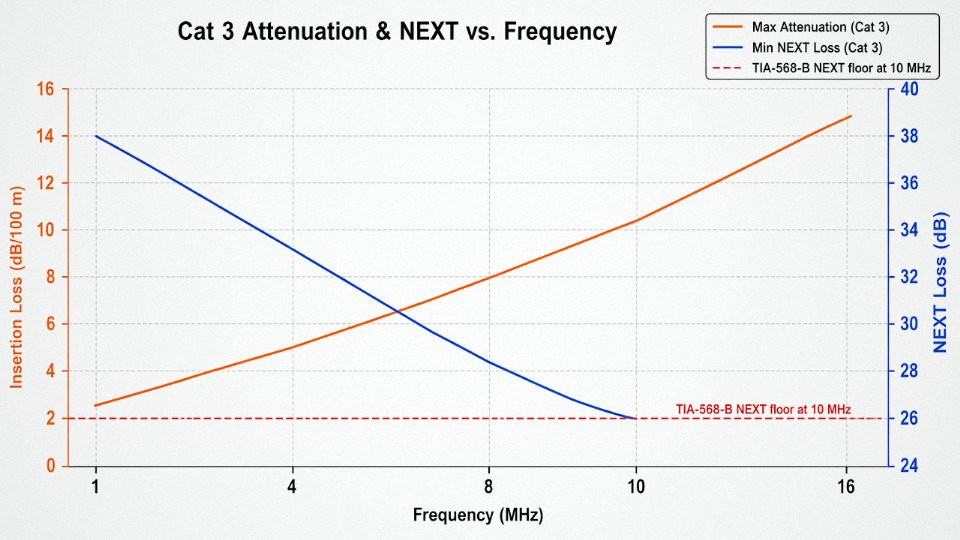
Cat 3 cable meets a minimum NEXT requirement of 26 dB at 10 MHz per TIA/EIA-568-B.True
TIA/EIA-568-B Table 4 specifies 26 dB minimum NEXT loss at 10 MHz for Category 3 horizontal cabling, a value reproduced in ISO/IEC 11801 Class C channel requirements.
Propagation Delay and Skew: The 100BASE-T4 Constraint
Maximum propagation delay for Cat 3 is 570 ns per 100 m at 10 MHz. That’s not usually an issue for telephone or basic 10BASE-T. It becomes relevant for 100BASE-T4, which splits traffic across all four pairs simultaneously — if one pair delivers its data window 45 ns or more behind the others, the receiver can’t reassemble the frame correctly. The maximum allowable delay skew between any two pairs is 45 ns per 100 m. In practice, skew problems show up most often in cable that’s been re-terminated multiple times or pulled through conduit with sharp bends, both of which subtly distort the twist geometry unevenly across pairs.
DC Resistance, Capacitance, and Impedance
DC loop resistance for a 100 m Cat 3 segment runs roughly 18–20 ohms depending on conductor quality and temperature. Mutual capacitance between pairs is specified at no more than 17 pF per foot — exceeding that value raises the cable’s characteristic impedance below the 100 ohm ±15% band and creates reflections. In telephony environments, capacitance matters most for voice quality and ringing voltage; in Ethernet, impedance deviation causes return loss problems that manifest as intermittent link drops rather than clean failures, which makes them genuinely annoying to trace.
Temperature Effects on Real Installations
Attenuation increases roughly 0.4% per degree Celsius above the 20°C reference temperature. Run Cat 3 in an unconditioned attic in a warm climate where summer temperatures hit 50–55°C, and you’re looking at an effective attenuation increase of 12–14% over the rated figure. On a borderline-length run, that’s enough to push a 10BASE-T link into marginal territory. Basements and outdoor conduit in cold climates go the other direction — attenuation decreases slightly, but dielectric moisture ingress from condensation cycling tends to raise capacitance over time, eventually degrading NEXT.
Performance Gap vs. Cat 5e and Cat 6
| Parameter | Cat 3 | Cat 5e | Cat 6 |
|---|---|---|---|
| Bandwidth | 16 MHz | 100 MHz | 250 MHz |
| Max attenuation at 100 MHz | Not rated | ~22 dB/100 m | ~19.8 dB/100 m |
| NEXT at 10 MHz (min) | 26 dB | ~47 dB | ~54 dB |
| Typical max data rate | 10 Mbps (Ethernet) | 1 Gbps | 10 Gbps (to ~55 m) |
The gap is not subtle. Cat 5e offers roughly 21 dB more NEXT headroom at 10 MHz alone. For any new installation where future bandwidth upgrades are even a remote possibility, the incremental material cost of Cat 5e over Cat 3 is far smaller than the labor cost of pulling new cable later.
Current and Legacy Applications: Telephone Systems, ISDN, 10BASE-T, and Alarm Wiring
Cat 3’s application landscape splits cleanly into two camps: places where it’s still the right tool, and places where someone is using it because it was already there and nobody’s replaced it yet. Understanding which situation you’re actually dealing with matters — specifying new Cat 3 for a voice distribution system is a reasonable procurement decision; leaving Cat 3 in place under a Gigabit Ethernet switch is a fault waiting to be logged.
Analog Telephone and PBX Distribution
This is where Cat 3 remains genuinely current. Analog voice (POTS) consumes roughly 4 kHz of bandwidth under normal signaling conditions — a rounding error relative to Cat 3’s 16 MHz ceiling. Hotel properties, mid-size office blocks, and residential MDUs (multi-dwelling units) with conventional PBX or key-system telephony have no electrical reason to over-specify. Hundreds of millions of existing telephone outlets worldwide are wired with Cat 3 or equivalent UTP, and a meaningful fraction of those continue to be installed new, particularly in regions where VoIP adoption is slower or where a building owner is extending an existing analog PBX rather than replacing it. The cable handles ring voltage, DC loop current, and DTMF signaling without complaint. Pulling Cat 5e instead would work, obviously, but at 1.3–1.8× the material cost per metre (depending on copper pricing and jacket type), the delta adds up fast across a 200-room hotel corridor run.
ISDN BRI
ISDN Basic Rate Interface runs two 64 kbps B-channels plus a 16 kbps D-channel — 160 kbps aggregate. Cat 3 handles this with enormous headroom. In practice, the installations that haven’t migrated to VoIP or SIP trunking tend to be older healthcare facilities, government offices, and industrial sites where the ISDN connection ties into a piece of equipment nobody wants to reconfigure. These aren’t glamorous applications, but they’re real, and specifying Cat 3 for them is technically and commercially defensible.
10BASE-T Ethernet in Legacy Industrial and Building Automation
Some SCADA front-ends, older Allen-Bradley and Siemens PLCs, and first-generation access control panels communicate over 10BASE-T at 10 Mbps — and that infrastructure is frequently Cat 3. Replacing it isn’t a cable question; it’s a change-management question. You’re touching live automation segments, which usually means a planned maintenance window, updated network diagrams, and sign-off from the controls engineer. Until that work is scheduled and budgeted, Cat 3 continues to carry the traffic it was designed for, and there’s no immediate performance argument for pulling it out.
Security, Fire Alarm, and Intrusion Detection Wiring
Fire alarm signal circuits, conventional zone wiring, and many intrusion detection loops specify 22 AWG or 24 AWG UTP meeting Cat 3 parameters. Bandwidth requirements here are minimal — often sub-kilohertz supervisory signals — and the cable selection is driven primarily by conductor gauge, listed jacket ratings (plenum vs. riser), and the panel manufacturer’s approval list rather than any networking performance spec. At scale, the cost difference between Cat 3-equivalent alarm cable and Cat 5e is meaningful: on a 50,000 m² commercial project with hundreds of detector drops, that delta can run to several thousand dollars in cable cost alone, before labour.
100BASE-T4 and the 100 Mbps Question
Cat 3 is technically capable of supporting 100BASE-T4 Ethernet — 100 Mbps using all four pairs simultaneously with 8B6T line encoding.
Cat 3 cable can carry 100 Mbps Ethernet using the 100BASE-T4 standardTrue
100BASE-T4 was ratified in IEEE 802.3u and operates at 25 MHz per pair across four pairs simultaneously, within Cat 3's 16 MHz per-pair specification. It is obsolete but technically valid.
That said, finding 100BASE-T4 equipment today is difficult. Cat 5e became universal fast enough that 100BASE-T4 barely saw real deployment, and it’s essentially irrelevant for any new installation.
Where Cat 3 Does Not Belong
Be direct about this. Cat 3 is not appropriate for Gigabit Ethernet (1000BASE-T requires 100 MHz per pair), any PoE application above Class 1 (conductor gauge and mutual capacitance both create thermal and signal integrity problems under sustained power delivery), structured cabling in new data centres, wireless access point backhaul, or any application where the bandwidth requirement exceeds 16 MHz. Using it in those contexts doesn’t just underperform — it creates intermittent faults that are genuinely annoying to diagnose because the cable looks fine to a basic continuity test.
Installation Best Practices: Pull Tension, Bend Radius, Termination, and Testing Requirements
Getting Cat 3 cable into the wall is straightforward — until it isn’t. Most field failures I’ve seen traced back not to bad cable but to someone pulling too hard around a tight corner, or a technician untwisting four inches of pair because “it’s just phone wire.” The physics don’t care about intent.
Pull Tension: Where Permanent Damage Begins
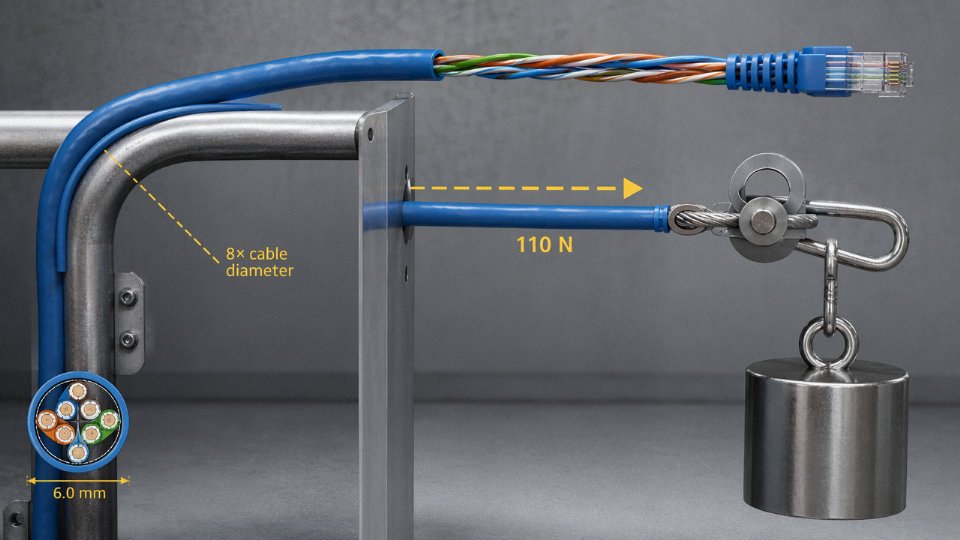
The TIA limit is 25 lbf (110 N) for a standard 4-pair Cat 3 cable. That sounds like a lot until you have 60 meters of cable dragging through a conduit with two 90-degree bends and a rookie on the far end. Exceeding this threshold stretches the copper conductor — 24 AWG solid in particular has almost no give — which increases DC resistance and, critically, disturbs the twist pitch. Once the twist geometry shifts, NEXT degrades in a way that cannot be corrected after the fact. The cable has to come out.
In practice, use a tension gauge on any pull longer than roughly 30 meters or through more than two bends. Spring scales cost almost nothing. A marginally-failed NEXT result on a link that otherwise looks fine is almost always a tension or bend problem, not a cable defect.
Bend Radius: Deforming the Twist Is Silent Damage
Minimum bend radius during pulling is 4× the cable outer diameter — for most Cat 3 cables that outer diameter runs 4.5–5.5 mm depending on jacket compound and number of pairs, so the working radius comes out somewhere around 18–22 mm. At rest, once the cable is seated, you can relax that to roughly 1× OD, though there’s no good reason to push it that tight at a junction box.
Tight bends are seductive because they look neat. A cable stapled hard into a 90-degree corner at a stud looks tidy; it also has a local impedance discontinuity right there. Voice-only telephone runs tolerate this badly enough. If the circuit is carrying 10BASE-T data, that same corner can generate reflections that push attenuation past the Cat 3 limit at 10 MHz.
Pair Untwisting at Termination: 13 mm Is Not a Suggestion
TIA-568 specifies a maximum of 13 mm (half an inch) of untwist at each termination point. That is less than the width of two fingers. The reason is specific: untwisted parallel conductors at a punchdown block act as a small loop antenna, coupling noise between pairs — exactly what the crosstalk specifications are trying to prevent. At 16 MHz the coupling is measurable; at voice frequencies it usually doesn’t matter, which is why generations of telephone technicians developed the habit of untwisting several centimeters and never noticed a problem. Data runs are less forgiving.
Use a proper 110-style or Krone-style IDC block and seat the pairs fully with a punchdown tool. Don’t pre-strip more conductor than you need. This is one of those things where technique matters more than equipment.
Termination Hardware: Mixing Categories Has Consequences
Terminating Cat 5e cable on Cat 3-rated IDC blocks degrades the link's performance to Cat 3 levels, regardless of the cable's own specification.True
The termination hardware defines the weakest electrical point in the link. Cat 3-rated jacks and blocks are not manufactured to the tighter geometric tolerances required for Cat 5e NEXT performance. The entire channel is limited by its worst component.
Cat 3 cable on Cat 6 jacks is electrically harmless and the NEXT performance of the jack won’t cause problems — it just costs more than it needs to. The reverse situation, running Cat 5e to a Cat 3 jack because “we had spares,” routinely produces marginal test results and wastes the cable investment entirely.
Conduit Fill, Bundling, and Power Separation
Keep conduit fill below 40%. This is partly a thermal issue, partly a future-access issue — anyone who has tried to pull additional pairs through a fully packed conduit knows why. Separation from unshielded power cables running parallel should be at least 50 mm, per NEC Article 800 for communications wiring. Crossing power cables perpendicularly is fine; running beside them for a meter is where interference accumulates.
Field Testing Before Handover
Every link needs a TIA TSB-67 Level II autotest at minimum: wiremap, length, attenuation, and NEXT. A marginal NEXT failure — one where the cable just barely misses the limit — almost always points to one of three things: a damaged pair from over-tensioning, excess untwist at a punchdown, or the wrong jack category. Length failures that look slightly long usually indicate a velocity-of-propagation mismatch because the tester was set up for a different cable type. Document pass/fail records per link and hand them over with the project. If a circuit develops a fault in year three, that test record is the difference between a quick diagnosis and a full retrace.
Cat 3 vs. Cat 5e vs. Cat 6: When Upgrading Is Worth It and When It Is Not
The honest answer is that the right choice depends almost entirely on what the cable has to carry — now and in roughly the next decade. Upgrading for its own sake wastes money. Staying with Cat 3 in the wrong application wastes time and labor when you eventually rip it out anyway.
The Cost Math Most Specifiers Get Wrong
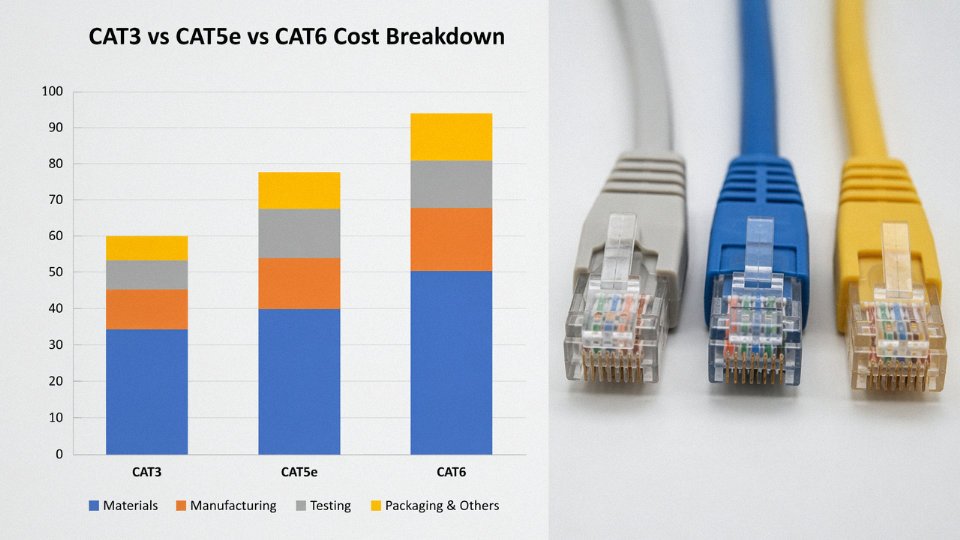
Cat 3 4-pair UTP typically runs 20–35% less per meter than Cat 5e and 40–55% less than Cat 6, depending on conductor count, jacket material, order volume, and whether you’re buying from a regional distributor or direct from a manufacturer. On a 100-outlet installation, that sounds significant. It rarely is, once you account for the full project.
Labor — pulling, dressing, terminating, labeling, testing — runs nearly identical regardless of cable category. A journeyman installer spending 45 minutes on a Cat 3 drop spends roughly the same 45 minutes on Cat 6. That labor typically represents 75–85% of total installed cost per outlet, which means the cable material saving, real as it is, only shifts your total project cost by somewhere in the 5–15% range. Worth capturing on a 2,000-outlet hotel, not worth agonizing over on a 40-outlet office retrofit.
Decision Rule 1: Voice-Only Buildouts
If an area will carry analog voice lines exclusively — hotel room telephone outlets, warehouse intercom drops, standalone burglar alarm or fire alarm wiring — Cat 3 is technically sufficient and will remain so for the foreseeable service life of the installation. The bandwidth headroom for plain old telephone service is trivial. Spending on Cat 5e here is purely speculative value against an unlikely future.
This applies most cleanly to high-count riser cabling in buildings where the PBX is fixed and IT has no plans to consolidate voice and data infrastructure. In those cases, the cost saving is real and defensible.
Decision Rule 2: Mixed-Use or Unknown-Future Applications
Even one data drop in a wiring closet changes the calculation. A uniform infrastructure that can be repurposed without a second pull is almost always worth the marginal cable cost difference. In practice, the material cost delta between Cat 3 and Cat 5e on a mixed-use floor rarely exceeds a few hours of labor for a future upgrade pull — so you’re effectively deciding between spending slightly more now or spending significantly more later, with downtime. Install Cat 5e throughout and don’t look back.
Decision Rule 3: Brownfield and Retrofit Work
Splicing into or extending an existing Cat 3 backbone in a functioning telephone system is one of the few situations where like-for-like Cat 3 replacement is genuinely appropriate. Pulling Cat 5e into a legacy riser only to terminate it on 110-blocks punched at Cat 3 performance gives you nothing — the weakest link governs, and you’ve just paid a premium for cable that performs identically to what it replaced.
PoE: Where Cat 3 Gets Dangerous
802.3af Class 0 PoE at up to 15.4 W technically operates on Cat 3 for short runs, but the higher DC resistance of 24 AWG Cat 3 conductors — especially on runs approaching 90 m — causes measurable voltage drop and heat rise in the bundle. On high-pair-count cables or bundled drops, that heat accumulates. 802.3at (PoE+, 30 W) and 802.3bt (up to 90 W) should never be deployed on Cat 3. Full stop.
802.3bt PoE at 90 W can be safely run on Cat 3 cable for short distancesFalse
Cat 3's higher DC resistance and limited heat dissipation make it unsuitable for 802.3bt regardless of run length; IEEE 802.3bt specifies minimum cabling requirements that Cat 3 does not meet.
Summary Decision Matrix
| Application | Cat 3 | Cat 5e | Cat 6 |
|---|---|---|---|
| Analog voice only | Suitable | Over-specified | Over-specified |
| 10 Mbps data (10BASE-T) | Suitable | Suitable | Suitable |
| 100 Mbps data (Fast Ethernet) | Not suitable | Suitable | Suitable |
| 1 Gbps data (Gigabit Ethernet) | Not suitable | Suitable (with caveats) | Preferred |
| 802.3af PoE (≤15.4 W, short runs) | Marginal — verify run length | Suitable | Suitable |
| 802.3at / 802.3bt PoE+ / PoE++ | Not suitable | Suitable | Preferred |
| Future-proof mixed-use infrastructure | Not suitable | Acceptable | Preferred |
The table is blunt for a reason. Cat 3 occupies a narrow but legitimate space. Outside that space, the cost saving evaporates against the risk of a second pull.
Procurement Guide: Conductor Material, Jacket Options, Reel Lengths, and Quality Verification
Sourcing Cat 3 cable in bulk is deceptively straightforward until a shipment arrives and you start pulling it through conduit — or worse, until a VoIP system starts throwing errors six months into service. Getting the specification right before you issue a purchase order saves real money.
Conductor Material: Why CCA Should Be a Hard No
Bare annealed solid copper (BC) is the correct conductor for any fixed horizontal run. It gives you the lowest DC resistance, bonds cleanly to 110-punch-down terminals, and is what every TIA and ISO performance table was built around. Stranded BC is the right call for patch cords, flexible drop cables, and anywhere the cable sees repeated movement — solid conductors fatigue and crack if you flex them repeatedly, which is a failure mode that shows up quietly as intermittent contact resistance.
Copper-clad aluminum, usually marketed as CCA, is sold into this market as a cost-reduction play. Reject it. CCA’s resistivity runs roughly 61% higher than solid copper, which means voltage drop and I²R heating that the Cat 3 spec never accounted for. For pure voice analog circuits on short runs you might never notice, but any application with powered devices — even low-current PoE used on older phone systems — or runs approaching 90 m will misbehave. The insulation and jacket look identical to a genuine BC cable in a visual inspection, so the only reliable check is a conductor resistance measurement on arrival, or an XRF (X-ray fluorescence) test on the conductor itself. Some procurement teams now request mill certificates tied to the copper lot. That’s not paranoia; it’s reasonable due diligence.
Jacket Options: Match the Environment First
Standard PVC with a CMR (riser-rated) jacket is the default for most commercial building vertical and horizontal runs. It’s cost-effective and widely available.
If the cable runs through an air-handling plenum space, NEC Article 800 requires CMP-rated (plenum) cable — typically jacketed with FEP or a plenum-grade PVC compound. Substituting CMR in a plenum ceiling is a code violation and a fire insurance issue, not just a performance concern.
LSZH (Low Smoke Zero Halogen) jackets are specified in enclosed public spaces: tunnels, rail stations, offshore platforms, and any environment where a cable fire could trap people with toxic combustion gases. LSZH Cat 3 carries a cost premium of roughly 15–25% over standard PVC, depending on order volume and market conditions for fluoropolymer and halogen-free compound feedstocks. Don’t specify LSZH reflexively — it’s a genuine safety requirement in some environments, but it also degrades UV resistance and sometimes flexibility, which matters in certain installation scenarios.
Reel Lengths and Length Accuracy
Standard boxed reels of 305 m (1,000 ft) are the international default for pull-through installations and match what most cable analyzers and installers expect. Large infrastructure projects — campus telephony, building retrofits, rail corridor cabling — typically run 500 m or 1,000 m wooden or plastic drums to reduce reel changeovers and labor cost.
Check the length marking. Sequential meter printing along the jacket is the reliable indicator; absent that, a supplier claiming exact footage on a generic unmarked reel is a yellow flag. Short-length reels are a documented problem in commodity cable markets and one that only shows up when you’re 40 m short on the last run of a floor.
Color Coding and Pair Identification
TIA-568-B specifies the four-pair color sequence: Blue/White-Blue, Orange/White-Orange, Green/White-Green, Brown/White-Brown. Before accepting a bulk shipment, pull a sample and check that insulation colors are consistent and not faded — color fastness matters because technicians rely on visual pair ID during termination and fault-finding years later. Also verify pair twist consistency across the reel length. Uneven twist rates are a manufacturing quality indicator and affect NEXT performance, even on a 16 MHz cable.
Quality Verification for International Orders
Request third-party test reports from UL, ETL, or an accredited national lab — not just the manufacturer’s own in-house data sheet. Review the Certificate of Conformance for the specific production lot, not a generic product document. On arrival, run incoming inspection with a calibrated cable analyzer against the key parameters: conductor resistance, characteristic impedance, attenuation, and NEXT at the relevant test frequencies.
UL and ETL file numbers for listed cable products can be verified online against the official UL Product iQ databaseTrue
UL maintains a publicly searchable Product iQ database at iq.ul.com where buyers can confirm the validity of any UL or cUL listing by file number, covering cable and wire products including telecommunications cable.
Counterfeit UTP cable with inflated category markings is a documented problem in global markets, and Cat 3 is not immune — the category label costs nothing to print on a jacket. Verifying the UL or ETL file number takes about two minutes and has stopped more than a few bad shipments.
Sustainable Procurement Considerations
RoHS II compliance is the minimum baseline for any cable entering the EU market: it restricts lead, cadmium, mercury, hexavalent chromium, PBB, and PBDE in cable compounds. Request a REACH SVHC declaration from the manufacturer and confirm it covers the specific jacket and insulation compounds, not just a boilerplate statement. End-of-service-life recyclability is worth factoring in for larger projects — copper conductors recover cleanly, and most PVC jacket material can be recycled through appropriate streams, though LSZH compounds vary by formulation and some halogen-free compounds are harder to recycle than standard PVC. Ask the supplier to specify the exact compound family if recyclability is a documented project requirement.
Frequently Asked Questions About Category 3 Cable
Can Cat 3 cable run Gigabit Ethernet?
No — and this is not a matter of run length or signal boosting. Gigabit Ethernet (1000BASE-T) requires a minimum channel bandwidth of 100 MHz and uses all four pairs simultaneously with complex DSP-based signalling. Cat 3’s bandwidth ceiling is 16 MHz. At frequencies above that, attenuation climbs steeply and NEXT performance is undefined because the standard never tested for it. There is no patch, no signal repeater, and no firmware setting that changes the physics. If a building has Cat 3 horizontal runs and someone asks whether Gigabit is possible, the answer is to pull new cable — Cat 5e at minimum.
Is Cat 3 cable still manufactured and sold new?
Yes, in meaningful volume. Analog voice infrastructure, two-line telephone systems, intercom wiring, basic alarm loops, and legacy 10BASE-T maintenance in older commercial buildings all keep demand alive. Most reputable cable manufacturers — including large-format producers serving international projects — still stock Cat 3 UTP in standard 305 m boxed reels and on larger drums (typically 500 m or 1,000 m depending on conductor gauge and jacket weight). Lead times are usually shorter than for specialty cables; it is a mature, well-tooled product.
Cat 3 UTP cable is still actively manufactured and available new from major cable producers.True
Cat 3 remains in production for analog telephone, alarm, and legacy data applications. It is stocked by established manufacturers including Shandong Jinda and available in standard reel formats for bulk procurement.
What is the maximum run length for Cat 3 in a 10BASE-T network?
TIA-568 specifies a maximum horizontal channel length of 100 m, which includes the horizontal cable plus patch cords at both ends. That limit applies to Cat 3 the same as it does to Cat 5e or Cat 6. The 10BASE-T protocol was designed with that 100 m channel in mind, so Cat 3 is not at a disadvantage there. What you do lose with longer runs is margin — attenuation at 10 MHz is already around 11.5 dB/100 m, which leaves limited headroom if the cable is old, poorly terminated, or running near interference sources.
Can Cat 5e replace Cat 3 in an existing phone system?
Straightforwardly, yes. Cat 5e is fully backward-compatible with analog telephone equipment and ISDN terminal adapters. The extra bandwidth goes unused, but that is not a problem — it just means the infrastructure is ready if the space is ever repurposed for data. In practice, most facilities managers doing partial rewiring during a renovation choose Cat 5e even for pure-voice drops, since the cost delta on labour-intensive runs is small and you avoid a second pull later.
What is the difference between Cat 3 and “Cat 3e”?
Nothing — because “Cat 3e” is not a real designation. Neither TIA/EIA-568 nor ISO/IEC 11801 defines a Cat 3e specification. It shows up occasionally in catalogue sheets from manufacturers who appear to be borrowing the naming pattern from Cat 5e. There is no performance standard behind it, no test methodology, and no certification body that validates it. Specify Cat 3 or Cat 5e and reject anything labelled with intermediate names that lack a corresponding TIA or ISO standard number.
Does Cat 3 support PoE?
It should not be used for PoE. Higher DC resistance on 24 AWG conductors — compared to the tighter resistance specs on Cat 5e and Cat 6 — means more heat generated along the cable bundle and greater voltage drop at the powered device end. TIA TR-42 has not validated Cat 3 for PoE operation, and the bundled heat effect in a conduit running multiple PoE circuits is genuinely risky from both a performance and a cable-longevity standpoint. Use Cat 5e or Cat 6, full stop.
How do I identify Cat 3 cable already installed in a building?
Check the jacket legend first — it should read “CAT 3”, “Category 3”, or occasionally the TIA designation “TIA-568 Cat 3” printed along the length of the jacket. If the legend is illegible, a field cable tester running a Cat 3 autotest sequence (Fluke DSX, Ideal SignalTek, or similar) will tell you whether the installed cable meets Cat 3 minimums. A pass does not prove the cable is Cat 3 specifically — a Cat 5e run will also pass a Cat 3 test — but it at least confirms the channel is usable for Cat 3 applications.
What flame ratings are available, and which one do I need?
Cat 3 UTP is available in CM (general commercial use), CMR (riser-rated, for vertical runs between floors in a building), and CMP (plenum-rated, for air-handling spaces and raised-floor plenums). The right choice depends entirely on where the cable is installed, not on the application it supports. Running a CM-rated cable in a plenum space is a code violation in most jurisdictions under NFPA 70 (NEC) and equivalent national fire codes — it is also a liability issue if a fire investigation traces back to improper cable selection. When in doubt, specify CMR as a baseline for general commercial buildings; CMP for anything above a suspended ceiling that serves as an air return.