Specify the wrong cable name on a purchase order — or accept a substitute that looks close enough — and you can end up with a conductor rated for 0.6/1 kV sitting in a 6.6 kV switchroom, insulation that degrades inside eighteen months because the ambient temperature was never accounted for, or a customs hold because the IEC designation on the drum label doesn’t match the import certificate. Any one of those scenarios costs more than the cable itself, often by a factor of three to five once you count installation rework, unplanned downtime, and the procurement cycle starting over from scratch.
A power cable is a general term covering any insulated electrical conductor or assembly of conductors designed to transmit electrical energy. Depending on voltage class, application, and regional standard, it may be called a low-voltage (LV) cable, medium-voltage (MV) cable, high-voltage (HV) cable, armored cable, flexible trailing cable, or by a designation such as NYY, XLPE SWA, or ACSR — each name encodes specific construction, insulation material, and performance requirements.
What makes this naming question genuinely complicated is that there is no single universal convention. The IEC world, the North American NEC world, and legacy national standards from Germany, the UK, China, and elsewhere have all produced overlapping terminology for cables that may be physically identical. An engineer who knows the cable they want but doesn’t know the right name for the market they’re buying into will waste weeks chasing quotes for the wrong product.
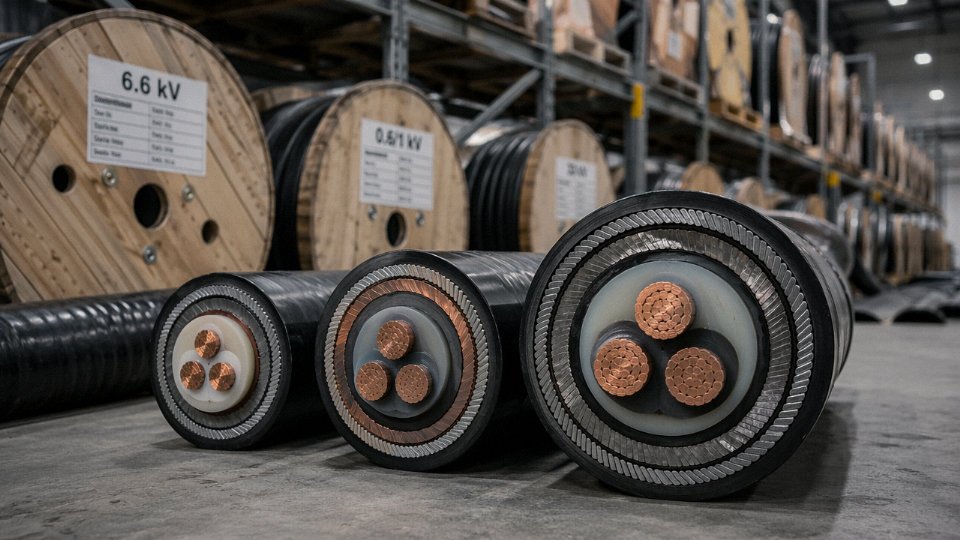
The Full Taxonomy: Every Official Name and Designation a Power Cable Can Carry
Walk into a procurement office handling a substation expansion and you’ll hear at least a dozen different cable names thrown around in one meeting — “YJV,” “SWA armored,” “MV-105,” “tray cable.” They’re not interchangeable. Each name carries embedded technical information about voltage class, insulation chemistry, construction, and installation context. Getting the designation wrong on a purchase order doesn’t just cause delays; it can mean a cable rated for conduit burial ends up in a cable tray, or a PVC-sheathed cable goes into a substation where a fire-retardant grade was required by code. Here’s how the naming system actually works.
Voltage-Class Designations
The most fundamental split is by operating voltage, and the boundaries are reasonably consistent across IEC, IEEE, and most national standards — though the exact cutoffs shift slightly depending on which edition you’re reading.
Low-voltage (LV) cables handle up to 1 kV and cover the vast majority of building wiring, motor connections, and distribution boards in residential and light commercial work. This is the 0.6/1 kV class you see everywhere. Medium-voltage (MV) cables run from roughly 1 kV up to 35 kV and are the workhorses of industrial plant distribution and utility feeders — the 6 kV, 10 kV, and 35 kV cables feeding large motors, substations, and wind farm collector systems. High-voltage (HV) cables span about 35 kV to 220 kV and appear in transmission links, cable-fed grid substations, and urban underground transmission corridors where overhead lines aren’t viable. Extra-high-voltage (EHV) cables — above 220 kV, sometimes 500 kV and above — are specialized equipment for bulk power transmission and HVDC interconnects; the design tolerances and factory testing requirements at this level are in a completely different league from anything below.
Insulation-Based Names
The insulation material defines not just a name but a performance envelope. PVC cable is cheap, flexible, and fine for general LV use, but it softens above roughly 70 °C and produces dense toxic smoke in a fire — not acceptable in tunnels or occupied buildings without additional fire ratings. XLPE cable (cross-linked polyethylene) operates to 90 °C continuously, handles moisture well, and now accounts for more than 60% of MV and HV insulation globally because the thermal and dielectric properties are simply better than PVC at those voltages. EPR (ethylene propylene rubber) costs more but stays flexible at low temperatures and tolerates wet environments unusually well — you’ll find it on offshore platforms and mining equipment. PILC (paper-insulated, lead-covered) cable is legacy infrastructure; it’s still in the ground under half the world’s old urban grids, but nobody’s specifying it for new installations. Mineral-insulated (MI) cable is its own category: compressed magnesium oxide insulation inside a metal sheath, virtually indestructible in fire, used for emergency circuits in hospitals, tunnels, and process plant safety systems.
Construction-Based Names
How a cable is built determines what environments it can survive, so construction terminology gets embedded in utility and contractor specifications.
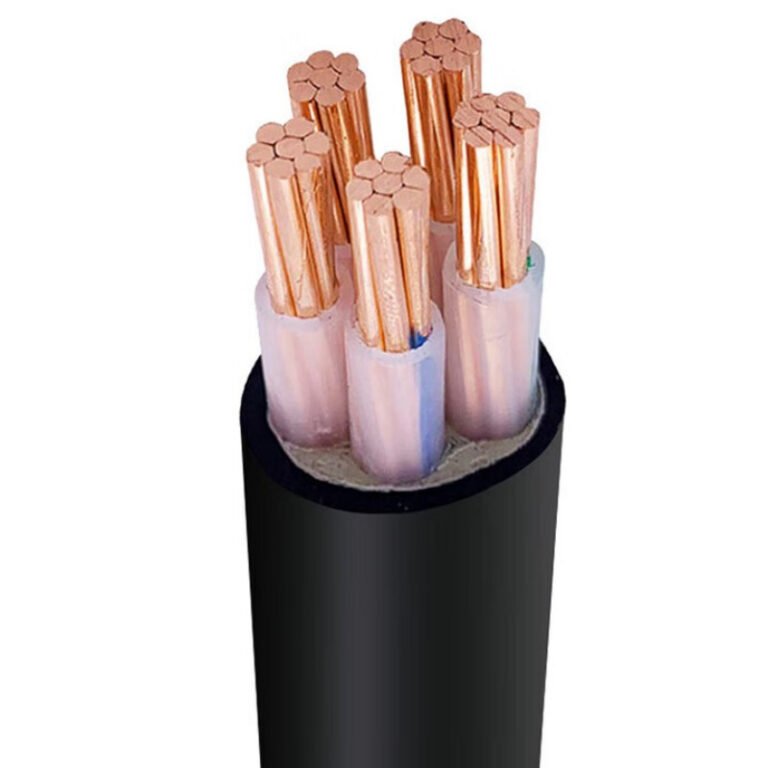
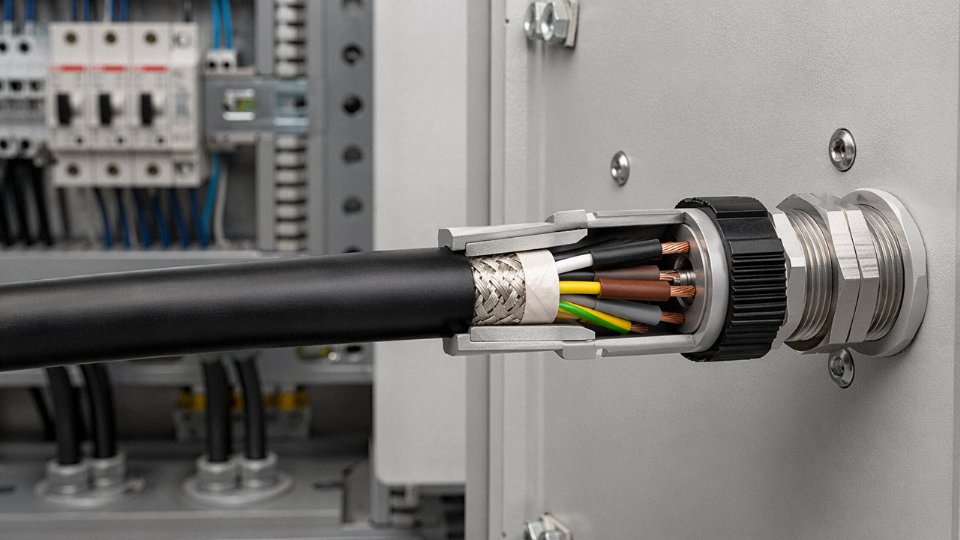
Armored cable — whether steel wire armored (SWA), steel tape armored (STA), or aluminum wire armored (AWA) — is named by its mechanical protection layer. SWA is the standard for direct burial and heavy industrial environments. AWA is specified where eddy current losses in steel armor would matter, particularly on single-core HV cables. Unarmored cable relies on conduit or tray for protection. Concentric cable has a neutral conductor wound concentrically around the core — common in utility service drops. Screened cable carries a metallic screen over the insulation for electric field control, which is mandatory at MV and above. Aerial bundled cable (ABC), sold in duplex, triplex, or quadruplex configurations, is a bundled overhead LV system that replaced bare open-wire distribution in many markets because it dramatically reduces fault rates and illegal tapping.
Application-Specific Names
Beyond construction, cables get named by their job. Feeder cable carries power from a source to a distribution point without intermediate taps. Distribution cable serves multiple loads along its run. Submersible cable is built to operate continuously submerged, with a water-blocking compound or longitudinal water seal — the construction matters, not just IP rating. Tray cable (TC rating in North American codes) is specifically tested and listed for installation in open cable trays without conduit. Service entrance cable (SE and USE types) is rated for the connection from utility service to the main panel; USE-2 is rated for underground and wet locations. Overhead transmission cable is typically an ACSR (aluminum conductor steel reinforced) or ACCC bare conductor, while underground transmission cable is insulated and often fluid-cooled at EHV.
Standard Alphanumeric Designations — and How to Read Them
Different standards bodies use structured alphanumeric strings that encode construction in sequence. The logic is similar across systems even when the codes differ.
| Designation System | Example Code | Conductor | Insulation | Sheath/Armor | Voltage |
|---|---|---|---|---|---|
| Chinese GB/IEC-derived | YJV | Copper (default) | XLPE | PVC outer sheath | 0.6/1 kV to 35 kV |
| Chinese, aluminum | YJLV | Aluminum (L) | XLPE | PVC outer sheath | same range |
| Chinese, flame-retardant | ZR-YJV | Copper | XLPE | PVC, flame-retardant | same range |
| Chinese, fire-resistant | NH-YJV | Copper | XLPE | PVC, fire-resistant | same range |
| IEC harmonized (Europe) | N2XY | Copper | XLPE | PVC | 0.6/1 kV |
| IEC, aluminum | NA2XY | Aluminum | XLPE | PVC | 0.6/1 kV |
| North American (NEC) | XHHW-2 | Copper or Al | XLPE | — (listed for conduit) | 600 V |
| North American (NEC) | MV-105 | Copper or Al | XLPE or EPR | — (MV tray/conduit) | 2001–35,000 V |
| North American (NEC) | USE-2 | Copper or Al | XLPE | — (underground service) | 600 V |
Reading a Chinese designation string — take “ZR-YJV22 8.7/15kV 3×95” as a worked example: “ZR” means flame-retardant; “Y” is XLPE insulation; “J” signals cross-linked (part of the XLPE code convention); “V” is PVC inner sheath; “22” means double steel tape armor plus PVC outer jacket; “8.7/15kV” is the conductor-to-screen / conductor-to-conductor voltage rating; “3×95” is three cores of 95 mm² copper. Strip the string apart like that and you can reconstruct the entire cable construction before you ever open a data sheet.
XLPE insulation now accounts for more than 60% of medium- and high-voltage cable insulation globally, displacing legacy PILC cables.True
This reflects well-documented industry trends reported by market research bodies and cable standards organizations; XLPE's superior thermal rating, lower installation weight, and elimination of the oil/paper maintenance burden have driven widespread adoption since the 1990s.
One practical note: in markets where both Chinese GB-style and IEC-harmonized designations are in use simultaneously — which happens often on projects with mixed international supply chains — it’s worth requiring the supplier to provide both the native designation and a plain-English construction description. Designation strings are compact and precise, but only if everyone in the procurement chain is reading the same codebook.
Regional and Industry-Specific Names: How the Same Cable Is Called Something Different Around the World
Walk into a procurement meeting where engineers from the UK, the US, and the Gulf are specifying the same substation project, and you will hear three completely different cable names for what is essentially the same construction. That confusion costs time, causes re-quoting delays, and occasionally leads to the wrong cable arriving on site. Knowing the naming map is not academic — it directly affects delivery lead times and compliance sign-off.
UK and European Market: SWA, BS 5467, and LSZH Variants
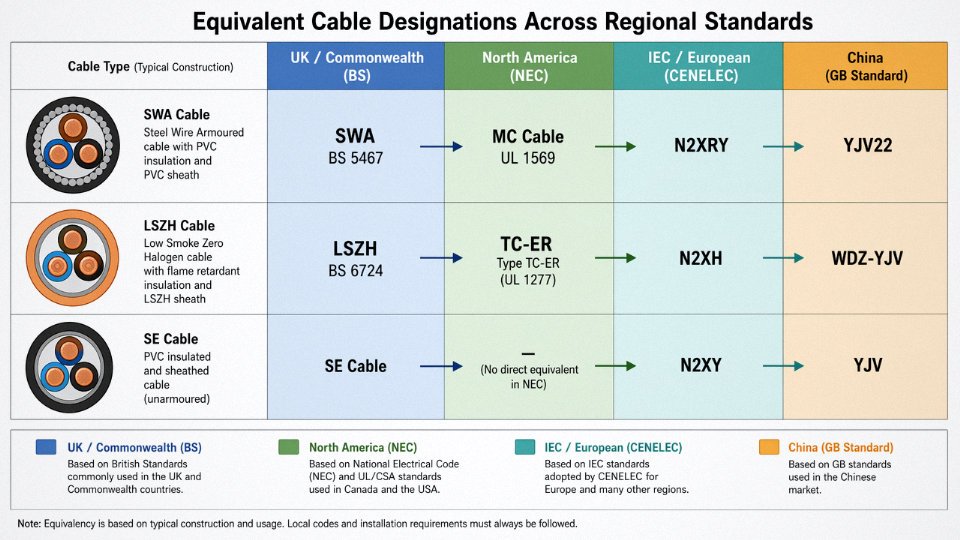
In the UK and most Commonwealth-influenced markets, the dominant name for an armoured low-voltage power cable is SWA — Steel Wire Armoured. The designation typically pairs with a standard reference: BS 5467 covers XLPE-insulated SWA, while BS 6724 covers the LSZH (Low Smoke Zero Halogen) armoured equivalent, sometimes called LSF or LSOH cable depending on who you ask. To an engineer trained on IEC 60502, these cables are immediately recognisable as 0.6/1 kV XLPE or PVC cables with steel wire armour — the construction is nearly identical. The name is just different. European continental markets lean on CENELEC harmonised designations like N2XY (XLPE insulated, PVC outer sheath, unarmoured) or N2XRY (with steel wire armour), which follow a letter-code system that, once decoded, tells you the full construction.
North American Market: NEC Type Codes and MC Cable
The US system under NEC Article 310 names cables by conductor insulation type and wet/dry rating: THHN (thermoplastic, heat-resistant, nylon jacket, dry locations), THWN-2 (rated for wet locations up to 90°C), XHHW-2 (cross-linked polyethylene insulation, wet/dry, 90°C). These are conductor designations, not complete cable assemblies in the IEC sense. The assembled product equivalents have separate names — MC cable (Metal-Clad, UL 1569) is roughly analogous to SWA for building wiring; TC-ER (Tray Cable, Exposed Run) covers multi-conductor power and control runs in industrial plants; SE cable (Service Entrance) handles utility connections to panels. A procurement manager sourcing THWN-2 for the first time from a non-North American supplier should expect some translation effort. The IEC structural equivalent is usually a 0.6/1 kV PVC or XLPE single-core cable, but the exact temperature ratings and jacket requirements need checking against project specs rather than assumed.
Middle East, Africa, and the GCC
Most Gulf Cooperation Council project specifications reference IEC standards with local addenda — SASO in Saudi Arabia, ESMA in the UAE. The trade names that circulate on site are often derived from German DIN-style designations: NYY cable (PVC insulated, PVC sheathed, unarmoured), 2XY cable (XLPE insulated, PVC sheathed), 2XRY (XLPE, steel wire armoured). These names are widely understood across Egyptian, Saudi, and East African electrical contractors, even when the project spec formally calls out an IEC number. In practice, a buyer specifying “NYY 4×16 mm²” will be understood almost anywhere from Cairo to Nairobi without further clarification.
NYY and 2XY cable designations follow a DIN/IEC-based letter-code system that encodes insulation, sheath, and armour type in sequence.True
The German VDE/DIN designation system, widely adopted across IEC-aligned markets, assigns specific letters to conductor, insulation, sheath, and armour materials — N=standard PVC sheath, Y=PVC insulation or sheath, 2X=XLPE insulation, R=round wire armour — making the full construction readable from the name alone.
Renewable Energy: PV Cable, DC Power Cable, and Wind-Turbine Cable
Solar installations have generated their own naming layer. PV cable (photovoltaic cable) or solar cable refers specifically to single-core DC cables rated to EN 50618 or TÜV 2Pfg 1169 — the UV resistance, ozone resistance, and dual-approved voltage rating (1.5 kV DC / 0.9 kV AC typically) are built into the name’s implied spec. Call it “1 kV XLPE single-core” on a solar BOM and a careful EPC contractor will push back asking for the PV-specific certifications. Wind-turbine cable adds torsional flex-life requirements on top of that — cables inside the nacelle twist continuously with yaw movement, so the “wind-turbine cable” name implies a minimum flex cycle rating, usually somewhere in the range of 3–10 million cycles depending on conductor stranding class and bend radius. Battery cable for storage systems is a related but distinct name, emphasising high current density, fine stranding, and short-circuit withstand.
Mining and Oil-and-Gas: Trailing Cable, SHD-GC, and SUBCAB
Hazardous-area applications generate some of the most specific names in the cable world. Trailing cable and reeling cable describe flexible cables designed for continuous movement — drag chains, cable reels on mining equipment — with the name implying mechanical flexibility and abrasion resistance as core requirements, not just electrical ratings. In North American mining, SHD-GC (Shielded Heavy-Duty, Ground Check) is a MSHA-regulated designation for trailing cables on high-voltage mining equipment; the “GC” element refers to a pilot conductor used for ground continuity monitoring, which is a safety-system requirement, not a convenience. SUBCAB is a trade-generic name that has become semi-standard for subsea power and control cables used on offshore platforms and ROVs, though individual manufacturer constructions vary considerably and buyers should verify crush resistance and water-blocking details rather than relying on the name alone.
Rail and Transit: Rolling-Stock Cable and Third-Rail Feeder
Rail applications layer fire-safety standards directly into the cable name. Rolling-stock cable refers to cables installed inside train cars and locomotives, where EN 45545-2 fire performance classifications (hazard levels HL1 through HL3) are essentially part of the product identity — specifying a rolling-stock cable without the HL rating is an incomplete specification. Trackside power cable covers fixed infrastructure alongside the track, typically with different UV and mechanical requirements than rolling-stock cable but sometimes similar fire classifications. Third-rail feeder cable is a more specific name for the heavy conductors supplying DC traction power to the conductor rail — construction is usually quite robust, often 1,000 mm² or larger cross-section, with insulation systems chosen for the specific DC voltage of the traction system, which ranges from 630 V to 1,500 V depending on the transit network.
The underlying lesson for procurement teams is straightforward: always ask for both the regional trade name and the IEC or applicable standard reference. One without the other leaves room for misinterpretation, especially across multi-country supply chains.
Conductor and Insulation Materials: How Material Choice Creates Sub-Names and Changes Performance
Every time a material decision gets made — copper or aluminum, XLPE or PVC, standard sheath or LSZH — the cable picks up a new layer of naming. These aren’t marketing labels. They encode real performance limits, and specifying the wrong one costs you either money upfront or a lot more money later.
Copper vs. Aluminum: The CU/AL Split
The CU prefix (from cuprum) and AL prefix appear in IEC-aligned designations and most European procurement specs. They signal more than just the conductor metal — they cascade into weight, jointing method, termination hardware, and installed cost.
A 3-core 240 mm² CU XLPE SWA cable runs roughly 13–15 kg/m depending on sheath thickness and armor construction. The aluminum equivalent sits closer to 8–10 kg/m. On a 500 m underground run, that difference matters enormously for pulling tension, conduit fill calculations, and crane capacity at the drum. Aluminum’s conductivity is about 61% that of copper on a volume basis, so AL cables are typically upsized — a 300 mm² AL conductor is the usual substitute for 240 mm² CU in LV and MV distribution. Copper stays preferred where space is tight, where vibration or repeated flexing is involved, or where the termination environment makes aluminum oxide formation a real reliability risk. Aluminum is almost always the economic choice for large-section MV feeder cables buried in stable ground, provided the jointing crew knows what they’re doing with bi-metal lugs.
XLPE vs. PVC: Why the Temperature Numbers Actually Matter
Above 1 kV, PVC insulation has largely been displaced by XLPE, and the naming reflects it. An “XLPE cable” carries a continuous operating temperature of 90°C against PVC’s 70°C — that 20-degree headroom translates directly into higher current-carrying capacity for the same conductor cross-section, or the same capacity from a smaller conductor. Short-circuit ratings tell an even starker story: XLPE handles around 250°C versus roughly 160°C for PVC. In a fault scenario, that difference determines whether your insulation survives or you’re pulling a new cable.
XLPE insulation accounts for more than 60% of medium- and high-voltage cable insulation globallyTrue
XLPE's superior thermal rating, lower dielectric loss, and moisture resistance have driven widespread displacement of traditional PILC and PVC insulation in MV and HV cable applications across major markets.
XLPE also has lower dielectric loss, which matters progressively more as voltage rises. For anything above roughly 11 kV, the efficiency argument alone often justifies the cost delta. PVC still dominates at 0.6/1 kV for short runs in commercial buildings — it’s cheaper, easier to handle in cold weather without pre-heating, and the thermal limits rarely get approached in practice.
EPR: Flexibility and Heat at a Price
Ethylene propylene rubber insulation gives you names like “EPR cable,” “rubber-insulated flexible cable,” or simply “flexible power cable” in many catalog systems. EPR stays flexible down to around -40°C, handles repeated bending cycles without cracking, and tolerates operating temperatures similar to XLPE. You’ll find it specified for trailing cables on mining equipment, offshore umbilicals, and portable generators — anywhere the cable moves rather than sits still. The cost premium over XLPE is real, typically 20–40% higher depending on conductor size and market, so don’t let it creep into static installations where XLPE does the job fine.
LSZH: When the Sheath Changes the Fire Classification
Adding “LSZH” or “LS0H” (Low-Smoke Zero-Halogen) to a cable designation changes its fire-safety classification and triggers different installation requirements and costs. Standard PVC sheathing releases hydrogen chloride when it burns — corrosive, toxic, and damaging to electronics. LSZH sheathing limits smoke opacity and halogen acid gas emission to levels defined in IEC 60754 and IEC 61034. Tunnels, offshore platforms, metro stations, and data centers almost universally mandate it. The sheath material is mechanically slightly less robust than PVC in some formulations, which is worth knowing if abrasion resistance matters on your installation.
Mineral-Insulated Cable: “Pyro” and Fire Survival
MI cable — also called “pyro cable” (from the Pyrotenax brand that became a generic term in some markets) or “fire-survival cable” — is constructed from a copper outer tube packed tightly with magnesium oxide powder around copper conductors. It maintains circuit integrity at temperatures reaching 950°C for 90–120 minutes under IEC 60331 test conditions, which is why it’s specified for fire alarm circuits, emergency lighting, and smoke extract fan feeders in high-rise buildings. It’s rigid, expensive, and requires specialist tools and trained installers to terminate properly. Use it where the circuit must survive the fire, not just not start one.
Emerging Materials: AAAC, ACAR, and XLPO
Aluminum alloy conductors — AAAC (All-Aluminum Alloy Conductor) and ACAR (Aluminum Conductor Alloy Reinforced) — have been in overhead transmission for decades but are entering underground MV cable specifications in some markets where improved sag characteristics and corrosion resistance matter. The names show up in procurement documents as distinct from plain aluminum, and the alloy composition affects both electrical and mechanical properties.
XLPO (cross-linked polyolefin) insulation is newer and gaining ground specifically in EV charging infrastructure cables, where its halogen-free chemistry and higher thermal performance suit both the fire-safety requirements of parking structures and the mechanical demands of repeatedly coiled, dragged charging cables. Expect to see “XLPO cable” appearing more frequently in EV infrastructure tenders — it’s a name that wasn’t common in procurement vocabulary five years ago and is now showing up in IEC 62893 and related standards.
Installation Environment Names: Underground, Overhead, Submarine, and Tray—How Where You Install It Renames It
Where a cable goes physically is not just a site-engineering detail — it directly determines what the cable is called in specs, purchase orders, and tender documents. Get this layer wrong and you’re either over-specifying (wasting money on armoring you don’t need) or under-specifying (and finding out at the worst possible moment, usually during commissioning or after the first wet season).
Direct-Buried, Duct, and Conduit: Three Installation Modes, Three Different Products
A cable described as “direct-burial” or carrying a “DB” suffix in North American specs, or designated with armoring code in IEC-aligned catalogs, is built to survive soil movement, ground water, and the occasional careless excavator. That typically means a steel wire armored (SWA) or steel tape armored (STA) construction over XLPE or PVC insulation, often finished with a polyethylene outer sheath rather than PVC — PE handles the moisture and abrasion cycle far better over a 30-year burial life. The naming convention matters because “armored cable” alone doesn’t tell you it’s rated for direct burial; you need to see the full designation.
Duct installation relaxes the mechanical requirement significantly. The conduit or HDPE duct takes the ground-load stress, so the cable inside can be unarmored — lighter, easier to pull through, and cheaper per meter. What changes is the pulling-tension rating and the coefficient of friction allowance in the cable schedule. Calling this “duct cable” in a spec is not informal; it’s a distinct product category with its own outer sheath hardness and minimum bend radius during installation.
Overhead Line Names: Span, Voltage, and Whether the Wind Loads Matter
Bare overhead conductors have a tightly standardized naming system that has been stable for decades. ACSR (Aluminum Conductor Steel Reinforced) carries transmission-level loads; AAC (All Aluminum Conductor) and AAAC (All Aluminum Alloy Conductor) appear in distribution and shorter spans where the steel core weight penalty doesn’t pay off. Each designation encodes the conductor geometry and mechanical rating — not just the electrical cross-section.
Aerial Bundled Cable (ABC, or ABC-XL for the cross-linked variant) is a separate product family entirely. It’s insulated, typically 0.6/1 kV, designed for last-mile distribution in areas where clearance to buildings or trees makes bare conductors unworkable. In practice, utilities in tropical and forested regions specify ABC almost exclusively now because bare-conductor tree-contact faults are an operational nightmare. Spacer cable systems sit above ABC in voltage class, used up to roughly 35 kV, with covered conductors held apart by polymer spacers — a name you’ll encounter in North American rural utility specs.
Submarine Cable: Depth, Dynamics, and Double Armor
Submarine cable naming adds layers fast. A “single-core submarine cable” for a relatively shallow inter-island grid tie looks nothing like a “three-core submarine HVDC cable” running 200 km at 320 kV, and both differ structurally from a “dynamic submarine cable” designed for a floating offshore wind platform that pitches and rolls continuously. The dynamic variant requires fatigue-rated armor wire lay angles, bend stiffener interfaces, and a flexible inner structure — naming conventions in project specifications will call this out explicitly, often referencing water depth rating, minimum dynamic bend radius (commonly in the range of 3–5 m for large-diameter designs), and whether a lead or aluminum moisture barrier is included.
Double-armor submarine cables use two contra-wound layers of steel wire to cancel torsional stress during laying and cable movement.True
Contra-helical armouring is standard practice in submarine cable design; the opposing lay directions neutralize the torque that a single armor layer would generate under tension, preventing cable rotation and internal damage during deployment and service.
Tray and Ladder: De-rating and the TC Cable Designation
In NEC-governed installations, “TC cable” (Tray Cable, per NEC Article 336) is a specific listed product — not just any cable you throw on a ladder rack. It carries a flame-resistance rating and is permitted for exposed routing in industrial facilities without additional conduit. Multicore tray cables for process plant I/O circuits typically run alongside power tray cables on the same ladder, which is where the de-rating conversation starts.
Bunched cables on a fully loaded tray carry a grouping correction factor, usually 0.7 to 0.8 depending on the number of loaded circuits and whether the tray is covered or open — the exact factor depends on your installation standard (NEC 310.15, IEC 60364-5-52, or similar) and actual fill. Ignoring this in conductor sizing is one of the more common errors in fast-track industrial projects; you size for the rated current, forget the grouping factor, and then wonder why the cables run warm in summer.
Fire-Resistant and High-Flex: When the Operating Condition Becomes the Name
Fire-survival cables are named almost entirely by their performance test category. FP200 and FP600S (Prysmian product designations that have become de facto industry shorthand in UK building services) reference the IEC 60331 and BS 8519 fire-resistance classifications. “Emergency circuit cable” and “circuit-integrity cable” appear in tender specs for hospital essential services, tunnel ventilation, and smoke-extract fan circuits — applications where the cable must keep working during the event it’s protecting against.
High-flex environments — cranes, cable reels, drag chains on automated machinery — generate another naming cluster entirely. Reeling cable, festoon cable, and drag-chain cable are specified not just by voltage and cross-section but by stranding class (IEC 60228 Class 5 or Class 6, with Class 6 being the finer-strand, more flexible option) and minimum dynamic bend radius. A typical specification might call for a dynamic bend radius of 7.5× OD or tighter, and using a standard fixed-installation cable in that application will show fatigue cracking in the conductors within a few thousand cycles — sometimes faster in cold climates where the insulation stiffens.
How to Decode a Power Cable Specification Sheet: From Name to Numbers
A cable designation like YJV22 3×240+1×120 0.6/1 kV contains everything you need to specify, procure, and install correctly — if you know how to read it. Most procurement errors I’ve seen don’t come from bad intent; they come from buyers who skip one field in the designation and end up with a cable that fails a factory acceptance test or, worse, fails in service.
Step 1 — Identify the Voltage Designation First
The voltage designation is always the starting point. 0.6/1 kV means 600 V phase-to-earth and 1,000 V phase-to-phase — this covers the vast majority of residential and light commercial wiring globally. Move up to 6/10 kV, 8.7/15 kV, 12/20 kV, or 18/30 kV and the insulation wall thickness changes at every step, governed by IEC 60502-1 (up to 30 kV) and IEC 60502-2 (above that).
The practical trap: ordering “medium-voltage cable” without specifying U₀/U. A 6/10 kV and an 8.7/15 kV cable may look identical in a photograph. Their insulation thicknesses differ by several millimetres, and using the lower-rated cable on a 15 kV system will cause partial discharge, premature insulation breakdown, and an unplanned outage that costs far more than the cable itself.
Step 2 — Read Conductor Cross-Section and Core Count
3×240+1×120 mm² tells you three 240 mm² phase conductors and one 120 mm² neutral. That reduced neutral is standard practice for three-phase four-wire systems with balanced or near-balanced loading. Map the 240 mm² figure against your applicable ampacity table — IEC 60364-5-52 for most international projects, NEC Table 310.16 for North America — and account for installation method, ambient temperature, and grouping correction factors. Buried direct in 25 °C soil, a 240 mm² copper XLPE cable typically carries somewhere in the range of 380–430 A; in a cable tray at 40 °C ambient with three cables touching, that number drops noticeably. The exact derating depends on soil thermal resistivity, burial depth, and how many circuits share the trench.
Step 3 — Verify Insulation and Sheath Codes
Chinese standard cable designations follow a consistent coding logic that most engineers outside China find opaque until someone explains it once:
| Code | Meaning |
|---|---|
| Y | PVC insulation |
| YJ | XLPE insulation |
| V | PVC outer sheath |
| L | Aluminum sheath |
| Q | Lead sheath |
| 22 | Flat steel tape armour |
| 33 | Round steel wire armour |
| 23 | Flat steel tape armour + PE outer sheath |
So YJV22 = XLPE-insulated, PVC-sheathed, flat steel tape armoured. The European equivalent N2XRY follows DIN VDE 0276-620 and means essentially the same construction. British SWA XLPE per BS 5467 uses steel wire armour instead of tape — mechanically tougher under tensile load, which matters for vertical runs or direct-buried installations with potential ground movement.
XLPE insulation now accounts for more than 60% of medium- and high-voltage cable insulation globallyTrue
XLPE displaced PILC progressively from the 1980s onward due to lower dielectric losses, higher continuous operating temperature (90°C vs 70°C for PVC), and easier jointing; this market share figure aligns with IEC and industry analyst reporting on global cable shipments.
Step 4 — Check What the Certificates Actually Require
A cable marked CE has passed self-declaration or third-party testing under the Low Voltage Directive or CPR (Construction Products Regulation) — the scope depends on application. CCC (China Compulsory Certification) requires type testing and annual factory audits by a CNCA-authorised lab; it’s not a rubber stamp. UL listing means samples were tested to UL 44 or UL 1072 at a UL-recognised facility and the manufacturer is subject to quarterly follow-up inspections. Marine cables carrying DNV or BV approval have been type-approved to IEC 60092-350 or equivalent, which includes flame propagation, halogen content, and smoke density testing that standard terrestrial cables never see.
Asking a supplier for a “certificate” without specifying which one is how projects end up with laminated documents that look official but cover only part of what the installation requires.
Step 5 — Match the Name to the Correct Standard
| Cable Designation | Applicable Standard |
|---|---|
| YJV22 | IEC 60502-1 |
| N2XRY | DIN VDE 0276-620 |
| SWA XLPE | BS 5467 |
| THHN/THWN | UL 44 / NEC Art. 310 |
| MV-105 | UL 1072 |
The Mistakes That Actually Cost Money
Three errors show up repeatedly. First, specifying voltage class incorrectly — ordering “MV cable” on a purchase order without a U₀/U designation is genuinely ambiguous and gives a supplier room to ship whatever they have in stock.
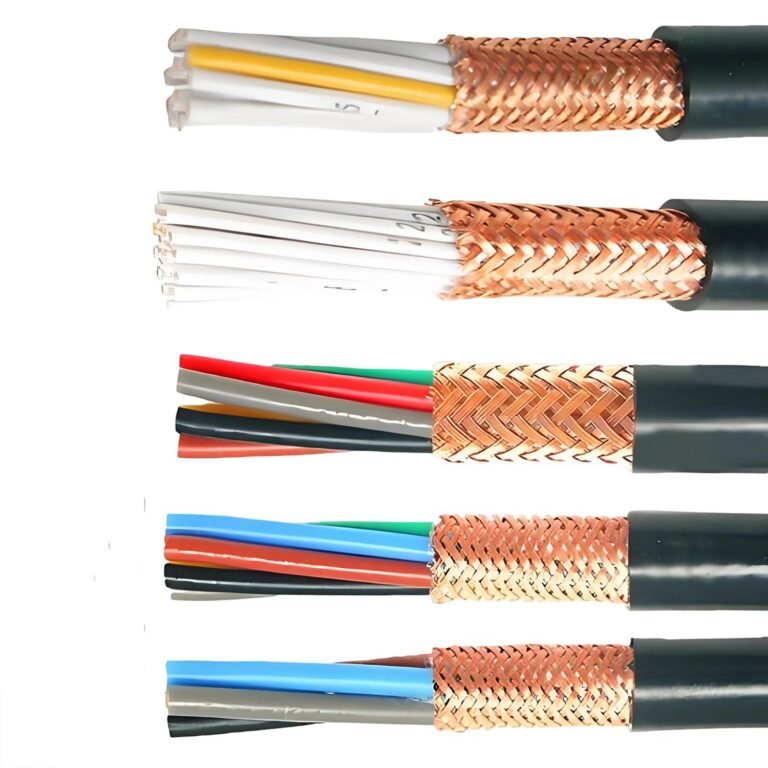
Second, confusing shielded with armoured. A shield (copper tape or braid) controls electric field distribution and is essential for MV cables; armour resists mechanical damage. A cable can be one, both, or neither. They are not interchangeable functions.
Third — and this one has real fire safety consequences — conflating flame-retardant (IEC 60332-1 or -3) with fire-resistant (IEC 60331). Flame-retardant means the cable won’t sustain combustion once the ignition source is removed. Fire-resistant means the cable continues to function during a fire for a defined duration, typically 90 minutes at 750 °C or higher. Installing a flame-retardant cable in an emergency lighting or fire pump circuit, believing it to be fire-resistant, is a life-safety error. The cost difference between the two cable types is usually 15–35% depending on construction; the cost of getting it wrong is a failed fire system when it is most needed.
Power Cable Naming in International Trade: Customs Codes, Certifications, and Supplier Verification
Getting the cable name right on a technical datasheet is one problem. Getting it to match every document in a cross-border shipment — purchase order, commercial invoice, packing list, test certificate, and customs declaration — is a different problem entirely, and it costs real money when it goes wrong.
HS Tariff Codes and Why Name-to-Code Alignment Matters
The Harmonized System classifies power cables under two principal headings: 8544.49 covers insulated electric conductors for voltages above 80 V but not exceeding 1,000 V, while 8544.60 covers those rated above 1,000 V. In practice, this means a 0.6/1 kV distribution cable ships under 8544.49, and a 6/10 kV feeder cable ships under 8544.60 — and the applied tariff rate, anti-dumping duty exposure, and import licensing requirements can differ substantially between the two headings, depending on the importing country.
Where procurement teams run into trouble is when the cable name on the technical document implies one voltage class but the declared HS code reflects another. A supplier labeling a product “medium-voltage XLPE cable” on the datasheet while declaring it under 8544.49 to reduce duty liability is a scenario that triggers customs holds, re-inspection, and potential penalties. The cable name you approve commercially needs to be consistent with every classification document, full stop.
CE Marking Under CPR and the Euroclass Fire Designations
European construction projects have added another naming layer that catches importers off guard: the Construction Products Regulation (EU 305/2011) requires cables installed in buildings to carry a declared Euroclass fire performance designation. These run from Aca (non-combustible, highest performance) down through B1ca, B2ca, Cca, Dca, Eca, to Fca (no declared performance). On any serious EU tender today, you’ll see the Euroclass appended directly to the cable designation in the specification — something like “LSZH 0.6/1 kV Cca-s1b,d1,a1.” Each suffix after the class letter describes smoke production (s), flaming droplets (d), and acidity (a).
If a supplier quotes you a cable for a German or Dutch infrastructure project without the Euroclass declaration, that cable cannot legally be placed on the market there. No Euroclass, no project. It’s that simple.
UL and CSA Certification for North American Supply
The distinction between UL Listed and UL Recognized matters more than many procurement teams realize. A UL Listed power cable has been tested and certified as a complete, finished product — the UL type designation (THHN, XHHW-2, MV-105, and so on) must appear verbatim on the cable’s surface print and in the specification sheet. UL Recognized, by contrast, applies to a component used within a larger assembly; a standalone power cable quoted as “UL Recognized” for a North American project is almost always wrong for the application and will fail the electrical inspector’s sign-off.
CSA certification follows similar logic for Canadian projects. The cable name on a North American spec sheet isn’t decoration — it’s a compliance statement, and substituting a generic equivalent name without the exact type designation will stall installation sign-off.
Third-Party Testing: What Actually Supports a Credible Cable Name
A cable name on a datasheet is a claim. What converts it into a verifiable fact is test documentation. Routine factory tests — conductor resistance per IEC 60228, insulation resistance, and high-voltage withstand — should be available for every production drum. Type tests are more demanding: bending, impact resistance, and hot-set elongation for XLPE insulation (the hot-set result is particularly telling for MV cables, since it confirms genuine cross-linking rather than thermoplastic material passed off as XLPE). ISO 9001 manufacturing certification provides process-level assurance, but it doesn’t replace product-specific test data.
ISO 9001 certification alone is sufficient proof that a cable meets its stated electrical specification.False
ISO 9001 covers quality management processes, not product performance. Electrical compliance requires product-specific type and routine test reports per the relevant IEC or UL standard.
Jinda’s five production bases across China, combined with active supply into 50-plus countries, mean the factory infrastructure — and the certification portfolio — already spans IEC, UL, CSA, and CPR regimes simultaneously. For a procurement team sourcing one cable type in THHN for a US project and a CPR Cca-rated LSZH variant for a European tender, that kind of multi-regime capability in a single supplier reduces qualification overhead significantly.
Red Flags That a Supplier’s Product Name Claims Don’t Hold Up
A few things to watch for. Insulation wall thickness significantly below the IEC or UL minimum for the stated voltage rating is the most common discrepancy — measure it against the standard before accepting a sample. “Flame-retardant” claims without IEC 60332-3 bundle-test data (not just the single-wire IEC 60332-1 test) are nearly meaningless for cable tray or conduit runs with high cable fill. And if a supplier cannot produce a third-party type-test report for a medium-voltage cable — not a factory self-declaration, an actual accredited-lab report — the MV designation on their datasheet should not be trusted. These aren’t edge cases. They come up regularly in supplier qualification work, especially when price pressure has driven a buyer toward an unfamiliar source.
Selecting the Right Power Cable Name (and Product) for Common Project Types
Knowing the taxonomy of power cable names only pays off when you can map that knowledge onto a real bill of materials. The following five project categories cover the bulk of what Jinda’s international customers are actually tendering and procuring. Each one demands a different cable name, different certification, and — critically — different sizing logic.
Urban Distribution Grid Upgrade
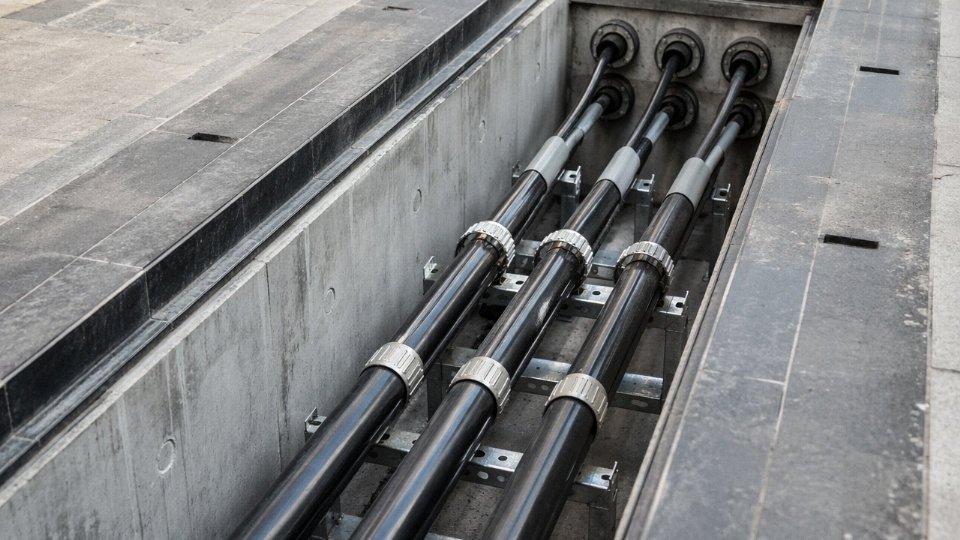
For direct-burial MV feeders in city trenches, the dominant product is the armored XLPE cable: YJV22 in Chinese-standard projects, N2XRY in IEC/European-designated ones, both typically specified at 8.7/15 kV, three-core, 240 mm² aluminum or copper conductor. The armor designation (22 = double steel tape; SWA in BS 7870 language) matters because urban trenches share space with water mains, gas lines, and civil works machinery. A backhoe doesn’t care about your cable schedule.
XLPE-armored beats traditional PILC here on three counts. Moisture tolerance is the first — PILC degrades badly if the lead sheath is nicked during installation and water ingresses; XLPE jointing is far less sensitive to that. Second, jointing time: an experienced jointer can terminate a 240 mm² XLPE cable in roughly a third of the time compared to a paper-lead joint, which matters when you’re paying for a trench closure in a live street. Third, the installed weight per meter is meaningfully lower, reducing pulling tension in long urban duct runs.
Solar PV Farm DC Collection
This is where naming discipline genuinely prevents procurement disasters. The correct product is a TÜV-certified solar cable — PV1-F under the original German standard or H1Z2Z2-K under EN 50618 — rated 1.8/3 kV DC, double-insulated, UV-stabilized sheath. Regular 0.6/1 kV building wire is not a substitute, regardless of what a low-price vendor claims, because it will fail the UV and ozone resistance requirements within a few years of rooftop or ground-mount exposure.
Standard 0.6/1 kV building wire meets the UV and ozone resistance requirements for outdoor solar PV string wiringFalse
PV string cables must meet IEC 62930 / EN 50618 (H1Z2Z2-K) or TÜV 2 Pfg 1169 requirements including UV resistance, ozone resistance, and double insulation. Ordinary 0.6/1 kV building wire is not rated for these conditions and will degrade prematurely in exposed outdoor installations.
Cross-section sizing: for 1500 V DC string cable, 4 mm² handles most standard residential string currents, but 6 mm² is common on commercial arrays where string lengths push 15–20 A. Combiner-box-to-inverter feeders run 35–95 mm² depending on how many strings are aggregated and the feeder run length — voltage drop below 1% is the usual design ceiling on those trunk runs.
Industrial Plant Internal Distribution
Inside a process plant, the workhorse is VV22 or YJV22 at 0.6/1 kV for cable tray and conduit runs. Motor feeders get sized at a minimum of 125% of full-load current per IEC 60364, and in practice many plant engineers add another 10–15% margin where future motor upsizing is plausible. Don’t neglect the flexible drop cable category: YC (general-purpose rubber-sheathed) and YCW (oil-resistant version) are the correct names for trailing leads to mobile equipment and CNC machinery. Using fixed-installation cable there is a maintenance headache — the copper fatigues and you’ll be cutting out failed terminations within a year or two of production start.
Offshore Oil Platform
“Offshore power cable” is a distinct product category, not just a marine label applied to standard MV cable. IEC 60092-353 compliance means the conductor class steps up — Class 2 minimum, Class 5 (flexible) where the cable moves with the vessel or rig structure. EPR insulation is more common than XLPE here because EPR handles the thermal cycling and mechanical flexing better over a platform’s service life. Sheath thickness runs heavier than onshore equivalents, and mud-resistance testing is a real factory test, not a paper specification. Overall screening plus SWA plus LSZH outer sheath is the standard stack. If a supplier quotes you a standard XLPE SWA cable against an offshore spec, that’s a red flag worth pushing back on.
Building and High-Rise Construction
Vertical riser cables in tall buildings must pass IEC 60332-3-24 (Category C bundle flame propagation test) as a baseline — single-cable flame tests are insufficient where cables are grouped in vertical shafts. The correct product name on fire-strategy documents is LSZH multicore power cable to IEC 60332-3-24. For emergency circuits — fire pumps, emergency lighting, smoke extract fans — the specification steps up further to fire-survival cable: FP200 by brand name in the UK market, CWZ or WDZN-YJY in Chinese-standard projects. These cables are tested to maintain circuit integrity at 850–950°C for 90–120 minutes depending on the standard applied. Getting the naming wrong on a fire-strategy document can trigger a full respecification during building control sign-off.
EV Charging Infrastructure
This is the fastest-growing naming category procurement teams are encountering without much prior experience. Mode 3 AC charging (the Type 2 connector common across European and increasingly global installations) uses an EV charging cable per IEC 62196 with Class 5 or Class 6 high-flex stranding — the cable takes roughly 10,000–30,000 plug cycles over its service life, so conductor flexibility directly affects service life. DC fast chargers at 150–350 kW run liquid-cooled cables or heavy cross-section DC cables rated 1.8/3 kV; at 350 kW the thermal management of the cable assembly is as much a mechanical engineering problem as an electrical one. Sizing conventional ampacity tables against these cables doesn’t work cleanly — consult the charger OEM’s cable specification before sourcing. The key procurement flag: confirm IEC 62893 compliance (the charging cable product standard), not just IEC 62196 (which covers the connector interface).
Frequently Asked Questions About Power Cable Names and Terminology
What is the difference between a power cable and an electrical cable?
“Electrical cable” is the broadest category in the field — it covers power cables, control cables, instrumentation cables, data cables, and signal cables under one roof. A power cable is a specific subset: its job is to carry bulk electrical energy from one point to another, typically at currents and voltages that would destroy a signal cable instantly. Every power cable is an electrical cable, but the reverse is emphatically not true. A CAT6 Ethernet cable is an electrical cable. It is not a power cable. The distinction matters in procurement because misquoting “electrical cable” on a purchase order can land you with the wrong product family entirely — and that mistake shows up at goods receipt, not before.
What does YJV stand for in a cable name?
This is one of the most common questions from buyers sourcing cables to Chinese GB/T 12706 standard. The code builds like a sentence, left to right. Y indicates polyethylene-based outer sheath material. J indicates cross-linked polyethylene (XLPE) insulation — the “J” comes from the Chinese term for cross-linked. V indicates a PVC outer sheath. So YJV reads as: XLPE-insulated, PVC-sheathed power cable. Swap the final V for a 22 and you’ve added double steel tape armour. Swap it for 32 and you have steel wire armour. The system is logical once you’ve decoded a few examples, though the sheer number of suffix combinations can catch out a procurement manager who only knows the base code.
Is “armored cable” the same as “SWA cable”?
No — SWA (Steel Wire Armoured) is one specific type of armored cable, and in practice it’s the most common in BS/IEC markets for direct burial and mechanical-protection applications. But the armored cable family is wider than that. STA (Steel Tape Armoured) is used where longitudinal flexibility matters less. AWA (Aluminum Wire Armoured) is the go-to for single-core cables where you need to avoid induced circulating currents in a steel layer. DSTA (Double Steel Tape Armoured) appears where heavier crush resistance is specified. Calling everything “armored cable” on a tender document creates real ambiguity — the spec needs to name the armour type explicitly, or the supplier will default to whichever type suits their stock.
What is the difference between flame-retardant and fire-resistant cable?
These two are confused constantly, and the consequences of mixing them up range from a failed inspection to a genuine life-safety failure. A flame-retardant cable (tested to IEC 60332) resists ignition and slows flame spread, but it will lose circuit integrity once the fire gets hot enough. A fire-resistant cable (IEC 60331) is engineered to maintain electrical function at defined temperatures — commonly 750°C or 950°C — for a specified period, often 90 minutes. Emergency lighting circuits, fire pump feeders, and evacuation system power supplies require fire-resistant cables. Fitting flame-retardant cable in those positions passes a visual inspection but fails when it actually matters.
Can I use the same cable name for AC and DC applications?
Not without checking first. A cable rated 0.6/1 kV AC is not automatically rated for the same voltage DC — in fact, the equivalent DC rating is typically around 1.8 kV DC for that same construction, because DC stress on insulation behaves differently from AC. This catches people out badly on photovoltaic string cables and battery storage interconnects. Always ask the supplier to confirm the DC voltage rating explicitly and in writing. Cables designed specifically for PV applications carry separate DC ratings and are tested accordingly.
A cable rated 0.6/1 kV AC carries a different DC voltage rating — typically around 1.8 kV DC — and these must be confirmed separately before use in PV or battery-storage systems.True
AC and DC voltage stresses act on cable insulation through different mechanisms. IEC 60502 and related standards specify AC ratings; DC ratings require separate verification and are commonly higher numerically but governed by different insulation-stress criteria. PV-specific cables are tested under IEC 62930.
Why do some power cables have “ZR” or “NH” in the name?
In Chinese GB standard naming, these are performance prefixes added ahead of the base cable code. ZR stands for the Chinese term translating to flame-retardant; NH stands for the term translating to fire-resistant. A cable marked ZR-YJV is a flame-retardant XLPE/PVC power cable. NH-YJV is fire-resistant. They are not interchangeable — see the answer above for why that gap matters. Some cables carry both prefixes (ZR-NH) indicating they meet both standards, which is required on certain public-building and tunnel projects in China. Ordering plain YJV when the spec says ZR-YJV is a compliant-looking mistake that won’t show up until a fire-performance audit.
How do I know if a cable supplier’s product actually matches the name on the data sheet?
Ask for the conductor resistance test report per IEC 60228, the insulation thickness measurement report, and the high-voltage withstand test certificate — then cross-check every value against the tables in the relevant IEC or GB standard. It’s a straightforward check, and a supplier who hesitates to provide those documents is telling you something. Conductor cross-section undersize and insulation thickness shortfall are the two most common discrepancies found in third-party audits of low-cost cable product. Third-party witnessed testing — where an accredited lab runs the tests with an independent witness present — gives the highest assurance, particularly for large project orders where substitution risk is real.
Why Naming Precision Translates Directly into Project Safety, Cost, and Compliance
Spend enough time on project sites and you start to see the pattern: the expensive problems rarely begin with a failed component. They begin with a specification that was just slightly wrong — a cable ordered under a vague description, a substitution accepted without checking the full designation, a bid evaluated on price alone because the RFQ never pinned down the actual product. By the time the mistake surfaces, the cable is already pulled through conduit or buried under a meter of compacted soil.
The Financial Exposure Is Not Abstract
On a medium-voltage feeder installation, substituting one cable type for another — say, accepting an XLPE-insulated armored cable without verifying the specific voltage grade, armor construction, and sheath material — can trigger a chain of consequences that most project budgets never account for. Third-party re-testing for a single MV cable route typically runs somewhere between USD 5,000 and 50,000 depending on the test laboratory’s location, the voltage class involved, and whether the cable is already installed or can still be tested on the drum. If the cable is in the ground, add excavation, reinstatement, and the knock-on delays to commissioning — usually two to six weeks on a project that was probably already tight.
Insurance and warranty exposure compound this. Most contractor all-risk policies and equipment warranties specify that installed materials must conform to the named standard in the project specification. A cable that was “basically the same” but carries a different designation can invalidate a claim outright. That is not a theoretical risk; it is the kind of clause loss adjusters look for first.
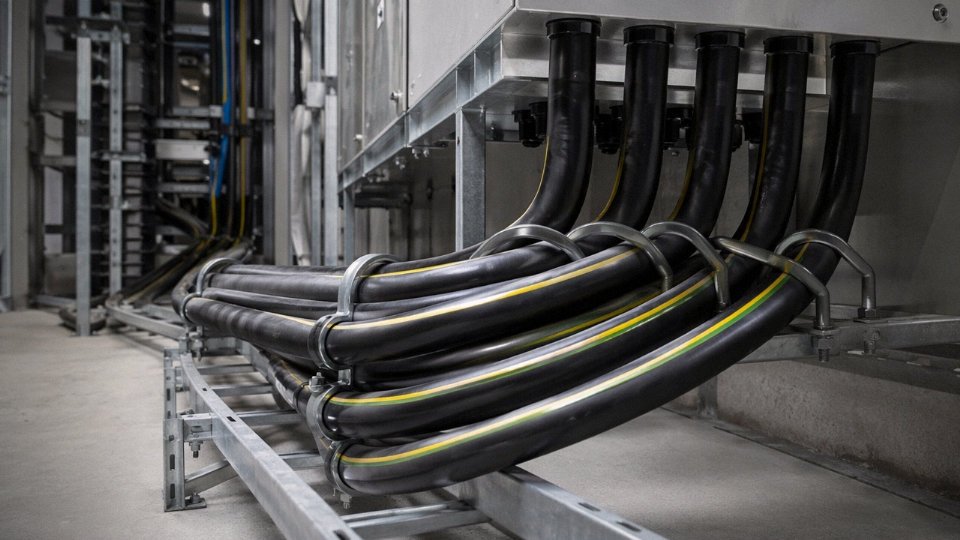
Safety Margins Are Embedded in the Name Itself
IEC and NEC naming conventions are not bureaucratic formalities. The insulation thickness specified for a 12/20 kV XLPE cable versus an 8.7/15 kV cable is different because the electric stress calculations are different, and those figures have been validated against decades of failure data, not just theoretical models. When an engineer specifies the correct full designation, they are — whether they think of it this way or not — invoking a body of accumulated incident knowledge encoded into the standard. Accepting a cable under the wrong name means accepting one where those margins may not apply.
Fire performance naming layers work the same way. A cable designated LSZH (low-smoke zero-halogen) or meeting IEC 60332-3 flame retardancy was tested to specific criteria. A cable described loosely as “flame retardant” may or may not meet those criteria. In a cable tray through a populated building, that distinction is the difference between a fire that self-extinguishes and one that propagates.
IEC and NEC cable naming conventions encode validated minimum safety margins — insulation thickness, conductor sizing, fire performance — developed from decades of field incident data.True
These standards are maintained by technical committees that review field failures, accident investigations, and material performance data on a regular revision cycle. The designations are not arbitrary; they reference specific test methods and minimum performance thresholds.
What a Precise RFQ Actually Buys You
A full cable designation in an RFQ — something like YJV22-8.7/15 kV 3×240 mm² per GB/T 12706.3 — does several things simultaneously. It eliminates ambiguity, so every bidder is pricing the same product. It creates a contractual technical baseline, so acceptance and rejection decisions have enforceable grounds rather than becoming a negotiation. And it forces suppliers to confirm compliance explicitly, which separates manufacturers with genuine production capability from traders reselling whatever they can source that week.
Vague specifications produce vague bids. Procurement teams that have learned this lesson usually learned it the hard way.
How Jinda’s Technical Team Fits Into This
Jinda’s pre-sales engineers work across IEC, GB, BS, NEC, and a range of regional standards — not as a sales pitch, but because the company’s customer base across 50-plus countries makes that depth genuinely necessary day-to-day. For project teams that need to confirm the correct designation before issuing an RFQ, or that are reconciling conflicting naming conventions between a local standard and an owner-supplied specification, that’s a practical resource rather than a formality.
Every order ships with a full test-report documentation package. Samples are available for qualification testing before bulk commitment. If your project has a naming question, a specification conflict, or a bulk supply requirement, the technical team is the right starting point — not a general inquiry form, but engineers who know the difference between a YJY and a YJV22 and why that matters on your specific job.