Armoured cable gets specified as the safe, durable choice — and for buried runs, mechanical-risk zones, and industrial installations it often is. But engineers who’ve priced up a large project, then watched installation crews wrestle with the stuff in a congested cable tray, know there’s a real cost on the other side of that decision. The weight alone adds up fast: a 4-core 16 mm² SWA cable typically runs 1.2–1.5 kg/m against 0.7–0.9 kg/m for an unarmoured equivalent, and that difference multiplies across hundreds of metres into structural loading headaches, slower pull-through times, and labour costs that quietly inflate the project budget before anyone notices.
Armoured cable’s main disadvantages are higher material and installation cost, significant weight increase (30–60% heavier per metre than unarmoured equivalents), restricted bending radius, complex termination requiring specialised glands and earthing, and reduced flexibility for re-routing or future modifications. These factors affect total installed cost, tray capacity, and long-term maintenance access — and they matter most in dense urban builds, retrofit projects, and installations where cable routes change frequently.
What’s rarely discussed upfront is that these disadvantages don’t hit every project equally — they compound in specific conditions, and understanding which ones apply to your installation is what separates a well-optimised cable schedule from one that quietly bleeds money from groundworks through to commissioning.
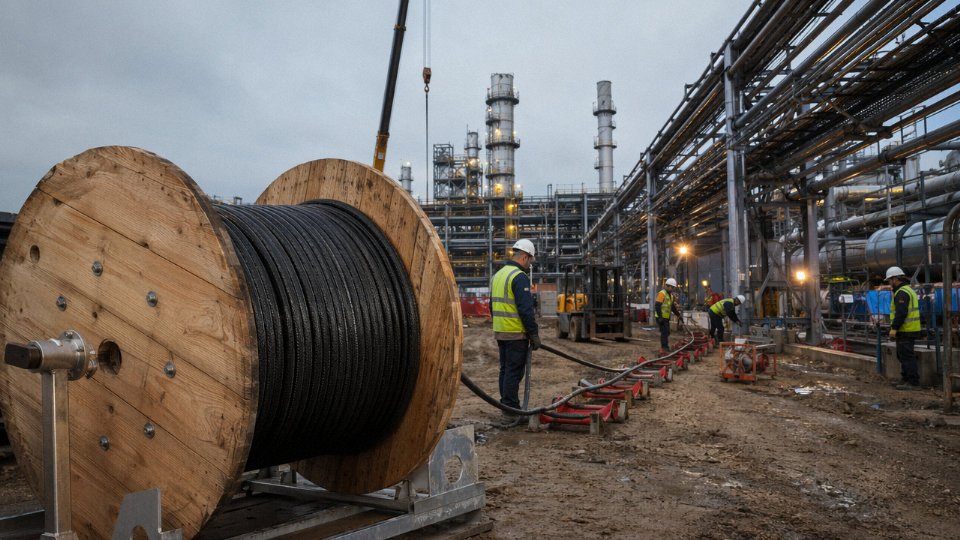
Excessive Weight and Handling Difficulty on Large-Scale Projects
Weight is the armoured cable disadvantage that bites earliest — usually at the point where someone actually tries to move the stuff.
A 4-core 16 mm² SWA cable runs roughly 1.2–1.5 kg/m depending on conductor stranding, insulation wall thickness, and whether the armour is galvanised steel wire or stainless. The unarmoured equivalent sits somewhere around 0.7–0.9 kg/m. That gap — call it 0.4–0.6 kg per metre — sounds trivial until you’re pulling 400 m through a cable tray on a refinery turnaround with a three-man crew and a deadline. Step up to 4-core 95 mm² SWA and you’re looking at a drum weight that can easily clear 800 kg for a 500 m length, sometimes pushing past 900 kg depending on the manufacturer’s specific construction. That is not a drum you unload from a flatbed with a pallet truck. You need a crane or a proper drum-jack, and if the site hasn’t planned for that — which smaller EPC contractors sometimes haven’t — you get improvisation, which on a live industrial site tends to end badly.
Structural Loading on Cable Trays and Ladder Rack
The weight problem compounds when you move from a single cable run to a full cable management system. Cable tray and ladder rack are designed to rated load limits — typically 50–150 kg/m for standard medium-duty systems — and those ratings get consumed fast when every cable in the bundle is carrying an extra 30–60% mass relative to an unarmoured equivalent. In a petrochemical plant with 20–30 cables per tray tier, the structural steel supporting the tray system may need to be upsized by one or two sections, adding fabrication cost and, more painfully, extra support drops that complicate routing around process equipment and pipe racks. On offshore platforms, where every kilogram of topside weight has a direct structural and cost implication, specifying SWA across the board without a weight-optimised alternative review can be a genuine engineering error rather than just an inconvenience.
A 500 m drum of 4-core 95 mm² SWA cable can exceed 800 kgTrue
Based on standard SWA construction per IEC 60502-1; actual weight depends on conductor configuration, insulation material, and armour wire diameter, but 800–920 kg is a realistic range for this size and length.
Manual Handling, Ergonomics, and Installation Throughput
The pulling and termination stage is where heavier cable translates directly into labour cost and injury exposure. A cable that weighs 60% more generates significantly higher sidewall pressure against conduit bends and cable guides, which means more pulling force, more intermediate pull points, and — in practice — more rest stops and crew rotations. Termination of SWA also takes longer than unarmoured cable because each end requires a proper armour gland, correct bedding of the wires around the cone, and a verified earth continuity check. Skilled termination on large SWA cables can take 30–60 minutes per end depending on cable size and the installer’s familiarity with the gland type. Multiply that across hundreds of terminations on a large project and the labour premium over unarmoured cable is real and measurable, not theoretical.
Freight and Logistics Costs for International Procurement
For buyers sourcing armoured cable internationally — a project in Nigeria, Saudi Arabia, or Vietnam pulling cable from a manufacturer in China, for instance — the weight difference directly affects shipping cost. Ocean freight for cable is typically quoted by weight or volumetric weight, whichever is greater, and armoured cable drums are dense enough that actual weight dominates. A 20-foot container loaded with SWA cable will carry meaningfully fewer metres of cable than one loaded with unarmoured product of the same cross-section, which either increases the number of containers required or forces a split shipment. Neither outcome is free. Import duties in some markets are also assessed on gross weight, which adds a further layer of cost that procurement teams sometimes miss at the budgeting stage.
Aluminium wire armoured (AWA) cable is sometimes specified specifically to address this weight problem — AWA can bring mass down by roughly 20–35% versus SWA, depending on the cable construction — but aluminium armour introduces its own set of considerations around corrosion compatibility, mechanical crush resistance, and gland selection that deserve separate treatment.
High Installation Complexity and Specialised Termination Requirements
Armoured cable doesn’t just weigh more — it fights you at every termination point. The mechanical protection that makes SWA and STA cable attractive for buried or exposed runs becomes a genuine liability the moment you have to connect it to something, and that cost shows up in labour hours, rework, and schedule slippage in ways that rarely appear in the initial cable budget.
Getting the Gland Right — and the Cost of Getting It Wrong
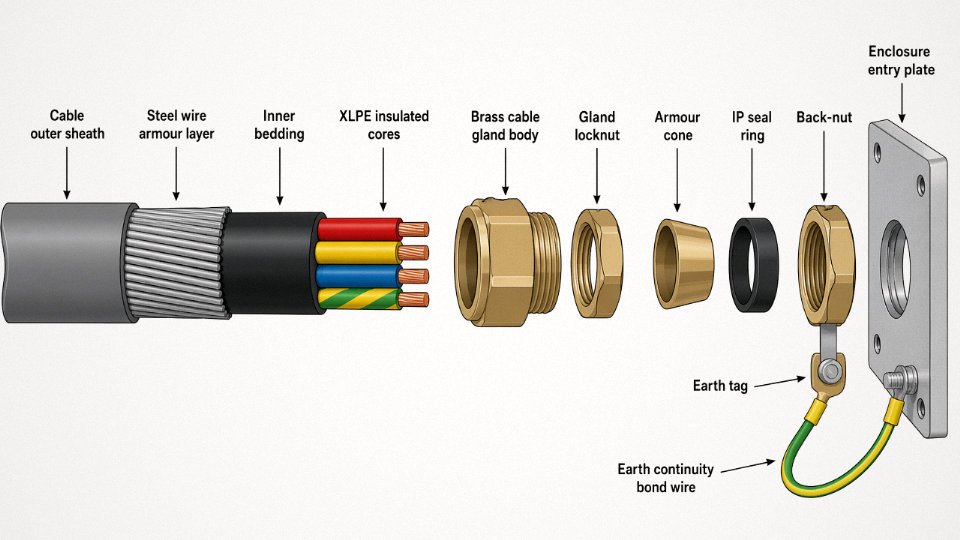
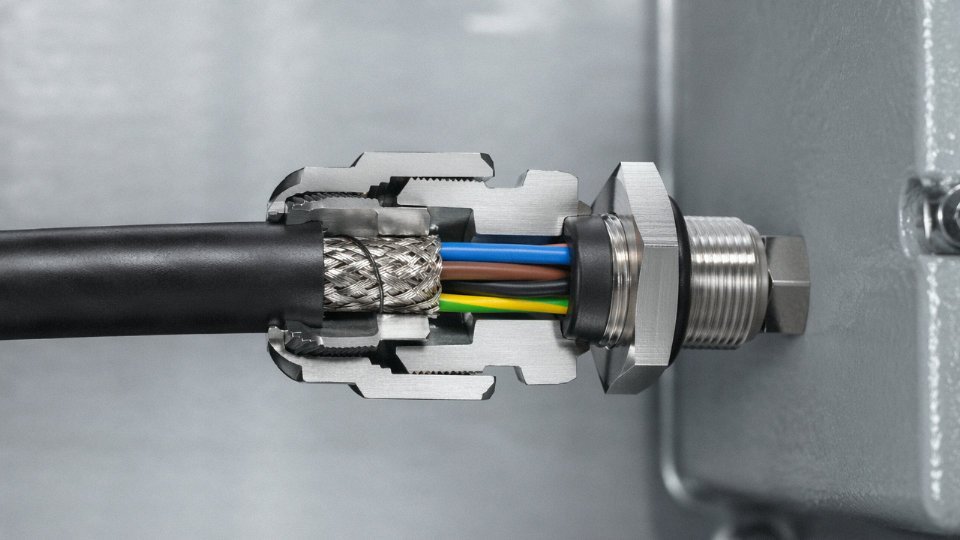
The armour gland system is where most field failures actually originate. A correctly specified brass or stainless steel cable gland does three jobs simultaneously: it retains the cable mechanically, maintains the IP rating of the enclosure, and provides a reliable earth path for the armour screen. BS EN 50262 defines Types A through D, each suited to different armour types and enclosure materials — Type A for simple mechanical retention, Type C and D for IP-rated and EMC-screened applications respectively.
In practice, purchasing teams under cost pressure sometimes substitute a lower-rated gland or source from a supplier who can’t confirm compliance. The result isn’t immediately obvious. The cable stays in place, the panel closes, commissioning passes. Six months later, moisture tracks along the armour wires into the gland thread, the IP seal degrades, and you’re troubleshooting an intermittent earth fault in a wet plant room at 2 a.m.
Wrong gland type is a leading cause of armoured cable field failures in industrial enclosuresTrue
Mismatched gland selection compromises IP integrity, EMC screening continuity, and mechanical retention simultaneously — all three failure modes can develop without being immediately visible during commissioning.
Gland cost itself is modest. The engineering time to specify, procure the right type, and verify installation against the schedule — that’s where the budget erodes.
Termination Time Is Longer Than Most Project Plans Allow
Stripping SWA or STA cable to a clean, undamaged termination requires cutting back steel wire or tape armour without nicking the bedding or insulation underneath. A skilled electrician using proper armour cutters — a rotary type like a Klein or Greenlee equivalent, or an angle grinder with a cutting disc on heavier gauges — still takes 30 to 50 minutes per termination for a multi-core cable. The same task on an unarmoured cable: 10 to 15 minutes.
On a small job, that gap is tolerable. On a project with 200+ terminations across a substation or processing plant, you’re looking at an additional 65 to 130 person-hours just in stripping time, before you’ve touched gland fitting, earthing, or testing. That translates to 25–40% higher installation labour costs overall, a figure that holds across most commercial quotes I’ve seen — though it tilts toward the upper end when site access is awkward or cable runs are long.
Earthing Continuity: A Test Step That Catches Shortcuts
The armour layer must be bonded at both ends under normal power applications, with continuity confirmed below 1 ohm per IEC 60502-1 requirements. Single-end bonding is legitimate in certain EMC-sensitive signal cable layouts, but it has to be a deliberate design choice, not an accidental omission. In ATEX or IECEx classified areas, documentation of that test result isn’t optional — it’s a regulatory requirement that auditors check.
Adding earth continuity testing and recording to every armoured termination is a small per-termination overhead. Across a large project it extends commissioning by days, particularly if any terminations fail the test and require stripping back and redoing.
Conduit Compatibility and Bending Radius at Termination Boxes
Armoured cables, especially STA designs, have a substantially larger outside diameter than an electrically equivalent unarmoured cable. Conduit and trunking systems sized during early design often can’t accommodate the actual OD once the steel layer is factored in. Mid-project redesign of containment systems is irritating, costs real money in revised drawings and additional materials, and occasionally forces a cable route change that nobody budgeted time for.
The bending radius constraint compounds this at the termination itself. SWA requires 6–8× the overall cable diameter; STA pushes to 8–10×. In tight enclosures or shallow back-boxes, achieving that bend without forcing the cable is genuinely difficult. Smaller cross-section cables — say, 4-core 2.5mm² or 4mm² SWA — have a high armour-wire-to-core ratio, meaning the wires carry a disproportionate share of any bend stress. Force it past the minimum radius and individual armour wires break, which reduces mechanical protection and can create stress points on the insulation directly underneath. That kind of damage isn’t always visible from outside the gland.
The honest summary: armoured cable demands a higher level of electrical craftsmanship throughout installation, not just at the design stage. Budget accordingly, or the savings from using a robust cable type get consumed entirely by rework.
Significant Cost Premium Across Material, Labour, and Maintenance
The weight and termination complexity get talked about plenty. The cost side gets underestimated more often than it should, usually because engineers and procurement managers look at the per-metre cable price and stop there. Total installed cost is a different number entirely, and the gap between armoured and unarmoured options widens at every stage from the purchase order to the first scheduled maintenance window.
Where the Material Premium Actually Comes From
SWA cable typically runs 20–35% more per metre than an equivalent unarmoured XLPE or PVC cable of the same conductor cross-section and voltage rating. That range depends on conductor size, current steel and copper pricing, and whether you’re buying SWA or the heavier STA (steel tape armoured) construction. The premium isn’t arbitrary — you’re paying for galvanised steel wire or tape, an additional binder tape layer, and a thicker outer sheath, all of which add real manufacturing cost. On small projects, that delta is manageable. On a 50,000-metre industrial site pull, it becomes a budget line worth challenging.
The smarter procurement managers I’ve dealt with will get quotes for both options simultaneously rather than defaulting to armoured “because the spec says so.” Sometimes the spec was written for a different environment than the one actually being built.
Labour Productivity Is the Number People Miss
Material cost is visible. Labour productivity loss is not, at least not until the schedule slips.
In a standard cable tray environment, experienced crews can pull and terminate unarmoured flexible cable at roughly 30–40 metres per hour. SWA in the same tray runs closer to 15–25 metres per hour — and that’s a realistic industry-level estimate, not a worst case. The armour has to be cut back cleanly, the gland body needs to be sized correctly, the armour wires dressed and clamped, the earth continuity verified. Do that wrong and you get a failed IEC 60502 armour continuity test, which means pulling the gland apart and starting again. On a 200-termination project, even a modest rework rate is expensive.
Installation productivity for SWA cable is typically 40–50% lower than for equivalent unarmoured cable in the same tray environmentTrue
Industry benchmarks and site-level labour studies consistently show SWA pull-and-terminate rates of 15–25 m/hr versus 30–40 m/hr for unarmoured flexible cable, reflecting added time for armour cutting, gland assembly, and earth continuity checks required under IEC 60502 and BS 5467.
Gland and Accessory Costs Multiply Fast
A pair of industrial SWA glands for a 4-core 50 mm² cable — say, a Hawke 501/453 or similar double-lock type — will cost somewhere between £15 and £40 per gland set depending on supplier, IP rating required, and whether you need an ATEX-rated variant for a hazardous area. A simple cable tie or compression fitting for unarmoured cable in a tray costs nearly nothing by comparison.
Multiply a £25 average gland set cost across 400 terminations on a medium-sized facility build and you’re looking at roughly £10,000 in glands alone, before installation time. That number surprises people when they see it itemised.
Maintenance Costs Don’t End at Commissioning
Armoured cable inspection isn’t plug-and-play. During routine maintenance shutdowns, electricians need to check outer sheath integrity for mechanical damage or UV degradation, verify gland sealing hasn’t deteriorated (especially in wet or chemically aggressive environments), and confirm armour continuity hasn’t been broken by corrosion or a poorly torqued gland. Each of those checks takes time, and in a live industrial system with limited shutdown windows, time is the most expensive resource on site.
Running a Real Comparison
For a 1,000-metre underground run routed inside a rigid conduit under a factory floor — a genuinely low-mechanical-risk environment — unarmoured XLPE cable inside the conduit can deliver equivalent physical protection at 15–25% lower total installed cost, depending on conduit material, local labour rates, and cable specification. The conduit provides the mechanical protection; the armour becomes redundant. Not every project fits that profile, but engineers who skip the comparison are leaving real money on the table.
The honest answer is that armoured cable earns its cost premium in direct-buried applications, areas with credible third-party mechanical damage risk, or installations where post-installation protection can’t be guaranteed. Everywhere else, that premium deserves scrutiny.
Corrosion, Galvanic Attack, and Chemical Exposure Vulnerabilities
Steel wire armour looks tough. It is tough — against mechanical impact, rodent damage, and accidental dig-ins. But steel corrodes, and the conditions where armoured cable gets installed most often are exactly the conditions that accelerate that corrosion. This is the disadvantage that gets skipped in the sales conversation and discovered three to seven years into service when a fault trace reveals armour wires that look like they’ve been sitting in seawater. Which, sometimes, they effectively have.
The Basic Corrosion Mechanism
SWA cable depends on its outer PVC or PE oversheath staying intact. The moment that sheath is breached — from a nick during installation, a joint box poorly sealed, UV degradation at a surface run, or simply ground movement over time — the steel armour is exposed to whatever the surrounding environment contains. In coastal installations, that means chloride ions. Chloride-induced pitting corrosion is aggressive and localised: it doesn’t give you a gradual uniform thinning you can trend over time; it gives you small, deep pits that can perforate individual armour wires with little visible warning from the outside. A cable that looks undamaged at inspection can have armour that’s structurally compromised and, worse, electrically discontinuous at exactly the location you’re counting on for earth fault protection.
Buried cables face similar risks in aggressive soils. IEC 60364-5-52 and the CIGRE reference guidelines both use soil resistivity as a primary proxy for corrosivity, and the threshold to watch is roughly 20 ohm-metres. Below that — typical of clay-rich soils, waterlogged ground, or soils contaminated by industrial runoff — the electrochemical environment is active enough that unprotected steel armour can lose meaningful cross-section over a service life of 10–15 years. Some coastal clay sites come in below 5 ohm-metres. In those conditions, an SWA cable buried without cathodic protection or sacrificial anodes is essentially on a slow timer.
Galvanic Corrosion at Terminations
The termination point is often where corrosion does its most concentrated damage, and the mechanism is straightforward electrochemistry. Steel armour terminated with a brass compression gland, bonded into a copper earth bar — as is standard practice — creates a galvanic couple. Steel sits lower on the electrochemical series than both brass and copper, which means steel is the anode in that couple and will preferentially corrode. In a dry indoor environment this matters very little. In a humid cable cellar, a coastal switchroom, or any enclosure that sees regular condensation cycles, this accelerates armour attack right at the gland interface, which is precisely the point where you need the armour continuity to be reliable. The corrosion is often hidden under the gland body until the joint is disturbed.
Chemical Plant Environments Add Complexity
In petrochemical or process plant settings, the outer sheath faces potential permeation by hydrocarbons, aromatic solvents, or process acids over long service periods. Once the sheath is softened or compromised by chemical attack, the path to the armour is open. Alkali environments — concentrated caustic lines, concrete-encased routes that remain damp — are particularly problematic for AWA (aluminium wire armoured) cables specified as an alternative to SWA to reduce galvanic risk. Aluminium is amphoteric: it corrodes readily in strongly alkaline conditions, so AWA in wet concrete or near lime-rich soils simply trades one corrosion problem for another.
Aluminium wire armoured (AWA) cable eliminates galvanic corrosion risk at terminations compared to SWA cable.False
AWA reduces the steel-copper galvanic couple at terminations, but aluminium is itself susceptible to alkaline corrosion in concrete and high-pH soils, and aluminium-brass galvanic couples still exist at standard brass glands. The risk profile changes; it does not disappear.
Mitigation Options — and What They Cost You
There are real engineering solutions. Double-sheathed SWA (an inner bedding layer plus a robust outer oversheath, sometimes called OS2 or equivalent) substantially reduces the risk of sheath breach reaching the armour, and is the right default for any buried coastal or industrial application. HDPE oversheathing outperforms PVC on chemical resistance and UV stability. For genuinely aggressive environments — offshore, chemical plants handling chlorinated compounds, or soils below 10 ohm-metres — stainless steel wire armoured (SSWA) cable eliminates the base corrosion problem but typically adds 40–80% to cable material cost depending on conductor size and armour wire gauge.
That cost arithmetic matters. If specifying SSWA or double-sheathed variants to make armoured cable viable in a corrosive environment pushes the total material cost above what a correctly installed conduit-and-XLPE system would cost, the case for armoured cable in that application becomes hard to defend on engineering grounds alone.
Inflexibility and Routing Constraints in Tight or Dynamic Installations
The weight problem gets most of the attention in project planning meetings, but in practice the stiffness of armoured cable causes just as many headaches — sometimes more, because it shows up late, on-site, when the cable is already cut and the schedule is tight.
Bending Radius: The Numbers That Bite You in the Field
SWA cable requires a minimum bending radius of 6–8 times its overall diameter during installation. STA (Steel Tape Armoured) is worse: 8–10 times. Run those figures against something real — a 50 mm OD SWA cable cannot be bent tighter than roughly 300–400 mm radius. That’s a large sweep. In a standard 300 mm wide cable tray with a 90-degree turn, or inside a junction box where two or three cores need to fan out to terminals, that radius simply doesn’t fit. Installers either force the bend or they loop excessive cable length into the enclosure to achieve the required sweep, both of which create problems down the line.
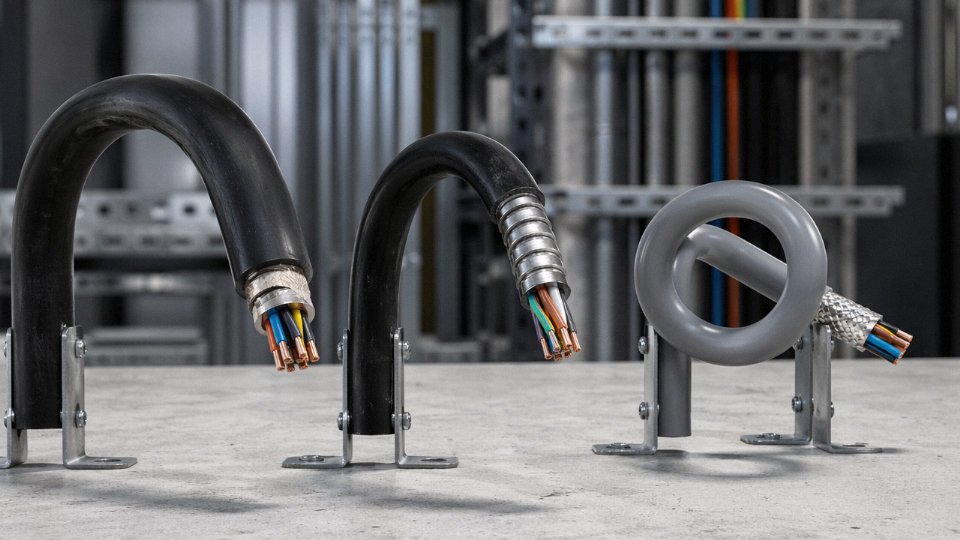
Forcing an SWA cable beyond its minimum bending radius can void the cable's mechanical protection rating and manufacturer warranty.True
Overbending displaces or cracks armour wires, creating stress concentrations on the underlying insulation. Most SWA cable standards, including BS 5467 and IEC 60502-1, specify minimum bending radii as a condition of the cable's rated performance. Damage from overbending is typically detectable only after insulation failure occurs.
What Overbending Actually Does to the Cable
When you push past that minimum radius, the armour wires on the outer curve spread and those on the inner curve compress and buckle. The steel doesn’t spring back cleanly. What you get is a localised displacement — a kink in the armour layer that sits directly over the insulation. That stress concentration doesn’t cause an immediate fault, usually. It causes a fault six months later, under load, when the insulation has been thermally cycled a few dozen times and that weakened spot finally gives way. By then, the cause is obscure, the cable is buried or dressed into a panel, and the fault-finding exercise is expensive and time-consuming. Warranty claims on overbent cable rarely succeed because the deformation is physically visible on inspection.
Dynamic Applications: Armoured Cable Simply Doesn’t Belong There
Crane festoon systems, robotic arm cable tracks, reciprocating conveyor drives, the tail-end of a mobile plant — any application involving repeated flexing cycles will fatigue steel armour wire. It’s not a matter of if; it’s a matter of how many cycles. The armour fractures progressively, broken wire ends work through the bedding layer, and eventually you have steel fragments inside the cable assembly. For these applications, screened flexible cables, trailing cables with fine-wire tinned copper braiding, or purpose-built chainflex-type constructions are the right answer. Armoured cable is fundamentally a fixed-installation product.
Directional Drilling and Conduit Pulling
Large-bore SWA cables pulled through curved conduit or directional-drilled ducts generate pulling tensions that can exceed the cable’s published jam ratio well before the run is complete. The stiffness of the cable means it bears hard against the inside of any bend in the duct, friction climbs steeply, and sheath damage — sometimes invisible — occurs at the contact points. Pulling lubricant helps, but it doesn’t solve a physics problem. On runs over roughly 80–100 metres with more than one direction change, it’s worth running a mandrel test and calculating sidewall bearing pressure before committing to an SWA pull.
Reconfiguration Costs in Flexible Manufacturing Environments
This is the disadvantage that facility managers in automotive and food processing plants tend to discover the hard way. A production line gets reorganised — it happens every few years in most plants — and the electrical infrastructure needs to follow. With trunking systems and flexible conduit, that’s a manageable job. With SWA cable dressed to structure, it usually means cutting out the run entirely and re-cabling from the distribution board. You can’t add a junction mid-run cleanly, you can’t re-route around new equipment without remaking terminations, and the gland positions are fixed to the original layout. The installed cost of that inflexibility doesn’t appear on the original project budget, but it shows up clearly in the maintenance capital account two or three years later.
EMI Shielding Limitations and Earthing Complications in Sensitive Systems
Steel wire armour does one thing well: it resists mechanical damage. What it does not do — and what a surprising number of specifiers assume it does — is provide reliable electromagnetic shielding across the frequency ranges that matter in modern industrial facilities.
Steel wire armour provides equivalent EMI shielding to a purpose-designed copper braid or foil screen.False
SWA armour offers some low-frequency magnetic attenuation below roughly 1 kHz due to the ferromagnetic properties of the steel, but its screening effectiveness drops off sharply at higher frequencies. Above 1 kHz, and certainly into the tens and hundreds of kilohertz range generated by VFDs and switching power supplies, copper tape or copper braid screens outperform steel wire armour by a wide margin. They are fundamentally different constructions serving different purposes.
Armour Is Not a Screen — The Frequency Problem
The confusion is understandable. Both armour and screen wrap around the cable core, and both are typically earthed. But the physics are different. Steel’s resistivity is roughly 10–12 times higher than copper, which directly limits how efficiently it can conduct away induced high-frequency currents. A purpose-designed copper tape screen on a 4-core instrument cable might offer 60–80 dB of screening effectiveness at 100 kHz; the steel wire armour on an equivalent SWA power cable is doing something closer to 20–35 dB at that frequency, depending on wire gauge, lay length, and coverage percentage. The exact figure shifts with construction details, but the gap is consistently large.
In a process plant running a mix of motor feeders, instrumentation loops, and PLC I/O cable in shared cable trays, this matters enormously. If someone has specified SWA for a 4–20 mA temperature transmitter loop because “it has armour so it must be screened,” that loop is exposed.
The Ground Loop Problem Nobody Mentions at the Design Stage
IEC 60502 and the earthing requirements under BS 7671 both require that the armour be bonded at both ends for fault protection. Mechanically and for personnel safety, this is correct and non-negotiable. The problem is that bonding at both ends creates a closed conductive loop around the cable run, and any difference in earth potential between the two bonding points — common in large plants where the earthing network is never perfectly equipotential — drives a circulating current through that loop. At 50 or 60 Hz, that current induces noise directly into any signal conductors sharing the same cable or running closely parallel.
In practice, on long cable runs of 50 m or more between a control room and a field junction box, ground potential differences of 0.5–3 V are not unusual, particularly in older facilities or sites with heavy variable-speed drive installations nearby. That’s enough to corrupt a millivolt-level thermocouple signal or introduce visible jitter into a 4–20 mA loop.
VFD Applications: Where SWA Genuinely Fails
Variable frequency drives generate common-mode noise with significant energy from a few kilohertz up to several megahertz. Controlling that noise requires a low-impedance return path for high-frequency currents — ideally a continuous copper braid or foil with 85–100% coverage, bonded at both ends with short, low-inductance earth connections. SWA cable cannot do this. Its higher impedance at HF, combined with the discrete rather than continuous nature of the wire lay, means high-frequency common-mode currents find alternative paths: through the earth conductors, through cable tray metalwork, through signal cable screens.
The consequence is usually erratic drive behaviour, nuisance trips on drives with sensitive earth fault detection, or corrupted encoder feedback signals. Some sites end up retrofitting EMC conduit around SWA runs to VFDs — which is expensive and should have been avoided at specification stage by selecting a purpose-built VFD cable with symmetrical ground conductors and continuous copper screen.
When Screened Unarmoured Cable Is the Right Answer
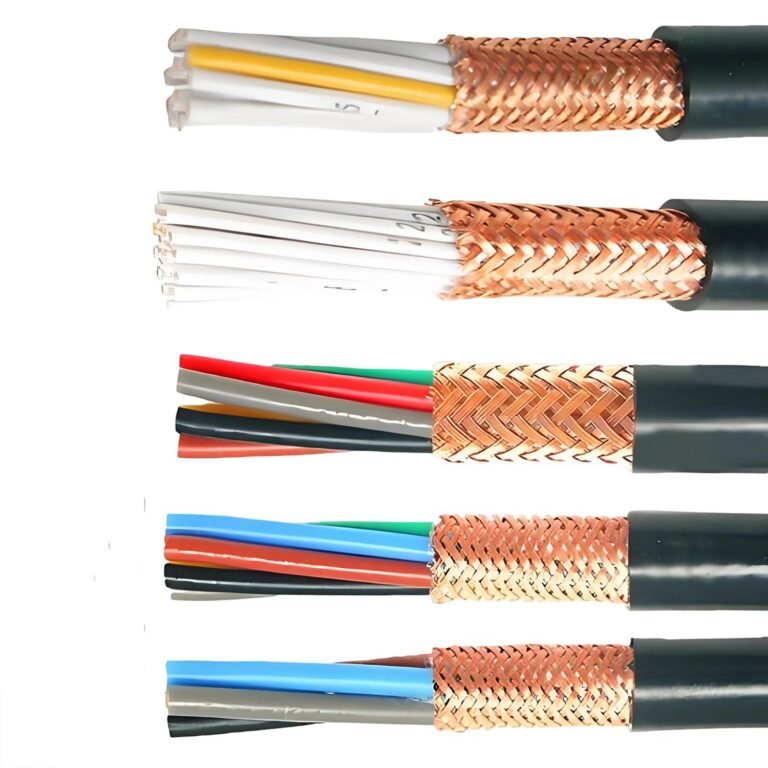
For instrumentation loops, PLC analogue I/O, RTD and thermocouple extension cable, and most data centre copper infrastructure, a foil-screened or braid-screened unarmoured cable consistently outperforms SWA on EMC grounds. It’s lighter, easier to route, terminates faster, and the screen can be earthed at one end only (single-point earthing) to break the ground loop — something you cannot do with SWA armour if you need fault protection compliance.
IEC 61000-5-2 installation guidelines address exactly this: physical separation between power and signal cables, screen earthing strategy, and the use of individually screened pairs for sensitive analogue signals. SWA power cables running adjacent to unscreened instrument cable in a shared tray technically comply with those guidelines only when separation distances and cable spacing rules are followed. In the real world, those rules get compressed under project cost pressure, and the EMC performance suffers accordingly.
The practical rule is straightforward: specify armour where you need mechanical protection or direct burial. Specify a proper EMC screen — copper tape, copper braid, or both — where you need signal integrity. Assuming one substitutes for the other is how instrumentation engineers end up chasing noise problems months after commissioning.
End-of-Life Recycling Challenges and Environmental Cost
Recycling armoured cable sounds straightforward until you’re standing next to a 500 kg drum of mixed-construction SWA cable at a scrap yard and realise the contractor is quoting you less than you paid for the reel. The multi-material construction that makes armoured cable robust in service is precisely what makes it awkward — and sometimes uneconomical — to recover at end of life.
The Multi-Material Separation Problem
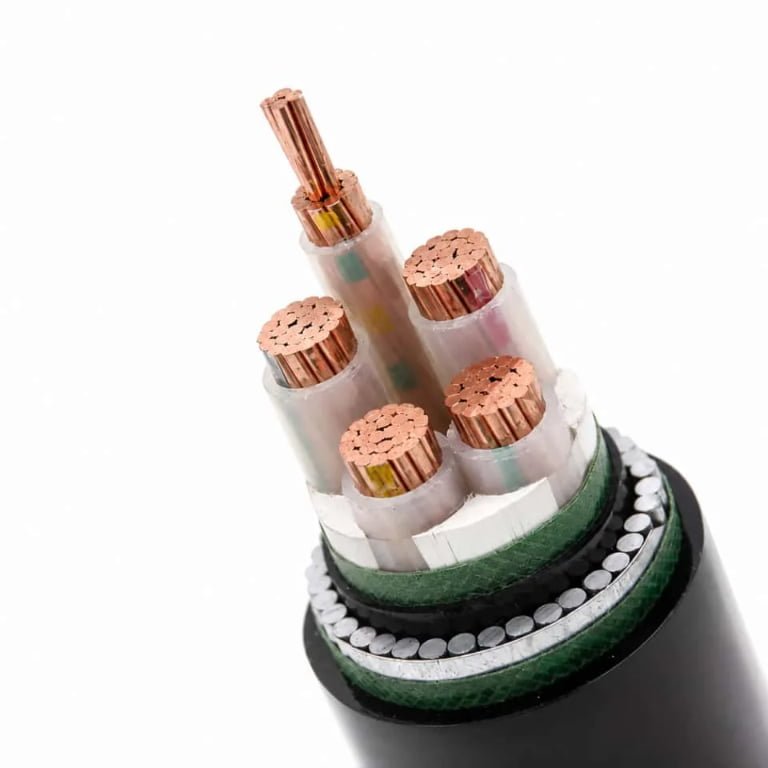
A typical SWA cable cross-section contains at least four distinct material streams: copper or aluminium conductors, XLPE or PVC insulation around each core, the steel wire armour layer, and a PVC or PE outer sheath. Each of these requires a separate recovery pathway. Mechanical granulation and air-table separation can handle the conductor and insulation reasonably well at industrial scale, but the steel armour complicates the process considerably. The wires don’t strip cleanly with standard cable granulators — the equipment needs to be adjusted, and for smaller batches the setup cost may outweigh the recovered value entirely.
In practice, recycling contractors often process armoured cable in bulk lots of several tonnes at a time. Below roughly 500 kg, many facilities simply aren’t interested at a margin-positive rate, which means project sites generating small volumes of offcut or decommissioned SWA cable face either landfill disposal or a net-cost recycling arrangement where you’re paying the processor.
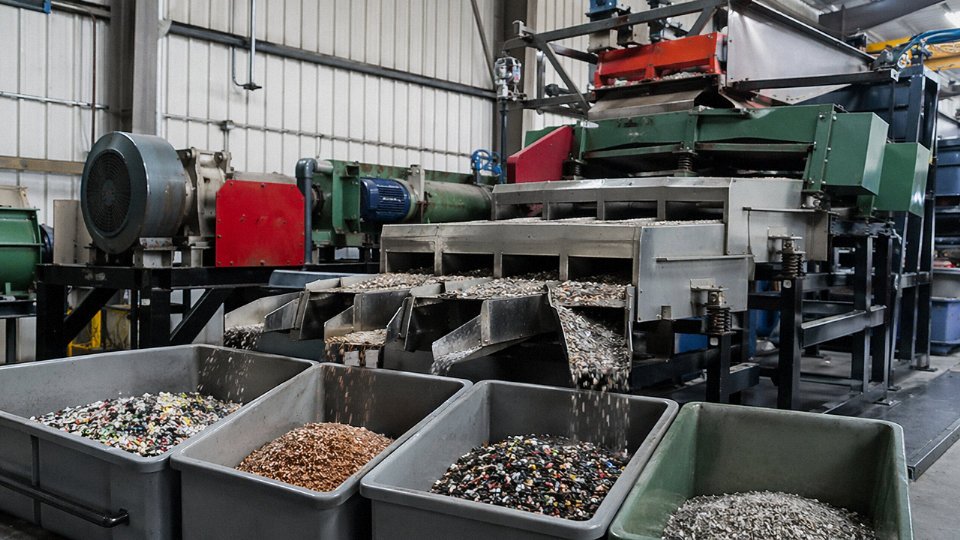
Steel Armour: Heavy, but Low Scrap Value
The steel in SWA cable adds significant mass — which, as covered earlier in this article, is already a handling problem during installation. At end of life, that weight doesn’t translate into meaningful recovery value. Steel scrap typically fetches somewhere in the range of £0.10–0.20/kg, and the actual value depends on regional scrap markets, contamination, and whether you can get a clean separation. Compare that to copper at roughly £4.50–6.00/kg (again, variable with LME pricing and purity) and you can see where the economics land.
The steel often costs more in labour and machinery time to separate than it returns. For a project decommissioning several kilometres of 4-core 25 mm² SWA, the copper content justifies the whole recycling exercise. But the steel armour is essentially a processing cost, not a revenue stream.
Steel armour in SWA cable adds scrap recovery value that makes end-of-life recycling more profitable.False
Steel scrap value is typically £0.10–0.20/kg versus copper at £4.50–6.00/kg. The steel adds processing cost and weight without meaningful recovery value, making it a net burden in most small-to-medium recycling operations.
PVC Sheath and Halogenated Waste Streams
If the outer sheath and core insulation are PVC rather than LSZH, the cable enters a halogenated plastic waste stream on disposal. In the EU, this is restricted under RoHS and the Waste Framework Directive 2008/98/EC. Incineration of PVC generates hydrogen chloride and, under certain combustion conditions, dioxins — which is why several EU member states impose surcharges or outright restrictions on halogenated cable disposal in standard municipal waste incineration facilities. Gulf Cooperation Council countries are increasingly adopting equivalent controls, and procurement teams sourcing armoured cable for infrastructure projects in Saudi Arabia or the UAE should be checking end-of-life compliance now, not at decommissioning stage 25 years from now.
LEED, BREEAM, and ISO 14001 Implications
Sustainability certification schemes are increasingly asking specifiers to document material recovery potential and toxic material content across a product’s full life cycle. Armoured cable with PVC sheathing and steel armour is not a strong answer to those questions. BREEAM’s Materials credit category and LEED’s Materials and Resources credits both reward transparent end-of-life planning — and a cable that generates mixed hazardous and low-value waste streams is a liability in that documentation.
The LSZH-Aluminium Armour Alternative
Specifying LSZH-sheathed cable with aluminium armour rather than PVC-sheathed SWA meaningfully improves the end-of-life picture. Aluminium scrap value is higher than steel (typically £0.80–1.20/kg, depending on alloy and market conditions), the material separates more cleanly, and LSZH compounds avoid halogenated waste restrictions entirely. The upfront material cost premium runs roughly 10–20% depending on conductor cross-section and armour configuration — worth modelling explicitly against the potential compliance costs or recycling penalties over a 20–30 year asset life. For projects targeting formal sustainability certification, that calculation often closes faster than procurement teams expect.
When to Use Armoured Cable and When a Smarter Alternative Exists
Armoured cable is not always the right answer. That sounds obvious, but walk through enough cable schedules and you will find SWA specified for indoor runs inside fully enclosed steel trunking, inside conduit, inside raised-floor voids — environments where the armour layer contributes essentially nothing to protection while adding weight, cost, and termination time. The question is not whether armoured cable is good or bad; it is whether it is appropriate for the specific installation environment you are actually working in.
Genuine Use Cases Where SWA Earns Its Place
Direct buried power distribution without conduit is probably the clearest justification. Digging up a trench, laying cable, and backfilling works reliably only if the cable can resist incidental contact with sharp backfill, rodent attack, and compaction loads over years of settlement. SWA handles all three. Conduit-less burial with unarmoured cable is a maintenance time bomb. Similarly, exposed runs across industrial plant floors and cable trays in warehouses — where fork-lift strikes, falling objects, or heavy foot traffic are credible threats — benefit from the mechanical armour in ways that are difficult to replicate cheaply through other means. Outdoor overhead runs subject to physical interference (vegetation contact, occasional mechanical disturbance) and sub-sea or wet-area supplies where you need simultaneous mechanical protection and water ingress resistance are the other cases where armoured cable is genuinely hard to replace cost-effectively.
Outside those scenarios, the calculus shifts fast.
Decision Matrix: Five Criteria, Five Cable Types
| Cable Type | Mechanical Protection | EMC Performance | Weight | Installation Cost | Corrosion Resistance |
|---|---|---|---|---|---|
| SWA (Steel Wire Armoured) | Excellent | Poor–Moderate | Heavy | High | Moderate (steel corrodes) |
| AWA (Aluminium Wire Armoured) | Good | Poor–Moderate | Medium | Medium–High | Better than SWA in damp soils |
| Screened Unarmoured (CY/SY) | Low | Good–Excellent | Light | Low–Medium | Depends on outer sheath |
| LSZH Unarmoured in Steel Conduit | Low–Medium | Moderate | Light | Medium | Conduit dependent |
| MICC (Mineral Insulated) | Excellent | Moderate | Heavy | Very High | Excellent (copper sheath) |
EMC performance ratings assume single-point earthed screen; SWA earthed both ends can introduce circulating currents that worsen EMC in some installations.
Alternatives for Specific Problem Scenarios
For instrumentation and control runs in electrically noisy environments — drives, switchgear rooms, anything with variable-frequency drives nearby — SY or CY screened cables are the right specification, not SWA. The copper braid or foil in a CY cable gives you a defined, low-impedance screen that actually performs at signal frequencies. SWA’s steel wire provides essentially no useful screening above a few hundred hertz.
For confined indoor runs with genuinely low mechanical risk, multicore LSZH in steel conduit satisfies IEC 60364-5-52 wiring method requirements, weighs a fraction of the equivalent SWA, terminates with standard glands, and costs noticeably less in labour. In practice, this combination is the sensible default for most commercial building services and light industrial applications — the conduit gives you the physical protection, the LSZH sheath handles fire safety, and you avoid dragging heavy drums across a finished floor.
For highly corrosive environments — coastal substations, chemical processing areas, fertiliser plants — standard galvanised steel wire armour is a poor choice regardless of outer sheath quality. HDPE-sheathed SWA extends service life somewhat, but SSWA (stainless steel wire armour) or glass-fibre braided armour with a chemically resistant sheath addresses the root problem rather than patching it.
The Over-Specification Trap
IEC 60364-5-52 installation method tables support using unarmoured cable in conduit as equivalent mechanical protection to armoured cable in many indoor scenariosTrue
IEC 60364-5-52 Table B.52.1 defines installation reference methods including conduit-enclosed wiring as a recognised wiring method with defined current-carrying capacity, explicitly treating the conduit as the mechanical protection element, making armour redundant in those conditions.
Engineers specifying SWA for runs that will sit inside cable management systems, enclosed trunking, or conduit are, bluntly, over-specifying. The armour adds roughly 30–60% to cable weight, increases gland cost, slows termination work, and — in conduit — can actually make fault-finding harder if the conduit and armour earth paths interact unpredictably. Refer to the IEC 60364-5-52 tables before defaulting to armoured simply because the project is “industrial.”
Jinda’s product range covers SWA, AWA, XLPE-screened instrumentation cables, LSZH multicore, and speciality armoured types including SSWA variants for corrosive environments. The practical advantage of working with a manufacturer rather than a distributor is that the right cable type for the actual installation environment can be confirmed at specification stage — not after the project is already bought, delivered, and partially installed.
Frequently Asked Questions About Armoured Cable Disadvantages
Is armoured cable always necessary for underground installation?
No, and this is one of the most common over-specifications I see on civil and utilities projects. Direct burial is one valid use case for SWA, but running cable through HDPE duct or PVC conduit at adequate depth achieves equivalent mechanical protection — often at lower total installed cost when you factor in future access and replaceability. The real decision hinges on several variables: soil type and stability (rocky ground with angular fill is genuinely harsh on unarmoured cable), installation depth relative to traffic loading, local regulatory requirements, and how much value you place on being able to pull and replace the cable without excavation. In practice, a ducted unarmoured cable in a road crossing is easier to replace than SWA buried directly, which matters over a 25-year asset life. Run both scenarios through a proper installed-cost comparison before defaulting to armoured.
Can armoured cable be used in flexible or continuously moving applications?
Standard SWA and STA cables are not rated for continuous flexing — full stop. The steel wire or tape layer is designed for static mechanical protection, and repeated bending cycles work-harden and eventually fracture individual wires, creating internal fault points that are nearly impossible to locate without specialist equipment. Dynamic applications — crane festoons, robotic cable tracks, winding drums, drag chains — require purpose-built trailing cables or braided-armour flexible cables with documented flex-cycle ratings and torsional twist specifications. The flex-cycle life of a suitable trailing cable might be 5–10 million cycles at a given bend radius; a standard SWA cable in the same duty might fail in thousands. Wrong cable selection here doesn’t just mean early failure — it can mean arc faults inside moving machinery.
Does armoured cable provide full EMC shielding?
No, and conflating armour with shielding is a persistent mistake in panel and instrumentation work. Steel wire armour offers some low-frequency magnetic shielding due to the ferrous material, but its transfer impedance is poor at frequencies above a few kilohertz, and the inter-wire gaps in SWA construction mean it is not a continuous conductive envelope. For instrumentation signals, analogue 4–20 mA loops near VFD outputs, or any application with a defined EMC compliance requirement, you need purpose-screened cable — copper foil, copper braid, or combination — with correct single-point or both-end earthing as the application dictates. Armoured cable does not substitute for that.
Steel wire armour on SWA cable provides full EMC shielding equivalent to a copper braid screen.False
SWA armour has significant gaps between wires and poor high-frequency transfer impedance. It does not meet the shielding requirements for instrumentation or EMC-sensitive circuits; purpose-designed screened cables with copper foil or braid are required for those applications.
Why is SWA cable so much harder to terminate than unarmoured cable?
Each SWA termination involves cutting back the outer sheath, carefully dressing and cutting the steel wire layer to a consistent length without damaging the inner bedding, selecting the correctly sized armoured cable gland for both the armour diameter and the overall cable diameter, assembling it to maintain the specified IP rating, and then verifying armour earth continuity with a low-resistance test. Miss any step — wrong gland size, wires not fully captured in the gland cone, poor earth connection — and you have either a mechanical failure point, a compromised IP rating, or an unprotected earth path. It takes a competent electrician considerably longer than a standard unarmoured termination, and in my experience it is the step where apprentice errors most commonly show up during commissioning.
Is armoured cable more expensive than unarmoured cable of the same rating?
Yes, routinely 20–35% higher in material cost per metre, depending on steel wire prices, copper content, and market conditions at the time of procurement. That gap widens when you add correctly rated armoured glands, earth tags, shrouds, and the additional labour time. In complex installations with many terminations — a motor control centre serving a production line, for example — the total installed cost premium can reach 30–45% over an equivalent unarmoured cable in conduit. The premium is most justifiable where direct burial or exposure to physical damage is genuine and unavoidable; it is hardest to justify in cable tray inside a building where conduit or trunking would serve equally well.
What is the main corrosion risk with steel wire armoured cable?
The failure sequence is usually: outer sheath damage (mechanical nick, UV degradation in LSZH compounds exposed to direct sunlight over years, or chemical attack), followed by moisture reaching the steel wire layer, followed by oxidation. In buried installations, the corrosion is often invisible until the armour has lost significant cross-section. Galvanic corrosion compounds the problem at gland interfaces — steel armour wires in contact with brass or copper gland bodies in humid or immersed conditions will corrode preferentially, and chloride-rich soils or coastal atmospheres accelerate this considerably. Stainless steel wire armour or aluminium wire armour is available and worth the premium in genuinely aggressive environments; the cost difference per metre is much smaller than the cost of early cable replacement.
Can I use armoured cable in an ATEX or IECEx hazardous area?
Yes, but the compliance requirements add real cost and time. The cable glands must carry the correct Ex certification for the zone, gas group, and temperature class — a standard industrial SWA gland is not compliant. Armour earthing must follow IEC 60079-14, and the installation is subject to inspection and documentation requirements that a standard industrial installation is not. On sites I have worked on, the combined cost of certified glands, third-party inspection, and documentation for hazardous-area SWA terminations can add 60–100% to the termination cost versus an equivalent safe-area installation. That is not a reason to avoid armoured cable in hazardous areas where it is the right technical choice — but procurement managers who budget based on safe-area labour rates will be unpleasantly surprised.