Pick the wrong wire gauge or insulation type for a home circuit and the consequences range from nuisance tripping all the way to a house fire — not a hypothetical, just basic overcurrent physics. A 14 AWG branch circuit fed from a 20 A breaker will run warm under normal load and can reach dangerous temperatures under sustained draw, long before the breaker sees enough current to trip. The repair isn’t just rewiring a run; it’s drywall, permits, and lost time, plus whatever the failed circuit took with it.
For most North American homes, the right wire is NM-B (commonly called Romex) with copper conductors — 14 AWG for 15 A circuits and 12 AWG for 20 A circuits. Conduit runs in garages, basements, or outdoors call for THHN/THWN-rated wire instead. Aluminum wiring is still used for large-load feeders but requires upsizing by at least one AWG gauge versus copper to carry equivalent ampacity.
What makes this more complicated in practice is that a single house usually needs three or four different wire types depending on where the circuit runs, what it powers, and whether local code has layered anything on top of the NEC baseline. The gauge chart on the back of a wire spool is a starting point, not a complete answer.
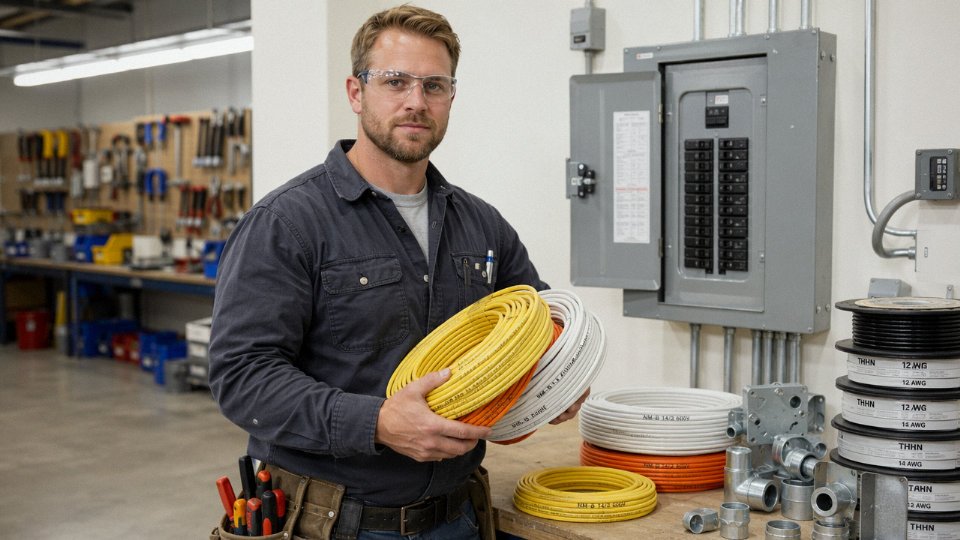
Copper vs. Aluminum Conductors: Which Metal Belongs in a Residential Wiring System
The short answer most electricians will give you: copper for branch circuits, aluminum for feeders and service entrance. That’s a reasonable rule of thumb, but understanding why lets you make smarter decisions — especially when you’re pricing a whole-house rewire or specifying a new service panel upgrade.
The Conductivity Gap and What It Costs You in the Field
Copper sits at roughly 58 MS/m conductivity; aluminum lands around 35 MS/m. That’s about a 40% reduction, which sounds academic until you’re running a 150-foot feeder to a detached garage sub-panel. At that distance, aluminum’s higher resistivity translates directly into measurable voltage drop — somewhere in the range of 2–4% more drop per foot than an equivalent copper conductor of the same gauge. Code generally caps voltage drop at 3% for branch circuits and 5% total, so on longer runs you’re already fighting the math.
The fix is upsizing. Aluminum wire needs to be at least one AWG larger than copper to deliver comparable ampacity. A practical example: a 4 AWG copper feeder rated at roughly 85 A can be matched by 2 AWG aluminum. For a 100 A sub-panel feeder, you’d typically use 1/0 AWG aluminum where 2 AWG copper might otherwise serve. The aluminum is cheaper per pound, and it’s significantly lighter — which matters when you’re pulling wire through a long conduit run or trying to land multiple conductors in a crowded panel enclosure.
Where Aluminum Makes Legitimate Sense
Service entrance cable is almost always aluminum in modern residential construction — has been for decades — and that’s perfectly fine. Same goes for feeder runs of 100 A or more, and for 240 V branch circuits feeding ranges, dryers, and HVAC equipment. The conductors are large enough that the connection hardware is purpose-rated, and you’re not making dozens of device terminations the way you are on a 20-circuit bedroom and kitchen layout.
The problems historically associated with aluminum wiring — and there were real fires attributed to it in the 1960s and 70s — stemmed almost entirely from using small-gauge aluminum (10–14 AWG) on 15 A and 20 A branch circuits, terminated on devices rated only for copper. Thermal expansion and contraction at the terminals loosened connections over time. Galvanic corrosion at dissimilar-metal junctions formed aluminum oxide, which is both a poor conductor and nearly invisible during a casual inspection.
Mitigation today is well-understood: use CO/ALR-rated devices (those are specifically listed for aluminum conductors at receptacle and switch points), apply anti-oxidant compound like Noalox at every termination, and torque terminals to the manufacturer’s specification — usually in the 35–45 in-lb range for panel lugs, though always check the label. Skip any of those steps and you’re back to a connection that runs warm and eventually fails.
Aluminum wire requires at least one AWG size larger than copper to achieve equivalent ampacity for the same circuit load.True
This is confirmed by NEC Table 310.16 and is a standard upsizing requirement based on aluminum's lower conductivity (~35 MS/m vs. copper's ~58 MS/m). For example, 2 AWG aluminum is roughly equivalent in ampacity to 4 AWG copper for feeder applications.
Why Copper Still Owns the Branch Circuit Side
For 15 A and 20 A circuits — your outlets, lighting, kitchen countertops — copper wins on every practical axis except raw material cost. It’s easier to work with, tolerates a wider range of termination hardware, doesn’t demand the same oxidation management ritual, and occupies less conduit fill. The smaller physical diameter matters more than people expect; in a crowded junction box, 12 AWG copper is noticeably easier to land cleanly than its aluminum equivalent.
Side-by-Side Comparison
| Property | Copper | Aluminum |
|---|---|---|
| Conductivity | ~58 MS/m | ~35 MS/m |
| Weight per 1,000 ft (12 AWG equiv.) | ~195 lb | ~65–70 lb |
| Relative cost index (material only) | Higher (1.0 baseline) | Lower (~0.4–0.6×, varies with commodity pricing) |
| Typical home applications | Branch circuits, device wiring | Service entrance, feeders, large appliance circuits |
| Required connector/device type | Standard CU-rated | CO/ALR or AL-rated lugs; anti-oxidant compound required |
| AWG upsizing vs. copper | Baseline | Minimum +1 AWG to match ampacity |
Copper’s cost premium fluctuates — sometimes dramatically — with commodity markets. During periods of high copper prices, the gap narrows the case against aluminum feeders even further. But for the 15 A and 20 A circuits that make up the bulk of any residential system, the labor savings from not managing aluminum’s termination requirements typically offset the material price difference.
Wire Gauge and Ampacity Decoded: Matching AWG Size to Every Home Circuit
The AWG scale trips up a lot of people the first time. Bigger number, smaller wire — it runs backwards from what intuition suggests. A 14 AWG conductor is noticeably thinner than a 10 AWG, and by the time you get to 2/0 or 4/0 AWG for a 200 A service entrance, you’re handling cable that’s closer to your thumb than your finger. Keep that inversion in mind and the rest of the selection logic falls into place.
The Ampacity Reference You’ll Actually Use
NEC Table 310.12 is the governing document for residential conductor sizing. The numbers below reflect that table for NM-B (the plastic-sheathed cable most North American homes are wired with) and for conductors run in conduit, where temperature ratings shift. Real-world ampacity depends on installation method, ambient temperature, and how many conductors share a conduit — these are the baseline figures before derating.
| AWG | Copper 60°C | Copper 75°C | Aluminum 75°C | Typical Breaker |
|---|---|---|---|---|
| 14 | 15 A | 20 A | — | 15 A |
| 12 | 20 A | 25 A | — | 20 A |
| 10 | 30 A | 35 A | 30 A | 30 A |
| 8 | 40 A | 50 A | 40 A | 40 A |
| 6 | 55 A | 65 A | 50 A | 50–60 A |
| 4 | 70 A | 85 A | 65 A | 70 A |
| 2/0 | 115 A | 130 A | 100 A | 100–125 A |
NM-B cable is always derated to its 60°C column in practice, even though the insulation is rated higher, because the device terminals it connects to — outlets, breakers, lugs — are themselves rated 60°C unless explicitly marked otherwise.
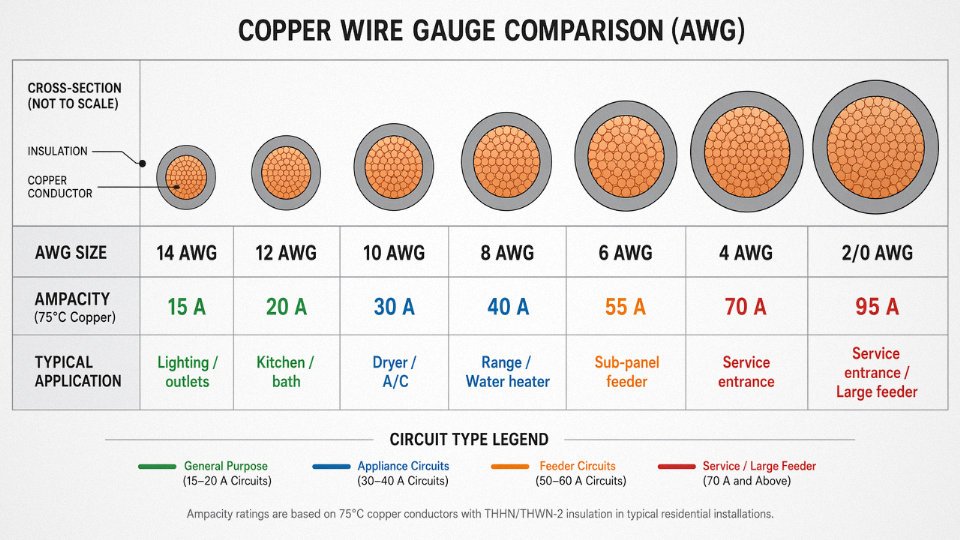
Circuit-by-Circuit Assignments
Lighting circuits and bedroom outlets run on 14 AWG / 15 A. That’s adequate for the load, but plenty of electricians now default to 12 AWG throughout a house — it costs maybe 15–20% more in material on a typical job but eliminates any future flexibility headaches when someone adds a second monitor, a space heater, or a charging station to a “bedroom” that becomes a home office.
Kitchen, bathroom, and laundry branch circuits require 12 AWG / 20 A minimum under NEC, and for good reason — a countertop appliance load can spike hard. Electric dryers land on 10 AWG / 30 A. Ranges typically need 8 AWG / 40 A, though some newer induction units pull closer to 50 A and should be evaluated against their nameplate data, not assumed. Large central HVAC units — a 4-ton system, say — often call for 6 AWG / 55–60 A; always cross-check the equipment’s minimum circuit ampacity listed on the data plate.
Voltage Drop: The Calculation People Skip
NEC recommends keeping branch circuit voltage drop below 3%, with combined feeder and branch drop not exceeding 5%.True
This is stated in NEC 210.19(A) Informational Note No. 4 and 215.2(A) Informational Note No. 2, which recommend these limits for efficiency and equipment performance.
Here’s a quick worked example. A 20 A kitchen circuit runs 100 feet from the panel — which means 200 feet of total conductor length (out and back). Using 12 AWG copper with a resistance of roughly 1.98 Ω per 1,000 feet, total resistance is about 0.40 Ω. At 20 A: voltage drop = 20 × 0.40 = 8 V on a 120 V circuit, or about 6.7%. That exceeds the 3% guideline by more than double. Stepping up to 10 AWG brings resistance down to around 0.25 Ω, dropping voltage loss to roughly 5 V — still marginal, but a further step to 8 AWG gets you comfortably under 3%. Long runs in large houses bite harder than people expect.
The 80% Continuous Load Rule and Why It Changes Your Sizing
Any load that runs for three hours or more continuously is a “continuous load” under NEC Article 100. A 20 A circuit should carry no more than 16 A of continuous load — that 80% factor applies to both the breaker and the wire. This catches people on EV chargers and workshop circuits. A Level 2 EV charger drawing 24 A needs a 30 A dedicated circuit minimum, not a 20 A. Ignore this and you’re looking at nuisance tripping at best, accelerated insulation degradation at worst.
Mistakes With Real Consequences
Undersizing is the obvious danger — overheated insulation, potential ignition in wall cavities, failed inspection. Less appreciated is chronic oversizing. Running 10 AWG on a circuit that will never exceed 12 A doesn’t hurt anything electrically, but it drives up material cost meaninglessly, makes terminations stiffer and harder to seat cleanly in standard outlets, and sometimes indicates the installer was simply guessing rather than calculating. On the other end, swapping 12 AWG for 14 AWG to save a few dollars on a kitchen circuit will fail rough-in inspection immediately — and should.
The most common field error I see is correct wire gauge paired with an incorrect breaker: 12 AWG wire on a 15 A breaker, for instance, isn’t a safety hazard per se, but it leaves protection capacity on the table and creates confusion during future service work. Match the wire, the breaker, and the outlet rating as a set, not as independent decisions.
Insulation Types and Cable Jacket Ratings: NM-B, THHN, UF-B, and Beyond
Every wire sold in North America carries a printed code stamped right into the insulation or jacket — a string of letters that tells you exactly what the product is rated for and where it can legally go. Most people ignore it. Electricians read it automatically. Once you understand the system, you’ll never reach for the wrong product again.
Decoding the NEC Letter-Code System
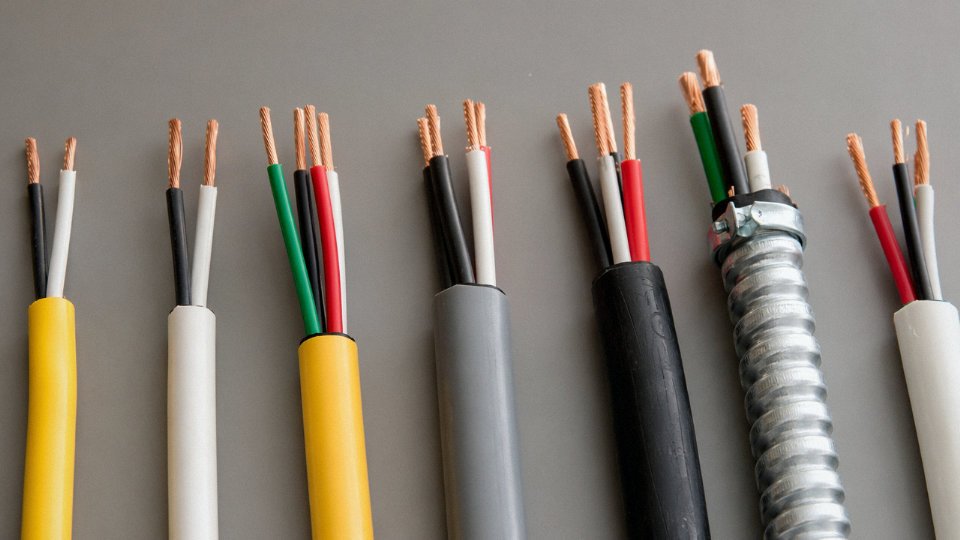
The National Electrical Code uses a shorthand that stacks individual property codes into compound designations. T means thermoplastic insulation — the baseline for most modern residential wire. H means heat-resistant to 75°C; HH steps that up to 90°C. W means rated for wet locations. N means there’s a nylon outer jacket, which adds abrasion resistance and makes pulling through conduit dramatically easier. U means underground-rated construction.
So THHN reads as: thermoplastic, 90°C heat-resistant, nylon jacket. THWN-2 means thermoplastic, heat-resistant, wet-location rated, with the “-2” suffix confirming 90°C in both wet and dry conditions. These aren’t arbitrary — each letter represents a specific tested performance property, and substituting a lower-rated product in the wrong environment is a genuine fire and code-violation risk.
NM-B: The Workhorse of Residential Wiring
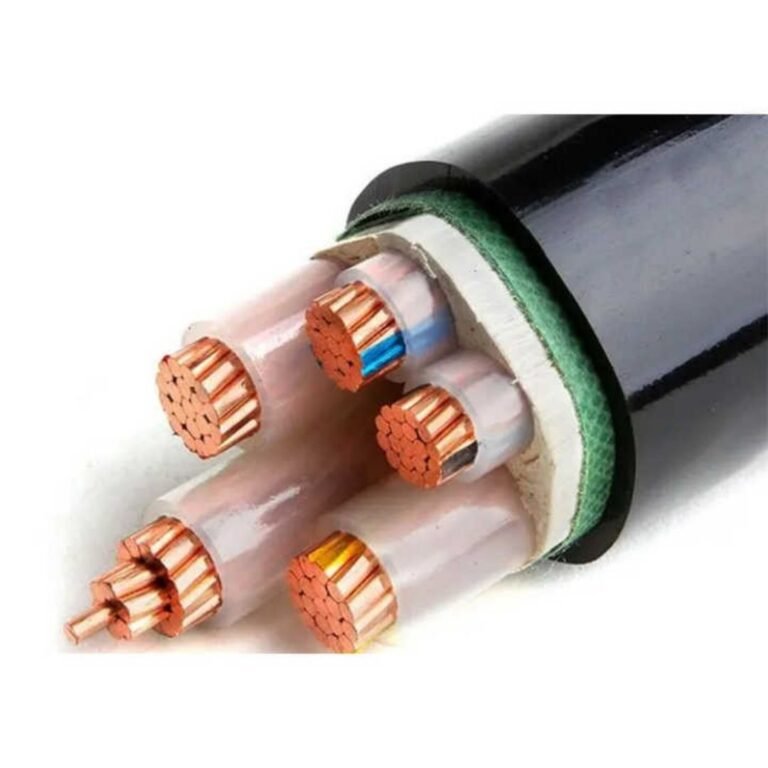
NM-B (non-metallic sheathed cable, widely known by the brand name Romex) dominates residential rough-in work across North America — realistically around 90% of branch circuit installations. Its construction is simple: individual THHN or THWN-rated conductors, a bare equipment ground, all wrapped in a flat PVC outer jacket. The conductors themselves are rated to 90°C, but NEC 334 requires you to derate ampacity to 60°C when installed in a wall cavity or ceiling. That’s why 12 AWG NM-B is rated for 20 A circuits even though the conductor insulation could theoretically handle more — the limiting factor is the installation condition, not the wire itself.
Where NM-B is prohibited matters just as much as where it’s allowed. NEC 334.12 bars it from commercial buildings over two stories, damp or wet locations, embedded in concrete, exposed in attics where it might be physically damaged without protection, and anywhere subject to environmental degradation. A detached garage with a concrete floor and a moisture problem? NM-B doesn’t belong there, regardless of what a previous owner might have used.
THHN/THWN: Individual Conductors in Conduit
When NM-B is prohibited — or when you need flexibility, repullability, or exposure tolerance — individual THHN/THWN conductors pulled through conduit are the answer. This is standard practice for garage sub-feeds, basement exposed runs, any location where the wire might see moisture or mechanical abuse, and commercial-adjacent residential work.
Conduit fill matters here. NEC Chapter 9 tables limit how many conductors you can pack into a given conduit diameter — typically 40% fill for three or more conductors. Cramming too many wires into a conduit creates heat buildup that forces further ampacity derating. In practice, a ¾-inch EMT conduit handles roughly 6–9 THHN conductors at 12 AWG comfortably, but that number drops quickly as you add circuits or move up in gauge.
UF-B: Direct Burial for Outdoor Circuits
UF-B (underground feeder) looks similar to NM-B on the shelf, but the construction is fundamentally different — conductors are encased in solid PVC compound rather than wrapped in a loose jacket. That solid fill is what makes it direct-burial rated. Typical applications include outdoor receptacle circuits, detached garage feeds run underground, garden shed power, and landscape lighting.
Minimum burial depth under NEC 300.5 depends on installation method: roughly 24 inches for direct burial of UF-B, though that drops to around 12 inches when run under a 4-inch concrete slab. Get this wrong and a single shovel strike can knock out power — or worse.
UF-B cable can be substituted for NM-B inside a home's interior wallsFalse
UF-B is rated for direct burial and wet locations, but its solid-fill PVC jacket makes it difficult to work with in wall cavities and it is not listed for general interior branch circuit wiring under NEC 334. NM-B is the correct product for dry interior applications.
USE-2 and Service Entrance Cable
Service entrance cable — either SER (service entrance round) or SEU (service entrance concentric) — covers the runs from the utility meter into the main panel and from main panels to subpanels. USE-2 designates individual conductors rated for underground service entrance applications. These cables are frequently aluminum, and for good reason: aluminum’s cost advantage at large conductor sizes (1/0 AWG and above) is substantial enough that copper rarely makes economic sense on service entrance runs.
Standard NM-B is never appropriate here. Voltage drop, fault current capacity, and the sustained load profile of a service entrance run are categorically different from a 20 A branch circuit. Using undersized or wrong-jacket cable at the service entrance is one of the more dangerous mistakes found during residential inspections.
Quick-Reference Insulation Selection Matrix
| Installation Environment | Correct Cable/Conductor Type | Temperature Rating | Relevant NEC Article |
|---|---|---|---|
| Dry wall cavity / ceiling | NM-B | 60°C ampacity (90°C conductor) | NEC 334 |
| Conduit — dry indoor | THHN | 90°C dry | NEC 310, 358 |
| Conduit — damp/wet (garage, basement) | THWN or THWN-2 | 75°C wet / 90°C dry | NEC 310 |
| Direct burial, outdoor circuits | UF-B | 60°C | NEC 340, 300.5 |
| Exposed outdoor, weatherproof conduit | THWN-2 in conduit | 90°C wet/dry | NEC 310 |
| Meter to panel / panel to subpanel | SER, SEU, or USE-2 | 75°C–90°C depending on insulation | NEC 230, 338 |
The label on the wire is not a suggestion. It’s a rated system that ties conductor material, insulation chemistry, jacket construction, and installation method together into a single listed product. Match the label to the environment, check the relevant NEC article, and the rest of the installation follows logically.
Room-by-Room and Circuit-by-Circuit Wire Selection Guide for Residential Projects
Specs on a datasheet mean nothing until you’re standing in front of a panel deciding what to pull through the wall. Here’s how the choices actually shake out, room by room.
General Lighting and Outlet Circuits — Bedrooms, Living Rooms, Hallways
Standard 15 A branch circuits use 14 AWG copper NM-B, full stop. The breaker limits fault current; the wire handles normal load. Most bedrooms and living areas run fine on 15 A, but if you’re retrofitting a home office with multiple monitors and a space heater, seriously consider upgrading to a 12 AWG / 20 A circuit before the drywall goes back up — it costs maybe $40 more in wire and saves a callback.
NEC 210.52 requires receptacles spaced so no point along a wall is more than 6 feet from an outlet. In practice this means a 12-foot bedroom wall needs at least two receptacles. Daisy-chaining (looping from outlet to outlet on a single circuit) is fine electrically up to the ampacity limit, but keep total connected load under roughly 80% of breaker rating for continuous loads. Don’t put more than 8–10 devices on one 15 A circuit in a home office or entertainment area — not a code number, just operational sense.
Kitchen and Dining Area
The NEC requires two separate 20 A Small Appliance Branch Circuits (SABCs) for kitchen countertop receptacles — two circuits, not two outlets on one circuit. Each runs 12 AWG copper NM-B. A toaster, microwave, and coffee maker running simultaneously on one 15 A circuit is a reliable way to trip breakers at 7 a.m.
Dishwasher and garbage disposer each get dedicated circuits. Disposer: 12 AWG / 20 A is usually sufficient. Dishwasher: use 12 AWG minimum; some higher-draw units (1,800 W range) benefit from a dedicated 20 A. AFCI protection is required on all kitchen branch circuits in the 2020 NEC; GFCI is mandatory for all countertop receptacles within 6 feet of a sink. Don’t assume the AFCI breaker covers your GFCI requirement — they’re separate functions, and a dual AFCI/GFCI breaker handles both if you want to keep the panel cleaner.
Bathrooms and Laundry
Bathroom circuits: 12 AWG / 20 A, GFCI-protected, dedicated to bathroom(s) only — no piggybacking lighting or hall outlets onto this circuit.
Laundry gets its own 20 A / 12 AWG circuit for the washer. Electric dryer runs 240 V / 30 A on 10 AWG copper, four-wire (two hots, neutral, ground) per current NEC requirements. Three-wire dryer connections still exist in older homes under NEC 250.140 grandfathering, but any new installation or panel replacement should go four-wire. This is one of those areas where inspectors vary by jurisdiction — ask before you pull wire.
Garage, Workshop, and Outdoor Circuits
Exposed conduit runs in a garage or along exterior walls should use THHN/THWN conductors rather than NM-B, which isn’t rated for exposed or damp locations. Pull 12 AWG THHN in 3/4-inch EMT for 20 A workshop circuits; all garage and outdoor receptacles require GFCI protection regardless.
EV Level 2 chargers (typically 40–48 A continuous) need a 50 A circuit minimum: 6 AWG copper or 4 AWG aluminum in conduit. Aluminum is perfectly legitimate here — the run is often 40–80 feet from panel to garage, and aluminum 4 AWG cuts material cost noticeably versus copper 6 AWG for the same ampacity.
Aluminum wiring is acceptable for EV charger feeder circuits when properly sized and terminated with AL-rated connectors.True
NEC 310.106 permits aluminum conductors in branch circuits when upsized appropriately; AL-rated lugs at the breaker and charger are required to prevent oxidation-related connection failures.
HVAC, Electric Range, and High-Load Appliances
Electric range: 8 AWG copper on a 40 A, 240 V circuit is the typical spec, though some larger ranges are rated 50 A — check the appliance nameplate, not just the product listing. Heat pump or central AC disconnect: 10 AWG copper for 30 A circuits covers most residential tonnage (2–5 ton range), but always verify the MCA (minimum circuit ampacity) and MOCP (maximum overcurrent protection) on the equipment label. Those two numbers override any rule of thumb.
Four-wire connections for ranges and dryers are mandatory on new circuits. The old three-wire arrangements that combined neutral and ground are grandfathered only for existing branch circuit connections to existing appliances in existing locations — don’t extend that logic to a remodel.
Subpanel and Feeder Wiring
For a detached garage, workshop, or accessory dwelling unit, NEC 225.30 requires a four-wire feeder: two hots, a neutral, and a separate equipment ground. No exceptions for detached structures, even short runs. Use SER (service entrance round) cable or individual THHN conductors in conduit. Aluminum is cost-effective and code-compliant for feeders in the 60–200 A range — a 100 A aluminum feeder in conduit typically runs 30–45% less in material cost than the equivalent copper, depending on current commodity pricing. Terminate with AL-rated lugs; apply anti-oxidant compound (Noalox or equivalent) at connections.
Smart Home and Low-Voltage Systems
Cat-6 data cables, 18/2 or 18/4 thermostat wire, 16 AWG speaker runs — these are Class 2 circuits under NEC Article 725. They operate at low voltage and low power, which is exactly why they must never share a conduit or enclosure with line-voltage conductors. The insulation ratings are incompatible, and the induced noise on data lines from a 240 V run nearby can cause real problems with smart home controllers. Keep them in separate pathways; a 1-inch separation in open ceiling runs is a bare minimum, more is better.
National Electrical Code Compliance and Safety Standards That Govern Wire Selection
The National Electrical Code — formally NFPA 70 — is updated on a three-year cycle. The current edition is 2023. That sounds straightforward until you realize that each state, county, or municipality adopts editions on its own schedule, and some jurisdictions are still enforcing NEC 2017 or even 2014. Your local Authority Having Jurisdiction (AHJ) is the only authoritative answer. Before you buy a single foot of wire for a permitted project, call the building department and ask which edition is in effect. Inspectors have failed work because a contractor assumed the state had adopted the latest cycle when the local AHJ hadn’t yet.
The NEC Articles That Actually Govern What Wire You Install
Most of the code that dictates day-to-day residential wiring decisions lives in a handful of articles. Article 110 sets general installation requirements — termination temperature ratings, working clearances, conductor identification. Article 210 governs branch circuits: minimum wire sizes, outlet spacing, which circuits need dedicated runs. Article 215 covers feeders (the conductors between your panel and a subpanel), and Article 230 deals with service entrance conductors, where undersized or improperly rated wire creates serious hazards. Article 250 is grounding — arguably the most consequential and most frequently botched article in residential work. Article 310 covers conductor ampacity tables, which is where you confirm that a specific wire in a specific conduit fill at a specific ambient temperature actually handles the load you’re putting on it. Articles 334, 338, and 340 govern NM cable (Romex-style), SE (service entrance) cable, and UF (underground feeder) cable respectively, spelling out permitted uses, prohibited locations, and installation methods for each.
Knowing which article applies keeps you from arguing with an inspector and losing.
Listing and Labeling: Why Unlisted Wire Is a Bigger Problem Than It Looks
Every wire or cable installed in a permitted U.S. residential project must carry a UL listing — or an equivalent recognized testing laboratory mark — for its specific application. THHN/THWN wire falls under UL 83. NM-B cable is listed under UL 719. SE cable falls under UL 854. These aren’t bureaucratic formalities. Unlisted wire can void your homeowner’s insurance policy on a fire claim, and in my experience, insurance adjusters have become more aggressive about checking this after significant loss events. It also constitutes a code violation in itself, independent of whether the wire otherwise performs adequately.
Installing unlisted or uncertified electrical wire in a U.S. home is a National Electrical Code violation and can void homeowner's insurance coverage in the event of a fire.True
NEC 110.2 requires that all conductors and equipment be approved, meaning listed and labeled by a nationally recognized testing laboratory (NRTL). Unlisted products fail this requirement. Insurance policies typically exclude coverage for losses caused by code-violating installations.
AFCI Requirements Under NEC 2020 and 2023
Arc-fault circuit interrupter protection has expanded significantly. Under NEC 2020 and 2023, AFCI protection is now required in nearly all living spaces — bedrooms, living rooms, hallways, kitchens, laundry areas. The practical implication for wire selection is subtler than people expect: AFCI breakers are sensitive to high-resistance connections and nicked insulation that a standard breaker would never detect. Staple damage, over-tightened wire nuts, and partially stripped conductors that would have passed inspection a decade ago will now trip a properly functioning AFCI breaker during commissioning. Installing the right wire correctly matters more, not less.
Aluminum Wiring in Pre-1972 Homes
Homes built between roughly 1965 and 1972 may have aluminum branch circuit wiring — 15 A and 20 A circuits run with aluminum conductors sized for copper. The Consumer Product Safety Commission documented a significantly elevated fire risk at termination points due to oxidation and differential thermal expansion. If you have this wiring, you have three practical paths. COPALUM crimp connectors, installed by a trained electrician using the purpose-built crimping tool, are the most reliable permanent repair. AlumiConn connectors are an acceptable alternative where COPALUM service isn’t available. Full rewiring is warranted when the existing aluminum wiring shows visible damage, when the home is undergoing major renovation that opens walls anyway, or when a buyer’s insurer refuses to underwrite the property as-is.
Permits, Inspections, and What Happens When You Skip Them
Whether a homeowner can pull their own permit varies by jurisdiction — many allow it for work on their primary residence, some don’t. What an inspector actually checks includes wire gauge against circuit breaker rating, staple spacing and method (NM cable requires support within 12 inches of a box and every 4.5 feet along the run), box fill calculations, and ground continuity. Unpermitted wiring creates compounding problems. It surfaces during home sale inspections and either kills deals or forces expensive remediation under time pressure. More seriously, some insurers deny fire claims when investigators determine wiring work was done without permit. The permit fee is, in practice, cheap insurance.
How to Read Wire and Cable Markings, Packaging Labels, and Reel Specifications
Walk up to any roll of residential cable at a supply house and you’ll see a string of text printed along the jacket at regular intervals — usually every 12 to 24 inches. Most buyers glance at it and move on. That’s a mistake, because every segment of that print line carries specific technical meaning, and misreading even one field can mean ordering the wrong product for a code-required application.
Decoding a Real Jacket Print Line
Take a typical marking: 12/2 NM-B WITH GROUND 600V (UL) AWM E12345 SUNLIGHT RESISTANT
Starting left to right: 12/2 is the slash notation — 12 AWG conductors, two current-carrying conductors (one black hot, one white neutral). The uninsulated bare copper ground wire travels alongside but is not counted in that second number. So 12/2 NM-B actually contains three conductors physically. 12/3 adds a red insulated “traveler” conductor, which you’ll need for three-way switch loops and certain multi-wire branch circuits. Confusing these two at the point of order is a classic rough-in mistake that costs a return trip and half a day.
NM-B tells you the construction type — non-metallic sheathed cable, 90°C rated conductors (the “B” suffix), though NM-B is derated to 60°C ampacity inside conduit or bundled runs per NEC 334.80. 600V is the voltage rating of the insulation system, not a recommendation to run it at 600V in residential use. (UL) confirms third-party listing. AWM stands for Appliance Wiring Material, which sometimes appears on sub-components. E12345 (the actual file number varies by manufacturer) is the UL file number — the key to verifying the cable’s listed status. SUNLIGHT RESISTANT means the jacket compound is UV-stabilized, required if the cable will be exposed outdoors, though NM-B generally shouldn’t be used in exposed exterior applications regardless — that’s UF-B territory.
Reel and Coil Packaging: Why Quantity Breaks Matter
Retail home centers typically sell NM-B in pre-measured coils: 25 ft, 50 ft, 100 ft, and 250 ft. Contractor-grade supply houses stock 500 ft and 1,000 ft reels. The price-per-foot difference between a 50 ft retail coil and a 1,000 ft contractor reel can run anywhere from 20% to 40% depending on copper spot prices and supplier margin — the gap widens when copper is volatile, since retail pricing adjusts slowly.
For any project requiring more than roughly 300 ft of a single SKU, it’s worth pricing contractor reels directly. Leftover reel footage has resale or future-use value; leftover retail coils usually don’t.
Date Codes, Lot Numbers, and Why They Matter Beyond Warranty
Large projects and ISO-compliant procurement both require traceability. Most cable manufacturers print a date code on the reel label — sometimes embedded in the UL file number string, sometimes as a separate Julian date or quarter-year code. On a whole-house rewire or a multi-unit residential build, recording lot numbers per circuit rough-in zone lets you isolate any potential batch defect without pulling every wall. It also supports warranty claims if a jacket defect surfaces 18 months post-installation.
The UL file number printed on a cable jacket can be verified against UL's public Product iQ database to confirm the listing is current and covers the specific product construction.True
UL maintains a publicly searchable database at iq.ul.com where any listed cable's file number, construction details, and certification scope can be confirmed. This is the correct verification step when sourcing from unfamiliar suppliers or importing cable internationally.
When sourcing internationally, verifying listed status is non-negotiable. The UL Product iQ database (iq.ul.com) is publicly accessible — enter the file number, confirm it matches the exact product construction and voltage rating. A file number on a jacket means nothing if the cable construction doesn’t match the scope of that listing.
What Proper Export Documentation Looks Like
For procurement managers sourcing cable internationally, documentation quality is a real differentiator. Jinda’s export shipments include English-language reel labels with full electrical ratings, applicable certification references (UL, IEC, or both depending on the product line), country-of-origin documentation for customs and compliance, factory test reports tied to the specific production lot, and technical data sheets formatted to align with international project specification requirements. That package matters when a project engineer needs to submit submittals for approval or when a quality audit requires traceability back to the manufacturing batch — not just a product brochure.
Bulk Wire Procurement for Developers, Contractors, and Large Residential Projects
Once a project crosses a certain threshold — call it 50 residential units, a mid-rise apartment block, or a custom home pushing 6,000 sq ft with a full home-automation load schedule — the way you buy wire changes fundamentally. You’re no longer making a hardware store run. You’re managing a supply chain, and the decisions you make before a single reel ships will determine whether your rough-in crew stays on schedule or sits idle waiting for material.
Scenarios That Actually Require a Procurement Strategy
New housing developments are the obvious case. A 75-unit subdivision might consume anywhere from 180,000 to 300,000 linear feet of NM-B cable across all gauges, depending on unit size, circuit density, and how aggressively the designer specified dedicated circuits for kitchens and HVAC. Multi-family apartment construction is similar in volume but compressed in schedule — floors go up fast, and a two-week material delay cascades into a general contractor penalty clause quickly. Large custom homes are their own category: a 7,000 sq ft residence with a theater room, EV charging infrastructure, whole-home generator transfer, and smart lighting throughout can easily require 25–35 individually specified circuits, with conduit runs for exterior and garage installations pushing the THHN/THWN-2 volume surprisingly high. Commercial-residential mixed-use projects layer in additional complexity because the ground-floor commercial spaces often demand different insulation ratings and conduit-fill calculations alongside the residential floors above.
Estimating Total Wire Quantity Without Guessing
The only reliable method is a load schedule takeoff — go circuit by circuit, assign each a run length from panel to final device, and sum by gauge. For preliminary budgeting, an approximation of circuit count multiplied by average run length (typically 50–90 ft per circuit in a single-family home, longer in multi-family corridors) gets you in the right range. Always add a 10–15% waste factor for cuts, miswires, damage during rough-in, and the inevitable field change order. Software-assisted BOM generation — whether from an estimating platform or even a disciplined spreadsheet linked to your floor plan — catches the gauge-mix errors that manual methods miss. Ordering 1,000 extra feet of 14/2 when you actually needed 12/2 for a kitchen circuit is the kind of mistake that only shows up at inspection.
Verifying Quality Before the Reels Leave the Factory
This is where bulk buyers get hurt most often. Request mill test certificates for every production batch; a legitimate manufacturer issues these routinely. Conductor purity should meet ASTM B3 minimums — 99.9% copper — and if you’re sourcing internationally, ask specifically whether the certificate covers the conductor wire rod or the finished drawn conductor, because those are different documents. Insulation wall thickness is worth checking physically: a micrometer on a cross-section sample should confirm compliance with UL 83 (THHN) or UL 719 (NM-B) minimums. Thin insulation is the single most common substitution in cost-cut cable, and it’s invisible until something fails.
Conductor purity below ASTM B3's 99.9% copper minimum increases resistivity, raises heat generation under load, and can cause NEC ampacity calculations to be non-conservative.True
ASTM B3 specifies soft copper wire at minimum 99.9% purity. Lower purity elevates resistivity above the standard value used in NEC ampacity tables, meaning the wire runs hotter than the design assumes — a genuine fire risk over time.
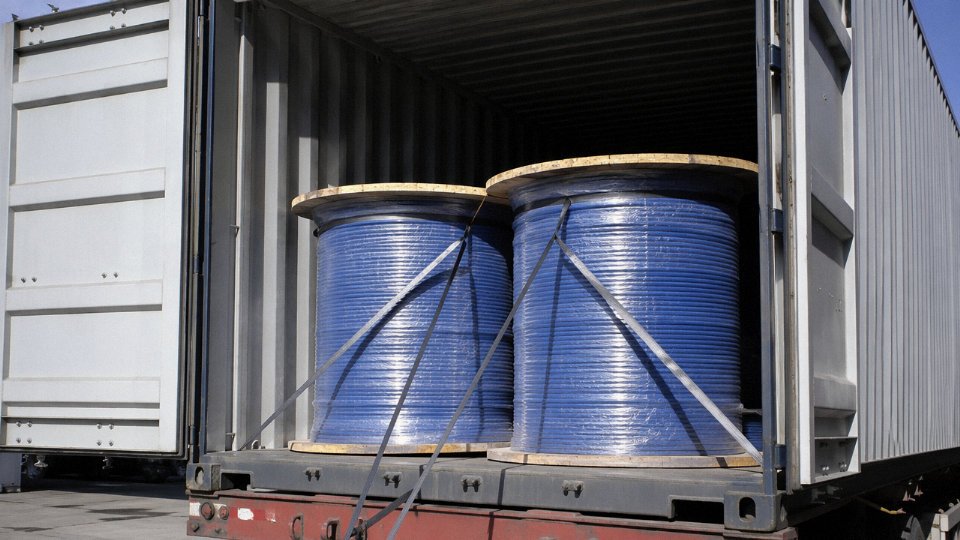
Logistics: Reels, Lead Times, and Incoterms
A 1,000 ft reel of 12/2 NM-B runs roughly 35–38 lbs. A 40-ft container can hold a substantial quantity, but reel dimensions — not just weight — govern how many fit efficiently; oversized reels for larger gauges or longer lengths can cut container utilization by 20–30% if you haven’t coordinated with the freight forwarder in advance. For international shipments, plan on 4–10 weeks FOB depending on factory location, port congestion, and destination customs. FOB suits buyers with their own freight forwarders and good visibility into port schedules. CIF transfers more logistical responsibility to the supplier, which is useful if your team lacks import experience. DDP makes sense for one-off or pilot orders where simplicity outweighs cost.
What a Long-Term Manufacturer Relationship Actually Provides
Batch consistency matters more than people realize until they’ve dealt with a reel-to-reel color variation that confuses field electricians, or a mid-project conductor diameter change that no one flagged. A supply partner like Jinda — with integrated production across five manufacturing bases and R&D capability — can lock a specification to a project and maintain it across multiple shipment tranches. Technical pre-sales support for specification matching is worth more than the cost of a phone call when you’re deciding whether a particular cable construction meets a local AHJ’s interpretation of the NEC. Dedicated account management means someone actually picks up when a shipment is delayed three days before your rough-in inspection.
Protecting Yourself Contractually
Short-measure reels are a real problem in bulk cable procurement — a “1,000 ft” reel measured at 960 ft, multiplied across 200 reels, is 8,000 ft of missing material. Specify reel length tolerances in the purchase order (typically ±1–2% is industry standard) and require random reel measurement as part of receiving inspection. Third-party inspection at origin — a pre-shipment inspection by an independent firm before the container is sealed — is worth the fee on any order above roughly $50,000. It catches dimensional non-conformance, labeling errors, and quantity discrepancies before they become your problem on a job site three weeks from now.
Frequently Asked Questions About Home Electrical Wire Types
Can I mix 14 AWG and 12 AWG wire on the same circuit?
You can install 12 AWG conductors on a 15 A circuit without any safety concern — the wire is simply oversized, which is fine. The dangerous scenario runs the other direction. If 14 AWG wire is connected anywhere on a 20 A circuit, that conductor becomes a fuse that doesn’t blow: the breaker will carry up to 20 A while the 14 AWG section, rated for only 15 A, overheats inside a wall where nobody can see it. Don’t do it. In practice, some contractors run 12 AWG throughout the whole house to sidestep this confusion entirely, and on large projects where material is being pulled from multiple reels, it’s a reasonable call — though it adds cost and makes pulling through tight conduit harder.
Using 14 AWG wire on a 20 A circuit is a fire hazard because the conductor is rated for 15 A maximum and the breaker will not trip before the wire overheats.True
NEC Table 310.12 and UL 83 both cap 14 AWG copper at 15 A ampacity under standard residential conditions. A 20 A breaker will not protect a 14 AWG conductor from sustained overcurrent, allowing the insulation to degrade or ignite before the protective device responds.
What wire do I need for a 240 V outlet — dryer, EV charger, or range?
These circuits almost always trip people up because the conductor sizes jump quickly with load.
For a 30 A dryer circuit, 10 AWG copper NM-B or THHN is standard. A 40 A range circuit calls for 8 AWG copper; if you’re using aluminum, step up to 6 AWG to match ampacity. For a 50 A EV charger — increasingly common now — you need 6 AWG copper or 4 AWG aluminum. Whatever the load, always run four conductors: two hots, a neutral, and a dedicated ground. Three-wire setups without a separate ground are legacy configurations that NEC 250.140 has restricted for new installations since 1996. Don’t cut corners on the ground conductor, especially for EV charger circuits where ground-fault protection depends on it.
Is aluminum wiring safe in a home?
Modern aluminum wiring — properly installed with CO/ALR-rated devices, anti-oxidant compound on all terminations, and torque values followed to the letter — is safe. The problem is the pre-1972 branch circuit wiring that went into millions of homes using alloys and termination hardware that weren’t suited to aluminum’s expansion characteristics. Those installations have a documented history of loose connections, arcing, and fires. If you’re buying or renovating a home built before roughly 1972, get a licensed electrician to inspect the branch circuits specifically. Remediation options range from full rewiring to pigtailing with copper at every device using listed connectors — not a DIY job.
What is the difference between wire and cable?
Wire is a single conductor, bare or insulated. Cable is an assembly of two or more conductors bundled under a common jacket. NM-B is a cable: it contains two insulated conductors (typically black and white) plus a bare copper ground, all wrapped in a gray or yellow plastic sheath. This distinction matters when you’re ordering materials or reading specs — “wire” footage and “cable” footage are not interchangeable figures.
Can I use outdoor extension cord wire for permanent wiring?
No. Extension cords carry a service cord listing, not a wiring method listing. They are not approved for in-wall installation, direct burial, or any permanent circuit under the NEC. Using one in a wall will void your homeowner’s insurance coverage and fail inspection. For permanent outdoor or underground runs, use UF-B cable, which is specifically rated for direct burial. For in-wall permanent circuits indoors, NM-B is the standard choice.
How much wire does a typical home rewire require?
Rough figures for a 2,000 sq ft single-family home: somewhere in the range of 1,500–2,500 linear feet of 12 AWG NM-B, plus 500–1,000 feet of 14 AWG NM-B, depending on circuit count, floor plan complexity, ceiling height, and what local code requires for dedicated circuits. Homes with open basements are easier to wire efficiently than slab-on-grade construction, where conduit routing adds footage fast. Add 10–15% for waste and mistakes when estimating material.
What certifications should I look for when buying wire from an international supplier?
For North American projects, UL listing is non-negotiable — specifically UL 83 for THHN/THWN and UL 719 for NM-B type cable. International projects running under IEC standards should specify IEC 60227 (PVC-insulated) or IEC 60502 (power cables) as appropriate. RoHS compliance matters for projects in the EU and increasingly elsewhere. Beyond the markings on the jacket, ask for a mill test certificate confirming conductor purity (typically 99.9% copper minimum for electrical grade) and insulation wall thickness measurements. A reputable supplier will provide this without hesitation. If they push back on documentation, that’s the answer you need.
Selecting a Reliable Wire Supplier: Quality Benchmarks and Red Flags to Watch
Specifying the right wire gauge and insulation type is only half the job. The other half is making sure what shows up on the job site actually matches the spec sheet — and that’s where supplier evaluation earns its keep.
Non-Negotiable Certifications
Third-party listing is the floor, not a bonus. For residential wire sold into North American markets, that means a valid UL listing (UL 83 for THHN, UL 719 for NM-B, among others) or CSA certification, with a publicly verifiable file number. This matters because UL and CSA conduct unannounced factory audits and periodic product retesting — a certificate alone, without a traceable file number you can check at ul.com, is essentially a piece of paper. Ask for the file number, look it up yourself, and confirm the specific cable construction listed matches what you’re ordering.
ISO 9001 certification covers the quality management system, not the product itself. It tells you the factory has documented processes, traceability, and corrective action procedures in place — useful context, but not a substitute for product-level listing.
Published, verifiable test reports from an accredited third-party lab (CNAS, NVLAP, or equivalent) should be available per production lot, not just on request after you’ve already placed a purchase order.

Conductor Purity: The Number That Actually Matters
Copper resistivity at 20°C should not exceed 17.241 nΩ·m for annealed copper — that’s the ASTM B3 and IEC 60228 Class 1/2 benchmark. Any supplier worth dealing with can hand you conformance certificates referencing those standards. If resistivity runs higher, you’re either looking at an impure alloy or, more commonly in low-price product, a conductor that’s been drawn slightly undersized. Either way, the actual ampacity of the installed cable will be lower than the label implies.
Ask for the conductor diameter measured at the drawing stage, not just the nominal cross-section. Reputable mills record this with calibrated equipment; the records should be retrievable by reel batch number.
Copper resistivity above 17.241 nΩ·m at 20°C indicates either conductor undersizing or alloy impurity, both of which reduce real-world ampacity below the rated value.True
This threshold is defined in ASTM B3 and IEC 60228 and is the standard against which annealed copper conductors are measured. Higher resistivity means more resistance per unit length, which translates directly to heat generation and reduced current-carrying capacity.
Red Flags That Should Stop a Procurement Dead
Pricing more than roughly 20–30% below the going market rate for a given gauge and insulation type is a serious warning sign. Copper costs what copper costs on the LME; a dramatically cheap price usually means something — conductor cross-section, insulation wall thickness, or both — has been quietly reduced. I’ve seen 12 AWG product from unknown-origin suppliers that measured closer to 14 AWG under the insulation. That’s a fire hazard in a 20 A circuit.
Other red flags: no in-house spark test capability (the standard for 600 V-rated cable is typically 2,500 V AC applied continuously along the full reel length), no reel length verification procedure, and no reference projects in your specific product category and volume range. A supplier who’s never shipped a container of NM-B to North America before is not who you want filling a 200-unit residential development order.
What a Factory Assessment Should Actually Cover
If volume justifies it, a site audit should check conductor drawing equipment calibration records, extrusion line temperature controls and screw speed logs, spark tester maintenance intervals, and the finished goods sampling plan — specifically what AQL level and how samples are selected. Reel-length short-shipment is a recurring problem in bulk cable; ask how length is verified at pack-out.
Jinda operates five production bases across China with a combined 470,000 m² of manufacturing space and over 1,000 employees, with active supply relationships across more than 50 countries. That kind of infrastructure supports production consistency at volume in a way a small trading operation simply cannot. Before committing to any bulk order — with any supplier — request a technical consultation, a physical sample lot, and a project reference list specific to your cable type. Samples cost almost nothing relative to the risk of wiring a building with undersized conductor.