Rewiring a house blind — buying whatever wire looks right at the hardware store, or worse, trusting the leftover spools in the basement — is how projects end up failing inspection, tripping breakers under load, or quietly overheating inside walls for years before something goes wrong. The wrong gauge on a kitchen circuit doesn’t just annoy you; it can void your homeowner’s insurance and turn a $3,000 rewire into a $30,000 fire remediation. Getting the wire selection right before the first staple goes into a stud is the entire job.
For a standard US residential rewire, you’ll need NM-B (Romex) copper cable in three sizes: 14/2 or 14/3 for 15-amp lighting and general circuits, 12/2 for 20-amp kitchen and bathroom outlets, and 10/2 or 10/3 for 30-amp appliance circuits like dryers and water heaters. A typical 1,500 sq ft home requires roughly 1,500–3,000 total feet of cable, depending on floor plan and circuit count.
What most guides skip is the part where regional wiring standards, circuit-by-circuit load calculations, and the physical realities of your wall cavities all collide. A house in Melbourne gets wired completely differently than one in Munich or Minneapolis — and even within the US, an older home with a 100-amp panel demands different planning than a new build with a 200-amp service. That’s where most rewire budgets quietly fall apart.
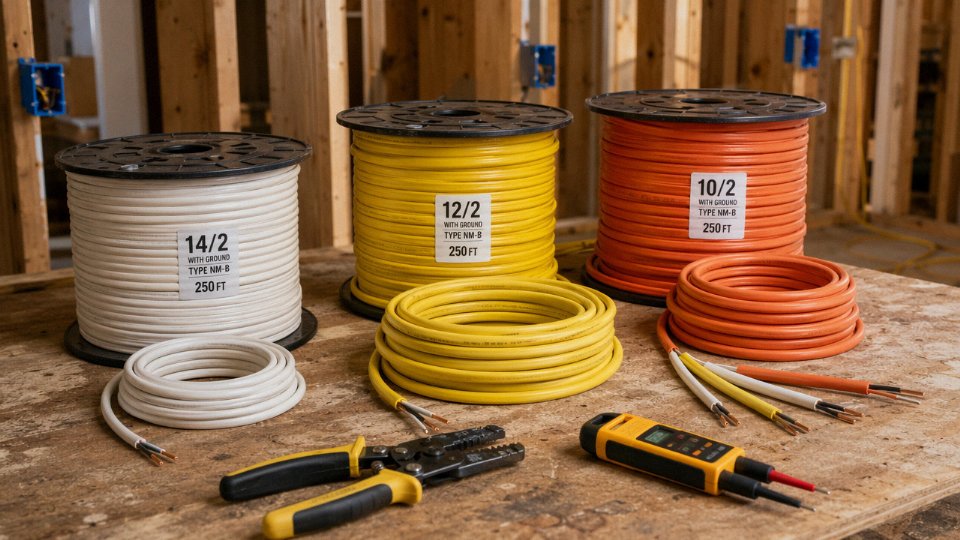
Conductor Material First: Copper vs. Aluminum for Residential Wiring
The single most consequential material decision in any rewiring project happens before you ever look at a cable catalog: copper or aluminum? Get this wrong and you’re looking at nuisance tripping at best, overheating terminations at worst.
Conductivity and What It Actually Means for Wire Sizing
Copper conducts electricity at roughly 58 MS/m; aluminum comes in around 35 MS/m — about 60% of copper’s conductivity. In practice, that gap means you must upsize aluminum by approximately one AWG step to carry the same current safely. Where 12 AWG copper handles a 20-amp circuit, you’d run 10 AWG aluminum. That size jump affects conduit fill calculations, box fill, and the connectors you stock. It’s not a dealbreaker, but it does add coordination work across a large project.
Weight and Cost — Where Aluminum Makes a Real Case for Itself
Aluminum is roughly 30–40% lighter than copper by length, and historically trades at somewhere between 60–70% less per pound, though that spread narrows when copper markets soften. On a 400-amp service entrance or a 200-foot underground feeder run to a detached garage or sub-panel, those economics stack up fast. A large residential development — say, 40 units — can see material cost differences in the tens of thousands of dollars on service conductors alone, depending on copper spot prices at time of procurement.
The weight advantage matters physically too. Pulling 2/0 AWG aluminum through a long conduit run is noticeably easier than the copper equivalent. Any electrician who’s pulled large copper on a hot afternoon knows exactly what I mean.
Thermal Expansion: The Problem That Burned Houses in the 1970s
Aluminum expands and contracts more than copper under load cycling. Every time current flows and the conductor heats up, it moves — and over years of daily cycling, a poorly terminated aluminum wire will work itself loose. A loose connection at a receptacle or breaker creates resistance; resistance creates heat; heat creates fires. This is not theoretical. It’s why solid aluminum in 15- and 20-amp branch circuits developed such a bad reputation after widespread installation in the 1960s and early 1970s.
The fix is not complicated, but it is mandatory: use only AL-rated (or CO/ALR-rated) connectors, apply listed anti-oxidant compound at every termination, and torque terminals to spec. Skip any one of those steps and you’ve negated the cost savings with liability.
Aluminum wiring is inherently dangerous in residential applications.False
Aluminum wiring installed correctly with AL-rated connectors, anti-oxidant compound, and proper torque specifications performs safely for decades. The historical fire risk was tied specifically to solid aluminum in small branch circuits paired with connectors not designed for aluminum's expansion characteristics — not to aluminum conductors as a category.
What the NEC Actually Says
The National Electrical Code restricts solid aluminum conductors in branch circuits smaller than 8 AWG — full stop. That prohibition covers the standard 15A and 20A circuits feeding outlets and lighting throughout a home. Stranded aluminum in larger sizes, and aluminum used for service entrance and feeder applications, remains fully code-compliant and common.
Where Aluminum Genuinely Wins
Service entrance conductors (typically 2/0 AWG and larger), underground feeder runs between structures, and sub-panel feeds are the practical sweet spots. These runs are long, the conductors are large, and the terminations are few — meaning the management burden of aluminum stays low while the cost savings stay high. For everything inside the walls feeding receptacles, switches, and lighting, copper NM-B is the right answer.
Sourcing Both from One Manufacturer
For contractors running large residential developments or procurement managers juggling multiple project phases, splitting your conductor material between two suppliers introduces quality variation, lead-time mismatch, and documentation headaches. Jinda’s integrated manufacturing covers both copper and aluminum conductor cables across residential-grade and feeder specifications, which means consistent QC documentation, unified test reports, and a single point of contact for technical questions — useful when a project inspector asks for conductor purity certifications at the last minute.
Wire Gauge Selection Room by Room: AWG and mm² Sizing Chart
The AWG system trips up a lot of people who are new to it — counterintuitively, the bigger the number, the smaller the wire. AWG 14 is thinner than AWG 12, which is thinner than AWG 10. If you’ve worked with IEC metric sizing (common in Europe, Asia, Australia, and most of the rest of the world), the logic flips to something more intuitive: larger mm² = larger wire. The rough equivalents you’ll use most in residential work are AWG 14 ≈ 2.5 mm², AWG 12 ≈ 4 mm², and AWG 10 ≈ 6 mm². These aren’t exact — ampacity tables also depend on insulation type, conduit fill, and ambient temperature — but they’re close enough for planning and procurement.
AWG 14 wire is rated for 15-amp circuits and AWG 12 for 20-amp circuits under standard NEC residential conditionsTrue
NEC Table 310.12 lists 14 AWG copper at 15A and 12 AWG copper at 20A for typical residential 60°C or 75°C insulated conductors in dry locations, consistent with standard breaker sizing practice.
Bedrooms and Living Rooms
AWG 14 on a 15-amp breaker is the code-minimum for general-purpose circuits in these spaces. It works, and for a house built in 1975 it was perfectly adequate. But in practice, modern living rooms are running 65-inch TVs, gaming consoles, sound systems, and a small forest of chargers — and a 15-amp circuit can feel cramped fast. Upgrading to AWG 12 on a 20-amp breaker costs maybe an extra $30–60 in wire per circuit and buys you real headroom. Worth it on a full rewire, especially if the homeowner is planning any kind of home office or media setup.
Kitchen Circuits
The kitchen is where AWG 12 is non-negotiable. NEC Section 210.52(B) requires at least two 20-amp small appliance branch circuits for countertop receptacles, both run in AWG 12. Beyond that, the refrigerator, dishwasher, and microwave each get their own dedicated 20-amp circuit — AWG 12, 20-amp breaker, no sharing. Don’t argue with this; a shared kitchen circuit with a microwave and a toaster on it simultaneously is a nuisance-trip waiting to happen every single morning.
Bathrooms
A single 20-amp GFCI-protected circuit serving bathroom receptacles — AWG 12, full stop, per NEC 210.11(C)(3). In practice a lot of electricians run one circuit to serve multiple bathrooms in smaller homes, which NEC permits under specific conditions, but on a full rewire I’d dedicate one circuit per bathroom if the panel has space.
High-Load Dedicated Circuits
This is where wire sizing has real consequences if you get it wrong. An electric dryer needs AWG 10 on a 30-amp double-pole breaker. An electric range typically calls for AWG 8 or AWG 6 depending on whether it’s a 40-amp or 50-amp circuit — check the appliance nameplate, not just the breaker size. A Level 2 EV charger running at 48 amps continuous needs AWG 6 on a 60-amp breaker; undersizing this is a thermal failure waiting to develop inside the wall over a couple of years of nightly charging cycles. Don’t cheap out on the wire run to a garage subpanel.
Lighting Circuits
AWG 14 on a 15-amp breaker is generally sufficient for lighting-only loops. LED loads are so low that conductor sizing rarely drives the decision here. That said, verify dimmer compatibility with the specific LED drivers you’re using — some older dimmers will cause flicker or buzz with certain LED fixtures regardless of wire gauge.
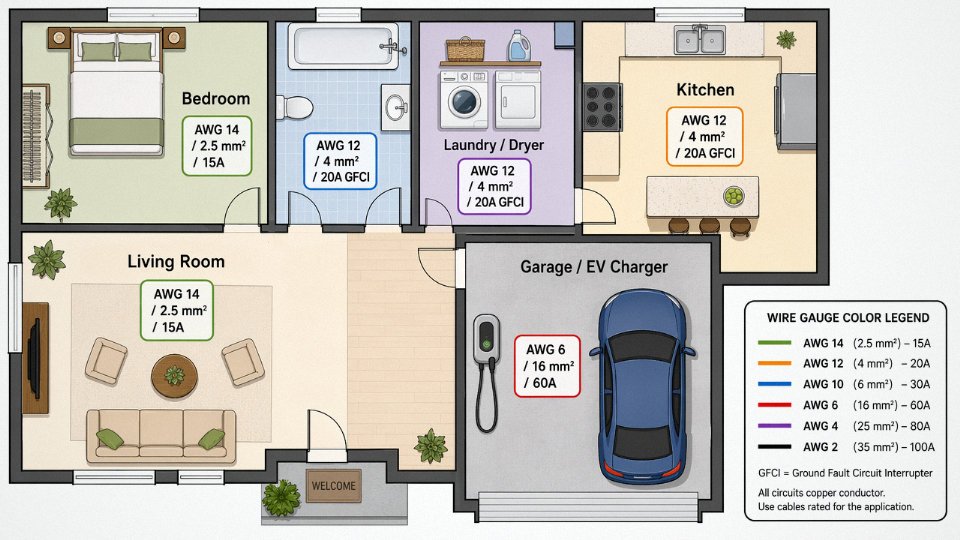
Room-by-Room Sizing Reference
| Room / Application | Typical Load | Recommended AWG | IEC Equivalent | Breaker Size | Special Requirements |
|---|---|---|---|---|---|
| Bedroom / Living Room | General outlets, lighting | AWG 14 (min) / AWG 12 (preferred) | 2.5 mm² / 4 mm² | 15A / 20A | AFCI protection required (NEC 2020) |
| Kitchen countertop circuits | Small appliances | AWG 12 | 4 mm² | 20A | Min. 2 circuits required; GFCI at countertop |
| Refrigerator (dedicated) | 100–200W running, ~700W startup | AWG 12 | 4 mm² | 20A | Dedicated circuit |
| Dishwasher (dedicated) | 1,200–1,500W | AWG 12 | 4 mm² | 20A | Dedicated; GFCI if within 6 ft of sink |
| Microwave (dedicated) | 1,000–1,500W | AWG 12 | 4 mm² | 20A | Dedicated circuit |
| Bathroom receptacles | Hair dryer, etc. | AWG 12 | 4 mm² | 20A | GFCI required; can serve multiple baths |
| Lighting circuits | LED/incandescent fixtures | AWG 14 | 2.5 mm² | 15A | Verify dimmer/LED driver compatibility |
| Electric dryer | 4,000–5,500W | AWG 10 | 6 mm² | 30A (2-pole) | 4-wire circuit (NEC 2008+) |
| Electric range | 8,000–12,000W | AWG 8 – AWG 6 | 10–16 mm² | 40–50A (2-pole) | Check appliance nameplate |
| EV charger Level 2 (48A) | ~11.5 kW | AWG 6 | 16 mm² | 60A (2-pole) | Continuous load rule: breaker at 125% of load |
Cable Types Decoded: NM-B, UF-B, MC, THHN, and Their Global Equivalents
Walk into any North American electrical supply house and the sheer number of cable designations on the shelf can stop a first-time buyer cold. NM-B, UF-B, MC, THHN — these aren’t arbitrary labels. Each one encodes a specific construction, temperature rating, and approved installation environment. Specifying the wrong type doesn’t just risk a failed inspection; in the worst case it causes insulation breakdown, ground faults, or a fire inside a wall cavity years after the job is signed off.
NM-B: The Workhorse for Dry Interior Runs
NM-B (Non-Metallic Sheathed Cable — most people in the trades just call it Romex, which is actually a brand name that stuck) is what fills the walls of probably 90% of American homes built in the last 40 years. The construction is straightforward: two or three THHN/THWN-insulated conductors plus a bare copper ground, all wrapped in a PVC outer jacket. The jacket is rated for 90°C, which matters for derating calculations in tight conduit fill situations, though in a standard wall cavity that thermal rating rarely comes into play.
Available configurations run from 14/2 (two conductors plus ground, 14 AWG) up through 6/3 with ground for heavier subfeeds. What NM-B is not rated for: damp locations, direct burial, exposed runs where physical damage is possible, or any installation where it can be hit, abraded, or wetted. The jacket looks tough but it isn’t. Inspectors in many jurisdictions will reject NM-B run through an unfinished garage even if it’s stapled neatly to a joist.
UF-B: When the Run Goes Outside or Underground
UF-B (Underground Feeder) looks superficially like NM-B but the construction is fundamentally different. Instead of individual conductors loosely bundled inside an outer jacket, each conductor in UF-B is encapsulated in solid PVC insulation with no air gap — the whole assembly is essentially a solid molded cable. That construction makes it genuinely moisture-resistant and sunlight-resistant, suitable for direct burial without conduit (though many electricians bury it in conduit anyway for future replaceability, which is worth the extra cost). Typical use cases: running power to a detached garage, a well pump, landscape lighting circuits, or outdoor subpanels.
One thing worth knowing: UF-B is harder to strip cleanly than NM-B because of that solid insulation fill. It takes longer in the field and the wrong technique can nick a conductor. Not a major issue, but worth flagging to anyone quoting labor.
MC Cable: Armor Where You Need It
Metal-Clad cable adds an interlocked aluminum or steel armor over the conductors. That armor provides real mechanical protection — enough that MC is required by many commercial building codes in exposed locations and is increasingly specified by inspectors in residential unfinished basements, crawlspaces, and exposed runs in utility rooms. The armor is not a substitute for a ground conductor; proper MC cable includes an insulated equipment ground inside the armor. Using the armor itself as the sole ground path is a code violation in most jurisdictions and a real maintenance headache.
MC terminates with dedicated connectors — Halex and Arlington both make common box connectors — and the armor needs to be cut with a rotary armored cable cutter rather than a hacksaw, which tends to drive metal shards into the insulation if you’re not careful.
THHN/THWN: Single Conductors for Conduit Runs
THHN and THWN are single-conductor wires, not cables. You pull them through conduit rather than stapling them to studs. THHN is rated 90°C in dry locations; THWN is rated 75°C in wet locations. Many wires sold today are dual-rated THHN/THWN-2, which covers both environments and simplifies inventory.
Conduit runs are required by code in several situations that show up in residential rewiring: service entrance conductors, exposed runs in garages or on exterior walls in many municipalities, and any circuit in a jurisdiction that mandates conduit throughout (Chicago being the most well-known example — their electrical code has required conduit in residential construction for decades).
Wire fill calculations matter here. Running three THHN conductors through 3/4-inch EMT is fine; trying to squeeze six through the same conduit will fail inspection and cause derating problems under NEC 310.15.
Global Equivalents: What the Rest of the World Installs
For anyone sourcing cable internationally or working on projects outside North America, the designation systems shift but the underlying logic is the same.
In Europe, H07V-U (solid conductor) and H07V-R (stranded) are the standard single-conductor building wires, governed by IEC 60228 and HD 21. The “07” indicates 450/750V voltage class; “V” is PVC insulation. NYM-J is the German-origin sheathed cable equivalent to NM-B — flat gray jacket, PVC insulation, widely used across Germany, Eastern Europe, and much of Asia that absorbed German technical standards. Australia and New Zealand use TPS (Tough Plastic Sheathed) flat twin-and-earth, which resembles NM-B in use but differs in conductor color coding and jacket compound.
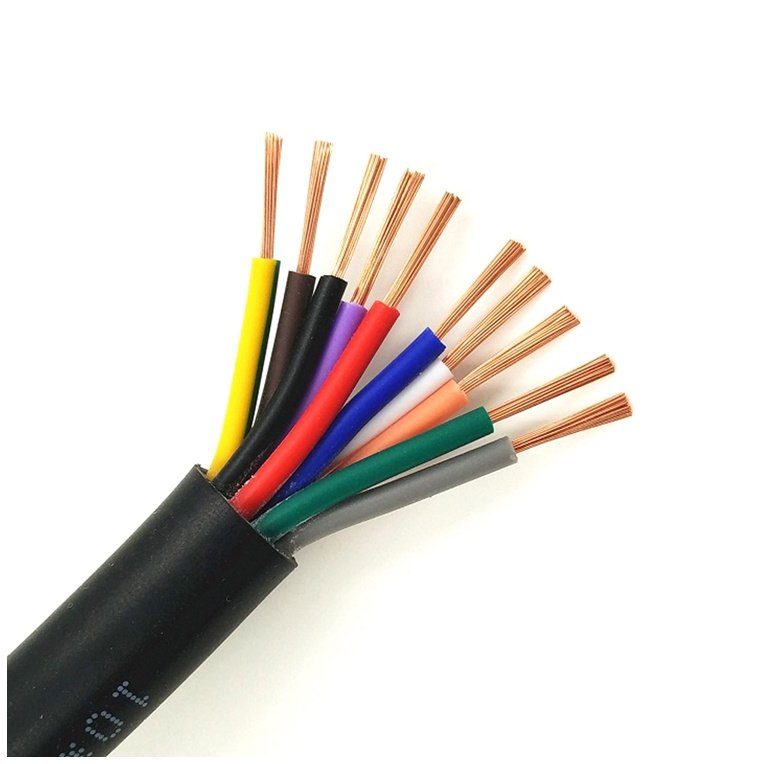
In China and in export markets served by Chinese manufacturers, RVV is a flexible multi-conductor PVC cable widely used for interior wiring and appliance connections. BV is the single-conductor equivalent of THHN for conduit runs. BVV adds a second PVC jacket layer for additional mechanical protection, roughly analogous to NYM-J in application.
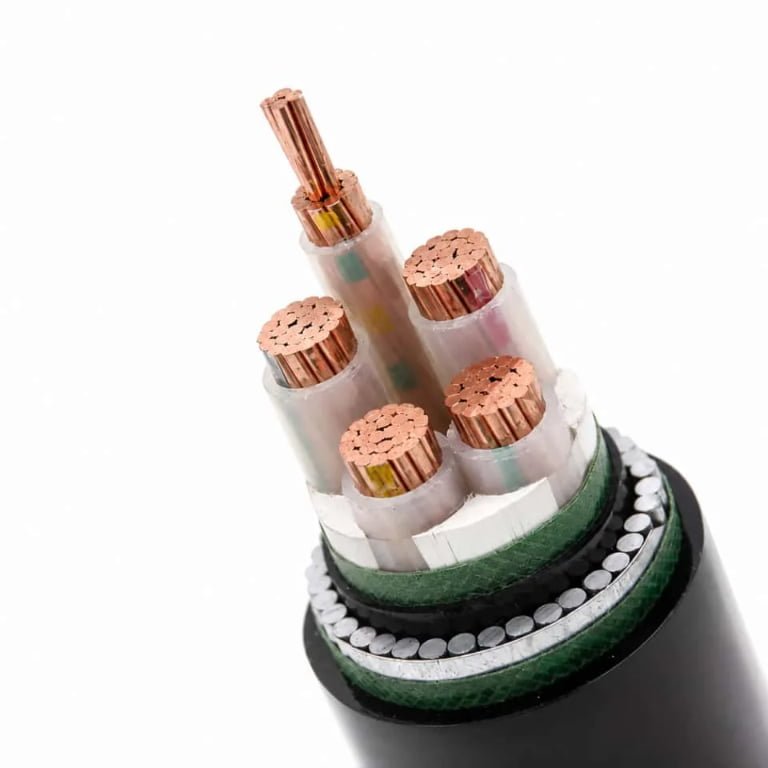
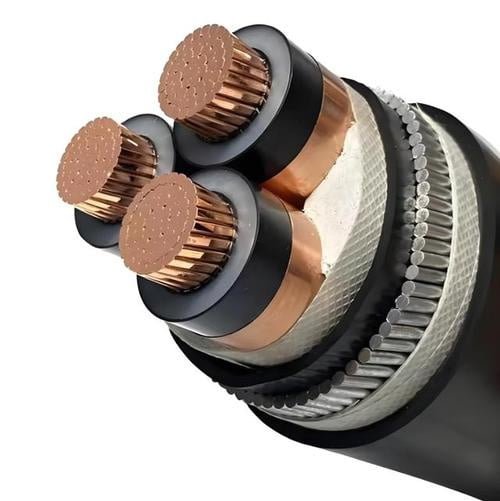
Jinda’s product catalog maps directly onto these categories: the BV and BVV series cover dry interior and sheathed applications; RVV handles flexible and multi-conductor runs; WDZA series cables are halogen-free low-smoke (LSZH) formulations suited for public buildings, tunnels, and projects where fire toxicity is a specification requirement; YJV uses XLPE insulation for higher-temperature and higher-voltage feeder applications.
XLPE insulation has a higher continuous operating temperature than standard PVC, typically 90°C versus 70°C for PVC, allowing the same conductor cross-section to carry more current without derating.True
This is consistent with IEC 60502 and NEC ampacity tables. XLPE-insulated conductors are rated 90°C continuous versus 60–75°C for standard PVC, which directly affects ampacity derating factors in conduit fill and elevated ambient temperature conditions.
Insulation Material Comparison
| Insulation | Continuous Temp Rating | Flame Spread | Smoke/Toxicity | Typical Cost Premium | Best Scenario |
|---|---|---|---|---|---|
| PVC (standard) | 70–75°C | Moderate | High HCl smoke | Baseline | General interior dry/damp locations |
| PVC (90°C rated) | 90°C | Moderate | High HCl smoke | +5–15% over 70°C | Panel wiring, conduit runs, tight fills |
| XLPE | 90°C continuous, 250°C short-circuit | Lower than PVC | Moderate | +15–30% depending on volume | Feeders, high-temp environments, longevity-critical installs |
| LSZH (Low Smoke Zero Halogen) | 70–90°C depending on compound | Low | Minimal halogen | +20–50% | Public buildings, confined spaces, transit, marine |
Cost premiums depend heavily on copper content, order volume, and market timing — a 30% premium on a small spool is different math than on a bulk project order. LSZH is genuinely worth specifying in schools, hospitals, or any building where evacuation during a cable fire is complicated. In a standard single-family home with good egress, the premium is harder to justify unless local code or the owner requires it.
Insulation and Jacket Ratings: Temperature, Moisture, and Fire Safety Standards
The letters printed on a cable jacket are not decoration. They define exactly where that wire can legally and safely live inside a building — and ignoring them is one of the more common (and expensive) mistakes made during residential rewiring.
Temperature Ratings: What 90°C Actually Means
A 90°C temperature rating does not mean your house wiring runs anywhere near 90°C in normal operation. It is the maximum conductor temperature the insulation can tolerate before it begins to soften, char, and lose dielectric integrity. Most residential branch circuits, under typical load, sit well below 60°C — often closer to 40–50°C in a well-sized installation. The 90°C rating matters most in two scenarios: when the wire is bundled tightly with other conductors (bundling derating applies), and when it terminates at a panel or device where heat concentrates. THHN/THWN-2 carries a 90°C dry/75°C wet rating; standard NM-B with 60°C-rated conductors gives you less headroom in a hot attic or a packed junction box. Specifying 90°C-rated conductors into a warm attic run is not overkill — it is the difference between insulation that lasts 40 years and one that becomes brittle in 15.
Moisture Categories: The W Suffix Is Not Optional
“W” in a cable designation — THWN, THWN-2, UF-B — signals wet-location approval. NM-B has no such rating. It is strictly a dry, interior, protected-location cable. Run NM-B through a crawl space with seasonal moisture, or pull it into an outdoor conduit, and the PVC jacket will absorb moisture over time, tracking current paths that shouldn’t exist. Inspectors catch this; insurance adjusters catch it worse.
UF-B (Underground Feeder) is approved for direct burial and damp locations. THWN-2 pulled through conduit handles wet outdoor runs, underground conduit in flood-prone areas, and unfinished basement environments where condensation is a real seasonal factor. The distinction matters most in older homes being rewired — crawl spaces under pier-and-beam construction, for instance, can see relative humidity above 80% for months at a time.
LSZH: More Relevant Than Many Contractors Think
Low Smoke Zero Halogen insulation was, until recently, considered a commercial or industrial specification. That is changing. Multi-family residential, hotels, and high-rise housing projects in Europe, Australia, and increasingly in North American urban markets are specifying LSZH as a minimum. The reason is straightforward: standard PVC insulation, when it burns, releases hydrogen chloride gas and dense black smoke. In an evacuation scenario inside a corridor or stairwell, that smoke is what kills people — not necessarily the fire itself.
LSZH compounds produce significantly less toxic gas and far lower smoke density under IEC 61034 test conditions. It is not a marginal difference.
Flame Spread Standards and Why They Matter at Inspection
UL 83 governs THHN/THWN. UL 719 covers NM-B. The IEC 60332 series — specifically 60332-1 for single cables and 60332-3 for bunched installations — is the applicable standard for international products. These tests measure how far a flame travels along a cable under controlled conditions. They determine whether a product can legally be installed in a given jurisdiction and whether it will pass rough-in inspection. Specifying a cable that carries the wrong flame rating for a bundled-in-wall installation is not a technicality — it is a failed inspection and a tear-out.
Standard NM-B cable will degrade and crack under direct UV exposure within 1–2 years.True
NM-B's PVC jacket is not formulated for UV resistance. Prolonged sunlight exposure causes oxidation and embrittlement of the jacket, leading to insulation failure. Cables intended for outdoor or exposed runs must carry a specific sunlight-resistance rating.
Sunlight Resistance: A Short Point Worth Not Skipping
Standard NM-B in direct sunlight will crack. The jacket is not UV-stabilized. Cables rated for outdoor exposed runs — some THHN types, specific UF-B formulations — must explicitly pass sunlight-resistance testing per UL standards. If you are running wire along an exterior wall, under roof overhangs, or anywhere that sees even indirect UV, verify the sunlight-resistance marking on the jacket. A conduit run solves the problem mechanically, but the cable inside still matters if the conduit isn’t fully sealed.
International Fire-Rated Products: WDZ and WDZAN Series
For projects outside North America — or for high-rise residential and mixed-use developments sourcing cable internationally — halogen-free flame-retardant designs are increasingly the baseline, not the upgrade. Jinda’s WDZ series (halogen-free, flame-retardant) and WDZAN series (halogen-free, flame-retardant, with added fire-resistance for circuit integrity under fire conditions) are designed to meet IEC 60754 (halogen content testing) and IEC 60332-3 (flame spread in bunched cables). The WDZAN designation indicates the cable maintains circuit function for a defined period during a fire — relevant for emergency lighting, fire alarm circuits, and evacuation systems in residential towers.
Matching Insulation to Installation Environment
| Location | Minimum Cable Requirement | Notes |
|---|---|---|
| Interior dry wall cavity | NM-B (60°C or 90°C) | Most common US residential |
| Hot attic space | NM-B 90°C or THHN in conduit | Bundling derating applies |
| Basement / crawl space | THWN-2 in conduit, or UF-B | Check seasonal moisture levels |
| Outdoor conduit (above grade) | THWN-2, sunlight-resistant | Conduit does not substitute for wet rating |
| Direct burial | UF-B or approved direct-burial cable | Depth per NEC Table 300.5 |
| Multi-family corridor / high-rise | LSZH preferred; check local code | IEC 60332-3 for bundled runs |
| Panel termination | 75°C or 90°C rated at terminal | Derate to terminal rating, not wire rating |
The most common mistake in practice: buying 90°C-rated wire and then terminating it at a device or breaker rated for 60°C or 75°C. The terminal rating is the limiting factor. Always check both.
Grounding and Neutral Conductors: Sizing Rules Most DIYers Get Wrong
This is where otherwise competent rewiring jobs quietly fail inspection — or worse, pass inspection and create a hazard that doesn’t show up until a fault occurs years later.
The neutral and the equipment grounding conductor (EGC) are not interchangeable, and they are not the same thing. The neutral carries return current during normal operation; every amp flowing out through the hot wire comes back through the neutral. The EGC, by contrast, carries current only when something goes wrong — a ground fault, an insulation failure, a tool falling into a wet panel. Its entire job is to give that fault current a low-impedance path back to the source so the breaker trips fast and hard. The EGC must be bonded to earth at the main service panel. It is a safety path, not a current-carrying conductor in daily use.
EGC Sizing Is Not the Same as Circuit Sizing
Most people assume that if they upsize the hot and neutral — say, pulling 10 AWG instead of 12 AWG on a 20-amp circuit for extra voltage-drop headroom — the EGC has to match. It doesn’t. NEC Table 250.122 sizes the EGC based on the overcurrent protective device, not the conductor itself. A 15-amp breaker requires a minimum 14 AWG EGC. A 20-amp circuit needs 12 AWG. Jump to a 60-amp circuit, a dryer subpanel feed or an EV charger branch, and you’re at 10 AWG. A 100-amp feeder requires 8 AWG.
Upsizing the hot and neutral conductors on a residential branch circuit does not automatically require a larger equipment grounding conductor under NEC 250.122.True
NEC Table 250.122 bases EGC sizing on the rating of the overcurrent protective device protecting the circuit, not on the size of the ungrounded (hot) or grounded (neutral) conductors. If you pull 10 AWG hot and neutral on a 20-amp circuit, the EGC still only needs to be 12 AWG minimum.
Where you do have to upsize the EGC is when you’ve increased the hot conductor specifically to compensate for voltage drop — NEC 250.122(B) requires proportional upsize of the EGC in that case. It’s a subtle distinction, but inspectors catch it.
The Neutral Isn’t Always the Same Size as the Hot
On a standard 120V branch circuit, the neutral carries the full return current, so it must be the same gauge as the ungrounded conductor. No exceptions there. On 240V balanced loads — a resistance heating element drawing equal current on both legs — the neutral theoretically carries near-zero imbalance current. This opens up reduced neutral sizing in some feeder designs, though in practice most residential electricians just run equal conductors throughout to keep things simple and avoid mistakes during future service work.
Multi-wire branch circuits (MWBCs) deserve special attention. Two hot conductors sharing one neutral sounds efficient — and it is, when done correctly — but the shared neutral carries the imbalance current between the two legs. More critically, under NEC 210.4, an MWBC must be fed from a handle-tied double-pole breaker so both hots open simultaneously. Find an older home where someone used two single-pole breakers on the same MWBC and you have a live neutral hazard: someone de-energizes one circuit thinking they’re safe, but the shared neutral is still carrying current from the second circuit. This is one of the most common violations in older homes being rewired today.
Panel Bonding: Main Panels and Sub-Panels Are Not the Same
At the main service panel, the neutral bar and the ground bar are bonded together — intentionally connected. This is the one point where neutral and ground meet in a residential system. At any sub-panel downstream, those bars must remain electrically separate. Neutral and ground run as independent conductors from the main panel to the sub-panel and terminate on separate bars.
If someone has bonded the neutral and ground at a sub-panel, you end up with parallel neutral paths: return current splits between the intended neutral conductor and the grounding system — conduit, ground wires, building steel. That’s objectively dangerous. It causes stray voltage on surfaces that should be at ground potential, and it can corrupt the operation of AFCI and GFCI devices that rely on clean neutral-ground separation to detect faults.
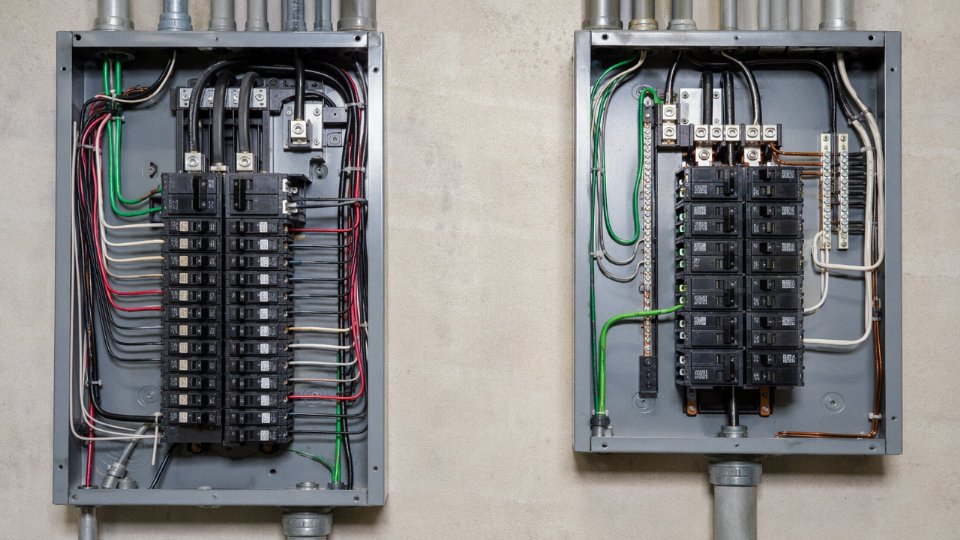
International Grounding Systems and What They Mean for Wire Selection
Outside North America, grounding architecture varies considerably, and it directly affects how you specify cable cores.
TN-S systems run a separate protective earth (PE) conductor throughout the entire installation, from the distribution transformer to every outlet. It’s the cleanest arrangement — neutral and earth never share a conductor after the source, so there’s no risk of neutral current on exposed metalwork. Most of Western Europe uses TN-S for new construction.
TN-C-S (also called PME or MEN in some regions) combines the neutral and protective earth into a single PEN conductor from the substation to the service entrance, then splits them at the consumer unit. Australia, New Zealand, and much of the UK distribution network operates this way. The split point is critical — downstream of it, neutral and earth must stay separate, same as a North American sub-panel.
TT systems rely on a local earth electrode at the premises rather than a metallic return to the source. France traditionally used TT; parts of rural Asia and Africa still do. Fault current has to flow through soil resistance, which can be high, so TT systems almost always require RCDs (residual current devices) with low trip thresholds — typically 30mA — to compensate.
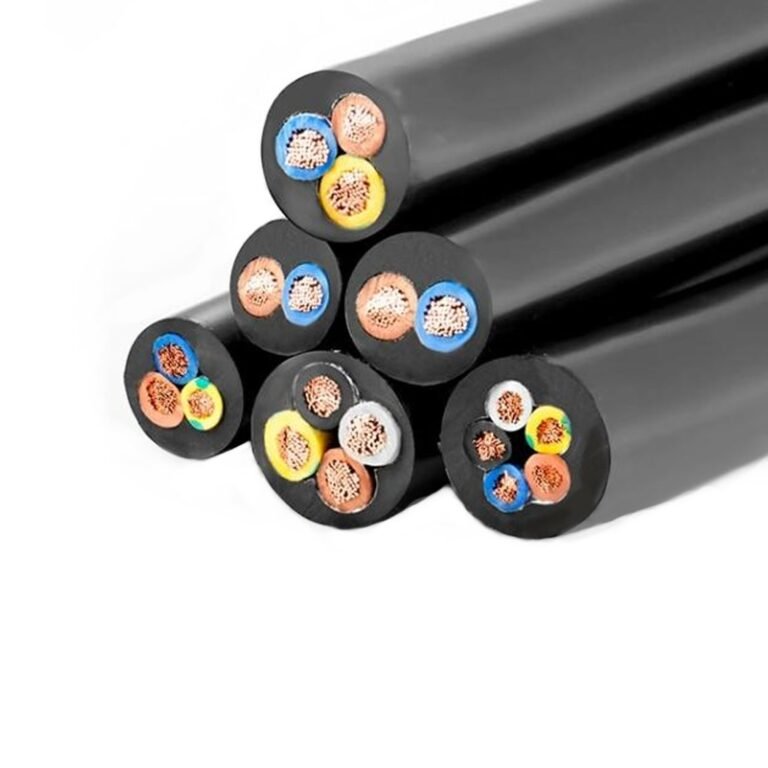
For export cable projects, these grounding architectures map directly to core count. A 2-core cable (line + neutral) suits TT applications where the earth connection is handled separately at the installation. A 3-core cable (line, neutral, PE) covers TN-S single-phase runs. Three-phase TN-S distribution needs 4-core (three lines plus PE) or 5-core (three lines, neutral, PE) depending on whether a neutral is required in the circuit. Jinda’s multi-core constructions follow IEC 60228 for conductor sizing and IEC 60332 for flame performance, with core identification per IEC 60446 — brown/black/grey for phases, blue for neutral, green-yellow for PE — which aligns with European and Asian residential wiring practice. Getting core count wrong at the procurement stage doesn’t just create installation headaches; it can mean a container of cable that is technically unusable without field splicing, which no building inspector anywhere is going to approve.
How Many Feet (Meters) of Wire Does a Full House Rewire Actually Require?
Getting the quantity wrong in either direction costs you. Under-order and you’re waiting three days for a delivery while your crew stands idle. Over-order by 30% and you’ve got expensive leftover spool sitting in a corner — copper doesn’t depreciate nicely. A rough but reliable starting point for a standard single-story US home: multiply the conditioned floor area (in square feet) by 1.5 to 2.0. That gives you total linear feet of branch-circuit NM-B cable across all circuits combined. A 2,000 sq ft home lands somewhere in the 3,000–4,000 foot range under that formula, though the actual number slides depending on panel location, ceiling height, wall construction, and how many dedicated appliance circuits the kitchen and laundry require.
Breaking It Down by Circuit Type
Not all wire is the same gauge, and when you’re ordering, you need quantities by cable type — not a single aggregate number.
Lighting circuits run 14/2 NM-B (15-amp, AWG 14). In a typical house, you might have 6–10 lighting circuits depending on room count and layout. Each one can stretch 80–150 feet once you account for the home run back to the panel plus drops to each fixture box. General-purpose outlet circuits use 12/2 NM-B (20-amp, AWG 12), and most houses need at least 6–8 of these. Kitchen circuits are also 12/2 NM-B but the NEC requires a minimum of two dedicated 20-amp small-appliance circuits for countertop receptacles — plan 50–80 feet each if the kitchen is interior and the panel is reasonably central. Bathroom circuits, one per bathroom at minimum under current code, add another 30–60 feet each.
Then there are the dedicated appliance runs, and this is where the footage adds up fast. An electric dryer wants 10/3 NM-B (or 10/2 if you’re updating to a separate neutral and ground configuration). An electric range or cooktop typically takes 6/3. A 240V EV charger or central air conditioner disconnect can require anywhere from 40 to 150 feet of 8/3 or 6/3 depending on where in the house those loads sit.
The Home Run Factor
Every circuit requires a continuous run from the device or first outlet back to the main panel — what electricians call the home run. In a house with a centrally located panel and one story, that run is often 20–40 feet. Put the panel in a corner of the basement under the garage and that same circuit might be 70–120 feet before it even reaches the first device. On large homes or any project with a sub-panel serving a detached garage or workshop, sub-panel feed runs of 80–150 feet in 4/0 aluminum or similar are not unusual.
In the US, a standard 1,800 sq ft single-family home typically requires between 2,700 and 3,600 feet of combined NM-B cable across all branch circuits.True
This aligns with the industry rule-of-thumb multiplier of 1.5–2.0x square footage, corroborated by electrical contractor take-off data for single-story residential projects with centrally located panels.
Sample Take-Off: 3-Bedroom / 2-Bath / 1,800 sq ft with Attached Garage
| Circuit | Cable Type | Qty (feet) | Qty (meters) |
|---|---|---|---|
| Lighting – bedrooms & hallways (4 circuits) | 14/2 NM-B | 480 | ~146 |
| Lighting – living, dining, kitchen (3 circuits) | 14/2 NM-B | 330 | ~101 |
| General outlets – living & bedrooms (6 circuits) | 12/2 NM-B | 660 | ~201 |
| Kitchen small-appliance (2 circuits) | 12/2 NM-B | 160 | ~49 |
| Refrigerator dedicated | 12/2 NM-B | 60 | ~18 |
| Bathrooms (2 circuits) | 12/2 NM-B | 100 | ~30 |
| Laundry circuit | 10/2 NM-B | 80 | ~24 |
| Electric dryer | 10/3 NM-B | 70 | ~21 |
| Dishwasher / disposal | 12/2 NM-B | 90 | ~27 |
| Garage outlets & door opener | 12/2 NM-B | 140 | ~43 |
| HVAC disconnect | 8/2 NM-B | 60 | ~18 |
| Subtotal | ~2,230 | ~680 | |
| 10–15% waste buffer | +220–335 | +67–102 | |
| Order quantity | ~2,450–2,565 | ~747–782 |
Smaller than the rule-of-thumb upper end because this is a single-story layout with a centrally located panel — in practice, two-story homes or homes with a basement panel on one end routinely push past 3,500 feet.
International Projects and Multi-Family Estimation
Outside North America, floor area is measured in m² and wire quantities are expressed accordingly. A rough metric equivalent: budget 1.5–2.0 meters of cable per m² of floor area for basic branch circuits, though this understates reality once you add dedicated appliance runs. A 170 m² apartment in a European project might need 350–420 meters of H07V-U or NYM cable across all circuits, not counting the riser cable from the building distribution board.
Multi-family projects don’t use rule-of-thumb at all. Developers and M&E contractors on apartment blocks work from a cable schedule — a tabulated document listing every circuit, its origin, destination, cable type, length (scaled from drawings plus a riser/horizontal routing allowance), and ordered quantity per spool size. It’s more work upfront and saves a lot of grief during procurement.
Waste Buffer and Spool Strategy
The 10–15% waste buffer isn’t padding — it covers re-routing around unexpected structural members, re-pulls when a wire gets nicked on a sharp edge, and the occasional re-inspection that requires extending a circuit. On a tight project, skipping this buffer almost guarantees a mid-job order.
Spool sizing matters here. Buying 50-foot coils for a 300-foot circuit means multiple splices or joints, which adds labor and potential failure points. Jinda’s bulk spool options — 100m, 200m, 305m (the standard US 1,000-foot equivalent for metric projects), 500m, and custom cut-to-length — let procurement managers match spool size to actual circuit runs rather than forcing awkward cut-and-join workarounds. On a large rewiring contract, consolidating to fewer, larger spools typically reduces per-foot material cost by a meaningful margin and cuts the number of purchase orders the project needs to manage.
Navigating Electrical Codes: NEC, IEC, BS 7671, and AS/NZS 3000 Requirements
Specifying the right wire gauge and cable type is only half the job. If that cable doesn’t conform to the electrical code governing the installation country, you’re looking at failed inspections, liability exposure, and in the worst case, a complete re-pull. This is where cross-border projects go wrong most often — a procurement manager sources cable to IEC dimensions for a job that turns out to be under NEC jurisdiction, or a contractor assumes BS 7671 and IEC 60364 are interchangeable when they aren’t quite.
NEC (NFPA 70): The US Framework and Its Local Variations
The National Electrical Code is a model code published by NFPA, adopted by all 50 states — but “adopted” doesn’t mean uniform. Local amendments are common. California, Florida, and New York each layer on requirements that go beyond the base NEC text, so always check the locally amended version, not just the national edition.
For residential rewiring, the articles you’ll live in are Article 210 (branch circuits — minimum sizes, circuit loading, receptacle spacing), Article 230 (service entrance conductors), Article 250 (grounding and bonding, which trips up more projects than almost anything else), and Article 310 (conductor ampacity tables and correction factors for ambient temperature and conduit fill). One thing NEC has that most international codes still lack: mandatory arc-fault circuit interrupter (AFCI) protection on virtually all residential branch circuits since the 2017 edition. That’s a compliance point that surprises buyers sourcing for US projects from outside North America.
IEC 60364: The Global Baseline
IEC 60364 is organized into seven parts — from fundamental principles and protection against electric shock through to wiring system installation methods and special locations like bathrooms and swimming pools. Most of Europe, large parts of Asia, Africa, and South America use national codes derived directly from IEC 60364. The cable product standards that sit underneath it (IEC 60228 for conductors, IEC 60502 for power cables) are the ones you’ll see referenced on test reports from most international manufacturers.
BS 7671 (18th Edition): Close to IEC, but Not Identical
The UK’s IET Wiring Regulations align with IEC 60364’s structure but carry specific British amendments that matter on the bench. The 18th Edition, which came into effect in 2018, made RCD protection mandatory on all final circuits in new dwellings — that includes lighting circuits, which many electricians trained under older editions still find counterintuitive. Consumer unit construction requirements also changed. If you’re specifying cable for a UK residential project, confirm your installer is working to the 18th Edition amendment 2 (2022), not the original 18th Edition text.
AS/NZS 3000: Australia and New Zealand
Known colloquially as the “Wiring Rules,” AS/NZS 3000 mandates TPS (Twin and Earth) flat cable for the bulk of residential wiring, specific switchboard labeling and arrangement requirements, and RCD protection on all power and lighting circuits. The standard also has strict rules around cable support spacing and penetration sealing that differ from both NEC and IEC practice. In practice, the Australian market is fairly closed to non-approved cable products — AS/NZS approvals from an accredited certification body are effectively non-negotiable for anything going into a licensed installation.
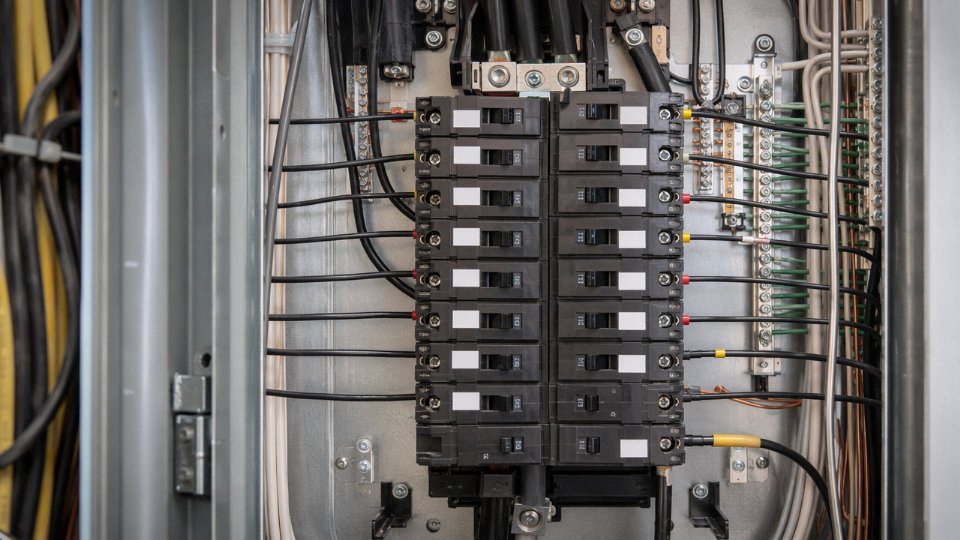
GB 50096 and GB/T 5023: Relevant for China-Sourced Projects
For buyers sourcing cable from Chinese manufacturers — whether for domestic Chinese construction or Belt-and-Road export projects — GB 50096 is the residential wiring design standard, and GB/T 5023 covers the corresponding flexible and fixed wiring cable products. These standards generally align with IEC 60364 and IEC 60228 in conductor sizing and insulation requirements, but there are differences in conduit fill calculations and circuit labeling conventions worth checking before a large shipment lands on site.
Jinda's cable products for export orders come with IEC test reports, CE Declarations of Conformity, and country-specific approval documentation as standard.True
Established manufacturers supplying international markets routinely maintain these documents; buyers should request them in writing before purchase order confirmation, not after shipment.
What Compliance Documents to Actually Request
When you’re buying cable for a cross-border project, the document checklist matters more than the sales conversation. Ask for: the relevant IEC type-test reports (conductor resistance, insulation resistance, voltage test, flame test); UL listing certificate if the cable is destined for the US or Canada; CE Declaration of Conformity for European Union projects; and any country-specific third-party approval certificates (BASEC for the UK, SAA mark for Australia, CCC for China). A credible manufacturer keeps these on file and can turn them around quickly. If there’s hesitation or a vague promise that the documents are “in preparation,” treat that as a procurement risk. The cost of a non-compliant cable rejection at the job site — re-inspection fees, re-pull labor, project delays — dwarfs the cost of asking the hard questions upfront.
Frequently Asked Questions About House Rewiring Wire Selection
Can I mix old aluminum wiring with new copper wire?
Not directly, and this is one of the most serious mistakes I’ve seen in older home renovations. Direct aluminum-to-copper contact creates a galvanic corrosion pair — over years, the connection oxidizes, resistance climbs, and you get a junction that runs hot under load. The fix isn’t complicated, but it has to be done right at every single termination: use CO/ALR-rated devices (the marking is stamped on the device body) or approved aluminum-to-copper pigtail connectors listed under UL 486C. Purple wire nuts labeled “AL/CU” are not the same thing and are not an acceptable substitute for branch circuit pigtailing in most jurisdictions. If you have aluminum branch circuit wiring throughout a pre-1973 home, the safe answer is usually a full rewire — not device-by-device remediation, which gets expensive fast and leaves the wire itself in the wall.
Direct aluminum-to-copper wire connections without approved connectors are a recognized residential fire hazardTrue
The US Consumer Product Safety Commission documented this risk extensively in the 1970s; CO/ALR and UL 486C connectors exist specifically to address the galvanic and thermal expansion differential between the two metals
Is 12 AWG wire always better than 14 AWG for a house rewire?
On a new rewire, yes — run 12 AWG on 20-amp circuits throughout if the budget allows. You get more headroom, and the incremental material cost over a full house is maybe a few hundred dollars, which is trivial against the labor cost of pulling wire. That said, 14 AWG on a 15-amp circuit is still code-compliant under the NEC for general lighting and standard outlet circuits in most states and jurisdictions. Where 14 AWG gets people into trouble is when someone later swaps a 15-amp breaker for a 20-amp breaker “because it kept tripping” — now the wire is the weak point, not the protection. Stick to 12 AWG on anything that might ever feed a countertop, garage, or workshop circuit.
What wire do I need for a 240V dryer outlet?
Current NEC requirements call for a 4-wire connection: two ungrounded hots, one neutral, one ground, run as AWG 10 copper minimum on a 30-amp double-pole breaker. The old 3-wire dryer hookup — two hots and a neutral, with the neutral doubling as ground — is no longer permitted in new installations. Older homes with existing 3-wire dryer circuits can sometimes keep them under grandfathering provisions, but any new circuit or panel relocation requires the 4-wire configuration. Use 10/3 NM-B with ground, or THHN pulled in conduit if the run is exposed.
How do I know if my house needs a full rewire or just partial repairs?
A few indicators are fairly decisive. Knob-and-tube wiring or aluminum branch circuits are essentially non-negotiable full-rewire territory. Frequent unexplained breaker trips, a persistent burning smell near outlets or the panel, outlets that are 2-prong only throughout the house, or a home inspector flagging the wiring as a safety concern — any one of these warrants at minimum a licensed electrician’s assessment. In practice, if more than roughly 30–40% of the circuits need work, the labor economics usually favor pulling everything and starting clean rather than chasing problems piecemeal.
What is LSZH cable and do I need it for a residential rewire?
LSZH — Low Smoke Zero Halogen — cable is designed to limit toxic gas and dense smoke output in a fire, which matters enormously in enclosed spaces with limited escape routes. Some jurisdictions require it for multi-family dwellings, condominiums, and certain commercial applications. Single-family homes in the US typically don’t mandate it under the NEC, but it’s a legitimate safety upgrade worth considering for finished basements, attics, and any room with limited ventilation. If you’re specifying cable for a project in the UK or parts of Europe, check BS 7671 and local authority requirements — LSZH is much more commonly mandated there than in North America.
How much does wire cost for a full house rewire?
Material cost for wire alone — standard NM-B copper, not including panel, breakers, devices, or boxes — typically runs somewhere between USD 1,500 and 4,000 for a 1,500–2,500 sq ft home, depending heavily on copper spot prices, the number of circuits, and whether you’re running 12 AWG throughout or mixing gauges. Total project cost, once you factor in labor, panel upgrade, permits, and inspections, usually lands in the USD 8,000–20,000 range in the US. That spread is wide because labor rates vary dramatically by region, and an old house with plaster walls and limited attic access can easily add 30–50% to labor hours compared to a straightforward frame construction.
Can I order residential cable directly from a Chinese manufacturer like Jinda?
Yes, and for large residential developments, multi-unit projects, or contractors running high volume, it makes economic sense to look at direct procurement. Jinda handles international orders with MOQs that work for both bulk residential development supply and smaller contractor quantities. The critical discipline on any cross-border cable order is specification precision upfront: state the exact standard — IEC 60227, UL 83, BS 6004, whatever the installation country requires — and request the corresponding third-party test certificates before you finalize the order. Don’t accept generic compliance claims. A reputable manufacturer will provide documentation; if there’s resistance to that request, that tells you something. Lead times from China to most markets run roughly 25–45 days by sea depending on port and destination, so factor that into your project schedule.
Sourcing Quality Cable for a Rewire: What to Check Before You Buy
The wire itself is usually 20–35% of total rewiring project cost. It’s tempting to shave money there. Don’t.
The Hidden Cost of Cheap Wire
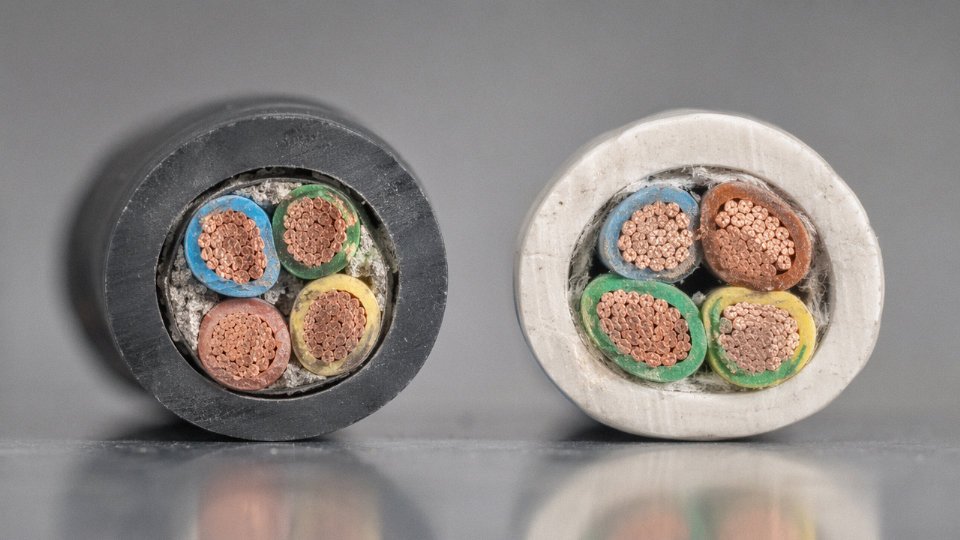
Substandard cable — and there’s a lot of it in circulation — typically ships with conductors running 15–25% below their labeled cross-section. A reel marked “12 AWG” with an actual cross-section closer to 14 AWG equivalent isn’t just a labeling annoyance. It causes measurable voltage drop under load, runs hotter inside walls, and fails the continuity and insulation-resistance checks that any competent inspector will run. The rework cost, meaning pulling wire you just installed, patching walls, rebuying material, and re-scheduling the inspection, routinely runs two to four times what you saved on the original purchase. I’ve seen contractors eat that entire margin on a single job.
Counterfeit cable is most common in markets where enforcement is thin and price pressure is high. It also appears in legitimate-looking packaging with plausible-looking certification marks that are simply printed on, not earned.
Third-Party Certification: Verify, Don’t Accept
A manufacturer’s self-declaration that a cable is “UL listed” or “CE compliant” costs them nothing to print. Verification costs you about five minutes.
For UL: go to ul.com/database, search the manufacturer name or the UL file number printed on the cable jacket, and confirm the specific cable type and gauge appear on that file. The file will show the exact product categories covered. If the file number isn’t searchable, the listing doesn’t exist.
For IEC-standard cable destined for European, Asian, or Middle Eastern projects, ask for test reports from an accredited third-party lab — CESI, KEMA, SGS, or TÜV are the names worth recognizing. A legitimate manufacturer can produce these without hesitation. If you get a PDF that looks like it was generated in-house with a lab logo pasted on top, push back.
A UL file number printed on cable packaging guarantees the specific product is currently listedFalse
UL listings are product- and category-specific. A manufacturer may hold a valid UL file for one cable type while printing that file number on an unlisted product. Always verify the specific product category within the file at ul.com.
Conductor Purity and Mill Certificates
Residential wiring should use ETP copper — electrolytic tough pitch, 99.9% minimum purity — in Class 1 (solid) or Class 2 (stranded) configuration per IEC 60228. Lower-purity copper has higher resistivity, which means more heat and more voltage drop at the same gauge. Ask for the copper mill certificate on any significant order. A real manufacturer sourcing rod from a reputable smelter can provide this; a trading company often cannot.
Reading a Spool Label Correctly
A legitimate cable reel carries: manufacturer name and address, applicable product standard (e.g., NM-B per UL 719, or H07V-U per IEC 60227), voltage rating, conductor cross-section, insulation material and temperature rating, and sequential meter markings along the jacket itself. Those meter markings matter — they let you verify you received the quantity you ordered without unspooling everything. Cheap product frequently has inconsistent or absent sequential marking, which is a fast tell.
What a Real Factory Looks Like
A cable manufacturer worth buying from has in-house conductor drawing and annealing lines — they’re not buying finished wire and re-jacketing it. Every extrusion line should have inline spark-test equipment. ISO 9001 is table stakes; ISO 14001 suggests enough organizational maturity to maintain documented process controls. Published production capacity and lead times are another indicator. Trading companies reselling unverified product from multiple mills cannot offer consistent traceability, and that matters when a failed inspection asks you to prove origin.
Jinda operates five production bases covering the full process from copper rod drawing through finished cable, holds ISO 9001 and ISO 14001 certifications, and has supplied export projects in 50-plus countries with the project-specific documentation — test certificates, conformity declarations, copper mill certs — that international procurement managers and inspectors actually ask for.
A Practical Pre-Purchase Checklist
| Step | What to Do | Why It Matters |
|---|---|---|
| Specify the standard | State NM-B / UF-B / H07V-U / NYM / TPS by name in your PO | Prevents substitution with unlisted equivalents |
| Request test certificates | Third-party lab reports, not self-declarations | Confirms real performance compliance |
| Verify on delivery | Measure conductor OD with a micrometer; compare to standard | Catches undersized conductors before installation |
| Check insulation thickness | Micrometer spot-check at cut end | Thin insulation fails dielectric tests |
| Confirm meter markings | Count sequential marks against ordered quantity | Ensures you received full length |