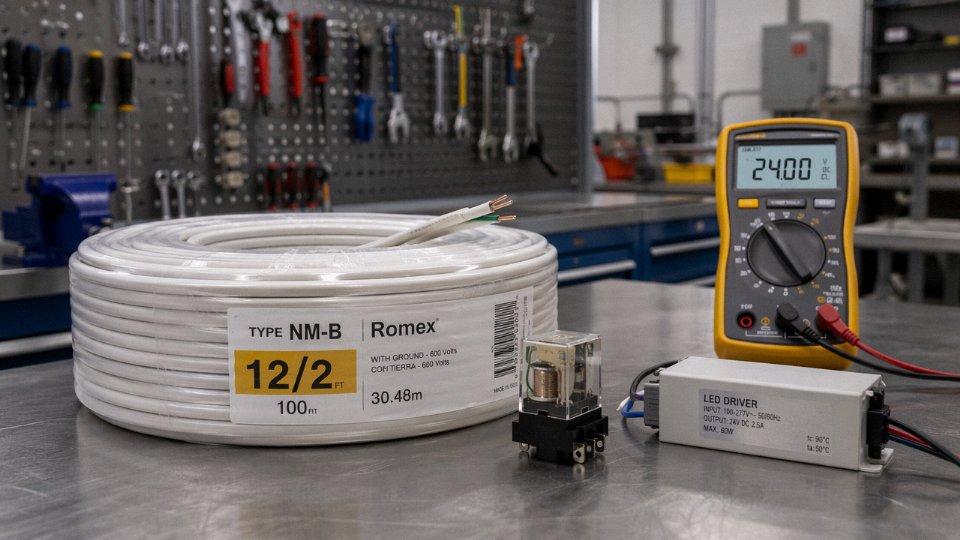
Grabbing a roll of 12/2 NM-B from the supply room because it’s already on-site feels like the practical move — until the LED fixtures start flickering at the far end of a 50-foot run, or the 24 V control relay drops out intermittently and nobody can figure out why. Voltage drop at low voltage is brutal compared to line voltage. A 0.79 V loss across a 12 AWG conductor carrying 5 A at 12 V DC over just 50 feet represents roughly 6.6% drop — more than double the 3% threshold most lighting and control engineers treat as the practical ceiling. That kind of loss shows up as premature driver failure, erratic sensor behavior, and service calls that cost more than the wire savings ever justified.
Yes, you can physically use 12/2 wire for low-voltage circuits, and in many cases the insulation is more than adequate — standard 12/2 NM-B is rated to 600 V, far above the 30 V Class 2 or 150 V Class 3 limits defined in NEC Article 725. The real problems are voltage drop on long runs at low voltage, code compliance for the specific circuit type, and the fact that 12 AWG is often overkill mechanically while still being the wrong tool electrically at 12 V DC.
What makes this genuinely tricky is that “low voltage” isn’t one thing. A 12 V landscape lighting circuit, a 24 V HVAC control loop, and a 48 V DC bus in a small industrial panel each behave differently over the same wire — and the answer that’s correct for one can get you into trouble with another.
Low-Voltage Defined: Voltage Classes, Standards, and Where 12/2 Cable Sits
“Low voltage” sounds straightforward until you’re standing in front of three different inspectors from three different jurisdictions, each citing a different standard. The term genuinely means different things depending on which code you’re working under — and getting the taxonomy wrong early leads to either failed inspections or, worse, undersized wire on a circuit that turns out to carry more load than the original design assumed.
NEC Article 725: The Class System Most North American Installers Use
The National Electrical Code doesn’t define “low voltage” as a single bucket. It carves the space into three classes based on both voltage and power limits, which is the right way to think about it because a high-impedance 150 V signal circuit behaves nothing like a 150 V power feed.
Class 1 circuits run up to 600 V and up to 1,000 VA — these are treated as full power circuits with full wiring method requirements. Class 2 is the one most people mean when they say “low voltage for controls”: capped at 30 V and 100 VA. Class 3 extends the voltage envelope to 150 V but keeps the same 100 VA ceiling. The power cap is the key safety logic; it limits the energy available to ignite fires or cause serious shock even if insulation fails.
Where does 12/2 NM-B sit against these classes? Its 600 V insulation rating clears every NEC class with substantial margin. The insulation is never the constraint. You could run a 12 V Class 2 signal through 12/2 NM-B and the cable jacket would be handling roughly 2% of its rated voltage stress. That’s not an endorsement — it’s just physics.
12/2 NM-B cable's 600 V insulation rating is sufficient for all three NEC Article 725 circuit classes.True
NEC Article 725 Class 3 reaches a maximum of 150 V, and Class 1 up to 600 V. Standard 12/2 NM-B carries a 600 V insulation rating, meaning it meets or exceeds the insulation requirement for all three classes. The limiting factor in low-voltage applications is almost always conductor ampacity, voltage drop, or code-permitted wiring methods — not insulation breakdown voltage.
IEC 60038 and IEC 60364: A Different Vocabulary Entirely
Outside North America, the IEC framework slices the spectrum differently. IEC 60038 defines “low voltage” as 50–1,000 V AC (or 120–1,500 V DC) — which would include 120 V circuits that NEC users consider ordinary branch circuits. What NEC installers think of as “low voltage” — the 12 V, 24 V, 48 V DC world — IEC calls extra-low voltage, or ELV, sitting below 50 V AC or 120 V DC.
IEC 60364 then subdivides ELV further into three practical categories: SELV (Separated Extra-Low Voltage, galvanically isolated from earth and from higher-voltage systems), PELV (Protective Extra-Low Voltage, earthed but otherwise similar to SELV), and FELV (Functional Extra-Low Voltage, used when SELV/PELV requirements aren’t fully met — subject to stricter touch-voltage rules). Each has different earthing and separation requirements that affect how you route and terminate your conductors, not just which gauge you pick.
For buyers sourcing 12/2-equivalent cable outside the US — say, for a solar control installation in Southeast Asia or a landscape lighting project in the EU — the insulation color coding matters as much as the conductor size. Standard US 12/2 NM-B uses black/white conductors; IEC-aligned cable typically uses brown/blue (phase/neutral) per IEC 60446. An inspector in Germany or Australia will not accept black/white without additional documentation, and in some jurisdictions it will simply fail the installation permit outright.
Voltage Class Comparison: Where 12 AWG Lands Across Frameworks
| Voltage Class | Framework | Typical Voltage Range | Common Applications | 12 AWG Status |
|---|---|---|---|---|
| Class 2 | NEC Art. 725 | ≤30 V / ≤100 VA | Thermostats, door bells, low-power controls | Physically permitted; typically oversized for current load |
| Class 3 | NEC Art. 725 | ≤150 V / ≤100 VA | Audio distribution, some CCTV feeds | Permitted; ampacity rarely the reason to choose it |
| SELV | IEC 60364 | <50 V AC / <120 V DC | Safety lighting, medical adjacent circuits | Permitted if insulation and separation rules met; verify color code |
| PELV | IEC 60364 | <50 V AC / <120 V DC | Control panels, PLC I/O loops | Permitted with earthing; conductor sizing driven by voltage drop, not ampacity |
| FELV | IEC 60364 | <50 V AC / <120 V DC | Functional controls where isolation isn’t maintained | Subject to higher-voltage touch rules; 12 AWG allowed but installation method governs |
| Low Voltage (IEC) | IEC 60038 | 50–1,000 V AC | Standard building power, motors | 12 AWG rated to 600 V — check local derating for conduit fill and ambient temp |
The Real Tension: Ampacity vs. Voltage-Drop Physics
Here’s where a lot of engineers get tripped up. At 12 V DC, 12 AWG still has its rated ~20 A continuous ampacity — that number doesn’t change because the system voltage dropped. What changes dramatically is the voltage-drop penalty. At 120 V AC, losing 2–3 V across a run is roughly 2% — tolerable. At 12 V DC, losing that same 2–3 V is 17–25% of your supply voltage. The conductor resistance is identical; the consequences are completely different.
In practice, the “low voltage = light duty = thin wire is fine” assumption gets installers into trouble more often than anything else on a 12 V or 24 V DC system. The wire may be more than adequate from an insulation standpoint. The voltage drop may still kill the circuit.
Ampacity, Voltage Drop, and Conductor Sizing at Low-Voltage Levels
Here’s where the engineering actually gets interesting — and where a lot of landscape lighting installers and small industrial control projects go wrong.
Ampacity De-Rating Is Basically Irrelevant at Low Currents
A single 5 W, 12 V LED fixture pulls about 0.42 A. A 12 AWG copper conductor is rated for 20 A continuous at 75°C. You’re using roughly 2% of the wire’s thermal capacity. So no, you will not overheat the conductor, trip a breaker through sustained load, or cause insulation degradation from heat. Ampacity de-rating — all those NEC 310.15 tables and conduit-fill correction factors — simply don’t matter at that current level.
What does matter is voltage drop. At low system voltages, a small absolute voltage loss becomes a large percentage loss. That’s the governing constraint, not heat.

The Voltage-Drop Formula and Three Real Scenarios
For DC circuits, the formula is:
VD = 2 × L × R × I
where L is the one-way run length in feet, R is resistance per foot (12 AWG is roughly 0.001588 Ω/ft), and I is current in amps. The factor of 2 accounts for the return conductor.
Scenario 1 — 12 V, 5 A, 50 ft run:
VD = 2 × 50 × 0.001588 × 5 = 0.79 V, which is 6.6% of 12 V. That exceeds the NEC-recommended 3% guideline and blows past the 5% practical maximum. Fail. At this run length, your LED fixtures are already dimmer than spec, and if you’re running any DC motor or control relay, you may get erratic behavior.
Scenario 2 — 24 V, 3 A, 100 ft run:
VD = 2 × 100 × 0.001588 × 3 = 0.95 V, or about 4.0% of 24 V. Marginal — over the 3% recommendation, still under 5%. Borderline pass depending on application sensitivity. A landscape lighting transformer running at 24 V with this load would likely show acceptable performance, but I wouldn’t push the run length further.
Scenario 3 — 48 V, 8 A, 200 ft run:
VD = 2 × 200 × 0.001588 × 8 = 5.08 V, or 10.6% of 48 V. That’s a hard fail for most control and lighting applications, though for a battery charging feed with compensation built in, it may be acceptable. Context matters.
12 AWG wire exceeds the NEC-recommended 3% voltage drop limit on a 12 V DC circuit carrying 5 A over a 50-foot one-way runTrue
Using VD = 2 × L × R × I: 2 × 50 × 0.001588 × 5 = 0.79 V, which is 6.6% of 12 V — more than double the 3% threshold.
Bigger Wire Isn’t Always the Answer
This is the design insight that saves money on real projects: on a 12 V system, no practical gauge of copper wire eliminates the voltage-drop problem at runs beyond 30–40 ft under meaningful load. You’d need absurdly large conductors. The correct engineering response is to raise the system voltage to 24 V or 48 V — not to run 10 AWG or 8 AWG.
For landscape and outdoor lighting specifically, this means specifying a 24 V transformer or LED driver at the outset. A 48 V DC backbone is increasingly common in solar-fed outdoor systems and makes conductor sizing far more manageable over runs of 150–300 ft.
Where 12 AWG Is Genuinely the Right Low-Voltage Choice
Smaller wire handles most 12 V lighting loads just fine at short runs. 16 AWG or 18 AWG landscape wire is adequate for loads under roughly 100 W within 50 ft — and it’s cheaper per foot, easier to pull through conduit, and faster to terminate. Using 12/2 NM-B for a 20 W garden path light is overkill and, in practice, harder to work with at terminal strips and push-in connectors.
Where 12 AWG earns its place in a low-voltage installation: higher-current 12 V DC feeds to pump motors, battery bank interconnects, solar charge controller output runs, and short trunk feeds to sub-distribution points in larger lighting systems. In those cases, the current is real — 10, 12, 15 A — and the lower resistance of 12 AWG meaningfully reduces losses.
Conductor Options for Low-Voltage Projects at Scale
For procurement managers and contractors buying in volume, purpose-built low-voltage cable is usually the better specification compared to repurposing residential NM-B. Jinda’s low-voltage cable range covers cross-sections from 0.5 mm² up to 16 mm² — roughly 20 AWG to 6 AWG in American terms — in both single-core and multi-core configurations. Insulation options include standard PVC (cost-effective for indoor and conduit-protected runs), XLPE (better temperature resistance and UV stability for direct-burial or outdoor exposed applications), and rubber-jacketed variants where flexibility and repeated flexing are a factor, such as in equipment feeds or mobile installations.
Bulk pricing on these cables depends on cross-section, insulation type, conductor count, and order volume, but the economics typically shift noticeably at container-quantity orders for large landscape developments, solar farms, or industrial panel wiring projects.
NEC Code Compliance: When 12/2 NM-B Is Permitted and When It Is Prohibited for Low-Voltage Wiring
The voltage rating on a cable and its listing status are two entirely different things. A 600 V-rated NM-B jacket absolutely can handle 24 V without arcing, melting, or failing electrically — that part is not in dispute. The problem is that NEC compliance is not purely about electrical adequacy. An AHJ (Authority Having Jurisdiction) will ask whether the cable is listed for the wiring method being used, and NM-B is not listed as a Class 2 substitute under Article 725. That distinction alone kills more low-voltage rough-in inspections than any other single issue.
Article 725 Class 2 Circuits: Listing Is Not Optional
NEC Article 725 governs remote-control, signaling, and power-limited circuits. Class 2 circuits — defined at 30 V / 100 VA or less — require conductors specifically listed as CL2, CL2P (plenum), or CL2R (riser). The listing means the cable has been evaluated as a complete assembly for its flame spread, smoke generation, and installation environment. NM-B carries none of those evaluations.
Standard 12/2 NM-B cable can legally substitute for CL2 cable in a Class 2 low-voltage circuit because its 600 V insulation rating exceeds the circuit voltage.False
NEC Article 725 requires conductors listed as CL2, CL2P, or CL2R for Class 2 circuits. NM-B is not listed for this wiring method regardless of its voltage rating. Listing covers flame-spread and environmental suitability, not just insulation voltage capacity.
In practice, inspectors in jurisdictions running the 2020 or 2023 NEC are increasingly strict on this. Using unlisted cable in a plenum or riser space triggers an automatic failure — the insulation rating is irrelevant to that conversation.
Where 12/2 NM-B Is Actually Permitted in Low-Voltage Work
There are legitimate exceptions, and they matter.
Class 1 remote-control and motor-control circuits operating above 30 V fall under NEC 725.31, which explicitly permits Chapter 3 wiring methods — meaning NM-B in dry, concealed residential locations is fully code-compliant. A 120 V coil circuit feeding a contactor, or a line-voltage thermostat circuit on a multi-stage HVAC system, qualifies here. 12/2 NM-B is appropriate and routinely used for exactly this application.
Line-voltage HVAC thermostat wiring on systems where the control circuit is derived from the load side (not a Class 2 transformer) follows the same logic. If the thermostat circuit shares voltage with the heating element supply — older baseboard systems sometimes do this — NM-B is the right call, not low-voltage listed cable.
Landscape Lighting and Direct-Burial Applications (Article 411)
NEC Article 411 covers lighting systems rated 30 V or less with a listed transformer. The code does not mandate CL2 cable here — it requires a conductor listed for the application, which in outdoor direct-burial contexts means UF-B. A 12 AWG UF-B is listed for direct burial and wet locations, handles heavier landscape fixture loads without the voltage drop problems that plague undersized runs, and will pass inspection. Standard NM-B, by contrast, is not rated for wet locations or direct burial and fails on environmental grounds before the inspector even checks the voltage.
Solar PV and Battery Storage: NM-B Fails the Environment Test First
Articles 690 and 706 govern PV source circuits and battery systems. The required cable types are USE-2 or listed PV Wire — both rated for sunlight resistance, wet locations, and the temperature cycling that outdoor DC circuits see. NM-B is none of those things. Running NM-B on a rooftop or in a battery enclosure fails the environmental rating requirement entirely, independent of the voltage question. This is a code violation and a genuine fire risk as the jacket degrades under UV exposure, typically within two to four years depending on climate.
A Working Checklist Before You Pull 12/2 Into Any Low-Voltage Application
Before the wire goes in the wall, run through these five questions:
- Is this circuit NEC Class 1, 2, or 3? Class 1 allows Chapter 3 wiring methods. Classes 2 and 3 require listed CL2 or CL3 cable.
- Is 12/2 NM-B listed for this specific wiring method and location? Dry, concealed, residential structural cavities: usually yes. Plenum, riser, wet, or exposed: no.
- Is the environment wet, damp, UV-exposed, or subject to physical damage? NM-B is a dry-location, protected-installation cable. Any moisture exposure ends the conversation.
- Has the local AHJ adopted amendments? Several jurisdictions have added restrictions beyond the base NEC — California’s Title 24 and certain municipal fire codes occasionally tighten listing requirements for low-voltage wiring in commercial occupancies.
- Does the conductor size actually make sense for voltage drop? A 12 AWG run carrying 5 A at 12 V DC over 50 feet loses roughly 0.79 V one-way — around 6.6%, which exceeds the 3% threshold most designers use for low-voltage lighting and control. If you’re using 12/2 purely to manage voltage drop on a long Class 2 run, the correct fix is a listed CL2 cable in 12 AWG, not standard NM-B with a reinterpreted listing.
The short version: 12/2 NM-B has a real place in Class 1 and line-voltage control work. Outside of that, the listing requirement — not the voltage rating — is what determines whether your installation passes.
Common Low-Voltage Applications Analyzed: Thermostats, Landscape Lighting, Security Systems, and 12 V DC Power
Not every low-voltage application fails with 12/2 wire — but most do, for reasons that vary by application. The wrong answer here costs you a failed inspection, a warranty void, or a callback at 2 a.m. when a landscape zone goes dark. Work through your specific case below.
Thermostat and HVAC Control Wiring (24 V AC)
Standard industry practice has used 18 AWG CL2-rated thermostat cable — typically 18/5 or 18/8 — for decades, and there’s a reason nobody switched. At 24 V AC carrying under 1 A, conductor resistance in 12 AWG buys you nothing. The real problem with 12/2 NM-B here is physical: the terminals on a modern thermostat sub-base or furnace control board are designed for 18–22 AWG wire. Forcing a stiff 12 AWG conductor into a screw terminal that was never intended for it risks cracking the PCB mount, stripping the terminal, or producing an intermittent connection that takes three visits to diagnose.
Beyond the mechanical issue, NM-B is not listed as a control cable under NEC Article 725. An inspector will reject it regardless of voltage. Verdict: do not use 12/2 NM-B for thermostat wiring. Use 18/5 or 18/8 CL2 thermostat cable.
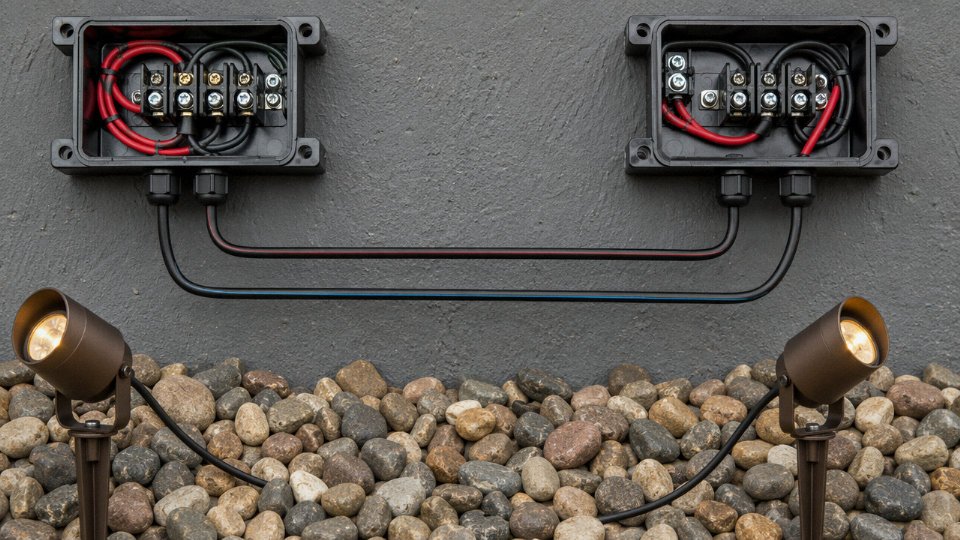
Landscape Low-Voltage Lighting (12 V AC, NEC Article 411)
This is the one application where 12 AWG legitimately earns its place. Most landscape lighting systems ship with 16 AWG or 14 AWG cable, which is adequate for short runs under light loads. Stretch a run to 100 feet or more while driving 200–300 W of LED fixtures, and voltage drop on 16 AWG starts pulling fixture voltage below 10.5 V — you’ll see dimming, color shift, and shortened driver life.
12/2 UF-B (not NM-B — this matters, because UF-B is rated for direct burial) is explicitly suitable for the output side of a listed low-voltage transformer feeding these zones. NEC 300.5 requires a minimum 12-inch burial depth for 12 V listed systems under NEC 411. In practice, I’d go 18 inches in any climate with freeze-thaw cycling, because 12 inches puts you right in the aeration zone of a typical lawn.
Verdict: approved for heavy-load zones (150 W and above) or runs over roughly 75–80 feet. Use UF-B, not NM-B.
Security and Fire Alarm Low-Voltage Circuits
NEC Articles 760 and 800 are not flexible on this. Fire alarm circuits require listed fire alarm cable — FPL for riser-rated, FPLR, or FPLP for plenum. Communications circuits require CM, CMR, or CMP listing. These listings exist because the cable must meet specific flame-spread, smoke, and structural integrity requirements that standard NM-B was never tested against.
12/2 NM-B cable meets the listing requirements for fire alarm or security system wiring under NEC Articles 760 and 800.False
NM-B carries no FPL, CM, or equivalent listing. It fails NEC 760 and 800 requirements regardless of the circuit voltage, and an AHJ will reject it at rough-in inspection.
Verdict: not permitted under any circumstance. The voltage level is irrelevant.
12 V DC LED Strip Lighting (Interior Residential or Commercial)
People get confused here because the 120 V feed wire and the low-voltage secondary wire share the same wall cavity. The line side — 120 V branch circuit feeding the LED driver — can and typically should be 12 AWG THHN in conduit or 12/2 NM-B in residential construction. That’s normal. The secondary side of the driver, where the actual 12 V DC output feeds the strip, is a separate wiring system and needs wire listed for that purpose. Running NM-B from a driver’s DC output terminals into a wall is not listed practice.
Verdict: 12/2 NM-B on the 120 V primary side only. Use appropriately listed low-voltage wire on the DC secondary.
Off-Grid and Battery Bank Interconnects (12 V, 24 V, 48 V DC)
Battery systems are probably where the worst improvisation happens in the field. At 12 V DC, a 20 A load is modest — but NEC Articles 690 and 706 require USE-2 or RHW-2 listed cable for these environments because battery compartments can be wet, can off-gas, and run conductors that carry fault current with no GFCI backstop. NM-B is not wet-location rated. Its paper filler absorbs moisture, the jacket degrades, and a ground fault in a battery enclosure with NM-B involved is a fire scenario, not just a nuisance trip.
12 AWG is a reasonable minimum conductor size for 20 A DC circuits at these voltages — the ampacity works — but the cable type must be correct. Tinned-copper construction is strongly preferred in any environment with hydrogen off-gassing or marine humidity, because plain copper oxidizes faster than most people expect in those conditions. Jinda produces tinned-copper PV wire and RV/marine-grade equivalents in bulk supply configurations suitable for off-grid installers sourcing at volume.
Verdict: 12 AWG conductor size is often appropriate, but NM-B is the wrong cable type. Specify USE-2 or listed DC PV/battery cable.
Physical and Environmental Limitations of 12/2 NM-B in Low-Voltage Installations
The electrical math might check out — ampacity is fine, the insulation is rated well above 12 V or 24 V — and yet 12/2 NM-B cable can still be the wrong choice. Physical and environmental failure modes are where a lot of low-voltage installations quietly fall apart, usually months or years after commissioning when tracing the fault is genuinely painful.
Moisture Ingress and the Direct-Burial Problem
NM-B is a dry-location cable, full stop. The outer jacket is nylon over PVC, neither of which is rated for soil contact or sustained moisture exposure. NEC 334.12(B)(4) is unambiguous: NM-B cannot be used in wet or damp locations, embedded in masonry, concrete, or soil, or run in conduit that might collect condensation outdoors. Voltage level is irrelevant here — you don’t get a pass on burial restrictions because your circuit is only 12 V DC.
In practice, landscape lighting and irrigation control wiring are the biggest offenders. Somebody runs 12/2 NM-B in a shallow trench to a low-voltage transformer because it was on the shelf in the utility room, the inspector either doesn’t see it or the work is never inspected, and eighteen months later the jacket has wicked moisture, the PVC insulation is tracking, and the system starts behaving erratically. Direct-burial installations require UF-B cable at minimum, and for anything more demanding — outdoor control loops, below-grade security wiring — a listed direct-burial cable with a water-blocking compound or a properly sealed conduit system is the right answer. UF-B costs maybe 15–25% more per foot than NM-B depending on purchase volume and copper pricing; that is not a serious argument against using it.
UV Degradation Is Faster Than Most People Expect
Run NM-B exposed on an exterior wall or across a rooftop — even in a mild climate — and the outer jacket becomes brittle and cracks within roughly 12 to 24 months. Standard PVC without UV stabilizers breaks down under prolonged UV exposure, losing tensile strength and eventually crazing to the point where physical handling causes the jacket to split. This matters even for low-voltage runs because a compromised jacket invites moisture and introduces ground-fault paths that will confuse any downstream control equipment trying to interpret a 0–10 V dimming signal or a 24 V thermostat loop.
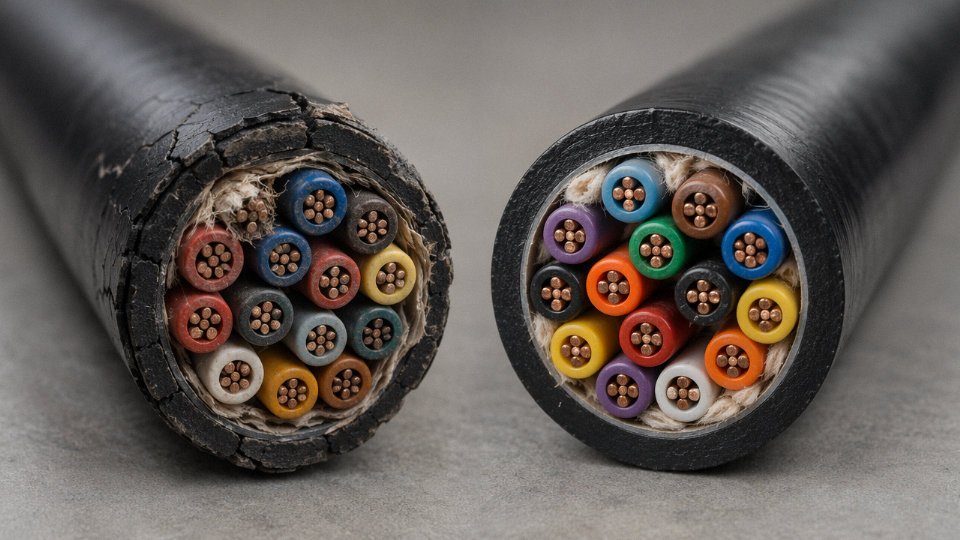
Cables engineered specifically for outdoor use — XLPE-insulated conductors with a UV-stabilized PVC or PE outer jacket, for instance — maintain mechanical integrity for 25 years or more under direct sun, and that service life gap is not marginal. It directly affects whether a 20-year landscape or building automation system needs a mid-life rewire.
Connector and Termination Compatibility
This one catches installers off guard. The 12 AWG solid conductor in standard NM-B is stiff — workably stiff for a 15 A or 20 A branch circuit feeding a receptacle box, but problematic for the quick-connect and push-in terminals that dominate low-voltage wiring hardware. Wago 221-series lever nuts, push-in thermostat terminal blocks, and landscape lighting tap connectors are designed around 14 AWG to 18 AWG stranded wire. The contact geometry assumes a certain conductor diameter and compliance. Forcing 12 AWG solid into a terminal designed for 18 AWG stranded doesn’t just require extra effort — it can deform the contact spring, reduce clamping force, and create an intermittent connection that reads fine on a continuity test but fails under vibration or thermal cycling.
12 AWG solid conductors are too stiff for most low-voltage quick-connect terminals designed for 14–18 AWG stranded wireTrue
Low-voltage quick-connect terminals such as Wago 221 series and push-in thermostat connectors are engineered for the diameter and flexibility of 14–18 AWG stranded conductors; inserting 12 AWG solid wire can deform the contact spring and produce unreliable connections.
Intermittent faults in a 24 V HVAC control circuit are maddening to diagnose. A loose terminal in a thermostat base produces symptoms that look like a bad control board, a failed transformer, or a refrigerant issue — anything but what it actually is.
Conduit Fill When Running Multi-Conductor Low-Voltage Bundles
Where conduit is required or chosen for protection, the gauge difference matters quickly. The cross-sectional area of 12 AWG conductors is roughly 3 to 4 times that of 18 AWG wire. A 12-conductor low-voltage bundle using 18 AWG might comfortably fit a 1/2-inch conduit; the same conductor count in 12 AWG typically forces a step up to 3/4-inch or even 1-inch conduit. That adds hardware cost, labor time, and often requires upsizing junction box entries — a cascading change that originated from a gauge choice that wasn’t sized to the actual load in the first place.
Temperature Rating in Mixed-Voltage Enclosures
One last point that gets overlooked: when 12/2 NM-B conductors enter a panelboard or control enclosure that also contains power wiring or heat-generating components, the 60°C or 75°C insulation rating of NM-B can become a liability. The conductor itself may be carrying almost nothing — 24 V, 200 mA — but ambient temperatures inside a crowded enclosure on a hot day can approach or exceed 40°C, and the derating implications compound if the NM-B insulation is the 60°C variant. Purpose-built low-voltage cable with 90°C-rated insulation gives you a meaningful thermal margin that NM-B simply doesn’t provide.
Choosing the Right Low-Voltage Cable: Specifications Buyers Should Verify Before Ordering
Ordering the wrong cable on a bulk purchase is one of those mistakes that doesn’t announce itself until commissioning — or worse, until something fails in the field six months later. Getting the specification right before issuing a purchase order saves real money and keeps projects on schedule.
Conductor Material and Construction
This is the first thing to nail down, because the market is full of cable that looks correct on the outside and isn’t.
Annealed bare copper is the standard for most fixed low-voltage wiring. Tinned copper — where each strand gets a thin coating of tin before drawing — is worth specifying whenever the installation involves damp conditions, coastal environments, or any marine application. The tin layer resists the oxidation that causes bare copper to develop high-resistance joints over time, particularly at crimp terminations. It costs a modest premium, typically 5–12% more depending on current tin pricing, but that trade-off is straightforward in wet environments.
Copper-clad aluminum (CCA) is where procurement decisions go quietly wrong. CCA carries roughly 60% of the conductivity of solid copper, which means a cable that measures the same diameter as a copper equivalent will underperform on ampacity. To match copper’s current-carrying capacity, you need to upsize by approximately 1.5×. A contractor who specifies “14 AWG equivalent” and receives CCA without realizing it ends up with a wire that behaves more like 16 AWG copper. For low-voltage control circuits running small signal loads, that may not matter. For 12 V DC systems with any meaningful current draw, it will show up as excess voltage drop and heat at termination points.
Copper-clad aluminum (CCA) conductor has approximately 60% the electrical conductivity of solid annealed copper, requiring roughly 1.5× upsizing to achieve equivalent ampacity.True
CCA conductors have a resistivity substantially higher than pure copper due to the aluminum core. The International Annealed Copper Standard (IACS) rates aluminum at roughly 61% conductivity versus copper, which is why CCA cables cannot be substituted 1:1 in current-carrying calculations.
Jinda’s standard production uses oxygen-free annealed copper. Tinned copper is available on request — worth asking about early if your project spec calls for it, since it’s not always a stock item and lead times differ.
Insulation and Jacket Compound
PVC insulation is cost-effective and perfectly adequate for dry indoor installations. Its thermal rating tops out around 70°C, and it doesn’t hold up well under UV exposure or repeated flexing. For most commercial building control wiring, PVC is fine.
XLPE (cross-linked polyethylene) handles temperatures to 90°C, resists a wider range of chemicals, and has lower dielectric loss — which matters more than most people expect in high-frequency control signal applications. If you’re running building automation or any signal cable near variable-frequency drives, XLPE is worth the slight cost premium.
LSZH (low-smoke zero-halogen) is non-negotiable for tunnels, transit stations, hospitals, and public buildings in most jurisdictions. When PVC burns, it releases HCl gas. LSZH compounds limit toxic smoke output per IEC 60332, which is why the spec shows up in European, Middle Eastern, and increasingly North American public-building projects. Verify the actual IEC 60332-3 fire test category required — there are multiple parts to that standard and they are not interchangeable on a spec sheet.
Listing and Certification Requirements
This varies sharply by destination market and it’s the area where procurement teams most often create delays by ordering first and checking later.
For North America: UL listing (or cUL for Canada) is required. Ask for the UL file number, not just a printed mark on the jacket. For Europe: CE marking with compliance to IEC 60227 (PVC-insulated cables) or IEC 60245 (rubber-insulated) is standard; verify the specific harmonized standard. China domestic supply requires CCC certification. EU projects also increasingly demand RoHS and REACH compliance documentation — get that paperwork before the order ships, not after it clears customs.
Conductor Stranding Class
Solid conductor (IEC 60228 Class 1) is appropriate for fixed installations where the cable won’t move once terminated. Stranded Class 2 is required anywhere the cable will flex during installation or occasional repositioning. Class 5 fine-stranded is what you specify for panel wiring, machine tool connections, or anything that sees repeated flexing in service. Specifying Class 1 solid conductor for a control panel installation where technicians are routing and re-routing wires is a common mistake — it causes conductor fatigue and broken strands at termination points, usually right after the warranty period.
Procurement Quantities and Lead Times
Standard low-voltage control cable in the 0.75 mm²–6 mm² range typically ships within 15–25 days for stock configurations. Custom multi-pair arrangements, non-standard color coding, or specialized compounds like LSZH with a specific fire test rating generally require 30–45 days. For large infrastructure or construction projects, that lead time difference matters when mechanical completion dates are fixed. Build the procurement timeline around the longest lead-time cable in your bill of materials, not the average.
Frequently Asked Questions About Using 12/2 Wire for Low-Voltage Applications
Can I use 12/2 NM-B for a 12 V DC LED lighting circuit?
It depends entirely on which side of the driver you’re wiring. On the 120 V line-voltage side — feeding the LED driver or transformer — 12/2 NM-B is perfectly legitimate, provided the circuit has 20 A overcurrent protection and the installation environment is dry and indoor. That’s a standard branch circuit, and NM-B is listed for exactly that.
The 12 V secondary output side is a different story. NM-B is not listed for Class 2 low-voltage wiring, full stop. Inspectors in most jurisdictions will flag it. Use listed Class 2 cable (look for the CL2 marking on the jacket) or a listed landscape lighting cable rated for the application. Mixing these up is one of the more common rough-in errors I’ve seen, particularly on retrofit LED jobs where someone reuses existing wire without thinking through which side of the transformer they’re on.
Is 12 AWG oversized for most low-voltage control circuits?
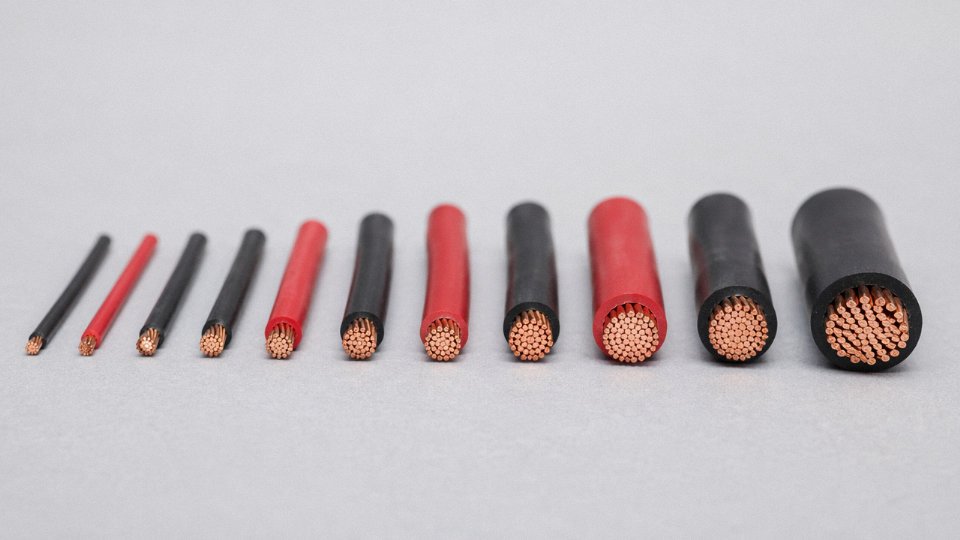
Usually, yes — significantly so. A thermostat wire carrying 24 V at under 1 A doesn’t need 12 AWG. Neither does a motion sensor, a door contact, or most building automation field devices. For control circuits running under 5 A at 12 V or 24 V, 16–18 AWG handles the current comfortably and is far easier to pull through conduit, terminate on small screw blocks, and manage in a crowded panel. The only time 12 AWG genuinely earns its place on the low-voltage side is when you’re pushing 10–15 A or more, or when a very short run at high current makes voltage drop the controlling variable.
Can I bury 12/2 NM-B for outdoor landscape lighting runs?
No. NM-B is rated for dry locations only — burying it violates its listing, voids any warranty, and creates a real shock and fire hazard as the jacket degrades. For direct-burial landscape circuits operating under 30 V, NEC 300.5 requires a minimum 12-inch burial depth, and the cable must be UF-B rated. Standard 12/2 UF-B satisfies that requirement and uses the same 12 AWG conductor if your voltage-drop math demands it. If the system runs at 12 V over long distances, it probably does.
Standard 12/2 NM-B cable can be buried in soil for outdoor low-voltage landscape lighting.False
NM-B is listed for dry locations only. Burying it violates UL listing and NEC requirements. Direct burial applications require UF-B or other listed direct-burial cable, with minimum depth per NEC 300.5.
Does specifying 12/2 for low-voltage work waste money?
In most cases, yes. Twelve AWG copper runs roughly 2–3× the material cost of 18 AWG per foot, depending on copper commodity pricing at the time of purchase — and that multiplier compounds fast on a 200-run commercial security system or a multi-zone HVAC retrofit. Labor cost goes up too; thicker wire takes longer to strip, is harder to dress neatly in a low-voltage enclosure, and fights back when you’re trying to terminate it on a 22 AWG-sized screw terminal. Unless your current load or run length specifically demands 12 AWG, you’re paying a premium for conductor metal you don’t need.
What cable should I use for a thermostat or HVAC control circuit?
For residential HVAC, 18/5 or 18/8 thermostat cable with a CL2 jacket is the standard. Five conductors covers most conventional systems; eight gives you room for multi-stage equipment or zone damper control without pulling a second cable. Commercial building automation is different — BAS manufacturers typically specify shielded 18 AWG or 22 AWG twisted-pair, CL2 or CL3 rated, often with a specific characteristic impedance. Check the BAS equipment manual before buying wire. Guessing on shielding or twist rate and then troubleshooting noise issues on a DDC network is a miserable way to spend a Tuesday.
Does Jinda manufacture low-voltage cable equivalents to North American standards?
Yes. Jinda’s control cable lineup covers conductor sizes from 0.5 mm² through 35 mm², with PVC or XLPE insulation options and available UL, CE, and other market certifications. Custom configurations — specific pair counts, shielding arrangements, jacket compounds — are supported with engineering documentation. For procurement managers sourcing in bulk, sample shipments ahead of a full order are available, which matters when you’re qualifying a new supplier and can’t afford to have 10,000 meters of off-spec cable arrive at the job site.
Is there a universal trigger for when 12 AWG becomes necessary on a low-voltage circuit?
There’s a reliable engineering rule, if not quite a universal one. Run the voltage drop calculation: VD = 2 × L × R × I, where L is the one-way run length in feet, R is resistance per foot (roughly 0.00159 ohms/ft for 12 AWG), and I is the load current in amps. If the result exceeds 3–5% of your supply voltage at the load terminals, you need a larger conductor — which at low voltages can mean stepping up from 18 AWG to 14 or 12 AWG sooner than you’d expect. Also check NEC Table 310.12 if the cable runs in conduit with other conductors or in an elevated-temperature environment; ambient derating can change the ampacity picture considerably. Both conditions together — long run, high ambient — are where 12 AWG quietly becomes the right answer even on circuits that look modest on paper.