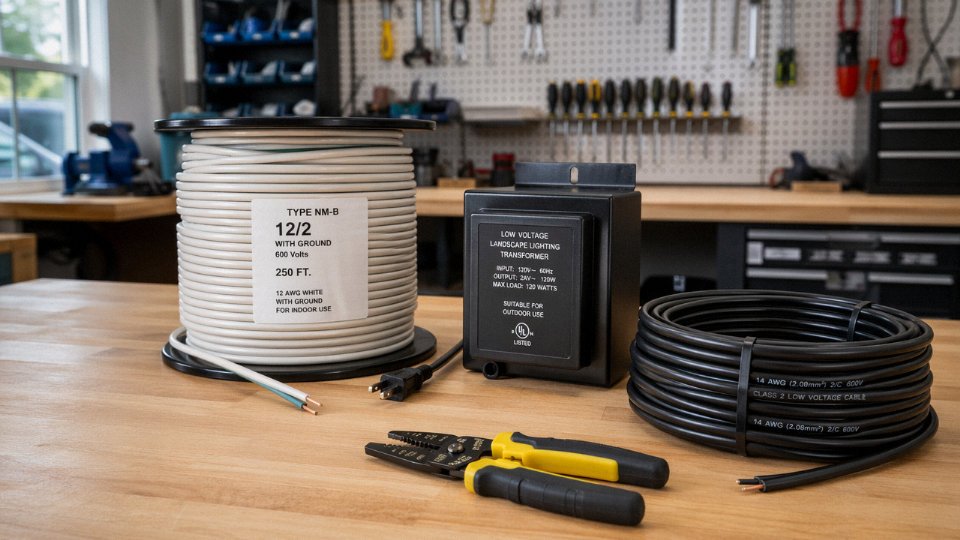
You’ve got a spool of NM-B 12 AWG sitting on the shelf, a 24V landscape lighting circuit to run, and a procurement lead time you’d rather not deal with. The temptation to just use what’s there is real — most electricians have been there. Use the wrong wire, though, and you’re not just bending code; you’re potentially undersizing or oversizing conductors for current, mismatching connector and termination ratings, and creating an inspection failure that halts a project or triggers a rework call at $80–$150 per hour depending on your region and trade rates.
Yes, you can use 120V household wire — NM-B 14 AWG or 12 AWG, both rated at 600V insulation — on a low-voltage circuit running at 12V, 24V, or 48V. The insulation voltage rating far exceeds what a low-voltage system will ever push. The real constraints are ampacity, conductor sizing for voltage drop at low-voltage levels, code classification under NEC Article 725, and whether the terminations and connectors in your low-voltage device are rated for the wire gauge you’re inserting.
What surprises most people is that the voltage rating of the insulation is almost never the binding constraint — it’s everything else around it that determines whether the choice is smart or a slow-burning problem.
How Insulation Voltage Ratings Actually Work: 300V, 600V, and 1000V Classes Explained
Insulation isn’t designed to match your system voltage exactly. It’s engineered in discrete tiers — 300V, 600V, 1000V, and above — because manufacturers can’t economically produce a unique insulation compound for every possible circuit voltage. That tiered approach is why a cable rated 600V works perfectly on a 24V LED circuit, and why nobody should be surprised by it.
What Dielectric Strength Actually Means on the Production Floor
Dielectric strength is the maximum electric field an insulating material can withstand before it breaks down and conducts current through the insulation wall itself. It’s measured in volts per unit thickness — typically kV/mm for PVC, XLPE, or rubber compounds. When a cable manufacturer specifies a 600V rating, they’re not saying the cable will fail at 601V. They’re saying the insulation compound and wall thickness combination will survive continuous service at up to 600V without degrading over its designed service life, typically 20–40 years depending on temperature class and installation environment.
UL and IEC don’t just take the manufacturer’s word for it. Both standards require production samples to pass high-potential (hipot) withstand tests at voltages well above the rated figure. For a 600V-rated cable under UL 83 (THHN/THWN), the AC withstand test is applied at 2,000V for one minute. Under IEC 60227 and IEC 60502, the multipliers vary but the principle is identical — typically 2× to 4× the rated voltage, applied to finished cable, not just raw insulation sheet.
A 600V-rated cable is tested at 2,000V AC before it leaves the factory.True
UL 83 and similar standards require hipot testing at voltages substantially above the cable's rated voltage — commonly 2,000V AC for 600V-class wire — to verify insulation integrity under worst-case conditions.
That means a coil of 12 AWG THHN you pull off a spool at an electrical supply house has already survived 2,000V in production testing. Running it on a 48V DC control circuit gives you a safety margin of roughly 40:1 against the test voltage, let alone the rated voltage. From an insulation-failure standpoint, that’s a non-issue.
The Three Common Tiers and Where You Actually See Them
| Insulation Class | Typical Products | Rated Voltage | Common Applications | Approximate Dielectric Test Voltage |
|---|---|---|---|---|
| 300V | SPT lamp cord, NEC Class 2 cable (CL2), thermostat wire | 300V | Lighting fixtures, thermostats, low-voltage controls | 1,000–1,500V AC |
| 600V | NM-B, THHN, THWN, USE-2 | 600V | Residential branch circuits, commercial conduit runs, PV wiring | 2,000–2,500V AC |
| 1000V | TC-ER tray cable, MC cable, PV wire (PV-W) | 1,000V | Industrial cable trays, solar arrays, VFD output wiring | 3,500–4,000V AC |
| 2000V+ | EPR/XLPE medium-voltage cable | 5kV–35kV+ | Utility feeders, large motor leads, switchgear | Per IEC 60502-2 / IEEE 400 |
The 300V tier is where things get restrictive. SPT lamp cord and most Class 2 cables sit here — adequate for 12V or 24V circuits, but with less physical robustness than 600V cable. Thinner jacket, smaller overall diameter, less mechanical protection. In a cabinet or conduit shared with 120V or 240V circuits, NEC 725.136 typically prohibits Class 2 wiring from running in the same raceway anyway, so the insulation headroom question becomes partly moot — physical separation is required regardless.
The Part Most People Conflate: Voltage Rating vs. Current Capacity
Over-specifying insulation voltage is harmless. Over-specifying or under-specifying wire gauge for the actual load current is not. A 14 AWG THHN has 600V insulation but is only rated for 15A at 60°C or 20A at 75°C per NEC Table 310.15(B)(16). Running 18A continuously through it on a 12V circuit doesn’t care that the insulation could theoretically handle 600V. The conductor heats up based on current and resistance — Ohm’s law doesn’t ask what the insulation is rated for. That’s the failure mode that actually starts fires and generates warranty claims, not the insulation voltage tier.
The practical upshot: if you’re using 120V-rated NM-B or THHN for a low-voltage application, verify your AWG selection against the actual load current and ambient temperature, apply the appropriate derating factors, and the voltage rating becomes a complete non-issue. The insulation is simply doing less work than it was designed for.
NEC and IEC Code Compliance: When 120V-Grade Wire Is Permitted, Restricted, or Overkill in Low-Voltage Installations
The voltage number printed on a cable jacket tells you what the insulation can withstand. It does not tell you whether that cable is listed for the application you’re about to wire. That distinction is where contractors run into failed inspections and costly rework — usually late in a project.
NEC Article 725: It’s About Power Level, Not Just Voltage
Article 725 governs remote-control, signaling, and power-limited circuits, and it splits them into three classes. Class 1 circuits can operate up to 600V and are wired using Chapter 3 methods — meaning standard THHN, NM-B, conduit fill rules, all of it. That’s the familiar territory. Class 2 and Class 3 circuits are where the logic shifts. Class 2 limits you to 30V/100VA (or 150V if energy-limited), and Class 3 caps at 150V/100VA. For these circuits, the NEC allows lighter, more flexible listed cable types specifically because the power level is inherently limited and the shock/fire risk is reduced.
Here’s the practical consequence: if you’re wiring a 24V access control system and you decide to run 12 AWG NM-B because “it’s rated 600V and I have a reel of it,” an inspector following Article 725 closely may reject it — not because the insulation can’t handle 24V (it obviously can), but because NM-B is not on the Article 725.179 listed cable hierarchy for Class 2 wiring methods. The circuit works. It may not pass.
The Substitution Hierarchy in NEC 725.49
Article 725.49 does allow substitution of higher-listed cable types for lower ones, but it follows a specific ladder. CL3P can substitute for CL2P, CL3R for CL2R, and so on up through plenum, riser, and general-purpose ratings. Standard residential wiring — NM-B or bare THHN pulled through conduit — sits outside this substitution ladder entirely for Class 2 applications. You can use THHN in conduit for a Class 1 circuit under Article 725, no problem. For a Class 2 thermostat circuit or a low-voltage lighting control run, you need a cable that carries the CL2 or CL3 listing, period.
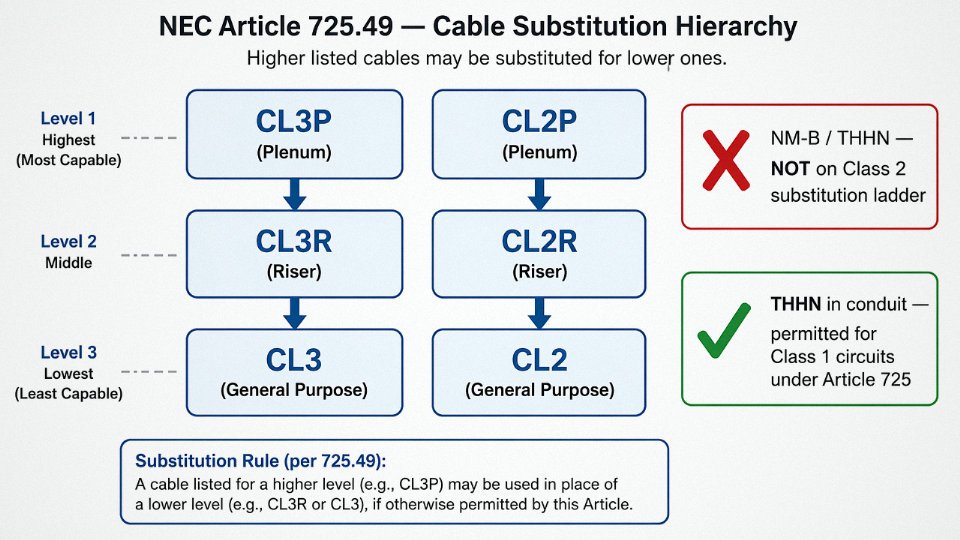
Standard 120V NM-B cable is automatically code-compliant for any low-voltage Class 2 circuit because its insulation rating exceeds the operating voltage.False
NEC Article 725 requires listed cable types (CL2, CL3, or approved substitutes per 725.49) for Class 2 and Class 3 circuits. Insulation voltage rating alone does not satisfy the listing requirement; NM-B is not on the permitted substitution hierarchy for these circuit classes.
Articles 411 and 680: Where Listed Cable Type Is Non-Negotiable
NEC Article 411 covers lighting systems operating at 30V or less — landscape lighting, under-cabinet LED systems, that category. It requires listed system components throughout, and the cable types are specified by the listing, not by the installer’s preference. Running standard 600V THHN to a 12V landscape fixture because “the voltage rating is way more than enough” doesn’t satisfy 411. The listing drives the requirement, full stop.
Article 680 is stricter still. Swimming pool and fountain lighting, bonding conductors, underwater luminaire wiring — all of it carries explicit cable type and construction requirements tied to wet location ratings, listed luminaire compatibility, and specific insulation types. Using a higher-insulation-rated cable that isn’t listed for wet submersible use doesn’t get you a pass here. The consequences of a wrong cable choice in a pool installation aren’t just an inspection failure; they’re a shock hazard in standing water.
IEC 60364 and Cross-Border Procurement Reality
Outside North America, the relevant standard is IEC 60364, and procurement specs for European or Asian projects typically reference cable types by the HAR/CENELEC voltage designation code rather than the application article. The H05 series (e.g., H05VV-F) carries a 300/500V designation — suitable for light-duty Class II equipment and many low-voltage control applications. The H07 series (e.g., H07RN-F) is rated 450/750V and is specified for industrial environments, outdoor use, and higher mechanical stress. Substituting one for the other based purely on “both exceed my 24V system voltage” misreads how European specs work. The designation codes encode conductor flexibility class, insulation material, sheath type, and application category — not just voltage capability.
For cross-border procurement, this creates a real practical problem. A factory in Southeast Asia specifying H05VV-F for a building automation system cannot simply accept 600V NM-B or THHN as a drop-in equivalent, even if the exporting supplier argues the insulation is “better.” The certifying body, the project engineer, and often the local authority having jurisdiction (AHJ) will look for the specific designation. Get the cable type right in the purchase order, not after it arrives on site.
The Practical Rule That Actually Holds
Match the listed cable type to the application article, not to the voltage number on the jacket. A cable with 600V insulation installed in a Class 2 circuit without the CL2 listing is a code violation waiting to surface at final inspection. A listed Class 2 cable with a 300V insulation rating installed correctly in a 24V thermostat circuit is exactly right. The voltage printed on the jacket is a floor, not a credential.
Physical and Practical Drawbacks of Using 120V Household Wire in Dedicated Low-Voltage Systems
The previous sections established that 120V-rated NM-B cable is technically permissible in many low-voltage situations — the insulation is more than adequate. But “permissible” and “practical” are different conversations entirely, and on an actual installation this distinction costs real money and real time.
Mechanical Stiffness Is a Bigger Problem Than It Sounds
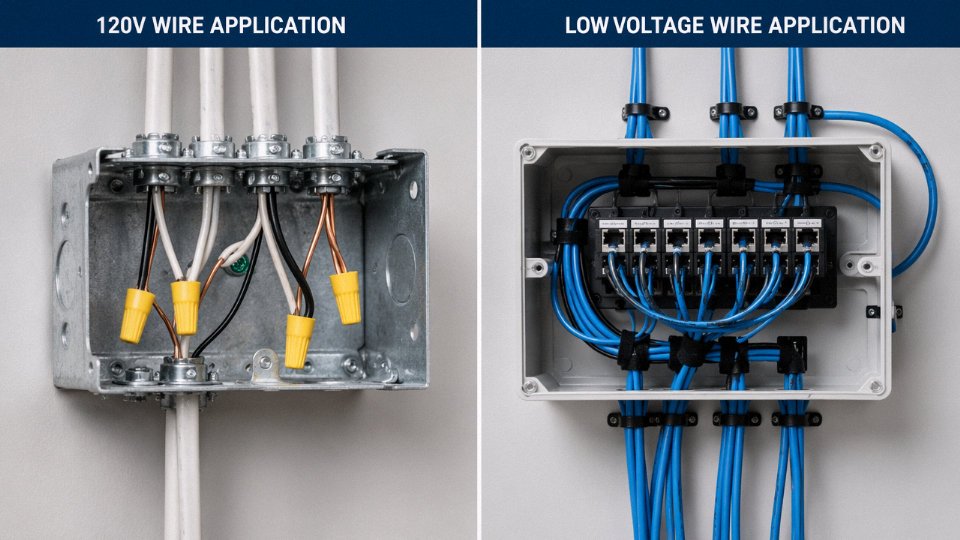
NM-B cable — the standard Romex-style stuff — is built around a rigid PVC outer jacket enclosing three conductors (hot, neutral, ground) in a fairly thick assembly. For a residential circuit inside stud walls, that’s fine. Routing it through a landscape lighting trench, fishing it behind a flush-mounted smart home panel, or dressing it inside an AV rack is a different matter. The cable doesn’t want to bend tightly, doesn’t lay flat, and in a rack environment it creates a bundled mass that interferes with airflow and makes future service genuinely unpleasant.
Dedicated Class 2 two-conductor cable, or a stranded 18 AWG multiconductor low-voltage cable, is far more pliable. In a tight conduit stub-up into a control panel, you’ll feel the difference immediately. Installers working with landscape lighting regularly note that even a 50-foot run of 14/2 NM-B is awkward to coil and bury compared to direct-burial 18/2 or 16/2 low-voltage cable that flexes naturally into bends and lays flat in the trench.
Termination Mismatch Is a Real Failure Mode
Low-voltage devices — LED transformer hubs, 12V security camera tails, Class 2 control modules, intercom panels — are almost universally terminated with IDC connectors, push-in spring terminals, or proprietary locking plugs sized for conductors in the 22–18 AWG range. Trying to land 14 AWG solid copper into a spring-cage terminal rated for 18–20 AWG isn’t just awkward; it either won’t seat properly or it deforms the terminal housing, creating a connection that may pass an initial pull-test and fail six months later under thermal cycling.
Forcing an oversized conductor into a terminal rated for smaller wire is a recognized cause of intermittent connection failures in low-voltage control systems.True
Terminal manufacturers specify maximum conductor cross-section to ensure the clamping mechanism applies correct contact pressure. An oversized conductor can bottom out the clamp before rated force is applied, leaving inadequate grip.
Field fix: a ferrule or a pigtail splice to a short 18 AWG stub — which adds splice points, labor, and potential code questions in inspected work. Not the end of the world, but entirely avoidable.
The Cost Arithmetic Runs Against Heavier Wire
For a typical 200-foot landscape lighting circuit, a rough comparison at common distributor pricing (which varies by region, copper market, and quantity — check your current pricing):
| Cable Type | Approximate Cost per Foot | 200 ft Total (Material Only) |
|---|---|---|
| 14/2 NM-B (600V rated) | $0.55–$0.85 | $110–$170 |
| 18/2 Class 2 direct-burial LV | $0.18–$0.35 | $36–$70 |
That’s roughly a 2–3× material cost penalty for wire that is heavier, stiffer, harder to route, and overkill for the application. In a 10-fixture landscape circuit, that delta funds the fixture upgrade or a second zone.
Voltage Drop Math Actually Favors Proper Sizing
This one surprises people. At 120V AC, a 3% voltage drop over 100 feet is roughly 3.6V — most loads don’t notice. At 12V DC, 3% is 0.36V, and that same 100-foot run of 14 AWG carrying 5A drops approximately 1.6V, putting the far-end devices at 10.4V. An 18 AWG conductor over that same run drops closer to 3.2V — worse, obviously — but the point is that wire gauge alone doesn’t solve low-voltage drop problems. System voltage is the dominant variable. The real engineering answer is either to boost source voltage (use a 13.8V or 15V transformer with adjustment taps), shorten runs, or use a topology with multiple feed points — not simply grab heavier household wire and assume that fixes it.
The ‘Can You’ Versus ‘Should You’ Summary
Can you pull NM-B into a landscape lighting run and have it work? Yes, in many cases. Should you? Almost never, unless it’s genuinely the only material available and the installation is temporary. Purpose-built low-voltage cable — properly rated, flexibly stranded, and sized for the actual load and run length — delivers lower material cost, better connector compatibility, easier routing, and a cleaner inspection record. The 600V insulation rating on NM-B is not an asset here; it’s just dead weight.
Application-by-Application Breakdown: Landscape Lighting, Security Systems, EV Charging Pilots, and DC Bus Wiring
The “technically permissible” argument falls apart fast once you move from theory into specific installation types. Insulation voltage rating is just one axis. Listing, burial rating, shielding, and conductor geometry all matter independently — and inspectors know the difference.
Landscape Lighting (12V AC/DC Transformer Systems)
This is where DIYers most commonly grab whatever Romex is left on the spool. Don’t.
Purpose-built 12V landscape cable — typically 16 AWG to 12 AWG, direct-burial rated, with a sunlight-resistant jacket — is listed specifically for that application. NM-B is not listed for direct burial without conduit, full stop. The insulation voltage rating of 600V is irrelevant here; the violation is about burial and listing, not voltage. In most jurisdictions, running NM-B in a shallow trench under a flower bed fails inspection regardless of whether the circuit is 12V or 120V. Direct-burial landscape wire costs maybe $0.15–$0.40 per foot more than NM-B depending on gauge and supplier — not a meaningful cost delta when you consider the labor to dig it up later.
NM-B Romex can be used for 12V landscape lighting if buried in conduitTrue
NM-B is not listed for direct burial on its own, but running it inside a listed conduit (Schedule 40 PVC, for instance) does satisfy NEC burial requirements. The 12V voltage is not the limiting factor — the conduit protection is what makes it legal. That said, purpose-built direct-burial landscape cable is simpler and purpose-listed.
Security Cameras and Access Control (12V/24V DC)
NEC Article 725 governs these systems. Class 2 and Class 3 circuits require CL2- or CL3-rated cable. Standard 14 AWG NM-B is a substitution violation in this context — not because its insulation voltage rating is wrong, but because it is not listed for the wiring method. An inspector will call it out. In practice, security installers usually pull CL2 or CL3 rated cable that also carries a direct-burial or plenum rating depending on the run, and many use combination coax/power cables for camera runs. Substituting NM-B saves nothing and creates a real documentation headache for the building owner at the next code review.
Smart Home and Building Automation (24V BACnet, KNX, Modbus RS-485)
Here the problem shifts from listing to signal integrity. These protocols depend on controlled impedance — typically 120 Ω characteristic impedance for RS-485, and defined capacitance specs for KNX twisted pair. A run of solid 14 AWG copper has capacitance and impedance characteristics that simply do not match what the protocol stack expects. At short distances under roughly 10–15 meters you might get away with it during commissioning, but longer runs or noisy electrical environments will produce intermittent communication faults that are genuinely difficult to trace. Shielded twisted pair specified by the manufacturer or per the protocol standard is the right answer, and no amount of insulation voltage rating changes that.
EV Charging Pilot Signal Wire (±12V PWM per IEC 61851 / SAE J1772)
The pilot circuit in a Level 2 EVSE runs at ±12V, which gets people thinking they can run any convenient wire. The actual constraint is that the wire must be part of listed EV supply equipment, and shielding matters for PWM signal integrity. Standard 120V wire is not inherently wrong from a voltage standpoint — 600V insulation on a 12V signal is fine — but using arbitrary wire outside the listed equipment assembly voids the listing. This is an EVSE wiring concern, not a voltage rating concern.
48V DC Microgrids and Telecom Power (–48V DC Bus)
Telecom DC power plants running –48V are one place where conductors from the standard wire repertoire legitimately appear in larger gauges. The 600V insulation rating is more than adequate for the voltage stress. What actually governs selection here is environment: plenum rating if above a drop ceiling, wet-location rating if near battery banks (which off-gas and sometimes leak), and temperature rating appropriate for the equipment room. A 600V THHN conductor in conduit works fine electrically; confirm the environmental listing matches the space.
Photovoltaic DC Wiring (12V–600V+ Systems)
PV systems are where voltage rating starts to matter again in earnest. NEC Article 690 requires USE-2 or listed PV wire for exposed DC wiring. Standard THHN — rated 600V, 90°C — is permitted on the DC side when installed in conduit, and the 600V insulation rating is adequate for many residential and small commercial arrays where the DC string voltage stays under 600V. For systems designed to 1000V DC or 1500V DC (increasingly common in utility-scale and commercial work), THHN’s 600V insulation rating is simply not enough and you need 1000V or 2000V rated PV wire. This is one of the few application categories where pushing the insulation voltage rating to its ceiling actually carries real risk — arc fault energy on a PV string is substantial and insulation breakdown under DC bias degrades differently than under AC.
| Application | 120V-Grade Wire (NM-B/THHN) Usable? | Primary Governing Constraint |
|---|---|---|
| 12V landscape lighting | No (NM-B) / Conditional (THHN in conduit) | Burial listing, not voltage rating |
| Security / access control 12–24V | No | NEC 725 listing (CL2/CL3 required) |
| BACnet / KNX / RS-485 24V | No | Impedance, capacitance, shielding |
| EVSE pilot signal ±12V | Only within listed EVSE assembly | Equipment listing, signal shielding |
| 48V DC telecom bus | Conditionally yes (THHN in conduit) | Environmental and location listing |
| PV DC under 600V, in conduit | THHN conditionally yes | NEC 690 listing; confirm string voltage |
| PV DC 1000V+ | No | Insulation voltage rating insufficient |
The pattern is consistent: in most low-voltage applications, the insulation voltage rating of standard 120V wire is not the binding constraint. Listing, burial method, shielding, and signal requirements are. Voltage rating only becomes the hard limit once you push into higher-voltage PV or industrial DC bus work.
Voltage Drop Calculations for Low-Voltage Circuits: Why Wire Size Matters More Than Voltage Rating
Once you’ve established that 120V-rated wire is technically permissible in a low-voltage circuit, a more pressing engineering question takes over: is that conductor actually large enough to deliver usable voltage at the load end? Insulation class becomes almost irrelevant at this point. Cross-sectional area is everything.
Why Voltage Drop Hurts Low-Voltage Systems Disproportionately
The basic formula hasn’t changed since your first circuits course. For a single-phase DC or AC circuit, voltage drop along the conductor is:
VD = 2 × L × R × I
where L is the one-way run length in thousands of feet, R is the conductor resistance in Ω per 1,000 ft, and I is the load current in amps. The factor of 2 accounts for both the supply and return conductors. Expressing that as a percentage:
VD% = (VD ÷ V_system) × 100
Here’s where low-voltage systems get punished. A 1V drop on a 120V circuit is 0.83% — barely noticeable. That same 1V drop on a 12V circuit is 8.3%. LED drivers, motor controllers, and solenoid valves designed for 12V or 24V typically have tight operating windows; many will misbehave or shut down if supply voltage sags more than 5–10%. The NEC and most lighting standards recommend holding VD to 3% or less in branch circuits, and some fixture manufacturers void warranties if you exceed it.
A Worked Example: 12V Landscape Lighting, 5A, 150 Feet
Say you’re feeding a small 12V LED landscape zone — 60W total load, which at 12V pulls 5A — from a transformer 150 ft away. One-way run: 150 ft.
14 AWG (solid copper, R ≈ 2.525 Ω/1,000 ft):
VD = 2 × 0.150 × 2.525 × 5 = 3.79 V → VD% = 31.5%
That’s not a rounding error. Fixtures at the far end would see roughly 8.2V. Most 12V LED drivers won’t even stay on.
12 AWG (R ≈ 2.0 Ω/1,000 ft):
VD = 2 × 0.150 × 2.0 × 5 = 3.0 V → VD% = 25%
Still terrible. This is the moment many installers realize the wire sitting on the truck — even 12 AWG NM-B — simply isn’t the right tool for a long 12V run.
10 AWG (R ≈ 1.26 Ω/1,000 ft):
VD = 2 × 0.150 × 1.26 × 5 = 1.89 V → VD% = 15.8%
Still above 3%. To hit the 3% threshold (0.36V maximum drop) at 12V/5A over 150 ft, you’d need to drop to roughly 6 AWG or restructure the circuit — shorter homerun runs, multiple feed points, or bump the system voltage to 24V.
Reference Table: Maximum One-Way Run for 3% Voltage Drop
The table below uses copper conductors at 75°C. “Maximum one-way run” assumes 3% VD limit and a 5A load current.
| AWG | R (Ω/1,000 ft) | Max run @ 12V/5A (ft) | Max run @ 24V/5A (ft) | Max run @ 48V/5A (ft) |
|---|---|---|---|---|
| 14 | 2.525 | ~11 | ~23 | ~45 |
| 12 | 2.00 | ~14 | ~29 | ~58 |
| 10 | 1.26 | ~23 | ~46 | ~91 |
| 8 | 0.786 | ~37 | ~73 | ~146 |
| 6 | 0.510 | ~56 | ~113 | ~226 |
These numbers assume no derating for conduit fill or ambient temperature. In a hot junction box or buried conduit in summer, resistance climbs and your effective run shortens. Keep that in mind before committing to a wire size on paper.
Ampacity Limit vs. Voltage Drop Limit — Which One Governs?
For short, high-current runs — say, a 12V bus supplying a motor 4 ft from the supply — ampacity is what you size for. But for any run over 20–30 ft at 12V or 24V with meaningful current, voltage drop takes over as the governing constraint almost every time. You end up selecting a conductor several gauges larger than ampacity tables alone would require. That conductor may have 600V insulation. It may be NM-B pulled from a box in the electrical room. It will carry the current safely. It still won’t deliver acceptable voltage at the load end if you undersized it for the run length.
For low-voltage DC circuits over long runs, voltage drop — not insulation rating or ampacity — is the primary driver of conductor sizing.True
At 12V or 24V, even small absolute voltage drops represent large percentages of system voltage. NEC recommendations and manufacturer specs typically require VD below 3–5%, which forces conductor upsizing well beyond what ampacity tables alone would require.
This is exactly the type of sizing problem Jinda’s engineering team works through regularly with project specifiers — particularly on 24V and 48V DC distribution for commercial smart building deployments and industrial control panels where runs can stretch 50–200 meters across a floor. The math is the same regardless of geography; what changes is conduit routing, ambient temperature derating, and whether local codes require a more conservative VD threshold than the NEC’s 3% guideline.
Selecting the Right Low-Voltage Cable for Your Project: Insulation Materials, Jacket Types, and Environment Ratings
Once you’ve worked through whether a 120V-rated conductor is technically permissible for a given low-voltage run, the real procurement question kicks in: what cable should you be specifying? This is where a lot of projects go sideways — not because the engineer picked the wrong voltage class, but because they defaulted to whatever was in the warehouse without thinking through temperature rating, jacket chemistry, or whether the conductor count actually matched the circuit topology.
Here are the five axes that drive every cable selection decision on a low-voltage project.
Voltage Rating, Conductor Size, and Why One Doesn’t Substitute for the Other
Insulation voltage class is just one axis. Pick 300V or 600V rated insulation based on your system voltage and any regulatory requirement (NEC, IEC 60227, IEC 60502), then set conductor size entirely on current capacity and voltage drop — in that order. On a 24V DC distribution loop running 8–10A over 30 meters, you might land on 2.5 mm² or even 4 mm² copper not because the current demands it thermally, but because anything smaller blows your voltage drop budget past 3–5%, which is the practical ceiling for most control and lighting loads. The insulation rating on that conductor could be 300V and you’d be fine.
Insulation Material: Match It to the Thermal and Chemical Environment
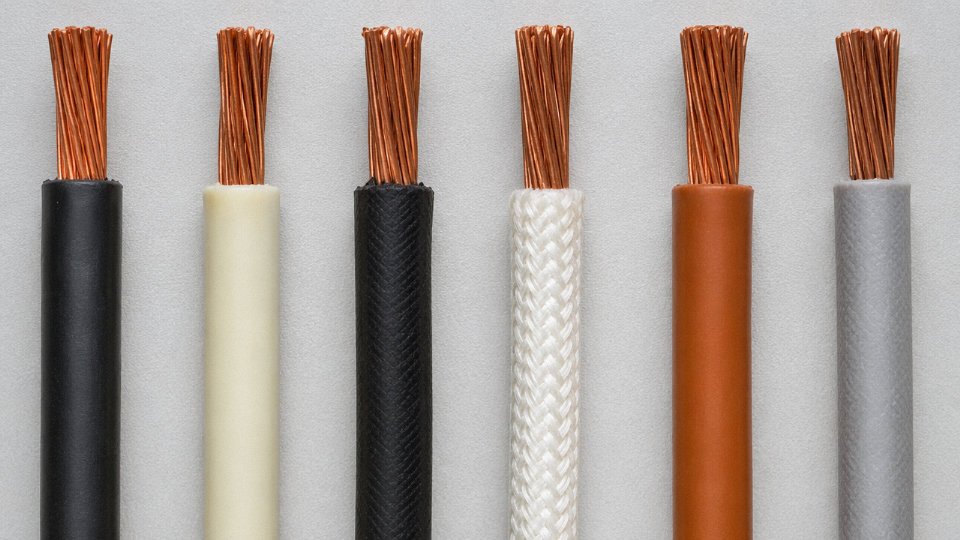
PVC remains the workhorse for indoor and moderate outdoor use — low cost, decent flexibility down to around -15°C or so, and readily available in 70°C and 90°C temperature classes. For most commercial building low-voltage work, it’s entirely adequate.
XLPE (cross-linked polyethylene) is a different animal. The cross-linking process raises continuous operating temperature to 90°C–105°C depending on formulation, and resistance to oils, ozone, and UV is meaningfully better than standard PVC. It’s the standard choice for solar DC string cables, industrial 48V bus wiring, and anything running through a cable tray in a hot plant environment. The trade-off is cost — expect to pay roughly 15–35% more per meter than equivalent PVC, depending on conductor size and order volume.
TPE and TPU jackets show up wherever the cable moves — robotic arms, drag chains, retractable reels. TPU in particular handles hydraulic oil splash and repeated flexing without cracking, which PVC simply won’t do reliably past 500,000 flex cycles or so.
LSZH (low-smoke zero-halogen) is non-negotiable in tunnels, data centers, mass transit, and most public buildings in jurisdictions following EN 60332 or IEC 60754. The logic is straightforward: in a fire, halogenated insulation releases HCl gas, which is corrosive to electronics and toxic to people. LSZH compounds burn with far less smoke and no halogen release. Specifying standard PVC in an LSZH-required environment isn’t just a code violation — it’s a liability.
Jacket and Sheathing for Mechanical and Environmental Protection
A UV-stabilized PVC outer jacket is the minimum for any cable running outdoors, even under conduit where sunlight exposure is indirect. Direct-burial runs need a solid polyethylene (PE) outer sheath or, better, a flooded construction if soil moisture is a concern. Underground power feeds to landscape lighting or gate controls that use standard indoor cable — even in conduit — tend to degrade within three to five years in wet climates. Not a theory; it’s a service call waiting to happen.
For runs with mechanical risk — under driveways, through concrete slabs, or in industrial yards — steel wire armor (SWA) or aluminum wire armor (AWA) adds crush and rodent resistance that no jacket compound alone can match. Silicone-insulated cables occupy a narrow but real niche: furnace wiring, proximity sensors near heat sources, and anywhere that continuous 150°C–180°C ambient is normal.
Multiconductor Configuration and Shielding
Single-conductor pulls give you flexibility in routing but cost you time in the field. Multiconductor cables — 2-core, 3-core, 4-core, and up — make sense for any fixed installation where all conductors share the same path and you’re pulling once. For DC distribution, 2-core is typical; 3-core appears on single-phase AC low-voltage feeds; 4-core covers three-phase or three-wire DC plus ground.
Once you’re into instrumentation and automation — thermocouple extension, 4–20 mA loops, RS-485 data, pulse signals from flow meters — shielding becomes load-bearing, not optional. An unshielded twisted pair running alongside a variable-frequency drive cable will pick up enough noise to corrupt readings, even at low voltages. Specifying individually shielded pairs with an overall braid, plus a dedicated drain wire, is standard practice in any serious panel build. The shield needs to be grounded at one end only to avoid circulating currents.
LSZH cable produces significantly less toxic smoke than standard PVC cable during combustionTrue
LSZH compounds are formulated without halogenated flame retardants; IEC 60754 and EN 60332 test standards confirm substantially reduced HCl emission and smoke density compared to conventional PVC insulation during fire conditions.
Certifications and What to Ask a Manufacturer
For export or cross-border projects, certification scope matters enormously. A cable bearing a CE mark satisfies European low-voltage directive requirements; UL listing is required for most North American installations; IEC standards govern international industrial procurement; CCC is required for products sold into China. RoHS compliance is increasingly a baseline expectation for any electronics-adjacent application, regardless of region.
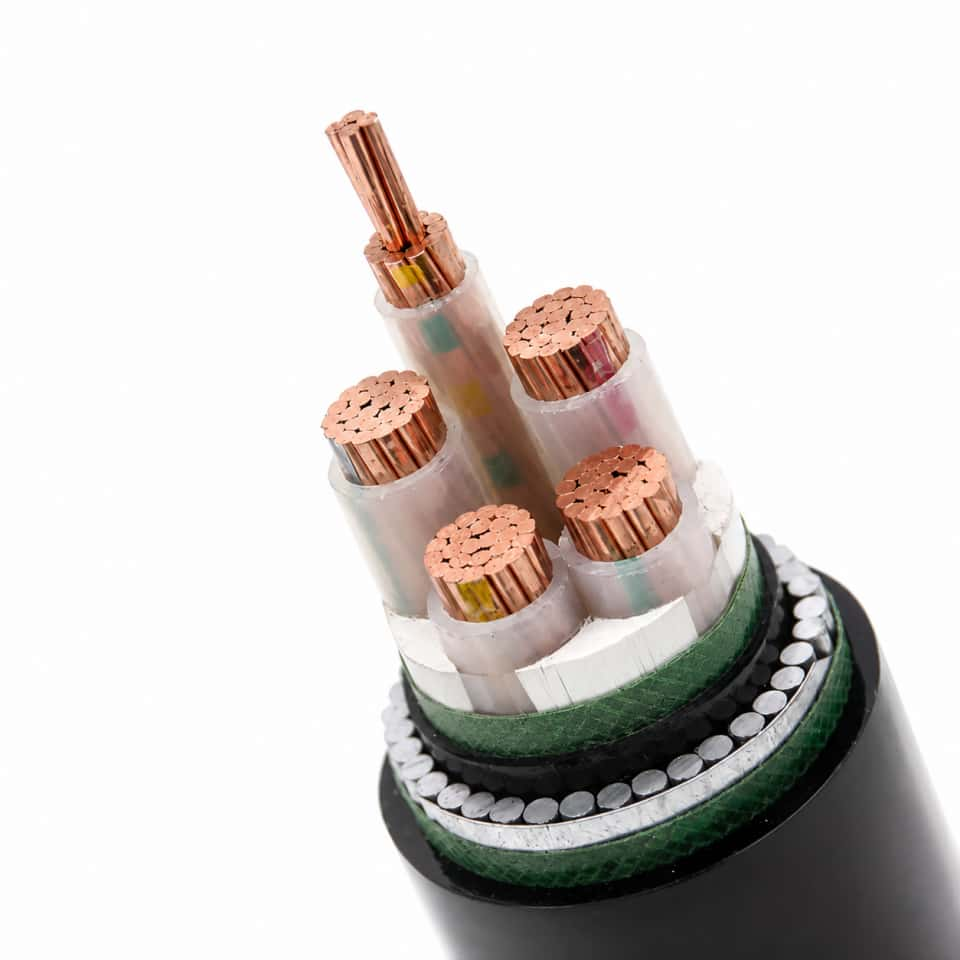
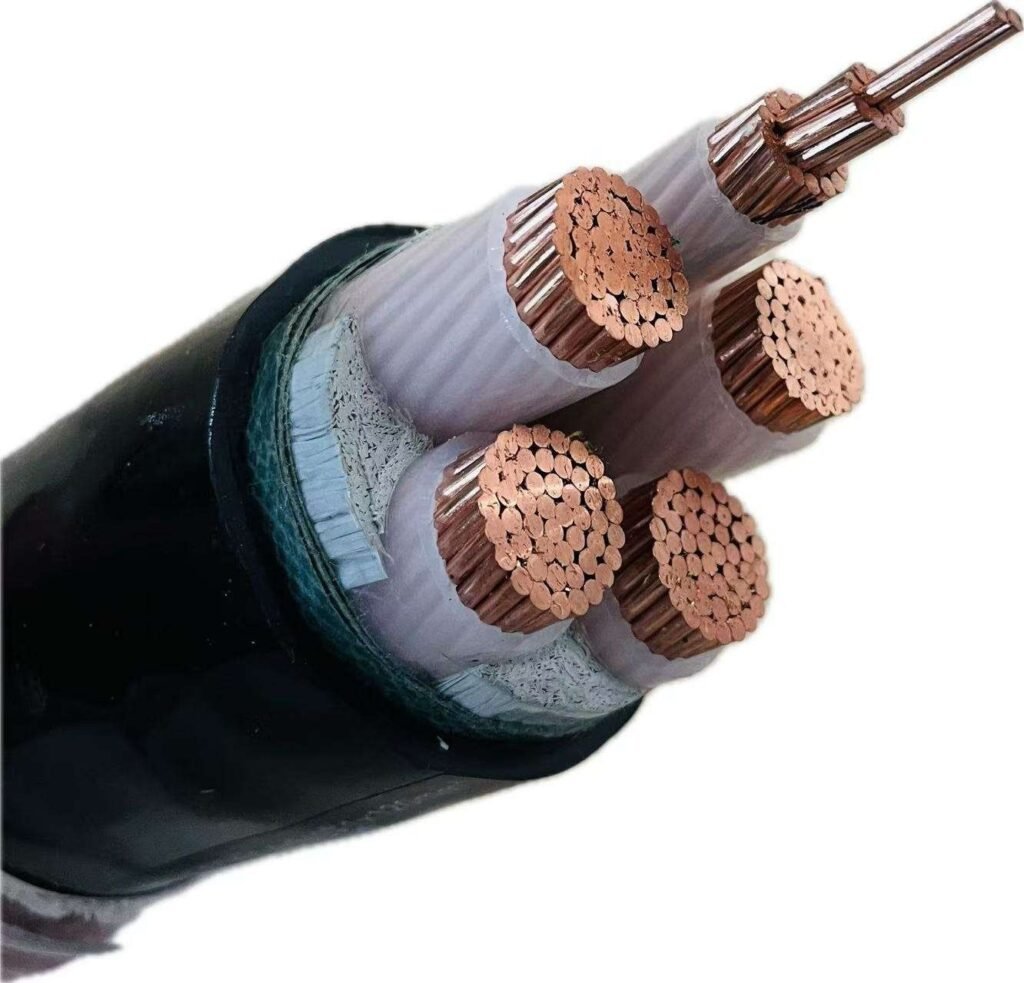
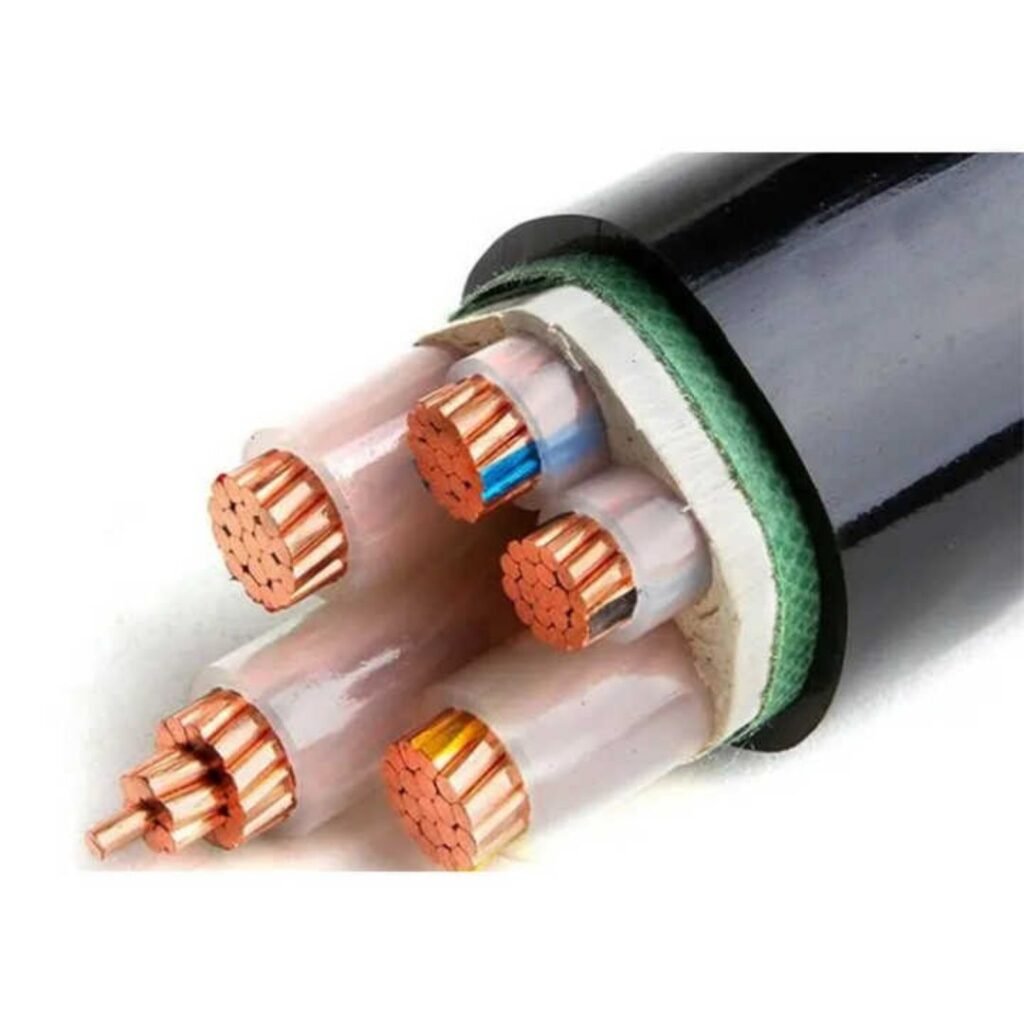
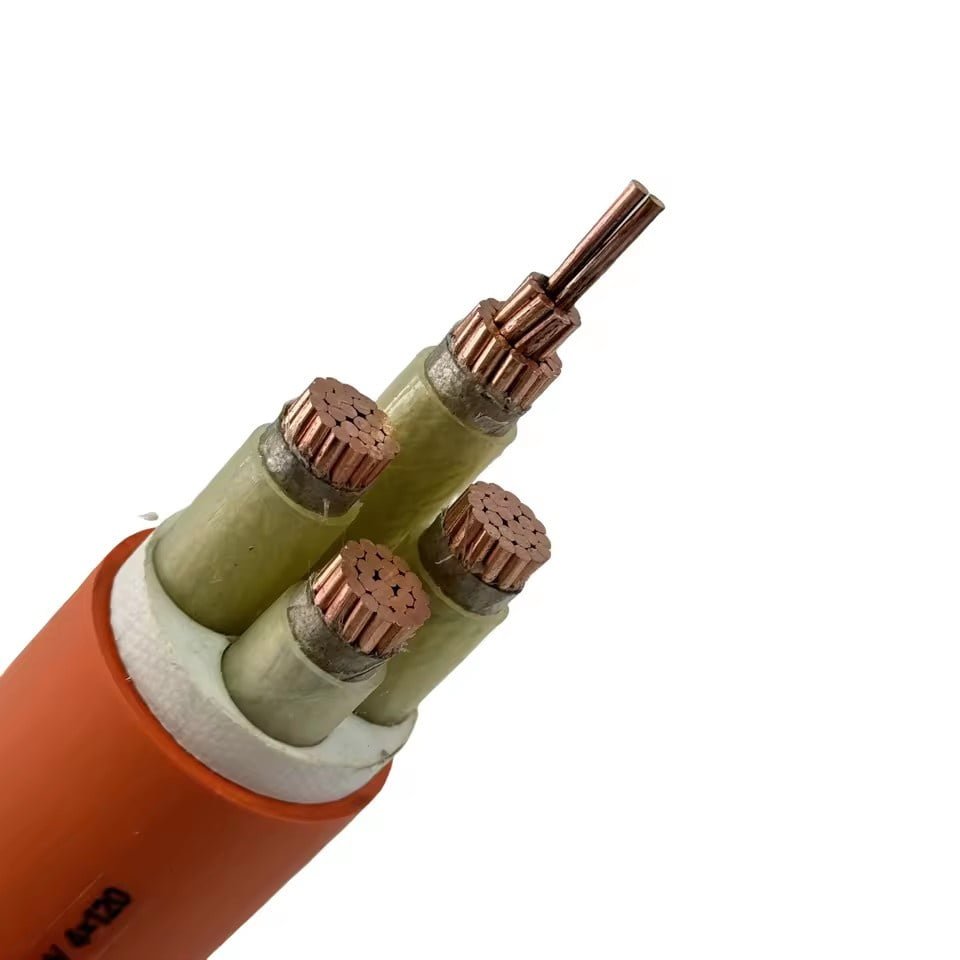
Jinda manufactures low-voltage control and instrumentation cables across five production bases in China, holds UL, CE, IEC, CCC, and RoHS certifications, and can manufacture to project-specific conductor counts, insulation materials, and armor configurations for bulk orders. If your project has a non-standard requirement — say, a TPU-jacketed 6-core shielded cable in a specific outer diameter to fit an existing gland — that kind of specification is exactly where working directly with a manufacturer beats trying to adapt a catalog product.
International Procurement Considerations: Matching Voltage Designations Across UL, IEC, and GB Standards
If you’re sourcing cable across borders — a common enough situation for any contractor running projects in multiple regions or a procurement manager buying in bulk from Asian manufacturers — the voltage designations stamped on cable jackets can look deceptively similar while meaning structurally different things. Getting this wrong doesn’t just cause paperwork headaches at customs. It can trigger failed third-party audits, rejected installations, or worse, insulation mismatches that only show up under fault conditions.
How UL Voltage Designations Actually Work
North American cables listed under UL 44 (which covers XHHW and RHW-type conductors), UL 719 (NM-B residential cable), and UL 83 (THHN/THWN) all carry a 600V insulation rating. That number is a dielectric test threshold — the voltage at which the insulation was proven not to break down — not a statement that the cable can only be used at 600V or that it’s unsuitable below it. A THHN conductor marked “600V” is perfectly legal and functional on a 24V DC control circuit, a 12V landscape run, or a 48V battery bank. The rating is a floor of proven safety, not a usage bracket.
UL 83 THHN cable rated 600V can be legally installed in a 24V DC low-voltage control circuit without violating the UL listing.True
The 600V figure on UL-listed building wire is an insulation test rating establishing minimum dielectric strength. Nothing in the UL listing or NEC prohibits use of this cable at lower system voltages; the insulation simply provides more margin than the system requires.
Reading IEC and CENELEC Voltage Codes
The IEC/CENELEC system used across Europe, the Middle East, and much of Asia looks different at first glance. A designation like 300/500V means 300V phase-to-phase and 500V phase-to-ground. 450/750V is broadly comparable to the North American 600V class — both describe cables suited for fixed wiring in buildings. 0.6/1kV steps up to the next tier, roughly equivalent to medium-distribution applications.
When you’re cross-referencing for a multinational project spec, the practical mapping is roughly this:
| IEC Designation | Approx. North American Equivalent | Typical Application |
|---|---|---|
| 300/300V | — (lower than standard NM-B) | Light flexible cords, Class 2 circuits |
| 300/500V | Partial equivalent to 300V UL types | Interior fixed wiring, control panels |
| 450/750V | Close equivalent to 600V UL | Standard building wire, low-voltage power |
| 0.6/1kV | 1000V UL / MV-90 | Feeder runs, industrial distribution |
The first figure always matters more for low-voltage DC systems, because most DC faults are line-to-line. Don’t just match the higher number.
GB/T Standards and Chinese-Manufactured Cable
China’s GB/T 5023 covers PVC-insulated cables up to 450/750V — the workhorse standard for building and light industrial wiring manufactured in China. GB/T 12706 steps into medium-voltage territory. For procurement purposes, a cable manufactured to GB/T 5023 at the 450/750V designation, with electrolytic copper conductors and appropriate stranding class, is fully suitable for low-voltage applications. The standard is technically rigorous; the insulation requirements align closely with IEC 60227. The bigger variable is conductor quality and whether the factory’s production is actually audited against the stated standard — which is where third-party certification earns its cost.
Third-Party Certification and Export Documentation
UL listing, CE marking under the Low Voltage Directive, BASEC approval for UK projects, and CSA certification for Canada — these aren’t interchangeable, and project auditors in different jurisdictions will ask for the specific mark, not a general declaration of compliance. In practice, a cable that carries UL listing and CE marking covers the majority of global project requirements, but some Gulf Cooperation Council projects additionally require SASO or ESMA approval, and Australian projects want AS/NZS compliance. Jinda’s export compliance team maintains documentation packages for the markets they serve, which matters at the point of customs clearance and during third-party construction audits, where missing paperwork can hold up an entire material delivery.
Conductor Material: A Procurement Warning
One specification detail that gets glossed over in voltage-focused discussions is conductor material. Electrolytic copper (often designated “Cu” or “ETP copper” in spec sheets) and copper-clad aluminum (CCA) can look nearly identical on a cut end, especially in smaller gauges. CCA is not recommended for critical low-voltage DC circuits — battery systems, EV charging pilots, 48V telecom power — because its higher resistivity increases voltage drop on already tight margins, its galvanic behavior at terminations causes resistance creep over time, and standard torque values for copper terminals don’t translate directly.
Practical Procurement Checklist
Before issuing a purchase order for cable crossing standards jurisdictions, verify each of these explicitly in writing:
- Voltage designation (both figures for IEC; the rated voltage for UL)
- Conductor material: electrolytic copper, confirm no CCA substitution
- Stranding class: Class 1 (solid), Class 2 (stranded), Class 5 (flexible) per IEC 60228, or equivalent AWG stranding per ASTM B8
- Insulation compound: PVC, XLPE, LSZH — and the specific sub-grade (e.g., PVC compound Type TW vs. THW matters for temperature rating and moisture exposure)
- Jacket compound and outer diameter tolerance (conduit fill calculations depend on this)
- Applicable listing marks and the certification body’s reference number, not just a printed logo
- Country of origin documentation for customs, and test reports traceable to a specific production batch
Voltage designation mismatches between standards frameworks are usually resolvable if caught during specification. They become expensive when discovered after a container of cable is on-site and a local inspector pulls out the project spec.
Frequently Asked Questions About Using 120V Wire for Low-Voltage Applications
Is 14 AWG NM-B wire safe to use for a 12V DC LED strip circuit?
Electrically, yes — the insulation handles 12V without any meaningful stress, since NM-B carries a 600V-rated jacket that dwarfs the operating voltage. The problem isn’t shock hazard or dielectric failure. It’s listing status. NM-B is not listed for Class 2 use under NEC Article 725, which governs most low-voltage LED control wiring. Run an inspection on a residential landscape or under-cabinet LED install wired with NM-B and you’ll likely get a rejection, regardless of how clean the work looks. Use a cable listed CL2 or CL2P (plenum, if the routing requires it). The wire costs less, pulls easier through tight spaces, and — critically — passes inspection the first time.
NM-B 14 AWG has a 600V-rated insulation system, which is electrically suitable for 12V DC circuits.True
NEC and UL standards define insulation voltage classes independently of system operating voltage. The 600V rating on NM-B refers to maximum insulation withstand, not suitability for a specific application type or listing category.
Can I use leftover THHN wire in conduit for a 24V thermostat control circuit?
Usually, yes. THHN in conduit is a recognized wiring method for Class 1 circuits, and NEC 725.49 lays out a substitution hierarchy that permits certain higher-listed conductors in Class 2 applications — though you need to verify that the specific article governing your control circuit actually permits it. A 24V building automation thermostat loop in a commercial HVAC system is a typical case where a contractor uses spare 12 AWG THHN already in conduit rather than pulling a separate run. In practice, this is common and acceptable, but confirm with your AHJ (authority having jurisdiction) before the rough-in inspection. Some inspectors read 725.49 conservatively.
Does higher insulation voltage rating improve safety in a low-voltage system?
Not in any practical sense at 12V or 24V. The real safety factors in a low-voltage DC system are correct fusing or current-limiting protection upstream, solid mechanical terminations that won’t loosen under vibration, and fault-current paths that trip protection rather than sustain an arc. A 1000V-rated jacket doesn’t change any of those. Where insulation class does matter — even at low voltage — is in temperature rating. A cable rated 90°C handles higher ambient or bundled-conduit conditions better than a 60°C-rated product, regardless of the voltage on the conductor.
What gauge wire should I use for a 24V, 10A DC power supply run of 75 feet?
Voltage drop drives this decision entirely. Using the standard formula — VD = 2 × length × current × resistance per foot — the numbers work out roughly as follows:
| AWG | Resistance (Ω/1000 ft) | Voltage Drop (V) | % of 24V | Verdict |
|---|---|---|---|---|
| 10 | 1.26 | ~1.89 | ~7.9% | Too high |
| 8 | 0.786 | ~1.18 | ~4.9% | Borderline |
| 6 | 0.510 | ~0.77 | ~3.2% | Recommended |
Most low-voltage DC equipment tolerates roughly 3–5% voltage drop without performance issues; LED drivers and sensitive control gear often want to stay under 3%. At 75 feet with 10A load, 6 AWG is the practical choice. The insulation voltage rating of whatever cable you select is almost irrelevant to this calculation.
Can I use 120V extension cord wire for temporary low-voltage connections on a job site?
Temporary, supervised, short-duration? It happens constantly and isn’t catastrophically wrong. The real risk is connector mismatch — stuffing a 12V DC lead into a standard NEMA 5-15 plug creates obvious confusion about what’s energized and at what voltage. Never leave a permanent installation wired with extension cord, regardless of voltage. The jacketing degrades faster than fixed-installation cable, and the stranded conductors aren’t meant for screw terminals that see repeated tightening.
Does Jinda manufacture cables specifically rated for 12V and 24V DC systems?
Yes. Jinda produces low-voltage control, automation, and DC power cables rated from 300/500V through 0.6/1kV, with conductor sizes, insulation materials, and outer jacket options tailored to landscape, solar, building automation, and industrial control applications. Custom configurations — shielded pairs, multi-core layouts, UV-stabilized jackets for outdoor runs — are available for project-specific procurement. For bulk orders or cross-standard specification matching (UL, IEC, GB), the technical team can provide sample datasheets and help align cable construction to your project’s inspection requirements.