Specify the wrong wire type on a construction drawing — or let a procurement team substitute a cheaper unrated alternative mid-project — and the consequences stack up fast: failed inspections, rework labor, potential fire code violations, and in worst cases, energized conductors in wall cavities that degrade silently for years before tripping a breaker or starting a fire. These are not edge-case disasters. They happen on ordinary commercial fitouts and residential subdivisions every construction season, usually because the person specifying or buying the wire didn’t have a clear working definition of what building wire actually is versus what it isn’t.
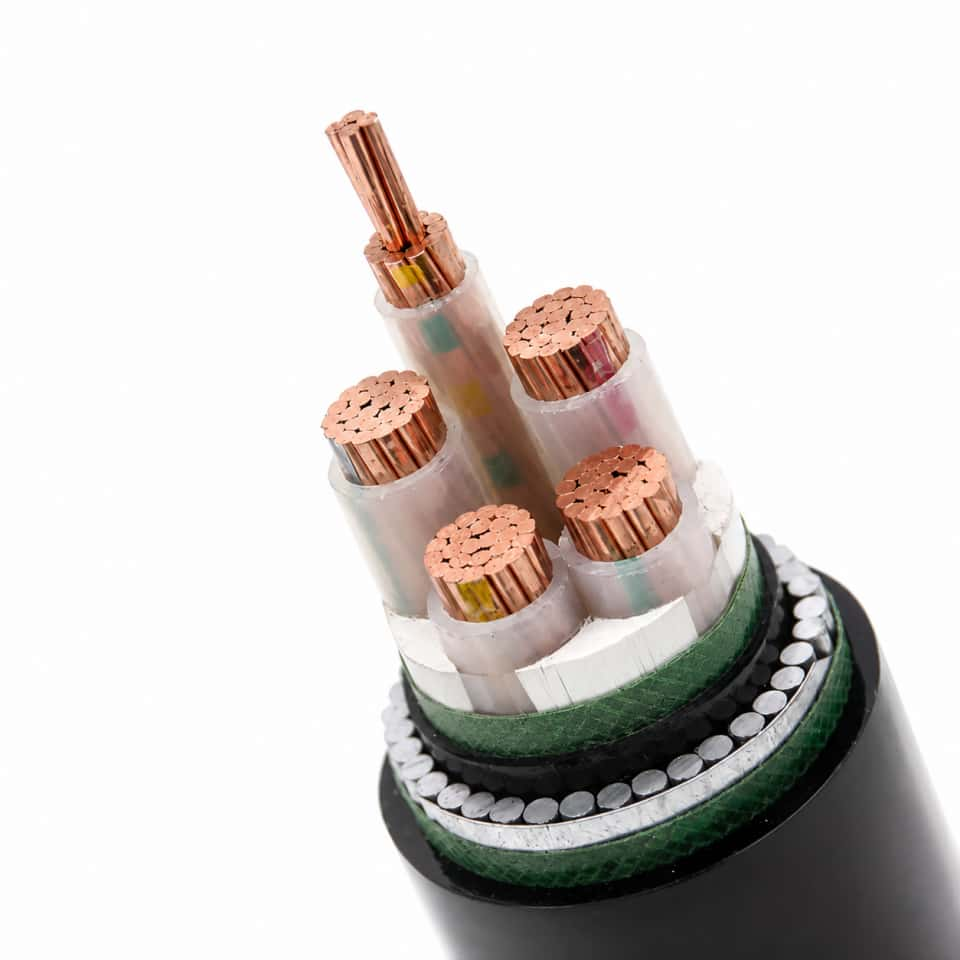
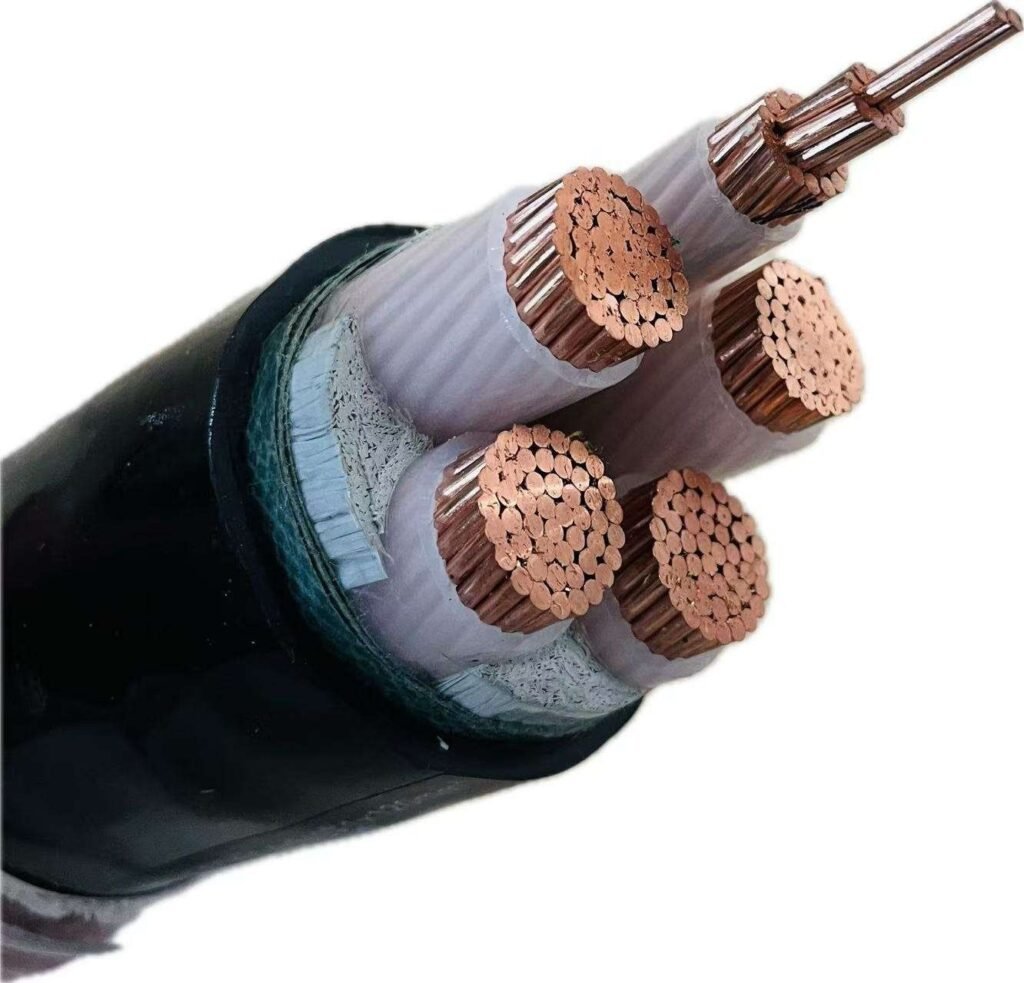
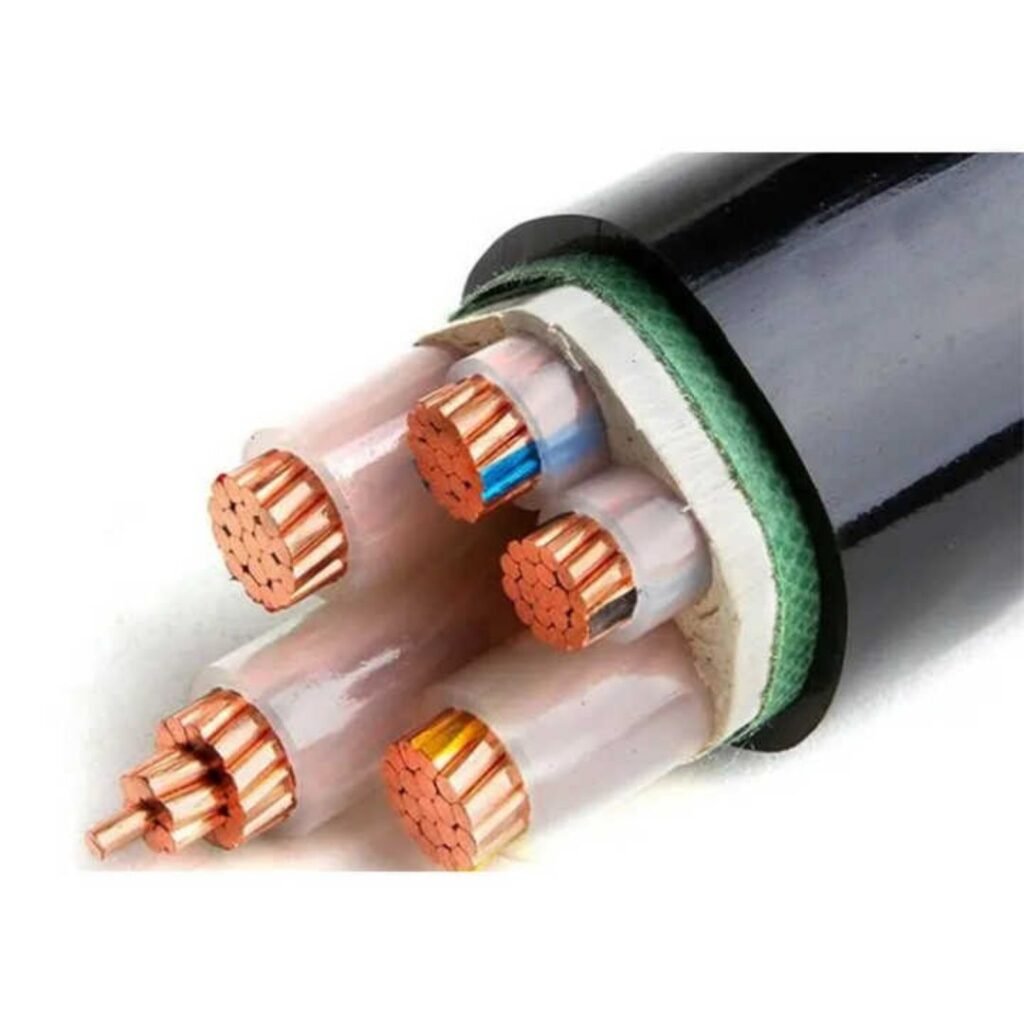
Building wires are insulated electrical conductors designed specifically for fixed, permanent wiring inside or between structures — typically running through conduit, raceways, or direct embedment in walls, ceilings, and floors. They range from 14 AWG (roughly 2.08 mm²) up to 1000 kcmil (about 507 mm²), carry voltage ratings of 600 V or 1000 V depending on the standard, and are classified by insulation type, temperature rating, and wet or dry location suitability — THHN/THWN-2 being the dominant North American designation.
What makes this category genuinely interesting — and occasionally maddening in practice — is how much variation hides behind a deceptively simple name. A wire called a “building wire” in a North American spec package looks nothing like what a European contractor orders under HD 21 or what an Asian infrastructure project sources to GB/T standards. The conductor sizing systems don’t map cleanly, the insulation chemistries differ, and the temperature and moisture ratings that determine real-world service life are buried in designations most buyers never fully decode. Getting that translation right is where projects save money or lose it.
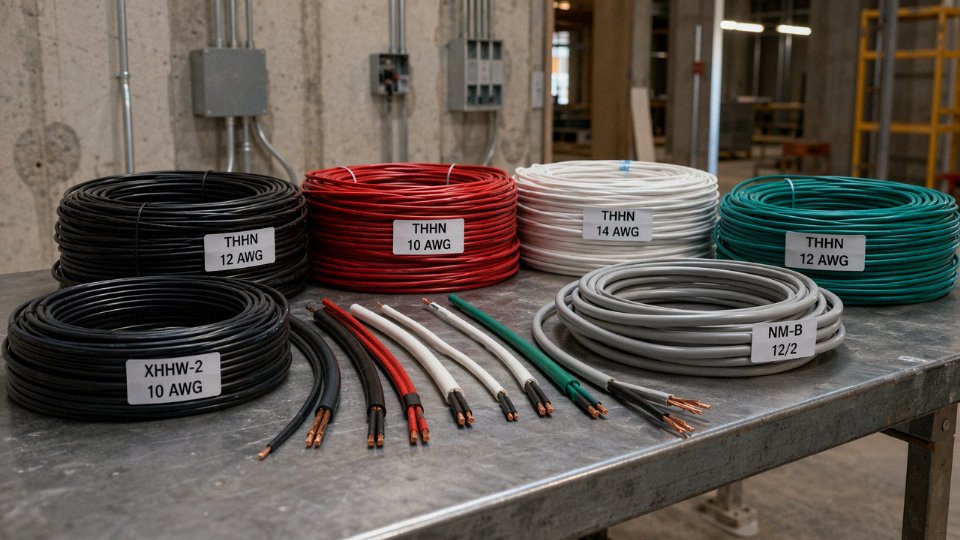
Anatomy of a Building Wire: Conductor, Insulation, and Jacket Materials Explained
Specifying building wire correctly starts with understanding what’s actually inside it — and the choices made at each layer have real consequences for installation labor, thermal performance, and long-term reliability.
Conductor Form: Solid vs. Stranded
Solid conductors (Class 1 per IEC 60228, or simply “solid” under UL 83) are the default for fixed branch-circuit wiring in smaller gauges, typically up to 10 AWG / 6 mm². They’re cheaper to manufacture, terminate more cleanly in screw terminals, and hold their shape in conduit. Once you get above 8 AWG, solid conductors become genuinely difficult to bend — try pulling a 500-foot run of solid 4 AWG through a conduit with two 90-degree elbows and you’ll understand why stranded exists.
Stranded conductors (Class 2 for general flexible use, Class 5 for higher flexibility) are standard in larger gauges and in any application where the wire will be moved during installation or service. The strand count and geometry affect how easily the wire pulls through conduit — a 19-strand configuration is stiffer than a 37-strand of the same cross-section, and that matters on long conduit runs.
Copper Grades and Aluminum Alloy Options
Most building wire uses electrolytic tough-pitch (ETP) copper, minimum 99.9% purity, which gives a conductivity of roughly 100% IACS. For applications requiring repeated flexing, annealed copper is specified — the annealing process relieves work-hardening and reduces the risk of conductor fatigue cracking at terminations.
Aluminum is genuinely viable in the right context. AA-8000 series aluminum alloy (particularly AA-8030 and AA-8176) was developed specifically to address the creep and oxidation problems that plagued early aluminum branch-circuit wiring in the 1960s and 1970s. Used properly, with compatible AL-rated terminations and anti-oxidant compound, it’s a legitimate cost-reduction tool on large feeders — aluminum is roughly 40–60% lighter than copper at equivalent ampacity and considerably cheaper per pound, though the cross-section required is larger.
AA-8000 series aluminum alloy conductors meet NEC Article 310 requirements for branch-circuit wiring when used with listed AL/CU rated terminationsTrue
NEC 310.14 explicitly permits AA-8000 series aluminum conductors for branch circuits, provided terminations are rated for aluminum. This alloy's improved creep resistance and surface oxide characteristics make it suitable where earlier 1350 aluminum alloy was not.
Insulation Materials: What the Chemistry Actually Means for Your Application
| Insulation Type | Temp Rating | Key Strength | Typical Limitation |
|---|---|---|---|
| PVC | 60°C–90°C (dry/wet) | Low cost, wide availability | Releases HCl when burned; less flexible in cold |
| XLPE | 90°C wet / 105°C dry | Higher ampacity, chemical resistance | Higher unit cost than PVC |
| EPR | 90°C wet / 105°C dry | Excellent flexibility, moisture resistance | More expensive; softer surface |
| LSZH | 70°C–90°C depending on compound | Low smoke/toxicity in fire | Often lower mechanical toughness; premium price |
LSZH isn’t just a specification checkbox. In a subway station or hospital corridor, the smoke density and halogen acid gas from burning PVC wire can incapacitate people before the fire itself is a serious threat. For enclosed public infrastructure, the chemistry matters operationally.
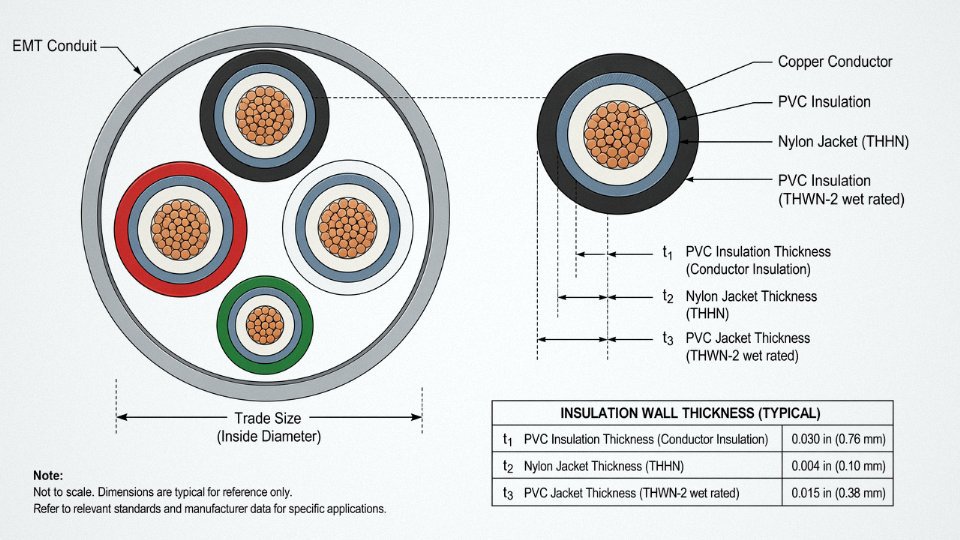
Insulation wall thickness is set by both voltage class and conductor size. A 600V-rated 12 AWG THHN wire requires a minimum insulation thickness per UL 83 that would be excessive and wasteful at 300V — and insufficient at 1000V. IEC 60227 and IEC 60502 define similar tiered requirements for metric-sized conductors.
Jacket Options and Why the Outer Layer Isn’t an Afterthought
Bare conductor (no jacket) is used only in specific grounding applications or when the wire runs entirely within conduit that provides mechanical protection. THHN’s nylon outer sheath — typically 0.004 inches thick, give or take — provides abrasion resistance during conduit pulls and a degree of chemical resistance to oils and gasoline. NM-B cable adds a PVC outer jacket over the assembly, suitable for concealed dry locations in wood-frame residential construction. For transit tunnels and public infrastructure, LSZH outer jackets are increasingly required by specification, sometimes by statute.
UV resistance is worth flagging. Standard PVC and nylon sheaths degrade noticeably in direct sunlight over 3–5 years depending on climate. If wire is routed outdoors or in a sunny equipment yard even temporarily, a sunlight-resistant jacket rating matters — and it’s easy to forget to specify until someone finds brittle, cracked sheathing two years post-installation.
Color Coding: A Procurement Detail That Causes Real Field Errors
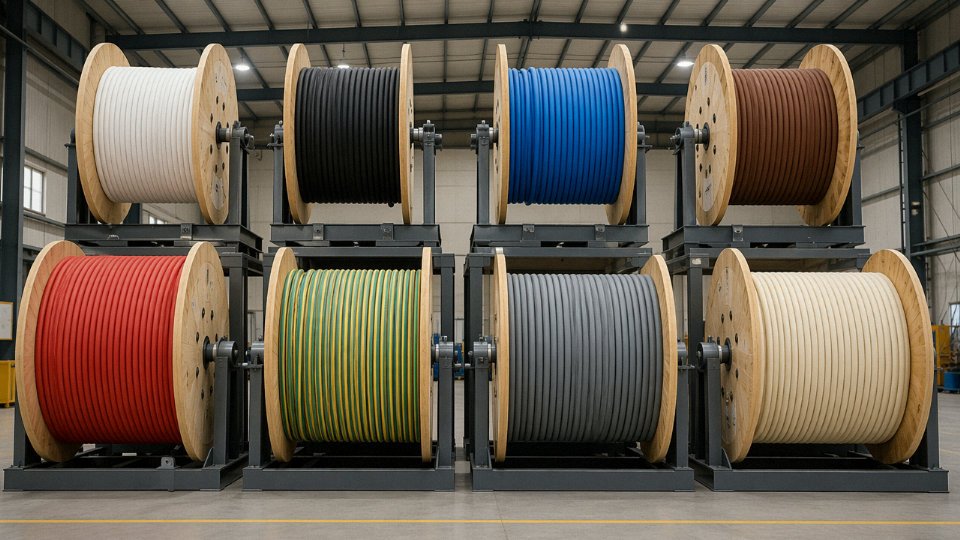
NEC (North American) color convention uses black and red for ungrounded conductors, white or gray for neutral, and green or bare for equipment ground. IEC 60446 (used across Europe, much of Asia, and international projects) uses brown for line, blue for neutral, and green-yellow for protective earth. On a cross-border project where some wire was purchased domestically and some imported, mismatched color conventions have caused field wiring errors — not hypothetically, but routinely. Specifying color code standard in the purchase order, not just wire type, is basic procurement hygiene.
AWG vs. mm²: Specify Both on Cross-Border Orders
AWG runs on an inverse logarithmic scale — smaller numbers mean larger conductors, which is counterintuitive and has caused ordering mistakes. 12 AWG is approximately 3.31 mm², 10 AWG roughly 5.26 mm², 4/0 AWG about 107 mm². These aren’t exact equivalents; they’re the nearest metric sizes, and ampacity tables between NEC and IEC don’t align perfectly because installation conditions and ambient temperature assumptions differ. On any international procurement, put both the AWG designation and the mm² cross-section in the specification. It takes ten seconds and eliminates a class of error that’s genuinely annoying to untangle after goods arrive.
Major Building Wire Types and Their Designated Applications
Specifying the wrong wire type for a given environment is one of the more expensive procurement mistakes you can make — not because the wire itself costs much more, but because rework in an occupied building or a failed inspection on a conduit run that’s already buried tends to multiply costs by a factor of 5 to 10 over the original material savings. Getting the type right the first time matters.
THHN and THWN-2: The North American Workhorses
THHN (Thermoplastic High Heat-resistant Nylon) is the baseline product in North American commercial construction. Rated 90°C in dry locations, it carries a nylon outer jacket over PVC insulation — that nylon layer is what lets it pull cleanly through conduit, reducing friction noticeably compared to plain PVC-insulated wire. Most purchasing conversations in the US and Canadian markets start here, which makes it the de facto price reference for any conductor size from roughly 14 AWG up through 500 kcmil or larger.
THWN-2 is the practical upgrade. Dual-rated at 90°C for both wet and dry locations, it has almost entirely displaced the older THWN rating in most distributor stock — you’ll rarely find plain THWN listed as a separate SKU anymore. If a conduit run passes through a mechanical room that sees condensation, an outdoor junction box, or an underground raceway where moisture intrusion is realistic (which is most of them, eventually), THWN-2 is the correct specification. Many manufacturers print both THHN and THWN-2 on the same wire, which is legitimate because the construction satisfies both standards simultaneously.
NM-B: Residential Staple, Misapplied Too Often
NM-B (Non-Metallic Sheathed Cable, sometimes called Romex generically) is factory-assembled — two or three current-carrying conductors plus a bare ground, all wrapped in a flat PVC outer jacket. It’s fast to install, doesn’t require conduit in most residential applications, and dominates single-family housing in North America for good reason. The critical restriction is “dry locations only.” Run NM-B through a basement slab, leave it exposed in a crawlspace that floods seasonally, or route it through a commercial kitchen wall — and you’re either failing inspection or creating a fire hazard, depending on who catches it first.
USE-2 and the PV Wiring Opportunity
USE-2 is rated 90°C, sunlight-resistant, and suitable for direct burial without conduit. Its original role was utility service laterals running underground between the meter and the panel. That’s still valid, but the application segment growing fastest right now is photovoltaic array wiring. USE-2 and PV Wire (a related but slightly different listing) have become essential specifications for solar installers dealing with rooftop and ground-mount systems where conductors spend decades in direct UV exposure and varying moisture conditions.
USE-2 wire is suitable for direct burial and solar PV applications due to its sunlight-resistant insulation and 90°C wet location rating.True
USE-2 is listed under UL Standard 854 for underground service entrance and is recognized by NEC Article 338 and NEC 690 for PV source circuits when rated for direct burial and sunlight resistance.
RHW-2 and XHHW-2: Industrial-Grade XLPE
When ambient temperatures run consistently high — foundries, chemical processing, commercial laundries, large motor control centers — PVC insulation starts to feel like a compromise. RHW-2 and XHHW-2 use cross-linked polyethylene (XLPE) insulation, which holds up better under sustained heat and resists oils and many industrial chemicals. Both are rated 90°C wet. In practice, XHHW-2 is more commonly specified for large feeder conductors in industrial facilities, partly because it’s available in the larger kcmil sizes that heavy equipment demands.
IEC Equivalents: Correlating North American and European Types
For international projects, North American wire designations don’t translate directly. Under IEC 60227, H07V-U covers single-core rigid PVC at 450/750V, H07V-R is the stranded equivalent — both broadly comparable to THHN for general wiring in conduit. RV-K is a flexible, stranded XLPE-insulated wire used widely in European industrial and panel wiring. N2XY steps up to medium-voltage applications with XLPE insulation and a PVC outer sheath, roughly analogous in intent (though not in voltage class) to heavier North American feeder cable. European buyers specifying for North American-built facilities, or vice versa, need to cross-reference not just insulation material but conductor cross-section (mm² vs. AWG/kcmil), voltage class, and applicable installation standard — IEC 60364 versus NEC — before assuming equivalence.
Fire-Performance Types: Non-Negotiable in Life-Safety Locations
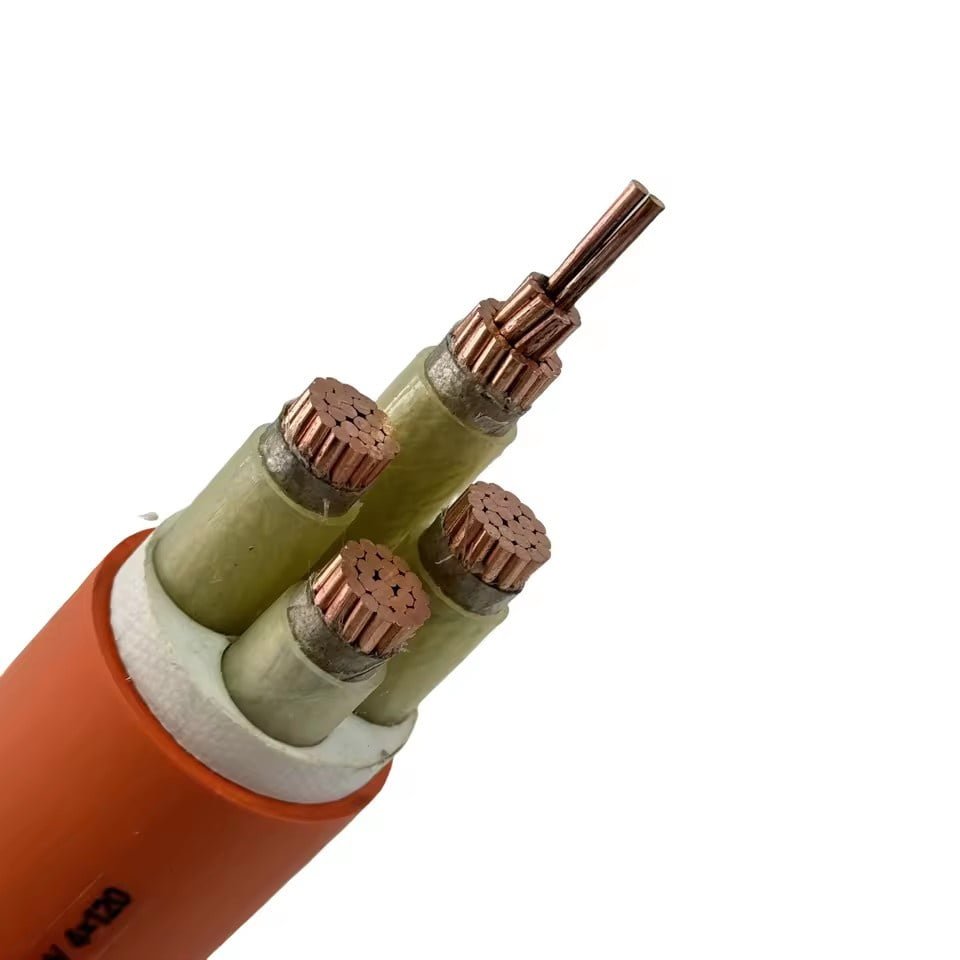
Egress corridors, hospital critical-care areas, and data center power infrastructure increasingly require wire that maintains circuit integrity under fire conditions, not just wire that won’t propagate flame. Mineral-Insulated Copper-Clad (MICC) cable is the traditional answer — it survives temperatures well above 1000°C and won’t generate smoke, but it’s expensive and inflexible enough that installation labor adds up fast. FP200 and similar fire-performance cables provide a more practical middle ground for many EN 50200 / IEC 60331 applications. LSZH (Low Smoke Zero Halogen) variants address the secondary hazard: in a building fire, hydrogen chloride gas from burning PVC causes more evacuation casualties and more equipment damage than is generally appreciated. LSZH is now required in many European and Middle Eastern specifications for any occupied building.
Halogen-Free Wire and Green Building Codes
HFFR (Halogen-Free Flame-Retardant) building wire is climbing steadily in specification frequency, driven by LEED, BREEAM, and updated local fire codes in markets from the Middle East to Southeast Asia. The insulation uses thermoplastic elastomers or polyolefin compounds instead of PVC, eliminating halogen-based flame retardants. It typically costs 15–30% more than equivalent PVC wire depending on conductor size and market, but that premium shrinks considerably when a project is chasing certification points or when the local authority having jurisdiction has started enforcing stricter smoke toxicity limits. In new commercial construction targeting sustainability ratings, HFFR specification is less a premium option and more an expected baseline.
Global Standards and Certifications Governing Building Wire Quality
Specifying the right wire type is only half the job. The other half is confirming that what arrives on your loading dock actually matches the specification — and that requires understanding which standards govern the product, what those standards actually test, and which certification marks are legally meaningful in the destination market.
UL 83: The Baseline for North American Projects
For any building wire installed under the National Electrical Code (NEC) in the United States, UL 83 is the foundational listing standard. It covers thermoplastic-insulated wires including THHN and THWN-2, and the scope is more demanding than many buyers realize. The standard requires conductor resistance testing against IEC 60228 tables, a spark test across the insulation at voltages typically in the 6–15 kV AC range (exact level depends on insulation thickness and conductor size), cold bend performance down to around -25°C, insulation resistance at a minimum of 20 MΩ·km at 20°C, and flame propagation per UL 1581 Section 1160. Products must carry the UL Listed mark — not merely “UL tested” or “UL compliant,” both of which are marketing language with no legal standing. If your GC or AHJ (Authority Having Jurisdiction) is doing the job correctly, unlisted wire gets rejected at rough-in inspection. Full stop.
IEC 60227 and IEC 60502-1: The Global Framework
IEC 60227 covers PVC-insulated cables rated up to 450/750 V and has been adopted — sometimes with national amendments — by over 160 countries. IEC 60502-1 extends coverage to extruded solid dielectric insulated cables from 1 kV up to 30 kV. Together, these two standards form the backbone of building wire specification across Europe, most of Asia, Africa, the Middle East, and Latin America. The test suite overlaps substantially with UL 83 but uses different sample counts, conditioning procedures, and pass/fail thresholds, which is why a wire can pass one and technically fail the other even if the physical construction looks identical. Tensile strength and elongation at break are particularly worth checking — IEC 60227 sets minimum elongation at break at 150–200% depending on insulation compound, and cheaper compounds sourced during raw-material squeezes can fall short right at that floor.
BS 6004 and GB/T 5023: Regional Standards That Carry Real Weight
BS 6004 is the UK standard for PVC-insulated cables and closely mirrors IEC 60227, but it includes specific requirements tied to UK ring-main circuit practice — relevant if you’re supplying projects in the UK, parts of the Commonwealth, or Gulf states where British-influenced codes still govern. Middle East project specs frequently cite both IEC and BS references in the same document, so dual compliance matters in practice.
GB/T 5023 is China’s national equivalent, derived from IEC 60227. The overwhelming majority of building wire manufactured in China for domestic use and export is produced against this standard. For procurement teams auditing Chinese-made product, knowing GB/T 5023 fluently lets you cross-check test reports against real pass/fail criteria rather than accepting a summary page at face value. One area worth scrutinizing: insulation average thickness versus minimum thickness tolerances, where GB/T 5023 follows IEC but some manufacturers’ QC records only document average values.
Products marked 'UL compliant' or 'UL tested' are equivalent to UL Listed for NEC-compliant installations.False
UL Listed requires ongoing factory follow-up inspections and product testing through an approved program. 'UL compliant' and 'UL tested' are unregulated marketing terms that carry no NEC acceptance and will typically be rejected by an AHJ.
Third-Party Certification Bodies by Export Market
| Market | Relevant Certification | Issuing / Recognized Body |
|---|---|---|
| USA | UL Listed (UL 83) | UL Solutions |
| Canada | CSA certification | CSA Group |
| European Union | CE marking, Low Voltage Directive 2014/35/EU | Notified Bodies (e.g., KEMA-KEUR, TÜV) |
| Saudi Arabia | SASO / IECEE CB scheme | SASO, accredited CBs |
| UK post-Brexit | UKCA marking | UKAS-accredited bodies |
| China domestic | CCC (where applicable) | CNCA / CQC |
CE marking under the Low Voltage Directive does not require third-party testing for every product — manufacturers can self-declare — but in practice, major project procurement specs and many European utilities require KEMA-KEUR or equivalent third-party certification. Worth specifying explicitly in your purchase order rather than assuming CE alone is sufficient.
What Buyers Should Actually Verify
Beyond demanding the certificate, ask for the test reports themselves — specifically conductor resistance per IEC 60228, the spark test voltage and pass/fail log, insulation resistance measurements, and the flame propagation test record per IEC 60332-1. Reputable manufacturers keep batch-traceable records; the ones who push back on providing them are telling you something. Elongation at break on the insulation compound is worth requesting separately if the wire is going into an application with thermal cycling, conduit pull-in, or exposure to plasticizer-leaching environments.
Jinda’s five production bases in China maintain simultaneous certification across UL, IEC, BS, and GB/T frameworks, with active CSA and SASO compliance for North American and Gulf project supply respectively. That multi-standard certification structure means a procurement team sourcing for a mixed-destination project — say, commercial buildings split across the US, UAE, and Southeast Asia — can draw from a single qualified supplier without triggering re-specification delays at each destination’s inspection stage. In practice that saves weeks on fast-track construction schedules where submittal re-approval cycles are genuinely painful.
Ampacity, Voltage Drop, and Sizing Rules Every Designer Must Apply
Ampacity is the maximum continuous current a conductor can carry without pushing its insulation beyond its rated temperature — 60°C, 75°C, or 90°C depending on the insulation system. That ceiling is not a comfort margin. Exceed it long enough and you degrade the polymer, harden it, crack it, and eventually create a fault that no visual inspection will catch until something burns.
The number itself is not fixed to a wire gauge alone. It shifts based on conductor material (copper vs. aluminum), insulation type, and how the wire is installed. The same 12 AWG THHN copper conductor that carries 30 A in free air is derated to 20 A when pulled with two other current-carrying conductors through conduit — NEC Table 310.16 is the standard reference for this, and that 20 A figure already accounts for the conduit installation method. Jump up to 4/0 AWG aluminum XHHW-2 in conduit and you’re looking at roughly 180 A. The jump from copper to aluminum at the same gauge costs you somewhere around 15–20% in ampacity depending on size, and that gap narrows as conductors get large. On big feeders — 350 kcmil and above — aluminum starts making economic sense despite the extra termination discipline it demands.
Derating: Where Most Sizing Errors Actually Happen
Three correction factors stack on each other, and designers who forget one end up with a wire that runs warm for years before it fails.
Ambient temperature correction applies whenever the installation environment exceeds 30°C (the NEC baseline for Table 310.16 values). Roughly speaking, ampacity drops around 13% for every 10°C above that baseline for 90°C-rated insulation. A wire routed through a boiler room running at 50°C is already operating at a meaningful penalty before you add any other factor. In practice, rooftop conduit runs in hot climates — Middle East installations come to mind — routinely hit ambient conditions that cut rated ampacity by 25% or more.
Conduit fill derating kicks in when more than three current-carrying conductors share a raceway. Four to six conductors: multiply by 0.8. Seven to nine: 0.7. These factors compound with temperature correction multiplicatively, not additively. A bundle of eight conductors in a 50°C ambient can reduce effective ampacity to roughly half the table value. That is not a hypothetical — it shows up in panel feed designs when engineers pull multiple circuits through a single oversized conduit to save tray space.
Continuous load factor is simpler but frequently ignored: any circuit that runs at full load for more than three hours must be sized so the conductor ampacity is at least 125% of the actual load current, not equal to it.
Voltage Drop: The Calculation That Determines Real-World Wire Size
For single-phase circuits, the formula is straightforward:
ΔV = (2 × L × I × ρ) / A
where L is one-way run length in meters, I is current in amperes, ρ is resistivity (roughly 0.0172 Ω·mm²/m for annealed copper, 0.0282 for aluminum), and A is cross-sectional area in mm². NEC recommends keeping branch circuit voltage drop below 3%, with total drop from service entrance to load point under 5%. IEC 60364-5-52 uses 4% for lighting circuits and 5% for power loads.
Here’s a concrete example worth working through. You have a 240 V, 30 A circuit running 75 feet (23 m) one-way in conduit.
Start with ampacity: 30 A continuous means you need 30 × 1.25 = 37.5 A minimum ampacity after derating. With three conductors in conduit at a normal ambient, 10 AWG copper THHN carries 35 A — that’s already marginal, and it fails the continuous load check.
Now run the voltage drop on 10 AWG (5.26 mm²): ΔV = (2 × 23 × 30 × 0.0172) / 5.26 ≈ 4.5 V, which is about 1.9% on a 240 V circuit. That passes the voltage drop limit. But it fails ampacity. So 10 AWG is out regardless.
Step up to 8 AWG copper THHN (8.37 mm²): ampacity in conduit is 50 A, which clears the 37.5 A continuous requirement comfortably. Voltage drop recalculates to roughly 2.8 V, well under 3%. 8 AWG is the correct selection — not because of voltage drop, but because ampacity drove the decision and voltage drop confirmed it.
Short-Circuit Coordination: The Constraint Designers Underestimate
Wire withstand rating under fault conditions is expressed as an I²t value — the thermal energy the conductor can absorb before the insulation or conductor itself is damaged. For an upstream breaker or fuse to protect the wire properly, its clearing I²t must be lower than the wire’s withstand I²t at the fault current level expected at that point in the system.
This matters most on industrial panel feeds and motor branch circuits where available fault current can be 20–50 kA or higher. A 10 AWG conductor with a 100 A breaker that has a slow clearing time under bolted fault conditions is a real problem — the breaker clears the fault, but the wire may have already sustained insulation damage that won’t show up until months later. Verify conductor withstand against the device’s published I²t clearing curves, not just its trip rating.
NEC Table 310.16 ampacity values already incorporate a conduit installation assumption and must be further derated for ambient temperature, conduit fill, and continuous loads.True
Table 310.16 is based on not more than three current-carrying conductors in a raceway at 30°C ambient. Separate correction factors in NEC 310.15 must be applied for deviations from these baseline conditions.
IEC designers work through the same logic but use installation method reference designations from IEC 60364-5-52 — A1 (insulated conductors in conduit in a thermally insulating wall), B2 (multi-core cable in conduit on a wall), C (clipped direct), D1 and D2 (buried) and so on. Each method carries its own ampacity table. The physics are identical to the NEC approach; the organizational structure is just different. Engineers switching between project jurisdictions need to re-anchor to the correct table set — assuming NEC-derived intuition translates directly to IEC conditions is a reliable way to undersize a feeder.
Installation Methods: Conduit, Tray, Direct-Burial, and Raceway Best Practices
Getting the wire type right on paper means nothing if the installation method doesn’t match. This is where specification errors actually cost money — through failed inspections, premature insulation breakdown, or a conduit fill violation that forces a complete re-pull.
Conduit Systems: EMT, RMC, and PVC
THHN/THWN-2 is the default choice for conduit work, and for good reason — it has a thin, slippery nylon jacket that pulls cleanly through bends and handles the 90°C wet/dry rating that most commercial specs demand. The three conduit types each suit different exposure conditions: EMT works fine in protected interior runs; RMC is the call for outdoor or corrosive environments; PVC (RNC) is common underground and in wet areas where metal corrosion would be a problem, though it needs expansion fittings in climates with wide seasonal temperature swings.
NEC Chapter 9 limits conduit fill to 40% of the internal cross-sectional area when you have three or more conductors. This is a rule that gets ignored under schedule pressure more often than it should. Overfilling a 1-inch EMT with four 10 AWG THHN conductors instead of three sounds minor until you’re pulling 200 feet with a fish tape and you’ve kinked two wires at the second 90-degree bend. In practice, check the fill tables before you order conduit. Upsizing by one trade size is cheap; a re-pull is not.
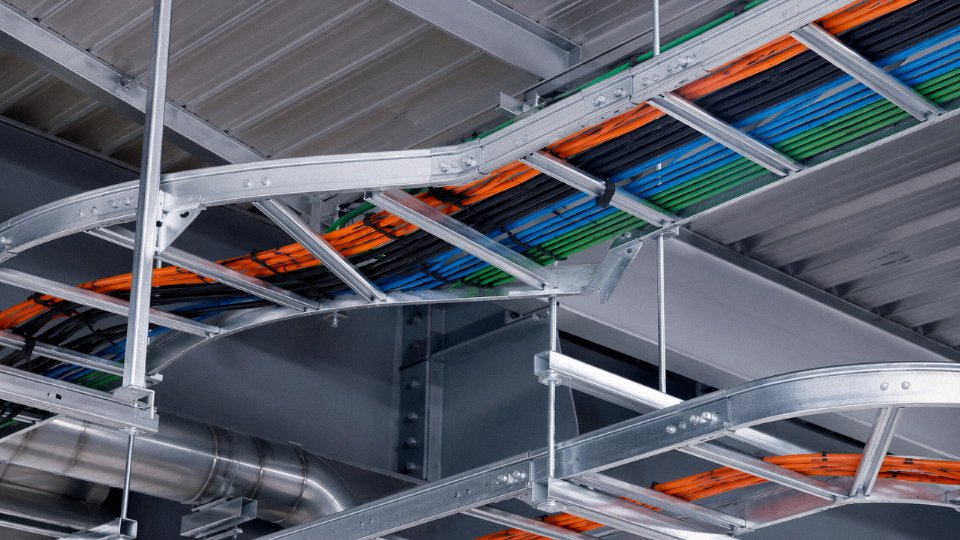
Cable Tray: Industrial and Data Center Environments
Open ladder tray and ventilated trough systems are standard in industrial plants and large data centers because they give maintenance crews visibility and fast access to reroute circuits. The wire choice shifts here — XHHW-2 or TC-rated (tray cable) is required, not bare THHN. The distinction matters: THHN is not listed for exposed tray runs.
NEC Article 392 allows tray ampacity at 75°C or 90°C depending on the conductor insulation rating and fill. Solid-bottom trays run hotter than ladder tray because airflow is restricted, which means derating applies. Most industrial designers default to ladder tray wherever possible specifically to avoid that calculation complexity.
Direct-Burial: USE-2 and UF-B
For direct-burial runs, USE-2 or UF-B cable is required — not THHN, regardless of what’s in the supply room. NEC Table 300.5 sets minimum cover at 24 inches for 120/240V circuits installed without conduit. Moisture ingress over time is the dominant failure mode here, not mechanical damage. Insulation chemistry matters considerably: polyethylene and cross-linked polyethylene (XLPE) compounds resist moisture migration far better than standard PVC under sustained soil contact.
A useful rule of thumb: if the burial depth spec looks borderline, spend the small premium on conduit-encased direct-burial instead of relying on depth alone.
Concealed Wiring in Walls and Ceilings
NM-B (commonly called Romex, though that’s a brand name) is the standard for concealed residential wiring in dry locations. Stapling requirements under NEC 334 call for support every 4.5 feet and within 12 inches of each box. Where wiring penetrates floors or walls, fire blocking with approved material is mandatory — a step that residential rough-in crews sometimes skip under pressure.
Pulling Tension and Sidewall Pressure
These two limits are underappreciated on most job sites. For copper THHN, maximum pulling tension is roughly 0.008 multiplied by the conductor’s circular mil area, expressed in pounds. Sidewall pressure — the force a wire sees at a bend — caps at approximately 300 times the conduit radius in pounds per foot. Exceeding either creates insulation micro-cracks that pass visual inspection but cause premature failure under thermal cycling.
Exceeding sidewall pressure limits during wire pulling can cause insulation damage that is undetectable by visual inspection at the time of installationTrue
Insulation deformation from excessive sidewall pressure creates micro-cracks internally; these do not present as visible surface damage but compromise dielectric integrity, leading to failures that often surface only after months of service under thermal cycling and load.
Thermal Derating in Bundled Conduit
When nine or more current-carrying conductors share a single conduit, NEC Table 310.15(C)(1) requires a 0.70 derating factor on ampacity. The heat buildup in a tightly packed conduit with nine 12 AWG conductors at full load is enough to noticeably shorten insulation life even if the derating prevents an immediate overload trip. The practical fix most experienced designers use is splitting circuits across two conduits — sometimes at slightly higher upfront conduit cost, but with full ampacity retained and a meaningful reduction in long-term thermal stress on the insulation.
How to Select and Specify Building Wire for Commercial and Industrial Projects
Getting the specification wrong at the front end of a project is expensive. A wire substitution discovered during rough-in inspection can mean pulling everything back out of conduit — days of labor, not hours. The framework below is how experienced specifiers move from project conditions to a locked wire spec without leaving gaps that a substitution can slip through.
Step 1 — Lock in the Voltage Class First
System voltage determines the minimum insulation voltage rating, and this is non-negotiable. A 120/240V residential feeder, a 480V three-phase commercial distribution circuit, a 600V industrial motor branch circuit, and a 1000V utility-scale PV string circuit each demand a different minimum rating. THHN/THWN-2, the workhorse of North American commercial work, is rated 600V — fine for most commercial and light industrial work, but not suitable as-specified for 1000V PV systems without an explicit USE-2 or PV-rated designation. Nail down the voltage class before anything else, because it filters out a large chunk of catalog options immediately.
Step 2 — Map the Installation Environment Ruthlessly
This is where most specification errors originate. Dry interior conduit, wet or damp locations, direct-buried runs, rooftop exposure with UV and thermal cycling, chemical or oil exposure in processing plants, ambient temperatures above 40°C in boiler rooms or foundry service areas — each of these eliminates specific insulation types from consideration. THHN alone, for instance, is not rated for wet locations; you need THWN or THWN-2. Direct burial requires a USE-2 or, for branched residential wiring, NM-B only where the code explicitly allows it (which is fewer places than contractors sometimes assume). In petrochemical environments, standard PVC insulation may swell or crack within a year. Write the environment conditions into the specification in plain language, not just a wire type code, so substitutions can be evaluated against actual conditions rather than against a part number.
Step 3 — Size the Conductor with All Derating Applied
Run the ampacity calculation first, applying every applicable derating factor: ambient temperature correction, conduit fill (more than three current-carrying conductors in a conduit starts costing you real ampacity — 4–6 conductors typically derate to roughly 80%, 7–9 to around 70%, though exact values depend on the applicable code table), and any continuous-load multiplier. Then calculate voltage drop independently and check it against the project’s acceptable limit, typically 3% for branch circuits and 5% total from service entrance to load. Select whichever calculation produces the larger conductor size. On commercial runs exceeding roughly 100 feet (30 m), it’s common practice to step up one standard AWG size as a practical hedge — voltage drop in long branch circuits causes more nuisance callbacks than almost anything else in commercial electrical work.
Step 4 — Verify Certification Requirements by Jurisdiction
The authority having jurisdiction (AHJ) may differ from what you’d expect on international or multi-site projects. North American projects governed by the NEC require UL listing. Middle Eastern projects may require SASO. European and increasingly Southeast Asian projects reference IEC standards and CE marking. Specify the required marks in the purchase order, not just verbally. Request the actual test reports and certificate of conformance from the manufacturer — not just a scanned label. Suppliers who can’t produce factory test reports on demand are a procurement risk.
THHN/THWN-2 building wire is rated for 90°C in both wet and dry locations.True
THWN-2 carries a 90°C wet/dry rating per UL 83. The original THWN designation is rated 75°C in wet locations; the -2 suffix confirms the upgraded 90°C wet rating, which is why THWN-2 has largely replaced THWN in commercial specifications.
Step 5 — Choose Conductor Material Against Real Project Economics
Copper is mandatory for branch circuits 6 AWG and smaller under most residential codes, and it remains the default choice for control wiring and motor branch circuits where termination reliability is critical. For service entrances and feeders at 1/0 AWG and larger, aluminum using AA-8000 series alloy is code-compliant and meaningfully cheaper — the price gap between copper and aluminum conductors fluctuates with commodity markets but aluminum feeders can run 40–60% less material cost at equivalent ampacity, depending on copper spot pricing at time of purchase. The condition is that terminations must be rated for aluminum: using aluminum conductors on copper-only terminals is a documented fire risk and a code violation.
Step 6 — Specify Packaging and Delivery Format Precisely
Building wire ships on spools, wood reels, or in continuous bulk lengths. Typical spool sizes run 500–2,500 ft (roughly 150–750 m) depending on gauge, but this varies by manufacturer. For large projects, specify reel weight limits that match the site’s handling equipment — a 600 lb reel is manageable with a reel stand; a 2,000 lb reel needs a forklift and a pulling setup. Specify length tolerance explicitly; ±1% is standard practice, but some suppliers ship short on bulk orders. State this in the purchase order.
Red Flags When Evaluating Wire from Unfamiliar Suppliers
Unlisted or uncertified product is the most obvious warning, but the subtler ones catch buyers more often. Conductor resistance measurably above IEC 60228 Class 1 or Class 2 limits suggests the conductor cross-section is undersized — the wire looks right but doesn’t carry rated current without excess heat. Insulation thickness below the minimums in UL 83 or IEC 60502 is similarly hard to catch visually without calipers. Any supplier unable or unwilling to provide a certificate of conformance and batch-specific test reports should be treated as a disqualified source, regardless of price.
Quality Control and Factory Testing Protocols That Separate Reliable Suppliers from Risk
Buying building wire on price alone is one of the more expensive mistakes a procurement manager can make. The failure mode is slow and invisible — undersized conductors, thin insulation, inconsistent compound — right up until it isn’t. Here’s what rigorous manufacturing quality actually looks like from the inside, and what you should be asking suppliers to demonstrate.
Incoming Material Controls
Copper rod doesn’t get a free pass just because it comes from a known mill. At a serious facility, every coil is tested for conductivity (the target is 100% IACS minimum, and anything below 99.5% should trigger a hold), oxygen content, and surface quality before it goes anywhere near a drawing line. Oxygen content matters because high-oxygen rod is more prone to embrittlement during fine drawing, which shows up later as strand breakage during installation — a failure mode that’s genuinely hard to trace back to the wire itself.
Insulation compounds — PVC, XLPE, whatever the spec calls for — get tested on incoming batches for Shore hardness, melt flow index, and carbon black dispersion. Melt flow index in particular tells you a lot about how consistently the material will extrude. A compound that’s out of spec on MFI will cause wall thickness variation even on a well-tuned line. Production release should be gated on passing these checks, not on a certificate of conformance alone. In practice, some smaller factories skip this entirely and rely on the compounder’s COA. That’s a risk.
In-Process Controls During Extrusion
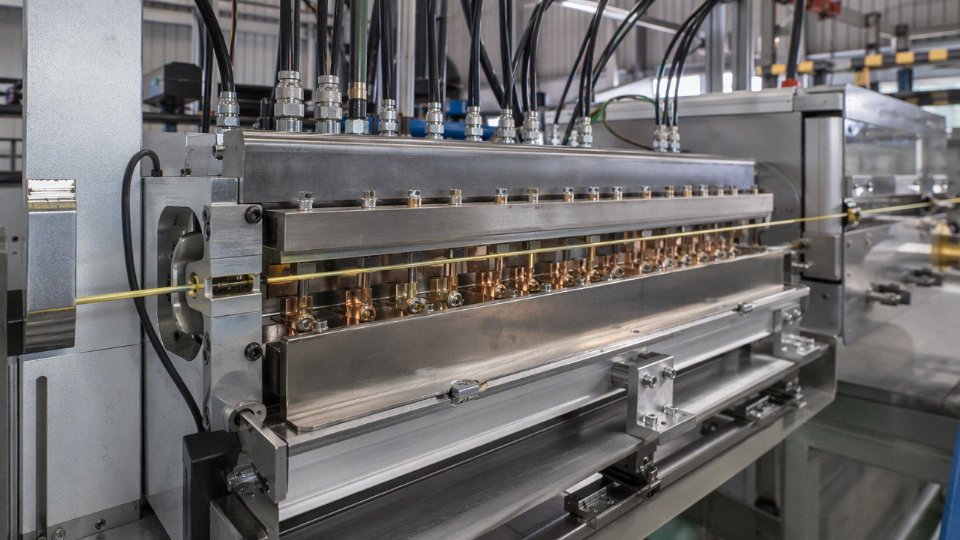
Continuous spark testing is the backbone of in-process quality for insulated conductors. For 600V-rated wire, the test voltage is typically 6 kV AC, and every single meter of conductor passes through the spark tester inline during extrusion. A pinhole, a void, a contamination inclusion — any of these will trip the tester and mark the fault location. The line doesn’t keep running and ship defective wire; it stops.
Alongside spark testing, conductor diameter and ovality are measured by laser gauge at roughly 30-second intervals. Ovality — the difference between the maximum and minimum diameter on the same cross-section — matters because an oval conductor creates uneven insulation wall thickness, and the thin side is where dielectric failure initiates. Line speed and extrusion temperature are logged to SPC charts, which means you can go back to a specific production run and see whether the process was in control or not. That traceability is what separates a manufacturer from a workshop.
Finished Product Testing
Once a reel is complete, it doesn’t ship until it passes a full battery of tests per IEC 60227 or UL 83, depending on the market. Conductor resistance at 20°C should land within ±1% of the IEC 60228 tabulated value. High-voltage withstand (AC or DC), insulation resistance above 20 MΩ·km, tensile strength and elongation at break no less than 125% of nominal, cold bend at −15°C, and flame propagation per IEC 60332-1 — these are not optional. They are the minimum.
Cold bend testing trips up compounds that have been reformulated to cut costs. A compound that passes elongation at room temperature can crack like glass at −15°C, which is exactly the condition you’ll see when wire is pulled through conduit on a January morning in northern Europe or Canada.
Drum Marking and Lot Traceability
Every drum leaving a serious factory should display wire type, conductor size, voltage rating, reel length, lot number, manufacturing date, and certification marks. Traceability down to the production shift is the standard to aim for — it means that if a field failure occurs, you can pull the SPC records, the incoming material test data, and the finished-product test sheet for that exact reel. Factories that can’t provide shift-level traceability are telling you something about how they operate.
Third-Party Certification and Audit
ISO 9001 provides the quality management framework, but the more meaningful checkpoint for building wire is annual UL factory inspection — including unannounced follow-up visits — and periodic product re-testing by accredited third-party laboratories. Maintaining these certifications across multiple production sites is genuinely demanding; it requires calibrated equipment, trained metrology staff, and documented corrective action processes. Jinda operates across five production bases and maintains this certification structure across all of them, which is worth verifying directly during a supplier audit rather than accepting a scanned certificate.
UL conducts unannounced follow-up inspections at listed facilities to verify ongoing compliance with UL 83 requirements.True
UL's Follow-Up Services (FUS) program includes both scheduled and unannounced visits to manufacturing facilities to verify that listed products continue to meet the original certification requirements.
Field Verification Before Accepting a Large Shipment
You don’t need a laboratory to do basic due diligence. A calibrated 4-wire Kelvin bridge will measure conductor resistance in minutes — compare the result against IEC 60228 Table values and the tolerance should be within ±1%. Weigh a 1-meter sample cut from the drum and back-calculate the cross-section from copper density (8.89 g/cm³ for annealed copper). If the number is 10% light, the conductor is undersized.
A basic flame test per IEC 60332-1 requires nothing more than a Bunsen burner and a timer. It won’t replace a laboratory, but it will tell you quickly whether the insulation is a self-extinguishing compound or something that has no business being in a wall.
Undersized conductors reduce actual ampacity by roughly 15–30% depending on how far off the cross-section is and the installation environment — and that degradation doesn’t announce itself until insulation starts breaking down from sustained overtemperature, nuisance tripping begins, or, in the worst case, a fire starts in a concealed conduit run. The cost of that outcome is not recoverable by the savings on the original purchase order.
Frequently Asked Questions About Building Wires
What is the difference between building wire and electrical cable?
Building wire is a single insulated conductor — one conductor, one insulation layer, done. It’s designed for permanent installation inside conduit, raceways, or as a component within a cable assembly. Electrical cable is a factory-assembled product that groups two or more of those conductors under a common overall jacket.
The confusion is understandable because the industry uses both terms loosely. NM-B (what most North American contractors call “Romex”) is technically a cable — it contains two or three THHN-class building wire conductors plus a bare equipment ground, all wrapped in a PVC jacket. You’re buying a cable, but what’s inside is building wire. Keeping that distinction straight matters when you’re specifying substitutions or dealing with code inspection.
Can I use THHN wire outdoors or underground?
THHN alone is dry-location only — 90°C in dry conduit, full stop. The product most suppliers actually ship and most distributors stock today is dual-rated THHN/THWN-2, which adds a wet-location 90°C rating. That covers outdoor conduit runs and conduit through wet or damp areas.
What it does not cover is direct burial. Putting THHN/THWN-2 in the ground without conduit is a code violation and a failure waiting to happen — moisture intrusion, insulation degradation, eventual ground fault. For direct-burial applications, specify USE-2 or UF-B cable, both of which have sunlight-resistant, moisture-resistant insulation systems designed for soil contact.
Is aluminum building wire safe?
Yes — with the right specification. Modern AA-8000 series aluminum alloy conductors are a genuinely different material from the pure 1350-series aluminum that caused connection failures in residential branch circuits during the 1960s and 70s. Those failures came from thermal expansion mismatch at devices not designed for aluminum, combined with oxide layer buildup. The code response was to prohibit aluminum on 15 A and 20 A branch circuits in most jurisdictions, and to require CO/ALR-rated devices and anti-oxidant compound wherever aluminum is used.
For feeders, service entrances, and large commercial branch circuits — say, 60 A and above — aluminum is routinely specified, and the cost savings over copper can be substantial depending on project size and copper market pricing at time of procurement. The wire is safe; the risk is in improper termination practice.
AA-8000 series aluminum alloy building wire is code-compliant for feeder and service entrance applications when installed with listed fittings and anti-oxidant compound.True
NEC Article 310 and UL 44 permit AA-8000 series aluminum conductors for these applications. The historical safety concerns relate specifically to pure 1350 aluminum used in small branch circuits prior to code revisions in the 1970s.
What gauge wire is required for a 20-amp circuit?
Minimum 12 AWG copper for a 20 A branch circuit, based on NEC Table 310.16 at the 60°C termination column — which is the column that governs most standard breaker and device terminals regardless of the wire’s 90°C insulation rating. Aluminum equivalent is 10 AWG. On runs longer than roughly 50 feet (15 m), run the voltage drop numbers; you may find 10 AWG copper is the right call even if 12 AWG technically clears ampacity.
How do I convert AWG to mm²?
The formula: mm² ≈ (conductor diameter in mm)² × 0.7854. In practice, most engineers just use the standard approximations: 14 AWG ≈ 2.5 mm², 12 AWG ≈ 4 mm², 10 AWG ≈ 6 mm², 8 AWG ≈ 10 mm², 6 AWG ≈ 16 mm².
These are close but not exact. AWG and IEC metric sizes have different conductor cross-sections and different resistance-per-meter values. If you’re substituting metric wire on a North American project or vice versa, verify conductor DC resistance against IEC 60228 or ASTM B3/B8 rather than assuming the nominal size is equivalent. Inspectors and engineers of record have caught substitutions this way.
What does LSZH mean and when is it required?
LSZH — Low-Smoke Zero-Halogen — describes insulation chemistry that, when burned, produces minimal smoke and no corrosive halogen acids (chlorine, fluorine, bromine). Standard PVC insulation releases hydrogen chloride when it burns, which damages electronics and lungs in confined spaces.
LSZH is mandatory or strongly recommended in enclosed public spaces, transit tunnels, subway systems, hospitals, offshore platforms, ships, and data centers. The threshold depends on local code and owner specification — some hospital systems now require it facility-wide; others apply it only to specific areas. If the project is in a space where occupant egress time is long or smoke accumulation is a serious hazard, specify LSZH and don’t leave it to value-engineering negotiation later.
How long does building wire last?
In a dry, stable-temperature environment, properly installed building wire is reasonably expected to last 30–40 years. Some installations run longer without issue; others develop problems in 15 years because of high thermal cycling at terminations, elevated ambient temperature, or chemical exposure.
PVC insulation is the more sensitive of the common types — it emulsifies and cracks faster under sustained heat above its rated temperature or prolonged UV exposure. XLPE-insulated wire handles thermal aging better and is often preferred for industrial applications where temperature swings are frequent. The weakest point in any building wire system is almost always the termination or splice, not the conductor itself.
What should I check when buying building wire from an overseas manufacturer?
Start with third-party certification marks — UL listing, CE marking, or the applicable regional equivalent. Then request factory test reports tied to the specific production lot you’re receiving, not generic sample data. Confirm conductor resistance values meet IEC 60228 Class 1 or Class 2 (or ASTM B3/B8 for North American specs), and measure insulation wall thickness against the standard minimums — substandard wire frequently cuts corners there first.
Review the manufacturer’s ISO 9001 certification and check whether it covers cable manufacturing specifically. For orders exceeding roughly 50,000 meters, a third-party pre-shipment inspection — dimensional checks, spark test witness, sample resistance measurement — is genuinely worth the cost. Discovering non-conforming wire after it’s pulled through conduit on a multistory project is a different problem than catching it at the factory gate.
Sourcing Building Wire at Scale: What Global Projects Require From a Supply Partner
Large infrastructure projects don’t fail because engineers chose the wrong insulation chemistry. They fail because wire arrived six weeks late, came on reels too heavy for the site’s manual handling equipment, or showed up certified to IEC 60227 when the local authority also required SASO compliance — and nobody caught it until the inspection stage.
Procurement at scale is a different discipline from specification work, and it deserves the same rigor.
Volume, Lead Times, and the Planning Gap Most Projects Underestimate
A mid-size commercial tower or industrial facility will routinely consume 50,000 to 500,000+ meters of building wire across eight to fifteen gauge sizes. That’s not a single purchase order — it’s a phased procurement program with overlapping delivery windows tied to construction sequencing. Standard lead times from order confirmation to shipment run roughly 30–60 days for stocked configurations and 45–90 days for custom gauge/insulation combinations, depending on the manufacturer’s current production loading and copper availability. Those ranges get wider when copper spot prices spike and mills queue orders differently.
The practical rule: lock procurement 3–6 months ahead of your installation start date. In practice, EPC project managers who treat wire like a commodity buy — something you call in four weeks before you need it — are the ones calling suppliers at midnight asking for expedited freight on partial quantities. That premium shipping cost alone can erase the margin saved by delaying the order.
Multi-Standard Supply: Why a Single Certified Source Matters
Projects in the Middle East, Southeast Asia, and Sub-Saharan Africa increasingly arrive with layered specification requirements — IEC 60227 as the base standard, plus SASO (Saudi Arabia), SIRIM (Malaysia), or KEBS (Kenya) local compliance stacked on top. Sourcing from two separate manufacturers to cover both standard families creates dual documentation chains, mismatched drum-marking conventions, and re-testing costs that can run $15,000–$40,000 per project depending on scope and the certifying body. A manufacturer holding all relevant certifications eliminates that entirely.
A single manufacturer certified to IEC 60227, UL 83, and multiple regional standards (SASO, SIRIM, KEBS) reduces per-project re-testing and documentation overhead compared to dual-source strategies.True
Each certification body issues approval against specific test reports tied to a specific manufacturer. Using one manufacturer means one set of test reports, one declaration of conformity, and one set of drum markings — all traceable to a single quality system. Dual-sourcing splits that documentation and often triggers re-testing requirements by local authorities.
Reel Configuration and Packaging: The Detail That Derails Site Logistics
This is one of those things that gets overlooked during tender and then causes real headaches on site. Many developing-market projects — and honestly quite a few European sites — have a hard limit around 500 kg net weight per reel for manual or basic mechanical handling. If your supplier’s standard reel for 185 mm² wire ships at 900 kg, you’ve created a rigging problem the electrical contractor didn’t price. Manufacturers that accommodate non-standard reel dimensions, specified continuous lengths without mid-run joints, and bilingual drum marking (English plus the destination country’s required language) are genuinely easier to work with on international contracts.
Factory Acceptance Testing and Third-Party Inspection Access
Government contracts, utility projects, and most EPC frameworks require factory acceptance testing (FAT) witnessed by an independent third-party inspector — Bureau Veritas, SGS, Intertek, or similar. A manufacturer with dedicated test bays and documented QC infrastructure can accommodate a witness inspection without pulling a production line offline. Manufacturers without that setup will delay your inspection, which delays your shipment, which delays your installation milestone. Ask directly during supplier qualification: do you have a dedicated FAT area, and what is your standard scheduling lead time for witnessed testing?
Production Redundancy and Supply Continuity
Geographic concentration in a single facility is a real risk on multi-year programs. Equipment maintenance windows, regional weather events, and raw material supply tightening can all constrain output from a single-site supplier. A manufacturer operating across multiple production bases — distributed across different provinces — can reallocate production internally when one facility has reduced capacity, without the buyer ever seeing a delivery disruption. That kind of redundancy is worth quantifying during supplier evaluation, not assuming.
Technical Support Through Project Execution
Field questions always come up. Conduit fill calculations change when the conduit routing gets revised. Ambient temperatures at the actual installation site differ from the design assumption. A substitution gets proposed and someone needs a written equivalency letter to satisfy the engineer of record. Suppliers with an in-house engineering team that can issue formal technical support documentation — not just a phone call — are a material risk-reduction asset for the contractor. That service also signals that the manufacturer understands how projects actually run, not just how wire gets made.
Long-term, the suppliers worth building relationships with are the ones who carry documented export compliance history, understand HTS code classification for the destination country, can work within letter-of-credit and documentary credit payment structures, and have the production capacity to stay with you across a three- or five-year infrastructure program. Transactional vendors can fill a gap order. Strategic supply partners reduce total project risk — and that distinction shows up in cost and schedule, every time.