What Are the Four Types of Cables? Coaxial, Twisted Pair, Fiber Optic, and Power
If you sort the cabling world by what each product fundamentally does, you end up with four families. Each one evolved to solve a specific transmission problem, and each one survives because no other family does that particular job as well. Knowing the four lets you walk into any installation, look at the cables on the wall, and immediately understand what is moving through them.
1. Coaxial Cable
Coaxial cable, or coax, has been around since the 1930s and still ships in the billions of feet every year. It is built around a single central conductor wrapped in a thick foamed dielectric, surrounded by a tubular conductive shield (foil, braid, or both), and finished in a plastic jacket. The geometry, with one conductor centered inside another, gives the cable a precise characteristic impedance: typically 75 ohms for video and broadband, 50 ohms for radio and instrumentation.
That impedance is the magic. It lets coax carry signals at very high frequencies with minimal loss and almost no leakage, which is why it became the backbone of cable television, satellite distribution, and broadband internet from the curb to the modem. The same construction is also why coax powers radio antennas, ham radio gear, and laboratory test equipment.
Common coax types you will recognize include RG-6, the modern standard for residential cable TV and satellite installations; RG-11, used for longer runs where signal loss matters; and RG-59, the older standard still found in legacy security camera installations. In professional broadcast and instrumentation work, you will see semi-rigid hardline coax and double-shielded laboratory cables.
2. Twisted Pair Cable
Twisted pair is the workhorse of voice and data networking. The construction is deceptively simple: two insulated copper conductors twisted around each other along the length of the cable. The twist is the engineering trick. Any electromagnetic interference that hits one conductor also hits the other almost identically, and because the two conductors carry opposing signals, the noise cancels out at the receiver. The tighter the twist, the better the noise rejection at high frequencies.
Twisted pair cable comes in two broad forms. Unshielded twisted pair (UTP) is what runs through most homes and offices, carrying Ethernet under names like Cat5e, Cat6, Cat6a, and Cat8. Each category supports progressively higher data rates: Cat5e tops out around 1 Gbps over 100 meters; Cat6a comfortably handles 10 Gbps over 100 meters; Cat8 reaches 40 Gbps but only over short data-center runs. Shielded twisted pair (STP) wraps additional foil or braid around the pairs to handle electrically noisy environments, such as industrial floors or near heavy motors.
The older cousin of twisted pair networking cable is plain telephone wire, which uses the same twisted-pair principle but at much lower frequencies. Voice-grade pairs still snake through millions of buildings, often repurposed today for thermostats, intercoms, or backup signaling.
3. Fiber Optic Cable
Fiber optic cable replaces electricity with light. Instead of metal conductors, fiber uses a thin glass or plastic strand that carries pulses of laser light from one end to the other. The light bounces along inside the core due to a phenomenon called total internal reflection, contained by a slightly less dense cladding layer and a protective coating.
Because light is unaffected by electromagnetic interference, fiber can run through environments where copper would pick up unbearable noise. It also carries enormous amounts of data, with single fibers in commercial backbones routinely handling hundreds of gigabits per second and laboratory experiments pushing into terabits. The distance advantages are dramatic too: a single-mode fiber can carry signal tens of kilometers without amplification, while copper Ethernet typically gives up at 100 meters.
Fiber comes in two flavors. Multimode fiber has a wider core, typically 50 or 62.5 microns, and uses LED or VCSEL light sources. It is cheaper and easier to terminate, and dominates short building-scale runs. Single-mode fiber has a much narrower core, around 9 microns, and uses precision laser sources. It is what telecom carriers, internet backbones, and submarine cables use to move data across continents.
4. Power Cable
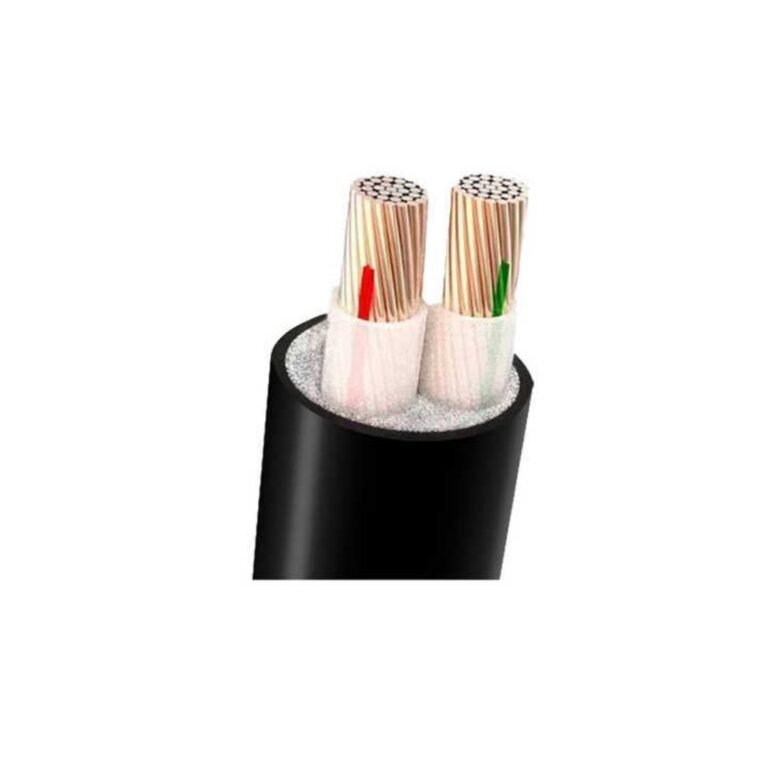
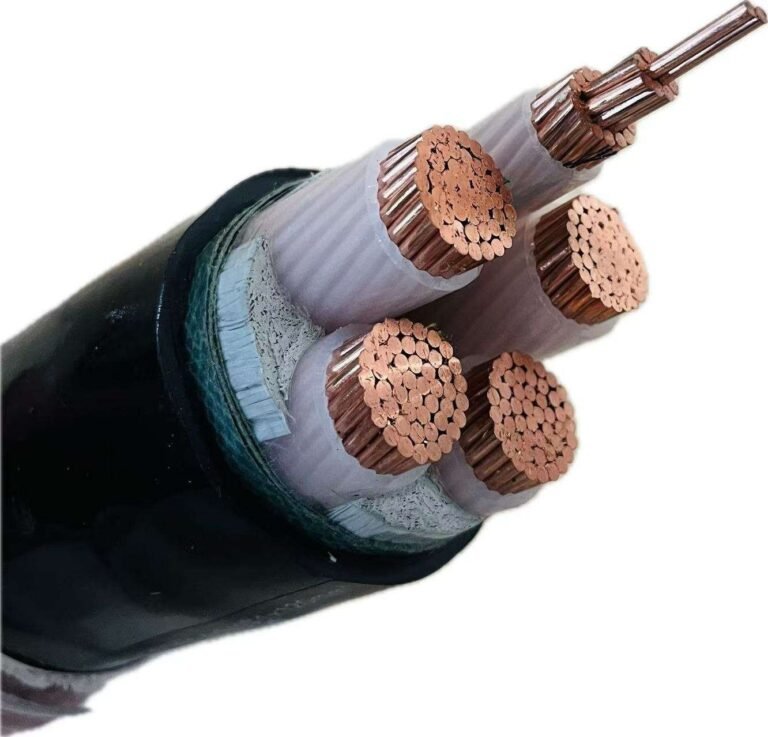
The fourth family is the one that powers everything else: cables built to carry significant electrical current at line voltage or higher. This category spans a huge range. At one end you have household lamp cords and extension cords carrying a few amps at 120 or 240 volts. In the middle sit branch-circuit cables like NM-B and feeder cables like SER and SEU. At the top are utility-grade medium-voltage cables operating at 5 kV, 15 kV, 35 kV, and beyond, and submarine power cables moving gigawatts between countries.
What unites the power-cable family is purpose: deliver energy from source to load with minimal loss, contained safely inside insulation and jacketing that match the voltage, environment, and physical stress the cable will see. Construction reflects that. Power cables use larger conductors than data cables, thicker insulation rated for higher voltage, and often armored or rugged jackets that survive burial, conduit pulls, or mechanical abuse.
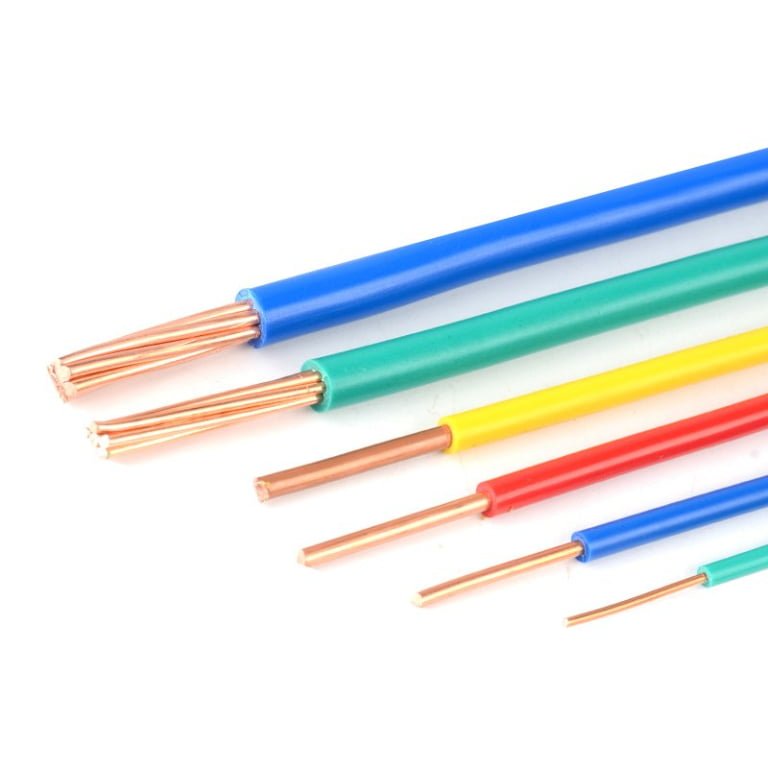
Within the power family you will encounter several subtypes. Service entrance cable runs from the utility drop into the meter and main panel. Building wire (THHN, NM-B, UF) carries circuits inside structures. Tray cable and instrumentation cable handle motor and control loads in industrial plants. Mining cable, locomotive cable, and welding cable each tune the design for an extreme niche.
How the Four Families Coexist
Most modern installations use more than one family at once. A typical home has power cables in the walls, coaxial cable behind the television, twisted pair Ethernet running to a router, and fiber optic coming into the building from the street. Each family does its job because no other family does it as well at the scale required. Coax dominates broadband distribution because impedance-matched single-conductor signals are still the most efficient way to multiplex video. Twisted pair dominates Ethernet because the cost per meter is low and the noise-cancellation trick still works. Fiber dominates long-distance and high-capacity backbone work because light is faster, cleaner, and more bandwidth-rich than electrons in copper. And power cables dominate energy delivery because there is no replacement for moving large amounts of current down a metal conductor.
Knowing the four lets you cut through any cable conversation. Once you can name the family, the specifics fall into place: the impedance, the data rate, the voltage, the connector type, and the installation rules all flow from which family you are looking at.