Budgeting an electrical job without a clear sense of what electricians actually charge is a fast way to blow contingency on the first call-out. Whether you’re retrofitting a production line, pulling permits for a new facility build, or sourcing a contractor to commission cable terminations, labor rates swing dramatically by license tier, region, and job complexity — and getting that estimate wrong doesn’t just hurt the budget, it pushes your schedule when you have to renegotiate mid-project.
In the U.S., most electricians charge $50–$100 per hour for journeyman-level work and $100–$150 per hour for a master electrician, depending on region, union status, and job scope. UK rates run £40–£70 per hour outside London, rising to £70–£120 per hour in the capital. Australian electricians typically charge AUD $80–$130 per hour nationally, with Sydney and Melbourne contractors often reaching AUD $160 per hour for specialist work.
What most rate guides skip is the gap between what’s quoted and what actually lands on the invoice — and that gap is where projects get hurt. The tier of license, overtime exposure, minimum call-out fees, and the type of cable or switchgear involved all pull that hourly figure in directions that aren’t obvious until you’ve been through a few hiring cycles. The sections below break that down in a way that’s actually useful for planning.

License Tiers and Certification Levels That Directly Set the Hourly Rate Floor
The hourly rate an electrician quotes you isn’t arbitrary. It tracks, almost exactly, to which license they hold and what that license legally permits them to do on your site. Hiring the wrong tier isn’t just a budget miscalculation — it can void permits, fail inspection, or in industrial settings, create genuine safety exposure.
Apprentice Electricians: Supervised Hours, Lower Rates
Apprentices in the U.S. typically earn somewhere in the $15–$30/hr range, depending on which year of their program they’re in (most IBEW apprenticeships run five years) and the regional wage scale. In the UK, first- and second-year apprentices sit around £12–£20/hr. These rates exist for a structural reason: apprentices cannot work unsupervised. Every hour billed at apprentice rates legally requires a journeyman or master on the same site, which means you’re actually paying two labor lines even if one looks cheap on the invoice. For straightforward residential fit-out with a crew, this still pencils out. For a specialized industrial pull requiring precise cable management, most contractors won’t send an apprentice as anything more than a labor assist.
Journeyman Electricians: The Working Rate Most Projects Actually Pay
This is the tier that prices most of the work. U.S. journeyman rates run roughly $50–$100/hr — the spread depends heavily on whether you’re in a right-to-work state or a union market, and whether the work is commercial or residential. In Australia, a licensed electrician doing independent work (the rough equivalent of journeyman status) typically bills AUD $80–$110/hr nationally, though that climbs fast in metro markets.
A journeyman can plan and execute most standard electrical work independently: branch circuit wiring, panel work up to their local code authority’s limits, standard commercial installations. What they cannot do in most U.S. jurisdictions is pull permits in their own name or take the electrical contract on a project. That ceiling matters on larger jobs.
Master Electricians and Electrical Contractors: Permit Authority Commands a Premium
Master electricians in the U.S. run $100–$150/hr, sometimes higher in tight labor markets or for specialized scope. The premium reflects two things that have real value: permit-pulling authority and legal accountability for the installation. A master electrician’s license is what allows an electrical contracting firm to take on a project as the responsible party. They’re also typically managing scheduling, coordinating inspections, and interpreting drawings — work that goes beyond hands-on installation but directly determines whether a project finishes on time.
In the UK, this tier roughly corresponds to an electrician holding a Part P competent-person scheme registration or a fully qualified contractor running their own business, billing £70–£120/hr in London and somewhat less elsewhere.
Industrial and High-Voltage Specialists: A Different Tier Entirely
Electricians working on medium-voltage and high-voltage cable systems (typically 6 kV–35 kV and above) consistently charge 30–60% more than standard residential journeymen in the same market.True
MV/HV work requires specialized training, additional certifications (such as NFPA 70E arc flash compliance, utility coordination, or specific HV jointing qualifications in the UK), and carries substantially higher liability. The rate premium is widely documented across electrical contracting trade associations in the U.S., UK, and Australia.
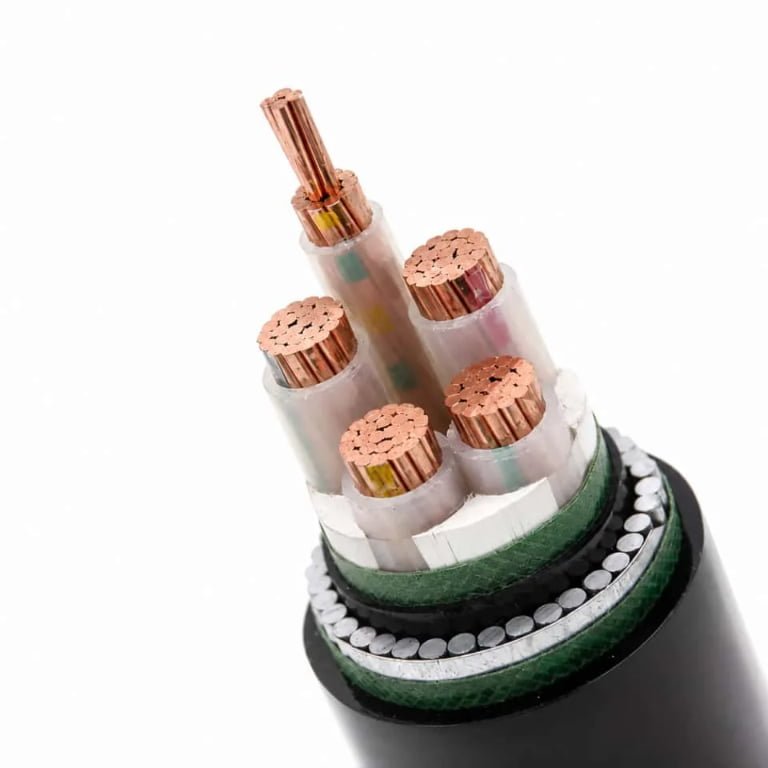
If your project specifies armored cable (SWA or interlocked armor), fire-resistant cable rated to IEC 60331 or BS 6387, or submarine and direct-burial MV cable, you are outside journeyman residential territory. These installations require certified cable jointers, proper termination kits, and in many cases manufacturer-specified installation procedures. Sending an under-qualified electrician to terminate a 10 kV XLPE cable is the kind of decision that produces a failed hipot test at best, and a catastrophic in-service failure at worst.
Certification Tier Rate Comparison Across Four Markets
| Certification Tier | United States | United Kingdom | Australia | Typical Scope Limitation |
|---|---|---|---|---|
| Apprentice | $15–$30/hr | £12–£20/hr | AUD $18–$35/hr | Supervised only; no independent work |
| Journeyman / Licensed Electrician | $50–$100/hr | £40–£70/hr | AUD $80–$110/hr | Independent work; cannot pull permits (US) |
| Master / Contractor | $100–$150/hr | £70–£120/hr | AUD $120–$160/hr | Permit authority; project responsibility |
| MV/HV Specialist (6 kV–35 kV+) | $130–$200+/hr | £90–£160+/hr | AUD $150–$220+/hr | Certified termination, jointing, testing |
Rates at the top of each range apply to union contractors, tight labor markets, or emergency/after-hours callouts. The bottom of each range assumes a competitive regional market, standard hours, and straightforward site access.
The practical takeaway for procurement managers specifying technically demanding cable products: the cable specification and the labor tier are linked. You cannot finalize a budget for a project using fire-resistant or medium-voltage armored cable without confirming which certification tier the installation contractor holds — and pricing their rate accordingly from the start.
Geographic and Regional Rate Variations: City, State, and Country Breakdowns
National averages are practically useless for budgeting. A journeyman electrician in rural Mississippi and one in San Francisco both get lumped into the same “$50–$100/hr” headline figure — which tells you almost nothing if you’re actually trying to price a project or vet a contractor’s quote.
U.S. Regional Breakdown
Bureau of Labor Statistics occupational data breaks the picture open considerably. The Northeast — Massachusetts, Connecticut, New York, New Jersey — runs roughly $85–$130/hr for journeyman work, driven by strong union density (IBEW locals in New York and Boston set wage floors that independents tend to shadow), high cost of living, and permit-heavy municipal environments where an electrician’s non-billable time on paperwork is quietly priced into the rate.
The Midwest sits in a more moderate band, typically $55–$85/hr, though Chicago is its own animal — expect rates closer to the Northeast floor there. Columbus, Kansas City, Indianapolis tend to be cheaper. The South is generally the most competitive U.S. market: $50–$75/hr in states like Alabama, Arkansas, Tennessee, though Texas metros like Austin and Dallas are creeping upward fast as construction demand outpaces licensed electrician supply.
West Coast rates are the highest nationally. California, Washington, and Oregon journeymen routinely bill $90–$140/hr, with prevailing wage jobs on commercial or industrial sites often landing at the top of that range or above it. Hawaii adds another layer — material logistics to the islands inflate everything, and electricians there factor in real delays on cable and conduit delivery.
United Kingdom
The UK splits cleanly between London and everywhere else. London and the immediate Home Counties run £70–£120/hr, sometimes higher for industrial or data center work where specialized certification is required. The Midlands — Birmingham, Coventry, Nottingham — comes in around £50–£70/hr. North England, Scotland, and Wales are broadly £40–£60/hr, though Scotland has pockets of higher demand tied to renewable energy projects where qualified electricians are genuinely scarce.
London electrician hourly rates average 40–60% higher than rates in northern England and WalesTrue
Consistent with Checkatrade and Which? 2024 survey data showing London rates of £70–£120/hr versus £40–£60/hr in northern regions, reflecting cost of living differentials, call-out minimums, and higher overhead for London-based tradespeople.
Canada
Ontario and British Columbia track closest to U.S. West Coast norms once you adjust for exchange rates — figure CAD $75–$110/hr for a licensed journeyman. Alberta and Saskatchewan (the Prairie provinces) come in at roughly CAD $65–$95/hr, though oil-patch industrial sites complicate this; remote site work and shutdown contracts command significant premiums. Quebec is genuinely different. The province’s licensing body — the CCQ — regulates wages through collective agreements, which compresses the range but creates a floor that’s often higher than a raw market comparison would suggest. Contractors unfamiliar with Quebec’s system sometimes underbid and absorb the difference. That’s an expensive lesson.
Australia
New South Wales and Victoria — Sydney and Melbourne specifically — push AUD $120–$160/hr for standard residential and light commercial work. Queensland and Western Australia are somewhat lower, generally AUD $90–$130/hr, though remote mining and resource sector sites in WA carry substantial travel and accommodation loadings that can effectively double the base rate on a project cost basis.
Middle East and Southeast Asia
For industrial cable installation projects — the kind involving international procurement of medium-voltage or specialized cables — expatriate-certified electricians in the Gulf states (UAE, Saudi Arabia, Qatar) typically work under contract rather than hourly billing, but day-rate equivalents translate to roughly $60–$120/hr USD depending on certification level and whether the contractor holds IEC or BS 7671 credentials. Southeast Asia project rates vary enormously: local labor is cheap, but clients specifying work to IEC or NEC standards frequently require foreign-certified supervision, which carries expat premiums and project-specific insurance loadings.
The Infrastructure Cost Multiplier
Remote sites and island markets show a consistent pattern: electricians price in what I’d call the friction cost — travel time, overnight stays, uncertainty around cable and materials delivery. A qualified electrician on a Caribbean island project or a remote Australian station isn’t just billing for hands-on hours. They’re pricing the risk of a three-day wait for a replacement part that would take two hours to source in a major city. That friction routinely adds 15–35% to effective hourly costs compared to urban equivalents, depending on site accessibility and project duration.
If you’re benchmarking a specific project, the regional figure matters far more than any national average. Use the ranges above as a floor-and-ceiling check, then adjust for union/non-union, site remoteness, and whether the scope requires any specialized certification beyond a standard license.
Residential vs. Commercial vs. Industrial Electrical Work: How Job Type Shifts Hourly Cost
The license tier matters, but so does where the work happens. An electrician who charges $75/hr for swapping outlets in a suburban ranch house will quote you $130/hr for the same day if you send them into a food processing plant with arc-flash hazards and permit requirements stacked three deep. Same hands, same tools — different billing environment entirely.
Residential Scope and What Drives Its Rate Band
Residential electrical work — outlet installation, panel upgrades from 100A to 200A service, EV charger rough-in, smart home low-voltage runs — typically lands in the $50–$100/hr range for a journeyman in most U.S. markets, though this depends heavily on local permit fees, whether the job requires a licensed master to pull permits, and how much of the home is finished wall versus open framing. Cable selection is straightforward: most residential branch circuits run 14 AWG or 12 AWG NM-B (Romex in practice), with heavier 6 AWG or 4 AWG for EV charger feeds or electric range circuits. The material is cheap, easy to pull, and fast to terminate. A competent electrician can rough-in a 15-circuit addition in a day on new construction; the same work in a finished basement with insulated walls will take two to three times as long and push labor cost accordingly.
EV charger and smart panel work is bumping residential rates up slightly right now — roughly $80–$110/hr in suburban markets — because it requires load calculation review and sometimes coordination with the utility, which takes time whether or not it’s billable.
Commercial Rates: Three-Phase Systems and Code Complexity
Step into a retail buildout or office fit-up and the rate shifts to roughly $75–$120/hr, occasionally higher for licensed master supervision. The cable itself changes: THWN-2 or XHHW-2 in conduit, MC cable for branch circuits, and sometimes armored assembly for runs in plenum spaces or where physical protection is required. Three-phase distribution panels, lighting control systems, and building management system wiring all require more planning, more coordination with other trades, and more documentation. Terminations take longer. Inspectors look harder.
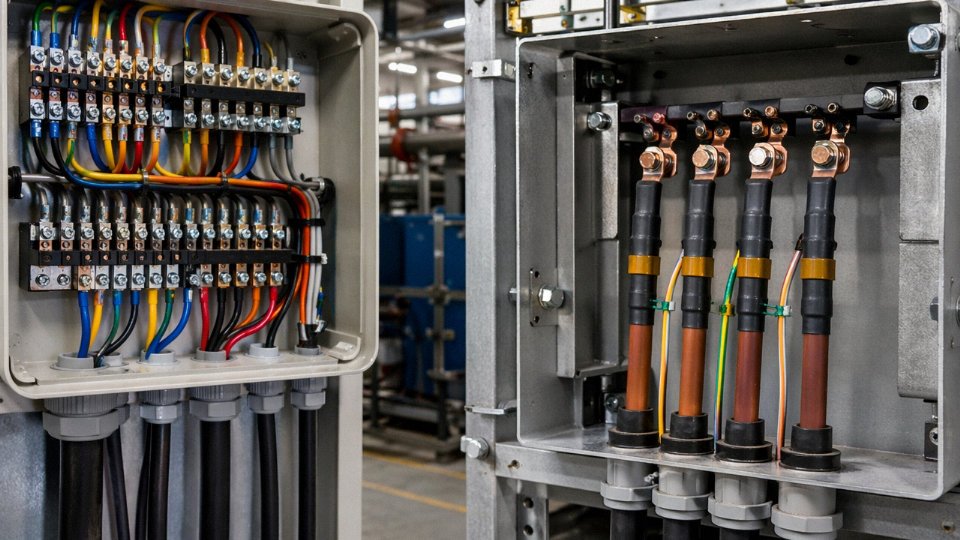
The permit and inspection overhead alone can add 15–25% to a commercial job’s effective cost relative to an equivalent residential scope.
Industrial: Where the Rate Ceiling Disappears
Industrial electrical work — motor control center wiring, variable frequency drive installation, high-voltage switchgear connections, explosion-proof conduit systems — routinely runs $100–$180/hr, and specialty contractors in petrochemical or utility environments can exceed that. The cable requirements are fundamentally different: armored cable (SWA or equivalent), screened MV cable rated 5kV–35kV, and cables with specific flame-spread or oil-resistance ratings depending on the environment. Terminations for MV cable require specialized stress-cone kits and, in some plants, a separate sign-off by a high-voltage competent person. That skill premium is real.
Industrial electricians typically charge 40–80% more per hour than residential electricians for equivalent hours workedTrue
The premium reflects arc-flash risk, more complex permitting, heavier cable termination skill requirements, and in many jurisdictions a separate industrial or high-voltage endorsement on the license.
Data Centers and Renewables: The Emerging High-Rate Category
Solar farm collection systems and wind turbine string wiring have created a niche that didn’t exist at scale ten years ago. DC cable rated to IEC 62930 (formerly IEC 60502-based PV cable), single-core 4mm²–16mm² with UV-resistant, double-insulated jackets, routed through tracker systems or buried in direct-burial conduit — this work requires electricians familiar with DC arc behavior, string combiner termination, and increasingly, BESS (battery energy storage) integration. Rates here run $90–$160/hr depending on project scale and remoteness. A 50 MW solar farm in a desert location will pay travel and per diem on top of that.
Data center work sits in a similar band. Redundant power distribution, busway tap-off connections, and low-latency structured cabling for critical loads all require precision and documentation that slows the work down relative to commercial office fit-outs.
How Cable Design Affects Labor Hours — and Total Cost
This is underappreciated in procurement conversations. Easier-to-terminate cable — consistent lay, stable insulation that strips cleanly, connectors that seat without forcing — genuinely reduces labor hours on large runs. On a 500-meter industrial cable pull, the difference between a well-manufactured armored cable and a cheaper import with inconsistent insulation wall thickness can be two to four additional hours of termination labor per end. At $130/hr, that’s not a rounding error.
| Installation Environment | Approx. Hours per 100m of Cable | Rate Range (USD/hr) | Key Cable Type |
|---|---|---|---|
| Residential (new construction) | 1.5–3 hrs | $50–$100 | 12–14 AWG NM-B |
| Residential (retrofit/finished walls) | 4–8 hrs | $60–$110 | 12–14 AWG NM-B |
| Commercial (conduit, open ceiling) | 2–4 hrs | $75–$120 | THWN-2, XHHW-2, MC |
| Commercial (plenum, BMS integration) | 4–7 hrs | $85–$130 | MC-HL, armored |
| Industrial (MCC, VFD wiring) | 5–10 hrs | $100–$180 | SWA armored, screened MV |
| Solar/wind collection (field runs) | 3–6 hrs | $90–$160 | IEC 62930 PV DC cable |
Hours depend on conduit congestion, termination count, inspection hold points, and cable bend radius requirements. These are working estimates, not guarantees — your actual site conditions will shift them.
After-Hours, Emergency, and Hazardous-Location Premiums That Inflate the Final Invoice
The base hourly rate gets the headline, but it’s rarely what ends up on the invoice. Premiums stack — sometimes two or three at once — and on a large cable installation or an unplanned fault-find, the final bill can run 2× to 3× what a straightforward daytime job would cost. Understanding the mechanics of each multiplier is the difference between a realistic project budget and a painful change order conversation.
Overtime Rules and How Union vs. Non-Union Shops Handle Them Differently
In the United States, federal overtime law sets time-and-a-half after 40 hours per week, but most union collective bargaining agreements are stricter: daily overtime kicks in after 8 hours on site, with double-time triggered after 12 hours or any hours worked before 6 a.m. Non-union contractors vary more widely — some mirror the union structure, others run straight time until the weekly threshold. If you’re commissioning a panel changeout that starts at 7 a.m. and drags into a 14-hour day because conduit routing turned out more complicated than the drawing showed, you’re paying double-time for the last two hours on a union crew whether the work was planned or not.
In the UK and Australia, the thresholds differ, but the principle is identical. Australian enterprise agreements commonly trigger overtime after 7.6 or 8 hours per day depending on the award, with Saturday rates at 1.5× and Sundays at 2×. Budget accordingly.
Emergency Call-Out Minimums: The Floor You Can’t Negotiate Away
Most electricians — union or independent — enforce a minimum charge on after-hours emergency call-outs, typically 2 to 4 hours regardless of how quickly the fault is actually resolved. That minimum is usually billed at 1.5× to 2× the standard rate. So a master electrician in London who normally charges £90/hr shows up at 11 p.m. to trace a tripped RCBO, fixes it in 45 minutes, and still invoices 3 hours at £180/hr. That’s £540 for a three-quarter-hour job.
This isn’t padding — it accounts for mobilization, travel, and the real cost of pulling a tradesperson off their evening. The practical takeaway: if a fault is non-critical and the plant can safely hold until 7 a.m., hold until 7 a.m.
Weekend and Public Holiday Multipliers
Weekend premiums typically run 1.5× to 2.5× the standard rate depending on jurisdiction, contract type, and whether the work is union-governed. Public holidays sit at the top of that range almost universally. A planned Saturday cable pull that could have been done on a Thursday doesn’t just cost more per hour — it often takes longer because fewer support staff are available, deliveries don’t arrive, and inspectors may not be on site.
Emergency after-hours electrical call-outs typically carry a minimum charge of 2–4 hours regardless of actual job duration.True
This is standard practice across US, UK, and Australian electrical contracting markets, reflecting mobilization costs and the loss of off-hours time for the tradesperson. It appears consistently in contractor pricing guides and trade agreements.
Hazardous Location Work: A Premium That’s Actually Justified
HazLoc work — NEC Class I Division I in the US, ATEX Zone 1 in Europe — commands a 25% to 50% premium above the standard industrial rate, and it earns it. The electrician needs specific certification, the cable specification is tighter (Ex-rated armored cable, explosion-proof fittings, intrinsically safe terminations), and every connection requires documented inspection before energization. Cut corners here and you’re not looking at downtime — you’re looking at incident investigation, insurance voiding, and potential fatalities.
In practice, even sourcing the right cable matters: Ex-rated armored cable for a Zone 1 installation isn’t interchangeable with standard SWA, and if a procurement team substitutes on cost grounds without flagging it to the electrician, the installer should — and usually will — refuse to terminate it.
Height, Confined Space, and Marine Installation Premiums
Work on transmission towers, inside tunnels, or on marine cable installations typically adds 20% to 40% to the standard rate. The driver is partly risk, partly the physical overhead: full PPE harness inspections, confined space gas monitoring, buddy systems, and the slower pace that safety protocol forces. A cable pull that takes 6 hours in an open industrial building might take 10 in a confined cable trench with entry permits.
The Compounding Problem — and How to Avoid It
The real budget risk isn’t any single premium; it’s when they stack. An emergency call-out on a Saturday at a classified HazLoc facility could theoretically trigger the call-out minimum, the weekend multiplier, and the HazLoc premium simultaneously — pushing the effective hourly rate to 3× or more the baseline. Scheduling major cable pulls and termination work during standard weekday hours, with realistic float built in for the inevitable reroutes, is the single most effective cost control available to a project manager before work starts.
How Material and Cable Specification Choices Directly Affect Total Labor Cost
Electricians sell time. Every project manager knows this in theory, yet procurement decisions routinely ignore the direct link between cable quality and billable hours on site. A cable that’s dimensionally inconsistent, stiffly jacketed, or poorly length-marked doesn’t just annoy the installer — it adds real, measurable time to the invoice.
The Labor-Hours-Per-Meter Reality
Experienced installation crews working on industrial panel builds or infrastructure cable pulls will often track labor-hours-per-meter informally, even if it never appears on a formal report. On a tidy, consistently dimensioned cable with accurate sequential length markings every meter, a skilled electrician can terminate, route, and glove-off multi-core runs significantly faster than on a cheaper alternative that arrives with inconsistent outer diameters, faded print, or length markings that drift by 3–5% over a drum.
Realistically, that translates to a 10–20% reduction in termination and layout time on medium-to-large cable projects — the exact percentage depends on cable count, conduit density, and how much of the work is in confined spaces. On a project with 200+ cable runs across a control building, that gap compounds fast. At $85/hr for a journeyman or £65/hr for a UK-based industrial electrician, even recovering four hours per day across a two-week pull adds up quickly.
Outer Diameter Consistency and Conduit Fill
Conduit fill calculations are done at the design stage based on published cable OD figures. When a cable arrives oversize — even 0.5 mm over nominal on a 16 mm² multi-core — it can cause a full conduit bank to fail fill compliance. The crew then faces re-pulling into a larger conduit, re-routing, or redesigning the tray layout on the fly. None of that is billable to the cable supplier. It comes out of contingency, or worse, it comes out of the project’s margin.
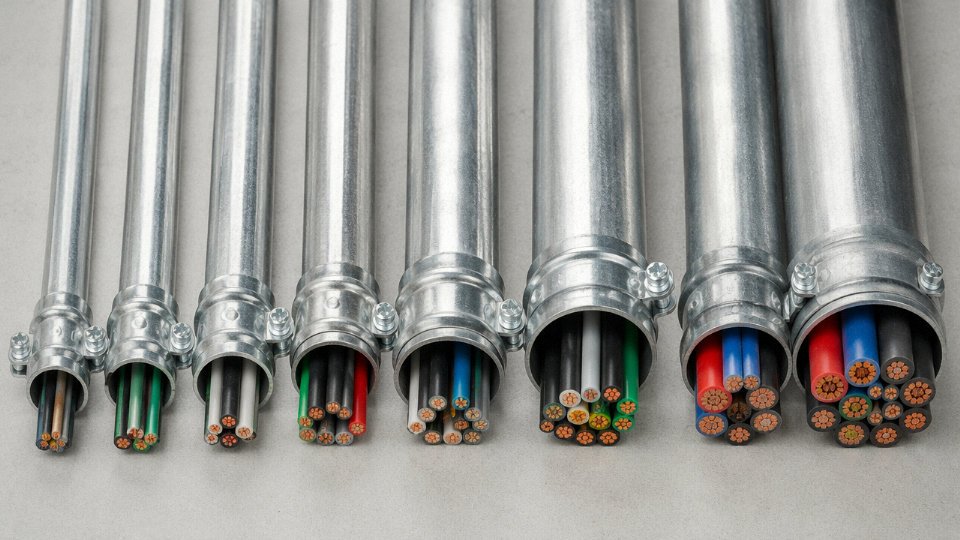
Consistent outer diameter is a manufacturing discipline problem, not a design problem. It requires tight extrusion control across the full production run — not just the first few meters off the drum.
Flexibility, Bend Radius, and Tight-Space Installation
In control panels, junction boxes, and densely packed cable trays, flexibility is not a luxury. A stiff cable that exceeds its minimum bend radius during installation creates two risks: insulation stress at the bend (a long-term failure point) and slower, more physically demanding installation. Electricians working in tight DIN-rail enclosures with 20+ multi-core instrumentation cables will spend considerably more time managing a rigid cable than a well-stranded, flexible equivalent. IEC 60228 Class 5 fine-wire stranding exists for exactly this reason on cables intended for installation-heavy environments.
Armor Type and Termination Time
Armor selection has a direct and often underestimated effect on termination speed. Steel wire armored (SWA) cable requires cutting individual wires, folding them back, and clamping — a process that takes a competent electrician roughly 20–35 minutes per termination depending on core count and gland type. Aluminum wire armored (AWA) cable behaves similarly but is lighter and easier to handle on long pulls. Corrugated aluminum sheath (CAS) cable, common in larger power installations, terminates differently again and requires specific gland hardware that not every crew carries on the van.
Specifying the wrong armor type for the installation environment doesn’t just create a compliance issue — it creates a labor cost issue the moment the crew realizes their standard gland kit won’t work.
Compliance Specifications That Prevent Rework
Cables manufactured to IEC 60502 and IEC 60332 reduce the likelihood of failed site acceptance testing and re-inspection labor costs.True
IEC 60502 governs construction and test requirements for extruded solid dielectric power cables, and IEC 60332 covers flame propagation resistance — both are standard acceptance criteria on industrial and infrastructure projects globally. Cables meeting these standards are less likely to fail flame tests or dielectric checks during commissioning inspection.
Rework is the most expensive labor category on any electrical project because it often requires the same work twice: pulling, terminating, testing, and then doing it all again. Specifying cables that meet IEC 60228, IEC 60502, and IEC 60332 from the outset is a straightforward way to eliminate one category of rework risk entirely. Most reputable project engineers and EPC contractors require this as a baseline — the cost of re-inspection alone, including the electrician’s time, an independent testing engineer, and project schedule slippage, easily exceeds any savings from specifying a cheaper, non-compliant cable.
Where Jinda’s Manufacturing Scale Connects to Your Labor Budget
Dimensional consistency, proper stranding, accurate length marking, and correct armor construction are all outputs of manufacturing discipline, not luck. Jinda’s five production bases across China, covering 470,000 m² of manufacturing space, operate with integrated R&D through to after-sales — which in practical terms means that a specification question raised during procurement can be answered by the same technical team that sets production parameters, rather than getting lost between a trading house and an unknown factory.
For international projects sourcing cable in volume, that integration matters. Inconsistent quality across drum lots — different outer diameters, variable lay lengths — is a known problem with lower-tier suppliers, and it’s exactly the kind of variation that turns a budgeted 6-week cable installation into an 8-week one. The electrician’s hourly rate didn’t change. The drum count just quietly added days.
Union vs. Non-Union Electricians: Rate Structures, Prevailing Wage Laws, and What They Mean for Budgets
The union versus non-union question trips up a lot of project budgets — not because one is obviously better, but because the cost structures are genuinely different in ways that don’t show up until the invoice arrives.
IBEW Scale and the True Cost of a Union Electrician
IBEW journey-level base wages in the United States currently run somewhere between $35 and $65 per hour, depending heavily on the local. New York City Local 3 sits near the top of that range; rural locals in the South or Midwest tend to land toward the lower end. But base wage is only part of what a contractor actually pays.
Once you stack in health and welfare contributions, pension fund payments, apprenticeship training fund contributions, and any annuity or vacation fund requirements, the total package cost to the contractor typically lands between $75 and $120 per hour for a journey-level wireman. That’s the number that matters for a project budget — not the wage printed on the classification sheet. Contractors who quote you a “union rate” and then hand you a bill that somehow comes in lower than $75 an hour are usually either misclassifying workers or cutting corners on fund contributions, both of which create compliance exposure.
Non-Union Rates and the Turnover Problem Nobody Talks About
Non-union electricians typically work at base rates 10–30% below their IBEW counterparts. On a short residential or light commercial job, that spread is real money and often perfectly acceptable. On a 14-month industrial installation — a new manufacturing line, a substation upgrade, a cable tray build-out across a 40,000 m² plant — the calculus changes.
Non-union shops carry their own benefits burden differently. Some offer competitive packages; many offer very little. The result tends to be higher turnover on long projects, and turnover on an industrial site is not just an HR annoyance. It means rework, inconsistent termination quality, retraining on site-specific safety procedures, and lost productivity every time a new face shows up at the tool crib. In practice, a non-union crew that starts strong and rotates 30–40% of its workforce halfway through a project often ends up costing more per installed foot of cable than the union quote that looked expensive at bid time.
That said, experienced non-union contractors with low turnover and solid QC programs absolutely exist. The issue is verifying which kind you’re dealing with before you sign.
Prevailing Wage Laws Change the Equation on Public Projects
The Davis-Bacon Act requires contractors on federally funded U.S. construction projects to pay locally prevailing wages and fringe benefits, regardless of whether the contractor is union or non-union.True
The Davis-Bacon Act of 1931 and its related Acts mandate prevailing wage rates on federal and federally assisted construction contracts over $2,000. This applies to non-union contractors as well, requiring them to pay wage rates determined by the U.S. Department of Labor for the specific trade and locality.
This is the part that catches international procurement managers off guard. If your infrastructure project is receiving federal or state funding — a public transit facility, a government building, a utility-funded grid expansion — Davis-Bacon applies. Non-union contractors bidding that work are legally required to pay union-scale wages and fringe benefits for each classification. Their lower overhead structure may still give them a small cost advantage, but the base labor cost is essentially fixed by the applicable wage determination.
Similar frameworks apply across EU public procurement, where member-state posted workers directives and public contract regulations impose comparable wage floors on state-funded projects.
What this means for cable procurement planning: the labor cost envelope on a publicly funded project is less flexible than it appears. You cannot arbitrage labor by sourcing a cheaper contractor and expect the same savings to flow through. The wages are mandated. What you can influence is productivity — how many hours that mandated wage actually buys you.
Apprentice Ratios and Crew Productivity
Union agreements specify apprentice-to-journeyman ratios, typically one apprentice per one to three journey-level workers depending on local agreement. Apprentices are paid at a percentage of journey-level scale, stepping up as they progress through their program — usually starting around 40–50% of journey wage and reaching 90% by the final period. A crew structured near the maximum allowable apprentice ratio costs less per labor hour but moves more slowly on complex terminations, switchgear work, and anything requiring independent judgment.
For straightforward cable pulling through pre-installed conduit, a ratio-heavy crew is often fine. For industrial instrumentation wiring or high-voltage terminations on a tight commissioning schedule, you want journey-level hands on those connections.
What to Actually Request When Budgeting
Ask every electrical contractor — union or not — for their certified payroll classification breakdown before you finalize a project budget. This document shows exactly which workers are classified at which rate and whether prevailing wage compliance is already priced into the bid. A contractor who hesitates to provide it on a public project should raise a flag immediately.
On large industrial cable projects, also ask how the contractor handles cable that requires extra handling time — stiff armored cable, large-diameter power cable, specialty tray cable with tight bend radius specs. Material that installs cleanly and consistently keeps the billable hour count predictable. That connection between cable spec and labor cost is real, regardless of whether the crew carrying IBEW cards or not.
How to Evaluate Electrician Quotes and Avoid Common Billing Traps
Getting a quote from an electrician is easy. Understanding what you’re actually agreeing to pay is a different matter. Most budget overruns on electrical projects don’t come from the hourly rate — they come from line items that were never clearly defined upfront, or from billing policies the contractor assumed you understood.
Insist on a Fully Itemized Breakdown
A quote that reads “electrical installation — $4,200” tells you almost nothing useful. Push for separation between labor hours and rate, materials (cable, conduit, junction boxes, fittings), permit and inspection fees, and any subcontract work the primary contractor intends to pass off. This matters because each category has a different negotiating lever. Labor rates are set by license tier and local market conditions. Materials are something you may be able to source directly. Permits are fixed by the authority having jurisdiction and shouldn’t be padded.
In practice, a well-structured quote looks like a mini bill of materials attached to a labor schedule. If a contractor resists providing that level of detail, that resistance itself is diagnostic.
Material Markups Can Exceed the Labor Line on Large Jobs
Electricians routinely mark up materials between 10% and 30% over their cost — sometimes higher on specialty items or when they’re sourcing from a single distributor they have a relationship with. On a small residential job, that’s a manageable few hundred dollars. On a mid-scale industrial installation involving several thousand meters of medium-voltage cable, that markup can comfortably exceed the total labor cost.
The practical countermeasure is a direct supply agreement. When you procure cable and major materials independently — ideally with full technical datasheets and third-party test certificates already in hand — you remove the markup entirely and give the installing crew exactly what they need on day one. Suppliers like Jinda provide that documentation package as standard, which also shortens the electrician’s prep and verification time. That’s billable hours you don’t pay for.
Electricians commonly mark up materials 10–30% above their cost on standard projects.True
This is consistent with standard contractor practice across the U.S., UK, and Australian markets, reflecting procurement overhead and supplier account management. The actual range depends on job size, material type, and regional competition.
Minimum Billing Increments Are Not Standardized
Some contractors bill in 15-minute increments. Others bill full-hour blocks regardless of how long the actual task took. On a service call where a licensed electrician spends 22 minutes diagnosing a tripped breaker, the difference between those two policies is roughly $60–$90 at current journeyman rates. Get the increment policy in writing before the first call-out. For facilities running multiple short diagnostic visits across a maintenance contract, this adds up fast over a year.
Travel Time Is Often Billed Portal-to-Portal
Many electricians — particularly independent contractors and smaller firms — bill from the moment they leave their shop to the moment they return. On a remote plant site or a project outside the metropolitan core, that can add 1–2 hours of billed time per day per technician. It’s legal, it’s common, and it rarely appears prominently in the initial quote. Ask directly: where does the billable clock start and stop?
Verify Experience with Your Specific Cable and Voltage Class
References matter most when they’re specific. Asking an electrician for references is standard; asking whether those references involved the same voltage class, cable construction, and installation volume you’re specifying is what actually tells you something. A crew experienced with residential NM cable has a very different learning curve on a medium-voltage shielded industrial run. Mismatched experience translates directly to slower installation, more problem-solving time, and a longer labor invoice — regardless of the hourly rate you negotiated.
For large-scale or international projects, the documentation package your cable supplier provides — installation guidelines, bend radius specifications, termination instructions — reduces the amount of time an electrician spends figuring things out on site. That reduction is real and measurable in the final invoice.
Forecasting Total Project Electrical Labor Cost: A Practical Estimation Framework
Hourly rate is just the starting point. What factory owners and project managers actually need is a repeatable method to convert that rate into a defensible total labor budget before a single cable is pulled. The six-step framework below is how experienced project engineers do it — not perfectly, but close enough to avoid the ugly surprises that blow up contingency reserves in the final weeks of a project.

Step 1: Cable Quantity Takeoff
Start with your single-line diagrams and cable schedules. Pull total meters for each cable type and cross-section separately — lumping 4 mm² control cable with 95 mm² power cable into one number will wreck your installation rate estimates downstream. A realistic industrial site takeoff usually surfaces 15–30 distinct cable types once you separate by voltage class, insulation rating, armoring, and core count. Don’t guess on lengths; add 5–8% to scaled drawing measurements to account for routing bends, drip loops, and the inevitable field detour around a structural beam nobody marked on the drawing.
Step 2: Apply Installation Rate Factors
Installation speed varies enormously by environment. Rough benchmark ranges — and these depend heavily on crew experience, conduit size, and how congested the cable tray is — run roughly 60–90 minutes per 100 meters for free-air or open cable tray on a clear run, 90–150 minutes per 100 meters for conduit pulls (more for long runs, bends, or small-diameter conduit), and 180–300 minutes per 100 meters for direct burial with bedding and compaction included. A busy cable tray that’s 70% full before your cables arrive can push tray rates toward the conduit range in practice. Get that information from the civil or structural engineer before you estimate, not after.
Step 3: Termination Hours
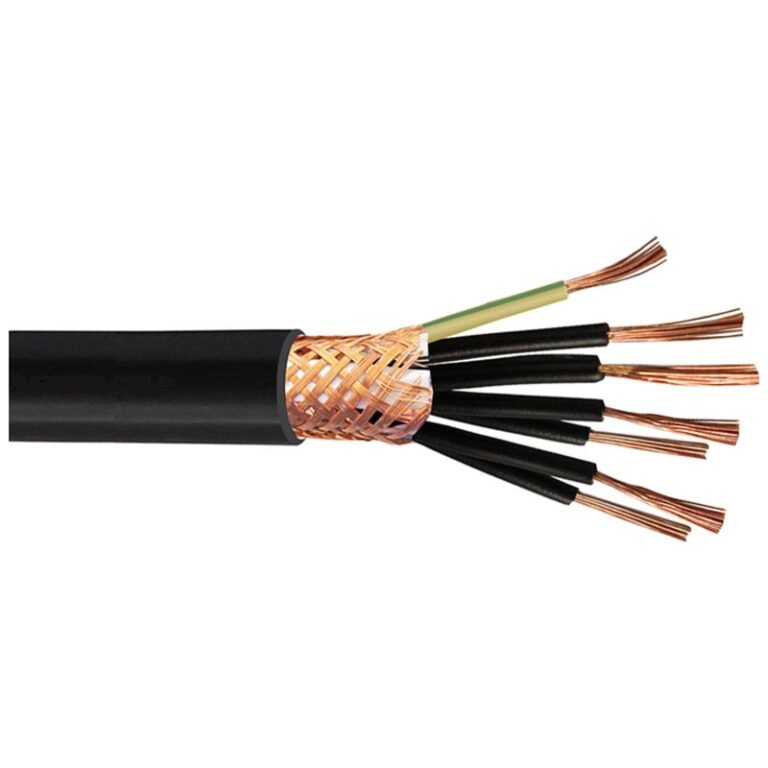
This step gets underestimated on almost every project. Count cable ends — both ends of every cable — then break them down by termination type: compression lugs on motor terminals, terminal block connections in junction boxes, cable glands through enclosure walls. A single 4-core 16 mm² cable with compression lugs at each end typically takes a journeyman 25–45 minutes per end depending on enclosure access. A multicore 37-core control cable terminated on terminal blocks can run 3–5 hours per end. On a medium-sized industrial project, termination labor frequently equals 30–40% of total installation labor. It is not an afterthought.
Step 4: Blended Crew Rate
Most industrial electrical crews are not all-master or all-journeyman. A typical site crew runs one master or foreman supervising two to three journeymen with one apprentice. Blended rates — weighted by actual crew mix and jurisdiction — usually land 15–25% below the master electrician ceiling rate. On a U.S. prevailing-wage project, that blended rate might be $85–$110/hr; on a commercial fit-out in regional Australia, AUD $100–$130/hr is a reasonable working figure, though it shifts with the enterprise agreement in place.
Step 5: Contingency Factor
First-time sites with incomplete as-built drawings: carry 15–20%. Repeat plant expansions with well-documented cable schedules and a crew that knows the facility: 5–8% is defensible. Inspection holds — where a city inspector flags an issue and the crew sits idle — can burn 2–4 days on a large project with no warning.
Step 6: Load the Premiums
Overtime probability, HazLoc area surcharges, and prevailing wage deltas all layer on top of the base calculation.
Termination labor on multicore cables commonly represents 30–40% of total electrical installation labor cost on industrial projects.True
Industry estimating guides and experienced project engineers consistently report that termination work — especially on multicore control cables with high core counts — accumulates hours rapidly. This proportion is well-supported by standard electrical project estimating practice.
Worked Example: 5,000-Meter Industrial Installation
Say you have a 5,000-meter project: 2,000 m of 95 mm² power cable in conduit, 2,000 m of 16 mm² multicore cable on tray, and 1,000 m of 4 mm² control cable free-air. Using mid-range installation factors, that’s roughly 2,000 hours of pull labor. Add 350 cable ends across all types — weighted average 45 minutes each — and termination adds another 260 hours. Gross labor: ~2,260 hours. At a blended U.S. crew rate of $95/hr, that’s $214,700 before premiums. Apply 12% contingency and a 10% overtime premium on 30% of hours: total loaded labor budget lands around $255,000–$265,000.
Now the cable quality variable: if the cable specified is dimensionally inconsistent — slightly oversized OD relative to nominal, stiff jacket compound — pulling through conduit slows by 20–30%, terminations take longer because insulation strips unevenly, and gland fitting becomes a fight. On this 5,000-meter example, that degradation can add $15,000–$30,000 in real labor cost. It is one of the clearest cases where procurement saving on cable unit price actually costs more on the labor invoice.
Frequently Asked Questions About Electrician Hourly Rates and Electrical Project Costs
What is the average electrician hourly rate in the United States in 2024?
Journeyman electricians run roughly $50–$100/hr nationally, but that range collapses quickly once you factor in location. A journeyman in rural Mississippi sits near the low end; one in San Francisco or Boston will clear $95–$110/hr before any overtime. Master electricians typically bill $100–$150/hr, sometimes higher on specialized industrial work. Apprentices, where contractors bill them out separately, might come in at $30–$55/hr — though most contractors bundle apprentice labor into crew rates rather than break it out on an invoice. What the number actually lands at depends on union affiliation, local licensing requirements, and how tight the skilled-trades labor market is in that metro.
Do electricians charge for travel time?
Most do, and a surprising number of project managers miss this on the first invoice. Portal-to-portal billing — charging from the moment the crew leaves the shop to the moment they return — is standard practice among many commercial contractors. On short local jobs it might add 30–60 minutes of billable time daily. On a large multi-week project at a remote industrial site, travel costs can run $800–$2,500+ per week for a full crew depending on distance and headcount. The negotiation lever here is job duration: contractors are generally willing to cap daily travel charges or fold them into a fixed mobilization fee on projects lasting several weeks. Get this in writing before work starts.
Is it cheaper to hire a non-union electrician?
In the short term, the rate difference is real — non-union shops often bill 15–30% lower per hour depending on region. Whether that saves money overall is less clear. Union contractors typically carry stronger warranty obligations, are more likely to be bonded at higher limits, and on any federally or state-funded project, prevailing wage laws may legally require union-equivalent pay regardless. On private commercial work, a non-union shop with a solid local reputation can absolutely deliver quality. The risk isn’t the union card; it’s vetting. A low hourly rate from an under-insured or undertrained crew can translate directly into rework, inspection failures, and change orders that erase the savings.
Non-union electricians are always less qualified than union electriciansFalse
Certification and licensing requirements apply equally regardless of union affiliation in most U.S. jurisdictions. Union membership affects wage structure and labor agreements, not the underlying license tier.
How much does it cost to wire a commercial building per square foot?
Labor-only for standard commercial office or retail build-out runs roughly $3–$8/sq ft, depending heavily on fixture density, panel complexity, and local wage rates. High-density spaces — data centers, commercial kitchens, medical offices — push that to $10–$18/sq ft or beyond. These figures assume normal-difficulty conduit runs and standard-specification cable; unusual routing, concrete core drilling, or hazardous-location classification adds cost fast.
Does cable quality really affect electrician labor costs?
It does, more than most procurement managers expect. Cable with tight outer-diameter tolerances pulls through conduit consistently without jamming — sloppy OD variation on cheaper product causes repeated re-pulls, which adds real hours on a long conduit run. Flexible, well-compounded sheathing matters on tight bends and tray installations; stiff, poorly plasticized jacket compound cracks at corners and slows termination. Conductors with consistent lay length and good flexibility reduce termination time at panels and junction boxes. On a large commercial or industrial project with thousands of meters of cable, these small per-meter time differences compound. A rough estimate: poor-quality cable on a 50,000 sq ft commercial project can add 5–12% to total labor hours versus properly specified product — which at $80/hr crew rates is not a rounding error.
What questions should I ask before hiring an electrician for a large cable installation project?
- Is the contractor licensed at the correct tier for this scope — journeyman, master, or electrical contractor license?
- What liability insurance limits do they carry, and will they provide a current certificate before mobilization?
- Have they worked with the specific cable types specified — MV cable, armored cable, instrumentation cable — or only standard NM and conduit work?
- How is travel time billed, and is there a daily cap?
- What is the markup on owner-supplied versus contractor-supplied materials, and is that rate fixed in the contract?
- Who is the site supervisor and what is their license level?
- What is the rework and warranty policy if terminations or splices fail inspection?
How do electrician rates differ for high-voltage cable work above 1 kV?
Medium-voltage and high-voltage cable work commands a meaningful premium — typically 25–50% above standard commercial rates, sometimes more. The drivers are certification (many jurisdictions require specific MV/HV credentials beyond a standard electrician license), the liability exposure involved, and the genuine skill required for proper cable preparation, splice kits, and termination. A crew-hour rate of $130–$200+ for qualified MV cable termination work is realistic in most U.S. markets. Skimping on this is one of the more consequential mistakes a project owner can make; a failed MV termination can take a substation offline for days.
Can I supply my own cable and just pay for labor?
Yes, and on large projects this arrangement is common and worth pursuing — particularly when the owner has a qualified procurement team or an established supply relationship with a manufacturer. The contractual structure matters enormously, though. The contractor will typically disclaim liability for cable performance, material defects, and any rework caused by product issues. Get that scope of liability explicitly defined in writing. The contractor may also charge a handling or staging fee (often 5–15% of material value) to cover their coordination risk. If you go this route, supply cable that meets or exceeds the contractor’s specification exactly — submitting a substitute product mid-project without approval is a reliable way to generate a change order and delay the schedule.
Why Cable Procurement Strategy Is as Important as Labor Rate Negotiation on Large Projects
Most project managers spend weeks grinding down an electrician’s hourly rate by a few dollars, then sign off on a cable purchase order without a second look. That’s backwards. On any industrial or commercial project above a few hundred thousand dollars in total electrical spend, cable materials routinely equal or exceed the accumulated labor bill. Shaving $5/hr off a journeyman’s rate while accepting substandard or misspecified cable is, practically speaking, rearranging the budget in the wrong direction.
The math isn’t subtle. A medium-sized industrial facility might run 15,000–40,000 linear meters of power and control cable, depending on layout complexity and equipment density. At current copper pricing plus manufacturing margin, that’s a material line item that can dwarf even a large unionized labor budget. Optimizing one side of that equation while ignoring the other leaves real money on the table — and worse, it creates downstream labor costs that never appear in the original quote.
The Quality-Labor Interaction Is Real and Measurable
Here’s what gets overlooked in procurement conversations: cable that arrives with inconsistent insulation geometry, marginal conductor cross-section tolerances, or undocumented fire performance forces the electrician to improvise. Terminations take longer. Inspectors raise flags. Re-pulls happen. In practice, a single rejected cable run in a conduit system — caught at final inspection rather than rough-in — can cost several hours of rework labor plus reinspection fees, sometimes more than the price difference between a compliant and a non-compliant cable in the first place.
Specifying cable to IEC 60502 (power cables up to 30 kV), IEC 60228 (conductor classes), and IEC 60331/60332 (fire resistance and flame propagation) isn’t bureaucratic checkbox behavior. Those standards set dimensional, electrical, and mechanical tolerances that make installation predictable. Electricians who work regularly with consistently manufactured cable move faster, make cleaner terminations, and generate fewer punchlist items. The labor saving is real, even if it’s hard to line-item on a quote.
Jinda’s Supply Capability at Project Scale
Shandong Jinda Special Cable Group, established in 1987, operates five production bases across China covering roughly 470,000 m² of manufacturing space, with over 1,000 employees and an active export program reaching more than 50 countries. That scale matters when you’re managing a project timeline. A manufacturer that can’t guarantee batch consistency or meet a staged delivery schedule forces the electrical contractor to manage partial installations, store excess material on-site, and potentially remix cable from different production lots — all of which adds coordination overhead and, yes, labor hours.
Jinda’s product range covers the categories that show up on most industrial and infrastructure project cable schedules: low-voltage power cables, medium-voltage cables, armored cables (SWA and STA constructions), fire-resistant and low-smoke zero-halogen cables, control cables, instrumentation cables, and specialty cables for renewable energy applications and demanding industrial environments. That breadth matters for EPC contractors who want a single qualified supplier rather than chasing five vendors across two continents.
Jinda exports cables to more than 50 countries and operates five production bases in China covering approximately 470,000 m² of manufacturing space.True
These figures are sourced directly from Jinda's documented company profile and manufacturing footprint, reflecting their established international supply operations since 1987.
One Accountable Supplier as a Risk Reduction Tool
Having R&D, production, quality control, sales, technical support, and after-sales service inside one organization means a project manager has a single point of accountability. When a test certificate question comes up during commissioning — and it always does — you’re not bouncing between a trading house, a mill agent, and a lab in three time zones. That integration reduces the administrative friction that quietly inflates project management cost on complex international jobs.
Procurement managers, EPC contractors, and distributors sourcing cable for international projects are welcome to contact Jinda directly for product specifications, third-party test certificates, and project-specific supply quotations.