Specify the wrong cable for a conveyor drive, an irrigation pump, or a substation feeder and you will find out quickly — insulation breakdown, nuisance tripping, overheated terminations, or a full conductor burnout that pulls the line down for anywhere from a few hours to several days depending on how fast your team can source a replacement. The repair cost is rarely the worst part; unplanned downtime in a mid-size manufacturing plant typically runs USD 5,000–15,000 per hour, depending on product value and shift structure. Getting the cable specification right the first time is not a procurement detail — it is an operational decision.
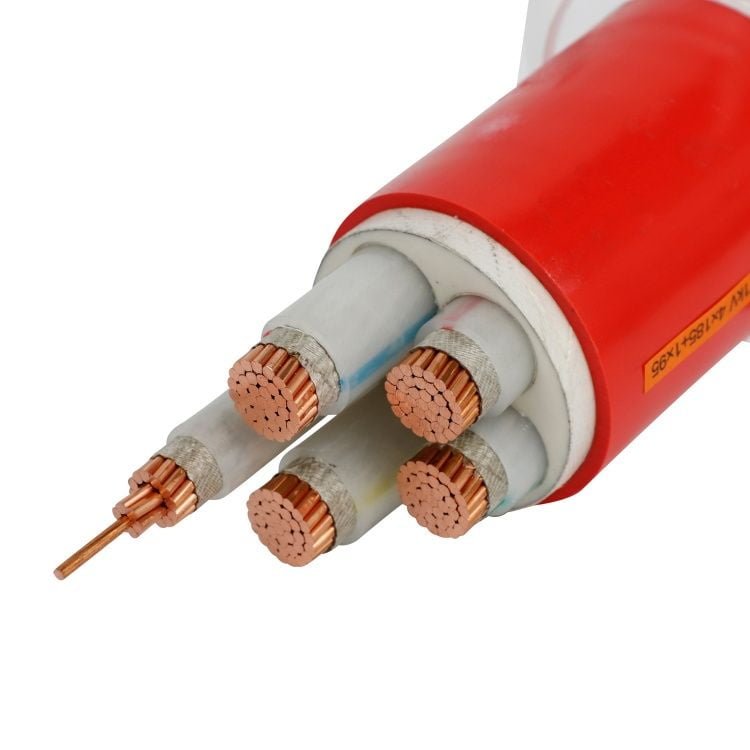
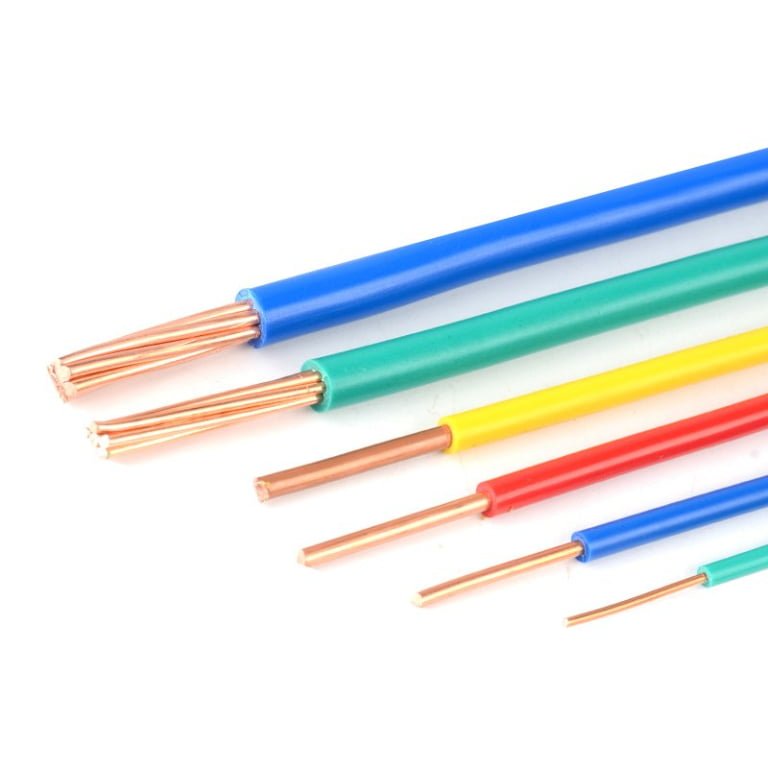
A cable wire is an electrical conductor — copper or aluminum — insulated and jacketed to carry power, signals, or data safely across a defined voltage, temperature, and mechanical environment. Applications range from 0.5 mm² flexible cords in appliances to 2,500 mm² armored feeders in utility substations. The correct type depends on installation method, load current, ambient conditions, and the governing standard — most commonly IEC or NEC.
What makes this genuinely complicated is how much the term “cable wire” actually covers. The global wire and cable market was valued at roughly USD 225 billion in 2023 and is on track to exceed USD 300 billion by 2030 — not because demand is exotic, but because the range of applications is almost absurdly broad, from a thin thermocouple extension lead in a food oven to a submarine HVDC link running hundreds of kilometers. Understanding what separates one category from another is where the real engineering — and the real procurement leverage — starts.
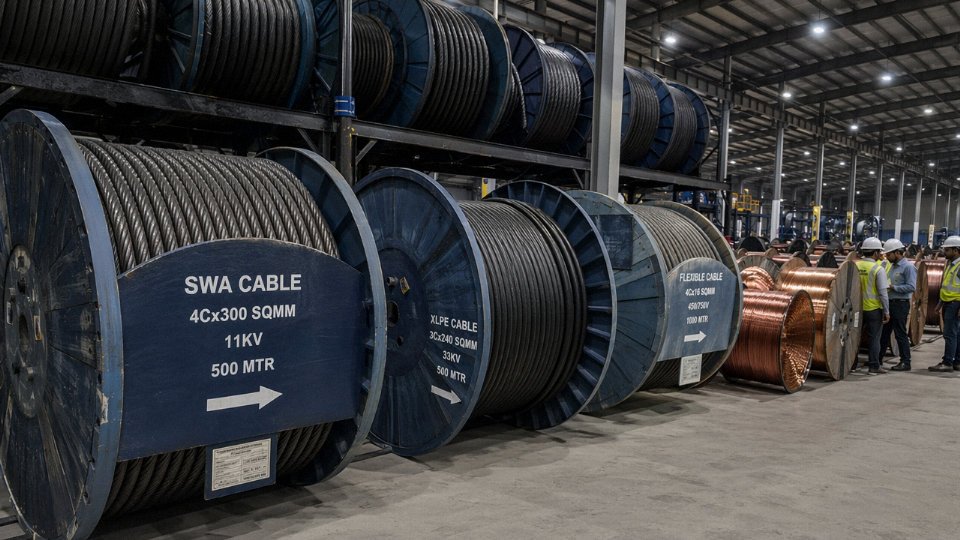
Power Transmission and Distribution: How High-Voltage Cable Wire Moves Electricity Across Cities and Nations
Moving electricity from a generation source to an end user is not a simple matter of running a wire. At grid scale — think 220 kV substations feeding a metropolitan area, or a 500 kV link tying two regional grids together — the cable itself becomes a piece of critical infrastructure, and the wrong specification can mean thermal runaway, dielectric failure, or years of excess I²R losses that quietly erode the economics of an entire project.
EHV Underground Cable Versus Overhead Line: The Real Selection Decision
Overhead bare conductors — ACSR (aluminum conductor steel-reinforced) and the newer ACCC (aluminum conductor composite core) — remain the default for long rural transmission corridors. They are cheaper per kilometer, easier to inspect, and faster to repair after storm damage. But in dense urban corridors, environmentally protected zones, and coastal areas where right-of-way acquisition is politically impossible, underground XLPE-insulated cables at 220 kV to 500 kV are mandated, sometimes by regulation, sometimes simply by the math of land cost versus cable cost.
The crossover point varies — rough rule of thumb in my experience is that once you factor in land acquisition, visual-impact studies, and community opposition, underground cabling starts looking economically competitive somewhere in the 5–15 km range for urban routes, though that depends heavily on local permitting costs and soil conditions. Sandy or waterlogged ground adds civil cost fast.
At 220 kV and above, XLPE (cross-linked polyethylene) insulation has largely displaced older PILC (paper-insulated lead-covered) designs for new installations. The dielectric loss tangent of XLPE runs roughly 0.0002–0.0004, compared to 0.003–0.005 for impregnated paper — a difference that matters over a 30-year asset life.
Conductor Sizing: Ampacity, Losses, and the Copper-Aluminum Trade-Off
Ampacity calculations follow IEC 60287, and the variables that drive them are installation depth, soil thermal resistivity (which can swing from 0.7 K·m/W in damp clay to 2.5 K·m/W in dry sand — a factor that procurement specs routinely underspecify), ambient temperature, and grouping effects when multiple circuits share a trench.
For bulk transmission, conductor cross-sections typically run 400 mm² to 2,500 mm². A 1,600 mm² aluminum XLPE cable at 220 kV will carry roughly 900–1,100 A depending on installation conditions; the same cross-section in copper would carry more, but the cable weighs significantly less in aluminum and costs substantially less per ton of conductor. On a 20 km underground link, that weight difference affects pulling tension, joint bay spacing, and drum logistics in ways that matter on-site.
Aluminum conductors are always inferior to copper in transmission cablesFalse
For bulk transmission at 220 kV and above, aluminum is the standard conductor material worldwide. Its lower resistivity per unit cost and weight-to-conductance ratio make it the rational choice for large cross-sections. Copper is preferred where cross-section is constrained — in sub-transmission feeders, switchgear terminations, or where conductor diameter itself must stay small.
Sub-transmission feeders — the 33 kV to 132 kV cables running from primary substations to distribution points — typically fall in the 95 mm² to 400 mm² range, again aluminum in most utility applications unless local standards specify otherwise.
Submarine Cables: Where the Engineering Gets Unforgiving
Offshore wind farms and cross-strait grid interconnections push cable design into genuinely demanding territory. A submarine cable for a 220 kV offshore wind export circuit carries not just the XLPE-insulated conductors but a lead alloy sheath as a moisture barrier (seawater ingress into XLPE insulation is a slow but eventual failure mode), steel wire armoring sized for the burial depth and seabed mechanical hazards, and often one or two fiber optic pilot cores for real-time thermal monitoring and protection signaling. Total cable diameters for three-core submarine designs at this voltage reach 200–280 mm; individual cable drums for deep-water runs can weigh 50–80 tonnes, which immediately becomes a logistics and vessel-capacity problem.
Jinda’s high-voltage cable product lines cover this spectrum, with export supply experience across utility-scale projects in over 50 countries — a manufacturing footprint that gives procurement teams realistic lead time and volume flexibility that single-factory suppliers typically cannot match.
Building and Construction Wiring: Matching Cable Wire Type to Load, Environment, and Safety Code
Construction wiring is where cable volume really lives. A single mid-rise commercial building might consume tens of kilometers of wire across dozens of circuit types — and getting the specification wrong doesn’t just mean a code failure on inspection day. It means re-pulling cable through finished walls, or worse, a fire that traces back to undersized conductors running hot for years.
Mapping Cable Types to Building Zones
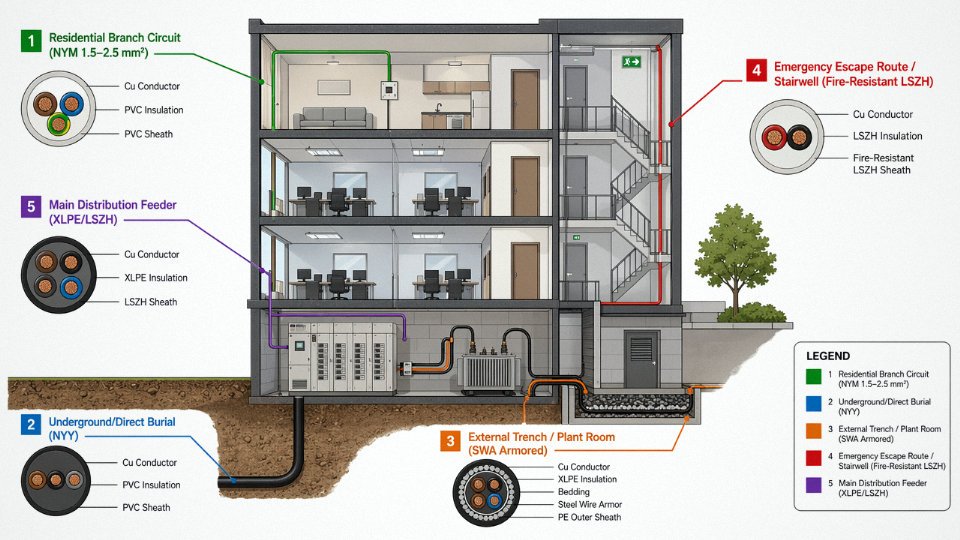
The starting point is always location and mechanical exposure. NYM cable — PVC-insulated, PVC-sheathed, unarmored — is the workhorse for dry indoor fixed installations: residential branch circuits, office partition walls, light commercial runs. It’s easy to handle, cost-effective in bulk, and widely accepted under IEC-aligned national codes across Europe, Southeast Asia, and Africa. Move the same cable underground or into a concrete enclosure and you need NYY, which carries a thicker outer sheath rated for direct burial and damp conditions.
Armored SWA (steel wire armored) cable comes into play when the route crosses foundations, runs under landscaping, or passes through areas with mechanical risk — plant rooms, external trenches, industrial annexes attached to commercial buildings. The armor isn’t just about crush resistance; it also provides a return path for fault current in certain earthing arrangements, which affects how your protective device will actually operate under a fault.
Fire-resistant cable deserves its own category entirely. For escape routes, stairwells, emergency lighting circuits, fire alarm loops, and hospital critical systems, the cable has to maintain circuit integrity at elevated temperatures — typically 90 minutes at 830–1000°C per IEC 60331 testing conditions. Specifying standard NYM on an emergency generator feed is a code violation in most jurisdictions and a genuine life-safety failure. Don’t do it.
Insulation Materials and the LSZH Argument
PVC is cheap, flexible, and has decades of installation history behind it. It’s also the right choice for a large fraction of building wiring. The problem with PVC in enclosed, high-occupancy spaces is combustion chemistry: it releases hydrogen chloride gas and dense smoke, which is what actually kills people in building fires — not always the flames themselves.
LSZH (low-smoke zero-halogen) insulation and sheathing eliminate that chlorine-based toxicity. In tunnels, metro stations, hospital corridors, data centers, and airport terminals, many national codes and project specifications now mandate LSZH as a baseline, not an upgrade. The material costs roughly 15–35% more per meter than comparable PVC grades depending on cable cross-section and order volume, but that premium is trivial against the liability exposure or the cost of a retro-specification after a building control review.
XLPE sits in a useful middle ground — better thermal rating than PVC (90°C continuous vs. 70°C), suitable for higher-load commercial feeders, and more dimensionally stable over long service life. For main distribution feeders in large buildings, XLPE conductors in LSZH sheath is a combination you’ll see specified frequently in Middle Eastern and Southeast Asian project specs.
Conductor Sizing: Voltage Drop and Derating in Practice
IEC 60364 sets the voltage drop limit at ≤3% for final circuits and ≤5% cumulative from the supply origin. In practice, for a 20-meter lighting circuit at 230 V drawing 10 A, a 1.5 mm² conductor sits right at the edge — acceptable, but with no margin if the circuit gets extended during fit-out, which it almost always does. Specifying 2.5 mm² on lighting circuits in commercial projects is common sense, not over-engineering.
The derating rules matter more than most contractors want to deal with. When you bundle four or more circuits in the same conduit or trunking, IEC 60364-5-52 grouping factors can reduce the effective current-carrying capacity by 30–50% depending on the number of cables and installation method. A 2.5 mm² cable rated at 24 A in open air might be limited to 14–16 A when grouped. Ignoring this is exactly how conductors run permanently warm and insulation ages out in ten years instead of thirty.
Standard cross-section selection for building circuits typically follows a rough logic: 1.5 mm² for lighting, 2.5 mm² for socket outlet circuits, 4–6 mm² for dedicated appliance circuits (cookers, AC units), and 10–35 mm² for sub-distribution feeders — though all of these depend on circuit length, load, and derating conditions specific to the installation.
Grounding and Protective Earth Conductors
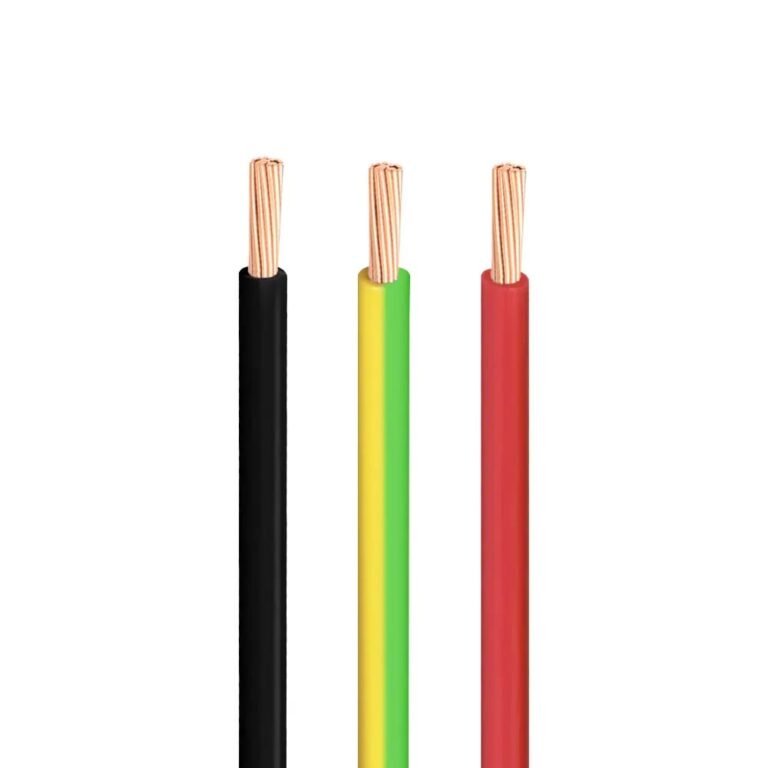
The green/yellow striped conductor isn’t optional, and it isn’t a formality. IEC 60364-5-54 governs protective earthing and equipotential bonding in detail, and the protective earth (PE) conductor is what ensures a fault to exposed metalwork trips the protective device rather than energizing the enclosure indefinitely. Undersizing the PE conductor — a common cost-cutting habit on long cable runs — increases earth loop impedance and can prevent fast disconnection under fault conditions.
IEC 60364-5-54 requires the protective earth conductor to be sized in relation to the phase conductor, with specific minimum cross-sections depending on whether it forms part of the same cable or is run separately.True
IEC 60364-5-54 Table 54.2 specifies minimum protective conductor cross-sections: up to 16 mm² phase, the PE must equal the phase cross-section; from 16–35 mm² phase, PE minimum is 16 mm²; above 35 mm², PE minimum is half the phase cross-section. This is a hard requirement, not a guideline.
Bulk Supply for Construction Projects
For real estate developers and electrical contractors sourcing cable across multiple sites or phased developments, consistency of specification across batches matters as much as unit price. Conductor resistance varying between production lots causes measurable differences in voltage drop on long runs — subtle enough to pass individual inspection but enough to skew energy metering over time.
Jinda’s building wire production, distributed across five manufacturing bases in China with ISO-certified quality processes, is structured specifically to support large-volume, multi-shipment contracts where dimensional tolerance and electrical consistency need to hold across the full order quantity — not just the first sample spool. For export procurement managers coordinating supply into Africa, the Middle East, or Southeast Asia, that production depth and multi-base capacity reduces lead-time risk on large project schedules in a way that a single-factory supplier often can’t match.
Industrial and Heavy Machinery Applications: Cable Wire Under Mechanical Stress, Heat, and Chemical Exposure
Standard PVC-insulated cable is fine for most building wiring. Put it on a factory floor next to a furnace, run it through a mining drift, or flex it 200 times a day on a crane trolley, and it fails — sometimes visibly, sometimes silently until something trips or burns. The failure modes are predictable: PVC insulation is rated for 70°C continuous conductor temperature under IEC 60364; push past that and the plasticiser migrates, the jacket hardens, and the insulation resistance drops. In a steel mill or glass plant where ambient temperatures near cable routes can exceed 60°C before the cable even carries load, that 70°C ceiling disappears faster than most engineers budget for.
XLPE insulation extends the continuous rating to 90°C (105°C for some specialist grades), and silicone rubber constructions handle 150–180°C depending on formulation and cross-section — numbers that matter when you’re routing alongside a reheat furnace or through a process area with steam tracing. UV degradation is a separate issue that catches outdoor industrial sites off guard: standard PVC yellows and crazes within 18–24 months in direct sunlight at equatorial latitudes; carbon-black-loaded polyethylene or UV-stabilised TPE sheaths push that service life to 15 years or more, though actual performance depends on UV index, sheath thickness, and whether the cable is mounted against a reflective surface.
Trailing and Reeling Cables for Cranes and Continuous Miners
Overhead travelling cranes, port gantry cranes, and underground continuous miners share one brutal requirement: the cable has to move, thousands of cycles per day, without work-hardening and cracking the conductors. That demands Class 5 or Class 6 stranding per IEC 60228 — fine or ultra-fine wire bundles, typically 0.2 mm or smaller individual wire diameter — combined with a sheath tough enough to survive being dragged across grating or spooled tightly on a drum. Reinforced chloroprene rubber (neoprene) or polyurethane sheaths are common choices; polyurethane in particular resists abrasion well but can be stiff in sub-zero conditions, which matters if you’re in a northern open-cast mine in winter.
Tensile load management is where a lot of specifiers get into trouble. A reeling cable on a 50-tonne EOT crane may see axial tension of 2–5 kN depending on drum diameter, cable mass, and travel speed. Without strain-relief elements — typically helically laid textile or steel wire reinforcement within the sheath — that load transfers directly to the conductors and accelerates fatigue failure. Good trailing cable designs decouple mechanical tension from the electrical conductors entirely.
VFD Cables and EMI in Automated Factories
Variable frequency drives generate high-frequency switching transients — typically 2–20 kHz carrier frequencies, sometimes higher — that couple capacitively to unshielded cable runs and radiate into adjacent instrumentation. In a CNC machining centre or servo-driven conveyor line, that interference shows up as encoder faults, axis errors, or nuisance drive trips. The fix is a shielded VFD cable with a symmetrical three-phase layout, low-impedance 360° shield termination, and an overall foil-braid combination shield with coverage above 85%. Some plants run separate conduit as a workaround, but that adds installation cost and doesn’t fully address common-mode noise on long runs above roughly 30–50 metres.
Shielded VFD cables with symmetrical conductor geometry reduce common-mode EMI by 20–40 dB compared with unshielded cable of equivalent cross-section.True
This range is consistent with published IEC 61800-5-2 guidance and independent EMC laboratory data; exact attenuation depends on shield coverage percentage, grounding quality, and cable route length.
Mining Cables: Earthing Pilots, Armoring, and Flame Retardance
Underground mining adds several requirements simultaneously: mechanical protection against rockfall and equipment traffic, a pilot conductor for earth continuity monitoring (so that a damaged sheath triggers a shutdown before someone touches a live frame), and flame-retardant sheathing because a cable fire underground is a mass-casualty event. IEC 60502 and AS/NZS 1125 both address mining cable construction; FRAS (flame-retardant anti-static) sheathing is mandated in coal mines specifically because static discharge near methane is obviously unacceptable. The anti-static requirement is typically a surface resistivity below 1 × 10⁹ Ω/square — easy to verify, often overlooked in procurement specs written by engineers who’ve never worked underground.
Offshore and Petrochemical Environments
Offshore platform cable runs deal with hydrocarbon contamination, salt spray, and the requirement that a fire doesn’t generate halogen acids that corrode electronics and incapacitate personnel simultaneously. SHF2 (mud-resistant, halogen-free) compounds meet the hydrocarbon resistance requirement; LSZH (low-smoke, zero-halogen) sheaths address the fire toxicity side. Instrumentation cables in these environments — carrying 4–20 mA signals or thermcouple outputs across hundreds of metres — need individual pair shielding plus an overall braid or foil shield to reject both differential and common-mode interference from variable-speed pumps, high-current bus bars, and VFDs running in the same cable tray.
Jinda’s “Special Cable Group” designation reflects exactly this range of non-standard constructions. Custom cross-sections, non-standard temperature ratings, unusual sheath compounds, multi-conductor configurations with integrated pilots or data pairs — these require an R&D capability behind the manufacturing line, not just the ability to extrude standard product. In practice, a petrochemical EPC contractor specifying 12 different cable types for a single plant needs a supplier that can engineer and certify all of them rather than sourcing from six vendors and managing the qualification headache.
Renewable Energy Systems: The Specific Cable Wire Requirements of Solar, Wind, and Energy Storage
Renewable energy is the fastest-growing segment in the global cable market right now, and the cable requirements are genuinely different — not just a matter of upsizing a standard product. Engineers who specify conventional building wire for solar string runs or wind turbine flex cables find out the hard way, usually within two to three years when insulation cracks, connectors arc, or a DC ground fault triggers a fire.
Solar PV DC Cables: Why Standard Wire Gets You Into Trouble
The core problem with using ordinary building wire in a utility-scale solar array is the combination of sustained DC voltage, continuous UV exposure, and moisture cycling that no typical PVC-insulated cable was designed to survive. Modern utility-scale systems run at 1,500 V DC on the string side — roughly double what most building wire is rated for in DC service, where arc suppression is far more difficult than in AC circuits.
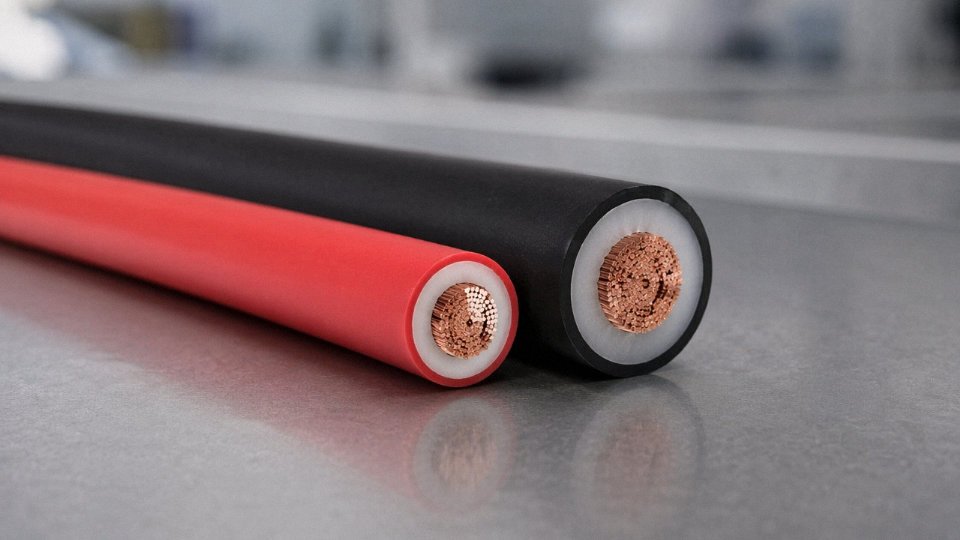
Purpose-built PV cables per EN 50618 (Europe) or IEC 62930 carry double insulation — a cross-linked polyethylene core insulation plus an outer XLPE or EVA-based sheath — and are certified for 1,500 V DC, 90°C continuous service. The tinned copper conductor matters more than most people initially realize: bare copper in a rooftop or ground-mount installation sees condensation cycles for twenty-plus years, and the resulting oxidation at crimp terminations raises contact resistance enough to cause measurable power loss and localized heating. Tinning adds roughly 3–6% to the conductor cost but eliminates that failure mode almost entirely.
Each GW of utility-scale solar typically requires somewhere between 35 and 50 tonnes of DC cable, depending on string length, row spacing, and whether the design uses central or string inverters. In 2023, global solar PV additions exceeded 350 GW. The arithmetic is straightforward, and it’s why PV cable production capacity is a real differentiator for any manufacturer supplying EPC contractors.
Standard PVC building wire is prohibited for solar PV string runs under IEC 62930 because it lacks the required DC voltage rating, UV resistance, and double insulation construction.True
IEC 62930 (and EN 50618 in Europe) specify dedicated requirements for photovoltaic cables including 1,500 V DC rating, resistance to UV and ozone, and double-insulation construction — requirements that standard building wire does not meet.
Wind Turbine Tower Cables: Torsion Is the Killer
A wind turbine’s nacelle yaws continuously to track wind direction. The power and control cables running from nacelle down through the tower twist with every rotation — potentially millions of flex cycles over a 20-year service life. Standard flexible cable fails in torsion because the stranding geometry locks up under repeated twisting and individual wires work-harden and fracture.
Torsion-resistant tower cables use specially laid stranded conductors — typically Class 5 or Class 6 fine wire per IEC 60228 — wound in opposing lay directions so the cable geometry absorbs rotational stress rather than transmitting it into the conductors. In northern Europe and northern China, these cables also need to perform at −40°C without the sheath becoming brittle, and handle up to +90°C inside the tower in summer. That temperature range rules out most general-purpose compounds and pushes toward specialized TPE or rubber sheaths.
BESS Cabling: Short Runs, High Current, Enclosed Spaces
Battery energy storage containers are a confined-space application. Short, high-current busbars and flexible battery interconnect cables carry hundreds of amperes at relatively low voltage, often 48 V to 1,500 V DC depending on system architecture. The repetitive charge-discharge cycling creates thermal cycling in the terminations — which is where most BESS cable failures originate, not in the cable body itself.
LSZH sheathing is essentially non-negotiable in container BESS installations. If a cable fault ignites in an enclosed steel container, halogen-laden smoke incapacitates response crews fast. Flexible LSZH cables with fine-wire Class 6 conductors handle the mechanical movement from thermal expansion while meeting fire safety requirements.
AC Collection Networks: Getting the Derating Right
Once DC power reaches the inverter and transformer, the collection network — typically 35 kV XLPE-insulated medium-voltage cable — ties multiple inverter stations back to the main substation. These cables are usually directly buried or pulled through duct banks, and ampacity derating for soil thermal resistivity is where designs routinely go wrong. Sandy, well-drained soil might have a thermal resistivity of around 0.7 K·m/W; dry compacted clay can reach 2.5 K·m/W or higher. That difference can require a full conductor size step up to stay within temperature limits — something worth sorting out during the cable procurement spec stage, not during commissioning.
Telecommunications, Data Centers, and Signal Transmission: When Cable Wire Carries Information, Not Just Power
Most power engineers think about cable in terms of current-carrying capacity and voltage drop. Shift to the data and telecom world and the governing parameters change almost entirely — now you’re managing bandwidth, insertion loss, return loss, and noise rejection, often over the same conduit runs that carry mains power a meter away.
Structured Copper Cabling: Category Ratings Are Not Interchangeable
Cat 5e still turns up in retrofits and low-budget installations, but anyone specifying horizontal runs for a building going up today should be starting the conversation at Cat 6A minimum. The reason is straightforward: Cat 6A supports 10GbE to the full 100 m channel length defined in ISO/IEC 11801, whereas Cat 6 unshielded starts losing that headroom somewhere around 55 m under real-world conditions — dense bundles, patch-panel connections, temperature above 20°C. That margin disappears faster than most installers expect.
Cat 8 sits at the other end of the spectrum. Rated to 40GbE over distances up to roughly 30 m, it’s specified almost exclusively for switch-to-server and top-of-rack links inside data centers, not for floor-to-floor backbone runs. The conductor gauge is heavier (typically 22 AWG), the dielectric is tighter, and the alien crosstalk requirements are severe enough that you’re almost always dealing with shielded twisted pair — either F/FTP or S/FTP construction. Installing Cat 8 across a 90 m open-office floor plan makes no engineering sense and costs significantly more than the application demands.
Coaxial Cable: Impedance Is the Specification, Not an Afterthought
The 75-ohm versus 50-ohm split confuses procurement teams who are new to RF. These are not interchangeable. RG-6 (75 Ω) is the workhorse of broadcast distribution and CATV headend-to-tap infrastructure — the dielectric geometry is optimized for video signal frequencies up to roughly 1 GHz, and the characteristic impedance matches the input impedance of domestic and commercial TV equipment. Terminating a 75-ohm cable plant with 50-ohm connectors introduces a reflection that shows up as signal ghosting or measurable return loss on a spectrum analyzer.
For antenna feeder runs and RF transmission — base stations, two-way radio systems, wireless access point installations — the LMR series (LMR-195, LMR-400, LMR-600) and RG-58 family at 50 Ω are the standard choices. Attenuation increases sharply with frequency and cable length, so for runs above roughly 15–20 m at frequencies above 900 MHz, jumping from RG-58 to LMR-400 or equivalent low-loss coaxial is often worth the cost difference in link budget terms.
Control and Instrumentation Cables: Why Shielding Architecture Matters
In process plants and SCADA environments, a multi-core instrumentation cable typically carries 4–20 mA analog loops and RS-485 data on the same multi-pair construction. The standard shielding arrangement — individual foil screen per pair plus an overall braid — exists because the two signal types have different interference profiles. Individual pair screens break ground loops between channels and prevent crosstalk between adjacent loops. The overall screen handles lower-frequency environmental interference and provides a common drain path.
Skip the individual screens to save money on a BMS installation and you will likely spend considerably more diagnosing erratic sensor readings after commissioning. That outcome is common enough that experienced instrumentation engineers will reject unscreened multi-core cable for any analog signal run near variable-frequency drives, regardless of what the specification originally called for.
Power-and-Data Hybrid Cables: One Conduit, Two Functions
Hybrid cable — a power core bundled with data pairs inside a common outer sheath — has moved from novelty to standard in several fast-growing applications. Smart street lighting controllers need both 230 V supply and a RS-485 or DALI communication channel run to each luminaire. EV charging stations increasingly require a power feed plus Ethernet or CAN bus to the charge point controller. Running separate conduits for each function adds installation labor, underground duct, and junction boxes. A single hybrid cable eliminates most of that.
The engineering caveat is real: the power core must be adequately separated from the data pairs within the sheath, and the data pairs need at minimum foil screening to prevent the 50 Hz (or switching-frequency) noise from the power conductors from coupling into the signal circuits. This is not always done well by lower-cost manufacturers, and it shows up on site as data communication errors that are genuinely difficult to diagnose when the team doesn’t know hybrid cable is in the run.
EMI Shielding: Matching the Screen to the Threat
Foil tape (aluminum-polyester laminate) provides near-100% optical coverage and handles high-frequency interference effectively — above roughly 1 MHz it performs well. Tinned copper braid at 85% coverage or better is more robust mechanically, handles repeated flexing without cracking, and provides lower shield resistance, which matters for low-frequency magnetic field rejection. When the environment includes both — a cable tray running alongside VFD output conductors in a machinery enclosure, for instance — combination foil-plus-braid construction is the correct specification, not the premium upsell it’s sometimes treated as.
Foil-only shielded cables provide near-100% optical coverage and are effective against high-frequency interference above approximately 1 MHz, but tinned copper braid offers superior mechanical durability and lower-frequency performance.True
This reflects established EMC engineering practice documented in IEC 60096 and IEC 61196 series standards, as well as published shielding effectiveness data from major cable test laboratories. The two shielding types address different parts of the frequency spectrum and different mechanical service conditions.
The right answer depends on the installation. A fixed building automation run in a clean ceiling void is a different problem from a drag-chain cable in a stamping press environment.
Marine, Offshore, and Transportation Infrastructure: Cable Wire in Extreme and Mobile Environments
These segments don’t make the headlines the way utility-scale solar does, but they represent some of the most technically demanding cable specifications you’ll encounter in procurement. A single cable failure on a ship at sea, a platform FPSO, or inside a rail tunnel isn’t a maintenance inconvenience — it’s a safety event. That reality shapes every material choice.
Ship Wiring and IEC 60092: Why Standard Building Cable Won’t Survive at Sea
The IEC 60092 series exists because the marine environment combines hazards that almost never occur together onshore: saltwater spray, diesel fuel and hydraulic oil exposure, mechanical vibration from propulsion systems, and confined spaces where a cable fire has nowhere to go. Standard PVC-insulated wire absorbs moisture, degrades in oil contact, and releases dense toxic smoke when it burns. None of those are acceptable in an engine room or a cable trunk that runs through crew quarters.
IEC 60092-compliant ship cables use tinned copper conductors — the tin coating prevents oxidation from salt-laden air, which would otherwise raise contact resistance at terminals over a typical vessel service life of 20–30 years. Insulation compounds are halogen-free, mud-resistant, and rated for continuous submersion in brackish water in many cases. Cross-sections in shipboard power distribution typically run from 1.5 mm² for lighting circuits up to 240 mm² or larger for main switchboard feeders, depending on propulsion class and vessel tonnage.
In practice, specifying the wrong cable in a newbuild is expensive. Replacing wiring runs buried behind bulkhead linings mid-construction costs roughly 4–8× what correct initial material selection would have, based on typical shipyard rework rates. Catch it at commissioning and that multiplier goes higher.
Offshore Platforms and FPSOs: Fire Survival and Explosion Risk Together
Offshore cable selection layers an additional requirement on top of marine standards: the cable must maintain circuit integrity while burning. IEC 60331 tests exactly this — a cable under rated voltage, exposed to a 750–840°C flame for 90 minutes minimum, must keep the circuit alive. On a platform, that means emergency shutdown systems, deluge valve controls, and evacuation lighting remain functional during a fire long enough for safe personnel evacuation.
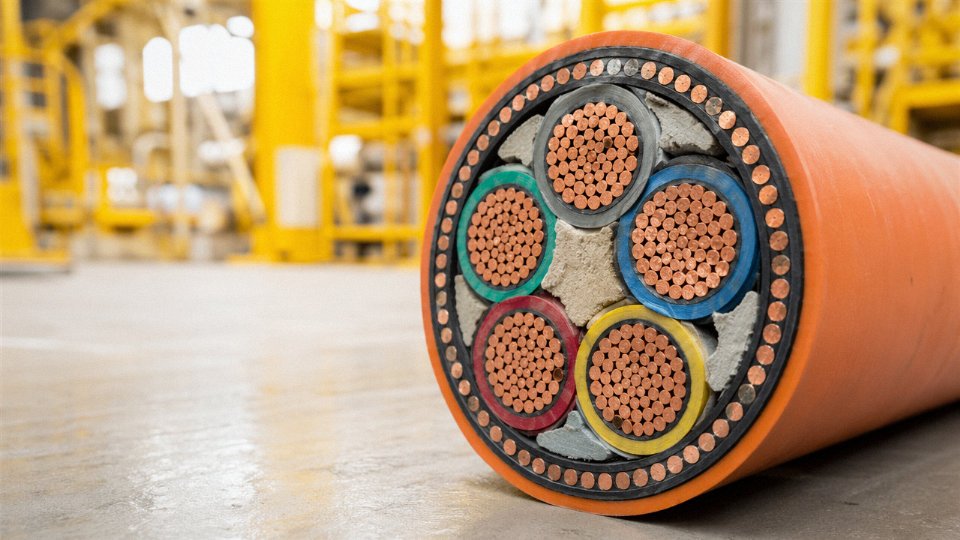
FPSO cable installations also need to be compatible with explosion-proof conduit systems in Zone 1 and Zone 2 classified areas. IACS (International Association of Classification Societies) unified requirements — enforced by classification societies like Lloyd’s Register, Bureau Veritas, DNV, and China Classification Society (CCS) — mandate type approval at the cable level, not just the installation level. You can’t substitute an uncertified cable and expect a surveyor to sign off. That’s a real procurement constraint: lead times for IACS-approved cable can run 10–16 weeks depending on conductor size and certification scope, so project timelines need to account for it.
IEC 60331 fire survival cables maintain circuit integrity under 750–840°C flame exposure for a minimum of 90 minutes during testingTrue
IEC 60331-1 and IEC 60331-21/25 define flame temperature and duration conditions for circuit integrity testing; the 90-minute minimum applies to the cable-under-voltage test protocol used widely in offshore and critical infrastructure specifications
Railway: 25 kV Traction, Signaling, and the EN 50306 Stack
Railway cable sits at an intersection of high voltage, safety-critical signaling, and armored mechanical protection — all on a moving or vibrating infrastructure. The 25 kV single-phase AC catenary return cable has to handle induced current from the overhead contact system while resisting trackside contamination: ballast dust, diesel exhaust residue, and periodic flooding in low-lying sections.
Track circuit signal cables carry low-level AC or coded DC signals for train detection. These need tight impedance control and good shielding — interference from traction current is a genuine operational hazard, not a theoretical one. Get the shielding wrong and you get false track occupancy readings, which triggers unnecessary braking or, worse, masks a real occupied track.
EN 50306 defines the cable families for rolling stock specifically, covering conductor construction, insulation materials, and temperature ratings for cables installed inside trains. For fixed infrastructure, EN 50308 and national annexes apply. Armored multi-core cables feeding interlocking equipment rooms typically use galvanized steel wire armor or aluminum tape armor, with cross-sections from 0.75 mm² up to around 4 mm² per core depending on relay load.
Road and Metro Tunnels: Three Tests That Together Define Fire Safety
Tunnel cable specifications usually cite three standards, and all three matter simultaneously. IEC 60332 covers flame propagation — whether a burning cable spreads fire along its length. IEC 60754 measures halogen acid gas emission from the insulation and jacket material when burned. IEC 61034 quantifies smoke density, specifically the reduction in light transmittance through smoke produced during combustion.
Pass one test and fail another and you’ve bought yourself a cable that either spreads fire slowly but blinds evacuation routes with smoke, or doesn’t spread flame but releases HCl gas at concentrations that incapacitate people before they can exit. All three tests together define what the industry genuinely means by fire-safe cable. Specifying only one — which unfortunately does happen when procurement is driven by lowest-bidder checklist compliance — is the kind of shortcut that shows up in incident investigation reports.
Metro operators in particular tend to enforce LSZH (low-smoke zero-halogen) compound requirements across every cable category installed inside the tunnel envelope, including traction power feeders, platform lighting, ventilation controls, and CCTV runs. Cross-sections vary widely: traction feeder cables might run 300–500 mm² in a high-frequency metro line, while control cables sit in the 1.5–6 mm² range.
Third-Party Type Approval: What It Means for Procurement
For buyers in these sectors, third-party type approval is not optional paperwork — it’s the mechanism that transfers liability to a certified test result rather than a supplier’s self-declaration. Lloyd’s Register, Bureau Veritas, DNV, and CCS each maintain their own approved product registers. Specifying “LR-approved to IEC 60092” and receiving an uncertified equivalent is a contractual and, in some jurisdictions, a legal exposure.
Jinda’s certification portfolio covers multiple classification society approvals, which matters practically when a shipyard or EPC contractor is managing a vessel build or platform module with a deadline and a surveyor visit already scheduled. Having the documentation in order before the cable ships — not after it arrives on the quay — is the difference between a smooth installation hold point and a costly inspection delay.
How to Select the Right Cable Wire: A Practical Decision Framework for Engineers and Procurement Teams
Getting the application sections right is one thing. Translating that knowledge into a purchase order without making an expensive mistake is another — and this is where a lot of projects go wrong. Wrong voltage rating, undersized cross-section, wrong insulation chemistry for the environment: any one of these can mean premature failure, a warranty dispute, or a regulatory non-compliance notice six months after commissioning. Here is a structured way to work through it.
Step 1 — Lock Down the Electrical Parameters First
Start with rated voltage (Uo/U), continuous load current, the expected short-circuit current, and whether the system is AC or DC. These four figures alone will eliminate most wrong cable types before you even open a catalogue. A cable rated 0.6/1 kV has no business in a 6/10 kV distribution feeder, and a DC solar string cable built for 1,500 V DC will not share the same insulation stress profile as an equivalent AC-rated cable — the partial discharge mechanisms are genuinely different.
Short-circuit current matters more than many procurement teams realize. A 95 mm² copper conductor can typically handle a fault current in the range of 8–12 kA for a 1-second duration, depending on initial temperature and conductor type, but that window narrows fast if the cable is already running warm.
Step 2 — Map the Installation Environment to Insulation and Sheath Materials
Ambient temperature, UV exposure, moisture ingress, chemical splash, mechanical impact, and fire propagation class each map to a specific material choice. XLPE handles continuous operating temperatures up to roughly 90°C and resists moisture far better than PVC, which is why it dominates buried and wet-area runs. Where hydrocarbon exposure is likely — a petrochemical pipe rack, say — you want an LSZH or EPR compound, not standard PVC, which can soften and absorb plasticizers. Direct burial in rocky soil calls for armoring (SWA or double steel tape), not just a heavier sheath.
A common field error is specifying LSZH solely for fire performance while ignoring that the installation sits in a tropical coastal area with daily condensation cycles. Material selection needs to address all hazards simultaneously, not just the most obvious one.
Step 3 — Size the Conductor Using IEC 60287 or Derated Ampacity Tables
IEC 60287 gives you the rigorous calculation path, accounting for soil thermal resistivity for buried runs and grouping factors when cables share a tray. In practice, most engineers start with published ampacity tables and apply derating factors: a typical grouping derating of 0.7–0.8 applies when six or more cables share a tray, and a burial depth correction can knock another 5–10% off the baseline figure, depending on soil conditions and depth. Aluminum’s resistivity (2.82 × 10⁻⁸ Ω·m vs. copper’s 1.72 × 10⁻⁸ Ω·m) means you need roughly one to two cross-section steps up to match copper ampacity — commonly a 150 mm² aluminum to replace a 95 mm² copper on a long distribution run.
Step 4 — Confirm Certification and Standard Compliance for the Project Jurisdiction
This step is non-negotiable and frequently underestimated in international procurement. The standard family governs not only the test regime but also the marking, and some jurisdictions require third-party witnessed testing and certificates from recognized bodies — not just a factory self-declaration.
| Jurisdiction | Primary Standard | Key Certification Body |
|---|---|---|
| Europe / international | IEC 60502, IEC 60228 | KEMA, CESI, SGS |
| United Kingdom | BS 6724, BS 7671 | BASEC, LPCB |
| North America | NEC, UL 44, UL 83 | UL, CSA |
| Australia / New Zealand | AS/NZS 3008, AS/NZS 5000 | SAA, independent labs |
| China domestic | GB/T 12706, GB/T 3956 | CCC, CNAS-accredited labs |
Always request the actual test report, not just a certificate number. Verify the cable construction in the report matches what is physically being shipped — conductor cross-section, insulation thickness, sheath compound. This sounds obvious. It still catches people out.
IEC 60228 defines conductor classes from Class 1 (solid, rigid installations) through Class 6 (finely stranded flexible cords), with cross-sections ranging from 0.5 mm² to 2,500 mm².True
This is directly specified in IEC 60228:2004 and its subsequent editions, which standardize conductor construction, resistance values, and flexibility classifications used globally in cable manufacturing and procurement.
Step 5 — Calculate Total Cost of Ownership, Not Unit Price Per Meter
The cable with the lower unit price frequently costs more over a 25–35 year service life. Aluminum XLPE on a long 11 kV feeder run can reduce conductor material cost by 30–45% compared to copper XLPE, depending on the copper-to-aluminum price ratio at the time of ordering — though jointing labor for aluminum is higher and requires compression tooling and anti-oxidant compound. PVC-insulated cables have a lower upfront cost but a temperature ceiling around 70°C continuous, which limits ampacity and can mean oversizing the conductor anyway. XLPE’s 90°C rating often allows a smaller cross-section that closes the cost gap.
Factor in: installation labor (heavier copper means more labor per meter on aerial or tray runs), expected jointing frequency, service life assumptions (XLPE routinely performs 30–40 years in buried medium-voltage applications), and warranty terms from the manufacturer.
| Parameter | Copper XLPE | Aluminum XLPE | Copper PVC |
|---|---|---|---|
| Ampacity (relative) | 100% | ~78–82% same cross-section | ~87–90% same cross-section |
| Weight (kg/m, 95 mm²) | ~1.1–1.3 | ~0.55–0.65 | ~1.0–1.2 |
| Cost index (material) | High | Low–medium | Medium |
| Max. continuous temp. | 90°C | 90°C | 70°C |
| Typical application | MV/HV distribution, industrial | Long feeder runs, overhead lines | Building wiring, cost-sensitive installs |
Weight figures vary with insulation thickness and armoring; cost index depends heavily on LME copper price at time of order.
Procurement teams often want a single answer. In reality, the right cable emerges from working through all five steps in order — skipping to conductor cost without locking down voltage class and environment first is how misapplication happens.
Frequently Asked Questions About Cable Wire Uses, Types, and Selection
What is the difference between a cable and a wire?
A wire is a single conductor — either bare or insulated — full stop. A cable is an assembly: two or more insulated conductors, or sometimes a single insulated conductor wrapped in a metallic sheath, all brought together under a common outer covering. In practice, people on the floor use the words interchangeably, which causes real specification errors. When a purchasing manager writes “wire” on an RFQ for a three-phase motor feeder, a supplier has to guess whether they mean a single conductor or a multicore assembly. Get the terminology right before the order goes out.
Can I use indoor cable wire outside?
No — and this is one of the more common installation mistakes in smaller construction projects. Standard indoor-rated cables like PVC NYM lack UV stabilizers, have no meaningful moisture barrier, and their outer sheaths soften and crack under direct sun within a few seasons. Direct burial is worse: soil moisture, mechanical pressure from backfill, and chemical attack from ground contaminants will degrade an indoor cable fast. Outdoor and underground cables carry specific markings — UV, WS, DB, or their IEC/BS equivalents — that indicate tested resistance to those conditions. If the route goes through even a short exposed outdoor section, the entire run should be rated accordingly.
What does the voltage rating on a cable mean?
The Uo/U notation is what matters here. Uo is the rated power-frequency voltage from any conductor to earth; U is the rated voltage between conductors. A 0.6/1 kV cable is designed to operate continuously at 600 V phase-to-earth and 1,000 V phase-to-phase. Running a cable above its rated voltage doesn’t cause immediate failure — it causes insulation degradation over time, which is harder to catch and more expensive to fix. Surge events compound this. Specify the voltage rating with some margin above your nominal system voltage, especially in systems with known switching transients.
How long does cable wire last in service?
Properly selected and installed XLPE-insulated cables are designed for a 30–40 year service life under IEC 60840 conditions. PVC insulation typically degrades noticeably after 20–25 years, sometimes earlier in hot environments. Both figures assume the cable was correctly sized for the load, isn’t running at or near its thermal limit continuously, and was installed without damage to the insulation during pulling. Load cycling, high ambient temperature, and poor termination quality all shorten real-world life. A cable that looks fine visually at year 15 can have brittle insulation internally if it ran hot for years.
What does LSZH mean and when is it required?
LSZH stands for low-smoke zero-halogen. These cables use halogen-free insulation and sheath compounds that, when they do burn, produce minimal toxic smoke and no hydrogen chloride gas. Standard PVC cables release HCl when burning — corrosive, toxic, and dangerous in any enclosed space where people are trying to evacuate. LSZH is mandatory in tunnels, airports, hospitals, data centers, and public transit infrastructure in most jurisdictions. Performance is tested per IEC 60754 (halogen content) and IEC 61034 (smoke density). The tradeoff is cost: LSZH compound is more expensive than PVC, so don’t spec it where it isn’t needed.
How do I verify a cable is genuine and not counterfeit?
Counterfeit cables with undersized conductors and substandard insulation are a documented problem in global distribution channels.True
Industry bodies including the IEC and national grid operators have issued warnings about counterfeit cables failing conductor cross-section and insulation thickness requirements, leading to fire and fault incidents.
Check the outer sheath for continuous meter markings — these should be present, legible, and consistent with the declared cross-section. Request third-party test reports from recognized bodies like SGS, Intertek, or TÜV, and confirm they’re traceable to the specific production batch, not a generic certificate. Cross-reference certification numbers against public databases: UL Product iQ, KEMA, or the CCC public registry. An ISO-certified manufacturer like Jinda maintains full batch-level traceability documentation — conductor dimensions, material certificates, test results — which any legitimate procurement audit should be able to pull on request.
Can Jinda supply cable wire for projects outside China?
Yes. Jinda has been exporting to more than 50 countries since building out its international sales network, with products certified to IEC, BS, and other applicable international standards. The company supports EPC contractors, utilities, and distributors with bulk orders, custom drum lengths, and complete technical documentation packages — including test reports, material declarations, and installation guidance. Lead times and minimum order quantities depend on product type and destination, so the practical starting point is a direct technical inquiry with your project specifications.