Specifying the wrong cable voltage class on a project sounds like a paperwork problem until it isn’t. An undersized or incorrectly rated cable run overheats under real load, degrades insulation faster than any datasheet predicts, and in a worst case trips protection gear or starts a fire inside a conduit you can’t easily access. Replacing embedded or tray-routed cable mid-project can cost three to ten times the original cable price once you factor labor, downtime, and any regulatory re-inspection — and procurement teams who discover the error late rarely have a clean way out.
Low voltage cables are cables rated for system voltages up to and including 1 kV AC or 1.5 kV DC, as defined by IEC 60038 and IEC 60502-1. They cover conductor cross-sections from roughly 1.5 mm² for light branch circuits up to 630 mm² for main feeders, and they represent the single largest segment of the global cable market — valued at around USD 42 billion in 2023.
What surprises most engineers new to international procurement is how much variation hides inside that single voltage class. Construction, insulation material, armor type, conductor stranding, and installation environment can all shift the right choice dramatically — and the global market growing at 5–6% annually means more product options, more regional standards, and more room for a wrong call on a bulk order.
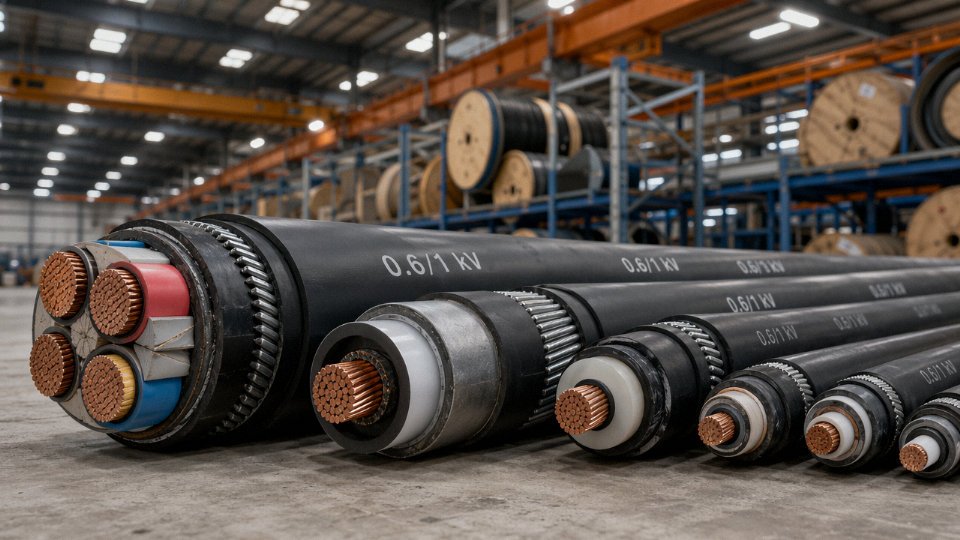
Core Construction Layers of a Low Voltage Cable: Conductor, Insulation, Bedding, Armour, and Sheath Explained
A low voltage cable is not a single material — it’s a carefully sequenced stack of functional layers, and getting any one of them wrong can mean premature failure, a rejected installation, or a warranty dispute six months after commissioning. Understanding what each layer does, and why specific materials get chosen, is where procurement decisions stop being commodity purchasing and start being engineering.
Conductor: Material, Conductivity, and the Weight-Cost Trade-Off
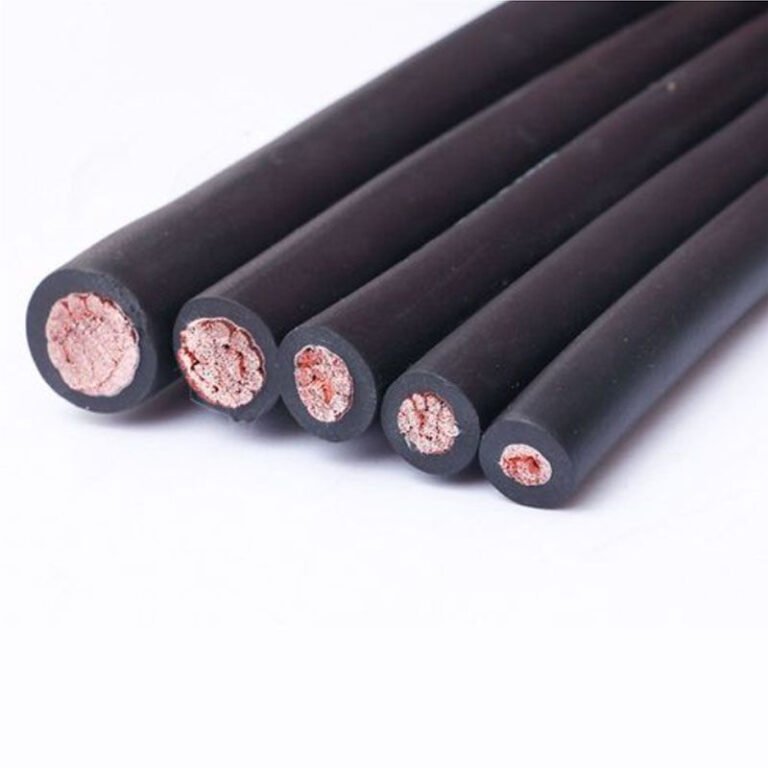
The conductor is where almost every cost and performance conversation begins. Plain annealed copper sits at roughly 58 MS/m conductivity and remains the default choice for most building wiring, industrial panels, and flexible drops — its ductility means it tolerates repeated flexing without work-hardening and cracking. Tinned copper is specified when the cable runs in high-humidity environments, marine installations, or wherever the termination hardware is tin or solder-based; the coating adds maybe 5–8% to conductor cost but buys meaningful corrosion resistance at the ends.
Aluminium, at approximately 35 MS/m, carries only about 61% of copper’s conductivity by cross-section — so an aluminium cable needs to be upsized (typically one or two cross-section steps) to carry the same current. The payoff is weight and price. Aluminium is roughly one-third the density of copper and, depending on the commodity market at the time you’re quoting, can be 40–55% cheaper per kilogram. For main feeders at 185 mm² and above running long underground routes, that matters. On short runs or in cable trays where you’re paying for tray capacity per metre, the weight saving sometimes justifies it even at smaller sizes. Where aluminium consistently causes trouble is at terminations — the oxide layer reforms quickly and requires either bi-metallic lugs or anti-oxide compound as a non-negotiable step, not an optional one.
Stranding Class and What It Actually Means in the Field
IEC 60228 defines the stranding classes most commonly encountered: Class 1 is solid, used in fixed installations at smaller sizes (typically up to 16 mm²) where cost minimisation matters and the cable won’t move after installation. Class 2 is the workhorse — stranded, stiff enough for conduit work, tolerates a reasonable bending radius. Class 5 is flexible, with fine stranding intended for cables that move repeatedly: machine tool trailing leads, welding cables, connections to vibrating equipment.
Specifying Class 5 where Class 2 would do adds cost for no benefit. Specifying Class 2 on a drag-chain application is a fatigue failure waiting to happen — usually within 6–18 months depending on cycle frequency, travel speed, and temperature. The bending radius minimum roughly halves going from Class 2 to Class 5, which also matters in tight junction boxes.
Insulation: XLPE, PVC, and EPR
PVC insulation, rated to 70°C conductor temperature, is inexpensive and broadly adequate for general fixed wiring. Its weaknesses show under sustained elevated temperature and in environments with plasticiser migration concerns — PVC can become brittle over years in hot dry locations, and some plasticisers are now restricted under RoHS.
XLPE (cross-linked polyethylene) pushes the continuous rating to 90°C and offers meaningfully better dielectric strength — typically in the range of 20–25 kV/mm depending on compound grade and thickness — along with excellent moisture resistance and lower dielectric losses. For the same conductor size, an XLPE cable carries more current than a PVC equivalent. That often makes the slight cost premium disappear when you account for the ability to use a smaller cross-section.
EPR (ethylene propylene rubber) also operates to 90°C but adds flexibility at low temperatures and better resistance to ozone and UV, making it the insulation of choice in offshore, mining, and portable equipment cables where mechanical abuse is routine.
XLPE-insulated LV cables can carry higher sustained current than identically sized PVC-insulated cables at the same ambient temperatureTrue
XLPE allows a maximum conductor operating temperature of 90°C versus 70°C for PVC per IEC 60502-1, which directly increases the permissible current rating for the same cross-section under standard derating conditions.
Inner Bedding and Fillers
Between the insulated cores and the armour sits the bedding — usually extruded PVC or PE, sometimes a wrapped tape. Its job is threefold: keep the circular profile consistent so armour wires bed down evenly, cushion the cores against armour abrasion, and in water-blocking designs, carry a swellable tape or powder that expands on moisture ingress to prevent longitudinal water migration. Skimping on bedding compound quality shows up in two ways: oval cable that installs awkwardly in glands, and armour corrosion that migrates along the cable length before anyone notices.
Armour Types and When Each Gets Specified
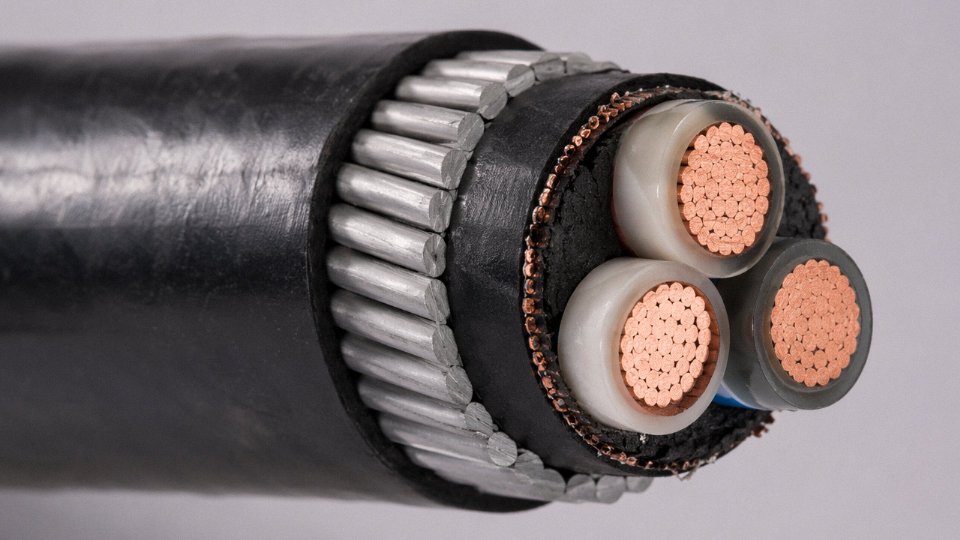
Steel wire armour (SWA) is the most common choice for direct burial and industrial installations where tensile load and impact resistance matter. It handles rough backfill, occasional mechanical impact, and rodent environments reasonably well. Steel tape armour (STA) provides crush resistance with less tensile strength — acceptable for protected cable ducts but not for direct-buried runs where a digger bucket is the threat.
Aluminium wire armour (AWA) is specified when weight is a genuine constraint or when the installation involves single-core cables where steel armour would create eddy current losses. A steel armour on a single-core AC cable acts as a shorted turn — unacceptable. AWA eliminates that problem at the cost of slightly reduced mechanical protection.
Outer Sheath: PVC, LSZH, and PE
The outer sheath is the cable’s first line of defence against the environment. Standard PVC sheath is fine for most industrial and building applications. Where fire safety in occupied or enclosed spaces is the driver — tunnels, public buildings, offshore platforms, transport infrastructure — LSZH (Low Smoke Zero Halogen) compound becomes mandatory or specified by the client. LSZH sheaths emit significantly less smoke and no halogen acid gases when they burn; smoke optical density and corrosive gas emission values are tested per IEC 61034 and IEC 60754 respectively. The performance difference is not academic: in a tunnel fire, toxic halogen gases from burning PVC cable sheath have been a documented cause of casualties before the fire itself reached people.
PE sheath offers better chemical resistance and lower water absorption than PVC — standard for subsea, direct burial in aggressive soils, and petrochemical environments. It’s harder to process and more expensive, but the service life in wet or chemically active ground justifies it on any installation you expect to last 30-plus years without re-pulling.
Major Types of Low Voltage Cables and Their Designated Applications Across Industries
Not all LV cables are interchangeable, and this is where a lot of procurement errors happen. Understanding the main product families — their designations, insulation types, and actual application logic — saves you from over-specifying (and overpaying) or, worse, installing something that fails prematurely.
NYY and N2XY Power Cables
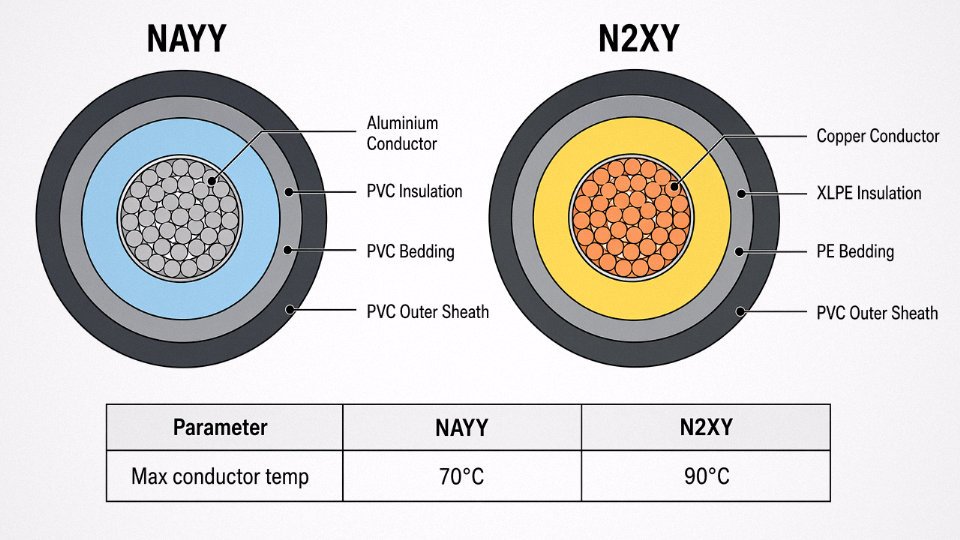
These are the workhorses of industrial and commercial power distribution. NYY uses PVC insulation and PVC outer sheath; N2XY substitutes XLPE insulation, which raises the continuous conductor temperature rating from 70 °C to 90 °C and meaningfully improves resistance to moisture ingress and mechanical stress over the cable’s service life. Both run from 1.5 mm² branch circuits up to 630 mm² main feeders, though in practice you rarely see single-core NYY above 240–300 mm² in duct installations because thermal derating in bundled conduit starts eating into the apparent ampacity gain.
Direct burial is straightforward with NYY provided burial depth and bedding comply with local installation codes — typically 600–800 mm in pedestrian areas, deeper under roads. N2XY is the better choice when ground temperatures are elevated or where the cable runs near heat sources.
NAYY and NA2XY — Aluminium Conductor Variants
Aluminium conductors carry a roughly 40–50% cost advantage over copper equivalents, depending on commodity prices at the time of procurement. That spread narrows when you factor in larger termination lugs, anti-oxidant compound at joints, and the need to upsize cross-section by roughly 1.6× to match copper ampacity.
Utilities and EPC contractors use NAYY extensively for underground distribution feeders converting overhead lines to buried routes. Large-scale solar farms use NA2XY or similar aluminium XLPE variants for DC collection strings between combiner boxes and inverters — the long cable runs make the weight and cost savings significant at that scale.
Flexible Cables: H07RN-F and H05VV-F
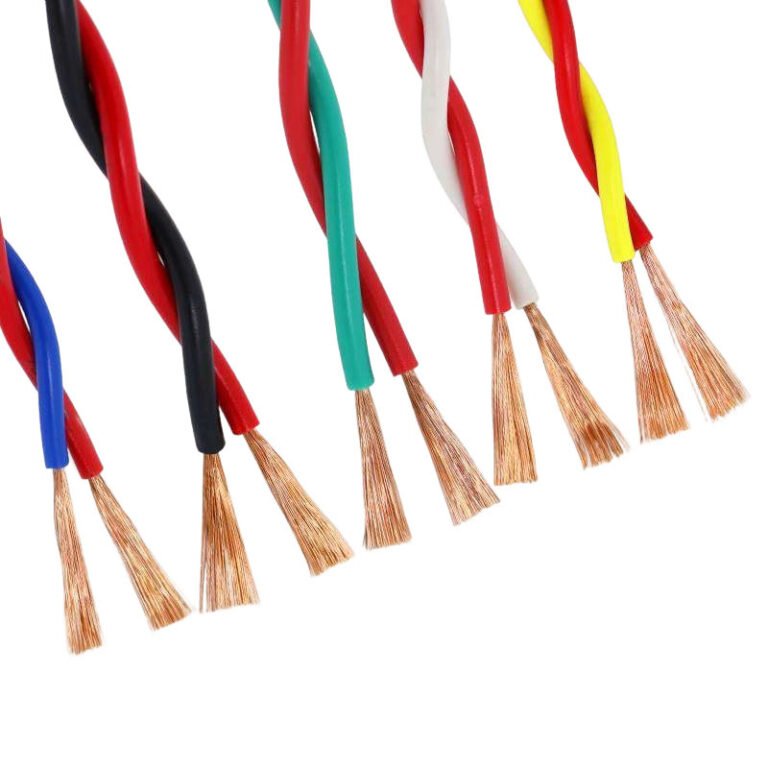
H07RN-F (rubber-insulated, rubber-sheathed, rated 450/750 V) is the standard for portable industrial equipment — welding machines, mobile compressors, temporary power distribution on construction sites. The fine-stranded conductor construction is what matters here: Class 5 or Class 6 stranding allows repeated flexing without conductor fatigue. Minimum bend radius during installation is typically 4× the overall cable diameter for static routing; for dynamic flexing applications, 6–8× is the practical floor, and going tighter than that is how you develop micro-fractures in the conductor strands that don’t show up until months later when the cable runs hot under load.
H05VV-F is lighter-duty — domestic appliances, office equipment, light machinery — not appropriate for industrial plant floors where mechanical abuse is routine.
Armoured Cables (SWA)
Steel wire armour gives a cable mechanical protection against crushing, rodent attack, and the kind of accidental shovel strikes that field crews will eventually deliver regardless of signage. XLPE/SWA/PVC is standard for direct-buried feeders, cable tray installations in chemical processing plants, and port/marine shore-power connections up to 1 kV. The armour also provides an earthing path, though whether to rely on it as a sole protective conductor is a design decision that should account for the earth fault loop impedance and local wiring regulations.
LSZH and Fire-Resistant Cables
Rail stations, airports, hospitals, and data centers share one critical constraint: in a fire, dense cable bundles produce toxic halogen acid gases and thick smoke that block evacuation and damage equipment. LSZH (Low Smoke Zero Halogen) cables limit HCl-equivalent acid gas emissions below 0.5% per IEC 60754 and smoke density per IEC 61034. Fire-resistant cables (IEC 60331) go further — they maintain circuit integrity at specified temperatures (typically 750–950 °C for 90–180 minutes) so emergency systems stay live during the event itself.
LSZH cables always perform better than PVC cables in fire scenariosFalse
LSZH cables produce less toxic gas and smoke than PVC, but their mechanical and electrical performance under sustained heat depends heavily on the specific compound formulation and cable construction. A poorly specified LSZH cable can lose circuit integrity faster than a properly rated fire-resistant PVC cable in certain fire conditions.
Specifying IEC 60331 fire resistance is not the same as specifying LSZH. Projects needing both — which includes most metro rail contracts — should require both certifications explicitly in the bill of materials.
Control and Instrumentation Cables
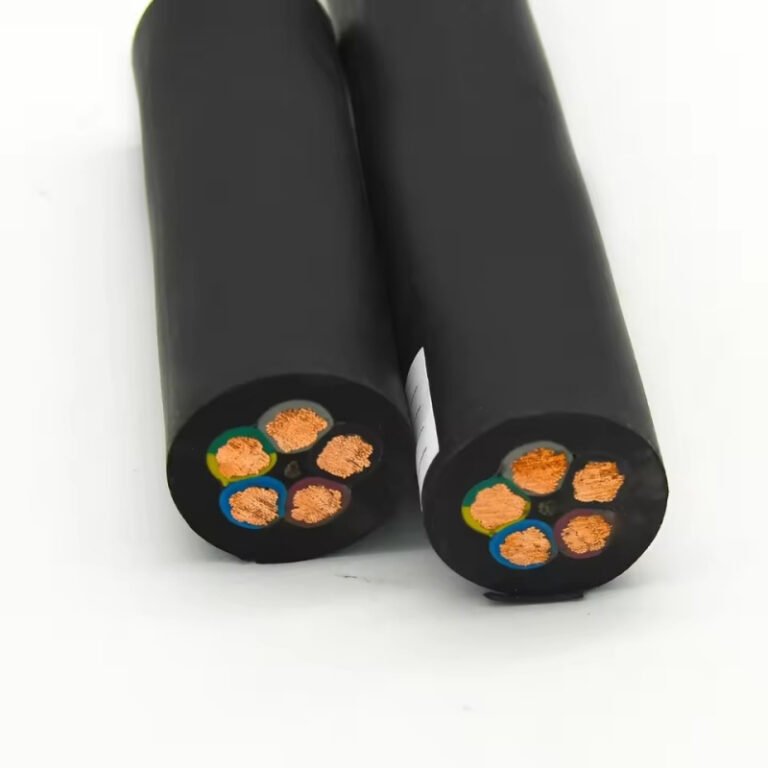
Multicore control cables at 0.6/1 kV cover motor control center wiring, PLC I/O loops, and SCADA field wiring. Shielding selection matters: foil screens work well for low-frequency interference, braided screens provide better high-frequency attenuation, and overall screens with individual pair shielding handle situations where cross-talk between signal pairs is the primary concern. Drain wire sizing is often under-specified — a 0.5 mm² drain wire in a high-current fault environment on the shield can melt and cause the fault condition it was supposed to manage. Sizing the drain wire to match anticipated fault current paths, even if the actual fault is brief, is worth the upsize.
Renewable Energy Cables
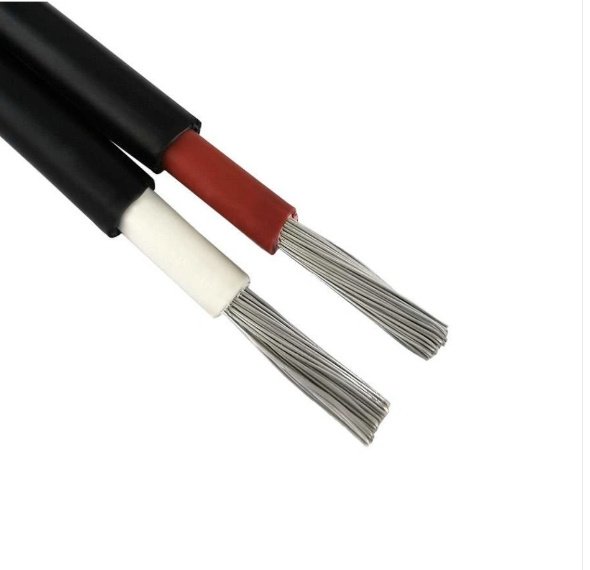
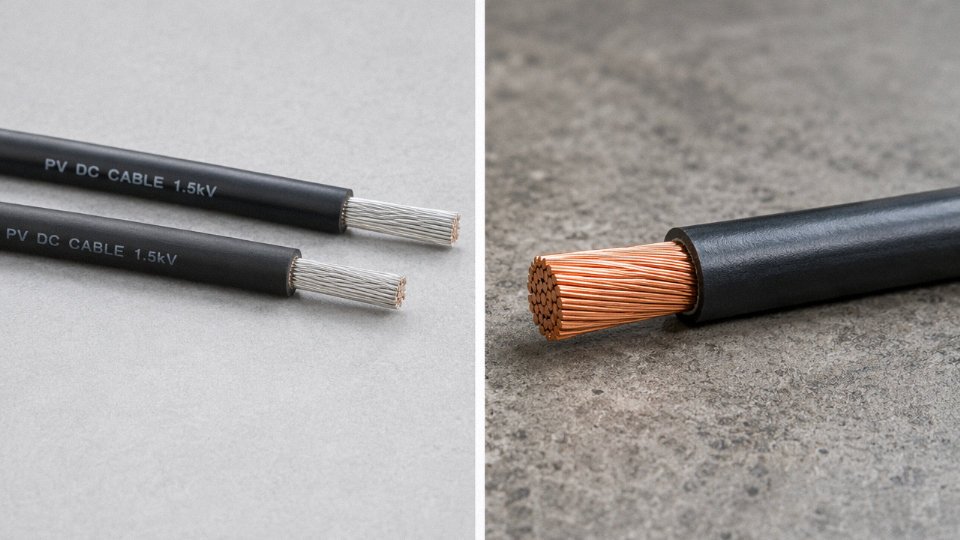
PV DC cables rated 1.5 kV DC to TÜV 2 Pfg 1169/08.2007 or IEC 62930 are UV-stabilized, ozone-resistant, and specified for double insulation — this is not a standard NYY or N2XY. The 1.5 kV DC rating is deliberate because many current string inverter architectures produce open-circuit voltages approaching 1,000–1,200 V DC under cold conditions with full irradiance, and the cable rating needs headroom above the maximum system voltage, not just the nominal.
Wind turbine torsional cables are a niche but important product — the cable inside the tower must survive continuous twisting as the nacelle yaws, which demands specialized stranding geometry and sheath compounds that standard flexible cables simply aren’t designed for. BESS interconnect cables combine high DC current capacity (often 150–400 mm² copper) with short routing runs and demanding thermal management requirements, since battery rooms run warm and heat cycles stress insulation over the system’s 15–20 year service life.
International Standards and Certifications That Govern Low Voltage Cable Design and Testing
Standards are where procurement gets complicated fast, especially on cross-border EPC projects where the specifying engineer is in one country, the cable manufacturer is in another, and the end installation is somewhere else entirely. Getting the standard hierarchy wrong — or assuming IEC compliance automatically satisfies a regional regulator — is one of the more avoidable causes of project delays and re-procurement costs.
IEC 60502-1: The Global Baseline for LV Power Cables
IEC 60502-1 covers extruded solid dielectric insulated power cables rated up to 1 kV. For practical procurement purposes, this is the single standard most international tenders reference first. The clauses that matter most day-to-day are the construction requirements (conductor sizes, insulation thickness by voltage grade and cross-section, sheath material and minimum thickness), the electrical tests (conductor resistance, high-voltage withstand, insulation resistance), and the mechanical tests (bending, elongation at break for insulation and sheath, tensile strength). Type test reports under IEC 60502-1 should itemize each clause separately — a test report that just says “tested to IEC 60502-1” without clause-by-clause results is not acceptable for serious project qualification.
IEC 60228: Verifying Conductor Class on the Test Report
This one trips up procurement teams regularly. IEC 60228 defines conductor resistance and stranding. Class 2 is stranded but not flexible — your standard multicore power cable. Class 5 is fine-wire flexible, used in trailing cables and equipment wiring. When a supplier lists “Class 5 conductor” on a data sheet, pull the test report and check that the DC resistance at 20 °C actually meets the Class 5 limit for that cross-section; a Class 2 conductor dressed with a few extra strands can look similar on a drawing but behaves differently in service, particularly in applications with movement or vibration.
Fire Performance Standards: IEC 60332, 60331, 60754, and 61034
These four standards cover different aspects of fire behavior and are frequently bundled together under project specs for infrastructure, transit, data centers, and public buildings.
IEC 60332-1 and 60332-3 test flame propagation — single cable and bunched cable respectively. The bunched test (60332-3) is significantly more demanding and relevant to cable tray installations. IEC 60331 tests circuit integrity under fire, critical for emergency systems like fire alarms and evacuation lighting where the cable must keep functioning during a fire event. IEC 60754 measures halogen acid gas emission from insulation and sheath materials — zero halogen (LSZH/LSOH) cables must pass this. IEC 61034 measures smoke density; in tunnel or metro projects, low smoke matters as much as low halogen. A cable branded “LSZH” without 60754 and 61034 test reports behind it is an unverified claim.
Regional Standards: Similarities, Divergences, and Practical Impact
| Standard | Region | Key Notes vs. IEC |
|---|---|---|
| BS 6724 / BS 5467 | UK | Closely aligned to IEC 60502-1; BS 6724 specifies LSZH sheath where 5467 allows PVC; armour wire dimensions specified explicitly |
| NF C 32-321 | France | Historically divergent on sheath color coding and construction tolerances; harmonization with IEC ongoing but legacy specs still appear on French utility projects |
| VDE 0276 | Germany | German adoption of IEC 60502 series; VDE certification adds factory surveillance on top of type tests |
| AS/NZS 5000 | Australia/NZ | Requires specific UV resistance for outdoor runs; conductor tinning requirements for certain environments differ from IEC defaults |
| GB/T 12706 | China | Technically close to IEC 60502-1 but with localized test procedures and CCC certification layer for domestic market supply |
The divergences that cause the most real-world trouble are usually sheath color coding (which varies enough between regions to require a clear specification), armour wire diameter tolerances, and which fire tests are mandated versus optional.
UL 83 and UL 1277: The North American Approach
UL standards approach cable qualification differently from IEC. Where IEC relies on type tests conducted at accredited labs on production samples, UL adds ongoing factory inspections and label licensing — the UL mark on the cable means the factory is under a continuing surveillance program, not just that a sample passed once. UL 83 covers thermoplastic-insulated wires and cables; UL 1277 covers electrical power and control tray cables. Dual IEC/UL listed cables are increasingly specified on multinational projects, particularly in oil and gas, because the EPC contractor may be delivering to a facility that has North American and international sections under the same project umbrella. The added cost of dual listing is real — roughly 5–15% on the cable price depending on cross-section and volume — but re-procurement mid-project costs far more.
Third-Party Certification Bodies
KEMA (now part of DNV) is widely respected for type testing in the utility and industrial sectors. SGS and Bureau Veritas are common on projects where the client wants independent factory audits alongside test reports. CCC (China Compulsory Certification) is mandatory for cables sold domestically in China and is a minimum baseline for Chinese-manufactured cables entering certain import markets. When validating any certificate, always check the certificate number against the issuing body’s online registry — certificate fraud is not unheard of in cable procurement, particularly on price-sensitive tenders.
A CE mark on an LV cable confirms it meets all applicable EU directives including fire performance requirements.False
CE marking on LV cables typically covers the Low Voltage Directive but does not automatically confirm compliance with fire performance standards such as IEC 60332-3 or IEC 60754. Those require separate type test reports and, for CPR-regulated cables in EU construction applications, a Declaration of Performance under EN 50575.
Jinda holds ISO 9001 and ISO 14001 across its production bases, CCC certification for the domestic market, and CE marking for European export. For international project tenders, project-specific type test reports are available — including IEC 60502-1 full type tests, IEC 60332-3, IEC 60754, and IEC 61034 where specified. In practice, submitting a complete type test dossier early in the tender qualification stage, rather than waiting for the purchase order, removes one of the more common bottlenecks in cross-border cable procurement.
How to Size a Low Voltage Cable Correctly: Current Capacity, Voltage Drop, and Short-Circuit Rating
Getting the size wrong costs you in one of two ways: you either cook the cable and get a fault, or you over-specify and waste money on copper that does nothing useful. Both happen more often than they should.
Current-Carrying Capacity (Ampacity)
Ampacity is fundamentally a heat balance problem. Current flowing through a conductor generates I²R losses; that heat has to travel outward through insulation, bedding, soil or air, and surrounding cables before the conductor temperature stabilizes. If the steady-state temperature exceeds the insulation’s rated limit — 70°C for PVC, 90°C for XLPE under normal operation — insulation degrades and cable life shortens sharply.
Soil thermal resistivity is the variable most engineers underestimate. Dry sandy soil runs around 2.0–2.5 K·m/W; moist clay can be as low as 0.8–1.0 K·m/W. That range alone can shift your ampacity by 15–25%. In practice, if you’re burying cables in an area that dries out seasonally — a common situation in parts of the Middle East or on reclaimed industrial land — design to the worst-case dry condition, not the average.
A worked example: a 95 mm² Cu XLPE/SWA cable, single circuit, direct buried at 0.8 m depth, soil resistivity 1.2 K·m/W, 30°C ambient soil temperature. IEC 60502-1 tabulated base rating (in reference conditions) is roughly 220–230 A depending on the specific construction. Apply the 30°C ambient correction factor (approximately 0.96 for XLPE-insulated cables referenced to 25°C soil) and a grouping derating of 1.0 for a single isolated circuit, and you end up with a derated capacity in the 210–220 A range. Add a second parallel circuit in the same trench and the grouping factor drops to around 0.75–0.80 — now you’re looking at closer to 165–185 A per cable. That’s a significant reduction that frequently gets ignored during early-stage design.
Voltage Drop
IEC 60364-5-52 uses the formula:
V_drop = I × (R·cos φ + X·sin φ) × L
where R and X are in Ω/km and L is the one-way cable length in km. For most LV power cables below 150 mm², reactance X is small enough that cos φ dominates — but at 185 mm² and above, or on long runs, ignoring X starts introducing real error.
Acceptable limits are generally ≤ 3% for lighting circuits and ≤ 5% for motor and general power circuits under IEC 60364. Some industrial plants tighten this to 2.5% for sensitive process equipment — worth confirming with the end user before you finalize the design.
| Conductor Size | Approx. R (Ω/km, 90°C, Cu) | Max Run at 5% Drop, 100 A load, cos φ 0.85 |
|---|---|---|
| 16 mm² | ~1.38 | ~50–55 m |
| 35 mm² | ~0.63 | ~110–120 m |
| 70 mm² | ~0.32 | ~215–230 m |
| 95 mm² | ~0.24 | ~285–305 m |
| 185 mm² | ~0.12 | ~565–590 m |
Figures depend on exact conductor resistance at operating temperature and power factor; treat as planning estimates only.
Short-Circuit Withstand
The adiabatic equation governs whether a cable survives a fault:
I²t = k²S²
S is conductor cross-section in mm², t is fault clearing time in seconds, I is prospective fault current in amperes. The k factor accounts for conductor material and insulation type: for copper conductors with XLPE insulation, k = 143; with PVC, k = 115. Aluminium with XLPE gives k = 94.
In practice you’re checking that the upstream protective device — a fuse or MCB — clears the fault before the cable’s thermal limit is reached. A 95 mm² Cu XLPE cable with k = 143 can handle roughly (143 × 95)² / I² seconds of fault current. If your upstream device clears a 10 kA fault in 0.1 s, the cable needs to withstand √(10,000² × 0.1) / 143 = approximately 22 mm² minimum — so the 95 mm² passes easily. The check becomes critical on small branch cables fed from high-fault-level busbars.
The k factor for copper/XLPE cables used in the adiabatic short-circuit equation is 143 per IEC 60364-5-54 and IEC 60502 references.True
This value reflects the thermal capacity of copper conductors with XLPE insulation, based on the conductor's initial and maximum permissible temperatures under fault conditions. It is a standardized figure widely referenced in IEC and BS 7671 calculations.
Neutral and PE Conductor Sizing
Under IEC 60364, PE conductor sizing follows a stepped rule: up to 16 mm² phase conductor, PE equals the phase conductor; 16–35 mm² phase, PE is 16 mm² minimum; above 35 mm², PE is at least half the phase conductor cross-section. This is a floor, not a ceiling — your earthing system architecture matters too.
TN-S systems carry protective earth and neutral separately all the way from the source, which gives cleaner earth fault loop impedance but requires an extra conductor. TN-C-S (the PEN arrangement common in European distribution) combines them in the supply but separates at the main distribution board — the combined PEN conductor must be at least 10 mm² Cu. TT systems, common in rural or older industrial sites, rely on local earth electrodes, and fault loop impedance can be high enough that you need an RCD rather than an overcurrent device for protection. That affects both the cable sizing calculation and the protection coordination.
Over-Specification Traps
Armoured cables (SWA or DSTA) are sometimes specified on every run by habit, including in dry indoor tray installations where a plain LSZH cable is sufficient and significantly cheaper. Armour costs money and adds weight; it’s justified for direct burial, exposed outdoor routes, or mechanical hazard zones — not reflexively on every circuit.
Over-sizing conductors is tempting as a “safety margin,” but on long runs in a thermally constrained trench, a larger conductor generates less heat per amp — which actually helps neighbouring cables. On short indoor runs, over-sizing purely for thermal margin while ignoring whether voltage drop is even the binding constraint is just wasted copper. Always identify which criterion governs: thermal rating or voltage drop. They don’t always point to the same answer.
Installation method tables in IEC 60364-5-52 run from Method A1 (cables in insulated wall) through to Method F (single cables in free air). Burial depth shifts the correction factor — going from 0.5 m to 1.0 m depth typically reduces ampacity by 3–6% depending on soil type, partly because deeper burial increases thermal resistance. Duct fill ratio matters too: a duct with four loaded cables has meaningfully lower capacity per cable than the same duct with one. These corrections compound, and it’s easy to end up with a derated capacity 30–40% below the base table value if you stack several unfavorable conditions.
Installation Environments and the Specific LV Cable Specifications They Demand
The voltage rating on a cable nameplate tells you surprisingly little about whether that cable will survive five years in service. Environment does most of the killing — moisture ingress on a buried run, UV degradation on a rooftop tray, hydrocarbon attack in a petrochemical trench. Getting the construction right for the installation context is where real specification work happens.
Direct Buried Underground
Burial puts mechanical stress and sustained moisture exposure on a cable simultaneously. For most LV direct-burial runs, steel wire armour (SWA) or steel tape armour (STA) is the standard answer; in corrosive soils — particularly waterlogged clay or ground with high sulphur content — you want a PVC or PE oversheath on top of the armour rather than leaving it bare. IEC 60364 recommends a minimum burial depth of 0.5 m for LV in pedestrian areas, moving to 0.7 m or deeper where vehicular crossing is possible, and in practice most plant civil specs push this to 0.8–1.0 m under roadways with a concrete tile or duct as an added mechanical warning layer.
The moisture-barrier sheath choice matters more than people admit. HDPE outer sheaths outperform PVC on long-term water resistance, especially on runs exceeding roughly 200–300 m where a pinhole sheath breach at one end can wick moisture the full length over a few wet seasons.
Cable Trays and Ladder Racks in Industrial Facilities
Grouping cables on a tray kills ampacity fast. Bunch fifteen cables on a fully loaded ladder rack and the derating factor can drop to 0.5 or lower depending on how many layers deep they’re stacked — this is where undersized trays generate chronic nuisance tripping that maintenance teams spend years chasing without identifying the real cause. Cables on open outdoor trays need a UV-stabilised outer sheath; standard black PVC usually provides adequate UV resistance for moderate climates, but in high UV-index environments (Middle East, tropical coastal sites) a carbon-black-stabilised PE sheath is the safer long-term choice.
Inside enclosed plant buildings, warehouses, or any space where personnel are present, LSZH (low smoke zero halogen) sheathing is increasingly the baseline, not a premium option. A PVC cable fire in a confined cable basement produces HCl concentrations that incapacitate people well before the thermal hazard arrives.
LSZH cables emit significantly less toxic fumes and smoke than standard PVC cables during a fire.True
PVC combustion releases hydrogen chloride (HCl) gas, which is both toxic and highly corrosive to electrical equipment. LSZH compounds are formulated to minimise halogen acid gas emission and smoke density, verified under IEC 60754-1 and IEC 61034-2 testing.
Hazardous Areas (ATEX / IECEx Zone 1 and 2)
Armoured and gland-sealed is non-negotiable in Zone 1. The cable gland forms part of the explosion protection — a loose or incorrect gland effectively invalidates the Ex certification of the connected equipment. Surface tracking is a real ignition risk in atmospheres with hydrocarbon vapours, so sheath compounds here need to be both antistatic and resistant to oils, fuels, and solvents. Standard PVC degrades in prolonged hydrocarbon contact; CPE (chlorinated polyethylene) or CSP sheaths hold up considerably better. Budget for roughly 20–35% cost premium over standard SWA cable for properly rated Ex-rated variants, depending on cross-section and quantity.
Marine and Offshore Installations
Salt atmosphere attacks standard steel armour within a few years. Aluminium wire armour (AWA) is lighter and corrosion-resistant, which is why it dominates topside offshore cable runs where both weight budget and corrosion exposure are concerns. Conductors should be tinned copper — bare copper in salt-humid cable termination chambers oxidises at an annoying rate, increasing contact resistance and generating heat at joints. IEC 60092-350 and IEC 60092-376 govern marine cable construction and fire performance respectively; any cable going onto a vessel or offshore platform that isn’t certified to these standards will get rejected at third-party marine survey, and that rejection at installation stage is expensive.
Renewable Energy Outdoor Installations
PV string cable in a rooftop or ground-mount array sits in conditions that would degrade most standard building cables within three to five years — sustained UV, temperature cycling between roughly −25°C and +90°C on the cable surface in a desert installation, and often no shade whatsoever. TÜV-certified PV cable (EN 50618 / IEC 62930) uses cross-linked PE (XLPE or EPR) insulation with UV-stabilised sheath specifically for this duty. In arctic deployments, cold-flexibility ratings matter: a cable that becomes brittle at −40°C will crack at the first maintenance bending event in winter.
Hot-spot prevention on tray-routed PV string cables is underappreciated. Parallel strings bundled tightly in cable trays can accumulate enough heat under peak irradiance to push conductor temperatures above rated limits, which degrades insulation life exponentially — every 10°C above rated temperature roughly halves insulation life, a relationship most procurement specs don’t account for.
High-Rise Buildings and Tunnels
Vertical cable runs in tall buildings create a chimney effect during fire. IEC 60332-3 categorises cables by their ability to resist vertical flame propagation when installed in bunches — Category A being the most stringent. In Europe, the Construction Products Regulation (CPR) classifies cables from Aca down to Fca; Cca is the typical minimum for common areas in commercial high-rise construction, while B2ca applies to escape routes and highly occupied spaces. Specifying a Dca cable where Cca is required is not a compliant substitution regardless of price advantage.
Tunnel installations add the smoke density requirement — IEC 61034-2 minimum light transmittance thresholds exist precisely because smoke in a tunnel kills the evacuation window rapidly.
Data Centers and Critical Infrastructure
Cable routing redundancy in a Tier III or IV data center means cables serving the same load travel physically separate paths through separate fire compartments — obvious in principle, frequently violated in practice when contractors optimise their pull routes without reading the design intent. Fire compartment penetrations must be sealed with listed firestop systems; the cable itself and the firestop system interact, and mixing an uncertified cable type into a firestop assembly that was tested with a specific cable can void the firestop rating.
The heat-load interaction with cooling is genuinely consequential. A heavily loaded 240 mm² feeder in a hot aisle contributing 40–60 W/m of heat into an already thermally stressed zone forces the cooling system to compensate. Routing high-current LV feeders through cold aisles or in underfloor pathways isn’t always possible, but it’s worth the coordination effort during design — cable derating and cooling load are two sides of the same thermal budget.
Key Quality Indicators and Red Flags When Sourcing Low Voltage Cables from Global Suppliers
Sourcing LV cables internationally is not difficult — until a drum arrives on site and fails its acceptance test, or worse, fails two years into service. The checks below are not theoretical. They are what experienced procurement engineers actually run, either at the factory gate or on receipt.
Conductor Resistance: The Fastest Honest Check
Measure DC resistance on a sample length using a Wheatstone bridge or a DLRO (Digital Low-Resistance Ohmmeter — a Megger DLRO10 or similar). Compare the result against IEC 60228 Table 1 limits for the declared cross-section and conductor class. The arithmetic is straightforward: resistance scales inversely with conductor area, so a “95 mm²” conductor that reads more than roughly 10% above the Class 2 limit almost certainly has a real cross-section somewhere around 85–88 mm². That shortfall usually traces back to substandard wire drawing — rod drawn slightly undersized to save copper or aluminium. In practice this is the single most common form of material fraud in cable procurement, and it is detectable in under fifteen minutes with gear most electrical labs already own.
Insulation Thickness: Calipers on a Cross-Section Tell the Story
Request cross-sectioned samples — cut perpendicular to the axis, polished enough to measure cleanly. Use calibrated calipers or an optical comparator and check minimum insulation thickness at the thinnest point against IEC 60502-1 Table 4 nominal values. A cable rated 0.6/1 kV in a 16 mm² conductor should have nominal XLPE insulation of around 0.7 mm; if you’re reading 0.55–0.58 mm consistently, the extruder was running lean. That’s not a random process variation. Thin-walling insulation is a deliberate cost reduction — roughly 5–8% material saving per drum — and it directly compresses the safety margin against partial discharge and thermal ageing.
LSZH Halogen Content: Don’t Take the Label at Face Value
A cable stamped LSZH must emit less than 0.5% HCl equivalent when tested per IEC 60754-1. The test involves burning a cable sample in a tube furnace and measuring acid gas evolution. Some suppliers achieve the label by applying a thin LSZH outer sheath over a standard PVC inner insulation. The jacket passes; the inner layers do not. In a fire, toxic HCl still evolves from the bulk of the cable mass. If the project specification mandates LSZH for personnel-safety reasons — tunnels, data centres, public buildings — ask for test certificates covering all non-metallic components, not just the outer sheath. A credible test report references the specific cable construction tested, not a generic compound approval.
A cable labelled LSZH must emit less than 0.5% HCl equivalent per IEC 60754-1, covering all non-metallic layers.True
IEC 60754-1 specifies the acid gas emission test method; the 0.5% HCl equivalent limit applies to the full cable construction under test, not individual layers in isolation.
Armour Wire Geometry: Count the Wires, Measure the Diameter
Steel wire armour (SWA) or aluminium wire armour (AWA) serves two functions simultaneously — mechanical protection and fault-current return path. Both degrade proportionally if individual wire diameter is undersize or wire count is reduced. Substandard armour is hard to catch on visual inspection of the drum exterior; it takes unwinding a short section and measuring individual wires with a micrometer. A 50 mm² three-core SWA cable should have armour wires in the range of roughly 1.6–2.0 mm diameter depending on overall cable diameter and the applicable standard. Fewer, thinner wires reduce the armour cross-sectional area and therefore its rated fault-current capacity — a real risk in LV distribution where earth-fault levels can reach several kiloamperes.
Factory Audit: What to Actually Look At
A paper audit is not an audit. The items worth verifying in person or via a trusted third-party inspector include:
| Checkpoint | What to Look For | Red Flag |
|---|---|---|
| Conductor rod incoming QC | Mill certificates, rod diameter tolerance log | No incoming inspection records |
| Extruder temperature logs | Process charts showing stability across the run | Missing logs or uniform suspiciously round numbers |
| Inline spark testing | 100% coverage at typically 8 kV for 1 kV-rated cable | Sampling only, or no test voltage record |
| Drum length verification | Measured length vs. label on each drum | Refusal to permit independent measurement |
| Third-party witness test | Buyer-nominated lab witness available | Resistance to independent presence |
Red Flags in Tender Responses
Pricing 15–20% below credible market rates without an explainable structural reason — significantly lower raw material costs, a genuinely different specification — deserves hard scrutiny, not celebration. Other patterns that warrant pause: type test reports that lack a traceable accredited test-lab number (ILAC-MRA signatories are verifiable online), vague lead-time answers that shift between communications, and ISO 9001 scope statements that cover “wire and cable products” so broadly they could include lamp cord and power cable interchangeably. Ask specifically whether the scope covers the cable family you are buying.
How an Integrated QC System Changes the Risk Profile
Jinda operates with raw-material traceability from copper or aluminium rod through to finished drum, inline spark testing on every metre of production, and pre-shipment third-party inspection as a standard offering for international orders. For buyers who cannot physically visit a factory in Shandong, that third-party inspection option — with a buyer-nominated inspector witnessing conductor resistance, insulation thickness, and drum-length checks before the container is sealed — is the practical substitute for an on-site audit. It does not eliminate risk entirely, but it shifts accountability to a documented, independently verified record that travels with the goods.
Frequently Asked Questions About Low Voltage Cables
Is a 400 V three-phase supply considered low voltage?
Yes, unambiguously. A 400 V phase-to-phase (230 V phase-to-earth) system sits well inside the LV band, which extends up to 1,000 V AC. This 400/230 V arrangement is the standard distribution voltage across most of Europe, large parts of Asia, Africa, and the Middle East, and it covers the vast majority of commercial and industrial buildings worldwide — motor control centres, lighting panels, HVAC feeds, you name it. When a factory owner asks “do I need special high-voltage cables for my 400 V distribution board?”, the answer is no: standard 0.6/1 kV rated LV cables are the correct and code-compliant choice.
What is the difference between a 0.6/1 kV cable and a “1 kV cable”?
The slash notation trips up a lot of buyers. The two numbers describe the same cable — 0.6 kV is the rated voltage from conductor to earth (phase-to-earth), and 1 kV is the rated voltage from conductor to conductor (phase-to-phase). A cable marked 0.6/1 kV per IEC 60502-1 is designed for use on any system where neither of those values is exceeded. “1 kV cable” without the slash is informal shorthand for the same product. Specifying one and receiving the other is not an error; they are the same thing. That said, always confirm the full designation on the drum label rather than relying on verbal descriptions from a sales rep.
Can LV cables be used for DC applications like solar PV?
Standard 0.6/1 kV cables are permitted for DC use up to 1.5 kV DC under IEC 60502-1, so short DC runs within a substation or battery room are generally fine with conventional LV cable. For outdoor PV string wiring — long runs exposed to UV, thermal cycling between roughly −40 °C and 90 °C, and sustained DC voltage — dedicated PV cables rated to 1.5 kV DC per IEC 62930 (formerly EN 50618) are strongly preferred. The difference matters: PV cable insulation and sheathing compounds are specifically formulated for UV resistance and extended thermal endurance. Using a standard NYY or SWA cable on a rooftop string run that will see 20 years of sun exposure is a maintenance problem waiting to happen.
What does LSZH mean, and when is it mandatory?
LSZH stands for Low Smoke Zero Halogen. In a fire, standard PVC-sheathed cables release hydrogen chloride gas and dense black smoke — both of which are dangerous in enclosed spaces and corrosive to electronic equipment. LSZH compounds are formulated to limit smoke density and produce no significant halogen acid gas. It is contractually or code-required in railway tunnels, metro stations, offshore platforms, airport terminals, hospitals, and many public buildings. The relevant performance standards to cite in a specification are IEC 60754-1/2 (halogen content), IEC 61034-2 (smoke density), and IEC 60332-3 (flame propagation for bunched cables). Specifying “LSZH sheath” without citing the test standards is not sufficient — a supplier needs to know which classes apply.
How long do low voltage cables last in service?
XLPE-insulated cables in normal buried or ducted service are typically designed for a 30–40 year service life. In practice, that life shortens under a few specific conditions: persistent overloading above rated current (accelerates thermal aging of insulation), water ingress into unarmoured buried cables causing water treeing in XLPE, prolonged UV exposure on unsheathed or poorly sheathed surface-run cables, and frequent thermal cycling in applications like EV charging feeders or furnace supply cables. PVC-insulated cables in ambient temperatures above roughly 50 °C can harden and crack noticeably faster — sometimes within 10–15 years in a hot plant environment. Periodic insulation resistance testing, usually every 3–5 years on critical circuits, catches degradation before it becomes a fault.
What is the minimum bend radius for an LV armoured cable?
The general IEC and manufacturer guidance for steel wire armoured (SWA) cables during installation is 8–12 times the overall cable diameter, depending on conductor type and number of cores. A 50 mm² four-core SWA cable with an overall diameter of around 38–42 mm, for example, should not be bent tighter than roughly 300–500 mm radius. Violating this during pulling or when forming bends into a cable tray is a real problem: armour wires can crack or separate, the insulation stack gets deformed under point stress, and — worst case — conductor strands break in a way that is not immediately visible but creates a high-resistance joint that heats under load. Crews in a hurry at the end of a project are exactly when this happens.
The minimum installation bend radius for SWA LV cables is typically 8–12 times the cable's overall outer diameter per IEC and standard manufacturer guidance.True
IEC 60502-1 and individual manufacturer installation instructions consistently reference this range for armoured cables; the exact multiplier depends on cable construction, conductor type, and whether the cable is being installed by hand or machine-pulled.
How do I verify that a cable drum I received matches the ordered specification?
Check the drum label first — every compliant shipment should show the manufacturer name, cable type designation (e.g., YJV22, N2XRY, or equivalent), rated voltage, number of cores and conductor cross-section, drum length, gross and net weight, manufacturing date, and the standard reference (IEC 60502-1 or equivalent). Cross-reference that label against the purchase order and the factory test certificate. The test cert should include conductor resistance per IEC 60228, insulation resistance, high-voltage test results, and — for LSZH cables — the fire performance test reports. A drum label that is vague, machine-printed on a sticker rather than stencilled, or missing the standard reference is a red flag worth raising before the cable goes into a trench.