Misread a wire color on a three-conductor cord and you can wire neutral to ground, reverse polarity, or leave a live conductor connected to an exposed metal frame — any one of which can trip a GFCI repeatedly under load, cause nuisance shutdowns on a production line, or in the worst case put lethal voltage on a chassis someone is touching. Maintenance teams dealing with imported equipment alongside domestically wired panels face this constantly, because the same brown wire means something completely different depending on whether the cord was made to IEC or North American spec. The rework cost when a machine has to be pulled from service and re-terminated is real, and it compounds fast across a facility.
A standard three-wire power cord uses one of two dominant color systems: IEC 60446 (used across the EU and most international markets) assigns brown to Live, blue to Neutral, and green/yellow stripe to Earth; North American NEC wiring uses black for Hot, white or gray for Neutral, and green or bare copper for Ground. Australia and New Zealand originally used red-black-green but transitioned to the IEC brown-blue-green/yellow scheme after the 2000 harmonization.
What makes this genuinely tricky in a plant or procurement context is that neither system is self-evidently “right” — they’re just different, and the danger lives in the gap between them. A cord manufactured in China to IEC spec, shipped to a North American facility, and terminated by a technician who learned on NEC wiring is a scenario that plays out more often than most safety audits would suggest.
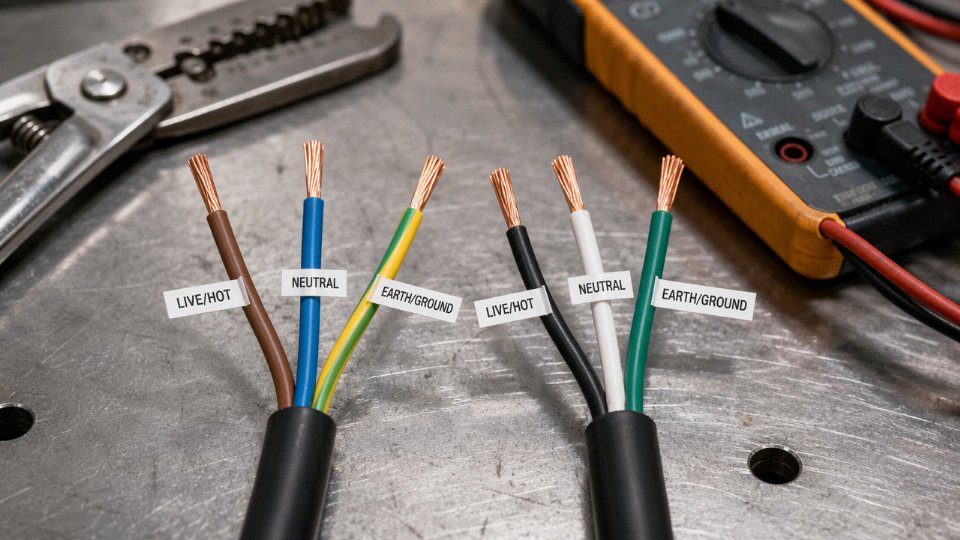
IEC 60446 and the International Harmonized Color Code for 3-Wire Flexible Cords
IEC 60446:2007, amended in 2010 and incorporated into the broader IEC 60445 identification framework, is the closest thing the wiring world has to a universal language. If you’re sourcing flexible cord for a product destined for Europe, the UK, most of Asia, or a significant portion of the Middle East and South America, this standard is what governs which color goes on which conductor — and deviation from it is not a minor paperwork issue. It’s a recall risk.
The Three Mandated Colors and What Each Conductor Does
The assignments are straightforward, which is precisely why manufacturers need to get them exactly right:
| Conductor | IEC 60446 Color | Approximate Hex Reference | Memory Aid |
|---|---|---|---|
| Line (Live / Hot) | Brown | #964B00 (medium brown) | “B” for Brown = Burns you |
| Neutral | Blue | #0070C0 (mid blue) | Blue = calm, return path |
| Protective Earth (PE) | Green-and-yellow stripe | #00A550 / #FFD700 alternating | Two colors = cannot be mistaken |
One thing worth emphasizing: the hex values above are approximations for reference. Actual insulation color is controlled by pigment batches and measured under standardized lighting conditions — a cord that looks “brownish-orange” under a factory’s sodium lighting may pass or fail a quality check depending on the colorimetry spec in the purchase order. Always reference the standard’s color chart, not a screen.
Why Green-and-Yellow, Specifically
The bicolor stripe for the PE conductor is not arbitrary. IEC 60417 reserves solid green for safety-related signage and solid yellow for caution signage across industrial environments globally. Using either color alone on an earth wire would create real ambiguity on a busy panel, especially for maintenance staff who aren’t reading wire tags — they’re reacting under pressure. The green-and-yellow stripe is visually distinct from any single-color convention in use anywhere on a plant floor. Solid green alone for earth is explicitly prohibited under IEC 60446; you’ll still find it on older cables and legacy equipment, which is a problem I’ll get to shortly.
Jurisdictions That Follow IEC 60446
All EU member states have mandated this scheme, and the UK aligned with it through BS 7671:2008 (the 17th Edition of the IET Wiring Regulations), which phased in from 2004 onward. Most of Asia — including China’s GB/T standards for flexible cords exported under international specifications, Japan for certain appliance categories, and the GCC countries — follows IEC closely enough that IEC 60446 colors will be recognized and generally accepted. Large portions of Africa and South America that have adopted IEC-derived national standards fall under the same umbrella, though enforcement rigor varies considerably by country and by product category.
IEC 60446 mandates that solid green or solid yellow alone must never be used for the Protective Earth conductor in flexible cords.True
IEC 60446 explicitly prohibits using a single solid green or solid yellow insulation for the PE conductor to avoid confusion with safety and caution signage colors standardized under IEC 60417. Only the bicolor green-and-yellow stripe is permitted for PE identification.
The Old European Code — and Why Mixing Old and New Is Genuinely Dangerous
Pre-2004 UK wiring and some continental European installations used red for Live, black for Neutral, and either green/yellow stripe or — on really old stock — solid green for Earth. The hazard isn’t academic. If a maintenance electrician connects a new brown-blue-green/yellow flex to an existing installation where black was previously the neutral, there’s a plausible scenario where black (now a live conductor in the new code convention sense, used on three-phase) gets treated as neutral. The consequences range from a nuisance trip to a fatal shock, depending on what’s downstream. Mixed-vintage installations should always carry clear labeling at every junction, and any facility running pre-2004 and post-2004 cables side by side should treat that as a formal electrical hazard rather than a legacy quirk.
The Three-Phase Clarification
Because this article is focused on single-phase 3-wire flexible cords — Line, Neutral, Earth — it’s worth briefly flagging the three-phase case to prevent confusion. In a three-phase system without a neutral conductor (a 3-wire three-phase arrangement), IEC 60446 assigns brown, black, and gray to the three phase conductors respectively. Black appears here as a phase conductor, not neutral. If you’re specifying or inspecting industrial cable and see a black conductor, the system topology matters before you assume anything about its function. Single-phase and three-phase IEC cables use overlapping colors for different purposes, which is one of the persistent sources of wiring errors on plant floors where both types are present.
North American Color Code: NEC and Canadian Electrical Code Requirements for 3-Wire Cords
North American power cord color conventions look nothing like IEC practice, and that gap has caused real problems at customs, on UL listing audits, and on the factory floor when imported cords get mixed into a North American installation. The underlying logic is different too — not just the colors.
NEC Article 200 and 310: What the Colors Actually Mandate
Under NFPA 70, the ungrounded Hot conductor in a standard 120 V branch circuit must be black. Red is also permitted as a second hot — common in 240 V split-phase applications — but you will rarely see it in a flexible power cord outside of appliance leads and range cords. White or gray identifies the Neutral (grounded conductor), and the Equipment Grounding Conductor (EGC) is either bare copper or green-insulated. Green with one or more yellow stripes is also permitted by NEC for the EGC, which is one of the few points of visual overlap with IEC 60446 — though the stripe pattern and context differ enough that you cannot simply assume equivalence.
For most 120 V cords feeding general appliances, the lineup is straightforward: black hot, white neutral, green or bare ground. Simple enough that it rarely causes confusion domestically.
The 240 V 3-Wire Configuration — and Why It Confuses Importers
Here is where things diverge sharply from the IEC world. A 240 V 3-wire cord in North America — the kind used on NEMA 6-30 welders, air compressors, and EV chargers, or the older NEMA 10-30 dryer cords still found in homes built before roughly 1996 — carries two hots and a ground. There is no neutral. Both hot conductors sit at 120 V to ground, 240 V between them.
Compare that to a 240 V 3-wire IEC flexible cord, which carries Live, Neutral, and Earth. Functionally and topologically, these are different circuits wearing cords that look superficially similar. A procurement manager who specifies a “3-wire 240 V cord” without qualifying the standard can easily receive the wrong product — one that is electrically incompatible with the termination point, regardless of whether the conductor cross-sections match perfectly.
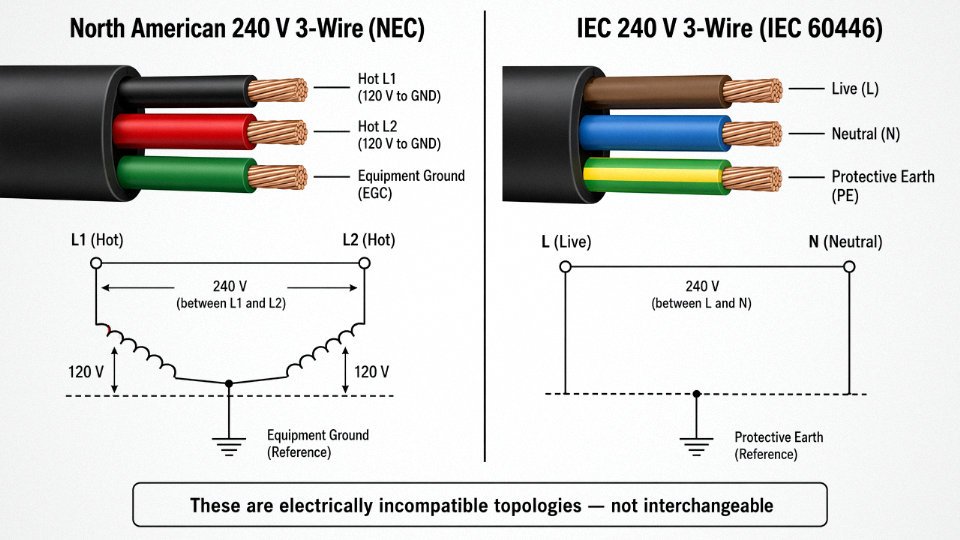
The Re-Identification Rule: Why Jacket Color Is Not Enough Above 6 AWG
NEC contains a permissive rule that experienced installers know well but procurement teams sometimes overlook: conductors larger than 6 AWG may be re-identified by phase using colored tape, heat-shrink sleeves, or paint at termination points. In practice, this means a large-gauge feeder cable might ship with all-black or even all-gray conductors, with phase identification applied only at the ends. Relying on insulation color alone to verify conductor function in a large-gauge North American installation is genuinely unsafe and, in an audit, will fail. For anyone sourcing pre-cut cord assemblies from overseas for North American industrial applications, this is worth specifying explicitly in the purchase order.
Canadian Differences: CSA C22.1 and the Isolated-Ground Conductor
CSA C22.1 tracks NEC closely enough that most cords compliant with one pass the other, but there is one divergence worth knowing. In healthcare facilities, data centers, and some sensitive industrial environments, CSA mandates orange insulation for an isolated-ground conductor — a separate EGC that runs back to the panel without intermediate connections, intended to suppress electrical noise. If Jinda is manufacturing OEM cord assemblies destined for Canadian hospital equipment or precision instrumentation, orange-insulated EGC wire needs to be in the BOM from the start. Retrofitting it later means reworking the entire assembly.
Import Compliance: The UL/ETL Listing Problem with IEC-Colored Cords
A power cord manufactured to IEC 60446 color standards (brown/blue/green-yellow) can be sold in the US market without modification as long as the plug is changed to a NEMA type.False
Changing the plug is not sufficient. UL and ETL listing requirements evaluate the complete cord assembly including conductor color identification. An IEC-colored cord sold in the US without re-labeling or a compliant UL-recognized cord designation will fail listing inspection, and distributors may face product withdrawal obligations.
This comes up more than it should. A cord that passes CE marking for European distribution — correctly colored brown, blue, green-yellow — cannot simply be fitted with a NEMA 5-15 plug and sold into the US market. The listing agencies evaluate the full assembly. Conductor colors that do not match NEC identification rules will trigger a nonconformance finding. For manufacturers supplying both markets, the cleanest solution is separate SKUs with region-specific cord sets built to the correct standard from the ground up.
Side-by-Side Comparison
| Conductor Function | IEC 60446 Color | NEC / US Color | CSA / Canada Color |
|---|---|---|---|
| Live / Hot (L1) | Brown | Black | Black |
| Live / Hot (L2, 240 V) | — | Red | Red |
| Neutral | Blue | White or Gray | White or Gray |
| Earth / EGC | Green-Yellow stripe | Green, Green-Yellow, or Bare | Green, Green-Yellow, Bare, or Orange (isolated ground) |
The color gap between North American and IEC systems is not a minor documentation issue. It affects listing compliance, field safety, and — when large-gauge re-identification rules are ignored — creates genuine hazard. For any international cable manufacturer supplying both markets, understanding this distinction at the product specification stage is far cheaper than resolving it after a listing rejection or a field incident.
Australia, New Zealand, and the Post-Harmonization Transition Color Code
Australia and New Zealand present a situation that catches importers and procurement teams off guard more often than you’d expect: two color systems, both legally valid depending on when a building was wired or when an appliance was manufactured, coexisting in the same facilities. For anyone sourcing flexible cord for these markets, understanding that history isn’t optional — it directly determines whether your shipment gets accepted or rejected at customs or by the electrical safety regulator.
The Current AS/NZS 3000 Color Code
Under AS/NZS 3000:2018 — the Wiring Rules that govern both Australia and New Zealand — the standard 3-wire flexible cord color code is brown for Active (the functional equivalent of Live in IEC terminology), blue for Neutral, and a green/yellow stripe for Earth. This is, wire for wire, identical to the IEC 60446 harmonized scheme used across most of Europe and the broader international market. That alignment was intentional. The harmonization effort around 2000 was meant to reduce exactly the kind of import-compliance friction that the old local scheme created.
What the Old Code Looked Like — and Why It Still Matters
Before harmonization, Australian and New Zealand fixed wiring used red for Active, black for Neutral, and green (occasionally green/yellow in later installations) for Earth. If you’ve ever walked through an Australian commercial building that was last rewired in the 1980s or early 1990s, there’s a good chance the cables inside the walls still carry those colors. That’s not a violation — it was correctly installed under the standard of the time. But it creates a real identification hazard when someone does retrofit work or adds a new circuit without properly tracing what they’re connecting into.
The practical problem is that black in the old Australian code means Neutral, while in some Asian and Middle Eastern wiring traditions black means something else entirely. An unfamiliar electrician working in a legacy Australian installation without checking dates can make a dangerous assumption.
The 2006 Cutoff and What It Applies To
New fixed wiring installations completed after March 2006 in Australia are required to use the harmonized IEC color scheme. Appliance flexible cords sold after 2000 should already comply with the brown-blue-green/yellow code. In practice, the installed base is messier than that clean cutoff implies. Older appliances get handed down, commercial premises do partial rewiring, and second-hand equipment moves between sites. A maintenance team working in a mixed environment genuinely needs a date-of-installation check before making any assumptions about wire identity — color alone isn’t enough in those buildings.
New fixed wiring completed after March 2006 in Australia must use the IEC harmonized color scheme (brown/blue/green-yellow), not the legacy red/black/green code.True
AS/NZS 3000 adopted the harmonized IEC 60446 color scheme with a transition cutoff for new fixed wiring installations after March 2006, as part of the broader Australia-New Zealand electrical standards harmonization process.
New Zealand’s Separate Regulatory Path
New Zealand follows the same harmonized color code on a roughly parallel timeline, but compliance is administered independently through WorkSafe NZ and the Electricity (Safety) Regulations 2010, not through any joint Australian body. This matters if you’re shipping product that carries electrical safety certification — SAA approval for Australia doesn’t automatically satisfy WorkSafe NZ requirements. Procurement teams managing dual-market orders for AU and NZ need to treat these as separate compliance streams, even though the actual wire colors end up identical.
What to Specify When Ordering Flexible Cord for These Markets
When placing a purchase order for 3-wire flexible cord destined for Australia or New Zealand, state the color code explicitly: brown Active, blue Neutral, green/yellow Earth. Reference AS/NZS 3000 and AS/NZS 3191 (the standard for flexible cords specifically) in the PO. Don’t assume a supplier’s “international” stock will ship in harmonized colors — legacy-colored stock does circulate, especially from smaller manufacturers, and a shipment of red/black/green cord will face field rejection regardless of how good the conductor specs are.
At Jinda, AU/NZ export batches go through color inspection under CIE illuminant D65 controlled lighting precisely because brown and red can look deceptively similar under warehouse fluorescents, and blue versus black is another common point of confusion on the production floor. A rejected container isn’t just a cost problem — it’s a lead-time problem that tends to arrive at the worst possible moment in a project schedule.
Industrial and Machine Tool Color Codes: IEC 60204-1 and NFPA 79 Requirements
Domestic appliance cords and industrial machine wiring operate in the same voltage range but live in completely different regulatory worlds. A procurement manager sourcing cable for a CNC machining center or a conveyor drive panel cannot simply apply IEC 60446 or NEC Article 210 and call it done — the governing standards for internal machine wiring are IEC 60204-1 and NFPA 79, and the color conventions diverge from household wiring in ways that matter for safety, inspection, and international compliance.
IEC 60204-1: Machine Wiring Colors Inside the Panel
IEC 60204-1 (Safety of Machinery — Electrical Equipment of Machines) is the standard that controls how conductors are identified inside a machine’s electrical enclosure. It layers on top of IEC 60446 rather than replacing it, which causes some confusion on the shop floor. The short version: black is used for all AC and DC power circuit conductors within the machine. That includes L1, L2, L3 on three-phase, and both poles of a DC bus. Using red or brown for internal power wiring — habits that carry over from building installation practice — is non-conforming under IEC 60204-1.
The color hierarchy then branches out by circuit function. Red identifies AC control circuits (the 24 V AC or 110 V AC wiring to relays, contactors, and solenoids). Blue covers DC control circuits — so the 24 V DC logic wiring running to a PLC I/O card should be blue throughout. That alone prevents a maintenance technician from probing an AC control line under the assumption it is DC, which is not a trivial risk on a machine that runs at 110 V AC control.
Orange is the one most engineers outside the machinery OEM world miss entirely. Circuits that remain energized after the main disconnect is opened — capacitor discharge paths, emergency lighting, UPS-backed controls — must be orange. This is not optional decoration. An orange conductor is a visual warning to the electrician cracking open the panel that voltage may still be present. In my experience, orange wiring gets specified correctly on new builds and then quietly violated during field retrofits, which is where incidents happen.
Green/yellow stripe remains the exclusive color for protective earth bonds, exactly as in IEC 60446. No other conductor in an IEC 60204-1 machine may carry green/yellow.
NFPA 79: The US Machine Wiring Equivalent
NFPA 79 (Electrical Standard for Industrial Machinery) tracks IEC 60204-1 closely in its color philosophy — black for power, orange for live-after-disconnect circuits — but it retains NEC heritage for neutral and ground. White or gray for neutral, green or bare copper for ground. That creates a genuine compliance gap for OEMs building one machine platform for both North American and European customers. The internal wiring harness, the panel layout, and the cable labeling scheme all need to be reconsidered for the destination market. It is not catastrophic to manage, but it adds real BOM and documentation complexity.
The Supply Cord Is Still Governed by the Installation Country
This is worth stating plainly because it trips up procurement teams. The three-wire power supply cord running from the wall outlet or machine disconnect to the machine is not subject to IEC 60204-1 or NFPA 79 for its color code. That cord follows the national wiring regulations of wherever the machine is installed: brown/blue/green-yellow in Europe, black/white/green in North America. IEC 60204-1 takes over at the point where the conductors enter the machine’s control cabinet. Getting this boundary wrong usually surfaces during CE marking audits or UL inspection sign-off, and correcting it in production is expensive.
VFD and Servo Motor Power Cable: The Shield Identity Problem
Variable frequency drive output cables and servo motor power cables introduce a specific complication. A typical configuration is a 3-wire or 4-wire shielded cable — three motor phase conductors plus, in a 4-conductor design, a separate PE conductor — with a braided or foil shield intended to contain the high-frequency switching noise the VFD generates. The shield must be bonded to PE at both ends, and IEC 60204-1 is explicit that it must be separately identified from the green/yellow PE conductor. In practice, Jinda’s motor cable datasheets document the shield as a drain/screen conductor with its own identification, distinct from the green/yellow PE wire running inside the same cable. This matters during installation because an installer who bonds only one end of the shield — a common field shortcut — will experience EMI coupling into nearby signal cables and intermittent drive faults that are genuinely difficult to diagnose.
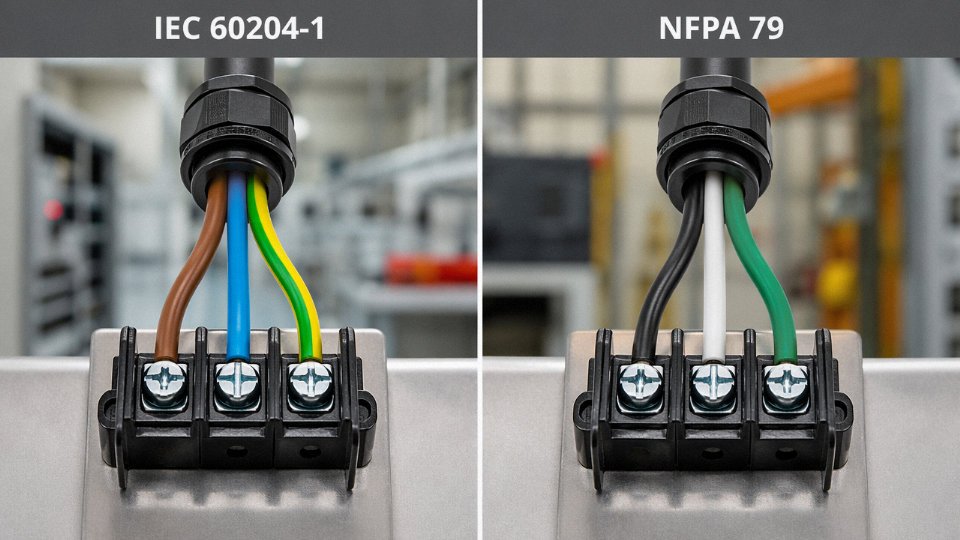
| Standard | Jurisdiction | Power Conductor Colors | PE / Ground Color | Control Circuit Color |
|---|---|---|---|---|
| IEC 60204-1 | EU, most international machinery markets | Black (AC and DC power) | Green/Yellow stripe | Red (AC control); Blue (DC control); Orange (live-after-disconnect) |
| NFPA 79 | United States | Black (power); White or Gray (neutral) | Green or bare copper | Red (AC control); Blue (DC control); Orange (live-after-disconnect) |
| Supply cord to machine (Europe) | EU installation | Brown (L), Blue (N) | Green/Yellow stripe | N/A — not internal wiring |
| Supply cord to machine (North America) | US/Canada installation | Black (Hot), White or Gray (Neutral) | Green or bare copper | N/A — not internal wiring |
IEC 60204-1 mandates orange for conductors that remain live after the main disconnect is opened, and no other conductor color may be used for that circuit function within the machine enclosure.True
IEC 60204-1:2018 Clause 13.2.2 specifies orange as the required color identification for circuits inside a machine that remain energized after the main power disconnect is switched off, including capacitor discharge circuits and emergency circuits with independent power supplies.
How to Read Cable Markings, Printing, and Datasheets to Verify Color Code Compliance
Buying cable on spec and assuming it arrives compliant is one of those habits that works fine — until it doesn’t. A miswired appliance cord reaching end users in Germany or a green-only earth conductor slipping through incoming inspection in Australia can trigger product recalls, failed CE audits, or, at worst, a site incident. Knowing how to read what’s actually printed on the jacket and what a legitimate test report should say is the fastest way to catch problems before they become expensive.
Decoding the Jacket Print
IEC 60227 and IEC 60245 require manufacturers to print the cable’s designation, voltage rating, conductor cross-section, and country of origin on the outer jacket at intervals not exceeding 500 mm. That’s roughly every half-meter, which means on a 100 m reel you’ll see the legend printed around 200 times — if you can’t find it within a few meters of unrolling, that itself is a problem worth noting.
A typical marking looks like this: H05VV-F 3G1.5 300/500V. Each character carries specific meaning and tells you exactly what the cable should contain:
- H — harmonized standard; means the cable was manufactured to a European harmonized document and should be accepted across all EU member states
- 05 — voltage class 300/500 V (a “07” prefix would indicate 450/750 V)
- VV — PVC insulation over each conductor, PVC outer sheath
- F — flexible cord (stranded conductors)
- 3 — three conductors total
- G — one of those conductors is a green/yellow earth; if you see X here instead, there is no earth conductor — that designation means something very different electrically
- 1.5 — nominal cross-section of each conductor in mm²
Get into the habit of checking this string character by character on incoming reels. A cord marked H05VV-F 3X1.5 in an application requiring earth protection is a non-conformance, full stop.
Verifying Insulation Color Against Standard References
Visual inspection alone isn’t sufficient for formal quality acceptance. IEC 60446 specifies that insulation color verification is performed under a D65 standardized daylight illuminant, compared against RAL or Munsell reference charts. Under fluorescent warehouse lighting, a pale blue neutral can look almost white, and a brown live conductor can look reddish-orange enough to confuse an inspector rushing through a goods-in check.
The green/yellow earth stripe has its own dimensional rule: the green portion must cover no less than 30% and no more than 70% of the conductor’s visible surface in any cross-sectional view. A solid green conductor — no yellow — does not comply with IEC 60446, even though it might look “earthy” enough to pass a casual glance. This particular violation shows up more often than people expect in lower-tier production runs.
Reading the Test Report and Declaration of Conformity
A Declaration of Conformity (DoC) for a harmonized flexible cord should explicitly reference the applicable harmonized standard (IEC 60227-5 for PVC-insulated flexible cords, for instance), state the voltage rating, and — critically — name the conductor color code. If a DoC lists mechanical and electrical test results but is silent on color designation, that omission is a red flag. Customs inspectors in the EU and BSI auditors both treat an incomplete DoC as grounds for holding a shipment.
The test report behind the DoC should include batch-level photographic evidence of conductor colors, a note on the measurement method used for the green/yellow stripe ratio, and a reference to the color standard revision. Self-declaration is permitted under certain harmonized standards, but the burden of proof sits entirely with the manufacturer if a field failure occurs.
A Practical Procurement Walkthrough
Say a buyer in Germany is sourcing 3-wire flexible cord for a 16 A appliance assembly line. The correct specification to put in the purchase order is: H05VV-F 3G2.5, 300/500 V, brown/blue/green-yellow per IEC 60227-5 and IEC 60446. Before shipment, request a batch inspection report with conductor cross-section photographs and the color measurement record. Specifying the color code by name in the PO — not just assuming it — removes ambiguity and gives you a contractual basis to reject non-conforming material.
Jinda runs 100% color inspection on all exported flexible cord production, with photographic batch records available on request.True
Color-code defects are among the most frequently cited violations in third-party cable audits for IEC-market products. A manufacturer supplying 50+ export markets needs systematic in-line inspection rather than end-of-line sampling to maintain consistent compliance across batches.
Color-code violations — solid green for earth, black used as neutral in an IEC cord, mismatched conductor designations — consistently rank among the top three defects in third-party cable audits of imported flexible cords. They’re also among the easiest to prevent, given that the information needed to verify compliance is printed right on the jacket every 500 mm.
Selecting the Right 3-Wire Power Cord for Your Destination Market: A Specification Checklist
Getting the color code right is only half the job. A cord with perfect conductor identification still fails compliance if the voltage rating is undersized, the jacket can’t survive the installation environment, or the plug doesn’t match the socket standard of the destination country. What follows is a working checklist — the kind you’d want pinned above the procurement desk, not buried in a datasheet footnote.
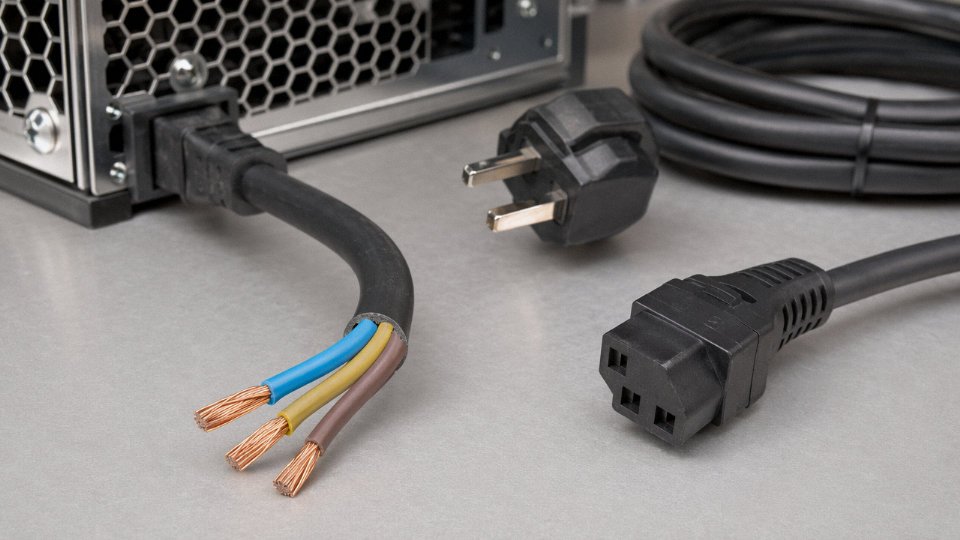
Step 1 — Confirm Destination Market and Applicable Standard
This sounds obvious, but it’s where most sourcing errors start. “Shipping to Europe” is not specific enough when your end customer is a Turkish OEM re-exporting to the UK, or an Australian distributor who orders through a Singapore trading house. Nail down the country of final installation, then map it to the correct standard:
| Destination | Color Code | Governing Standard |
|---|---|---|
| EU / EEA, most of Asia, Africa | Brown (L), Blue (N), Green-Yellow (PE) | IEC 60446 / HD 308 S2 |
| USA | Black (Hot), White or Gray (Neutral), Green or Bare (Ground) | NFPA 70 (NEC) |
| Canada | Black (Hot), White (Neutral), Green (Ground); Orange = isolated ground | CSA C22.1 |
| Australia / New Zealand | Brown (L), Blue (N), Green-Yellow (PE) | AS/NZS 3000 (post-2000) |
| UK (post-2004 harmonization) | Brown (L), Blue (N), Green-Yellow (PE) | IEC 60446 (BS 7671 adopted) |
Canada’s orange isolated-ground conductor is worth calling out specifically — it trips up procurement teams sourcing from Asian manufacturers who’ve never seen it, and it gets omitted from factory samples fairly routinely.
Step 2 — Specify Voltage Class and Conductor Cross-Section
Match the cord’s rated voltage to the circuit. Flexible cords typically come in three voltage classes: 300/300 V (light-duty, small appliances), 300/500 V (general household and office equipment), and 450/750 V (heavier portable tools and industrial drops). Putting a 300/300 V cord on a 230 V circuit powering a 16 A load isn’t catastrophic on day one — it becomes a problem over months of flexing and heat cycling.
For conductor sizing, use IEC 60364-5-52 current-carrying capacity tables for IEC markets or NEC Table 310.15(B)(16) for North America. Rough practical ranges: 0.75 mm² handles up to roughly 6 A in open air, 1.5 mm² handles around 10–16 A depending on installation method and ambient temperature, and 2.5 mm² gets you into the 20–25 A territory for most flexible cord configurations. AWG equivalents (18 AWG ≈ 0.75 mm², 14 AWG ≈ 2.5 mm²) matter when ordering from North American-spec stock.
Step 3 — Choose Jacket Material for the Operating Environment
PVC works for most dry, indoor, general-purpose applications and it’s what you’ll get by default if you don’t specify otherwise. If the cord sees outdoor exposure, dragging across concrete floors, or contact with oils, specify rubber — H05RR-F for lighter duty, H07RN-F for genuine mechanical punishment. Food processing and cold-storage facilities usually want TPE, which handles low temperatures and repeated washdowns better than standard PVC, which can go brittle below about -10 °C or so. For tunnels, rail vehicles, and public buildings where smoke toxicity matters, specify LSZH (halogen-free, low-smoke); the jacket prints will call this out explicitly, usually as “LSZH” or “HF” in the cable designation.
H07RN-F rubber flexible cords are rated for outdoor use and mechanical stress under IEC 60245 and maintain flexibility at temperatures down to approximately -25°C depending on compound formulation.True
IEC 60245 covers rubber-insulated cables including H07RN-F; low-temperature flexibility depends on specific rubber compound but -25°C is a common published figure for general-purpose heavy rubber flexible cords.
Step 4 — Specify Plug and Connector Type
A mismatched plug is usually the first visible symptom of a deeper specification error — someone swapped the color-code standard mentally but ordered the wrong plug family to go with it. Match these pairings:
- EU general use: CEE 7/4 (Schuko) or CEE 7/16 (Europlug, unearthed only)
- UK: BS 1363 (fused, 13 A)
- North America: NEMA 5-15 (15 A, 125 V) or NEMA 5-20 for 20 A circuits
- Australia / NZ: AS/NZS 3112
- Industrial worldwide: IEC 60309 (the colored-ring “commando” plug); color band indicates voltage and phase
Step 5 — Request the Right Certifications
Certifications are where color-code compliance becomes legally documented. For EU markets, request CE declaration with VDE or KEMA test reports. North America needs UL listing or ETL listing — not just “UL-style” testing, which is a phrase that means nothing enforceable. Australia and New Zealand require SAA approval or RCM mark. China domestic supply needs CCC. Crucially, ask the supplier to confirm that the test report explicitly names the color-code standard; a UL listing that covers conductor insulation without calling out NEC color identification is not sufficient for a project requiring full NEC compliance documentation.
In practice, a supplier who can’t produce a test report referencing the specific color standard by name is probably not the right supplier for a regulated market shipment.
Frequently Asked Questions About 3-Wire Power Cord Color Codes
Is green/yellow always the Earth wire?
In any IEC 60446 market — the EU, Australia and New Zealand post-harmonization, most of Asia, and a growing number of African and South American jurisdictions — yes, the bicolor green/yellow stripe is exclusively reserved for the protective earth (PE) conductor. No exceptions, no workarounds. It cannot be used for a phase conductor, a neutral, a control wire, nothing else. Solid green alone is prohibited for new installations under IEC 60446; the bicolor stripe exists precisely because solid green caused misidentification in older European installations and the standard was tightened.
North America is the main outlier. NEC and the Canadian Electrical Code both reserve solid green and bare copper for the equipment grounding conductor. A bare copper conductor is common in fixed building wiring; flexible cords almost always use insulated green instead.
IEC 60446 prohibits using solid green as a protective earth conductor in new installationsTrue
The standard mandates the bicolor green/yellow combination specifically to eliminate confusion with solid-green conductors that appeared in older European wiring. Solid green alone is reserved for legacy identification only and is not permitted for new installations under current IEC 60446.
Can I use a brown/blue/green-yellow IEC cord in the United States?
Physically, yes — the copper and insulation don’t care what standard you follow. Legally and safely, only with proper re-identification. NEC 200.6 requires that the neutral conductor be white or gray at termination points, so the blue IEC conductor must be marked with white tape or white paint at both ends where it lands. Brown, being a non-standard color under NEC for residential and light commercial wiring, should similarly be marked at terminations to indicate its Hot function. You also need to fit a NEMA-type plug appropriate to the circuit — a NEMA 5-15 or 5-20 for 120 V, for instance.
In practice, this comes up often with imported equipment that ships with a CEE 7/4 Schuko plug. Don’t just cut the plug off and assume color correspondence. Verify with a meter first, then re-mark.
What is the color code for a 3-wire 240 V cord in the US?
This trips people up because “3-wire 240 V” can mean two different things. On a NEMA 6-series circuit — think a workshop air compressor or certain HVAC equipment — the cord carries two Hot conductors and a ground, with no neutral at all. Standard colors are black and red for the two Hots, plus bare or green for Ground. There is no white wire, because there is no neutral.
Compare that to a 3-wire 120/240 V cord on a NEMA 14-series or older dryer circuit: that’s black Hot, white Neutral, and bare or green Ground. Same conductor count, completely different electrical configuration. Mixing them up is a real hazard, not a theoretical one.
Why does my imported appliance have different wire colors than my wall outlet?
The appliance was built to IEC 60446 (brown/blue/green-yellow), and your building is wired to a different national code. The functions are identical; the colors differ. This is especially common in North America and parts of Asia where locally-wired buildings don’t follow IEC conventions. Always verify conductor identity with a multimeter before making any connection. Never assume by color alone when you’re crossing standards — a brown wire in an IEC appliance is the Live conductor, but in some older UK installations brown was used for a switched neutral. Context and measurement matter.
What does “3G1.5” mean on a cable jacket?
Three conductors, one of which is the green/yellow protective earth — the “G” comes from the German Grüngelb — and each conductor has a nominal cross-section of 1.5 mm². If the designation read “3X1.5” instead, there is no dedicated earth conductor in the cable. A 3X cord is only suitable for Class II double-insulated equipment. Using a 3X cable where a grounded connection is required is a wiring fault, not just a specification mismatch. Check the marking before you cut.
How does Jinda ensure color-code compliance for export orders?
Each of Jinda’s five production bases runs dedicated color-inspection stations using calibrated spectrophotometers traceable to national color standards — visual inspection alone isn’t reliable enough at production volumes. Every export batch ships with a color conformance report. For custom configurations, such as NEC-compliant black/white/green coloring on an IEC-constructed flexible cord, Jinda can produce to order; typical lead time for standard cross-sections runs roughly 15 working days, though that depends on current line scheduling and whether the compound color requires a special extrusion run.
Are there any colors internationally prohibited for power conductors?
Yes, and this is worth stating plainly. IEC 60446 explicitly prohibits solid green, solid yellow, and the green/yellow bicolor for any conductor other than the PE. Those colors are off-limits for phase and neutral conductors in all IEC-market installations — full stop. NEC takes a similar position: green and bare copper are reserved exclusively for equipment grounding conductors and cannot be used for ungrounded (Hot) or grounded (Neutral) conductors. Using a prohibited color on the wrong conductor doesn’t just fail inspection; it creates a genuine risk that a downstream technician will misidentify a live conductor as a safe earth connection. That’s the kind of mistake that ends careers and causes serious injury.
Jinda’s 3-Wire Flexible Power Cord Production Capabilities and Global Supply Framework
Shandong Jinda Special Cable Group has been manufacturing flexible power cables since 1987 — long enough to have lived through several cycles of standards harmonization, export market shifts, and the kind of supply-chain disruptions that expose which manufacturers actually have depth and which are assembling product from bought-in components. The company operates five production bases across China with a combined floor space of roughly 470,000 m², which is large enough that conductor drawing, stranding, insulation extrusion, jacketing, and final testing all happen under one organizational roof rather than being farmed across a network of sub-suppliers.

Manufacturing Scale and Conductor Range
The flexible cord lines cover conductor cross-sections from 0.5 mm² up to 35 mm², which spans everything from light appliance leads to heavy-duty industrial supply cords. Annual output across all flexible cord product families runs above 50,000 km — a figure that matters in practice because it means production scheduling can absorb large blanket orders without pushing lead times into uncomfortable territory. In my experience, the manufacturers who quote short lead times but run thin on capacity are the ones who quietly push your shipment when a bigger account places an order. Scale is a real buffer against that.
Standards Portfolio and Type Approvals
Jinda holds type-approvals and certifications that cover the major destination markets where color-code compliance is a hard regulatory gate: VDE (Germany), KEMA (Netherlands), UL (USA), SAA/RCM (Australia), CCC (China), and CE Declaration of Conformity under the relevant harmonized cable standards. For an OEM shipping the same appliance to Germany, the US, and Australia — all of which use different wiring color conventions and different certification bodies — this creates a genuinely practical single-source option. You specify the destination market, the required color configuration, and the applicable approval marks, and those requirements get resolved at the production level rather than being patched together after the fact.
Jinda holds active VDE, UL, SAA/RCM, and CCC type-approvals for flexible power cordsTrue
These certifications are standard for established Chinese cable exporters supplying regulated markets; type-approval certificates are issued by the respective bodies and are verifiable through their public registers.
Color-Code Changeover and Minimum Order Quantities
Production lines can be switched between IEC brown/blue/green-yellow, NEC black/white/green, and legacy or market-specific configurations within a scheduled changeover window. For repeat customers, minimum order quantities for custom color configurations start at around 500 m per conductor size — which is workable for OEM prototyping runs before committing to full container quantities. That flexibility matters when you’re qualifying a new product for a new export market and don’t yet know whether demand will justify a full 10,000 m order.
Quality Assurance Infrastructure
The in-house laboratory runs conductor resistance testing, AC voltage withstand up to 6 kV, insulation resistance, elongation at break, and — notably — calibrated spectrophotometer measurement for color conformance. That last item sounds minor until you’ve had a customs inspector in Australia reject a pallet because the green-yellow earth conductor looked too uniform green under lab lighting. Color measurement is traceable to CNAS-accredited reference standards, which is what a serious QA audit will want to see.
Logistics and Lead Times
Jinda ships through Qingdao, Tianjin, and Shanghai, with typical sea freight transit times of roughly 20 days to Europe, 25 days to the US East Coast, and around 18 days to Australia — though those figures depend on carrier routing and seasonal port congestion, particularly around Chinese New Year. LCL consolidation and air freight are available for urgent orders, usually at a cost premium that’s worth running through your landed-cost calculation before assuming sea freight is always the right answer.
Technical Support Model
Each customer is assigned a dedicated application engineer who reviews cable specifications against installation drawings, confirms that the correct color-code standard applies to the destination jurisdiction, and coordinates pre-shipment inspection. That’s not unusual among large manufacturers, but the value depends entirely on whether that engineer actually knows the standards — not just the product catalog. Given the number of markets where color-code errors create compliance failures at the point of import or installation, having an engineer who can catch a specification mismatch before production runs is worth more than a competitive price per meter.