Fieldbus networks that made perfect sense in 2005 are quietly becoming the bottleneck on modern lines. A 12 Mbps ceiling sounds adequate until you’re running vision inspection, servo coordination, and predictive-maintenance telemetry on the same segment — then latency spikes, cycle times slip, and what started as a bandwidth problem turns into scrap rates creeping up and OEE numbers you’d rather not show a plant manager. The fix isn’t exotic; it’s a protocol shift that most facilities are already halfway toward.
Industrial Ethernet delivers data transmission speeds from 10 Mbps to 10 Gbps — orders of magnitude beyond legacy fieldbus limits — over ruggedized cabling rated from -40 °C to +85 °C, with standardized TCP/IP architecture that integrates plant-floor devices directly with enterprise systems, cuts diagnostic overhead, and supports the high-bandwidth sensor and control traffic modern automated lines demand.
What makes this worth examining carefully isn’t just the raw speed — it’s the cascade of operational decisions that follow from the choice of protocol, cable category, topology, and installation method. Get those right and you’re building infrastructure that scales. Get them wrong and you’re rewiring in three years, or worse, chasing intermittent faults that only appear at full production rate. The rest of this article breaks down exactly where industrial Ethernet earns its place and where the tradeoffs still require honest thought.
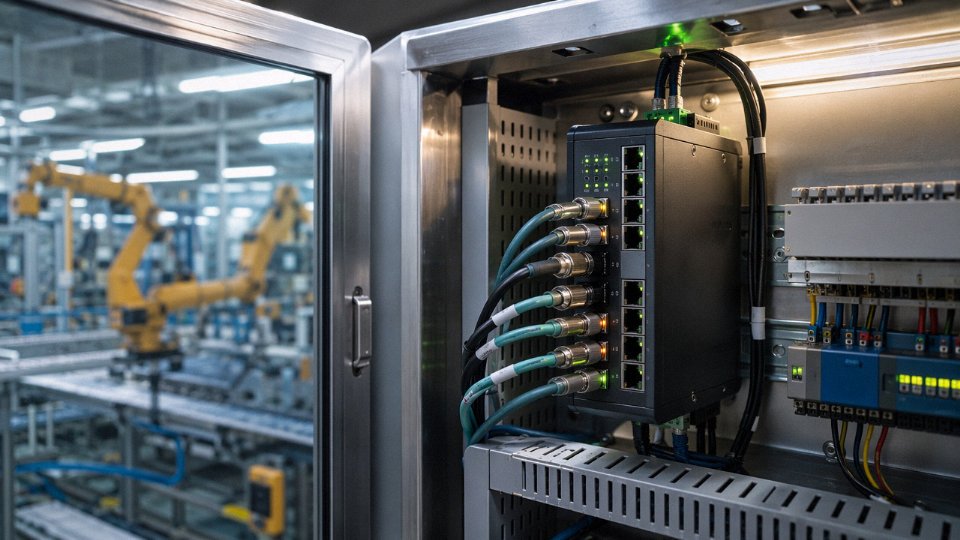
High-Speed, High-Bandwidth Data Throughput Across the Entire Automation Pyramid
The ISA-95 automation hierarchy isn’t just an org chart for software — it’s a map of where latency kills you. At the bottom, field devices need deterministic cycle times measured in microseconds. At the top, ERP systems are reconciling production orders against actual output, and a 30-second data lag can mean a shift supervisor is making decisions on stale numbers. Industrial Ethernet delivers speed improvements at every tier, but the gains are not uniform, and the cable infrastructure underneath has to keep up.
Field Device and Control Levels: Where Milliseconds Are Too Slow
Legacy PROFIBUS DP runs at a theoretical 12 Mbps, but real-world cycle times on a busy segment with 30–40 nodes typically land somewhere between 5 ms and 20 ms, depending on node count and message length. For a servo axis doing 1,000 position updates per second, that’s already marginal. EtherCAT, running over standard Cat5e or Cat6 cabling, achieves cycle times under 100 µs — often 50–62 µs in practice — because it processes Ethernet frames on the fly rather than waiting for full frame receipt. PROFINET IRT can get down into the 250–500 µs range with properly configured hardware. That gap between milliseconds and microseconds is the difference between a smooth cam profile and a jitter-induced reject rate on a high-speed packaging line.
| Protocol | Max Raw Speed | Typical Cycle Time | Max Segment Length | Network Topology |
|---|---|---|---|---|
| PROFIBUS DP | 12 Mbps | 5–20 ms | 100–1,200 m (speed-dependent) | Bus/ring |
| DeviceNet | 500 Kbps | 10–50 ms | 100–500 m | Bus |
| Modbus RTU | 115 Kbps | 20–100 ms | ~1,200 m (RS-485) | Bus |
| PROFINET RT | 100 Mbps–1 Gbps | 1–10 ms | 100 m per segment | Star/ring |
| PROFINET IRT | 100 Mbps | 250–500 µs | 100 m per segment | Line/ring |
| EtherCAT | 100 Mbps | 50–100 µs | 100 m per node | Line/ring |
| EtherNet/IP | 100 Mbps–1 Gbps | 1–10 ms | 100 m per segment | Star |
Cycle times vary with node count, payload size, and switch configuration. These are representative ranges, not guaranteed specs for every installation.
Supervisory and MES Levels: Bandwidth That Doesn’t Force Trade-offs
At the SCADA and MES tiers, the challenge shifts from cycle time to sustained throughput. A vision inspection system pulling 5 MP images at 30 frames per second generates somewhere around 400–700 Mbps of raw data before compression. Trying to route that over anything slower than a 1 Gbps backbone segment — while simultaneously streaming PLC historian data to a cloud MQTT broker and running OPC-UA communications to a MES database — creates queuing delays that show up as slow alarm acknowledgment, historian gaps, and sluggish operator displays. A 10 Gbps backbone between the control room switch and the plant server rack makes those bandwidth conflicts largely irrelevant.
Full-duplex switched industrial Ethernet eliminates collision domains entirely, enabling deterministic, collision-free communication unsuitable under legacy CSMA/CD shared-bus Ethernet.True
IEEE 802.3 full-duplex operation over switched infrastructure removes the shared medium contention mechanism (CSMA/CD) by providing dedicated transmit and receive paths per port, verified by standard Ethernet protocol documentation and IEEE 802.3 specification.
Early Ethernet’s CSMA/CD collision mechanism was the reason plant engineers resisted it for motion control for so long — and rightly so. A switched, full-duplex architecture gives each device its own dedicated channel. Collisions are a non-issue. For robotics cells or coordinated multi-axis motion, that determinism is not optional.
Why the Cable Spec Actually Limits What You Can Do
None of this works if the physical layer can’t support it. Reaching 1 Gbps over a 90 m horizontal run with a 10 m patch cord requires Cat6 at minimum — and in electrically noisy environments near VFDs or large motor starters, Cat6A shielded cable (S/FTP or F/FTP construction) is the practical choice, not a premium upsell. The relevant parameters: impedance must be 100 Ω ±15%, near-end crosstalk (NEXT) should exceed 44 dB at 250 MHz for Cat6, and the shield continuity across every connection needs to be verified, not assumed. A single unshielded patch panel in an otherwise fully shielded run will degrade signal-to-noise ratio enough to force the link to drop to 100 Mbps — at which point your EtherCAT cycle time assumptions are gone.
Bend radius matters in cable trays and flexing drag chains. Ruggedized Cat6A variants rated to –40 °C through +85 °C and specified with a minimum bend radius around 4× the cable diameter are standard for installations near ovens, cold stores, or continuous-flex applications. Standard office-grade patch cables will fail within months in those conditions, usually intermittently at first, which is the worst kind of failure to diagnose.
Deterministic Real-Time Control That Protects Machine Safety and Product Quality
Bandwidth gets all the attention in spec sheets, but for anyone who has watched a multi-axis servo system fault out mid-cycle, determinism is the number that actually keeps machines — and operators — safe.
Determinism in industrial networking means one specific thing: a message will arrive within a guaranteed, bounded time window, every single cycle, regardless of what else is happening on the network. Not usually. Not on average. Every time. That distinction matters enormously once you’re dealing with a safety PLC monitoring a press brake, a CNC interpolating a five-axis contour, or a servo drive receiving torque commands at 4 kHz. A timing deviation of even 1 ms in a high-speed servo loop can cause position error to accumulate fast enough to scrap the part, strip a leadscrew, or — in a worst case — drive two axes into mechanical interference. Standard commercial Ethernet, with its best-effort CSMA/CD heritage, cannot make that promise.
How PROFINET IRT and EtherCAT Actually Enforce Timing
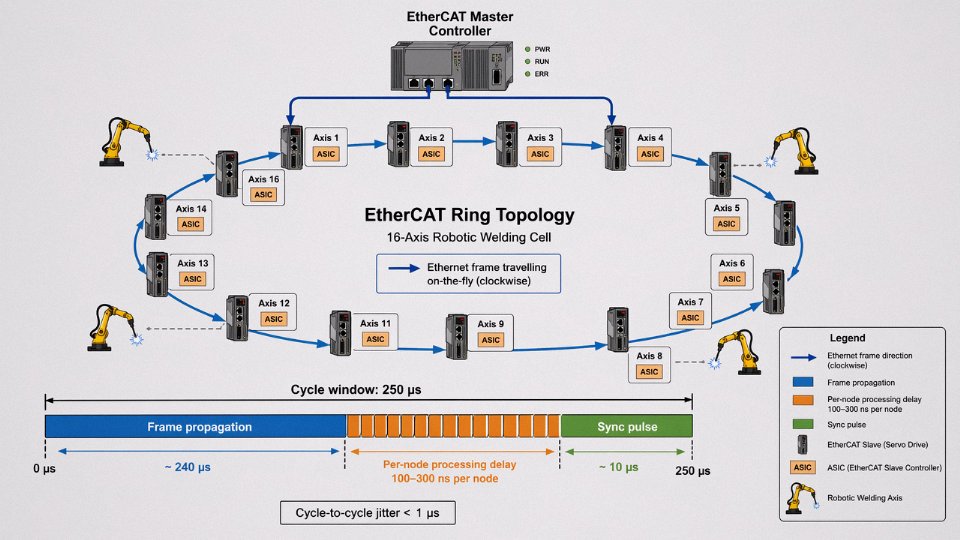
PROFINET Isochronous Real-Time (IRT) and EtherCAT take fundamentally different architectural routes to the same goal. PROFINET IRT carves the bus cycle into hard time slots at the switch hardware level — a reserved “red phase” where IRT traffic runs with hardware-enforced priority, isolated from any standard TCP/IP traffic that shares the wire. The result, in a properly configured system, is cycle-to-cycle jitter below 1 µs across a multi-axis network. EtherCAT goes further by having each node process the Ethernet frame on the fly using dedicated ASIC logic, updating its data segment and forwarding the frame in nanoseconds rather than storing and retransmitting. In a 16-axis ring topology, the processing delay per node is typically around 100–300 ns depending on the slave hardware, so a full ring can complete a cycle in well under 100 µs even with complex topologies.
Both protocols depend on distributed clock synchronization — essentially, every node agrees on what time it is to sub-microsecond precision. Lose that synchronization, and you lose determinism. In practice, that synchronization can be disrupted by poor cable termination, impedance mismatches, or signal reflections caused by substandard cable construction.
TSN: Bringing Determinism to Standard Silicon
IEEE 802.1 Time-Sensitive Networking is a suite of standards — 802.1Qbv time-aware shaper, 802.1Qbu frame preemption, 802.1AS timing and synchronization — that bake determinism into standard Ethernet hardware rather than requiring proprietary ASICs. The commercial implication is significant: a TSN-capable switch can simultaneously carry EtherCAT motion data, PROFIsafe traffic, and regular OPC UA payloads on one physical network without the safety-critical frames ever competing unpredictably with IT traffic. Convergence on a single fabric reduces cable runs, switch counts, and the complexity of maintaining separate OT and IT networks. Most major PLC vendors have TSN roadmaps now, and you’re starting to see TSN-native I/O modules on the market, though wide adoption in brownfield plants is still a few years out in most industries.
The Welding Cell Scenario
Consider a 16-axis robotic welding cell. Every servo drive must receive an updated position command within a 250 µs cycle window — miss that window on even one axis and the motion controller will either fault the cell or, worse, allow a position drift that produces a weld out of tolerance. EtherCAT in a ring topology handles this comfortably under normal conditions. Where it breaks down is at the cable layer.
In a welding environment, you have spatter, high-current cables running parallel to data cables, and VFD noise that can push EMI levels well above what a standard Cat6 cable tolerates. If the industrial Ethernet cable uses only foil shielding (FTP construction), that foil provides reasonable protection against high-frequency radiated interference, but it offers limited coverage against lower-frequency magnetic field coupling from heavy welding transformers. Braided shielding (STP) handles low-frequency magnetic interference better but has coverage gaps at higher frequencies. The cable construction that actually holds up in arc welding and motor drive environments is combined foil-plus-braid — SFTP — where the foil handles the high-frequency component and the braid handles the low-frequency magnetic coupling, and the combination delivers transfer impedance low enough to keep signal integrity intact through thousands of weld cycles.
EtherCAT jitter in a properly implemented multi-axis system can be held below 1 µsTrue
EtherCAT's distributed clock mechanism synchronizes all slave nodes to sub-microsecond precision; published Beckhoff documentation and independent test data confirm jitter figures of typically 20–100 ns in well-configured systems, well within the 1 µs threshold.
Reflections caused by poor cable quality — impedance outside the 100 ± 15 Ω specification, poorly crimped RJ45 connectors, or tight bends that deform the cable geometry — introduce return loss that degrades signal integrity enough to cause intermittent CRC errors. In a deterministic protocol, a single CRC error means a missed cycle. In a welding cell running at 250 µs cycles, even a handful of missed cycles per hour will eventually produce a motion fault or a bad weld. The fix is never in the software configuration; it’s always in the cable and connector quality chosen at procurement time.
Seamless Vertical Integration from Field Sensors to ERP and Cloud Platforms
For most of the last three decades, the OT/IT divide wasn’t a philosophy — it was a physical fact. A PROFIBUS DP segment on the factory floor had no native way to talk to an SQL historian running upstairs, so plants installed gateway boxes: PROFIBUS-to-OPC bridges, Modbus-to-TCP converters, serial concentrators feeding data into middleware that then fed something else. Each hop added latency, usually 50–200 ms per translation depending on poll rates and buffer sizes, and every gateway was a single point of failure that nobody budgeted spares for until one failed on a Saturday night. The total cost of owning that layer of translators — hardware, licensing, engineering time, and unplanned downtime — rarely showed up cleanly on a capital budget, which is part of why it persisted so long.
Industrial Ethernet over a shared TCP/IP stack collapses most of that. When your field devices, SCADA servers, MES layer, and ERP system all speak the same fundamental protocol family, the gateway boxes either disappear entirely or shrink to lightweight software adapters. That is not a small operational improvement.
One Cable Run, Multiple Protocol Streams
A single Cat6A shielded industrial Ethernet run — foil plus braid, typically an SF/FTP or S/FTP construction — can simultaneously carry PROFINET device data from an I/O module, OPC-UA payloads from a PLC publishing process variables, and standard MQTT streams feeding a cloud broker. The physical medium doesn’t care. What makes this work reliably in practice is managed switch configuration: proper VLAN segmentation keeps OT control traffic isolated from IT bulk transfers, and QoS policies (typically DSCP marking or IEEE 802.1p priority queuing) ensure that a firmware download to a workstation doesn’t compete for bandwidth with a 1 ms PROFINET cycle. Get those switch configs wrong and you will see intermittent motion faults that are genuinely hard to diagnose — they look like mechanical issues until you run Wireshark on the segment.
What This Looks Like on a Real Production Line
Consider a pharmaceutical tablet press environment — a high-regulation, high-audit-frequency application where data integrity is non-negotiable. Field I/O modules report compression force, punch depth, and feed frame speed via PROFINET to a local PLC. That PLC publishes timestamped process values over OPC-UA to a SCADA historian. The historian forwards aggregated batch records to a cloud-based OEE analytics platform over HTTPS, and the same platform feeds deviation alerts back down to a maintenance tablet on the floor via MQTT. The entire chain runs on one Cat6A industrial Ethernet backbone with no protocol translation boxes anywhere in the path. Audit trail completeness is better because timestamps survive end-to-end without re-stamping at each gateway. Latency from sensor event to cloud dashboard sits in the 800 ms–2 s range, depending on historian flush intervals — fast enough for OEE analytics, though obviously not for the real-time control loop itself, which stays local.
Edge Nodes Change the Latency Math
Where cloud round-trip times are too slow for a given decision — vision inspection reject signals, predictive maintenance responses, local AI inference on vibration data — edge computing nodes connected directly via industrial Ethernet bring that latency down from seconds to roughly 5–50 ms, depending on model complexity and hardware. An edge server sitting in the panel room, pulling data from six machine axes over a dedicated VLAN, can run a bearing degradation model locally and trigger a maintenance work order before a human analyst would have noticed anything unusual. That reduces cloud dependency in a meaningful way, which matters in plants with unreliable WAN links.
Cable Infrastructure Planning for Convergence
Sharing conduit runs between OT and IT traffic creates one underappreciated problem: noise coupling. High-frequency IT data bursts generate electromagnetic interference that can corrupt timing-sensitive OT signals on adjacent cables, particularly in long parallel runs through steel conduit with variable grounding quality. The practical fix is double-shielded cable — SF/FTP or S/FTP construction with both an overall foil and individual pair braids — with drain wires properly terminated at one end to avoid ground loops. In mixed-use industrial facilities, cable selection is not interchangeable between IT and OT zones even when both run on Cat6A. Ruggedized industrial variants rated for -40°C to +85°C operating range also handle the thermal cycling in conduits near heat sources that standard commercial Cat6A simply isn’t tested for.
Industrial Ethernet over TCP/IP eliminates the need for protocol translation gateways in OT/IT convergence architecturesTrue
When field devices, SCADA, MES, and ERP systems share a common TCP/IP stack, data can traverse all layers using standard protocols such as OPC-UA and MQTT without requiring dedicated PROFIBUS-to-OPC or Modbus-to-SQL gateway hardware, reducing latency, hardware cost, and single points of failure.
The infrastructure decision made at the cable and switch level — shielding specification, VLAN architecture, QoS policy — is what determines whether vertical integration delivers on its promise or produces a network that is technically unified but operationally unreliable.
Physical Ruggedness and Environmental Tolerance That Legacy Fieldbuses Cannot Match
Commercial Ethernet was designed for offices. Clean rooms, stable temperatures, patch panels behind locked IT cabinets. Take that same Cat6 patch cable off the server rack and run it past a 400 A welding robot on an automotive body line, and you’ll be chasing intermittent dropouts within a few months — if the jacket doesn’t crack first.
Industrial Ethernet hardware is a genuinely different product category, not just rebranded office cable with a tougher label.
Temperature Range and Jacket Materials
The specification gap is immediate when you compare datasheets side by side.
| Parameter | Commercial Cat6 Patch Cable | Industrial Ethernet Cable (ruggedized) |
|---|---|---|
| Operating temperature | 0°C to +60°C | -40°C to +85°C continuous |
| Jacket material | PVC | TPE, PUR, or LSZH depending on application |
| Shielding | UTP (none) or basic foil | SFTP: foil per pair + overall braid |
| Minimum bend radius | ~8× cable diameter | 4× cable diameter (flex-rated versions) |
| UV and oil resistance | None rated | Rated per application class |
| Flame/smoke rating | Standard PVC burn | LSZH where tunnel/rail codes apply |
A conveyor running in an outdoor distribution center in northern China or a Canadian prairie warehouse will see ambient temperatures that kill commercial cable. The TPE and PUR jacket compounds stay pliable at -40°C; standard PVC goes brittle and cracks at mechanical stress points — typically right where a cable enters a conduit fitting. That’s not a theoretical failure mode. It’s a Monday morning problem.
IP-Rated Connectors Versus the RJ45 Tab Problem
Every technician who has worked a washdown environment knows the fragile plastic locking tab on a standard RJ45 is essentially a consumable. One caught cable, one pressurized water rinse, and you have an intermittent connection that takes an hour to diagnose.
M12 circular connectors — D-coded for 100 Mbps Fast Ethernet, X-coded for Gigabit and multi-gigabit — use a threaded or push-pull bayonet locking ring. IP67 keeps out dust and short-term immersion. IP68 handles continuous submersion at defined depth. IP69K, the rating you need in food processing and automotive paint shops, survives high-pressure steam cleaning at close range. The connector physically cannot be dislodged by a cleaning hose.
For outdoor infrastructure or any installation where connectors are exposed rather than inside a cabinet, IP67 minimum is the sensible baseline. IP69K anywhere steam or caustic wash chemicals are routine.
Flexing Life and Conductor Construction
A six-axis robot arm can complete somewhere between 5 and 20 million flex cycles over its service life, depending on cycle rate and duty schedule. Standard solid or coarse-stranded conductors work-harden and fracture under that loading. Fine-stranded conductors per IEC 60228 Class 6 or Class 7 — individual wires in the 0.05–0.1 mm diameter range — distribute the bending stress across hundreds of individual strands instead of a few thick ones.
Shielding construction matters equally. Braided shields, well suited to fixed installations, fatigue at the crossover points under repeated flex. Spiral-wrapped (served) shields maintain consistent coverage through millions of cycles without wire fracture. Some high-flex designs combine a foil layer for high-frequency EMI attenuation with an outer spiral braid for mechanical protection — the right answer when you need both.
EMI Immunity in Real Plant Environments
Variable-frequency drives, spot welders, high-current bus bars, induction heaters — these are normal neighbors on a plant floor, and all of them radiate. Transfer impedance, measured in mΩ/m, is the practical metric for how well a cable’s shield contains or rejects interference. A properly specified SFTP industrial cable typically achieves transfer impedance below 10–20 mΩ/m at relevant frequencies, which keeps bit error rates below 10⁻¹² at 1 Gbps even in moderately hostile EMI environments. An unshielded patch cable in the same location can produce error rates orders of magnitude higher — not enough to drop the link, but enough to flood the protocol stack with retransmissions and introduce latency that looks, confusingly, like a software problem.
SFTP industrial Ethernet cables with properly terminated shields maintain bit error rates below 10⁻¹² at 1 Gbps in environments with variable-frequency drives and welding equipment present.True
Transfer impedance specifications for SFTP cables (foil-plus-braid construction) are published in IEC 61156 and IEC 61726 test standards. At low transfer impedance values (typically under 20 mΩ/m in the relevant frequency range), the induced noise voltage on the cable remains well below the noise margin of Gigabit Ethernet PHY receivers, supporting the stated BER figure under typical industrial EMI conditions.
Jinda’s Manufacturing Approach to Industrial-Grade Cable
Producing cable that reliably meets these specs at volume requires process control that goes beyond running the right compound through a standard extruder. At Jinda’s production bases — five facilities across China totaling 470,000 m² of manufacturing space — industrial Ethernet cables are produced with foil-plus-braid shielding combinations, TPE and LSZH jacket extrusion lines, and conductor constructions validated for flex applications. Testing follows IEC 61156 for transmission performance, ISO/IEC 11801 for structured cabling system requirements, and TIA-568 where North American project specifications demand it.
For procurement managers sourcing cable for large infrastructure projects, the practical value is consistent electrical and mechanical performance across high-volume orders — not batch-to-batch variation that creates field problems six months after installation.
Scalability and Future-Proofing That Protects Capital Investment Over Decades
The scalability gap between industrial Ethernet and legacy fieldbus becomes obvious the moment a plant starts growing. A PROFIBUS DP segment tops out at 32 nodes and loses reliable signal beyond roughly 100 m at full 12 Mbps speed — add more devices and you’re buying repeaters, additional segment controllers, and the wiring overhead that comes with them. Industrial Ethernet on a Cat6A STP backbone flips that equation: a single managed switch fabric can address 1,024 or more nodes, gigabit speeds hold to 100 m per copper segment, and fiber uplinks extend backbone runs to kilometers without signal degradation. For a plant adding a new machine cell every 18 months, that headroom is not a luxury.
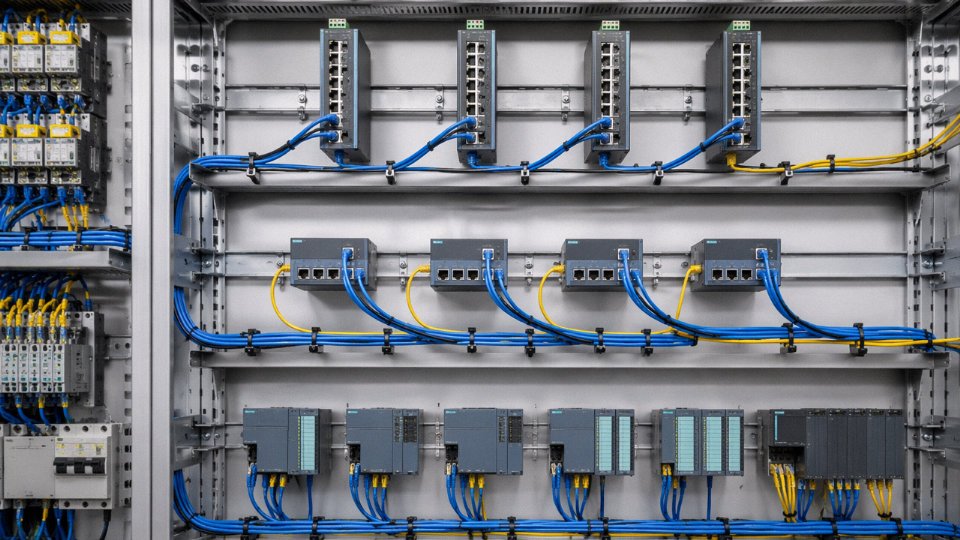
The Cabling Layer Is the Long-Term Asset
The part procurement managers sometimes miss is that the cable itself is the most durable component in the network. Industrial Cat6A STP installed correctly — proper bend radius, correct gland selection for the conduit entry, terminated with shielded RJ45 or M12 X-coded connectors — does not become obsolete when bandwidth demands increase. A run installed today running at 1 Gbps will support 2.5 Gbps with a switch upgrade and 10 GbE with no cable replacement at all.
Cat6A structured cabling supports 10 Gbps transmission up to 100 m per TIA-568-C.2-1 and ISO/IEC 11801 standards, meaning the physical layer does not need replacement when upgrading switch hardware from 1 GbE to 10 GbE.True
Cat6A is specified to 500 MHz bandwidth, which is the frequency headroom required for 10GBASE-T. The cable specification was designed with this upgrade path intentionally built in.
In practice, that means a plant engineering team that specs Cat6A STP today is protecting the physical layer for 15 to 20 years — realistic cable service life in a controlled industrial environment is often that long or longer, depending on mechanical abuse and chemical exposure. The switch hardware changes; the copper stays.
Topology Freedom Matters More Than People Expect
Legacy fieldbus is mostly linear. Industrial Ethernet is not. Star, ring with Media Redundancy Protocol, daisy-chain, and tree topologies are all achievable with the same cable type and the same termination tooling. MRP ring failover typically lands under 20 ms, which is adequate for most motion and process control applications. Being able to choose topology based on physical plant layout — rather than being forced into a bus segment because the protocol demands it — quietly eliminates a lot of awkward cable routing and the maintenance headaches that come with it.
Brownfield Migration Without Shutting the Line Down
Most plants are not greenfield. The honest brownfield picture is: you have working PROFIBUS or DeviceNet already, and ripping it out during production is not an option. Industrial Ethernet handles this through protocol bridges and parallel installation. The new Ethernet backbone goes in alongside existing fieldbus wiring; gateways translate traffic at the boundary until legacy devices are replaced on a normal maintenance or upgrade cycle. Done in phases, this approach avoids production shutdowns entirely. It is slower than a full cutover, but for continuous-process facilities or high-OEE assembly lines, “slower and safe” is the only acceptable plan.
Total Cost of Ownership Over the Asset Life
Industrial Ethernet cable and connectors do cost more upfront than comparable fieldbus cabling — roughly 20 to 40% more per meter installed, depending on specification and connector type. The offset comes from several directions. Proprietary gateways between fieldbus islands and the IT network disappear. Troubleshooting drops to standard IT tooling: cable testers, managed switch diagnostics, Wireshark — skills that maintenance electricians and IT staff already have, or can train on quickly. Field experience on medium-to-large installations generally puts ROI in the 3 to 5 year range, though the figure depends heavily on how many gateways are being eliminated and what downtime currently costs per hour at that facility.
Over a 20-year plant life, the infrastructure calculus favors Ethernet by a meaningful margin. The upfront premium on cable and connectors is a one-time cost. Every year of reduced gateway licensing, simplified spares inventory, and faster fault resolution compounds in the other direction.
Network Redundancy and Cybersecurity Architecture for Uninterrupted Production
Uptime is the metric every plant manager ultimately answers to. A fieldbus segment goes down — say, a PROFIBUS DP cable develops an intermittent break near a cable gland — and you’re looking at a maintenance electrician tracing the fault by hand, sometimes 20 to 40 minutes before production resumes. That’s not a worst-case scenario; it’s a Tuesday. Industrial Ethernet changes that equation in ways that legacy serial networks simply cannot replicate, both in how quickly faults are recovered and in the depth of security architecture the infrastructure can support.
Media Redundancy Protocols: Automatic Recovery Before the Operator Notices
PROFINET ring topologies using MRP (Media Redundancy Protocol) and EtherNet/IP installations using DLR (Device Level Ring) both achieve network reconfiguration in under 20 ms after a cable break or switch failure — typically 10–15 ms in well-configured rings, though actual recovery time depends on ring size and switch firmware. At 20 ms, most motion controllers and PLCs don’t even register a communication gap. The process keeps running. Contrast that with a broken fieldbus segment: no automatic healing, no ring topology, no path around the fault. The network is down until someone fixes it physically.
For environments where even a sub-20 ms interruption is genuinely unacceptable — power substations, turbine protection systems, SIL-rated safety interlocks in petrochemical plants — PRP (Parallel Redundancy Protocol) and HSR (High-availability Seamless Redundancy) provide zero-packet-loss redundancy by transmitting every frame simultaneously across two independent network paths. If one path fails, the receiver discards the duplicate from the failed path and continues processing the frame from the healthy one. The application layer sees nothing. No switchover, no recovery window, no jitter spike. This is the standard in IEC 61850 substation automation for a reason.
Cybersecurity: What a Fieldbus Simply Cannot Offer
Legacy fieldbuses were designed in an era when “air gap” was the assumed security model. That assumption is long dead in most plants. Industrial Ethernet, because it is fundamentally IP-based, can actually leverage the full stack of modern OT security tools — something a PROFIBUS or DeviceNet network cannot do at all, not in any retrofit-able way.
IEC 62443 has become the practical framework most serious OT security programs work against. Industrial Ethernet enables the controls IEC 62443 requires: VLAN segmentation to isolate machine cells from each other and from the IT network, deep packet inspection firewalls enforcing the Purdue Model zone boundaries, and encrypted OPC-UA tunnels between field devices and SCADA or MES layers. You can authenticate devices, log communication attempts, and detect anomalous traffic patterns. None of those capabilities exist on a serial fieldbus. There’s nothing to inspect, no addressable identity per device, no encryption layer available.
IEC 62443 cybersecurity controls including VLAN segmentation and encrypted OPC-UA are implementable on industrial Ethernet networks but are not achievable on legacy serial fieldbus architectures.True
Serial fieldbuses such as PROFIBUS and DeviceNet use proprietary, non-IP protocols without native support for IP-based security mechanisms like VLANs, TLS encryption, or deep packet inspection. Industrial Ethernet's IP foundation is a prerequisite for these controls.
Physical Layer Security and Cable Routing Discipline
There’s a less-discussed angle here. Shielded industrial Ethernet cable — S/FTP or SF/UTP construction with continuous foil plus braid — measurably reduces radiated emissions from the cable itself. In facilities handling sensitive process IP, proprietary formulations, or defense-adjacent manufacturing, this matters. It’s not a theoretical concern; it’s a TEMPEST-adjacent consideration that shielded cable partially addresses at the physical layer, before any software security even comes into play.
Cable routing discipline reinforces both redundancy and security. Primary and redundant ring cables should run separate physical pathways — different cable trays, different conduit runs, ideally separated by a structural member — so a single mechanical event (a forklift catching a tray, a burst pipe) can’t take out both paths simultaneously. Maintain at least 30 cm separation from power cables operating above 1 kV; in practice on a busy machine frame, this often means one tray low, one tray high, with the Ethernet routed away from the main power bundle. In areas with real mechanical risk — robotic cells, press lines, anywhere steel hits steel — armored industrial Ethernet cable isn’t optional. The armor stops the fault from reaching the conductor before the redundancy protocol ever needs to activate.
Standardization Benefits That Simplify Engineering, Procurement, and Maintenance
Anyone who has commissioned a plant built up incrementally over fifteen years knows the pain intimately: one section runs PROFIBUS DP for the drives, another uses DeviceNet for the safety I/O inherited from a North American machine builder, the conveyor system talks Modbus RTU, and somewhere in a dusty corner cabinet there is an AS-Interface segment that nobody fully understands anymore. Four protocols. Four separate spare connector inventories. Four diagnostic tools. And if your best automation technician leaves, you are not losing one skill — you are losing four.
Industrial Ethernet consolidates that fragmented landscape onto a single physical and logical standard. That is not a small operational gain. It is a structural change in how a maintenance department functions.
A Competitive Procurement Market Instead of Captive Vendor Relationships
The IEEE 802.3 standard is genuinely open and genuinely global. That means the switch sitting in your panel can come from a half-dozen credible suppliers, and the cable feeding it can be sourced on three continents. Compare that to a proprietary fieldbus where the approved connector might be sourced from one or two qualified vendors, lead times stretch unpredictably, and pricing reflects the captive relationship.
For large international projects — an automotive greenfield in Eastern Europe, a pharmaceutical expansion in Southeast Asia, a water treatment upgrade in the Middle East — the ability to dual-source or multi-source industrial Ethernet hardware is not a procurement preference, it is a supply chain resilience requirement. Single-vendor lock-in is a risk that procurement managers increasingly have to justify to finance teams, and with industrial Ethernet it simply does not exist in the same form.

Cable Interoperability Across Borders
Cable standardization deserves its own attention. Industrial Ethernet cables built to IEC 61156-5 (Cat5e), IEC 61156-6 (Cat6), and IEC 61156-7 (Cat6A) carry internationally recognized performance specifications — attenuation, impedance, NEXT, return loss — that mean the same thing whether the cable is produced in Germany, the United States, or China. A project specification written to IEC 61156-6 is readable and verifiable by any certified manufacturer supplying into that project.
Industrial Ethernet cables manufactured to IEC 61156-5, IEC 61156-6, and IEC 61156-7 are interoperable worldwide due to harmonized electrical performance requirements under these IEC standards.True
IEC 61156 is a globally adopted standard specifying transmission performance for balanced cabling. Cables from different manufacturers meeting the same category tier within this standard are electrically interoperable, enabling competitive global procurement without compatibility risk.
That interoperability is what allows a manufacturer like Jinda, supplying customers across 50-plus countries, to certify production against a single recognized specification rather than maintaining separate product lines per region. For procurement managers building international supply chain alternatives, that matters considerably.
Diagnostics That Any Network-Trained Technician Can Run
Here is something the fieldbus world never quite solved: proprietary diagnostic tooling. PROFIBUS has its own analyzers, DeviceNet has its own, and in practice many plants end up with a single expert who owns those tools and that knowledge. That person becomes a single point of failure.
Industrial Ethernet uses SNMP monitoring, LLDP device discovery, ping and traceroute, and port mirroring for packet capture — all standard IT networking tools that any technician with basic network training already knows. The protocols are the same whether you are troubleshooting a Cisco enterprise switch or a Hirschmann industrial switch on a press line. That crossover is genuinely valuable.
In practice, this reduces specialized training costs by roughly 35–45% versus maintaining competency across a multi-fieldbus environment — the exact figure depends on plant complexity and workforce turnover, but the direction is consistent across the plants I have seen make the transition.
The Workforce Mobility Benefit
Engineers trained on Ethernet move between industries without retraining on network fundamentals. The technician who spent three years supporting a pharmaceutical packaging line can join an automotive body shop project and recognize the switch topology, read the diagnostic output, and replace hardware without a week of vendor training. That portability reduces onboarding time, makes contractors more immediately useful, and gives HR one fewer specialized competency to recruit for.
It is easy to understate this. In a tight labor market, not requiring niche protocol expertise for maintenance roles is a real operational advantage — quietly, consistently, year after year.
Selecting the Right Industrial Ethernet Cable: Key Specifications and Common Mistakes
Getting the network architecture right is only half the job. Specify the wrong cable and you’ll see intermittent faults, degraded throughput, or outright failures within months — problems that almost never trace back to the switch or the PLC during initial troubleshooting, which makes them expensive to diagnose.
Category Selection: Match the Cable to the Actual Data Rate and Run Length
The category decision is where most projects start and where a surprising number of them go wrong. Cat5e handles 100 Mbps and 1 Gbps comfortably out to 100 m under clean lab conditions, but in a noisy industrial environment with VFDs running nearby, derate that to roughly 45 m for reliable gigabit operation. Cat6 gets you the full 100 m at 1 Gbps with meaningfully better NEXT performance, which matters in tightly bundled cable trays. For any new installation specifying 10 Gbps — and most current industrial standards effectively mandate this for backbone and new field installations — Cat6A is the only sensible answer. It runs 10 Gbps to 100 m and has the headroom to tolerate the alien crosstalk that shows up when you bundle dozens of cables together.
| Specification | Cat5e | Cat6 | Cat6A |
|---|---|---|---|
| Max. bandwidth | 100 MHz | 250 MHz | 500 MHz |
| Max. rated speed | 1 Gbps | 1 Gbps | 10 Gbps |
| Max. segment length (industrial) | ~45–55 m in high-EMI | 100 m | 100 m |
| Attenuation at 100 MHz | ≤22 dB/100 m | ≤19.8 dB/100 m | ≤20.9 dB/100 m |
| NEXT (at 100 MHz) | ≥35.3 dB | ≥44.3 dB | ≥45.3 dB |
| Typical new-install recommendation | Retrofit only | Acceptable | Preferred |
Exact attenuation figures depend on conductor gauge, insulation material, and operating temperature — a cable running near a motor at 70°C will show higher attenuation than the same cable at 20°C.
Shielding: Read the IEC 61156 Code Before You Order
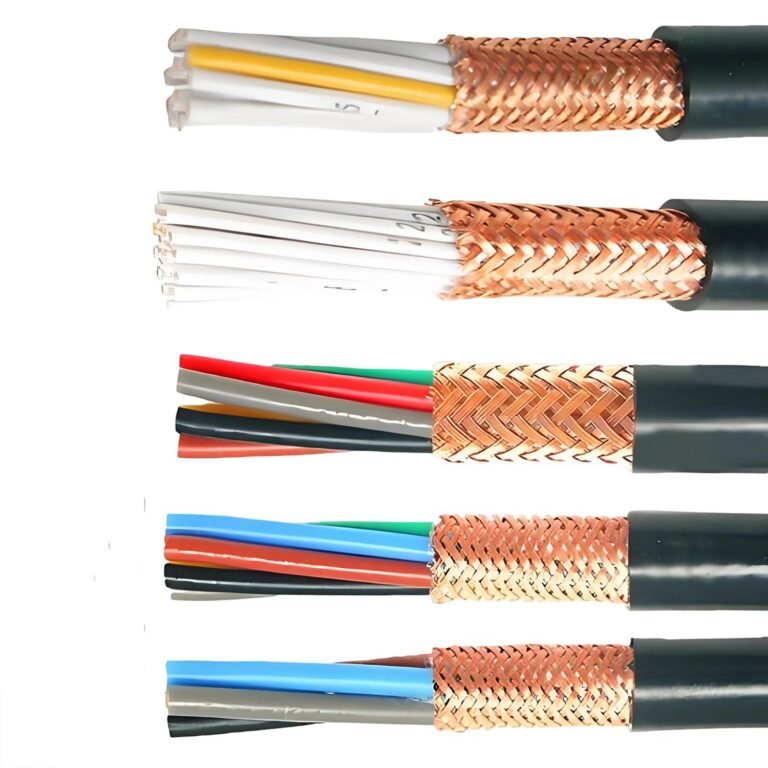
The IEC 61156 notation follows the pattern XX/YZZ, where the first element describes the overall shield and the second describes pair-level shielding. U/UTP means nothing — no overall shield, no pair shields. Never use it in an industrial cable tray. F/UTP adds a foil overall shield and is acceptable for light-duty environments without heavy VFD density. S/FTP — braid overall plus individual foil on each pair — is the configuration most experienced network engineers specify for general industrial use. It handles both high-frequency noise and lower-frequency magnetic field coupling reasonably well. SF/UTP combines braid and foil overall without pair shields and is sometimes used where mechanical flexibility matters more than individual pair isolation.
In VFD-dense areas, S/FTP is not optional. The switching frequencies from variable-frequency drives couple into unshielded or lightly shielded cables aggressively and will corrupt EtherCAT or PROFINET IRT timing margins even when the cable passes a basic continuity test.
S/FTP shielded industrial Ethernet cables provide better EMI protection in VFD-dense environments than F/UTP cablesTrue
S/FTP construction combines an overall braided shield with individual foil shields on each pair, attenuating both common-mode and differential noise across a wider frequency range than a single foil overall shield. IEC 61156-5 and field measurements in inverter-heavy environments consistently show lower noise floor on S/FTP cables under comparable EMI loading.
Jacket Material: Match the Chemistry to the Installation Zone
PVC is cheap and widely available. It is also the wrong choice near motors running above 70°C or in any enclosed space where cable fire behavior matters. LSZH (low smoke zero halogen, per IEC 60332-3) is mandatory in tunnels, confined spaces, and most European public infrastructure projects — it limits both flame spread and toxic gas generation. For robotic arms, drag chains, or outdoor runs exposed to UV and cutting oils, TPE or TPU jackets are the correct answer. They flex without cracking, resist most industrial lubricants, and tolerate UV exposure that destroys PVC in two or three seasons.
Steel wire braid armor adds meaningful protection against rodents and mechanical impact in cable ducting that isn’t fully enclosed. Corrugated steel tape armor is heavier and better suited to direct-buried or heavily trafficked areas. Neither replaces a proper cable management system, but in a real plant they get abused in ways the design never anticipated.
Five Specification Mistakes That Cause Real Downtime
Commercial patch cables in industrial trays. Happens constantly. Standard office patch cables use stranded conductors and thin PVC jackets rated for light handling — they fail from vibration fatigue and temperature cycling within months in a production environment.
Under-specified shielding near VFDs. Already covered, but worth stating plainly: a single large drive can ruin Ethernet timing across 30 meters of cable if the shielding isn’t right.
Ignoring bend radius. Fixed installations typically require a minimum bend radius of 8× the cable OD; continuously flexing applications push that to 10× or higher depending on the jacket material. Violate this in a drag chain and the internal conductors fatigue-crack within weeks.
PVC jackets in high-temperature zones. Any cable run within roughly 300–500 mm of a large motor or heat exchanger should be specified in a higher-temperature jacket material. The actual threshold depends on local ambient and airflow, but PVC rated to 70°C has no margin in those zones.
Missing drain wire termination specs. A shielded cable that isn’t grounded at both ends — or that’s grounded at only one end when the system design calls for both — provides significantly reduced EMI protection. Procurement documents should explicitly specify drain wire termination requirements and the installer should verify continuity through the shield path before commissioning.
Jinda’s Manufacturing and Supply Capability
Jinda manufactures industrial Ethernet cables across Cat5e, Cat6, and Cat6A categories with S/FTP, F/UTP, and U/UTP shielding configurations, in PVC, LSZH, TPE, and TPU jacket materials, tested to IEC 61156 and TIA-568 standards. Custom lengths, jacket colors, and sequential print marking for project identification are available for bulk orders — useful on large infrastructure projects where cable identification during installation and maintenance reduces labor time noticeably. With production capacity across five bases in China and established logistics to over 50 countries, Jinda supports both initial project procurement and long-term replenishment for maintenance inventories.
Frequently Asked Questions About Industrial Ethernet Advantages and Implementation
Can I use standard commercial Ethernet cable on a factory floor?
No — and this is one of the most common and costly mistakes I see during plant retrofits. Commercial Cat5e or Cat6 UTP cable is designed for climate-controlled office buildings, not for environments with variable-speed drives, welding equipment, or even aggressive seasonal temperature swings. The absence of proper shielding (F/UTP is the practical minimum; S/FTP is better near high-horsepower drives) means that electromagnetic interference from nearby motor cables will induce noise on unshielded pairs. The result isn’t always a hard network failure — often it’s intermittent packet retransmission, increased cycle jitter, and eventually a maintenance team chasing phantom faults for weeks.
Jacket compound matters just as much. Standard PVC becomes brittle below roughly -10°C and softens near continuous heat sources above 60–70°C. Industrial-grade LSZH or PUR jackets maintain flexibility from -40°C down to around -25°C depending on compound, and they resist oils, cutting fluids, and UV exposure that would crack a commercial cable within a year or two.
Commercial UTP Cat5e/Cat6 cable meets the shielding and jacket requirements for factory-floor industrial Ethernet installations.False
Commercial UTP cables lack the F/UTP or S/FTP shielding needed to reject EMI from VFDs and motors, and their standard PVC jackets are not rated for the temperature extremes, oil exposure, or mechanical abuse typical of industrial environments. Industrial-grade variants with appropriate shielding and jacket compounds are required.
Does my protocol choice — PROFINET, EtherNet/IP, or EtherCAT — change what cable I need to buy?
Functionally, no. All three operate on the IEEE 802.3 physical layer, so the copper or fiber cable requirements are identical regardless of which application-layer protocol your automation vendor specifies. The cable selection is driven by transmission speed, EMI environment, installation category (fixed tray vs. continuous flex), and operating temperature — not by whether your PLC runs PROFINET IRT or EtherNet/IP.
Where the protocols do differ: EtherCAT’s ring topology is sensitive to switch forwarding delay, PROFINET IRT demands managed switches with hardware-level clock synchronization, and EtherNet/IP is generally the most forgiving from an IT integration standpoint. But those are infrastructure and switch selection decisions, not cable decisions.
How far can I run a copper industrial Ethernet segment?
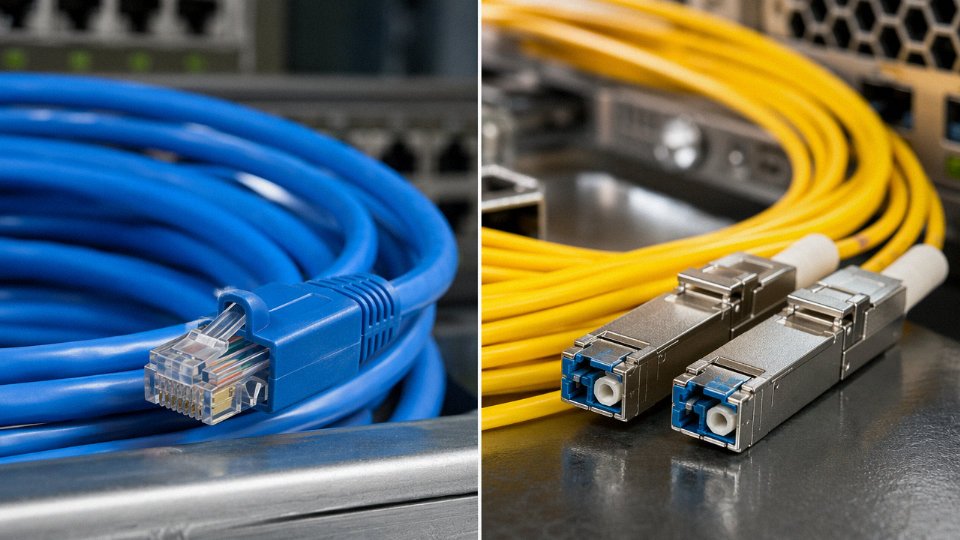
IEEE 802.3 caps copper twisted-pair at 100 m per segment regardless of whether you’re using Cat5e, Cat6, or Cat6A. That limit accounts for signal attenuation and round-trip delay, and no amount of cable quality buys you meaningfully more distance on copper.
For longer runs, fiber is the answer. Multimode OM3/OM4 fiber reaches roughly 300–550 m at 1 Gbps depending on cable type and transceiver. Single-mode pushes 10 km and beyond without active amplification, which is why large sites — think multi-building plants, port terminals, or outdoor inter-facility links — almost always use a fiber backbone with copper drops to individual panels or machines. Industrial-grade fiber switches and media converters handle the conversion cleanly, and Jinda manufactures both copper and fiber industrial cables specifically to support these mixed-media architectures.
Can industrial Ethernet be used in ATEX or IECEx hazardous areas?
Yes, though the cable itself is the passive element in this equation. A correctly specified cable — LSZH jacket, no significant surface charge buildup — presents no ignition risk on its own. The active components (switches, I/O modules, sensors) are what require Ex-rated enclosures for Zone 1 or Zone 2 installations. Intrinsically safe Ethernet per IEC 60079-47 (the 2-WISE standard) is gaining traction for direct device connections in Zone 0, though hardware availability is still narrower than conventional Ex-d or Ex-e enclosure approaches.
What service life should I expect from a properly installed industrial Ethernet cable?
A fixed installation — Cat6A SFTP, LSZH jacket, managed cable tray, no chronic exposure to aggressive chemicals or temperatures above the jacket rating — should last 20 to 25 years without degradation that affects network performance. That figure assumes correct installation: bend radius respected (4x cable diameter minimum for most ruggedized Cat6A), no over-tensioning during pull-in, and shield continuity verified at termination.
Flexing applications are a different story entirely. Continuous-flex or robotic cable assemblies carry a rated flex life, typically somewhere between 5 and 20 million cycles for Class 6 or Class 7 stranded conductor designs, and those ratings drop sharply if the cable is routed with inadequate bend radius or if the cable track geometry changes under load. In practice, installation quality determines whether you hit the rated cycle life or fall well short of it.
How does Jinda support large international procurement projects?
Jinda handles full project scope from initial specification review and sample submission through bulk manufacturing and export. With five production bases across China totaling 470,000 m² of manufacturing space and over 1,000 employees in an integrated R&D, production, and quality organization, Jinda can fulfill large-volume orders built to custom specifications. The company exports to more than 50 countries and manufactures to IEC, TIA, and major regional cable standards — which matters practically when a procurement manager needs consistent documentation for a plant in Southeast Asia, the Middle East, or Europe without chasing multiple regional suppliers.