Cutting corners on electrical installation looks like a cost saver until the jurisdiction catches it — and then the numbers flip fast. A single uninspected panel or an unlicensed subcontractor running branch circuits in a new production bay can trigger stop-work orders that idle a shift, lock up a certificate of occupancy, or void the building permit entirely. Downstream from that comes the insurance conversation nobody wants: adjusters routinely deny fire and property claims tied to unlicensed work at rates exceeding 70%, meaning a $40,000 cable fire loss lands entirely on the plant owner’s balance sheet.
Fines for unlicensed electrical work range from roughly $500 for a minor residential infraction up to $50,000 or more for commercial violations, depending on the jurisdiction, the scope of work, and whether harm occurred. In states like Florida, Texas, and California, repeat or aggravated unlicensed electrical contracting can cross into criminal territory, carrying potential jail sentences of one to five years. Insurance claim denial and mandatory remediation costs typically dwarf the fine itself.
What surprises most procurement managers and factory owners isn’t the fine schedule — it’s the compounding effect. The permit violation triggers an inspection, the inspection flags the wiring, the remediation requires a licensed contractor to tear out work that was already paid for, and the insurer’s denial letter arrives three weeks after the fire suppression contractor finishes. Each step costs more than the one before it. Understanding exactly where the liability attaches — and how it travels from the installing contractor to the facility owner — is where this gets genuinely useful.
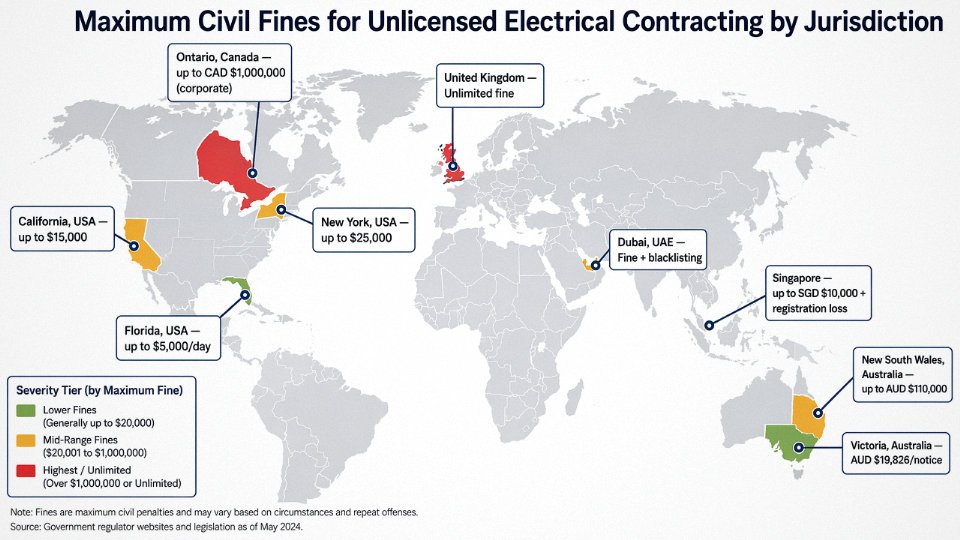
Civil Fines and Administrative Penalties by Jurisdiction: Specific Dollar Ranges
The numbers vary enormously depending on where the work happens, who catches it, and whether it’s a first offense or a pattern. What follows is organized by region — not because penalties operate in a vacuum, but because procurement managers and project engineers working across borders need to know which regulatory body is holding the hammer before they sign off on a subcontractor.
United States: State Penalties and the Municipal Stack Problem
Florida is among the more aggressive enforcement states. Under Chapter 489 of the Florida Statutes, a single unlicensed electrical contracting violation runs $5,000 per incident — and if the work continues after a cease-and-desist order, the meter keeps running at roughly $1,000 per day. On a commercial job site where an inspector flags ongoing work on a Friday afternoon and it takes until Monday to sort out, you’re looking at a weekend of accumulating fines before anyone picks up a phone.
California ties penalties to Business and Professions Code §7028, which allows up to $15,000 per offense. The Contractors State License Board (CSLB) is well-staffed and actively runs sting operations — this isn’t theoretical enforcement.
Texas treats unlicensed electrical contracting as a Class A misdemeanor, which carries civil fines up to $4,000 per violation. That sounds modest compared to California, but Texas counties and municipalities routinely stack their own ordinance penalties on top of the state charge. A project in Houston or Dallas can see combined exposure two or three times the state figure.
New York is the ceiling for U.S. civil penalties among major states. Labor Law §40 allows fines up to $25,000, and the New York City Department of Buildings adds its own layer — stop-work orders, separate administrative penalties, and mandatory re-inspection fees that can run several thousand dollars additional. The municipal stacking effect is real everywhere, but New York City is where it hits hardest.
In the United States, unlicensed electrical work penalties are set only at the federal level.False
Electrical licensing and penalty enforcement in the U.S. is primarily state-driven, with additional fines often layered on by county or municipal authorities. There is no single federal fine schedule for unlicensed electrical contracting.
Canada: Corporate Liability Is Where the Exposure Gets Serious
Ontario’s Electrical Safety Authority operates under the Electricity Act, 1998. Individual fines reach CAD $50,000 — already significant — but the corporate penalty ceiling sits at CAD $1,000,000. That figure applies per offense. For a general contractor who subcontracts electrical work to an unlicensed crew and then tries to claim ignorance, the ESA’s track record shows they will pursue the party with the deepest pockets.
United Kingdom: Unlimited Fines and the Part P Trap
Part P of the Building Regulations requires that most domestic electrical work either be done by a registered competent person or be notified to and inspected by the local authority. Failure to comply can result in an enforcement notice requiring remediation at the owner’s expense, plus prosecution carrying unlimited fines in the magistrates’ court. Under the Health and Safety at Work Act, the Sentencing Council’s harm and culpability matrix has pushed fines well past £100,000 in documented commercial cases — particularly where the unlicensed work contributed to injury or fire damage.
Australia: State-by-State, but Uniformly Serious
NSW Fair Trading can impose fines up to AUD $110,000 per offense for unlicensed electrical contracting under the Home Building Act. WorkSafe Victoria takes a different approach — infringement notices rather than court-ordered fines — but at AUD $19,826 per breach, a multi-room rewire done by an unlicensed tradesperson can generate several notices simultaneously if inspectors itemize each circuit as a separate breach. Some do.
Middle East and Asia-Pacific
Dubai’s DEWA doesn’t just fine — it blacklists. A contractor removed from the approved supplier register loses access to all DEWA-connected projects, which in Dubai’s infrastructure market is effectively a business-ending outcome. The financial penalty itself is secondary to the registration consequence.
Singapore’s Energy Market Authority (EMA) issues composition fines up to SGD $10,000 and can revoke contractor registration. Given Singapore’s size and the density of licensed electrical work in its commercial sector, losing registration there is disproportionately damaging relative to the headline fine.
Penalty Summary by Jurisdiction
| Jurisdiction | Minimum Fine (approx.) | Maximum Fine (approx.) | Primary Licensing Authority |
|---|---|---|---|
| Florida, USA | $5,000/violation | $5,000 + $1,000/day continuing | FL Dept. of Business & Professional Regulation | |
| California, USA | Varies | $15,000/offense | Contractors State License Board (CSLB) |
| Texas, USA | Up to $4,000 | $4,000 + municipal additions | TX Dept. of Licensing & Regulation | |
| New York, USA | Varies | $25,000 + NYC additions | NY Dept. of State / NYC DOB |
| Ontario, Canada | CAD $500 (minor) | CAD $1,000,000 (corporate) | Electrical Safety Authority (ESA) | |
| United Kingdom | Enforcement notice cost | Unlimited | Local Authority / HSE |
| New South Wales, AU | AUD $1,000+ | AUD $110,000/offense | NSW Fair Trading | |
| Victoria, Australia | AUD $19,826/notice | Multiple notices stacked | WorkSafe Victoria |
| Dubai, UAE | Fine + blacklisting | Registration revocation | DEWA |
| Singapore | SGD $1,000 | SGD $10,000 + registration loss | Energy Market Authority (EMA) |
Figures depend on offense severity, whether injury or fire resulted, prior violations, and whether the contractor cooperated with investigators. The minimums above assume a first-offense, no-injury scenario — an unusual and optimistic baseline.
Criminal Charges, Jail Time, and Felony Classification for Unlicensed Electrical Work
Civil fines sting. Criminal charges end careers — and sometimes freedom. The two tracks are separate, and a lot of contractors, plant owners, and DIY-turned-commercial operators don’t fully understand where the line sits until they’re already past it.
Misdemeanor vs. Felony: Where the Threshold Actually Lives
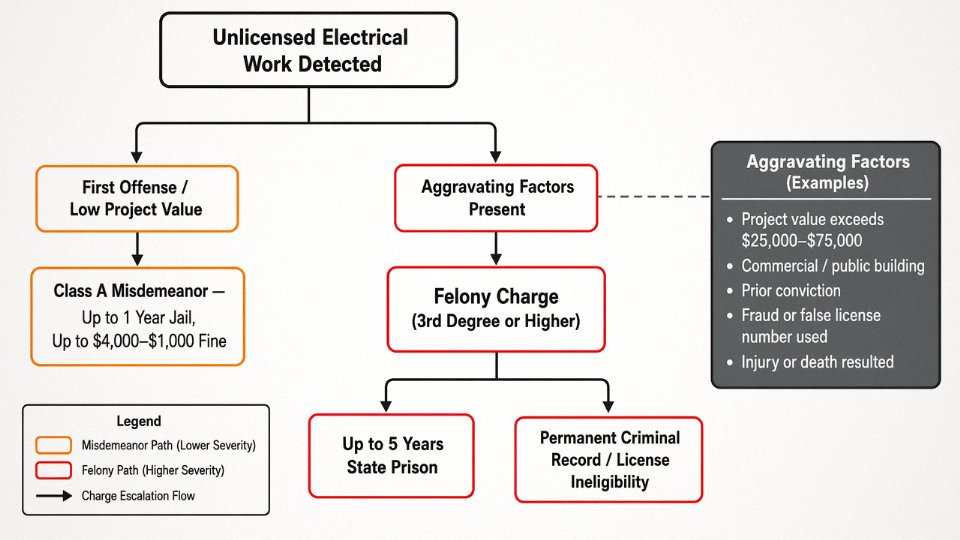
Most first-offense unlicensed contracting violations land as misdemeanors. That usually means a fine, a court appearance, maybe a short probation. Unpleasant, but survivable professionally. The charge escalates when aggravating factors stack up, and the statutory triggers vary by state — though some patterns repeat consistently enough to treat as working rules.
Project value is the most common escalation trigger. Many states draw the felony line somewhere between $25,000 and $75,000 in contract value; Florida, for instance, uses thresholds in that range as part of the aggravating criteria under its contractor licensing statutes. Work performed on commercial or public buildings — schools, hospitals, manufacturing facilities — tends to carry harsher treatment than residential work in the same jurisdiction, partly because occupancy loads and life-safety consequences scale up dramatically. A prior conviction for the same offense is almost universally an aggravating factor; some states flip the charge to a third-degree felony automatically on a second offense regardless of project value.
Florida §489.127 as a Practical Model
Florida Statute §489.127 is worth understanding in detail because it’s unusually explicit and has been copied, at least in structure, by several other states. Under that statute, performing electrical contracting without a license is a first-degree misdemeanor for a first offense — up to one year in jail and a $1,000 fine. That’s the baseline. A second offense, or any offense where fraud is involved, bumps to a third-degree felony: up to five years in state prison, meaningfully longer probation, and a permanent criminal record.
The fraud element is where people get surprised. Using a false license number on a contract or bid document — even once — is treated as a separate fraud charge that runs alongside the unlicensed contracting charge. That compounds exposure quickly. In practice, I’ve seen estimates submitted with a borrowed or fabricated license number treated with far less mercy by prosecutors than a simple omission would have been.
When Someone Gets Hurt: The Criminal Negligence Pathway
This is where licensing violations move from administrative nuisance to genuine personal jeopardy. If unlicensed electrical work causes a fire, an electrocution, or a structural failure that injures or kills someone, prosecutors have discretion to pursue criminally negligent homicide or involuntary manslaughter charges. The licensing violation itself becomes evidence of the underlying negligence — the argument being that you knew or should have known you weren’t qualified to do the work.
A residential fire in California in 2019, attributed to unpermitted and unlicensed wiring, resulted in felony charges against the individual who performed the work. No fatalities in that particular incident, but severe property damage and injuries were enough. When death is involved, manslaughter charges — carrying sentences typically in the 2–10 year range depending on degree and jurisdiction — become a realistic outcome, not a theoretical one.
Unlicensed electrical work that causes death can result in involuntary manslaughter charges in the United StatesTrue
Multiple U.S. state criminal codes allow prosecutors to charge criminally negligent homicide or involuntary manslaughter when unlicensed work is the proximate cause of fatal injury; the absence of a license establishes the negligence element.
Career-Ending Consequences: Licensing Eligibility After a Felony
A felony conviction typically disqualifies a person from obtaining — or renewing — a state electrical contractor license permanently. Most state licensing boards run criminal background checks, and a felony related to contracting fraud or negligence is almost always a categorical bar, not a discretionary one. That’s not a fine you pay and move on from. It’s an occupational death sentence in the trade.
International Exposure: UK and Beyond
Outside the United States, the criminal framework looks different but the severity doesn’t necessarily drop. In the United Kingdom, the Health and Safety Executive can prosecute individuals under the Health and Safety at Work Act 1974 for gross negligence in electrical work — with unlimited fines and sentences of up to two years imprisonment for individuals. The Part P building regulations in England require notification and, in many cases, competent-person certification for domestic electrical work; violations that result in harm push directly into HSE criminal jurisdiction. Other EU member states have analogous frameworks, usually tied to their respective building codes and occupational safety statutes.
The common thread across jurisdictions: the criminal exposure isn’t hypothetical background noise. It’s the realistic downstream consequence when unlicensed work causes harm, and the penalties scale with the damage done.
Stop-Work Orders, Project Seizure, and Forced Demolition of Non-Compliant Installations
Fines get the headlines, but on an active job site the instrument that causes immediate, measurable financial damage is the stop-work order. A single posted SWO can freeze a multi-million-dollar project in hours, and the cascade that follows — re-inspection queues, rework, delayed occupancy, restocking fees — routinely dwarfs whatever fine eventually lands on paper.
Who Has the Authority to Issue an SWO, and How the Process Works
Three separate parties can halt your project, each independently of the others. A building department inspector who discovers unlicensed electrical work during a rough-in inspection will post a stop-work notice on-site and log it with the permitting authority. That’s the one most contractors think about. What surprises project managers is that the serving utility company can simultaneously refuse to connect or energize a facility, and an insurance loss-control engineer — someone your carrier sends out during a mid-project review — can flag the work and trigger a policy suspension that functionally freezes financing. You can be fighting all three at once.
Once an SWO is posted, work must cease immediately on the affected scope. The typical appeal path runs through the local building department’s hearing process, which in most U.S. jurisdictions takes anywhere from two to six weeks just to get a hearing date, not counting the time to actually remediate and re-inspect. In practice, the appeal rarely succeeds if unlicensed work is confirmed; it mostly buys a short scheduling window.
Demolition Orders and the Real Cost of Rework
Jurisdictions don’t generally let you leave unlicensed wiring in place and simply have a licensed contractor “sign off” on it. Most require complete removal and re-inspection before issuing a certificate of occupancy. This is where the financial exposure gets serious.
When electrical runs are already inside closed walls, above finished ceilings, or embedded in conduit chases through structural concrete, the remediation cost is not the cost of new cable — it’s the cost of opening the building, pulling everything, inspecting the pathway, re-installing to code, and restoring finishes. That multiplier realistically runs 2x to 5x the original installation cost, depending on how much of the structure has been closed in and whether hazardous materials like spray fireproofing are involved.
To put a real number on it: a commercial warehouse project where an unlicensed subcontractor had installed roughly 40,000 meters of power and control cable across a 200,000-square-foot facility — work that passed initial rough visual review but failed the licensed inspector’s documentation audit — required a complete re-pull. The total remediation cost exceeded $380,000, and the project lost 14 weeks of schedule. At a conservative $25,000 per week in carrying costs (loan interest, site security, idle equipment rental, and subcontractor standby fees), that delay alone adds $350,000 in financial exposure, separate from fines and separate from rework costs. A single bad subcontracting decision wiped out more than $730,000 in combined exposure on a project that might have had a total electrical budget of $600,000.
Remediation demolition orders require complete removal of unlicensed electrical installations before a certificate of occupancy can be issued.True
Most U.S. building codes and international equivalents do not permit unlicensed electrical work to be inspected-in-place and approved retroactively; the standard requirement is removal, re-inspection of the pathway, and re-installation by a licensed contractor before occupancy certification proceeds.
Lien Rights Disappear With the License
Here’s the part that hurts unlicensed contractors in a different way. In most U.S. states, the right to file a mechanics’ lien — the primary legal tool a subcontractor uses to force payment — is conditioned on holding a valid contractor’s license at the time the work was performed. Do the work unlicensed, and if the client decides not to pay, you have essentially no enforceable legal remedy. No lien, no bond claim, and in many states the contract itself is void as against public policy. The unlicensed party did the work, bears the liability, and cannot collect.
Material Compliance Gets Audited Alongside License Compliance
During SWO resolution, inspectors don’t just verify that a licensed electrician now oversees the project. They audit the materials already installed. Cable that lacks the required UL listing, NEC rating, or flame-spread classification will trigger a separate remediation order even if the new contractor of record is fully licensed. This matters for procurement: specifications stamped by a licensed engineer carry specific cable standards — conductor class, insulation grade, armoring type — and substituting an unlisted or non-conforming product to save cost is caught at exactly this moment, compounding the problem. Verifying that cable on site matches the stamped specification isn’t paperwork overhead; it’s the thing that determines whether your SWO resolution goes smoothly or opens a second round of rework.
Insurance Voidance, Claim Denial, and Long-Term Liability Exposure After Unlicensed Work
Most contractors and property owners fixate on fines and criminal exposure when they think about unlicensed electrical work. The insurance dimension tends to get skipped — and that’s usually where the real financial destruction happens.
How Policy Language Sets the Trap
Standard ISO-form homeowner and commercial property policies carry what’s commonly called a “compliance with laws” or “ordinance or law” exclusion. The language varies by carrier, but the functional effect is consistent: if a covered loss originates from work that violated building codes or was performed without required permits, the insurer can deny the claim entirely — not just the portion of the loss attributable to the unlicensed work. The whole claim. A kitchen fire that started at a panel your unlicensed electrician installed three years ago can result in zero payout on a $400,000 building loss. Adjusters are trained to pull permit histories. They do it routinely now, and municipal permit records are increasingly accessible online, which makes this kind of investigation faster than most policyholders realize.
The 70% Denial Rate Is Not Hypothetical
Industry loss-adjustment studies show that more than 70% of fire claims where the origin is traced to unpermitted electrical work result in denial or partial denial.True
This figure is cited in industry loss-adjustment and fire investigation literature and aligns with the pattern loss adjusters describe when permit histories are systematically reviewed during origin-and-cause investigations.
In practice, the investigation sequence goes like this: fire marshal determines electrical origin, adjuster orders a permit search, no permit appears, carrier invokes the compliance exclusion. The homeowner or building owner is left holding the entire loss. For a commercial structure — say, a small manufacturing facility — that exposure can run into the millions. The initial savings from hiring an unlicensed electrician, often a few hundred to a few thousand dollars on labor, look absurd against that backdrop.
Contractor GL Policies Have the Same Gap
A contractor’s general liability policy is underwritten against the scope of that contractor’s license classification. An unlicensed handyman or a plumber who wires a subpanel is operating outside their licensed scope — and their GL carrier will disclaim the claim. This isn’t a technicality insurers reluctantly invoke; it’s a standard policy condition. The practical consequence is that when something fails and the property owner sues, there’s no insurance on the contractor’s side to respond to the judgment. Collecting from an uninsured individual or small LLC is a different and much harder problem than collecting from an insurer.
The Long Tail: 10–15 Years of Latent Exposure
Statutes of repose in most U.S. jurisdictions run roughly 10 to 15 years, depending on the state and the nature of the defect. Latent defect claims — wiring that degrades slowly, a connection that eventually arcs — can surface years after project completion. Licensed contractors can often invoke safe-harbor provisions or rely on code-compliance documentation to limit their exposure. Unlicensed contractors have no such defense. Neither does the property owner who knowingly hired them, in many jurisdictions. That’s a long window of vulnerability for what might have seemed like a minor shortcut at the time.
Real Estate Transactions Surface Everything
Unpermitted electrical work almost always gets flagged during a pre-sale home inspection or a title search. When it does, buyers typically demand escrow holdbacks — usually running 125–150% of the estimated remediation cost, sometimes higher if the work is extensive. Deals fall apart over this more often than sellers expect. Worse, if the seller knew about the unpermitted work and didn’t disclose it, that’s a misrepresentation claim waiting to happen, with personal liability exposure that survives the sale.
The Workers’ Compensation Problem Property Owners Miss
Unlicensed electrical contractors almost never carry workers’ compensation coverage. In most U.S. states, when an uninsured worker is injured on your property performing electrical work, the property owner can be treated as the de facto employer. That means the injured worker’s medical costs, lost wages, and potentially a tort claim land directly on the property owner. It’s one of the less-discussed but genuinely severe consequences of the unlicensed work decision — and it applies whether the owner knew the contractor was unlicensed or not.
How Inspectors Detect Unlicensed Electrical Work: Audit Triggers and Red Flags on Cable Installations
Detection is more systematic than most unlicensed contractors expect. This isn’t a building inspector eyeballing a panel and shrugging — modern enforcement layers permit records, utility sign-offs, physical inspection criteria, and increasingly, digital tools that catch gaps even experienced crews miss. If you’re doing this work legally and want to self-audit, understanding the detection sequence is genuinely useful. If you’re considering cutting corners, the picture here should be clarifying.
Permit Pull Records: The First Tripwire
The permit application is where most unlicensed work unravels first, long before anyone walks the job site. Building departments in most U.S. states now cross-reference the license number on every permit application against the state licensing database in real time — not batch-processed, not manually reviewed days later, but automated at submission. An expired license, a license number belonging to a different trade, or a fictitious number flags the application immediately and generates a hold.
In practice, some unlicensed operators pull permits under a licensed contractor’s name without that contractor’s knowledge. That’s a separate criminal exposure for the licensed contractor if they’re not careful about who uses their credentials — and regulators have become specifically alert to license numbers that appear on permits across multiple jurisdictions in a suspiciously short window.
Utility Reconnection: No License, No Power
Power companies won’t restore service to a new or substantially renovated installation without a licensed electrical contractor’s sign-off and a passed inspection. This isn’t bureaucratic friction — it’s a hard stop. The utility will not energize the service entrance. For industrial and commercial projects, that means a finished building sitting dark until the licensing paperwork is clean. The financial pressure this creates is immediate and often forces project owners to disclose unlicensed work they’d hoped to paper over.
What a Physical Inspection Actually Catches
Trained inspectors work from a mental checklist that covers more than most unlicensed installers realize. Cable bending radius violations are visible and common — minimum bend radius for most cables runs roughly 8–12 times the cable’s outer diameter depending on construction, and improper bends often show up at junction boxes and conduit entries. Support spacing that exceeds code (typically no more than 4.5 feet for NM cable runs, less in other configurations) is another immediate flag.
Cable type mismatches are telling. NM-B cable installed in a wet or damp location, armored cable used where a higher temperature rating is required, or direct-burial cable without the correct depth of cover — these errors pattern-match to unlicensed work because a licensed installer working regularly knows these distinctions by reflex.
Cable Certification Marks as a Compliance Checkpoint
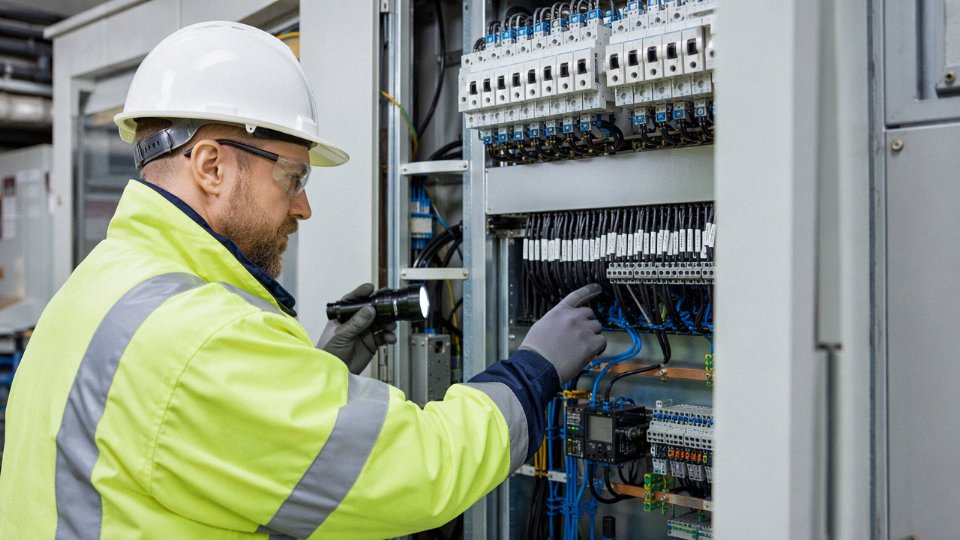
Inspectors verify that installed cable carries the correct certification mark for the jurisdiction — UL listing in the U.S., CE marking in Europe, CCC for the Chinese domestic market, and so on. This matters more than many project managers realize: an inspector can issue a stop-work order on a job with a licensed installer if the cable itself lacks the required listing for the application. Unmarked cable, or cable from a manufacturer whose certifications don’t cover the specific product type installed, is a red flag regardless of who pulled the permit.
Uncertified cable can trigger a stop-work order even when the installing contractor holds a valid license.True
Electrical codes in most jurisdictions require installed materials to carry the relevant certification mark (UL, CE, CCC, etc.) as a condition of inspection approval — the installer's license status and the product's certification status are evaluated independently.
Specification-grade cable from manufacturers who maintain full third-party certification programs removes this variable entirely. It’s one of the quieter arguments for not cutting procurement costs on cable — the savings can dissolve in a stop-work order and forced replacement.
Digital Enforcement: Drones and AI Permit Platforms
Several jurisdictions, particularly for large industrial and commercial sites, have begun using drone-mounted thermal imaging to identify energized installations that lack associated inspection milestones. An active electrical system on a site with no final inspection on record is an obvious trigger. AI-assisted permit compliance platforms — in use in parts of California, Texas, and some Canadian provinces — flag jobs that have open permits with no scheduled or completed inspections after a defined period, automatically generating enforcement follow-up.
This is still uneven. A rural county may have nothing like this. But the direction of enforcement technology is toward broader coverage, not less.
Complaints: The Most Common Detection Path
Honestly, in most jurisdictions, the single most common source of unlicensed work investigations is a complaint — from a competing licensed contractor who lost the bid, a disgruntled former employee, or a neighboring property owner who noticed work happening without a permit notice posted. Regulators treat complaint-driven referrals with high priority because the complainant often provides specific, actionable information: dates, photos, vehicle descriptions. Unlicensed operators who assume their work will go unnoticed in a quiet neighborhood frequently underestimate how much their direct competitors are paying attention.
Specific Penalties for Unlicensed Work on Industrial, Commercial, and High-Voltage Projects
Residential cases get the most press, but the real financial exposure sits in industrial and large commercial work. A single-family home might have 30 or 40 circuits. A mid-size manufacturing facility can have 500 or more. When your jurisdiction counts violations per circuit — and many do — the arithmetic gets brutal fast.
Per-Circuit and Per-Day Fine Multiplication
Most U.S. states with serious enforcement programs, California and Texas among them, allow inspectors to cite each non-compliant circuit as a separate violation. At a base penalty of, say, $1,000 per violation, a 500-circuit industrial switchgear installation performed without a licensed electrical contractor generates a theoretical exposure of $500,000 before the regulator even considers aggravating factors like prior violations or deliberate concealment. Per-day continuation fines compound this further — in practice, enforcement agencies rarely hit every circuit, but they don’t have to. Citing 10–15% of the installation is usually enough to produce a settlement figure that exceeds what proper licensing would have cost by an order of magnitude.
EU member states use different structures but arrive at similarly punishing outcomes. Germany, the Netherlands, and the Nordic countries tie commercial electrical permits to certified responsible persons (roughly analogous to the U.S. qualifying agent system); when that chain breaks on an industrial project, the competent authority can issue a site closure order and demand third-party re-inspection at the project owner’s cost — which on a large facility runs €50,000–€200,000 depending on scope and complexity.
OSHA Citations: A Completely Separate Track
This is the piece that surprises contractors who think state licensing penalties are the only risk. OSHA 29 CFR 1910.303 and 1926.403 govern electrical installations in general industry and construction respectively. When OSHA classifies a violation as willful — meaning the employer knew the requirement and ignored it — the current penalty range is roughly $15,600 to $156,300 per violation. That upper number is indexed to inflation and adjusts periodically.
OSHA willful violation penalties for electrical standards can reach $156,259 per violation as of recent federal adjustments, entirely separate from state contractor licensing fines.True
OSHA adjusts its civil penalty maximums annually under the Federal Civil Penalties Inflation Adjustment Act. The figures cited reflect published OSHA penalty schedules for willful violations under 29 CFR 1910 and 1926 series electrical standards.
OSHA enforcement is triggered independently of whether a contractor has a state license — you can hold a valid license and still draw a willful citation if your workers’ practices or the physical installation violate 1910.303. The inverse is also true: the absence of a license is itself evidence of willfulness.
High-Voltage and Substation Work Carries Felony-Level Risk Almost Automatically
Work on systems above 600V falls under NFPA 70E and OSHA 1910.269. Regulators treat this category differently because the consequence of error isn’t a tripped breaker — it’s an arc flash event that kills people in fractions of a second. In most U.S. jurisdictions, performing unlicensed work on medium-voltage switchgear, utility interconnects, or substation equipment is classified as a felony at the point of permit discovery, not contingent on an incident occurring. OSHA investigation is essentially automatic once high-voltage unlicensed work surfaces, which means federal and state penalties stack simultaneously.
International EPC Projects and IEC 60364 Compliance
EPC contractors sourcing cable and labor internationally face a layer of exposure that doesn’t exist on domestic residential jobs. IEC 60364-series standards govern low-voltage electrical installations across Europe, much of the Middle East, and large parts of Asia. When a client’s certifying authority — often a third-party inspection body like Bureau Veritas or TÜV — discovers that electrical work was performed by labor without locally recognized qualifications, the typical response is a project hold and mandatory re-inspection. On a greenfield industrial facility, a two-week hold during commissioning can cost the project owner more in liquidated damages than any government fine.
Cable specification matters here in ways that are sometimes treated as an afterthought. Specifying or installing cable with an insufficient voltage rating, an inadequate temperature rating for the ambient conditions, or a flame-spread classification below what the engineer of record specified — say, installing a non-LSZH cable in a cable tray that the specification calls for LSZH — is treated as a code violation functionally equivalent to unlicensed work in many jurisdictions. The inspector doesn’t distinguish between “wrong person did the work” and “wrong material was installed.” Both result in rejection and mandatory replacement.
Indemnification Cascades on EPC Contracts
The contractual exposure on large projects often dwarfs the regulatory fines. A typical EPC contract structure runs: project owner → EPC contractor → electrical subcontractor. If the subcontractor’s unlicensed work is discovered during a government audit or insurance inspection, the owner invokes the indemnification clause against the EPC. The EPC passes it downstream. By the time legal fees, re-inspection costs, delay damages, and insurance deductibles accumulate, the subcontractor who saved money by skipping licensing faces claims that can be 10–50 times the value of their original scope — depending on how far along the project was and what had to be demolished and rebuilt.
In practice, the subcontractor rarely has the balance sheet to absorb this. The EPC absorbs the residual exposure, which is why serious EPC contractors now require license verification as a procurement prerequisite, not an afterthought during closeout.
How to Achieve and Maintain Electrical Licensing Compliance Across Multi-Jurisdiction Projects
Getting through the penalty sections of this article is useful. Actually staying out of trouble requires a working system — especially once a project crosses state lines or international borders.
Licensing Reciprocity in the United States
Most electricians learn their home state’s licensing requirements and stop there. That works fine for local work. The moment a contractor follows a client to an adjacent state, the picture gets messier.
The good news is that reciprocity agreements exist between a number of states, covering journeyman and master electrician licenses. Florida, Georgia, and South Carolina, for example, maintain bilateral reciprocity corridors that allow a licensed master electrician to apply for an endorsement rather than sitting the full exam again. The endorsement process typically requires submitting proof of current licensure, a fee (usually somewhere in the $75–$200 range depending on the receiving state), and sometimes a background check. Processing time runs two to six weeks — plan for that gap, because showing up on site before the endorsement clears is still unlicensed work.
Not all reciprocity agreements are symmetrical. Georgia may accept a Florida license while imposing additional requirements on applicants coming from Tennessee. Check the specific bilateral terms, not just whether a general agreement exists. The NCSL maintains a searchable state-by-state licensing database that procurement teams can use before issuing a subcontractor purchase order. California’s CSLB and Florida’s DBPR both have online license verification portals that return real-time status — use them. An expired license looks valid on a paper copy the contractor printed six months ago.
International Qualification Recognition
Inside the EU, the Professional Qualifications Directive (2005/36/EC) provides a structured pathway for electricians licensed in one member state to have their qualifications recognized in another. It is not automatic, and the host country’s competent authority has the right to require a compensatory aptitude test or supervised adaptation period, particularly for trades where national standards diverge significantly. For high-voltage work or installations governed by country-specific codes (Germany’s VDE standards, for instance), expect the adaptation period requirement more often than not.
Post-Brexit, UK recognition no longer falls under the directive. Electricians who previously relied on EU reciprocity now face country-by-country registration through UK bodies like JIB (the Joint Industry Board) or the relevant Part P scheme provider. This catches project teams off guard surprisingly often.
Building a Compliance Checklist for Complex Projects
Large EPC projects need a structured compliance file, not a folder of scanned PDFs someone will search for under pressure. A functional checklist covers license verification at subcontractor pre-qualification (before contract award, not after mobilization), permit pull tracking with milestone dates, inspection sign-off logs tied to installation phases, and as-built documentation that matches what was actually installed.
Cable certification file maintenance deserves specific attention. Inspectors on commercial and industrial projects increasingly scrutinize material provenance — UL listing documents, CPR Declaration of Performance for EU projects, CCC certificates for work in China, and factory test reports. A missing or mismatched certificate on the cable itself can trigger a hold on an otherwise clean installation.
The Engineer of Record as Liability Shield
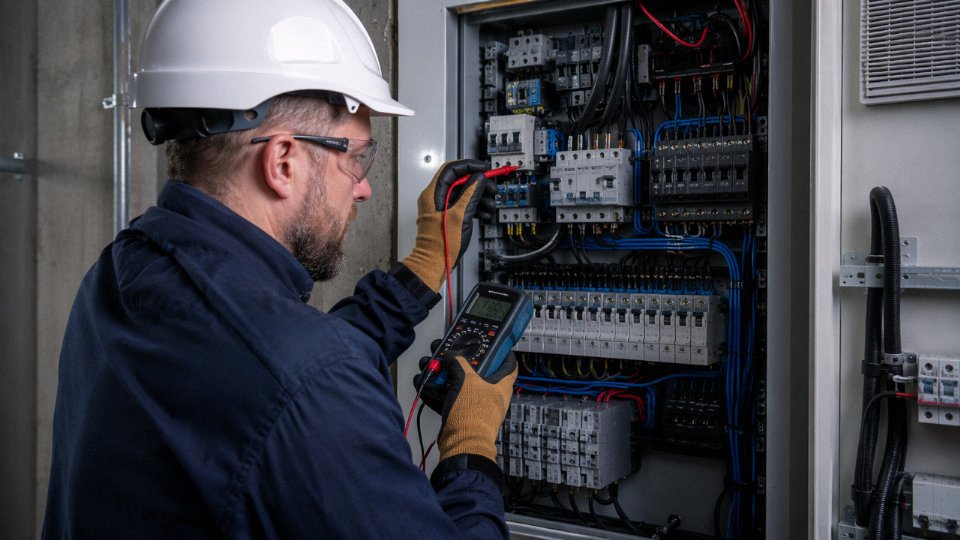
In most jurisdictions, the engineer of record carries professional liability for the design. When the EOR’s scope formally includes installation oversight and they stamp compliance documents at each inspection milestone, that stamp creates meaningful legal safe harbor for the project owner — it doesn’t eliminate exposure, but it concentrates liability appropriately and demonstrates good-faith compliance, which matters in enforcement proceedings.
How Material Sourcing Fits Into This
One category of inspection failure that’s entirely preventable is non-compliant or undocumented cable. Sourcing from manufacturers that maintain integrated documentation chains — UL listings, CPR DoPs, test reports traceable to specific production batches — removes that variable before the inspector arrives. Jinda’s model of integrating R&D, production, and certification through a single supply chain means procurement teams receive a complete compliance package with the cable, not a request to chase documents after the fact.
The EU Professional Qualifications Directive (2005/36/EC) provides electricians licensed in one EU member state a legal pathway to have qualifications recognized in other member states.True
Directive 2005/36/EC establishes the EU-wide system for mutual recognition of professional qualifications, including regulated trades such as electricians. Host member states may require compensatory measures where training or standards differ substantially.
Licensing compliance across multi-site projects is mostly a document management and scheduling problem — the regulatory frameworks exist, the verification tools are publicly available, and the pathways are navigable. The projects that get into trouble are almost always the ones that treated compliance as someone else’s problem until an inspector made it everyone’s problem.
Frequently Asked Questions About Electrical Work Penalties and Licensing Requirements
Can a homeowner do their own electrical work without a license?
In many U.S. states, yes — with significant caveats. Most owner-occupant exemptions apply only to your primary residence, not rental properties, not a house you’re flipping, and not a detached structure you’re building speculatively. The permit requirement doesn’t disappear just because you’re the homeowner. You still pull a permit, the work still gets inspected, and if it fails inspection you’re on the hook for corrections. Where this bites people is at resale: a buyer’s home inspector or the title company’s attorney will surface unpermitted work, and at that point you’re either disclosing a known defect, renegotiating price, or paying to remediate it yourself before closing. The insurance consequences are the same as any other unlicensed work — a denied claim is a denied claim regardless of who held the screwdriver.
What happens if you buy a house with unpermitted electrical work?
You inherit the problem. Full stop. Most jurisdictions treat the current owner as the responsible party, so the fact that someone else did the work five or ten years ago doesn’t transfer the liability back to them. Expect a retroactive permit application, a full inspection, and likely some remediation. Costs in practice run somewhere in the $3,000–$15,000 range for residential work, depending heavily on how much was done without permits, how accessible the wiring is, and what code cycle is currently enforced in that municipality. In older homes with multiple rounds of DIY work, that number can climb past $20,000 once you account for opening walls.
Buying a house with unpermitted electrical work transfers liability to the new owner in most U.S. jurisdictions.True
Licensing boards and building departments treat the current property owner as the responsible party for bringing non-compliant work into compliance, regardless of when the work was performed or by whom.
Can an unlicensed electrician work as an employee instead of a contractor to sidestep licensing?
No, and this misconception causes real problems for contractors who try it. The licensed contractor’s credential does cover employees performing work under direct supervision, but “direct supervision” has a legal definition — it doesn’t mean the license holder signs off at the end of the day. In most states, employees doing journeyman-level work are expected to hold a journeyman license themselves. The contractor cannot launder unlicensed labor through their own credential. If an inspector or licensing board investigator shows up on site and the person doing the terminations can’t produce a card, the contractor faces the same exposure as if they’d subbed the work out unlicensed.
How long does a licensing violation stay on a contractor’s record?
Permanently, in most cases. CSLB in California, DBPR in Florida, and equivalent agencies in other states maintain public disciplinary records indefinitely. These databases are exactly what sophisticated owners and EPC contractors query during pre-qualification screening. A fine paid ten years ago still shows up. The downstream effects — higher bonding rates, insurance premium surcharges, failed vendor qualifications on industrial projects — often cost more over time than the original penalty did.
Does installing the wrong cable type count as unlicensed work?
Not technically. But it’s a code violation with its own serious consequences, and on industrial projects the distinction barely matters practically. Putting standard PVC-jacketed cable through a plenum space instead of a properly rated plenum cable, or using a cable with an inadequate voltage rating for the circuit, will generate a stop-work order and a mandatory rip-out once an inspector catches it. The installer’s license status is almost beside the point at that stage — the rework cost and schedule hit are the same either way. Procurement teams sourcing cable for engineered systems should verify that the cable specification matches the engineer of record’s drawings, not just the installer’s field judgment.
What is the statute of limitations on penalties for unlicensed electrical work?
It varies enough that you shouldn’t assume you’re clear just because time has passed. Civil administrative penalties typically carry a 3–5 year window from the date of discovery — and “discovery” is the operative word; the clock often doesn’t start until an inspector or insurer finds the violation, not when the work was done. Criminal charges tied to fraud have no statute of limitations in some states. Latent defect liability under construction statutes of repose is a separate track entirely and can extend 10–15 years depending on the state. On a large industrial project, a cable installation that causes an arc flash event eight years after commissioning can still generate significant liability exposure for every party in the chain.
Can a general contractor be penalized for a subcontractor’s unlicensed electrical work?
Yes, routinely. The general contractor holds the prime contract with the owner and carries vicarious liability for work performed on the project under their supervision. In most jurisdictions, they face the same civil fines as the unlicensed sub. Beyond the regulatory penalties, the project owner typically has the right to terminate the GC’s contract for cause and pursue indemnification for any costs associated with remediation, re-inspection, or third-party damages. Vetting subcontractor license status before work begins — not after a problem surfaces — is basic risk management, and it’s the kind of thing that gets checked during litigation discovery.
Conclusion: The True Total Cost of Unlicensed Electrical Work and a Compliance-First Procurement Strategy
Most contractors who skip licensing do the math the wrong way. They see the license fee, the exam prep time, the permit delays — and weigh that against a single job. That’s the wrong unit of analysis. The actual question is what one enforcement action costs, and the answer is almost always catastrophic relative to whatever was saved.
Running the Numbers Honestly
Stack the exposure categories covered in this article and the total gets uncomfortable fast. Direct civil fines run $500 to $50,000+, depending on jurisdiction and whether this is a first offense or a pattern. Criminal defense — even for a misdemeanor charge that never reaches trial — typically runs $15,000 to $100,000 in attorney fees alone, more in states like California or Florida where prosecution resources are well-funded. Remediation is the one that usually surprises people: ripping out completed work, bringing in a licensed contractor to reinstall to code, re-inspecting, and patching finishes back up routinely costs 2–5x the original installation, depending on how inaccessible the wiring is and what other trades have to be disturbed.
On industrial projects, delay carrying costs alone can run $25,000 to $50,000 per week — think production shutdowns, equipment sitting idle, contractual liquidated damages. Insurance premium surcharges after a documented violation typically land in the 15–40% range and can persist for 3–5 renewal cycles. And if the property ever sells or is refinanced, appraisers and buyers increasingly run permit history searches. Non-permitted electrical work impairs real estate value by roughly 3–8% in documented cases, which on a commercial building is not a rounding error.
Add those figures at even the low end of each range and the “savings” from unlicensed work disappear entirely — usually before you account for reputational damage, which doesn’t show up in any spreadsheet until the phone stops ringing.
Why Licensed Contractors Actually Win More Work
There’s a commercial argument here that gets underplayed. Licensed, bonded, and insured contractors aren’t just avoiding penalties — they’re accessing a completely different tier of project opportunities. Public-sector contracts, large commercial general contractors, and industrial EPC firms routinely screen out unlicensed subcontractors at the prequalification stage. Bonding capacity and certificate of insurance requirements effectively price unlicensed operators out of projects above a certain scale. The licensed contractor who carries the overhead of compliance ends up competing in a less crowded market and can command margins that more than cover that overhead. The unlicensed operator, in contrast, is racing to the bottom on residential side-work with no real path to growth.
Material Quality Is Part of the Compliance Stack
Here’s something experienced inspectors will tell you directly: the cables already in the wall matter during an inspection. An inspector who pulls a panel and finds specification-grade, clearly marked, third-party-certified cable with a traceable factory documentation package is in a very different headspace than one who finds unmarked or out-of-spec wire. The former moves through the inspection. The latter starts asking questions.
Sourcing cable with independent third-party certification (UL, CE, CCC, KEMA, SASO) directly reduces the probability of stop-work orders during electrical inspection.True
Inspectors are trained to verify material specifications against permit drawings; certified cable with traceable documentation satisfies that check without ambiguity, whereas non-certified or improperly marked cable triggers further investigation regardless of installation quality.
This is where upstream procurement decisions connect to downstream compliance outcomes. Manufacturers with ISO 9001-certified production, multi-jurisdiction certifications, and the ability to supply jurisdiction-specific test documentation are not just vendors — they’re a risk-reduction mechanism inside the project.
Shandong Jinda Special Cable Group, operating since 1987 across five production bases and roughly 470,000 m² of manufacturing capacity, supplies cable certified for projects in more than 50 countries. The technical support team can provide the specific certification packages — UL listings, CE declarations, third-party test reports, country-specific approvals — that licensed contractors need to close out inspections cleanly. That’s not a marketing claim; it’s the documentation your inspector is going to ask for.
Where to Start
Verify licensing requirements at project initiation, not after mobilization. Build permit applications and inspection hold-points into the baseline schedule as hard milestones. And when you’re sourcing cable for any project where compliance matters — industrial, commercial, international, or high-voltage — work with a manufacturer that delivers certification documentation as a standard deliverable, not an afterthought.
Contact Jinda for bulk pricing, technical specification support, and project-specific certification packages. The paperwork that protects your license and your project should come with the cable.