Specify “armored cable” on a purchase order without knowing its regional and standards-based synonyms, and you risk receiving the wrong product entirely — or at minimum, triggering a back-and-forth with a supplier that costs you two to three weeks on a tight construction schedule. A cable that looks correct on paper but lacks the right armor construction can fail under crush loads or fault currents, turning a specification shortcut into an unplanned outage, a scrapped conduit run, or worse, a safety incident that shuts down the whole installation.
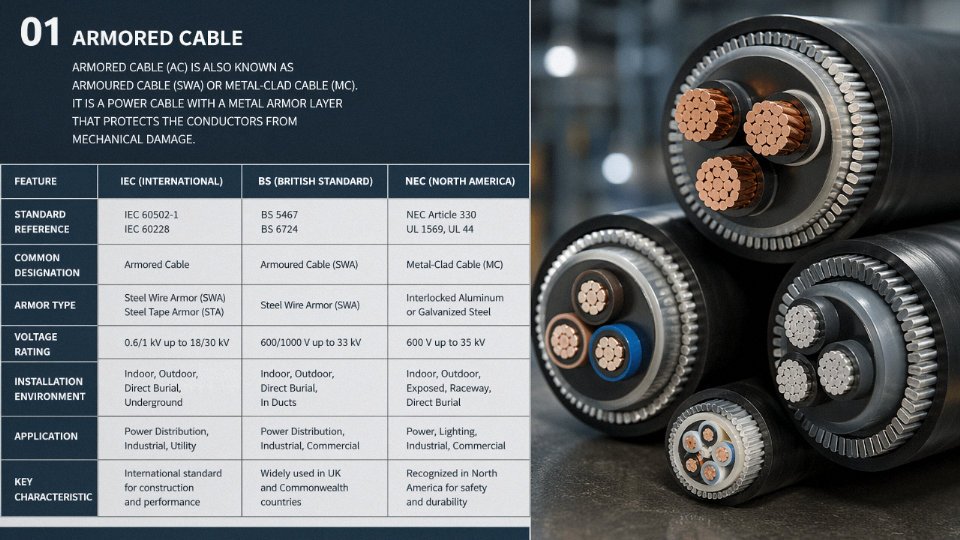
Armored cable is also known as SWA cable (Steel Wire Armored), STA cable (Steel Tape Armored), MC cable (Metal-Clad, in North American usage), armoured cable (Commonwealth spelling), and mechanically protected cable. The specific name used depends on the regional standard, armor material, and application — IEC-based markets typically use SWA or STA terminology, while NEC-governed markets use MC or AC (Armored Cable) designations.
What makes this genuinely complicated in procurement is that the naming differences are not purely cosmetic — they often correspond to real construction differences, different test standards, and different installation rules. A cable sold as “SWA” to BS 5467 and one sold as “MC” to UL 1569 are not interchangeable on a cross-border project, even if both have a steel layer and look identical in a catalogue photo. The rest of this article maps out every major synonym, explains what each actually means structurally, and gives you enough detail to specify the right cable the first time.
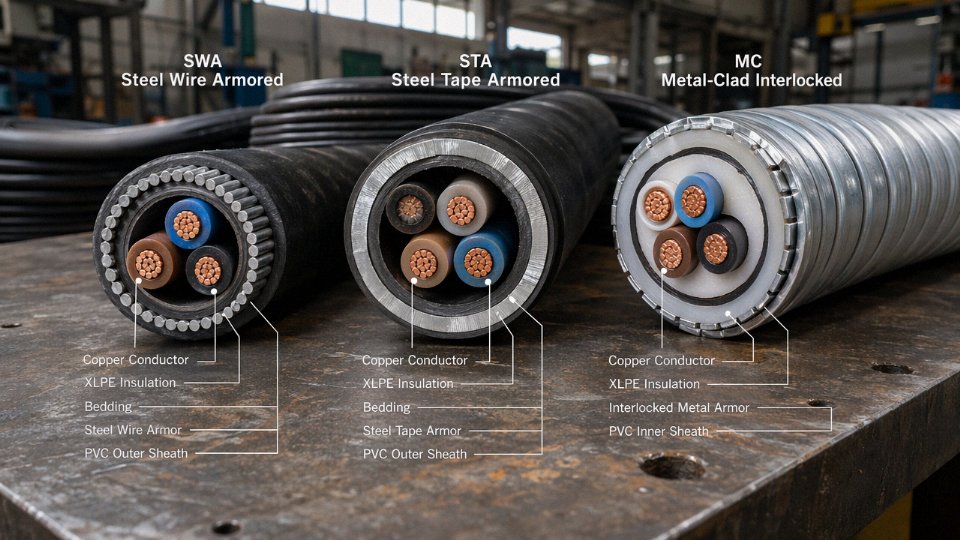
Anatomy of an Armored Cable: How Each Layer Creates a Different Trade Name
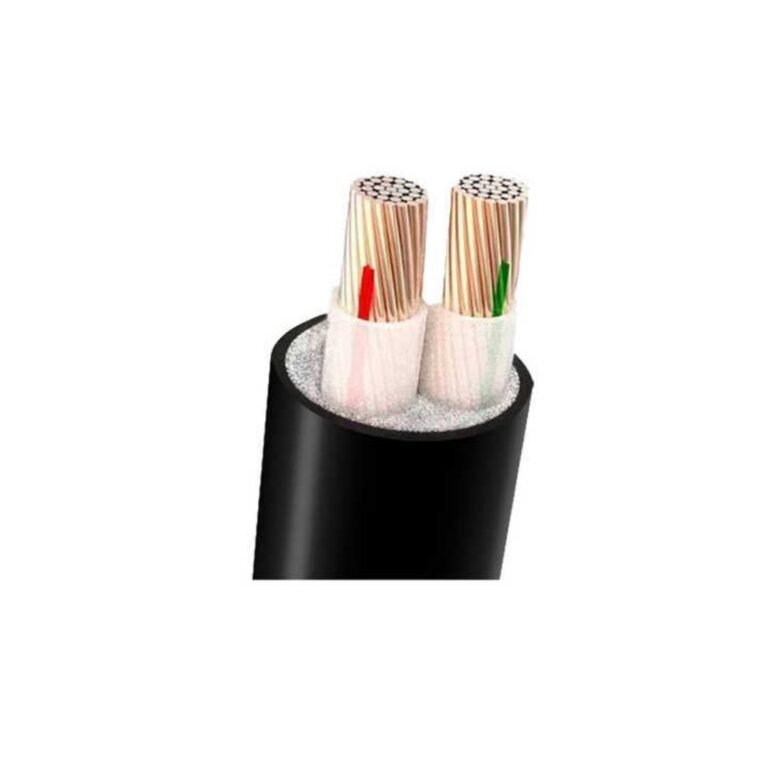
Pull apart any armored cable and you’ll find the same basic stack: conductor, insulation, bedding, armor, outer sheath. Five layers. The trade names multiply because engineers and procurement catalogs name the cable after whichever layer is most distinctive for their application — usually the armor material, sometimes the insulation, occasionally both combined. Understanding what each layer actually does clears up most of the naming confusion immediately.
Conductor: Copper or Aluminum, and Why It Shows Up in the Name
Most armored cable runs on plain annealed copper or stranded copper conductors in smaller cross-sections, switching to solid or stranded aluminum for larger sizes — roughly 50 mm² and above in many utility specifications, though that threshold varies by project and regional standard. Aluminum is significantly lighter and cheaper per unit length, which matters enormously on long underground feeder runs. In North American catalogs, aluminum-conductor armored cable sometimes carries a separate designation entirely: “AAC” or “ACSR-armored” in overhead variants, or simply called out as “aluminum MC” in the interlocked-armor world. In British-standard markets, the conductor material usually doesn’t alter the top-level name (SWA stays SWA), but it does appear in the full product reference string — so a procurement datasheet might read “Al/XLPE/SWA/PVC” to distinguish it from the copper version. Get the conductor material wrong in a specification and you’re looking at potential termination compatibility problems and, in some jurisdictions, code violations at inspection.
Insulation: Where XLPE vs. PVC Changes the Full Product Name
The insulation layer sits directly over the conductor and sets the cable’s thermal and voltage rating. XLPE (cross-linked polyethylene) handles higher continuous operating temperatures — typically up to around 90°C versus roughly 70°C for standard PVC — and performs better in wet or partially submerged conditions. EPR (ethylene propylene rubber) shows up in mining and offshore applications where flexibility at low temperatures matters more than cost. Each combination generates its own full designation. “XLPE SWA PVC” and “PVC SWA PVC” are both steel-wire armored cables, but they are not interchangeable: the former can carry more current at a given cross-section, tolerates higher fault temperatures, and commands a price premium of perhaps 15–30% depending on conductor size and market conditions. Specifying one when you need the other is a common procurement error on projects where the electrical engineer and the buyer aren’t reading the same revision of the datasheet.
Bedding: The Overlooked Layer That Sometimes Creates Sub-Categories
Between the insulation and the armor sits the bedding — typically extruded PVC or, in some designs, a wrapped tape. Its job is mechanical cushioning and galvanic isolation. Steel armor in direct contact with certain insulation compounds or with moisture-laden environments can set up corrosion cells that quietly destroy the armor over years. In some European and Australian standards, cables with a thicker or specially compounded bedding layer carry a distinct sub-designation to indicate enhanced corrosion protection, which occasionally confuses procurement teams who see two “SWA” cables with slightly different code suffixes and assume they’re interchangeable.
Armor Layer: The Primary Source of Every Major Alternate Name
This is where most of the naming diverges. Galvanized steel wire armor — SWA — offers crush resistance typically in the range of 1,500 to 3,000 N/cm depending on wire diameter and the number of wires in the layer, and it’s the default choice for direct burial and industrial tray installations. Steel tape armor (STA) uses overlapping helical steel tapes rather than round wires; it’s cheaper and handles radial crush loads reasonably well but provides less tensile protection, making it more appropriate for conduit-pulled or duct-installed cables than for direct-buried runs with ground movement risk. Double steel tape armor (DSTA) adds a second tape layer wound in the opposite direction to improve coverage uniformity — this shows up frequently in submarine and river-crossing cable specs.
Aluminum wire armor (AWA) substitutes aluminum wires for steel, primarily to eliminate the magnetic losses in single-core cables carrying AC current. Run a steel-armored single-core cable on AC and the armor acts as a shorted turn around a transformer; eddy current and hysteresis losses can waste several percent of transmitted power over a long run. Single-core medium-voltage cables are almost always specified AWA for exactly this reason, and that material choice is stamped directly into the product name.
Steel wire armor on single-core AC cables causes significant eddy current losses compared to aluminum wire armorTrue
Steel is ferromagnetic; a single-core cable's alternating magnetic field induces circulating currents in a continuous steel armor layer, increasing losses. Aluminum is non-magnetic and avoids this effect, which is why AWA is standard for single-core MV cables.
In North American practice, the interlocked aluminum armor used on MC (Metal-Clad) and AC (Armored Cable) types is mechanically and electrically distinct from the helically applied wire or tape designs common in IEC-standard markets. The interlocked construction — each armor strip mechanically engages the next — provides flexibility and a degree of crush resistance, but the crush rating is generally lower than a fully bedded SWA design, which is part of why NEC installation rules treat MC cable differently from a direct-buried SWA equivalent.
Outer Sheath: Color Coding That Enters Regional Trade Names
The outer sheath is usually extruded PVC, though LSZH (low smoke zero halogen) compounds are increasingly specified for tunnels, confined spaces, and public buildings — and LSZH sheath cables carry that designation as a suffix or prefix depending on the regional standard. Color conventions aren’t universal, but in practice black PVC dominates general-purpose industrial and infrastructure installations. Red outer sheaths are common on fire-resistant variants in several Asian and Middle Eastern markets, acting as a visual warning during maintenance. Yellow or orange sheaths appear on cables intended for direct burial in sandy or loose soil, providing high visibility during excavation work — some regional specifications actually require a specific sheath color for buried MV cables, so the color becomes part of the purchasing specification rather than just a preference.
Taken together, the full product name on a procurement datasheet is essentially a shorthand description of each layer’s material in sequence. “Cu/XLPE/PVC/SWA/PVC 11 kV” tells an engineer everything from conductor metal through to sheath compound and voltage class. The alternate names — SWA, STA, AWA, MC, AC, BX — are just shortcuts that emphasize whichever layer most defines the cable’s application in that market.
SWA vs. STA vs. AWA vs. MC Cable: Choosing the Right Armor Type for Your Application
The names are different. The protection goals are different. Mixing them up costs real money — wrong armor type on a direct-burial run can mean a dig-up within five years; wrong armor on a single-core medium-voltage feeder can mean transformer-room heat you can’t explain until something burns.
Steel Wire Armor (SWA) vs. Steel Tape Armor (STA)
SWA uses individual galvanized steel wires laid helically around the cable core. That construction gives it genuine tensile load capacity — typically somewhere between 8 kN and 40 kN depending on conductor cross-section and the number of wire layers — which is why it’s the default choice for vertical risers, submarine pulls, and any direct-burial route where a cable may be dragged through conduit under significant tension. If you’re pulling 240 mm² SWA down a 30-meter vertical shaft in a mining shaft or an offshore platform leg, the armor itself is sharing the mechanical load. STA can’t do that.
Steel tape armor wraps two overlapping steel strips helically in opposite directions. It resists radial crush well — fine for cables lying in a horizontal cable tray or in a duct where the threat is someone dropping a steel beam on top, not axial pulling force. STA is also noticeably cheaper and produces a smaller overall diameter, which matters when you’re trying to fit 12 cables into a tray sized for 10. The tradeoff is that under tensile load, the tape edges can dig into the bedding layer and you get progressive damage you won’t see until insulation resistance starts drifting.
Aluminum Wire Armor (AWA) and Why Magnetic Properties Matter
AWA replaces the steel wires with aluminum alloy wires. Lighter, yes — roughly 30–45% weight reduction on the armor layer alone, which on a long offshore cable run adds up fast. But the real reason to specify AWA isn’t weight. It’s magnetic permeability.
Steel is ferromagnetic. Wrap a steel armor layer around a single-core AC cable and you’ve created a shorted turn around an alternating magnetic field. The result is eddy-current and hysteresis losses in the armor itself — heat generation that can derate the cable’s current-carrying capacity by 15–25% in practical installations, depending on current magnitude and armor geometry. For single-core cables above roughly 95–120 mm² (the exact threshold depends on current rating and installation method), this is not a theoretical concern. It’s a real derating problem.
AWA is non-magnetic, so the single-core eddy-current issue disappears. That’s why every competent spec for single-core medium-voltage feeders — 6.35/11 kV, 19/33 kV — in petrochemical, offshore, or marine environments calls for AWA or some other non-ferrous armor. The corrosion resistance in salt-laden air is a secondary benefit, though a meaningful one.
Steel wire armor on single-core AC cables above certain cross-sections causes measurable eddy-current losses that reduce current-carrying capacityTrue
Ferromagnetic armor surrounding a single-core AC conductor forms a closed magnetic circuit, inducing circulating currents and heat in the armor layer. IEC 60502 and BS 6622 both acknowledge this effect and require correction factors or specify non-magnetic armor alternatives for single-core high-current cables.
Interlocked Armor (MC Cable, NEC Article 330)
MC cable — Metal-Clad cable under NEC Article 330 — uses a spiral interlocked strip of steel or aluminum rather than wrapped wire or tape. The interlocked profile allows the cable to flex and route around corners inside commercial and industrial buildings without rigid conduit. It’s a North American construction, heavily used in office buildings, data centers, and light industrial fit-outs where you need mechanical protection but also need electricians to route cable quickly through ceiling spaces and wall cavities.
Tensile capacity is modest compared to SWA. MC cable is not a direct-burial product in most configurations. It exists to replace conduit in above-grade interior runs, not to survive ground movement or installation tension.
Side-by-Side Specification Summary
| Armor Type | Material | Typical Min. Bend Radius | Tensile Load Range | Weight vs. Unarmored | Primary Application | Key Standard |
|---|---|---|---|---|---|---|
| SWA | Galvanized steel wire | 8–12× OD | 8–40 kN (varies by size) | +20–50% | Direct burial, vertical runs, MV distribution | IEC 60502, BS 5467 |
| STA | Galvanized steel tape | 10–15× OD | Low (radial crush only) | +10–25% | Horizontal trays, short duct runs | IEC 60502, GB/T 12706 |
| AWA | Aluminum alloy wire | 8–12× OD | 5–25 kN (varies by size) | +8–20% | Single-core MV, offshore, marine | IEC 60502, BS 6622 |
| MC (Interlocked) | Steel or aluminum strip | 5–7× OD (flexible) | Low — interior use only | +15–30% | Commercial buildings, interior industrial | NEC Article 330, UL 1569 |
Bend radius and tensile figures depend on conductor cross-section, number of cores, and manufacturer construction. Always verify against the specific datasheet before specifying on drawings.
Specifying Correctly Across Regions
The practical problem for procurement managers is that RFQs often arrive with a regional name rather than a construction specification. “BX cable,” “armored cable,” “MC cable” — these don’t all mean the same thing, and a supplier who doesn’t ask clarifying questions before quoting may ship something technically different from what the design engineer intended.
Jinda’s production lines cover all four armor configurations — SWA, STA, AWA, and interlocked-strip MC-equivalent construction — with testing to IEC, BS, NEC, and GB/T standards depending on the destination market. That matters on projects sourcing for multiple countries simultaneously, where the same cable function needs to be met with different type designations on the same purchase order.
Standards and Certifications That Define Armored Cable Designations Worldwide
The naming confusion around armored cable doesn’t just come from regional habit — it’s baked into the standards themselves. IEC, BS, NEC, AS/NZS, and GB/T each approach the same physical product from a different regulatory philosophy, and each framework generates its own vocabulary. If your procurement team is sourcing globally, understanding which standard governs which name is the fastest way to catch a spec mismatch before it becomes a site rejection.
IEC 60502: The Alphanumeric Baseline Most of the World Uses
IEC 60502 is split into two parts that map roughly to low- and medium-voltage applications. Part 1 covers cables rated 0.6/1 kV — the workhorse range for industrial power distribution, sub-station feeders, and building infrastructure. Part 2 extends coverage up through 3.6/6 kV, 6/10 kV, 12/20 kV, and 20.8/36 kV, which is where you get into serious medium-voltage underground distribution and renewable energy transmission runs.
What IEC 60502 doesn’t do is call anything “SWA.” Instead, it uses construction codes: armor type, conductor material, insulation class. A cable described as Cu/XLPE/SWA/PVC under IEC notation is specifying copper conductor, cross-linked polyethylene insulation, steel wire armor, and PVC outer sheath — all in sequence, without a trade name. This matters in procurement because a supplier quoting “SWA cable to IEC 60502-1” and another quoting “armored power cable to IEC 60502-1” may be offering identical products described through different commercial conventions.
BS 5467 and BS 6346: Where the SWA Name Was Standardized
British standards did something IEC avoided — they attached the trade designation directly to the standard. BS 5467 covers XLPE-insulated armored cables and BS 6346 covers PVC-insulated versions, and both explicitly use “SWA” and “STA” (steel tape armored) as part of their nomenclature. The standard also mandates specific armor wire diameter tolerances relative to the overall cable diameter, which is why you’ll see wire gauge callouts like 0.8 mm or 1.25 mm on datasheets from Commonwealth suppliers. Those aren’t arbitrary; they’re compliance figures.
BS 5467 cables dominate procurement specifications in the UK, much of sub-Saharan Africa, South Asia, and parts of the Middle East — anywhere with a legacy of British electrical codes. When a Nigerian or Pakistani contractor specifies “SWA cable,” they typically mean BS 5467 construction. Assuming IEC 60502 compliance is automatically equivalent can get you into trouble on third-party inspection.
NEC Article 330 and 320: Cable as a Wiring Method
The US approach is categorically different. NEC Article 330 defines Metal-Clad (MC) cable not just as a product but as a listed wiring method — which means the installation inspector is checking not only that the cable passed a UL test, but that it was routed, supported, and terminated according to NEC rules. Article 320 covers AC (Armored Cable), the older BX-style construction with an interlocked aluminum or steel armor. The labeling requirements under UL 1569 (for MC cable) require printed footage markings and listing identification on the outer surface. A cable that carries IEC or BS certification but lacks UL listing cannot legally be installed as a wiring method on a US job site, regardless of its electrical performance. That’s a hard stop.
MC cable listed under UL 1569 requires a printed listing mark and footage markers directly on the cable jacketTrue
UL 1569 Standard for Metal-Clad Cables mandates product marking including the manufacturer name, AWG size, and cumulative footage at regular intervals, which is a NEC compliance requirement for field inspection.
AS/NZS 5000.1: Australian and New Zealand Terminology
Australia and New Zealand use AS/NZS 5000.1, which introduces designations less familiar to European or American engineers. The term “SAC” (Steel Armored Cable) appears in some older Australian project specs, though current documentation tends to use the IEC-style construction description alongside a voltage designation like V-90 — referring to PVC insulation rated to 90°C. Armor specifications in this framework track closely with IEC 60502 requirements, but local climate conditions (UV exposure, high ambient temperatures in northern Australia) mean the sheath compound specified often differs from a European equivalent even when the armor construction is identical.
GB/T 12706 and Dual-Certification Manufacturing
China’s national standard for power cables is GB/T 12706, which spans low voltage (Part 1, 0.6/1 kV), medium voltage (Parts 2 and 3), and sheathed construction variants. The construction logic mirrors IEC 60502 closely — intentionally, as GB/T 12706 was harmonized with IEC standards starting in the early 2000s — but the type codes differ enough that a procurement spec listing only “IEC 60502” doesn’t automatically qualify a GB/T-certified cable without cross-referencing the construction parameters.
Jinda manufactures to both GB/T 12706 and IEC 60502 simultaneously, which matters for export projects in Southeast Asia, the Middle East, and Africa where the end client’s spec requires IEC compliance but the project financing or local import documentation references Chinese national standards. Dual-certification supply eliminates the re-testing delay that can stall a shipment by four to eight weeks.
Third-Party Certifications: What They Add Beyond the Product Standard
The product standard — IEC, BS, GB/T — defines what the cable must do. Third-party certifications confirm that a specific factory’s specific product actually meets it, under audit conditions rather than self-declaration.
CE marking (technically a Declaration of Conformity under EU Low Voltage Directive or CPR, depending on application) is necessary for European market access but is self-declared for many cable categories — which means it carries less independent weight than it sounds. KEMA (now KEMA-CESI after the merger with CESI) and Bureau Veritas (BV) type-test certifications involve independent laboratory testing of actual production samples and carry genuine third-party weight in project tender evaluations. SGS audit and test reports are widely recognized across African and Asian procurement contexts. SONCAP certification is required specifically for exports into Nigeria and a few other West African markets — skipping it means your shipment gets held at the port of Lagos, which is an expensive lesson.
The practical advice: for any export project, confirm which third-party certifications the end client’s engineer-of-record or local authority having jurisdiction will actually accept, not just which ones look impressive on a product catalog.
Direct Burial, Cable Tray, and Conduit: How Installation Method Changes the Armored Cable Specification Name
The armor type gets most of the attention in procurement conversations, but in practice the installation environment drives the final designation just as much — sometimes more. A 95 mm² three-core SWA cable specified as “SWA/PVC” on a European drawing and “SWA/PE” on the revised underground version are not interchangeable, even though the armor layer is identical. The outer sheath material, conduit combination, and burial depth change the commercial designation, change what you order from the catalog, and in some jurisdictions change which standard the product must comply with.
Direct Burial: Why the Sheath Suffix Matters More Than People Expect
Burying a PVC-sheathed SWA cable in aggressive soil — waterlogged clay, acidic peat, ground with high chloride content near coastal sites — accelerates sheath degradation faster than most plant engineers anticipate. PVC becomes brittle under sustained hydrostatic pressure and loses plasticiser over time when saturated. PE (polyethylene) outer sheathing resists moisture ingress and soil chemical attack significantly better, which is why drawings and BOQs for direct-burial runs specifically call out “SWA/PE” or “STA/PE” rather than the default PVC variant.
On a bill of quantities, this distinction looks small — one line item versus another — but if a procurement manager substitutes SWA/PVC to save a few percent on unit price, the consequence is premature insulation failure, usually showing up as an earth-leakage fault somewhere between years three and eight depending on soil conditions. Replacement in a congested cable route costs orders of magnitude more than the original price difference.
SWA cable with PE outer sheath provides substantially better resistance to soil moisture and chemical attack than the equivalent PVC-sheathed version for direct burial installationsTrue
PE has lower water absorption and better resistance to soil acids and alkalis than PVC; this is documented in IEC 60502 construction requirements and widely acknowledged in utility cable engineering practice.
Burial depth also affects which armor weight class is specified. In routes where mechanical excavation traffic overhead is realistic, the crush resistance of the armor layer — typically ranging from roughly 1,200 N/cm up to around 2,800 N/cm for heavier SWA constructions, depending on wire diameter and conductor cross-section — becomes a real selection criterion, not a checkbox.
Cable Tray and Ladder Rack: Weight and Fill Rules Change the Preferred Type
Above-ground ladder rack and cable tray installations shift the calculus toward interlocked aluminum-armored MC cable or AWA (aluminum wire armored) constructions. The reason is mostly weight. Steel wire armor on a multi-core medium-voltage cable can add roughly 0.8 to 2.5 kg per meter over the unarmored equivalent — the range depends heavily on wire gauge and the number of cores. Over a 40-meter tray run with twenty circuits, that accumulates fast, and it affects tray derating, support bracket spacing, and seismic anchorage calculations in one move.
Under NEC Article 392, tray fill calculations require the actual outside diameter and weight of each cable. Engineers who specify SWA where AWA or MC would suffice end up either oversizing the tray structure or discovering mid-installation that their support centres need halving. Neither outcome is cheap.
MC cable (Metal-Clad, per NEC Article 330) with its interlocked aluminum armor is the default specified type for most North American industrial tray runs. The designation on the drawing typically reads “MC-HL” in hazardous locations or simply “MC” in general industrial areas. The interlocked armor construction — as opposed to continuous corrugated armor — allows flexibility during pull-in without the torsional stiffness problems you get trying to route heavy SWA around bend radii in a congested tray.
Duct and Conduit: When Armored Cable Inside Conduit Is Redundant and When It Is Not
Running armored cable inside rigid conduit is sometimes dismissed as belt-and-suspenders engineering, and for straightforward indoor industrial runs that criticism is fair. The conduit already provides mechanical protection; the armor layer adds cost, stiffness, and weight without adding meaningful protection.
That said, there are real cases where the combination is justified. In some jurisdictions — parts of the Middle East, certain Southeast Asian national codes — the local standard requires armored cable even inside buried conduit for circuits above a defined voltage threshold. The combination is sometimes called “double-protected cable” in project specifications, and it appears on BOQs as a distinct line item with both the cable designation and the conduit schedule called out separately. If you are pricing a project in one of these markets and strip out the armor to cut cost, the installation will fail the AHJ inspection.
Conduit also changes the pulling tension limits. Armored cable is stiffer and heavier, so maximum conduit fill percentages and pulling tension calculations need to account for both the cable OD and the interlocked or wire armor’s contribution to sidewall pressure on bends.
Underwater and Submarine Runs: A Different Category Entirely
River crossings, harbor runs, and lake crossings use what specifications typically call “armored submarine cable” — and it is worth being precise here, because this is not the same product category as high-voltage subsea transmission cable. For a 1 kV river crossing of, say, 80 meters, the typical specified product is a PE-sheathed, lead-sheathed, or double-steel-armored cable with a sacrificial bedding layer designed for continuous immersion and the mechanical loads from water flow and occasional drag.
Lead sheathing (designated “SL” in some European conventions, producing designations like “XLPE/SL/SWA/PE”) serves as the primary water barrier for these applications. It adds cost and weight significantly, but in permanent immersion conditions, no polymer sheath gives equivalent long-term moisture resistance. The designation on a harbor-crossing drawing will look unfamiliar to someone used to specifying standard SWA for trenched industrial sites — more layers, a longer alphanumeric string, and a different section of IEC 60502 governing the construction.
Hazardous Areas: The Sheath Designation Becomes a Safety Requirement
In ATEX Zone 1 or IECEx-certified areas — refineries, chemical plants, grain handling facilities, mine headings — the outer sheath material is not a procurement preference, it is part of the explosion protection strategy. Standard PVC sheaths can generate static discharge when abraded in certain conditions. Low-smoke zero-halogen (LSZH) or halogen-free flame-retardant (HFFR) outer sheaths are specified because in an emergency, the combustion products of the sheath determine evacuation survivability in enclosed process areas.
The designation “armored SY control cable with LSZH sheath” or “SWA/LSZH” appears on hazardous-area drawings specifically to communicate this. Some petrochemical contractors require both the armor type and the sheath designation to appear in the cable tag stamped on the outer sheath itself, making field verification during hot-work permit inspections straightforward. Substituting a standard PVC-sheathed SWA to fulfil a “SWA/LSZH” line item is a compliance failure, not just an engineering preference.
The table below summarizes how installation environment maps to armor preference, sheath material, and the resulting commercial designation.
| Installation Environment | Preferred Armor Type | Sheath Material | Typical Commercial Designation |
|---|---|---|---|
| Direct burial, normal soil | SWA or STA | PE | SWA/PE, STA/PE |
| Direct burial, aggressive/acidic soil | Heavy SWA | PE (thick-wall) | SWA/PE (IEC 60502-2) |
| Cable tray / ladder rack (North America) | Interlocked aluminum (MC) | PVC or LSZH | MC, MC-HL |
| Cable tray (European / international) | AWA | PVC or LSZH | AWA/PVC, AWA/LSZH |
| Conduit (double-protected per local code) | SWA | PVC or PE | SWA/PVC in conduit |
| River / harbor crossing | Double SWA or lead-sheathed SWA | PE | XLPE/SL/SWA/PE |
| ATEX / IECEx hazardous area | SWA or braided armor | LSZH / HFFR | SWA/LSZH, armored SY/LSZH |
Fire-Resistant and LSZH Armored Cable: When the Outer Sheath Name Overwrites the Armor Name
Specify cable for a metro station emergency lighting circuit and the first term you’ll see on the tender document probably isn’t “SWA” — it’s “FP400” or “FR-SWA LSZH.” The armor is still there. The steel wire is still doing its job. But the fire-performance designation has moved to the front of the name, and that shift trips up procurement teams more often than it should.
Fire-Resistant SWA (FR-SWA) and the Role of the Mica Tape
The defining feature of a fire-resistant armored cable isn’t the armor at all — it’s a mica-tape wrap applied directly over the insulated conductors, between the insulation and the bedding layer. Mica survives sustained flame exposure without losing its dielectric properties, which is exactly what IEC 60331 demands: circuit integrity maintained for 90 minutes or more under a flame temperature of roughly 750–840 °C, depending on the specific test regime. The steel wire armor sits outside that mica layer, contributing crush and rodent protection as usual, but in the fire scenario its job is largely mechanical — keeping the cable from collapsing under falling debris while the mica holds the circuit live.
On datasheets and British-market project specs, this cable appears as “FR-SWA,” “FP200,” or “FP400,” the FP designation coming from the fire-performance product family rather than any IEC armor code. FP400 specifically targets 400 °C short-term exposure, a threshold relevant to corridor lighting and fire-pump circuits in commercial high-rises. The underlying construction is still steel wire armored. It just doesn’t lead with that fact.
LSZH Sheathing and the SWA/LSZH Designation
Rail, tunnel, and large public building projects — airports, hospitals, underground transit systems — increasingly mandate low smoke zero halogen outer sheaths. The reasoning is straightforward: in an enclosed space during a fire, PVC sheathing releases hydrogen chloride gas and dense black smoke that kills people before the heat does. LSZH compounds produce neither.
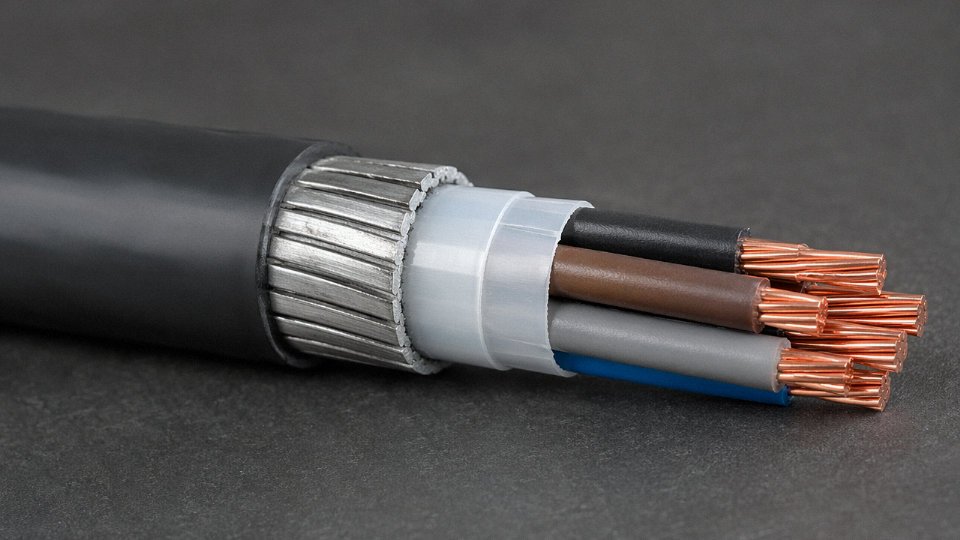
Swap the outer sheath material on a standard SWA cable from PVC to an LSZH compound and you get a product that appears on specification sheets as “SWA/LSZH” or, where aluminum wire armor is used instead, “AWA/LSZH.” The armor layer is structurally identical. The conductor cross-sections, voltage ratings, and IEC 60502 compliance all carry over. What changes is the sheath chemistry — and the price, which typically runs 15–30% higher than equivalent PVC-sheathed SWA depending on compound formulation, order volume, and raw material pricing at the time.
Flame spread performance under IEC 60332-3 (bunched cable tests) and individual cable tests under IEC 60332-1 are usually tested and reported alongside LSZH sheathed cables, and passing those tests feeds directly into how the product gets marketed. A cable that clears BS 6387 Category CWZ — meaning it survives flame, water spray, and mechanical shock simultaneously — will be sold primarily under that designation even though the steel armor underneath hasn’t changed one thread.
MICC Cable: The Most Compact Armored Option
Mineral-insulated copper-clad cable — widely known by the Pyrotenax trade name or simply “MI cable” — is worth treating separately because its construction is genuinely different. There is no polymer insulation, no bedding, no separate armor layer. The conductors are embedded in compacted magnesium oxide powder inside a seamless copper tube, and that copper tube is simultaneously the outer sheath, the armor, and the mechanical protector. It’s extraordinarily compact for its current rating, survives temperatures exceeding 1,000 °C, and carries IEC 60702 compliance.
The tradeoff is inflexibility — literally. MICC is rigid, requires specialist termination fittings (typically compression-type pot terminations), and is more expensive per meter than FR-SWA, running roughly 2–5× the cost depending on conductor count and cross-section. For critical fire-safety circuits in plant rooms, boiler houses, and tunnel emergency systems, that cost is accepted. Specifying it elsewhere is usually overkill.
Offshore and the HFFR Armor Category
On Norwegian Continental Shelf platforms and similar offshore installations, the governing document is often NEK 606 rather than IEC 60502. NEK 606 mandates halogen-free flame-retardant (HFFR) sheathing, and cables built to it get marketed directly as “NEK 606 armored” — the standard name displacing both the armor type descriptor and the sheath material descriptor. The armor is still present (typically steel wire or aluminum wire), but procurement teams sourcing these cables need to know that “NEK 606” implies HFFR sheathing as a baseline; specifying “SWA” alone won’t get them what the installation safety case requires.
Offshore environments also drive the combination of HFFR sheathing with enhanced crush resistance ratings. The armor layer on a NEK 606 cable might be specified at 1,500–2,500 N/cm crush resistance depending on routing — through cable trays in congested module decks versus open ladder rack on the topside.
Jinda manufactures fire-resistant and LSZH-sheathed SWA cables compliant with both IEC 60502 and IEC 60331 simultaneously, with full third-party test reports available for project tender submissions.True
IEC 60502 governs construction and electrical performance for power cables up to 30 kV; IEC 60331 governs circuit integrity under fire conditions. A cable can be designed and tested to both standards concurrently, and reputable manufacturers routinely provide CNAS- or ILAC-accredited test reports to support tender documentation.
The practical takeaway for procurement: when a fire-performance designation appears first in a cable specification, confirm what armor construction sits underneath it, verify which specific fire test standard was passed and to what category, and ask the supplier for the actual test certificate rather than a self-declaration. The name changed. The armor didn’t disappear.
Armored Control Cable, Instrumentation Cable, and Data Cable: Extending the Armor Concept Beyond Power
Most procurement documents that land on an engineer’s desk say “armored cable” and mean a power cable — SWA, STA, or something similar. That assumption quietly causes real problems, because the same armor concept runs through control, instrumentation, and data cable families, each with its own naming conventions, conductor sizing, shielding architecture, and applicable standard. Conflating them at the requisition stage can mean the wrong product ships, and by the time you catch it on the panel floor, the project schedule is already bleeding.
Armored Control Cable
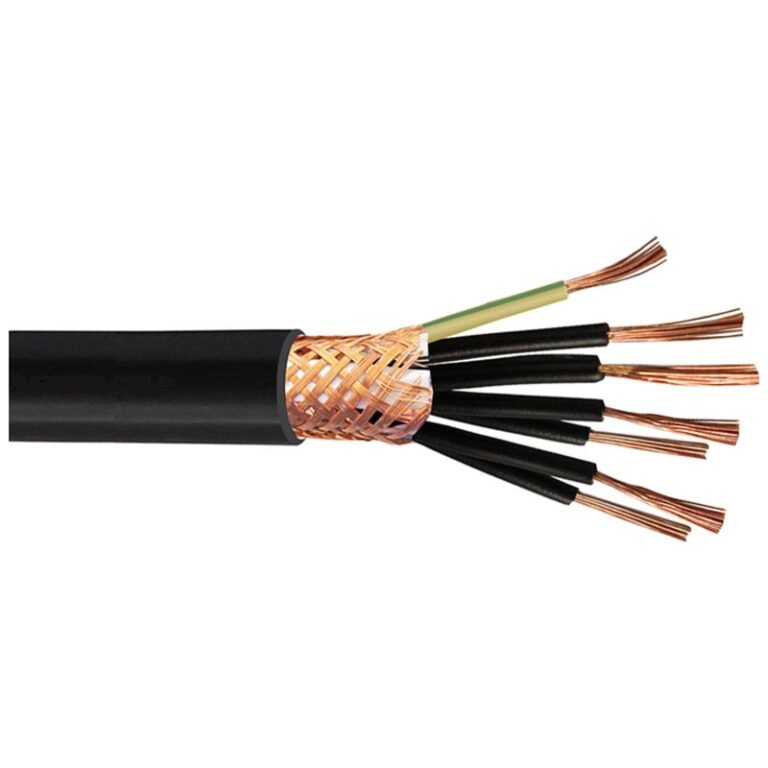
These are multi-core cables, typically 0.75 mm² to 6 mm² per conductor, used between motor control centers, PLC marshalling panels, switchgear terminals, and field junction boxes. The armor — usually steel tape (STA) or steel wire (SWA), sometimes aluminum wire for weight-sensitive trays — is there to handle mechanical abuse in cable management systems, not to carry fault current.
In IEC and GB markets you’ll see these called KVVP2 or KVVP22 (the suffix encoding the armor and sheath type under GB/T 9330), or simply “armored control cable to IEC 60228.” European project specs often reference BS EN 60228 conductor classes and call the product “armored multicore control cable, SWA, PVC/PVC.” The name changes; the function doesn’t. A 19-core 1.5 mm² SWA control cable for a pump skid is the same product whether the datasheet was written in Shanghai or Aberdeen — but sourcing against only one naming convention will get you zero responses from half your potential suppliers.
Armored Instrumentation Cable
This is where things get more nuanced. An instrumentation cable for a SCADA or DCS system typically combines individual pair shielding (IS) and overall shielding (OS) with an armor layer on the outside, and you’ll see it written as IS/OS SWA on oil and gas project material requisitions. Each twisted pair has its own foil-and-drain-wire screen to suppress cross-talk and common-mode noise; the SWA layer then provides mechanical protection and a secondary EMI barrier.
Armored thermocouple extension cables are a specialized sub-family here — the conductor alloy matters (Type K, J, T, etc.), the armor has to be compatible with the sheath material, and substituting a standard copper-conductor armored control cable will introduce a thermoelectric error the control system will never self-diagnose. That mistake shows up as a calibration drift that can take weeks to trace.
Armored Data and Fieldbus Cable
Factory automation environments increasingly specify armored CAT6A or armored PROFIBUS DP cable precisely because the armor eliminates the need for a separate metal conduit run — a real cost and labor saving on a large automated line. The armor here is usually a thin corrugated steel or aluminum tape, light enough not to compromise the cable’s flexibility through cable carriers. Impedance control and pair geometry still have to meet the data standard (TIA-568 for structured cabling, EN 50170 for PROFIBUS), and the armor layer has to be grounded correctly at one end to avoid creating a ground loop that degrades signal integrity. This isn’t theoretical — it’s a startup issue that shows up often on first commissioning.
Armored Fiber Optic Cable
Loose-tube armored fiber optic cables — ADSS (All-Dielectric Self-Supporting), OPGW (Optical Ground Wire), and tight-buffered armored indoor/outdoor types — share the “armored” label but are mechanically and electrically a completely different product family. The “armor” in ADSS is a corrugated steel or aramid-yarn layer protecting optical fibers that carry no current at all. Quoting a fiber optic armored cable against a power SWA specification because both say “armored” is an error that happens more than it should.
The Specification Error Risk
Writing only 'armored cable' on a purchase order, without specifying the application type, conductor range, and applicable standard, is sufficient for a supplier to dispatch the correct product.False
'Armored cable' covers at minimum six distinct product families — power, control, instrumentation, data/fieldbus, fiber optic, and fire-resistant variants — each with different conductor materials, shielding architectures, and governing standards. An underspecified order forces the supplier to make assumptions, and those assumptions may not match the installation requirement.
Jinda’s technical team handles these ambiguities before production begins — cross-referencing the application description, conductor count, cross-section, installation environment, and the governing project standard to confirm the exact construction before a meter of cable is drawn. It saves re-production runs, and on medium to large orders the lead-time impact of getting it wrong the first time is rarely recoverable.
Armored Cable Types by Application — Summary Matrix
| Application | Typical Conductor Range | Armor Type | Primary Standard | Common Trade Name |
|---|---|---|---|---|
| Power distribution | 1.5 mm² – 630 mm² | SWA, STA, AWA | IEC 60502-1/-2, BS 5467 | SWA cable, XLPE/SWA/PVC |
| Motor control / PLC wiring | 0.75 mm² – 6 mm² | STA, SWA | GB/T 9330, IEC 60228 | KVVP2, armored control cable |
| Instrumentation / SCADA | 0.5 mm² – 1.5 mm² (pairs) | SWA | IEC 60332, project specs | IS/OS SWA, armored instrument cable |
| Industrial Ethernet / fieldbus | 26 AWG – 22 AWG | Corrugated tape | TIA-568, EN 50170 | Armored CAT6A, armored PROFIBUS cable |
| Fiber optic | N/A (optical fiber) | Corrugated steel, aramid | IEC 60794, ITU-T G.652 | ADSS, OPGW, armored tight-buffered |
How to Read an Armored Cable Part Number and Decode Every Alternate Name You Will Encounter
Part numbers are where procurement goes wrong. A tender arrives from a Dubai EPC contractor specifying “SWA 3×240 mm² 0.6/1 kV BS 5467,” your factory issues a quote against “CU/XLPE/SWA/PVC 3×240 mm² 0.6/1 kV,” and somewhere in the email chain someone flags a “mismatch.” There is no mismatch — they are the same cable. Knowing how to read both designations is what prevents a hold-up at customs or a rejected material inspection.
Decoding an IEC-Style Part Number
Take the full IEC-convention designation: CU/XLPE/SWA/PVC 3×240 mm² 0.6/1 kV
Each segment is a layer, read outward from the conductor:
- CU — copper conductor (AL would indicate aluminum)
- XLPE — cross-linked polyethylene insulation
- SWA — steel wire armored; this is the field that generates the alternate name
- PVC — polyvinyl chloride outer sheath
- 3×240 mm² — three power cores, each 240 mm² cross-section
- 0.6/1 kV — rated voltage, 0.6 kV conductor-to-earth, 1 kV conductor-to-conductor
That last field matters more than people realize. SWA cables run from roughly 0.6/1 kV up to 33 kV for medium-voltage distribution, and the voltage class changes the insulation wall thickness, the bedding thickness, and sometimes the armor wire gauge — so two cables with identical IEC strings except for the voltage field are not interchangeable, even though they look alike on a reel.
Reading a British Standard Designation
Armoured Cable 4-core 25 mm² SWA BS 5467 carries less text but encodes just as much. BS 5467 alone tells a specifier that the insulation is XLPE and the voltage rating is 0.6/1 kV — those fields don’t need to be written out because the standard mandates them. The “4-core” gives core count, “25 mm²” gives cross-section, and “SWA” identifies the armor type. If you need LSZH sheath instead of PVC, that becomes BS 7846, and the part number changes accordingly. Procurement teams who don’t track which BS number anchors which insulation/sheath combination end up requesting the wrong product about 20–30% of the time, in my experience with project submittals.
Reading an NEC/UL Designation
MC Cable 3C #2 AWG THHN 600V UL 1569 is a different language entirely. “MC” is the installation category (Metal Clad, per NEC Article 330), not a material description. “3C” is three conductors. “#2 AWG” is the American Wire Gauge equivalent of roughly 33.6 mm² — note there’s no exact mm² match, which creates genuine substitution risk on mixed-standard projects. “THHN” describes the conductor insulation (thermoplastic, heat-resistant, nylon-coated), which loosely corresponds to PVC but is not identical in flame or temperature performance. “600V” is the voltage class, and “UL 1569” is the listing, not a construction standard in the IEC sense.
Suffix Codes That Change the Specification
Several suffix codes modify the base name without changing what most people call the cable:
| Suffix | Meaning | Practical effect |
|---|---|---|
| /E | Earth conductor included | Adds a green/yellow core; changes core count in the part number |
| /CWS | Corrugated wire screen | Replaces SWA; used where flexibility matters more than crush resistance |
| /DB | Direct burial rated | Specifies sheath compound hardness; not all SWA cables qualify automatically |
| /OS | Overall screen | Adds an EMI screen outside the armor; common on instrumentation variants |
A cable listed as “SWA/DB” is not just SWA with a shovel-friendly label — the outer sheath compound is genuinely different, usually harder and more resistant to soil stress and moisture ingress over decades. Specifying plain SWA for direct burial and assuming it qualifies is a real mistake that shows up in asset management audits years later.
How the Same Physical Cable Ships Under Different Part Numbers
This is the practical problem Jinda solves with a cross-reference database maintained at the factory level. A 3×240 mm² 0.6/1 kV copper XLPE SWA cable ships against a BS 5467 test report to the UK market, an IEC 60502-1 test report to the Middle East, a GB/T 12706 certificate for domestic Chinese projects, and — where applicable — an adapted designation for Australian AS/NZS 5000 projects. The underlying construction is equivalent; the documentation and the part number printed on the drum differ.
The same armored cable construction can legitimately carry different part numbers for different export markets while meeting all respective local standard requirements.True
IEC 60502, BS 5467, and GB/T 12706 specify broadly equivalent construction and performance requirements for XLPE/SWA/PVC cables at 0.6/1 kV; a cable manufactured to meet all three can be documented and labeled to each standard's convention for its target market.
Worked Example: Middle East EPC Tender vs. Factory Code
A typical tender from a Gulf-based EPC contractor might read:
“Power cable, 3-core, 240 mm² copper conductor, XLPE insulated, SWA, PVC sheathed, 0.6/1 kV, BS 5467, black outer sheath, drum lengths 500 m.”
The equivalent Jinda factory code resolves line by line: CU conductor ✓, XLPE insulation per BS 5467 test report ✓, galvanized steel wire armor ✓, ST2 PVC sheath in black ✓, 0.6/1 kV voltage class ✓, 500 m drum length ✓. The factory part number includes the internal GB/T reference for production routing, but the shipping documentation, drum print, and test certificates all reference BS 5467 — because that is what the tender requires and what the material inspection engineer will check on site.
Getting this cross-reference right before the purchase order is issued eliminates re-testing costs, which run roughly USD 800–2,500 per cable type per project depending on the lab and the scope of the test program. That is not a large number in absolute terms, but it delays commissioning, and delays cost more than the test.
Sourcing Armored Cable for International Projects: Quality Benchmarks, Testing, and Supplier Evaluation
Buying armored cable across borders is where specification errors become expensive. A cable that passes a supplier’s in-house test but fails an EPC contractor’s witness inspection can hold up an entire substation energization. Getting the evaluation framework right before you issue a purchase order matters more than most buyers realize until it’s too late.
Minimum Factory Audit Criteria
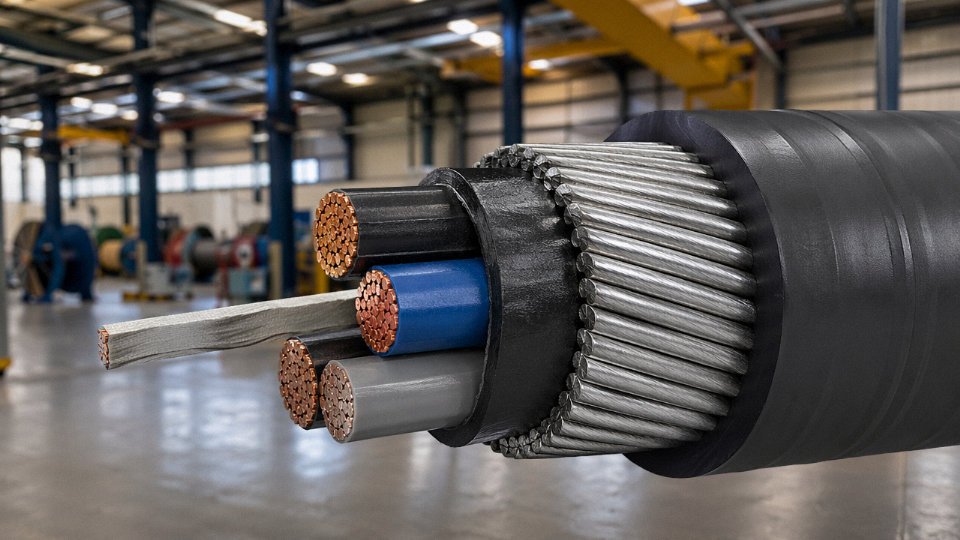
Before approving any armored cable manufacturer for a project, insist on documented compliance against at least four tests. Conductor resistance per IEC 60228 confirms that the stated cross-section is real — in practice, some manufacturers undersize conductors by 3–8% and stay within tolerance on finished cable diameter by adjusting the stranding geometry. That quietly increases circuit losses and heating. Insulation resistance per IEC 60502 should be measured at full drum length, not on a short sample; values below roughly 1,000 MΩ·km on XLPE-insulated SWA at 1 kV rating warrant immediate investigation. Armor wire tensile strength per BS 5467 Annex C — commonly 300–600 N/mm² depending on wire diameter and grade — is the test most frequently skipped by budget suppliers, which is exactly how cables rated for direct burial end up with armor that deforms under backfill compaction loads. Flame propagation per IEC 60332-1 should be a baseline requirement on any cable destined for an enclosed plant or building, and the test report needs to reference the actual submitted product code, not a generic cable type.
Third-Party Witness Testing and What a Complete Report Package Looks Like
EPC contractors on petrochemical and utility projects routinely require SGS or Bureau Veritas witness testing during production, not after. The distinction matters: post-production testing catches finished defects; witness testing catches process deviations — inconsistent armor wire count, wrong bedding compound, undersized outer sheath wall thickness — while they can still be corrected without scrapping a full drum batch.
A compliant test report package for export armored cable should include drum-by-drum identification (drum number, net cable length, gross reel weight), confirmed conductor cross-section from a micrograph or resistance measurement, armor wire count and diameter matched against the approved drawing, and insulation test results tied to specific drum serial numbers. Vague batch-level reports are a red flag. In my experience, the suppliers who push back on drum-level traceability are the same ones with the most variation in armor wire count between drums.
Jinda's factory audit documentation includes drum-level test records with conductor resistance, insulation resistance, and armor wire count for each production reel, available for third-party witness inspection.True
This level of traceability is consistent with Jinda's stated quality system supporting EPC and international utility procurement requirements.
Production Scale and Lead Times
Jinda operates five production bases across China, covering a combined 470,000 m² of manufacturing space. That scale matters for concurrent production — running 33 kV SWA alongside 0.6/1 kV AWA and armored instrumentation cable for the same project without compromising delivery scheduling is genuinely difficult at smaller facilities. Stocked cross-sections in the 16 mm² to 240 mm² range (three-core SWA being the most common utility procurement configuration) typically ship within 25–35 days of order confirmation. Large-diameter feeders, special armor configurations, or medium-voltage builds above 11 kV generally need 45–60 days, and that window assumes a confirmed material supply chain — copper pricing volatility can affect raw material availability, so locking in orders early on large projects protects your schedule.
Export Packaging
Wooden cable drums built to ISSA/ICPC standards are standard for containerized ocean freight on larger conductor sizes. Steel drums are available for particularly demanding shipping routes or high-humidity transit. Smaller armored control cables — typically 1.5 mm² to 6 mm² multicore — can ship on export-grade wooden-free pallets in coil form, which reduces freight volume meaningfully on mixed shipments.
Supply Track Record
Jinda supplies customers across more than 50 countries, with direct delivery experience into utility, petrochemical, rail infrastructure, and commercial construction sectors. Project references are available under NDA for qualified buyers. That last point is worth taking seriously: any manufacturer reluctant to provide verifiable references for projects comparable in voltage class and cable type to yours should be treated with caution regardless of price.
Frequently Asked Questions About Armored Cable Names, Types, and Specifications
Is BX cable the same as armored cable?
Not exactly. BX is a trade name that dates back to early 20th-century American manufacturing — it refers specifically to AC (Armored Cable) constructed with a flexible interlocked steel spiral wrap around the conductors. In US residential and light commercial work, electricians still use “BX” and “armored cable” interchangeably, which causes genuine confusion when those same electricians are sourcing cable for an industrial or export project. BX/AC is a subset of the broader armored cable family. It shares nothing structurally with SWA, STA, or MICC other than the principle of a metallic protective layer. Specifying “BX-type armored cable” on an international procurement document will get you blank looks from a European or Asian supplier.
Can SWA cable be installed in conduit?
Yes, and it is done regularly — particularly where a run transitions from direct burial into a building entry. The practical issue is that once the cable is inside a rigid conduit, the armor is mechanically redundant. That redundancy is not inherently a problem, but it does affect conduit fill calculations. SWA cable has a noticeably larger outside diameter than an equivalent unarmored cable of the same conductor cross-section — sometimes 15–25% larger depending on armor wire gauge and bedding thickness — so your conduit fill percentages will eat up capacity faster than the tabulated values for standard cable. Check fill limits before the conduit is purchased, not after it is installed.
Why does single-core SWA cable overheat?
Steel armor around a single AC conductor forms a closed magnetic loop. The alternating magnetic field from the conductor induces circulating eddy currents in that loop, generating heat directly in the armor itself. On larger conductors — roughly 16 mm² and above, though the threshold depends on current loading and installation grouping — this effect is significant enough to reduce the cable’s current-carrying capacity and in severe cases cause accelerated insulation degradation. The standard fix is to specify AWA (Aluminum Wire Armor) or another nonmagnetic armor material for single-core runs. Aluminum does not sustain the same eddy current losses. This is not obscure theory; it is a real failure mode that shows up in medium-voltage single-core installations where the armor specification was copied from a multi-core project without adjustment.
Single-core SWA cable above approximately 16 mm² experiences measurable eddy current heating in the steel armor under AC loading, requiring nonmagnetic armor for correct thermal performance.True
Steel armor on a single-core AC cable creates a closed ferromagnetic loop around the conductor. The time-varying magnetic flux induces circulating currents in the armor, producing I²R losses that add heat to the cable system. IEC 60502 and BS 7671 both address this — nonmagnetic armor (typically AWA) is the accepted solution for single-core cables where this effect is significant.
What is the difference between armored cable and screened cable?
These serve entirely different functions and are frequently conflated, especially in instrumentation work. A screen — copper tape, aluminum foil, or braided copper — is designed to block electromagnetic interference, either preventing the cable from radiating noise or protecting the signal conductors from external fields. Armor is mechanical protection: crush resistance, rodent resistance, protection from incidental impact. A cable can have both (common in instrumentation cable for noisy industrial environments), either one alone, or neither. Ordering a “shielded armored cable” without specifying both layers clearly often results in receiving whichever one the supplier assumed you meant.
Does SWA cable need earthing at both ends?
Yes, in the vast majority of installations. Under IEC wiring practice and BS 7671, the SWA armor serves as the circuit protective conductor (CPC), and it must be bonded and earthed at both the supply end and the load end. Leaving the armor unearthed at the termination end creates a genuine shock hazard — the armor sits at an indeterminate potential relative to earth, and anyone touching the gland or exposed armor at that end under a fault condition is exposed. In practice, the most common failure point is the load-end termination on a motor connection box where a gland has been installed without a locknut earth tag. It is a quick fix when the cable is still being terminated. It is a much larger problem after the switchboard is energized.
How do I specify the correct armor type in a tender BOQ?
Never write “armored cable” alone in a bill of quantities. It tells a supplier almost nothing. A complete specification entry includes conductor material (copper or aluminum), insulation type (XLPE, PVC, EPR), armor type (SWA, STA, AWA — spelled out, not abbreviated without definition), outer sheath material (PVC, LSZH, HDPE for direct burial), number of cores, conductor cross-section in mm², voltage rating (e.g., 0.6/1 kV or 6.35/11 kV), and the applicable standard (IEC 60502-1, BS 5467, or your local equivalent). Projects that skip this level of detail during tender routinely receive substitute products that technically meet the vague spec but fail in service — wrong armor for the installation environment, wrong sheath for the chemical exposure, wrong voltage class.
What certifications should I request from an armored cable manufacturer for export projects?
Third-party-verified test reports are the floor, not the ceiling. At minimum, request IEC type test reports from an accredited laboratory, a recent third-party factory audit report (SGS, Bureau Veritas, or TÜV are the most recognized), and a CE Declaration of Conformity if the product is destined for EU markets. Beyond those basics, destination-country approvals matter: SONCAP for Nigeria, SASO and SABER certification for Saudi Arabia and broader GCC procurement, and NOM for Mexico, among others. Jinda maintains a portfolio of these approvals specifically because export projects get held at customs or fail final inspection when the documentation package is incomplete — and that delay costs more than any price difference between a certified and uncertified supplier ever saved.
Conclusion: Matching the Right Name to the Right Cable—and Finding a Manufacturer Who Speaks Both Languages
The core answer hasn’t changed since the first section of this article: armored cable is SWA in a British-standard tender, MC cable on a North American drawing, AWA where aluminum armor is specified for weight-sensitive or corrosive environments, STA where steel tape wrapping is the convention, and BX or AC cable in older U.S. residential documentation. Mineral-insulated cable sits at the far end of the family—genuinely different in construction but still, technically, an armored cable in the sense that its conductors are mechanically protected by a continuous metallic envelope. All these names describe the same fundamental engineering decision: surround insulated conductors with a layer tough enough to resist crush loads, which depending on armor type and conductor cross-section runs roughly 500 N/cm on the low end up to around 3,000 N/cm for heavier SWA constructions.
The terminology is a regional and standards-driven variable. The cable’s job is not.
That distinction sounds obvious, but on a real project bill of quantities it causes genuine procurement pain. A BOQ line that reads “armored cable, 3-core, 16 mm², 600 V” is almost useless to a factory. It doesn’t say whether the armor is steel wire or steel tape or aluminum wire. It doesn’t state the insulation system—XLPE or PVC makes a difference at elevated operating temperatures. It says nothing about the outer sheath color, the fire-performance class, or whether the project specification calls for IEC 60502-1, BS 5467, or a GB/T 12706 equivalent. A procurement manager who sends that line to three suppliers in three countries will get three different cables back, all of them technically compliant with what was written, none of them necessarily interchangeable on site.
Getting the specification right means writing down the armor material, insulation system, outer sheath compound, voltage class, and the governing standard—every time, without exception. Experienced project engineers know this. It still gets skipped under schedule pressure, and it still causes delays at the customs inspection stage or, worse, at the commissioning stage when an inspector queries whether the installed cable matches the approved drawing.
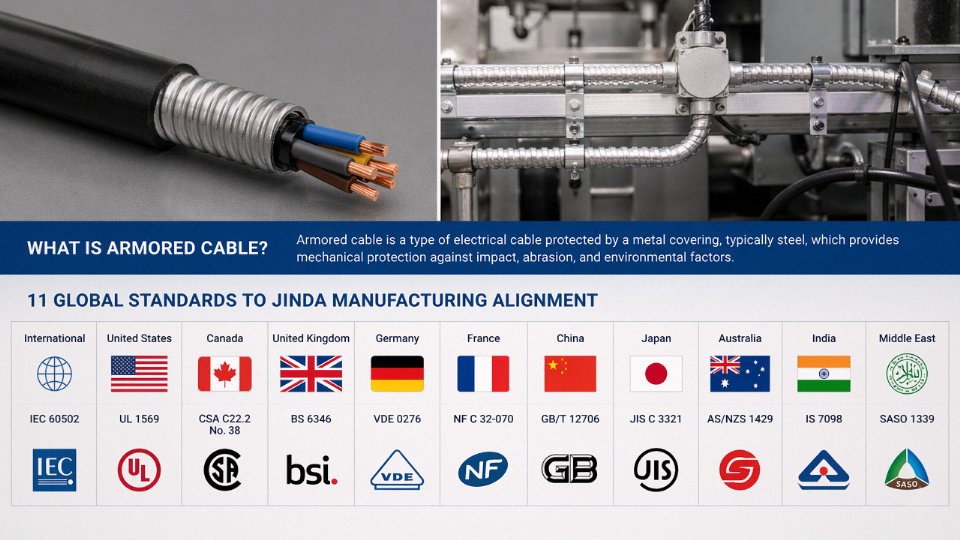
This is precisely where Jinda’s position matters in a practical sense, not just a marketing one. Founded in 1987, with five production bases and roughly 470,000 m² of manufacturing space operating today, the engineering team has spent decades fielding specifications written under IEC, BS, NEC, and GB standards simultaneously—sometimes all four on a single LNG or data-center project destined for multiple countries. Over 1,000 employees, export relationships in more than 50 countries, and that specific cross-standard experience means a Jinda application engineer can read a BS 5467 SWA spec and map it to the correct factory standard without the buyer needing to translate.
Jinda exports armored cable products to customers in more than 50 countries and manufactures to IEC, BS, NEC, and GB standards.True
This is consistent with the manufacturer's stated production scale, export history since 1987, and multi-standard product certifications across five production bases in China.
For procurement managers running multi-country infrastructure programs—renewable energy rollouts, EV charging networks, smart grid upgrades—the nomenclature complexity only compounds. A solar farm in Southeast Asia, a substation upgrade in West Africa, a distribution project in Eastern Europe: each one may land on your desk under a different standard and a different cable name. The global armored cable market is heading past USD 18 billion by 2030, growing somewhere around 6% annually depending on regional infrastructure spend, and that growth is happening across all naming conventions at once.
Having a single qualified supplier capable of manufacturing to any of them, with the test documentation to prove compliance, cuts procurement complexity in a way that split-sourcing across regional vendors simply cannot match.
Submit your RFQ with whatever local specification nomenclature your project requires. Jinda’s technical team will cross-reference it to the correct factory standard, confirm the construction parameters, and provide compliant test documentation before production begins.