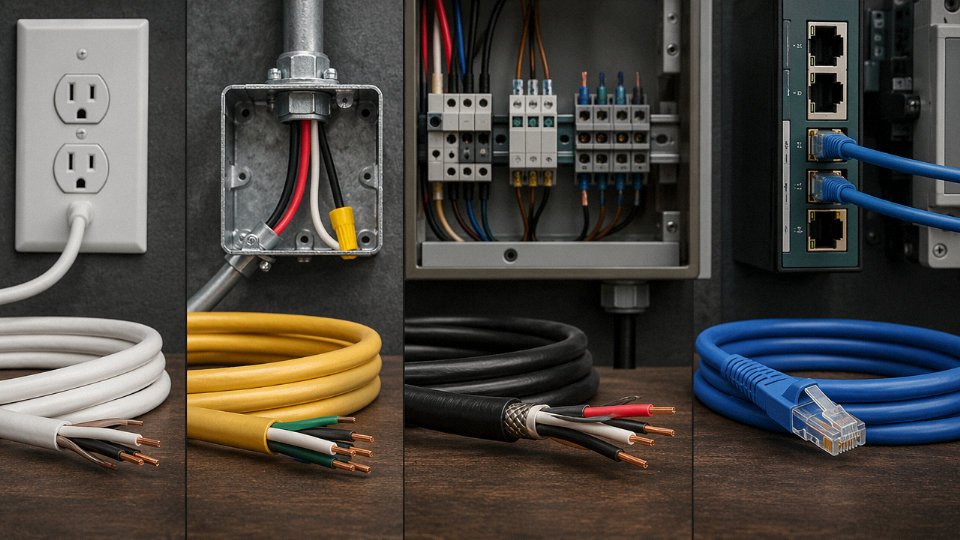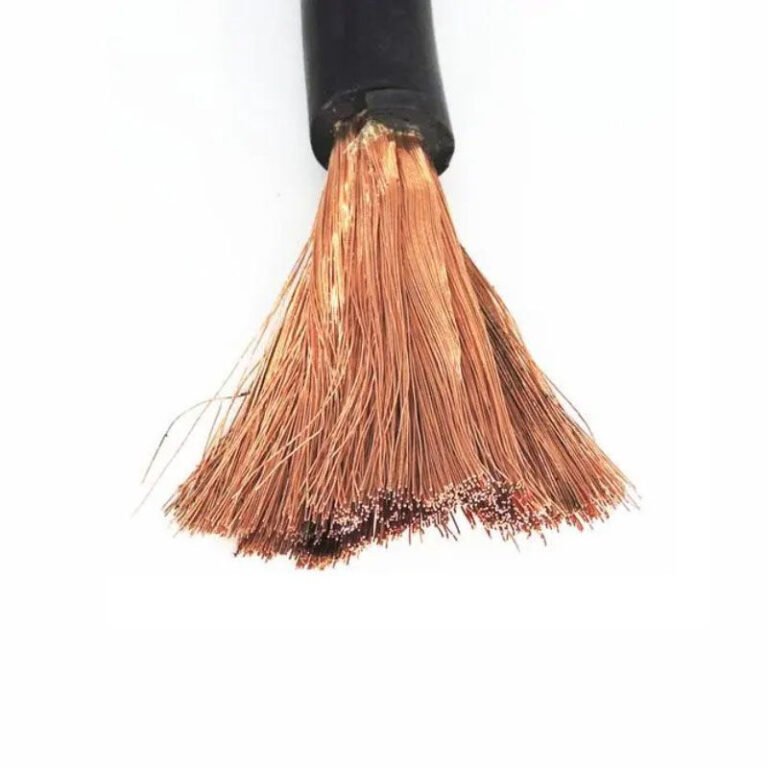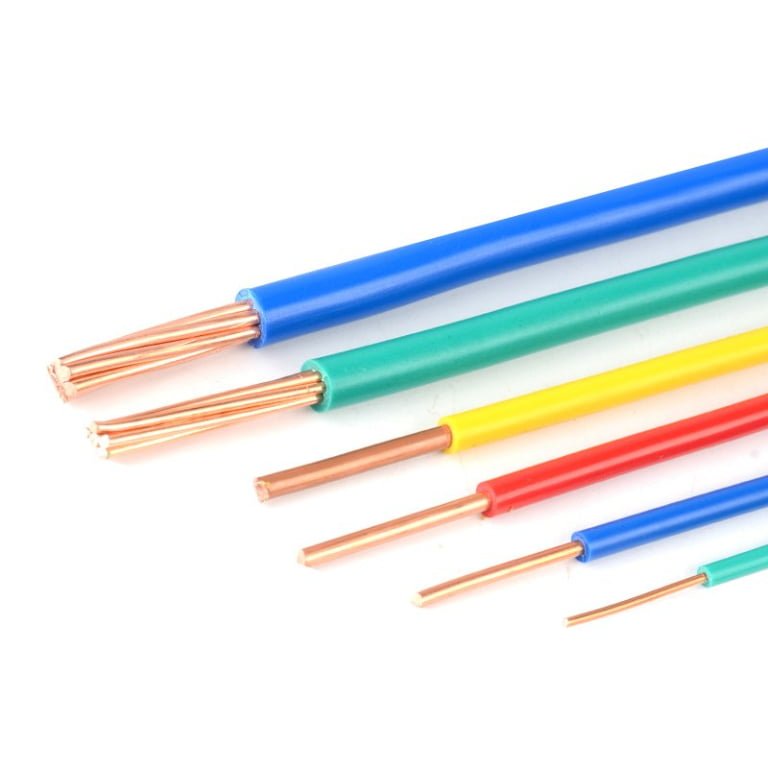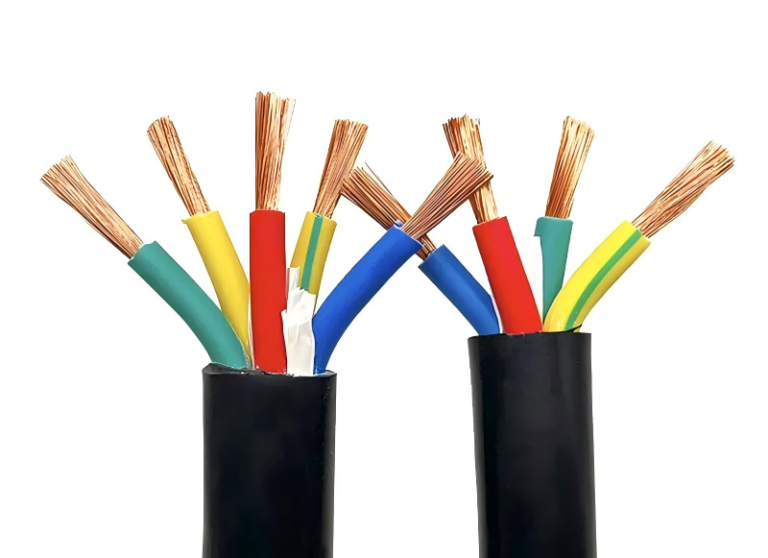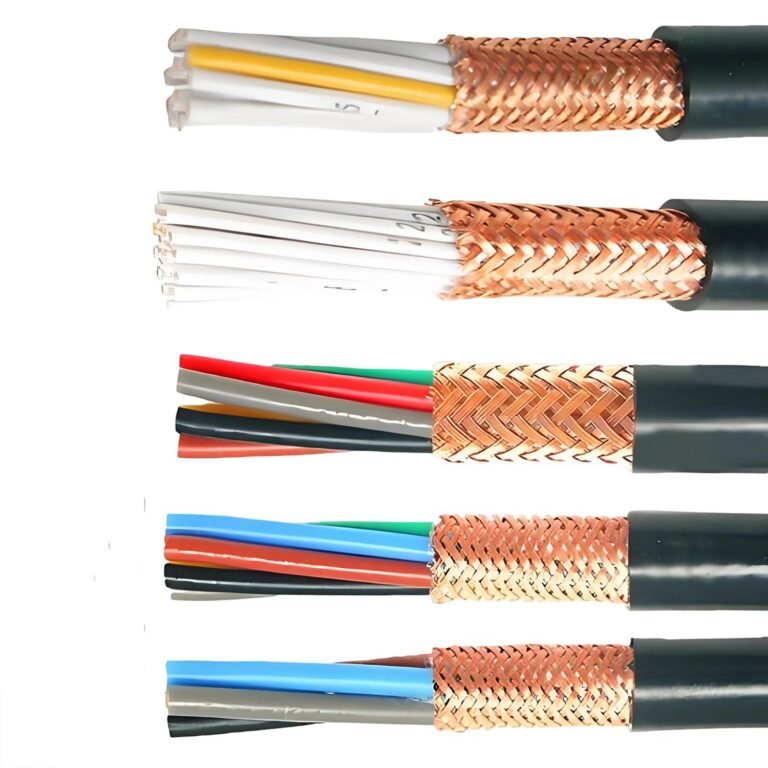
Grab the wrong wire spec on a residential job or a light commercial retrofit, and you’re not just looking at a failed inspection — you’re looking at pulled permits, rework costs that can easily run into four figures, and in some cases, a liability exposure that follows the contractor for years. The confusion usually starts with a simple question: does Romex qualify as low voltage wiring? It sounds straightforward until you realize “low voltage” means genuinely different things depending on which code, which application, and which engineer you ask.
No, Romex (NM-B cable) is not considered low voltage. It carries a 600V rating and is designed for standard residential branch circuits operating at 120V or 240V AC. Under NEC Article 725 and equivalent IEC definitions, “low voltage” typically refers to Class 2 circuits below 50V AC — a completely separate category from the line-voltage circuits Romex is built and listed for.
What makes this worth unpacking further is that the voltage rating stamped on the cable jacket and the voltage classification used by electrical codes are answering two different questions entirely. One tells you what the insulation can withstand; the other tells you where the circuit sits in a regulatory hierarchy that has real consequences for installation method, permitted wire routing, and who can legally do the work. Those two things get conflated constantly on plant floors and job sites alike, and the mix-up rarely ends quietly.
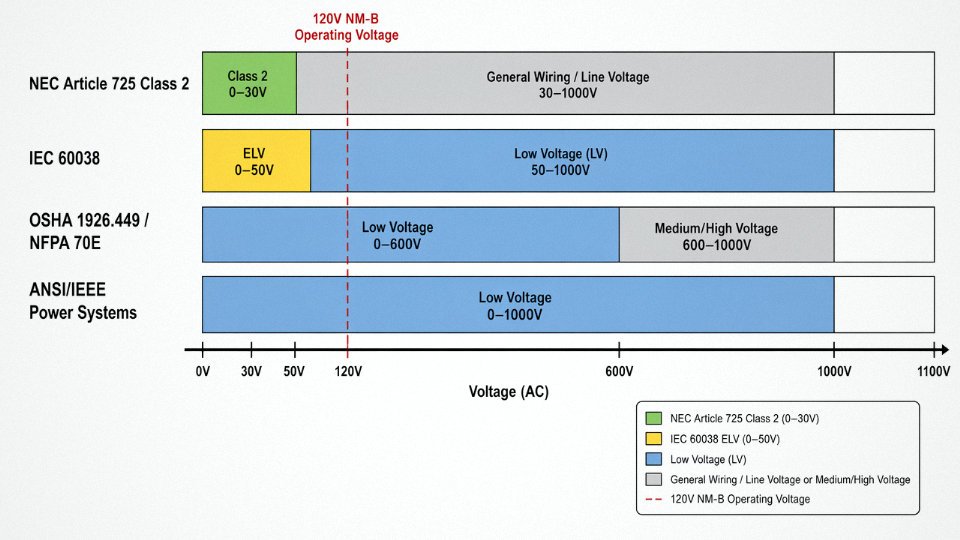
Voltage Classification Frameworks: NEC, IEC, and OSHA Definitions Side by Side
The phrase “low voltage” sounds like it should mean one thing. It doesn’t. Depending on which standard governs your project — your jurisdiction, your industry, your insurer — the same 120V NM-B circuit can simultaneously be “not low voltage,” “low voltage,” and “extra-low voltage” depending on who’s doing the classifying. That’s not a bureaucratic quirk; it’s a genuine source of specification errors in procurement and field work.
NEC Article 725: The U.S. Residential Benchmark
NEC Article 725 defines Class 1, Class 2, and Class 3 remote-control, signaling, and power-limited circuits. Class 2 is the one that matters here — it caps out at 30V AC (42.4V peak) or 60V DC under normal conditions, and this threshold is the de facto definition of “low voltage” in U.S. residential construction practice. Doorbell wiring, thermostat cable, low-voltage landscape lighting — all of these live in Class 2 territory.
Standard Romex NM-B is rated at 600V and runs branch circuits at 120V or 240V. That puts it firmly outside Article 725’s Class 2 envelope. Under NEC’s own internal logic, a 120V Romex circuit is general wiring governed by Chapter 3, not a low-voltage circuit. Electricians who’ve been in the trade long enough sometimes use “low voltage” loosely to mean “anything below 480V,” which creates real confusion on mixed residential-commercial jobs.
Under NEC Article 725, a standard 120V NM-B (Romex) circuit does not qualify as a Class 2 low-voltage circuit.True
NEC Article 725 Class 2 circuits are limited to 30V AC or 60V DC. Romex NM-B operates at 120V or 240V AC on standard branch circuits, placing it outside the Class 2 voltage threshold entirely.
IEC 60038: Where 120V Becomes “Low Voltage”
The IEC framework divides the spectrum differently. IEC 60038 defines extra-low voltage (ELV) as up to 50V AC or 120V DC, and low voltage (LV) as the band from 50V up to 1,000V AC. That means 120V and 240V residential circuits — and the cables that feed them — fall squarely within the IEC low-voltage band.
This matters for procurement on international projects. A spec written to IEC standards that calls for “LV cable” is not calling for thermostat wire. It’s calling for exactly the kind of 600V-rated, thermoplastic-insulated building wire that Romex-equivalent products represent. Confusing ELV with LV in an IEC-governed spec can lead to undersized cable being ordered for circuits that need full branch-circuit-rated conductors — a mistake that usually surfaces during commissioning, not before.
OSHA and NFPA 70E: Occupational Safety Context
OSHA 1926.449 (construction industry) and NFPA 70E use a different cut point altogether. In occupational electrical safety, “low voltage” generally means below 600V. Under this framework, standard residential Romex circuits — 120V, 240V — are low-voltage systems. The practical implication is arc-flash and shock-hazard classification: workers on these circuits follow low-voltage PPE and approach-boundary rules rather than medium- or high-voltage protocols.
ANSI/IEEE: The Power Systems Engineer’s View
ANSI/IEEE standards for power systems engineering push the boundary further still — “low voltage” typically extends to 1,000V AC. At this level of classification, virtually every building wiring application, including 600V-rated NM-B, sits inside the low-voltage category without qualification.
Practical Comparison: One Cable, Four Answers
| Framework | LV Upper Threshold | Applicable Territory | Does 120V NM-B Qualify as LV? |
|---|---|---|---|
| NEC Article 725 (Class 2) | 30V AC / 60V DC | United States | No |
| IEC 60038 | 1,000V AC | International / most export markets | Yes |
| OSHA 1926.449 / NFPA 70E | 600V AC | U.S. occupational safety | Yes |
| ANSI/IEEE power systems | 1,000V AC | U.S. engineering / utility | Yes |
The honest answer is that Romex is rated 600V, operates at 120V or 240V, and qualifies as low voltage under three out of four major frameworks — but not under the one framework most people in U.S. residential work are thinking of when they say “low voltage circuit.” Know your governing standard before you write the spec.
Romex Voltage Rating vs. Operating Voltage: Understanding the 600V Insulation Rating
The number stamped on the jacket of a roll of NM-B — “600V” — trips up specification writers and procurement managers more than almost any other cable marking. It looks like an operating voltage. It isn’t.
What the 600V Rating Actually Means
That figure is an insulation withstand rating, established under UL 719, the standard that governs NM-B cable construction. It tells you the maximum potential difference the dielectric system — PVC insulation over each conductor, the paper or nylon separator, and the outer jacket — can reliably withstand before breakdown becomes a real risk. Think of it as a safety envelope, not a nameplate operating condition. The actual circuits NM-B feeds in residential work run at 120V or 240V single-phase, which means the insulation is operating at roughly one-fifth to two-fifths of its rated ceiling. That margin exists for a reason: voltage transients, inductive kick from motor loads, and decades of thermal cycling in a wall cavity all degrade insulation over time. The headroom keeps the system safe across a realistic service life.
The 600V marking on NM-B cable indicates insulation withstand capacity under UL 719, not the circuit operating voltage.True
UL 719 specifies dielectric and insulation integrity tests at 600V for NM-B; the cable is used on 120V/240V circuits, making 600V the safety ceiling, not the working voltage.
NEC 334.10 Puts a Hard Box Around Where NM-B Goes
Even if the insulation could theoretically handle higher potentials, NEC Article 334.10 restricts NM-B use to single-family dwellings, multifamily dwellings, and certain other limited occupancies — and only in circuits operating at the standard residential voltages of 120/240V single-phase. Commercial and industrial facilities are off the table entirely in most jurisdictions. The code constraint is tighter than the physical capability of the cable, which is actually a fairly common pattern in wiring methods. Regulators draw the line based on installation environment and foreseeable misuse, not purely on what the conductor and insulation could theoretically sustain.
For a procurement manager writing a cable specification, this matters enormously. Specifying “600V NM-B” for a commercial renovation project because the voltage rating looks right is a compliance failure waiting to happen, regardless of whether the insulation would physically survive the installation.
How the Marketplace Uses “600V” as a Voltage Class Label
Across the broader wire and cable industry, “600V” has become shorthand for a product tier — a maximum rated voltage designation that groups cables intended for residential and light commercial wiring. Purchasing managers encounter this on THHN, THWN-2, NM-B, UF-B, and a range of other products. None of those cables operate at 600V in normal service. The label describes the upper boundary of safe use, full stop. When a buyer sources cable internationally and sees “0.6/1 kV” on an IEC-rated product, that follows the same logic: rated maximum, not working voltage.
Where True Low-Voltage Cables Sit by Comparison
This is where the confusion between Romex and genuine low-voltage wiring compounds itself. Class 2 cables — the thermostat wire running to an HVAC control board, 18 AWG at 24V AC, or a doorbell circuit pulling maybe 16V — are engineered to a completely different set of parameters. Their jacket materials are thinner and sometimes omit the heavier outer sheath entirely because the dielectric stress is so much lower. Conductor sizing is optimized for signal integrity or very small current loads, not branch-circuit ampacity. NEC Article 725 governs Class 2 and Class 3 remote-control and signaling circuits and explicitly separates them from power wiring like NM-B. The code treatment, the installation methods, the permitted bundling, the raceway rules — nearly everything differs.
A side-by-side look at typical specs shows the gap clearly.
| Cable Type | Rated Voltage | Typical Conductor | Governing Standard | Jacket Construction |
|---|---|---|---|---|
| NM-B (Romex) | 600V | 14–6 AWG copper | UL 719 / NEC 334 | Heavy PVC outer jacket |
| Class 2 thermostat wire | 30V max | 18–22 AWG | UL 13 / NEC 725 | Lightweight PVC, thinner wall |
| Doorbell wire | 30V max | 18–20 AWG | UL 13 / NEC 725 | Minimal jacket, often no sheath |
| Low-voltage landscape wire | 30–150V range | 12–16 AWG | UL 493 variants | Direct-burial PE or PVC |
The Cost and Safety Consequences of Misclassification
Running NM-B into a low-voltage Class 2 application — say, a thermostat circuit — isn’t automatically a code violation in every scenario, but it’s almost always a waste of material. NM-B at current commodity pricing runs noticeably higher per foot than 18/2 thermostat wire, and the mechanical bulk makes it awkward to route through the tight paths these circuits typically follow. In practice, an installer pulling Romex to a 24V control panel is just spending money they don’t need to spend.
The reverse situation is genuinely dangerous. Substituting Class 2 wire — that lightweight 18 AWG thermostat cable — into a branch circuit application where NM-B is required creates a fire hazard. The conductor simply can’t carry the fault current safely. Insulation that’s rated for 30V may fail catastrophically under a 120V short. This is not a theoretical risk; it’s the kind of misinstallation that causes house fires and fails inspection for good reason.
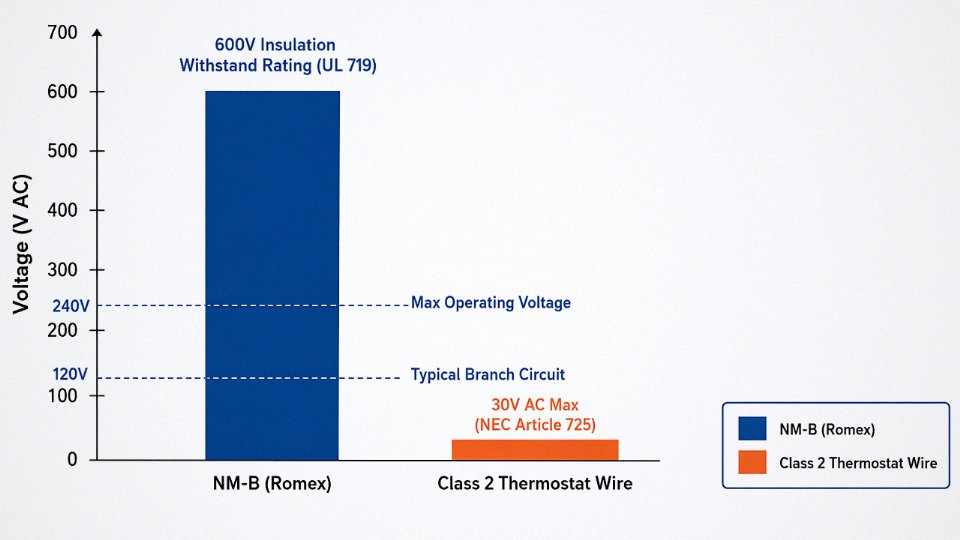
The specification discipline required here is straightforward: always distinguish between a cable’s rated voltage ceiling and the voltage at which your circuit actually operates, and never let the former substitute for proper application matching under the governing installation code.
NEC Article 334 Permitted and Prohibited Uses of NM-B Cable
Article 334 is the section most electricians have half-memorized, yet code violations involving NM-B remain among the most common items flagged during residential inspections. Getting this right matters — not just for passing inspection, but because improper NM-B installation in the wrong environment can result in insulation degradation, arc faults, and fires that manifest years after rough-in.
Where NM-B Is Permitted
Under NEC 334.10, NM-B cable is permitted in one- and two-family dwellings, and in multifamily dwellings that are no more than three floors above grade. That floor-count limit trips up more contractors than you’d expect on mid-rise townhouse projects. The 2020 NEC also allows NM-B in “other structures” where not otherwise prohibited — but that language has conditions attached, and inspectors in different jurisdictions interpret it with varying strictness. Always verify with the local AHJ (authority having jurisdiction) before spec’ing NM-B in anything that isn’t straightforwardly residential.
Dry, protected interior spaces are the natural habitat for this cable. Think finished stud cavities, attic runs where the cable is protected from contact by guard strips or running boards, or basement framing above a concrete floor. Those are the environments NM-B was designed for.
Where It Is Prohibited
NEC 334.12 is blunt. NM-B cannot be used in the following situations, and the list is worth knowing cold:
- Embedded in concrete, plaster, or similar masonry
- Wet or damp locations of any kind
- Direct burial
- Service entrance conductors
- Hazardous (classified) locations per Article 500
- Exposed in commercial or industrial occupancies — runs that would be visible in a warehouse, retail space, or manufacturing floor are not permitted
The attic restriction deserves its own note. NM-B can run through attics, but if the cable is run across the top of joists in an attic that is accessible, it must be protected by guard strips at least as high as the cable. If it’s run through bored holes in framing, that requirement relaxes — but unprotected cable draped across open attic flooring is a frequent violation that passes rough-in and gets caught later, or worse, never.
NM-B (Romex) is prohibited from use in wet or damp locations under NEC 334.12.True
NEC 334.12(1) explicitly lists 'in a wet or damp location' as a prohibited use for Type NM cable, regardless of the cable's insulation voltage rating.
Physical Installation Requirements
Stapling and support rules are where installers cut corners most often. NM-B must be secured at intervals not exceeding 4.5 feet, and within 12 inches of every box, cabinet, or fitting. In practice, on a long unobstructed run through a basement ceiling, that 4.5-foot rule tends to stretch — I’ve seen 6- and 7-foot spans that passed nobody’s scrutiny until a reinspection. Don’t do it.
Where the cable passes through studs or joists within 1.25 inches of the edge, a nail plate — typically 1/16-inch steel — is required to prevent fastener penetration. Bending radius minimums require that any bend not damage the cable; a general field guideline is no bend tighter than five times the cable’s overall diameter, though Article 334 defers to the manufacturer’s specification.
Where NM-B must transition through areas exposed to physical damage, it needs to be protected by conduit, raceway, or equivalent guard. A short section of EMT through a garage wall is the typical solution.
2020 and 2023 NEC Updates Worth Knowing
The 2020 NEC cycle expanded AFCI requirements significantly, and those changes intersect directly with how NM-B circuits get wired. AFCI protection is now required for nearly all 120V, 15A and 20A branch circuits in dwelling units — bedrooms, living rooms, kitchens, hallways, and more. That’s a broader scope than many contractors trained pre-2014 expect. The 2023 edition tightened this further in some circuit categories and adjusted ampacity correction and adjustment rules in a way that affects multi-conductor bundled NM-B runs, particularly in tight framing cavities where heat buildup is a real factor at the 60°C conductor temperature rating.
No Direct IEC Equivalent — What That Means for Global Projects
Outside North America, NM-B has no direct counterpart. IEC-based markets — the UK, EU member states, Australia, China under GB standards — use fundamentally different wiring systems. The closest functional analogues are flat twin-and-earth cables (such as the UK’s BS 6004 flat profile cables) or, in China, BVV-type PVC-insulated sheathed wire under GB/T 5023. The similarities are superficial. Conductor sizing conventions differ (metric cross-sections versus AWG), voltage ratings and insulation materials are tested to different standards, and installation code requirements diverge significantly. Direct substitution on an international project isn’t a matter of finding “the equivalent cable” — it requires a full code compliance review for the destination country. Procurement teams sourcing cable for cross-border projects should treat NM-B as a North America-specific product and engage with the relevant IEC-compliant cable specification from the start, not as an afterthought.
How Romex Compares to True Low-Voltage Wiring Systems in Residential Construction
Walk through any house under construction and you’ll see two entirely different categories of wire being pulled through the same stud bays on the same day. The electricians running NM-B are doing something fundamentally different from the low-voltage contractor fishing thermostat wire and Cat6 — even though both crews are working in the same walls. Conflating those two categories causes real problems: wrong wire specified on a bid, separation requirements ignored during rough-in, or an inspector red-tagging work that has to be torn apart.
What Actually Qualifies as Low-Voltage in a House
Residential buildings are full of circuits that genuinely operate at low voltage — not just rated for it on a label. A standard doorbell transformer steps 120V down to somewhere between 16V and 24V AC; the two-conductor wire running from that transformer to the chime carries almost no current and has insulation rated to handle the task, not 600V. Thermostat and HVAC control wiring — typically 18/2 or 20/2 with a thin PVC jacket — runs at 24V AC in the vast majority of split systems and heat pumps. Landscape lighting systems commonly use 12V AC off a plug-in transformer. None of these are anywhere near the 600V insulation rating on NM-B, and that gap is intentional.
Structured wiring is another category entirely. Cat6 UTP is rated to 100V (the 150V figure appears on some listings, but 100V is the more conservative in-practice value) and carries data, not power in the traditional sense. RG6 coaxial for CATV and satellite runs at even lower signal levels. Security system wiring — often 22/4 or 18/2 shielded — operates at 12V DC to 24V DC depending on panel design. These cables have thin jackets, small conductors (22 AWG to 24 AWG in many cases), and insulation walls that would be physically inadequate if you tried to push 120V through them for any sustained period.
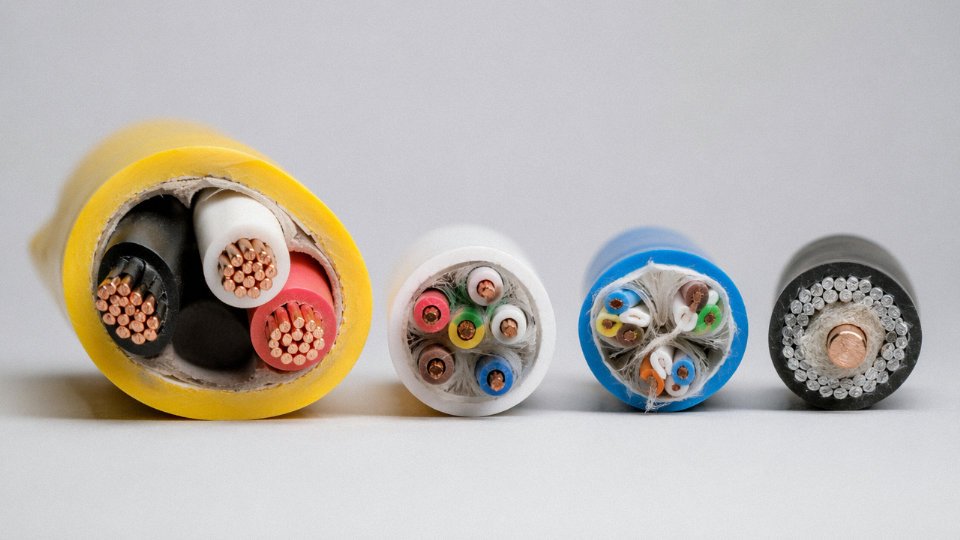
Why Physical Separation Is a Code Requirement, Not a Suggestion
NEC 300.3(C) sets the baseline: conductors of different systems need to be kept separate unless they share a common voltage rating or meet specific listing requirements for the combination. NEC 725.136 gets more specific for Class 2 and Class 3 circuits — those low-voltage signal and control cables can’t be bundled with power conductors like NM-B unless both cables carry a special listing that permits it. The reasoning is straightforward: if a fault in the NM-B circuit energizes the jacket of a Cat6 cable stapled against it, you now have 120V on a wire rated for 100V touching a connected device — a laptop, a thermostat, a security panel — that was never designed for that exposure.
In practice, most experienced low-voltage contractors keep their runs at least a few inches away from NM-B and avoid crossing at acute angles when they do cross. It’s not paranoia; it’s just what an inspector in most jurisdictions will expect to see.
PoE, Smart Home, and the Rough-In Planning Problem
Power over Ethernet complicates things slightly. PoE operates at 48V DC and sits in NEC Class 3 territory — above Class 2’s 100VA ceiling but still well below the 600V world of NM-B. Modern smart-home builds often have PoE switches powering access points, IP cameras, and even some lighting controls, all on Cat6 infrastructure. That’s still low-voltage work, but it deserves its own rough-in pass. Trying to plan PoE pathways as an afterthought — after NM-B is already run and stapled — usually means fishing wire through tight spaces or drilling new holes, both of which cost time on a schedule that’s already tight.
PoE (Power over Ethernet) at 48V DC is classified as low voltage under NEC Class 3, not as a power circuit subject to NEC Article 334 or the NM-B installation rules.True
NEC Class 3 applies to circuits up to 100VA with voltage limits defined in NEC Article 725. At 48V DC, PoE falls within Class 3 parameters and is installed under low-voltage rules, not the branch-circuit wiring methods that govern NM-B.
The Cost Consequence of Getting This Wrong
Over-specification is wasteful but survivable. A builder who specifies NM-B where 18/2 thermostat wire belongs will spend more per foot — NM-B 14/2 runs roughly three to five times the material cost of 18/2 thermostat wire depending on copper pricing and quantity — and the heavier cable is harder to route through tight control board knockouts and HVAC cabinets anyway.
Under-specification is dangerous. Using thermostat wire or Cat6 on a 120V circuit because someone assumed it was “basically the same” as low-voltage wiring creates an immediate fire and shock hazard. The insulation isn’t rated for it, the conductors aren’t sized for the current, and the overcurrent protection on the circuit won’t respond quickly enough to protect that undersized wire before damage occurs. That’s not a code technicality — it’s the sequence of events that produces house fires.
The practical rule for material selection: confirm the operating voltage and current of every circuit before specifying cable. NM-B is a power conductor for branch circuits at 120V/240V. Everything running at or below 50V AC or 120V DC in the same building is a different product category, requires different installation methods, and should never be treated as interchangeable with Romex regardless of how the cables look sitting next to each other in a stud bay.
Global Cable Equivalents to Romex: What International Buyers Need to Specify Instead
Romex is, at its core, a North American product — full stop. The UL 719 listing, the NEC Article 334 code basis, AWG conductor sizing, and the characteristic gray or white PVC jacket with a bare copper ground all exist within a regulatory ecosystem that most of the world simply does not use. When a U.S.-trained engineer hands a spec sheet calling for “12/2 NM-B with ground” to a procurement team in Germany, the UK, or China, that spec is essentially untranslatable without deliberate conversion work. Getting it wrong means delays at customs, failed inspections, or — worse — undersized conductors on a live circuit.
Why the NEC/AWG Framework Doesn’t Cross Borders Cleanly
AWG sizing runs counterintuitively — larger numbers mean smaller conductors — and the cross-sections don’t map cleanly onto IEC mm² sizes. A 12 AWG conductor has a nominal cross-section of roughly 3.31 mm², but IEC markets will round that to 4 mm² for the nearest standard size. The voltage class also shifts: NM-B carries a 600V insulation rating, while many IEC residential cables are rated 300/500V or 450/750V. That difference matters for what installation environments and overcurrent protection levels are permissible under local code.
IEC and Continental European Equivalents
In most EU countries, the practical equivalent for fixed residential wiring is NYM-J (to DIN VDE 0250 / HD 21.5), a multi-core PVC-insulated and sheathed cable rated 300/500V with solid or stranded copper conductors. German and Central European installers use this almost by default for surface-mounted and in-wall conduit runs. Construction is similar in intent to NM-B — a PVC outer sheath, PVC-insulated cores, and a separate green/yellow protective earth conductor — but the geometry and materials follow VDE rather than UL tolerances.
For flexible cord applications (not direct fixed wiring), H05VV-F (300/500V) and H07VV-F (450/750V) are the relevant harmonized designations under CENELEC. These are stranded, not solid, so they’re not the right substitute for in-wall branch circuit wiring — a distinction that trips up procurement teams who grab whatever flexible cable is on the shelf.
NYM-J cable rated 300/500V is a functionally valid substitute for NM-B in EU residential fixed wiring applications when conductor cross-section and installation method are matched to local code.True
NYM-J follows DIN VDE 0250 and harmonized HD 21.5 standards, uses PVC insulation and sheathing similar in function to NM-B, and is explicitly permitted for in-wall and surface residential wiring in EU member states under EN 50525 and national derivatives. The 300/500V rating is appropriate for standard residential branch circuits operating at 230V AC.
UK Flat Twin-and-Earth
British installers will recognize 6242Y (flat twin-and-earth) and 6243Y (three-core-and-earth), both manufactured to BS EN 50525-2-31 and installed per BS 7671. Both are rated 300/500V and use a gray PVC flat sheath — the profile looks almost nothing like Romex’s round jacket, but the functional role is identical. Conductor sizes run from 1.0 mm² up to about 16 mm², solid copper for sizes up to 10 mm². The bare earth conductor in 6242Y is uninsulated within the sheath, which sometimes confuses overseas buyers expecting a fully insulated ground wire.
China GB Standard: BV and BVV
For projects in China — or sourced through Chinese manufacturers — the relevant standards are GB/T 5023. The two main product types are BV (single-core, PVC-insulated, no outer sheath, typically run in conduit) and BVV (PVC-insulated with an additional PVC sheath, used in surface-mounted applications). Both are rated 300/500V for standard residential use. Jinda manufactures both BV and BVV across a range of conductor cross-sections, with production capacity that supports both domestic Chinese construction projects and international bulk orders requiring GB-compliant cable documentation.
In practice, most Chinese residential projects use BV pulled through embedded conduit rather than a sheathed cable stapled to framing — the installation method itself is different from North American practice, which affects conduit fill calculations and how you size conductors for thermal derating.
Translating a U.S. Spec to an International Purchase Order
When a contractor sends you a spec for “12/2 Romex with ground,” here’s the conversion logic:
| U.S. Specification | IEC/Regional Equivalent | Notes |
|---|---|---|
| 12 AWG conductor | 4 mm² (nearest IEC standard size) | 3.31 mm² actual; always round up |
| 2-conductor + bare ground | 3-core cable (2 insulated + PE) | PE must meet local color code (green/yellow) |
| 600V insulation rating | 300/500V or 450/750V class | 300/500V sufficient for 230V residential |
| NM-B, dry locations only | NYM-J (EU), 6242Y (UK), BVV (China) | Confirm installation environment with local inspector |
| UL listing required | CE marking (EU), UKCA (UK), CCC (China) | Not interchangeable; verify jurisdiction |
The voltage class question that started this article becomes very concrete at the procurement stage: a buyer who doesn’t understand that Romex’s 600V rating is an insulation specification — not a statement about what voltage the circuit runs at — may over-specify or under-specify the IEC voltage class and end up with cable that either fails a local inspection or costs significantly more than necessary. For international projects, specifying the right conductor cross-section, the right installation category, and the correct certification mark is the actual work. The cable standard is just the starting point.
Safety and Fire Risk Implications of Misclassifying Romex as Low Voltage
The classification error here isn’t a paperwork problem. It’s the kind of mistake that ends in a house fire or an electrocution, and understanding why requires looking at what the voltage difference actually means for energy delivery and protection design.
Arc-Flash and Shock Hazard: The Current Is What Kills You
A standard 120V branch circuit protected by a 15A breaker can source somewhere between 1,800 and 2,400 VA — more than enough to cause cardiac fibrillation. The commonly cited lethal threshold is around 100–200 mA through the chest; a 120V circuit can drive that through typical body resistance (roughly 1,000–10,000 Ω depending on skin condition, contact area, and moisture) without any difficulty. Ohm’s law doesn’t care about your intentions.
NEC Article 725 Class 2 circuits are fundamentally different by design. They’re current-limited at the source to under 100 VA, meaning the power supply itself physically cannot sustain a dangerous fault current. That’s an inherent safety characteristic, not a downstream protection device. You can touch a Class 2 output under most fault conditions and walk away. You cannot say that about a 15A, 120V Romex circuit.
A 120V residential branch circuit can deliver lethal current even at low-voltage distances or brief contact durations.True
At 120V AC, current through the human body depends on contact resistance, but body resistance can drop below 1,000 Ω under wet or puncture conditions, producing currents well above the 100–200 mA ventricular fibrillation threshold. Class 2 circuits are power-limited to prevent this.
Thermal Runaway and the Fire Scenario
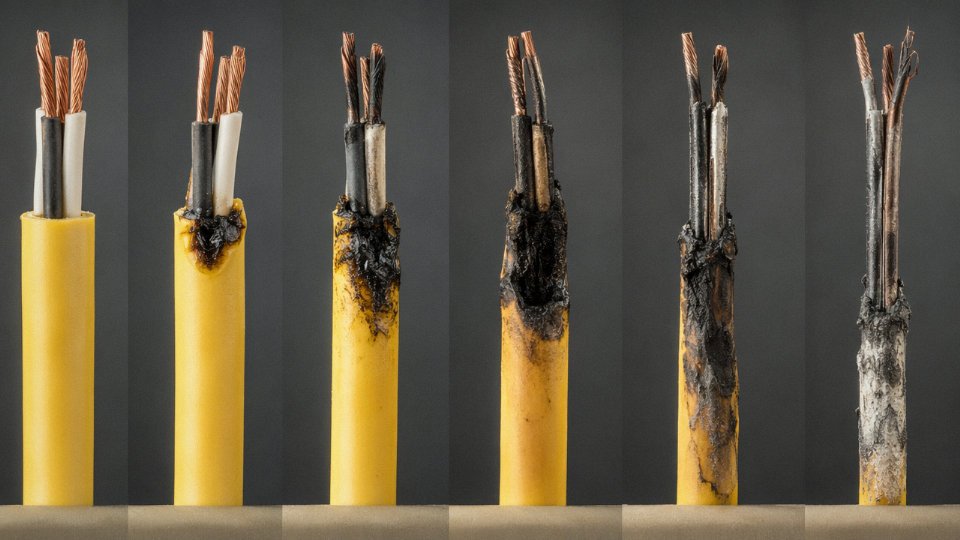
NM-B fire risk usually doesn’t come from someone grabbing a live conductor. It comes from slow thermal degradation — heat buildup over months or years that nobody sees until the insulation carbonizes and arcs.
NEC 334.80 requires ampacity correction when NM-B is installed in contact with thermal insulation. If the cable is completely surrounded (common in retrofit attic work where someone blows in cellulose after the wire is already there), the allowable ampacity can drop to 60% of the open-air rating. A 14 AWG circuit rated at 15A in free air may only handle 9–10A continuously under those conditions. Installers frequently ignore this because the breaker doesn’t trip — the circuit just runs warm, steadily degrading the insulation until it doesn’t.
NFPA data consistently identifies electrical failures as one of the top causes of U.S. residential structure fires, with wiring faults and overloaded circuits accounting for a significant share. Bundling multiple NM-B cables in a tight chase without derating compounds the problem; each cable’s heat adds to the adjacent cable’s thermal environment.
Substituting Low-Voltage Cable in a 120V Circuit
This is the failure mode that shouldn’t happen but does, usually in DIY repairs or in regions where NM-B isn’t readily available and someone uses whatever thin-jacketed wire is on the shelf. A Class 2 cable — something like a UL 13 power-limited circuit cable or a UL 444 communications cable — has insulation rated for maybe 150V or 300V, with dielectric strength and jacket wall thickness designed for those lower stress levels.
Put that into a 120V branch circuit and the sequence is predictable: the insulation sees voltage stress it wasn’t designed for, particularly at terminations and bends. Micro-voids in the dielectric allow partial discharge. Over time, the insulation breaks down, tracking begins, and eventually you get arcing to ground or to an adjacent conductor. The arc may be intermittent at first — which is exactly the scenario AFCI breakers were designed to detect.
AFCI and GFCI Protection Don’t Cross Over
Arc-fault circuit interrupters are tuned to the signature of arcing in 120/240V power circuits — specific frequency and current waveform characteristics that appear on a residential branch circuit. They are not designed to monitor or protect low-voltage signal or control wiring, and they provide no meaningful protection if you’ve accidentally installed undersized low-voltage cable in a power circuit and the fault pattern falls outside their detection window. GFCI devices similarly operate on ground-fault current differentials at power-circuit voltages; they won’t catch a slow insulation breakdown that hasn’t yet produced a measurable ground fault.
What UL Certification Actually Validates
UL 719 testing for NM-B covers flame resistance under a defined vertical flame exposure, crush resistance (the cable has to survive a specified load without insulation damage), and dielectric strength at rated voltage. It also covers conductor ampacity and temperature rise. These tests are calibrated to the actual stresses a 600V-rated, 15–20A power cable will see in residential construction.
UL 13 (power-limited circuit cable) and UL 444 (communications cable) test to different parameters — lower dielectric stress, different flame exposure geometry, no crush test requirement equivalent to NM-B. The certifications are not interchangeable, and no amount of physical similarity between the cables changes what the testing validates.
Specifying by UL listing number rather than by appearance is not bureaucratic caution. It’s the only way to know that the failure modes were actually tested.
Selecting the Right Cable for Your Project: A Decision Framework for Contractors and Procurement Managers
Getting cable selection wrong on a residential or commercial development rarely announces itself immediately. Usually it shows up later — a failed inspection, a tripped breaker on a baseboard heater, or a fire marshal flagging a bundle where thermostat wire and NM-B are jammed into the same chase without separation. The decision framework below is meant to front-load that thinking before the cable is on the truck.
Step 1: Nail Down the Circuit’s Operating Voltage and Current First
Before touching a catalog, confirm the actual operating voltage and the continuous load current. A 240V baseboard heater circuit and a 24V thermostat control circuit share the same mechanical space in many installations, but they are categorically different electrical environments. Know the difference between the circuit’s operating voltage and the cable’s rated insulation voltage — a 300V-rated cable on a 240V circuit sounds fine until you account for transient spikes, and NEC 310 derating rules mean your actual allowable ampacity may land well below the cable’s nominal rating depending on conduit fill and ambient temperature.
Step 2: Match the Applicable Code Standard to the Project Jurisdiction
NEC governs most of North America. IEC 60364 and its national variants (BS 7671 in the UK, GB 50054 and related standards in China) apply elsewhere. These frameworks define voltage categories differently — a “low voltage” installation under IEC 60364 can include systems up to 1,000V AC, which would cover standard residential wiring, while NEC Article 725 Class 2 circuits cap out around 100VA/30V for many configurations. Specifying to the wrong standard can invalidate a certification, void insurance, or cause a container of cable to sit in customs while the project schedule slips.
Step 3: Characterize the Installation Environment Honestly
Dry, concealed in-wall runs in a wood-frame house are where NM-B (Romex) is appropriate. Damp locations, direct burial, exposed runs in a commercial kitchen, or conduit through a wet crawl space — each of those demands a different cable construction. This is where procurement teams sometimes optimize for unit price and inadvertently select an unsuitable jacket material or temperature rating.
Reference Table: Circuit Type to Cable Selection
| Circuit Type | Typical Voltage | Cable Category | Example Designation | Applicable Standard |
|---|---|---|---|---|
| Residential power (branch circuit) | 120V / 240V AC | Building wire, non-metallic sheathed | NM-B (14–6 AWG) | NEC Article 334 |
| Residential power (general wiring, IEC markets) | 230V AC | PVC insulated building wire | BVV / BVVB | GB/T 5023, IEC 60227 |
| HVAC thermostat control | 24V AC | Multi-conductor control cable | Thermostat wire / KVV | NEC Article 725 / GB/T 9330 |
| Structured data (commercial) | PoE up to ~57V DC | Category cable, UTP/FTP | Cat6 / Cat6A | TIA-568, IEC 11801 |
| Security and alarm (shielded) | 12–24V DC | Screened multi-conductor | RVVP | GB/T 5013, EN 50525 |
| Lighting control (Class 2) | ≤30V AC / ≤60V DC | Class 2 rated cable | CL2 / CL2P | NEC Article 725 |
Common Field Errors Worth Calling Out Explicitly
Thermostat wire run to a baseboard heater is probably the most common misapplication I’ve seen. The wire gauge may physically fit the terminal, but the insulation system and current capacity are completely wrong for a heating load that may draw 12–15A continuously. Running NM-B and Class 2 signal cables in the same bundle without physical separation violates NEC 725.136 and introduces noise coupling issues on top of the code violation. Specifying 300V-rated cable on a 240V circuit without derating review is another one — on paper it looks like it passes, but it may not survive inspection or, worse, service life.
A 300V-rated cable is not automatically suitable for continuous use on a 240V circuit without reviewing NEC derating factors and installation environment.True
NEC 310 and related articles require ampacity derating based on ambient temperature, conduit fill, and installation method. A 300V insulation rating addresses voltage withstand, not current-carrying capacity or thermal suitability under all installation conditions.
Bulk Procurement Planning for Large Projects
On developments running hundreds of units or large commercial fits-out, cable procurement deserves the same scheduling discipline as structural steel. Specify reel quantities against your pull-section lengths to minimize splice points and waste — cut lengths cost more per meter and create logistics complexity. Drum weight matters for container loading: standard reels for 2.5 mm² BVV or 12 AWG NM-B typically run 50–100 kg depending on length, and a 20-foot container has a practical payload ceiling that affects how many reels you can ship per consignment. Lead times for certified cable from overseas manufacturers typically run 4–10 weeks depending on order volume, sea freight routing, and whether customs documentation is straightforward — factor that against your project’s rough-in schedule, not your finish-out schedule.
Working With a Manufacturer’s Technical Team Before You Order
Jinda’s pre-order technical review process is one example of how this should work in practice. Before a bulk order is confirmed, their technical team reviews the project’s voltage class, installation environment, applicable standard, and certification requirements — then validates whether the specified cable construction matches all of those parameters. That catches mismatches between what a procurement manager requested and what the project engineer actually needs, before the cable ships rather than after it arrives on site. For international projects where GB-standard cable needs to cross-reference to an IEC or BS equivalent, that kind of manufacturer-side review pays for itself quickly in avoided rework and re-inspection costs.
Frequently Asked Questions About Romex, Low Voltage, and Residential Wiring Standards
Is Romex considered low voltage?
No — not under the definitions that matter most for electrical safety and code compliance. NM-B cable runs at 120V or 240V in typical residential branch circuits, and its insulation is rated to 600V. Under IEC standards, “low voltage” means below 50V AC. Under NEC Article 725, Class 2 circuits operate at 30V AC or less. Romex sits comfortably above both thresholds.
The confusion usually comes from OSHA and NFPA 70E occupational safety language, where any system below 600V is sometimes grouped into a “low voltage” hazard category for arc-flash and shock-risk purposes. That’s a worker protection classification, not a cable specification category. An electrician reading an OSHA lockout/tagout procedure and a procurement manager reading an IEC datasheet are using the same words to mean entirely different things. Keep those contexts separate.
Romex NM-B is classified as low voltage under standard electrical safety definitions.False
NM-B operates at 120V or 240V with a 600V insulation rating, which exceeds the IEC threshold of 50V AC and the NEC Class 2 threshold of 30V AC for low-voltage circuits. It is a line-voltage cable under both frameworks.
Can I use Romex for landscape lighting or thermostat wiring?
Technically you can pull NM-B through a wall to a thermostat and it’ll work electrically — the cable is more than capable of carrying a milliamp control signal. Whether it’s code-compliant and cost-effective is a different question. NEC Article 725 defines Class 2 wiring methods for low-voltage control circuits, and those requirements exist partly because the smaller, cheaper cables designed for that purpose are easier to route, terminate, and inspect. Substituting 12/2 NM-B where a 22 AWG thermostat cable is called for doesn’t improve safety; it creates unnecessarily stiff runs, makes terminations awkward at small terminal blocks, and will likely draw a comment on your rough-in inspection.
For landscape lighting running at 12V AC from a plug-in transformer, NM-B is simply not listed for outdoor or wet locations in its base form, so the question becomes moot on safety grounds before you even get to the code-compliance issue.
What is the difference between a 600V rated cable and 600V operating voltage?
The 600V figure on an NM-B label is an insulation test standard — it tells you the cable’s jacket and conductor insulation can withstand that voltage without breakdown under UL 719 test conditions. The actual circuit voltage in a U.S. home is 120V or 240V, running at 30–40% of the insulation’s rated limit on a normal day. Think of it the way you’d think of a pressure vessel rated to 150 psi operating at 80 psi: the rating gives you margin, not the operating point.
Does Romex meet IEC low-voltage cable standards?
No. Romex is a North American product governed by UL 719 and installed under NEC Article 334. IEC low-voltage cables follow EN 50525 or national derivatives — BS 7671 in the UK, GB/T 5023 in China — and they’re constructed differently: metric mm² cross-sections, different sheath materials, different concentric lay requirements. A specification that simply says “600V cable” without stating the standard framework leaves room for serious procurement errors, especially on projects crossing jurisdictions.
What is the international equivalent of 12/2 Romex?
Roughly speaking, 12 AWG corresponds to about 4 mm² cross-section (3.31 mm² actual, rounded up to the next standard IEC size). A two-core-plus-earth equivalent would be:
| Region | Cable Designation | Voltage Rating |
|---|---|---|
| EU (Germany-style) | NYM-J 3×4 mm² | 300/500V |
| United Kingdom | Flat twin-and-earth 6242Y, 4 mm² | 300/500V |
| China | BVV 3×4 mm² | 300/500V |
Note that 300/500V rated IEC cables are used on the same 230V circuits that 600V-rated NM-B serves in the U.S. — the rating conventions differ, not the hazard level.
Is Romex safe for outdoor or underground use?
No. NM-B is listed for dry, indoor locations only. Moisture ingress into the paper wrap and PVC jacket degrades insulation resistance over months to years, and there’s no armoring against physical damage. Outdoor or direct-burial applications require UF-B (underground feeder cable, listed under UL 493) or THWN/THHN conductors in appropriate conduit. Using NM-B in a damp crawlspace or buried conduit run is one of the more reliable ways to generate a nuisance ground fault — or worse, a slow insulation failure that never trips the breaker until something ignites.
Where can I source IEC-compliant alternatives for large international projects?
Manufacturers producing GB/T and IEC-compliant cables — including BVV, NYM-style sheathed cable, and low-voltage control cable — can supply bulk reel quantities with export documentation and assist with specification conversion from AWG to mm². Shandong Jinda Special Cable Group manufactures this range with certifications supporting multi-country export, and their technical teams can translate a North American NM-B specification into the correct IEC or GB equivalent for your project’s jurisdiction. For procurement managers sourcing at scale, getting that conversion confirmed in writing before placing an order avoids the kind of substitution disputes that stall project timelines.