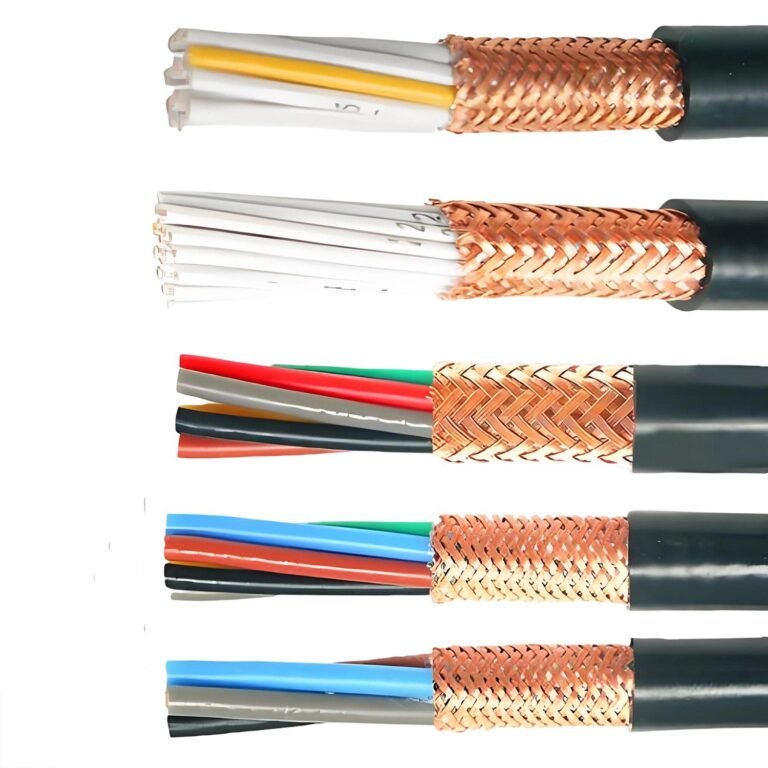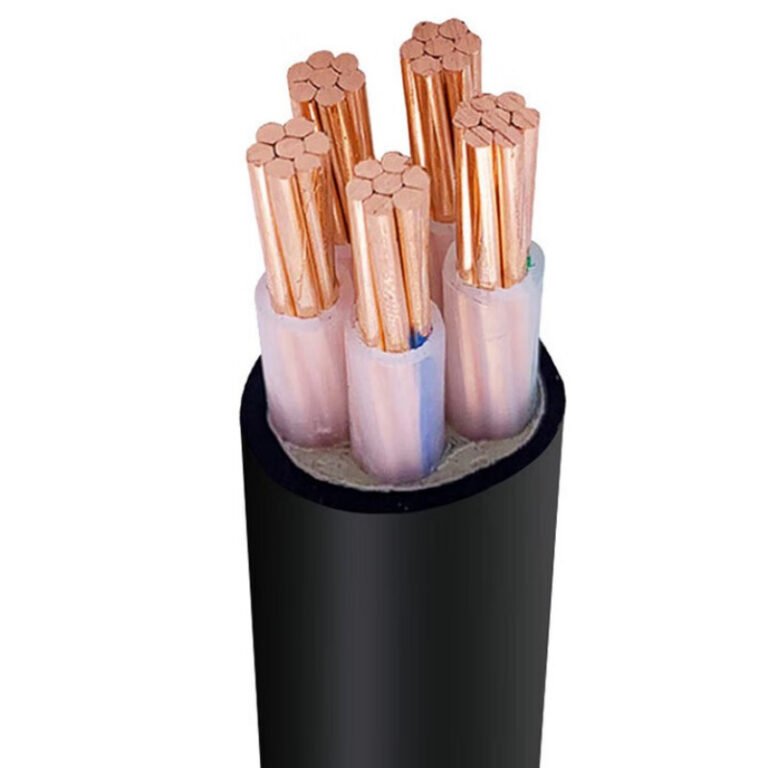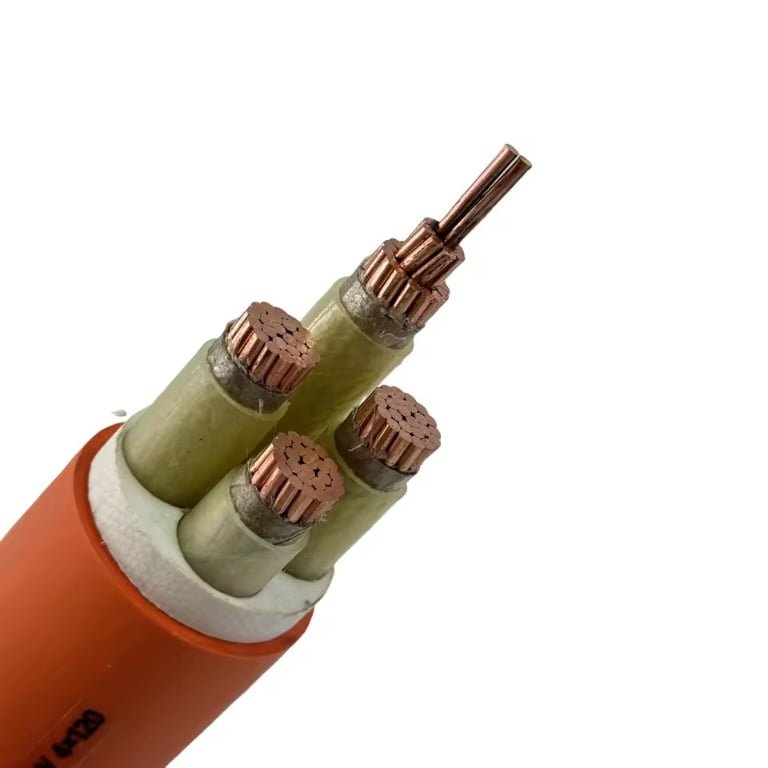
A bad Romex-in-conduit call usually shows up after the wall is closed, the inspector is on site, or a maintenance tech discovers a cable that will not pull, cool, or drain the way the installer assumed. That turns a simple branch-circuit detail into rework, failed inspection, schedule slip, and sometimes paid labor to remove perfectly usable material. The practical answer is not “never” or “always”; it is knowing where NM-B is allowed, where conduit changes the rules, and when individual THHN/THWN conductors are the cleaner purchase.
Romex, usually NM-B cable, is not automatically illegal inside conduit under the NEC, but it must be installed in a permitted location, protected from damage, kept out of wet locations, and sized for conduit fill using the cable’s largest outside diameter. Local inspectors may also apply stricter requirements.
The part that catches people is that conduit can be used for protection, but it does not magically upgrade cable insulation, erase fill limits, or make an outdoor raceway “dry.” A short sleeve below a panel is a very different job from a long buried run to a detached shop, and the code logic follows that difference.
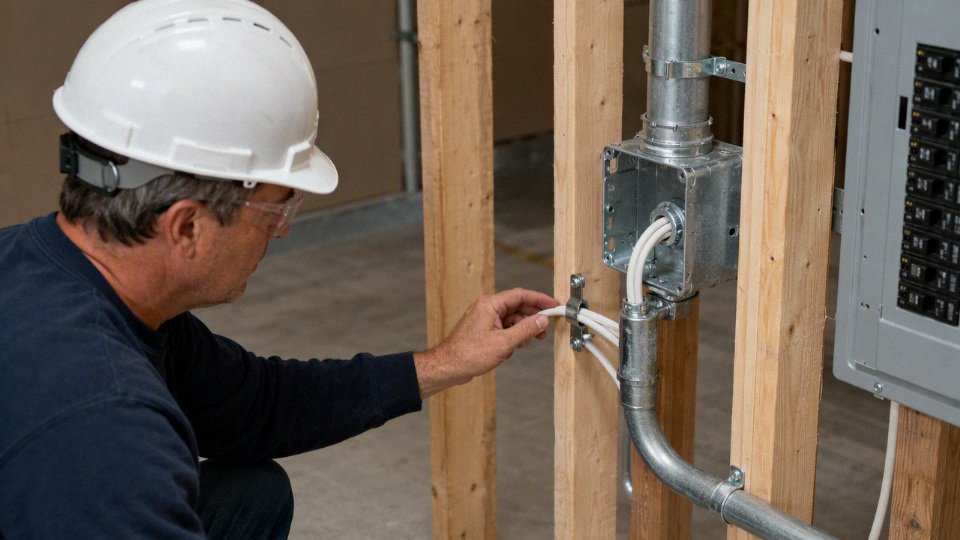
Code terms that matter
The legality usually turns on four definitions, not on the single word “conduit”: what cable is being installed, what raceway or sleeve is being used, whether the location is dry, damp, or wet, and whether the product is being used within its listing. A piece of PVC, EMT, or flexible conduit can be perfectly legal in one detail and the reason for rejection in another.
NM-B cable is not the same thing as conduit wire
NM-B is nonmetallic-sheathed cable: insulated conductors plus a bare or insulated equipment grounding conductor wrapped inside an outer nonmetallic jacket. In normal North American trade language, people call it “Romex,” although that is a brand name often used loosely. Its usual job is branch-circuit wiring in normally dry interior residential and light commercial spaces where the applicable electrical code allows it.
That outer jacket is not just packaging. It is part of the cable assembly’s listing, flame behavior, handling properties, and installation rules. NM-B is commonly stapled or strapped to framing, run through bored holes, and terminated in boxes with clamps listed for that cable type. A common support benchmark is securing it within 12 inches of boxes and supporting it at intervals not exceeding 4.5 feet, but the actual requirement depends on the current code edition, box clamp arrangement, and local inspection practice.
Individual building wire is a different animal. Conductors such as THHN, THWN, THHN/THWN-2, XHHW-2, and similar types are made to be pulled as separate insulated conductors in raceway systems. They do not have the same bulky common jacket as NM-B, and their insulation markings tell you where they may be used.
A useful procurement distinction:
| Product type | Typical form | Common installation path | What must be checked |
|---|---|---|---|
| NM-B cable | Multi-conductor cable with outer nonmetallic jacket | Dry interior cable wiring method, sometimes sleeved for protection | Cable listing, dry-location rule, support, protection, fill if inside raceway |
| THHN | Individual conductor insulation marking | Usually inside conduit or other raceway | Whether it is also wet-rated; many are dual-marked, but do not assume |
| THHN/THWN-2 | Individual conductor with dual marking | Raceway systems, including many wet-location applications if listed | Temperature rating, wet-location rating, terminal temperature limits |
| XHHW-2 | Cross-linked insulation conductor | Raceway systems, often selected for wet or demanding environments | Bend handling, diameter, ampacity conditions, listing |
In practice, the wire print matters more than the counter label on the box. I have seen maintenance crews pull “THHN” from stock without noticing one reel was dual-rated and another was not. That kind of mix-up is exactly how a clean-looking conduit job turns into a compliance argument.
Raceway versus sleeve
A complete raceway system is a wiring method. It normally includes the conduit or tubing, couplings, connectors, boxes, fittings, bushings where needed, supports, and a continuous path suitable for the conductors installed in it. EMT between panels, PVC underground to a pedestal, or rigid metal conduit in an exposed industrial area are raceway systems, not just “protection.”
A sleeve is more limited. It is often a short piece of conduit or tubing used to protect cable where it passes through a wall, emerges from a panel area, crosses a vulnerable spot, or drops down a surface where it might be hit by storage, carts, or maintenance tools. The sleeve may provide localized mechanical protection without turning the entire run into a conduit wiring method.
That distinction matters because the sleeve does not magically change the cable listing. NM-B inside a short protective sleeve in a dry interior location is a very different discussion from NM-B pulled 60 feet through underground PVC to feed a detached structure. The first may be accepted when properly protected, supported, bushed, and terminated. The second runs straight into wet-location and listing problems in most code regimes.
Dry, damp, and wet locations
Dry, damp, and wet are code classifications, not casual descriptions of whether the space “usually looks dry.” A finished interior wall cavity may be dry. A sheltered exterior ceiling, washdown-prone utility area, or masonry wall that sees condensation may be damp. Underground raceways, exterior raceways, and conduits exposed to weather are normally treated as wet inside, even if the ends are sealed neatly.
That last point catches a lot of competent tradespeople. Conduit outdoors collects condensation through temperature cycling. Underground conduit can admit water through fittings, glue joints, damaged adapters, or simple vapor migration. Anyone who has opened a handhole in spring and found water up to the conductors knows this is not a theoretical code lawyer problem.
The inside of exterior or underground conduit is normally treated as a wet location.True
Raceways installed in wet locations require wiring methods and insulated conductors or cables listed for wet locations. The exact wording and enforcement should be checked against the current adopted code and the authority having jurisdiction.
NM-B is intended primarily for normally dry interior uses allowed by the applicable code. Individual conductors marked for wet locations, such as THWN-2 or XHHW-2 when properly listed and installed, are the usual choice for conduit runs exposed to weather or installed underground. The boundary is simple enough: if the raceway location is wet, do not assume a dry-location cable becomes acceptable just because it is protected from impact.
Listing, labeling, and the manufacturer’s instructions
Electrical products are not approved in the abstract. They are listed and labeled for specific uses, construction types, temperature ratings, environmental conditions, and installation methods. The code then relies heavily on those listings and the manufacturer’s instructions.
For buyers and project engineers, this affects substitutions. A purchasing department may see “12 AWG copper cable” and think two products are equivalent. They are not equivalent if one is NM-B cable for dry interior branch circuits and the other is wet-rated individual conductor intended for raceway. The copper size may match, but the legal installation envelope does not.
The same applies to conduit fill and pulling. NM-B in conduit is treated as a cable assembly, and fill is based on the cable’s largest outside diameter rather than only the copper conductor area. A common NEC fill benchmark is 53 percent for one cable, 31 percent for two cables, and 40 percent for more than two cables, with cable area calculated from the largest outside diameter. Because NM-B is flat or oval rather than round, that calculation can become conservative fast.
Putting cable in conduit can create new compliance issues instead of automatically making the installation safer. The jacket adds bulk, pulling friction rises, bends become harder on the sheath, and heat has fewer escape paths. A conduit run is also limited by bend rules; a common benchmark is no more than 360 degrees of total bends between pull points. Even when a cable physically fits, it may be a poor installation if the pull scuffs the jacket, kinks the cable, or leaves it unsupported at the sleeve ends.
The authority having jurisdiction still decides the field detail
The authority having jurisdiction, usually the electrical inspector or inspection department, applies the adopted code, local amendments, and local interpretation. Two installations that look the same in photos may receive different decisions because one city has amended the code, one inspector treats a long sleeve as a raceway, or one project is under a different code edition.
That is frustrating, but it is how construction enforcement works. In plant projects, I try to settle these details before material is purchased, especially where cable routing crosses from interior to exterior, from dry to damp, or from protected framing into exposed conduit. A five-minute plan review question can prevent pallets of the wrong cable from arriving on site.
The practical vocabulary is this: NM-B is a listed cable assembly for permitted dry interior uses; THHN/THWN-2, XHHW-2, and similar products are individual conductors commonly selected for conduit systems; a sleeve is not always the same as a raceway; exterior and underground conduit are wet-location territory; and the AHJ has the final local say. Once those terms are clear, the “Romex in conduit” question becomes a routing, location, and listing decision rather than a yes-or-no myth.
Permitted conduit uses
NM-B in conduit is usually acceptable when the conduit is acting as short, dry-location mechanical protection, not as a full raceway system that hides a long cable pull or changes the cable’s environment. The safe cases are normally sleeves, exposed drops, close device connections, and surface protection where fill, bending, box entry, support, and abrasion control are all handled correctly.
The most common acceptable example is a short protective sleeve down a wall where the cable would otherwise be exposed to impact. Think of a garage receptacle fed from above, a workshop wall with lumber leaning against it, an unfinished basement column, or a utility room where someone may drag a ladder, compressor hose, or trash bin past the wiring. In those areas, the conduit is not being used because NM-B suddenly becomes a raceway cable; it is being used because bare NM-B on the face of a wall is vulnerable.
Typical dry interior protection details include:
- A vertical conduit sleeve from a ceiling joist area down to a surface-mounted metal or nonmetallic box.
- A short run across an unfinished basement wall where the cable would otherwise be reachable and easily damaged.
- Protection on a workshop wall behind benches, shelving, or storage racks.
- A sleeve through a floor, sill plate area, or framed opening where the cable jacket could be rubbed or crushed.
- A conduit stub into a utility space where the cable transitions from concealed framing to an exposed device box.
The practical test is simple: if a maintenance person can reasonably hit, snag, scrape, or lean material against the cable, a sleeve may be justified. If the same sleeve becomes a long, buried, wet, tightly packed, or inaccessible raceway, the installation has moved into a different category and deserves a much harder code review.
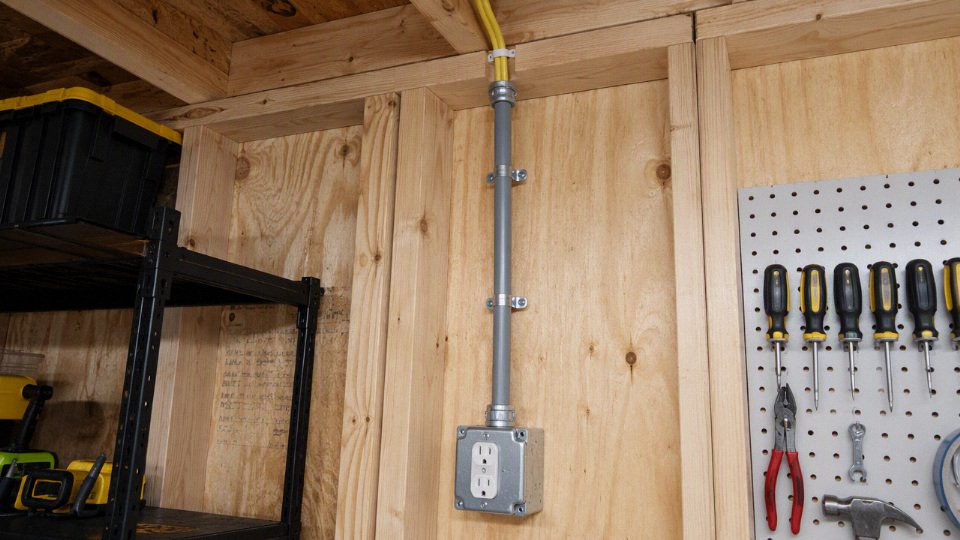
Transitions are another legitimate use. Bored holes, masonry openings, rough framing details, floor penetrations, and block-wall pass-throughs can have abrasive edges that are not kind to a cable jacket. I have seen NM cable damaged by nothing more dramatic than vibration against a sharp knockout edge or a slightly proud screw point inside a framed chase. A short nipple or sleeve can solve that problem, provided it is installed like electrical hardware, not like scrap pipe.
For sleeves and nipples, the details matter:
- Deburr both ends of metal conduit after cutting.
- Use bushings or listed insulated fittings where the cable enters or leaves the sleeve.
- Secure the conduit so it cannot rotate, slide, or work loose.
- Avoid tight offsets that force the flat NM-B cable to twist sharply.
- Keep the cable jacket intact through the protected area.
- Do not use the conduit edge as a clamp.
- Do not bury a splice inside the sleeve.
- Keep required junction boxes accessible.
Plastic conduit still needs attention. PVC has softer edges than cut steel, but a sharp saw-cut end or an unglued, moving sleeve can still abrade the jacket over time. In a plant or shop environment, thermal movement and vibration are real; that wall-mounted air compressor or unit heater can make a sloppy sleeve move just enough to become a file.
A short conduit run between an accessible box and a nearby device may also be acceptable in a dry interior location when the NM-B is not being abused during installation. This comes up around surface-mounted receptacles, furnace service areas, small utility rooms, and similar spaces where the installer wants a clean protected path from a junction box to the device. The cable should not be pulled like individual THHN conductors. NM-B is comparatively stiff, often oval or flat, and its jacket has higher friction in conduit than single conductors.
That matters mechanically. Pulling force rises with conduit length, bend count, cable stiffness, and friction. Once the cable is dragged through multiple bends, the outer jacket can stretch, scuff, or flatten; at the same time, tight conduit can compress the assembly and make removal nearly impossible later. NEC bend practice commonly limits raceways to no more than 360 degrees of total bends between pull points, but with NM-B I would be more conservative in the field because the cable does not behave like loose conductors.
Surface-mounted conduit in a dry interior space is where people get into trouble. It may pass inspection in some jurisdictions when it is short, accessible, correctly sized, and clearly used for protection. It may fail when it looks like someone designed an entire branch circuit in conduit and simply pulled Romex through it because NM-B was on the truck.
The installation has to satisfy several checks at the same time:
- Conduit fill: common NEC fill benchmarks are 53 percent for one cable, 31 percent for two cables, and 40 percent for more than two cables, with cable area calculated from the largest outside diameter. For flat NM-B, that “largest diameter” treatment can make the allowed fill much less generous than it first appears.
- Box fill: the conductors, clamps, device yokes, grounding conductors, and internal fittings all count according to the applicable box-fill rules.
- Support: NM-B is commonly secured within 12 inches of boxes and supported at intervals not exceeding 4.5 feet, subject to box clamp conditions and the adopted local code.
- Termination: the cable must enter boxes through listed fittings or clamps suited to the box and cable.
- Heat: conduit can reduce air movement around the cable, especially if the sleeve is long, packed, or routed near heat-producing equipment.
- Accessibility: junctions and required access points must not be buried behind drywall, cabinets, fixed machinery, or finished surfaces.
A permissible sleeve is not a permission slip to undersize the raceway or force the cable through a hard pull. The trade-off is clear: conduit gives impact and abrasion protection, but it adds friction, heat-retention potential, fill limits, and termination requirements. The choice flips against NM-B-in-conduit when the run becomes long, wet, concealed in a questionable way, exposed to high temperature, or difficult to inspect.
Inspection-friendly work is usually boring, and that is a compliment. Use listed connectors instead of improvised bushings. Leave enough sheath into the box to meet the applicable requirement and to let the inspector see that the cable assembly is intact. Keep splices in accessible boxes, not in sleeves. Strap conduit neatly, avoid mystery transitions, and label panels clearly enough that the next electrician does not have to guess what was done behind the wall.
Short conduit protection for NM-B can be acceptable, but the sleeve still needs proper sizing, fittings, bend control, support, and dry-location suitability.True
This reflects typical NEC-based installation practice. Exact acceptance depends on the adopted code edition, local amendments, the authority having jurisdiction, and the listed use of the cable, boxes, fittings, and raceway.
Prohibited and risky locations
NM-B in conduit is most often rejected when the conduit run passes through a wet, underground, embedded, heat-prone, industrial, or otherwise restricted location. The problem is not that conduit automatically makes Romex illegal; the problem is that conduit does not upgrade NM-B into a wet-location, damage-rated, hazardous-location, or high-temperature wiring method.
Exterior conduit runs
Exterior raceways are generally treated as wet inside, even when they look well sealed. Rainwater gets past fittings, threaded joints breathe with temperature swings, and condensation forms inside the raceway when warm humid air hits cooler metal or PVC. Anyone who has opened an outdoor LB after a winter freeze or a humid summer morning has seen the little puddle sitting in the bottom.
NM-B is not built for that service. Its paper fillers and overall jacket are intended for normally dry building interiors, not repeated moisture exposure inside a raceway. The conductors inside NM-B may be insulated, but the cable assembly itself is not the same as individual wet-rated conductors or a cable type listed for wet locations.
Common exterior trouble spots include:
- Conduit from an interior panel to an outdoor receptacle, condenser, sign, detached structure, or exterior disconnect.
- Surface-mounted conduit along siding, block walls, parapets, or roof edges.
- Short outdoor “sleeves” that continue beyond a dry interior protection point.
- LB fittings on exterior walls where NM-B enters from inside and continues through the fitting.
- Conduit exposed under decks, open carports, exterior stairways, loading docks, and service yards.
The practical trap is that a run may start indoors and look harmless for the first few feet, then cross the building envelope. Once the wiring method enters the outdoor wet-location portion, NM-B is usually the wrong cable unless a very specific local interpretation or listed assembly says otherwise.
Continuous conduit makes NM-B acceptable outdoors because water cannot reach the cable.False
Outdoor raceways are not assumed to be dry. Water intrusion and condensation are normal design considerations, so the wiring inside must be suitable for the location.
Underground, earth contact, slabs, and embedded raceways
Underground conduit is not a legal workaround for NM-B. A continuous PVC run with glued fittings still counts as a wet location below grade, and it often becomes one of the wettest raceways on the property. Groundwater, condensation, imperfect joints, damaged elbows, and low-point pooling are normal installation realities, not unusual failures.
This applies to:
- Underground conduit between buildings.
- Feeds to yard equipment, gate operators, pumps, signs, garages, sheds, and landscape controls.
- Raceways stubbed through slabs.
- Conduit buried in or under concrete.
- Raceway passing through masonry, retaining walls, foundations, or earth-filled chases.
Concrete and masonry deserve special caution. They can hold moisture for a long time, wick water, and expose cable to alkaline conditions or abrasion at rough entries. A sleeve through a dry interior wall for physical protection is one thing; a conduit system embedded in a slab or earth-contact structure is a different environment.
If the raceway is underground, in earth contact, or embedded where moisture exposure is expected, treat NM-B as the wrong starting point unless the specific code method and cable listing prove otherwise. The usual solution is not “better sealing”; it is selecting conductors or cable listed for wet locations and the raceway system the design actually requires.
Damp, wet, washdown, and corrosive working areas
Some locations are not outdoors but still behave like wet or damp locations from an electrical standpoint. A conduit run in these spaces may look protected mechanically while exposing NM-B to moisture, cleaning chemicals, temperature cycling, or physical abuse.
Typical problem areas include:
- Food, beverage, and packaging washdown zones.
- Car wash bays and detailing areas.
- Agricultural buildings, livestock spaces, milking areas, poultry houses, and manure-handling zones.
- Greenhouses, pump rooms, humid process rooms, and water treatment areas.
- Exterior walls with known moisture migration, especially block walls and poorly flashed penetrations.
- Commercial kitchens where cleaning, heat, grease, and moisture all stack up.
- Unconditioned utility spaces that sweat seasonally.
- Corrosive storage rooms, chemical handling areas, and battery rooms.
In these places the conduit is often selected for impact protection or neat routing, but the environment drives the cable choice. Moisture enters through boxes, covers, hubs, and fittings. Washdown crews are not gentle; if a hose hits a box every night, any marginal sealing detail will eventually show itself.
There is a trade-off here. NM-B is fast and economical in dry framed construction, and conduit sleeves can protect it where a short section is exposed to damage. Once the space becomes wet, corrosive, or frequently cleaned, the lower first cost is usually lost through failed inspection, rework, or long-term reliability risk.
Commercial, industrial, multifamily, and hazardous occupancies
A wiring method that passes in a single-family basement may fail immediately on a commercial or industrial plan review. NM-B has occupancy and construction limitations, and many projects restrict it further through specifications, insurance requirements, fire-resistance requirements, or owner standards.
Watch these categories closely:
- Commercial tenant spaces where project specifications call for EMT, MC cable, or individual conductors in raceway.
- Industrial plants with vibration, forklift traffic, oil mist, dust, corrosive vapors, or frequent modifications.
- Multifamily buildings where construction type, fire rating, or local amendments limit NM cable use.
- Assembly, institutional, or high-rise buildings with stricter raceway and fire-performance requirements.
- Hazardous classified locations involving flammable vapors, combustible dust, fibers, fuel dispensing, spray finishing, grain handling, or similar risks.
- Plenums, shafts, fire-rated assemblies, and environmental air spaces where the cable type and installation method must match the listing and code path.
Procurement teams sometimes miss this because they buy “residential cable” by conductor size and assume the installer can protect it with conduit if needed. That is not how inspectors, engineers, or insurers read it. The allowed wiring method is tied to the occupancy, building construction, environmental classification, and listing of the product. A conduit sleeve does not convert NM-B into a wiring method suitable for a hazardous area or a project specified as all-metal raceway.
Heat-prone and bundled installations
Heat is a quieter failure mode than water, but it matters. NM-B placed in conduit near boilers, furnaces, ovens, rooftop runs, process equipment, steam piping, hot attics, or grouped raceways can run hotter than expected. The insulation rating, conductor ampacity rules, number of current-carrying conductors, ambient correction, and bundling all start to matter.
Risk increases in these situations:
- Conduit routed tight to heating equipment, flues, steam lines, or process ovens.
- Raceway installed across roofs or under dark roof decks where temperature climbs well above room ambient.
- Long conduit sleeves packed with more than one cable.
- Multiple NM-B cables grouped through bored holes, sleeves, or chases without spacing.
- Panels, troughs, and equipment rooms where many circuits leave through the same raceway path.
- Attics in hot climates, especially above insulation where air movement is poor.
The mechanism is simple: resistance creates heat, ambient temperature reduces the cable’s ability to shed it, and grouping several loaded conductors together compounds the rise. Conduit can make the condition worse because it limits airflow around the cable jacket. Larger conduit may help pulling and reduce crowding, but it does not erase ampacity correction or the cable’s temperature limitations.
The preferred choice flips depending on length and load. A short protective sleeve through a vulnerable spot may be acceptable when fill, support, box entry, and heat are controlled. A long raceway run carrying multiple loaded NM-B cables through a hot roof space is a different design problem and should be recalculated, not guessed from the breaker size.
Conduit used to hide damage, splices, or overloaded work
Conduit is not a cure for damaged cable or bad circuit design. I still see this in service calls: a nicked jacket disappears into a short piece of EMT, an old splice gets pushed into a wall sleeve, or a homeowner adds conduit to make an overloaded garage circuit “look professional.” It may look tidy from six feet away, but it does not make the installation compliant.
Do not use conduit to:
- Cover NM-B with a cut, crushed, heat-damaged, oil-soaked, or rodent-chewed jacket.
- Bury an unapproved splice inside a wall, slab, conduit body, or inaccessible fitting.
- Avoid using a listed junction box with a cover that remains accessible.
- Make an undersized conductor acceptable for the breaker protecting it.
- Add load to a circuit that is already at or beyond its practical capacity.
- Replace required strain relief, clamps, bushings, support, or abrasion protection.
- Conceal cable that was routed through a prohibited location.
Physical protection is legitimate only when the underlying cable, circuit, location, and terminations are already acceptable. If the jacket is damaged, the repair method has to be listed or the damaged section has to be replaced. If a splice is needed, it belongs in an approved accessible enclosure, not hidden inside a raceway as a maintenance surprise for the next person.
The waterproof-pipe mistake
Raceway should be selected and installed as an electrical wiring system, not imagined as plumbing. Even good conduit work leaks a little over time. PVC expands and contracts, metal fittings corrode, box gaskets age, locknuts loosen, and low points collect water. A plant electrician will usually drill a drain where allowed or choose fittings with drainage in mind because pretending the pipe will stay dry is how failures get designed in.
That is the common mistake behind many illegal Romex-in-conduit jobs: the installer treats conduit as a waterproof shell around a dry-location cable. Code does not generally allow that assumption. The location classification comes first, then the cable and raceway are chosen to match it. Local amendments, current NEC adoption, product listings, and inspector interpretation still need to be checked, but if moisture, burial, heat, hazardous classification, or restricted occupancy is part of the run, NM-B is usually the wrong material to force into the design.
Fill, heat, and pulling
A conduit run that is legal on paper can still be a poor installation if the cable fill is tight, the route has several bends, or the circuit grouping forces ampacity adjustment. NM-B was designed to be stapled through framing cavities, not to behave like loose THHN/THWN conductors in a raceway. Once the conduit is long enough that you are calculating fill, pull tension, bend count, and derating, individual building wires in the correct raceway are usually the cleaner engineering choice.
Conduit fill is not based on how “thin” the flat cable looks
For conduit-fill work, a multiconductor cable is not treated like three separate small conductors lying neatly side by side. A cable assembly is typically counted as one cable, and for an oval or flat cable the area is commonly calculated from a circle using the cable’s largest outside dimension. That is the detail that catches people: a flat NM-B cable may look compact when held in your hand, but the code calculation can treat it as if it occupies a round envelope as wide as its thickest measured dimension.
That can make NM-B consume raceway space faster than expected, especially where someone tries to pull two or three cables through a short sleeve and assumes the flat shape will “stack.” It rarely stacks politely after the first bend. The jacket rolls, the cable corkscrews, and the wide face may end up presented against the inside radius of the conduit.
Common NEC conduit-fill benchmarks used for raceway sizing are:
| Raceway condition | Common maximum fill benchmark | Practical meaning for NM-B |
|---|---|---|
| One cable or conductor | 53 percent | A single cable may be allowed to occupy more of the raceway, but pulling friction can still be ugly if the cable is flat and stiff. |
| Two cables or conductors | 31 percent | Two NM-B cables often become the worst case because they wedge against each other instead of sliding independently. |
| More than two cables or conductors | 40 percent | Fill allowance rises compared with two, but conductor count, heat, and pull damage usually become the controlling issues. |
These percentages are useful as a benchmark, not a substitute for the actual calculation. The raceway type and trade size, the cable’s measured outside dimensions, the applicable code table, and any local interpretation all matter. On procurement drawings, I do not like seeing “NM in conduit as required” without the actual cable OD, conduit size, bend count, and fill calculation. That note looks harmless until an installer is trying to drag a flattened cable through a half-inch EMT offset with the apprentice feeding it from a half-open carton.
For conduit fill, a flat multiconductor cable can require area calculation using a circle based on its largest outside dimension, rather than its visible flat profile.True
This reflects the common code method for cable assemblies in raceways. Project work still has to use the applicable code edition, raceway table, and actual cable dimensions.
Flat cable pulls badly compared with individual conductors
Individual conductors can slide, rearrange, and share contact pressure around bends. NM-B cannot do that very well because the conductors are locked inside a jacketed assembly with a flat or oval geometry. The cable behaves more like a strip than a rope.
The problems show up in a few predictable ways:
- Twisting at the entry point: The cable enters the conduit flat, then rotates as the first bend forces it to find a lower-resistance orientation.
- Wedging in small raceways: In smaller EMT, rigid metal conduit, or PVC conduit, the wide side can jam against the wall while the trailing cable continues to push.
- High sidewall pressure at bends: Pulling force is converted into pressure against the conduit wall. A flat jacket concentrates that pressure unevenly.
- Jacket shaving at connectors: Set-screw connectors, rough bushings, cut PVC, and poorly reamed metal conduit can damage the outer jacket.
- Compression at offsets: A quick box offset that is harmless for THHN can become a pinch point for jacketed cable.
The raceway material changes the feel of the pull. EMT with properly reamed ends and listed fittings is usually smoother than a rough field-cut metal nipple. PVC can be forgiving at the edge if prepared well, but long PVC runs often have more friction, and thermal movement can shift alignment over time. Rigid metal conduit gives strong mechanical protection, but bad threads, burrs, and tight elbows are not kind to soft cable jackets.
Pulling lubricant is not a magic fix either. Some lubricants are not intended for every cable jacket, and excess lube can make the first pull seem acceptable while hiding the fact that the cable was overstressed around a bend. The right question is not “Can we make it go through?” It is “Can we install it without jacket damage, conductor displacement, or an uninspectable mess?”
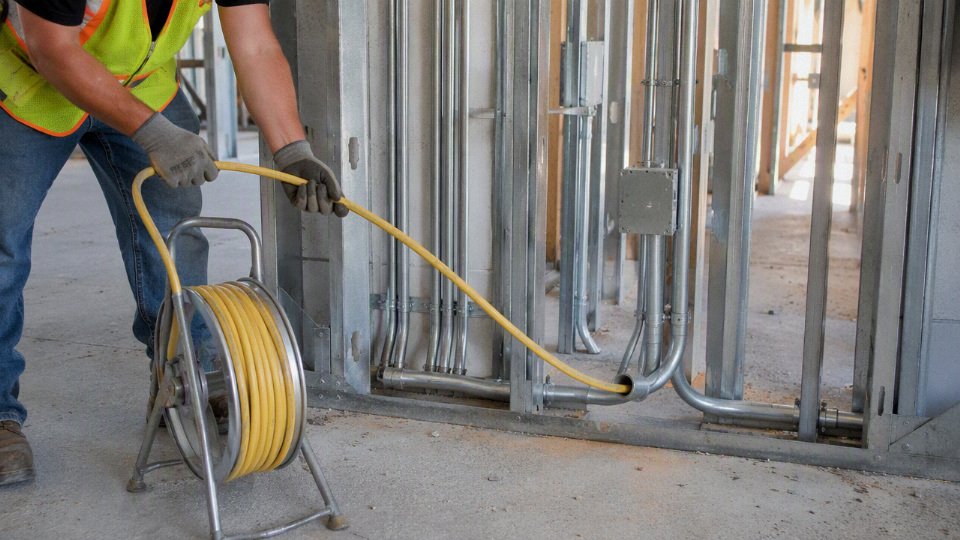
Bend count sets the pull, not just the route length
The common raceway bend benchmark is no more than 360 degrees of total bends between pull points. That means four 90-degree bends is the normal upper limit before a pull box, junction box, or other accessible pull point is needed. In practice, NM-B often needs a more conservative layout because each bend punishes the flat cable harder than it would punish individual conductors.
A short sleeve through a wall may have almost no meaningful pull problem. A garage protection drop with one gentle offset may be manageable if the fill is correct and the location is dry. A 40-foot run with two offsets, a 90 into a box, and a sweep into another wall is a different animal. The print may show “less than 360 degrees,” but the person pulling it still has to overcome friction, cable memory, and jacket drag.
Good raceway planning for NM-B, where it is permitted, usually means:
- Keep the raceway short and direct. Use conduit as protection, not as a substitute wiring method for the whole branch circuit.
- Use larger raceway than the bare fill number suggests. Extra room reduces friction and gives the inspector a more believable installation.
- Use proper bushings and smooth entries. This is basic workmanship, but it is where many jacket cuts start.
- Avoid back-to-back tight bends. A small offset immediately followed by a box entry can be worse than a longer route with a gentler sweep.
- Provide accessible pull points when the route becomes complex. Do not bury the only practical rescue point behind drywall, millwork, or fixed equipment.
The trade-off is straightforward. Conduit lets you protect exposed cable from physical damage, but every foot and bend adds pulling risk and inspection uncertainty. Past a short protective section, the benefit often flips: the conduit that was supposed to make the installation tougher starts making it harder to install correctly.
Heat and ampacity can become the real limiter
Fill and pulling are visible problems. Heat is less obvious, and it is the one that can quietly reduce circuit capacity. Current-carrying conductors generate heat, raceways restrict air movement, and multiple cables or circuits grouped together may require ampacity adjustment. High ambient temperature makes the margin worse, especially in attics, roof spaces, mechanical rooms, exterior raceways in sun, and plant areas near ovens, compressors, boilers, or process piping.
NM-B has its own ampacity rules, and the allowable adjustment method is not something to guess from the breaker size. In many code applications, conductor insulation temperature ratings may be used for adjustment calculations, while the final permitted ampacity is still limited by the cable type, terminal ratings, and code rules. That distinction matters. A circuit that appears acceptable before adjustment may no longer support the intended load after grouping and ambient conditions are considered.
Conductor counting is another place where casual field logic gets people into trouble. The equipment grounding conductor is not normally counted as a current-carrying conductor for ampacity adjustment, but neutral treatment depends on the circuit type and load characteristics. A neutral in a simple two-wire circuit is not the same design question as a shared neutral in a multiwire branch circuit, and nonlinear loads can change the analysis in some systems. Procurement teams should not accept a cable schedule that says “grounds and neutrals don’t count” as a blanket rule.
The variables that usually need checking are:
- Number of current-carrying conductors in the raceway or bundled section
- Whether neutrals carry only imbalance current or are otherwise required to count
- Ambient temperature around the raceway, including seasonal peaks
- Cable type and insulation temperature basis allowed by the applicable code
- Terminal temperature ratings at breakers, devices, and equipment
- Length of bundled or raceway-contained section
- Load profile: continuous load, motor load, receptacle load, lighting, controls, or mixed use
A short protective sleeve is less likely to create a meaningful heat problem than a long raceway containing several loaded cables. That boundary matters. The concern rises when the raceway stops being a sleeve and starts behaving like a wiring system with grouped circuits inside it.
Installation damage is not a paperwork issue
A code-permitted design can be made unsafe by the way it is installed. I have seen jacketed cable pulled through raceways with the same attitude used for scrap wire: vise-grips on the end, two people yanking, and somebody blaming the conduit size when the jacket finally tears. That is not an engineering problem; that is workmanship defeating the design.
The common damage modes are easy to miss because they are hidden after the pull:
- Outer jacket cuts from unreamed metal conduit, box knockouts, or connector throats.
- Insulation abrasion where the jacket is breached and conductors rub against metal edges.
- Cable flattening from over-tight straps, clamps, or compression at bends.
- Conductor displacement inside the jacket after excessive pulling force.
- Thermal stress later in service because the damaged area becomes a weak point.
- Moisture tracking if damaged NM-B is installed where dampness is present or where condensation forms.
Inspection access is part of the decision. With individual conductors, you can often see conductor type, color, and condition at boxes and pull points. With NM-B inside conduit, the jacket hides the individual conductors for most of the run, and damage may only be visible at the ends. That does not automatically make it illegal, but it makes the installation less forgiving.
Why professionals often switch to individual conductors
The counter-intuitive professional answer is that conduit becomes more useful when you stop trying to pull Romex through it. If the job needs a raceway system, use a raceway system: properly sized conduit, listed fittings, accessible pull points, and individual conductors rated for the environment, such as dry-location or wet-location building wire as required. In wet or outdoor raceways, conductor rating is not optional; the raceway interior may be treated as a wet location depending on the installation and code requirements.
Individual conductors give the designer better control:
- Raceways can be sized from standard conductor areas rather than a flat cable envelope.
- Pulls are smoother and easier to lubricate properly.
- Circuit identification is cleaner at boxes and panels.
- Future conductor replacement or upsizing is more realistic.
- Derating calculations are clearer because conductor count is explicit.
- Inspectors have an easier time verifying the wiring method.
The sacrifice is that the installation becomes a raceway-and-conductor job rather than a quick cable job. It may need more planning, more boxes, careful color selection, and better labeling. For a two-foot damage-protection sleeve, NM-B may still be the simple answer if the location and code conditions allow it. For a long run, a commercial space, a plant maintenance area, or any route with several bends, using individual conductors is usually less expensive after you count labor, failed pulls, rework, and inspection risk.
Better wiring alternatives
For a full conduit system, individual conductors are usually the cleaner choice than pulling NM-B through raceway. Use properly marked building wire, such as THHN/THWN-2 or XHHW-2, in a raceway selected for the location, mechanical exposure, corrosion, fire requirements, and installation labor. NM-B in short sleeves can make sense; NM-B as the basis of a long raceway job is often a poor procurement and installation decision.
Individual conductors in conduit
For most residential service upgrades, commercial branch circuits, machine drops, lighting circuits, and light industrial feeders, specify individual insulated conductors in a complete raceway system. The common North American choices are:
- THHN/THWN-2 copper or aluminum conductors for many dry, damp, and wet raceway applications, provided the conductor marking, temperature rating, and terminal limitations match the job.
- XHHW-2 conductors where moisture resistance, abrasion resistance, or insulation toughness is preferred, often in feeders, outdoor conduit, underground raceway, and industrial environments.
- Equipment grounding conductor or qualified metal raceway grounding path, depending on the raceway type, installation standard, and local inspection practice.
The practical advantage is geometry. Round or compact individual conductors pull more predictably than flat-jacketed NM-B, especially through offsets, LB fittings, stub-ups, and long runs with several bends. They also allow conductor count, color, size, insulation rating, and grounding method to be specified directly instead of being inherited from a cable assembly that was designed mainly for dry, protected building cavities.
The trade-off is that a raceway wiring method must be designed as a system. You cannot just buy “some THHN” and a box of fittings and call it equivalent. The installer must verify fill, conductor ampacity, temperature correction, number of current-carrying conductors, wet-location suitability, box fill, fittings, grounding continuity, and the 360-degree bend limit between pull points. The better alternative to NM-B in conduit is not one product; it is a listed wiring method with compatible conductors, raceway, fittings, boxes, and terminations.
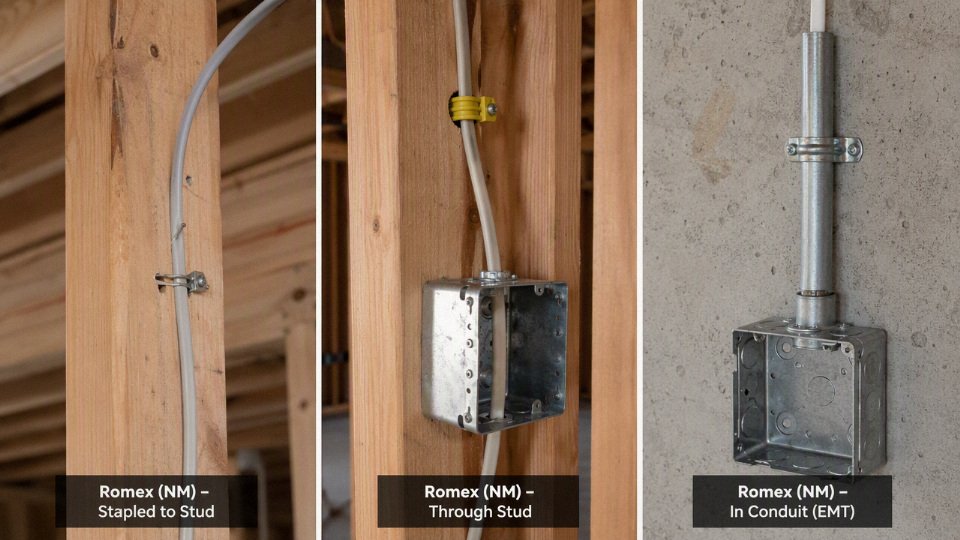
Cable assemblies that may fit better than NM-B
UF-B cable is sometimes the right residential answer where the route is underground or exposed to moisture and the applicable code permits it. It is built for wet locations and direct burial when installed according to its listing and burial-depth requirements. That does not make it pleasant to pull through conduit. UF-B is stiff, broad, and high-friction; in practice, conduit is often used only where the cable emerges from grade, crosses a vulnerable area, or needs physical protection.
Armored cable, metal-clad cable, and similar factory assemblies solve a different problem. They are useful where the owner, inspector, insurer, or facility standard wants physical protection, faster installation, better commercial acceptance, or a grounding path integral to the assembly, subject to the exact product listing. In tenant improvements and light commercial work, MC cable can be much faster than pipe-and-wire above suspended ceilings, but it gives up some future flexibility. A conduit system is easier to repull or upsize later; a cable assembly is faster on day one if the route is stable.
Common selection points look like this:
| Wiring method | Where it often fits | Watch before buying |
|---|---|---|
| THHN/THWN-2 in conduit | Branch circuits, feeders, commercial wiring, equipment circuits | Confirm wet rating, conductor material, insulation marking, terminal temperature limits, and raceway fill |
| XHHW-2 in conduit | Feeders, underground raceways, damp or wet sites, tougher pulls | Larger outside diameter may affect fill; check pulling lubricant compatibility |
| UF-B cable | Direct burial and certain wet-rated residential runs | Hard to pull in conduit; must match listing, burial depth, and protection rules |
| MC or armored cable | Commercial interiors, exposed protected runs, fast branch-circuit installation | Verify armor type, grounding method, fire rating, support spacing, and local acceptance |
| NM-B with short conduit sleeve | Dry residential protection details | Not a substitute for a full raceway wiring method, especially in wet or harsh locations |
Choosing the raceway, not just the wire
PVC conduit is attractive in corrosive, underground, and wet environments because it does not rust and is cost-effective. It needs proper expansion fittings where temperature movement matters, and it does not provide a metal grounding path. Schedule selection matters too; a driveway stub-up and a protected basement sleeve do not see the same abuse.
Electrical metallic tubing is the workhorse for many commercial interiors. EMT is light, fast, and acceptable in many exposed indoor routes when protected from severe physical damage. Intermediate metal conduit and rigid metal conduit step up the mechanical protection and are common where the run is exposed to vehicles, machinery, exterior impact, or stricter industrial specifications. They cost more in material and labor, but the difference can be cheap compared with one crushed raceway at a loading dock.
Flexible metal conduit, liquidtight flexible metal conduit, and flexible nonmetallic raceways have their place at motors, pumps, HVAC equipment, vibration points, and awkward final connections. The mistake is using flexible raceway as a lazy substitute for proper routing. Long, unsupported, sagging flexible runs collect abuse, look poor, and can create grounding or pulling problems depending on product type and fittings.
Procurement points for larger or international projects
On small jobs, the electrician may buy from local stock and solve the details at the counter. On apartment programs, hotels, prefab buildings, export projects, industrial expansions, and OEM equipment packages, the cable schedule needs to be procurement-ready before purchase orders go out.
Specify at least:
- Conductor material: copper or aluminum, including stranding class where flexibility or termination type matters.
- Conductor size and voltage rating: matched to load, voltage drop, fault conditions, and local standard.
- Insulation class and temperature rating: suitable for dry, damp, wet, underground, high-ambient, or enclosed raceway conditions.
- Flame and smoke performance: based on building type, installation zone, and required certification.
- Wet-location and sunlight resistance markings: especially for outdoor, rooftop, underground, and plant-yard routes.
- Certification and standard: NEC/UL-style requirements, IEC-based requirements, regional approvals, or project-specific owner standards.
- Packaging: coil, reel, drum size, drum strength, lifting method, storage condition, and maximum drum length.
- Documentation: datasheets, certificates, test reports, packing lists, batch traceability, and marking requirements.
- Traceability: production lot, meter marking, drum ID, inspection record, and retained quality documentation.
Do not substitute by appearance. Two black-jacketed cables can look nearly identical on a pallet and behave very differently in service. One may be dry-location only; another may carry wet-location, sunlight-resistant, flame-performance, or temperature markings that are mandatory for the installation. That difference is not cosmetic. It affects inspection, liability, service life, and whether the owner can legally energize the work.
For project-based supply, manufacturers such as Jinda can support cable selection by reviewing specifications, providing technical documentation, coordinating production across large orders, applying quality control systems, and planning long-term supply for multi-phase projects. With five production bases, large manufacturing space, and an integrated R&D, production, sales, technical support, and after-sales structure, Jinda is positioned for bulk cable procurement rather than one-off retail substitution. The engineering work still starts with the project schedule: installation environment, governing standard, conductor material, voltage rating, certification requirement, packaging plan, and the inspection documents the buyer must hand over at commissioning.
Inspection checklist
Use this checklist before anyone buys cable, pulls wire, closes walls, or signs off a repair. The worst time to discover that NM-B was the wrong wiring method is after conduit is glued, drywall is patched, or a shipment of cable has already landed on site.
- Confirm the rule set before buying material
- Identify the governing code edition, such as the adopted NEC edition in the project jurisdiction.
- Check local amendments. Some cities, counties, and utilities are stricter than the base code, especially on garages, multifamily work, agricultural buildings, damp basements, exterior penetrations, and service-related raceways.
- Confirm permit requirements and inspection stages:
- rough-in inspection before concealment
- underground inspection before backfill
- final inspection after devices and covers are installed
- Ask how the authority having jurisdiction interprets NM-B in short protective sleeves versus continuous raceway runs. In practice, two inspectors can agree on the code text and still differ on what they will accept in a basement wall stub-up or garage protection sleeve.
Do not purchase bulk cable or conduit until the accepted wiring method is clear for that location. Procurement mistakes here are not small; the labor to remove rejected cable often costs more than the material.
- Verify the exact cable and conductor marking
Read the printing on the cable jacket or conductor insulation, not the purchase description alone. A carton label, distributor quote, or warehouse bin tag is not enough.Check for:
- NM-B, UF-B, THHN/THWN-2, XHHW-2, or metal-clad cable marking
- voltage rating
- conductor size, such as 14 AWG, 12 AWG, 10 AWG, or larger
- copper or aluminum conductor material
- insulation temperature rating
- wet-location marking where needed, such as THWN-2 or XHHW-2
- recognized certification mark acceptable to the jurisdiction
- number of current-carrying conductors, including multiwire branch circuit arrangements
NM-B is commonly marked for dry locations. UF-B is built for direct burial and wet exposure when properly installed, but it is stiff and unpleasant to pull through long conduit. Individual THHN/THWN-2 or XHHW-2 conductors are usually the cleaner choice for a raceway system, provided the raceway is complete and the conductors are properly identified.
Classify the installation environment
Walk the route, not just the drawing. A conduit run that looks “indoors” on paper may pass through a damp block wall, a washdown corner, an exterior LB fitting, or an underground stub.Classify each section as:
- dry, damp, or wet
- indoor, outdoor, or underground
- concealed or exposed
- accessible or inaccessible after construction
- corrosive, such as near chemicals, manure, salt air, or process washdown
- high-temperature, such as near unit heaters, ovens, boiler rooms, rooftops, or sun-loaded metal surfaces
- subject to physical damage from carts, forklifts, stored pipe, lawn equipment, or maintenance traffic
The mechanism is simple but often missed: raceway can collect water through condensation and temperature cycling even without a visible leak. If the inside of the conduit is considered a wet location, dry-location cable is the wrong assumption.
Check the raceway design
Inspect the raceway as a system, not as a piece of pipe.Verify:
- raceway type, such as EMT, PVC, rigid metal conduit, flexible metal conduit, liquidtight flexible conduit, or ENT where permitted
- raceway size and actual internal diameter
- conduit-fill calculation using the cable’s largest outside diameter for elliptical cable
- bend count, keeping the common NEC benchmark of no more than 360 degrees between pull points
- pull length and pulling direction
- pull box, junction box, or conduit body placement
- fittings listed for the raceway and wiring method
- bushings or insulated throats where conductor or cable damage is likely
- raceway support spacing and fastening method
- termination method at boxes, panels, and equipment
For fill, the common benchmark is 53 percent for one cable, 31 percent for two cables, and 40 percent for more than two cables, using cable area based on the largest outside diameter. Flat NM-B becomes penalized in conduit because the calculation treats the cable like a round object with the diameter of its widest dimension. That is why a raceway that “looks big enough” can fail the fill check on paper and still be miserable to pull in the field.
Inspect boxes, connectors, grounding, and strain relief
A legal raceway run can still fail at the terminations.Check:
- box fill based on conductor count, device yokes, internal clamps, grounding conductors, and pigtails where applicable
- equipment grounding conductor continuity
- bonding of metal boxes, metal raceways, fittings, and enclosures
- connector listing for NM cable, MC cable, flexible conduit, EMT, PVC, or the specific method used
- cable sheath extending into the box far enough to be clamped properly
- strain relief at every cable entry
- separation of power, control, communications, and low-voltage conductors where required
- no buried or hidden junctions behind finished surfaces
With NM-B, the sheath must be protected and secured correctly. The common support benchmark is to secure within 12 inches of boxes and support at intervals not exceeding 4.5 feet, subject to the box clamp style and local code interpretation.
Evaluate electrical loading before approval
Confirm that the wiring method is not merely physically installable, but electrically suitable.Review:
- ampacity of the conductor size and insulation type
- overcurrent protective device rating
- number of current-carrying conductors in the raceway
- derating for conductor bundling or multiple circuits
- ambient temperature correction
- continuous load factor where applicable
- voltage drop based on run length and load current
- motor, HVAC, lighting, receptacle, EV charging, heater, or nonlinear load characteristics
- neutral loading on multiwire or harmonic-producing loads
The trade-off is straightforward: putting multiple circuits in one raceway can look tidy and reduce pipe runs, but it may create derating, heat, and troubleshooting penalties. The preferred choice flips when labor access is poor or the route is congested; then a properly sized raceway with individual wet-rated conductors may be better than trying to sleeve or pull cable assemblies through tight bends.
Look for workmanship risks before concealment
These are the defects that cause callbacks, failed inspections, and intermittent faults months later.Watch for:
- nicked or abraded cable jacket
- crushed cable from over-tight straps or connector clamps
- sharp conduit edges at cut ends
- missing bushings
- water entry at exterior fittings or vertical runs
- unsupported cable above ceilings or inside cavities
- excessive bends between pull points
- mixed wiring methods without proper boxes or transitions
- mismatched fittings, such as indoor set-screw fittings used in damp or outdoor conditions
- cable pulled so hard that the sheath is stretched or conductors are displaced
- junction boxes hidden behind cabinets, wall finishes, insulation, or equipment
NM-B is never allowed in conduit under any circumstances.False
NM-B may be accepted in conduit for certain dry-location protection details when installed under the governing code and local interpretation. It is commonly rejected where the raceway is wet, underground, outdoors in wet conditions, overfilled, overheated, or used contrary to the cable listing.
Document what was installed
Keep a package that a future maintenance lead, buyer, inspector, or property owner can understand without opening walls.Include:
- photos before concealment, with wide shots and close-ups of labels
- cable and conductor product datasheets
- raceway and fitting datasheets where listing may be questioned
- photos of cable jacket markings and conductor insulation markings
- fill and derating calculations
- box fill notes
- test records, such as continuity, insulation resistance where appropriate, and functional checks
- purchase records tied to lot numbers or delivery batches when available
- permit documents and inspector sign-offs
Documentation does not make a bad installation legal, but it prevents good work from becoming unverifiable later. For owners and procurement teams, it also protects resale, warranty discussions, insurance reviews, and future expansion work when nobody remembers why a conduit was routed through that one awkward corner of the building.
Frequently asked questions
Can Romex be run in conduit at all?
Yes, Romex, meaning NM-B cable in common trade language, can be run in conduit in some dry, code-compliant situations. The usual example is a short sleeve used for physical protection where the cable drops down a wall, passes through a vulnerable area, or enters a box.
That does not make NM-B a good choice for a complete conduit wiring system. The cable is wide, stiff, jacketed, and not pleasant to pull through bends. Once the installation starts looking like a raceway system rather than a protective sleeve, individual conductors are usually cleaner, easier to inspect, and easier to size correctly.
Is Romex in outdoor conduit legal?
Generally, no. Outdoor conduit is normally treated as a wet location, even if it looks sealed and even if the conduit is under a roof overhang. Condensation, rain entry at fittings, and temperature cycling all matter.
NM-B is not rated for wet locations, so putting it inside outdoor PVC, EMT, or rigid metal conduit does not make it wet-rated. The conduit protects against physical damage; it does not change the cable listing.
Outdoor conduit is generally considered a wet location, and NM-B cable is not acceptable there unless a specific code-approved exception applies.True
Raceways installed outdoors or underground are commonly treated as wet locations under electrical code practice. NM-B is intended for normally dry locations, so the wiring method must be changed to wet-rated conductors or an approved wet-location cable.
Can Romex be run underground if it is inside PVC conduit?
No, not as a normal compliant installation. Underground PVC conduit is a wet location, and water will eventually be present inside the raceway. I have pulled plenty of “sealed” underground conduits that still had water sitting in the low point.
For underground work, use conductors or cable approved for wet locations. In many projects that means THWN-2 conductors in PVC conduit, or a direct-burial cable type where allowed and suitable for the job. The exact choice depends on voltage, circuit type, burial depth, mechanical protection, local amendments, and whether the run is residential, agricultural, commercial, or industrial.
Can I sleeve Romex through conduit for protection?
Yes, short protective sleeves are commonly accepted in dry locations when installed properly. This is the normal fix where NM-B needs protection from impact, abrasion, storage damage, or a short exposed drop.
Check the practical details:
- Size the sleeve so the cable is not crushed or shaved during installation.
- Use bushings or listed fittings at sharp conduit ends.
- Keep the cable supported according to local requirements, commonly within 12 inches of boxes and at intervals not exceeding 4.5 feet, subject to box clamp conditions.
- Do not use the sleeve to sneak NM-B into a wet, underground, or otherwise prohibited location.
- Avoid creating a heat trap with several loaded cables packed into one sleeve.
A sleeve should look like protection, not like an improvised conduit system.
Does conduit fill apply to Romex?
Yes. Conduit fill still applies, and NM-B is awkward because it is not a round single conductor. The commonly used benchmark is to calculate cable area from the largest outside dimension of the cable, which can make the allowed conduit size larger than people expect.
For raceway fill, the familiar NEC benchmark is:
| Number of cables in the raceway | Typical maximum fill benchmark |
|---|---|
| One cable | 53% |
| Two cables | 31% |
| More than two cables | 40% |
That table does not mean the cable will pull well. Flat NM-B through a small conduit with two 90-degree bends can be miserable, especially after a rough cut end catches inside a coupling. Also remember the bend benchmark: no more than 360 degrees of total bends between pull points in a raceway run.
Can multiple Romex cables share one conduit?
Sometimes in a dry, permitted application, but it often becomes impractical quickly. The problems stack up:
- Conduit fill gets tight because NM-B is calculated using its outside cable dimensions.
- Heat dissipation gets worse when several current-carrying conductors are bundled together.
- Derating may be required depending on conductor count and installation conditions.
- Pulling damage becomes more likely, especially at bends and fittings.
- Inspectors may question whether the raceway is being used as a complete wiring method rather than a protective sleeve.
In practice, if someone wants to put several NM-B cables into one conduit, I usually ask why the job is not being designed with individual conductors instead.
Do I need THHN instead of Romex in conduit?
For a full conduit system, individual conductors are usually the better method. In dry indoor conduit, that often means building wire such as THHN where permitted. In wet or outdoor raceways, the conductor insulation must be wet-location rated, so buyers commonly specify dual-rated THHN/THWN-2 or another approved conductor type.
This also makes procurement cleaner. Instead of fighting cable geometry, the buyer can specify conductor size, insulation rating, copper or aluminum as applicable, color, quantity, reel length, and packaging. The electrician gets a wiring method that pulls better and is easier to terminate neatly.
Will an inspector fail Romex in conduit?
Yes, an inspector may fail it if the installation conflicts with code, listing, local amendments, or acceptable workmanship. The most common failure reasons are:
- NM-B installed in outdoor or underground conduit.
- Overfilled raceway.
- Cable jacket damaged during pulling.
- Missing bushings at conduit ends.
- Unsupported cable entering or leaving the sleeve.
- Too many bends without a pull point.
- Use in a commercial or industrial setting where the wiring method is not accepted.
- Local rule or authority having jurisdiction interpretation that is stricter than the installer expected.
A clean short sleeve in a dry location is a very different inspection conversation from 80 feet of NM-B dragged through PVC with glued elbows. If the installation is more than simple physical protection, confirm the wiring method before buying cable or roughing in the conduit.
Verify your wiring method
Treat the legal question as a wiring-method verification, not a yes-or-no argument about Romex and conduit. The installation is acceptable only when the exact cable type, raceway type, location, conduit fill, ampacity, support method, and local approval all line up. If one of those items fails, the fact that the cable physically fits in the conduit does not rescue the installation.
NM-B in conduit is not automatically illegal, but the installation can fail code if the cable is used in a wet location, exceeds raceway fill, loses required ampacity, or lacks local approval.True
This follows the normal code logic: the listed cable type, raceway environment, conductor ampacity, physical installation, and the authority having jurisdiction must all agree. The exact decision depends on the current adopted code and project conditions.
Use a simple decision path before you pull cable, energize the circuit, or approve a purchase order:
- Confirm whether NM-B is allowed in that location.
Use NM-B only where NM-B itself is permitted. A short sleeve for physical protection in a dry interior location is a very different job from using conduit as a full raceway system through exterior walls, underground runs, slab areas, washdown zones, rooftops, or damp service spaces. Decide whether the conduit is protection or the wiring method.
If the conduit is only a sleeve protecting a cable drop down a garage wall or guarding a short exposed section, the installation may be acceptable when fill, support, box entry, and local practice are right. If the conduit is the actual wiring method for a long run, individual wet-rated conductors or an approved cable assembly are usually the cleaner design.Classify the environment honestly.
“It’s under a roof” does not automatically mean dry. Exterior conduit, underground conduit, raceways in concrete, and many utility or agricultural spaces are commonly treated as wet or damp. For those applications, specify conductors or cable types listed for that environment rather than trying to make NM-B behave like a wet-location product.Check fill, bends, and pull damage before installation.
NM-B is flat and jacketed, so it does not pull like individual THHN/THWN-type conductors. The practical risk is not only code fill; it is jacket scuffing, crushed cable at fittings, overheated conductors in a tight raceway, and a pull that maintenance people regret the next time the circuit needs modification.Verify ampacity and terminations.
Do not size the cable from habit. Confirm conductor material, insulation rating, terminal temperature rating, overcurrent protection, bundling, ambient temperature, and any derating required by the adopted code. A substitution that looks equivalent on a buying sheet can still be wrong at the lug, breaker, gland, or enclosure.Get local approval before the work becomes expensive to undo.
For a homeowner project, that means a licensed electrician and the local inspector. For a plant, warehouse, farm facility, housing project, or export package, involve the authority having jurisdiction, project engineer, or electrical consultant before procurement locks in reel quantities.
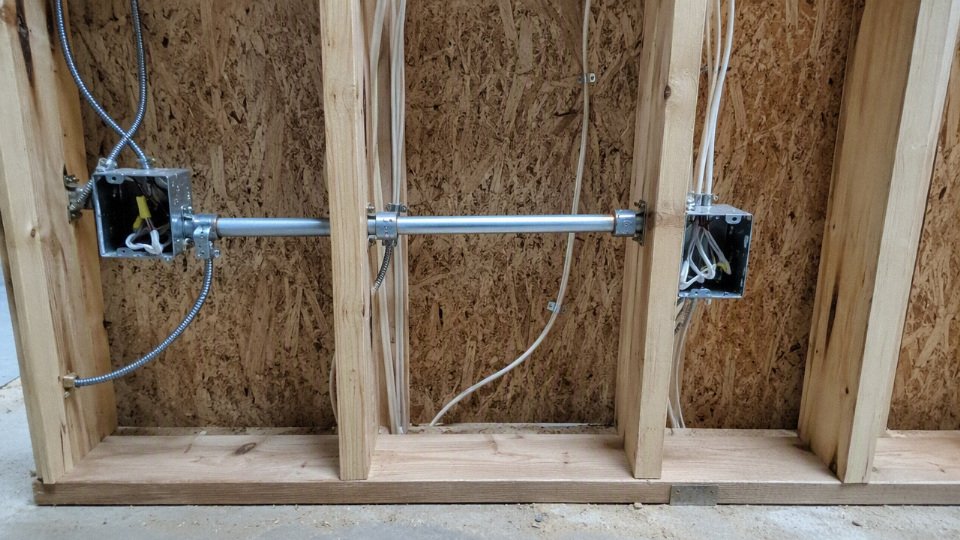
For exterior, underground, damp, or wet raceways, the usual direction is to move away from NM-B and specify a wiring method intended for the environment. That may mean wet-rated individual conductors in a complete raceway system, or an approved cable type selected for the project’s installation conditions. The trade-off is straightforward: NM-B can be economical and fast in the right dry interior work, but wet-rated conductors or project-specific cable assemblies give better compliance control in conduit systems, at the cost of more deliberate specification and procurement.
Procurement teams should treat cable substitutions with the same discipline they apply to motors, breakers, or instrumentation cable. Before approving an alternate product, request:
- Product datasheet with conductor size, material, insulation, jacket, voltage rating, and application limits
- Certification documents and applicable standard references
- Cable markings exactly as they will appear on the jacket or insulation
- Test reports where required by the project, customer, or local authority
- Packaging details, reel lengths, labels, and traceability information
- Written application confirmation for the intended raceway, location, and installation method
- Confirmation of conductor color, grounding arrangement, and termination compatibility
- Order quantity, delivery schedule, and any inspection or documentation requirements
This is where many project mistakes start. A buyer sees the same conductor size and voltage rating, approves a cheaper cable, and only later finds that the jacket marking, wet-location suitability, fire performance, or local certification does not match the project specification. On a small job that is irritating; on a multi-building project or export order, it can turn into rejected material, delayed commissioning, and a very awkward meeting with the owner.
Jinda can support buyers who need compliant conductor and cable options for conduit systems, branch circuits, industrial distribution, and international project supply. With in-house R&D, production, sales, technical support, and after-sales service, the useful next step is not a generic quote; it is matching the cable specification to the installation conditions and required documentation.
Share the installation environment, voltage, conductor size, raceway type, location classification, applicable standard requirements, and estimated order volume. If available, include drawings, photos of the route, termination details, and any buyer or inspector notes. Jinda’s technical team can then help verify a suitable cable specification and provide the relevant product and procurement information for review before you commit to the order.